Thursday 22nd May 2025

My friend Ray and I enjoyed another of Network Rail’s walking tours of London’s three main line termini serving the south coast last Thursday. This time we were at London Bridge and once again enjoyed the brilliant company of our guide Rachel Kolsky, who as mentioned in the write up on our tour of Victoria last week, brings the tour to life with her enthusiasm and passion for the social history of the railway and her extensive knowledge of the station’s development over the last 189 years.
It’s amazing what you learn on these tours. Despite passing through London Bridge many times a week and thinking I knew most of the station’s features, Rachel was able to get us to look up and around as the tour progressed both inside and on the surrounding streets and see aspects I’d previously passed by, oblivious to their existence.
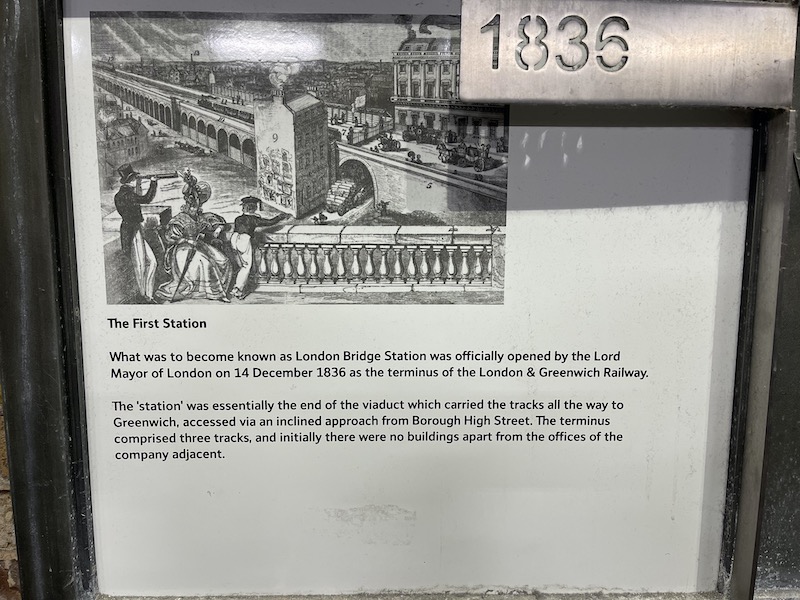
For example right in front of my eyes, but I’d never noticed, are four panels on the wall along Stainer Street (now pedestrianised and, along with Joiner Street, pass through the station under the tracks) which explain the history of the station. It was opened on 14th December 1836 as the terminus of the London & Greenwich Railway, albeit the ‘station’ was essentially the end of the viaduct which carried the tracks all the way to Greenwich and initially there were no station buildings.
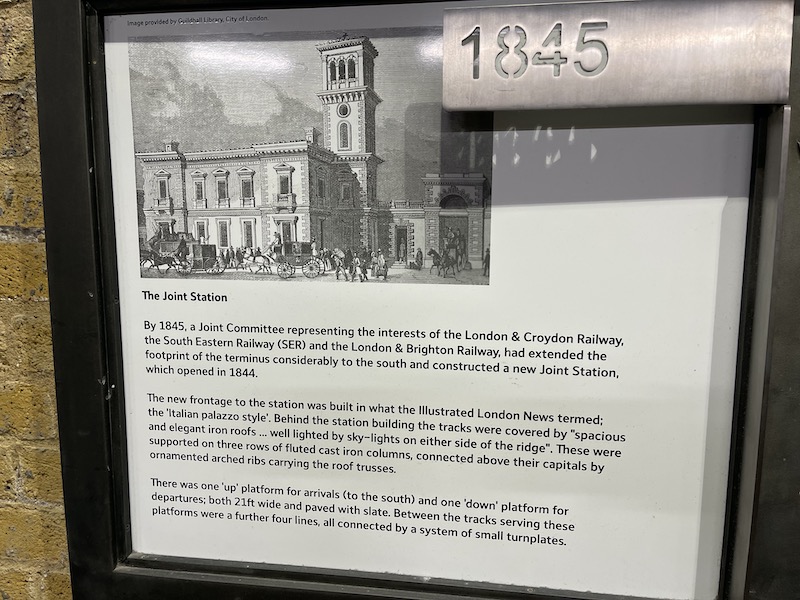
By the 1840s the joint interests of the London & Croydon Railway, the South Eastern Railway and the London & Brighton Railway had extended the footprint of the terminus to the south and a new ‘joint’ station was opened in 1844.
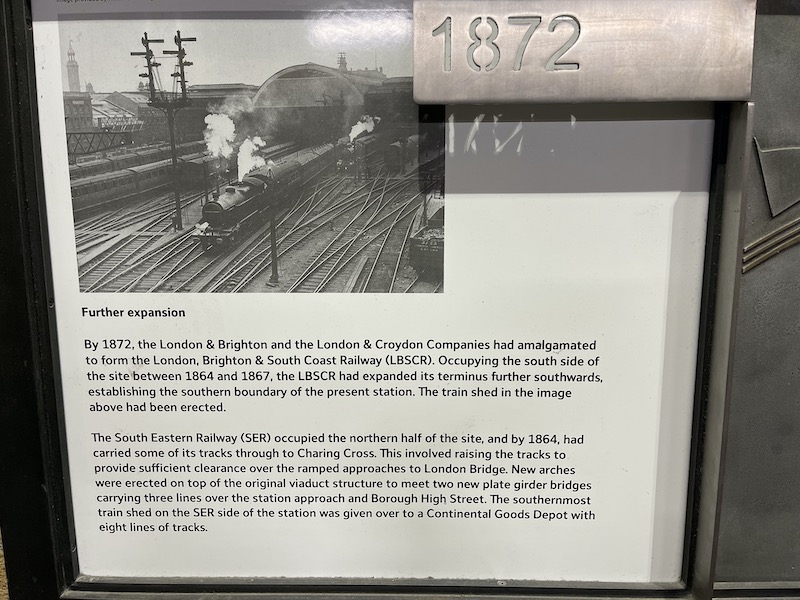
Rather like at Victoria, in those early years, London Bridge essentially was two stations – a ‘shed’ on the southern side of the site where London, Brighton & South Coast Railway trains terminated and the South Eastern Railway’s trains used the northern side with tracks continuing to Charing Cross, and later to Cannon Street too. These were later referred to as the Low Level and High Level stations respectively.
Following the huge transformation between 2013 and 2018 as part of the Thameslink 2000 project (suitably renamed Thameslink Programme when it inevitably ran late) the station was completely remodelled to provide nine through (high level) platforms and six terminating (low level) platforms whereas previously it had been the other way round. The huge benefit of this was Thameslink trains were given exclusive use of platforms 4 and 5 which meant a regular service could be provided throughout the day. Previously, due to capacity constraints, Thameslink’s peak hour trains used the longer route via Herne Hill, Elephant & Castle between East Croydon and Blackfriars, avoiding London Bridge altogether. It’s difficult to imagine that now when you see hundreds of commuters boarding and alighting peak hour Thameslink trains in London Bridge.
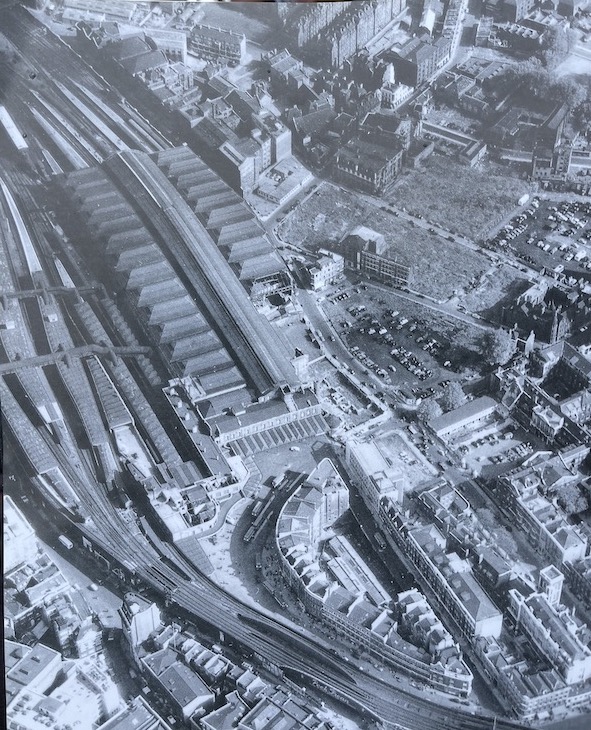
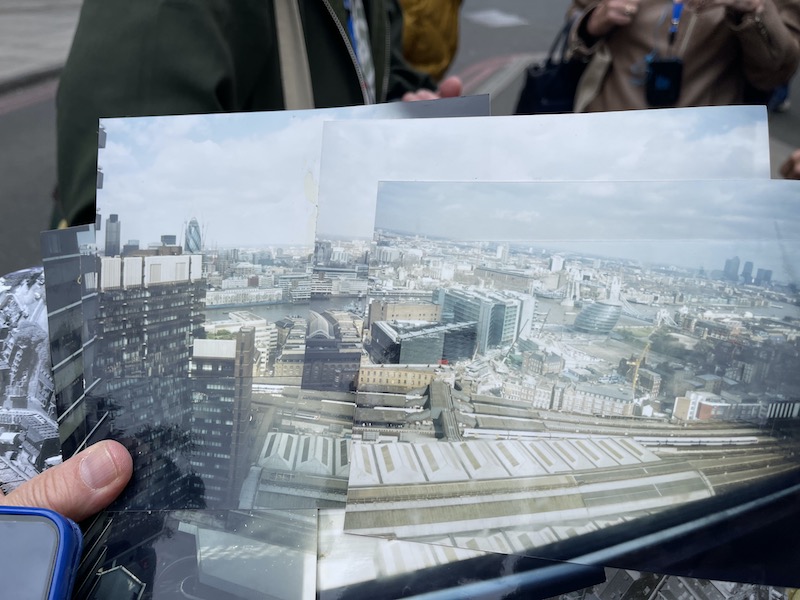
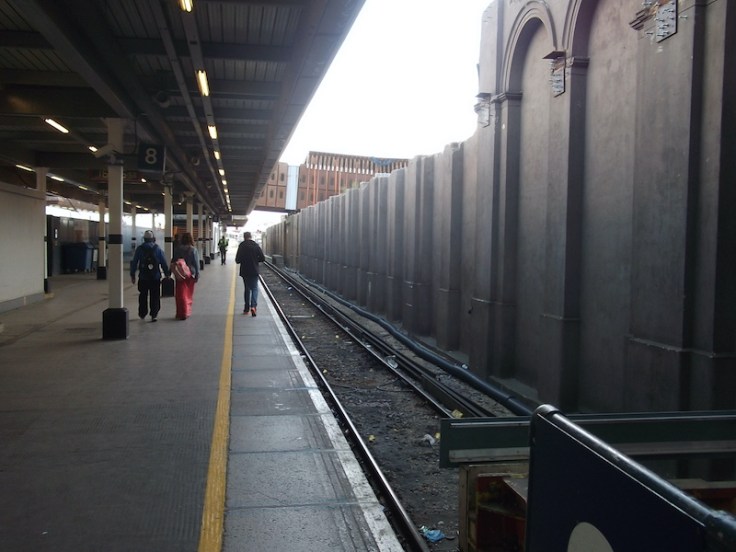
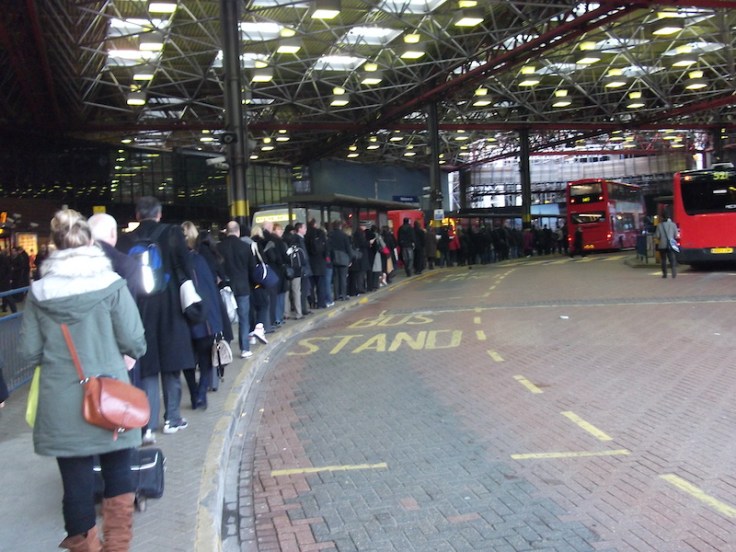
It’s difficult to remember how London Bridge looked before these major changes but Rachel helped to jog our memories as we walked around the station complex with the aid of photographs from those pre-transformational days reminding us of the carbuncle of a brown footbridge which linked the high level platforms and led down to platform 8 on the low level side, and which, in turn stood, outside the ‘shed’ opposite its giant northern side wall.
The transformation brought access to all 15 platforms from one new street level concourse, said to be the size of Wembley Stadium as well as fully opening up the western arcade with many retailers lining either side.
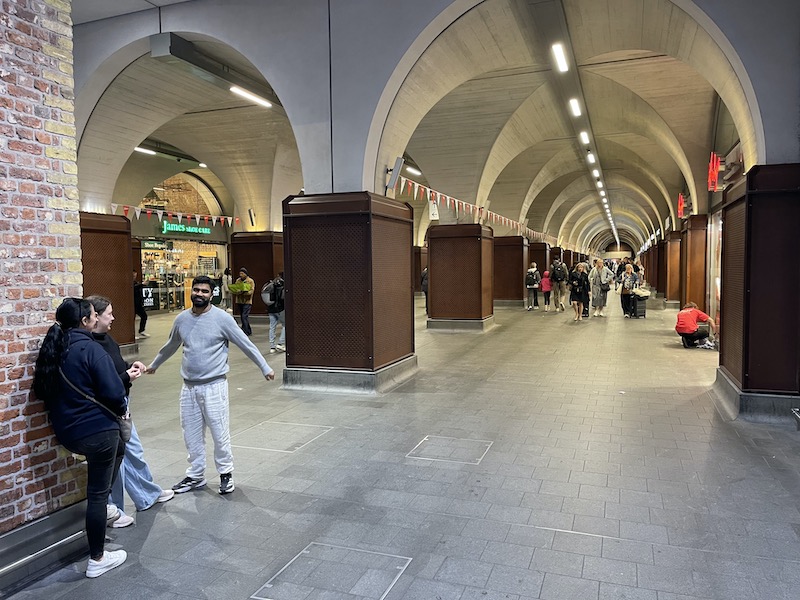
And that included one of the “Secrets of London Bridge” that I’d not noticed before how the old extreme western end of the arcade (which used to have access by escalator and stairs from the low level terminating platforms) has different adornments around the pillars so you ‘can see the join’ of the old and new.
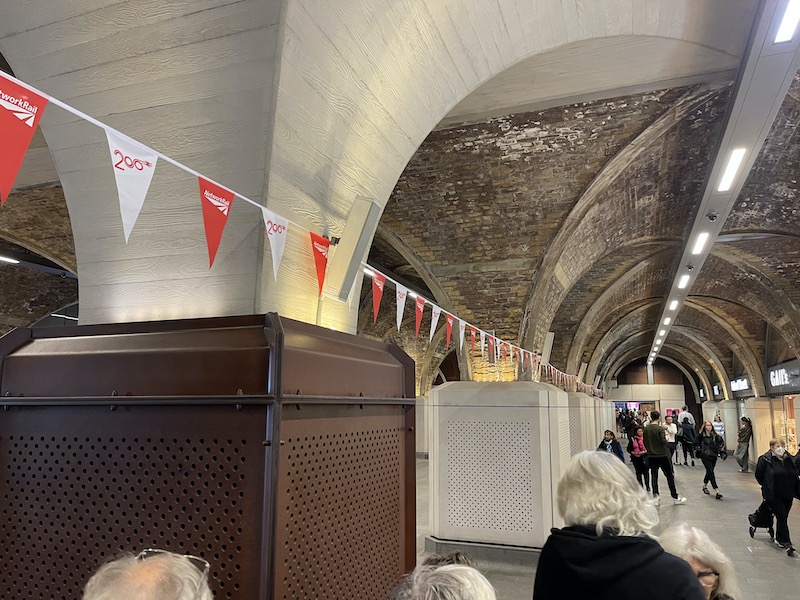
Another ‘Secret’ was not previously spotting the ‘umbrella’ like sculptures on the roof of Stainer Street…
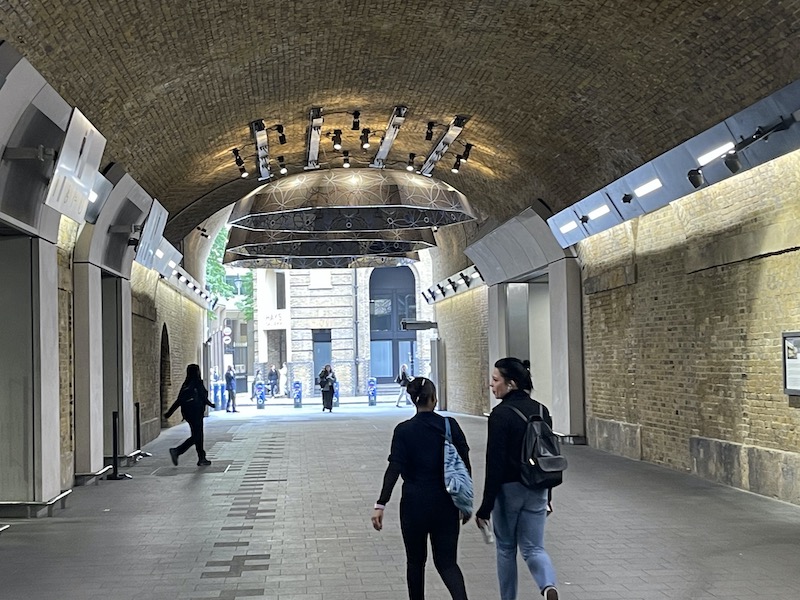
…or the giant ‘salt cellar’ like pillars holding up the high level platforms…
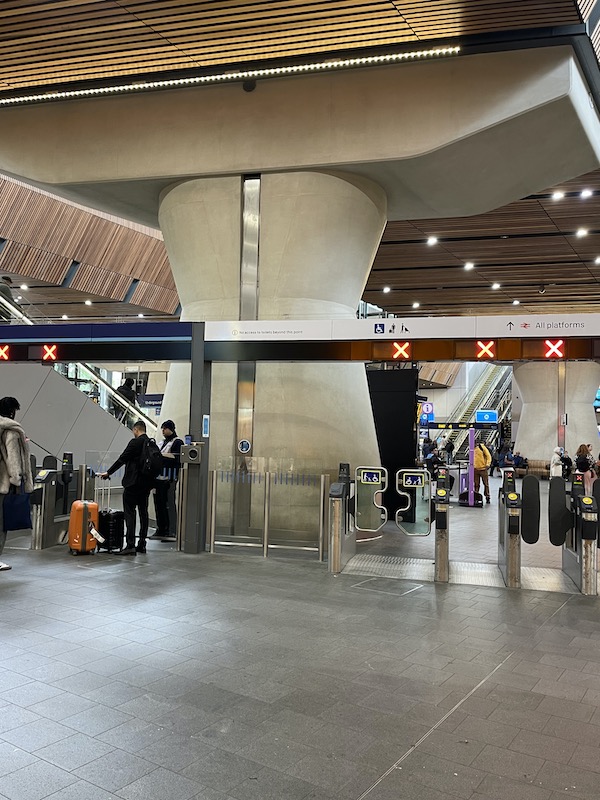
…and the way wooden slats adorn underneath the tracks in between the high level platforms which contrast with the grey coloured underneath side of the long escalators which take you up there.
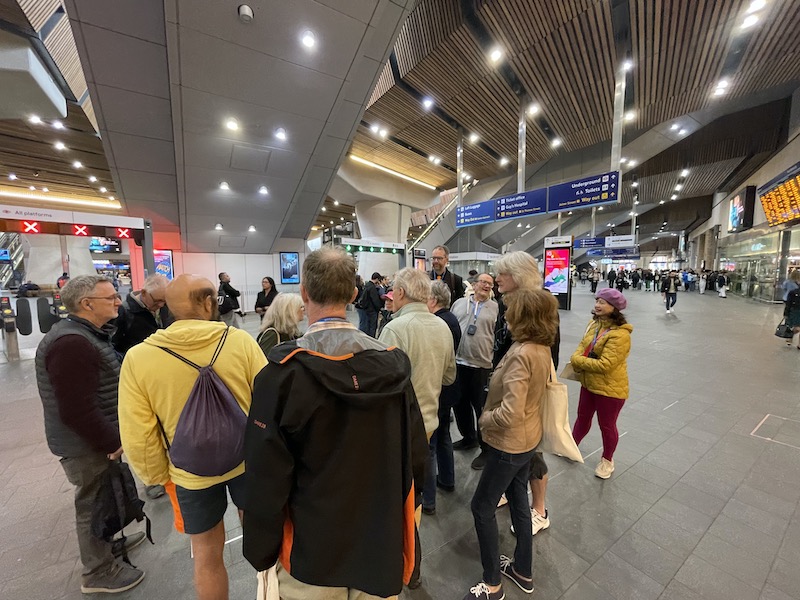
As the western end of the Arcade is Joiner Street where passengers can access the Jubilee and Northern lines in the adjoining Underground station …
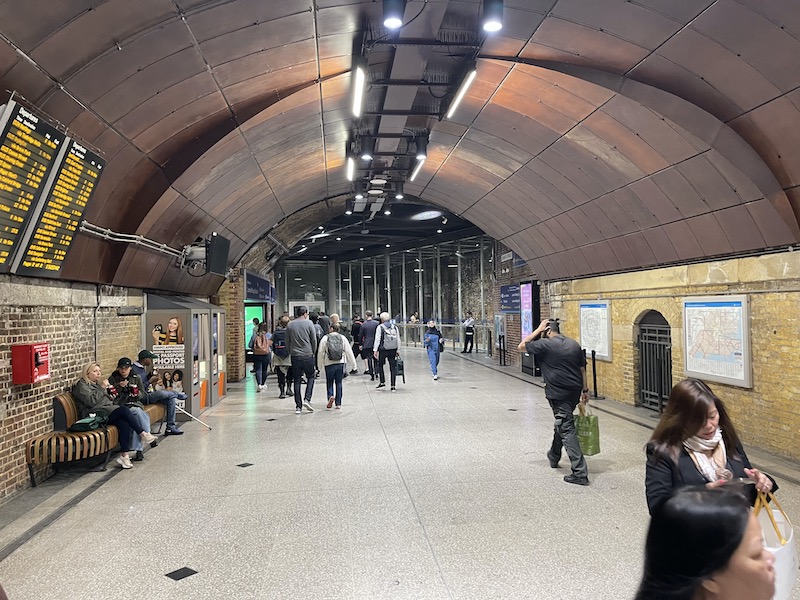
… and where at the northern end by the junction with Tooley Street…
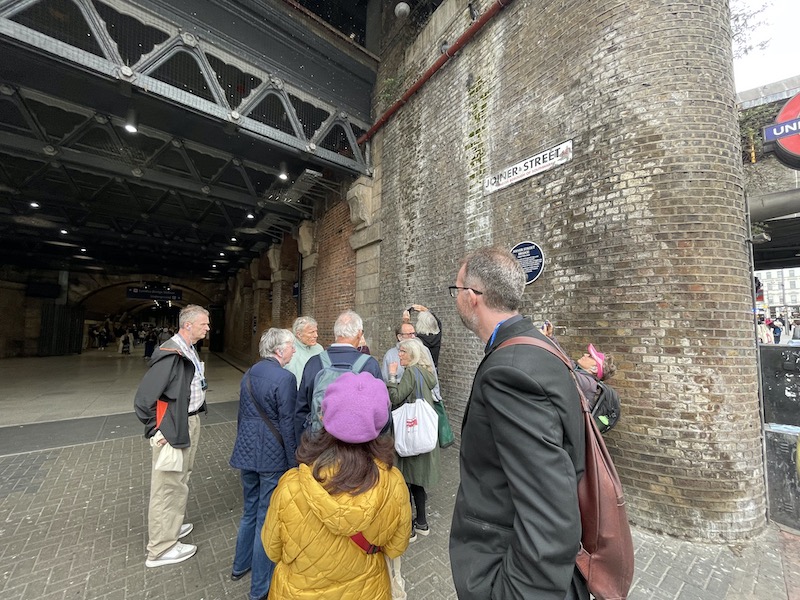
… has a blue plaque…
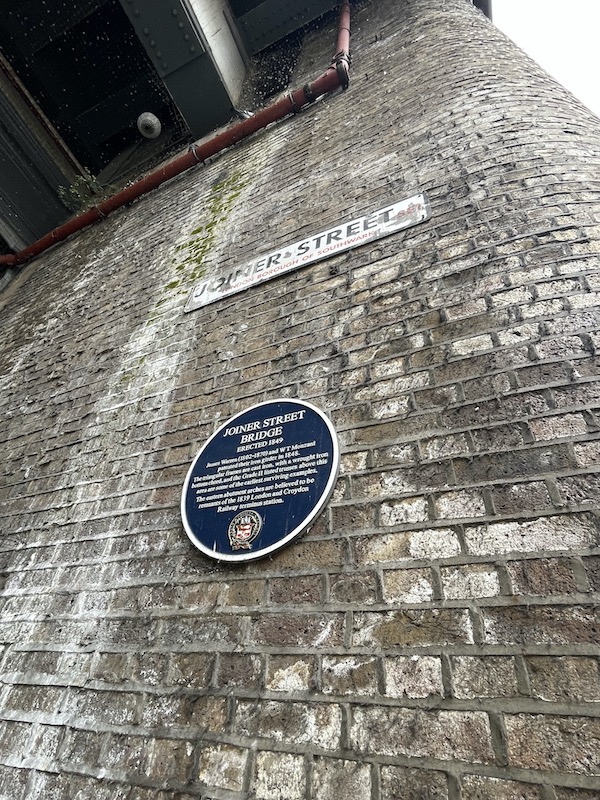
… which commemorates the pioneers of the iron girder bridge erected in 1848 which now has Grade II listing…
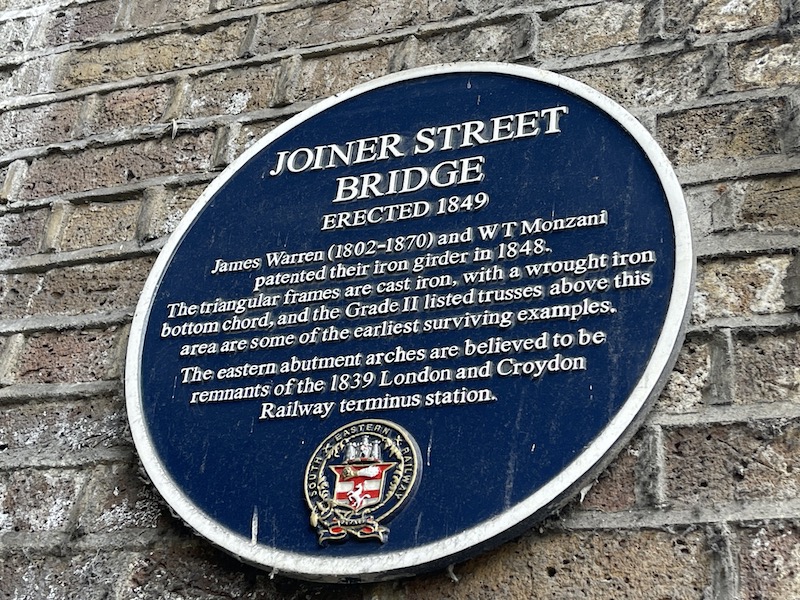
… and can be clearly seen when looking upwards.
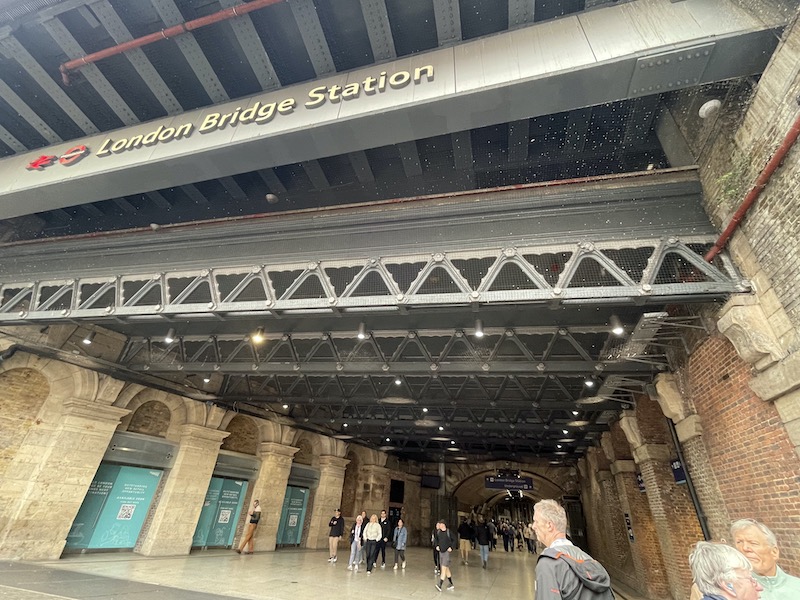
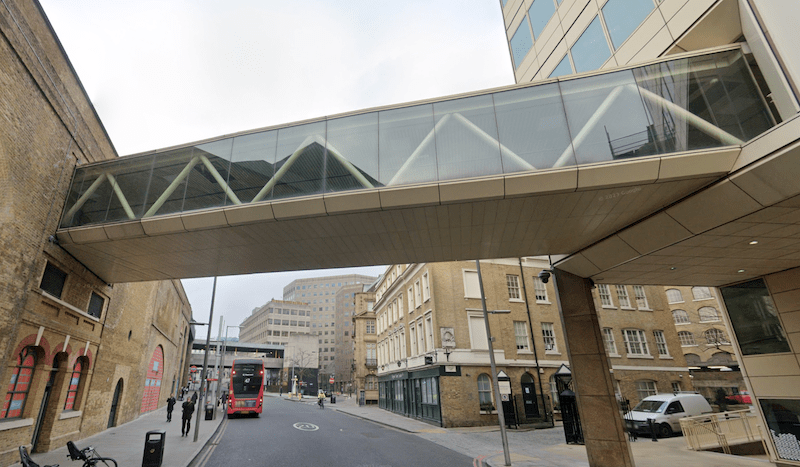
Heading along Tooley Street Rachel pointed out where a footbridge used to cross the road (previously giving access to an office building, now refurbished) but was taken down so none would notice during the 2021 lockdown…
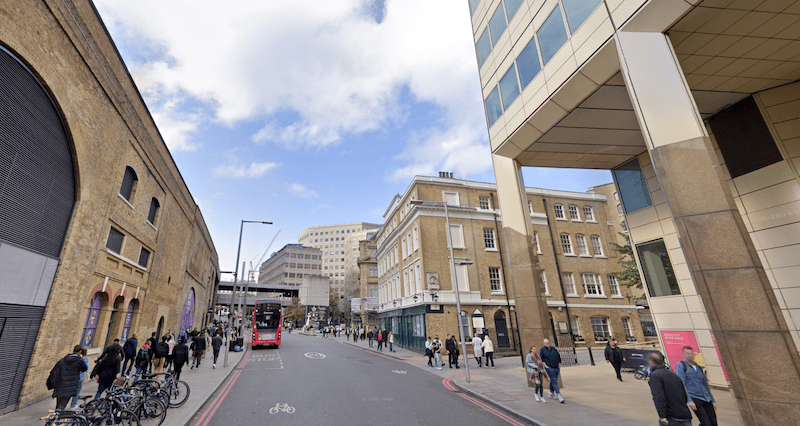
… as well as where Southeastern once had an office building, now demolished, resulting in a pleasant open space…
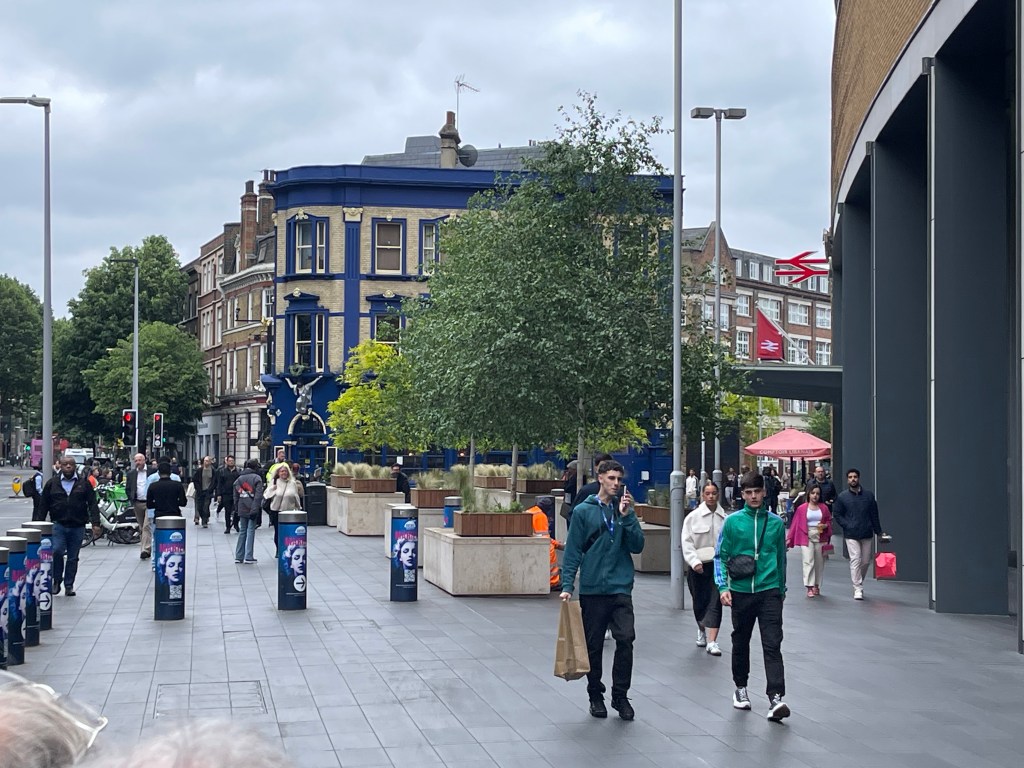
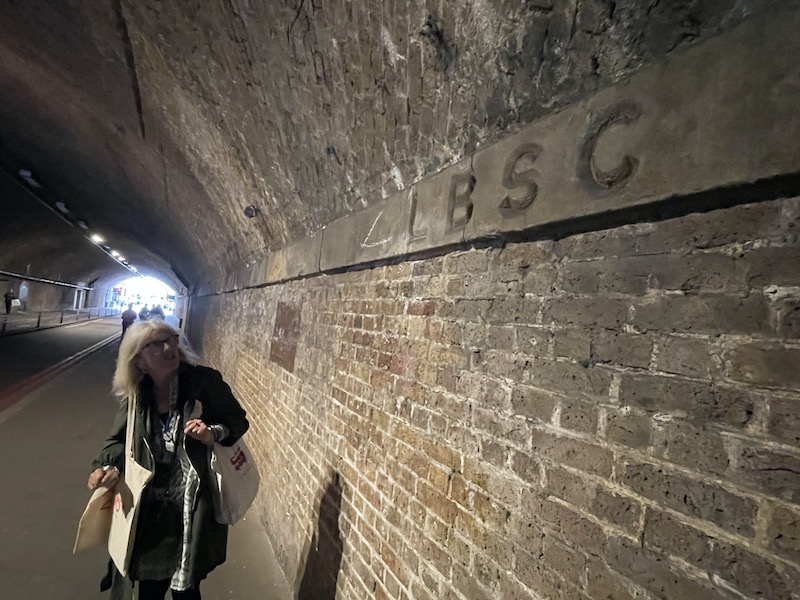
… from where we walked under the tracks at the eastern end of the station along Bermondsey Street…
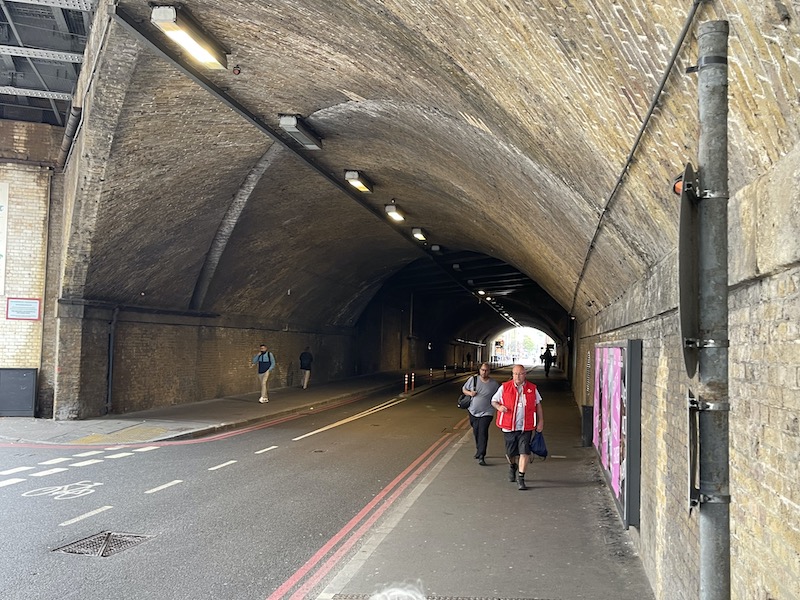
… and Rachel pointed out the London & Brighton South Coast Railway’s initials imprinted in the wall.
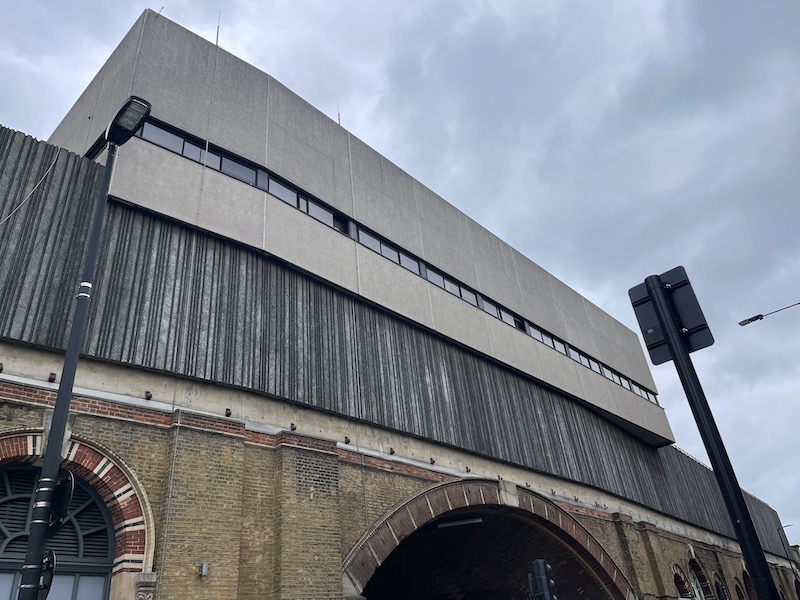
Other things to look up at included the now disused London Bridge signal box on the south side of the terminating lines with its brutal 1970s architecture but restricted access only from track side making alternative uses for Network Rail to earn a bob or two from rental income highly impractical.
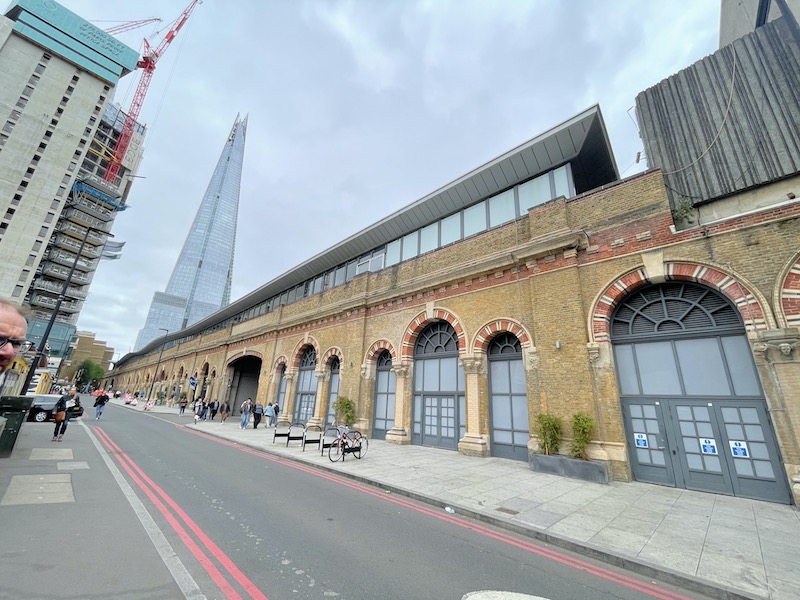
Obviously looking upwards one can’t but help notice The Shard but, as Rachael pointed out, tall it may be, it’s only the same measurement as London Bridge station is lengthwise which can be appreciated from this photo below taken as we headed back on the south side of the station along St Thomas Street.
As we did so, Rachel took us along a couple of adjoining streets to appreciate the history of the surrounding area, particularly in Bermondsey where as well as the famous Leather Market there was the original social housing project – the Guinness Trust…
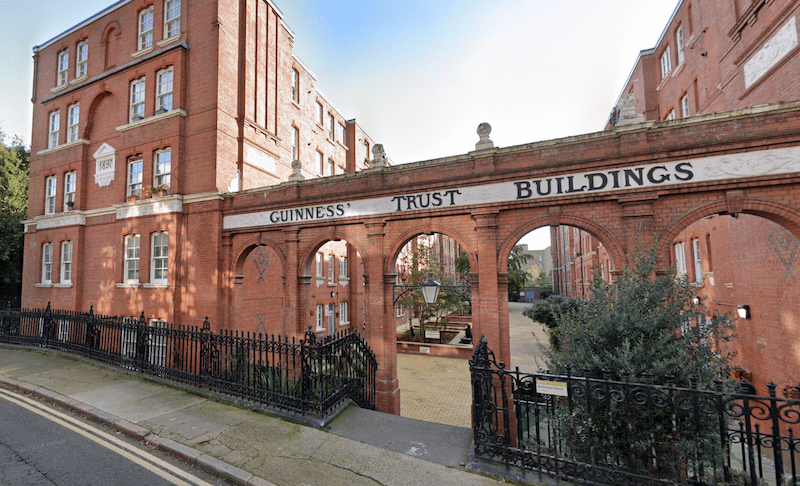
… as well as Arthur’s Mission building in Snowfields.

Back at the entrance/exit of the ‘low level’ terminating platforms Rachel pointed out a recent initiative to brighten up the grey street scape with ‘London Bridge in Bloom’.
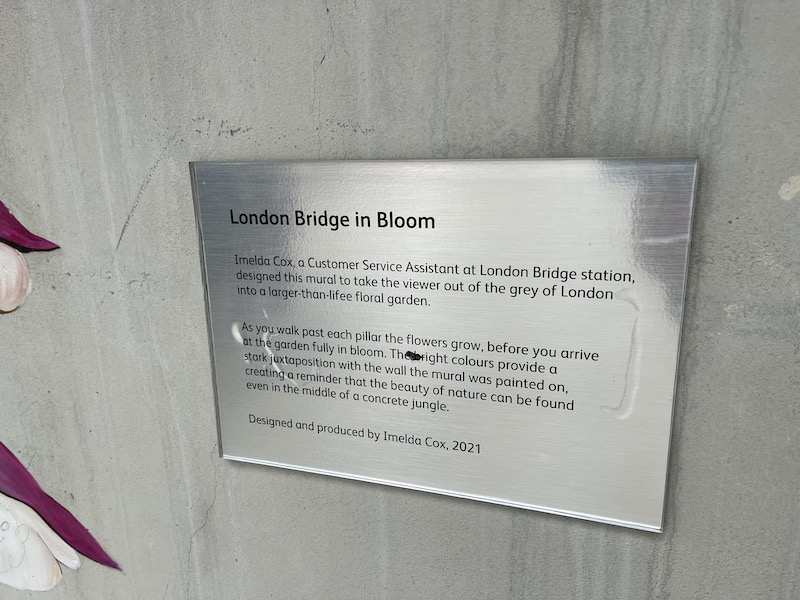
This has seen Imelda Cox who works as a Customer Service Assistant at the station and has a talent for artistry “take the viewer out of the grey of London into a larger-than-life floral garden”.
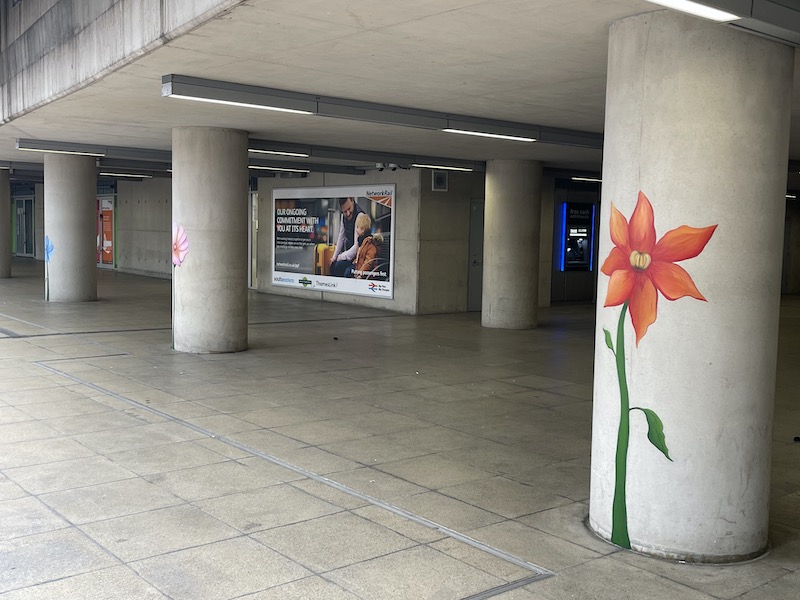
Each pillar is adorned with a flower as you walk towards the station culminating in the complete garden.
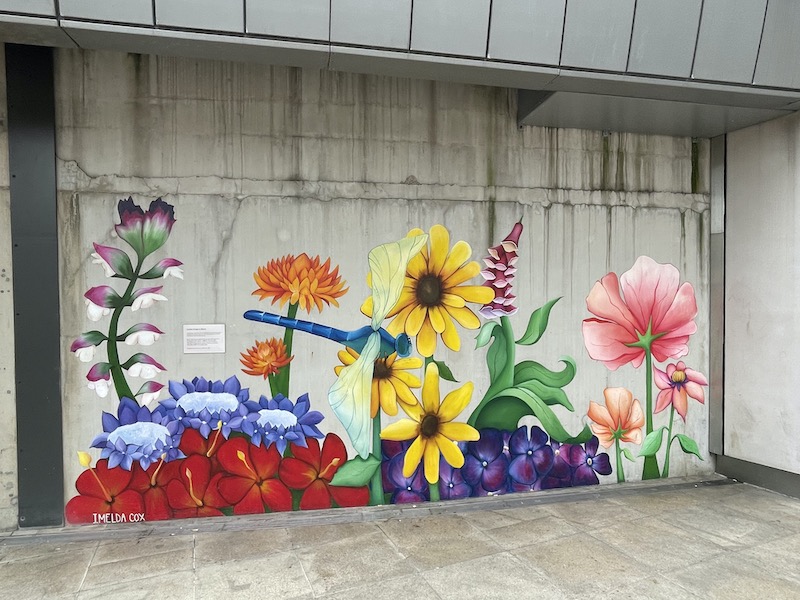
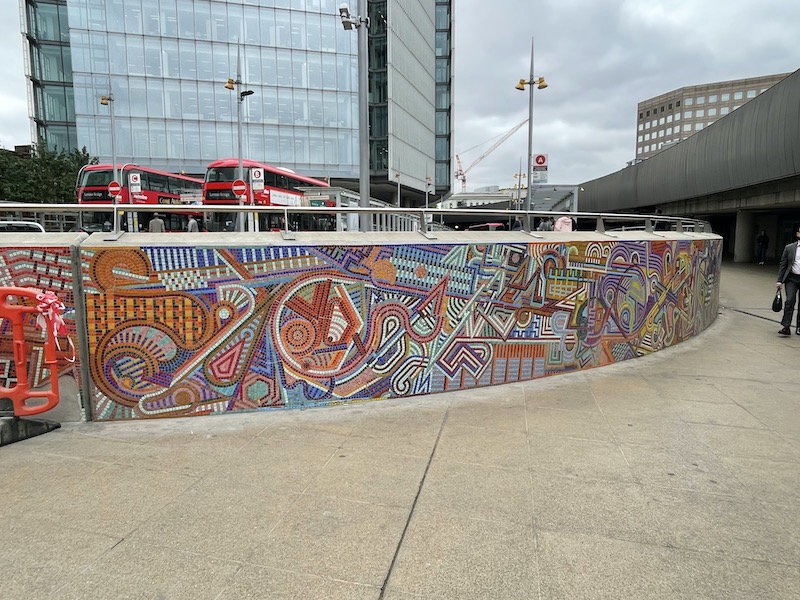
Opposite this there’s a rather delightful mosaic mural alongside the bus station which presents a contrast with…
… how the area used to look before the transformation.
One other ‘Secret’ Rachel loves and enthusiastically points out on these tours is Network Rail’s system for identifying the location of all its infrastructure through attaching metal plates, which once you know are there, you can’t help but notice. They’re all coded and fascinatingly include the distance in miles and chains from the start of each railway line. So, below we see the very first plate in Stainer Street of ‘LBW’ (for line from London Bridge to Windmill Bridge Junction) and it’s at the start so shows 0 miles and 0 chains.
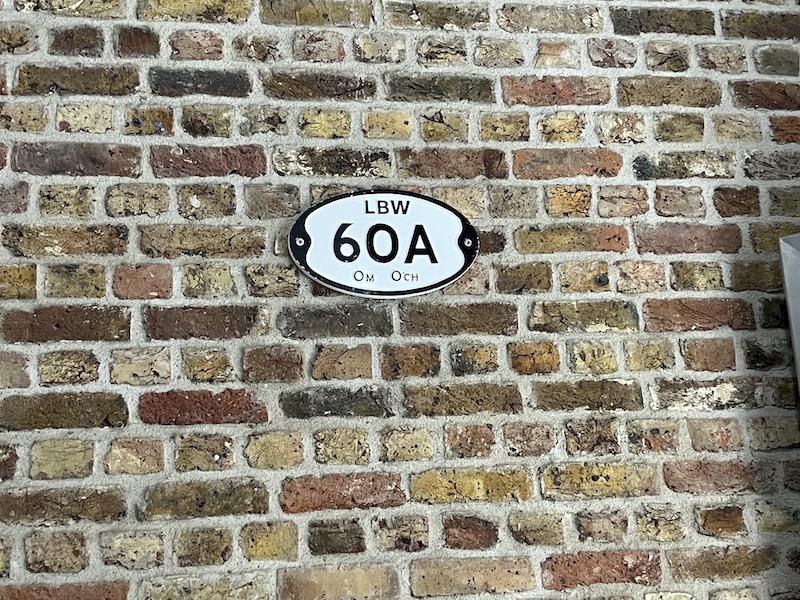
Apparently it’s expected these will be converted to metric measurements in the coming years so take a look now at this unique aspect of the railway.
I’ve only featured small fragments here of the two hour tour and once again it comes highly recommended but, looking at the Network Rail website, it looks as though future tours are almost all booked out with just a smattering of spaces left (at the time of writing), so be quick if you’re interested.
The third tour in this series is of Waterloo and we’re booked on that in a couple of weeks.
Roger French
Blogging timetable: 06:00 TThS
 BusAndTrainUser
Coming soon, or it may already be open, a JDW public house to add to the eating & drinking opportunities here!
LikeLike
Two quick comments.
1.. In 1970 Greenwich Theatre did a brilliant musical/documentary on the London & Greenwich Railway, starring the wonderful Derek Griffiths and called “Down The Arches”.
2. I actually visited and spoke at Arthur’s Mission in, I think, 1983!
LikeLike
Roger,
Will you be doing an analytical piece on the major changes coming to TfL Euston & Marylebone changes & your perceived impact on passengers?
I regularly use the 205 from Marylebone one of the services revised.
Richard
LikeLike
It’s on the ‘to do’ list!
LikeLike
Cheers Roger
LikeLike
The original terminus of the LGR was Spar Road
LikeLike
Spa Road.
LikeLike
London Bridge was subject to a thorough rebuild in the 1970s. That saw the layout shown in the aerial photograph transformed, by eliminating all but one of the four SECR low level platforms (i.e. the ones outside of the LBSC shed), and adding a through track adjacent to platform 6 (the up Charing Cross line).
Oh, and that “carbuncle of a brown footbridge” was a far, far quicker way to transfer between platforms than the current arrangements.
KCC
LikeLike
Play-it-yourself pianos are a feature of some London stations, notable St Pancras (and elsewhere – I noticed one recently at Leamington Spa). London Bridge goes one better with a play-it-yourself organ, near the entrance to the retail arcade.
LikeLike
Thanks for your excellent blog Roger, London Bridge is by far my favourite Network Rail station to use in the capital even surpassing my beloved Euston.
This morning I took time to explore and then sit and have a coffee at one of the many table equipped seats watching the world glide by in emaculate surroundings.
There is a place for nostalgia but in the case of London Bridge reality paints a different picture, opening the train doors as a teenager and jumping out of trains before they stopped to get to the exit or my late father reminiscing about platforms crammed with commuters booing cancelled train announcements in the 1970s.
But best of all the coffee was bought at Greggs inside the barrier, served at lightening speed, it’s like getting on a bus with Autofare.
Anyway Brighton here I come thanks to the excellent wayfinding!
John Nicholas
LikeLike
New toilets have now opened in the Stainer Street corridor. There’s only limited capacity so it’s a secret to be shared only with this blog’s readers!
Steven Saunders
LikeLike
Your tour matches the breathless experience of normal travellers having to march huge distances between anything versus the old compact layout where everything was so handy. These articles are always the same espousing the barren concrete architecture and assuming everyone loves what they did
LikeLike
Network Rail have opened the second set of toilets in the Stainer Street corridor. Pity they do not provide toilets inside the barrier for travelling passengers.
LikeLike
With reference to the Southeastern office building, now demolished, I recently visited the Railway Heritage Trust’s 40th anniversary exhibition, and one of the projects included is the removal and relocation of the ornate stonework from the entrance to the former office building. This now graces the entrance to the exhibition hall at the Vale of Rheidol Railway in Aberystwyth!
The RHT exhibition is currently at York station (near platform 1) until 30 May; its final “station stop” is then Edinburgh Waverley from 2 to 13 June.
Chris M.
LikeLike