Tuesday 20th May 2025
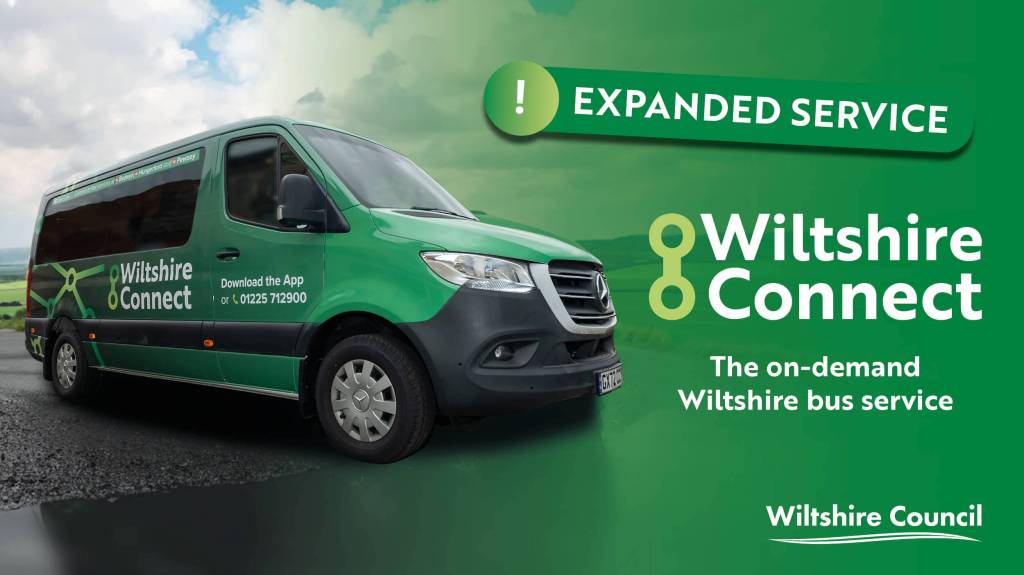
I’ve been back on the DRT trail again, trying out the recently introduced geographic expansion of the Wiltshire Connect branded scheme to cover more of the county.
I’ve previously praised Wiltshire Connect in a number of blogposts for showing how to do DRT properly. Until now their schemes have been built on the successful semi-flex principle of a part fixed timetable with specified departures from key timing points advertised for all to see supplemented by pre-booked pick ups from hamlets served on route variations as required and pre-booked.
The arrangement combines the best of both worlds – fixed times from main points passengers can rely on but flexibility for those travelling to and from more isolated communities.
Sadly this long standing method of working which goes back to the ‘Wigglybus’ brand in the 1999 has not been adopted for the new zone which launched last month on 23rd April and covers Royal Wootton Bassett and Malmesbury.
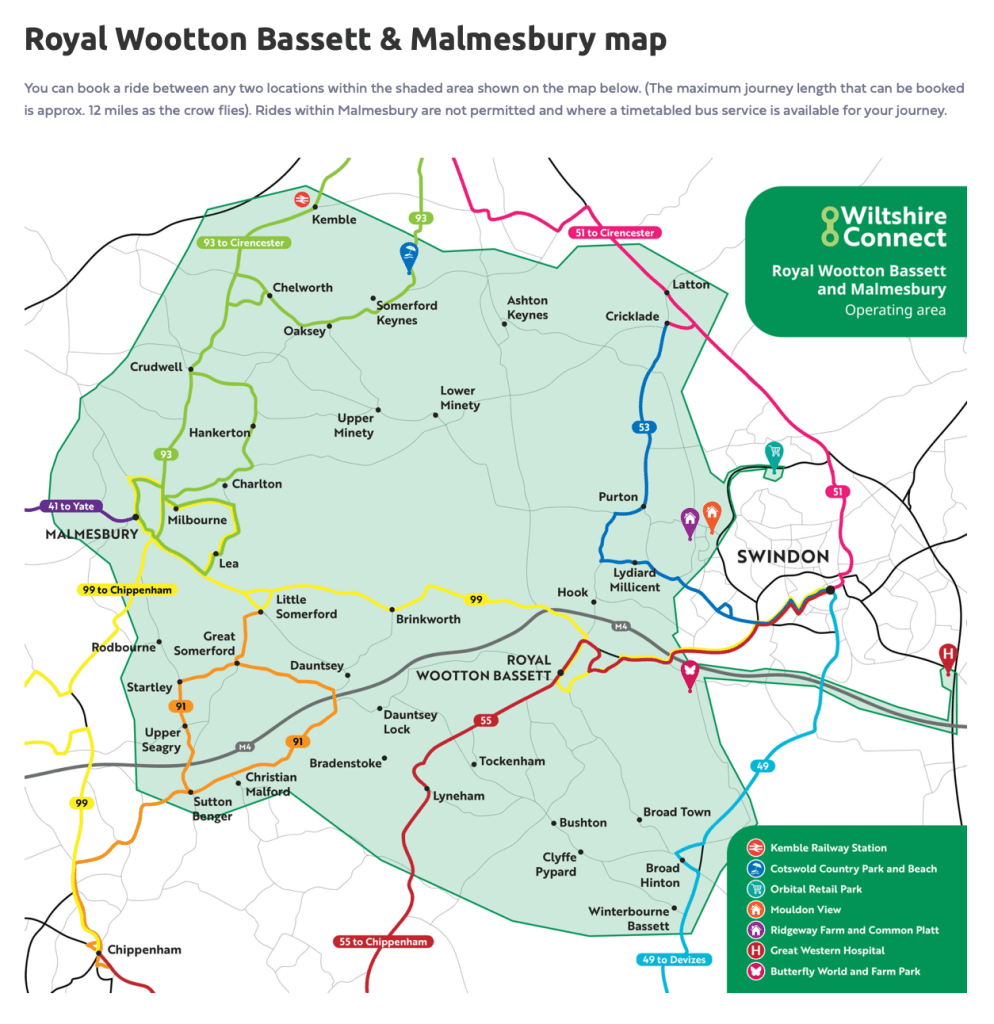
The new arrangements revert to the more standard DRT pattern of full flexibility with all passengers having to book and being able to travel from anywhere to anywhere (within the defined zone) meaning numbers travelling at any one time are unlikely to exceed two (and that’s good going) making for a costly inefficient way to provide a bus service, as highlighted so many times in previous blogposts.
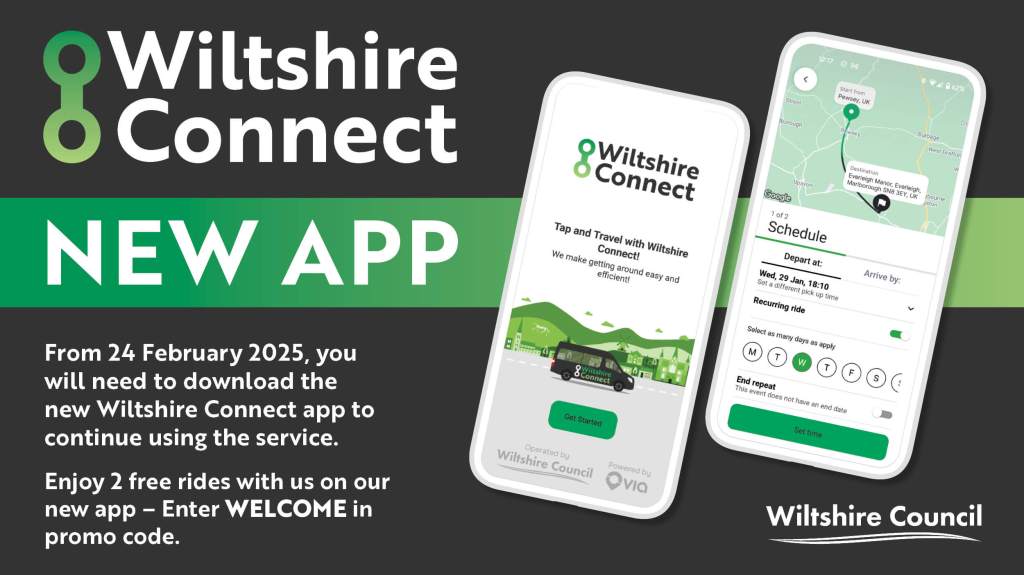
I gave the new zone a try out on Saturday booking a journey from Kemble railway station, in the far north of the zone, to Royal Wootton Bassett. First off I had to download the new app which incorporates the new area…
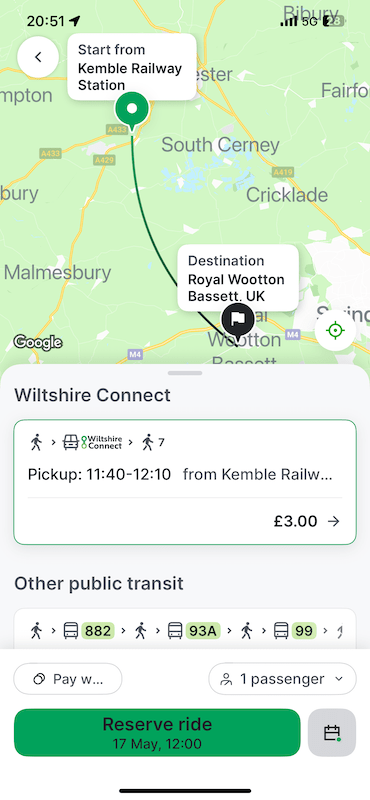
… but then had the usual faff on the app trying to get a convenient half hour pick up slot to coincide with my train arriving at 11:41, being originally offered 11:40-12:10…
… which would have been too tight and thankfully then being offered 11:50-12:20 which would work much better.

This app is a standard one from Via (which also operates the minibus/es in the new zone rather than Go South Coast) and is not as good as the Padem one which at least offers you a range of half hour slots and you can just click on the one that suits best. With the Via app you have to keep trying from scratch to get the times you want.
While on the train from Paddington, I received a text at 10:41 (coincidentally exactly an hour before the train’s scheduled arrival into Kemble) updating the precise pick up time to 11:56 thus giving me a 15 minute wait – almost ‘seamless’.
Except it then all went wrong thanks to a points failure delaying trains as we approached Swindon. Once we’d been stationary just outside Swindon for ten minutes with four stationary trains ahead of us and no sign of movement I realised I wasn’t going to make it for 11:56 so gave the Wiltshire Connect ‘Contact Us’ number shown on the app a call to see if the minibus could be held (seamless travel and all that) for a few minutes if needed, only to hear a recorded message advising the phone line is only staffed on Monday to Friday between 09:00 and 17:00 – so much for “demand responsive”.
As there was no sign of movement into Swindon as the minutes ticked by I decided the best course of action was to use an option in the app to cancel the journey – so I wouldn’t get a ‘no show’ black mark against my name and try and rebook once we were on the move.
Once we started inching our way towards Swindon I tried to rebook the journey for a later time – 12:15 – but the app was having none of it, telling me (Trumpian style) “we’re currently experiencing very high demand” (oh yeah?!) “and all out seats are filled!” (Oh, no they’re not, you lying b***ards). “Please try booking again in a few minutes”. (How is that going to change things and anyway you don’t know I wasn’t trying to book for much later on in the day.)
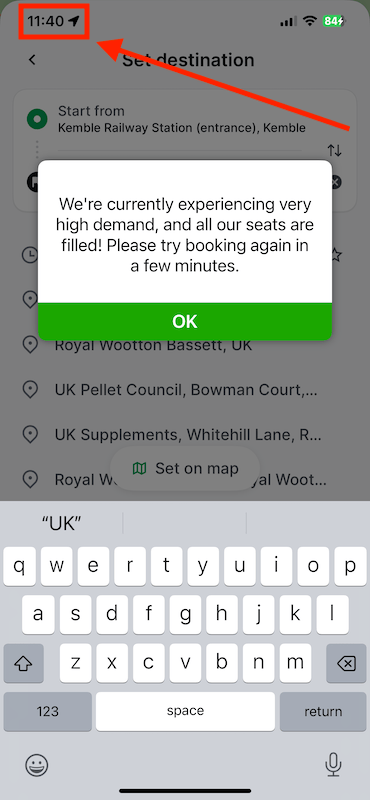
The omens didn’t look good so as we rolled into Swindon at 11:47, 20 minutes late, I decided it was probably better not to risk getting stranded at Kemble and instead to catch a bus to Royal Wootton Bassett and book a journey the other way to Kemble.
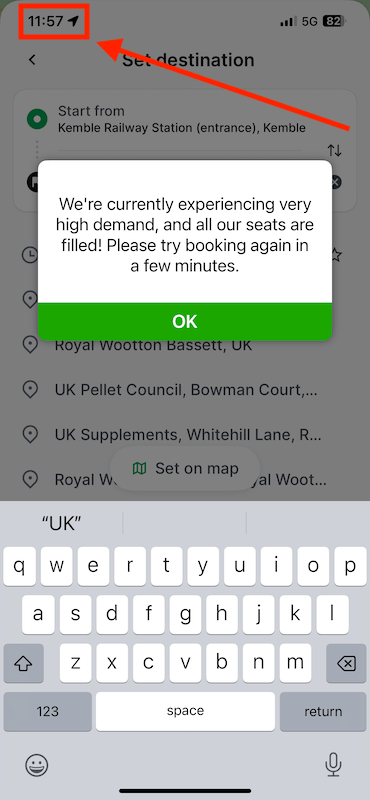
As you can see, the app was still not allowing any bookings so I abandoned the whole idea and in the absence of a functioning app and phone line to ring, presumably along with any other passengers wanting to book with Wiltshire Connect on Saturday, I gave up, after one last try.
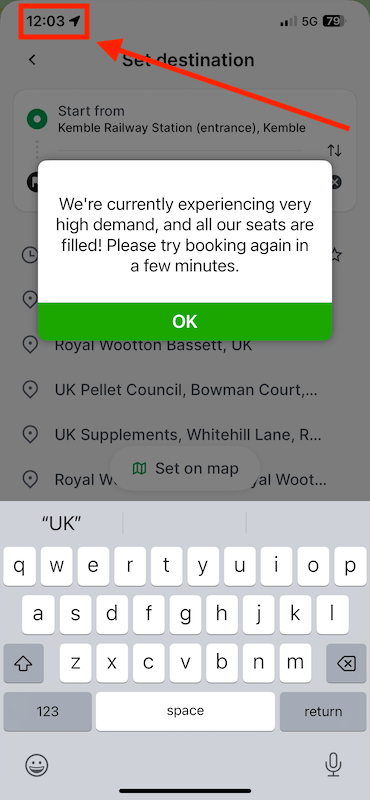
DRT – don’t you just love it?
Completely useless.
Well done Wiltshire Connect for trashing your reputation for sound DRT operation.
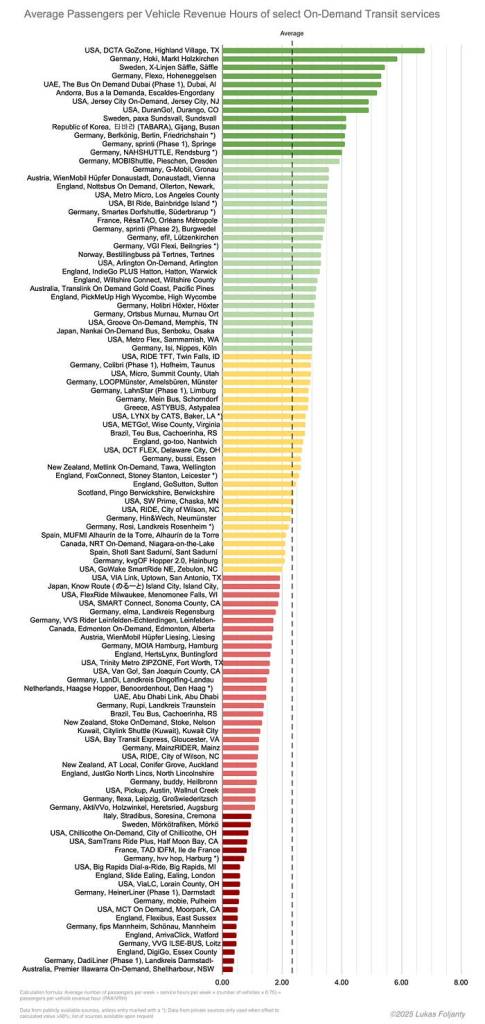
And it’s no better anywhere else in the world where tech providers continue to sell their software to transport authorities keen to introduce DRT. A report has just been published which looks at recent global trends in the ‘On-Demand Transit’ market which has analysed results from 111 DRT operations across 22 countries with some interesting statistics:
- The average passengers per vehicle hour across all the schemes is 2.34
- 13 services performed very strongly with over 4 passengers per hour and are probably maxing out what can be achieved in demand-responsive transport.
- Another 23 services delivered 3-4 passengers per hour.
- However, 68% of the sample achieved less than 3 passengers per hour – defined by the report author as “the minimum threshold to justify the efficiency pitch of On-Demand transit“.
- Of more concern, 49 services achieved fewer than 2 passengers per hour, “raising serious doubts about whether these services are suitable for real-time optimised pooled on-demand transportation”.
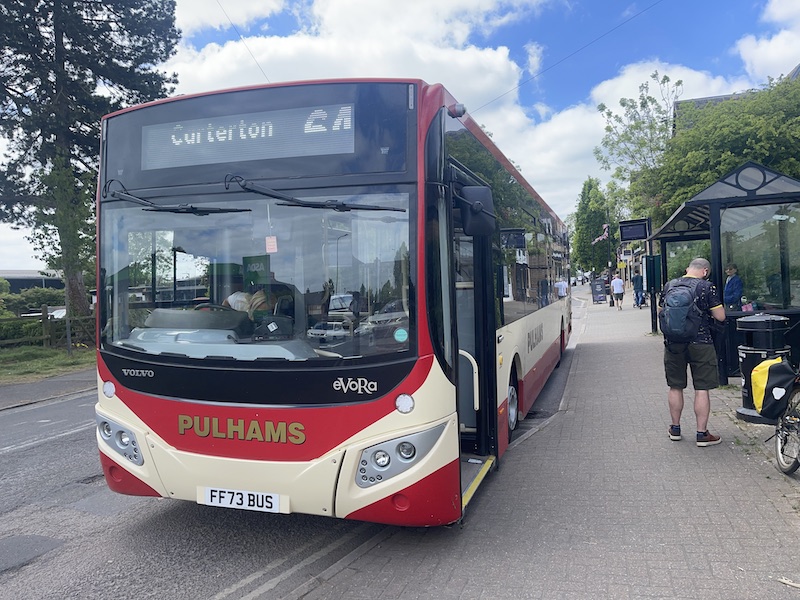
As for my wanderings last Saturday, a smart Pulhams bus arrived into Swindon’s soon-to-be-replaced (thank goodness) bus station on one of the few journeys a day on route 64 to Carterton, so I jumped on that to see how the route was doing.
Readers may recall it’s one of the routes introduced with Bus Service Improvement Plan funding by Oxfordshire County Council now 18 months old.
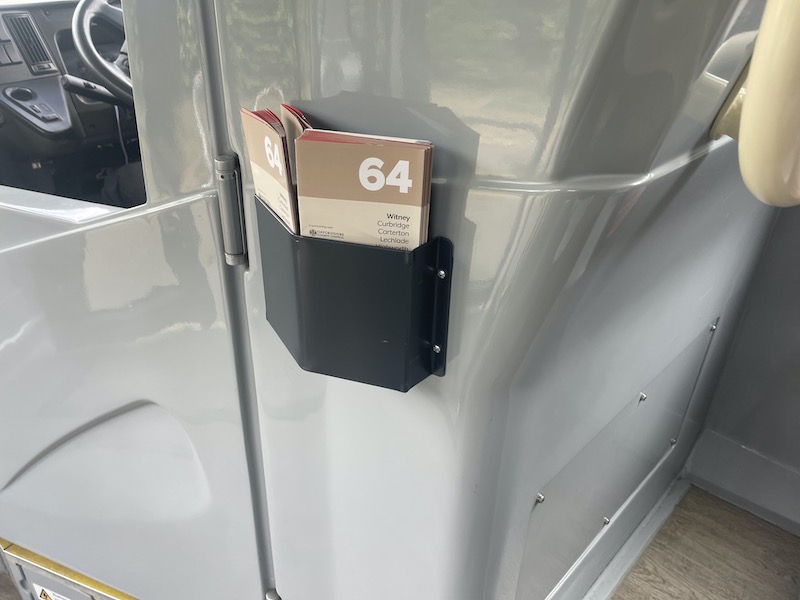
It was good to see a timetable leaflet available on board the bus but sadly it doesn’t look as though the route is catching on with only two other passengers on board as we left Swindon – one travelling to Highworth and one to Carterton – and no-one else joining us. Almost a DRT type load for the 44 minute journey.
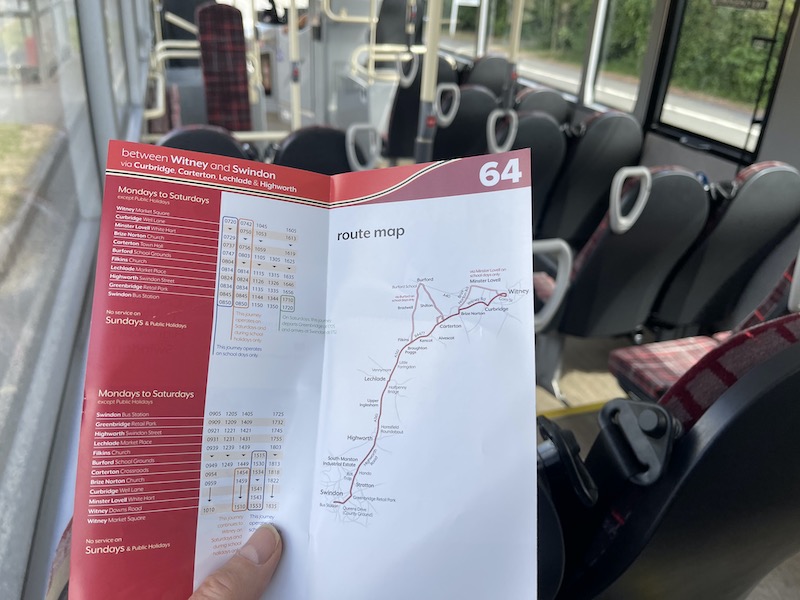
I’ll be returning to Kemble later this week to try my luck with Wiltshire Connect (all in the name of research) – and this time will allow even more time to connect between train and bus. Seamless travel indeed.
Roger French
Blogging timetable: 06:00 TThS
 BusAndTrainUser
You missed a letter and a space.
It should read seams less travel. 🤣
LikeLiked by 1 person
On your next try, make it a weekday and call into Swindon’s Bus Station enquiry office …. they have a new (February) comprehensive bus timetable available.
All local services, irrespective of operator, are included, plus maps.
I suspect the book is compiled by GoAhead, but nonetheless I do wish other authorities would look and learn. It may be “all on line”, but there’s no harm in publishing a book, and it may just encourage more passengers to travel …
LikeLiked by 2 people
Will do; thanks.
LikeLike
Here’s a link to download it:
https://www.swindonbus.co.uk/swindon-area-timetable-book
LikeLike
Thanks for this link. Pleased to see new edition of Morebus Bus Times available in boxes outside travel centre in Poole last night even when it was closed. It can be done!
John Nicholas
LikeLike
Difficult to believe that, in this day and age, you cannot book a DRT to meet a particular train – surely the software should be able to check how that train is running, adjust the bus’s route and timing, and keep you up to date with when it will be there for you!
LikeLiked by 1 person
Technology is difficult to match with real-world conditions. In theory – yes – but in reality – no. The “back office” needed for such a system would be immensely expensive to code and maintain. Not even conventional bus services can reliably manage this with fixed timetables!
LikeLike
If technology cannot cope with this apparently simple idea, then ditch the disliked app, and simply have enough staff to run a decent phone-booking system! – real-world conditions are that people (customers) do wish to make connections …
LikeLike
LikeLike
Can you clarify the source of these statistics?
RC169
LikeLike
Is it unusual for a DRT to cross a county boundary? This one does, giving my tiny village the choice of both The Robin and the Wiltshire one, including to make journeys to Kemble railway station!
LikeLike
Given that the numbers of passengers are so low ( generally not even filling a medium sized car ), it would surely make sense to operate them with conventional taxis?
RC169
LikeLike
subsidised taxi schemes are politically tricky to operate. Subject to one or more issues:
DRT is already treading a fine line on this.
Transit perversely needs to be unattractive enough to mitigate the last complaint (or so good and universal that nobody complains, e.g. best of big city Services)
There have been experiments in North America of contracting out all public transit to standard ridehailing. The outcomes were predictable.
I agree with Roger that hybrid schemes (scheduled routes with bootable deviations) is best compromise in most cases
I am also of the view that augmenting bus service with a taxi voucher scheme to support social cohesion and health, but always with an point in time payment (£3 per trip, more if ride is in unsocial hours or commuting/school travel peak) and needs tested, strictly personal vouchers (maybe with companion travel permitted) and expectation of shared taxi. And limited vouchers per quarter, maybe 2 round trips per week average.
If the rider fails a needs/means test (or wants more than their capped allocation) then allow voucher purchase upfront at a modest discount to average local fares (still with point in time payment).
But taxi voucher is not what DfT wanted to fund (not the right political message).
MilesT
LikeLike
Thanks.
The German “Anruf-Sammel-Taxi” system would seem to be a more satisfactory option. The cases that I am familiar with are effectively taxis that replace normal buses at times of low demand, and only operate if actually required – so passengers need to book in advance. The route is specified, but the bus only serves those points that have been requested. There is also a small supplement to the fares, compared to normal bus services.
This avoids the need for complicated journey planning software that tries to combine diverse requirements into a single journey ( with apparently little or no success in the case of the British DRT schemes ). The services are generally operated by taxi operators, but those are quite often also bus operators.
If the vehicles used are large cars or minibuses with no more than 8 passenger seats, then some aspects of the PSV regulations would not apply.
I did use one of these services a few years ago – ironically, to visit an open day event at one of the local bus and coach operators – and the system worked quite satisfactorily. However, in more recent years, the local government of the area has enhanced the conventional bus ( and train ) services, so that I think that there are fewer such services in operation today.
RC169
LikeLike
I was interested to see that my local DRT (Digigo in North Essex) is third from the bottom in the chart although I suppose that might refer to its original format before expansion in 2024.
Decades ago some rural bus services in North Essex were replaced/ enhanced by “Country Car” which was a timetabled service operated with an estate car (7 seater, I think) complete with a Setright ticket machine! It was, I believe, relatively successful.
LikeLike
From this week’s Travel Essex Newsletter: “Digigo has officially reached 100,000 passenger journeys! Since launching in April 2022, the service has helped residents across rural and suburban areas reach health, education, employment, and social opportunities.” Perhaps a contributor can give an opinion on whether this suggests the service is a success or otherwise.
LikeLike
It’s impossible to draw any meaningful conclusion from the headline figure of 100,000 journeys on Digigo. For the first two years it operated on a small scale with two electric minibuses in a deeply rural area. In 2024 it expanded to replace some relatively frequent (hourly) bus services but all observations suggest that loadings are rarely above two or three people due partly to the app not being able to merge similar passenger journeys on to one vehicle.
Nigel Turner
LikeLike
A large sign saying BUSES
from the Bus Station is the
sum total of bus information in
the ticket hall at Swindon
station as I found out when
alighting there last Sunday to
avoid standing with many
others all the way from Wales
to London
As you say the bus station is
awful with adverts covering windows of what used to be Stagecoaches enquiry office and the toilet was shut.
The buses looked smart
enough but with no network map there was no incentive for me to catch a bus in this part of the world with multiple
operators and no fares
advertised.
A lovely empty multiple unit
whisked me onwards to London that was deemed by a train spotter on the platform to have no character.
He looked nonplussed when I replied these semi fast GWR trains are great compared to their cousins on the Brighton line which i’ll be catching this week to sample the finale of Brightons Scanias.
While Roger is struggling with his App, I’ll hopefully zooming up and down the Lewes Road with my Key card.
John Nicholas
Held at a red signal outside East Croydon hopefully on the move shortly!
LikeLike
That’s interesting John. At Chippenham there’s a bus information display in the ticket hall listing all the destinations in alphabetical order with route numbers, and stop letters, together with a map of the town centre showing all the stops.
Strange as the train operator is the same for both stations.
Peter Brown
LikeLike
This service appears to replace a previous demand responsive ‘taxi bus’ service that was centred on Wootton Bassett, but which had specific ‘times’ associated with it (either for arrival or departure from Wootton Bassett, I can not recall which).I have got two interests in this scheme – I live in the area that it covers and I was part of a team that set up a similar scheme centred on Midhurst back at the start of my career.I am not aware how many vehicles this new service has, but if it is only one then to my mind the operating area is far too big and unfocussed, with a substantial risk of the sort of customer experience that you experienced, Roger.Wiltshire will hopefully gain knowledge of potential demand patterns from the trip data that the service will generate (either trips fulfilled or those that can not be fulfilled) and from that seek to focus the future service specifications accordingly. I do wonder whether adding a degree of DRT to the existing ‘fixed’ 91/93/99 routes and focussing the more flexible DRT resource on a smaller area around Wootton Bassett may be the right answer in the end.
LikeLike
Here are some conventional bus services in the area you could try Roger:
https://www.coachstyle.uk/bus-timetables/
Peter Brown
LikeLike
Source of above link:
https://www.connectingwiltshire.co.uk/getting-around/bus/bus-timetables-maps/
Peter Brown
LikeLike
The Ealing , London, DRT looks interesting to try
It is probably worth carrying a 2nd wi-fi device for apps only. This can help as I suspect iffy wifi on the train and “cache” issues can make some apps fail to default responses ?
JBC Prestatyn
LikeLike
While there is no excuse for your experience of being unable to reschedule/cancel a journey due to the delay on an incoming train, a fixed route & timetable but low-frequency service in a rural area could still have left you stranded.
For seamless travel to succeed people need to believe that the services involved are reliable and not subject to frequent delays. As is often said, perception is reality, so until there is a general belief that public transport is reliable no solution will work, especially in rural parts.
John
LikeLike
Hi Roger,
When I read through this blog and got to the chart of “busy” DRT schemes, I nearly choked on my coffee when I saw that one of the best schemes was based in Jersey City, New Jersey. By no stretch of the imagination is Jersey City sparsely populated! Nor is it even remotely close to a rural area. Interestingly it has a dense network of bus routes, a Light Rail Line, and a Metro style line (PATH) runs through it, so the DRT is very much in a supporting role; indeed, the blurb for the VIA scheme suggests using it to get to a main transport hub as one reason for using it.
It’s only slightly dearer than the standard on-bus cash fare ($2, v.v. $1.80). Americans also have much more experience of shared rides, e.g. airport services, and this part of the NY area was one of at least two that saw development of “jitney” pirate type bus services on the past, therefore three more possible explanations of its “success”.
I have had a quick look at a few of the other “successes” in the chart; Durango Colorado is an evenings only alternative to the regular daytime scheduled services, and is only available within the city limits. The Highland Village scheme serves an extensive suburban area in Ft.Worth/Dallas. The Markt Holtkirchen scheme does seem to link a town with outlying rural areas, although I couldn’t find a map on its website to confirm this.
Anyway, I wonder what the split of urban/rural would be for the rest of the schemes in the chart? Several are listed as based in big Cities such as Berlin, but I have no idea if the areas each covers is urban or rural.
I continue to be an avid reader of your blog, always interesting and informative!
Best regards
David
>
LikeLiked by 1 person
This new DRT scheme in Royal Wootton Bassett is to partially replaced a shared Taxi-bus scheme which has been operating for many years in the area. Normally the service is operated by 3 vehicles but unfortunately there were some operational issues on Saturday which is why ride availability was more limited than the norm. Providing public transport in deep rural areas is costly to provide for local Authorities regardless of whether it is a fixed route, semi-flexible or fully flex DRT.
LikeLike
And the moral of the story is – don’t trust app providers to operate a bus service.
LikeLike
As much as I dislike DRT – I have to disagree with your comment.
App providers don’t run bus services, just as OptiBus doesn’t run Stagecoach services and CitySwift doesn’t run Go Ahead. They simply write and produce schedules. DRT software has the added benefit of allowing bookings via their software, too. In theory this should work well – if not for the Transport Act and various council funding streams T&Cs outright disallowing competition between councils and operators. This automatically puts any subsidised service at a loss before it begins service. Operators have been very good at mopping up any profitable routes over the past 40 years.
Obviously this all depends on your definition of “works well”. If subsidy per passenger trip is no issue, then some schemes are fantastic in connecting isolated areas. DRT is a stepping stone between taxis and rural village services and should be managed as such. You wouldn’t expect a 5 minute headway in the middle of nowhere, and DRT expectations should be managed as such.
To correct your comment: the moral of the story is – any decent bus operator or subsidised tender contract should have a controller or similar human role manging bookings and driver allocations.
Driver running boards are always checked by a human, so why shouldn’t DRT schedules be?
K
LikeLike
App developer Via technology DOES operate this DRT (and MK Connect and WESTlink in north Bristol). See today’s post.
LikeLike
Interesting for the USA note of an Evening Service covering where fixed routes cease. Maybe this is an area of filling UK demand where the use of a bus to get somewhere is not done as there is no return method
JBC Prestatyn
LikeLike
I travelled on Pulhams service 64 today and some of the services were rather better loaded than your experience. There were about ten on the bus arriving at Swindon bus station just before midday, but only three on when it left. I was the first off at Lechlade. On the last bus to Swindon of the day around 5 pm, there were nine passengers as we left Lechlade, six of whom boarded there with all but one staying on to Swindon. There were four on the bus as it headed back to Whitney for the last time in the day.
However, if most passengers are travelling south of Lechlade, Oxfordshire Council might not be overly satisfied as that’s entirely outside their boundary.
Also, since you first tried the service, they have adjusted the times of the buses around 9 am and 5 pm to allow more time between Highworth and Swindon – time keeping this evening was quite good.
LikeLiked by 1 person