Saturday 12th April 2025
After Windsor and Northumberland I’m in south west London for this month’s featured bus route I’ve ranked eighth in Britain’s Top 10 Quirky Bus Routes.

It’s a TfL contracted route, operated by Transport UK (formerly Abelllio), running from Whitton via Richmond, Mortlake and Barnes to Roehampton. Some readers might be puzzling how on earth can a London bus route be described as quirky. They’re all operated by contracted bus companies with red buses to TfL’s prescribed route and timetable. Nothing quirky to see here, you might think.
The clue is in the route number. London’s bus route number 969 is the Capital’s least frequent bus route with just one return journey between Whitton and Roehampton leaving at 10:00 on a Tuesday and Friday, returning at 13:15, and that’s it.
It’s a hangover route from the days before standard buses were wheelchair accessible when TfL ran a network of infrequent Mobility Routes all over London numbered in a 9xx series on one or two days a week with specially adapted vehicles to take passengers with accessibility needs, particularly those using a wheelchair, to a shopping centre or large supermarket and then travel home again afterwards.
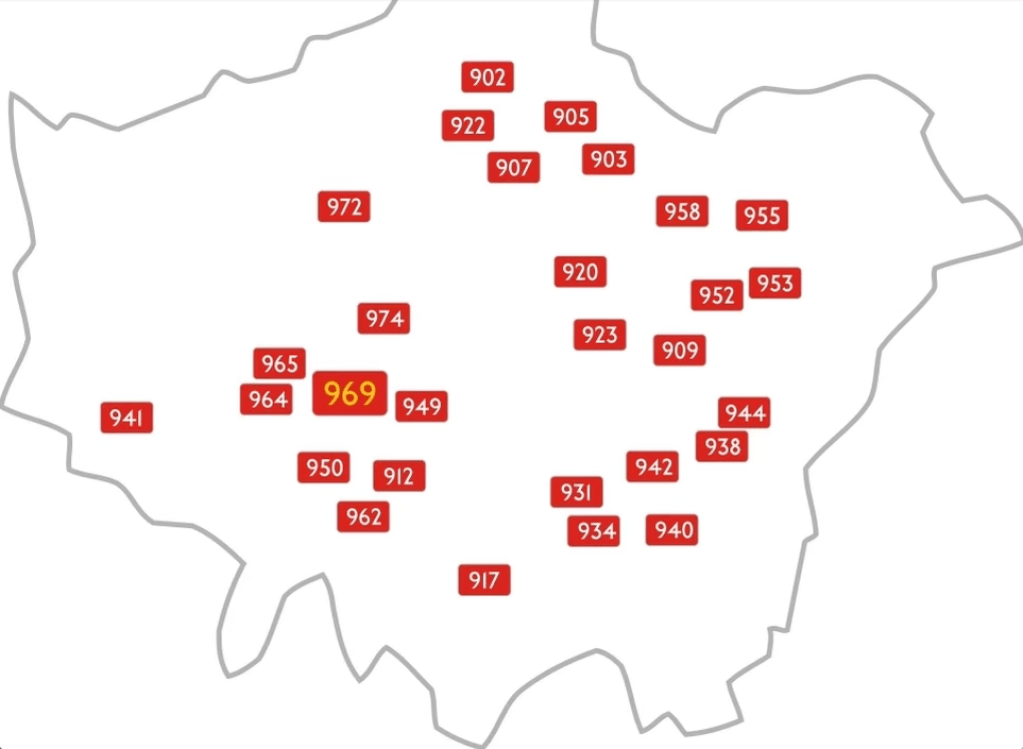
As standard buses were redesigned and low floors with ramps for wheelchairs became the norm and then the law, all London’s bus routes became accessible leading to the Mobility Routes withdrawal, not least because TfL also took responsibility for the London wide Dial-A-Ride operation which has drivers and minibuses available for pre-booking to those with severe accessibility needs.

However, route 969 soldiers on providing a somewhat indirect hour’s journey through south-west London which, other than two sections of route (Gladstone Avenue/Lincoln Avenue in Whitton and Lennox Estate in Roehampton – shown in grey on the map below), are well served by other frequent TfL bus routes.
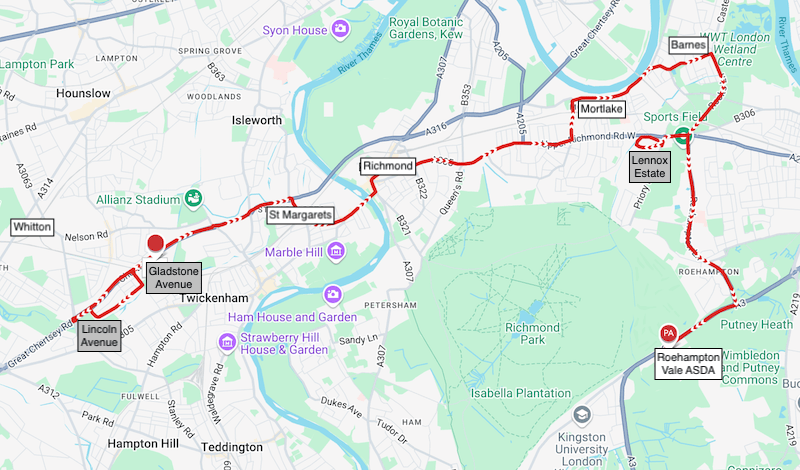
When I travelled on the route in pre-Covid days six years ago in April 2019 it carried five passengers from the small residential area of Gladstone Avenue on the south side of Chertsey Road where the bus begins its journey in Whitton. However, when I took another ride in February 2024 there was just one. The driver explained sadly, most of the other regulars had died.
The one who did travel, Adam, is a relative newcomer to the route and uses it to visit his sister in Richmond, the 969 making for a convenient link for him when needed.

The other hotspot for passengers with no alternative along the route is the Lennox Estate. This area is home to hundreds of people in flats located beyond TfL’s minimum distance from a bus stop but due to the road layout is impossible to serve by a regular bus service circumnavigating the estate.
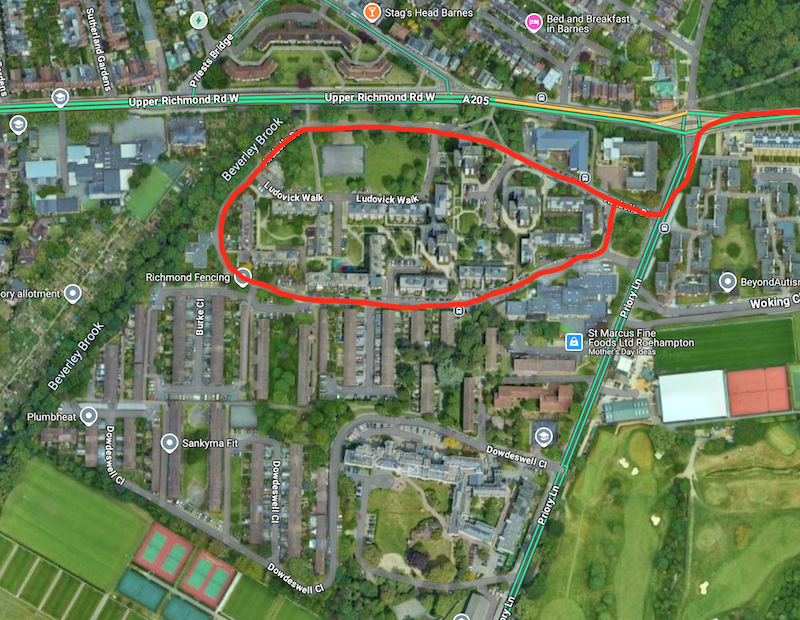
Indeed the 969 itself only touches the northern half of the Estate as it double runs in a loop around Arabella Drive.
Unfortunately, the southern section has no suitable through road.

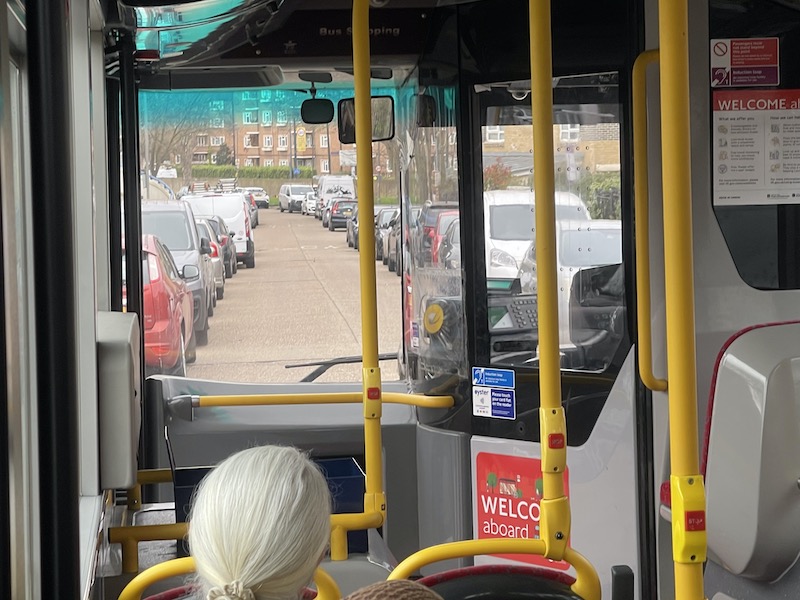
Even the northern section offers challenges with parking on both sides of the road that loops round and readers may recall my journey in 2019 was blocked by a builder’s lorry delivering supplies and the driver had to abandon that part of the route.

Despite that detour, nine passengers boarded here making for a full house of shopping trolleys…

… but in February 2024 numbers were down to five including a wheelchair user and her carer Sally who explained they won’t use the Dial-A-Ride service preferring the certainty of the fixed journey time offered by the timetabled 969 to reach Asda in Roehampton Vale.

On both those two occasions, when I took a ride, the bus also carried between half a dozen and a dozen other passengers on sections of route where it parallels other standard frequent bus routes but just happened to come along at a convenient time for passengers to hop aboard for a short ride. Indeed, coming into Richmond on the February trip last year we had ten on board at one point.

Knowing I was going to feature the route in today’s blog I popped out to Roehampton Vale on Friday before last to see how many people travelled home from Asda a year on from my last journey.
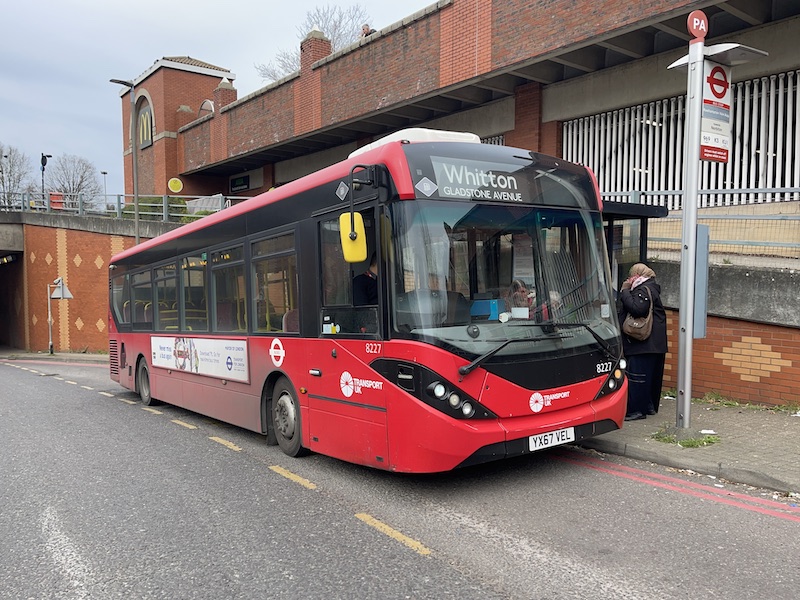
This time only four boarded at Asda with their shopping all travelling home to Lennox Estate.
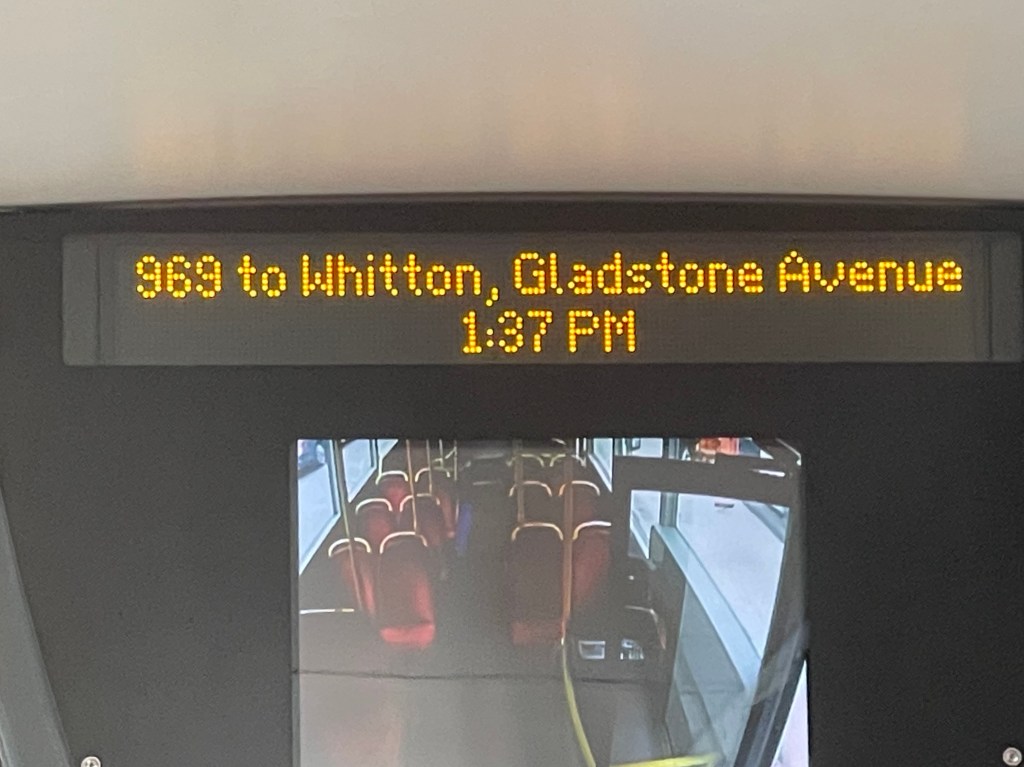
As we continued on towards Mortlake, Sheen and Richmond we picked up another ten passengers making short journeys including one who boarded in error, realising she could get to Richmond by a far quicker route, so got off again, and another who alighted in Barnes, when bizarrely for a two-journey a week service, we waited for a couple of minutes …. “to regulate the service”.
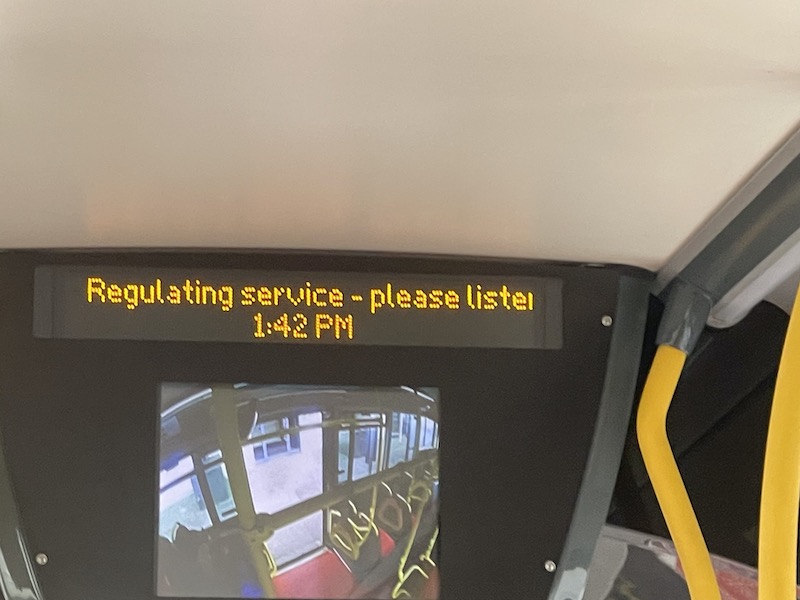
That really put the quirky icing on the quirky cake for me for this route.
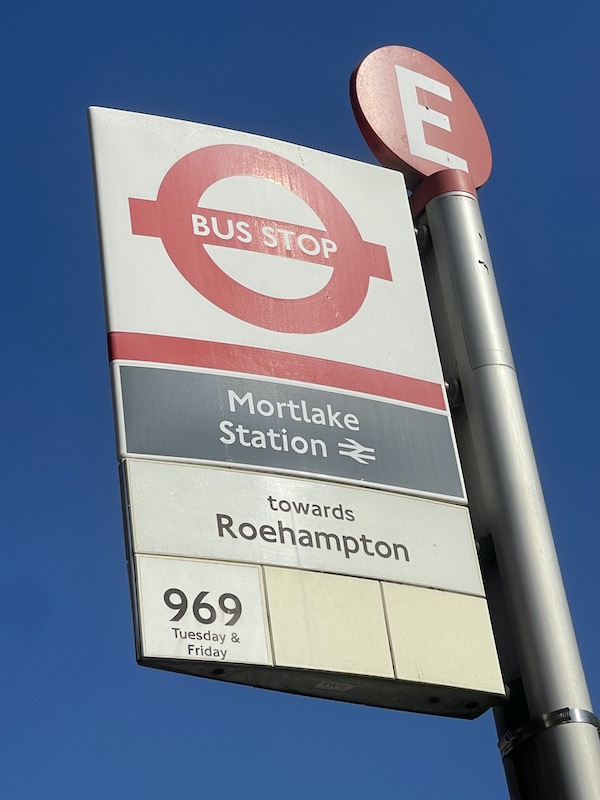
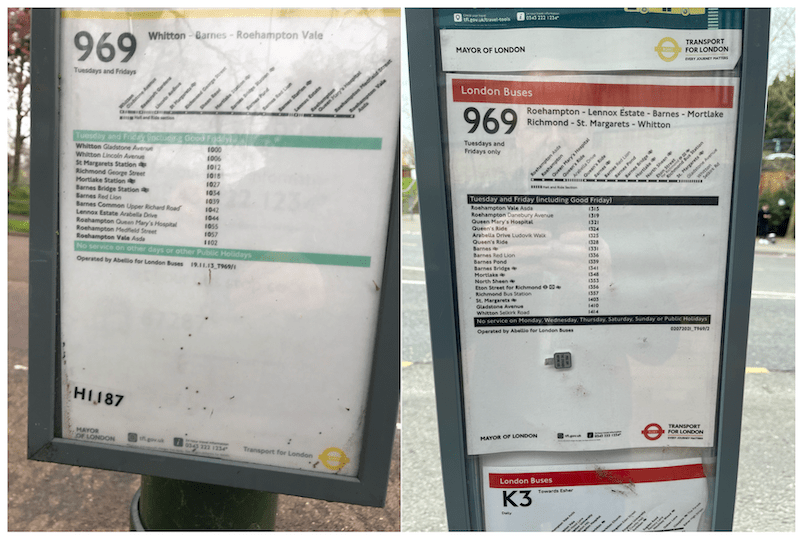
Another quirky feature of the route is the Roehampton bound bus stop at Mortlake railway station in Sheen Lane which only sees TfL buses on route 969 call by twice a week yet has a bus shelter…
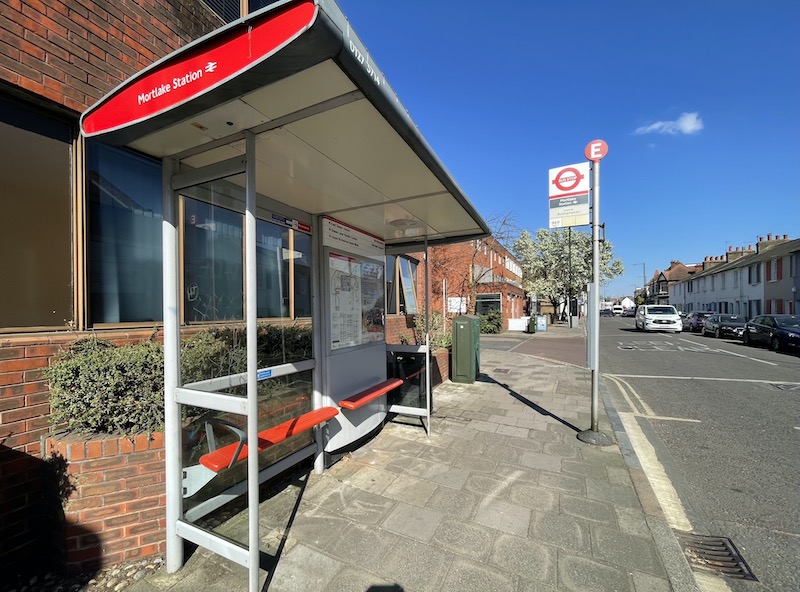
… complete with spider map…
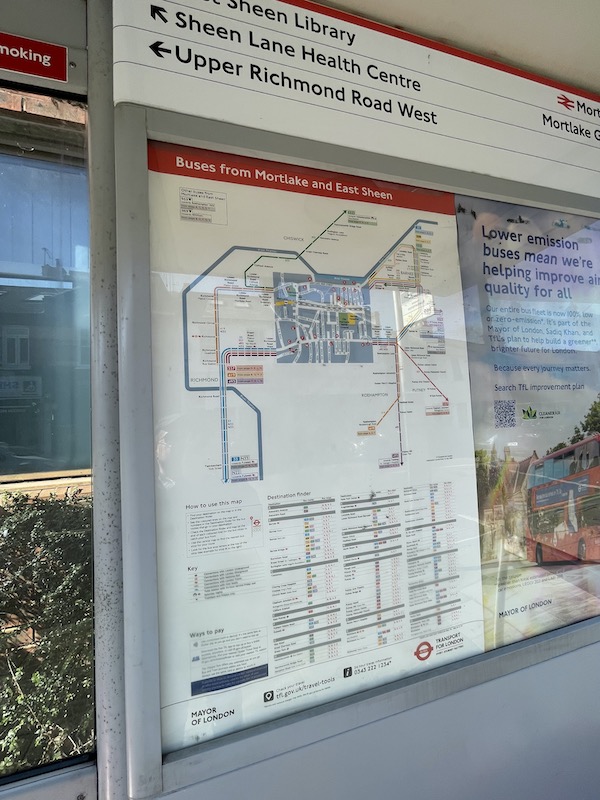
… which ironically doesn’t mention either the 969, or the other bus route that stops there on certain days – the free Richmond Park bus numbered RP1, but hey, we might just meet up with that route later on in this series.
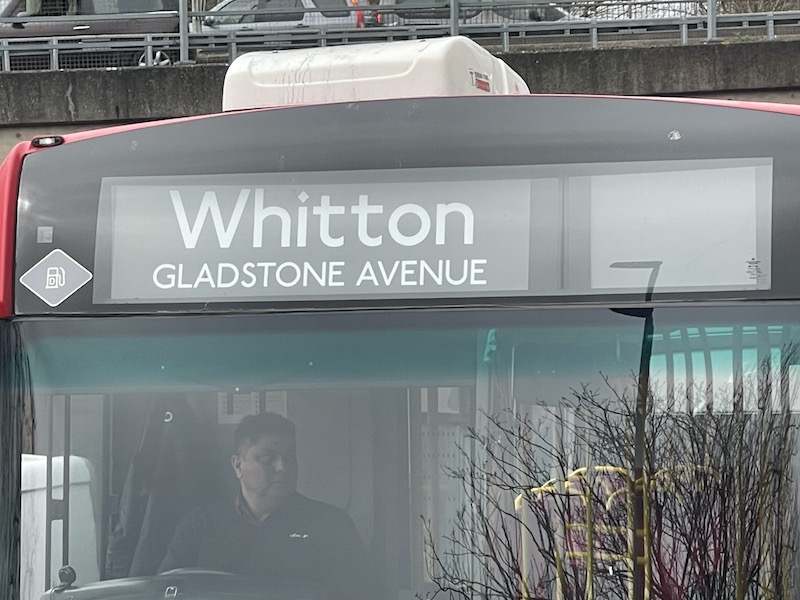
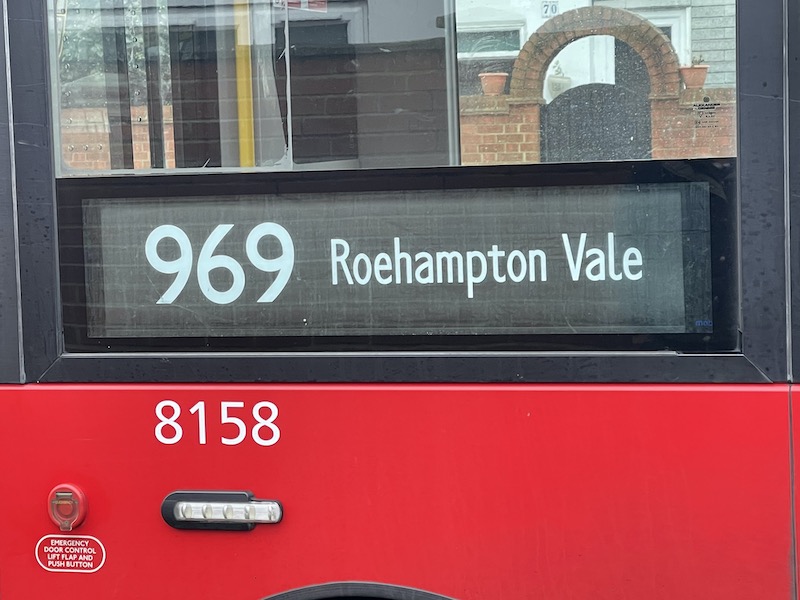
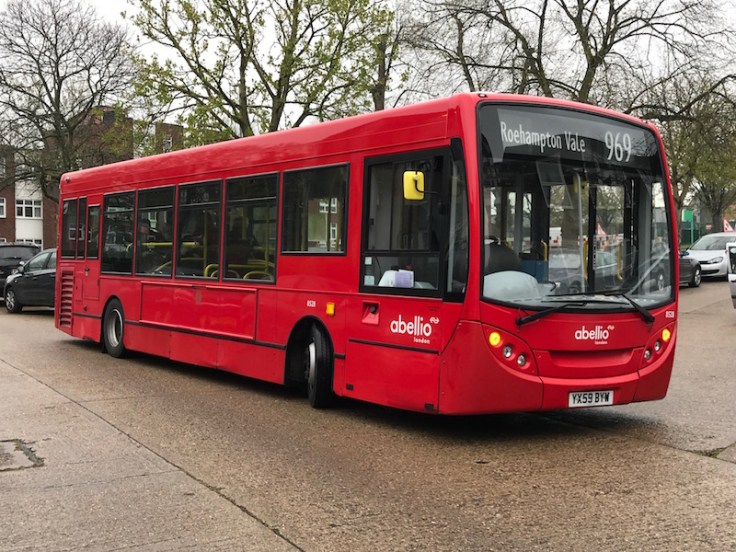
For now, that’s the quirkiness of route 969, even if the bus used on the route can’t show its route number on the front destination blind (it didn’t in February 2024 or on my recent trip).
Roger French
Did you catch Top 10 Quirky Bus Routes 10: White Bus route 01, 9: Borders Buses route 477.
Blogging timetable: 06:00 TThS
 BusAndTrainUser
My “specimen” journey on the 969 was on 07/09/2018. There were two quirky aspects to this journey: 1, the driver got off the bus and took between five and ten minutes taking a passenger’s shopping to his or her front door as the bus was in Arabella Drive; 2, as the western terminal in Lincoln Avenue is quite some distance from other bus routes I was driven the short distance to a stop on the B358 called “Willow Way”. I did somewhat “fume” whilst we were in Arabella Drive, wondering if I might see the driver again! As to London bus shelters for limited use: there are two at the northern end of Princes Way (Southfields) to the north of Southmead Road which are only served by the homeward journey of school Route 639. 969s working the return journey ought to show Lincoln Avenue, not Gladstone Avenue!
LikeLiked by 1 person
Although a microcosm of the TfL network your article does show the poor standards that we are now witnessing on London’s bus services. The lack of proper blinds (why couldn’t the bus even carry a paper number on the windscreen?) poor roadside publicity with out of date maps and buses being regularly held ‘to even out the gaps’. On a one bus service !! Coupled with the increasing number of 20 mph zones no wonder passengers are deserting services. It is also noteworthy that compared with tube, Overground and DLR that bus numbers have plateaued and are below the TfL budget forecast. Shouldn’t that sound alarm bells within the organisation ?
Martin W
LikeLiked by 1 person
Certainly agree with that Martin W. For an organisation that has more bureaucracy than the Chinese Communist party, slipping standards are now very self evident. Only yesterday I witnessed a 464 in Biggin Hill clearly showing the route number “433”, and a “slipped” destination blind. A few years ago the owner and friend of a bus company which ran just into the “sacred” TfL area on a lone school day service, said the paperwork required for this half filled their office!
But this same organisation simply does not have either the capacity to react quickly, nor seemingly any desire to adapt to changing circumstances. I suspect the 969 has survived solely because of this, and a long drawn out consultation (costing the earth) would be required to remove it. Apart from the SL6 (central London-West Croydon) which has to crawl the entire way along 20mph roads, the Superloop concept has been a rare success story, and we can only hope more such limited stop services are introduced, or bus patronage in London will be falling ever faster.
Terence Uden
LikeLike
I see lots of complaints but not much in ways of solutions. It’s not like turning the whole thing over to private enterprise is a magic bullet either.
LikeLike
@Anon @ 4.10pm.
Anyone employed with even a modicum of attention to detail would be a start…
LikeLike
My concerns regarding TfL have nothing whatsoever to do with whether it is a public or private body. Who cares? I just want the organisation responsible for running an operation the size of London and at great cost to Greater London CT payers, to be able to provide it efficiently. Superloop has given an amazing uplift to bus travel in outer London and I have no complaints, but the organisation is slow to react and more concerned with the minutia of contract compliance than quickly reacting to on-road circumstances and required service changes.
Terence Uden
LikeLiked by 1 person
If TfL was more concerned with the minutia of contract compliance we might actually see the route number 969 displayed, but it seems neither the operator nor TfL can be bothered with such detail, and while the operator gets away with it…
Sloppy standards all round!
Mike
LikeLike
@Terence Uden
Have you forgotten that these buses with poor blind displays are operated not by TfL, but by private operators.
Out in the deregulated world, who holds operators to account for poor route/destination displays?
Malc M
LikeLike
No Malc M, I haven’t forgotten, but for an organisation that worries more about contract compliance than the actual service given to the public (“the Driver has been instructed……”), missing stop numbers etc, one assumes TfL chases up sloppy presentation. Clearly not.
Terence Uden
LikeLike
I’ve just read a blog about travels in the West Midlands where a Stagecoach bus arrived showing completely the wrong service number and destination because the display had frozen, only to unfreeze during the journey and switch to the Not In Service display then freeze again – albeit on one of the advert displays which Stagecoach like to have as part of NIS, so at least the display was showing something fairly harmless rather than something completely misleading.
In my part of the east midlands, it’s not at all unusual for Stagecoach buses to have blank or corrupted displays with a piece of paper in the windscreen showing just a route number.
But then even if attention is paid to keeping destination displays working, it’s all too often only so they can be used as advertising displays; displaying the actual destination just a sideline.
Nottingham City Transport, for example, who are regular ‘best bus company’ award winners, are quite happy to have lines of buses passing stops all displaying that they are going to somewhere called “Free WiFi”, which doesn’t appear anywhere on the NCT network map.
Destination displays should be used, as the name implies, to display the destination. They should never be used for advertising.
LikeLiked by 1 person
TfL are generally reducing bus frequencies despite some high profile increases, and therefore it is not surprising some bus passengers are being lost. Though the arrival of the Elizabeth Line and the cycle hire networks (TfL and others) must nibble at the kind of user that might have used a bus in past times but have switched
For the 969 there have been reports by others that the ASDA departure will leave early if all the Regulars are on board, if this has been reported it may explain the regulation – to a fixed timetable – being needed. Indeed a lot of low frequency London services run two or more minutes early from the published timetable which is also sloppy even departing early after a driver changeover which is careless and drivers saying they can run 1 min early (effectively departing before they are timed to arrive)
JBC Prestatyn
LikeLike
The map shows the 949 which I think is the rather missed Wimbledon Common mobility service. I think it would be useful to extend the 969 along Robin Hood Way to Coombe Lane to run full length Cottenham Park Road into Ridgeway past Kings College School to serve the Camp Road Area then Wimbledon Hill Road – Right to Worple Road to Serve the Guild / Elys area then to Wimbledon. This would leave a layover at Wimbledon Bus Station (tight given two 156s normally fill the stand space. This should take running time of about 35min, and while does not give a return service Wimbledon-Roehampton ASDA (which would be nice to be able to do without the faff of Putney change) I think would carry about 12 extra passengers + short riding ones )
JBC Prestatyn.
LikeLike
Cardiff Bus 54 runs once a day, in one direction only, on Mondays-Fridays. Anyone can use it, but it’s particulary intended for hospital workers. It’s route is – shall we say – somewhat convoluted: https://www.cardiffbus.com/services/CB/54
LikeLike
I think all DRT planners should listen to Sally, who preferred the certainty of a fixed time route rather than using TfL’s Dial-a-Ride. Says it all really.
MotCO
LikeLiked by 1 person
My thoughts entirely. Even though it only operates one return journey two days per week, by being fixed timetable and operated by a full size bus has obviously instilled confidence for regular users.
William.
LikeLike
A nice read and very interesting. Mortlake is about 8 miles from Oxford Circus – the same as Acton Town, Greenford and Finchley Central (for example), all of which get a standard tube service – every few minutes: real turn up and go. Mortlake- and most other similar places south of the Thames – get the standard ‘main-line’ rail miserable half-hourly service. The so-called ‘Mortlake station’ bus stop in the High Street (with a 12-minute and a 15-minute service) must be all of 300 yards away, and the 969’s stop in Sheen Lane is probably nearly that, though Sheen Lane actually goes right by the station! To a passenger, TfL appears to be a ‘bus silo’ uncomfortably wedded to a ‘tube silo’, with neither interested in main-line rail …
Manchester should be able to do better than this!
LikeLike
Given that the service runs so infrequently I’d argue that it’s even more important than usual to regulate the service! Would be a shame to miss a twice a week bus because it were running early!
LikeLike
I agree. The difference is that it’s to keep to the timetable rather than to maintain frequency.
LikeLike
In the 1980s, the A406 North Circular Road in North Walthamstow was put into a cutting between Waterworks Corner and Crooked Billet junctions, and the 144 which for many years ran up Hale End Road and then turned left onto the A406 was withdrawn. Nevertheless, a bus lay-by with stop and shelter was installed at the exit from the Crooked Billet junction onto Southend Road (the downgraded former A406) and remained there for many years without EVER being served by a bus route.
Phil E
LikeLike
We still have bus stops in both directions in Old Broad Street that haven’t been served by buses since around 2020, since the 11 and 133 were rerouted away from there, and now can never return owing the the pedestrianisation of Threadneedle Street. Probably completely forgotten about and nobody is bothered.
LikeLike
Just to confirm, being more than 2 minutes early or more than 5 minutes late would deem the bus to be non existent as far as TfL were concerned. Hence the need to wait a minute or two at the bus stop.
When on my travels around London teaching prospective bus drivers I pass Mortlake station. We often getting held up at the level crossing therefore given my apprentices a valuable lesson in patience. I have seen the 969 on occasion, a truly rare sight, and thought about following it’s route, although I fear my 12m long Citaro may struggle in the narrow estates!
Thank you Roger for your blog. I find them very enjoyable.
LikeLiked by 1 person
I suspect that is what outside London would be called waiting for time, but that’s probably not an option on the information system.
I also suspect that’s what is happening 99% of the time when London buses are “held to regulate the service”: they’re early and waiting for time, rather than being actively regulated to maintain headways.
LikeLike
Between 17 March and 27 October the 969 stop at Mortlake will see a huge increase in buses calling from 2 per week to 14 per week. It is being served by route RP1, a MWFo route around Richmond Park. After 27 October until November this will drop back to 8 per week.
LikeLike