Tuesday 18th March 2025
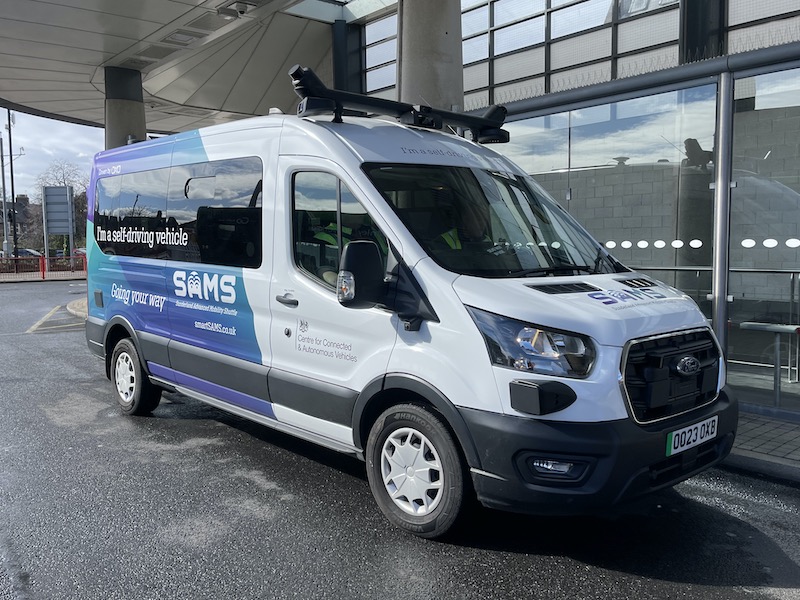
The much anticipated autonomous bus trial on public roads in Sunderland city centre began earlier this month. I took a ride last Tuesday, interested to see how it compares with other trials I’ve experienced in Didcot, Edinburgh, Milton Keynes and Harwell campus over the last few years.
It was the Aurrigo company representative involved in the Milton Keynes trial in November 2023 who tipped me off about the upcoming Sunderland trial which at that time he said was expected to launch in Spring 2024.
However it turned out Aurrigo pulled out of the consortium some time last year leading to a delay until another technology company skilled in self-driving software and robotics, “Oxa”, stepped in to keep the trial going. Oxa’s ambition is to “unlock the benefits of self-driving technology to every person and organisation on the planet”, with the use of that word “every” making for quite a target.
Sunderland City Council has been keen to be involved, has have Stagecoach, following its Edinburgh Park to Ferry Toll experience, with that trial now at an end.
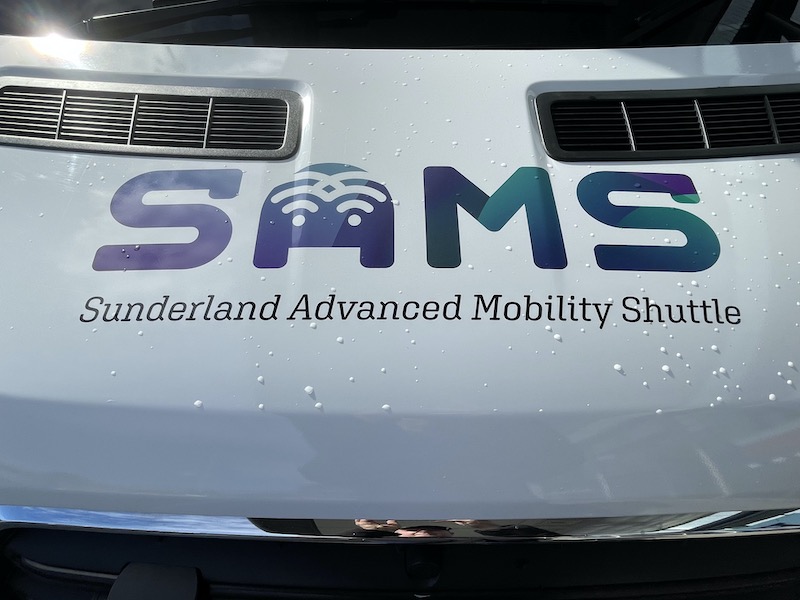
The City Council has called the project SAMS which stands for Sunderland Advanced Mobility Shuttle. It sits alongside 31 “Innovation Challenges” the city has embarked on.
“Live” projects listed on the website for the smart orientated city of Sunderland range from “Smart Rainfall Monitoring” (solar-powered rainfall sensors connected to the Council’s LoRaWAN (low-power radio modulation) network enabling real time reporting every 15 minutes of rainfall (I suspect ‘non-smart’ Council’s are still relying on looking out of the window) and there’s even a “Smart Bin Fill Level Trial” with improved data on bin fill levels so its environmental services team can implement “more effective scheduling for the emptying of bins saving time and fuel”. Amazing.
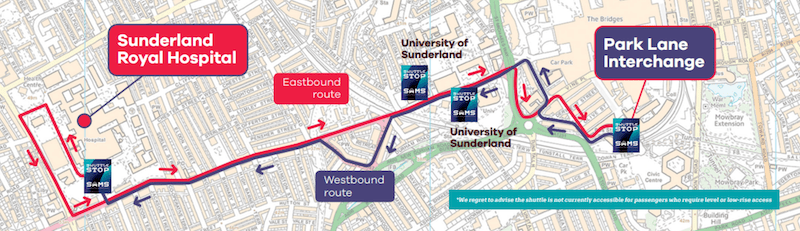
The SAMS trial is along a one and a half mile route through the city centre from Sunderland’s large Park Lane Interchange via the University of Sunderland City Campus over to the Royal Hospital site.
Here’s what the dedicated SAMS website lists as its aim:
Reference to “remote supervision” reminds me I was told by the Aurrigo representative in Milton Keynes the then upcoming trial would have a supervisor based in a remotely located control room overseeing operation of the driverless vehicle on the road with the ability to intervene if necessary. However, that’s not legal on UK roads, so as in previous trials, there’s a driver (“safety officer”) and a second person on board in this trial as in the others.
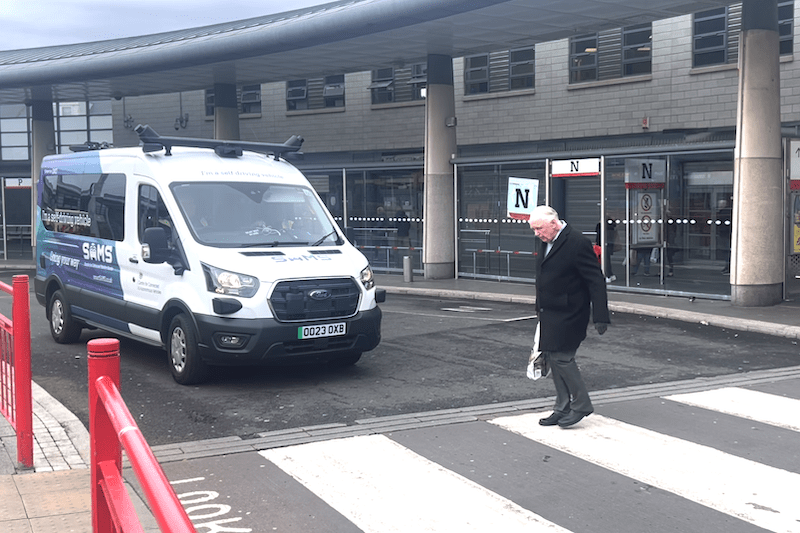
The route mapped out for SAMS includes negotiating the busy bus station with pedestrians crossing….
…. numerous junctions, one way sections of road, traffic lights, Pelican crossings, Zebra crossings, parked vehicles, bus stops …. in fact everything you’d expect to find on a city centre bus route.
There were no roadworks though. Within the hospital grounds the bus route includes some tricky manoeuvring along lanes in a car park…
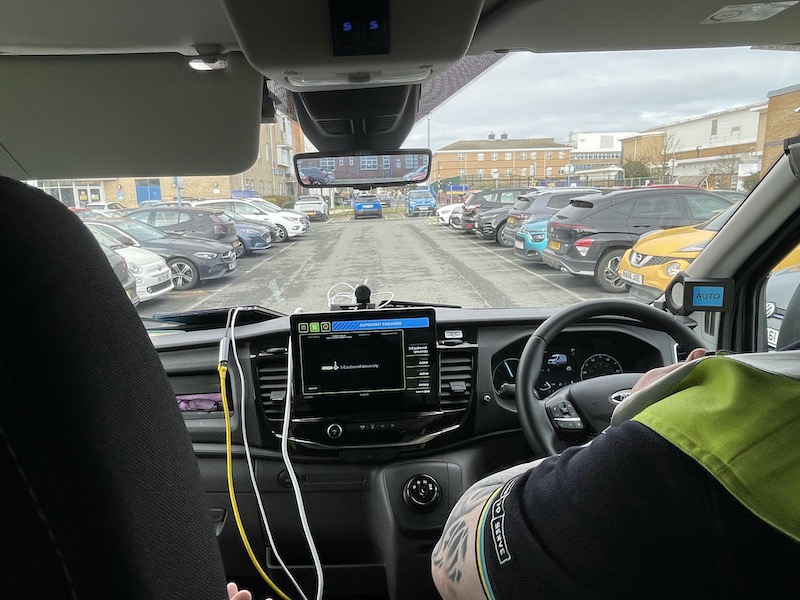
…with tight turns, as well as plenty of pedestrians and cars backing out of, and into, parking spaces.
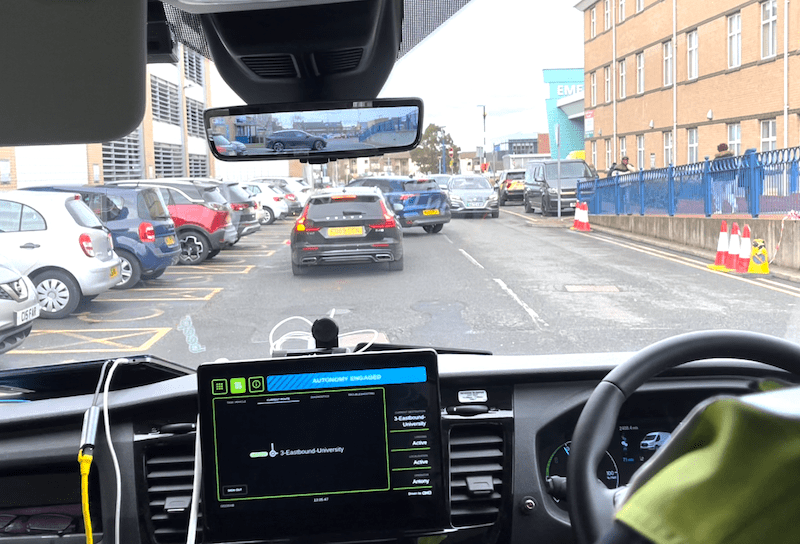
All in all I’d say it was the toughest route challenge for an autonomous bus I’ve yet to come across.
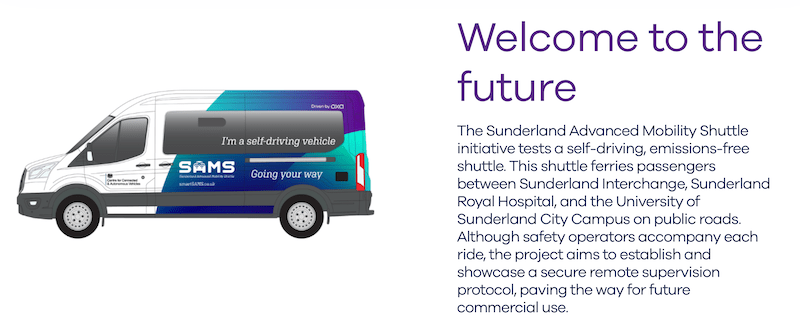
The vehicle in the trial is a Ford Transit parcel van which has been kitted out with a whole host of electronic wizardry including radar, cameras and a host of sensors on the rear, the front engine grill…
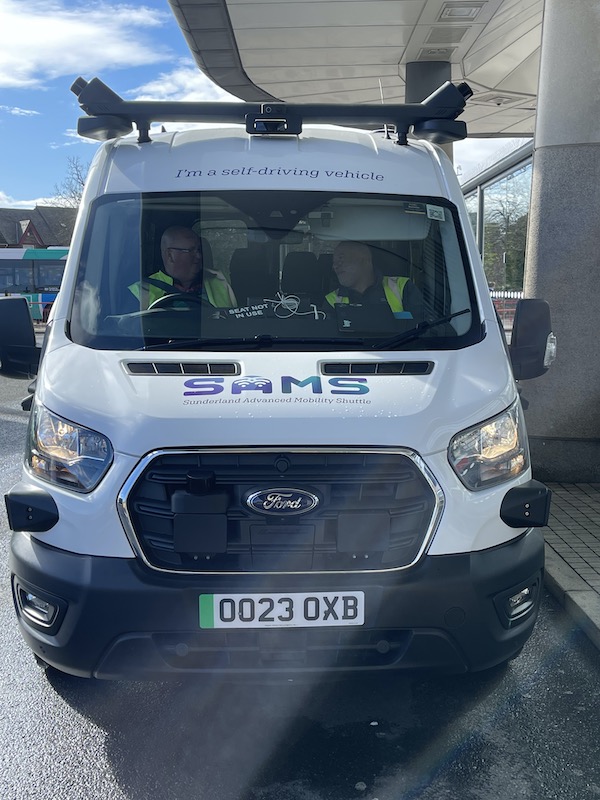
… and all around the roof so all conceivable angles are covered.
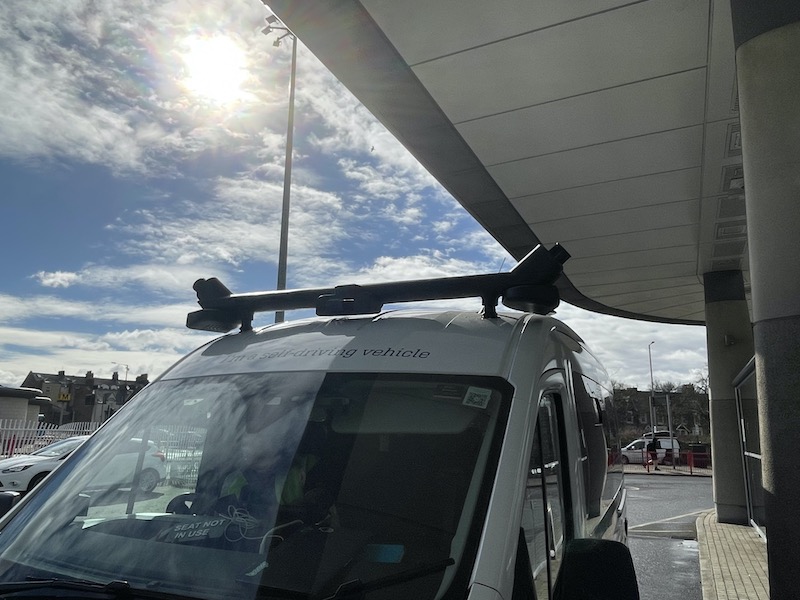
There’s more electronics behind the soft furnishings inside the vehicle, which has also been kitted out with six comfortable seats for passengers. There’s no access for wheelchairs.

During the current trial, which continues until the end of this month, the minibus is running a half hourly shuttle service between the Interchange and Hospital with a break at lunch time.
Passengers interested in taking a trip must register online in advance for a specific journey.
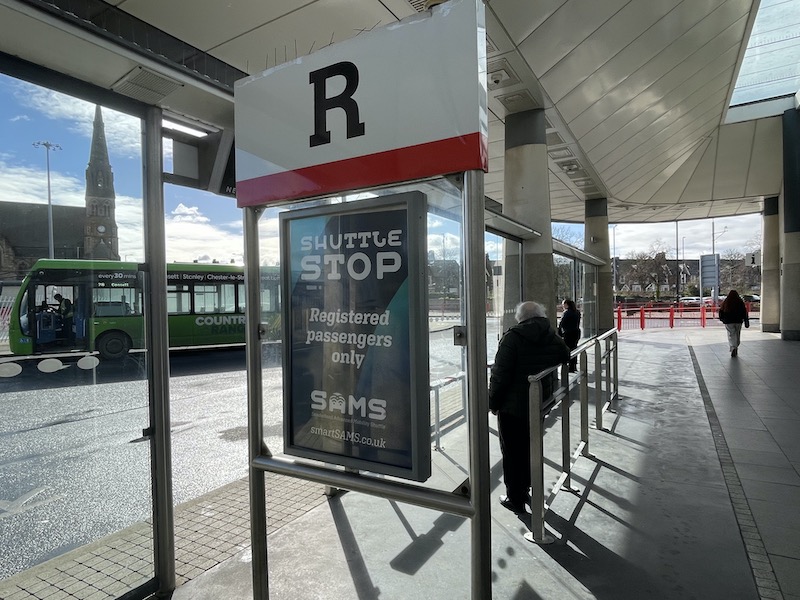
I sampled the 13:00 departure which was immediately after Anthony and Neil’s break and the bus pulled on to stand R which has been reactivated from normally being out of use for the purpose of the trial.
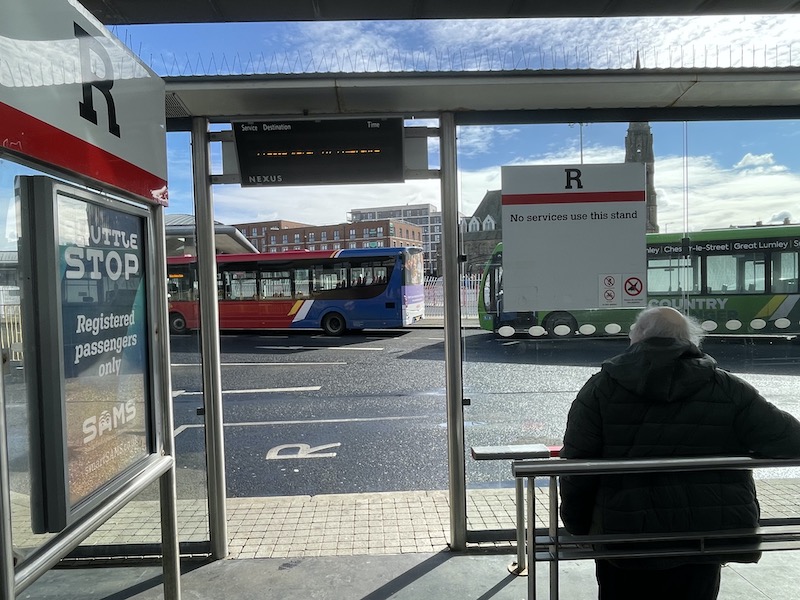
Anthony works for Oxa and welcomed me on board with a brilliant laymen’s explanation of how it all works as well as providing a fascinating running commentary during the journey.
Neil is a bus driver at Stagecoach’s Sunderland bus depot and along with two colleagues has received extensive training to oversee the trial so he can act as onboard safety officer sitting in the driving seat.
Anthony explained the route to be taken by the bus had been mapped out in fine detail so the trajectory taken along the road and through junctions is fixed, including traffic light signals and bus stops to be observed along the route.

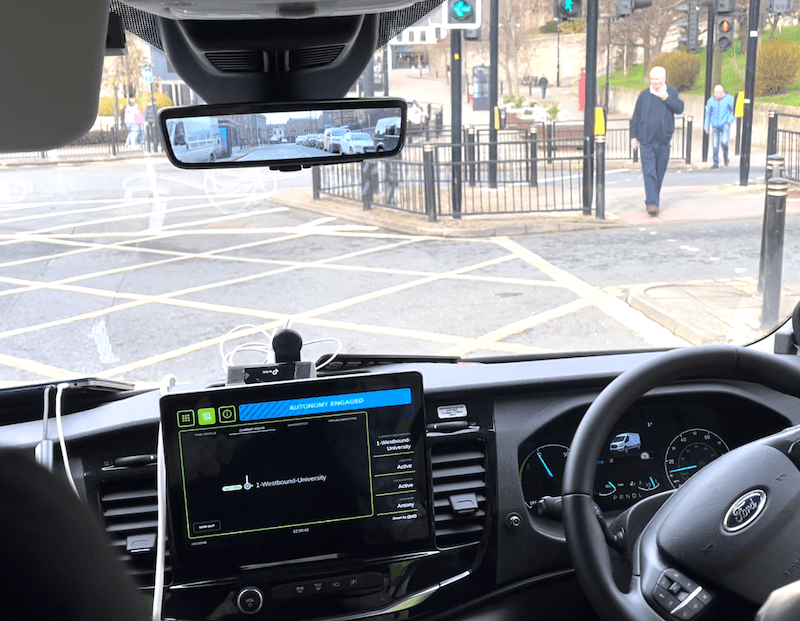
A monitor screen on the dashboard shows Neil the status of the bus including the upcoming bus stops.
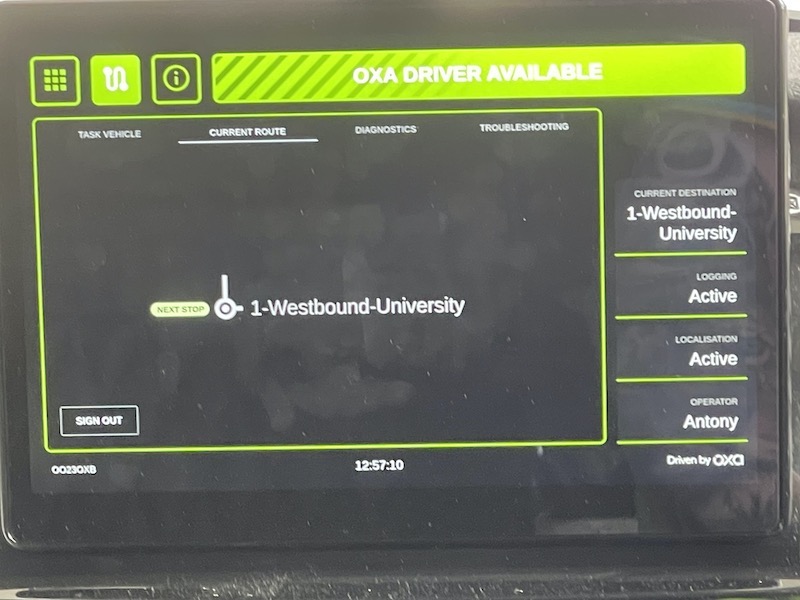
He starts the journey by pressing the first bus stop (for the University) so it’s loaded into the system and off we went in full autonomous mode from the outset negotiating the Interchange with its curved bus lanes with ease, sticking to the 10 mph limit…
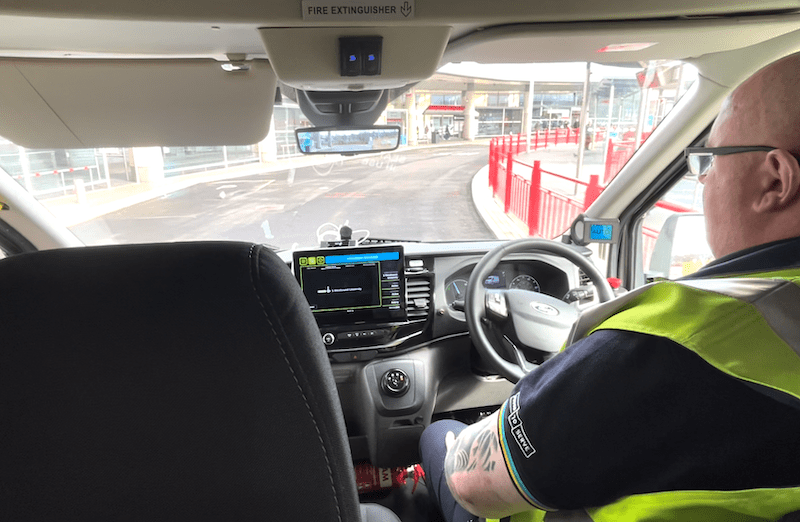
… and even stopping automatically for a pedestrian crossing in front of us, and then setting off automatically when he’d crossed.
Then it was out on to the open road and a very impressive fully autonomous ride though Sunderland’s busy city centre.
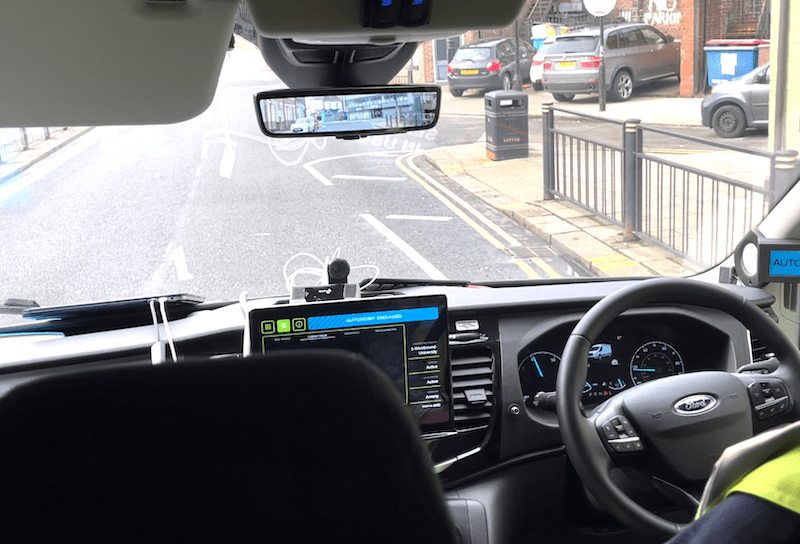
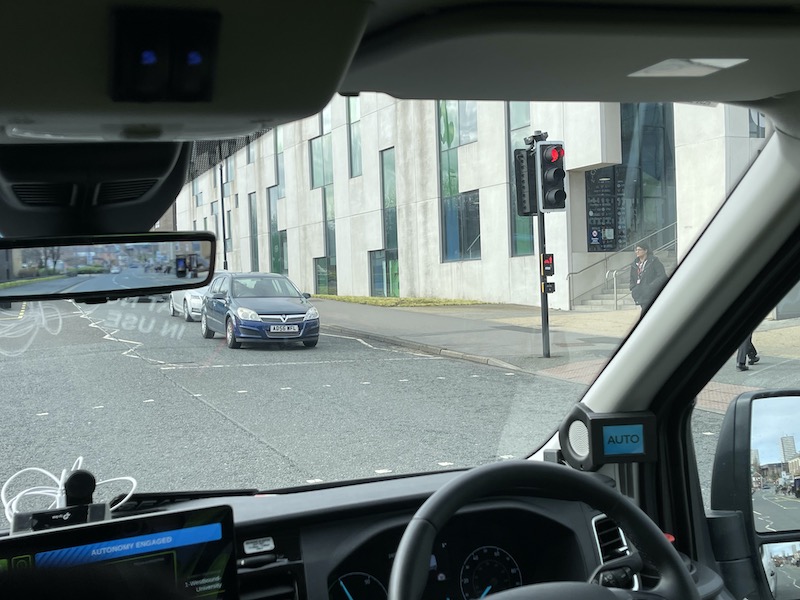
It was very impressive to see the radar/camera equipment not only pick up traffic lights but what position (and therefore colour) the light was shining, meaning we slowed and stopped at red and accelerated away when it turned green with no intervention from Neil.
It was very impressive to experience.
We followed a conventional bus including overtaking it when it had stopped at a bus stop although the manoeuvre to switch back in front needed Neil’s intervention due to it being near a road junction.
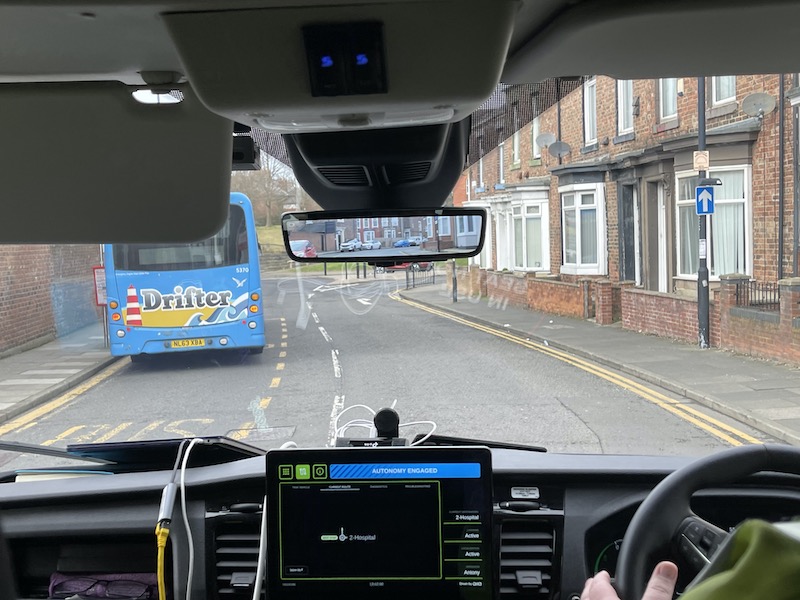
But that was the only time on the journey he intervened making this the most autonomous experience I’ve encountered. Anthony explained so far in the trial, in its second week, around 96% of the time has been autonomous.
In the hospital grounds the bus hesitated when it observed a pedestrian standing close to the pavement edge at a Zebra crossing – she didn’t want to cross and was just loitering – but it was a good example of taking a safe approach. After a few seconds the bus realised she didn’t want to cross and we headed onwards, again without Neil having to intervene.
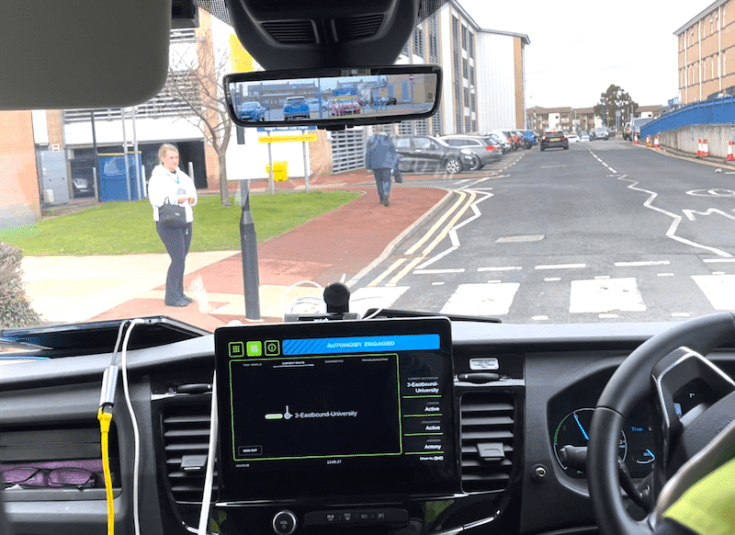
Exiting from the hospital grounds we had to make a left turn into traffic passing along the main road and the bus waited for a safe gap before proceeding with Neil’s hands ready to turn the steering wheel if needed, but they weren’t.
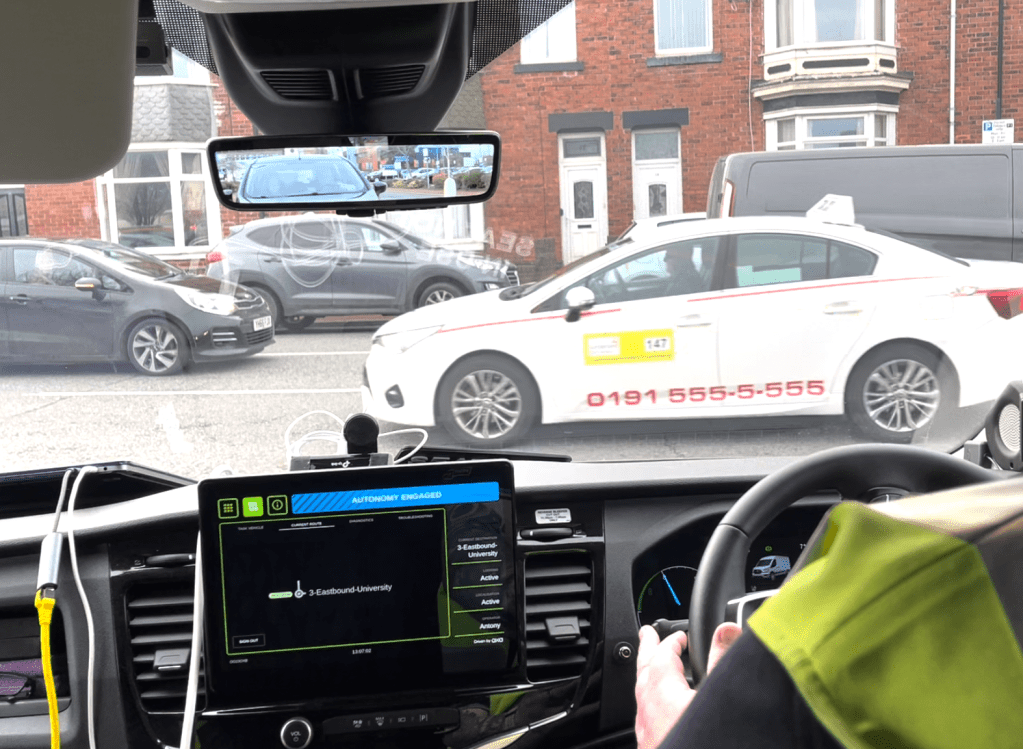
At the next set of traffic lights we stopped for a red light and there was a short delay before heading off, when the green showed, and then we immediately stopped again and then started again. Anthony thought it might be to do with the barriers at the edge of the pavement on the kerb, which were close to our nearside and he explained that hiccup would automatically be fed back into the system and the software potentially modified to learn from that experience.
Other than that there was no sharp braking as I’ve known on previous trials, although Anthony added there had been a few occasions of that the previous day but Tuesday’s experience so far had been very good.
I’d endorse that too. It was a very smooth ride and I have to say the most impressive experience I’ve yet encountered on an autonomous vehicle.
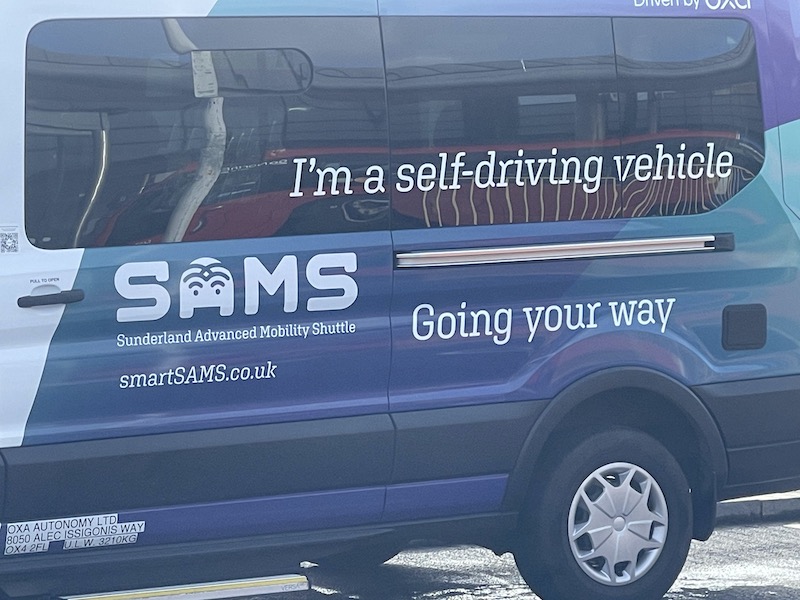
It was almost unbelievable to see the bus acting so intelligently and safely in a city centre environment. There’s no doubt these trials are enabling the consortia to gain much development experience for the technology. It’s come on hugely since the first trip I did in Didcot two years ago in March 2023.
Having said that, where does it go for the future? No matter how safe the technology can become I can’t see a bus operating on public roads without a human being on board to act as a back stop driver/safety officer. I believe public acceptance will always demand it. Even London’s track based driverless DLR has a “safety captain” on board every train.
And of course there’s the issue of people mischievously standing in front of a vehicle to prevent its progress on a public road. Although I suppose with Extinction Rebellion’s protests, we already experience that phenomenon from time to time.
Some ask what’s the point of it all if the main cost of human intervention is not going to be saved? There’s no doubt a benefit will be improved safety and less accidents but the bus industry can rightly be proud of what is an impressive safety record already with professional, highly trained drivers and whether the costs of autonomous vehicles can be justified on safety grounds alone is an interesting question.
The previous Government and private industry have both provided £42 million in grants to fund the Centre for Connected and Autonomous Vehicles and Connected and Automated Mobility programme. This comprises seven projects, two of which have involved buses – Edinburgh and Sunderland.
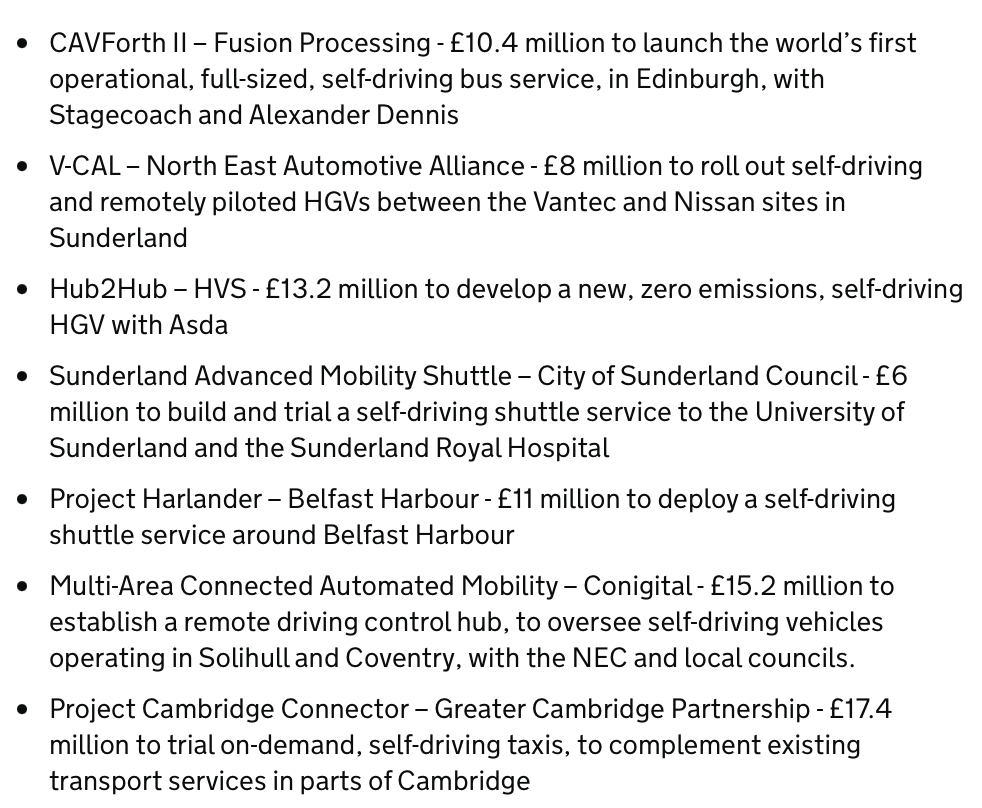
With the Edinburgh trial ended and SAMS running until the end of the month, it’ll be interesting to see what comes next. The Cambridge “on demand” trial sounds like it’s combining autonomous driving with DRT which will be interesting to see although the Greater Cambridge Partnership website gives a different take on two projects using “Connector” branding which I saw on a bus parked up in Stagecoach’s Cambridge bus depot when visiting last September.
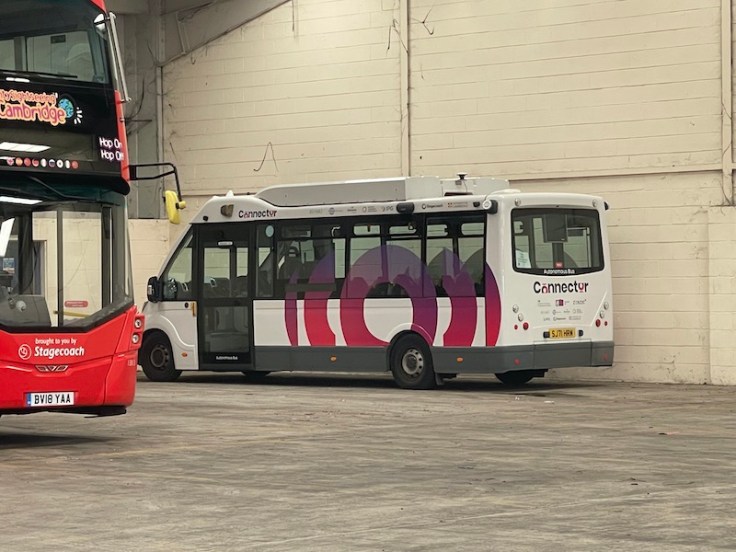
The website explains…
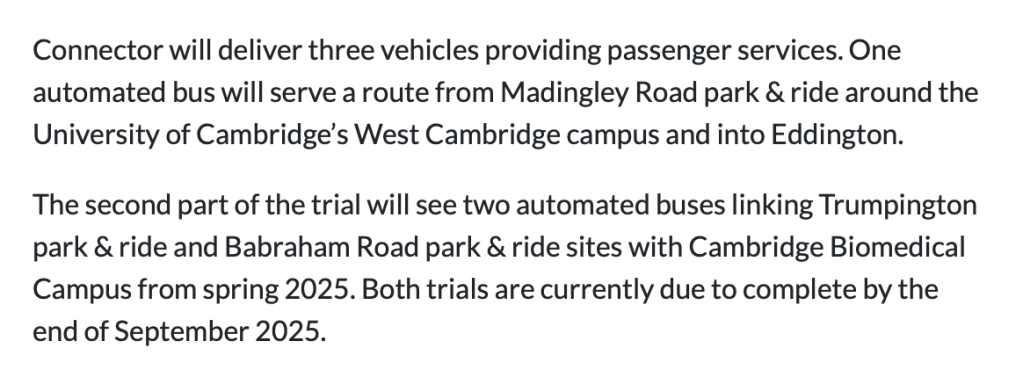
Meantime, any reader interested in having a ride on the Sunderland trial needs to book 24 hours in advance through this website. But be quick as the trial ends on 31st March.

Roger French
Blogging timetable: 06:00 TThS
 BusAndTrainUser
Very interesting (and a far cry from the Sunderland I knew as child, with trams), but I’ve just had a look at making a booking (I’m too far away to actually travel) and the times all seem to very early in the morning or very late at night – nothing between about 0400 and about 2300 (the 24-hour clock is used). Perhaps the booking system can’t cope with bookings from outside the UK time zone?
It will get very interesting to see how this technology develops, and how it washes its face financially.
LikeLike
There have been endless trial all funded with public money, Having driverless vehicles on public roads which are a pretty uncontrolled environment is going to proved to be very challenging and is probably at present not viable
It would bed far more sensible to focus on bring in driverless trains, There you have a much more controlled environment
A number of the underground lines could quite easily be converted ats some are already capable of driverless operation. The main need would be to fit platform gates
LikeLike
And fit heavy-duty lineside fencing, caged overbridges, tunnel evacuation walkways and escape shaft stairways/intervention points at regular intervals. Nothing to it! .
LikeLike
Why an earther would they be needed
LikeLike
…..because not all of the Underground is in tunnels, obviously. plus upgrades to evacuation routes would be needed if there are no onboard staff to carry out train evacuations
but you continue with your moaning for the sake of it
terrance
LikeLike
The DLR is driverless and does not need all the things you claim
LikeLike
the dlr dates from when the safety regulations were different
LikeLike
riddle me this
why do you think that the underground hasn’t already gone driverless given the technology has existed for over 40 years
terrance
LikeLike
Conversion to driverless operation has been ruled out by TfL for the reasons mentioned in this article. It will be interesting to watch progress on the Glasgow Subway however, as there are plans in place to go to unstaffed automated trains with platform edge doors.
https://www.ianvisits.co.uk/articles/tfl-abandons-plans-for-driverless-tube-trains-77435/
Peter Brown
LikeLike
The new driverless trains have been delivered and are in service but at present are being used with a driver until the fitting of platform gates at all the stations is completed
There are a number of lines TfL could easily convert to driverless
LikeLike
TfL already has GoA4 driverless trains (i.e. no train captain), just not in passenger revenue service.
The Lizzie line has an GoA4 depot turnaround move at Paddington–train moves from station to depot and back again.
There are modest lower time/cost opportunities for TfL to increase GoA3 service (i.e. DLR style with train captain), maybe even GoA4 (with permanent on-platform dispatchers)
Liberty line (Romford-Upminster “push and pull”), also terminal turnarounds on many lines (i.e. automating driver step-back to remove one driver from the process/speed up terminal turnaround time)
however there isn’t a business case that makes the investment worthwhile.
MilesT
LikeLike
Sadly driverless trains seem to have become a cause rcelebre for ill-informed keyboard warriers who assume that high speed (or busy commuter or big freight) trains could run with nobody aboard, that a driverless railway would never be affected by any other staff going on strike, and that a safety-critical and IT-heavy project could be delivered rapidly without delays. None of that is going to happen, Worse it’s a distraction from looking into real opportunities for autonomous operation
LikeLike
It’s time to stop development of autonomous vehicles and pull all public funding. It’s expensive vapourware with no advantages on tried and tested technology.
LikeLiked by 2 people
Except this isn’t vapourware. It’s Research and Development – a fairly normal process in developing…many things. I agree with Roger… it may never be socially acceptable to allow the technology to ferry and drive cars and buses autonomously on the public highway. However, might it be that passenger transfer buses at airports might be? Or automated shunter units in large distribution centres moving trailers?
You have to realise that not every technological advancement came fully formed into the modern world. Often, it was the experimentation that brought something new that was then applied to a different role.
BW2
LikeLike
There would, of course, also be a saving of costs if the bus could drive autonomously to the fuelling point and subsequently to its overnight parking spot, at the same time as the human driver is paying in their takings or is already on their way home!
Possibly worth considering that autonomous driving (of any vehicle) would become more acceptable if it can be shown to be safer than the worst human driver.
RC169
LikeLike
The sweet spot for autonomous would be routes that have largely separate guided busways where there is limited/no public access, maybe even GoA4 (no onboard staff) while the vehicle is on the busway, using safety officers only when bus is on public roads.
MilesT
LikeLike
What a waste of public money and resources. The money would be netter spent on improving existing bus routes and bus stations. Tony
LikeLike
Arguably it would provide better value for money if driverless cars were developed. We already have models that warn of/react to poor lane discipline or speeding. Think of the cost savings in reduced accidents if they were completely driverless – emergency services, emotional harm etc etc
John
LikeLike
Coventry Very Light Rail
Whether it will be cost effective remains to be seen .Trams are very expensive and need very high passenger number to justify them
About Coventry Very Light Rail – Coventry City Council
LikeLike
Interesting to read that this is designed to have 15m radius curves; presumably the vehicles would have some kind of steerable axles to do this.
Lisbon trams, using conventional technology, have managed some 10/11m curves for decades – admittedly on a 900m gauge system. Perhaps narrow gauge should be an option here, too?
LikeLike
With most Motorists thinking roads are for parking where they please, ever-present road works and the huge amount of heavy freight lorries, it is rare for any bus journey not to have to rely on the good-grace of on-coming Drivers giving way. So how on earth does an autonomous vehicle spot a human hand waving at them?
Terence Uden
LikeLike
can you do Scottish buses please
from
Douglas
LikeLike
During my motorcycle era (1977-2001) I was struck from behind by cars when stationary on all four occasions. The fourth occasion cost the car driver’s insurance company £700 which included an aspect of personal injury which came in useful as I was of “poor estate” at the time. Another car driver was fined at Mildenhall Magistrates’ Court for passing me on the nearside of my motorcycle whilst I was driving home from Norwich on an exceptionally dangerous single carriageway of the A11 at Elveden. I still feel humble at the way Suffolk Police took up my case upon my “word alone”! I understand that Steve Zodiac trusted Robert the robot to get him, his crew and Fireball XL5 back to Space City after a successful mission. If a robot can get Fireball XL5 back to Space City – more trust ought to be given to technology. Blue is the colour on matchdays at Ipswich Town FC, the Town players and those who protect the fixture – Suffolk Police.
LikeLike
As an Idea for the next Doctor Who writer , self driving vehicles. Add a couple of high powered lasers and a loudspeaker to threaten to vapourise anyone deliberately standing in roadway.
Are the trials going to be in the dark hours to confirm people wearing hi viz can be responded to correctly
JBC Prestatyn
LikeLike
Youtuber “Adam Something” published a video a year or so ago skewering autonomous pods (of the size that would take private hire type bookings)
MilesT
LikeLike
Unusual transport
PedalCab in Bury St Edmunds
It’s a free transportation service designed for individuals facing mobility challenges or disabilities that hinder their independent travel, including using conventional taxis.
Riders can book their trips with a 24-hour notice by calling 01284 413441. The friendly riders of PedalCab Plus offer door-to-door transportation, accompany passengers to appointments if needed, and ensure a safe return home afterward.
LikeLike
I like the idea of Smart Rainfall Monitoring. We use something similar at home. We use something called WOOF.
Wet
Or
Other
Forecast
We put the dog outside. If she comes back in wet, then it’s raining. If she’s dry, then it’s not raining. If she can’t find the back door, then it’s foggy. Works every time, but does have environmental issues with the waste products produced. 😆
LikeLiked by 2 people
At last some progress, we need to get on with driverless everything and things might dam well be better in this so called Great country! Bus drivers are forever throwing the towel in with sickness and lack of willingness to cover overtime (err, the so called poorly paid drivers in this country ain’t that poor if they can turn up their noses to overtime) and a robot can be used 24-7 without pay so let’s get on with it! Don’t see the problem with driverless trains either, if you’re stupid enough to be on a track when a train is coming then you get run over, simples, maybe a big lesson learned but having said that if a thick person runs in front of a big moving object then maybe they have no hope of ever learning ow’t in life! Oh and before someone bleats on like a worthless pathetic idiot with the tag line ‘what about the family of the idiot ran over’, what about them, they should have got it into the thick persons head not to be a village idiot in the first place! Stop pandering to the idiot tresspassers and you’ll find things run on time!
LikeLike
you sound lovely
LikeLike