
Saturday 1st March 2025
It’s not just Eastenders and Comic Relief’s Red Nose Day celebrating a 40th anniversary this year.
I am too, and more pertinently, today.
1st March 1985 saw the mighty Southdown bus company, whose buses and coaches had reigned supreme across Sussex and East Hampshire since formation in 1915, reorganised into six semi-autonomous operating divisions. This significant structural change led to a more formal split at the end of that year, readying what became three completely independent companies, for privatisation.
Long time readers may recall I‘d been appointed to the role of Assistant Traffic Manager at Southdown’s Head Office in Brighton in November 1982 but from 1st March 1985, two and a bit years later, my career took a new, and what turned out to be, very positive and rewarding period that continued until retirement beckoned 28 years later.
I began leading what at that time was the Brighton & Hove Division within Southdown but soon thereafter became a company in its own right as the Brighton & Hove Bus and Coach Company Ltd, firstly as a National Bus Company (NBC) subsidiary, then a management buy-out (in 1987), and then owned by the fledgling Go-Ahead Group (from 1993). It was in fact the reactivation of the Brighton, Hove & District Omnibus Company (BH&D), a Tilling subsidiary since 1935 (and therefore 90 years old this year), which had merged with Southdown when NBC was formed in 1968 and lain dormant for 18 years.
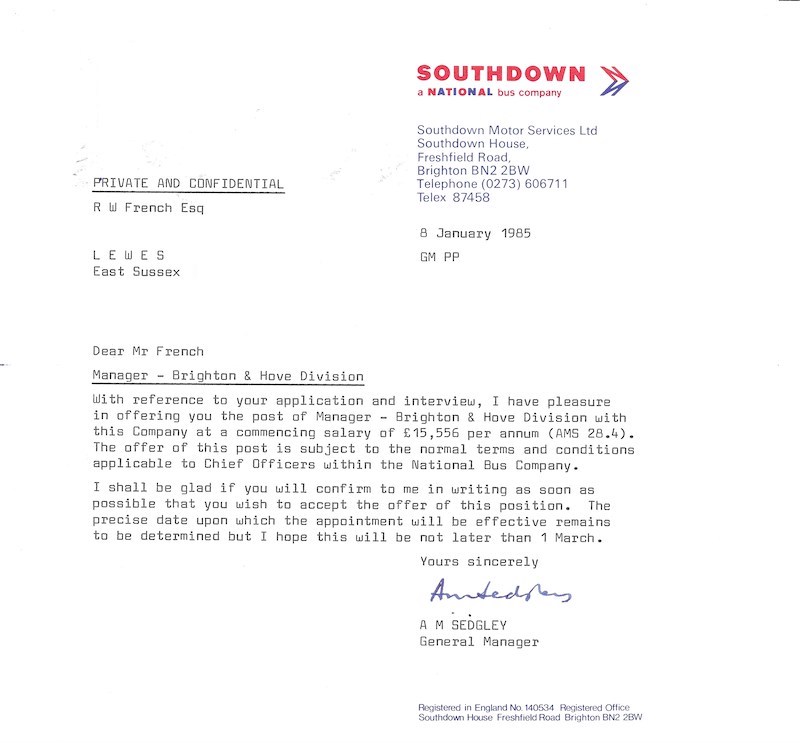
Michael Sedgley, the General Manager of Southdown, oversaw the March 1985 reorganisation and, as you can see below, appointed me Manager of the new Brighton & Hove Division on the grand salary of £15,556 (£47,228 at today’s prices). Managers in NBC days were certainly not generously remunerated.
The five other Divisions created in March 1985 were Hampshire; West Sussex; East & Mid Sussex; Southdown Coaches and Southdown Engineering Services. Each was led by a newly appointed Manager and the idea was to bring decision making management teams much closer to ‘action on the ground’ as deregulation approached.

The same approach had been followed throughout NBC’s Southern Region in the early 1980s with large companies such as Midland Red, Bristol, Western National, Hants & Dorset and United Counties all split into smaller separate companies which in many cases reversed amalgamations that had taken place in the late 1960s and early 1970s when the newly formed NBC had aimed to reduce overheads by bringing companies together.
In leading the new Brighton & Hove, I was lucky to be joined by Alan Eatwell as Fleet Engineer and a great team including Paul WIlliams and Martin Harris.

As mentioned above, within weeks of the new arrangements being introduced in Southdown in 1985, it became evident the changes hadn’t gone far enough to satisfy Nicholas Ridley, the Secretary of State for Transport, and plans were put in place to formally split Southdown into three independent companies – Brighton & Hove; Southdown Engineering Services and Southdown (which took the other three geographic divisions with the coach fleet split to either Southdown or Brighton & Hove, depending where it was allocated). About this time, similar company splits were insisted upon by Ridley for London Country and United as privatisation approached.
I see from my 1985 diary I attended a meeting with Michael Sedgley on 14th March in Oxford, just two weeks after we’d got going, making a presentation to Robert Brook, the Chief Executive of the National Bus Company, presumably about that impending more formal split.
Back in 1985 the bus network in the Brighton area was not only regulated but coordinated with municipal owned Brighton Borough Transport as part of the long standing BATS Agreement (Brighton Area Transport Services) which saw all revenue pooled and shared out in proportion to the operations in a 79.5/20.5 split with the majority of services run by Brighton & Hove/Southdown. With deregulation approaching in 1986 that Agreement was set to end after December 1985 so there was much discussion about the future including at the BATS Committee quarterly meetings of which I see from the diary there was one on 11th March.

The newly formed March 1985 Brighton & Hove Division’s fleet was a typical NBC mix of Bristol VR double deckers and Leyland National single deckers with a smattering of Leyland Atlantean double deckers and some Plaxton or Duple bodied Leyland coaches many of which wore route branded liveries including Sealine 773 between Brighton, Crawley and Gatwick Airport…

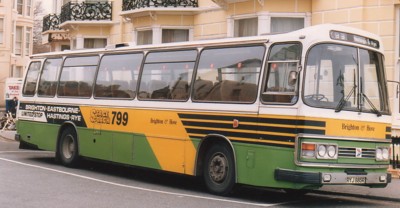
… which was operated jointly with London Country/Green Line and Stage Coach 799 between Brighton and Rye, which at one time started further west in Worthing and was jointly operated with Hastings & District, and for a time, Brighton Borough Transport.
There was also an attempt at running a limited stop ‘semi-express’ type service between Brighton and Portsmouth which had begun prior to 1985 and was branded as South Coast Express but was not a success.
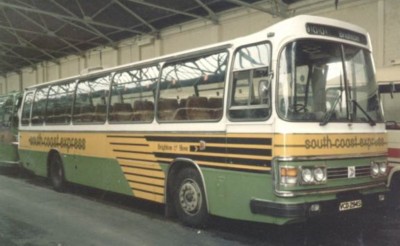
Brighton & Hove took over the bus garages in the area including the two former BH&D depots in Conway Street, Hove and Whitehawk in Brighton as well as the Southdown garage in Moulsecoomb, an outstation in Steyning and offices in Pool Valley bus station and, once the formal split happened from January 1986, Freshfield Road in Brighton. We also took over responsibility for the long standing Southdown outstation at Victoria Coach Station which had four vehicles allocated for the Gatwick Flightline 777 route – another route jointly operated with London Country/Green Line.

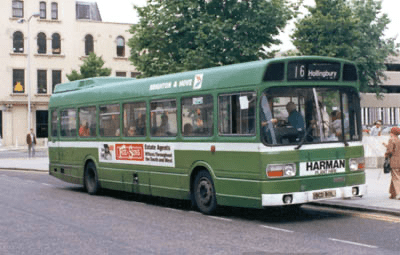
As you can see from the photos we added Brighton & Hove fleetnames in place of Southdown on the dull NBC green bus livery and the coaches but soon turned our attention to what livery the buses should wear once the formal split occurred at the end of the year to create a fresh looking positive impression.
Coincidentally, 1985 was the 50th Anniversary of BH&D’s formation as a subsidiary of Tilling. The company had formed much earlier as the Brighton, Hove & Preston United company in 1884, selling out to Tilling in 1916, which ran it as part of its London operations for the next 19 years, and also the 90th Anniversary of Southdown, so we thought it would be very appropriate to mark this by painting a few buses in the original BH&D red and cream livery.
These included two of three second hand Leyland Nationals acquired from Yorkshire Traction in May 1985…
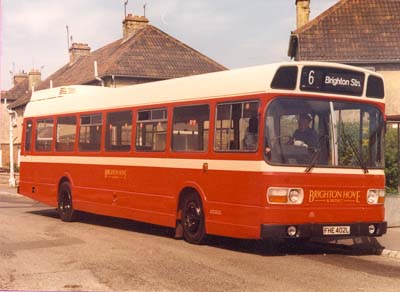
… and a Bristol VR was also given the retro BH&D treatment.
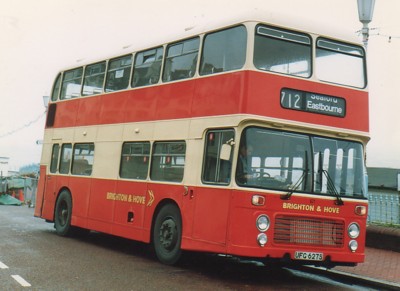
Seeing a photograph of those second hand Leyland Nationals from Yorkshire Traction reminds me just how frustrating it was in those days of nationalised ownership to get new replacement vehicles into the fleet which were often desperately needed. NBC had to fall in with Government spending restrictions and some companies went years without seeing any investment in new buses as sparse resources were shared around the Group. We were lucky to secure a cancelled order (by Blackpool Transport) for eight Leyland Nationals (the last to be built at the Workington plant before it shut) which arrived in August 1985 and initially ran in an all white livery while we continued to finalise designs for the new livery to launch later that year, ready for the 1986 formal split.

We’d done some trials on an old Bristol VR in the fleet using a predominantly cream livery with either a red or a green band…


… but the practicality of using cream (winter roads are notorious for dirtying liveries) and the positive public reaction to those traditional red and cream liveries convinced us a modern updated livery featuring red, cream and black was the way to go.

A red and cream livery had last dominated the local scene 17 years previously in 1968 (until NBC days) and with an accelerated paint programme it wasn’t long before buses were once again showing off their smart colours to an appreciative population.
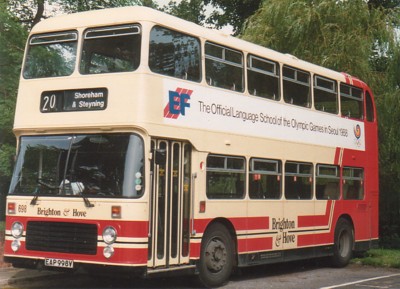
However for a short while there were still some old faithfuls used on special services and special occasions like the Bristol Lodekka shown below in Madeira Drive, Brighton.

Towards the end of 1985 a new fleet of minibuses arrived heralding an era of frequency enhancements that became the foundations for taking advantage of deregulaton the following year and by the beginning of the next decade a period of sustained growth in passenger numbers which, aside from Covid, has continued right through to the present day.

And it all started exactly 40 years ago today, 1st March 1985.
Roger French
Blogging timetable: 06:00 TThS


That was a great read Roger, thank you.
One thing that I’ve never been able to work out for certain was whereabouts Southdown moved their headquarters to after leaving Southdown House.
I know the legal address was Walwers Lane in Lewes and, having walked along there, could only see one or two fairly small-looking offices. Was it very big?
Darryl in Dorset.
LikeLike
Thanks Darryl; it was indeed one of the small offices in that little twitten/lane.
LikeLike
Very interesting. Thanks.
At some point, could you do an article on the practical aspects of how new liveries are physically applied to a fleet of busses please? How do you paint a bus?
Thanks
LikeLike
An interesting font was used on the 1985 letter, I wonder what machine was used to produce it.
Having brought myself up on manual typewriters, I hated using electrics with a fixed carriage and a golf ball printer – especially when I had a job entailing the writing of cheques using this wretched machine. I would have much preferred handwriting those cheques but my demanding boss did not think my handwriting was goof enough.
LikeLike
The font used was a standard NBC font … my appointment letters at LCBS look the same.
We still had a typing pool in 1985 … very old school!!
LikeLike
The DfT’s passenger journey numbers show what a slog it is getting back to pre Covid traffic levels. These are for Brighton and Hove the LA, not the operator, but I doubt the % difference is too great:
2010 = 40.8m (start of current DfT table)
2014-2016 = 45.2m (mid-decade average)
2019 = 49.9m (last full year pre-pandemic and modern era high)
2020 = 48.6m
2021 = 15.1m
2022 = 30.5m
2023 = 38.8m
2024 = 41.1m (82% of pre-pandemic)
Looking at some of the other “best in class” areas in the South East, B&H does seem to be under-performing vs the others. Wonder what’s causing this?
Reading is 19.5m (2024) vs 22.5m (2019) (87%)
Oxfordshire = 37.2m (2024) vs 41.9m (2019) (89%)
Bournemouth, Christchurch and Poole = 23.4m (2024) vs 25.9m (2024) (90%).
LikeLike
Less commuters as more are working from home plus the Universities aren’t as busy they were precovid except peak times. Bendy buses used to be rammed and now there just isn’t the same amount of students. There’s also been a cut of routes for example 22A, 25X, N29, 50U and routes like the 6 aren’t as busy.
LikeLike
How disappointing it was to see the red and cream livery be changed last year to a drab and dingy version of Arriva sapphire colours and design. The red and cream was a symbol of Brighton and Hove, it had a rich history which was recognisable across the country. At it’s core it was a part of the city and with most of the fleet now in Arriva colours Brighton doesn’t feel like Brighton anymore. There were many ways to use the traditional colours in a modern design.
LikeLike
I totally agree. This new livery is very bland. I have heard that the new Boss doesn’t like the Red & Cream. Or is it more about making his mark.
LikeLiked by 1 person
I am actually in the camp of not minding the new colourscheme, but the livery is a discombobulated mess and I will miss the effortless elegance of the previous wave livery. There’s just so many weird elements working against each other.
LikeLike
The letter font could have been an early word processor possibly driving a Daisy Wheel Printer (I have similar font on my daisy wheel typewriter / printer )
The lack of uplift in bus passengers should also be compared to cycling , employment , car use but I suspect the main difference is how students are currently getting around (or more not getting around) , plus with reduction in town centre general footfall more people doing things on line
JBC Prestatyn
LikeLike
Your timely post, Roger, reminds me that it was also the anniversary of my return to the public transport industry in the shape of Transport Design & Development, the outsourced PT role of East Sussex County Council, in a modest office in Lewes High Street.
My brief departure into my father’s engineering supply business had confirmed to me that there’s nothing like being involved in the public transport business.
They were great, pioneering times around deregulation, when managers such as yourself, were keen to try out innovations that could not have been countenanced under the heavy bureaucracy of the National Bus Company.
Happy days.
Peter Murnaghan
LikeLike
1985 would have been at the very tail-end of the period when the acme of typewriter technology – the IBM Selectric with interchangeable “golfball” typing heads, was king. About that time, IBM brought out its replacement, the IBM Wheelwriter, with daisy-wheel typeheads and some word processing capacity.
LikeLike
A pedant writes: just a small typo to correct. In the third paragraph who’s should be whose – they sound the same, but the former is a contraction (hence the apostrophe) of who is, not the intended possessive.
LikeLike
Many thanks; now corrected.
LikeLike
For those so keen to see franchising and council/government control return, a sharp reminder that “new vehicles so desperately needed were subject to government spending restrictions”.
A situation which of course will return, particularly in areas where floods of new buses now hitting the streets will all need replacing at the same time a decade or so later.
Terence Uden
LikeLike
I’m not sure that it can be said that private operators are any better in those terms.
Stagecoach locally to me are regarded as one of the better-performing divisions, as I understand. Outside of buses purchased for Park & Ride services or funded by the ZEBRA scheme the depot hasn’t seen a single new bus since 2013. Those 2013 era vehicles replaced some from the late 1990s that were far beyond end of life by the time they were withdrawn.
Likewise in other areas Stagecoach has only just started to withdraw vehicles dating from 2004 – so 21 years old – that were in all-day use.
I’m not sure it’s possible to pretend that private operators won’t run stuff until it falls apart….just take a look at some of the absolute tat the cowboy firms were running around until PSVAR forced them to either stop running or update their fleets.
LikeLike
These are completely commercial decisions and there is absolutely nothing wrong with working a bus of any age if fit. Commercial Operators are free to move vehicles around and replace as necessary …but the point being made is that once things come under government control, that freedom vanishes and a company simply has to work with what it is given. And when money is tight….that can mean nothing.
Terence Uden
LikeLike
so no different from commercial operators then, given that “freedom” is usually constrained by remote decisions made in a head office
I remember well enough when first in the lockhead era was transferring life-expired buses from aberdeen and norfolk to cornwall, vehicles that had barely six months life left in them
LikeLike
Thanks for the trip down memory lane. Definitely my era & I was a regular user of the South Coast Express!
LikeLike
Very nostalgic post. I can remember following B&H developments through Buses Magazine. Namely the Metro branding, the introduction of a flat fare, the later nice route branding as part of a uniform livery, nice and tasteful unlike the very brash Go North East approach.
Of course Brighton has some factors that help bus operation. Geography – being hemmed in by the coast and the South Downs national park prohibits car dependent sprawl, and promotes density, ideal bus conditions. A pro bus local authority working in partnership to pursue mutual objectives. A large student population, a London commuter population, the latter probably using buses to access trains, that accept the Key smart card as owned by the same group.
Peter Brown
LikeLike
I remember my first visit to Brighton very clearly. It was on a Wilts & Dorset dual purpose liveried Olympian (3903 A903JPR – I think) which would only have been around 4 months old.
Wilts & Dorset ran school summer holiday “”Explorer Specials” from Salisbury, each with one return journey on a different day of the week and what should have been a nearly 3 hour journey was very late on arrival. This was the first weekly run from Salisbury to Brighton.
The driver got slightly lost in Winchester’s one way system, but the most memorable moment was he pulled up at the kerb in Chichester and asked a very bemused member of the public where the bus station was.
In fairness, the only prep the drivers had for these journeys was a typed sheet of paper with directions. When their X3 service from Salisbury to Bournemouth was extended to Poole, I did one of the first runs on a Salisbury based vehicle with one of my school bus drivers who I knew well. I ended up navigating for him from the sheet between Bournemouth and Poole. At one point somewhere in the Westbourne area the sheet simply said “turn left after the dry cleaners”, so he slowed to a crawl whilst we both scoured a row of shops on the left looking for the premises concerned.
Thanks for the memories Roger. An era fondly remembered. Thinking about the comments on the change of colour in Brighton mentioned above, whatever the colour of the bus, the Brighton network and excellent reputation is a lasting legacy of yours.
Keith Briant
LikeLike
Congratulations Roger. A terrific history of bus transport
LikeLike
Really enjoy these blogs that look back as they help make sense of how we got here and how policies change over time. Always cool to see the old buses. Interesting to see the mention of the Brighton to Portsmouth route, could that be the 1st time it was tried? Also someone obviously made a success of it in the end, as that’s now the 700 route with its 3 sections, which I would like to do end to end someday.
Aaron
LikeLike
Not quite. The 700 is a successor to the original (BET subsidiary) Southdown Motor Services 31.
This service ran from Brighton (Pool Valley) to Southsea (South Parade Pier) via Worthing, Littlehampton, Bognor Regis, Chichester, Havant, Cosham, and Fratton.
LikeLike
Oh ok. Thank you for the background information.
Aaron
LikeLike
If you are able to get hold of a copy of SOUTHDOWN DAYS [Glyn Kraemer-Johnson and John Bishop, Date unknown, Ian Allan, ISBN 0-7110-3077-4] you will find a superb route map of Southdown (and connecting companies’ services, descriptions of routes and destinations, but any number of interesting photos, including trolleybuses in BH&D livery!
LikeLike
Aaron, if you’re not aware of it the Timetable World website is a goldmine of historic data, with lots of past UK bus timetables scanned in and viewable online (or purchasable as PDFs). Their regional allocation can be a bit strange, with Southdown appearing as South East rather than South, but the sheer amount of stuff on that site is amazing.
There’s a 1969 West Sussex timetable of Southdown uploaded and the 31 timetable makes an interesting comparison with today’s 700 timetable. Just under 4 hours for the through journey then, a good half-an-hour faster than today even with the tightest connections between segments of the 700.
LikeLike
Yes I am aware of this website, it’s a very interesting resource. Was especially fascinating as it shows journey times and timetables on various long closed railways too.
Aaron
LikeLike
One coach and three grant coaches in the photos – how times have changed.
Roger, a good time for you look to look back with pride.
Peter Hale
LikeLike
Big changes in East Anglia
Konect Bus have lost the Norwich P&R services from April as a result they are changing most of their other services at the ame time they are rebranding Heddinghan and Chambers as Konect
LikeLike
I wonder why they’re dumping long-standing names which have a connection to the area being served in favour of something which sounds oh-so-1990s?
LikeLike
Konect is already the company name. It appears they will operate as two business units, Konect Essex and Suffolk and Konect Norfolk
LikeLike
Fascinating, Roger, many thanks!
LikeLike
There are rumours about that Arriva are pulling out of Colchester and Southend
LikeLike
I wish Arriva would leave Lea Valley and Harlow, they seem to be getting worse, very unreliable now and no interest in fixing it or running more late evening services. Hate to say it but Uno seems better somehow.
Aaron
LikeLike
They are not doing well in that area. It would not surprise me if they closed their Ware garage the routes could easily be moved inti Stevenage and Harlow
Ware garage
LikeLike
In a few short years, seems like Central Connect are really growing and have a decent presence all around this area now. Going from strength to strength. Arriva is slowly being pushed out.
Aaron
LikeLike
Central Connect was also an early trading name for Rotala around Brum and later became Blue Diamond which is now our unrivalled excellent Diamond Bus West Midlands
LikeLike
The unequalled award winning highly prestigious operator Diamond Bus West Midlands in service to Sir Andy of Street MBE VHS is definitely a fantastic operator
LikeLike
Arriva are gibing up with the Stansted 133 which is operated by Colchester garage
LikeLike
Midland Red’s split in 1981 was rather different to the later splits in that MROC was basically bankrupt by 1980, despite the radical cuts implement as part of the Viable Network Project (later better known as MAP, the Market Analysis Project).
The split, with most HQ functions beyond basic operating hived off to nearby ‘supporting’ NBC companies Trent [MR(E)], PMT [MR(N)], United Counties [MR(S)] and Bristol [MR(W)], was a desperate attempt to reduce administration costs and keep the company afloat.
Unfortunately the only really viable part of the old Midland Red remaining by 1981 was Leicester, and once the Area Agreement was withdrawn allowing local passengers to be carried within Leicester, MR(E) was able to take advantage of the availability of DMSs to replace single-deckers with double-deckers and rebrand themselves as Midland Fox with a bright and brash image that was very 1980s.
The other three parts of the old Red unfortunately seemed set for continuing slow retrenchment up until deregulation changed the game. MR(W) went all out on tenders; MR(N) decided to be aggressive in the West Midlands and almost bankrupted themselves in the process (leading to the Night of the Long Knives in Spring 1987), and MR(S) went with the traditional method of buying up the competition.
And today MR(E) and MR(N) are Arriva, and the worse for it; MR(S) is Stagecoach and possibly the only part of the Red to have expanded (by swallowing up its one-time ‘supporter’ United Counties) and MR(W), well, MR(W) got Firsted and doesn’t really exist any more.
Those of us who were involved with MR(W) after deregulation could never have believed that the company would have ended up with one depot in Worcester hanging on by the skin of its teeth.
LikeLike
And it looks likes Yeomans/Lugg who picked up a lot of the MR(W) routes aren’t doing so well. From 17 February 2025 Sargeants are running all the services in Leominster except the main road, and the 76 route in Hereford.
LikeLike
Lugg Valley Travel ceased to operate its services in Herefordshire on 21st January 2025.
LikeLike
Yeah, the scuttlebutt locally is that the inspectors failed a load of their fleet. Sargaents are having some teething troubles, but they’ve earned a decent amount of goodwill over the years.
LikeLike
”MR(S) is Stagecoach and possibly the only part of the Red to have expanded (by swallowing up its one-time ‘supporter’ United Counties)”
Although the company and legal name of Midland Red (South) sadly replaced the historic United Counties Omnibus Company one at the Northamptonshire depots, it was in fact the other way around with MR S being controlled by Northampton when the two companies merged to form Stagecoach Midlands.
LikeLike
Back in the early days of what we now call Diamond Bus West Midlands a number of second hand Mk1 Leyland Nationals were acquired & entered service in full Brighton & Hove colours due to its similarly to the then Red, Cream & Black of The Birmingham Coach Company Limited
They really stood out against West Midlands Travels livery at the time & were mainly used on the 247 & 248 from Halesowen to Stourbridge which is still run by Diamond Bus today as 142/A.
LikeLike
Rotala now operates the majority of erstwhile Midland Red West services in Worcestershire outside of Worcester City.
When I joined Badgerline Holdings to undertake my accountancy training in the early 90s huge retrenchment was already underway at Heron Lodge as much of the network was simply unviable even Centro tenders.
Enevitably after Red Diamond arrived the writing was on the wall for First Midland Red with Worcester now remaining hanging on by a thread in the City of Worcester.
LikeLike
Indeed. MR(W) post deregulation was a really interesting company with buses appearing in the strangest of places on random tenders but far from a viable business!
While many of the services do still exist, as you say in Rotala’s hands, they’re not Midland Red. Even if they do have one of the few surviving BMMO-built garages (Redditch).
LikeLike
40 years ago Roger unbelievable. Such an achievement in the industry & just respect to you. Many Congratulations 🎊 & a brilliant read.
40 years ago I was at our local further education college in Halesowen doing BTEC BUSINESS AND FINANCE how times have changed mate wearing White Sports Socks with a Sony Walkman glued to my ears listening to 80s Synth Pop. Hang on a minute in 2025 I’m……..
LikeLike
Thank you for enlightening
readers on your appointment
as Manager of the Brighton
and Hove division of
Southdown then part of BATS.
From those humble beginnings
twenty years later in 2005
when I was a regular user of
Brightons buses with convenient central stops, all city routes were by then red
and cream with the Scania
being the iconic Brighton bus,
branded for core Metro routes.
Bus Times was the
comprehensive guide
containing maps, times and
fares for all the city’s bus
services issued twice a year to
coincide with service changes,
This was available at Brighton
Station, on buses and at One
Stop Travel that met my
transport needs including the
scratchy Saver tickets valid on
all services when I wished to
travel.
Today twenty years later when
visitors arrive at Manchester
Piccadilly in a region that is
embracing integrated
transport, a large sign welcomes you to the Bee network with free subsidised
services around the City Centre
and maps that say you are here
on them.
I recently arrived at Brighton
station, the Real Time screens
were not working, there’s no
Bus Times to introduce visitors
to the city’s buses, there were
out of date bus maps on
shelters outside the station
and a line of blue Coaster
buses saying Sorry Not in
Service.
Nowadays Brighton buses
advertise Walking and Cycling
ahead of travelling by Bus in
line with council policy that will
manifest itself to the detriment
of bus users by public realm
improvements in Old Steine
and by the Pier.
Forty one years ago you could buy a week Busranger pass valid for travel on East Kent, Maidstone & District, Maidstone Corporation, Southdown, Brighton Blue Bus, Hants & Dorset and Wilts & Dorset for £10.50 (£33.52 in 2025 prices)
Nowadays my weekly travel needs in Brighton together with Metrobus are met by a MetroVoyager bought on a Key card only available in Crawley for £34.50!
Where did it all go wrong, but more importantly will Transport for South East ultimately be the road to coordinated bus services with a bold livery in this part of the country or will it be the local Mayor?
John Nicholas
LikeLike