Thursday 23rd January 2025

The latest Hidden London tour from the London Transport Museum launched yesterday and I went along to see what’s on offer.
This one features a behind the scenes look at Green Park Underground station, or to give it its original name, Dover Street, with passageways, ventilation shafts and lift landings long closed now able to be explored. A former station within an existing station.
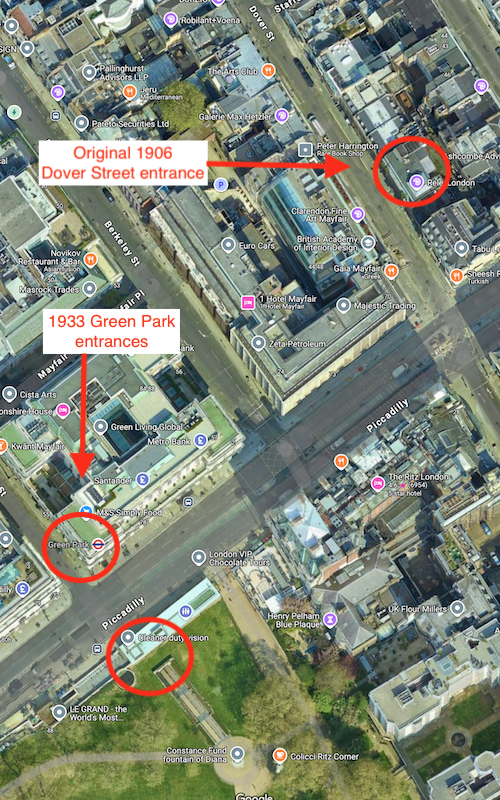
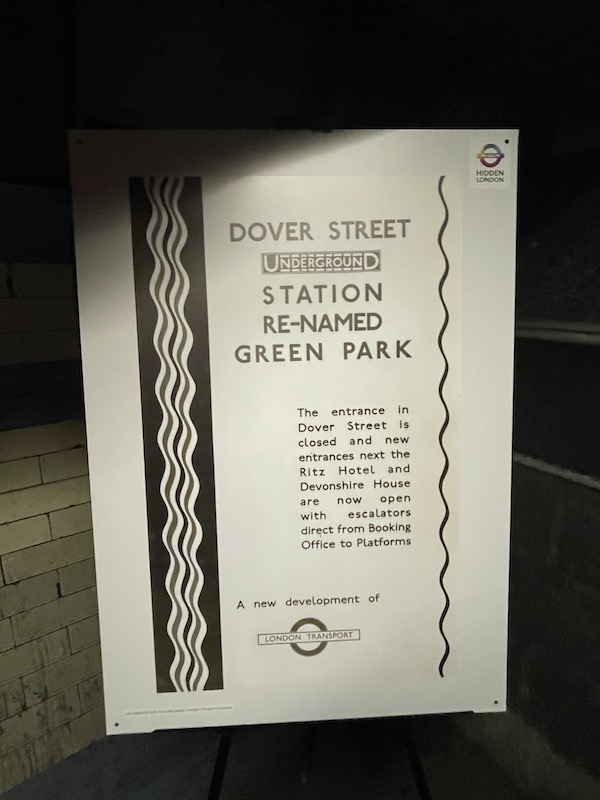
Dover Street opened in 1906 on what was then called the Great Northern, Piccadilly and Brompton Railway – the Piccadilly line as we know it today. It was renamed Green Park in 1933 to better reflect the area it was serving, especially as at the same time, new entrances opened on Piccadilly right outside the Park and the old entrance/exit on nearby Dover Street closed.
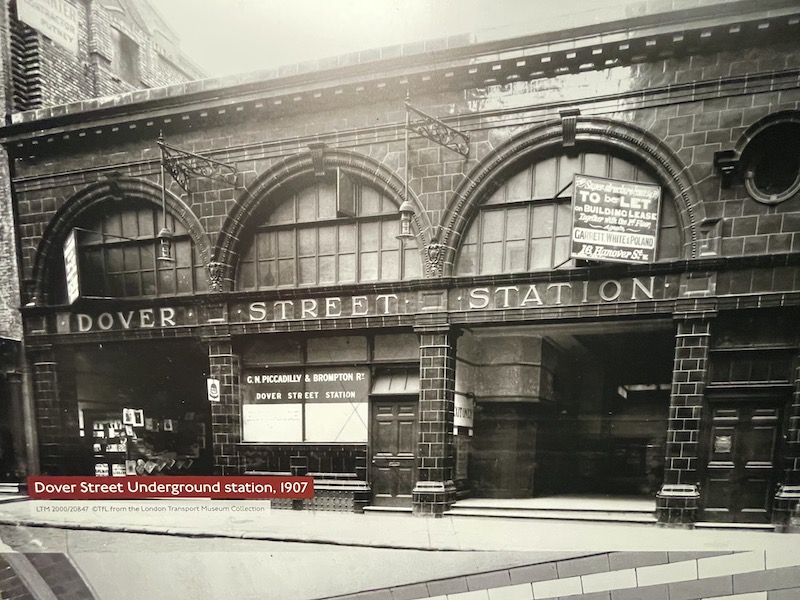
This original entrance was designed by Leslie Green in his traditional style that can also be found on other stations on the original Great Northern, Piccadully and Brompton Railway between Finsbury Park and Hammersmith as well as the Bakerloo line and the Charing Cross branch of the Northern line which were in the same Underground grouping prior to 1933. You can still see the spot where the original Dover Street entrance was located although it’s now almost unrecognisable following modern development.

The new Green Park was designed by Charles Holden and included escalators enabling the two lift shafts housing four lifts and a shaft for a staircase to be closed including the two passageways which pass over the Piccadilly line platforms…
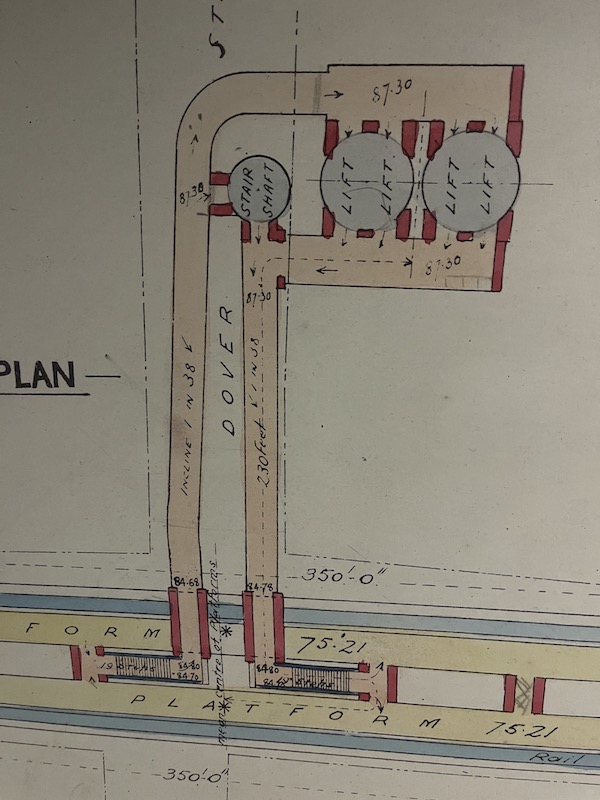
… taking passengers to and from the platforms below.
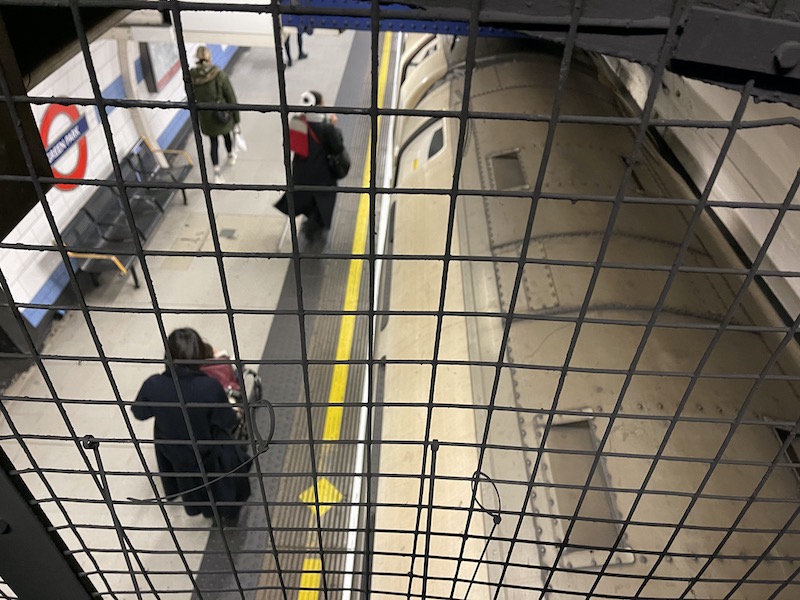
As always with Hidden London tours, as you explore these abandoned passageways…

… there are examples of vintage signs…

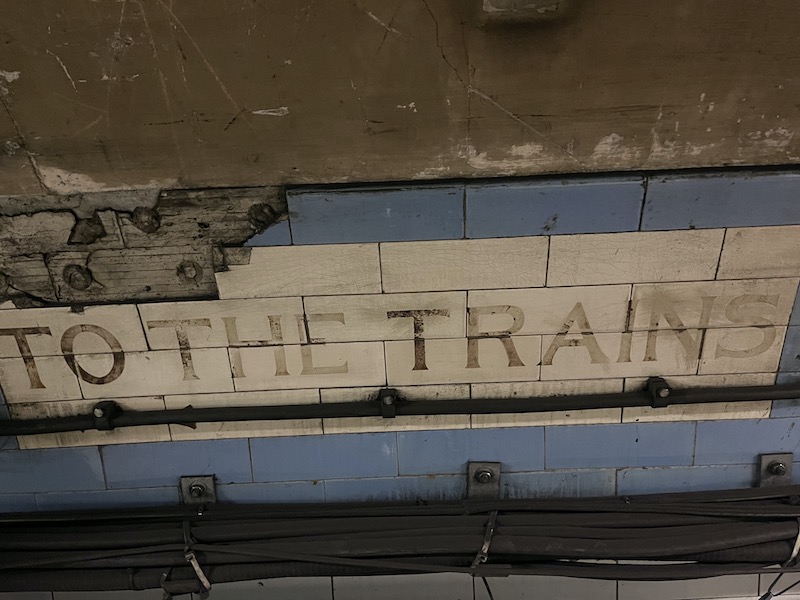
… and wall tiles to admire which were last seen by passengers almost a century ago.

Our two excellent Tour guides, Becky and Eesa, explained how Dover Street played a pivotal role during the Second World War, with the abandoned passageways and lift shafts offering a place for the London Transport Executive Board to safely meet during air raids and helping ensure London’s public transport continued to function. There’s a detailed plan showing how the confined space was repurposed into offices and other facilities.
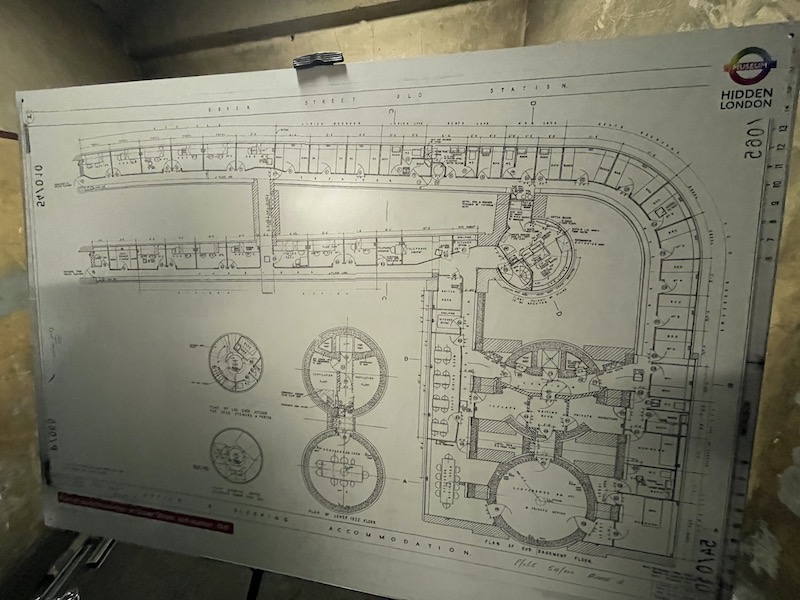
Particularly fascinating is seeing where Lord Ashfield, then chairman of the London Passenger Transport Board, had his bedroom secretly fitted at the heart of the station by one of the former lift shafts…

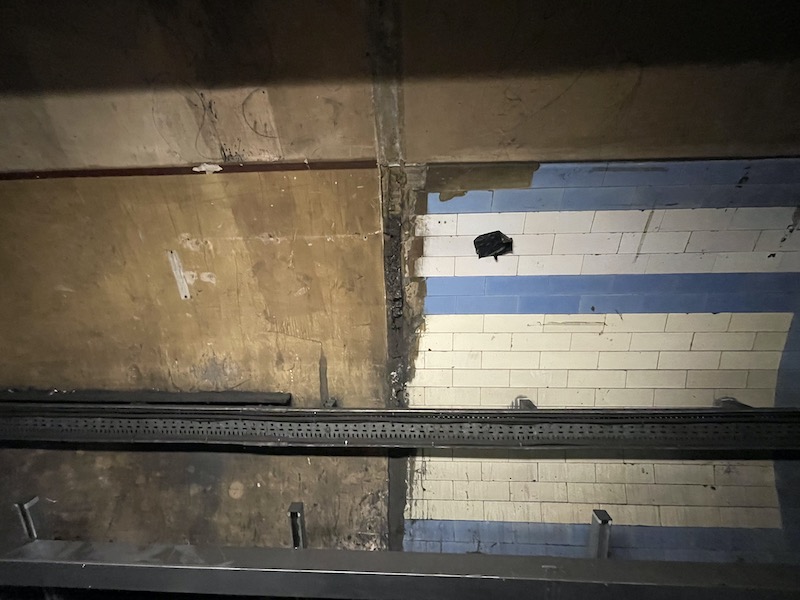
… and hearing about and seeing examples of the class distinction between directors and employees being very much a thing in those days with an executive dining room separated in the passageway from another eating area for other employees. The former had walls treated with finer materials while the latter remained covered in the original Dover Street tiles, left untouched with the contrast still visible today.
After hearing about that history, the Tour continues to explore developments at the station in more recent decades, notably the 1960s and 1970s, when Green Park expanded to accommodate two post-war lines, the Victoria line (1969) and Jubilee line (1979).
The Tour takes you along the long connecting passageway to the Victoria and Jubilee line platforms and looks at the extensive building work to construct huge ventilation shafts installed for both lines.

Participants are also entertained by clips from a 1960s documentary charting the background to the building of the Victoria line…

… it’s formal opening…
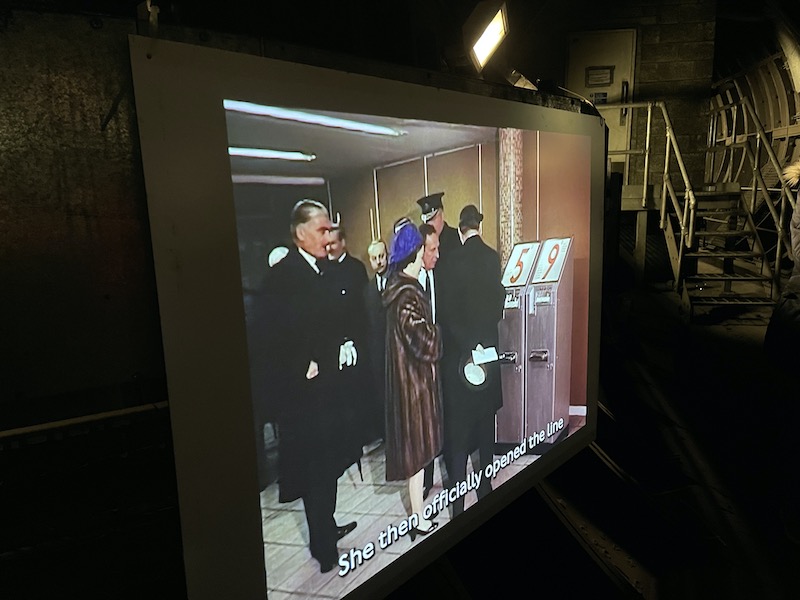
… and the extensive marketing that raised awareness of its existence.

Having seen the Victoria line, the Tour then continues down a level…
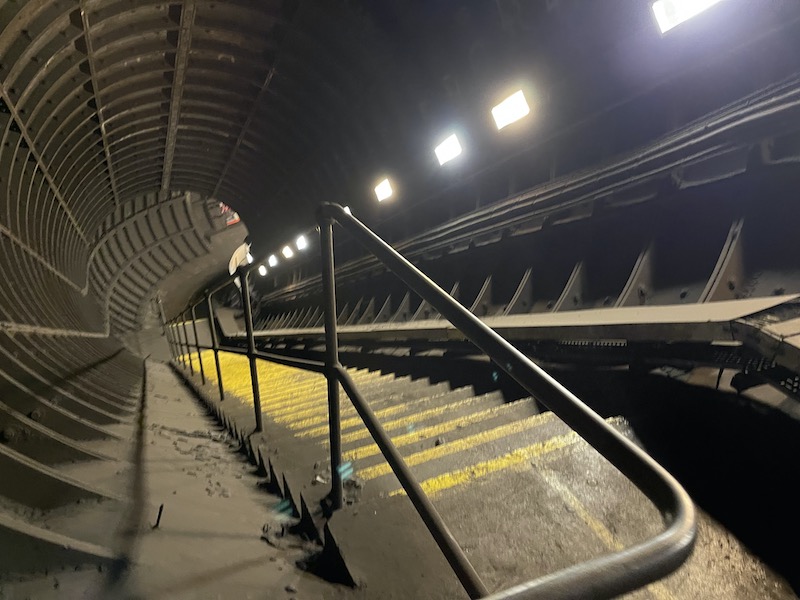
… to reach above the Jubilee line platforms…

… and hear about that line’s development and how its eastern terminus was originally at Charing Cross…

… as well as seeing another incredible ventilation shaft.

It’s a fascinating tour and well done to Aaron and the Hidden London team for another excellent exploration behind the scenes. Tours are taking place four times a day, five days a week (Wednesdays to Sundays) until the end of March and can be booked on the London Transport Museum Hidden London website for £45 (£42 for concessions and children). There’s currently very limited availability until mid February with weekends particularly popular, so if you feel the urge to attend, it’s best to book soon.
Roger French
Blogging timetable: 06:00 TThS
 BusAndTrainUser
As I understand it, the remodelling of Dover Street station and the opening of its entrance further west was basically done to allow closure of the little-used Down Street station (which of course has its own secret history!). The stations on the GNPR were close together so closure of the little-used Down Street enabled the service to be slightly speeded-up. Brompton Road suffered the same fate when new entrances were provided for Knightsbridge station; even before this, some trains had not stopped there.
LikeLiked by 1 person
Hyde Park Corner also got the relocated entrance and new subway entrances as basically the faster toward the trains escalators replaced the lift only access buildings. Did similar happen at knightsbridge and Holborn. Which probably leaves Russell Square as the least changed picc station
LikeLike
Holborn is complicated. Originally it only served the Piccadilly Line, with lifts, although there were four platforms because of the Aldwych shuttle. The station was rebuilt in 1933 to incorporate the Central Line, allowing the separate station at Museum to close. At Holborn the original station entrannce remained at the same location on Kingsway (although much modernised, and expanded due to the removal of the lifts) and new escalator shafts were constructed, plus a new below-ground concourse just above the new Central Line platforms.
The Central Line platforms were excavated around the running tunnels as trains continued to run, which is why they are on the left side of the train and not the right. Museum station closed after 24th September 1933 and Central Line trains called at Holborn from the following day.
Julian Walker
LikeLike
Holloway Road and Caledonian road are pretty much still original other than the lifts
LikeLike
Thanks for doing this tour on my behalf and the pictures. My legs ache so much that the stairs at Hersham Station are a challenge so doing this tour would be an awful task. Green Park Station has happy memories: my office at the TC&S Headquarters was nearby at 45 Berkeley Street. Happy days! My Go As You Please ticket era, £3.80 a week.
LikeLiked by 1 person
It would have been the London Passenger Transport Board in World War II – the LT Executive was only created in 1948, surely?
LikeLike
£45 – the usual Transport Museum bargain. They’re having a laugh! Hopefully you got yours for free in return for the publicity.
IanD
LikeLike
I don’t take freebies for such things as I like to report back as I find rather than feel beholden to the organisation giving the freebie. I agree £45 is pricey but the market is clearly there at that price as the tours quickly get booked up. Also, any ‘profits’ go to support the Museum (a charity).
LikeLike
About half that price would be more sensible in my view
LikeLike
Fair play to you.
I’m a Friend of the museum so I’m not averse to supporting them. I just feel that most of their special events (not just the Hidden London stuff) are way too pricey and not aimed at your average person/family. Which is a shame. Even with the “generous” £3 discount for friends.
A lot of the stuff has been covered (by the Museum staff) online and on various TV shows which makes it even less value for money. I can’t say I can get too excited about the 500th sighting of an original glass tile or another filthy scrap of an ancient poster either. But each to their own.
IanD
LikeLiked by 2 people
Ah! Those days when the Directors, and later LT Executives did not share meal facilities with the foot soldiers. On first working in 55 Broadway (1959-1962), I had the misfortune to be located on the second floor. Whilst the Chairman and those closest to him occupied the rarified atmosphere of the 7th floor, their “dining-rooms” and the ever-pervading and unpleasant smell of cooking were located on our floor. I gather bath facilities existed here too, but not sure about bedrooms. I can still smell way-over-done cabbage when thinking back!
Terence Uden
LikeLiked by 1 person
And the famous 55 Broadway three separate lavatories on each floor : Men, Women, Officers …
LikeLike
wonderful days when the proletariat new their place, clearly
LikeLike
Roger did it smell? I was responsible for this area at some points in my LT career and my overriding memory is of a fairly unpleasant smell. It must have been grim living there. Did you not see Churchill’s bath? From memory I don’t think he or Ashfield actually spent too much time there although it was certainly important that provision was made.
MikeC
LikeLike
I didn’t notice any particular smell, Mike.
LikeLike
I was looking for this on my youtube history, forgetting I read it hear first, it has not come up as a YT tour yet.
Meanwhile I see today Silver roundel launched for 25years of TfL achievements, which I note your London Bus Routes Changes/ Cuts tracker has not been updated of recent year
LikeLike