Tuesday 7th January 2025
Biggest news on the Changing Hands front this week is of course the start of the third and final tranche of Greater Manchester’s Bee Network from Sunday when Metroline took over routes and bus garages previously operated by Stagecoach together with Go North West and Diamond Bus also gaining smaller chunks of work. But this blog isn’t about Manchester. It’s about bus routes changing hands in Ebbsfleet and Potters Bar.
Residents in parts of the ever expanding Ebbsfleet ‘Garden City’ are getting used to having a fixed timetable bus route after Arriva ceased its Click branded DRT operation on New Years Eve. The developer Henley Camland had been funding Click since it began in December 2020 so it’s not clear why Arriva pulled the plug stating passenger numbers were “sadly not at the level needed to ensure it can be cost-effective for us as a business”. My understanding was Henley Camland were paying a gross cost reimbursement arrangement which would tend to suggest costings weren’t as they needed to be rather than a revenue problem.

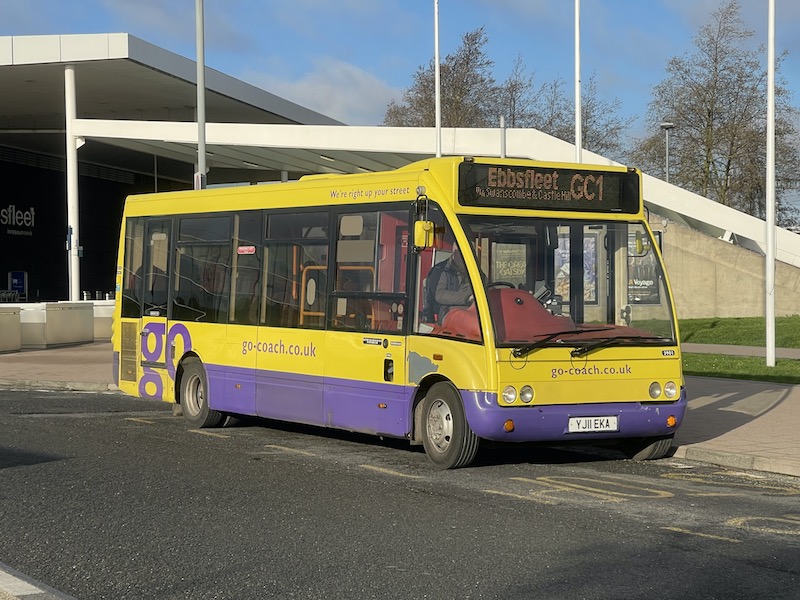
The enterprising Austin Blackburn (now back in control of Swanley based Go-Coach Hire after buying the business back from Hulleys of Baslow to whom he sold it last year) has secured funding from the developer for a replacement service on a two year gross cost contract with potential for an extension beyond 2027, and it’s good to see it involves the return of a fixed timetable and fixed route linking Ebbsfleet Green and Castle Hill (two of the new residential areas in Ebbsfleet), as well as Swanscombe, with railway stations at Ebbsfleet, Swanscombe and Greenhithe.
Route GC1 (which neatly represents both ‘Garden City’ and ‘Go-Coach’) is a daily half hourly service operated by two buses on a fairly tight hour’s rounder schedule between 06:36 and 20:34 although once a new bus only section of road opens between Ebbsfleet Green and Castle Hill timings will become less tight.

I took a ride on the route on its first day last Thursday, 2nd January, and didn’t see anyone else travelling. Indeed the driver coming off for his break as I boarded at 11:35 said he’d carried just one passenger since starting out at 07:00 that morning.
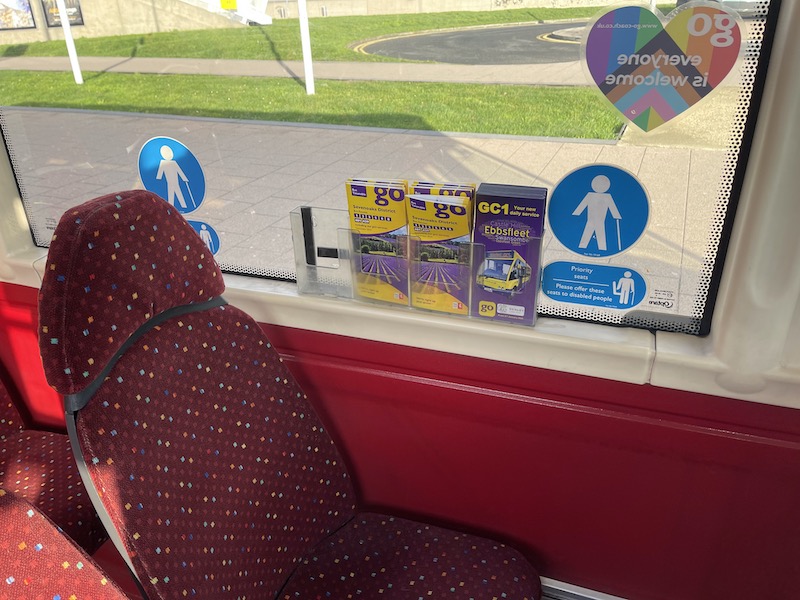
As you’d expect with Go-Coach there are colourful timetable leaflets complete with map and fares information available on board the buses and hopefully are being distributed by the Developer around the residential areas being served to raise awareness of the changed arrangements.
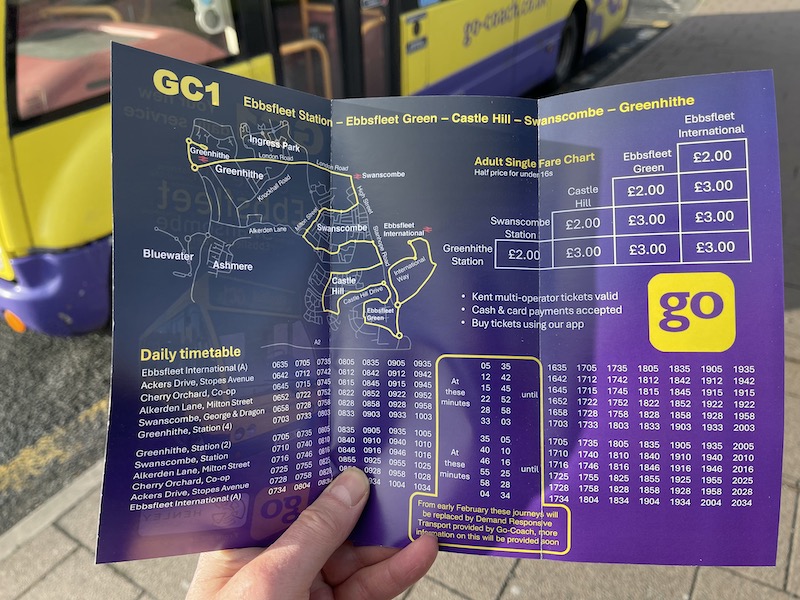
As you can see from the timetable, the off-peak service will be replaced with a DRT operation next month. Austin tells me this will use minibuses rather than taxi-sized vehicles which he has been deploying successfully in Sevenoaks for some years, and he’s hopeful Kent County Council will help with an application to the DfT for grant funding towards their purchase. The plan is for two ‘Sprinter’ style minibuses to supplement the fixed timetable, which will continue during the morning and afternoon peak periods with two larger vehicles, and in the off-peak period a third minibus will supplement the two operating the DRT arrangement for driver breaks.
The area to be covered by the DRT minibuses will be the same as applied for Arriva’s Click operation and includes Darent Valley Hospital and Bluewater shopping centre. Residents will therefore have a choice at peak times to either use the fixed route GC1 timetable for the stations or a Go2 DRT for Bluewater and the Hospital although it’s understood most of the journeys to the shopping centre during Click days were in the off-peak period.
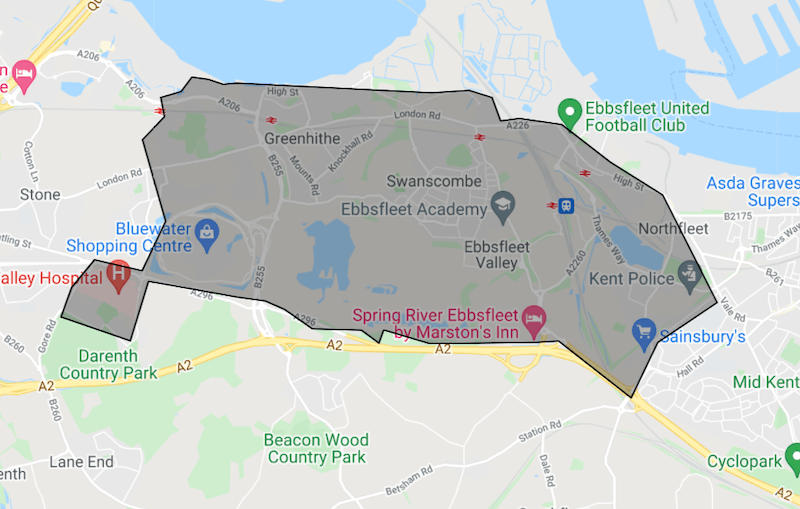
With all the costs being funded by the developer, for once it’s not public money that’s being used for such a speculative venture and it’ll be interesting to see how use of the fixed timetable GC1 compares to numbers using the Go2 DRT option once it launches next month.
This situation has parallels with the new residential development at New Lubbesthorpe in Leicestershire where I’ve previously reported on the original Arriva Click scheme which was introduced in April 2019 offering “on demand” journeys across a wide area including Leicester city centre…
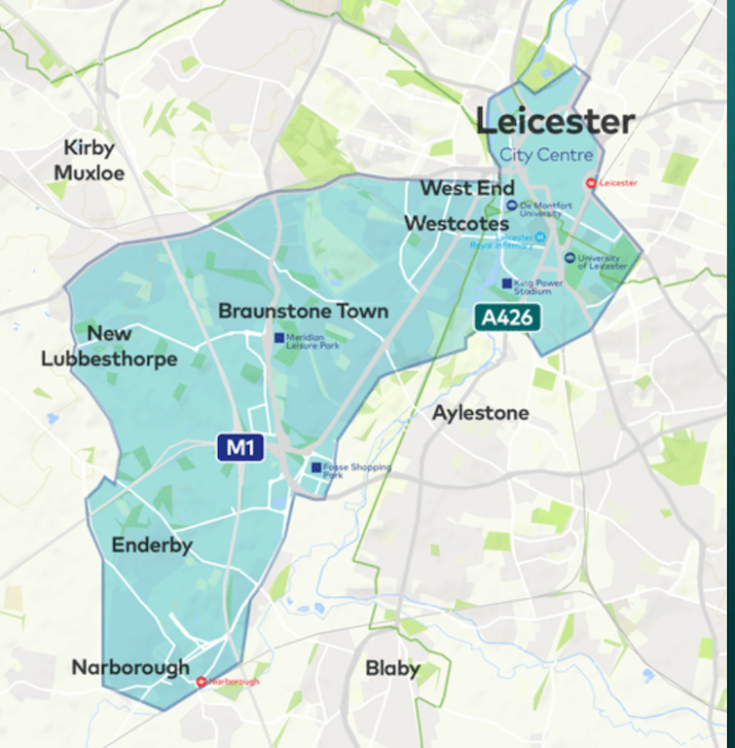
… but when Arriva pulled out after the three year Section 106 developer funding ended in July 2022 Vectare did a deal with the developer to operate a half hourly fixed route between New Lubbesthorpe and Leicester branded as Novus Direct (subsequently improved to every 20 minutes) with a two bus Novus Fosse branded DRT operation to cater for more varied journey demand but which was subsequently replaced with a fixed circular route half hourly frequency.
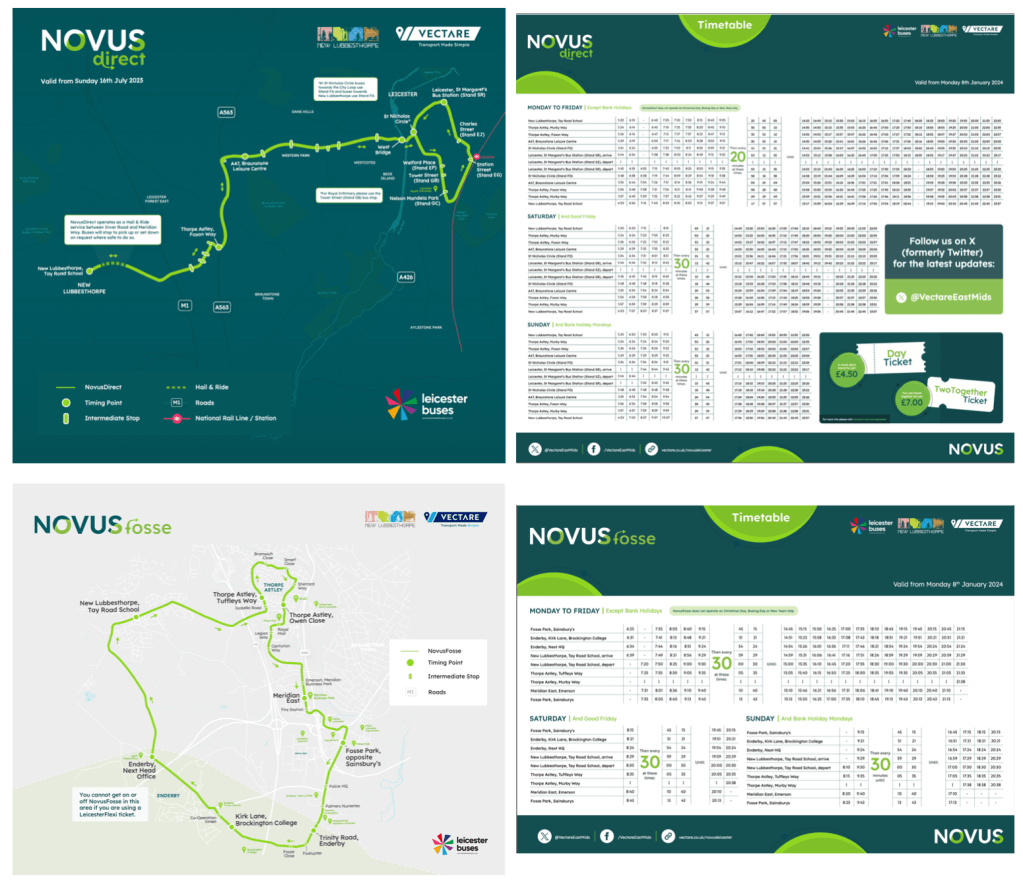
Interestingly from this week Central Connect (the rebranded Vectare) has now withdrawn Novus Fosse completely and redeployed the minibus to increase the frequency of Novus Direct to every 15 minutes.
I can’t help but think if, back in 2019, instead of faffing about with DRT in the first place, Arriva had used the Section 106 funding to introduce a 15 minute frequency between New Lubbesthorpe and Leicester it would have encouraged more passengers and probably become a commercial operation much sooner and now be a successful route for the company and well used by passengers. Arriva’s loss is Central Connect’s gain.
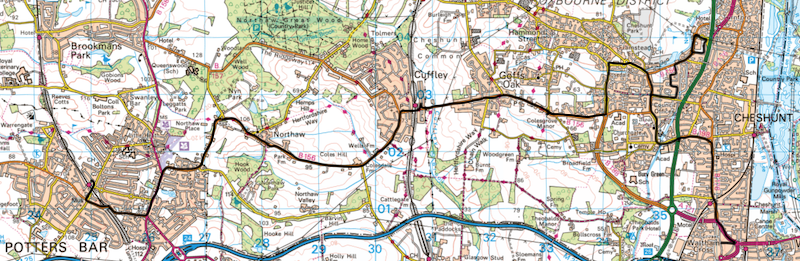
Another route that’s changed hands in recent days is the long standing former London Transport route 242. Famously running just north of the northern arc of the M25, in history the route skirted the top of the red bus area linking South Mimms and Potters Bar along rural Hertfordshire roads (ie the B156) via Northaw, Cuffley, Goffs Oak and Cheshunt to Waltham Cross from where its original eastern terminus was Epping Forest before changing to Chingford in 1963.
It was cut back to Waltham Abbey in 1986 and subsequently Waltham Cross as well as diverting to serve the expanding residential area of Flamstead End to the extent the timetable was skewed to concentrate on that eastern end of the route with a small number of journeys as far west as Cuffley (supplemented by a peak hour route C1 operated by Arriva linking the station with Flamstead End and Hammond Street). In more recent times the link with Potters Bar has been reduced to a couple of positioning journeys at the beginning and end of the day from and to Metroline’s Potters Bar bus garage supplemented by two journeys on schooldays for children attending Dame Alice Owen’s School.
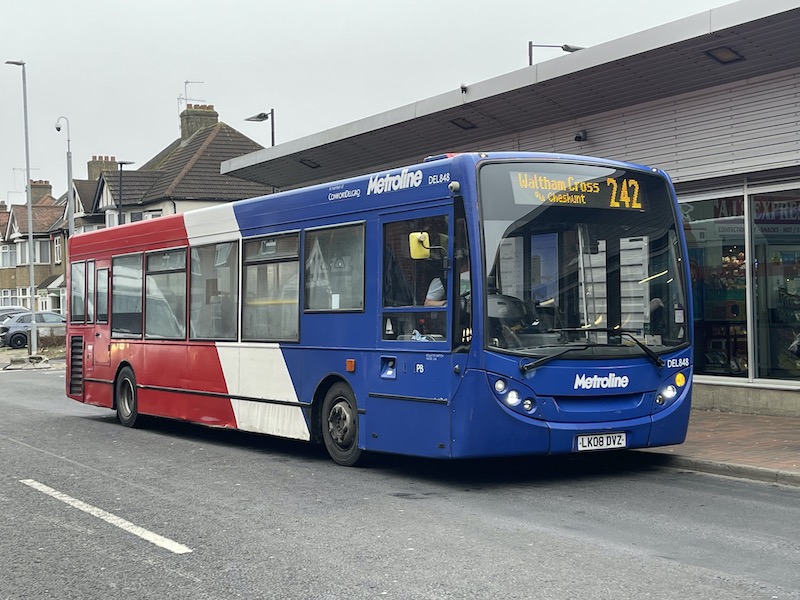
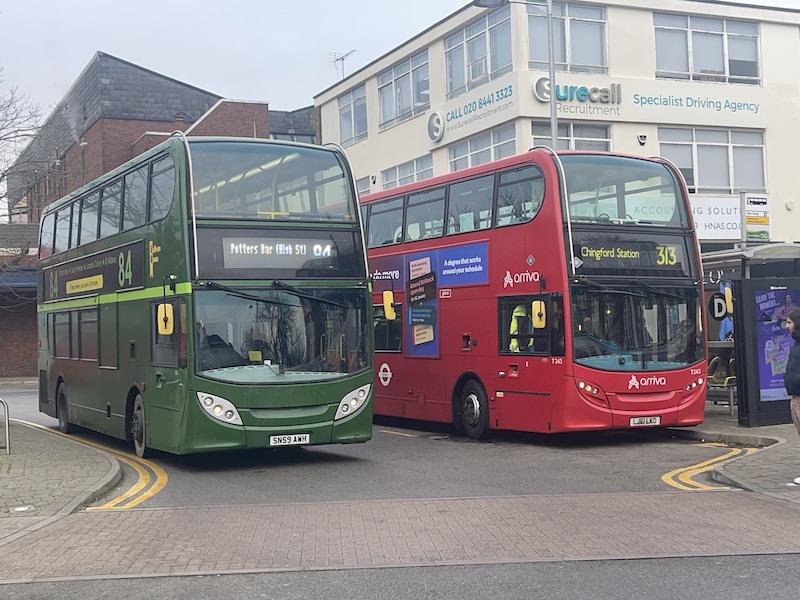
Metroline has therefore continued its policy of withdrawing from deregulated bus operations by adding the 242 to the 84 as routes it no longer finds to be a commercial proposition.
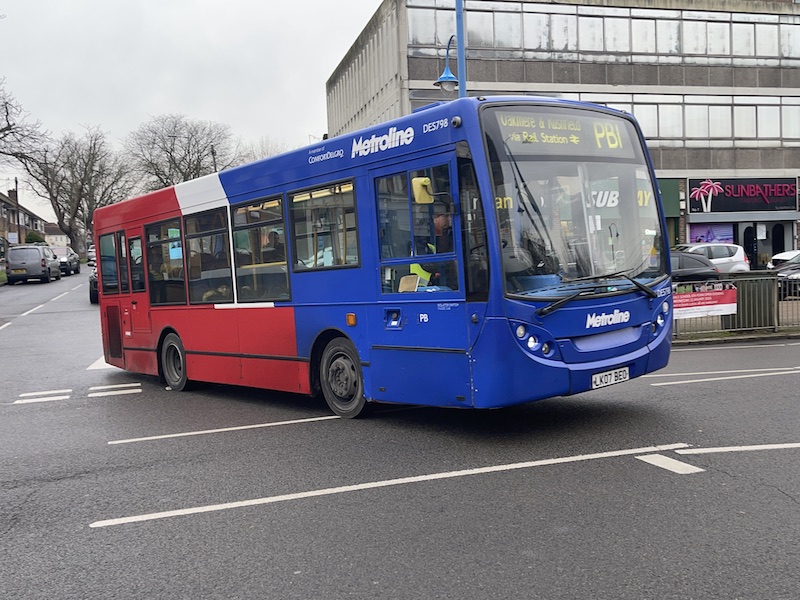
Only the Potters Bar town route PB1 remains at Metroline’s large bus garage in the town with everything else now being TfL contracted operations.
Metroline’s withdrawal from the 242 is UNO’s gain as that company has taken over the route on Mondays to Saturdays with, I assume, some funding from Hertfordshire County Council.

Interestingly UNO has decided to redeploy the two buses allocated to the route to run an hourly end-to-end service between Potters Bar and Waltham Cross throughout the day thereby returning a regular bus service to Northaw and the western side of Cuffley which I’m sure will be welcomed by residents living there.
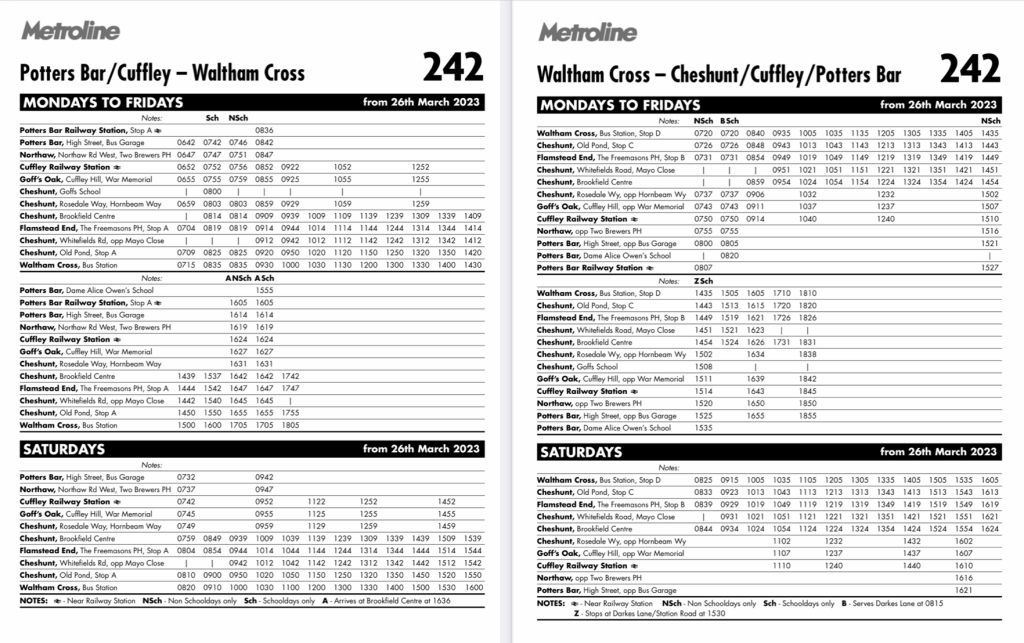
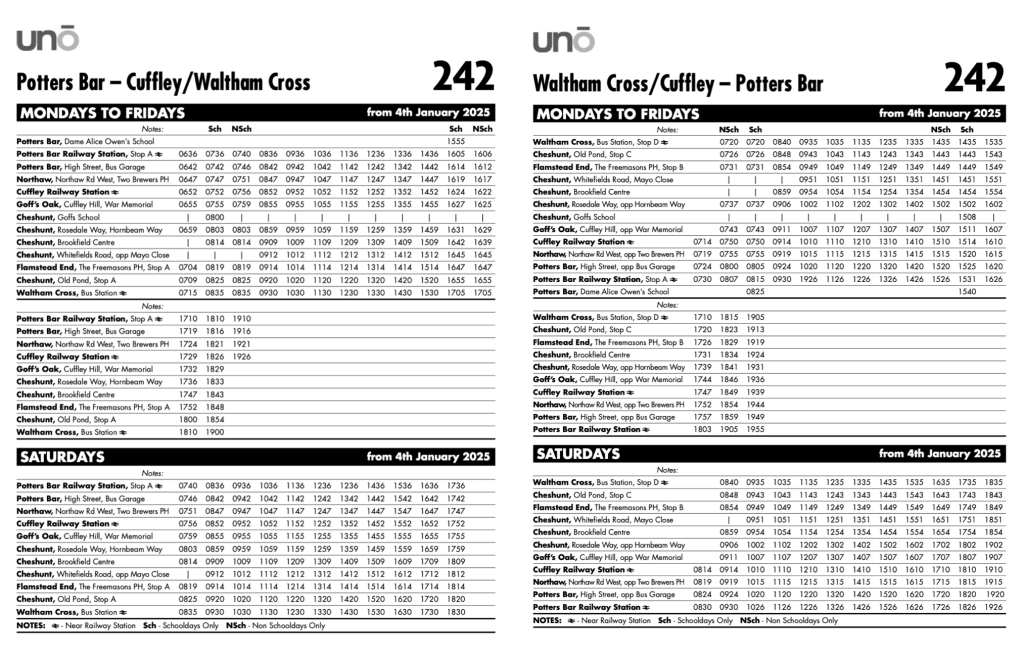
On the other hand, those living in the more densely populated Flamstead End of the route have seen their half hourly service reduced to hourly although they do have Arriva’s twenty minute frequency route 251 (Hammond Street to Upshire) which continues unchanged.
I took a ride on route 242 on Metroline’s final Saturday (28th December) and was impressed with the numbers boarding in Flamstead End, many of who were shopping at the large Brookfield retail centre on the north side of Cheshunt, which the bus doglegs to serve, as well as others travelling into Waltham Cross.

On the other hand only one passenger boarded in Potters Bar and travelled over to Cheshunt, although even that was a surprise bearing in mind I caught the last journey of the day at 09:25.
Taking a ride on the route again the following Saturday (4th January), the first day of the new timetable, it was again interesting to see a passenger board in Potters Bar and travel over to Cheshunt on a journey at 11:36 which had previously not run.
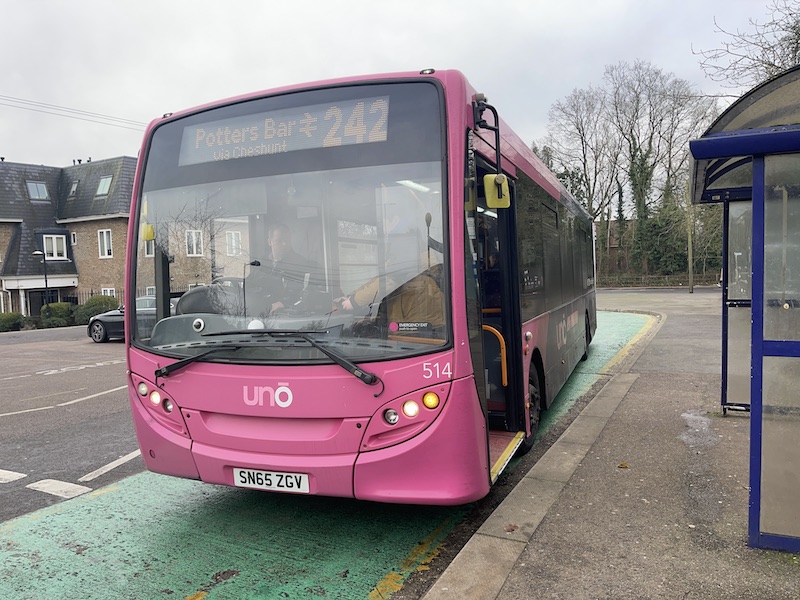
There were one or two others travelling on the ‘new’ western end of the route who, like me, were just exploring the new arrangements, but otherwise it was unsurprisingly very quiet. I think UNO and the County Council will need to work hard to raise awareness of the new facility as residents of Northaw have got used to seeing empty buses driving through the village as Metroline use the route to ferry buses and relief drivers over to Waltham Cross for route 491 and more recently 317.
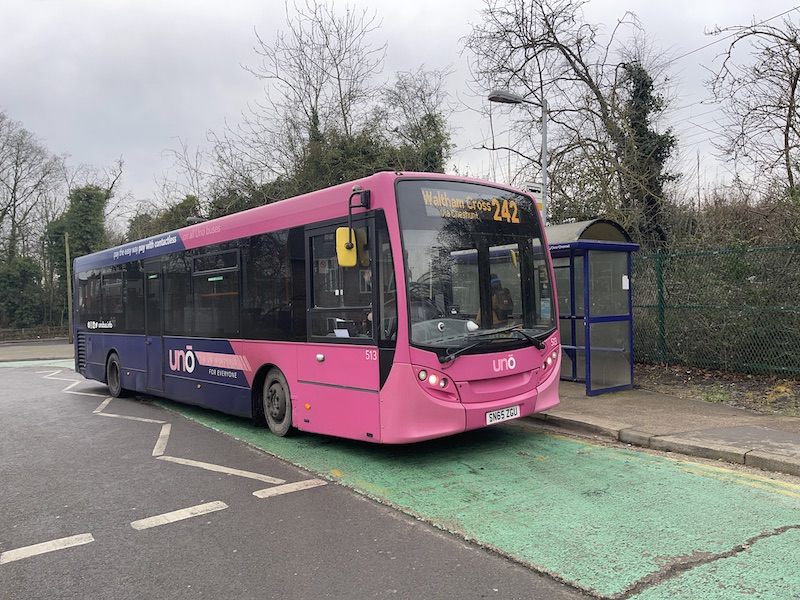
Last Saturday, the first day, it was good to see the electronic departure display in stand A at Potters Bar had been updated although printed departure lists will no doubt be updated this week. It’ll be interesting in the coming months to see if more passengers are attracted to the route with UNO’s changed emphasis on giving an improved and regular link across to Potters Bar.
The Sunday timetable continues to be operated by Central Connect with an unchanged two-hourly frequency with the route extended north of Potters Bar to Brookmans Park and Welham Green as well as over to Waltham Cross. The anomalous situation whereby the Sunday service through Northaw was better than Mondays to Saturdays has finally ended.
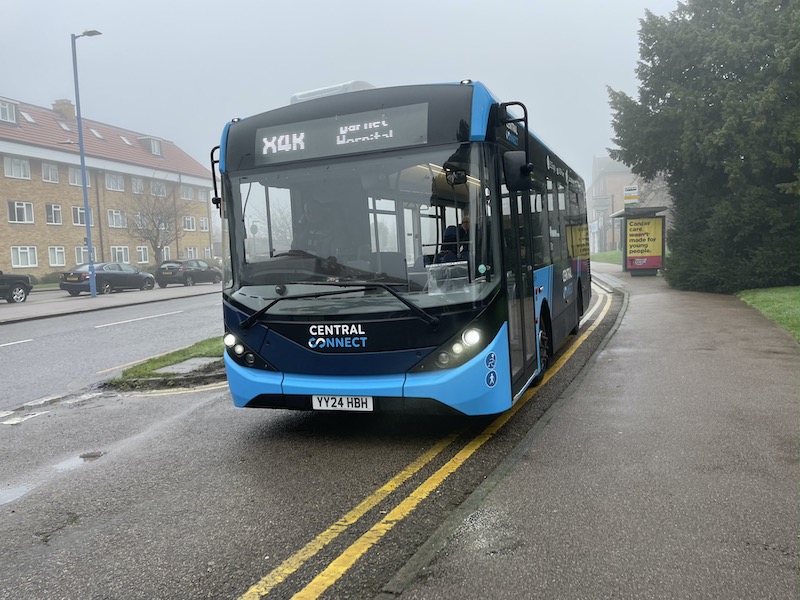
While in Potters Bar on both Saturdays it was good to see one of Central Connect’s smart new Enviro200 MMC buses operating on route 84B which reminded me of the precarious nature of this route. Introduced in September 2023 as a 12 month trial with £183,600 funding from Hertsmere Borough Council’s Community Infrastructure Levy pot, last Autumn, councillors agreed the service could continue until the end of April 2025 thanks to £83,000 funding from Hertfordshire County Council. However a “use it or lose it” plea was made to residents with £65,000 still to find if the service is to continue beyond April until at least September although there’s hope some funding may be forthcoming from Barnet Council who gave a supportive commitment back in 2023. More on this in a forthcoming blog.
Roger French
Blogging timetable: TThS
 BusAndTrainUser
Uno has gradually become a quite significant player on the Herts / London border, replacing the niche Sullivan had in the market. It now has three full time routes (242, 298 and 383) and a bunch of schools services some of which are multiple bus operations (628, 643, 653, 683, 688 and 699).
It will be interesting to see if they decide an outstation is neccessary to support this, since the dead mileage to and from Hatfield has got to be expensive. In the meantime, even with the TfL rules to navigate, I’m sure it’s a lot easier to manage than running a completely separate operation up in Northampton.
LikeLiked by 1 person
In Leicester, to be fair to Arriva, it was the developer aided and abetted by their consultants who insisted on a DRT operation, as another operator put in an alternative regular service bid back in April 2019 which was rejected. It was fairly obvious that DRT from the new development would never be commercially viable in the long term, whereas a regular service would also be able to abstract local passengers on the Hinckley Rd, which is exactly what Vectare has achieved. The service has also benefited from Leicester’s all operator Flexi ticket and the significant pro-bus policies of Leicester City Council.
Wether there are now too many buses on the Hinckley Rd remains to be seen.
LikeLike
Also saying CIL/Section 106 money isn’t “public funds” is a bit of misnomer, given that the Local Council has wide descretion on how to spend it, so public transport is competiting with other priorities (or pet projects depending on one’s view). As you say, it really should be used to best effect which means regular bus services than can serve a wider area than just the new development.
LikeLike
On the contrary, S106 funds are allocated for specific purposes which can rarely be changed except by legal agreement.
Councils must demonstrate when requesting funds that they meet the three CIL tests – necessary, related to the development and fair/reasonable. Each clause in an S106 and associated financial request will be for a particular purpose which has been judged as meeting the tests.
People try and touch my bus S106 funds at their peril!
Dave Harrison, Oxfordshire County Council
LikeLike
Until I retired in 2020 I was responsible for timetabling the “commercial” routes at PB Garage, so a couple of notes may be of interest.
The Metroline timetable on Route 242 (from March 2020) was balanced to run mainly at the Waltham Cross end, as passenger numbers to/from Brookfield far outweighed the numbers at the Potters Bar end. The few daytime journeys to/from Cuffley were to avoid leaving that community isolated . . . although it would probably been better to not bother with them, as numbers travelling were usually less than 5 on most trips.
There used to be a TrustyBus service via Brookfield, but that was withdrawn in around 2019, leaving 242 as the only route. The school trips for Dame Alice Owen’s School used to load to 35-40 students, but I believe that this had recently fallen to barely 20 students . . . a big reduction, which no doubt contributed to the decision to close the route. This final Metroline timetable was nominally commercial, although Herts CC did provide a substantial (de-minimus) financial contribution (around 20%) to the costs.
The service via Northaw had been hourly until about 2017, but originating passengers through that village were usually less than 5 each day! Through passengers were pretty low as well, and commercially the hourly through service simply couldn’t be justified.
Herts CC have long desired to return the 242 frequency to hourly across the whole route, seeing this as a “strategic” link . . . this will now give them the opportunity to see if it is worth it, as they (I assume) fund the entire route now. Strategically desirable, maybe, but reducing the frequency at the well used end to increasing the frequency at the hugely underused end . . . ? Not sure if that’s the best use of funding.
Just to touch on S106 monies . . . whilst it may be disbursed by the local Authority, the original monies are from “private” sources. The developer is required, as part of the grant of planning permission for a development, to lodge funds for the benefit of the local community, be it a road improvement, or improved public transport. There is no timescale for the use of such funds, but presumably the LA has to account for their usage at some point.
LikeLiked by 2 people
I wonder what the justification is for the resumption of DRT in Castle Hill. Better to give up on that money pit and focus on the fixed route, perhaps extending it from Greenhithe to Bluewater if do-able with the time saved by the bus link at the eastern end (and especially when the new tunnel (?) is finished at the western end. Oh and use the DRT funds to extend the service to a full 20-hour all day service as finishing at 2030 is poor for many potential users.
LikeLike
With regard to the 242s “busy end”, there were still hourly gaps on the Metroline schedule, and overall only three journeys have had to be dropped (same direction shown twice on UNO timetable illustration) . The residents of Northaw were not known for their bus use even in RT days, but far, far better to restore the County link and at least with memorable clock face timings. Although it would throw up all sorts of operational problems entering TfL land, and thus could never be considered whilst the present regime is in control, but it is tempting to think that extending it to Barnet (instead of the 84A) could have been of some additional benefit.
What a shame the GC1 has began with a scheduled service, only to revert to daytime DRT one month later. The daytime service would have a much greater chance of success if routed to Bluewater rather than wasting time along the London Road to Greenhithe station and thus be useless for Shoppers.
Terence Uden
LikeLike
Terence . . . the hourly gaps on Route 242 were for the drivers to take a meal relief at Brookfield . . . on weekdays there were 2.5 drivers required (the 0.5 driver covered some PB1 trips); on Saturdays there were just 2 drivers required. This brought the costs of operation close to expected revenue (with the Herts CC contribution, the route should’ve covered all costs). Of course, 3 days before commencement in March 2020, something else happened which rather screwed all my forecasts!!
For a “really useful route” . . . extend Route 84 to Waltham Cross!! Hourly SA – PB – WX; hourly SA – PB (loop via Church Road as now). The danger, of course, is that when the M25 goes “plop”, both routes are wrecked . . . unless there is substantial recovery time “just in case”; and that’ll cost money, and may ruin the finances. One of the reasons why I discounted that idea in around 2016 . . .
LikeLike
I do fully understand the scheduling reasons, but was merely pointing out that the statement that it had gone from “a 30 minute to hourly headway” wasn’t quite as dramatic as claimed.
And I know realistically the current 84A and 242 will never be linked for the reasons I gave, but in saner times, the flesh pots of Barnet may have been a better lure than Potters Bar station.
Terence Uden
LikeLike
@Terence Uden – you beat me to it!
Referring to the previous 242 timetable as half-hourly is misleading in my opinion. Looking at arrivals/departures at Waltham Cross, the interval was hourly (or thereabouts) before 09:30, two more gaps of an hour 10:30-11:30 and 12:00-13:00, and hourly again after 15:00. On Saturdays, the service was generally hourly, with three additional journeys at different points in the day making sporadic half-hour intervals.
If Roger will permit another minor observation, it was 1986 when the 242 was cut back to Waltham Abbey. The short section within Greater London was replaced by route 179A (since revised as 379), the section in between being left to London Country’s 503, another route that has passed into history.
Malc M
LikeLike
Thanks Terrence; timetable now corrected to show both directiuons.
LikeLike
As someone from Cheshunt, overall I’m very happy to see the 242 restored to it’s proper route. The timetable appears to have teething problems though and was running 15 to 20 minutes late today, which is poor for an hourly service. When I saw the new timetable, I was worried this would happen, it’s just not given enough time to turn around at either end to remain punctual throughout the day. There are some roadworks here at the moment but traffic seems less than usual. The other unfortunate thing is HCC hasn’t updated any bus stop timetables anywhere, leading to a lot of confusion. Given the change to the route is massive. Rosedale residents seem happy to even be remembered at this point! The service was very poor on that side of town for far too long. I’ve been on the restored 242 yesterday and today and for the middle of a weekday, very good to see people use it for Goffs Oak and Cuffley. Areas that are getting lots of new housing everywhere! And both times I wasn’t the only one going to Potters Bar. Provide the service and people will use it! I couldn’t help but wonder how people were travelling in that direction before this year.
To me, this really shows the failure of deregulation as the 242, before my time was a crucial and frequent link but crippled by a thousand cuts. This time, they need to just make it more punctual and then leave the timetable alone. People need to be aware this exists again and the possible journeys with it and then a base of passengers will grow if it’s allowed to. Part of the success of London’s buses is that they have had stable routes and timetables for many decades, this wasn’t allowed for us who lost the ‘Country’ services. If we want to reduce congestion, we need our counties to massively raise the profile of the bus network and make it clear where people can go on them. Having them compete as individual routes has failed big time. Also the number of short routes in the London/ Herts/ Essex border area like the 327, 14, 16, 379 and 385 suggests the county borders are completely misaligned. The same can be said about the long missing WX-Waltham Abbey-Chingford link, let alone a complete failure in this area to properly connect buses with the excellent train service we have, Cheshunt Station still has no direct bus service! The other thing that needs to change is the lack of evening services, almost everything bus wise stops at 7:30pm here which is not great. The train runs to Midnight even on Sundays!
The restoration of the 242 to Potters Bar is incredibly useful for me as it’s much easier to get to Hatfield and St Albans whilst also connecting with the 298 and 313 which provides far more pleasant ways into London than WX or the A10! The pair of 84 buses are immensely more useful for me now than before and a regular 242 means a journey like Cheshunt to St Albans is easily half the previous journey time by bus. Without the 242, it is a lengthy detour either by Enfield or Hertford by bus, or a train via Central London! A journey that wasn’t worth the hassle but is now possible once more and I will take full advantage of it! Hearing about the uncertain future for the 84B at the end is very disappointing though and again points to the need for a stable network that covers all likely routes people will take. Ideally the 84B would be part of a much longer route, like it used to. If it disappears again, people won’t give it another chance and both towns will suffer! TFL needs to step in here, ideally they would run all cross-boundary services, especially as a number of Barnet or Finchley routes dead run from Potters Bar Garage. Transport in general needs to align with the built up area.
Aaron
LikeLike
Interesting comments, Aaron.
In terms of punctuality, I can only think it must have been new route teething issues that caused the 242 to be late when you observed it, given there’s a quite generous combined 15 minutes layover/recovery time (10 mins. at Potters Bar and 5 at Waltham Cross) for journeys that takes less than an hour off-peak.
Dan Tancock
LikeLike
I thought so too, Dan. It should be enough time to do the route but Cheshunt, especially Brookfield is notorious for traffic. It’s like London, it doesn’t take much for gridlock to happen here. Waltham Cross de-pedestrianising most of the high street doesn’t help, cars already getting in the way at the small bus station! The limited Sunday 242 manages well enough though.
I noticed the Uno drivers had to explain to a lot of people about the changes too which held us up a bit. I think Herts has pretty good bus info through Intalink but sadly most aren’t aware of it’s existence like they are with TFL.
Aaron
LikeLike
“I noticed the Uno drivers had to explain to a lot of people about the changes too which held us up a bit”.
I wonder if would it be sensible to have an additional customer service agent on each bus, for the first week of a new service? They could take time to chat to passengers and hand out leaflets etc. Bus drivers are busy enough driving and issuing tickets. It must be very stressful if trying to make up time and having to answer enquiries.
Peter Brown
LikeLike
I agree there, Peter. Some places around here haven’t had a somewhat regular predictable service for many many years, so someone who helps passengers understand the changes is a good idea. If we want bus ridership to grow, the information on them needs to be easily accessible.
Aaron
LikeLike
How about extending the Harlow ro Waltham Abby service to Cuffley
LikeLike
To add some further context to the 242 changes, the service is now an HCC-contract in its entirety, though on a subsidy basis (the operator retains revenue).
The hourly through-service is indeed strategically important but also gives Uno a better basis than the old timetable to integrate/develop this service into the wider student network should they wish to do so.
As others have commented, there has been considerable housing development in the Goffs Oak area so maybe more chimney pots will mean more bums on seats?!
Roger – as Terence has pointed out, the blog shows two Potters Bar direction Uno timetables.
Dan Tancock
LikeLike
The Cuffley to Potters Bar section get almost no passengers. I cannot see it lasting for long
LikeLike
It’s 3 miles and 1 settlement! Hardly the ends of the earth, plenty of bus routes outside the cities (a small number in the TFL network too) have sections of this length, often longer where they rarely stop. Many routes deadrun more than this. They cope. I wish people would just think of the bigger picture. The individual routes form a network, can’t have that if they fail to connect with each other. A bit like with the railways, cut off the branches and the whole system suffers. And we wonder why bus ridership has declined so much… At some point we decided profit was more important than service. Even if sections are quiet, we need the 242 to help connect this county.
Aaron
LikeLike
Over Cuffley a notable military incident took place during WWI. William Leefe Robinson flying a BE2c shot down a German airship (Schutte Lanz SC11) after spending many hours aloft in this heroic task. He won the VC, and this was the first VC won over UK territory. As with many things, facts became blurred and many thought that it was a Zeppelin which was shot down. Cuffley FC have the nickname “The Zepps” in the way that Croydon FC are “The Trams” as they have a tram stop adjacent to their ground. Leefe Robison was given his VC at Windsor Castle and being a Harrow man although born in India has several memorials around Metroland and is honoured by the Miller & Carter Steakhouse chain as their Harrow Weald outlet bears his name. As to the buses currently traversing the roads of this area: my fondest memories are from the mid-1970s when I held a Go As You Please ticket. Gratuitous jaunts between High Barnet and St Albans on a DMS are what my heart yearns for, but to no avail.
LikeLike
Well it is positive that a DRT (Decimating Rural Transport) scheme is replaced with a fixed route.
As funding expires hopefully replacements will be similar to those pre-DRT
Gareth Cheeseman
LikeLike
On a related point of routes that have changed, but where further change is needed
London route 603 (Swiss Cottage to Muswell Hill, nominally a schools service)
Started as Metroline, then Sullivan until they gave up their routes at short notice.
But local calls for further change so it better performs the intended function as schools transport (current timings seemingly poorly aligned, probably generating some needless car journeys to schools along the route)
https://www.hamhigh.co.uk/news/24810723.haringey-council-urged-back-buses-tfl-route-603/
@Roger maybe worth a future post?
Also one remains ever hopeful for some retiming of late night journeys on Sanders 44A/44 to meet the last train at Sheringham on Fri/Sat evenings (misses by 5 minutes for no good reason I can see), and also extending 44 to start from Holt earlier in the evening (unclear what constrains the journey from not starting from Holt).
MilesT
LikeLike
While off-topic I’d add my plea to Lynx to add at least one evening journey beyond Hunstanton on their Coasthopper service. The last bus from King’s Lynn through to the north coast is ridiculously early for train connections from London, and if they could develop an out-station arrangement at Wells or Burnham the coast and its tourism (including the excellent complex at Burnham Deepdale where I have stayed a couple of times) would really benefit.
Stephen Hosking
LikeLike
Perhaps Sanders don’t realise that the last train on Fridays/Saturdays is later than on other days? Or perhaps they either don’t want to alter the timetable all along the route because they think it will confuse passengers? Or would running later mean extra staff costs for driver and/or the depot? I’ve no idea!
LikeLike
Indeed all of those reasons may be relevant.
In terms of retiming–retiming the whole last journey of 44/44A on Friday/Sat to start out 15 mins later from Norwich could generate more traffic (supporting slightly later nights out in Norwich) although maybe not desirable traffic. Extra 30 mins time for the driver (short layover in Norwich bus station); the route finished just post midnight in Holt (as the last service on that vehicle in the day) so the driver is presumably already getting some sort of unsocial hours payment and no knock on service impact; not a big extra cost to retime (extending the early evening start from Holt may be more costly/impactful, needs a string diagram analysis to see what it does to driver hours/PVR).
On my last use of 44/44A service on a Friday it did pick up some late night pub-goers later on in the route going home to Sheringham, who would have to wait a bit longer.
On a further related point, does anyone know David Hurdle, retired transport planner who now lives in Sheringham and writes a transport column in the “Just Holt” magazine? Does he read Roger’s blog, can anyone who knows him nudge him to read and contribute here? Tried linking in linkedin but no response.
MilesT
LikeLike
I guess that Sanders would prefer to have the pasengers all the way from Norwich on their bus, rather than encourage people to use the train over the Norwich to Sheringham section. Understand it is different if you are coming from say London on the train and connecting in Norwich.
LikeLike
Bus from Norwich vs. Bus from Sheringham. (NB I have done both)
It would not make that much difference, revenue wise, to join at Sheringham. Train+bus is a little quicker (could leave Norwich even later)
But in terms of journey opportunities and convenience, having the ability to interchange at the train is much better
Clearly I would prefer to interchange at Sheringham, but that’s not possible later in the evening.
MilesT
LikeLike
The 603 was a weird school route for London in that it originally ran every m-f and not just school days, no idea why. It also ran in service against the flow. The reason for that was to enable parents to travel to the school with the children and be able then to return home and vice versa.in the afternoon. The schools it was aimed at were the numerous private school between Hampstead and Swiss Cottage, and as far as I know timings were correct for those. However this latest campaign is saying the times are wrong for those attending schools in Muswell Hill etc. As it was never designed to serve these, of course use is low on the against the flow journeys.
LikeLike
I’d like to take this opportunity to thank greenline727 and Dan Tancock for their regular and insightful comments on this blog, especially for the Hertfordshire area. The combination of commercial experience and history, and current local authority perspective is really helpful to understand why things are done in a certain way, and what could be done better.
Stephen Hosking
LikeLike
Clearly everyone welcomes the hourly service returning on the 242 at the Potters Bar end. Evidently it couldn’t be provided on a commercial basis, had withered to a point where it was barely a service yet it offers useful connections as part of a network and there is potential for growth as new developments spring up. To my mind this is exactly where a subsidised service is most useful. What I question though, is providing it to the determent of the part of the service that most of the existing passengers actually use. To do so really is the worst kind of cross-subsidy.
LikeLike
Good point and good way of looking it at it. I think returning the 242 to a predictable timetable made me realise how lacklustre buses are here in Cheshunt. The last time Waltham Cross to Potters Bar ran hourly, Cuffley got buses on 242 every 30 minutes, Cheshunt had a circular route to the rail station. The routes we have now were more frequent and ran much later at night. There were more routes. Bus cuts were brutal here. And I think every cut reduced the potential number of passengers, in places like Cuffley and Northaw, many would’ve given up on the bus entirely because of the cuts. In Cheshunt, what was left was unreliable and many only use it, as it’s our only option of transport. Cutting this town out of the London bus network was a historic mistake too. It’s easy to lose passengers but hard to gain them back. The 242 was said to run every 20 minutes from early to late in 1986, they certainly didn’t run them empty back then. What happened next was clearly a huge failure and we are still picking up the pieces.
Aaron
LikeLike
its good to see Go coach back in the Control of Austin Blackburn, this enterprising manager has done much to provide the services of an alternative operator in an area dominated by a big national operator and I wish them much success with new Route GC1, the buses certainly add a splash of colour to an area which is virtually monopolised by ARRIVA.
LikeLike