
Saturday 23rd November 2024

Passengers on TfL’s route 358 between Crystal Palace and Orpington finally got to travel on the much anticipated Irizar electric ‘tram style’ buses on Wednesday when seven of the 17 vehicles allocated to the route, operated by Go-Ahead London from its Green Street Green bus garage, hit the road.

Readers may recall I wrote about a journey I made exactly two years ago expecting at that time to compare the then allocated Mercedes Citaros on the route…
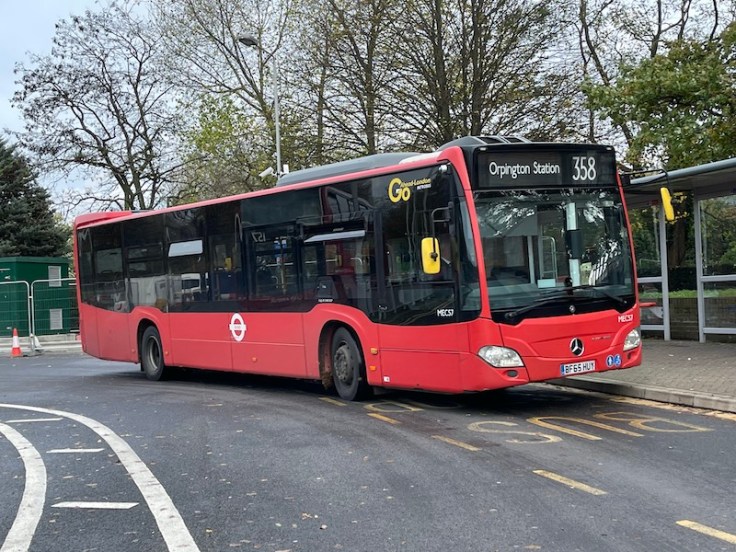
… as well as an occasional 13 year old Enviro 200…

… with the new Irizar ‘ie Tram’, which at that time I (wrongly) expected to be on the road within a matter of weeks.

Now, at last, two years later the days of sitting on hard uncomfortable seats to a rather odd layout (on the Citaros as described in that blog and see above) for over an hour are coming to an end as the new ie Trams enter service with their much improved comfort and on-board ambiance.

As is the way with these things there have been issues with getting the associated infrastructure installed, not least the pantographs at both the Crystal Palace and Orpington termini. These things are never straightforward.

Back in November 2022 (as well as since) I’ve expressed some scepticism about the ie Tram’s narrow entrance as well as the gangway in the first section of the bus…

… and also some surprise at the lower glass panels on the sides.

These may look eye catching and something very different, but knowing the tendency for side panels to receive ‘battle damage’ during a lifetime on busy urban roads with challenging driving conditions it does seem a risky development, but more significantly, there’s been a long tradition in the UK that where seated passengers’ legs are on view from outside the bus, then decency panels are deployed to prevent ‘gawpers’. I’ll be interested to see whether this becomes an issue.

Already I’ve heard from Clare Waters, Chief Executive of Bus Users UK, who was aghast to see the (above) photograph I posted on social media on Thursday indicating she’d be pursuing the matter with TfL.
After all the anticipation I was delighted to take a ride on route 358 on Thursday and see how these head turning buses perform in practice on the road.
And in case there’s any doubt following recent comments on my blog about the Thameside Fastrack, what follows is a description of what I found and experienced as a passenger and no criticism is intended of the hard working staff who I can imagine have spent months frustratingly trying to sort out all the myriad of issues that always come with a new type of bus, particularly one involving infrastructure and technological innovations.

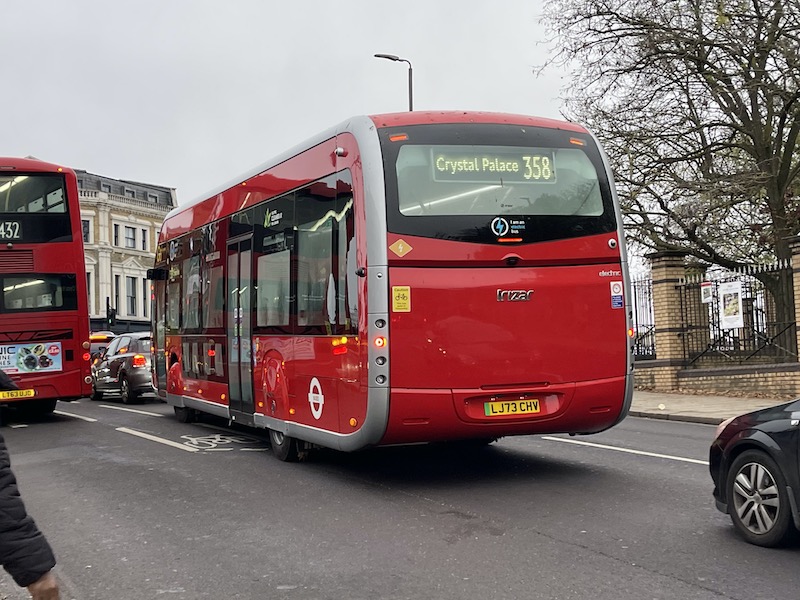
The first thing that strikes you as the bus approaches is the unusual nature of the design. It reminded me of when the New Bus for London hit the streets for the first time. Its glazed staircase and rounded rear stood out from other box-type bus shapes that had been the standard design for decades. It’s the same with the ie Tram. The deliberate ‘tram like’ shape is like nothing else in London and draws attention for that reason.
It has echoes from the First Bus ftr articulated Wright StreetCar vehicles in the mid 2000s and the Van Hool ExquiCity articulated buses currently used on Belfast’s Glider route.
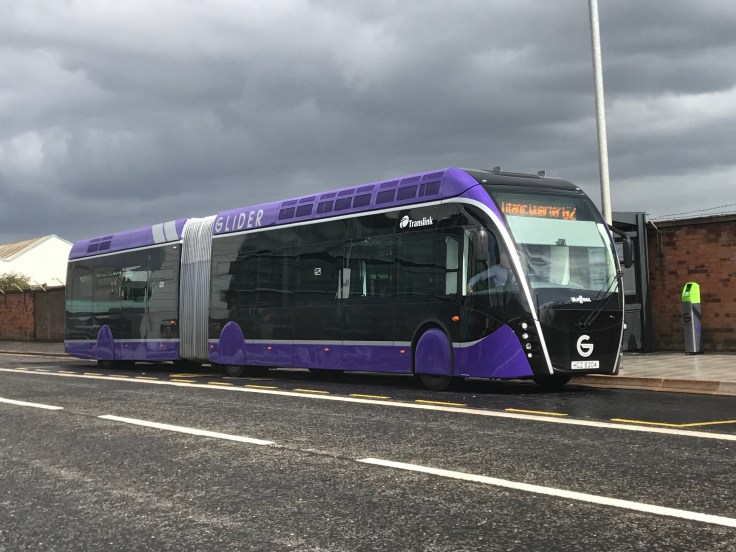
The 12 metre Irizar ie Tram bus is not a tram of course, and calling it a tram is just a gimmick. But if it attracts attention, which it clearly does, just by overhearing comments at bus stops and on board on Thursday, then it’s achieved its objective.
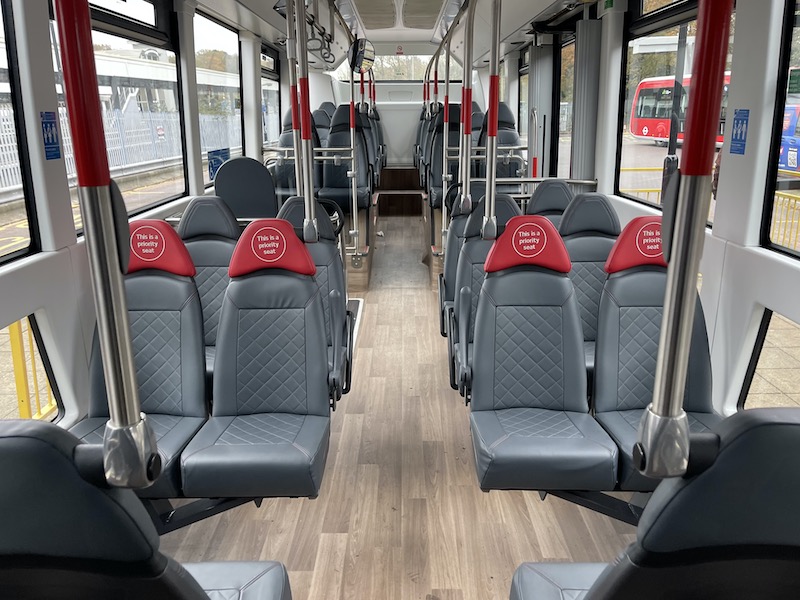
Inside, the seating is a huge improvement on what went before. The seats are not the most luxurious you can find on buses these days (check out my comments on the Go South Coast and Brighton & Hove examples) but for the London urban market they’re an admirable and practical choice.

The bus has 35 seats (compared to 36 in the Mercedes Citaros) with four sets of pairs of seats facing each other – one either side in the step-free first section and one either side in the rear section which involve a step up to reach.
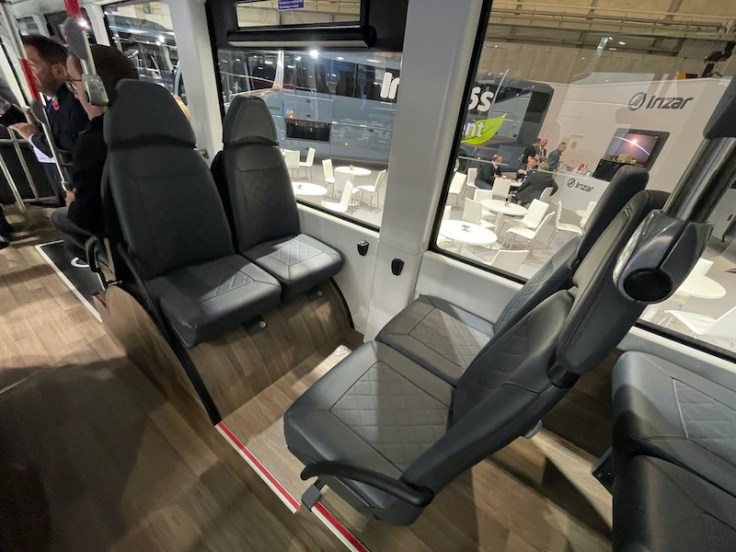
The problem is, as you can see in the photographs below, whereas in the step-free section there’s space under both pairs of seats, by contrast in the rear section, being over the wheel arches, the space between the facing seat pairs is very restricted such that knees easily touch the person sitting opposite…

… although as there’s not enough room for two pairs of feet opposite each other on the floor, you tend to sit with legs askew which impacts the comfort.

I noticed some passengers sitting sideways and using the gangway for their legs…

… to avoid the awkwardness…
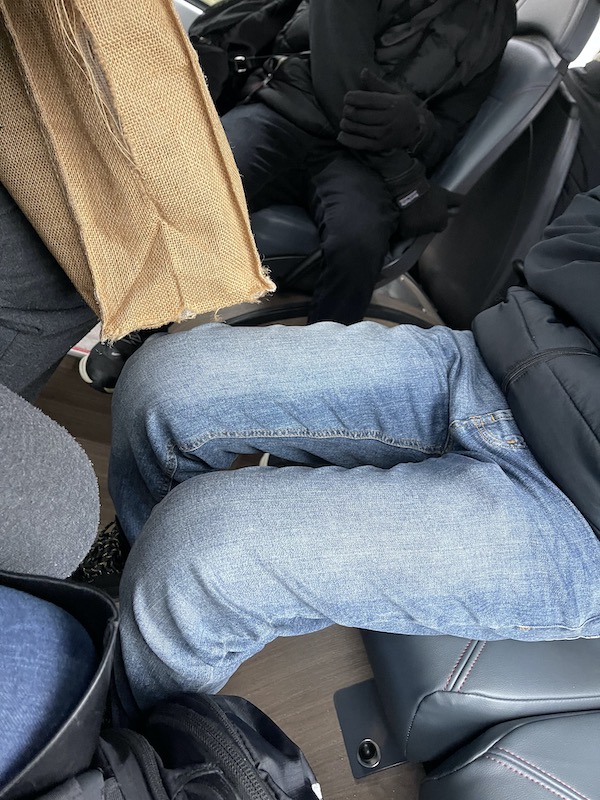
… and also on occasions strangers sat diagonally opposite each other leaving the other two seats empty thus reducing the capacity.

As an aside, as reported in my blog on Euro Bus Expo, these seat pairs also have a table on the ie Tram buses destined for Thameside Fastrack which will make it very challenging to get in and out of the window side seats.

Passenger feedback, either elicited or overheard ranged from very complimentary to concerns at the narrowness of the entrance and gangway with one ‘senior’ in Bromley extremely concerned whether she’d get her shopping trolley along the gangway at the front and not liking the idea of boarding through the centre door as an alternative.

A few passengers commented on the cramp conditions, especially as the buses we travelled on became very busy.

One passenger found a good use of the space behind the ‘priority’ facing pairs of seats to stow her shopping trolley so it was partly out of the way, but you can see there’s not a lot of room and passengers are reluctant to use the wheelchair space as they don’t want to stand in that area – there being no tip-up seats. It’s something older people in particular worry about as they tend to use shopping trolleys and these buses aren’t really suitable for them.

However, there are plenty of positives to highlight about these buses, which being electric, silently glide along, rattle free, including the doors as they open and close – rather like how CD trays use to do on top of the range players.

The electronic information signs are clear and there’s one in the cove panel above the space for wheelchairs showing how long the bus is expected to take to an upcoming timing point.

It’s a bit odd to show the status of Underground lines in deepest south London on the main sign and it might be more helpful to switch to a display of train departures at the many stations the route passes as some bus companies outside London now do very successfully as the bus approaches each one (eg in Reading).

Air conditioning is welcome albeit regular opening and closing of the doors can make it challenging to be effective…
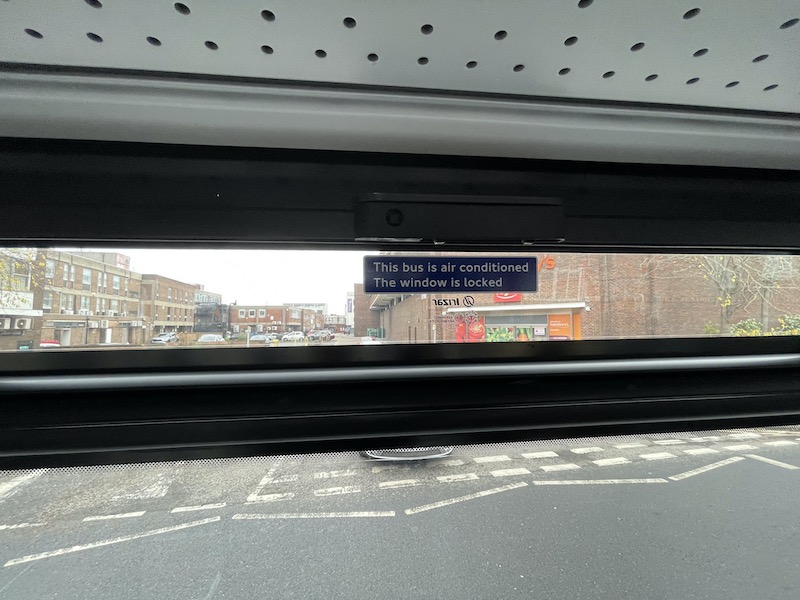
… and usb sockets (two types) are now becoming common on buses in London.
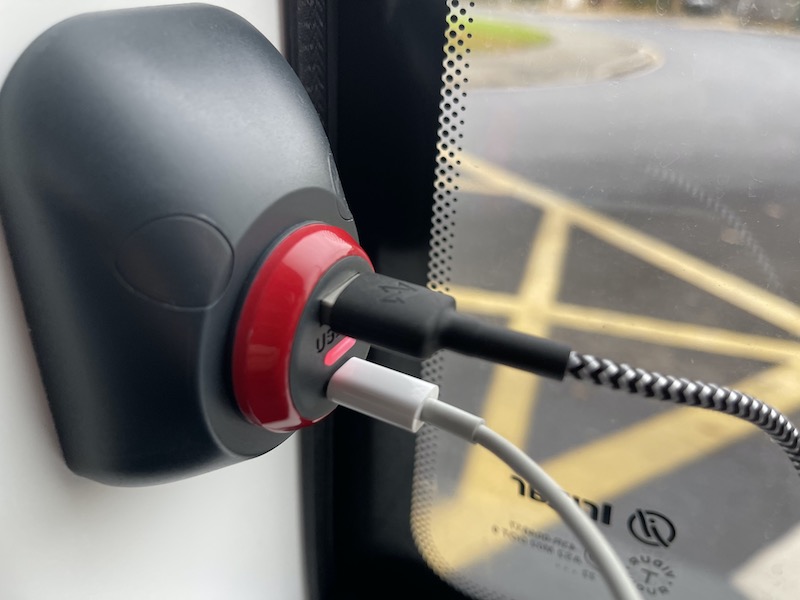
The wood-effect floor is anti-slip…

… and there are pretty lights along the upper side panels.

All in all they’re nice buses but I note everyone is being tight lipped about how much they cost. Unsurprisingly there’s no price quoted in Irizar’s sales literature but I saw £700,000 quoted in the Evening Standard which, if true, sounds an awful lot of money for 35 seats when infrastructure costs have to be added on as well.
I appreciate route 358 has been chosen for the trial because pantograph top up charging at termini means buses on this lengthy intensive route don’t need to return to depot during the day for a recharge with the consequential need for costly additional buses to maintain the timetable. But it’s pushing it a bit to say, as TfL does in its press release “this means fewer buses are required on the route, bringing savings that can be invested into other areas of TfL’s network, in addition to the benefits of cleaner, greener travel.” There are no “savings” as the same number of buses and drivers are being used this week as last week.
Indeed, more than the impact of the new buses, the story of Thursday’s travels was dominated by the severe impact of temporary traffic lights, roadworks and general traffic conditions on the reliability and frequency of this extremely busy route scheduled to run every 12 minutes. Buses were being turned short at various points along the 15 mile route at Penge, Beckenham, Elmers End and Green Street Green as controllers battled to keep some semblance of service going.

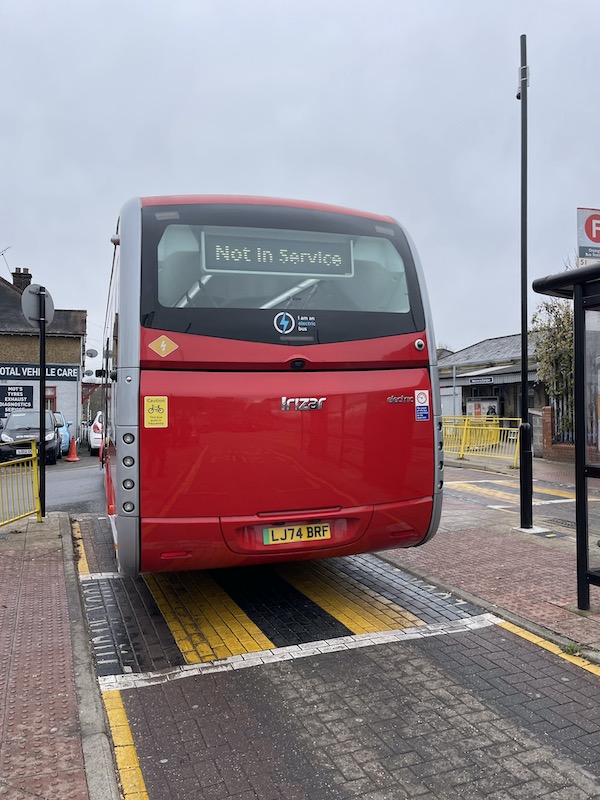
Observations on Thursday showed this situation isn’t helped by buses spending six minutes under the pantograph at each terminus. One bus took its charge at Orpington all screened up for the next trip to Crystal Palace…

… only to then head off “Not In Service” – I’m guessing to run dead to somewhere along the route to mitigate its lateness.
Looking at route 358’s vehicle schedules most buses at Crystal Palace have eight minutes stand time in the peak increasing to 11/12 minutes off-peak and at Orpington 10-16 minutes in the peak and 18/19 minutes in the off-peak. When there’s late running, as the roadworks are currently causing, what had previously been eight minutes slack to help get the next journey away on time from Crystal Palace, is now taken up with manoeuvring the bus into position and lowering the pantograph for a six minute charge.

Bearing in mind the bus doesn’t need to top up after every journey (and obviously short turning buses are unable to wherever they turn), I was a bit surprised to see late running buses as early as 08:45 on Thursday taking a charge when they were already late for the next journey. This, together with the short turns, led to some long gaps in service and the inevitable crowded conditions on board and passengers thinking along the lines …. ‘it’s all very well to have a new bus, but what we want is a reliable service’. As I pointed out in the Fastrack blog, it’s all about expectation management.

It might have been better for the Deputy Mayor and others at Wednesday’s official launch to publicly acknowledge the serious impact roadworks in Upper Elmers End are having on the operational performance of the service and in view of the two year delay already experienced in getting the new buses on the road, announce the whole route will be upgraded in one hit with the new fleet of 20 buses entering service from Sunday 5th January 2025 when the roadworks have been completed. This really would make a high profile positive impact.

As it was, we waited at least 20 minutes for a bus at Crystal Palace – including while it had its charge at 09:00, and the driver needing help as to where he should park in the markers…

… as “it’s been three months since I was trained” and having left at 09:16, as we got very busy heading down Anerley Road within minutes after starting out came the announcement “the destination of this bus has changed – please listen for more information”.

It was to be curtailed at Green Street Green which made sense, as I guess the driver was coming off at the garage for a break with a relief driver taking over and also, by the time we reached Bromley, the bus behind had caught up and overtook…
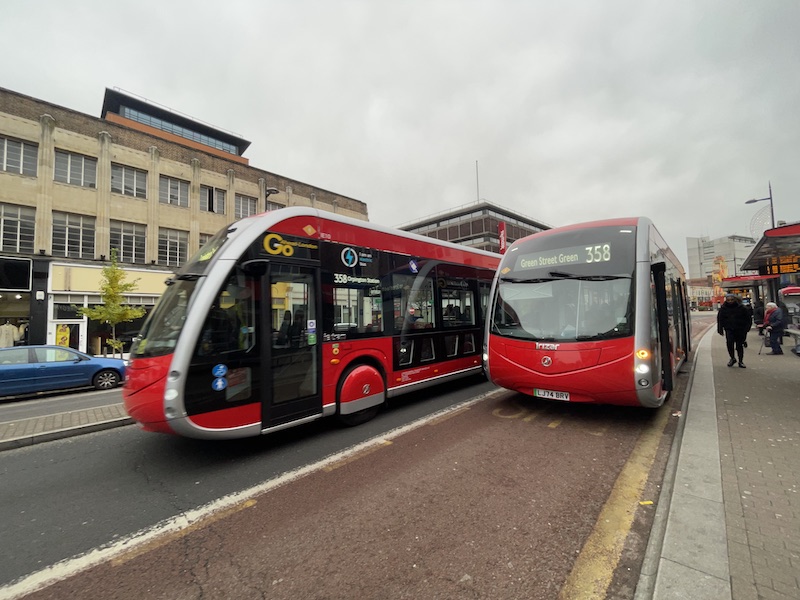
… and a third one came by within a minute behind that…

… which we’d spotted earlier in the journey being turned at Elmers End.

It took us 67 minutes to reach Bromley South from Crystal Palace compared to the scheduled time of 50 minutes – and this was off-peak – reflecting the busy nature of the journey (because at least one bus was missing in front) and the roadworks at the Links Way/South Eden Park Road roundabout which is currently severed and subject to four-way temporary traffic lights …

… where buses on route 358 turn left on route towards Orpington.
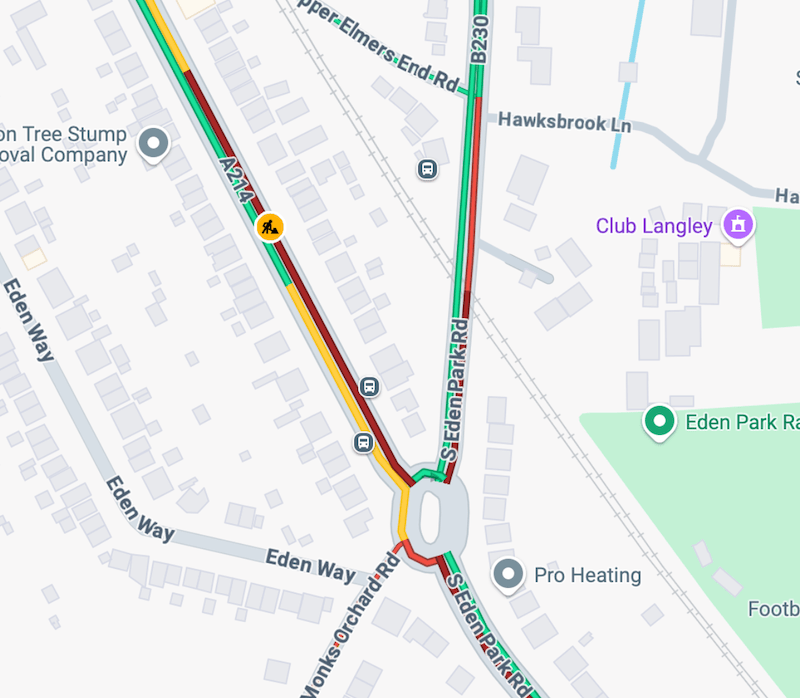
To mitigate the impact of these, buses towards Crystal Palace were turning short at both Elmers End and Penge.
On arrival at Bromley South railway station we decided to avoid the upcoming wait at Green Street Green for another bus and switched to using Southeastern for a quicker journey to Orpington, having also stopped for a much needed refreshment and toilet stop. After arriving there we saw that third bus of the trio we’d seen in Bromley on charge which was the one I explained above then headed off “Not in Service”.

To add to the short turning experience, the return journey we took from Orpington…

… had a curtailment at Penge, also announced almost immediately we set off, but in the event it got further curtailed in Beckenham and just as passengers alighted the bus behind passed it leaving them to wait for the next bus after that. Luckily we didn’t experience that disappointment as we’d opted for catching the more direct route 227 to Crystal Palace by bailing out at Shortlands.

It’s in the context of the aforementioned operational challenges and for which I could see everyone was working hard to mitigate, I would offer the suggestion on future occasions to delay introducing a fleet of new buses while disruptive roadworks are in place, especially in the busy build up to Christmas (the roadworks are due to finish in a month’s time on 21st December), and especially when the introduction is already well over a year late. Sadly I don’t think passengers are going to experience these head-turning buses at their best over the next few weeks, which is a great shame. As the marketeers will always tell you, for a product or service to be successful all the ‘customer touch points’ need to be top quality and reliability is the number one major touch point for bus passengers.
In my November 2022 blog a number of commentators suggested route 358 should be split, as well as partly double decked, to help with capacity on this busy service. The route is very much one of two halves and my observations show there are few ‘cross Bromley’ passengers as a percentage of the whole. Splitting the route in Bromley and double decking the eastern/southern end to Orpington would then be possible and the western end to Crystal Palace, restricted to single decks because of the low bridge at Shortlands, could perhaps be increased in frequency to every 10 minutes. It needs it.

Obviously this is a non starter now the pantograph infrastructure has been installed but perhaps is something for consideration in the longer term.
My thanks to my good friend and travel companion, Geoff, for making the day’s travelling so enjoyable on Thursday despite the frustrations and do give his video about the new buses a watch on YouTube.

Roger French
Blogging timetable: 06:00 TThS
Comments on today’s blog are welcome but please keep them relevant to the blog topic, avoid personal insults and add your name (or an identifier). Thank you.
 BusAndTrainUser
hi I work fir TFL I’m going to remain tight lipped but I can confirm it costs just under 1 million and I’ve been told a tax hike was the only way to fund these buses I mean trams
yours faithfully a TFL whistleblower
LikeLike
Looking at a First Bus Presse release they were going to be paying £81M for a 193 EV’s buses
The layout of the seating etc does not seem logical., THe double door and wheelchair bay is in the middle meaning you would the have to go to the front to show the ticket
Why the lower glass panels besides the modesty and risk of damage issue they will be adding to the cost but adding no value
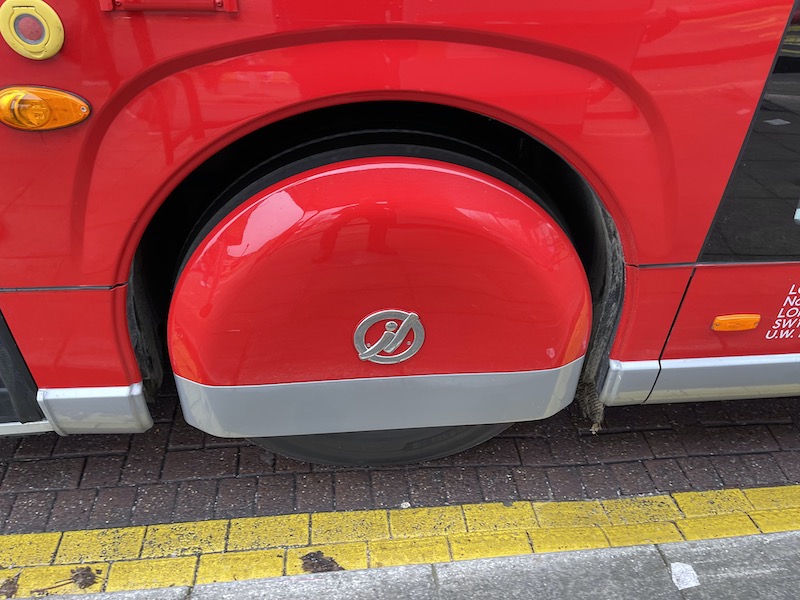
The Wheel covers are probably not a good idea neither. Add to the cost, You cannot see if the wheel is secure nor can you easily see the condition of the tyre
If buses are frequently being turned short hey probably need another charging point where they are normally turned short
If they do cost in the region of £700,000 is seem unlikely the vehicle saving will cover that cost but with no accurate costings who knows for sure
LikeLike
“TfL whistleblower”, it’s really not helpful just making things up, is it?
LikeLike
Not buying the line that TFL claims they are short of money, whenever we ask for improvements or extensions to cross boundary services ever again. Whatever these Trolleybuses (not trams) cost, It’s all political will. If their decisions of the last few years have anything to go by. Aaron
LikeLike
A recent trip to Warsaw showed how the pantograph charging is supposed to be done, unlike the arrangements pictured above.
The pantographs are directly above the loading and unloading bays in the bus station. The buses draw straight up, empty out their passengers, the pantographs go up and the bus doors stay open for the departing passengers to load. The destination screen alternates between the route and a countdown to when the bus is due to depart. When its time, down come up the pantographs and off it goes.
Maximum efficiency of vehicle use and the most attractive customer offer since there’s always a bus waiting (I think the frequency thins out in the evening). Warsaw’s buses have ticket machines / card readers on board with all doors boarding and passengers are trusted to get on (at least in the daytime!) even if the driver is having his break.
A second set of chargers is a bus length down the loading bay in case there’s some bunching and two buses need to be charged at once. I don’t think I can post links, but Googling “Ekoenergetyka is a supplier of the largest bus station in Poland” will get you a nice photo!
LikeLike
Last time I was at Birmingham Airport the car park shuttle buses were being charged on stand as Phil describes.
Ian McNeil
LikeLike
You say that the pantographs rise to meet the gantry in Warsaw. I think, but am happy to be corrected, that the 358 pantographs are lowered on to the bus, so positioning the bus may need to be more exacting.
MotCO
LikeLike
I think pantograph up to charging point is preferable because if it fails then only that bus is affected. If a downwards pantograph fails then that charging point is out of service for all buses.
Combining top up charging at termini bus stops as at Warsaw, and also on the French systems is more efficient as passengers can board ready for departure.
Peter Brown
LikeLike
I think that’s similar to the situation in Harrogate bus station.
And they have the comfort and space of a “proper” bus – not one that thinks it’s a tram!
LikeLike
I suppose one could have had the Shelvoke and Drewery Tramocar vehicles as the last time a non rail using vehicle was called a tram ?
LikeLike
Good report, particularly highlighting how seemingly out of control roadworks are destroying the bus network (not confined to London). Proliferation if roadworks and associated OTT traffic management are the biggest enemies of bus services right now.
On the buses themselves, the interior gangway is exactly the same width as on any other full-size single deck bus. The front door is wider than the gangway. Also, a bit puzzled about the comment regarding where people put their shopping trolleys because the wheelchair bay is exactly where people put them on every London bus I’ve ever travelled on.
The seats over the rear wheel arch are tight for legroom, but no more so than on some other buses, eg Kite Electroliner.
Contravision film over the lower glazed panels would be a simple solution if this aspect really is causing concern but I don’t hear similar comments about glazed staircases or the high exposed seats at the rear of some other EVs.
If TfL really did pay £7m per bus then they’ve been ripped off!
I dare say operation will become slicker as experience is gained, but I agree that just one charger at each end of the route is challenging. But then maybe that’s the point. If this route can manage then many others could.
Shame about the delays to introduction, but good for TfL for pushing the boundaries on this project.
Steve
LikeLike
Pictures featuring a guest appearance from some very high black boots!
LikeLike
Designed to be looked at, not travelled in? Rather like another TfL bus I can think of.
Jeff
LikeLiked by 1 person
TfL likes to think of itself as an ‘innovator’ but I wonder how practical these buses will turn out to be in the long run with all the issues identified in Roger’s excellent blog. Apart from normal maintainence issues like checking wheel nuts (an important safety requirement) some other features like the lower glass panels will no doubt soon be replaced with body panels (at additional cost).
The seating configuration though would seem to be something which should have been given more detailed thought. Given that the population is getting larger decent legroom should have been a basic design requirement. If passengers are forced to sit at an angle they are not doing their posture any good either. Hardly a transport of delight.
Given the cost of this ‘experiment’ it is unlikely to be repeated Londonwide. Recent tender awards on routes travelling through central and inner London have seen sharp PVR reductions. Perhaps this is the price we are paying for the bus/tram on the 358 ?
Martin W
LikeLike
The wheelnuts and tyre pressures are continually monitored by an electronic system. Safer than a visual inspection, which by its nature only verifies wheel and tyre integrity at one particular moment.
LikeLike
And to think when the 358 was first introduced (as a Metrobus initiative, and I think to utilise empty commuter buses returning from London), there were only a handful of journeys a day. Now it us every 12 minutes for about 20 hours a day.
Also, if each bus costs £700,000 that is about twice the cost of a normal 12mtr EV bus. Would it not have been cheaper to buy 50% more normal EV buses, and let them return to base during the day to recharge, with the extra buses taking their place?
MotCO
LikeLike
I have obviously not been keeping up properly, but I took don’t understand why these vehicles are preferable to EV buses that can run all day and recharge overnight.
Nicholas Lawrence
LikeLike
Objectively they aren’t. It’s another one of these grifts politicians fall for like DRT. In this case making a bus look like a tram is supposed to convince car drivers to use it, despite the fact there is zero evidence that this is actually the case. In fact, given that these buses usually cost significantly more and need infrastructure changes, they are almost certainly less attractive to car users than the much more frequent conventional bus service which could be provided for the same budget. That’s why they are only ever introduced on routes with loads of Government cash available, as no commercial entity would go near them.
LikeLike
There aren’t (currently) any EV buses that can run all day and recharge overnight for the mileage requirements concerned.
LikeLike
Battery electric buses run all day on Guildford Park & Ride and charge overnight. Just being a pedant.
LikeLike
They aren’t covering the day length & mileages of this service, and Park & Ride services tend to actually be quite low daily mileage in comparison to normal services as there is a lot of stand time at either end, even the manufacturers don’t claim that a standard battery electric can cover all urban bus workings without a recharge. We have one electric urban route that can just about cope in the summer but the moment it gets cold & dark so heating & lighting go on we have to swap the buses off during the day to top them up as they can’t do a full day and that is using a model known to have on of the longest ranges on the market at the time. A normal urban bus cycle is generally less than 200kms but something like this may well be nearing double that for the longest bus days (early starts & late finishes).
Also there is an advantage in using opportunity charging meaning the buses have smaller batteries and so are cheaper to buy per vehicle (though you do have to pay for extra infrastructure with the charging pantographs) and lighter which is seen as an advantage.
Unlike the Borismaster these aren’t bespoke London only vehicles, they are pretty common on the continent though opting for the tram look is more common as part of a BRT scheme with major bus priority where the ‘tram look’ helps highlight the extra infrastructure of the scheme (so they sit as a mid point between a conventional bus & a more expensive tram which dedicated sections like a tram without the expense of installing rails), so the FastTrack in Kent is closer to how they are deployed on the continent than a conventional service like the 358.
Dwarfer
LikeLike
What is the daily mileage for this route and what is the best mileage for EV buses please?
LikeLike
Opportunity charged eBuses don’t need such large batteries, saving weight, which can be reallocated to increased passenger capacity or be beneficial in less tyre and road surface wear and tear.
Peter Brown
LikeLike
Hi, I have subscribed to your blog and I received the confirmation email. I clicked on the link and it took me to WordPress but it didn’t automatically add the subscription. It’s not a problem for me but it might be for others. Just a thought.
LikeLike
I can confirm your subscription is on the WordPress database. Many thanks. Roger
LikeLike
I tried this service from Orpington yesterday, Friday 22nd November, boarding at the stop outside of Sainsburys Supermarket in Orpington Town Centre. Also boarding at that stop was a chap in a wheelchair and, unfortunately, the Driver seemed to be having a bit of an issue with the ramp. Luckily, the chap had a carer with him and was able to help him into to a seat via the front doors. The harder part was the wheelchair which, even when “concertinaed” wouldn’t fit between the seats and had to be lifted by the carer and a volunteer over the seats to the wheelchair space – thankfully the ramp was back working when we got to their stop but this really couldn’t have been a pleasant or dignified experience for the wheelchair user nor his carer.
At the next stop, several elderly ladies boarded, all with shopping trollies, none of which fitted easily between the seats – that’s the trollies not the elderly ladies! – and I heard a few comments about waiting for an alternative service in the future.
The plus side was that I personally found the seats comfortable and I did hear admiring comments about the bus from some more able-bodied customers including a group of school children but that doesn’t sit comfortably with me if less able passengers are essentially being discriminated against.
David Potts
LikeLike
Buses are not designed to have shopping trolleys between the seats. THey should be put in the wheelchair area or luggage bay
LikeLike
I had a ride yesterday from Orpington to Bromley South. I had a 20 minute wait, I think I just missed one. Yes, they have comfortable seats. Part way along I saw a man holding a buggy with a child in it making his way along Catherine gangway, with other passengers helping.
About five stops before Bromley South the bus was crammed. There was no chance of a buggy or a wheelchair getting on. I’ll have another ride in the new year to see how it’s settling down.
LikeLike
Many thanks for this generally positive report.
Roadworks: It would be nice to know (why isn’t anyone in the bus industry telling us users/customers?) what is being done to tackle this issue? By small bus companies – are they letting local councils/MPs etc. know how the problem affects, their customers/their staff who have to cope/their profits? By big bus companies – are they individually and/or in combination using their commercial/political clout to let ministers know what would improve things? – have they got an industry-agreed list of demands (I’ll write them one if they haven’t done so yet)? By the allegedly all-mighty Road Lobby (I’m sure the AA etc. as representatives of car-drivers would be on board)? By the rail industry – are they pointing out how roadworks affect their rail-replacement buses? – how uncertainty and delays to connecting buses affect rail customers and rail-revenues? Have all these things been tried and failed? – or simply not thought of? – or dismissed as ‘not our problem’?
I do agree that the route does serve two different local ‘markets’; what it doesn’t serve is any sort of express route Orpington-Bromley-Crystal Palace. Because of the fixation rail managers have with running services only half-hourly, the rail option in one direction is brilliant (30 minutes – better than driving – with a 4 minute connection however at Beckenham), but 50 minutes in the other! Get a grip, chaps, and look at what the tube lines in the north half of London do; at least bring back 4tph on Victoria-Orpington. Meanwhile, for customers, there are quicker bus services CP to Bromley and Bromley to Orpington than the 358.
LikeLiked by 1 person
I travelled yesterday end-to-end in both directions. The buses are comfortable, warm, smooth and quiet. A wheelchair-user boarded and alighted without too much trouble, save that the doors have to close for the ramp to glide out / int, then open again, which caused some delay/uncertainty. The front folding door nonplussed a few. Generally favourable comments from passengers and passers-by.
Have to agree with two earlier commenters – roadworks must be the biggest factor affecting service reliability in many areas. Now that sophisticated traffic-light systems allowing 3 or 4-way control are available, they seem to be used for the sake of it where 2-way control would be sufficient.
Minor points : the assortment of logos / icons on the side – Go Ahead London, TfL roundel, I’m an electric bus, USB charging icon, Cleaner air leaf motif and the orange lozenge could be tidied up / pruned to advantage.
Interested to see the Navaho internal route display is using a “default” font instead of New Johnston.
Observer
LikeLiked by 1 person
Related topic concerning wider adoption of eBuses and current, sorry 😀 obstacles:
https://www.route-one.net/news/bus-electrification-can-be-quickened-by-policy-change-says-zenobe/
Peter Brown
LikeLike
EV’s are currently heavily subsidized that cannot go on for much longer
Another big problem is the grid,. It was designed to server power stations distributed around the UK and not a few remote wind farms, It is ill suited to server EV’s and need extensive and very expensive upgraded to do so which probably accounts for the long delays in introducing them
LikeLiked by 1 person
Glazed lower panels aren’t that new. Skimming through my photos of buses in Europe, I have photographed buses with those glazed lower panels as long ago as 2013, in Bordeaux (buses built by Heuliez). I’ve seen similar styling on Ivecos in Lyon (2015) and Mercedes Citaros in Malmö (2017).
Malc M
LikeLike
I had no idea of the price of these “Prams” (the older generation will possibly note the similarity) and perhaps Mayor Burnham, whole loves “London style” services will be next to waste Manchester Council Tax Payers money on some of them? A comfortable seat isn’t much joy if you have to fight to get in and out of it every time.
There will be no “settling down” of road works, as they are now constantly disrupting the entire UK.
Unfortunately, and splitting routes is not helpful to passengers, but the 358 experiences delays, over-crowding and inadequacy at peak times, particularly south of Bromley, and most certainly should be double-deck (the 126 could be extended and double-decked to cover). But of course, this will now never happen and the unfortunate residents of Farnborough and Green St Green who have no alternatives will be left to “put up with things” for a long time to come.
And how typical of TfL to be displaying Underground information in areas so far from the Tube it is utterly meaningless.
I live on the route near Locks Bottom, but thankfully have three other services to choose from unless having to go to the afore mentioned areas, and my now very rare journeys will be come rarer still.
Terence Uden
LikeLiked by 1 person
The amount of roadworks should start to decline. Most are down to installing Fibre and replacement of old gas and water pipes
LikeLike
Here in Brisbane, the local council is spending an eye-watering amount of money on what it calls the Metro, using 60 Hess Lightrams. The vehicles are neither Metro nor trams, being 24m long double-articulated buses. Since they will only run on the dedicated busway, which has been in operation for over 20 years, they are unlikely to cause delays to other road users.
Because standing space on the Busway is limited, two of the overhead charging points are at layover points a couple of minutes beyond the inner-city termini. Because there is space at the dedicated bus station at the university terminus, there are two chargers in the layover area and two at the pick-up stops to be used by the service. Even now, at university times, the five-minute service on the route to be converted from here struggles to cope.
The fourth charging point is in the depot, which is just beyond the southern terminus, which is useful in case a bus needs to be changed over.
I have heard rumours that, while on test, some of the buses can’t hold enough charge for a single trip (around 20km). We’ll have to see what happens when the service is up and running early next year.
LikeLiked by 1 person
Can depend on load and weather conditions, Cold weather will be less of an issue in Australian but if they have air con that will be a heavy drain on the batteries
Issues can arise with EV’s with later running normal buses can be turned straight around the EV’s though need to be sat on charger
LikeLike
Good to see you on Thursday Roger. This is the first time I had been in the 358 getting in at Orpington but unfortunately due to late running the bus was curtailed on route so I quickly changed o to a 227 as the following 358 was 12 minutes plus it was very cold !!! I agree it would have been a lot better to wait until January and convert the whole route in one go. I am sure that extra time will have to be out in at each end to maintain the service especially at Orpington where the drivers have to reverse the bus into the correct position.
Jon
LikeLike
Thanks Roger, a very comprehensive reveiw.
The problem of very tight schedule to accomdate the charge time should be plan ahead with extra vehicle purchased to built a more robust timetable. As a flagship project, the return is not the most critical factor to consider rather to build a good reputation of the service. Also, wonder is the ie Tram / bus being manufactured in the UK to support local industry, which may also be more justified for the higher cost incurred, at least, our economy benefitted.
LikeLiked by 1 person
You can see where the Irizar factories are located here:-
https://www.irizar.com/en/irizar/production-plants
I don’t see much opportunity for UK industry there, apart, possibly, for component suppliers.
LikeLike
Interested?
LikeLike
My old friend Geoff Williams from Orpington has one major criticism: “The 358 has a major issue for me and other old crocks of now limited mobility and that is failure to provide a grab-pole in the “Priority seating” area at the front, meaning that either the passenger remains on seat, unable to get out at the intended stop, or s/he goes flying into the passenger opposite because there’s nothing else to hang on to. Not funny. It seems to me that a single upright grabber would suffice. The new vehicle doesn’t appear to have such”. Graham L.
LikeLiked by 1 person
I had a ride on “IE13” on Saturday. I did not need to wait long at Crystal Palace for it and it was fun seeing it being charged although the pantograph needed two attempts to “connect” before the huge power management boxes nearby switched the power on! I was generally impressed except with the narrower front platform entrance. There were worries at Elmers End Green when there was a “pregnant pause” with the information screens going blank for a short time. The facing seats enabled me to chat with a Scotswoman sitting opposite me and as the weather was foul, steaming up the windows, there was little point using the journey for sightseeing. I regaled her with all the glories of her homeland which I enjoyed on holidays a long time ago: family car when a child, rail rovers, motoring on my own (Honda CD175) and free by air once as I was a travel agency clerk at that time.
LikeLike
Whilst there’s only one fewer seats than a Citaro there are twenty fewer standing places, 45 v 65, although more than Enviros. At school times Citaros often fail to stop when requested so more pressure there, unfortunately.
LikeLike
I took a trip on the 358 this lunchtime from Crystal Palace arriving by Windrush line with updated line diagrams, digital displays and audio announcements.
The 358 is a suburban BUS route operated by red vehicles with stops closer together than any tram would ever be, charging bus fares. It was running reliably, however less than half the vehicles were tracking on BusTimes.
I travelled to Bromley aboard a Citaro, a bus suitable for inter urban routes along fast roads that I enjoy travelling on but not pottering around suburbs.
And so to the Irizar electric bus.
I’ve been on Lothians new electric buses where no customers made any comment as it is the high standard expected on every bus (good luck at the awards ceremony tomorrow).
I’ve been on Merseyside hydrogen buses where the interior is a bright transformation from corporate colours that causes customers to say “wow what is this”!
The ie13 is easy to spot and the single leaf door makes for disciplined boarding where folks queue in a line not descend in a melee.
You step aboard swiftly touch in and proceed (no Ticketer here) only to be met with dull interior of grey seats. They are comfortable and I was lucky to get one near the back with adequate legroom. There were always standing customers despite seats available, however I must commend the standard of driving and the excellent behaviour from a cross section of society who refrained from playing music or talking on their phones aboard as the cramped bus that glided along.
The bus had mood lighting but I’m not sure it has night lighting otherwise an evening journey will be an ADL experience.
The line status was an initiative by Tim O’Toole brought in from the States to run the tube that resulted from him travelling the system before taking up his post. He was not impressed by your first impression walking into a station is seeing a whiteboard with something scrawled on it that was bad news. He wanted a system where you checked on a display to see if your line was OK and go, only stopping if it mentioned your line.
I walked into Crystal Palace Station checked the board delays on Metropolitan and Piccadilly lines, I’m OK to go.
A fresh pair of eyes from the customer perspective can have a lasting positive effect on everyone’s journey experience.
The only bus company that comes near this is Lothian as evidenced by their App when storm Bert struck on Saturday.
John Nicholas
Irizar ie13 7.5 out of 10
One day buses will designed by starting with the seat layout then engineers using their skills to design a body where the windows align to them.
LikeLiked by 1 person
Are these the first TfL Buses to have a rear ultimate destination since the withdrawal of the Routemasters from the 159 bus route ?
JBC Prestatyn
LikeLike
BYD electric buses used on route 63 that were the original new standards for Londons buses have them and warm red seats too!
John Nicholas
LikeLike
Well, that’s pulled that initiative to bits then! A lot of people have worked on the project for quite some time. It may not be perfect, but I applaud their work.
LikeLike
Interesting article regarding today’s announcement on a national Integrated Transport Strategy:
https://transportactionnetwork.org.uk/five-tests-for-integrated-transport/#:~:text=The%20announcement%20of%20the%20vision,badly%20in%20this%20area%201.
Plus, if the government wants to radically improve public transport in our larger towns and smaller cities, the DfT should study this French report on Buses with a Higher Level of Service:
https://nbrti.org/wp-content/uploads/2017/05/buseshighlevelservice_bhns_2009_english.pdf
Peter Brown
LikeLike
I have to say I think these buses look ridiculous. And I think they will prove too small for the job.
We have EV buses on one of our local routes the W5 in north London. They have the same or maybe slightly more capacity than the old Optares they replaced and thankfully no one felt the need to try and do a mutton dressed as lamb number on them. I think they are actually well designed from a passenger point of view. I think reliability has suffered although that is only my anecdotal impression. Whether the problems are caused by the vehicles I’m afraid I can’t say.
Are EV buses worth the trouble? The real win for public transport in the decarbonisation effort is modal shift from private to public transport. That means investing in good value fares, high frequency and high reliability services on nice, clean and comfortable vehicles. Why not wait until battery and recharging technology is a decade further on before investing in new buses simply because they are electric?
LikeLike
The new 358 buses are very difficult for me to use. I am relatively small (5’2”) and have mobility issues. Unlike the old buses, the new ones cannot be lowered to allow access for those who struggle with high steps. Often my bus arrives just behind another bus, and the driver cannot drive close to the sidewalk. So the driver opens the door in the middle of the road, making it almost impossible for me to board the bus. I almost had to crawl in on my knees. Also, there is only a handle to the right at the front door, no option to hold onto anything to the left. This makes it very difficult for me to enter the bus, as I have to hold on to the left, because my right knee doesn’t work. All in all, I really dread having to use the new buses.
LikeLike