Thursday 21st November 2024
Earlier this month media outlets in London and Surrey ran a story about an “isolated Surrey village” “urgently needing” a bus service. The village is Netherne-on-the-Hill. I’d never heard of it so decided to investigate and verify claims elderly residents may be “forced to leave” for the lack of a bus.


Nerherne-on-the-Hill, despite lying just 650 yards outside the Greater London boundary, definitely has a feel of being “isolated”.
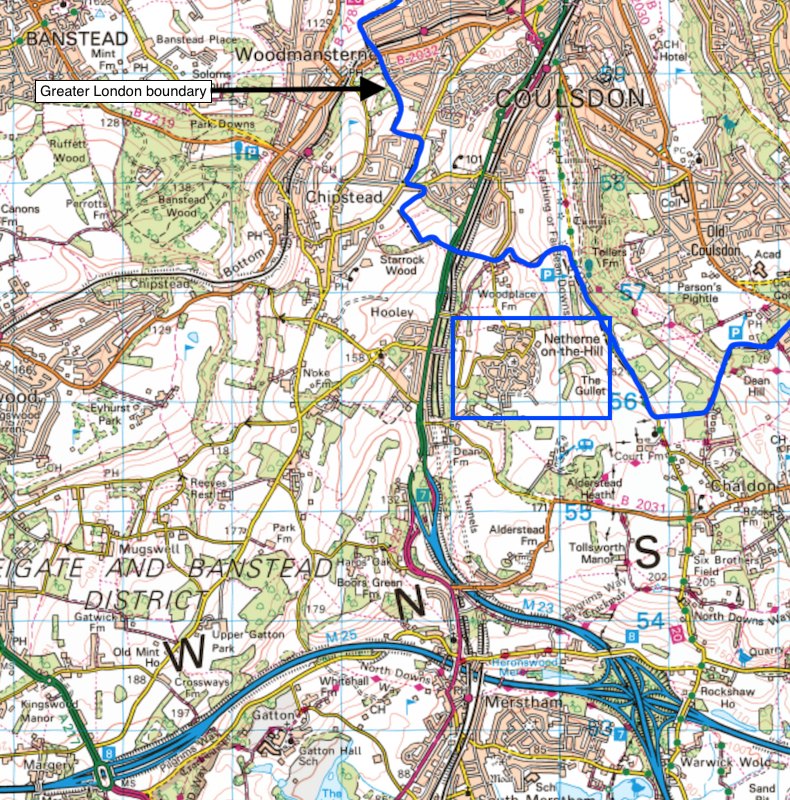
As its name implies, the village’s lies atop a hill meaning consequential challenging access for pedestrians to and from the A23 Brighton Road which runs north/south on the west side of the Brighton Main Line tracks which run in two separate deep cuttings at this point (see above map).
The village was created as recently as 1995 and comprises around 1,500 residents in just under 600 houses and flats built on land which once housed Netherne Hospital. The Hospital was what used to be called a ‘lunatic asylum’ prior to the 1960s. It had opened in 1909 having been designed by George Thomas Hine who was Consultant Architect to the ‘Commissioners in Lunacy’ – I promise I’m not making this up. That’s how life used to be and thank goodness times changed such these vast institutions had all closed by the 1980s and 1990s with government’s Care in the Community policies and a greater understanding of mental health issues and how to treat them.
A developer snapped up the Netherne site in the 1990s converting many of the former hospital buildings into flats and terraced houses. Walking around the village now you could easily miss the amazing backstory of what went on in the 20th Century when there was no need for a bus service for the “residents” although it’s intriguing to ponder how staff accessed the Hospital.
Once residents started moving into the newly created village in the 2000s, the Netherne Community Bus Company was established to provide a shuttle service to and from Coulsdon South railway station during morning and evening peak periods as captured in the photo below by Michael Wadman to whom many thanks.
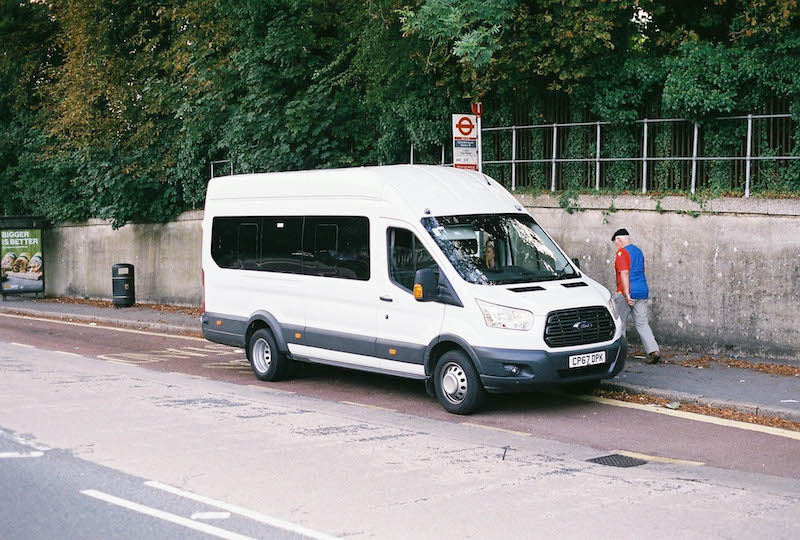
It was set up with Section 106 funding from the developer and a small grant from Surrey County Council but sadly operations ceasing during Covid and the company was wound up leaving the village bus less.
I’m not sure why the story has taken hold this month as things came to a head back in June when London’s Deputy Mayor for Transport, Seb Dance, wrote a response to Caroline Russel AM, leader of the Greens on the London Assembly, in response to a petition organised by local Ward Councillor Shasha Khan which was submitted in December 2023 calling on TfL to extend route 463 from its terminates at Coulsdon South station (shown at the top of the above map extract) having arrived from Pollards Hill, Mitcham Eastfields and Wallington to the north.

But that doesn’t look a likely prospect, as Deputy Mayor Dance explained in his response. Route 463 runs every 20 minutes and an extension to Netherne-on-the-Hill would add around eight minutes travel time in each direction necessitating an extra bus being added to the cycle. Deputy Mayor Seb Dance wrote “TfL has carefully assessed the cost of providing this service using the same criteria it applies for assessing all changes to its route (sic). TfL’s assessment suggests that extending the service to Netherne-on-the-Hill would cost around £1 million per year.”
£1 million for a one bus extension sounds a lot to me but knowing TfL’s penchant for long layovers I’m guessing they’ve assumed two extra buses. And, of course, a 20 minute frequency would be overkill for a small village the size of Netherne but I can understand why it wouldn’t work to extend, say, every third journey to provide an hourly frequency as buses wouldn’t then cycle round efficiently. You might as well extend every journey.
Deputy Mayor Dance went on to say “as Netherne-on-the-Hill is located in Surrey, it is Surrey County Council that is responsible for funding any public transport service that is not provided commercially by bus operators, and this extends to some of TfL’s existing contracted services operated within Surrey.” In other words if Surrey hand over £1 million to TfL, then Netherne could get its bus. Fat chance.
However, it is not true that Netherne-on-the-Hill is completely isolated from public transport. The BBC news story stated “since September, residents of Netherne have been able to use the Surrey Connect-on-Demand bus service, but this currently only provides journeys into the Tandridge district of east Surrey rather than crossing the London border in Coulsdon.” So the village isn’t completely bus less and enjoys the option of a DRT service, albeit taking passengers somewhere they don’t really want to go, for example, the shops in Caterham, which ironically is further away than Coulsdon just up the road, but that’s in London, not Surrey.

In better news, the Green Party website explains how Councillor Shasha Khan organised a meeting between East Surrey Rural Transport and Netherne residents “to explore ways to bring a shopping bus into the village” adding that “with some careful budgeting a service was successfully introduced” There’s even a photograph to celebrate…

… and back on the Netherne Village website are details of the “Wednesday Netherne/Town Centre Bus Service” confirming the “bus leaves Netherne at 10:30 and returns at 1:30” with a cost of £5. Details are still online of the 6th November trip to Haskins Garden Centre adding “this is a community bus service that has been set up to transport Netherne residents to local towns or garden centres every Wednesday”. Sounds like an ideal arrangement.
I paid a visit to Netherne-on-the-Hill last Friday to test out its isolation and see whether I could book a Surrey Connect ride to Caterham. I travelled on route 405 from Redhill, alighting in Hooley on the A23.

There’s a pedestrian phase at the traffic light controlled junction with Star Lane to cross the busy Brighton Road and then it’s into Forge Bridge Lane…

… which gives access to a road maintenance contractor’s yard at the end of the short no-through road after crossing over the Brighton Main Line in its deep cuttings – both the line via Redhill…

… and the Redhill avoiding line.

And just to explain I aligned my camera up with one of the holes in the mesh netting to prevent anyone jumping down on to the tracks, in case you thought it was rather open.

Having passed the contractor’s yard…
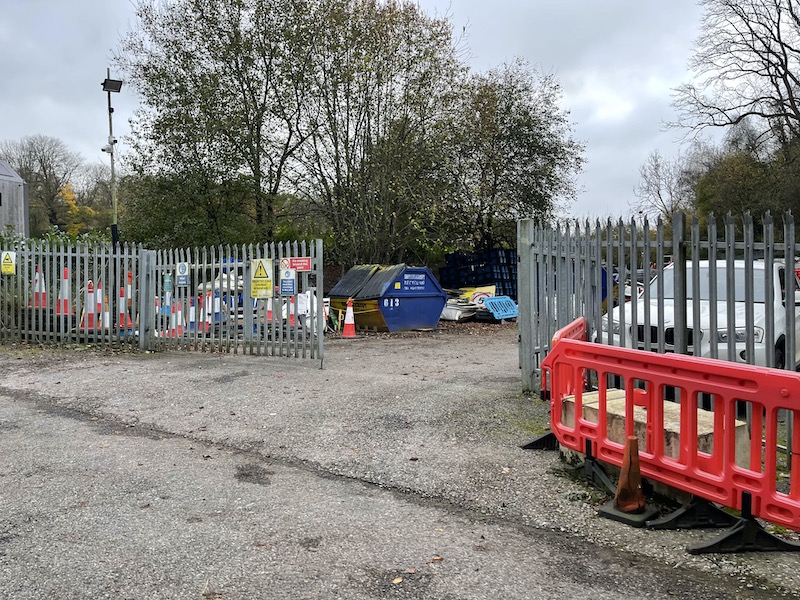
… the road ends with an unlit footpath continuing up a steep incline on a fairly rough and potentially slippery surface – no chance for wheelchairs, scooters or buggies…

… with some nice trees to admire on the north side…

… and after a while the road access (Netherne Drive) comes into view, which the footpath crosses as it continues up the hill.
As the map below illustrates this road access does offer a lighted alternative for pedestrians (and better access for wheelchairs and buggies) but it’s a longer climb, albeit less of an incline, as the road meanders around the hillside.
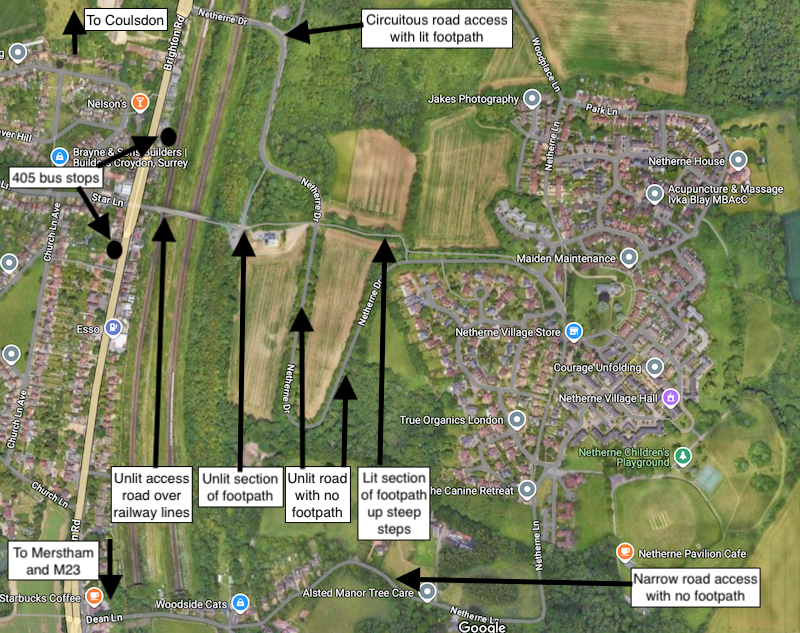
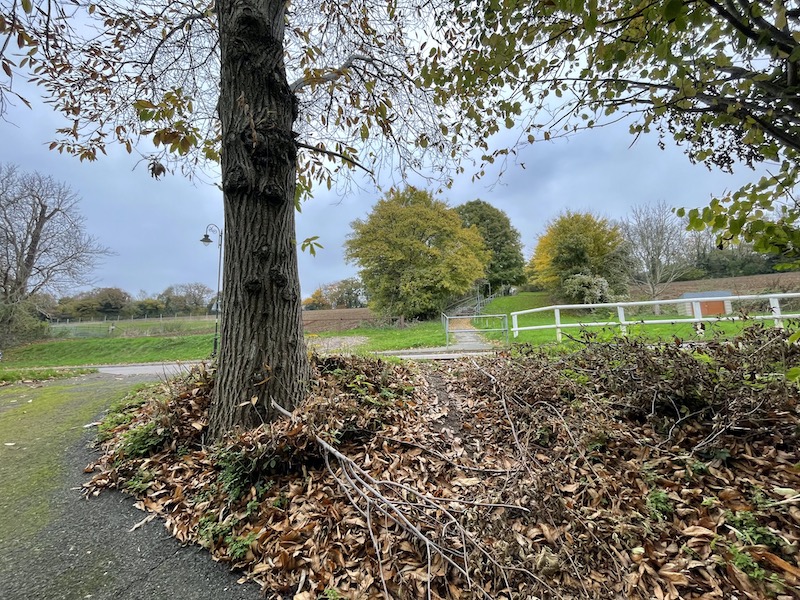
As I’ve shown on the map above, where the footpath crosses the road it then becomes lit but the incline gets steeper with steps alongside a narrow leaf covered slope.

The road alternative from that point isn’t possible for pedestrians as there’s no footpath and it isn’t lit. The incline is very steep – I read it’s a 1 in 6 gradient – but there are some nice views to be had as you pause to catch a breath.

Having reached the top of the hill the footpath then returns to being alongside the road which is the other side of the hedge in the photo below after completing its circuitous route.
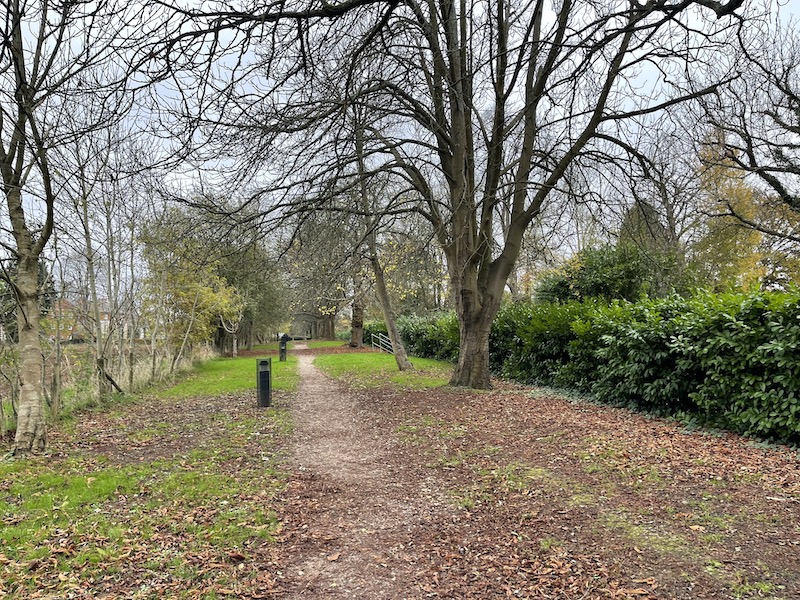
It’s then not far into the village and you soon pass the sign confirming you’ve arrived…
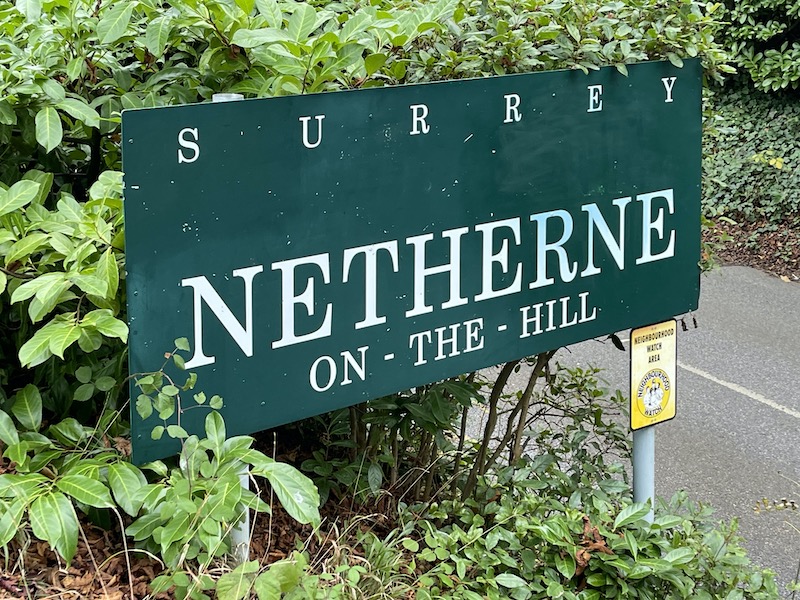
… and the houses begin.
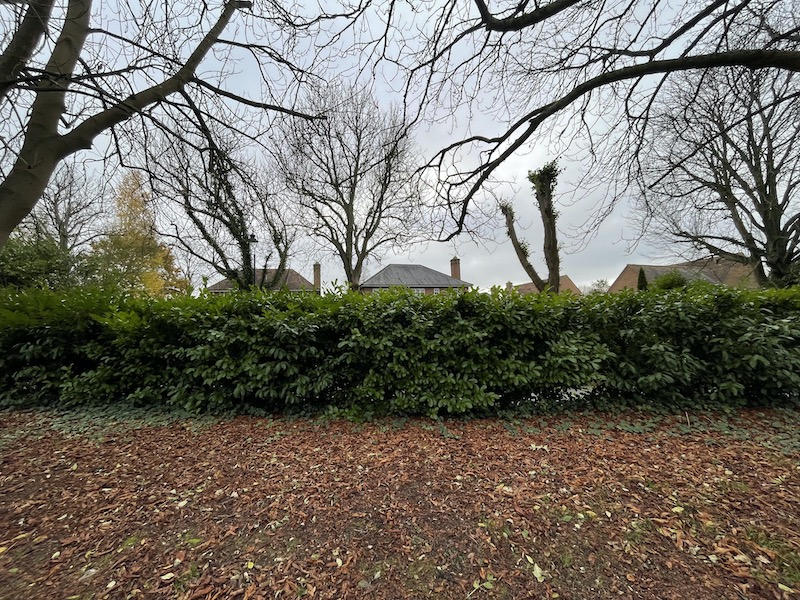
I hadn’t researched the background to the village prior to my visit and was initially blown away with the size of the houses and the number of cars parked in drives…

… and I soon gained the impression this wasn’t what you might call “bus territory”.

But then I came across what were obviously former hospital buildings and realised there were a lot of flats in the village…

… but seeing the number of cars parked alongside, I suspect there aren’t many residents who don’t have access to a car.

It really is a very pleasant place to wander around with some lovely footpaths…

… in the former Hospital grounds …

… the former Water Tower…
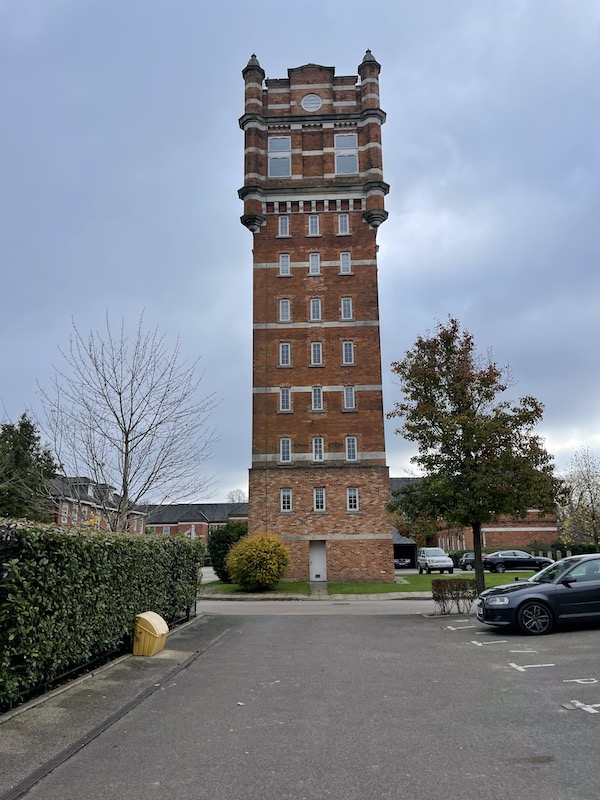
… a substantial church…

… a huge village hall which used to be the main recreational hall of the Hospital…

… a village shop …
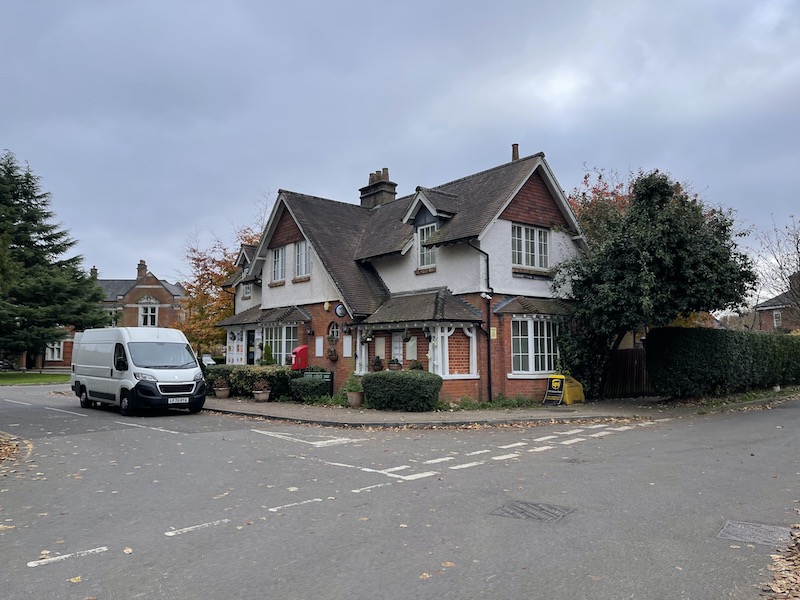
… which was well stocked…

… a children’s playground…

… and some lovely views of the surrounding countryside.

As well as the many residents’ cars parked around the well kept village (no yellow lines here)…

… the other thing that struck me was just how quiet it was with no traffic and no other people walking around save for one dog walker, a window cleaner and the shop owner unloading a van of supplies.

I came across a property for sale…

… it’s a five bedroom detached house with a double garage and is on the market for what seemed to be a very reasonable “offers in excess of £800,000” perhaps reflecting the isolation of the village, although I see the Estate Agent’s blurb reckons there are “numerous bus services provide transport to all the surrounding areas” …

… which is rather pushing the boundaries of what route 405 offers as well as glossing over the fact its a 15 minute steep incline walk away partly in darkness. Perhaps it was referring to the Surrey Connect DRT option which I decided to try out myself and take a ride over to Caterham having completed my most enjoyable wander around the village. Except it turned out I couldn’t book due to “an internal error (code 403)”.

This was a great disappointment as that was going to be the highlight of my visit – summoning up my own personal taxi. Never mind, instead, I enjoyed the walk back down the steep hill to catch one of the “numerous bus services” on the Brighton road (ie route 405). And it only took 12 minutes to walk down the hill, rather than the 15 it took on the way up.
When I got home I checked out the App again and it turned out I needed to download an upgrade from the App store. I thought about heading back to Netherne earlier this week and giving Surrey Connect another try, so on Monday while waiting for the train to Dover I tried to book a pick up at 10:15 but the only option was a journey two hours later at 12:15.
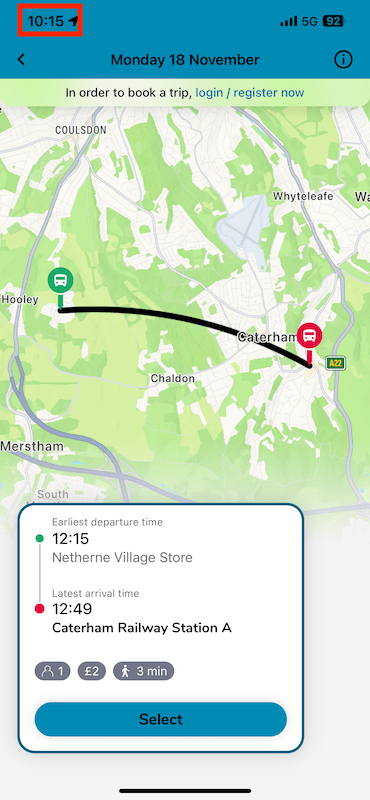
So I had a go at seeing what it would offer for the same time the following day, Tuesday, and hit the jackpot as I got offers of both 10:05 and 10:15 – not bad for an “isolated village” if you’re prepared to book 24 hours ahead.

Just to test it out again, while at home the following day, Tuesday, I tried to book the same journey as the rain was pouring down outside during the morning peak and impressively got offered a pick up half an hour from booking, with another option just 15 minutes later than that.

This demonstrates a very clear benefit of DRT which I’m delighted to acknowledge is the best option for providing a bus service to this awkwardly sited but delightful Surrey village alongside the weekly community bus arrangement the residents have organised.
Sadly, Councillor Shasha Khan is on to a loser in thinking TfL will extend route 463 to serve Netherne-on-the-Hill despite the petition.

As well as the recent Surrey Connect development of including the village as an out of zone stop, the Netherne Residents Association goes on to report that “in September 2025, the third phase of this service will be extended to Reigate and Banstead. This they consider may be a better route for us and hope to include Coulsdon and Old Coulsdon as out of area stops” which really would be good news for residents. But, if so, does it really have to wait until September next year?
The Netherne Residents Association also report “we have been having meetings with representatives from Surrey County Council. Whilst they maintain that there is no money to provide a service to Netherne we have discussed the possibility of one bus and two drivers to run from Netherne to Coulsdon South Station, into Coulsdon and back again.” It goes on to add “in July 2024 we had a meeting with Surrey County council”… and … “Valerie Sexton – the Bus Service Planning Team manager from SCC has ascertained from TfL that a shuttle bus or extension would cost in the region of £400,000 a year. Surrey County Council would be required to fund the full amount.”
You have to admire the tenacity of those campaigning for a decent bus service for Netherne-on-the-Hill notwithstanding the inherent challenges due to its isolated position. But, that isn’t a unique situation. There are other villages with comparable logistical issues including, coincidentally, the nearby Surrey village of Tatsfield. This is broadly of a similar size to Netherne with a population slightly larger at 1,900 and 770 dwellings, but it’s similarly located in being just outside the London boundary, yet Tatsfield residents enjoy a half hourly service (hourly on Sundays) on route 464 to Biggin Hill and New Addington including journeys as late as midnight. Surrey County Council makes no financial contribution towards the route.
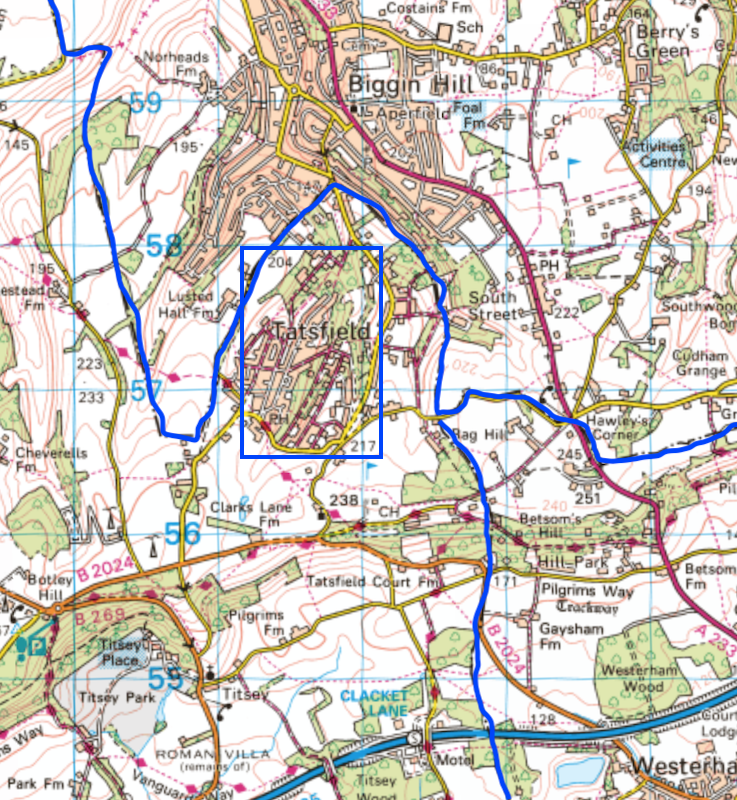
Smacks a bit of a postcode lottery.
Roger French
Blogging timetable: 06:00 TThS
Comments on today’s blog are welcome but please keep them relevant to the blog topic, avoid personal insults and add your name (or an identifier). Thank you.
 BusAndTrainUser
“This demonstrates a very clear benefit of DRT which I’m delighted to acknowledge is the best option for providing a bus service to this awkwardly sited but delightful Surrey village alongside the weekly community bus arrangement the residents have organised.”
Sorry, Roger – DRT is only the answer if the question is “what variant of bus service is least bad?”. Unless there is much greater success in combing trips than has been achieved elsewhere, then DRT services like this spend most of their time taking one person (or travel-together group such as a couple) at a time – the “personal taxi” that Roger so craves.
If you remove the requirement that sparse demand has to be met by something called a bus, then the vehicle you would select to deliver a “personal taxi” service would be … a taxi. Sure, the subsidy cost would be horrible – but less horrible than for DRT. And probably with lower emissions, too.
But we have county councils charged with providing buses, and district councils covering taxis. And we have politicians who are desperately keen not to have to define who would get a heavily-subsidised taxi ride and/or the purposes for which they would be provided. And without such constraints, they would see the year’s budget blown in a few weeks once people started using subsidised taxis to pop over to the golf club for a quick snifter.
With DRT, you constrain the demand by defining the spend and thus the number of vehicles and coverage area. You can be sure that you won’t blow the budget – but you need to close your eyes to the pitiful utilisation and consequently the horrible cost per passenger journey (or the even higher cost per travel-together-group journey which is the relevant comparison against taxi costs).
The most convincing argument for DRT is perhaps the legal opinion briefed by the Campaign for Better Transport in September 2011 (https://tinyurl.com/cbt260911), which seems to say that as long as a local authority gives everyone some chance of transport (however thin that provision actually is) then that counts as OK in fulfilling the statutory duty to provide an “appropriate” public transport service.
So mop up all that messy rural demand by allocating a pitiful number of DRT vehicles to a wide geographical area, and job done: “it could be you” public transport that ticks the box.
Is it this that is whispered to desperate local authorities by DRT providers to clinch the many otherwise-hard-to-justify schemes around the country?
John Geddes
LikeLiked by 2 people
There are other options that can be provided in a fixed budget
Firstly, a publicity campaign to encourage liftsharing (there are existing websites for this). Maybe even taxisharing–attempting to steer demand to fixed times and departure points for a taxi with a modest subsidy
As part of this, also encourage/signpost/support a local volunteer “hospital car” scheme to take those who cannot drive to medical appointments
Secondly: Taxi voucher scheme (fixed number of journeys per month for specifically eligible persons) to fixed locations. This might pay for a complete fare or part fare (pre-payment or PAYG). Yes defining eligibility for vouchers can be politically contentious but that is what politicians and officials are for, live up to your responsibilities.
Also, some spending to improve “active travel” arrangements in the form of pedestrian and cycling improvements to/from the 405 bus stop, and maybe accessibility improvements more generally (enabling powered wheelchairs and mobility scooters)
MilesT
LikeLike
Netherne used to have a proper bus service when it was a lunatic asylum, London Transport Country Buses 472 from Leatherhead to the hospital on two days per week.
In my quest to get a photo of every Country route I only made this one close to its withdrawal as for some bizarre reason Green Rovers were not available on this or other special hospital services, so at the time making it a relatively expensive day out.
A nice crew operated RT from Leatherhead on I think Wednesdays, possibly an OMO RF on Sundays. An easy duty for someone with a couple of hours sat at the hospital.
LikeLiked by 3 people
When the 472 commenced in the mid-1950s, and for a considerable time into the 1960s, it was so successful that it required THREE RTs on both Wednesdays and Sundays, some duties being intermingled with other routes at Leatherhead. Not advertised in the timetable, buses on layover also performed numerous trips “up and down the hill” (turning by the bridge) to carry passengers who had arrived by 405 and 414 from the Redhill and Croydon areas, all then in Surrey. There must have been an awful lot of Inmates in the Asylum.
A similar situation of leaving a community “stranded” occurred just up the road in Coulsdon c1955/6, when London Transport finally gave way to providing a service (263) to the Clockhouse Farm Estate, but said they could only do so on Saturdays! Needless to say every journey on the six minute run provided by a lone RT from South Croydon was full!
Terence Uden
LikeLike
Thanks for this intriguing report. I have actually been to Nethene-on-theHill, about twenty years ago, when I used to visit a music club which met – near the old hospital cemetary – about 500 yards north of the village; I used the car (having that option) as I really didn’t fancy the walk back near midnight, and waiting for probably the last 405, and definitely the last train to Tonbridge. It was, as you say, an interesting village, but difficult to find your way through (so I mostly drove via the Coulsdon end).
Netherne doesn’t sound like ‘good bus territory’ – but perhaps that should pose the question: when we are trying to get as much travel-mode transfer as possible, what are the tactics which would get people who live in ‘not good bus territory’ on to public transport? That sort of population would include, as well as older people who have no ‘access to a car’, younger people who would rather not or can’t afford a car, families of people whose car is siiting most of the day in a car park, people whose car has failed, etc.. Certainly a challenge to the bus industry and councils: maybe the challenge for you (and me) is to find and report on bus operations which serve ‘not good bus territory’, and what do they do which might be copied in places like Netherne?
LikeLiked by 2 people
Looks a lovely spot (but wot’s this – no pub?!), but as you say not really geared to people who need buses to get round. You get the same thing at Longcross near Sunningdale – big new upmarket estate in the middle of nowhere (on an old MOD site), with no “proper” bus service. There’s some sort of commuter minibus shuttle, and I think there’s an “on demand” service too, but no bus-stops so no visible timetable info. There’s also a station, unsignposted and tucked away in one corner of the development, but the last train is around 20 30 – no use for returning from a night out. And again, no pub on the estate. (These people obviously have different lives from mine!). You should take a trip out there sometime and see how the on-demand services actually work! Graham L.
LikeLiked by 1 person
LikeLike
One a bit closer to home which might be worth a verify trip is the headline grabbing removal of Partridge Green from the Stagecoach Brighton to Horsham route – Petition · Petition StageCoach to Reinstate the No.17 Bus Route into Partridge Green and Littleworth – Partridge Green, United Kingdom · Change.org. Its generating a lot of headlines in Horsham but needs a verify style visit to see what it is all about
Nick L
LikeLiked by 1 person
Yes Nick, I’d be very interested to see this too having previously lived in Horsham and had reason to visit Brighton. I’ve also used the 17 after visiting The Partridge at Partridge Green and am sympathetic to villagers’ needs but in my opinion there should be two separate services.
LikeLike
Has the village ever had a bus service?
LikeLike
There used to be a visitors’ bus running up and down the hill from the Brighton Road on (if memory serves) Wednesday and Sunday afternoons. It came over in service from Leatherhead.
LikeLike
Full lighting on that path and completion of the footway on the access road would both help to reduce isolation from the nearest high frequency bus service. Apart from the start, it looked like a very pleasant walk!
LikeLike
History time. There was a staff bus in the days when this was a hospital which would also carry visitors to see the staff, but not patients. My mother’s cousin’s husband was the hospital chaplain ( with the rather grand chapel you photographed ) and a was provided with the house next door. When Mum visited the time of arrival of her planned 405 or 414 was noted and the hospital bus with it’s full time driver came down to meet her. I did manage to travel myself once but had to walk back down to the main road.
The bus was, in 1970, a very unusual Commer T95A (a lorry chassis) with a Thurgood body, new in 1961 and registered, for those who like me are interested in such things, 588 UPH. I think it was painted cream. There is a photograph on Flickr. It was replaced about 1974 by Bedford VAS-Dormobile JPL 514N.
Alan Simpkins
LikeLiked by 1 person
Tatsfield is very different to Netherne in that rather than being relatively isolated, it is part of a long standing settlement contiguous with Biggin Hill. The latter is in Greater London, of course, hence TfL bus services.
Pre-Greater London, Biggin Hill was in Orpington Urban District, but had no bus route to Orpington. In the 60s, after a long local campaign, London Transport, as it then was, provided a Saturday service provided from Dunton Green garage. This didn’t last long, but led to Orpington Rural Transport (ORT) starting a service from Orpington to Biggin Hill which also ran to Tatsfield. At some point ORT became North Downs RT, with the network also running to New Addington.
Metrobus came later, but the core point is that Tatsfield’s cross boundary service is at least 50 years old.
LikeLike
Perhaps this is case of where there needs to be a review of the local authority boundaries? These were last reviewed in 1974 so, given developments since, are overdue for a change.
However, I would expect Netherne residents to get quite a big council tax raise if that was to happen – which wouldn’t be popular but might get them a bus service.
Richard Warwick
LikeLike
Actually the Council Taxes aren’t that different and I suspect most readers of this blog would happily pay two quid a week Council Tax for a decent bus service.
Reigate and Bansted:
Band D = £2,235.36
Band C = £1,986.98
LBC Croydon:
Band D = £2,366.91
Band C = £2,103.91
LikeLike
For a bit of nostalgia, a quick search of Flickr revealed these pictures (not mine):
https://www.flickr.com/photos/60580721@N06/46190625044/
https://www.flickr.com/photos/dickdapre/6090579556/
https://www.flickr.com/photos/197554650@N06/53548253100/
https://www.flickr.com/photos/126254131@N05/51634030497/
https://www.flickr.com/photos/9003948@N05/52829787392/
N.P. Beasley.
LikeLike
On looking at the ever-excellent London Bus Routes.net website . . . Route 463 seems to have a total of around 32 minutes stand time per rounder during the day on Mondays-Fridays; 16 minutes at each end. I suspect the turning manoeuvre at Coulsdon South may take a couple of minutes, but even so . . . 30 minutes per rounder with a 3 BPH service is pretty generous!
If we assume that 8 minutes journey time to Netherne-On-The-Hill is correct, by adjusting the timetable by (say) 5 minutes later towards Pollards Hill, there ought to be sufficient time to extend to N-O-T-H every 60 minutes between (say) 0930 and 1430, giving 6 (shopping) trips each day to the estate. Not beyond the wit of man (and a decent scheduler) to come up with a timetable that costs +0 PVR and +0 drivers. I’d do it for the “kudos” only !!
It’s about 2.4 miles each way, so 2.4 x 12 = 28.8 miles per day @ 6 MPG = (say) 5 gallons of diesel, so maybe £30 / day cost, or £7600 per year. A bit less than £1m, or even £400k !!!
I accept that daytime timings on Saturdays rather preclude a service on that day, and as for a Sunday service . . . nah !! However, this would provide a weekday service for the old dears to get to the shops in Coulsdon, amd probably even Croydon and Redhill.
Alternatively . . . if I read it right, there was a commuter service that finished in 2020 . . . what happened to the funding for that? If, of course, with home working now prevalent, there are still many commuters to use the bus?
I’d also make the point that most local councillors nowadays are allocated a small amount of money to spend at their discretion for the benefit of “their” residents. Has Councillor Shasha Khan considered this? Route 84B (Potters Bar-Barnet) was part-financed in this way by the local councillor for Hertsmere a while ago . . .
LikeLiked by 1 person
I did ride the 472, I believe, on the last day of operation with London Country on a Leyland National .
Two other schemes which might be adapted to work in the area are:-
John Crowhurst
LikeLike
I don’t know that area ort the route but looking on the map it looks as if they could tweak the odd journey by altering the route slightly to give a bit more time. Probably one journey an hour or even every two hours would do it. Cannot see TfL doing that though
LikeLike
It’s one of those unfortunate situations were the Village is just the wrong side of the border.
Fobbing people off with DRT is not a solution if you need a bus before 9am, & after 5pm [or weekends], ideally diverting the 405 would be the best option, but looking on Google street view, the roads in & out of the Village look quite narrow, & tree lined which makes it unsuitable for deckers.
SM
LikeLike
I wonder what the demographics of this village are. If it is a retirement village then perhaps as part of the service charge should cover an in house DRT minibus.
I say this because a retirement village near me has such a vehicle and I often see it out and about in neighbouring towns, presumably taking residents to shops or appointments.
Peter Brown
LikeLike
Thanks, Greenline727, for putting some more believable figures together! Looking at the costs provided by TfL, it did occur to me that they were deliberately inflating the cost to put off would-be supporters…
In my experience, these former asylums actually generate a reasonable amount of traffic. As Roger says, many of the buildings lend themselves to the conversion of flats and it is quite possible a number of these are deemed ‘affordable’ or for social rent. The problem arises where these old hospitals were originally built quite deliberately away from centres of population. In Hertfordshire, the exceptions that are in proximity to existing settlements (e.g. Napsbury Park near London Colney and Porters Park close to Shenley) do reasonably well in bus user terms. Harperbury Park near Radlett on the other hand is miles away from anywhere and is served only by a developer-funded minibus to Radlett or London Colney which doesn’t really meet the needs of the new population there. Rather unfathomably, this is the site for an NHS hospital that offers (somewhat appropriately) mental health related services for the residents in the whole of Hertfordshire so encouraging car use on a large scale. I guess the land was cheap…
Dan Tancock
LikeLiked by 1 person
The boundary demon strikes again. Ordinary people cross boundaries for work & leisure as they see fit. Politicians are only concerned about their part of the patch so unless an operator can run a service commercially we get anomalies such as this.
John
LikeLike
Fascinating article as ever. In my wildest dreams I never thought I’d be planning a trip to Netherne on the Hill but now I find myself contemplating that very thing! Something like the Devon Fare Car operated by a large vehicle owned by a local taxi firm as described by John Crowhurst above sounds most sensible. Fix the time so forcing people to ride share. If no one calls up until, say, 30 minutes before departure time don’t send the cab and don’t charge the council. I think this is how most DRT’s operate in Europe rather than as a personal taxi.
MikeC
LikeLike
I recall Reigate and Banstead being one of the authorities that “voted” against being in the proposed GLC area prior to 1965.
Tatsfield I assume has a LT Bus Service by virtue of it being a prior served by LGOC/LTE by 1971 ( actually was it one of the odd independent operator areas that were finally acquired by LT mid 1970s?)
The institution areas in Epsom also had Sunday visitors buses, the newer housing developments had / have (Ex Epsom Coaches service/s) Monday-Saturday services (but not sundays) likewise on the site of one retains a NHS Mental Health Service office/ practioner location.
I think I recall reading that a number of housing developments accross England have been given planning permission with no access to regular . frequent or appropriate public transport (and despite what might be called DRT/Shared Taxi or whatever what most people think of as Public Transport is a bus) , which is hardly the way to bring sustainable. net zero, development and time for Labour to put its money where its mouth is
I wonder if Sadquiq Khan is blocking a bus from Nethern-on-the-Hill to collect ULEZ payments from the car drivers there?
The village is not a retirement village .compared say to Whiteley Village , which has its regular Monday-Saturday bus service.
Why is TfL so reluctant to fund/explore bus expansion generally ( unless its linking Stamford Hill with Golders Green ?) for these kind of services at really little operating cost ?
Why is the fare for the “flexibus”£3 and not the £2 per journey present bus cap ?
JBC Prestatyn
LikeLiked by 2 people
“I wonder if Sadquiq Khan is blocking a bus from Nethern-on-the-Hill to collect ULEZ payments from the car drivers there?”
Can you spell the words conspiracy theory? Going to level with you here, it reads like you’ve attempted to add 2 with 2 and ended up with 600.
LikeLiked by 1 person
Looking at the housing stock, I’m not envisaging that ULEZ revenue received from NotH residents is especially high, given the age/type a car needs to be before it has to pay the ULEZ.
LikeLike
Tatsfield’s 464 TfL bus service has nothing to do with London Country days but rather because this route replaced the Biggin Hill-Tatsfield link of Metrobus’s commercial 356 (formerly Tatsfield-Croydon via West Wickham) in 1998 and was subsequently brought into TfL’s tendering remit when Tramlink opened in 2000.
LikeLike
@JBC – upon the split of London Transport and London Country in 1970, Tatsfield was served by London Country route 403 (mostly Croydon to Sevenoaks via Warlingham, Tatsfield and Westerham). It was beyond the reach of London Transport’s red buses.
London Country 403 became 403A, then 483, then 23 in the days of Kentish Bus. The service was withdrawn in 1991, at which point Metrobus extended their 356 (Croydon <> Biggin Hill) to Tatsfield. Metrobus later replaced that section of 356 with the 464, which was fully absorbed into the TfL network in 2000. I suspect the reason TfL serves Tatsfeld is the marginal cost of doing so is minimal (the 464 would still require two vehicles in service even if it ran only to Biggin Hill) and any cost is outweighed by revenue.
TfL did expand bus services massively in the early 2000s. Since then, however, finances have become much tighter, making service expansion far less easy. Nevertheless, as well as the recently-introduced Golders Green <> Stamford Hill service, the Superloop has been quite a high-profile service expansion.
As for whose responsibility it is to serve Netherne-on-the-Hill, that development is in Surrey therefore if no operator is willing to operate commercially, it falls to Surrey County Council to decide whether to fund a subsidised service.
Malc M
LikeLike
Nethene is a victim of what is becoming a fairly hard border between London and Surrey, with a Mayor of London increasingly at odds with his own residents in the furthest reachers in addition to Surrey CC following a fairly bitter battle over ULEZ.
That said, the village has never seen anything other than a commuter minibus, so residents must have known what they were signing up for when moving there when considering shopping and leisure.
If its really deemed essential to run a regular bus service, I’d have thought a re-jig of route 404 would have been more appropriate, with shared funding from Surrey and TfL. The opportunity could even be found to serve Chipstead Village and Star Lane to justify the cost.
Exiled Northerner
LikeLiked by 1 person
Some timetables for the hospital service at timetablegraveyard
eg
https://www.timetablegraveyard.co.uk/Scanned_Counties/450to499/472_As_at_19791027_3593.pdf
The shuttle up and down the hill is mentioned from 1979. Interesting that the 472 served 3 hospitals.
MKIan
LikeLike
I don’t understand why these places get built with no thought of how people will travel about, it makes no sense! Also shows that the county boundaries, or at least the transport part of it needs major reforms. Both really. Netherne should at least be able to benefit from London’s extensive dial a ride scheme, so the bus network is accessible for the elderly and disabled. The definition of TFL’s area needs to change, strictly Greater London with 40 odd cross boundary routes of varying lengths (the furthest they go is Dorking believe it or not!) clearly is no longer working as intended. Millions of people at this point live 5 to 10 miles outside the current political London county boundaries and commuting and economic activity extends far beyond Greater London. Right now there is a hard cliff edge around the city in terms of transport, but these problems could easily be fixed if the transport authority area was reformed to cover the true built up area and commuter towns once more.
Aaron
LikeLiked by 1 person
” Right now there is a hard cliff edge around the city in terms of
transport, but these problems could easily be fixed if the transport
authority area was reformed “
Doesn’t that just move the cliff edge to somewhere else? Plus, the transport authority would need to be funded by residents or other taxes from the additional areas served. How many of Netherne’s residents would willingly pay a voluntary tax to TfL?
KCC
LikeLiked by 1 person
I say it like that because even with all the countryside, there are dozens of towns around London (easily a couple million people combined) with many people commuting to London by train or using that for leisure and the local buses just don’t add up or connect with the trains. Of course, there will always be a boundary somewhere but they need to align with economic geography and commuting as much as possible. I would rather the end of TFL’s responsibility be a village or major county town where services actually connect and people are more likely to work locally than commute. Some parts of the network already get it right like the 246 to Westerham and the 405 to Redhill and TFL’s Staines and Slough routes but in my neck of the woods, everything comes to a grinding halt at small and cramped Waltham Cross. Here there is no gap in the built up area for many miles and is getting more built up all the time, we deserve the same level of service as Enfield. It’s the same in much of Southern Hertfordshire, the greenbelt technically stopped London sprawling but the development jumped over it instead. I can’t be the only one who’d happily pay more tax for a London Country style service for all the benefits it’d bring. Just wonder if residents of Watford, Borehamwood or Potters Bar have to pay anymore for their current TFL services?
Final point about Netherne, I don’t see why the 463 couldn’t be extended once an hour and still maintain a 20 minute frequency with the same number of buses. This arrangement already exists with the 166 to Banstead, one an hour goes onto Epsom Hospital in the daytime and that’s a much longer distance than Coulsdon South to Netherne.
Aaron
LikeLike
By altering the 403 route on one bus an hour it could gain a few minutes more time to allow it to be extended to Nether on the Hill. THe cost if any would be negligible. It is probably the most cost effective way to provide a reasonable service to the area. THe big problem is it is cross border
As Surrey now has some more money for bus services they might be prepared to pay TfL a modest amount to extend one bus an hour to the area. Whether TFL would be prepared to modify the route slightly fort one bus an hour I doubt though
LikeLike
Having used the Route 405 several times, I had noticed signs to Netherne-on-the-Hill and knowing the history of this site rather fancied having sight of the village, yet the steep hill was an incentive to stay away! Thank you for providing me with a pictorial survey of the place. Although the shop obviously sells different drinks, Netherne does not have a public house to incite and encourage general tourism. As to Tatsfield, I “did” the 464 on its first day as a full TfL route! I only rode “free” along the Surrey section as I had the up-to-date leaflet with me showing Travelcard and Bus Pass availability otherwise the driver would have charged me – he had not been informed.
LikeLike
Good morning Roger,
Ironically there was a bus service to COULSDON Netherene Hospital in the
1960s and into the 1970s which went past my house near Carshalton
Windsor Castle PH. It ran once on a Wednesday and twice on a Sunday from
Leatherhead through Epsom and Sutton. It was, I recall, green RF
operated. Frustratingly I never was able to go on it as it picked up en
route and put down only at the hospital and thus this would have
involved a minimum 2 hour wait at this location (although some research
would have shown the 12 minute walk back to the A23). It was a limited
stop service and curiously on Sunday the two services ran 15 minutes
apart, presumably recognising that one bus would be insufficient . The
service was clearly aimed at visitors to patients rather than to staff .
Visiting times must have been from 2pm to 4pm
Regards,
Peter Haining
LikeLike
I should have said it was route 472.
LikeLike
I don’t know whether it still runs but certainly before the lockdown there was a community minibus that ran a peak-hour service between the village and Coulsdon South station ( https://www.flickr.com/photos/michaelwadman/49021679076/ ). I was never too sure how public it was or under what authority it ran (ICBW but I don’t ever remember seeing a s22 registration or an LSP) but it charged fares and I do know people who weren’t residents of the village who rode on it.
I suppose I ought to pop down to Coulsdson one evening and see if it’s still running, but it’ll have to wait for the lighter evenings.
Michael Wadman
Sutton, Surrey
LikeLike
It didn’t restart after lockdown, Michael, and the organisation running it went into administration. Would you be agreeable to me adding the photo to the blog (with credit to you)? Roger
LikeLike
Yes, certainly Roger. You should be able to download it from flickr, but get back to me if you have any problems.
Michael
LikeLike
All done; thanks Michael.
LikeLike
Reading the successive accounts for the Netherne Community Bus Company Limited it would appear that, like so many such services established with a one-off pot of developer-funded s106 capital, they never managed to generate enough income to replace their assets. The accounts show a steadily declining asset base (i.e. value of the minibus). It was set up as a Company Ltd by Guarantee, but was neither a charity nor a Community Interest Company. There is no mention of them in the PSV Operator database, so as a hire or reward operation one assumes either a s22 Community Bus Permit or a s19 Permit for Class E – residents of isolated communities. They do not appear in OTC records from 2019 so any Permit must have been issued before then.
This could be a model example for many other similarly isolated communities – it isn’t just the boundary. Thanks Roger and other contributors.
John Taylor
LikeLike
The response to an FOI request to TfL about bus links to Netherne is available here https://tfl.gov.uk/corporate/transparency/freedom-of-information/foi-request-detail?referenceId=FOI-2683-2425
I must admit that, as a Surrey Council Tax payer, the onus on procuring a bus service really does sit with Surrey and not TfL. Given that the population of Netherne is about 600, most of whom probably haven’t ever used a bus, I can’t see it needing more than a 16 seater minibus every hour. Alternatively perhaps residents should lobby to be incorporated within Greater London…
LikeLike
I posted this last year but it seems to have disappeared.
I am the chair of Netherne Residents Association and I would like to address some of the points that have been raised.
As many have said when the hospital was open there was a bus twice a week for visitors. There were also coaches at the beginning and end of shifts to get staff to Coulsdon and I believe Redhill.
When many people moved in 20 plus years ago they were told by the developers, estate agents etc that there would be a public bus service. Many of these people are now reaching an age where they will have to move due to lack of transport. Yes the walk looks lovely and is great if you are relatively fit but is not suitable for most residents.
The school bus to the nearest secondary school is being phased out. Children are expected to walk down an unlit unmade path through the woods, up the other side and through Happy Valley to school a 50 minute walk. Or walk down to the A23, cross where there is not a crossing, and get 2 buses.
The village did not benefit from the scrapage scheme.
A round trip to the GP in old Coulsdon costs around £25.
One way to the station £8-10
There is very little parking at the station or in Coulsdon
20% of the village is social housing. There is a mix of private and rented houses. There are lots of cars as well have no other way of getting in and out of the village. There are approximately 600 dwellings not 600 people, more likely 1500+.
Netherne residents pay at least one band higher than they should in Council Tac and receive less services than anywhere else in the borough. Most houses pay a service charge to a management company for the upkeep of our village.
The councillors budgets will not go anywhere near the money needed to fund a service.
The commuter bus was run by volunteers. There were approximately 85 journeys made each day.
The DDRT does not go to Coulsdon or Redhill, the two main places we need to go. We can only go to Tandridge. A residents survey showed that 95% of residents need to get to Coulsdon South station. Phase 3 of the bus is highly unlikely to go to Coulsdon as it is across the border.
Residents do not wish to go to Tandridge for leisure activities. The most popular destination is London via Coulsdon.
We can get to Caterham on the DDRT but the journey there takes 16 minutes and is 9 miles, the journey to Coulsdon South is 7 minutes and 2.8 miles. A train from Caterham to London Bridge takes 50 minutes, from Coulsdon it is 24. To Victoria it is 54 minutes with one change, from Coulsdon it is 27 minutes.
It is far more economical and environmentally friendly for us to travel to Coulsdon. The Mayor has stated that he is happy to talk to Surrey County Council but we have thus far been unable to persuade Surrey to do this.
All we want is for Residents to be able to reach our local transport hubs safely and quickly.
LikeLiked by 1 person
Many thanks for articulating these points.
LikeLike