
Tuesday 22nd October 2024
A ride on route 310
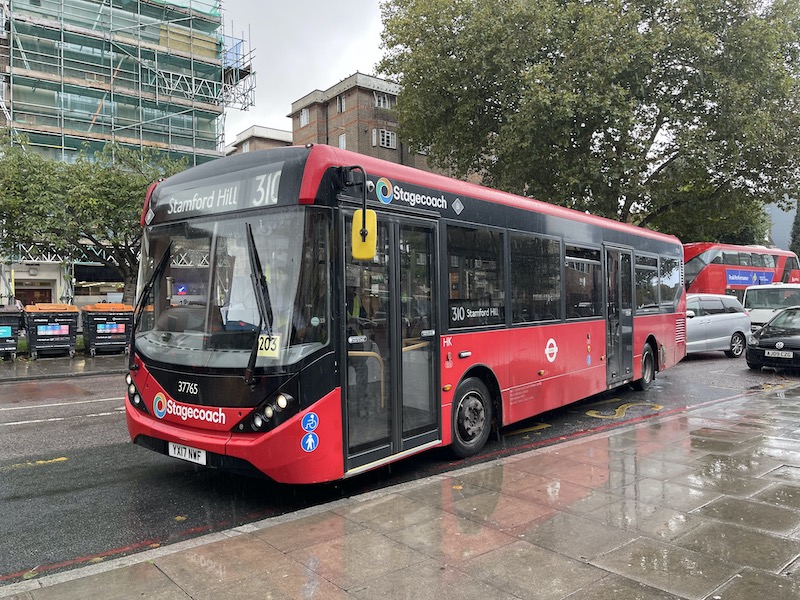
I finally managed to take a ride on TfL’s recently introduced route 310 which provides a direct link between the two Jewish communities in Golders Green and Stamford Hill, removing the need for a bus change in Finsbury Park between parallel routes 210 and 253/254 as described in a blog last month.
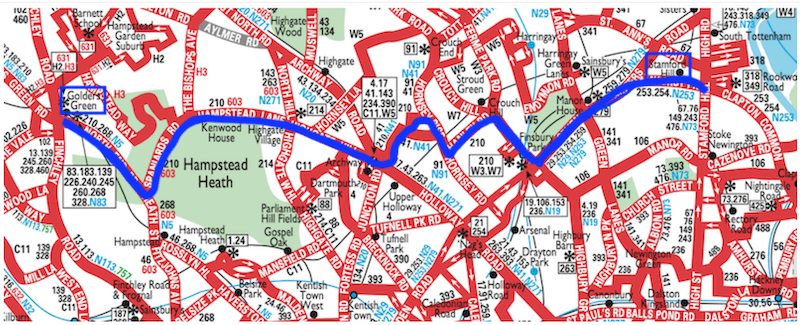
Now in its eighth week, I wondered how many passengers would travel across Finsbury Park justifying the cost of eight extra buses to provide the 20 minute frequency service at an annual cost of around £2-2.5 million.
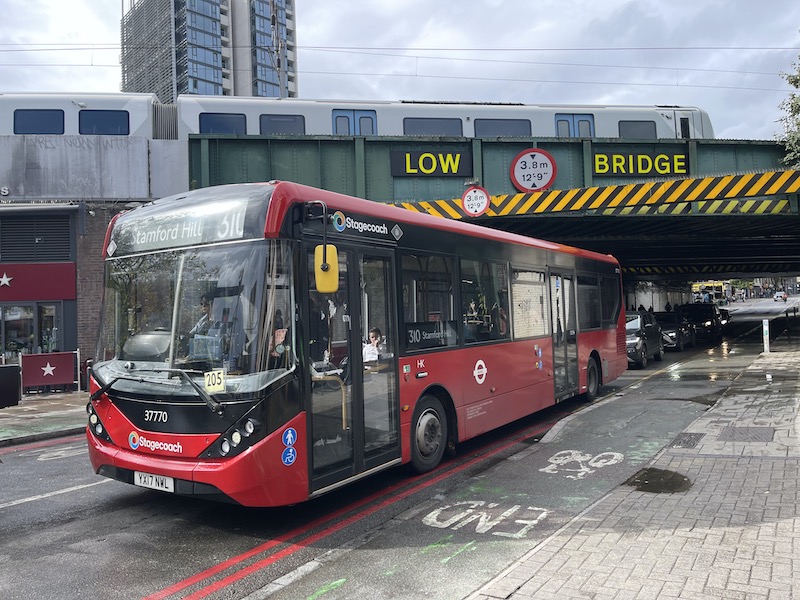
And, to cut to the chase, the answer is four passengers – on the 12:36 departure from Golders Green on a Thursday which took 56 minutes for its end-to-end journey compared to a scheduled time of 51 minutes mainly due to a delay of eight minutes in a queue of traffic under the railway bridges in Stroud Green Road waiting to join Seven Sisters Road in Finsbury Park.
So not too bad a response and if (and it’s a big IF) that’s a typical average use then multiplying the 77 single journeys each weekday (76 at weekends) by the number of days in a year (minus Christmas Day) gives us 27,848 journeys and (times 4 passengers) is 111,392 passenger journeys benefiting from not having to change buses across a year. Taking a guess the extra annual costs are £2.25 million gives us a cost per single passenger journey of £20.19 – or £40.38 per return journey.

I’ll leave it to readers to decide whether that’s good value for not requiring passengers to change buses bearing in mind the sensitivities of the cultural and religious issues involved. I wonder how much a UBER would cost?

Incidentally the 310 doesn’t seem to have any stand space in the bus station alongside Golders Green Underground station and instead waits by its first bus stop partly blocking things for buses on route 210 and 268.

I arrived at the stop at 12:20 and a bus on route 210 came and picked up ten waiting passengers at 12:34. We left two minutes later at 12:36 with three boarding and aside from one on and off at the next stop did nothing until Highgate Village, 14 minutes later, where we picked eight up with six more joining us between there and Archway station. Ten more joined through to Finsbury Park with the bus emptying out either in Stroud Green Road or round the corner in Seven Sisters Road other than for the aforementioned four who travelled through, two of whom went all the way from Golders Green to Stamford Hill but the other two just made local “round the corner” trips (eg Hornsey to Manor House). We picked six passengers up between Manor House and Stamford Hill making short journeys.
And that was it.

Pedestrianising Oxford Street is bad news for bus passengers
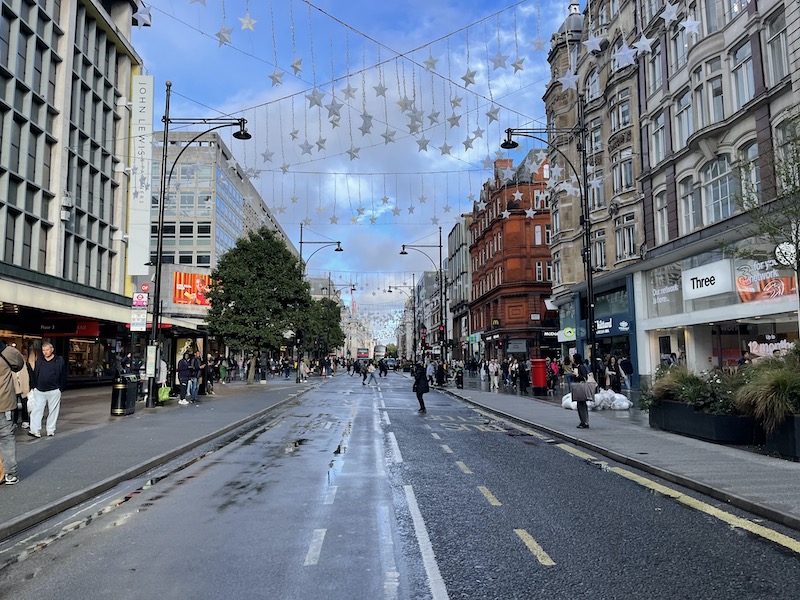
Hearing about Mayor Khan’s renewed keenness to introduce full pedestrianisation of Oxford Street (initially, west of Oxford Circus) led me to take a look at the situation on the ground and what it’ll mean for bus passengers.
TfL has cut back the number of bus routes using Oxford Street over the last few years with just five now left providing 34-35 buses per hour in each direction.
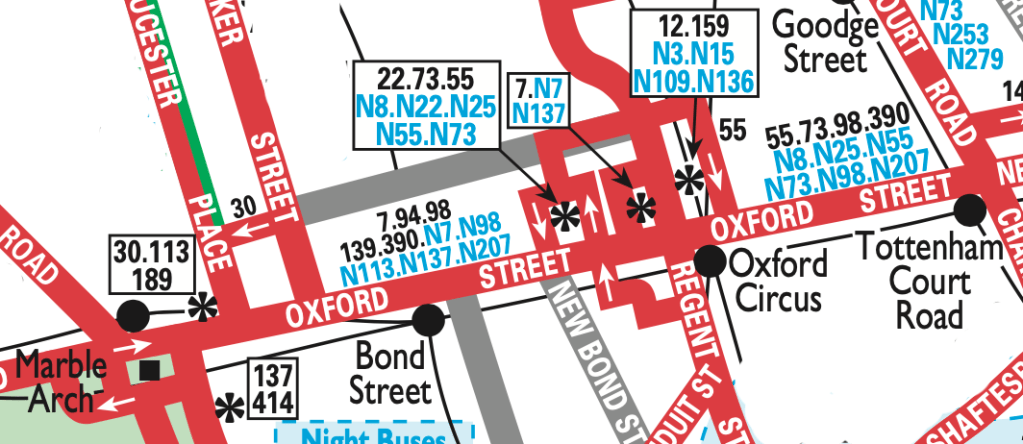
Route 7, turns at Oxford Circus and provides a 5 buses per hour (bph) link to Edgware Road, Paddington, Ladbroke Grove and East Action.

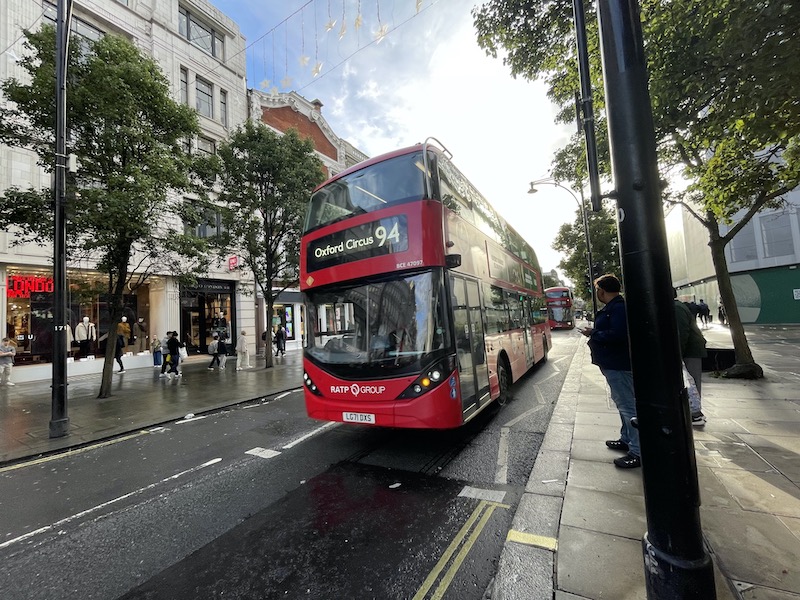
Route 94 uses Regent Street to turn round at Piccadilly Circus and provides a 7 bph link west to Notting Hill Gate, Shepherds Bush and Acton Green.
Route 98 continues east to Holborn and provides a 7 bph link north west up Edgware Road to Maida Vale, Kilburn and Willesden

Route 139 uses Regent Street, Trafalgar Square, Strand and Waterloo Bridge to turn round at Waterloo station and provides a 7-8 bph link north up Baker Street, Abbey Road, West Hampstead and Golders Green.
Route 390 uses Park Lane and Hyde Park Corner to turn round at Victoria and provides a 7 bph link to Warren Street, Euston, Kings Cross, Tufnell Park and Archway.

Despite previous cut backs and route withdrawals buses continue to provide direct links to a significant number of destinations east, west, north and south.
Four things struck me as I wandered along Oxford Street from Oxford Circus to Selfridges.
Firstly how quiet the road seemed. It’s nothing like the old days of “wall-to-wall” buses and taxis queuing all along the street.

Secondly, how busy the bus stops are. Despite good frequencies on the five routes, it doesn’t take long for lots of passengers to soon be at each stop, conveniently sited right by the shops.

Thirdly, how congested Wigmore Street gets. It runs parallel with (and north of) Oxford Street and is the only realistic alternative for buses to be routed along. Without serious traffic management measures to give buses priority (for which there’s no room), they’ll get badly delayed.
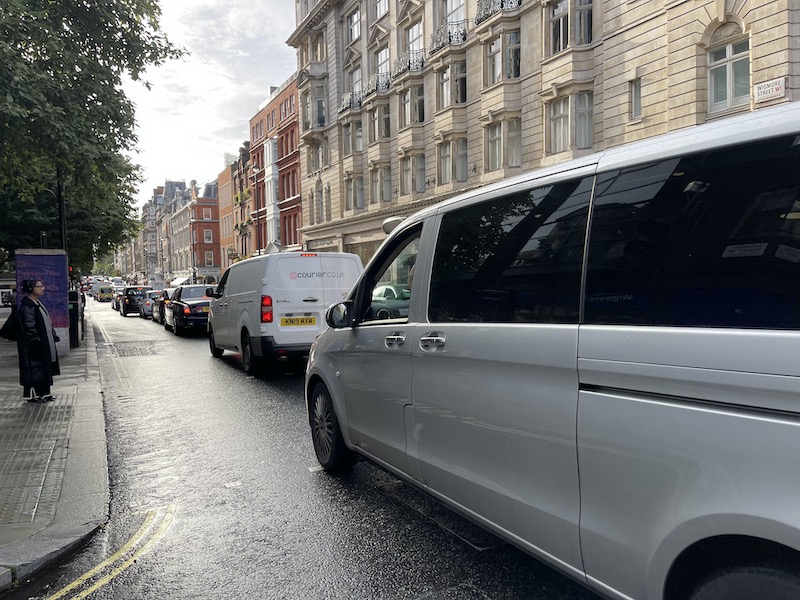
And fourthly, the 250 yards between Oxford Street and Wigmore Street feels like a long walk up one of the roads which join the two such as Marylebone Place (photographed below).

In the past, residents and businesses in Wigmore Street have been very vociferous in their objections to buses being routed along that road, probably fearing it might lead to calls for restrictions on other traffic.

But Wigmore Street is not a satisfactory alternative to get passengers close to the shops.
In an ideal world, pedestrianisation of main shopping thoroughfares is a noble objective. It dramatically improves the ambiance for pedestrians and shoppers. But you have to look at each case on its merits and what can realistically be achieved with the available road layout, without making things worse for bus passengers. Which this would.
A compromise could be the implementation of much improved public realm in Oxford Street with more chicanes and build outs to create widened pavements in places and the feeling of a “shared space” as has happened in Queen Street, Oxford by the Westgate Centre.

Perhaps greater restrictions could be introduced on taxis – controversial I know, but leave the buses alone.

Where are the ieTrams?

How long does it take to introduce new electric buses, once built, on to a London bus route? Judging by Go-Ahead London’s experience with its swish Irizar manufactured ieTrams, the answer seems to be “over two years”.
The tram like looking buses were first displayed to industry watchers at the EuroBus EXPO Bus and Coach show at the NEC, Birmingham in early November 2022 with expectations of an introduction on to TfL’s 15 mile route 358 between Orpington and Crystal Palace in “early 2023”.
Readers may recall I took a ride on the route later that November to assess how the new vehicles, with their narrow entrance door and tight spacing inside, would fair on what is a busy suburban route. I came away with the thought that while the much more comfortable seats on the Irizar would wow passengers, the spacing and leg room don’t compare well with the Mercedes Citaros currently running the service.
It wouldn’t be long, I thought back then, until we’d be able to test out the new buses in service and see passenger reaction.
“Early 2023” came and went, with the introduction date for the buses revised to “summer 2023” and then in “summer 2023” it was updated to “November 2023“….

… with the delay explained as being due to “power connections and land ownership”.
“November 2023” came and went, with the introduction date revised to “Summer 2024” and the delay explained as “it is important to get the hardware installed properly before the buses are introduced” referring to the pantograph ‘opportunity charging’ the buses will deploy at the terminal points.

Two years seems a very long time from when buses are ready to enter service, and either paid for or leasing costs commence for the bus company, and not turn a wheel. I can’t imagine the Finance Director being very happy with the situation.
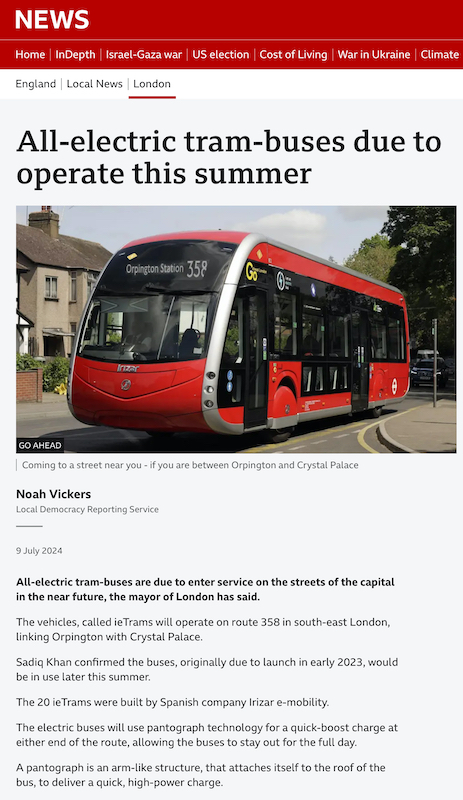
Is the introduction now imminent? Changes were made to departure bus stops in Orpington bus station at the end of last month “to make space for new pantograph bus charging for new electric buses on route 358” which I would have thought was something that would have been addressed back in “early 2023” rather than September 2024, but at least it might indicate the wait is coming to an end.

However, a site visit on Sunday confirmed the pantograph infrastructure is ready and waiting (including for anticipated use by double deck buses) on the far right of the parking area behind the departure bus stops so I can’t understand why some bus routes had to be changed around.

It’s obviously not led to an immediate introduction of the new vehicles anyway as that was a month ago.

The impasse, whatever it is, obviously continues. Having sorted Euston maybe Passenger-in-Chief Louise Haig could intervene here to “fix it and fast”.
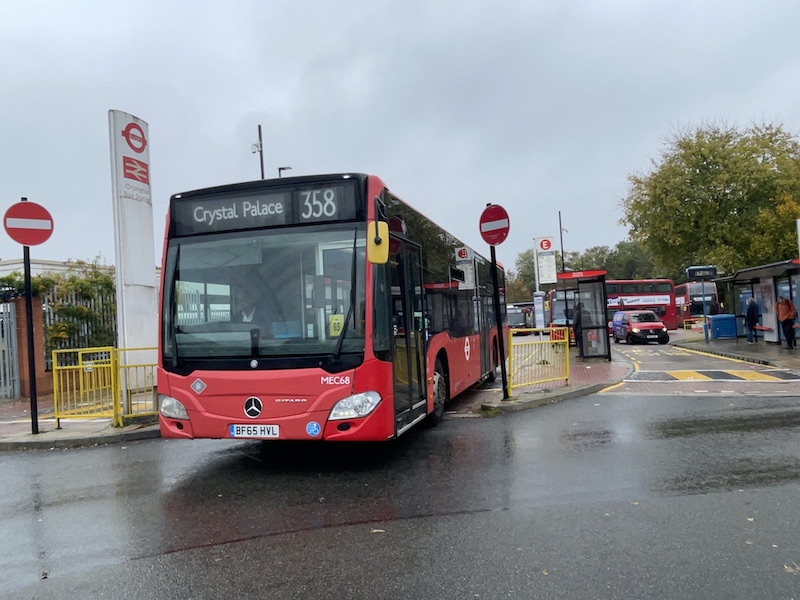
One other concern about the design of these buses is the lack of a decency panel to hide passenger’s legs in the seating area in the front section. I just hope if more public comments are made about this deficiency it doesn’t cause another delay while it’s fixed.

The two-yearly EuroBus EXPO Bus and Coach Show comes round again early next month at the NEC, Birmingham and guess what? Irizar are displaying another new ieTram bus bound for Go-Ahead London.
This time it’s destined for the new Fastrack contract the company has won commencing from 10 November. Let’s hope these buses take to the road before November 2026.
Roger French
Blogging timetable: 06:00 TThS
Comments on today’s blog are welcome but please keep them relevant to the blog topic, avoid personal insults and add your name (or an identifier). Thank you.


In the 310 section, I think you mean “Highgate” Village, not Hampstead.
My journey on a 310 in August had 2 passengers across Finsbury Park …. make of that what you will !!
I drove 113s along Oxford Street in the 1990s …. my memory even then was of how pedestrians simply walked out in front of my bus without looking, and that taxis would u-turn without warning …. walking pace was as fast as I dared drive !!
I can’t help but think that the 358 electrification has been poorly managed by TfL …. after all, the tech is hardly new; Harrogate has been using it for a couple of years now.
LikeLiked by 1 person
Many thanks for spotting a reference to Hampstead had inadvertently wandered into the blog. Now corrected.
LikeLike
Not the technology that was the issue, but getting the permissions for the charging infrastructure, especially as Network Rail were involved.
Steve
LikeLiked by 1 person
Next lot is the Jent Fast Trak services, Due to start in November. Whether the electric vehicles will be available who knows ?
LikeLike
The new Kent (Thameside) Fastrack electrics won’t be in service before next Spring.
Coming Soon: Your New Fastrack – Fastrack (go-fastrack.co.uk)
LikeLike
TfL seem to be very god at wasting money. The 310 did not seem to make sense and passenger numbers seem to confirm that
Surely when TfL specify electric buses they realise the charging infostructure need to be in place in order to use them
I would guess they cost £500,000 each and as hey have been delivered either TfL or the bus company are picking up the tab plus the storage costs. That’s a lot of money wated and presumably TfL is not awash with spare cash
LikeLike
The introduction of the 310 bus route was a commitment made by Mayor Khan during his re-election campaign in the spring.
This Ham & High article outlines the rationale behind its introduction:
https://www.hamhigh.co.uk/news/24557236.sadiq-khan-believes-310-bus-will-reduce-antisemitic-attacks/
This Jewish News article goes into more depth:
https://www.jewishnews.co.uk/new-310-bus-launched-to-resassure-the-community-over-safety-fears-says-sadiq-khan/
It includes this paragraph:
‘The Mayor admitted Transport for London bosses had told him there was “no business case” for launching the route a cost of £3.2million but that “public transport is a public service” and therefore there was a case for subsidising the 310 route.’
Later the article states:
‘The 310 will run for a trial period of “at least 12-months” to assess demand and to allow TFL to establish whether it is “viable” in the long term.’
The argument here being there is a bigger picture than just considering the ‘business case’ for the bus route.
LikeLiked by 1 person
Give there was already as perfectly viable way to get from Golders Green to Stamford Hill and demand was likely to be very low he Public service argument was very weak
LikeLike
I have to admit seeing the true cost of this new route has really angered me. I live in Cheshunt (so only just outside the city) where buses are not so good and I like to go to Chingford so would really like the 215 to be extended to at least Waltham Abbey, but ideally Waltham Cross. Apparently this would cost £765,000 a year to extend across the 3 miles where there is no buses, but it would really go far to improving connectivity in the local areas. TFL and Sadiq Khan have come out with all the excuses imaginable to not do it, including a supposed lack of demand and lack of money available. They can’t say that and then do this, it’s very hypocritical! TFL should be working with neighbouring counties and councils to massively improve cross boundary bus services. I still can’t believe how unhelpful TFL and the mayor have been over the 84B from Barnet to Potters Bar in the past couple years, which the current basic service cost just £183,600 per year with S106 helping with that. The regulatory system TFL has made it very difficult for private operators to fill in the gaps in the bus network between Outer London and the neighbouring towns so surely the onus is on TFL to fix this rather than provide another bus route in an area where the 210 is never super busy anyway, much of the route is surprisingly rural. Also, If there was such a concern in Finsbury Park, surely they should be bolstering the police presence in the area until a more permanent change can happen, either reroute the 210 to Stamford Hill or lower the road under the railway if possible.
And I feel this strongly about it because I agree that “public transport is a public service” but right now this feels like a postcode lottery and local and national government and transport bodies need to work together and get their act together. The lack of buses in places like Cheshunt and Waltham Abbey compared to London, especially at night is insane, but no such drop off happens with trains! If this new route can get a trial, why can’t TFL do this in more places where an actual difference to congestion could be made?
Aaron
LikeLike
The 242 used to to Chingford
LikeLike
Missed that by 40 years unfortunately and what replaced it, the 505 stopped about 7 or 8 years. Now it’s a lengthy detour either via Loughton or Ponders End and I found taking a bus to Waltham Cross to get the 491 and then walking from Enfield Island Village to the Lea Valley Campsite where the 215 starts from took a similar time. A direct bus would be much quicker! You’d think it wouldn’t be much to ask for. These sort of issues need to be fixed if we want less people driving.
LikeLike
@Aaron
Cheshunt is outside the Greater London boundary. TfL doesn’t have any duty to provide services there, nor is it funded to do so.
Where TfL does provide services extending beyond the Greater London boundary, I expect it will be for one of the following reasons:
Improving bus services in Cheshunt/Waltham Cross would be the responsibility of Hertfordshire County Council, if the commercial operators choose not to; in Waltham Abbey it would be the responsibility of Essex.
The direct bus link between Cheshunt and Chingford was lost as long ago as 1986, suggesting it was poorly-used even then. At the time, London Country provided an alternative service south from Waltham Abbey through Sewardstone (route 503 from Harlow to Walthamstow) but that was abandoned in 1988. The 505, tendered by Essex County Council, replaced it but even that has now given up with that section of route.
Having said all of this, if you want to travel from Cheshunt to Chingford, TfL already provides a service for you. London Overground, change at Hackney Downs (unless you are a wheelchair user – the change at Hackney Downs is not wheelchair-accessible).
Malc M
LikeLike
That is not really a satisfactory answer, there needs to be a bus that goes down the length of Sewardstone Road, people live there and it even has elderly accommodation on it with no bus services! For me, the train is too much of a detour, I’ve taken that journey before and it’s even more ridiculous than the bus journey! (the fact you say its not accessible is funny which again shows the need for a bus). I can’t be the only one who thinks the current county boundaries make little sense, especially as there is no countryside between Enfield, Cheshunt and Waltham Abbey. Most of us here interact with London a lot (many here were from London) and the transport authority should recognise that like they did for much of the 20th century. The fact we have Overground trains and London fare zones, they should at least bring us into parity with Watford and give us red buses too. Enough pass through the area from Potters Bar garage! Thing is we can’t have effective public transport if we stick to political boundaries, people’s social and economic needs don’t work like that. The current arrangement sees way too many areas fall through the gaps. To then see TFL throw money on a bus route in an area with already very good services when they claim there is no money to safeguard cross boundary routes just hurts. We need social bus services everywhere but at least, lets be consistent here.
LikeLike
I think many would share your concerns, but the ultimate issue is Cheshunt is not in London, and TfL has no obligation, and probably little motivation without local council funding, to provide a London bus service. The boundary of London needs to be changed if Hertfordshire isn’t going to help with buses, but that again is not TfL’s job. It’s an unfortunate situation but really cannot blame TfL.
LikeLike
There must be room to consider the provision of transit services to meet social needs (beyond a financial business case); it is a necessary (although often divisive) discussion to prioritise competing social needs in a region based on pool of resources available. Longer term maybe there should be a discussion on community sponsorship of service costs of a service like the 310 (c.f. the way Section 106 and similar developer funds are used to initiate and maintain services for new housing/retail/office developments)
@Roger it would be interesting to get your experts view of the spread of “social subsidies” per passenger mile, perhaps pre-pandemic, pre-BSIP and post, and then compare the 310 on that spectrum. Also, depending on the date of the ride reported in this blog, you might have been within or just after a religious holiday period which could skew the ridership numbers. It may be helpful if you can take another ride (or solicit volunteers) in a more average week in the New Year (and not on a Friday afternoon/all day Saturday) to revalidate one-ride-only view of ridership and allow awareness to build in the potential target ridership.
MilesT
LikeLike
“I wonder how much a UBER would cost?”
By contrast I would wonder how much an UBER would cost… 🙂
And for what it’s worth, the UBER app currently gives an estimate of £20.67 for the journey from Golders Green to Stamford Hill.
LikeLiked by 1 person
Reaching for my copies of the final three Mike Harris “Historic” Maps: 1964 and 1970 editions show Wigmore Street to have bus routes running along it but by 1976 it had become bus free!
As to Route 310: it is too much of an effort to travel from my home in Walton on Thames just to have the fun ride under that notorious low bridge at Finsbury Park.
As to electric buses: the 358 saga is astonishing. Unless the matter has been resolved very recently there are still “replacement” diesel buses on Route 200. Will the electric double decks ever return?
LikeLike
Typo: shard for shared.
Concerning Oxford Street: Queen Street Oxford works, I think, because the buses go 5mph in one direction only. The drivers seem to be instructed to give total priority to pedestrians. And there are no bus stops. I wonder if Oxford Street might work one way, buses only, west to east, with Wigmore Street one way, all traffic, east to west. An obvious downside would be a different (and probably very unpopular) route for taxis etc west to east, such as Blandford Street and New Cavendish Street.
Nicholas Lawrence, Radley
LikeLike
Thanks; ‘shared’ now corrected.
LikeLike
Given that there is no evening service on the 310 shouldn’t the E-Plates on stops show this ?
Martin W
LikeLike
Regarding the 310 introduction, I best hold my thoughts to myself for fear of upsetting the “pitchfork brigade”, and the pedestrianisation of Oxford Street would just be just another nail in the coffin for Central London bus services. But perhaps that is behind the whole “cunning plan”? The young, fit and foreign visitors can funnel onto the Underground/Elizabeth line. The less mobile can go elsewhere. Aspirations to turn most of central London into European-style streets “embracing” some kind of “coffee-culture” paradise takes another giant leap forward.
Why on earth the lengthy and busy 358 service was chosen to become a guinea pig for testing “opportunity charging” is a disconnect from reality. In spite of extra running times being added over the years, the service can suffer appalling disruption on bad weather days and school times, meaning many buses short-turned. Frankly, these Spanish built things look to be made of plastic and nothing like the previous generations of sturdy Scanias and Mercedes Benz types which are out on the road for almost 22 hours a day. I doubt the lack of a decency panel will trouble too many these days, but the awful seating arrangements certainly will.
Terence Uden
LikeLike
Oxford Street pedestrianisation: City of Westminster (CoW) was blindsided and I think irked by Mayor’s proposals, as they weren’t consulted before the announcement (which was covered by Ianvisits and OnLondon as well as Evening Standard and other media a few weeks back)
The CoW pre-existing proposals are more aligned to Roger’s view (improve public realm and leave some traffic access to Oxford street), and also raised concerns about the potential increase in criminality and public order offenses that could occur with wide open public spaces (e.g. wheel bourne phone and bag theft, also terrorism).
Also, access for Persons of restricted mobility (PRM) to the shops on Oxford street is not universally possible from the parallel streets without a long walk (and Oxford street is likely not well suited to “shopping centre” style Shopmobility schemes), so whatever the outcome PRM access needs to be taken into account. Perhaps with a frequent ride and hail “circulator” service aimed to support PRM in key opening hours, and some form of blue badge access for drop off/pick up (not parking) and taxi access.
Balancing all these needs with the constraints of traffic on Wigmore street is hard; it may be the only answer is a radical restructuring of the bus routes that travel along Oxford street to cease most during trading hours except for a very frequent circulator service, with interchanges to longer distance routes at each end of Oxford street. That implies removing “single seat” bus travel to most parts of Oxford street while preserving rapid frequent service more regionally transiting the general vicinity (with minimal use of e.g. Wigmore Street).
MilesT
LikeLike
It looks as if GoAhead are moving into AI type timetables. They are rolling out something called CitySwift. It claims to make timetables more efficient and reliable, I assume it is based on some form of AI
LikeLike
CitySwift have a ‘Performance Optimisation Platform’ which basically brings together all of the data which a bus operating company already has and makes it accessible to managers.
A skim read of these two…
… will give the general idea. Whippet is a small operation, EYMS considerably larger, albeit both are operating subsidiaries of large groups.
A quick look at timetables of both operators will show peak-time variations but not the ‘Artificial Idiocy’ of a random mist-mash of times.
LikeLike
NX West Midlands have used CitySwift for quite some time. It’s not AI timetabling (thank goodness!). It processes huge amounts of running time data to enable schedulers to optimise schedules as effectively as possible.
Steve
LikeLiked by 1 person
So it is basically using AI
LikeLike
The older form of “AI” called Machine Learning “ML” (or sometimes Big Data) as opposed to newer large language models/image models/neural nets etc which is what OpenAI and others offer
ML techniques date back to the early 1970s but computing power/cost constrained most use cases until early 1990’s (initially for more “continuous” statistical use cases like forecasting variables using curve smoothing from historical curves), specific models like weather (over ever finer geographic squares).
Integrating historical bus run times into multi-route, multi-region schedules has needed additional development and power and therefore has only become available fairly recently (scheduling individual vehicle runs to process volumes of demand with some average speeds over the road network has been available for 20+ years, e.g. for grocery home deliveries)
LikeLike
I was in a line three 74s going through Handsworth tonight, last time it was six.
Profit margins are set and NX routes are allowed sufficient resources to live up to them.
A woman going home from work commented the buses come but they are always full up, while we stood adjacent to sea of folk boarding two buses passing through Smethwick.
Public realm initiatives have directly caused scrums like these in other cities by reducing the number of boarding points.
Makes the Victoria line seem civilised by comparison.
John Nicholas
LikeLike
If the traffic congestion which once made Oxford Street a bus parking site is no longer there thanks to service reductions and restrictions in other traffic it should be left well alone. I’m there reasonably often and it’s never hard to cross the road.
As for the 310 I live nearby and all I’d say is it’s never empty. How many are travelling all the way I have no idea. But latent demand and a readiness to use public transport in London usually means an overall uplift in passenger numbers when extra services are put on.
Those awful “tram” buses in the 358 will be a disaster. Are they thinking of increasing the frequency? If they don’t they’ll be horribly overcrowded with lots of older people standing. Not really accessible transport. Experimentation or trials are important but the level of pain these will inflict on human guinea pigs is unacceptable.
Thanks for a fascinating blog as ever
MikeC
LikeLike
Re the 310. Would it not make sense to extend the 210 to Stamford Hill, either by single-decking it with 12mtr buses (is this feasible re sharp turns), or to re-route away from low bridges.
Re the 358. The Kent Fastway is starting in early Movember initially using buses formerly on the 358 apparently. Wishful thinking?
MotCO
LikeLike
I doubt the demand would make it sensible, Going under the lo bridge would probably mean more buses needed, Diverting it would make he route longer as well as putting more buses on a section of road that already has multiple high frequency services
The real question is how many people want to travel from Golders Green to Stamford Hill? The answer to that appears to be very few
Getting from Golders Green to Stamford Hill using he 210 and the 253/4 is perfectly viable and worst case would add about 10 minutes to the journey time(That allows 5 minutes walk from Well Terrace to Seven Sisters road and a 5 minute wait for a 253/4 bus
LikeLike
In re the 210 / 310 conundrum . . . the obvious solution would be to extend (say) every 3rd journey to Muswell Hill, and allocate saloons to those journeys. That is what would happen outside London, and seems logical to me.
Hang on . . . I hear the men in white coats banging on the door . . .
LikeLike
Re Oxford Street, is it the lack of self-discipline among Britons that makes them walk around without looking?
In other countries, eg St Gallen in SWitzerland, pedestrians walk among buses and trolleybuses all the time with seemingly no safety concerns.
Please do not take any more buses away from Oxford Street. They a re needed by many shoppers. Some older people will not use the tube
malcolm chase, Buses Worldwide
LikeLike
@Malcolm Chase
One of the issues in Oxford Street is people from other countries, not used to traffic driving on the left, looking the wrong way before stepping off the kerb. (At least, it was an issue some years ago, when I was doing the safety stats for London Buses – I can see no obvious reason why that would have changed since).
Malc M
LikeLike
JBC Prestatyn
Re 310. I cannot comment on other good places where more/any buses would be useful and used but the 310 does carry more than the 4 passengers you indicated. You counted them on and off , and we dont know if these abstracted from other routes and would already travel, or that an extra service allows more people a choice to travel at a time to suit them. So the financial income to the route is greater than your calculation, though the income as a whole to TfL is a unknown, somewhere between zero (as the journeys would all have been made, with a change, anyway and the total revenue for the route assuming none of the journeys would otherwise be made)
Re Previous Blog on Streatham High Road. I see there is consultation on the 118 to be withdrawn entirely, with an extended 45 and changes to the 59 replacing said 118. Without seeing if the other routes have a minor increase in frequency (or at least the extended 45 retaining 6bph rather than the 118 5bph, this might help the overbussing you previously reported while not making too many passengers annoyed they cannot get to their expected destination from their starting point. While I would miss the 118 being a very old numbering of the route (though the north end of it has moved its terminal over the years it actually seems a sensible move IF reliability can be ensured, hopefully it could be made 24 hour route.
Answering above the 200 all electrics are gradually being reintroduced, 2 at present noted at any one time on the route. the SEs on the 163/164 appear supplemented with a couple of WVL double deckers lately , though that might be more use of School Time extra capacity through the day.
LikeLike
Regarding the prospective pedestrianisation of Oxford Street, this is the third attempt to do this. It is the wrong solution in the wrong place. There is no doubt that London is way behind in terms of pedestrianising traditional streets, but the whole of Soho between would be a far more appropriate location for this than a major public transport corridor. Walking along Old Compton Street or Dean Street etc really brings this home to you. And as Roger points out, in Oxford Street the public transport isn’t just passing through it picks up significant volumes of passengers many of whom are carrying bags of shopping – which is really the idea isn’t it? There are really no suitable alternative routes for buses. An alternative approach which might in some way compensate for the reduction in bus service might be to restructure the bus routes entirely so that they pass north south across rather than along Oxford Street with conveniently located bus stops. (I was actually involved in this approach for a while in conjunction with investigating the feasibility of a tram) while working for TfL. A change of mayor put paid to that particular idea!).In much of Europe there would be no doubt at all that this would be a suitable thoroughfare for trams, which passing at a frequency of say 12 to 20 an hour would pose no problem whatsoever to pedestrians. And modern buses with zero or very low emissions are in no essence different from this. But somehow we have a concept in the UK – that even trams should not be going down shopping streets where there are pedestrians – see the proposals for the Croydon Tramlink in Sutton. (For which entirely the wrong route, not forming part of a meaningful network, has been chosen but that’s another story!).
LikeLike
This is the pedestrianised centre of Freiburg with trams. It looks a very pleasant and busy environment. The trams move slowly as you would expect.
I don’t think this would work so well with buses. Trams stick to their predetermined path, buses don’t, they manoeuvre around each other, swing into stops and pull out. At busy stops buses block passengers view of approaching buses, you never know if your bus might overtake another and not stop. Another factor is that you need more buses to move a given number of people than trams because they are smaller. So a pedestrianised street would have more vehicular movements than with trams.
Peter Brown
LikeLike
As for the new route 310, I think it only exists to “please the Jewish community”. For it’s expectedly low ridership, I’m not sure why TfL didn’t invest in any Minibuses for the operations of the route, as it surely would have been considerably cheaper than funding Stagecoach London to redeploy their fleet of AD Enviro200 MMCs? Of course, they could have just chosen to not run the service at all, which would have been ideal.
For the Oxford Street pedestrianisation scheme, I don’t think it’ll ever go ahead (pun not intended?), not just because TfL and the contracted bus operators will not be happy, nor just because there is no suitable alternative, but I think that there is also no financial justification for it’s pedestrianisation, whether it’s only Marble Arch-Oxford Circus or the entire road down to the Tottenham Court Road junction, as the entire area is iconic for being busy road junctions and throughfares at both Oxford Circus, Tottenham Court Road, Cambridge Circus and Piccadilly Circus, which could potentially affect trade, not to mention the potential for reduced taxi ridership.
The Irizar ie Trams, is a strange choice of vehicle for Go-Ahead to order, so I wouldn’t be surprised if some politician or beaurcrat told Go-Ahead London to order these vehicles, even if they turn out to be crap, there’s a reason why Irizar buses are not popular in the UK, and why Go-Ahead has effectively stopped buying new Optare buses, since one of their Electric Metrodeckers caught fire on route 200 in Wimbledon. And for the takeover of the Kent Fastrack service, I find it quite odd that Arriva, neither their London, Southern Counties or Kent & Surrey operations chose to bid on the continued operations of the Kent Fastrack services, so I wouldn’t be surprised if what is meant to be a “profitable” bus service has actually turned out to be highly unprofitable for Arriva, hence why no one else but Go-Ahead London chose to bid on it’s operation last year(?).
LikeLike