Thursday 10th October 2024
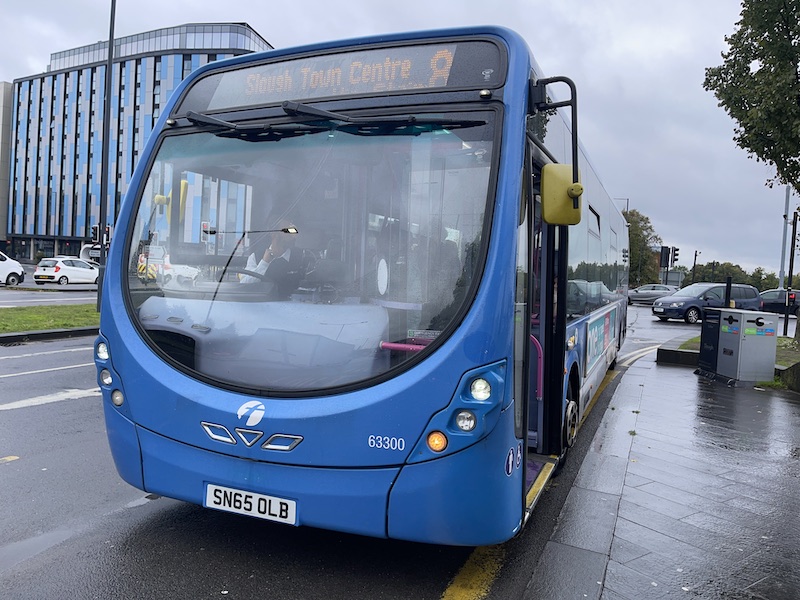
Readers will know I like to get out and about and see what’s actually happening on the road as well as on the tracks when commenting. Something I wish more managers and especially senior directors of transport companies would do more often so they can take informed decisions based on real world experience.
When I first wrote about what is now a widespread adoption by First Bus of using AI to compile timetables back in January, it was without any actual experience of seeing how it performs on the road. I travelled on route 8 between Slough and Heathrow Airport just before the new AI timetable was introduced and as a result predicted the £4.5 million the company had blown on the technology would be a complete waste of money.
Back in January I made the observation from a passenger perspective the about-to-be-introduced AI derived timetable offered “a more complicated, difficult to remember and even off-putting timetable with none of the simplicity or attractiveness of a regular frequency” but noted Simon Pearson, Commercial Director at First Bus, reckoned the upside of the “cutting edge technology” was “more punctual, reliable and comfortable bus services”
I decided nine months on it was now time to see if I was wrong and Simon was right so I returned to the border of the former Berkshire and Greater London to see how route 8 is doing on Tuesday last week (1st October).
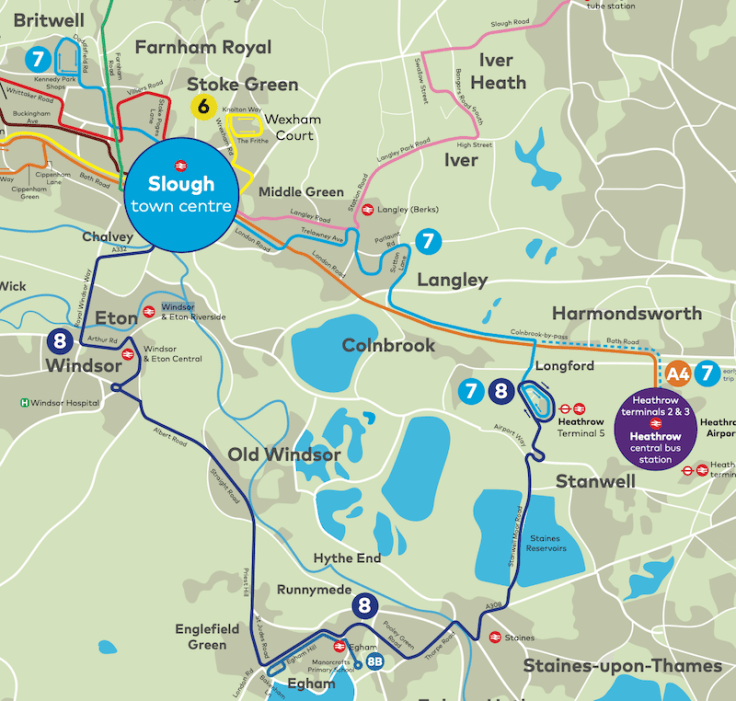
Remember, time allowances between stops on every journey on this twice an hour (I can’t say half hourly any more) route via Windsor, Egham and Staines are different. Often by just a minute, but that’s the whole justification of the £4.5 million spent on AI. It makes for a “sate of the art” accurate-to-the-minute timetable.
But, just to complicate things, and unbeknown to me last Tuesday, it seems a new AI timetable began on Sunday (7th October) with amended intermediate timing points as shown below on the Bus Times website.
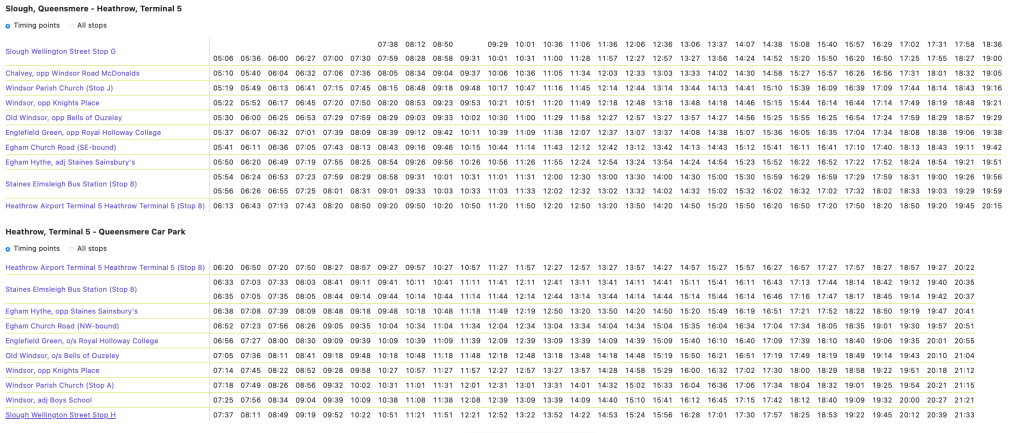
So, I’ve compared my sample journey last Tuesday with the timings applicable last week as well as with the revised timings for this week.
I arrived at Heathrow’s Terminal 5 in time to watch the arrival from Slough due in at 11:20. It’s given seven minutes stand time and was scheduled to leave for the journey back to Slough at 11:27.
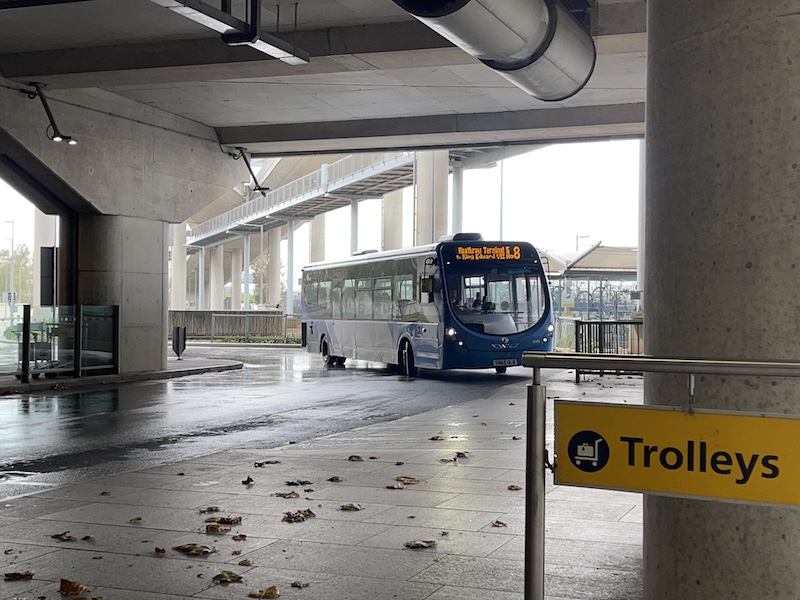
The bus arrived at 11:22. Two minutes late.
I walked down to departure stop 8 in Terminal 5’s grim bus station to wait for the driver to pull forward from the alighting point.
And waited.
And Waited.
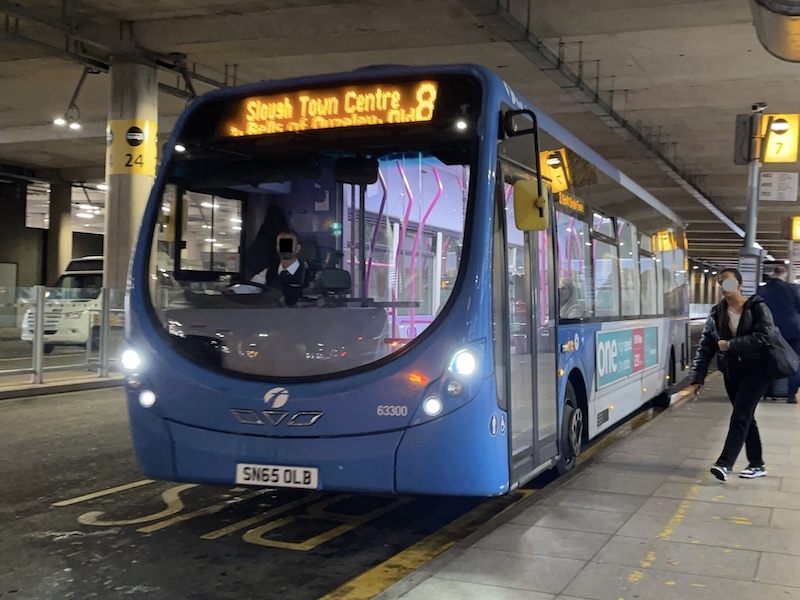
At 11:36 he appeared and the four of us waiting got on board having waited nine minutes longer than the AI timetable had promised. We left at 11:37, 10 minutes down. This week’s timetable has an unchanged 11:27 departure time.
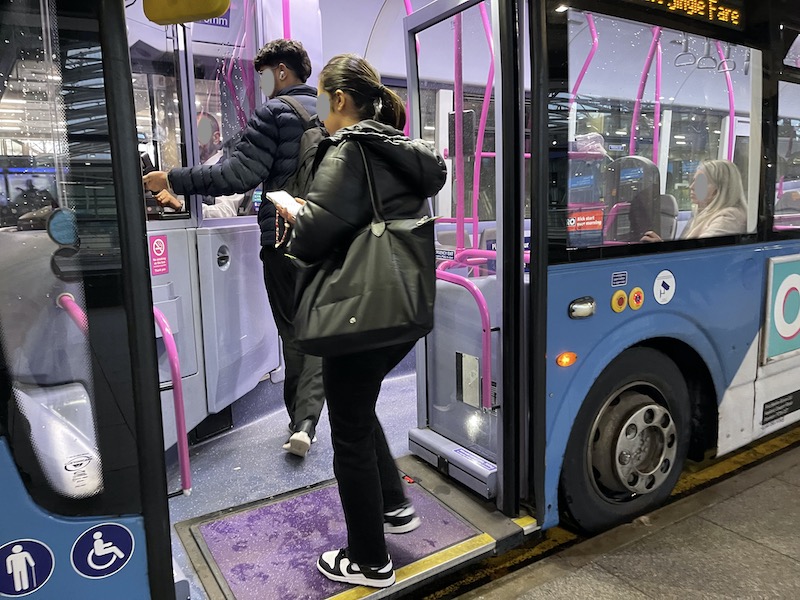
Not exactly a punctual start.
I guessed the driver was being tardy in his departure as I recalled my pre AI journey in January had been padded with slack time for the first section of route to Staines yet despite AI supposedly being able to make for accurate timetables, taking account of varying traffic conditions by the hour, this glaring anomaly I pointed out for free back in January, still applied. Except from this week, the timing has been tightened up as I’ll explain.
We passed the bus stop called Kingston Road in Staines nine minutes later at 11:46 against the scheduled time of 11:40 – in less than 10 minutes we’d made up four minutes lateness. AI – an Amazing Invention, that’s for sure.
Last week’s timetable had us arriving in Staines bus station at 11:49 with a departure at 11:53.
We actually arrived at 11:50 (one minute late confirming the slackness of the schedule) and left at 11:52 (one minute early) having picked up seven more passengers.
This week’s timetable has the bus arriving in Staines eight minutes earlier at 11:41 and departing at 11:44 – so it seems AI has finally caught up with what I experienced back in January.
On the way to the bus station I’d spotted the bus behind us heading towards Heathrow Airport between Kingston Road and the bus station. It was 11 minutes late.
Continuing my journey, at the next stop by Staines Bridge we picked up four passengers leaving at 11:54, one minute late, on last week’s timings.
AI had us leaving Sainsbury’s, the next stop, at 11:55 (this week, 11:49). Having got caught in traffic, we passed that at 11:58 – three minutes late – only to then come to a halt at the level crossing.
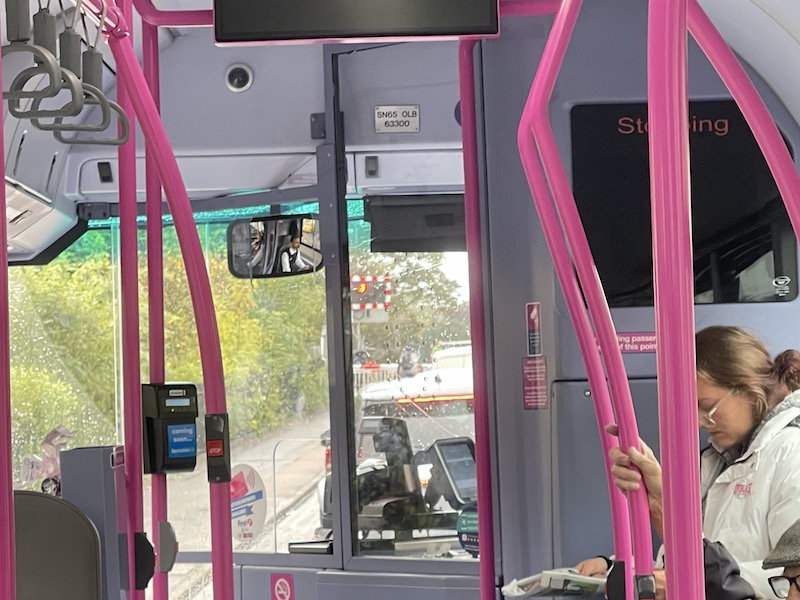
That held us for two minutes arriving at Magna Carta School setting down two passengers, still four minutes late, at 12:02 instead of 11:58. One passenger was picked up at Glebe Road, four minutes late, and then came the next level crossing which we passed without any delays as it was open for traffic.
Egham High Street was reached at 12:07 instead of the scheduled 12:06 where three alighted and we picked up four passengers. Five more boarded at the next stop, Egham shops, at 12:08 (instead of 12:07) and I noticed the next bus towards Heathrow Airport passed the other way which should have been there at 11:48 – being 20 minutes late!
One reason for this Heathrow Airport bound lateness became apparent – four way temporary traffic lights in Egham. Something I thought AI was supposed to know about and adjust timetables accordingly. So much for that promise – which was always a ridiculous thing to claim anyway.
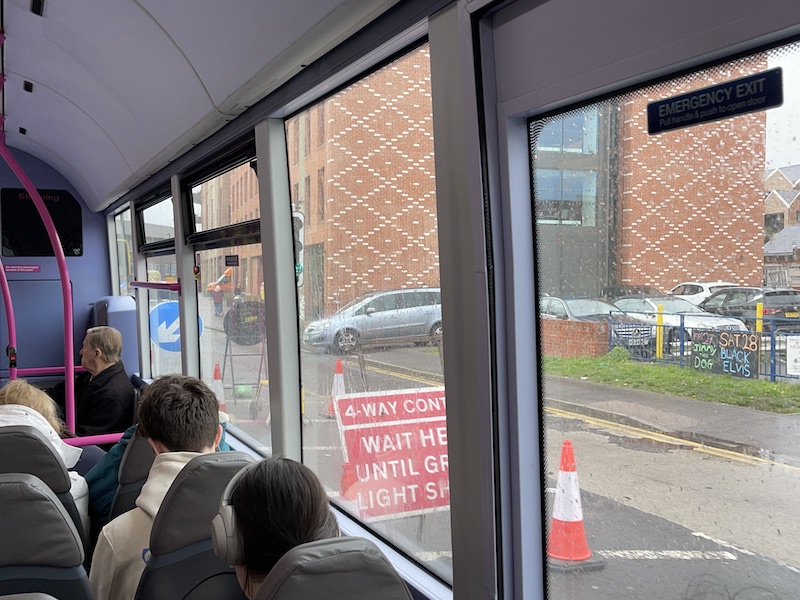
After that delay the next stop at Egham Church Road saw three passengers alight and 12 students board – I wonder if AI took account of that as they looked to be regular travellers so would need an extra minute’s boarding time allowance – obviously only on the days when college is in session of course.
In the event we left at 12:13, three minutes down. On this week’s timetable the scheduled departure time is 12:04.
One off, one on at the next stop. One off at the following stop and another at the next one after that. And then at the Royal Holloway College we said goodbye to 11 of the students and two passengers boarded. It was now 12:18 and we were still three minutes down. This week’s scheduled departure time is 12:09.
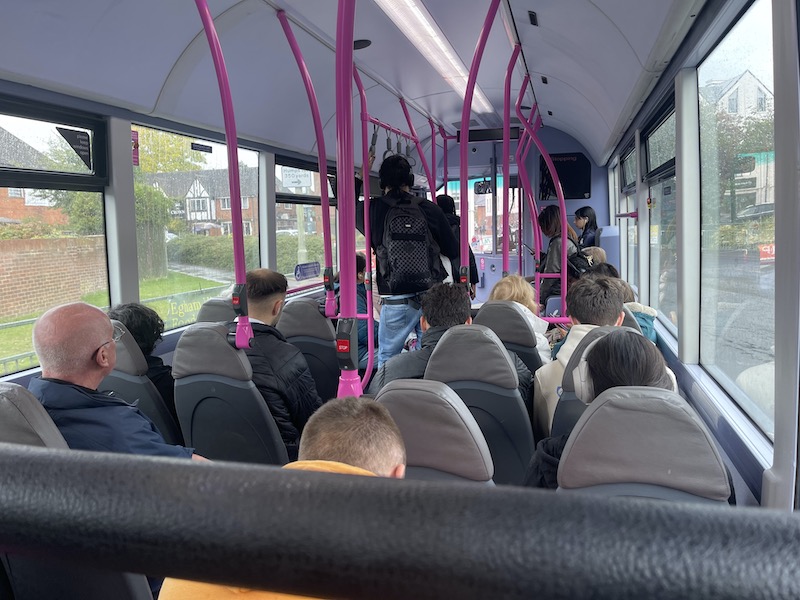
We passed the next bus heading to Heathrow Airport which was five minutes late.
Four alighted at the next stop at St Jude’s Cemetery but we’d pulled a minute back and were only two minutes down. One alighted at Middle Hill and we’re now just one minute down and then at the next stop, Bells of Ouzeley we finally hit the jackpot at 12:25 – almost an hour into the journey – as we were exactly spot on AI time for the very first time and one passenger boards to celebrate with everyone on board.
On this week’s timetable we’d be due at Bells of Ouzeley at 12:18 (seven minutes earlier) but presumably drivers aren’t now hanging around at Terminal 5 keeping passengers waiting before departing late.
After that, we then kept exactly to time at the next few stops through Old Windsor until we reach Windsor Parish Church where we pause for a couple of minutes at 12:38.
As we came into Windsor the next bus towards Heathrow Airport passed us running 12 minutes late (are you detecting a pattern for buses running in that direction?),
It was a quiet run between Windsor and Slough with few passengers such we passed McDonalds just after the M4 flyover a minute early at 12:49 instead of 12:50, and the next stop at Landmark Place two minutes early at 12:51 instead of 12:53 where seven alighted and we finally arrived into Wellington Street two minutes early at 12:53 instead of 12:55. This week’s timetable has us arriving at 12:52, so we’d have been one minute late, having left Terminal 5 ten minutes late – giving a measure of the slack time in the schedule.
This bus leaves for the return to Heathrow Airport from the picking up point on the opposite side of Wellington Street at 13:04. The bus appeared on stand at 13:02, picked up six passengers and left at 13:03.
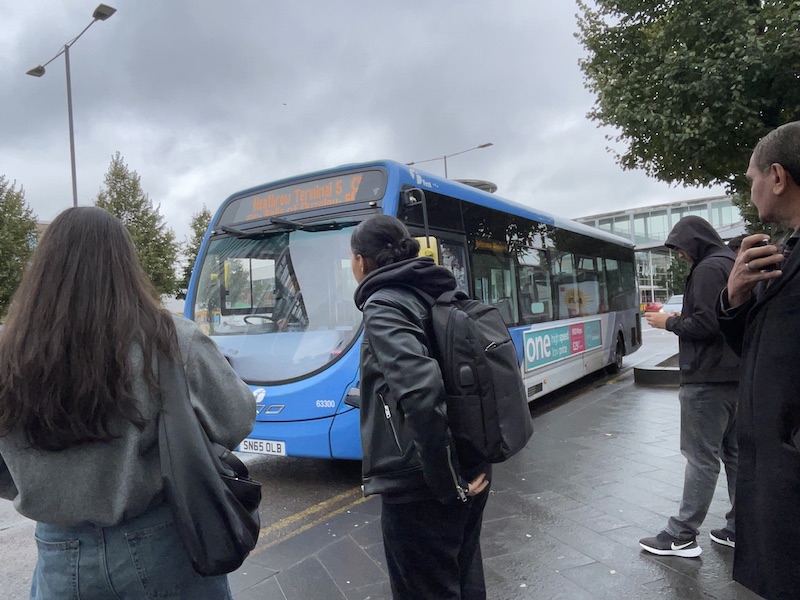
I waited to see the next arrival, due into Wellington Street at 13:26 which arrived on time. It’s due to head back to Heathrow Airport at 13:32. It drew on to the stand at 13:35, picked up seven and left at 13:36.
It was branded for route 7.
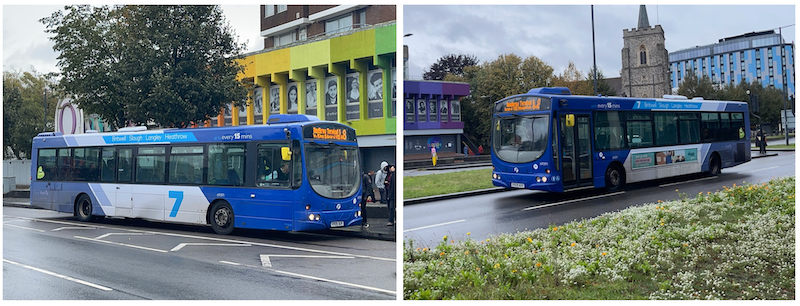
I’d want my £4.5 million back if I was running First Bus.
Roger French
Blogging timetable: 06:00 TThS.
Comments on today’s blog are welcome but please keep them relevant to the blog topic, avoid personal insults and add your name (or an identifier). Thank you.


AI = Artificial Incompetence. It’ll de-skill humans, it doesn’t work, and no one will know what’s going on.
Who will argue back with the computer when it says ‘no’?
LikeLiked by 2 people
It does make sense, It analysis the actual data over a long period of time to come up with realistic journey times for a typical trip
The Heathrow area is very difficult as it can be subject to unpredictable delays and unplanned road works and frequent RTC’s
Possibly more sensible in that area to try to keep them at an equal headway rather than to a fixed timetable
A clockface timetable would be not work neither
LikeLiked by 1 person
Headway management only makes sense for services which have a high enough frequency that passengers just turn up at the bus stop without consulting a timetable, usually 6 buses (5 in London) per hour or better.
AI clearly produces an immense amount of useful data, but allowing it to effectively write a bespoke schedule for each individual trip is clearly nonsense and demonstrates a complete lack of understanding of bus scheduling and operations.
Steve
LikeLiked by 3 people
Fully agree. Can see AI combined with headway management as useful for TfL in central London on routes with 7 or so buses per hour.
But not on a route like this where a convenient timetable is likely to be more useful and where daily non systematic fluctuations in traffic mean that no statistical tool (which has to be based on historical data) will ever get it right.
I wonder if First Group management have even tried to understand the algorithms that this tool uses. Sounds like they treat it as a black box and have not thought through when it is good to use and when less good. If First is like most other corporations my guess is that everyone is now just forced to use it so as to justify the “investment”. Questioning that is likely then to be career limiting. I suspect that local management realise the problems but cannot say anything.
Good to see that the drivers (or at least the one driving your bus) are smarter than the tool though and I guess smarter too than group level executive management. In a prior age of stronger unions, this is exactly the type of stupidity that you might expect them to question. Especially if it causes issues with driver duties constantly altering.
LikeLiked by 2 people
a clock face timetable may not work better but is more human friendly. If the schedule is going to be wrong, then at least make it wrong in a human centric way
LikeLiked by 2 people
As AI is more & more encompassing all industries from Bus to Accountancy the ICAEW held a major Breakfast Seminar on the subject last Wednesday very sucessfull in Brum to members. I contributed about how First are using the model.
Mind you the moderator who I now very well opened the seminar saying now AI can be an amazing future or it can have a chilling dimension consider the prospect of every accountancy practice having thier own AI version of Rich……
LikeLiked by 1 person
Three comments from me:
(1) Yet another brilliant article, thank you!
(2) “I like to get out and about and see what’s actually happening on the road as well as on the tracks when commenting. Something I wish more managers and especially senior directors of transport companies would do more often so they can take informed decisions based on real world experience.” – I couldn’t agree more and would add: eavesdrop on what your customers are muttering about. Sometimes you don’t even need to eavesdrop. Last year in the Netherlands after a particularly grim rail replacement bus journey the driver cheerily said on the PA “See you next time”. “Oh no you won’t” came the chant back from a group of the disgruntled.
(3) The AI approach is statistically unsound. Anyone interested in why this is should google ‘Deming’s rules of the funnel’. The first thing you’ll see is: “Dr. Deming has said “If anyone adjusts a stable process for a result that is undesirable, or for a result that is extra good, the output that follows will be worse than if he had left the process alone.” This is often called tampering with the process.” Drop me a line if you want me to send further reading – richard@theuic.com
Richard Capper, The Universal Improvement Company (cumulative delay at destination so far this year: 46 hours 16 minutes – really!)
LikeLiked by 3 people
I can’t help feeling that the reliance on AI is a desperate attempt to make up for shortfalls in competence and ability by management. Traffic patterns are rarely so predictable that a variance of 1 minute from one journey to the next will be consistently upheld. If the average running time for a specific journey is 49 minutes and the next is 51 minutes but the IQR for each is 10 minutes then random variations in congestion will wipe out any improvement in average punctuality in passengers’ eyes, rendering any putative benefits moot and just leaving people with an incomprehensible and unmemorable timetable for nothing.
LikeLiked by 2 people
Solent Ranger X4 and X5 now uses the same rubbish system so buses are now rarely on time.
LikeLiked by 1 person
I presume the proof of the pudding for First will be whether the new system results in less trouble overall with the Traffic Commissioner? But from your experience it would seem they could have achieved this by just padding an old style timetable. That might still result in “waiting time” at points on route (TfL style) or starting off several minutes late in the expectation of making up the time (as you experienced) but I suspect passenger experience is a much lesser concern. At least passengers would be unlikely to miss the bus because a particular journey was timed earlier. Leaving very late from the terminus reminded me of evening buses in the 1970s where timings were often the same as during the day so easy for the driver to make up the time but annoying if waiting if the wind and rain.
LikeLiked by 1 person
All a good reason for having comprehensive and consistently accurate real-time bus departure displays at every bus stop. They need to understand that customer’s waiting discomfort multiplies tenfold after dark in bad weather. I would rather be inside a warm well-lit bus that has to stop to “regulate the service” than to be at a stop in the dark 10 minutes after the bus is due with no information on its whereabouts and wondering if it’s been cancelled or departed early. Not all of us have bus smartphone apps.
LikeLiked by 1 person
AI might be very good at spewing out faster schedules than a human Compiler, and obviously based on previous running data which could overwhelm a Human. But surely, even the most remote Manager must know traffic conditions virtually everywhere are now totally unpredictable. Thus what worked last week will not work this week. Any bus schedule has to be based on averages….and certainly not by padding out journey times which helps Nobody. Using TfL services demonstrates that in spades.
If AI is used to full advantage, surely it also becomes an economic nightmare having to keep submitting new registrations to the Traffic Commissioner, who are normally as unbending as ever. Not to mention the added back office costs of changing schedules, rosters and reprinting duty cards etc. etc. every five minutes.
Terence Uden
LikeLiked by 3 people
We have a similar situation here in Somerset.
We have had a winter full of floods, diversions and road works.
New timetables were produced in April which had obviously been influenced by these delays. There are massive amounts of free time, causing buses to run early, or wait. In small villages where a bus waiting for 10 minutes causes more traffic congestion than before.
The AI system is not clever enough to identify causes of late running and know whether they are still relevant. And again, the removal of regular XX minutes past the hour makes them incomprehensible to the customers.
How do we persuade FirstBus particularly to change their minds, or reintroduce people (yes, people) to correct these mistakes before issuing a timetable?
Tony Reese
Somerset Bus Partnership
LikeLiked by 2 people
Well done Roger-it is important to expose the nonsense of AI timetables. Commonsense, remember that, points to regularity. The average passenger or even customer in modern daft jargon, recognises the realities of traffic conditions. Whilst waiting for #2 in your old domain of Woodingdean, my fellow traveler said ‘it’s Ok I know the buses are delayed because my daughter just came back from town and there was a Demo delaying buses. ‘ But we both knew that the bus would be with us as near to the scheduled time as possible.
LikeLiked by 1 person
On 07/09/2019 I used Route 8 from Staines Bus Station to the Windsor Road (McDonald’s) stop on my way to watch the football match: Old Etonians v Old Carthusians upon Eton College’s vast playing fields known as “Dutchmans”. AI could not have predicted what happened at the second level crossing in Egham, the one near the Runnymede BC Leisure Centre on Vicarage Road. After the gates went up and the vehicles between the gates and the bus moved off – we remained stationary for quite some time. I was in the single seat over the leading part of the front nearside wheel arch. I leaned forward at some juncture to see the driver seated crookedly in his seat. HE WAS ASLEEP at the wheel of this bus. I needed to exercise great tact in waking him otherwise I would not get to football. As to St Jude’s Cemetery in Englefield Green: as a former Internal Audit Clerk for Runnymede Borough Council, I had the honour of auditing the Cemetery Superintendent’s books on several occasions.
LikeLiked by 3 people
It is, of course, easy to criticise, and the low hanging fruit in all of this presents easy pickings, but it would be good to hear what First Bus has to say about the situation. First’s significant spend to embrace AI will surely embrace more than just timetable tweaking. Knowing that Roger knows the key players in all of this, perhaps a request for a response to his findings would be reasonable, along with an update on which other elements of the business the significant spend is being deployed? Mike L.
LikeLiked by 1 person
Is AI the reason why Firstbus seem unable to produce a single timetable PDF covering Monday to Friday, Saturday and, where appropriate, Sunday times but persist in producing them separately? Is this because AI keeps rejigging the times?
Thank you Roger for highlighting the crass stupidity of compiling timetables in this manner.
John Crowhurst
LikeLiked by 3 people
if the bus driver knew he could start from Heathrow 10 minutes late yet still arrive at its destination on time, why not get him to write the timetables?
MotCO
LikeLiked by 3 people
That very thought went through my mind too
TU
LikeLiked by 2 people
never any excuse for early running in my book
LikeLiked by 2 people
If the drivers know that there’s ten minutes’ too much running time between Heathrow and Staines, then it sounds as if the model was trained on too little data, over a time when there were some roadworks on this section. If buses in the other direction are 20′ late because of roadworks, then no timetable would ever be able to cope, human-written or otherwise. I don’t doubt the AI exercise has been problematic, but in the first case it seems down to the people feeding insufficient data into the model, and in the second I’m not sure what to suggest – a temporary timetable during roadworks? Roadworks aren’t generally announced 49 days in advance.
LikeLiked by 2 people
I suppose somebody needed to try AI scheduling to see how it worked in practice. Hopefully First senior managers will gather feedback from old, new and former passengers, drivers and their managers and depot staff. They should also request detailed punctuality and reliability reports based on the vast amount of data being collected, compare them with pre-AI ones and discuss them with schedulers and others able to interpret them.
Only then will they be able to decide whether the exercise has been successful or whether the money would have been better spent in other ways or taken as profits.
My personal method of avoiding waiting around at bus stops is to ignore the timetable and see what’s happening in real time before settling out. Operators rarely seem to encourage this though.
Chris B
LikeLiked by 1 person
The proof of the pudding should actually be in the increased numbers of passengers using First’s buses – are there any statistics on that? Perhaps First would like to try out my suggestion, which I’m sure could be done with as little as £4.5 million: Take an area with a fair number of routes, and make them all at least 8 per hour – don’t worry about a timetable, just use your operations expertise to make sure no passenger waits more than 8 minutes. Part of the £4.5 million will go on real-time displays at bus stops. DON’T start havering with ‘but route 17 doesn’t justify more than 3 buses an hour’ – make all the routes in the network 8 per hour. Then see if that has not increased your passenger numbers, and revenue, by more than the AI experiment.
And re the road-works issue, surely it is time that the big bus operators got together to insist the government forces anyone who causes roadworks to pay for the consequences and compensate the users (rather than the operators, which has been the great failing in the railway equivalent scheme introduced with privatisation). A fee should be paid which would cover (a) provision – in advance – of comprehensive alternative-route advice; and (b) the cost of providing additional buses, so that passengers ‘downstream’ of the roadworks do not suffer. I’m sure that other road user organisations would support this too.
LikeLiked by 1 person
Councils are given advance notification of road works other than emergency works and bus companies can have access to this information
Causeway one.network
LikeLiked by 2 people
I like this suggestion. When Devon General introduced minibuses in Exeter the operating costs for the high frequency increased, but this was more than offset by an increase in passengers and fares. Jarrett Walker says “frequency = freedom”, and he’s right.
Simple turn up and go frequency on all routes with network designed around connections giving more destinations overall and a simpler network compared to a tangled spaghetti of low frequency routes trying to give one seat rides. Don’t make each route a stand alone cost centre, it’s the overall network performance that counts.
Peter Brown
LikeLiked by 2 people
Really Peter?
Apart from the fact that it’s historically incorrect, it is also utterly impractical. It was only selected city services that went to high intensity frequencies – not services to Tiverton, Exmouth, etc. Even if you had the financial wherewithal to have enhanced frequencies (as it wouldn’t be financially sustainable), you wouldn’t have the drivers to operate them.
Perhaps some better investment would be to have improved bus priority so that productivity was improved, journey times more robust and attractive etc
BW2
LikeLiked by 1 person
First’s route 3 between Slough and Uxbridge has been “tweaked” (their word) this weekend, which seems to involve dropping the AI element. The weekday off-peak service reverts to a clockface timetable rather than the previous futile 1 or 2 minute variation each hour, so to the average passenger will seem no more or less on time than before, just easier to remember.
The Sunday service however has more drastic changes as the AI version had significant differences each hour presumably trying to make the most of I think 2 buses on the road while reflecting vastly different likely traffic levels at different times of day. It’s now almost back to clockface all day (apart from 1 minute wobbles at the route end) which could lead to some very early or slow running most of the morning, or much late-running after lunch, depending on how generous they have been with that standard running time. I’ll find out which in the coming weeks.
LikeLiked by 2 people
I agree with Tony Reece, Yeovil has been gridlocked for weeks, due to Wessex Water replacing pipes, Gas main replacement, fibre optic cable companies duplicating cables every where and finally Somerset Council making a main link road one way (the contractors set it up the wrong way to start with!) to allow the resurfacing of a pavement that is in far better condition than a lot of other more used ones. First also failed to make sure all the drivers on the 54 used the correct alternative route! Then a serious water main burst occoured! Best not to ask any driving instructors!
LikeLiked by 2 people
The fundamental point is that a huge proportion of one to two minute delays are random, for example caused by a passenger needing the ramp. Given this, its logically impossible for an AI compiled timetable to be any more accurate than a properly compiled conventional timetable with the correct sectional running times. All the bus company is doing is changing the point around which the random variation is occurring. Many other delays are non random, but short term such as road works. AI models trained on historic data can’t reflect these either.
LikeLiked by 3 people
I’m unfortunate enough to live on the route and try to rely on the 8 for journeys for Heathrow connecting to the Elizabeth Line into London and to Windsor for regular trips. It’s impossible to know when the bus is coming, I turned up at the stop for the 07:42 last week needing to be in London only to find on the app that one bus had passed 10 minutes earlier and the other was 39 minutes away. The only option is to look at the app an hour before you need to travel and see where the live buses are. Impossible for most local residents who don’t have this app and it’s completely unreliable to plan a journey. It used to be a regular 30 minute frequency. It regularly halts one stop from Heathrow towards Staines for 8 minutes as the journey time is now wrong and also the same at Staines Sainsbury’s in both direction.
Don’t event get me started on the terrible mixed branding, quality of bus ride, interior and complete lack of luggage facilities they are absolutely terrible.
and this is a flagship route to Heathrow….
LikeLiked by 3 people
BW2, I was referring to the Exeter City services in my comment. The country services were operated by larger Mercedes minibuses but at higher frequencies than previously. Additional drivers were recruited from the retail sector at a lower wage than existing drivers, but higher than retail norm.
My source material regarding the financial sustainability is here.
Exeter Memories – Minibuseshttp://www.exetermemories.co.uk/em/_transport/minibus.php
I agree with your point about more bus priorities to improve bus productivity. To my mind AI timetabling is accepting congestion and trying to work around it, whereas bus priorities provide infrastructure to reduce the effects of congestion on buses.
Peter Brown
LikeLiked by 1 person
Link to above
https://www.exetermemories.co.uk/em/_transport/minibus.php
Peter Brown
LikeLiked by 1 person
First Kernow has destroyed its sensible clock face timetables and it now means you need to carry around an A4 timetable book to know when your bus is coming. The buses now seem to waiting time or belting along making uptime. The services before were good and reliable. I try to use other company buses now when I can.
LikeLiked by 2 people
In my opinion, AI can be useful if it is used to ‘suggest’ a timetable based on huge amounts of compiled data, gathered from vehicles’ ‘actual’ journey times on any particular route.
But it should not just be “left to its own devices”. As I have found myself recently with my own experiences of using AI – for other work-related non-bus uses I must add – it is good for some uses, but is not infallible. Yet many people have this misguided belief that whatever AI churns out – based on the prompts it is provided with – is somehow ‘perfect’ and unquestionable.
By all means, use some AI tool to suggest and recommend timetable schedules, but its output still needs some experienced ‘human’ oversight to make it workable.
This is what happens when you have inexperienced people being ‘dazzled’ by sales pitches from technology companies trying to sell their products.
Stu – West Midlands Bus Users
LikeLiked by 2 people
Post of the year.
i’d be interested to know if AI looks at historical run times and “knows” when driver changeovers occur.
What happens when Ai adjusts the runtimes of trips which driver changeovers occur, and because the timetable changes, the changeovers are moved to other trips….
LikeLiked by 1 person
The data which AI uses gives a clear signpost where routes are failing to perform as scheduled.
It doesn’t tell you the causes and therefore the person who has accountability and therefore the responsibility for doing something about it!
I used Brightons most reliable bus service the 701 last Monday which was held up by a Road Traffic Accident in Lewes Road that threw local routes into disarray. By the time the 701 got to Eastbourne it had made up sufficient time despite being 30 minutes late at Newhaven to return a few minutes late, only the service doesn’t run in the evening.
Data on its own could never give that insight to understand day to day fluctuations of journey times and resilience at termini to provide a memorable service.
I used to breeze up the downs to Ditchling Beacon on hourly 79 but since it became every 80 minutes, no thanks even though the local day ticket can be used.
I’ve made £2 journeys twice on Sloughs route 8, first time with card and got the previous four passengers tickets. Second time with cash where the driver unsuccessfully tried to sell me the previous passengers internet receipt after ripping five tickets off.
Pity First didn’t pay as much attention to collecting revenue as they do to frittering it away on systems that are used to outwit Traffic Commissioners performance targets that aren’t fit for purpose in AI times.
John Nicholas
P.S. I googled Ensign 2024 running day and AI said said it’s Monday 2nd December 2024!
LikeLiked by 1 person
Internet receipt? Think AI wrote this post as it’s just as garbled as the timetable. Nobody asked about the Ensign running day either!
LikeLiked by 1 person
There seems to be a bit of a rebellion against AI timetables brewing in Yorkshire, with two examples of new competitive links being introduced specifically mentioning regular timetables as a selling point.
Firstly, from September 1st, Arriva 254 was extended every 30’ from Brighouse to Huddersfield in competition with First X63, which has headways varying between 15’ and 18’. Arriva’s announcement of the changes includes the following :
“Additionally, there has recently been a significant reduction in the number of trips offered by another bus operator between Brighouse and Huddersfield, as well as their introduction of “AI timetables” which has led to large gaps between trips along this corridor. For all these reasons, we are hopeful that this extended service will be a welcome addition to the bus network in the area.”
Over in the East Riding, from November 10th, East Yorkshire are introducing a new hourly service X45 between York and Market Weighton, which diverts off the main road to serve Dunnington, otherwise served by First York 10. This has an AI-generated timetable with off-peak headways from Dunnington to York varying between 34 and 41 minutes. EY don’t pull their punches in their announcement, which states :
“We’ve worked hard to ensure, where possible, our new trips into Dunnington and from York follow a consistent timetable, with departures at the same time each hour. Our customers tell us they appreciate regular, easy-to-remember departure times, and we’re looking forward to welcoming both new and returning passengers on board. Additionally, we will be furnishing our new customers with user-friendly printed timetables to help them on their journeys.”
Enough said !
LikeLiked by 1 person
another zany network “improvement” is the new headingley lane services in Leeds which changes some of the most well known services in the city.
re numbering apparently to give a more coherent service on the corridor overall but has ruined thr services for otley ilkley etc.
deserves a review from Roger as petition gaining momentum now and bbc are oooking into it https://www.bbc.co.uk/news/articles/ce9g1j11pxpo.amp
LikeLiked by 1 person