Thursday 3rd October 2024

Last Sunday wasn’t a good day for GWR passengers and as bad luck would have it I was one of them.
The signs weren’t good from first thing with a post on X from GWR at 07:19 advising “disruption is expected to the end of the day” due to “forecasted severe weather”.

Passengers were advised “to travel as early as possible” and “fewer trains are able to run on all lines”. I understood the thinking behind getting passengers on the move early in the day with weather conditions expected to deteriorate but was, and still am, puzzled why “all lines” needed to have “fewer trains” running on them.
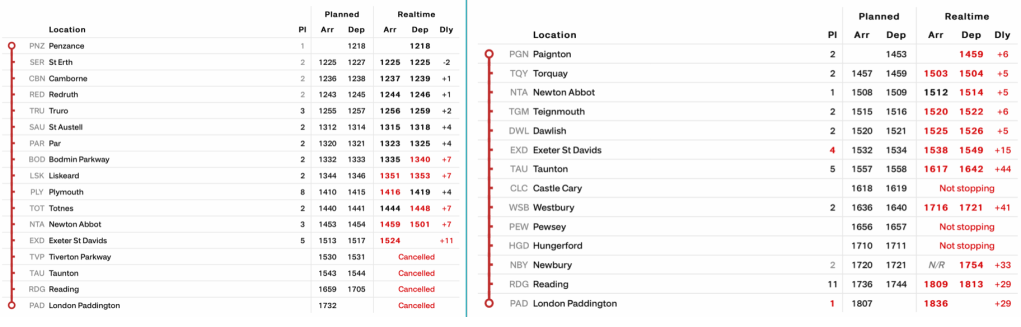
I had a single ticket and reservation on the 12:57 from Truro to Paddington (12:18 from Penzance). A speaking commitment in Truro that morning prevented me from folllowing the advice to “travel as early as possible” otherwise I’d have certainly caught one of the three trains that left Penzance earlier that morning.
I also couldn’t delay travelling until Monday although GWR weren’t saying “do not travel”, just advising “disruption is expected”.
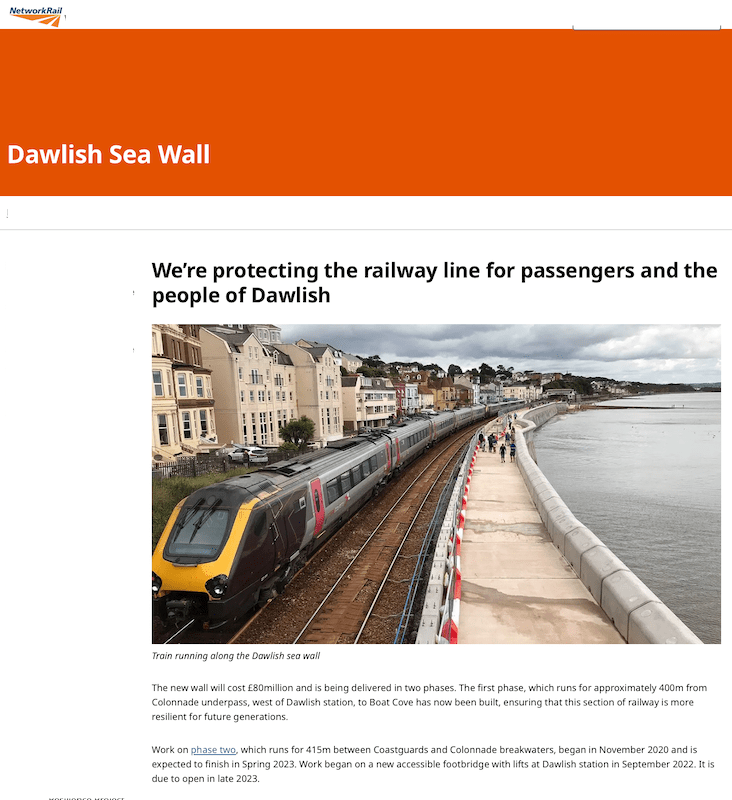
The weather was certainly windy along with heavy rain falling from around 10:00 and I guessed, notwithstanding £80 million spent on bolstering the defences along the seafront at Dawlish, including a new sea wall completed last year, that section of the journey would be the most precarious and vulnerable to the elements.
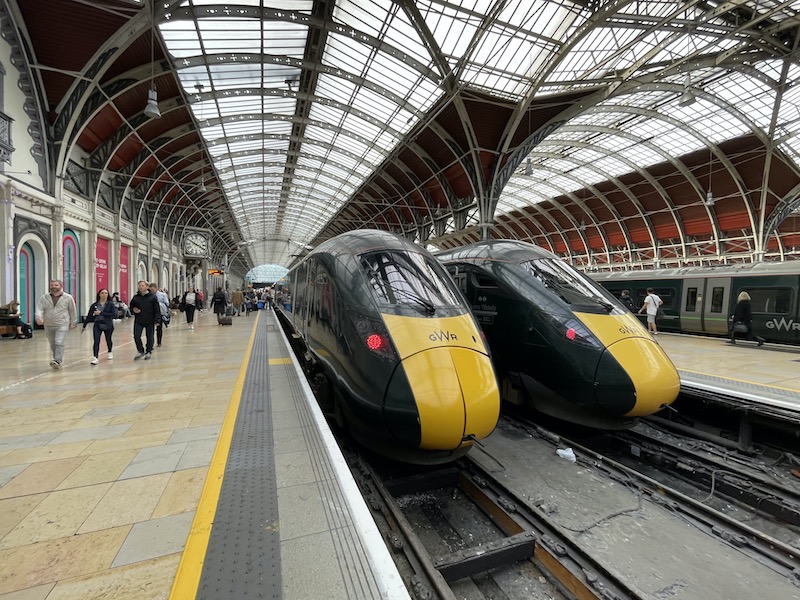
I arrived at Truro station at 12:45 and immediately realised a nightmare journey was going to unfold, not so much because of the aforementioned disruption warnings, but seeing the platform sign showing the train was short formed with just five coaches.
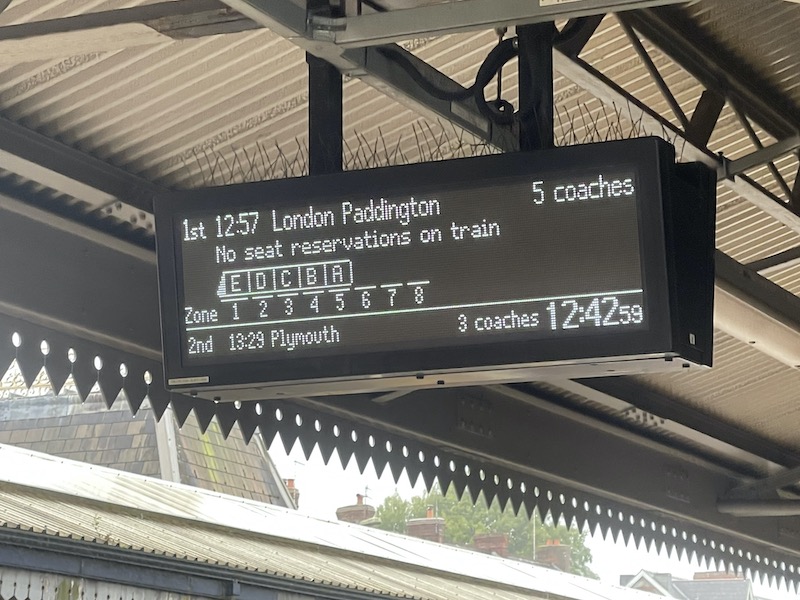
This is inexcusable. Fewer train workings on a Sunday than in the week means spares should be available. We were told “fewer trains are able to run” so that means even more spares should be available. The normally allocated nine or 10 coach trains on the West of England line on Sundays are always extremely busy so to run a five coach train was a complete abdication of responsibility to passengers.
The consequence was no seat reservations, a declassified first class section and no catering and at every station bedraggled passengers, waiting in the rain, boarded in the hope of a comfortable journey ahead but instead having to seek out any spare inch of gangway or vestibule in which to stand or sit on the floor.
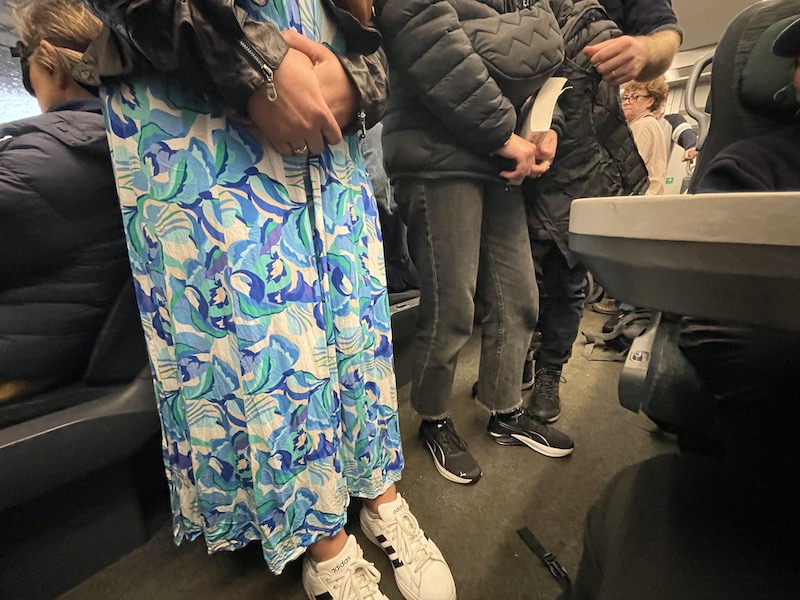
Conditions quickly became intolerable on board. Making a trip to one of the toilets was almost impossible yet passengers kept good natured and seemed resigned to the conditions, with many observing this was sadly becoming all too typical of poor service delivery by GWR, particularly at weekends.
I increasingly felt sorry for the Train Manager as the journey progressed through St Austell, Par, Bodmin Parkway and Liskeard. He sincerely apologised and empathised with the appalling conditions we were all suffering and, of course, he could offer no explanation or reason for the allocation of a completely unsuitable five coach train. All he could say was “Control” had made the allocation and although he’d requested another five coach train be joined on at Plymouth he’d been told this wasn’t possible.
Suffice to say arriving into Plymouth was somewhat daunting not least because the previous GWR stopping journey half an hour before us serving Exeter and Taunton (and on to Cardiff) had been cancelled adding even more passengers to the huge throng waiting to board.

If the overhead racks hadn’t been full of luggage I seriously think passengers would have climbed up to find space there as we headed off towards the famous Dawlish Wall in every sense of the word “rammed”, with the rain beating down.
It was the same story at Totnes of rain soaked, bedraggled passengers looking horrified at the conditions they were joining on board, but at Newton Abbot the Train Manager made the sensible suggestion passengers without a seat might find it better to get off the train and catch a following nine coach train that was coming from Paignton with plenty of empty seats and would be about ten minutes behind us.
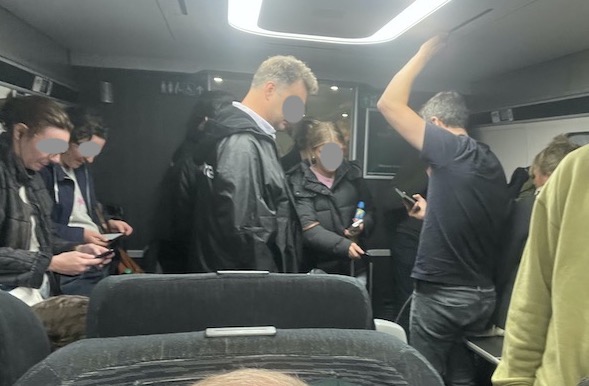
A few made the move but more joined us, possibly swayed by that alternative train having more stops including Castle Cary, Westbury, Pewsey, Hungerford and Newbury on its way to Paddington.
It was now time to pass along the Dawlish Wall. Although the sea was rough and waves were high I wouldn’t describe it as appalling conditions. There was a lot of spray and it was noticeable we’d slowed right down, including alongside the River Exe and through Starcross, even when the worst of the impact of the wind had abated. I had a feeling something wasn’t right.

We arrived into Exeter St Davids at 15:24 just eleven minutes late but seeing around 250 passengers waiting on the platform quickly realised this wasn’t going to have a good outcome.
The Train Manager repeated his announcement imploring passengers to consider waiting for the next train but after a few more minutes announced the clincher – the train’s engine had developed a fault coming through Dawlish and the train would have to terminate where we were, in Exeter.
I’d guessed all was not well on the approach to Exeter as a Hitachi employee was on board and his increasing activity and furrowed brow said it all.
The five coach train slowly emptied as everyone and luggage made their way via the narrow staircases and footbridge from platform 5 to platform 4 where the much discussed nine coach train from Paignton was just arriving.

It was the same story of first class being declassified and despite the efforts of the catering staff they quickly realised it would be best to retreat to the safety of the kitchen as more and more of the floor space became occupied with human bodies as passengers piled on board.
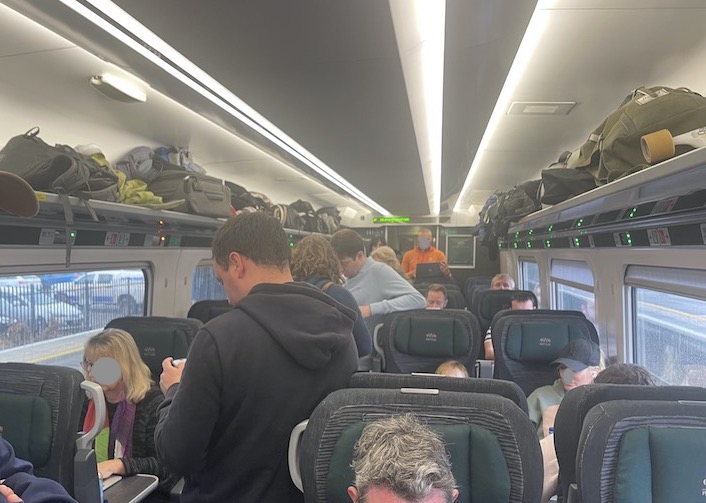
We set off at 15:49 (15 minutes late for that train and 32 minutes late for those of us from the broken down train) and the next stop at Tiverton Parkway saw what had become the usual scrum of passengers seeking out spaces to perch, sit or stand.
But it was the next station, Taunton, where things came to a head. I got the impression the Train Manager had rightly thought enough is enough as we’d become dangerously overloaded. He told us he “was trying to get through to Control so some station calls could be cancelled to create more room for passengers” … or to out it another way … to have less passengers on board … “but they weren’t answering”.
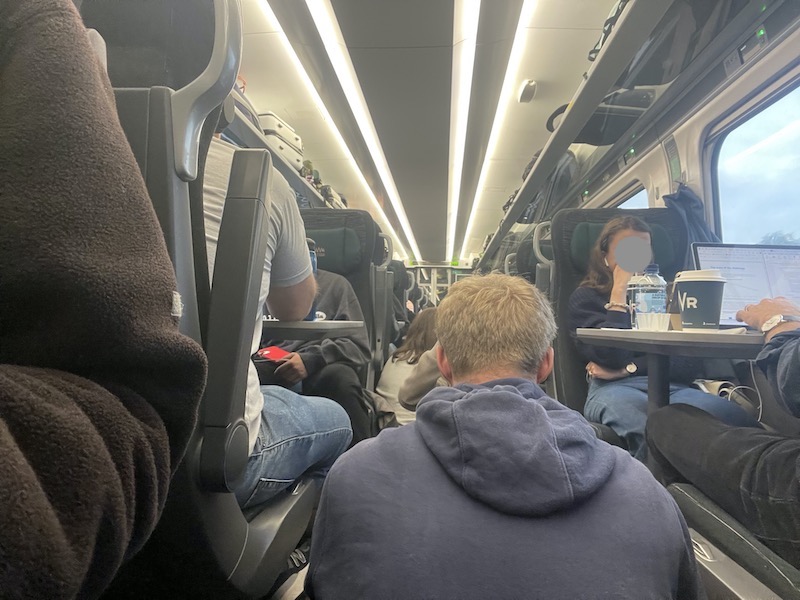
All in all we waited in Taunton for 25 minutes while Control sorted something out with the solution communicated to us the train would now only call at Westbury, Reading and Paddington with passengers for Castle Cary advised to alight where we were in Taunton, and take a taxi and those for Pewsey, Hungerford and Newbury advised to alight in Reading and catch a train back from there.

It’s possible this eased pressure on space in other carriages but there was no movement in the one I was in – we were all Reading or Paddington bound, but at least the change meant a few minutes would be saved by not calling at the four skipped stations and we’d avoid more on board distress as passengers tried in vain to get on the train. Sadly those passengers waiting to board at Castle Cary and Pewsey had another two hours to wait for their next train.
It was bad enough at Westbury, where, as at all other stations, boarding passengers with accessibility needs, medical conditions or with babies and young children requested fellow passengers to give up their seat and it was good to see the human spirit of generosity was alive and well with exemplary acts of kindness.

My main concern was reaching the toilet not least as while keeping an eye on the red light indicator I’d noticed it was pretty much permanently occupied, wondering if someone was using it as a seat for the journey. I think that was indeed the case.
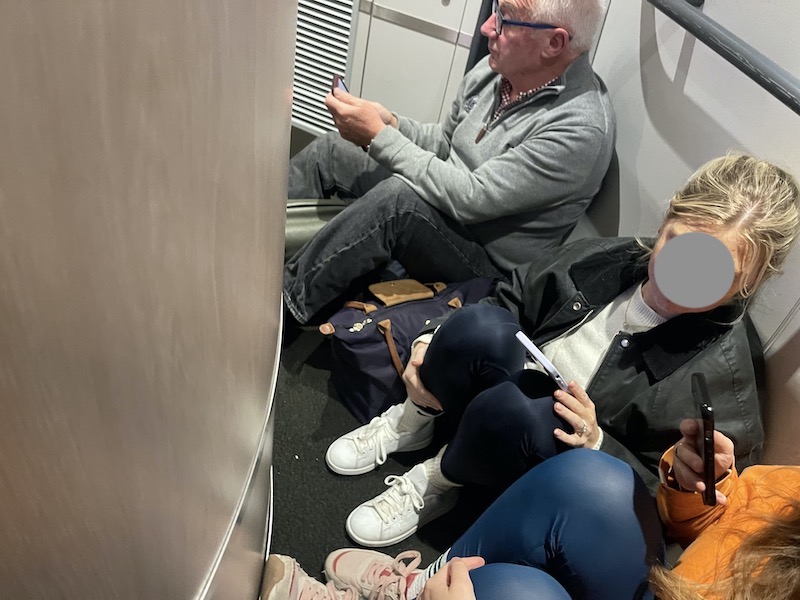
As we continued on to Reading I noticed at 17:09 GWR posted on X news that the line between Exeter and Plymouth had closed due to the weather and felt grateful I’d managed to get through just in time. But it did make me wonder about that Network Rail £80 million Dawlish Wall Resilience Project – the weather was bad, but not atrocious. The Shipping Forecast that morning reckoned Portland to Plymouth would be “Six to Gale 8; Moderate or Good, occasionally poor”. How on earth is the railway going to cope in gale, cyclonic and storm force winds during the worst of the coming winter?

We arrived into Reading at 18:09 and many passengers alighted although plenty were still standing, sitting or squatting through to Paddington where we arrived at 18:36 – 29 minutes later than scheduled for that train and 62 minutes later than my original broken down train had been due in.
My takeaways from this nightmare of a journey are….
Something is seriously wrong with the availability of trains such that a known busy journey on a reduced timetable is operated with a five coach train. I’m hearing comments about the mechanical state of the first generation of Hitachi trains introduced seven years ago and someone needs to come clean with passengers. There seem to be far too many journeys being short formed with just five coaches. GWR may have a maintenance contract with Hitachi protecting itself financially when train availability is lacking but it’s passengers who suffer. And yes, I’ll get all my fare back through delay repay for Sunday’s trip, but frankly I’d rather not go through the nightmare of such a journey.
And talking of refunds, I really think this is where the railway falls down big time. Train Managers on both trains were using cautiously scripted explanations that “passengers may be entitled to some form of compensation” when it came to explaining the lack of catering, declassification of first class and lateness of the journey. If GWR really are serious about customer service, Train Managers should be authorised to tell everyone due to the appalling on board conditions they’ll all be entitled to a full refund as well as a voucher giving £5 (or something like that) off a future booking. That’s how you win back goodwill. Not keeping passengers waiting for weeks to get the refund they’re entitled to and have the audacity to be questionned about the veracity of their claim – something, in my experience, that happens all too frequently with GWR as I keep reporting in these blogs. And I bet GWR get handsomely compensated by Hitachi. None of this “may be entitled to compensation”.
Which brings me to “Control”. When major disruption is expected, as happened on Sunday, extra resources need to be brought into “Control” so that decision making can be speeded up and Train Managers not left waiting for replies, keeping whole train loads of passengers waiting amid increasing uncertainty and distress.
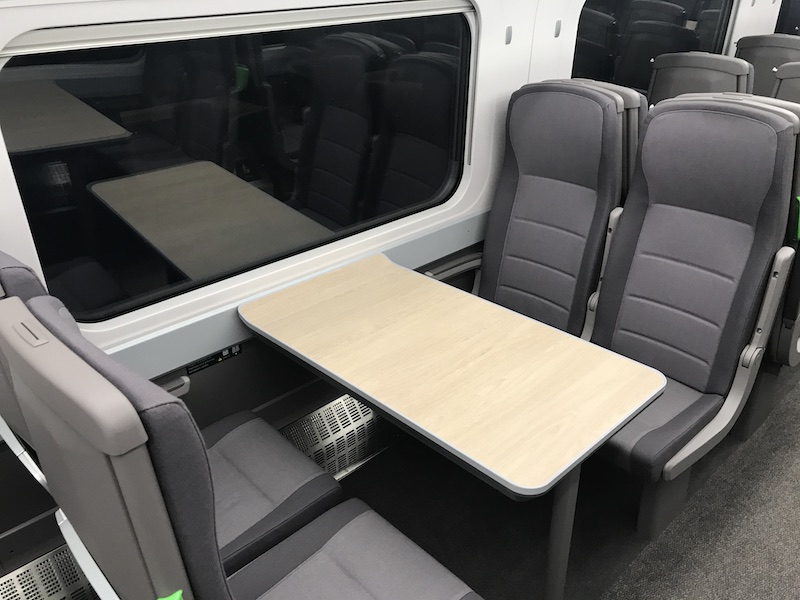
One other observation about Hitachi Class 800s is their age is beginning to show in terms of seat discomfort too. Never particularly comfortable from the start, many of the seats in standard class are now losing their internal padding leaving a hard ridge across the seat where your bum sits making it extremely unpleasant to sit, particularly for a six hour journey as some people experienced on Sunday . They need refurbishing and quick.
Among the thousands of passengers inconvenienced by GWR on Sunday was TV personality Kirstie Allsopp. She was privileged to receive a detailed reply to her posts on X from Celia at GWR who refreshingly gave some straight answers rather than hiding behind the weather as a reason for the problems – as we all know these issues are happening regularly, not just when it’s wet or windy.

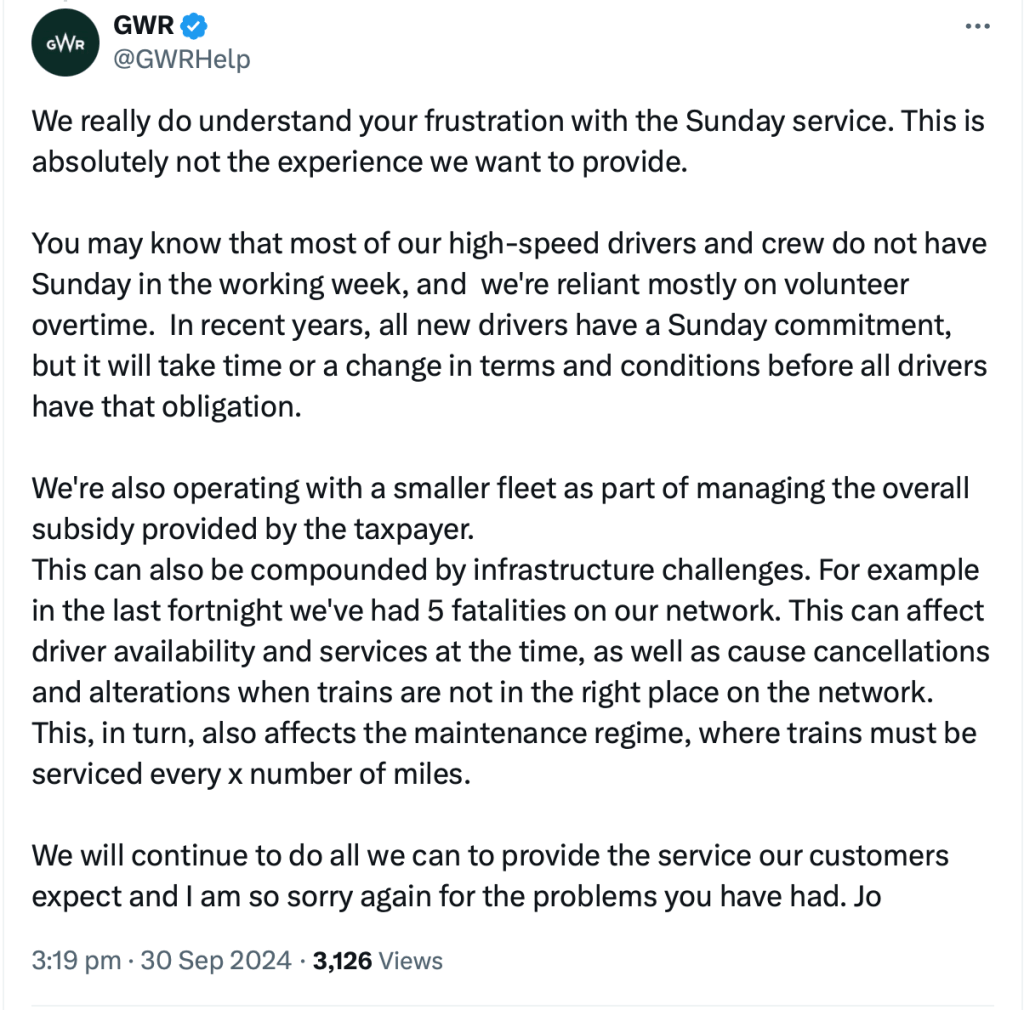
The admission “we’re also operating with a smaller fleet as part of managing the overall subsidy provided by the taxpayer” is interesting and shows the continued level of DfT interference in the rail industry.
I’ve Seen it.
I’ve Said it.
Now, come on Lord Hendy of Richmond Hill CBE … Get it ….. Sorted.
Roger French
Blogging timetable: 06:00 TThS.
Comments on today’s blog are welcome but please keep them relevant to the blog topic, avoid personal insults and add your name (or an identifier). Thank you.
 BusAndTrainUser
GWR has been screwed by the DfT removing the Castle Class HSTs and the entire 769 fleet. That has left both the ICE and Turbostar fleets over stretched (even before what are evidently serious maintenence issues with the ICEs).
Ironically rumour is that the 175s from TfW might be transferred, after what will no doubt be a hugely expensive renovation when rust or water damage is found below the sole line.
As a regular weekend user, short formed trains are frequent especially on the Hereford line and reservations are pointless about half the time. Apart from the handful of services with dining, the catering offer is poor even everything is working, not helped by ten carriage trains requiring two catering crews.
How exactly nationalision is supposed to help when the root cause of the problem is a badly designed ICE fleet and too few trains, both of which are the DfT’s responsibility.
LikeLike
I do hope not (class 175s being transferred), after a nightmare, almost four hour journey from Crewe to Newport (SW) a couple of weeks ago with us having to be propelled from behind by the following train after Hereford. A previous journey within Wales a few months ago was also delayed by “mechanical problems”. The only blessing being it was midweek, mid afternoon (at least when we left Crewe!), and thus not rammed full. Oh! And we got a complimentary tin of water, so looks as if they are well prepared and used to it.
Terence Uden
LikeLike
As a regular traveller to Leominster I can’t say I’m exactly wild about the idea either.
LikeLike
Nationalisation will help because the DfT will be sidelined and management placed in the hands of professionals. BR built the HST remember.
LikeLike
Thanks for reorting on this grim situation. I note that passengers are referred to the two different websites (GWR and XC) for further info – perhaps SGBR will be able to provide a unified PI system some time in the future for such weather events etc..
LikeLike
Sadly, five-car trains cannot be considered ‘short formed’; they are the norm on GWR, particularly on the Oxford fast service which loads well even with a nine-car set. This gives very crowded journeys on the SX and SO service, but completely unacceptable every few Sundays when the service is hourly. Why five-car trains were ordered at all is a mystery – the only time I see lightly-loaded trains is in SX am peaks, with people understandably baulking at the £70 return fare. Of course interpeaks and weekends are much busier.
LikeLike
The issue of short-formed trains is as you know a longstanding issue with GWR, and is frequently worse on a weekend. I catch a Saturday morning train to Hereford every week to go home and it’s regularly only 5 cars instead of 9. This wouldn’t be a problem for most of the journey as it would accommodate the number of passengers travelling West of Oxford, BUT there are t enough trains running to Oxford so it’s rammed as far as there. As you say, the train crews are generally magnificent but they don’t have any answers – the last time this happened to me the train manager candidly admitted he only found out when the train actually pulled into Paddington! As for the problems at Dawlish, last year I had to travel back from Cornwall as a storm approached, and yes all the IETs were failing on the sea wall. A GWR driver told me that they have crucial electrical gear on the roof which fails if something live a wave hits it. Can this be true? I was lucky, they laid on one of the surviving “castle” HST sets that I suspect would make it to Hell and back if required, and of course it made it through Dawlish without a problem. Sadly as you know this isn’t an option any more as the DfT insisted they got rid of the HST sets. Frankly, GWR are now a failing franchise and need to go
LikeLike
What is the root cause of all the problems. Whilst there was bad weather it was not abnormal conditions so GWR should have been able to cope
They need to change the drivers conditions do that they are required to work on Sundays, Relying on volunteer drivers on overtime is not sensible
The Hitachi trains are not old yet seem to be unreliable, Is it the design that is poor or is it poor maintenance
GWR seem s as well to have considerable problems with communications and poor management. I suspect the rail unions are not helping neither
GWR is possibly a good example of how not to run a railway
LikeLike
“They need to change the drivers conditions do that they are required to work on Sundays, Relying on volunteer drivers on overtime is not sensible.”
If you’ve been living under a rock, you might have missed the massive industrial action caused by this very suggestion?
LikeLike
| They need to change the drivers conditions do that they are
| required to work on Sundays, Relying on volunteer drivers on
| overtime is not sensible
According to the Twitter quote, new drivers do have Sunday in their working week.
Older drivers conditions could have had a change negotiated by the previous government were more interested in trying to keep industrial action going so they could show how hard they were fighting those nasty, old-fashioned unions who had dared to ask for a pay rise.
Next year’s pay negotiations will include discussions about changes to terms and conditions, and it’s likely those will include bringing Sunday into the working week. Be aware that just moves the unavailability from Sunday to another day in the week, although it does spread it out so it has less of an immediate impact. Unless there’s significant recruitment into the driver grade, there’ll still be reliance on drivers working their days off to cover the service.
LikeLike
My understanding is that the Class 802s, which run the majority of services to the West Country, were modified to enable them to better withstand the adverse weather conditions they would sometimes encounter around the Dawlish area. It would appear these changes have not had the desired effect.
LikeLike
No wonder the railways are a mess with this sort of nonsense going on. The cost of it must be high as well
Brand new £1billion fleet of passenger trains has been sitting in storage for YEARS after trade union row over window wipers
South Western Railway bought ninety Arterio trains to replace the 40-year-old ex-British Rail carriages that are still in use on commuter lines out of London Waterloo. But the trains, which have one of the largest windscreens of any modern UK train, have been delayed from entering service for years because of objections by train drivers’ trade union Aslef. Union reps raised objections to the size of its windscreen wipers, claiming they were so big that they blocked drivers’ views of the trackside signals used to tell trains when to stop and go.
According to SWR sources, Aslef is said to have dropped its objections to the trains as part of a deal for a 15 per cent pay rise with Louise Haigh, the Transport Secretary, earlier this year.
LikeLike
There are many more problems with 701s than the bloomin’ windscreen wipers, don’t worry about that!
LikeLike
Such as what ?
LikeLike
Well the biggest is that they were out of date the day the metal starting being cut, since they don’t offer level boarding, so we’ll be using ramps on SWR for the next three decades.
LikeLike
I don’t think that’s really relevant to the question being asked. Plenty of other stock being introduced now doesn’t have level boarding either.
LikeLike
“fewer trains are able to run on all LINES”. How many lines does FGW think there are between Exeter and Plymouth ? The line between Exeter and Newton Abbot via Heathfield closed some 60 years ago and the Southern link between Okehampton and Bere Alston hasn’t yet been reinstated. That only leaves the ONE LINE through Dawlish. Does nobody read what they are posting?
John Crowhurst
LikeLiked by 1 person
There is an Up line (towards London) and a Down line (towards Penzance). In stormy conditions it’s common for trains in both directions to run on the Up line through Dawlish which is the furthest away from the sea as modern trains don’t like salt water getting into the electrical equipment mounted on the roof and this keeps them a little drier. Obviously this means fewer trains can run.
Roger’s first train probably failed and had to be taken out of service as it got too wet.
The older 1970s and 1980s trains are pretty ‘Dawlish proof’ and it would have made sense to terminate the modern trains at Newton Abbot / Exeter and run a shuttle service of older trains on the intervening section.
The ‘missing’ five cars from Roger’s train were forming the Cardiff one as GWR are so short of rolling stock, especially as the old HSTs are now confined to Plymouth and Cornwall.
Chris B
LikeLike
I sympathise, having recently spent six hours getting from Lancaster to Carlisle including four and a half on Oxenholme station due to a broken rail north of Penrith.
The message “IF your journey has been delayed by more than 15 minutes you MAY be entitled to compensation” was repeated incessantly with the incorrect advice to apply to Avanti West Coast for a refund (I was a TPE passenger). Also repeated regularly was the advice that the 1112 to Glasgow was delayed – this was still being repeated at 1530!
According to the excellent platform staff at Oxenholme, who coped very well, it only took an hour to fix the rail but three hours to obtain possession of the line from Network Rail to do so.
Jim Davies
LikeLiked by 2 people
Quite apart from passengers this cannot help GWR recruitment. Who would want to be a train manager for such a shambles of a company?
This whole scenario sums up modern Britain: a dysfunctional system with a whole host of both public and private sector executives paid a multiple of what their predecessors made a few decades ago but not actually fixing problems. There is also a lot more of them across all the different organisations that have proliferated in the meantime: Dft, GWR, Network Rail and various contractors rather than just British Rail.
I am not holding my breath for them to fix it. The issue is that they do not have an incentive to do so. The current disaster for passengers (and many frontline staff) is actually fine for the people running the so called industry.
LikeLike
I thank God that I did all my long-distance railway excursions in the 1970s using cheap All Line Rovers at about £27 for the week. As part of my week in 1974 on my way from Scotland to Devon I found a “Sunshine Special” waiting for me at Paddington – “haulage” and probably a rake of twelve coaches. No catering if I recall correctly but non-stop to Dawlish where I had a stroll along the beach discovering that it had been warmer in Scotland! With a long distance to ride from Paddington to Dawlish I examined the entire train finding my search for food and drink fruitless! Furthermore, there were very few other passengers. The only other excursion train which I travelled on was in 1984 between Hersham and Eastbourne via Point Pleasant, Longhedge and Factory Junctions (£5 return) on a through train marketed as a “Merrymaker”.
LikeLike
Catering on trains is now very hit and miss you may get it or may not. If they can get something simple right such as basic catering on trains they have no hope of running the services reliably
LikeLike
The railway has long ceased to be a service to the public, and I don’t say that lightly as I work on the railway. Unfortunately, the fact that your train was short-formed is irrelevant in the current rules as it ran, and that’s all that matters. I used to work for GWR and I’m sad to say it but their standard of service has been deteriorating for some time now
LikeLike
The UK railway today is just a full-size train set for politicians to play with and for empire-building “managers” and civil servants to use for creating their little lands of sweetness and light they can lord over.
LikeLike
The sad thing is that Mark Hopwood, the MD of GWR, is the last of the old BR managers and knows what is needed to run a good railway. This suggests deep seated problems beyond his control.
LikeLiked by 1 person
It looks like GWR has descended to the levels of the WCML and I would suggest that the problems are not limited to one network.
I gave up using West Midland Trains and Avanti except when there was no alternative. And they wonder why passenger numbers are down ….
One for the new government ?
AM
LikeLike
Governments do not run railways, The problem I would suspect is mainly down to very poor management and dysfunctional organisation
LikeLike
I was under the impression that they had control of those that set the contracts for the rail operating companies.
LikeLike
Northern, TransPennine Express, LNER, SouthEastern, TfW and ScotRail are all Government owned.
The other passenger train companies are effectively Government contractors with the Treasury receiving the revenue and the Department for Transport paying the costs. Any significant expenditure has to be signed off in Whitehall.
The Open Access operators like Grand Central and Lumo and the freight operators are the only truly private parts of the railway left.
LikeLike
GWR have tended to not be able to cope with passengers, and running trains. I wonder if a split “franchise” or management model might help. Paddington-Wales, Wales-West Country, Paddington-West Country. Increase South Western Capacity to Exeter – I would like to go beyond perhaps when Oxehampton – Plymouth ever gets put in place – it has to long term and extend Elizabeth Line to Oxford along with running Chiltern Oxfords back round to PAD from MRY , but each would bring their own resource requirements.
LikeLike
It’s only a small fiasco amongst many but it particularly annoys me because it’s local to me – why the hell was the Paignton to London service put onto platform 4 at St Davids thus forcing everyone from Roger’s train up and over the footbridge. Did no-one think it might make more sense to move the Cardiff stopping train that was starting at St Davids away from platform 6 to platform 4 or even platform 2. (As an aside, in over 30 years using St Davids I don’t recall ever seeing an up train on platform 4!)
LikeLike
I have been fortunate not to have to travel on GWR recently at weekends. I did go from Reading to Bristol TM on a short formed 800x class train on a Saturday about 3 years ago. That was crammed to the doors on arrival and passengers were left on the platforms at Swindon & Chippenham. The train miraculously almost emptied at Bath. No obvious sporting event, just Summer visitor traffic and the left behind passengers were lucky that the weather was good.
I have been noticing the deterioration of the seat cushions on GWR for some time. They are in need of immediate replacement ! I was shocked to find the same problem on a TPE train I was on recently between Glasgow and Preston. The discomfort was compounded by a ride that wasn’t up to much either. I was grateful to get on a refurbished Pendolino for the onward leg to Euston (despite not really being a Pendolino fan, and only really appreciating them for the train length and their speed).
LikeLike
Yes, totally agree with the seats. I cam back from Par in June and found the front of the seat frame digging into my legs where there was no padding. Not great for such a long journey. Why do those seats have to be so bad!
LikeLike
I have had several similar journeys at the hands of GWR and XC. SWR are no strangers to the 5 cars instead of 10 club as well.
LikeLike
Ah, to be in England, now that October is here! I once taught Pete Hendy, though fortunately for my CV, he won’t remember that detail.
Bruce Perkins
LikeLike
A friend who is a CAMRA member off for a day of gustation in Oxford heart sank when a four car Voyager turned up with Train Full on the front!
This should be easy to solve as railways are fortunate that the entire network timetable changes twice a year on predefined dates. This ought to facilitate movement of stock to where it is needed once the government “own” all the train services.
I had a wry smile on Tuesday morning arriving at Euston to see a 10 coach Voyager in the adjacent platform completely rammed (including First Class) taking delegates to the Tory party conference in Birmingham. Who undoubtedly blamed the railways not their own party or First for North London Line travelling conditions of old.
Later that morning after crossing the “Orange wall” that stretches from Eastbourne to North Devon I witnessed a bus packed full of students on a seemingly AI generated frequency with “Sorry, Not in Service” on the front i.e. full, so it’s not just the railways that suffer from overcrowding due to inadequate capacity. At least it made the bus more agile especially as that part of the route hasn’t got a 20mph speed restriction.
Imagine Tesco at Christmas limiting the number of shoppers due to insufficient staff, advertising their shops are full, and even saying to me “you not welcome carrying that Sainsbury’s bag”!
The inspiration has to come from Captain Haigh to turn the oil tanker that is public transport around.
Change is needed but not for change sake, but where there are problems DOING something about it!
John Nicholas
LikeLike
As you will be aware Sunday services on Scotrail are also abysmal and the current reduced timetable is made worse by frequent short forming of services. When I queried why a packed Sunday Edinburgh – Stirling service was just three coaches despite a majority of trains being cancelled I was told that if action was taken to say connect two class 385 units together this would mean that even fewer services could be operated because of the driver time required to do this.
The reduced timetable also includes reduced numbers of carriages on some trains. An Alloa – Glasgow Queen Street peak service which I use quite often has been reduced from six coaches to four despite the service level at Lenzie and Bishopbriggs being halved. Yesterday I had the joy of the frequent two car class 158 substitution on an Inter City 7 service. Faced with the same allocated for my return journey I spent an extra hour in Aberdeen and had a lovely comfortable journey back on an HST.
Had Scotrail still been a franchise I have no doubt that Scottish Government would have called in the operator to discuss it’s recent abysmal performance. What can be done though now that Scottish Government runs the trains ? It seems rather extreme that the only way to improve rail performance is to vote against the current government but it seems that this will soon be the case across Great Britain. Such a major opportunity was lost in Scotland to demonstrate how good a nationalised railway can be. The takeover was entirely voluntary and should have led to faster and more frequent services, improved trains and lower fares. Instead we’ve a massively poorer service (six trains an hour fewer from the West into Edinburgh than pre covid), fare rises double the rate of England and now the ending of the same fares all day experiment which was an excellent initiative.
LikeLike
Thanks for this tale. Same problems in South Wales I keep sending email to GWR about the train conditions and the frequent shortforming but should we also send it to DFT?
LikeLike
Depends on what service mainline to Paddington is GWR the rest mainly come under TFW
LikeLike
There are so many problems here but the main one appears to be the IETs are unable to keep working when splashed with salt water despite claims made when they were being introduced that they are “Dawlish proof”. So even when conditions are safe for trains to operate but there is spray from the sea, it causes problems for the IETs. The Voyagers have the same issue (possibly to a lesser degree). So 158 and Turbos won’t have a problem but newer stock generally does. The short forms are mainly due to the loss of the HSTs and so using IETs on the routes previously served by them instead.
Then there is the nonsense of Sunday working where crucial staff like drivers and guards are under no obligation to work on Sundays. Yet rail operators with staff on these contracts haven’t changed them and continue to publish a Sunday schedule and sell Advance tickets for trains on Sundays despite not knowing what they are actually going to be able to run on the day. Working Sundays has to be made compulsory or GWR need to stop publishing a timetable for Sunday given they don’t know if they can actually run it. There were extensive cacnellations on other routes too like the North Downs Like, it wasn’t just services to Cornwall.
Lastly it seems nothing was learnt from the Voyager problem that 4 and 5 car trains are too small for virtually all routes. Even when doubled up it means additional staff compared with running a single train with the same no of carriages (or issues with catering only being available in half the train). So many people predicted 5 car IETs would cause overcrowding but it seems no one in the DFT took any notice.
LikeLike
In contrast I had an interesting experience following delays on a recent trip to Normandy from Paris. My train to Caen was delayed due to a train in front having broken down. Amazingly both trains were lined up next to each other in the middle of nowhere and the staff proceeded to detrain passengers from the stranded train onto ours . A military style operation carried out efficiently with minimum fuss. Staff then handed out food parcels (long life stuff and not the most appetising but nonetheless appreciated) and we were on our way with delay of about 75 mins. As for passengers with connections…a train was waiting at Caen to transfer them to their destination. Partial refunds of course could still be claimed for the delay.
Martin W
LikeLike
I’ve noticed on past trips to France and neighbouring countries that Health & Safety does not have the stranglehold on decision making that it has in the UK.
LikeLike
When a train breaks down in the UK the passengers are usually left stranded for hours and with no real information given out
LikeLike
Last Saturday, five car train from Hereford arrived to a totally packed platform in Oxford. Became a completely rammed train, and an incredibly thoughtful announcement I’ve never heard before “I’ve told control we will be leaving slightly late. Because conditions are so bad, if you feel uncomfortable onboard, I’ve re-released the doors for 60 seconds should you wish to leave the train and assuming you can get to the exits. There is another train (nine car) in 30 minutes, and this will be less overwhelming to use”.
What a way to run a rail network. One international visitor to Oxford looked at me and said “Is this normal in the UK?”.
LikeLike
The ongoing problem with the Dawlish sea-wall section of track* is SURELY the best advert there is for providing resilience by fully reinstalling the old (north of Dartmoor) Southern Railway route between Exeter & Plymouth! (* See a very telling video from that Sunday at https://www.youtube.com/watch?v=aNtz9NMtX8c.
But even given an alternative route out of Cornwall and Plymouth, it’s hard to see how First GWR would have the nouse and organisational ability to maintain a proper, customer-focussed service. Hey ho! I hope, Roger, that you have now recovered from what must have been an horendous ordeal. Stay strong! All best, John Pinfold, Cheltenham, UK.
LikeLike
What an ordeal! Perhaps Roger should expand the blog to includes coaches? A quick check on NatEx shows a journey from Truro to Gatwick changing at Heathrow. A longer journey time and would still need a train for the final leg but would be better travelling conditions- just a thought.
Richard Warwick
LikeLike
If you look at Scotrail and TfW it does not look look like nationalizing rail will change anything
LikeLike
I’m afraid this is just another example of a complete toxic and appalling rail industry which treats its customers with total contempt. Almost every line of this forensic account demonstrates one aspect or of another of our truly terrible rail service. For some reasons seat comfort is completely unimportant. That isn’t how the motor industry works! Expensive engineering works which still allow a bit of stormy weather to bring a service to a complete standstill. Running trains which inevitably become dangerously overcrowded. In all the huge masses of expensive regulations that we now impose, many not fit for purpose, how is it that we seem to allow almost any number of passengers to be crammed into absurdly short train formations? Drivers not having to work on Sundays?! These antediluvian work practices are completely outrageous. And so it goes on.
LikeLike
| Drivers not having to work on Sundays?! These antediluvian work
| practices are completely outrageous.
The unions have been trying to negotiate changes to these working practices for decades – bringing Sunday into the working week has been ASLEF policy since before privatisation – yet the DfT have been telling TOCs not to negotiate on the issue. It’s ridiculous.
As far as I’m aware the only TOC which managed to bring Sundays into the working week companywide for drivers in the past ten years or so was East Midlands Trains under Stagecoach, and that only got past the DfT because it was basically cost-neutral as ASLEF sold EMT drivers down the river by accepting a paltry pay offer for bringing Sunday into the working week.
LikeLike
Apart from trips to London, I seldom travel by rail these day’s. In August I decided to go by train to Warminster for the Imber village event. Arrived at Salisbury only to find the GWR train to Warminster was running about 15 minutes late! Coming back I thought about getting a return to Westbury to see what locos were in the yard and also I’d get a seat on the train if it was crowded at Warminster. On checking the train from westbury to Salisbury was cancelled! Fortunately the train door stopped right in front of me. At Salisbury others peoples bad luck worked for me as a few minutes wait and a late running train from Exeter arrived.
LikeLike
The people at fault are the passengers themselves, including you Roger. You were all told TAKE AN EARLIER TRAIN but you all selfishly chose to take the ones you were booked on. I’m sure the majority on that train had no good reason not to take an earlier train. As for you Roger, your talk could easily have been cancelled, it wasn’t that important, you could easily have taken an earlier train, it wasn’t like you had family in the land far far away to visit that morning, it wasn’t like you were doing a contracted job whereby you had to work that morning. When a train company says travel early, frigging well do so because they know the reasons why things will go tits up and you have to follow what they say!
LikeLike
Nothing will improve if we continue to put all the blame on the customer. Perhaps the majority of these passengers were travelling earlier than they otherwise would have done on a Sunday. How can you reconcile that request with providing a five car train? Also not sure how that fits in with passengers having to book a specific journey with a reservation which is a deterrent to travelling by train anyway never mind changing your travel plans anyway?
Adam Yates
LikeLiked by 1 person
I’ve made my first train journey since 2019 in August with some trepidation. Strange as I am a lifelong rail enthusiast and know my way around. It was a weekday and everything worked perfectly I’m pleased to say. My local Stagecoach subsidiary took me to Chippenham Station (bustimes . Org helped me track my bus). GWR and Cross Country all turned up when they were supposed to on my journey to Bristol Parkway via Temple Meads.
The only criticism I had was my connection from Temple Meads to Parkway was a rammed 4 car Voyager that had come from Paignton and was going to Manchester, a ridiculously small train for such a lengthy journey. I was very pleased on my return that Stagecoach turned up just as I exited Chippenham station.
Regarding the GWR IETs. These are awful trains, I once travelled to London sat next to a solid wall where the external doors recess. The seats were hard boards and visibility was limited.
One final observation about the uselessness of everything in this country. If you drive out of Chippenham along the A4 you pass under the GWR main line and can see the gantries minus the overhead wires because the money ran out. They spent millions lowering the track through Box Tunnel and Sydney Gardens in Bath. But hey we have bimode trains so we don’t need to electrify. Also we are tinkering with hydrogen and batteries, and lately I read about discontinuous third rail on the SW main line to Exeter. Enough! Get the electrification done like any other NORMAL country.
Peter Brown
LikeLike
GWR are not alone.
Last Sunday the 10:14 TPE service from Manchester Piccadilly to Cleethorpes was formed of a three-car train. It was rammed beyond belief. The train manager was apologetic and couldn’t understand why such a small train had been provided.
I changed at Sheffield onto the EMR service that started in Sheffield (normally running from Liverpool) to Nottingham. It was a wonderful surprise to see a train of 6 – yes 6 – class 158 coaches pull in.
TPE got it wrong, as usual, and EMR – somewhat unusually – got it right.
LikeLike
I had a similar experience a few Sundays ago travelling from Paddington to Exeter. In that case the previous train and following train to the west country were cancelled. Again, the train manager was empathetic, and the passengers were remarkably good-natured, but I couldn’t help wondering how many of them would drive next time. This sort of experience must cause the rail industry to haemorrage revenue, and is no way to “manage the overall subsidy.”
LikeLike
With Rail you pay a lot for what is typically a third class service. What other service can get away with short changing passengers ?. You may or may not get a seat and that can apply even if you have a reservation. The train may or may not have the advertised number of carriages and services. The train may or may mot get you to your destination
LikeLike
The situation regarding fleet position is complicated. The IET trains were procured by the DfT under a TSA with Agility Trains.
Agility has a contract with Hitachi to maintain the trains and with the DfT to provide an “agreed number” of train sets for service each day.
On top of that, Hitachi has a maintenance contract with GWR to provide some train sets directly under an unrelated agreement.
Neither contracts have the best interests of the passengers anywhere in them.
LikeLike
What does need to happen is a removal of the kitchen taking up half a carriage on every train. It services just two “Pullman” trains a day. You could pay a fancy restaurant to bring meals to those two trains and yet add 40 extra seats to all other GWR mainline trains. CH, Oxford
LikeLike
One interesting fact is the principle of driverless trains on the underground has now been established. On the Elizabeth line there is already some very limited driverless operation
LikeLike
its ok saying that people should travel by an earlier train, but how many people would find that out? For many, maybe most, if they are booked on the 10:00 departure, then they will turn up just before, especially if they have an advanced ticket which says that you can only travel by that train.
The whole system needs to be reset!
LikeLike
Actually, the Pullman Restaurant service on GWR is the only catering bright spot! I sample this regularly. It would be better to make more use of the kitchens, like the Travelling Chefs that GWR used to run.
GWR’s BIG mistake was not to install buffets on IETs, like LNER did.
Richard
LikeLike
On the other hand, on a recent journey with LNER from Alnmouth to the south, with rail replacement in place covering stations from Edinburgh to Newcastle because of weekend engineering works, the whole process worked smoothly and with no obvious issues. Stagecoach was providing the organisation for my part of the rail replacement, with a comfortable, privately owned coach and an excellent driver whisking me down the A1 to connect, in good time, with my train. In general, my rail journeys around the country run well. The underlying reasons for short-formed trains, on-board comfort and catering are well known. So I find myself offering general praise to the train crews and station staff (and the rail replacement teams) for their professionalism and commitment to doing their best in sometimes very challenging circumstances.
Stuart R
LikeLike
And today….
Due to more trains than usual needing repairs at the same time between London Paddington and Reading:
Impact:
Train services running to and from these stations may be revised. Disruption is expected until the end of the day. Customer Advice: We’re sorry for the disruption to your journey today. Due to more trains than usual needing repairs today, our local stopping trains between London Paddington and Reading will run with less carriages than normal. We understand this may cause your journey to be less comfortable than usual and we do apologise for this.
Customers are strongly advised to use our high speed long distance trains between London Paddington and Reading where possible. Customers travelling from London Paddington to Slough, Maidenhead and Twyford are strongly advised to use the Elizabeth Line between London Paddington and these stations. Tickets will be accepted at no additional cost. Westbound Elizabeth Line services depart from platform B at Paddington. This can can be found in the Elizabeth Line station located adjacent to platform 1.
LikeLike
And another thing …
Soon after the IETs were introduced on GWR I remember a Train Manager saying to me that the IETs were the worst intercity trains ever, and that In Japan they were designed as commuter trains, not intercity trains.
It’s about time that Hitachi and the DfT mandarins responsible for them are hauled before the court of public opinion!
Richard
PS: Last comment for today.
LikeLike
Not quite. They are based on the AT300 platform which is a general purpose train for longer distance services. They are not commuter trains (that’s the AT200 which was the basis of the ScotRail Class 385 trains), but equally they are not Hitachi’s bullet train platform which is the AT400.
I don’t believe the speed is an issue, but I do wonder if they are upto to the very heavy duty cycles UK InterCity operations require. That said of course, the DfT messed around with the design so much that its hard to know how much of the original design has been compromised (and at a much more fundamental level than the seat cushions). The problems we’re seeing certainly suggest something is very wrong.
LikeLike
I share Rogers despair at the seats. The light weight causes another issue in that unless someone is seated on the seat in front of you, the empty seats shake quite violently at speed – I’ve had coffee and water bottles dancing across the tray table, it’s quite dangerous with hot drinks.
This happens to me quite regularly – I take an IET on LNER every Tuesday morning down from Yorkshire to London. In almost a year, I have only *once* had anyone sit next to me. The peak time trains from Northallerton and York are so quiet due to LNERs pricing – well over £100 for an advance single in standard.
LikeLike
Rejoice Roger,
Captain Haigh has decreed the the large advertising boards be switched off at Euston as part of a plan to reduce overcrowding!
https://www.standard.co.uk/news/transport/london-euston-station-departure-boards-network-rail-concourse-louise-haigh-b1185923.html
John Nicholas
LikeLike
I was going to suggest why doesn’t GWR get passengers to transfer to SWR to London when they are overcapacity due to disruption (Ideally ORR/DfT to issue a standing instruction that they must do this)
But, If I have looked up the right date on Realtimetrains, it would seem that there wasn’t any service from Exeter to London on that date on Southwestern lines, so that would have been a moot point.
For disruption days in general, I am increasingly of the opinion that ORR/DfT should be mandating that operators have solid emergency “thunderbird” coaching arrangements that can be executed effectively at short notice.
This may require franchise operators to actually set up their own coaching operations (perhaps shared with nearby operators) and then try to defray the costs by finding other uses for the coaches when not needed to cover a disruption; in some cases this may need to be a two class operation i.e. passengers who have paid for first class, or more expensive tickets (or carrying disabled railcard, where practicable) are prioritised for alternative coaches (and taxis), or vice versa.
I have been involved in an late night incident on SWR where lack of trains and lack of organised alternative for a crowd of passengers was not handled properly, in effect “YOYO to get a taxi and claim it back” (needing passengers to have hundreds of pounds of available credit on their payment cards to get to where they needed to go, and no support for underaged or disabled).
MilesT
LikeLike
So because the railway industry is incapable of reliably running trains on railway tracks we should allow them to introduce state funded competition for small family owned businesses? Leaving aside the fact that the moment you find other work to defray the cost of having the coaches & drivers available you are tying up the coaches when you need them (the reason why train operators often can’t find coaches in an emergency is they are all tied up on other work or the drivers have used up all their driving time on their regular work so there is no one free to drive) there is a shortage of coach drivers so allocating them to waiting around in case the railway needs them means they aren’t available to drive school coaches, service buses or all the other existing work coaches do.
I’m sure there are lots of local coach operators who would gladly take money from the railways to ensure there are coaches & drivers on standy in case the railway goes down but it isn’t cheap, we are talking £100k per year per coach probably (as you will need a driver on pay but not working just in case) plus the normal rail replacement payment for the coach moving (though lower than normal as the driver & standing costs are already covered but running costs like fuel need to be covered) and to get a reasonable response time you need . Over any period of time it would just be cheaper to put the money in to sort the railway problem than paying millions of pounds a year to have a few hundred coaches parked around the country for when things go wrong.
Dwarfer
LikeLike
@Dwarfer
Carrying a standard cost on the books would make the business case for fixing the root cause look better (where the root cause is reasonably fixable without gold-plating; predictable failure vs “black swan” events).
And I wasn’t expecting it to be cheap, but reducing over time so that it only needs to cover the more truly exceptional events.
If the support contract was tendered out to local operators (which is a nice aspiration) I suspect that it would need to be multiple local operators to get capacity and speed of response which adds complexity (hence my initial suggestion to make this industry owned to some extent to simplify the response procedure, covering the capital cost of the vehicles).
That said, there could be digital ways to engage local operators, spreading the oncall payments to a localised level with rapid callout to operators with various sizes of vehicles–minibus up to full size (and that could be a useful industry-wide subsidy from government to provide support to the industry). With such a scheme the ToC could input their demand, and the operators showing as “on call available” accept the job (a bit Uber-like; and smaller demands could be automatically farmed out to digitally enabled taxi firms.).
MilesT
LikeLike
Why are nearly all disruptions, whatever time of the day, are ‘to the end of the day’? It wasn’t that long ago when it would be for the next xx hours.
LikeLike
While not as bad as Dawlish, a number of the SWR lines including the main line through Hampshire/Surry/Dorset has persistent problems with flooding and landslips.
I’ve had a number of rainy day disruptions on the SWR main line which, although only a hour or so, has wrecked my plans on the day.
LikeLike
This is where a privatised and fragmented railway has got us. On the “working with a smaller fleet to manage the overall taxpayer subsidy” this means cutting any corner possible and is solely attributable to the Tories. I hope Labour change things fast because the country needs decent rail and bus to get us out of our low productivity hole.
And how come thrusting private enterprise in all the 30 years of rail privatisation completely failed to get to grips with working practices like Sundays on overtime only? I would only point out that state owned London Underground managed to do this in 1990!
As for the lack of control resource – inexcusable.
I avoid travelling wherever possible on Inter-City lines into London on a Sunday for whatever reason and have done for years. It is too stressful.
MikeC
LikeLike
The real enemy is the DFT who have forced the operating companies to reduce fleets (lots been scrapped or sitting mothballed) since the pandemic to claw back as they see it costs. Surely a decent service would reduce costs because of an increase in passenger numbers.
Nationalization will not help as we see from the terrible services offered by LNER and Scotrail to name but two as we will be back to BR days when for 50 years it was about managed decline in the endless pursuit of reducing the subsidy.
Matarredonda
LikeLike