
Tuesday 17th September 2024
1. Penny pinching over Railcard discounts

Holders of Railcards will notice their discounted rail ticket has increased in price this week. That’s because the discount reduced marginally on Sunday from 34% to 33.4% making it closer to the actual “one third” discount included in all marketing and advertising literature for Railcards.


The increase will be small change for most passengers, some who pay by contactless may not even notice, but for me it’s irksome and annoying when the change could quite easily have been implemented next March at the time of the next fares increase when any direct impact would have been masked.
2. LNER introduces more unfair fares

Not content with withdrawing flexible off-peak tickets from Kings Cross to Newcastle, Berwick-upon-Tweed and Edinburgh back in February under its “Simpler Fares pilot”, supposedly lasting two years, now, without any consultation once again, from 30th September the state run nationalised company are extending the “Simpler Fares pilot” further by withdrawing off-peak tickets to and from 26 more stations including all stations between Newcastle and Edinburgh as well as non LNER stations such as Heworth, Dunston, Manors and Metro Centre (around Newcastle) and Haymarket and Edinburgh Gateway (around Edinburgh).
It’s now called a “Simpler Fares pilot AREA”. There’s even a map to show where you’re going to be ripped off by extortionate pricing once the quota of advanced fares for each journey has been sold.

It’s a cynical move by LNER as the passenger flow to these stations (compared to Newcastle/Berwick-upon-Tweed/Edinburgh Waverley) must be minimal. Make no mistake, this new arrangement withdraws the previous workaround of buying an off-peak ticket to Haymarket instead of Edinburgh, Reston instead of Berwick-upon-Tweed and Manors instead of Newcastle.
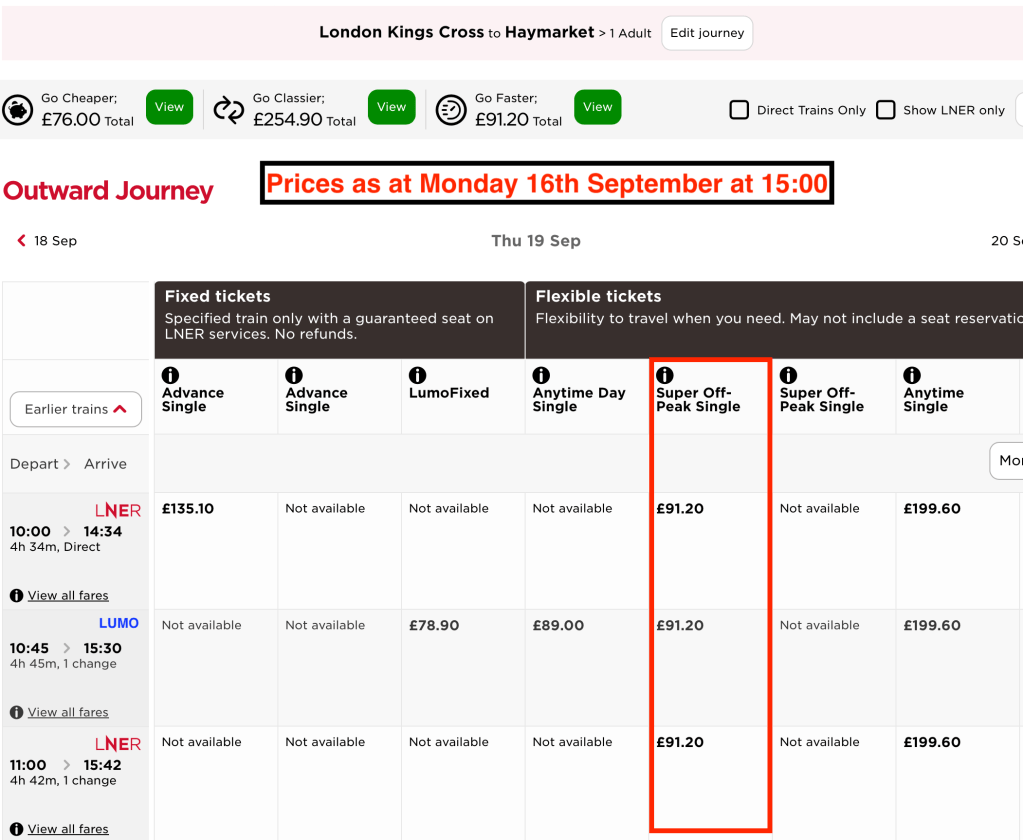
Here’s the situation I checked yesterday afternoon for a journey this Thursday 16th September, from Kings Cross to Haymarket. On LNER passengers can travel on the 10:00 or 11:00 departure for £91.20 with a flexible Super Off-Peak Single. Much cheaper than the £135.10 Advanced Single being quoted. (LUMO’s 11:45 departure offered two cheaper fares – either £78.90 fixed or £89 flexible but only valid on LUMO).
Now here’s the situation for travel on Monday 30th September, the first day of the new arrangements for tickets to Edinburgh rather than Haymarket as technically you’re not allowed to use an Advance ticket to Haymarket to alight at Edinburgh, so that option has gone. LUMO’s 11:30 departure still has its £89 flexible single but its advance ticket has increased to £81.90 even though it’s a fortnight away instead of three days, but just look in horror at the LNER offerings. The all restricted advance fare is £107.80 (an increase of £16.60 over the Haymarket Super-Off Peak fare of £91.20 hitherto available) or if you want the 70-minute FLEX option you have to pay a further £20 (£36.60 more than the Haymarket Super Off-Peak fare). The only option if you want flexibility on journey time is to stump up £199.60 for the pleasure of a single journey to Edinburgh.
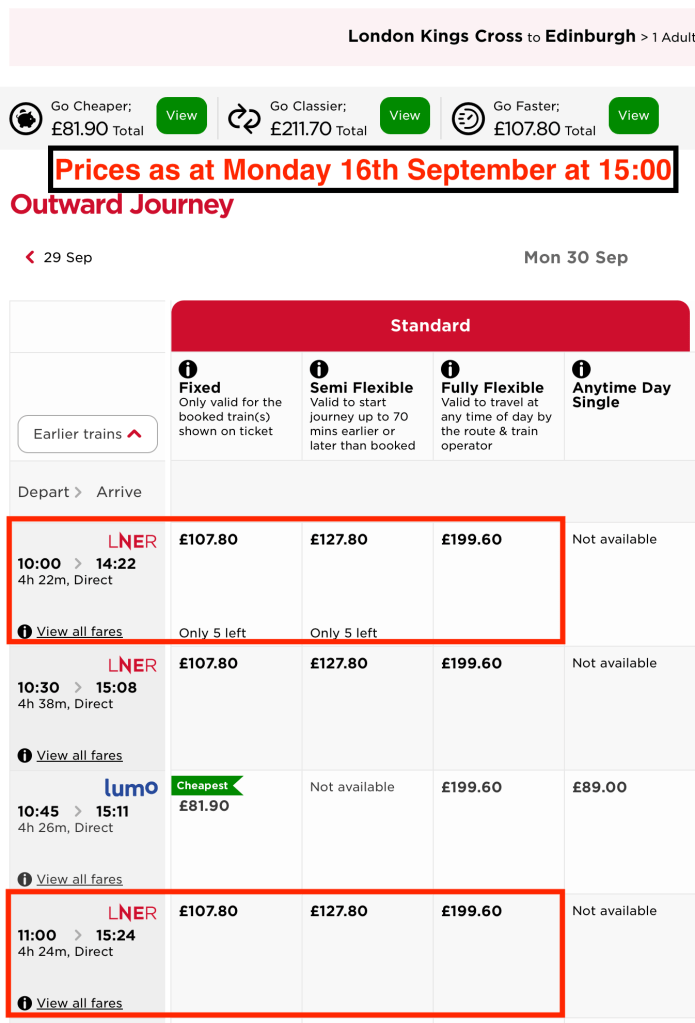
No wonder LNER’s PR spin doctors are suggesting these new “Simpler Fare pilot” ticketing arrangements are going very well. Passengers are being fleeced. And what’s next? Extending the “Simpler Fares pilot area” to cover York, Leeds and all stations on the East Coast Main Line? So much for being a “pilot”.
Incidentally for a comparable departure/arrival time in Edinburgh, easyJet are offering prices as low as £28.99 from Luton or £39.99 from Stansted for travel on 30th September.

And even British Airways from London City Airport is offering tickets for £83.

I hope the self styled “Passenger in Chief”, Louise Haigh is aware of the con the nationalised LNER is inflicting on passengers using the East Coast Main Line, but I’ll not hold my breath for the return of Off-Peak fares. I regret to say they’re now history. As the Prime Minister has been telling us: “things can only get worse”.
3. Arriva takes on First Bus over AI
Arriva made some changes to its Yorkshire network from the beginning of the month including a new peak hour service X10 between Wakefield and Leeds via the M1 and M621. But it was the explanations the company gave for extending its route 254 from Brighouse south to Huddersfield which are an interesting development.
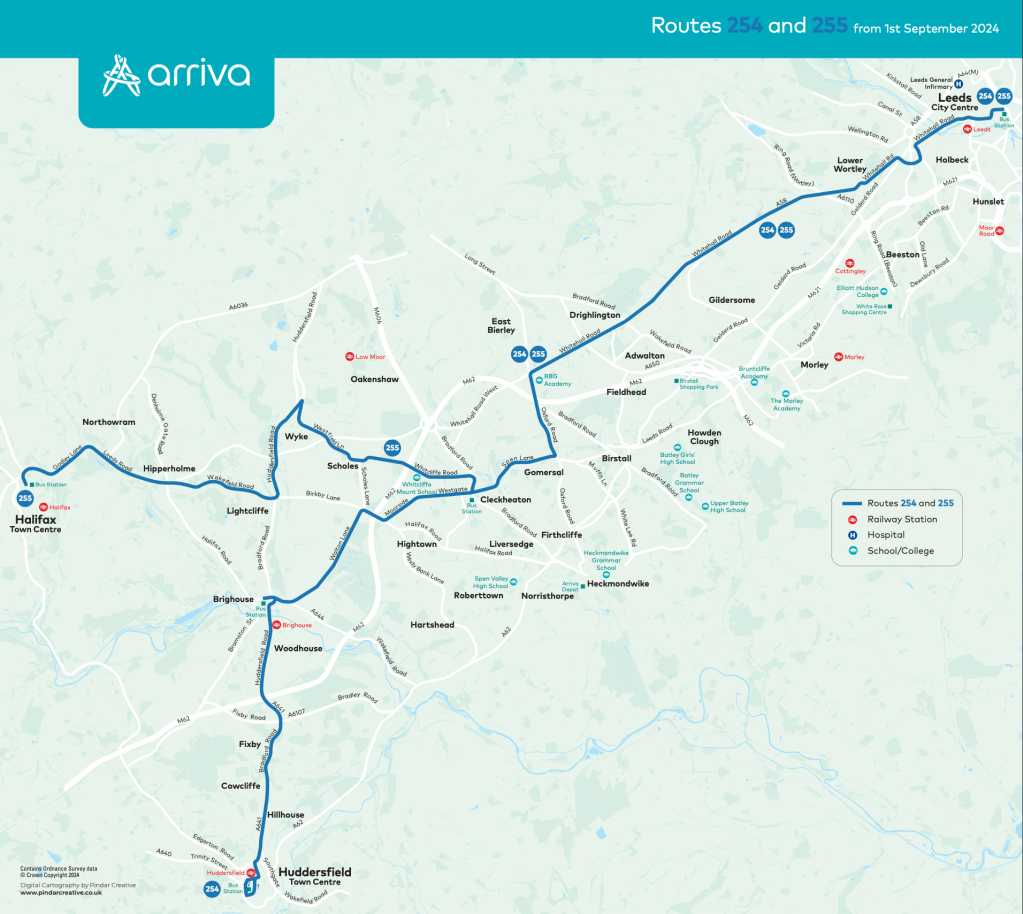
Here’s Arriva’s explanation from its website with my added emphasis….
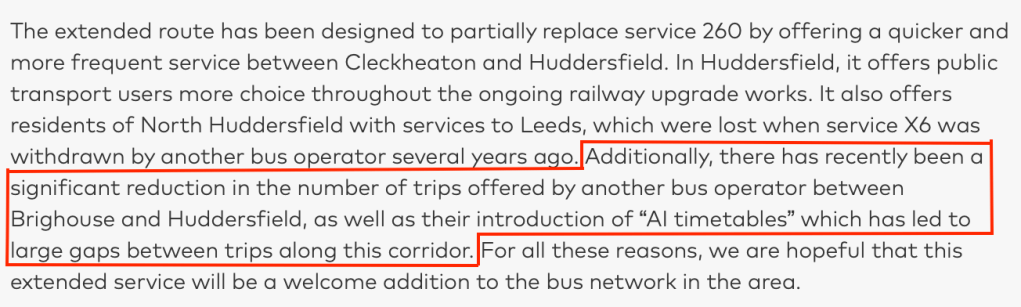
… and indeed, looking at “another bus operator”, ie First Bus’s, timetable for the corridor you quickly come to appreciate the veracity behind Arriva’s explanation. Here’s the timetable for First Bus route X63 between Huddersfield and Bradford – albeit, unless you know “Ritz Ballroom” (or even “Stop code: 450021223″) is in Brighouse and “Hall Ings” is in Bradford, you wouldn’t have a clue they’re the times in those towns.
Take a look at the unmemorable frequency between Huddersfield and Brighouse (“Ritz Ballroom“) during the morning…
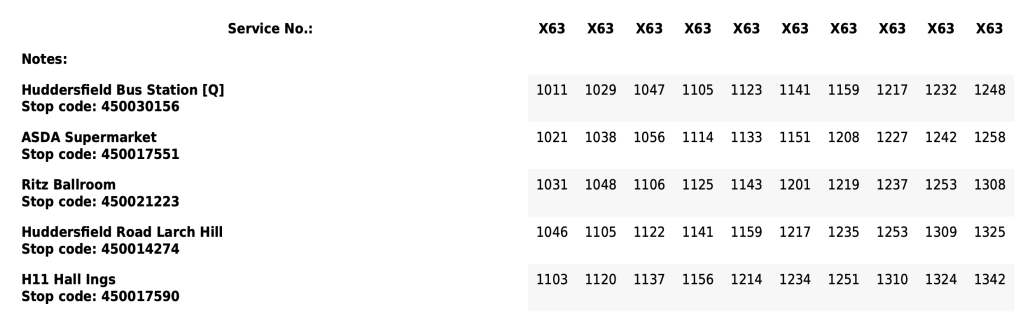
… every 18 minutes, except when it’s every 15 minutes, or 16 minutes. And now take a look at Arriva’s newly extended route 254 with its even half hourly departures with a gear change just before the afternoon school peak.

I know which I prefer.
Meanwhile over in the Potteries take a look at the passenger unfriendly AI generated timetable for circular route 38 linking Kidsgrove, Hanley, Newcastle and Kidsgrove taking in Tunstall and Talke introduced earlier this month. Enjoy the stop name and code descriptions and just relish the frequency being offered.
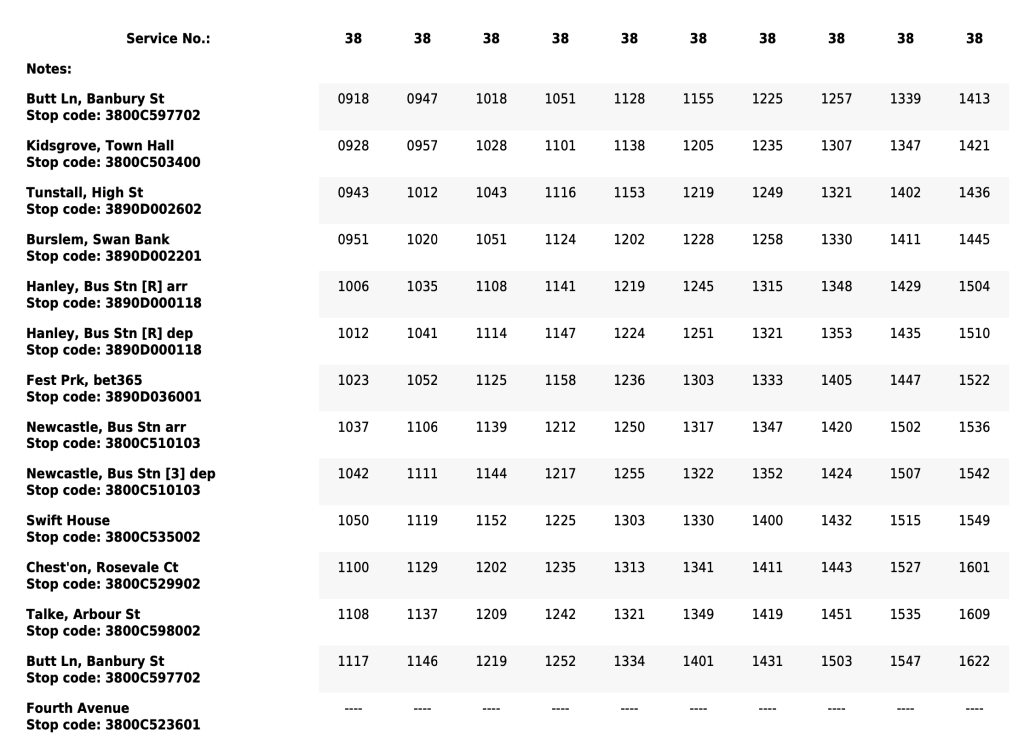
And remember, for First Bus it’s all about “solutions that reduce complexity, making travel smoother and life easier.”

What planet are these people on?
4. Ember explains why its prices have doubled

Up in Scotland the ever expanding Ember coach company increased its fares from 23rd May by a substantial amount, for example, the onboard fare from Dundee to Edinburgh increased from £10.50 to £19.90. Which you might think is a rather steep increase for a highly competitive corridor. But all is not what it seems, and the company took the opportunity to issue a long and detailed explanation on its website – “bear with us”, it said, “because the reason for this is a little complicated”.
And guess what? It’s all to do with the reimbursement of concessionary fares in Scotland where, with free travel now available to a significant proportion of the population (those aged under 22 and over 60, or with a disability) the implications of the on board adult fare for commercial coach and bus operators are enormous.
It is indeed “complicated” but Ember’s explanation was one of the clearest I’ve come across and unusually was quite lengthy too. I thought it was worth replicating here for interest to blog readers….. so, I’m now handing the blog over to Ember….
Fare Update
Since launch in 2020, our goal has been to provide the best possible experience for travelling between towns and cities. That included having affordable, fair and easy-to-understand fares.
In particular, we chose to avoid complex yield management systems which vary ticket prices based on how far in advance you book and how busy a service is. These algorithms can boost short-term revenue but reduce trust – it’s hard to expect people to leave their car at home when public transport penalises them for changing their travel plans or travelling on a busy day.
We’ve also stayed away from short-term, too-good-to-be-true promotions and ensured we maintain our ticket prices at a sustainable level – that means making small increases when our underlying costs increase so that we can keep running high-quality, reliable services.
In line with that approach, on Thursday 23 May 2024 we will be increasing our prices. For tickets booked online, the increase will be small – around 4% reflecting underlying inflation since our last update.
Changes to Onboard Fares
We’re also making more fundamental changes to the pricing on our tickets sold onboard, with much larger increases. Bear with us, because the reason for this is a little complicated.
In Scotland, a large proportion of the population – people over 60, under 22 or those with disabilities – are eligible for free bus travel. You get given a card for this which you tap as you get on board a bus. This tap allows the bus operator to claim back money for the journey from the government.
The tricky bit is for the government to decide how much to pay the operator.
One option would be that the government sets the price they are willing to pay based on the route but that doesn’t work too well. It requires the government to monitor the right price for every possible route in the country. If they get it wrong, they may cause an operator to withdraw services because it’s not viable.
To avoid this, the government instead chooses to pay back operators a percentage of their regular adult single fare. This percentage varies between passenger types but for 60+ travellers it’s 55%. The idea of paying less than a full adult fare is that it’s supposed to leave operators no better or worse off due to the scheme, taking account of the fact that the scheme encourages more people to travel by bus and not all adults would otherwise buy the adult single fare.
This system means that two operators who compete on a route may get entirely different reimbursements for an identical journey, depending on their regular adult single fare. There’s a logic behind this. If one operator charges adults more, they’re probably justifying it by offering a better service (otherwise adults wouldn’t travel with them), and hence it’s reasonable for the government to reimburse them based on that higher fare.
But what if most adults don’t actually pay the regular adult single fare? At that point, the operator can just increase their regular adult single fare to get paid more by the government for concession travellers, without putting off their fare-paying passengers.
It turns out this isn’t a hypothetical. This is how the market functions today.
For example:
- Many operators offer significant discounts to adults who buy return tickets or daily/weekly passes.
- Some operators, particularly those running long-distance routes, sell a huge proportion of their tickets online at drastically discounted rates compared to the regular adult single fare charged onboard.
The more an operator does one of the above, the more they get paid for concessionary travel without having to increase the price that most of their regular travellers pay – a win for the operator but a loss for the taxpayer.
We saw these loopholes from the day we launched Ember and flagged them up in the hope they’d get addressed. But we also took a conscious decision not to optimise our pricing to exploit them, instead offering simple pricing where a return is just two one-way tickets and on-board fares only incur a small fixed premium compared to online fares.
The result has been that Ember is currently paid significantly less for each concession traveller compared to direct competitors running on the same route. Consider a single trip from Dundee to Edinburgh. The other operator running a comparable service to Ember is Citylink.
- Ember: The standard onboard fare is £10.50. Ember receives £5.78 if a 60+ concession pass holder chooses to travel with them.
- Citylink: The standard onboard fare is £22.30. Citylink receives £12.27 if a 60+ concession pass holder chooses to travel with them.
However, with both Citylink and Ember very few people pay the standard onboard fare – instead the vast majority book online (for Ember, about 98% of fare-paying passengers book online).
Ember’s online fare is currently £8.30 (prior to tomorrow’s small increase). With Citylink, there are lots of ways to book online at completely different prices. For example, it’s easy to book for £7.10 on almost every service tomorrow (as of 22 May).
The trick is that Citylink has set their onboard fare so they are earning far more money from concessions, without having to charge fare-paying adults any more.
We believe this system is fundamentally flawed. It represents poor value for money for the government and means we are not operating on a level playing field with the competition. No matter how much focus we put on optimising our costs to deliver better value for money, Citylink will not feel the competitive pressure because they are being paid so much more for taking each concession card holder. It’s a broken market.
To address this, we’ve also decided to update our pricing from 23 May so we’re no longer operating at such a disadvantage. As such, onboard fares will be increasing much more. The price changes will vary based on the exact journey but take Dundee to Edinburgh as an example:
- Current onboard fare is £10.50
- New onboard fare will be £19.90
We know that the onboard fare increase will not affect 99% of passengers and for the remaining 1%, we will support them with their booking through our live chat available from 7 am to 9 pm every day of the week. However, it will remain possible to purchase an onboard fare at every one of our stops including those that are pre-booked only (if you call us we can request the bus stops there).
We don’t love making this change. We’d be happy to revert it when the system is fixed and a level playing field is restored. And we have a practical suggestion for fixing the system – pay operators based on the average adult fare actually charged, not the theoretical onboard single fare. This resolves all of the issues identified, whilst not requiring the government to set fares on every route across the country.
In the meantime, we will continue to have simple fixed pricing for all of our journeys. It will cost the same to book 10 days ahead or just 10 minutes ahead. We will continue to offer fully flexible tickets, allowing unlimited changes for free. We will still allow passengers to cancel tickets for a full refund, even when they just miss a bus by a few minutes. We will also continue to provide refunds for any journey that is delayed by more than 30 minutes with our zero-click refund process.
At our core, we’re passengers first and strive to make sure that we’re building a service that we want to use ourselves. If you want to get in touch then we read every email that comes to ride@ember.to.
Roger French
Blogging timetable: 06:00 TThS.
Comments on today’s blog are welcome but please keep them relevant to the blog topic, avoid personal insults and add your name (or an identifier). Thank you.


I know there was pushback that some of the comments in the IoW thread were OTT – but there’s no polite way to say this – the Railcard thing is proof that the people running the railway’s marketing are incompetent. In return for what is rounding error in the total scheme of things, they generated headlines in every single national media outlet about the discount on railcards being reduced. That has a probably cost the railway more lost revenue than the 0.6% reduction in the discount will raise, at a time when the railways should be laser focused on increasing the number of leisure travellers. And as Roger says, if it had to be done for some technical reason, then it should have been at the same time as the annual fares revision.
LikeLike
Rail fares are already to high. They need to focus on reducing costs and not increasing fares
There is plenty of scope to curt rail costs considerable by running the railways more efficiently
I find it strange that since the demise of steam rail cost have increased which is just crazy since costs should have fallen dramatically
LikeLiked by 1 person
That’s a very fair point. Myself and several of my friends have 26-30 railcards and several of them have messaged me about this using vocabulary like “hiking the ticket prices” “reducing the railcard discount”, because that’s how it’s been reported to them. Not everyone fully reads the details, and immediately you’ve just angered a load of frequent rail passengers for the sake of, for lots of fares, the amount of a rounding error.
LikeLiked by 2 people
Given that LNER are basically state owned you wonder if this will the fare structure of the future of Great British Railways as it takes over each rail franchise.
One thing I think it is a sure thing that tickets such as the one I picked up this week to Marylebone from Brum for a meeting at just £5.65 single will soon be a thing of the past.
After nearly 30 years of excellent service linking Brum & The Black Country with London it will be both heartbreaking & sad to see Chiltern Railway reach the end of the line .
I am old enough to remember how god awful our service from Rowley Regis was under British Rail with filthy unpunctual half hourly trains with no Sunday service that ran from just Kidderminster to New Street………..
LikeLiked by 1 person
To be fair it was BR with its full route modernisation that gave Chiltern the opportunity to be the railway it is today. BR investment in rolling stock and signalling and permanent way would not have come from the private railway that took over from BR.
MikeC
LikeLike
Yes that may be so but M40 TRAINS promptly commenced the redoubling of the Chiltern Main Line under the Evergreen initiative and ordered the Class 168 Clubman diesel multiple units (DMUs) to supplement its ex-British Rail fleet. Following the awarding of a 20-year franchise to Chiltern Railways in August 2000, Evergreen phase 2 works begun to raise line speeds around Beaconsfield, built two new platforms at its London Marylebone terminus. In January 2010, a £250 million upgrade package was agreed for Evergreen phase 3, remodelling the line and permitting 100 mph operations, thus greatly reducing journey times after the franchise was awarded.
LikeLiked by 1 person
I’ve always wondered how/why Chiltern got the seemingly unending franchise deal that it did. Its unique as far as I know, and as Richard says it enabled the company to fund significant infrastructure works. Very different from the other ephemeral TOCs.
Peter Brown
LikeLike
Chiltern got lucky with timing. They were the first franchise to tender in what was to be a new form of longer term franchise of 20 years to support increased investment from the TOC themselves commercially into the franchise (though I think the Virgin ones were also long on the back of big investment which may have formed the original inspiration to roll it out wider). South West Trains was to be the second for its second term and came within days of being awarded before the DfT got cold feet and cancelled all such tenders after Chiltern had been awarded but they had got so far with the process with Stagecoach that to avoid claims for damages over wasted spending Stagecoach could almost name their price for a standard term franchise so made a big profit on that term. It would have been interesting to see what the groups would have done if this had become the standard model of letting franchises.
Dwarfer
LikeLike
Personally I don’t regard Chiltern as “lucky”. They had an inspirational Chief Executive in Adrian Shouter whose management of M40 TRAINS led the industry in how a TOC should operate successfully as a businesses when a strong business plan is created.
It is very fitting given his achievements at Chiltern Railway that everyone walks past a statue of the late Mr Shouter everyday at London Marylebone.
LikeLike
I just need to correct a previous reply to this comment. The Chief Executive of Chiltern Rail was Adrian Shooter. To name him Mr Shouter belittles his achievements, even if it was a typo or due to uncorrected predictive text.
LikeLike
It is predictive text unfortunately & no one has more respect for Adrian than me. He bought a quality service from Rowley Regis to Marylebone I proudly use most weeks.
If you think I have nothing but respect for Adrian them you have no place on Rogers blog & am just some argumentive muppet who simply wants to course trouble & quite simply has nothing better to do.
I was very privileged to be on the Chiltern Railway Users Group & met the great man many times he was quite simply THE BEST.
LikeLike
This – On time, On Budget – and Fast – from Thomas Ableman is of great relevance when discussing Chiltern Railways.
LikeLike
You don’t have any right to decide who has a place or not to visit and comment of Roger’s blog. So stop crying and deal with the fact that comment sections are places people are allowed to express their opinions.
LikeLike
I think that the railway finances are out of control and have been since 2019. Curtailment of cheaper fares is going to be the norm going forward as it’s less obvious than a rail fare increase. As all of the franchises become government controlled completely this will spread.
Ember, now we know why Scottish Citylink is so profitable, effectively a massive government subsidy. Also interesting that the Scottish Government offers free long distance travel in competition with its highly subsidised railways whereas this is not available in England.
LikeLike
Entry into Pedants Corner, Roger – it’s Dunston (not Dunstan – he was a saint)
Cheers
BW2
LikeLiked by 1 person
Corrected. Many thanks.
LikeLike
It looks as if Ember are axing the E1Z service
LikeLike
A long time ago when my sister and brother-in-law lived at several different addresses in the Scottish Borders they always flew down to London as those addresses were about the same distance from Edinburgh Airport as they were from stations on the ECML. I am glad that I was able to have my fill of the Scottish railways in the 1970s when an All Line Rover cost about £27. In my motorcycle era on a Honda-CD175 (L-plates too) I made Dundee on a multi-day touring holiday with hotels in Chester and Lockerbie on my way north. Before bed at Chester, I spent around half an hour chatting to a member of the “inside staff” of the bus garage next to the hotel. He was supervising that day’s “run-in”! The complexities of long-distance railway fares now utterly baffles me even though Roger has probably explained the matter as best he can. I gave up my Network Railcard in 2003 when a weekday minimum fare was introduced so stopped buying One Day Travelcards from SWT sources. My £4.80 Discounted ODTC would have become £7.30 at full price on a weekday as there was a £10 minimum fare. I therefore bought my ODTCs from a nearby TfL “Ticket Stop” for £5.10. TfL got my money, I still had my day out and I saved £2.20 each time.
LikeLiked by 1 person
First Bus are one of the worst operators in my experience.
On holiday in Cornwall last week I experienced random cancellations for no obvious reasons that messed up my plans & also gave a poor impression to foreign tourists.
LikeLike
My opinion on climate change is that it is all too late and the inevitable is now unstoppable unless the entire planet population returns to living in caves…but with so many somehow still believing we can “save” the planet, I am surprised domestic air travel is still allowed.
I thought Arriva themselves had dabbled in AI timetables at at least one of their subsidiaries, but cannot remember the detail. Perhaps wrong?
And the Ember situation simply underlines how political interference and decisions, many possibly made in good faith at the time, are not thought through properly and particularly in Scotland and Wales it appears. Concessionary fares sprayed about even to working age people (60 to 66) and 20mph speed limits come to the fore.
And thank God for my British Rail Staff Card!
Terence Uden
LikeLiked by 1 person
“Statistics show a drop in casualties on 20mph and 30mph roads in Wales in the first three months of 2024, after the default built-up area limit was reduced. The number of serious casualties or fatalities has dropped 23%, and Wales’ largest police force says there have been at least 11 less deaths on the roads in their area.”
Read that, and tell me – as someone who has seen their 2 year old child hit by a car doing 20mph in a 30mph zone, and who survived with a fractured skull – that 20mph limits represent unwarranted “political interference”. Frankly, who cares that a bus will take 30 seconds longer when it stops people being killed or seriously injured.
LikeLike
If cars were limited to 5mph or better still, a man with a white flag walking in front, we could probably get casualties down to zero. By all means keep 20mph in residential streets, but NOT main roads and thus most bus routes where people usually have the option of crossing the road at appointed locations. A bus journey in Wales now is nothing short of painful.
I am sorry you have suffered, and I too had a family member rendered seriously ill as a result of a road collision, but we live in the real world and I thus stand by the above comment.
TU
LikeLike
There would also be considerably fewer accidents involving people crossing the road if they would look both ways before crossing, and only cross when it is clearly safe to do so. Many people these days have their head buried in their mobile phone, wearing headphones, and are totally oblivious to their surroundings. I can’t have sympathy for total stupidity.
LikeLiked by 1 person
The rail industry would do well to heed this from Ember:
“In particular, we chose to avoid complex yield management systems which vary ticket prices based on how far in advance you book and how busy a service is. These algorithms can boost short-term revenue but reduce trust – it’s hard to expect people to leave their car at home when public transport penalises them for changing their travel plans or travelling on a busy day.”
When they were introduced advance purchase fares were a way of selling seats that might otherwise remain empty. A substantial discount in exchange for loss of flexibility and travelling at quieter times. Customers had a reassurance that fares wouldn’t be above a certain ceiling should advance purchase not be available.
Even putting LNER to one side that system is being turned on it’s head. There’s often little discount for AP fares any more. In fact a lot of booking systems highlight single fares in each direction and don’t make it clear when a flexible return is cheaper.
Many customers would choose the flexible return even if it’s slightly more expensive if they were fully informed. I suspect that a large number of people actually believe long distance fares work in a similar way to airlines and that you must be booked on specific train.
it’s also notable that this may reduce the attractiveness of rail as people will feel they need to leave a time buffer to ensure they don’t miss their booked train, in effect making journey times longer.
Surfblue
LikeLiked by 1 person
Very good point about a large number of people (particularly those new to rail) actually believing they can only catch the train that’s shown on their journey planner result / ticket even when they have purchased a flexible ticket. I think that’s quite likely.
Stephen H
LikeLike
If you can already get cheaper air fares than rail fares on routes such as Newcastle to London, think how much cheaper it will be to fly from Birmingham to London once the premium priced ‘Simpler Fares’ HS2 is in operation. Easyjet could run a half-hourly service to London and the trains would be empty.
MotCO
LikeLike
How an earth can air be cheaper than rail? I guess with Air there is a lot of real competition and the airlines have to operate efficiently
LikeLike
Well, no airline has to maintain 400 miles of track and signaling between Edinburgh and London for a start.
LikeLike
And aviation fuel isn’t taxed.
Peter Brown
LikeLike
Neither is fuel for trains, and railway premises always used to be exempt from business rates. It’s only the road transport industry that is paying fuel duty.
KCC
LikeLike
It had been noted that Arriva had taken aim at First’s AI timetabling. It’s an interesting story and for two main reasons.
The main one is that First has gone with the Emperors New Clothes approach to AI; they’ve trumpeted it as some sort of game changer when it is nothing of the sort. It doesn’t solve the problem that they were tackling and, in fact, is counterproductive. It is supposed to make more resilient timetabling so that journey times are more reflective of real life experiences.
Whilst the Potteries is becoming a cause celebre (as noted), there are other areas (like Cornwall and West Yorkshire) where some really bonkers timetables are being generated. Moreover, I travel on my local First subsidiary and on a recent Saturday, I took the opportunity to make a few journeys. One my first journey, we were 10 mins late arriving, the next two journeys had to take excessive stops during their trips as the services are so gently timetabled, and the fourth one was ok.
As noted in the Potteries, there is now massive padding in schedules. Vehicles and drivers are now less productive so you’ve lower revenue earning capability. It feels that they’ve tried to make a science out of something that is prone to the vagaries of day to day traffic, and been so conscious about not upsetting the TCs re: late running that they have gone too far the other way. Not good
BW2
LikeLiked by 1 person
The other thing to note is the first twitchings of Arriva under new management. The MK to Luton express, the X38 in Derby, and now being a little bit more aggressive in West Yorkshire. Now removed from the financial constraints of a debt laden DB, might we see a more entrepreneurial and, dare I hope, a more customer focussed Arriva?
BW2
LikeLike
Using AI to try to come up with realistic timetables rather than pure clock dace ones is sensible.,. It will not be a 100% reliable but should result in an overall improvement in reliability and time keeping
Main factors impacting journey times being day of week, Whether schools and colleges are in session, That can get complex with cross border as they can have different school holidays and colleges may have different holidays to schools, Some areas will have seasonal differences etc
LikeLike
AI timetables are a fool’s attempt to mitigate against traffic congestion. Unless government incentivises modal shift (the delivery aspect of all the climate change strategies) then congestion will get worse and worse.
A true integrated public transport organisation would identify the congestion pinch points and introduce bus priority measures to regularise the running times.
Peter Brown
LikeLiked by 1 person
Yes, the best use for these new software systems (I’m not sure they are actually ‘AI’) is to identify locations where buses are held up, so Local Authorities can prioritise bus priority at those locations.
An extension of that would be to do what the Swiss have done with their railways and identify routes where cycle times are just over 30 / 60 / 90 / 120 minutes etc. and work out where to speed up buses to bring the cycle times within those limits to enable truly clock-face timtables across the whole day.
Stephen H
LikeLike
Fascinating article as ever. What’s really shocking is the relative low price of the BA business class fares in flying from London to Edinburgh compared to rail standard class default fares. LNER are not making the case for low carbon travel.
MikeC
LikeLike
Two mini points to for this set of miniblogs
I haven’t checked if that hack will still work with these recent changes (and of course one should check with any of the several ticket splitting websites as well).
One if you can’t “transfer” a digital railcard bought on e.g. Trainline into a Railcard account (from whence you can order a physical card even if initially issued digitally)
Two: if you are on the cusp of a significant age you can’t swap e.g. Network card (or a regional TOC issued card) for Senior part way through the year for free (Senior is less restrictive in T&C and geography). You either pay twice or defer the Senior purchase until your Network end.
Three: Network area allows really long distances on some line but not the same distance on others. Example: King’s Lynn is in Network area, but Ipswich and Norwich are not (despite being closer to London than King’s Lynn). There are various other inconsistencies all over the edges of the map. (Related peeve: GA Club 50 is a useful regional card–better than Network in some cases–but won’t cover King’s Lynn or most London-Cambridge because they are GN services–and this can matter when GMEL is closed for repair as most websites will then suggest getting to Norwich via Cambridge at a much higher fare, made worse by no GA Club 50 discount–a “Via COL” on the national rail website/GA website/others will show the GA route with replacement bus to get the cheaper fare.)
MilesT
LikeLike
| if you can’t “transfer” a digital railcard bought on e.g. Trainline
Sounds like yet another reason not to use Trainline.
LikeLike
Or other resellers of Railcards (Trainline is not the only one)
MilesT
LikeLike
Why bother with Trainline anyway isn’t it just simpler to buy any Railcard direct on its own website. Why would you bother with a third party site?
Personally I have never used Trainline as an accountant its a clever leverage operation that Micheal Porter who wrote Strategic Management would be so proud off. Its a text book operation.
I always use Chiltern Railways website you can’t fault it although the end of the line is sadly looming.
LikeLike
I believe that Trainline and other ticket sellers have actually offered Railcards at discounted initial fees. Hence the restraint on transferring their digital ones off onto other sites. It’s the only area where they are permitted to offer price cuts that aren’t being offered by the train companies themselves. (Ignoring spit tickets which are not cut price but when combined can give great savings compared with through tickets).
LikeLike
Miles T – while Ipswich may be closer to London than King’s Lynn, I don’t believe that Norwich is.
LikeLike
As the crow flies (measured on Google maps), Norwich is very slightly further than KL, by around 5 miles.
I suspect rail mileage to Norwich is a bit further as GEML is not the most direct route.
But, as a further comparison, Exeter is in Network card area and is about 50 miles more than Norwich. Weymouth and Worcester are also in the area and are around 20 miles further. Taking Exeter as the benchmark I think would put all the GA branches into scope including Sheringham, Lowestoft, Felixstowe and Yarmouth. (And we should also sort out the odd gap that includes Castle Cary where you exit and re-enter the zone)
The list of destinations based on distance from notional centre in London is just not particularly consistent or fair; arguably some of the further edge cases should be part of a regional railcard instead. It’s a weird historical administrative basis for inclusion (almost entirely)
And, to be honest, why not just simplify the Railcard to fewer types with a range of discounts and prices. Maybe have
All the national cards with 1 and 3 year (or end of age range) validity options and ability exchange for a different one in term (3 year Young persons/Student is swapped automatically fo National when aged out or at course end date, keeping/extending the term
MilesT.
LikeLike
No need to make the “side trip” as long as the ticket type allows break of journey. This includes pretty much all flexible tickets. Perfectly permissable within the rules to travel from or to any station covered by the validity of the ticket as long as you observe any associated time restrictions.
Network card validity is a hangover of the former Network South East area. It’s probably time for reform along with many other ticketing issues but I think LNER have proved that’s unlikely to be in the customer’s favour.
Also worth noting that the NSE fares structure was historically quite different from InterCity and Regional Railways. Much of that still persists and is the reason for many of the split ticketing savings.
Surfblue
LikeLike
@surfblue
You are correct about break of journey (and I didn’t think to add that note to my comment), but many of the cheaper tickets that would be “surfaced” by adding the side trip don’t, or don’t on the outbound leg of a return.
That said, even if a BoJ is not allowed, it’s not clear how much that is enforced in practice at the interchange point by ticket inspection or electronically by tracking the serialised ticket through gatelines (especially if you don’t make a habit of it on the same route; and gateline data will have errors and omissions and would be otherwise noisy, so could be challenged in court if it came to that, assuming an actual case and not a single justice procedure)
MilesT
LikeLike
There must be some sort of common software that keeps being used, that for town X, precise location Y, only presents location Y in timetables. I keep seeing this happening. It makes it almost impossible to plan a journey to places that you are not familiar with, as you haven’t a clue if you are looking at the correct town.
If the railways did this (e.g. all Parkway stations were just listed as simply “Parkway”), there would be an outcry.
CH, Oxford.
LikeLike
In this instance it is probably due to how different Local Authorities interpreted the NaPTAN guidance when it first came out, leading to certain key fields being populated in different ways. No-one has had the money or inclination to harmonise things.
LikeLike
| It’s a cynical move by LNER
When are you going to stop pretending that LNER is a self-controlling business making it’s own decisions? They’re doing, as they have since Covid if not before, what they’re told by the DfT, and they’re just taking the blame.
I find it worrying that someone as intelligent and experienced as Roger falls for this crap every time, because it demonstrates just how effective it is for the UK government departments to hide their unpopular decisions behind a middle-man operator.
LikeLike
This is a little harsh on Roger French I personally value his analysis & comments on his quite excellent blog.
Many contributions may not be agree with my thoughts on the bus industry. However unlike many armchair commentators on here like Roger use the bus network 364 days a year not needing a car for any use.
I was very privileged to be involved with West Midlands Bus for 7 years building on my experiences doing my accountancy training at Midland Red West & of course supporting the great team we have at Rotola in Tividale who I proudly use 7 days a week in the West Midlands.
I personally thank Roger for giving us the chance to share all our opinions. He is a Top Man & fully agree with him there no place on Bus And Train User for personal insults .
LikeLike
.“No place for personal insults”… says the same person who called someone a “muppet” for expressing a differing opinion elsewhere in the comments of this same post. You’re hilarious!
LikeLike
As was stated earlier, First appears to be wedded to an “Artificial Intelligence” which produces real stupidity. From at least the customer’s point of view First’s timetables and their online presentation are both amateurish and puerile: the results of an ill-considered school exercise formatted with the aid of a Toytown Typewriter.
When recently planning a day-out using First’s services, I noted that a timetable for a service that I knew existed was not on their website. I contacted customer (dis)services; the response I received was that they could not find the timetable on their website either, but had checked the bus-tracker and discovered that it was indeed running. They suggested that I try bustimes.org.
You couldn’t (or could you?) make it up.
I’m fortunate to live in Go-Ahead Land, where not only are timetables printed, but also websites and schedules are devised by professionals.
LikeLike
I find GoAhead a very mixed bag, They have some excellent business units as well as plenty of dire ones
LikeLike
Fully agree I personally cannot see why GO AHEAD is lauded by so many given the absolute mess they made of Diamond Bus in the West Midlands which involved a £1m write off on thier Balance Sheet& subsequently defrauding the tax payer of £51m in its rail franchises.
In the parts of the country I have visited where they are the incumbent operator I find them overpriced, unprofessional, unpunctual & quite simply over rated.
LikeLike
Because a lot of people experience Go Ahead’s bus services NOW whilst you are talking in the past about experiences that happened between 2005 and 2008. I point you to Roger’s former operation – Brighton and Hove – it is exceptional and far better quality than anything in the West Midlands.
Same goes for the superb, related operations at Metrobus in East Sussex. They took what was a downtrodden Arriva operation and made it one of the best in Southern England. Go South Coast is another excellent operation – Roger did a recent post on how well managed it is. Consistent investment, customer focus, investment in providing appropriate publicity – it is superb in every facet.
The morebus and bluestar operations are a work in progress only in that they had to expand markedly following the collapse of Yellow Buses and exit of First Southampton. That necessitated the drafting in of additional older vehicles but they are now sorting that with further new vehicle investment to go alongside the other smart moves they’ve made. It’s a similar observation with Carousel who are also managing a massive uplift in operations though, in fairness, it has always been the poor relation to the main Oxford operation.
The only operations that “really let the side down” are Go East’s Essex operations – a melange of Hedingham and Chambers that has never really been “sorted”, and the North East operations that seemed distracted by various marketing initiatives without a clear operational focus.
Now stop your anti Go-Ahead diatribes. It simply massively undercuts any sensible and relevant points that you wish to promote.
BW2
ps I am not a Go Ahead shareholder, never have been a Go Ahead shareholder, have not been and am not an employee, and have no personal connection with Go Ahead in any way so I’m totally unbiased.
LikeLike
I will probably never travel by train again even though I love.LNER ARE DRIVING PEOPLE INTO THE AIR OR ON THE ROADS. So much for the Green agenda
IT IS HISTORY.Roy Yallop
Sent from Outlook for Androidhttps://aka.ms/AAb9ysg
LikeLike
I never thought I would say this but I agree with Richard Jones’ 20.45 comment yesterday. Don’t shoot the messenger. Unless ‘a nony mouse’ has inside knowledge I cannot imagine there is anyone with the knowledge or intelligence in the Dft to suggest the fare changes noted in this blog. What will have been said to the state run railways is that the finances are dire and if anyone has a bright idea to increase revenue that can be disguised then try it.
The reference to Lumo is interesting. Lumo made a massive profit last year, LNER loses money, now that may be to do with track access charges , but basically they run the same service, Intercity trains. Someone with rail industry knowledge(Roger Ford in Modern Railways?) should do an analysis of cost cost per mile or similar between the two operators.
My guess is that LNER is woefully inefficient.
LikeLike
There was quite a detailed analysis of the track access charges a while back in Modern Railways. In essence the Open Access Operators have historically only paid the marginal cost to operate rather than their full share which effectively means they pay less than the incumbent operator. There is a new regime which changes that somewhat with them paying a fuller share on an increasing scale the longer they operate.
OA has been able in effect to cherry pick the most profitable times to operate without paying their full share for fixed costs. There was also some quite detailed analysis of the cost of the IEP fleet which was negotiated by the Dft and appears to have been a bad deal. Lumo are probably paying less to lease their trains but that’s a cost which is outside the control of management at LNER.
LikeLike
I have no experience of Advance Purchase railway tickets but on one occasion my late mother did and to her advantage. She was on a short break in the north of England although I cannot fathom why she had not gone whilst at the wheel of her motor car. During this short break in the north of England she fell badly inside Ripon Cathedral, sufficiently badly for her to decide to return home several days earlier than her AP ticket was booked for. Between either Harrogate or York she seemingly got to London Waterloo without being subject to an on train ticket inspection or any RCO failed to notice that she was travelling “early” on her AP return-half! However, I noticed the “debris” from her trip north. There on the table was the AP return-half but she clearly lost her nerve at London Waterloo, not wishing to press her luck any further as she bought a single from there to her home station of Walton-on-Thames. I would argue that the Waterloo to Walton-on-Thames part of the journey on SWT would have been outside the scope of the AP return-half date restriction and she could not have been excessed by a SWT guard! The time and date restriction on that AP return-half applying only to the Inter City journey from the northern England station to London King’s Cross.
LikeLike
nnn
LikeLike
Another unintended consequence of the LNER Advance-fare-only policy will be even more overcrowding on the already unsustainably-overcrowded Cross Country service. I suspect where I live (Oxford) is not the only place where I have a choice when travelling to Doncaster and points north (Leeds, York etc). I can take Cross Country direct or with one change, or I can go to London and take LNER. Generally GWR, Chiltern and LNER have space to spare, indeed most LNER trains are 9 cars. Cross Country trains are almost all 3 or 4 trains of standard class. It’s rare that vestibules don’t have some standing passengers or luggage. In any sane world we’d be encouraging, not discouraging, people to travel via London, to which inter city TOCs provide more capacity on the core routes.
LikeLike
I don’t know why everyone complains about AI timetables, they are reflective of actual running in real life over a period of time so that is how they should be presented, not this fixed rubbish that can’t run to time half the time because of various hold ups. Really timetables should be checked and changed at least once a week to reflect actual running times over that week. Tough titty if people want a timetable they can remember, just carry a copy of the frigging printed timetable for that week around with you!
LikeLike
The reason it perhaps irritates some is that impacts their OCD but for the most part, it doesn’t work. As Roger illustrated, you have a service that runs every 18 minutes mid morning and then is 16 mins and then 15 mins – does it really run 16% faster on a lunchtime?
Experience of the AI timetables is that it tries to make something scientific by taking data over time . However, that data seems to default to making services far slower and the timings don’t reflect the real world.
On a local First route, the timings from one village into a smallish town are 17 mins in peak, then 15 mins, then 14, then 15, 15, then 18 (this is early afternoon) and then 15 and 16 in peak. The operational reality is that vehicles will arrive, wait time, and then trundle along before again waiting time in the town before arriving at the bus station.
A more practical, financial aspect is that on some routes, such as in the Potteries, you had two vehicles undertaking perhaps 20 revenue earning journeys per day. That timetable moves from every 30 mins to an AI generated every 35 mins, and by the end of the day, you’ve only got 18 revenue generating trips. Whilst fuel, tyres and maintenance is variable, all the fixed costs and driver wages are still needing to be covered by a reduced revenue – it really doesn’t make sense.
an anonymous senior commercial manager
LikeLike
Completely agree. Well said.
LikeLike
Unfortunately, a lot of operators don’t produce printed timetable leaflets.
LikeLike
How can AI timetables be reflective of actual times over a period of time. What utter rubbish, the same rubbish that the amateurs at First have bought into. If you know anything about bus scheduling you will know that actual running times will vary considerably between schooldays and non schooldays, wet and dry days and be affected by many other factors. Any competent scheduler can produce a timetable that will be regular and allow for known effects of traffic etc. And it’s not AI anyway,it’s a very poorly programmed computer looking at data and spewing out something that is unintelligible to staff and passengers.
As a competitor of First the more AI timetables the better.
LikeLiked by 1 person
This is a bit of a silly objection! The whole point of AI timetables is to “crunch” masses of data about actual measured running times and apply these to the passenger timetable. Computers can do this sort of thing much better than human beings, with their biases, groupthink etc etc (there is an enormous literature on this).
This is NOT the key objection to AI derived timetables, which is that planned departure times are no longer easily memorable and the whole timetable becomes too complicated and user unfriendly to passengers. This is much more important than getting run times more accurately represented in the timetable. Passengers might grumble, but often expect buses to run a few minutes late. As long as not 5 minutes early!
LikeLike
There may be some good news in the “simplified fares area” pilot area. Twenty years ago I used to travel from Newcastle to County Hall in Morpeth and I recall that my daily return fare was more than £4. Now the bus is £2 each way and I see the train is £3.65 with advance ticket from Manors. Until September advance tickets were not available northwards from Manors and passengers had to travel from Newcastle to get the much cheaper fare.
LikeLike
I was going to comment earlier and have just read all those comments already made (including some which are more than a little irritating!!). Instead of changing the discount on Railcards I believe they should introduce a loyalty card available to everyone – such as is the case in some European countries. That railcard should replace all existing ones which have so many differing conditions. This could be introduced on 1/1/25 with all existing railcards taken to a ticket office to be replaced, and retaining the current expiry date. There could be two versions – say one a little more expensive that allows accompanied children at a discount.
With regard to the LNER fares situation we mustn’t forget the flexibility of the Saver Return. Indeed some years ago (many years) I took 8 children with anther adult and myself from South London to the Isle of Skye via Inverness and Kyle of Lochalsh when 4 children travelled for £1 each. On the return we broke our journey at Edinburgh and stayed the night and then stopped off for a few hours in York on the way home. In those days InterCity tickets were available east or west coast (and Midland Main line or various permutations).
John Parkin. Carshalton
LikeLiked by 1 person