
Thursday 12th September 2024
What is going on with the Isle of Wight’s railway?
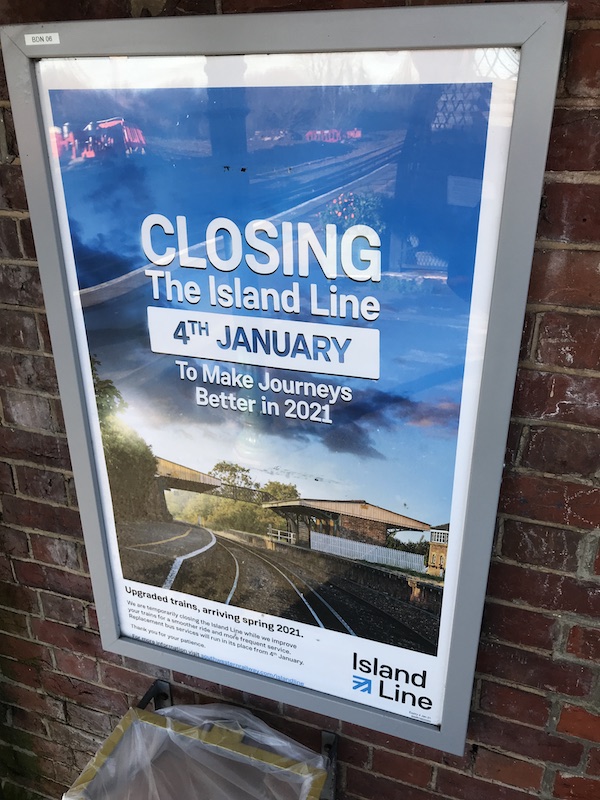
The Island Line’s first closure of recent times was between 4th January and 1st November 2021. Originally billed to last three months with a March reopening, it dragged on through the summer season and lasted for a total of 10 months.
£26 million was spent upgrading the track, installing a passing loop at Brading and introducing five refurbished two-coach Class 485 trains.

An even 30 minute frequency was promised as a consequence of the passing loop at Brading offering improved connections with Wightlink’s ferry at Ryde Pier Head.

Mark Hopwood, then managing director of SWR, enthused “the £26 million being invested in new trains and infrastructure upgrades will help to deliver a railway fit for 2021, with performance and customer experience both set to be transformed.”
Nothing was said about any further closures. Everything was positive about the future.

Unfortunately as soon as the new trains started running and the new timetable began, it became obvious it was unworkable. Many close to the industry observed “you can’t have a passing loop five miles down an 8.5 mile line and expect trains to run at 30 minute intervals”.
Issues with the new trains and a tight turn around at Ryde Pier Head exacerbated matters.

But the latter became irrelevant eleven months later, in October 2022, when the line between Ryde Esplanade and Pier Head was closed so Network Rail could “carry out a programme of vital upgrades”.
There was much puzzlement why these upgrades weren’t done during the previous closure but at least it meant the timetable on the rest of the line was more reliable while engineers braved the elements to “strengthen the 143 year old, 686 metre long Victorian pier and return the steel structure to its former glory.” Network Rail replaced 172 metres of track and installed 143 metres of new steel rail bearers “as well as giving the station a new lick of paint.”

The line fully reopened again after that nine month closure on 10th July 2023. Maybe we’d now benefit from Mark Hopwood’s vision of the transformed “performance and customer experience”, promised for 2021, but in 2023 instead.
Nothing was said about any further closures. Everything was positive about the future.
Except service performance continued to suffer particularly with Class 484 trains proving increasingly unreliable. At times, in recent months, only one of the five two-coach trains has been available for service. RAIL magazine quoted “flood damage from their first operating season, electrical issues and excessive wheel wear made it impossible to run a full timetable.”

Sometimes the service has deteriorated to a frequency of one train every two hours and SWR seems to have abandoned any idea of an even 30 minute frequency (the justification for the new passing loop at Brading) and settling for a “sort of” (ie almost) 40 minute pattern as applied before the £26 million upgrade.
Now, in the latest development, the entire line is closed yet again for a month.
It began last Friday and continues until 6th October except for the section of line between Ryde Esplanade and Pier Head which will remain closed “until May 2025”. An explanatory poster at stations along the line is somewhat confusing implying (a) there’s a through bus from Ryde Pier Head to Shanklin (there isn’t) and (b) the final paragraph appears to contradict the second paragraph implying “trains will run between Ryde Esplanade and Shanklin every 30 minutes” from 6th September.

Fortunately there is a timetable also on display which confirms the current arrangements of there being two replacement bus services.

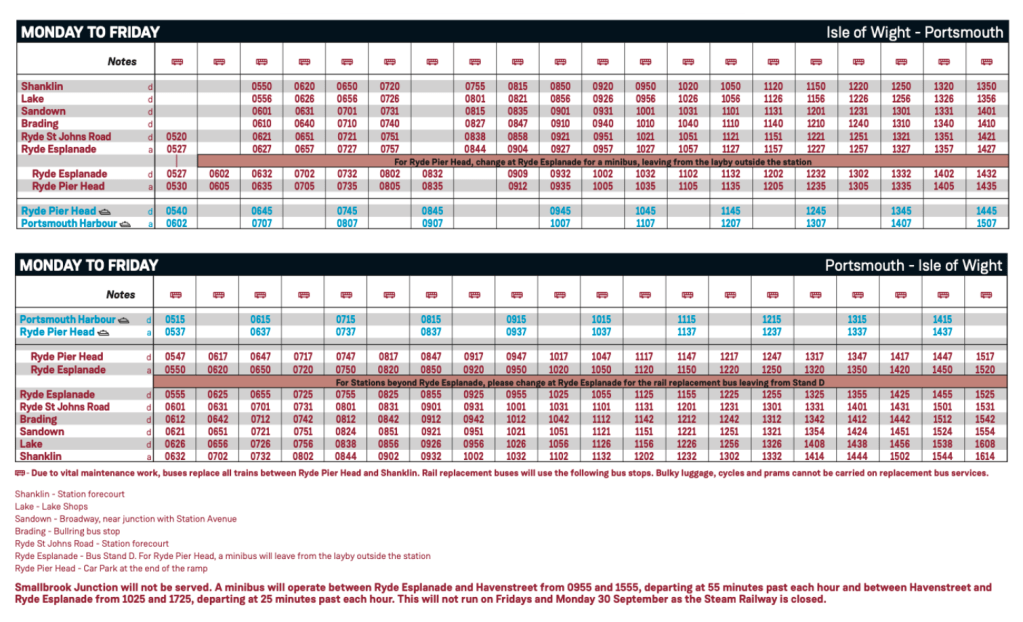
This latest month long closure is for “a significant amount of infrastructure work – bridge, track, signalling and some station work”. It’s reported the old footbridge at the new Brading passing loop has been dismantled for repairs and will be reinstated, but there’s already a new one installed in the 2021 closure, and I’m not sure why there’s a need for two footbridges.

The cost of the aforementioned work hasn’t been made public but for the further work on the pier, Network Rail has said it’s investing £19 million to “future proof the pier” involving 2,500 metres of new steel bearers and “renewing pretty much all the track along the pier – 590 metres.” What happened to the 172 metres of track it said it replaced in 2023?
Money spent on the Island Line over the last couple of years must now be well in excess of £50 million which begs the question is this a good use of public money? Would it be better to ignore any nostalgic attachment to the railway and seriously look at more economic alternatives? Are we chucking good money after bad? Is the Island Line really worth continued investment?
Obviously there are sunk costs of the work already undertaken but that didn’t stop a halt to HS2 and in particular the vast construction site wasteland that’s now the approach to Euston. By comparison to HS2, £50 million on the Island Line is “petty cash” but in the context of the number of passengers and convenient bus alternatives it must deserve the same scrutiny, to say nothing of the current “£22 billion black hole” in public finances mantra.
In that context I thought it would be interesting to take a ride on this month’s bus replacement services to see their effectiveness. Could they be a permanent replacement and perhaps turn the track over to the Isle of Wight Steam Railway to make for an enhanced tourist attraction which stands or falls on its commercial sustainability?
As already explained, there are two separate bus replacements running this month.
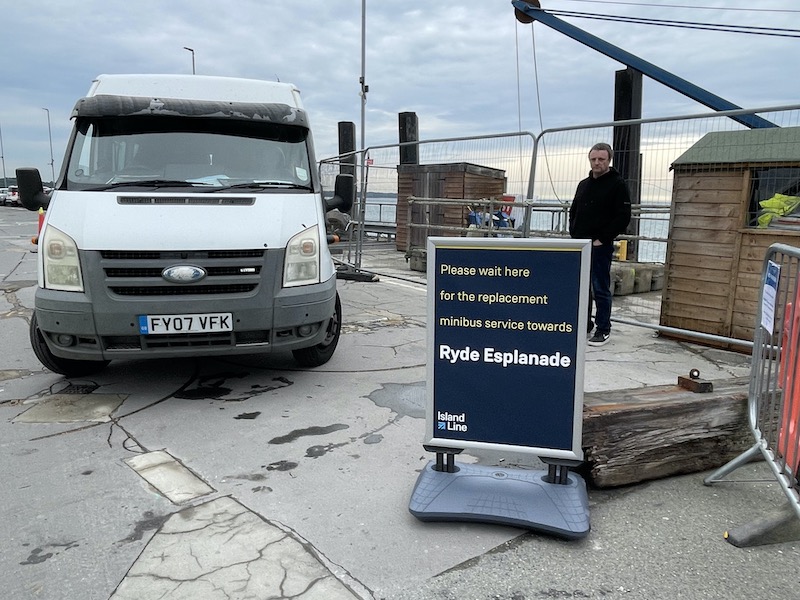
A non accessible 14 seat minibus provided by Redline Taxis/Jet Cars provides an hourly shuttle between Ryde Pier Head and Ryde Esplanade connecting with (a) at the former, the hourly Wightlink Fast Cat foot ferry to and from Portsmouth Harbour and (b) at the latter, the half hourly bus service between Ryde Esplanade and Shanklin provided by First Bus with four Wright Streetlite single deck buses from its Solent division on a timetable requiring three bus workings.

I cruised over the Solent on Wightlink’s 09:15 Fast Cat service from Portsmouth Harbour arriving at Ryde Pier Head at 09:37 on Saturday morning.

Most of the 60 or so passengers on the ferry were either met in cars, which were packing out the Pier Head manoeuvring area, took a pre-booked taxi, or walked down the pier towards Ryde. Just two other passengers joined me on the minibus which wasn’t hard to find at the Pier Head, being parked by a notice explaining what it was.

With everyone off the ferry we left at 09:43, four minutes ahead of the scheduled 09:47 departure and slowly drove down the pier passing some of those walking (probably oblivious to our presence)…

… and engineers at work on the adjacent tracks.

It took just a couple of minutes and we arrived at the end of the pier at the Esplanade and the driver pointed to “the purple bus over there” for our onward journey.

This already had three on board and after a few minutes we were joined by a party of 12 men who’d been on the ferry and walked down the pier.

We set off on time at 09:55 for Shanklin, picking one passenger up at Ryde St Johns Road who travelled to Brading after which we went on diversion via Yaverland and Sandown seafront due to the closure of the A3055 north of Sandown where it passes under the railway bridge.

This closure is reported as being “until 31st October to allow for engineering works on the track and bridge to be carried out by Network Rail”. I hope that means trains can be reinstated on the promised date of 6th October while work, presumably, will continue on the bridge necessitating the road closure for a further four weeks.

The diversion is along narrow stretches of the B3395 which I guess must cause significant delays at busy times in the week which could cause problems for connections at the Ryde end of the route.

We pressed on via Lake to arrive at Shanklin station a couple of minutes ahead of the scheduled arrival time of 10:32.
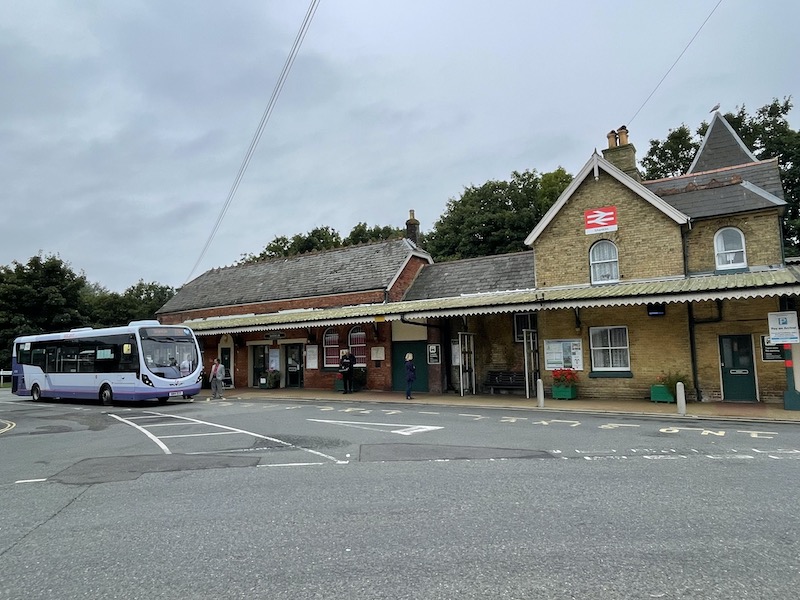
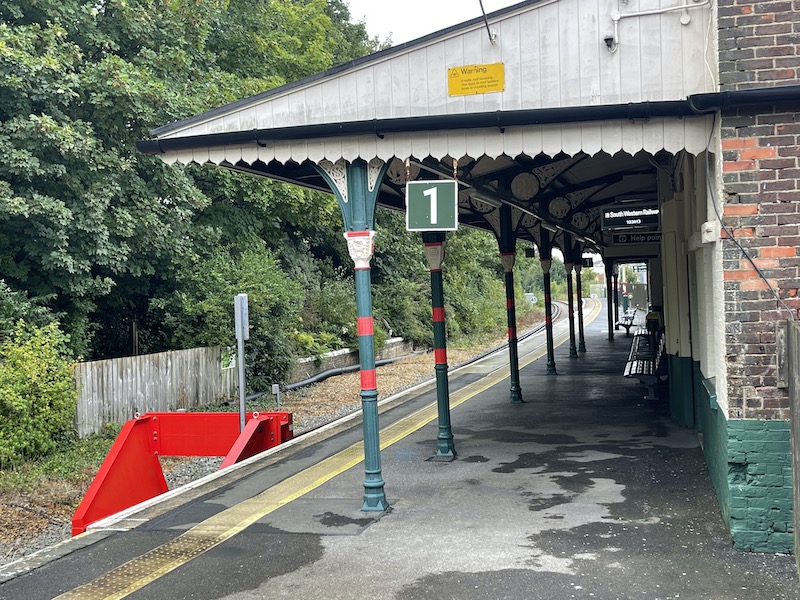
The bus then has 18 minutes stand time before heading back to Ryde Esplanade at 10:50. I had a wander around but with a closed station at Shanklin, although the ticket office was open, there wasn’t much to see other than the buffers.
On the journey back to Ryde we took five passengers from Shanklin, one travelling only to Lake and the other four to Ryde Esplanade of whom two took the minibus shuttle to the Pier Head for the ferry. Four more joined us at Sandown and alighted at Ryde Esplanade, two of whom were bound for the ferry but didn’t use the minibus so I assume they walked.
Taking the minibus back to the Pier Head it was noticeable just how congested the restricted area was with cars dropping passenegrs off or waiting for those arriving on the ferry. Sadly, the minibus almost seemed irrelevant to them all.

Fortunately there was someone wearing a high-viz protecting our reserved parking spot.
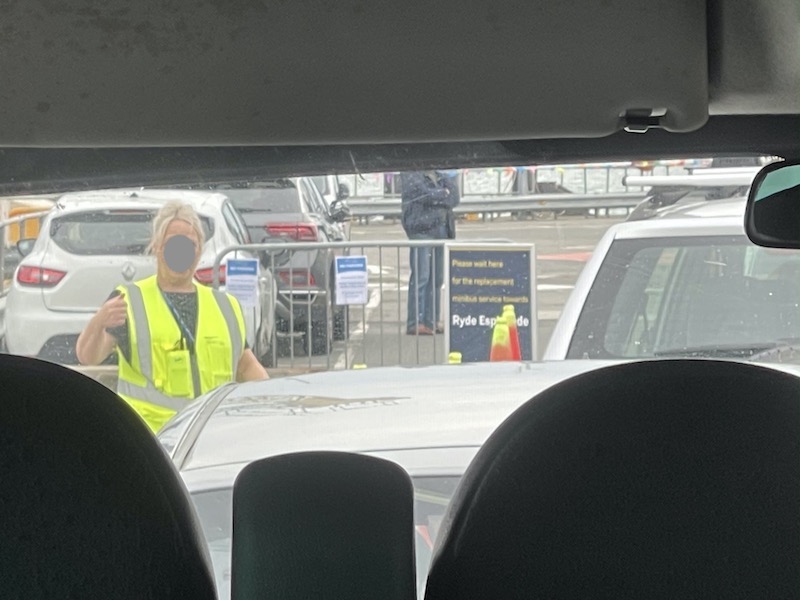
The barriers are up at Pier Head station to prevent access to the platform and I joined the long queue of around 160 passengers taking the 11:45 ferry over to Portsmouth.

In more “normal times” for the Island line (whenever that was, or will be) trains are scheduled to take 27 or 28 minutes from Shanklin to Ryde Pier Head.
The replacement bus did the journey in 37 minutes (ignoring connection time at Ryde Esplanade) but on the plus side the frequency was an even, easy to remember, half hourly service.
Departures on the train timetable up to the closure on 6th September left Shanklin at an unmemorable pattern of xx:07, xx:51, x1:30, x2:07 etc with return times from Ryde Pier Head at xx:03, xx:47, x1:26, x2:03 etc. Connections to and from the ferry were equally poor involving an alternating 10 or 26 minute wait arriving on the Island and alternating 11 or 27 minutes leaving the Island each hour whereas the bus is consistently providing a standard 10 minute connection each hour, albeit being hardly used, probably due to a combination of the faff of it and lack of awareness.
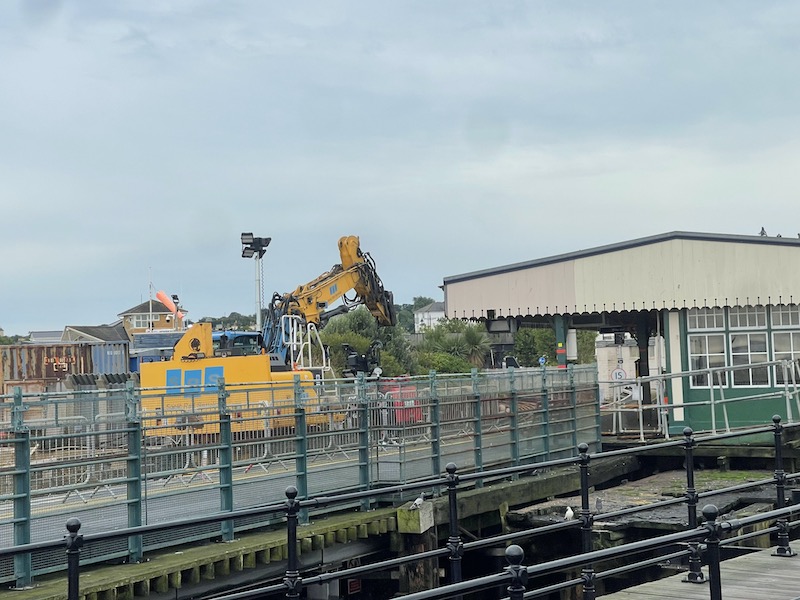
As already said, when the line closed in 2022 there was no mention of a further closure of tracks on the Pier in 2023 nor at that time was there mention of the yet further closure in 2024 continuing into 2025. There mustn’t be any more closures. Let’s have closure on these.
Or let’s have full closure and make the bus replacement permanent and save a fortune.
For closure of this blog here’s a photo courtesy of Peter Murnaghan of happier times for the Island Line as he captured a seven-car Vectis unit leaving Ryde St Johns Road in 1972.

Those were the days.
Roger French
Blogging timetable: 06:00 TThS.
Comments on today’s blog are welcome but please keep them relevant to the blog topic, avoid personal insults and add your name (or an identifier). Thank you.
 BusAndTrainUser
Where to start:
– the Class 484s are junk (as every TOC who had the misfortune to buy them out has found)
– they stuck the passing loop in the wrong place
– the Pier refurb was totally mishandled and should have been done at the same time as the line was closed, not afterwards in the depth of winter.
To add insult to injury, it appears that after Phase 1 of the Pier refurb was wrecked by the unexpected development that the sea is rougher in the winter, the cunning planning is to do Phase 2 in the winter as well. But we’re assured lessons have been learned.
LikeLiked by 4 people
the 484s are very obviously not junk, some people just have a weird derangement about anything involving Vivarail
LikeLike
The converted District Stock has caused the complete collapse of the service on three different rail lines, IoW, Wrexham with TfW and Bletchley to Bedford. No one has even managed to get it to equal the reliability of 40 year old Pacer stock which was generally considered to be fit only for the scrap yard. I’m leaving GWR out of this since their train is a different beast and because I’ve not seen any reliability stats yet.
LikeLike
It’s nothing personal against the people involved, and I appreciate the concept, but the trains aren’t winning any Golden Spanners anytime soon are they?
They contributed to my local line having no, or reduced, service for the best part of the last half a decade. Not all Vivarail’s fault but it is clear the concept, especially the diesel power packs, was a concept and paying customers were the guinea pigs.
Let me know when the TfW ones make it a whole day without delaying the timetable or being swapped out!
-Daniel C
LikeLike
“Junk” is emotive, but objectively the Class 484s have been very unreliable. I liked the concept and the trains, but – and this is a wider point – we shouldn’t base transport policy and investment decisions involving large sums of taxpayers money on clever innovative ideas, nostalgia, or enthusiast considerations.
LikeLike
See also the conversion of Class 319s to bi-mode trains, and the attempted rebuild of Class 442s as an excellent way to burn scarce cash on flights of fancy (or in the case of the 442s, what appeared to be an enthusiast’s whim).
LikeLike
Given the low passenger numbers and high costs the line appears to be very economic
The question is can big cost savings be made. Could it become a Tram line. Would that reduce costs sufficiently. I cannot see less then 1.5M passengers a tear supporting a train every 30 minutes. I suspect ass well that the passenger numbers are higher in the summer and lower in the winter
It would be sad for the line to close but I think they need to find ways to cut costs
The £50M may be small compared to HS3 but factoring in passenger numbers it is probably as high if not higher
LikeLiked by 1 person
I think you mean the line appears to be very uneconomic!
No, a tram is not a viable option either; it too would just be a money sink, albeit one that could possibly allow better penetration of the towns and which would allow politicians to brag about the “investment” they’re making in the island.
No, the line won’t close. It would be political suicide to close it, same as any other line which is losing money hand over fist.
Yes, that’s stupid, but it’s how things are in this country. Everyone seems to think that there’s a magic money tree to pay for the things they want but don’t use.
Oh, by the way, Roger, if you want to consider a wasted money comparison, how much of a difference would the hundreds of millions wasted by the previous government on the Rwanda project (which I believe cost something like £175 million for each returned migrant) make to public transport in the UK? The whole HS2 debacle was used as a sidescreen to hide that sort of endemic profligacy and waste.
LikeLiked by 1 person
This is becoming rather political now as you raise the issue, of course the Rwanda scheme was designed to deter migrants dangerously crossing the channel, not to have to transport tens of thousands of people to Rwanda. We don’t know how it actually would have operated in practice, but a very similar scheme in Australia was very successful in previous years, radically reducing the numbers crossing buy small boat to Australia to almost zero.
Whatever, the costs of the rewinder scheme were a tiny fraction of HS2!
LikeLiked by 1 person
I believe the problem with trams is there are no off the shelf models with either gauge clearance or the requisite power collection. So you’re e looking at a bespoke order of half a dozen low height trams which would need to be built for 4th rail DC power supply. That would be the most expensive tram order in history (even allowing for the insane amount Sheffield paid for its tram trains).
LikeLike
Why fourth rail when Island Line is third rail?
LikeLike
My error, I meant third rail, but the point still stands people don’t build standard trams with third rail power collection so you’re looking at a bespoke build.
LikeLike
My thought is given that the loading gauge accepts ex LU D Stock, maybe a way to convert to light rail would be to take displaced DLR trains by the new CAF built trains. These already run from third rail (albeit bottom contact). There is a precedent for this as Essen took the original trains and converted them to manual operation.
Operational savings could be made by changing to line of sight driving like Manchester Metrolink. There are many examples of single track LRT in Europe, I’m thinking Baselland Transport for example.
Peter Brown
LikeLike
They did consider conversion to a Tramway but the loading gauge limits prevented it.
LikeLiked by 1 person
What do the train crew, signalling staff etc do during these closures?
Sit around on full pay?
LikeLiked by 2 people
Yes. Are you suggesting those staff be docked pay for Network Rail’s mishandling of the pier work and SWR’s poor choice of rolling stock? As usual people look at frontline rail staff as the problem when it’s so often the higher ups poor decision making.
LikeLiked by 2 people
The huge costs of public investments and services, however incurred, are a major problem to us all. Railways which are entirely relevant to most people in this country for most of the time are a prime example of this. The country is going to have to wake up to this as it has done it earlier periods.
Nobody suggested that anybody’s pay should be docked, but the reality is that paying people who are doing and producing nothing it’s part and parcel of the major problems that we see whether it’s their fault or not.
LikeLike
i would hope that the maintenance staff are working flat out to ensure all five trains are in tip-top condition for when the railway reopens.
MotCO
LikeLiked by 2 people
What do you propose instead – they all get made redundant and recruit new staff when the works are complete, all for something that is not their fault?
LikeLike
It’s four buses for service to maintain the timetable supplied by the railway plus one spare.
LikeLike
The replacement bus poster has a baffling new text construction for the times of the third (unmentioned by Roger) bus service between Ryde Esplanade and Havenstreet: “A minibus will operate between Ryde Esplanade and Havenstreet from 0955 and 1555,……” – from 1555, or until 1555?!
Often I see the construction “….between xxxx to yyyy” which really annoys me (it should be “….between xxxx and yyyy”) but this error is the other way round!
LikeLiked by 1 person
I was taught “between … and” and “from … to”, with the rider that “-” means the latter, so 0955-1555 means “from 0955 to 1555”, and like you I get irritated by the “between … to” usage.
I also get irritated by the insistence on mixing 24 and 12 hour clock (such 1700pm), especially when it’s by organisations which really should know better.
Mind you, a local store in my town advertised earlier this year that they were closing for a holiday and would be reopening “in two weeks on the 31st February”. There’s no helping people who can’t even use a calendar…
LikeLiked by 1 person
I certainly remember with affection using the VECTIS stock on either an All Line or Southern Region Rover jaunt. On at least one occasion SV bus drivers allowed me free travel between Shanklin and Ventnor! The SWT “Free Tickets Day” on 20/02/1997 was an especial joy. However, the most memorable journeys on the Island were in my pre-school days travelling with family to and from the Flowersbrook Caravan Park in Ventnor. Indeed, those journeys were the only journeys I ever made using BR steam services as reaching Portsmouth on the mainland we would have used 4-COR electric stock. Pictures of Ventnor Station in Atterbury’s books and especially pictures of the tunnel portal remind me of the loudest noises I have ever heard in my life – travelling through that tunnel under St Boniface Down. During that pre-school era I remember the SV services offering “hail & ride” especially on the road near the Flowersbrook Caravan Park. The Sealink boats occasionally called at the Clarence Parade Pier at Southsea traveling between Portsmouth and Ryde.
LikeLike
Why were the trackside engineers working on a Saturday morning?
Possible answers might include:
a) for their benefit – so as to get overtime or a higher weekend rate;
b) for SWR’s benefit – because the whole job (ie reopening the track) will be completed sooner than if they had stayed at home that day;
c) for customers’ benefit – same as in b;
d) Spanish customs;
e) management mistake, eg not following the project plan;
or maybe some other reason?
Ian McNeil
LikeLike
| Why were the trackside engineers working on a Saturday morning?
Because the railway is a seven-day-a-week operation and engineering work on the railway is done without regard to the day of the week, as it has been for, ooh, about 200 years?
I really don’t understand why you’d question engineering work being done on a Saturday. Or a Sunday. Or Xmas Day, for that matter.
I certainly don’t understand why you’d assume it was being done for the financial benefit of the workforce. That’s the sort of rabid idiocy I’d expect to hear of being claimed in the Daily Mail.
LikeLiked by 1 person
Thank you for your reply. It isn’t a 7 day operation at present; it’s a zero-day operation and my only assumption is that there must be a reason why expensive engineering staff are working on it at the weekend. The possible reasons I have presented were those which occurred to me as a layman, and I don’t quite see the connection with any rabid idiocy deriving from the Daily Mail or elsewhere.
However, if you are saying that for the last 200 years routine engineering work on every railway track has been required on a fixed calendar basis irrespective of the day of the week and irrespective of whether or not trains are using it, then I welcome your informed explanation.
Ian McNeil
LikeLike
Most engineering work is done overnight and at weekends, so I’m unsure why you are confused to engineers working on a Saturday. If they only worked Monday to Friday 9-5 then we’d probably have commenters complaining about lazy staff. Front line staff really can’t win with some people – whatever they do is wrong, and it’s not even them making the decisions.
LikeLike
What is the issue about engineering work being carried out of weekends? Surely ideally it should be being carried out as intensively as possible?
LikeLike
Hopefully this is just within topic: I really enjoyed Geoff Marshall’s youtube video (Britain’s buses at their best – for which he acknowledged your help and inspiration. He didn’t include Southern Vectis; perhaps they will appear in a follow-up. But could the running of the Island line be contracted to SV buses, as part of an effort to provide a unified transport network? The quality of their bus publicity is at a level which seems sadly missing on the rail operation – particularly re these closures. And, while bus operators don’t usually get involved with the maintenance of the tracks (roads) which they use, their general nous with respect to the passenger experience would be valuable – and in turn they might, with benefit to themselves and passengers, get more into issues like road-works and road improvements!
LikeLike
Southern Vectis is a brand of Go South Coast, a Go-Ahead Group company.
Go Ahead Group don’t have the best of reputations for their railway operations.
“Be careful what you wish for” might apply here.
LikeLike
You may be right. However, a national organisation running TSGN (badly) might not be indicative of what a subsidiary with a good reputation in its area does with with the Island Line, especially if the contract is to run it as part of an integrated network with its buses. Go-Ahead’s TSGN hve never seemed interested in co-operating with any of the Go-Ahead bus companies whose territories pass by its stations (and perhaps the same is true vice versa – one of great failures of the rail privatisation and take-over by bus companies: not very ‘Passenger comes first’… on either side)
LikeLike
I’d say the KeyGo smartcards valid on bus and train are a very good indication of what Go-Ahead has achieved in the area, never mind the assorted mundane PlusBus schemes.
Very much a “what have the Romans ever done for us” issue.
KCC
LikeLike
Smartcards were a DfT project, introduced by TOCs at their behest. PlusBus is a national project also loaded onto the TOCs.
In neither case does their introduction or operation say anything much about the skillset, competence or cooperativeness of any particular TOC.
LikeLike
ITSO smartcards may be a DfT project, but tell me where else intermodal versions exist outside PTE areas?
And PlusBus originated in Brighton (as RailBus, if I recall), though I think probably ahead of Go-Ahead ownership of either rail or bus.
KCC
LikeLike
Running buses is very different to running trains, as a whole generation of bus managers discovered in the late 1990s.
It doesn’t matter how good a reputation a bus operator has when running buses.
It’s also worth noting that all rail operations are micromanaged by the DfT and subject to significant financial pressures from HM Treasury. Transferring Island Line to a bus company won’t change that one jot.
LikeLike
Of course the Treasury, representing the interests of the taxpayer and public finances, is always going to have an interest when public services cost a huge amount of money. This is absolutely inevitable
Since the buses will be run at a fraction of the cost of trains , as they are everywhere in the UK, perhaps “the Treasury” would be slightly less bothered about intervening.
LikeLike
The bridge closure is due to them removing the redundant deck from the unused side of the bridge.
I have long championed the line, but I was on the island this weekend just gone and, talking about it with friends, we discussed whether light rail would be better. A frequent Croydon Tramlink style service would be appealing and probably reinvigorate things
LikeLike
Yep, that’s about right. Everybody has been very surprised that work that is allegedly now required wasn’t done within previous closures. Reasons given about eg ‘weather’ causing previous delays doesn’t really cut it. The next test will be whether it can reopen on 6 October AND whether the service, albeit only to the Esplanade, can achieve the long-promised 30 minute pattern. The rail replacement buses never work properly! I used them on the first day of closure last week. The first bus at Sandown to Ryde was very late, got stuck behind a tractor, and missed the minibus going up the pier, although the ‘operative’ at the Esplanade said we couldn’t have got it anyway as it was full! I intend to temporarily use the hovercraft instead now as at least you don’t have the added faff, as you rightly put it, of having to get up the pier, whether by minibus or not. We can but hope for bertter times when the full service is expected to resume in May 2025. The recent 40 minute service has been a joke, with no sensible connections to the FastCat running pattern. Which also highlights one of the main problems since they brought the ‘new’ service back in late 2021, ie that they shaved several minutes off the departure time at Pier Head, which has frequently left passengers stranded – it only takes eg a passing container ship in the Solent to cause the FastCat to arrive slightly late. It’s a great railway, but needs a period of near perfect service, surely possible, to justify its existence.
LikeLike
There’s no issue running a 30min service to Esplanade, they did during the last pier closure, and the replacement signals at St Johns should lift the lengthy speed restriction helping running times. I don’t see people demanding vast swathes of the mainland network which lose money ‘justify their existence’, funny how a few miles of water changes the enthusiast attitude.
LikeLike
I’m certainly not an “enthusiast” who considers that major public decisions should be just made on the basis that we like trains, wherever they happen to be located in the country!
LikeLike
The Island Railway is important to a small number of people. There are parallel bus services which could be used, but with inconvenience for those catching the FastCat and some increased journey times. As a society how do we justify paying tens of millions of pounds on this railway for such a small number of people while so many bus services are cut?
Problems have mounted as everything is done “on the cheap”. Bringing in 40 odd year old trains is a symptom, but the track works are another example of make do and mend. Invest in the rail service, convert it to tram (or guided bus) or close it, but running such a poor service serves nobody. The upgrade to a 30 minute frequency has failed and once connections are missed the viability of the service suffers.
Add in the fact that SWR are awful at managing change and this is an egregious example of what is wrong in how the railway is run.
At least the bus services on the island are exceptional.
Gareth Cheeseman
LikeLiked by 1 person
I spent a glorious few days on the Isle of Wight in the summer of 1992. The Island Line was operating a 20 minute frequency, which allowed me to explore the various towns on the route without having to worry which train I was going to catch next. When I returned the following summer, the Brading loop had gone and trains were operating the inconvenient 20/40 frequency instead.
As much as I have enjoyed visiting the line in the past, I’m inclined to think we may have reached the stage where it should perhaps be closed for good – even though an eye-watering amount of money has been invested in it. I’m not sure how this would be achieved, politically, however.
Carllo
LikeLike
the ex SPT subway cars should have been bought instead, relaying the entire line to the 4′ gauge. It would have cost under £10m.
LikeLike
I think that sums up the bizarre enthusiast attitude to Island Line – on what planet does adopting a non-standard track gauge for life expired, low capacity trains make any sense. The D78s required two minor track lowers under a couple of bridges!
LikeLike
The crazy thing is that it only took a 2 & half month closure to convert the line from steam to electric in 1967. Since Network Rail took over the line is desperately over engineered. The stations at Sandown & Shanklin are further from the town and sea than the buses. Better to spend the money on them.
LikeLike
Buses can’t go up Ryde Pier, take twice as long if not more during summer and aren’t popular with visitors – especially those with luggage. Aside from the politics those fundamentals aren’t changing, so Island Line is here to stay.
LikeLike
I would say that you are somewhat in denial here. The country is an a terrible economic mess for a start and the government just has to make difficult decisions of one kind or another.
So perhaps Island Line has dodged a bullet here, but unless its performance radically improves and costs go down, it will always be vulnerable to cost cutting in the future.
LikeLike
Probably what doesn’t help is the Island Line track is leased to South Western Railway which does all of the minor and most of the major repair works.
LikeLike
What has puzzled me over the last few years is how regular users, commuters, students etc put up with it! Do they set their alarm clocks an hour earlier than necessary in case the trains are not running? All journeys are from A to B, house to work/college. I’m sure that for many, maybe most people a bus is far more convenient than the train, where the station might be up to a mile away.
In the not so distant future a decision will be made on whether to keep the line open, or close it and add an enhanced bus service in it’s place.
LikeLike
Island Line is going nowhere, every major structure will now have been refurbished or renewed along with the trains and much of the signalling. Southern Vectis buses take twice as long as the train and can’t use Ryde Pier, so Island Line is here to stay.
LikeLike
You might well be right but this doesn’t mean to say that these costly and time consuming engineering works represented a good use of public money.
Those funds of course are now not available to improve the NHS or social services, or myriads of other calls on the public purse.
LikeLike
The funds for the Island Line most likely came from a pot of money already allotted for the railways of GB.
LikeLike
The Islands roads are not the best in the world either, and closing Island line will only mean more traffic on already congested roads, so, you have a choice, re gig the timetable, to you have an guarenteed connection with the Fast cat, which is hourly, and its worked in to have waiting time, so you would need to split the service, into say ryde st johns to Pier head, and Ryde to Shanklin,
Or you close the railway, and lift the tracks, and turn it into a bus only way, but, heres the problem, there is only enough room for one bus at a time until you reach the station sites, so would it be any better, it wouldn’t be much faster either, the only advantage would be that you could extend the service to Ventnor if that bit of track bed was also used,
One option with the fast cat, would be to cut a channel right up to esplanade and build a new terminal but that’s very expensive, and would need the cut to be cleared frequently, but it would make it easier to reach the boat, because you would disembark right on the esplanade,
Giving the line to the IOWSR, they can’t afford it, without being given the money to operate it, and they don’t have enough stock, the best option might be if island line was taken out of the national network, ran by an consortium, involving SV, the council and IOWSR, whereby SV run the public service side of it, as part of their public requirement ,as an option as a fast guarenteed service between Shanklin and Ryde pierhead, but dovetailed in with feeder services from Ventor, and outer places, limited stop using both busses and the railway, and on limited week ends, preserved trains can operate on the line, with public services suspended replaced by busses. ryde pier head station rebuilt with the old platforms re instated and a run round .
LikeLike
While I fully accept demand declines when rail replacement buses are in use, the fact that each departure is being covered by one 40 seat bus doesn’t sound as though transferring rail passengers to road is going to add anything significant to road traffic levels, whether they use buses or their own cars.
LikeLike
that’s because local residents just use Southern Vectis which is slower but more convenient and you can buy onboard, the RRB is mainly used by ticketholders from the mainland
LikeLike
During the closure I suspect the better option across the Solent is the Hovercraft (to Esplanade) even though it needs a shuttle bus from P&S station to the hoverport; unless the weather prevents the hover operating.
I think the hovercraft was the preferred rail through ticketing route during parts of the last closure.
Even if the rest of the line is abandoned, it would make good touristic sense to have some sort of railed vehicle along the pier (maybe driverless), with bus connection at Esplanade, likely through to Ryde St. Johns (which also has a park and ride for Ryde).
And yes offer the rest of the line to the IoW Steam, potentially offering a regular-ish service using heritage diesel railcars, sharing Ryde St. John’s station.
A more radical option might be to turn most of the trackbed into a guided busway (starting at Ryde St. Johns) , although I haven’t checked with google maps if that would be possible for two way dial carriage busway or one way with passing loops and traffic lights.
The island is also having problems with the ferries, Red Funnel in particular has some financing challenges with its current debt and also needs to consider fleet replacement in next 5 years (and may be up for sale to a new private equity owner).
MilesT
LikeLike
I don’t see people suggesting we convert mainland railway services to busways, so why Island Line? It literally makes zero sense even if there wasn’t a half mile pier
LikeLike
Frankly, most railways in the UK get away with murder in terms of cost to the taxpayer. The Island Line is short; there is already a good bus service on the Isle of wide and it could be made absolutely fantastic with a fraction of the money splashed out on this railway
So you’d really have to provide a little backup for your “zero sense” comment.
LikeLike
Changinging parts of Island line to busway would be an exceptional response to exceptional situation. And my comments are are specifically NOT the pier railway, which needs some sort of peoplemover grade service to Esplanade at least (which is why I said busway from Ryde St. Johns which is the station away from pier/esplanade complex, and would be grade accessible for a bus to enter a busway)
I agree rail to busway not something that would be relevant elsewhere although the Luton busway did reuse a disused freight rail trackbed, which kind-of proves my point that it may be relevant for the island as a way of running better buses which are less hampered by road congestion which is a problem at key spots on the island. I don’t know how much of the other old rail trackbed on the island are still available for similar busway consideration (e.g. round Newport)
MilesT
LikeLike
Guided Busway wouldn’t due to the extreme cost to start up, as well as most of the Island Line ROW is single track so you will only be able to guide one direction. Plus a guided busway will be worse for the environment and you might lose some visitors to the Island as some just come for the Island line and therefore they will no longer invest in local companies. As part of the Restore Your Railways project they considered a Guided Busway however, they felt that a Railway option was cheaper, more reliable, higher capacity, faster and more efficient than a Bus, even when the Newport line would run via Sandown from Ryde. Some busways like Cambridge are being suggested to be made into a Tramway. The buses do seem to often get stuck in Traffic in the Summer months on the Island.
LikeLike
I wonder if the LU D78 stock would have worked better if it was left as it was mechanically and just given a body interior refurb and repaint? I believe Vivarail reused the traction motors anyway and added other gubbins, the latter being the bit that didn’t work perhaps.
Peter Brown
LikeLike
Why? the 484s work, they’ve had some teething issues like any new train but they’ve settled down pretty well and being virtually new electronically (including new AC traction motors) there’s a supply chain parts can be ordered from.
LikeLiked by 1 person
No sure where you get this idea that they work from. Both the local and rail press have reported that for lengthy periods of time only a single unit has been available for service. TfW have suffered similar disastrous availability with their units and LNWR withdrew their entire fleet and closed the line down for nearly a year until they could source replacement stock and train the drivers.
LikeLike
A lot of the spare parts of the 484s are no longer being made, so SWR is forced to strip parts off other units for spares, they have six vehicles for stripping spares off.
LikeLike
Indeed. Leaving aside the merits of the technical solution, this was always the reason they should never have been purchased. Vivarail was under capitalised and if anything went wrong it was evident that sourcing spare parts and retaining engineering expertise was going to be very hard. Probably the only solution once it started to go sideways was for the DfT to pay a single ROSCO to take on the entire fleet and the associated supply chain. And frankly I’m not sure that was worth the effort for a dozen trains.
LikeLike
Likewise. One of the issues found as soon as testing starting was that the new system could not cope with momentary loss of power e.g. gapping in the third rail. The software had to be rewritten and then drivers instructed they had to use a specific technique. If the existing motors & controllers had been kept there would be no software. While the available power from the third rail on the IoW may be limited, although back 50+ years ago it could support 7-car sets and 42 out of 43 cars in service, at least the driver could make full use of it. Maybe this would have reduced the time between stations to deliver the still elusive 30 minute service Ryde Pier Head <> Shanklin ?
Even if many more D78 sets had been repurposed a large pool of spares could still have been acquired and refurbished ready to fit as and when required. The Island Line staff would be familiar with the principle of operation too.
Maybe I’m wrong but given the drives(control system) were changed from DC to AC logically new or at least reconditioned AC motors would be required too.
JD.
LikeLike
I always enjoy travelling on the Island Line during our annual summer holiday.
But last time, I realised how these recent ‘upgrades’ have left it no better: with the old trains, they aimed for a 40/20 frequency, but they’ve been operating a 45 minute frequency, which is disappointing.
As for Brading’s footbridge, the ‘new’ one has always been temporary, pending proper refurb of the ‘historic’ (but only about 20-years-old) one.
LikeLiked by 1 person
Never mind all the money spent in recent years upgrading the line, why is there even a need for a dedicated replacement bus service, when Southern Vectis operate frequently along much the same route?
Paul B
LikeLike
I suspect because the regulations require it
LikeLike
Why is the ex District Line stock so troublesome. It was working OK on the District Line and has it really changed for the IoW track significantly ? Why the wheel wear – or did they always wear wheels and a sixteen week schedule of wheel changes at Ealing happen ?
Pity the replacement buses dont continue to Ventor and back (something rail replacement buses never do is to go to or serve stops more useful to people than the rail service they replace)
Would older Croydon Trams work ? (or would DLR units function on the IoW lines ?
JBC Prestatyn
LikeLike
Hand me down trams/light rail vehicles is likely to have similar risk of being unserviceable and needing frequent repair, and would need significant adaptation for the line. So that doesn’t seem realistic at first glance.
If the D-trains are not fit for purpose (and if there isn’t a quick fix e.g. replacing the wheels with a different source, grinding wheels/rails to reduce wear or similar) then it is a case of starting over with a fresh procurement based on an existing proven light rail vehicle which “fits” the conditions.
And that may mean moving away from continuous third rail power traction to a BEMU which can do “opportunity charging” from short sections of 3rd rail (while standing at a station) or new overhead (standing or in motion). Which could reduce maintenance costs on the pier railway (remove 3rd rail and use lighter vehicles).
The problem with moving completely to buses is that there is significant road congestion at Ryde and other points in the route, and it’s very slow for road transport to get on and off the pier. Structuring the timetables so that a more intermodal service with Vectis (i.e. no through running of trains–shorter shuttles linked to bus and sea timetables), with through ticketing, could help improve the service and ridership while foregoing single seat travel for some journeys. Likely that would require Island line to move from SWR as ToC to Go-Ahead, and significant initial government subsidy similar to a BSIP, implemented via IoW council governance.
MilesT
LikeLike
You’re really limited on the rolling stock the Island Line can have as it is RA1 throughout, so that means a max axle load of 13.75 metric tons. So only real new train you could get is a third rail version of the 555s for Tyne & Wear Metro as they have an axle weight of 12.5 metric tons, plus they would fit as they are smaller in size compared to the 484s, 484s are 2.84 wide and 555s are 2.65m wide, 484s are 3.65m high and 555s are 3.445m high and vehicle length is 18.372m on a 484 and about 12.5m on a 555. The Island Line for most of its life has had hand-me-downs, like the LSWR O2 tanks where Hand me downs, then the 485s and 486s VECTIS were also hand-me-downs from London Transport in the form of Standard stock, then the 483s where hand me downs in the form of 1938 stock and now the 484s which are also hand me downs.
LikeLiked by 1 person
And to think, only recently, a bid was put in to the “Restore your Railway” call to actually extend the island’s rail network…..
LikeLike
How about ex Piccadilly Line stock soon to be available? No doubt cheap and only 50 years old, one careful owner.
LikeLike
My understanding is that TfL is considering stripping it for spares to keep the Bakerloo line stock going.
LikeLike
Well Roger, that generated some comment! I do wonder if many of those that post actually re-read what they’ve written before posting? Equally, do they intend to be so nasty? It is, sad to say, and much like the situation with the Island Line, a sign of the times.
Stuart R
LikeLiked by 2 people
I think these blogs perform a very useful purpose and the majority of the comment is relevant with sometimes off the wall ideas. This blog highlights how various bits of government have so far wasted £50m on a railway that will never provide the advertised service of every 30 minutes because the loop is in the wrong place and the trains used are and continue to be unreliable. So to achieve what was promised more money needs to be spent.
Regardless of the money how do people get away with making such stupid decisions without facing the consequences, because some organisation must have come up with this seriously flawed plan, and have it approved by others.
That’s the real scandal. Have lessons been learned? I doubt it. Any how was the expertise which did exist lost in the first place?
LikeLiked by 1 person
Don’t even start on the 458s where tens of millions were spent converting them to five carriage units before tens of millions more were spent converting them back a few years later.
LikeLiked by 1 person
I know this will get the rail frothers in a lather, but the whole line is a relic and needs either converting to a heritage railway, or scrapping as a public service.
Surely a better solution all round would have been paying Vectis to run a semi fast service along the 2/3 corridor during the works, but that would have meant not giving money to another First company…..
LikeLike
SWR also have the class 701 debacle on their hands. It’s got to be said that MTR/First have proved appalling at project management when compared to their predecessors at Stagecoach. (Acknowledge the pier is a Network Rail cock up!)
LikeLiked by 1 person