Tuesday 13th August 2024
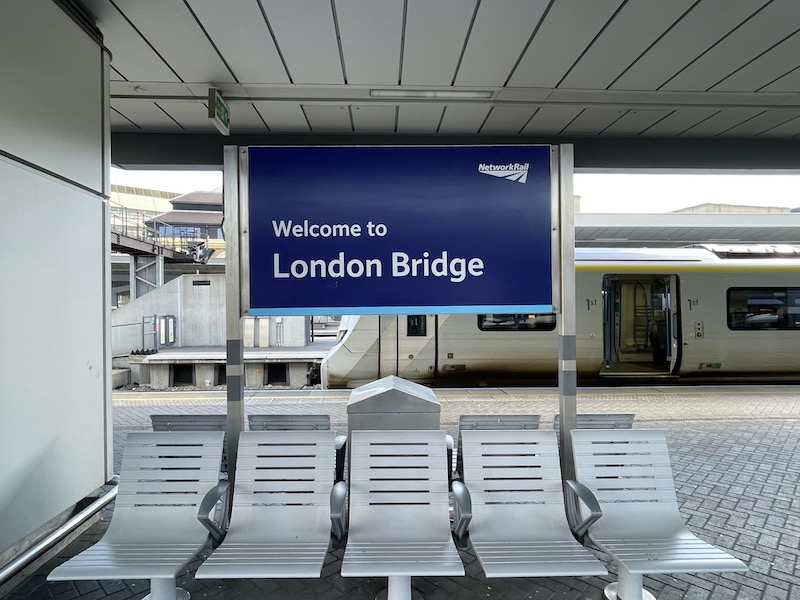
We’re up to number 4 in this Pick of the Pops style countdown of Britain’s busiest railway stations and after looking at Victoria in fifth place last month with its 45,563,972 passengers, just ahead of it in fourth place is fellow Brighton Line companion, London Bridge, boasting a couple of million more at 47,657,264 passenger journeys in 2022/23 with East Croydon the most popular linked destination taking 3,230,650 of those passengers.
Like Victoria, London Bridge sees both Southern and Southeastern trains but in 2018 when ‘Thameslink 2000′ finally became a reality, and the station having been completely rebuilt so it could handle the greatly expanded cross-London network, more destinations were added including Cambridge, Peterborough, Horsham and Rainham, as well as East Grinstead in the peaks, supplementing the longer standing Bedford and Brighton.
That huge rebuild which began in 2013 for the 2018 Thameslink revolution saw the ratio of through platforms to terminating ones change from 6 through and 9 terminating to 9 through and 6 terminating and the opening up of a new large area underneath the through platforms to create new entrances and exits and a ground level concourse area for passengers. The station is unrecognisable from those pre 2013 days.
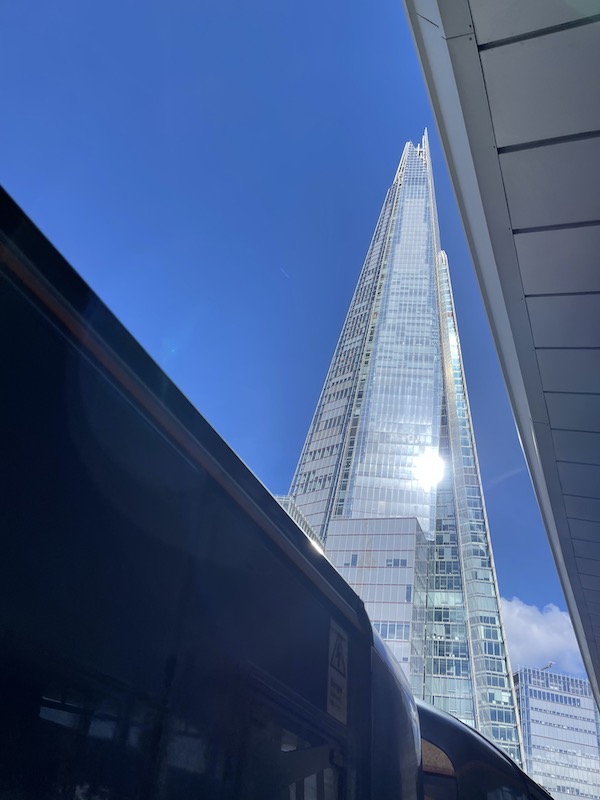
I found these photographs taken 10 years ago in 2014 during a visit to the Shard which towers over the station. These show the additional viaduct installed over Borough Market so the tracks to and from Charing Cross, which Thameslink trains had previously shared, could be split off and both lines given exclusivity. Tracks to Cannon Street can be seen diverting off to the top right across the River.
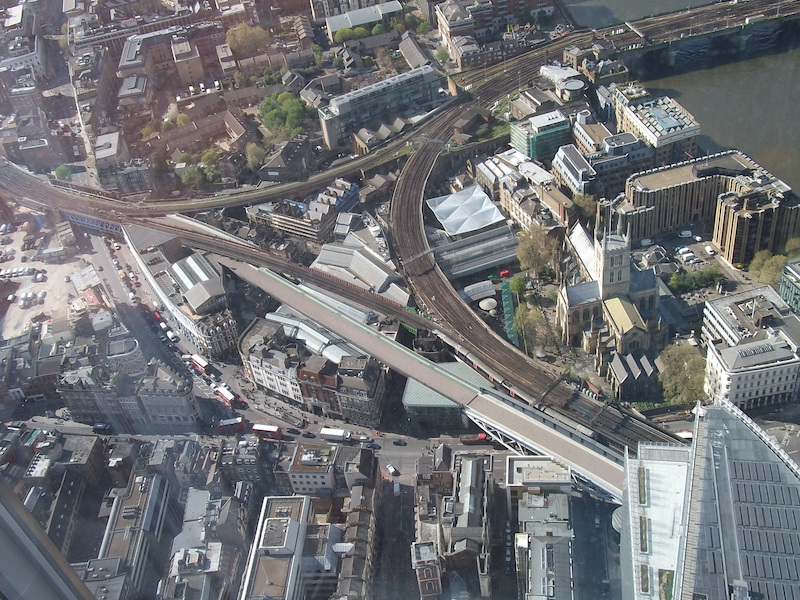
It’s quite incredible to see the engineering feat that was installing the viaduct within inches of existing buildings, and reflecting now, it’s almost unbelievable that at that time Thameslink Brighton/Bedford trains not only had to fit into the gaps between Southeastern’s frequent services between Bermondsey and Metropolitan Junction west of London Bridge, but on the tracks leading towards Blackfriars had to negotiate a section of single line working on a short section of bi-directional track. No wonder Thameslink suffered from unreliability.
The photograph below, looking south towards Bermondsey, shows work underway to reconstruct the terminating platforms. The first three on the far right, then numbered 16, 15 and 14 (now numbered 15, 14 and 13) are already done although new 13 has yet to get its tracks while the next island platform (for 13 and 12 – now numbered 12 and 11) has been completely demolished.
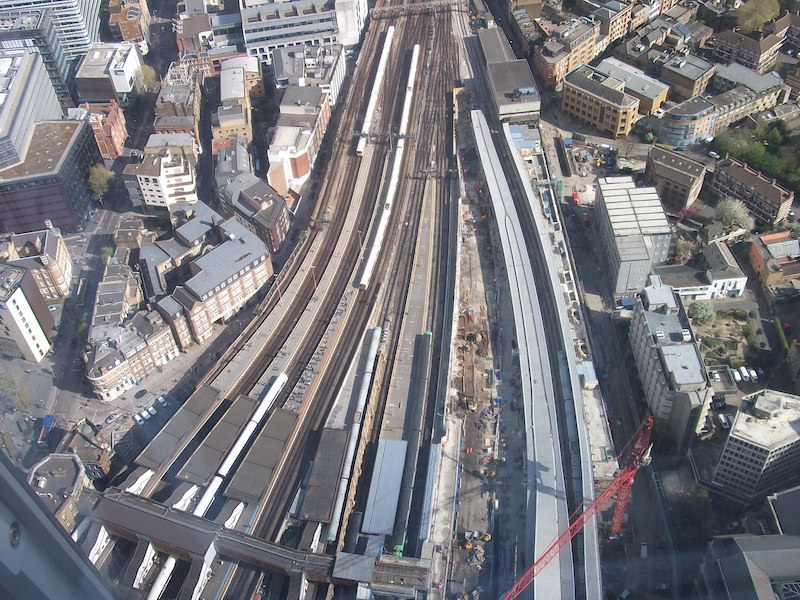
Old numbered platforms 11, 10 and 9 look as though they’re still in use with the old short section of light coloured grey covered roof, and similarly platform 8 (there was no platform numbered 7 at that time) which was sited to the left of the terminating platforms and separated by a large wall, as can be seen below.
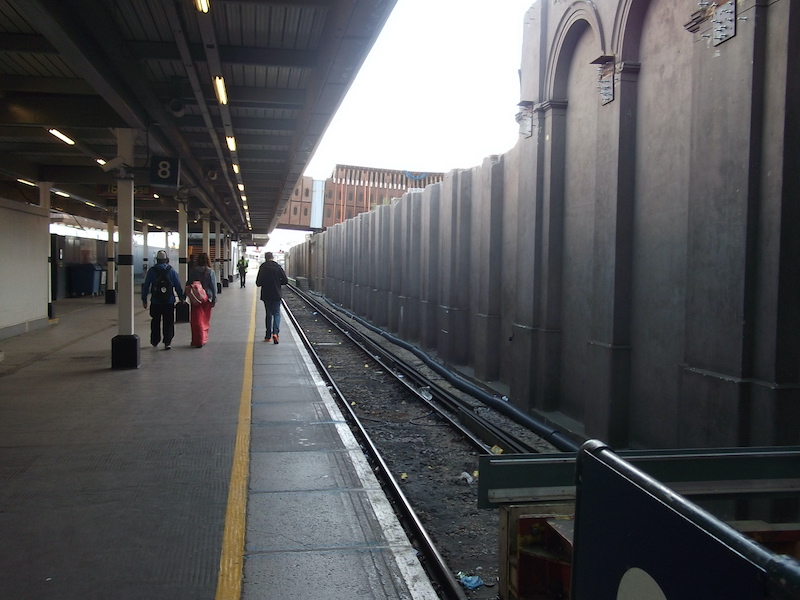
You can also see the old footbridge which spanned across the six through platforms offering passengers the opportunity to interchange with the terminating platforms where there were steps down on to the terminating platforms.
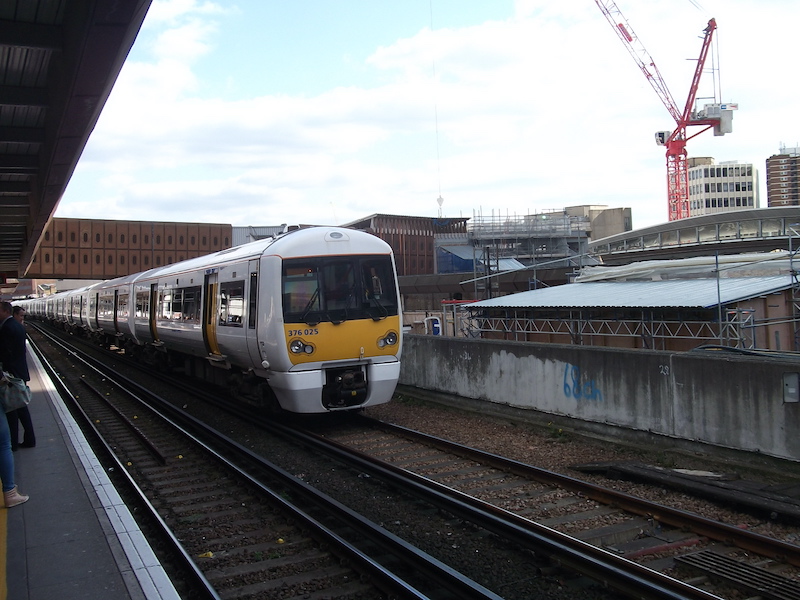
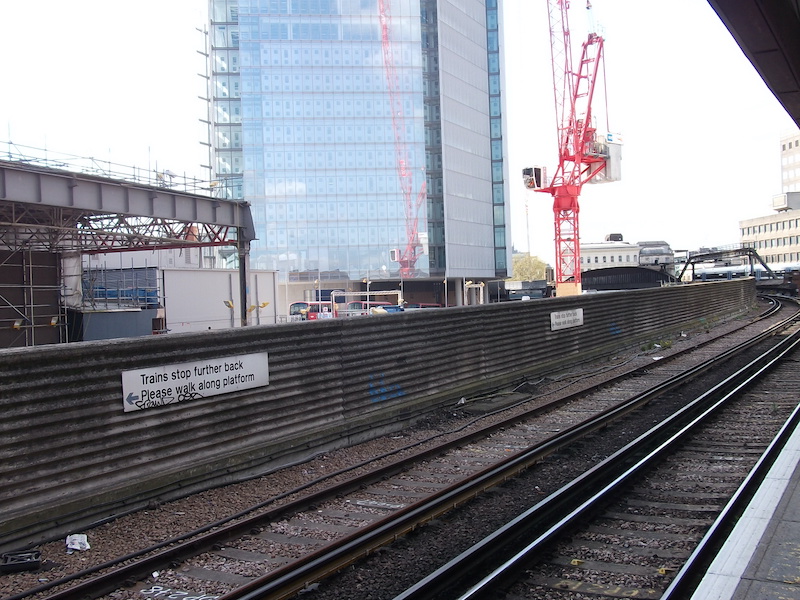
On the old through platforms there was a track running alongside the west of platform 6 as can be seen in the photographs above (looking south) and below (north) – you can also see the footbridge in the background in the above photo. This space was partly used to expand the area for the additional through platforms.
One of the huge benefits of the rebuild was giving Thameslink trains their own island platform (new platforms 4 and 5) as well as exclusive tracks for the ten trains an hour (with additions to East Grinstead in the peaks) although a late decision to include Rainham in the network meant the objective of eliminating crossovers between Thameslink and Southeastern tracks wasn’t met as that half hourly service has to make that manoeuvre in both directions.

The 15 platforms are now numbered consecutively from 1 to 15.
Platforms 1, 2 and 3 are used by Southeastern trains to and from Cannon Street with platform 1 for south bound trains to Slade Green and the Dartford loop as well as Orpington with platforms 2 and 3 for trains to Cannon Street.

Platforms 6 and 7 are for southbound trains from Charing Cross to Dartford, Gravesend, Hayes, Sevenoaks, Tunbridge Wells, Hastings, Maidstone East, Ramsgate and Dover Priory with platforms 8 and 9 for trains to Charing Cross.

On occasions when Charing Cross bound trains are running late they can be terminated at London Bridge and use platform 8 to pause before returning south again.

Those are the through platforms with the six terminating platforms (10-15) used by 11 Southern trains an hour.

There are half hourly services to and from East Croydon via Norbury, Victoria via Crystal Palace, Beckenham Junction via Crystal Palace, Caterham and Epsom and the hourly service to and from Uckfield which unusually brings diesel trains into a London terminus station south of the River (along with Exeter trains into Waterloo).

The area between the buffers and the ticket gates for the terminating platforms is uncharacteristically huge, especially as six platforms for the 11 trains per hour is also quite generous, although these platforms do sometimes get used when engineering works prevent through trains from continuing beyond those platforms.
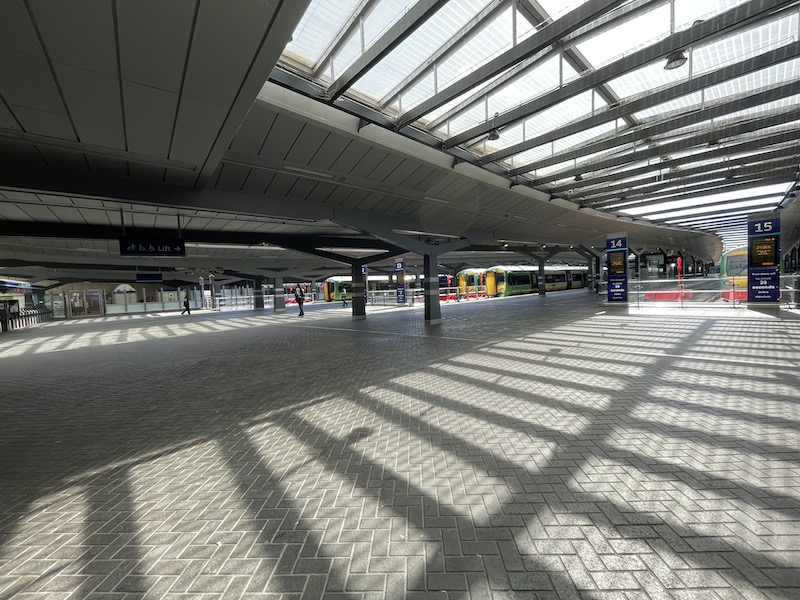
There’s an equally large concourse area on the other side of the barriers including an information window and six ticket machines…

… with a large display showing the next train to destinations and platform number in alphabetical order.

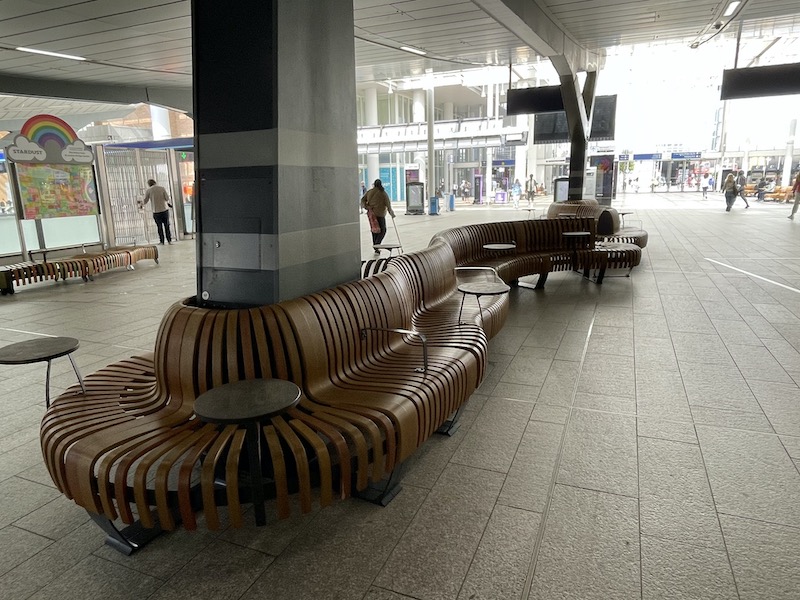
Network Rail have also been very generous with seating provision in this area…
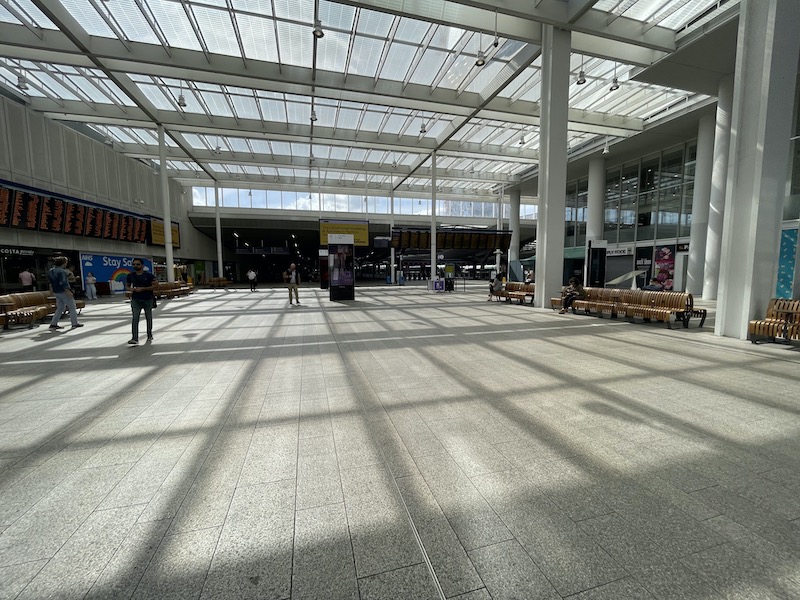
… epecially by the escalator, stairs and lift down to the concourse below.
Prior to the rebuild passengers could access the Underground (Jubilee and Northern lines) from a narrow staircase and escalator in the corner which led down to the undercroft and a passageway through small retail outlets to the entrance to the Underground station. Here’s another photo taken in 2014 showing the rebuilding work taking place but the escalator down can be seen bottom left.
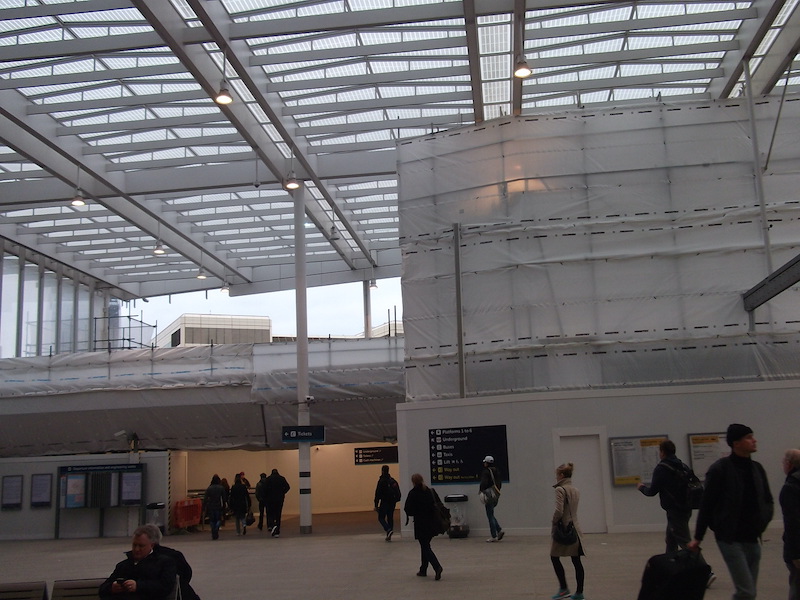
Passengers arriving on a terminating train wanting a bus from the bus station or the Underground can leave by the main entrance….
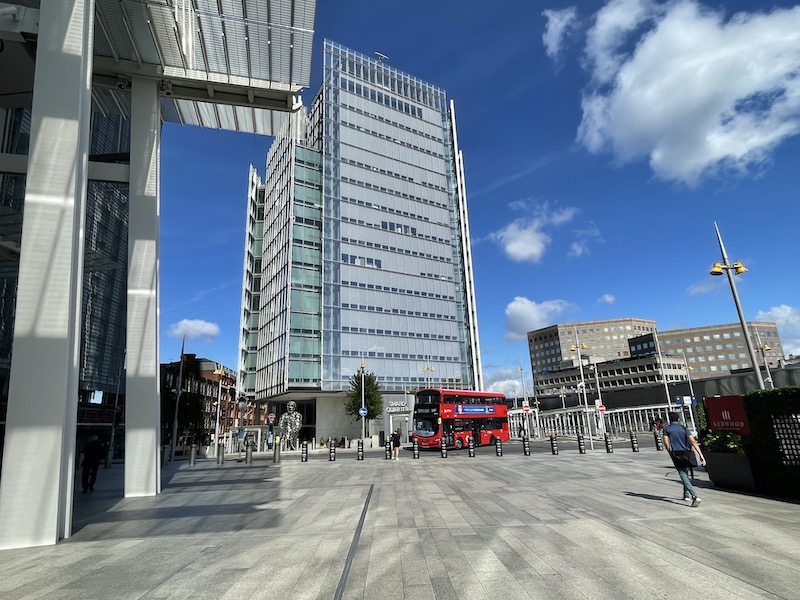
… and use the escalator at the bottom of the building straight ahead (called the Shard Quarter) or they can follow the old route signed on the new tracks that were installed…
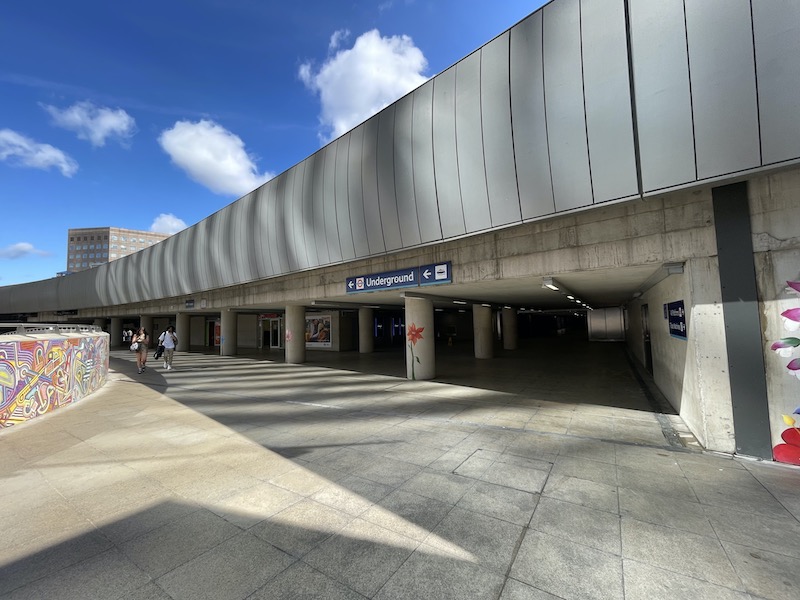
… which takes you to a rather uninviting staircase under the original tracks…

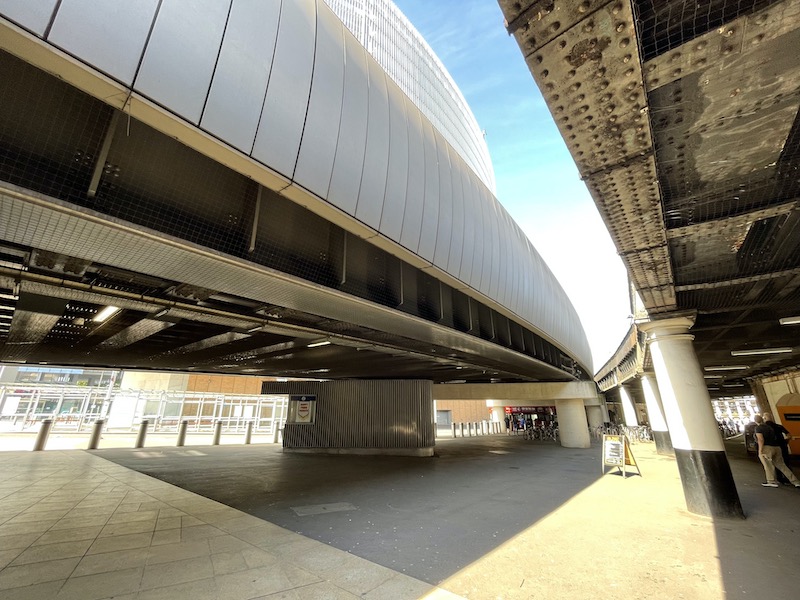
… and where it’s interesting to reflect once again on the engineering achievement of installing those additional tracks, making for quite a contrast.
Just beyond the stairs down to the Underground, is what used to be a very popular walkway. London Bridge Walk, in the days of having nine busy terminating platforms…
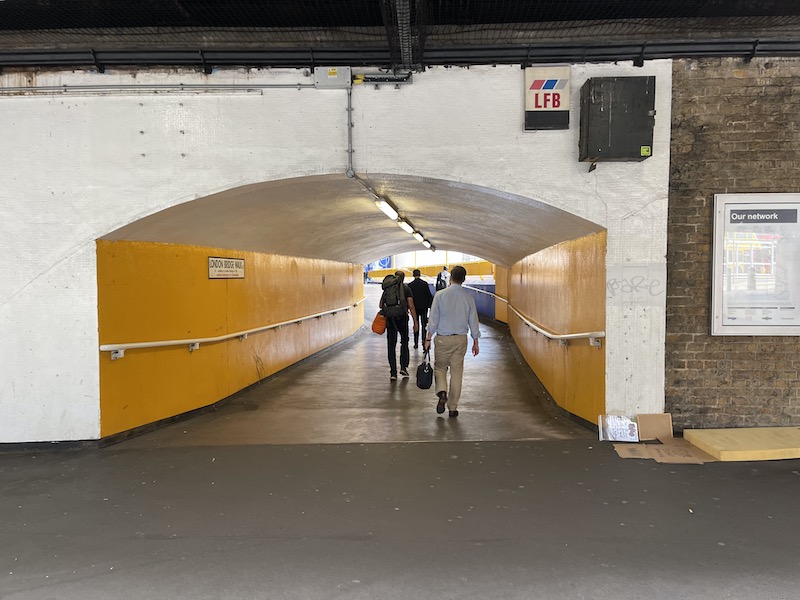
… which enabled passengers to cross Tooley Street on a footbridge and access London Bridge itself.
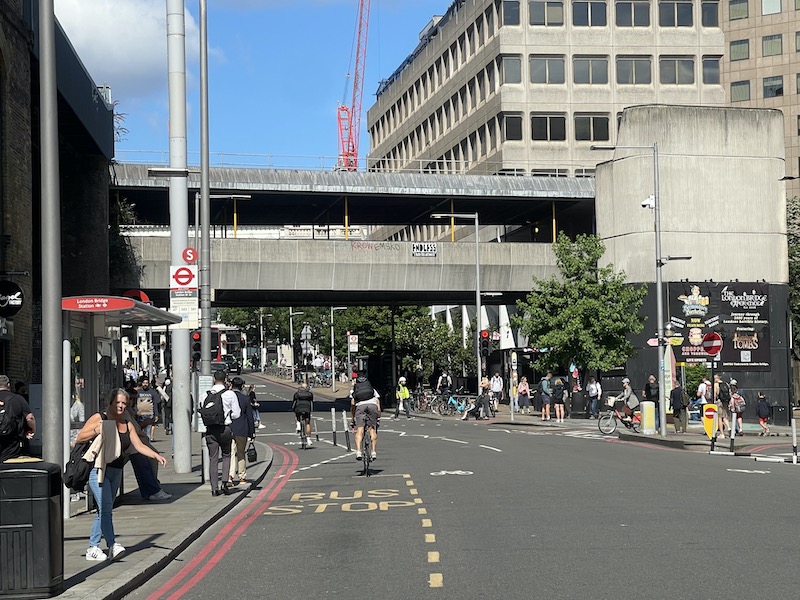
The passageway is now much more deserted with more trains using the through platforms. Oddly, despite the sign indicating it’s the way to River Boats, another passageway leads to a dead end…
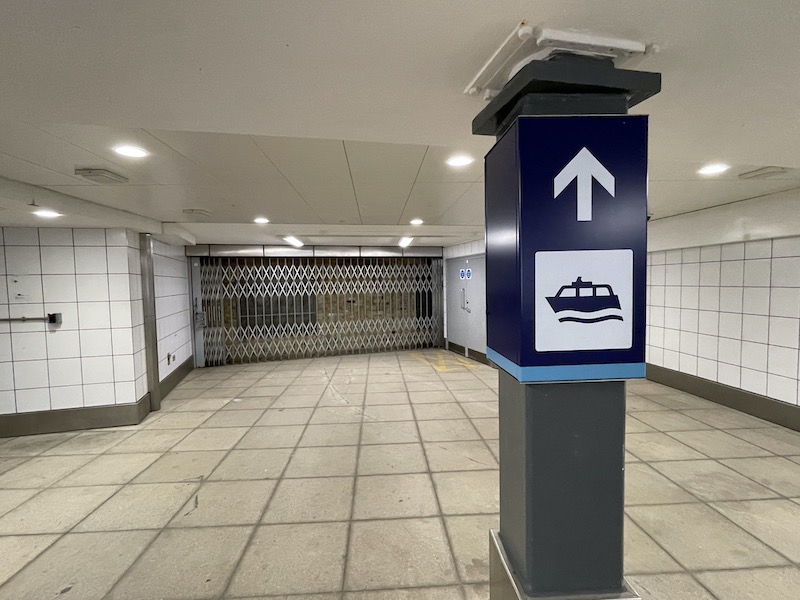
… but it has reminders of where stairs and escalators from the through platforms above once came out.
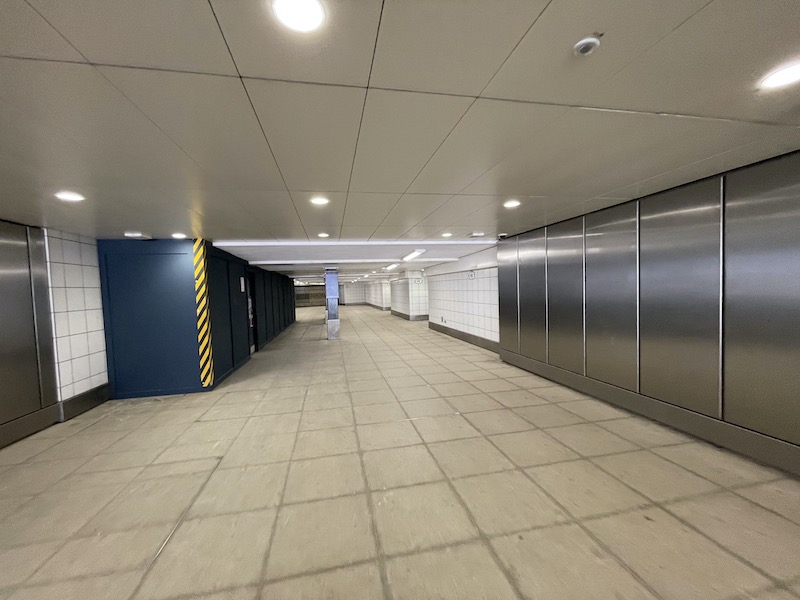
Back on the route outside this passageway you’ll find London Bridge’s Left Luggage office…
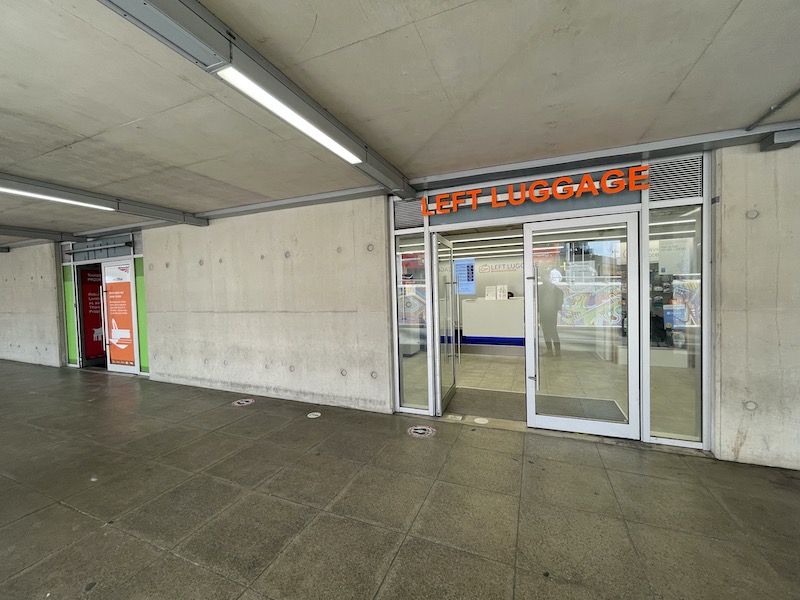
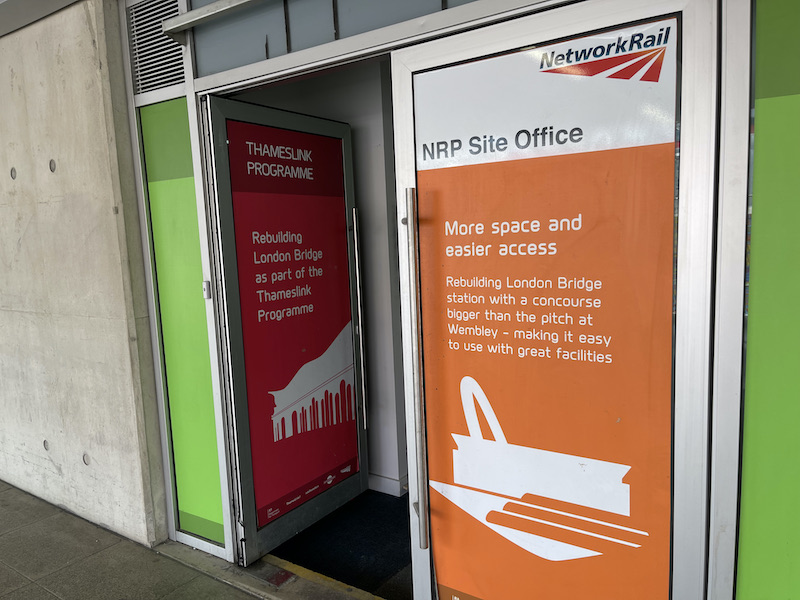
… as well as a throw back to the past – a Thameslink Programme and NRP Site Office which is still occupied (I didn’t ask if they person working at a computer inside the open door realises the rebuilding work is now complete!).
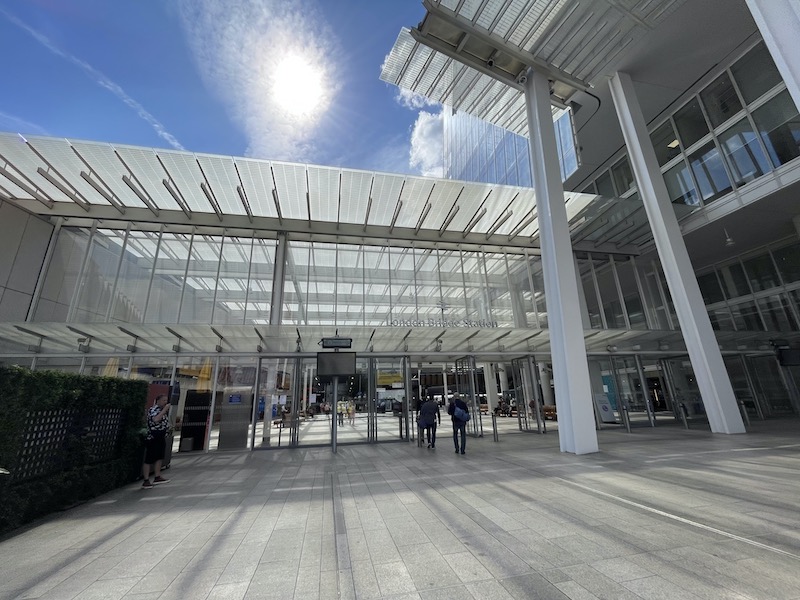
I headed back through the main entrance…
… and took the escalator down to the much busier lower concourse…
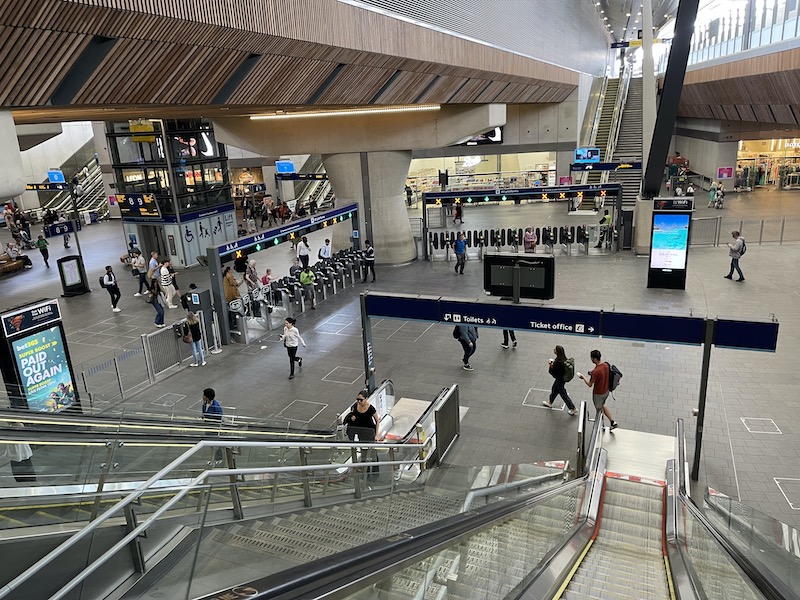
… below the through platforms as well as where there’s access to mid way along the terminating platforms on the other side of the seven sets of barriers.

Entrances/exits on the north side of this area to Tooley Street…
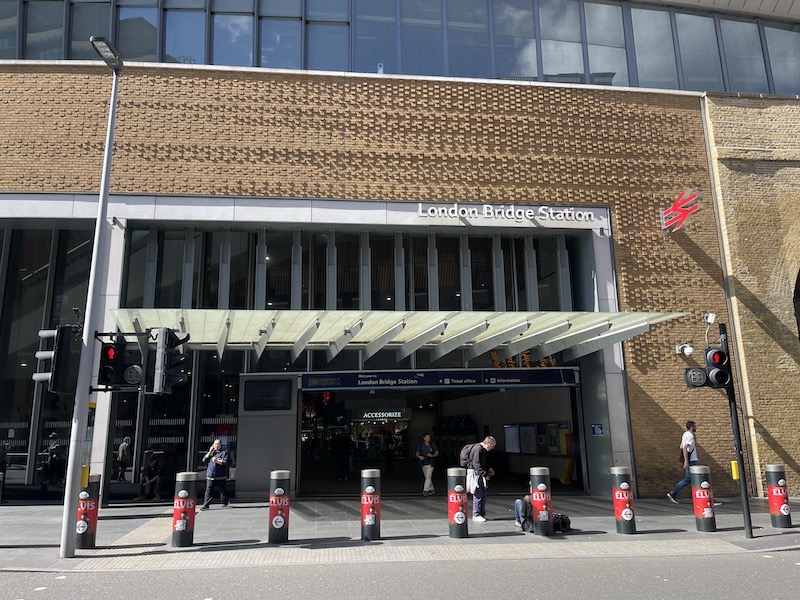
… and St Thomas Street on the south side for Guys Hospital.

There’s a public right of way through this area (on its west side) called Stainer Street, but the northern end is currently closed off…
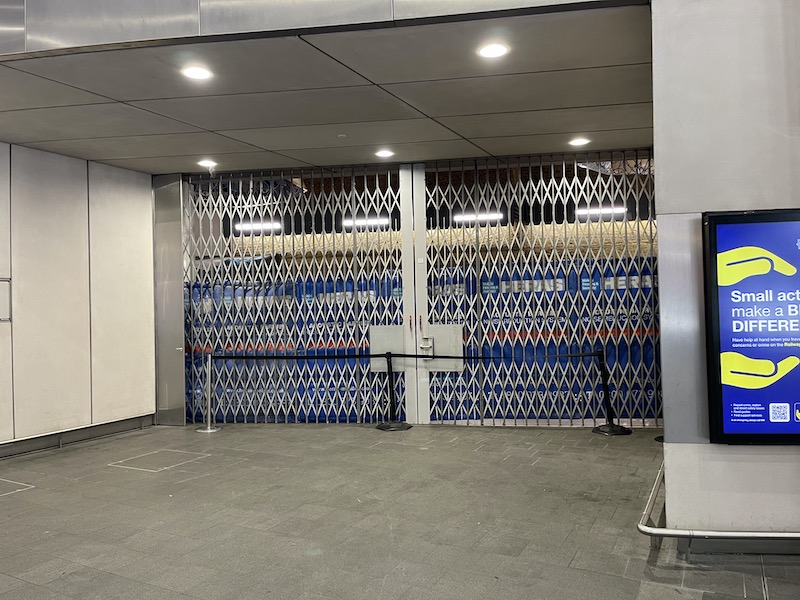
… to allow for the much welcome installation of more toilets…
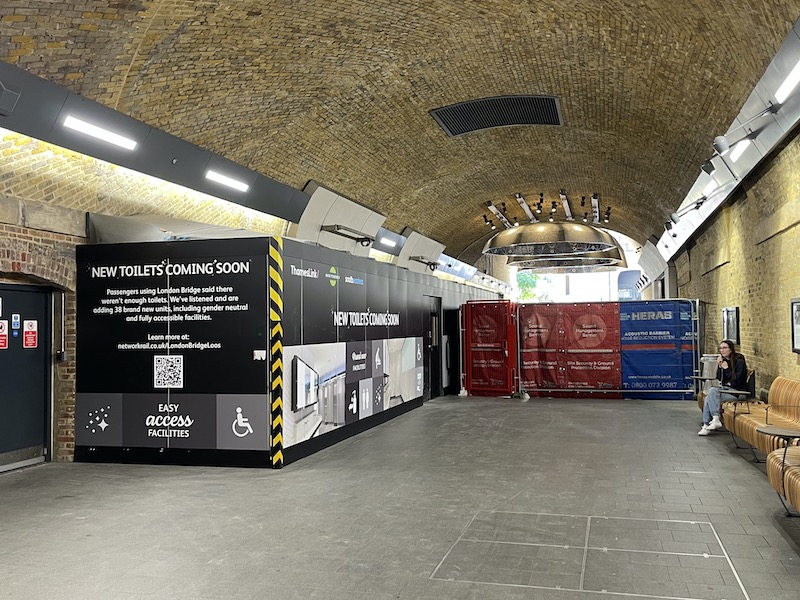
… with the original set completely inadequate for the numbers of passengers using the station.
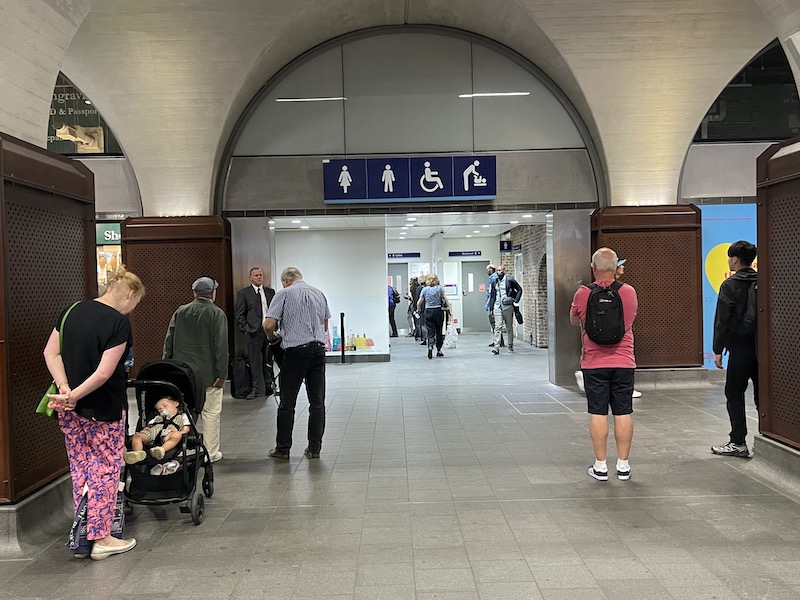
The florist is still trading alongside these works…

… as is the organ still available for anyone wanting to give it a play.
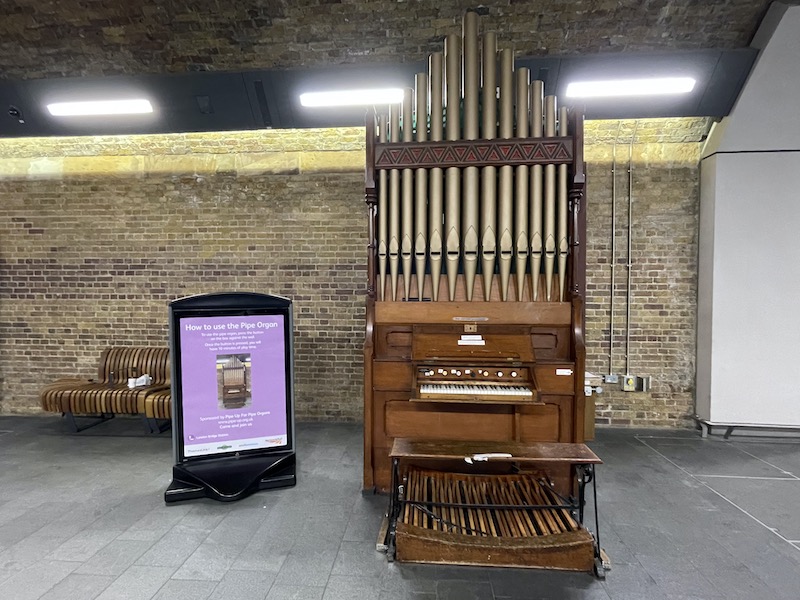
The current toilets are located in the undercroft leading to the Underground station, which was carved out and refurbished as part of the rebuild making for a huge improvement on what went before (which was just a short narrow strip at the far end which you joined from the terminating platforms). The retailers along here are an eclectic mix with some coming and going maybe reflecting high rentals?
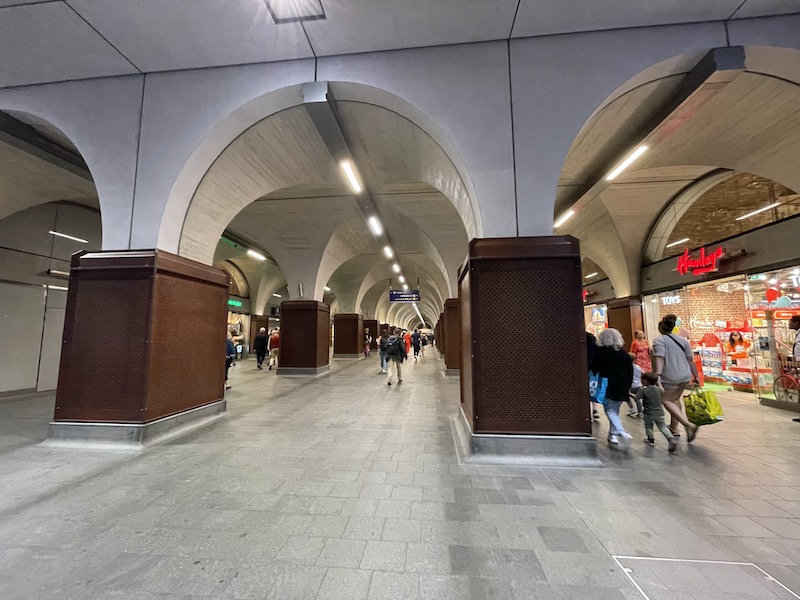
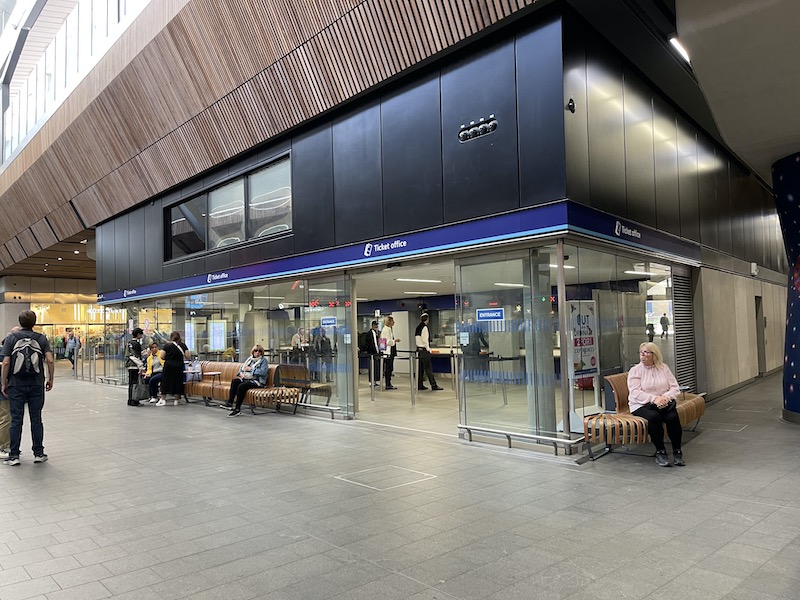
Back in the concourse area on the outside of the barriers you’ll find the ticket office as well as other retail units and those seven sets of barriers.

Through the barriers there’s a small information point and more retail units…
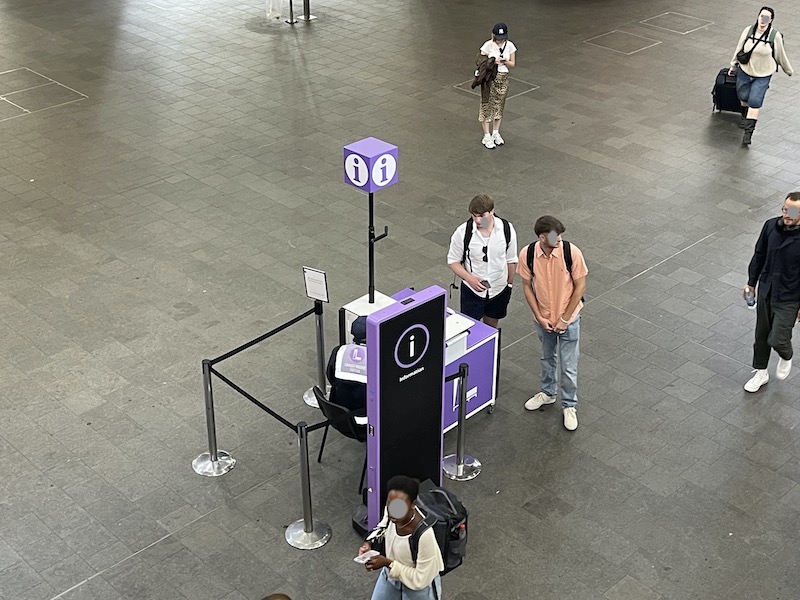
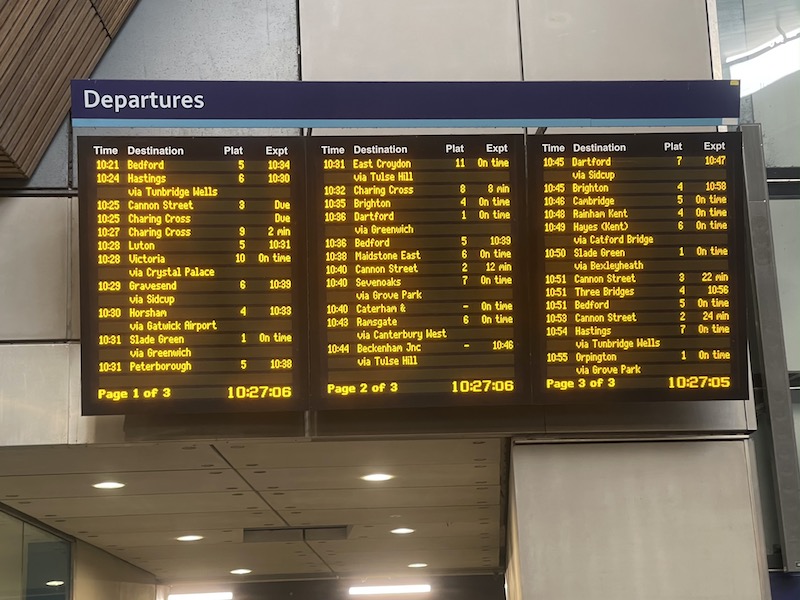
…as well as departure boards in both alphabetical order…

…and time order.
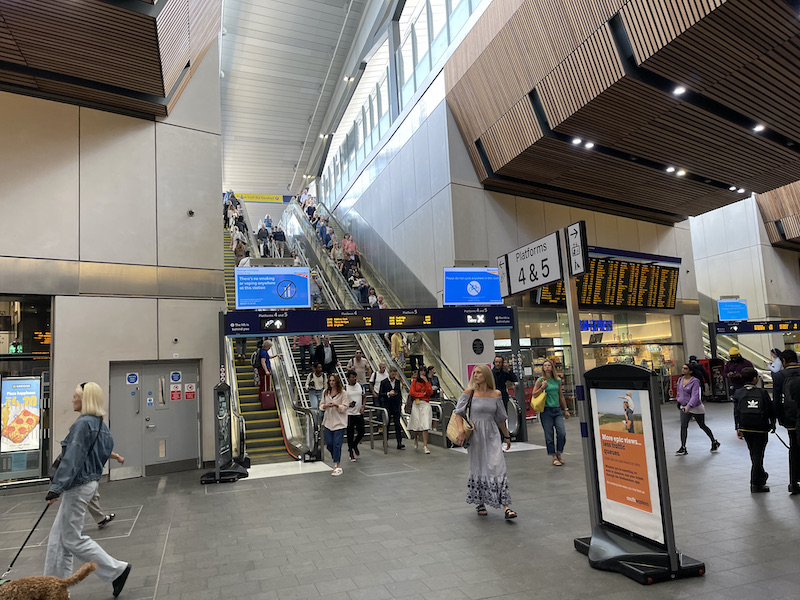
As befits the fourth busiest railway station in Britain a lot of passengers pass through every hour and the escalators and stairs leading to and from each platform can certainly get busy when a train empties out.
Stand on platforms 8 and 9 and there are 21 off-peak trains an hour to Waterloo East and Charing Cross with 10 off-peak trains an hour from platforms 2 and 3 to Cannon Street. The Thameslink platforms see 16 trains an off-peak hour taking both directions together.
London Bridge uniquely provides direct connections with seven other main line London termini including, in addition to Charing Cross and Canon Street, …. Blackfriars, Kings Cross/St Pancras, Waterloo (via Waterloo East) and Victoria (albeit via Crystal Palace and taking nearly an hour).
At one time, the bus station outside the main exit would also see crowds of passengers qiueuing to continue their journey into the city by bus. Now, that no longer seems to be the case in such numbers with TfL cutting both the number of routes and frequencies of those that remain. Here’s a reminder of what the scene looked like 10 years ago.
Where have all those passengers gone?

And finally a couple more images showing the remarkable feat of engineering to install those extra tracks taken from the adjacent Borough Market.

Quite incredible. how they were slotted into place.

Roger French
Previous blogs in this Britain’s Busiest Railway Stations series: No 10 Euston; No 9 Farringdon; No 8 St Pancras International; No 7 Tottenham Court Road; No 6 Stratford; No 5 Victoria.
Blogging timetable: 06:00 TThS with Summer Su extras including tomorrow.
Comments on today’s blog are welcome but please keep them relevant to the blog topic, avoid personal insults and add your name (or an identifier). Thank you.
 BusAndTrainUser
Minor correction – the Uckfield line is not the only appearance of diesels at a terminus south of the river, it is joined by the SWR services to Salisbury and Exeter into Waterloo.
LikeLike
Oh yes! Thanks for the reminder. Will add that.
LikeLike
if I recall correctly, the new rail bridge at Borough Market was built to one side of the road underneath, then slid into place. What a piece of engineering!
LikeLike
I presume there were good reasons (I am not an Engineer) for abolishing the over-bridge to allow easy access between platforms, but it can be a marathon task changing platforms now and a very definite negative.
I understood one of the main reasons for the £multi-million upgrade, which wasn’t just London Bridge station, but re-designing tracks right down to the New Cross area, was to eliminate bottlenecks either side of the station itself. This may have happened as such, but my experience is that trains now merely clog up in the Lewisham/New Cross areas rather than outside London Bridge itself. Not a single second has come off any journey times, and if in fact trains (from both directions) do happen to reach London Bridge without hindrance, they sit there, TfL bus fashion, “awaiting time”, sometimes by up to 3-4 minutes.
Not impressed
Terence Uden
LikeLiked by 1 person
Is it my imagination, or was there at least one platformless through road, before 1978 if not later? I certainly recall the constant reminders at Charing Cross that “this train does not call at London Bridge”.
The progenitors of the London & Greenwich Railway would be amazed to see the station today!
LikeLike
Yes, there was, adjacent to the Southern section of the station.
LikeLike
Your memory has not failed you! There was an Up Fast Loop parallel to Platform 6. Its purpose was to allow a non-stopping train to creep up alongside anything in Platform 6 and then follow it out over Borough Market. It avoided passengers on P6 thinking they could join the next service, rather than have it maintain its momentum (especially in an era of slam door trains).
LikeLike
Roger. Thank you for all the great pictures. Small point. Doesn’t Waterloo still have diesel trains to Salisbury and Exeter?
Dave James
LikeLike
Indeed so Dave; had a mental block on that so have now updated the post. Many thanks.
LikeLike
I was at London Bridge station recently on a wet day, and on the pavement footpath down to the traffic lights where terminating buses enter from the bridge itself there was a steady drip of water from the railway overbridge on to people walking below. Terrible.
Ian McNeil
LikeLike
Victoria has diesel trains (Belmond) at least once a week for most of the year – and occasional steam!
LikeLike
The fourth, surely, Roger.
LikeLike
Thanks for spotting that. Now updated.
LikeLike
My introduction to London Bridge was an article on the 1970s resignalling that appeared in the first copy of Modern Railways I bought.
While these works were being undertaken my late father commuted from Ladywell. He recollected being treated like cattle, on one occasion commuters booed at the station announcer after the platform was changed repeatedly.
I commuted for 5 years from mid Kent in Network South East times in the early 80s when “fast” trains from Kent allegedly didn’t stop at London Bridge using a relief line installed to bypass platform 6 mentioned above.
Despite the major changes to the station layout and more importantly services I find it easy to use, coming up from the Underground glancing at the comprehensive screens whether I’m travelling to Hastings, Brighton or as last Sunday to Hayes with three minutes to catch the train.
A modern station that acts as an ideal interchange sweeping me through and up the escalators to my desired train. In Sunday’s case on to one of those old fashioned Networkers that I enjoy travelling on.
You can always tell a good station when you don’t have to remember the platform number, the train just goes from the usual place and there is a Greggs to nip in for nourishment en route too!
What a transformation from the days when my late father commuted. l’m sure even he would “enjoy” the modern day London Bridge experience.
The good old days are now!
John Nicholas
LikeLiked by 2 people
I used LB for the first time in about 20 years last weekend. Is my memory playing tricks on me or is the walk from the platforms to the underground much longer than it used to be?
LikeLike
You’re not wrong. All platform access was shifted a lot further Eastwards. The through platforms used to be accessed at the western end, adjacent to the underground but are now middle platform access only. The terminating platforms buffer stops moved significantly East. Conversely the bus stops were moved West. What was quite a tightly knit station is now spread out
LikeLike
The new bus station at London Bridge is pretty poorly designed in terms of pedestrian movement. Officially, pedestrians are not allowed to cross the road from the terminating platforms concourse exit, where they can very clearly see their bus waiting, and have to walk round to the north side of the bus station and use the pedestrian crossing half way along the stands and double-back to their bus. Similarly, arriving bus passengers are not allowed to simply walk towards the station entrance after alighting but have to go out of their way to use the same pedestrian crossing (in some cases walking away from the station in order to do so). It wouldn’t be quite so bad if there was obvious physical barriers to prevent direct movement between buses and the station but there aren’t. Thankfully the enquiry office has been moved from the south (remote) side to the north side All good bus station design needs to account for pedestrian desire lines as the starting point!
Stephen H
LikeLike
Straying off topic here but that is presumably why Victoria Station’s bus station next door (well not directly!) has so many accidents. Terrible design not in line with desire lines…
The London Bridge bus station’s issues are largely averted by the fact it is largely deserted nowadays… at least compared to Victoria. Both very very far, as Roger noted, from the days of higher bus ridership.
Matthieu
LikeLike
Where have all the passengers gone?
Apart from the usual ‘working from home’ post Covid, using Thameslink to reach Blackfriars and City Thameslink is now a valid option, I also wonder how many travel via the Overground to Shoreditch for the Liverpool Street area rather than go via London Bridge. The Northern Line is also better following it’s re-signalling, you are less likely to find the next train is 13 minutes away and you should have got that 43 when you had the chance.
On that basis the traffic for the 17, 43, 48, 141, 149 and 521 wasn’t there like it was.
LikeLike
What surprises me is the fact the toilets are outside the barriers! It’s a long way from the platforms if you are caught short to go down very long escalators, then finding someone to open the barrier, walk to the undercroft, and for women, a possible queue.
I’m pleased to see that they are adding new toilets, but really this should have been noticed during the planning.
LikeLike
We recently arrived there by bus, found our way into the station for a nosey around, but it seemed very difficult to find our way out again in order to walk back across London Bridge (the real one, not the station!). We found ourselves downstairs somewhere looking at an amazing art installation and eventually found the outside world.
Presumably it is better for regular users but as visitors we found it impenetrable and confusing. Better signage for the unwary might be helpful!
John Carr
LikeLike
One practical point to cover is the woeful lift access to platforms 10-15. Just a single lift partway down platforms 13/14. And I also recommend a return visit in the middle of winter to experience the extreme wind funnel effect of those artistic platform canopies
LikeLike
As a regular user I agree with others there are some big failings here, particularly:
1 The crossing from the terminating platforms to the through platforms. It takes much longer than the old footbridge
2 Related to 1, each of the terminating platforms has only 1 escalator which can lead to crowding especially as they are not always operating with the heaviest flow of passengers. I think the designers misjudged the balance between passengers who will leave via the lower concourse and on the level. As pointed out above the lift provision is very poor.
3 Worst of all the bus station. Very exposed to the elements especially as the bus shelters no longer have any cover, I’m imagining because the glass blew off. It really is an inhospitable place to wait on a cold and/or rainy day. Add in the significant reduction in services, especially the removal of the always busy 521 and the replacement of the 48 with the infrequent 388, and the improvement in the Northern Line and it’s no wonder most people have found other ways.
thanks as always Roger
Tim
LikeLike
I spy a relic from Network SouthEast days in the picture of London Bridge Walk. Also nice to see again the “Trains stop further back” signs alongside the old Up Passenger Loop that I was responsible for getting installed when the platforms were previously extended for 12-car Networkers in the early 1990s.
Steven Saunders
LikeLike
the new station was designed by architects Grimshaw. They certainly ensured the station lived up to the first part of their name.
LikeLike