
Tuesday 9th July 2024
Two very different new bus routes began operating on Sunday and I’ve taken a ride on both.
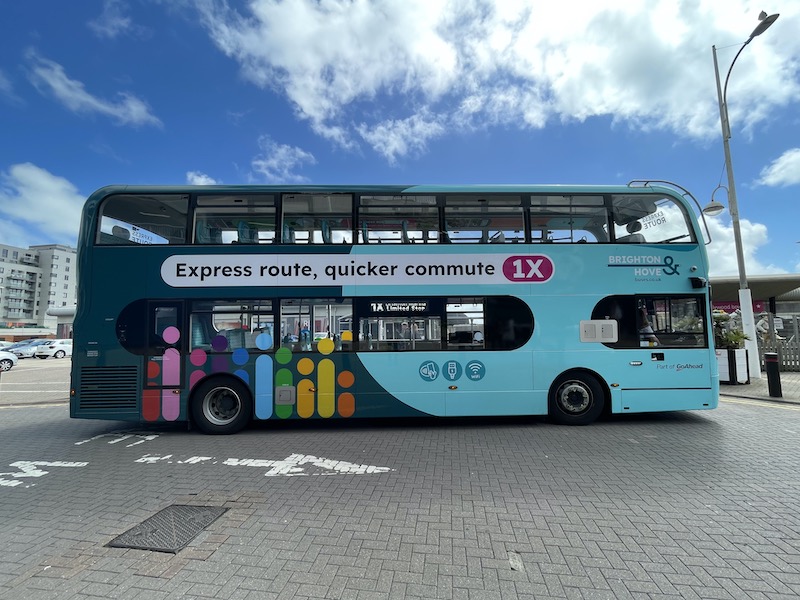
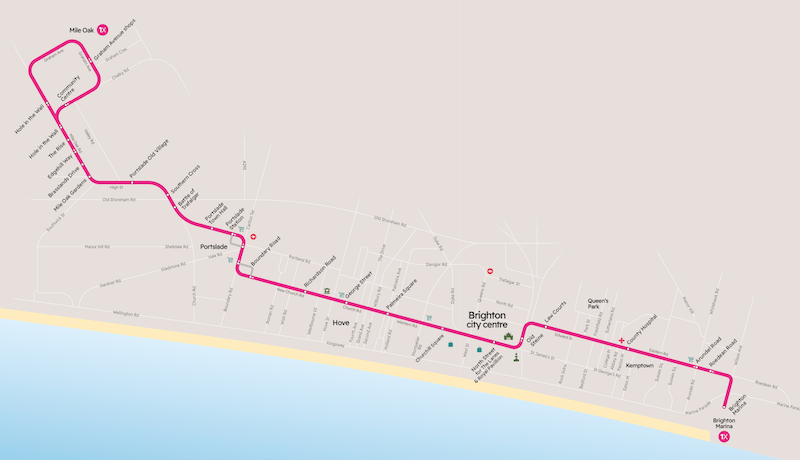
First up, thanks to Bus Service Improvement Plan (BSIP) funding, is a cross-city limited stop route in Brighton and Hove. New route 1X links the residential area of Mile Oak (in the north west of the city) with Portslade, Hove, central Brighton, the Royal Sussex County Hospital and Brighton Marina (in the south east).
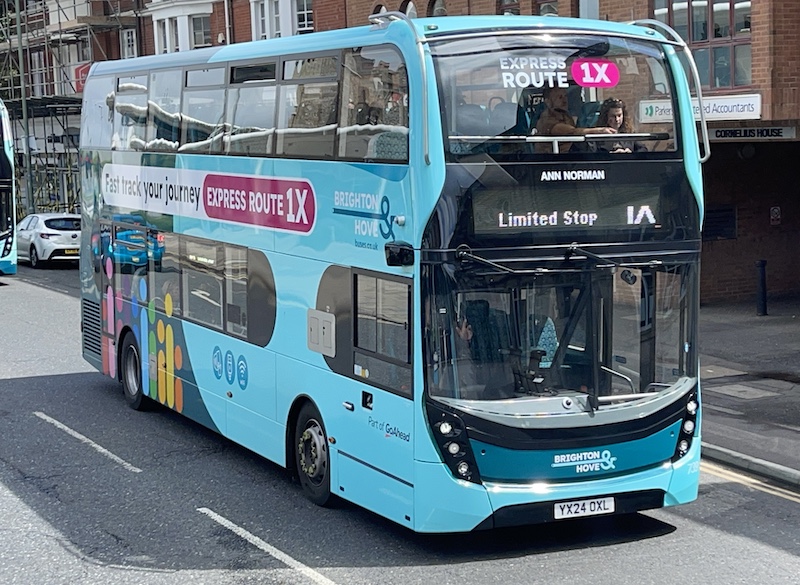
Six new ADL Enviro400 MMC buses in the new Brighton & Hove livery have received bespoke branding for the service which runs every 15 minutes for most of the day (20 minutes on Sundays; half hourly each evening) with a span of day from 05:20 to 00:30 (07:20 to 23:30 on Sundays).
The new timetable supplements the long-standing frequent (7-9 buses per hour) cross-city route 1 from Mile Oak to Whitehawk which hitherto had a 1A variant taking a slightly different route on certain sections which the 1X has now superseded.
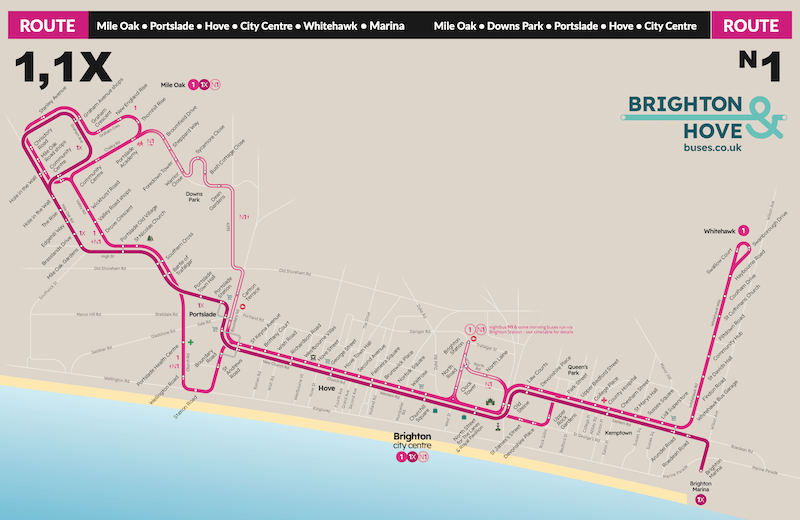
Whereas route 1 has 33 bus stops between Portslade Old Village (on the southern edge of Mile Oak) and Arundel Road (the last common stop where the route to Whitehawk and Brighton Marina divide), the new 1X has only 13.
From Mile Oak, daytime buses on route 1 take 44 minutes to Brighton’s Churchill Square and 56 minutes to the Royal Sussex County Hospital while new route 1X takes 33 minutes and 42 minutes respectively making for a handy 25% journey time reduction.
Residents of Mile Oak, Portslade and parts of central Hove wanting to access Brighton Marina (and vice versa) have previously had to change buses with an added time penalty but now they have a direct service taking between 45 and 49 minutes.
The idea is straight out of the TfL Superloop playbook except Brighton & Hove, renowned for its excellent marketing pedigree, has shown how to promote a new limited stop bus route.
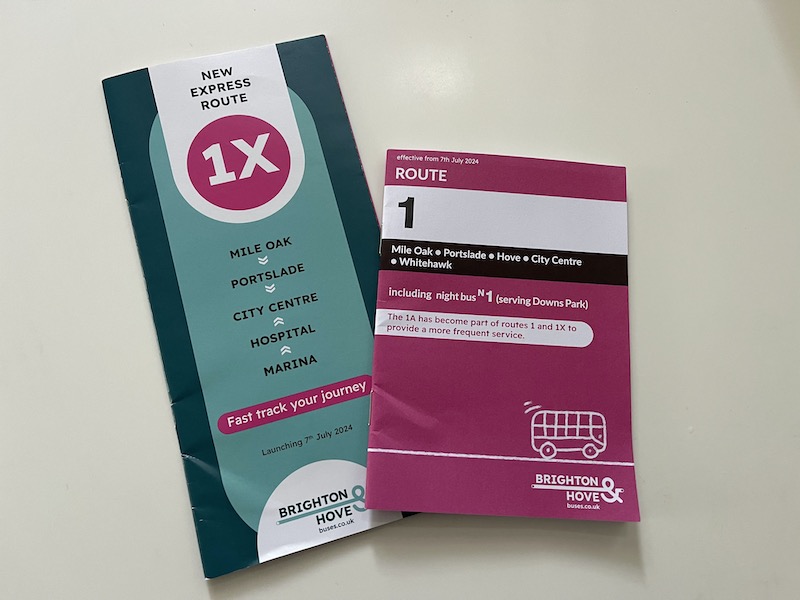
There’s a timetable leaflet, which doesn’t just have a map showing the bus stops…
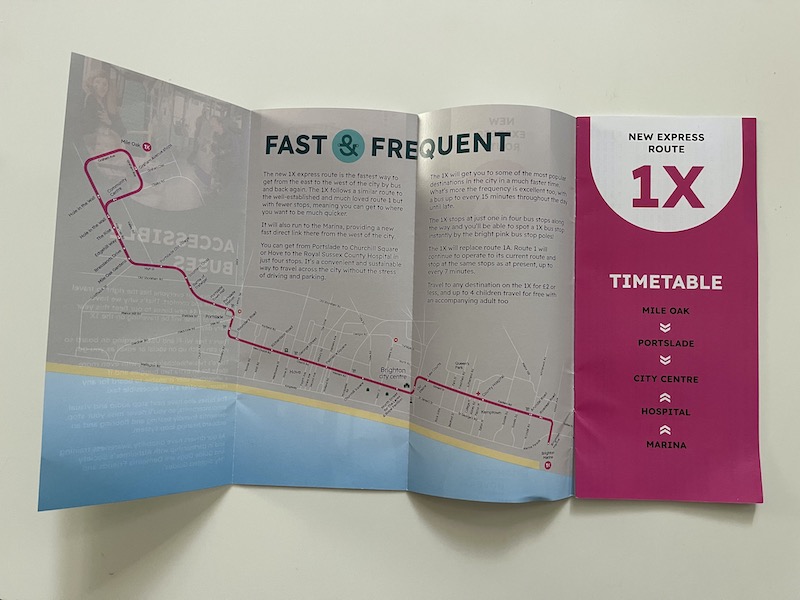
… but also has a full easy-to-read full timetable (TfL please note)…
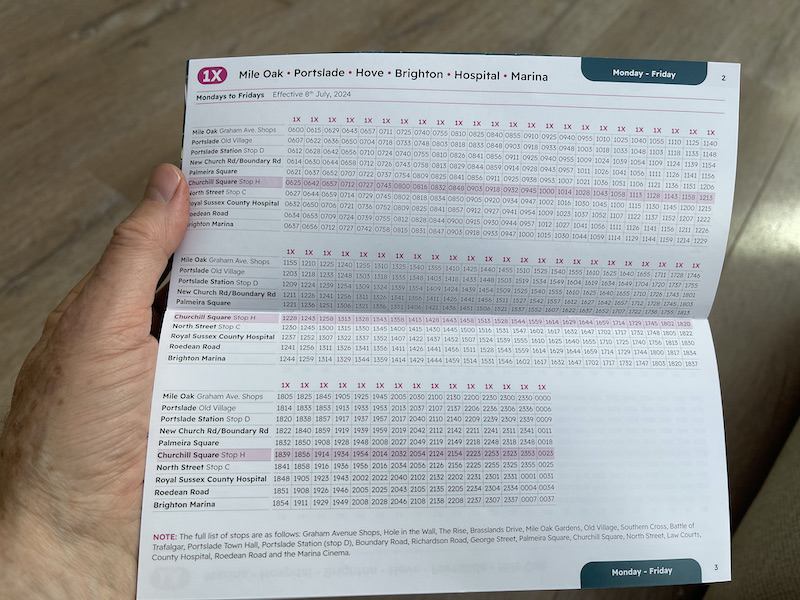
… and they’re available on board buses.
No flash in the pan agency staff in a high-viz tabard at bus stops on day one, but a lasting sustainable policy making useful information available to passengers at all times….
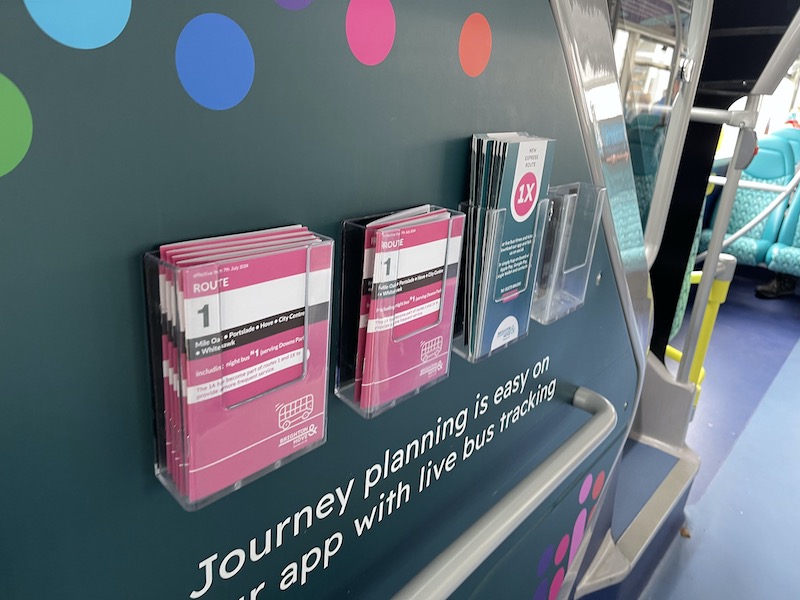
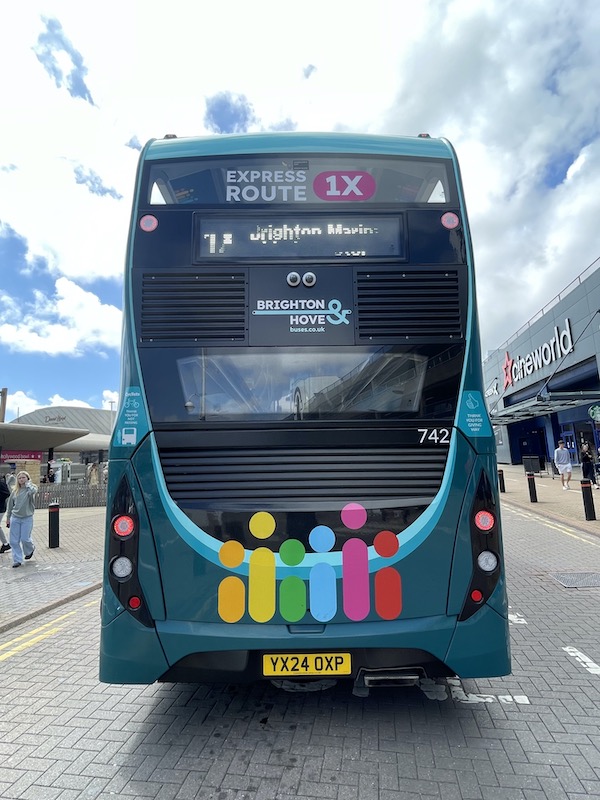
… and the buses have branding for the new route, albeit rather ‘shouty’ in effect, which highlights the main features of the route – ie being an “express” route and using some of the cleanest buses around.

Even better, there are promotional posters at bus stops served by the route extolling its virtues and its limited stop characteristic.

As a consequence, even on the route’s first day on Sunday – a busy day in Brighton …
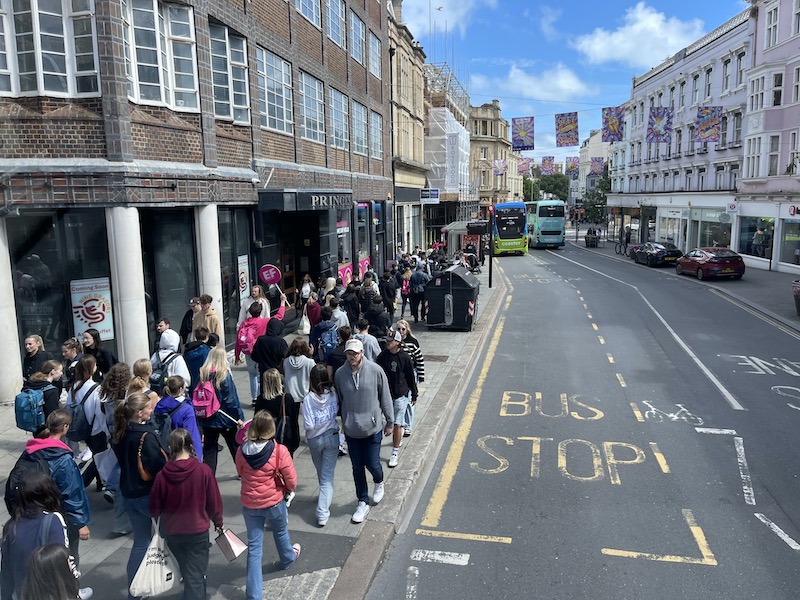
… many passengers were already wised up to the advantages to catching the new route and letting a bus on route 1 go by …
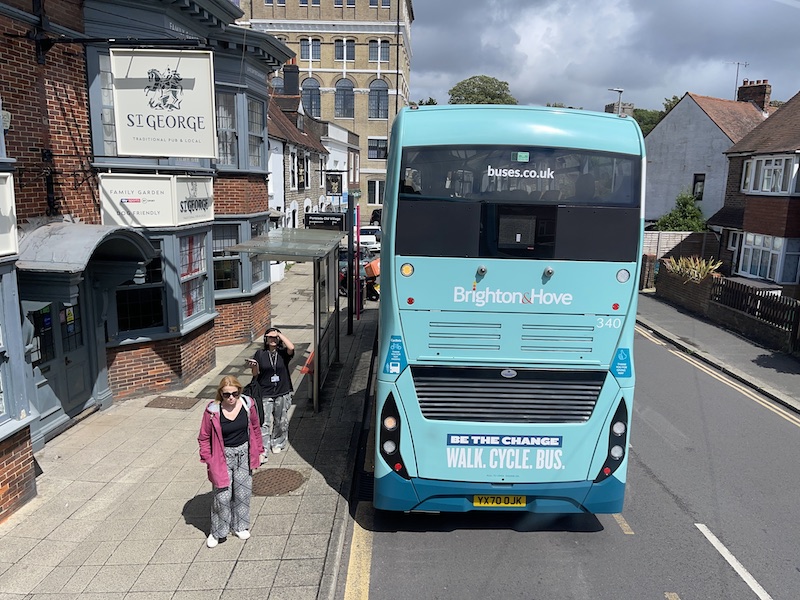
… and not once did I hear anyone press a bell to alight at a stop the 1X doesn’t observe, or see passengers sticking their hand out for the bus to stop, where it doesn’t. Indeed, such bus stops have information in the poster case confirming the route doesn’t stop.

The pre-launch publicity and information provision has obviously done its job, perhaps helped by a rather oddball decision to install pink coloured poles with a timetable case at bus stops where buses on the 1X stop.
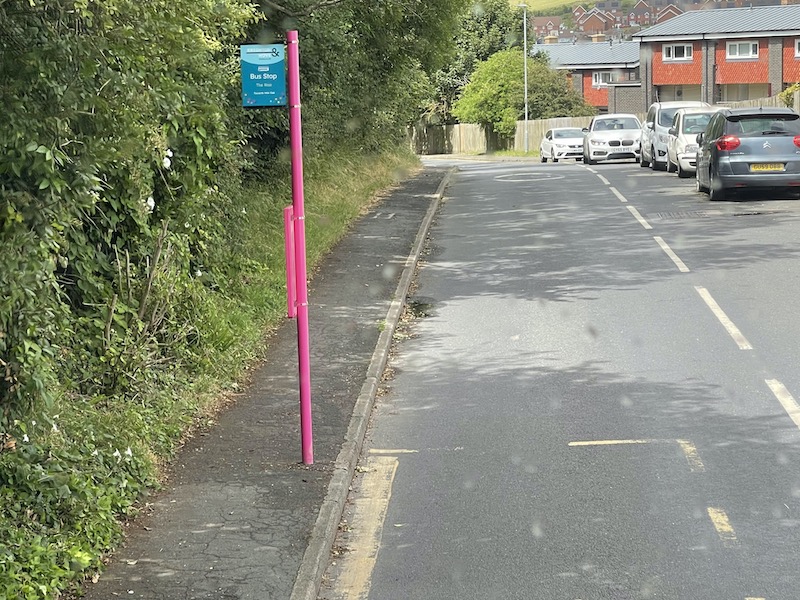
I’m guessing pink was chosen as a throwback to the era when route branding was more prevalent on the Brighton & Hove network and buses on route 1 were branded with pink in the livery. There’s even a pink pole at the Brighton Marina terminus bus stop.
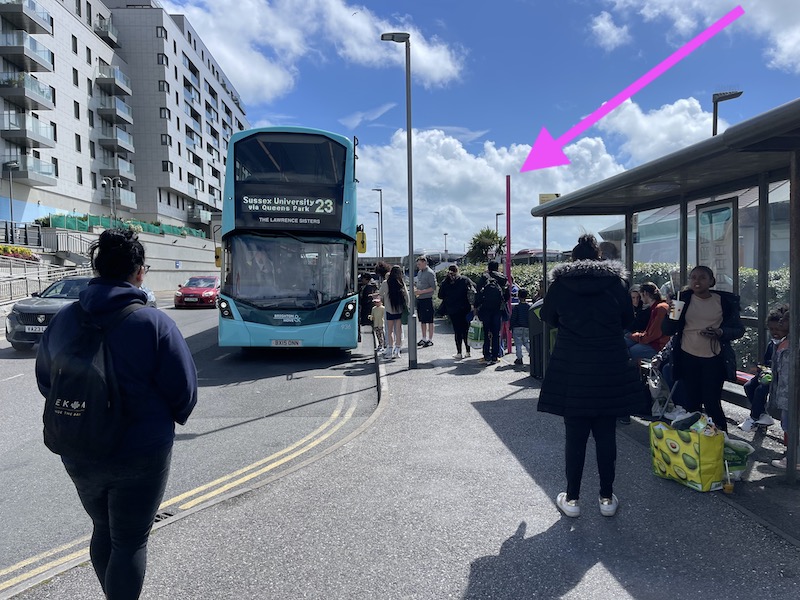
The timetable case includes a map, journey times and departures from that stop showing precise minutes past each hour. None of your “every 13-17 minutes” beloved of TfL, or ridiculous AI generated nonsense here.

Journeys I made up and down the route on Sunday afternoon saw encouraging numbers travelling, including many passengers making a cross city journey to Brighton Marina. Some passengers boarded obviously excited at the idea of once again being able to travel on a limited stop service through Portslade and Hove.
I say “once again” because Mile Oak was connected to Hove and Brighton with, at the time in 1983, an innovative new “express” limited stop route branded Shuttle, taking the number 60. It ran for around ten years before being downgraded to a normal stopping bus route. Just over 40 years later it’s good to see the idea reintroduced.
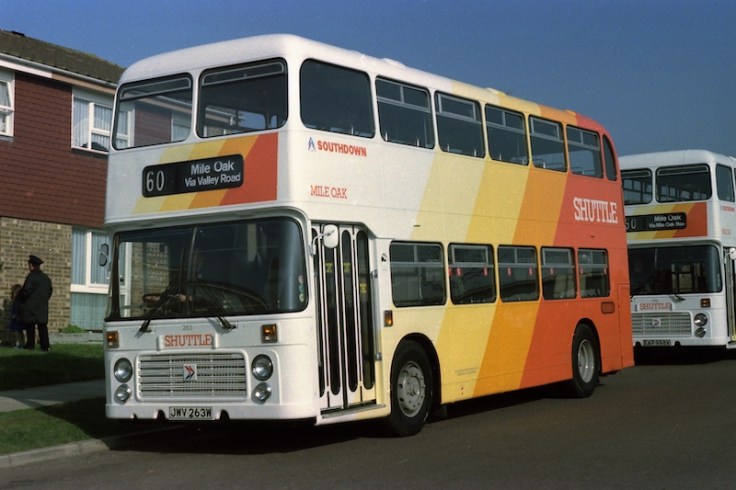
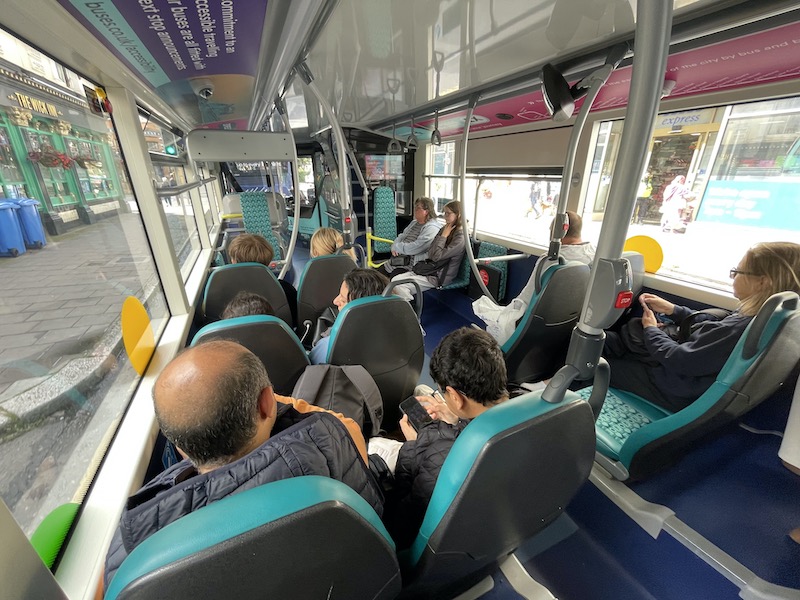
And whereas the Shuttle launched with what were modern buses of their time – the latest Bristol VRTs in the Southdown fleet – passengers on today’s route 1X can enjoy excellent comfort on the latest new vehicles into the company’s fleet.
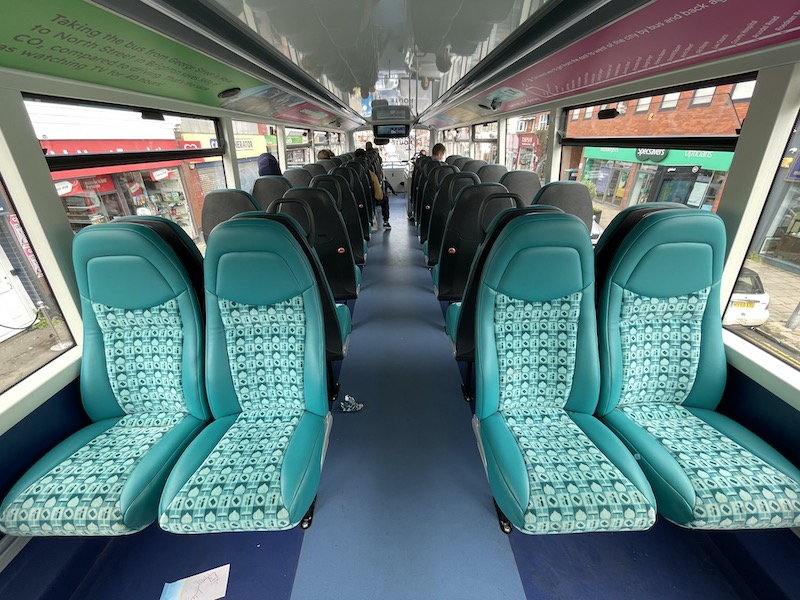
Like those on the Coaster branded route 12 I blogged about in March, the seats give excellent comfort…
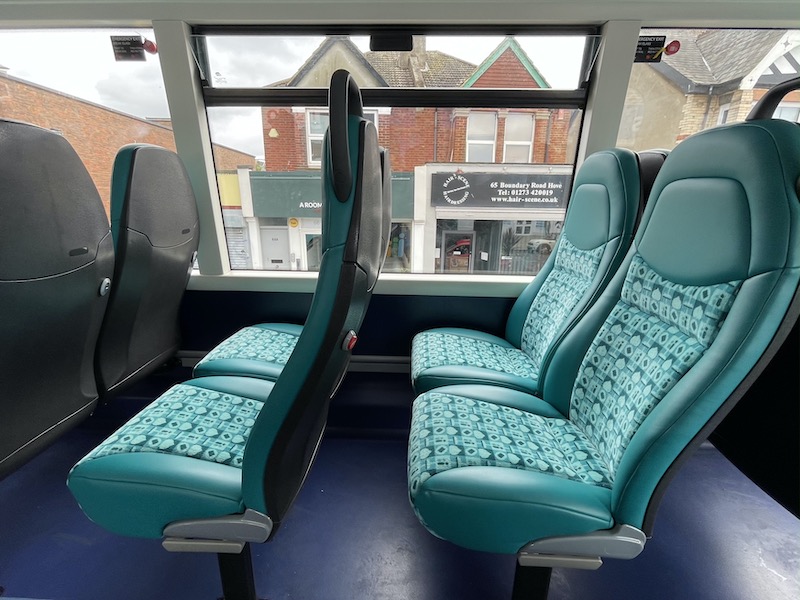
… albeit the leg room is a little tight.

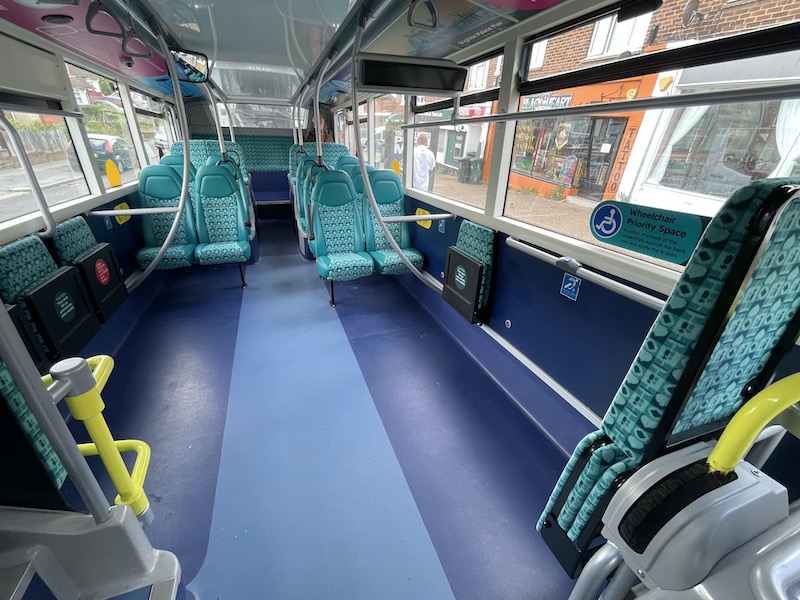
Although there’s no table on the upper deck, the lower deck has the usual accessible features…
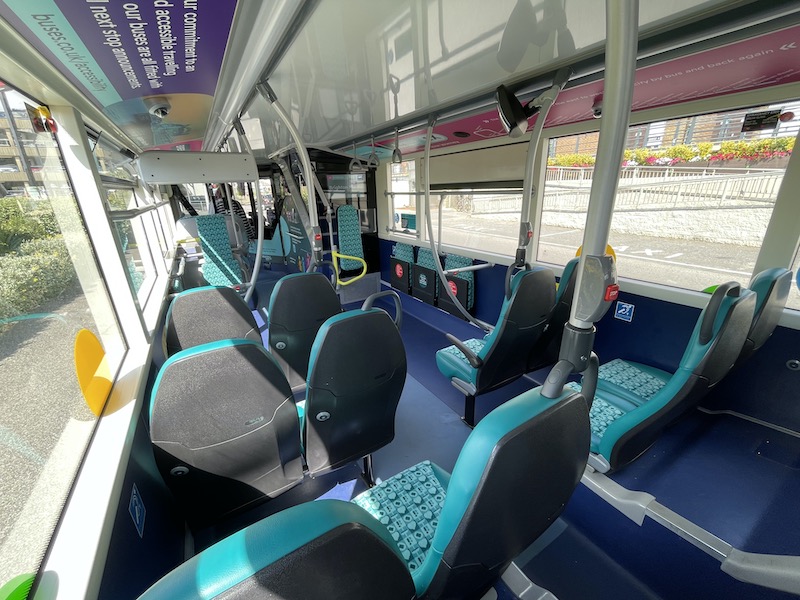
… including two wheelchair bays, and being single door configuration, ample other seats too.
The upper deck has promotional posters for the route including line diagrams showing the route and bus stops…
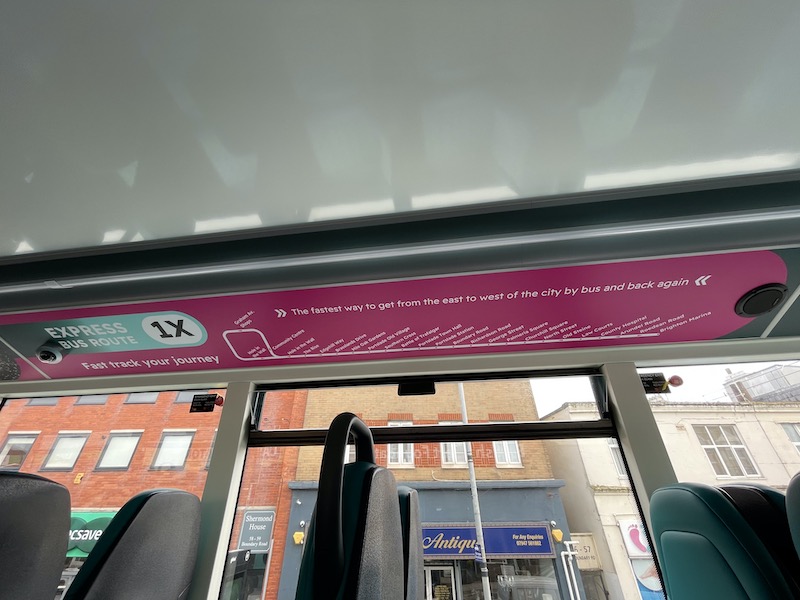
… but the ones on the lower deck nearside suffer from being pretty much on the roof, and therefore virtually unreadable.

It may be just getting used to first day arrangements, but most buses I saw on Sunday were running around five to six minutes late and one driver I spoke to thought the timings might be tight, not helped by three sets of temporary traffic lights in Western Road by Churchill Square (where the Council closed the road for many months to carry out resurfacing and public realm improvements so it’s disappointing to see these weren’t all completed) …
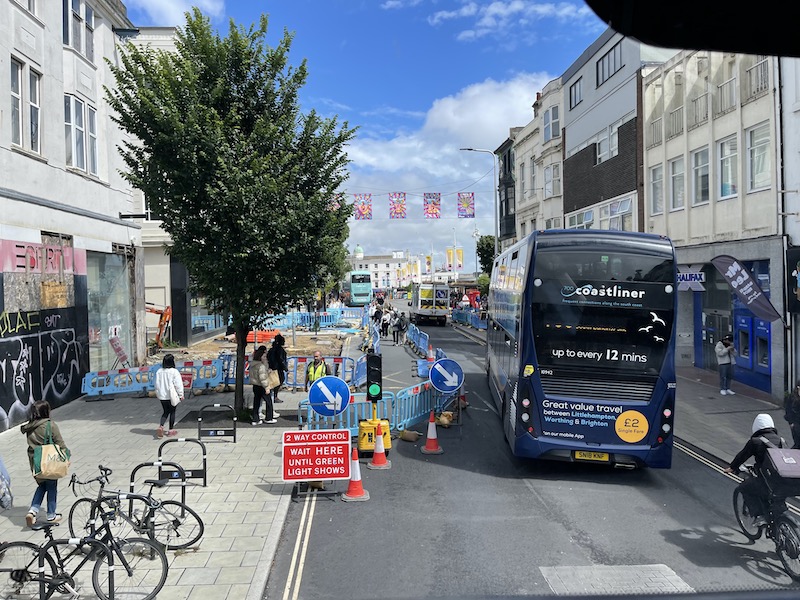
… at the Clock Tower…

… and in Arundel Road

It also crosses the busy level crossing at Portslade station which can be notorious for delays.
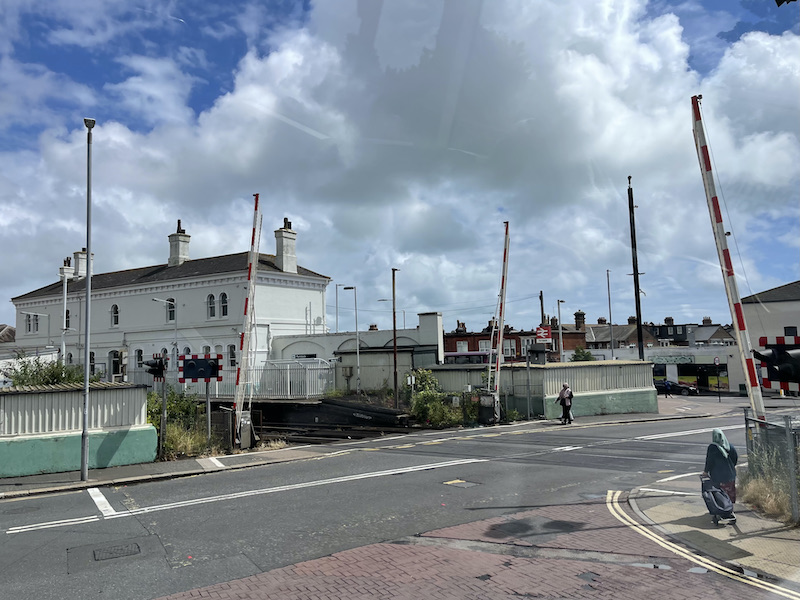
But the route has all the hallmarks of being a successful addition to this city’s much admired bus network.
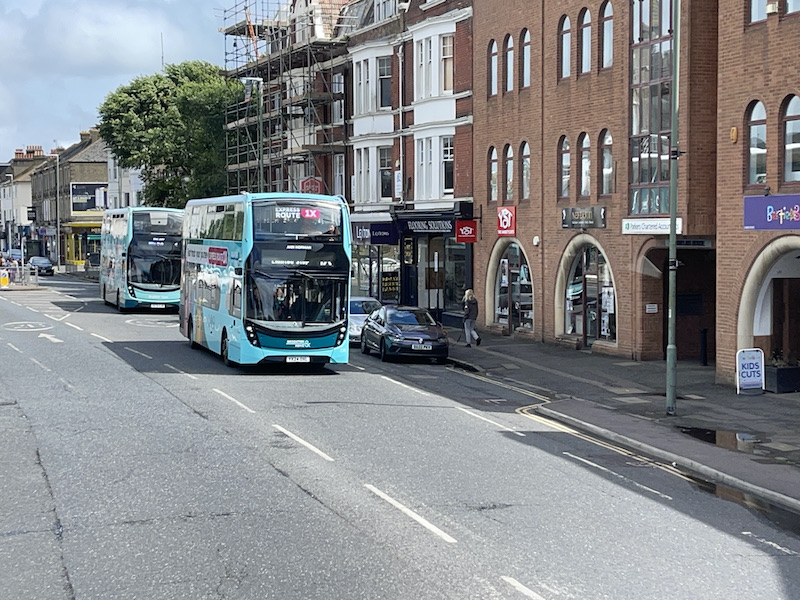
It links important destinations including the expanding Royal Sussex County Hospital…

… the city centre…

… and Brighton Marina.
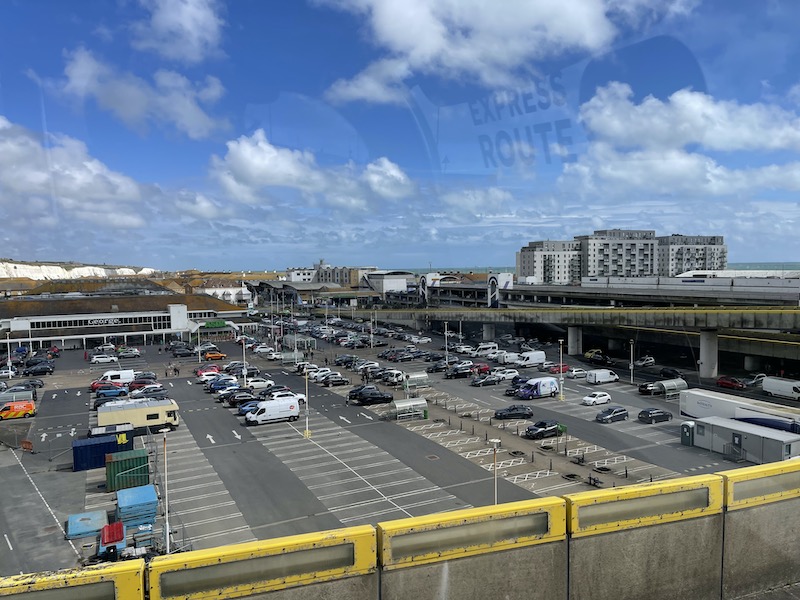
The one disappointment is the wording and logo across the upper deck front window.
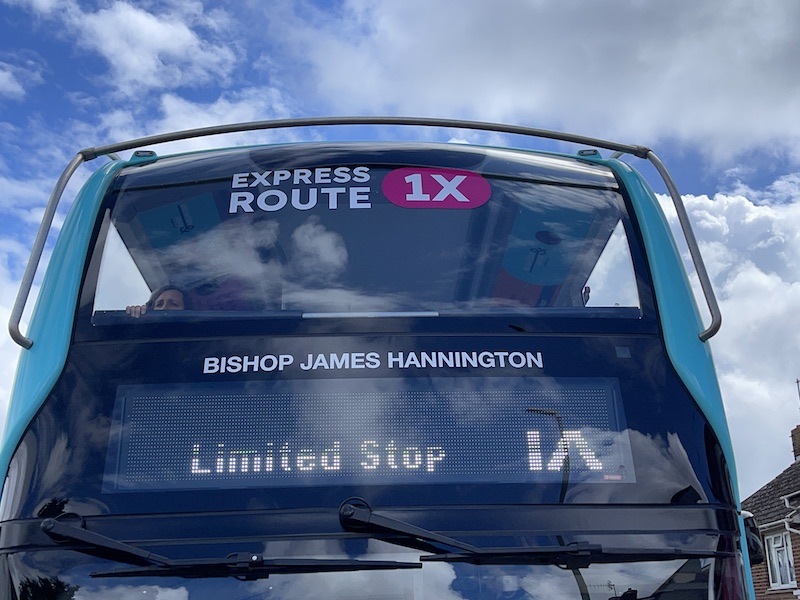
It’s obviously helpful to let passengers waiting at bus stops easily recognise the bus coming towards them is a 1X but there are ways of doing this other than blocking the best view for passengers from inside the bus.
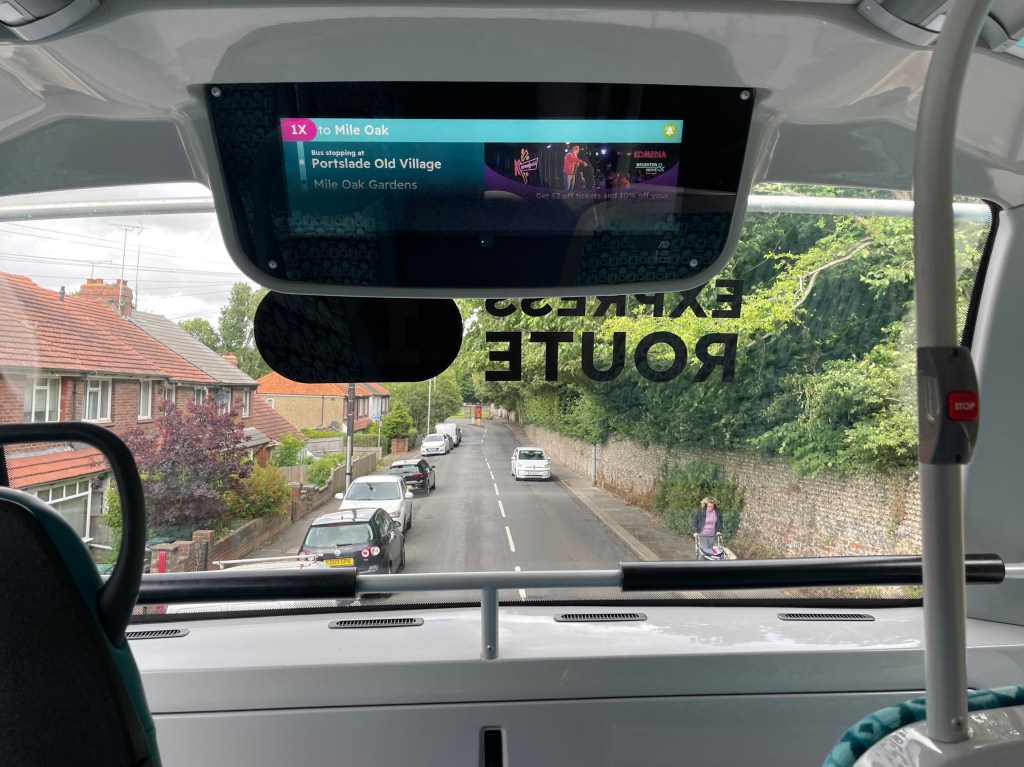
You wouldn’t be allowed to install such things on the lower deck front windscreen and disrupt the driver’s view, so why frustrate passengers by interrupting their view on the upper deck?
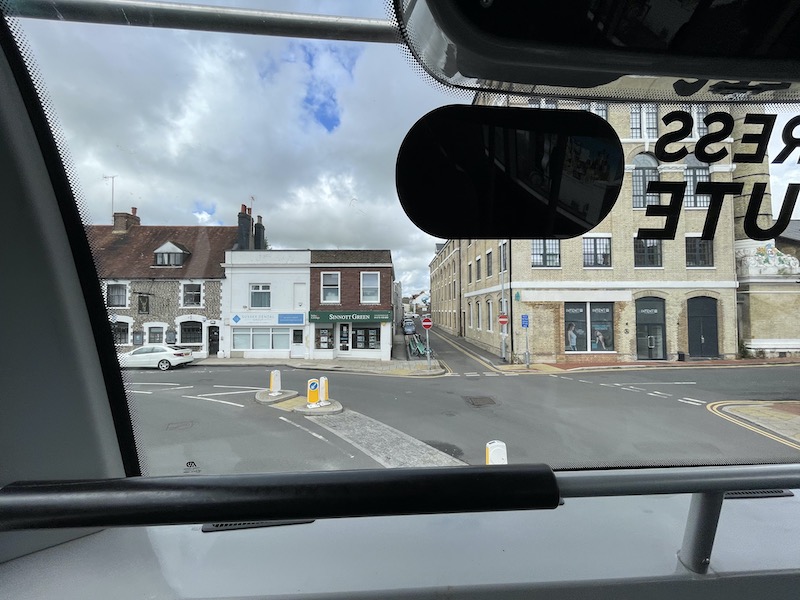
Passengers using routes 12X and 13X along the Coast Road seem to happily manage distinguishing their bus by reading the destination display.
That aside, the 1X is a great new development and I wish it every success.
The second new route which began on Sunday comes courtesy of Kent’s BSIP and the deep financial pockets of the property developers and Ebbsfleet Development Corporation at Ebbsfleet Garden City (to give it its official title).
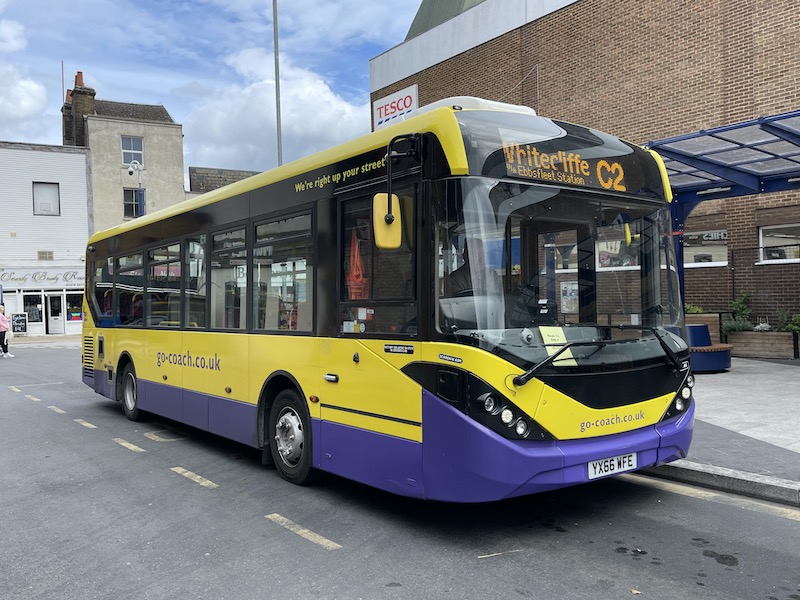
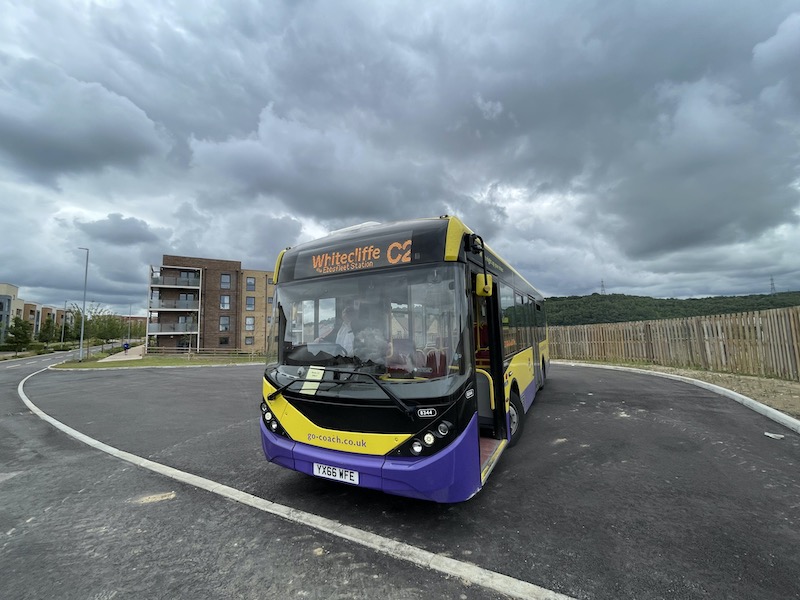
Route C2 is operated by Go-Coach Hire and links the expanding Ebbsfleet, including all the box like new residences in Whitecliffe Castle Hill, with Gravesend. It runs every 30 minutes from 05:30 to 23:30 (06:30 to 22:30 on Sundays).

The C2 is a temporary arrangement until the new Fastrack contract begins in November, when the Go-Ahead Group takes over from Arriva, and when I assume it will receive Fastrack branding.

Whereas Fastrack route B links Gravesend with Ebbsfleet International on a direct route, serving houses close to Springhead Enterprise Park, new route C2 operates via another new residential development alongside the Thames Estuary called Cable Wharf on a ‘Hail & Ride’ basis …
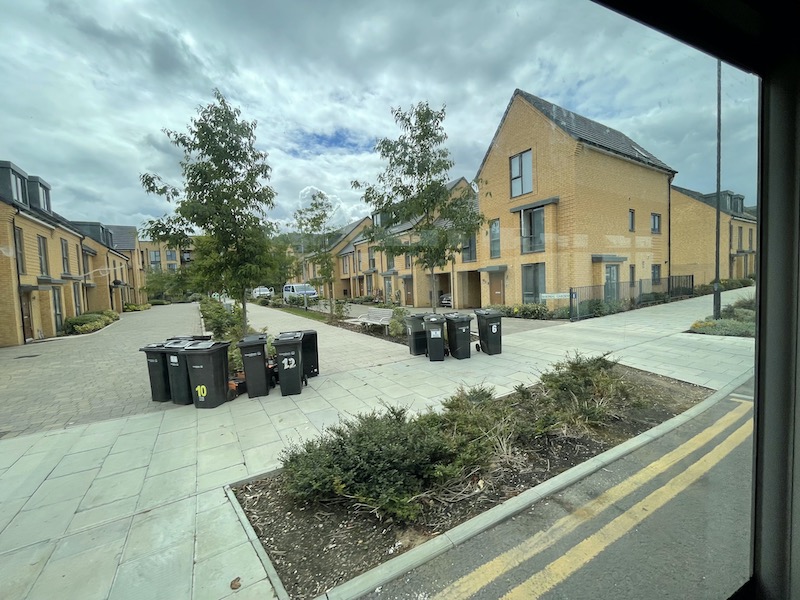
… before heading over to Ebbsfleet International railway station…
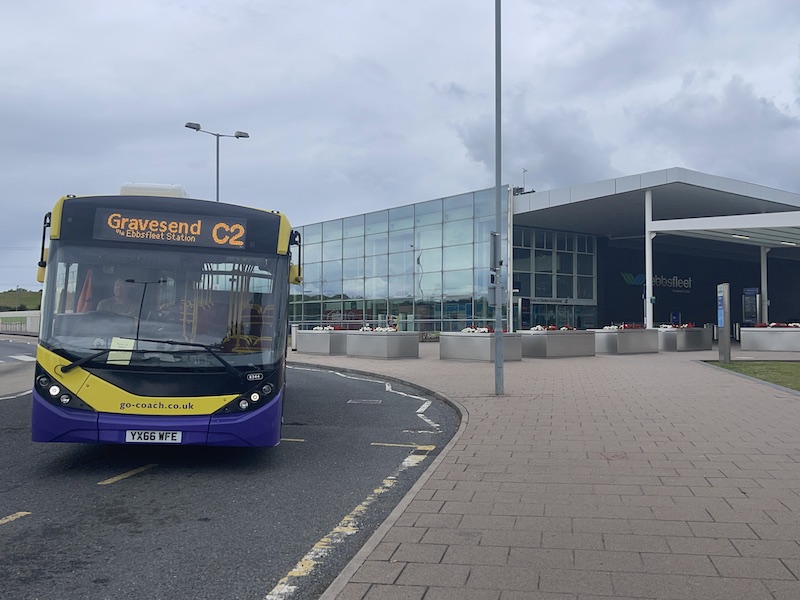
… and on to Whitecliffe.

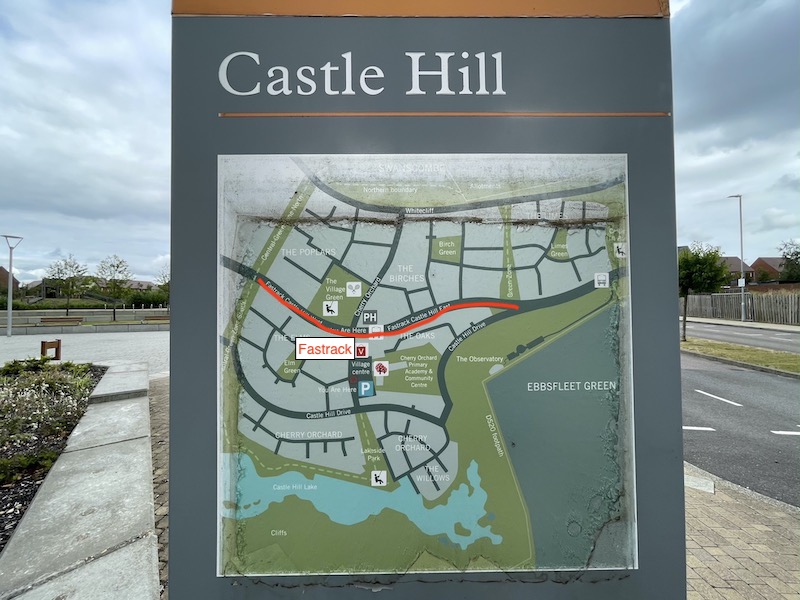
The route to serve the station in the Whitecliffe direction doubles back – I’m not sure why – then enters the expanding residential area that now includes its very own Fastrack branded road for buses only.
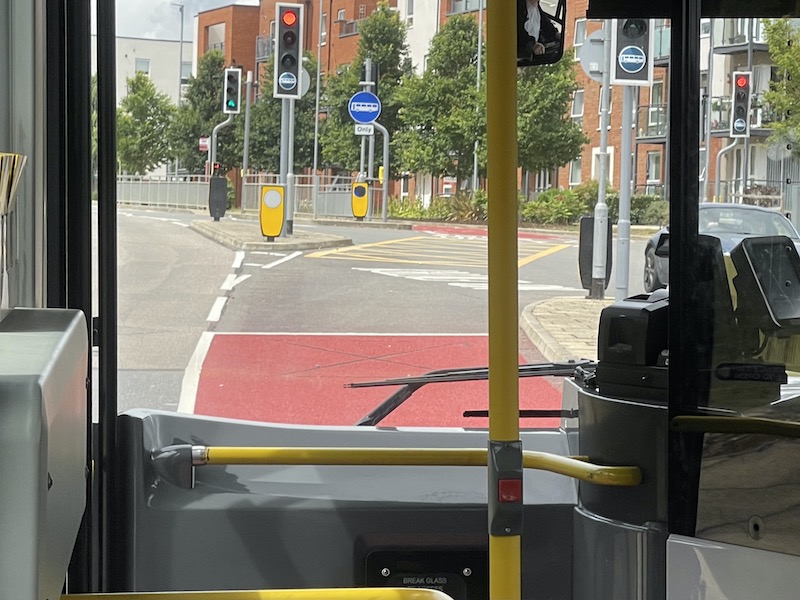
After 0.6 miles the bus runs out of Fastrack road and arrives at a large turning circle at a dead end…

… where there’s no bus stop or shelter.

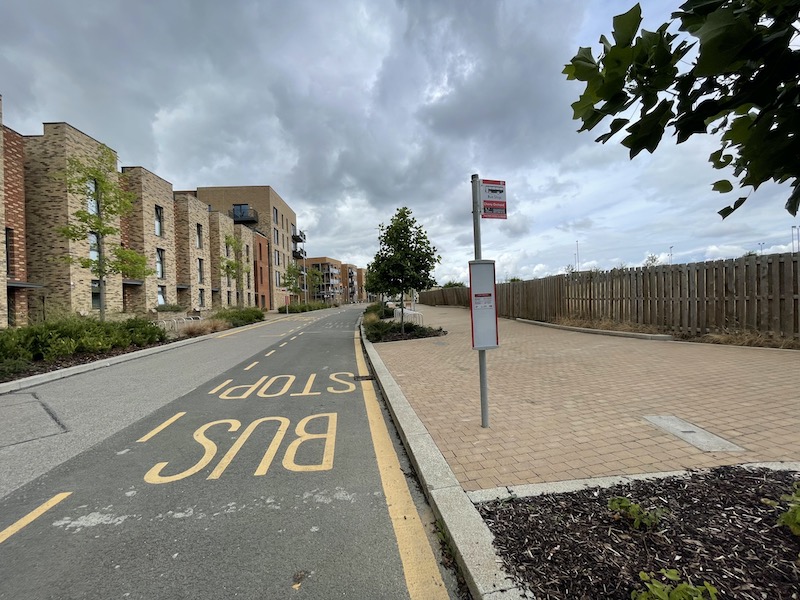
Indeed although there are some lovely public realm touches along the ‘Fastrack Busway’ by the shoebox houses and flats…
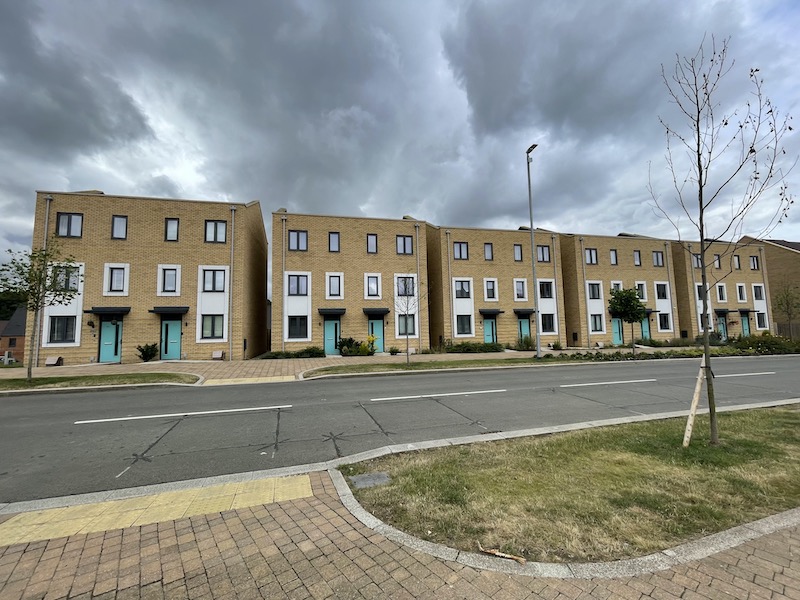
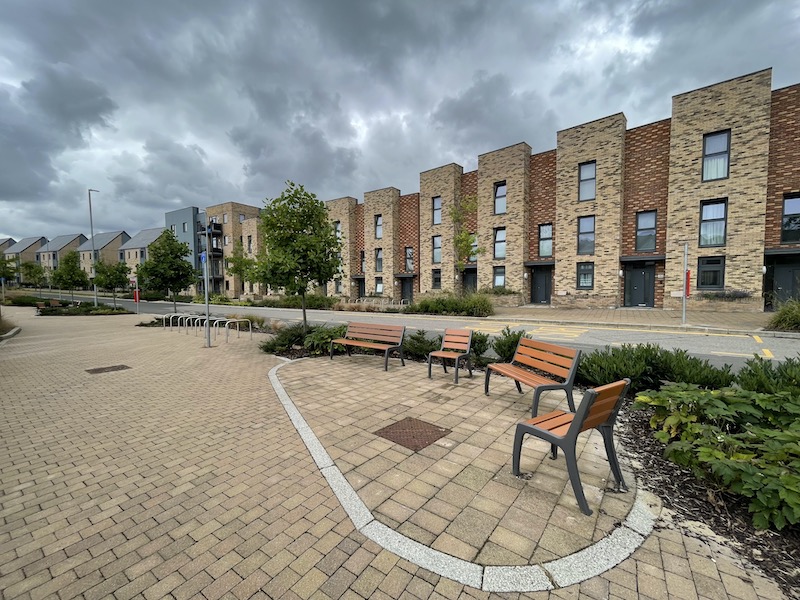
… it’s odd that no bus shelters have been installed at the two bus stops.
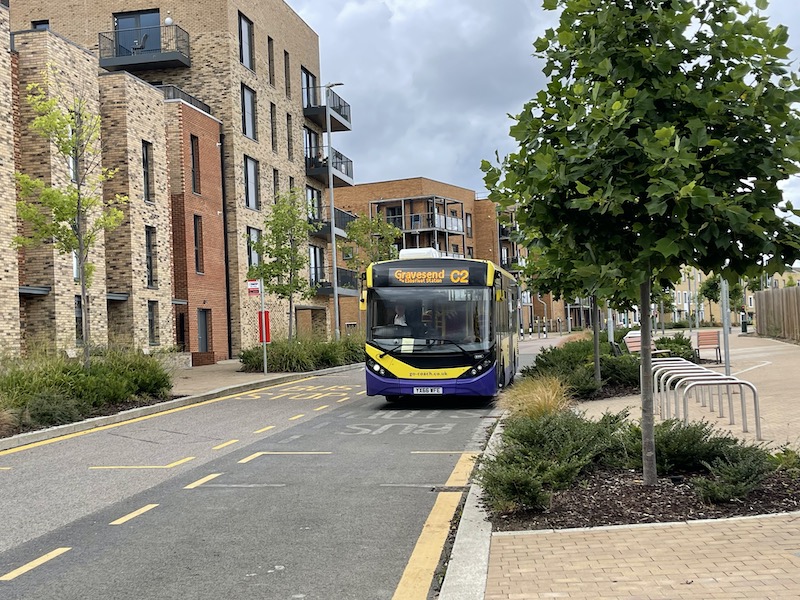
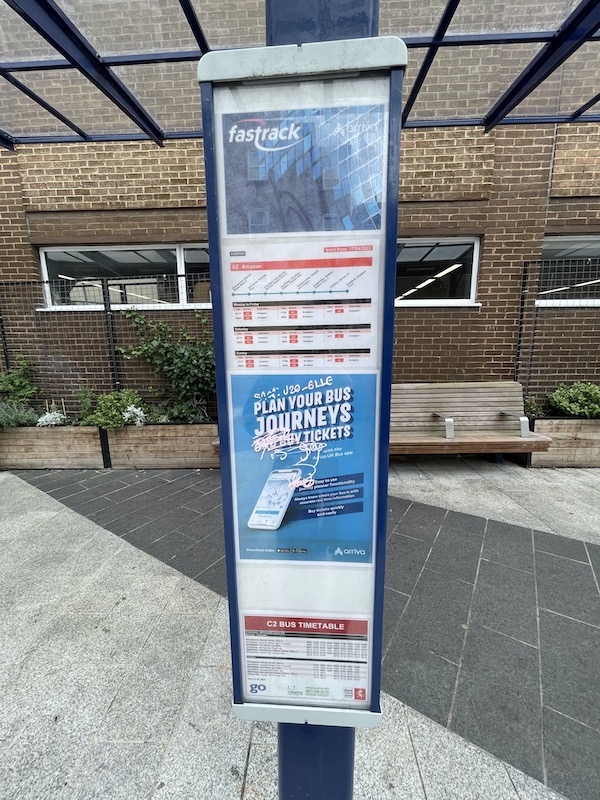
It was good to see Go-Coach has installed timetable displays all along the route…
… including at Gravesend…
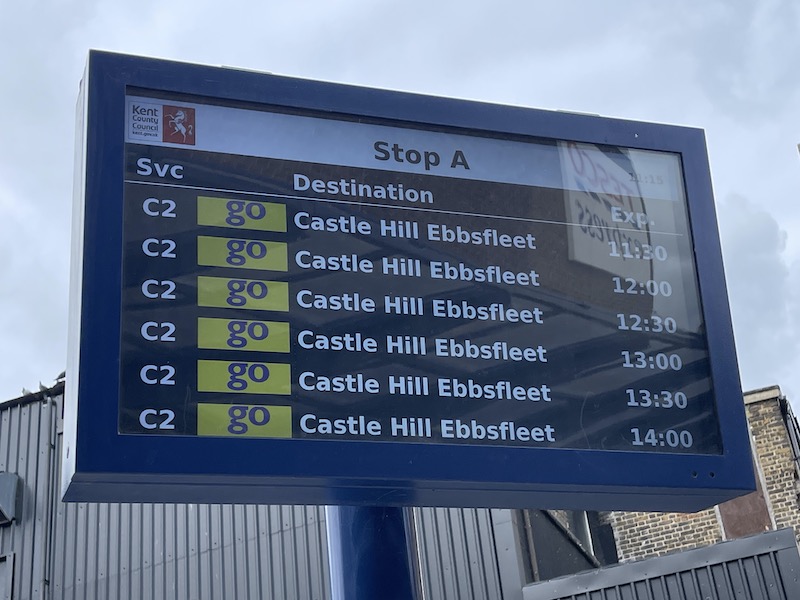
… where departures were also showing on the electronic screen.
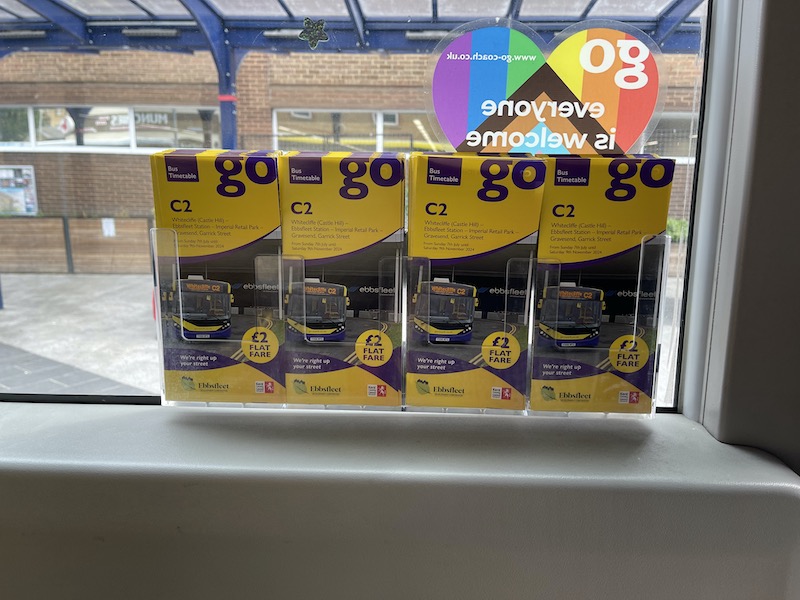
Also impressive was a plentiful supply of a timetable leaflets, complete with route map, available on board the buses.
I had a ride out and back as well as observing a few other journeys yesterday morning and numbers travelling ranged from zero (the most common) to one.
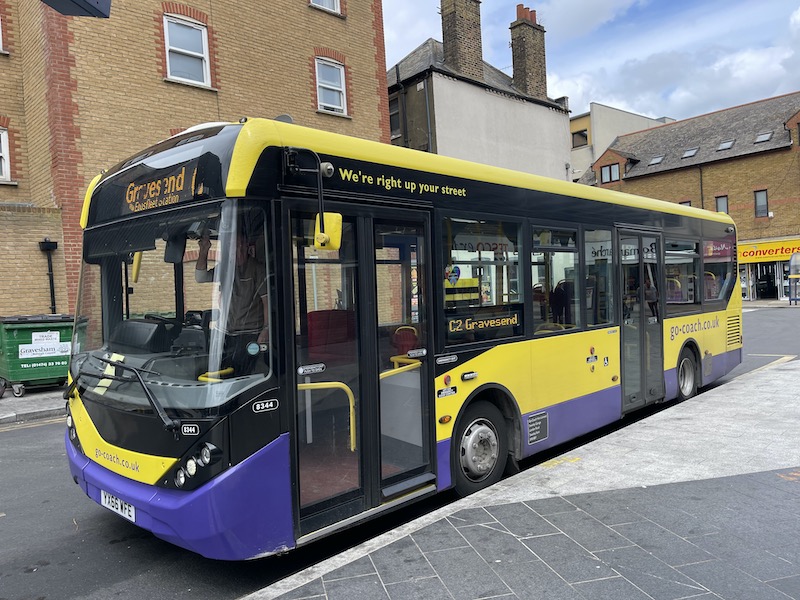
It’s just a 19-20 minute end-to-end journey time so the half hourly service requires two buses.
Ebbsfleet Development Corporation also funds the Arriva Click DRT operation in the Whitecliffe area providing a link to Bluewater, Darent Valley Hospital, Greenhithe, Swanscombe and also Ebbsfleet which route C2, it is said, “compliments”.

Interestingly I spoke to a resident who travelled on one of the journeys I made on the C2 and without any prompting he mentioned how he was looking forward to using the C2 with its fixed timetable rather than the “uncertainty of using Arriva Click”.

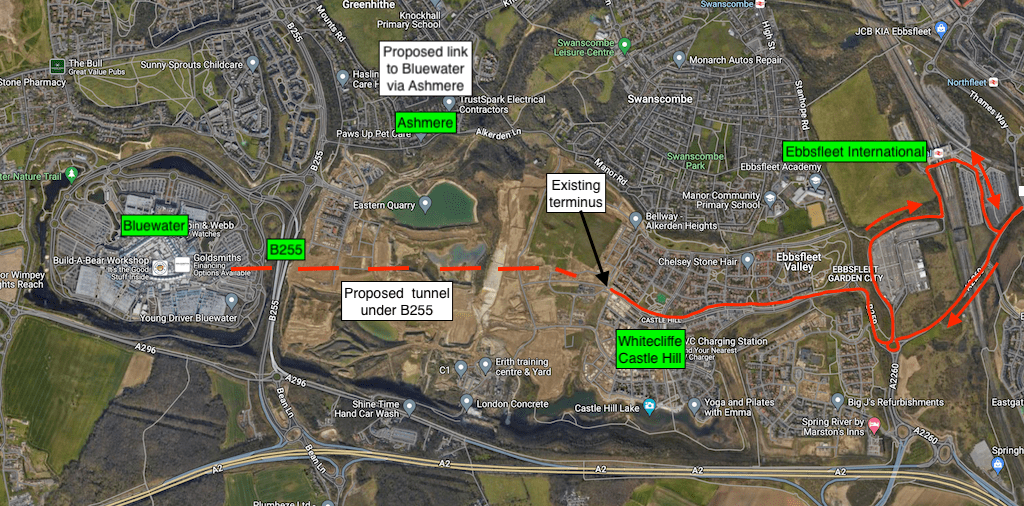
He said many residents had hoped the C2 would also provide a link to Bluewater (replacing Click) but the road continuing on via Ashmere isn’t expected to be completed until November 2025. Plans for a new £12 million 80 metre tunnel under the B225 (and through the quarry) which will provide a more direct access for buses between Whitecliffe and Bluewater, as I explained when I last blogged about this area in 2020, are “being refined by Kent County Council” – the organisation who will deliver that element of the proposed route” according to Ebbsfleet Development Corporation.
When I wrote that blog in 2020, connecting Whitecliff to Fastrack was expected to open in 2022, so, if it happens this November, it will only be two years late. Here’s a map showing the existing route of the X2 and plans for connections to Bluewater.
Here’s a map I included in the 2020 blog explaining the plans for Fastrack development.

It’ll be interesting to see how the replacement for route C2 is incorporated into the expanded Fastrack network when Go-Ahead takes over the contract in November, but in the meantime I don’t think the two buses will become very busy as most residents – according to the man I spoke to – “already have cars”.
Roger French
Blogging timetable: 06:00 TThS with Summer Su extras including this Su.
Comments on today’s blog are welcome but please keep them relevant to the blog topic, avoid personal insults and add your name (or an identifier). Thank you.
 BusAndTrainUser
Surpised Roger isn’t calling out B&H for the rather tatty looking blue lino which seems to be the flooring and lower wall covering on their latest buses. I’m sure when TfL had a similar spec he was (rightly) saying it was nowhere near as attractive as provincial buses which were using wood effect or patterns.
For my six-pence worth, the new B&H livery is a retrograde step as well – the red and cream looked very smart, was largely unique to the area, and had plenty of flexibility to work around different bus designs. The new scheme looks like something Arriva might have rejected a decade ago.
It’s an interesting question whether saying the service is every “13-17 minutes ” is better or worse than a timetable showing an extact 15 minute headway, when most of the buses are running 5-6 minutes late. What matters to me more is the accuracy to which Google Maps can tell me when the next bus is due, since that governs when I leave home.
LikeLiked by 1 person
Agreed about Roger calling out other companies but not his old employer for the same faults, and I’ll add on dismissing the tight seat pitch as a minor issue. It’s not.
It doesn’t matter how comfortable a seat may be in theory if you can’t get into it without wedging your knees against the seat in front! Ryanair seat pitch isn’t what the bus industry should be mimicking if it’s claiming a quality product.
As a more general snark, I dislike the current exaggeration of calling ‘Limited Stop’ routes ‘Express’, especially when they use exactly the same roads and get stuck in the same traffic as the all-stops route.
Express should mean exactly that: many fewer stops and routing avoiding the worst traffic hotspots between calling points (if that can be done).
LikeLike
Not so keen on the new livery either…..B & H Red & Cream was much smarter.
Geoff
LikeLike
Designer here. I’m not against B&H’s colour change, but I hate the new livery. It’s really generic and there are a lot of really weird details that make it pretty ugly in places. I assume this isn’t the work of Best Impressions? It doesn’t have that effortless elegance of his usual work. The new logo is also clunky and badly proportioned. I would have actually been pretty happy for them to just switch to their Live & Breathe livery used on the 2020 batch of buses.
LikeLike
As much as I’d like a limited stop service to be successful in Brighton, the traffic lights simply don’t prioritise buses. Boundary Road with New Church Road for example takes longer due to cycle lights being installed in the recent “upgrade” even when there’s no cyclists waiting. Lewes Road Sainsburys now uses sensors to detect if a cyclist is waiting in the cycle box before delaying the lights further. This should have been installed across the board
The Portslade barriers have become much worse recently delaying some services in cases up to 10 minutes. Even worse the 1X has to fight it’s way out of Victoria Road turning right over the level crossing. As a Mile Oak resident I personally would have rather had a link to West Hove Sainsbury’s brought back running the old Metro 1A route over the level crossing, having priority on the main road, serving Sainsbury’s as currently it’s a 2 bus journey to the closest superstore and entering Mile Oak from Fox way which has no buses during the day other than a few morning 55’s.
There are plenty of other junctions that slow buses down such as Church Road with Grand Avenue which often only allow 3-4 vehicles pass through before turning red and the newly designed Western Road with Montpellier Road junction that instantly changes red when no vehicles trigger the road cables.
The bus company has done some work on their side, despite a poor route choice, however the council could have done more to ensure the 1X and other buses stay on time instead of constantly “improving junctions” resulting in traffic lights becoming worse across the city.
You boarded the 1X on a Sunday where buses were 5-6 minutes late, so I wonder how late they’ll be at rush hour!
LikeLike
Roger,
A number of local residents who use the new ADL’s on the Coaster 12/14’s have commented about the lower saloon layout which leaves a huge gap between stanchions around the two wheelchair/buggy bays. There are straps attached to the ceiling but these are too high for little old ladies to grab hold of. Whilst I agree with providing more space for wheelcahirs and buggies, the new design disadvantages a lot of older passengers who use the seats in the lower saloon. The only safe solution is to remain seated until the bus comes to a complete stop and this further slows down the services, which are already getting slower for a whole host of reasons. This appears to be a case of an advantage for a minority being at a disadvantage of the majority of passengers.
Alec Horner
Telscombe Residents Association
LikeLike
Not sure if you’ve gone to the upper deck but there’s no hand rails either on this batch. There are only handles on the chair headrests which many on a busy bus are not available to grab! Who designs a bus with no poles and where all the stop buttons are on the back of the chairs! I’d understand if it was convertible!
LikeLike
| The only safe solution is to remain seated until the bus comes to a complete stop
Stagecoach and Arriva both have a policy that all passengers should do this, and drivers on S. East Midlands sometimes get a bit tutty at people who do stand up before the bus has stopped.
For our generation who grew up with the idea of being at the door before the bus came to a stop so you could be off in seconds it’s a bit strange, but presumably there’s an insurance cost to the way we used to do it which is mitigated by instructing passengers to remain seated.
Do the latest ADL buses still insist on ringing an emergency stop (doorbell repeated giving four bells) each time a passenger “presses once”?
LikeLike
Emergency stop is a “rapid succession of bells”.
Four bells, or “two pause two bells” signifies ‘an emergency vehicle behind, pull over and wait for said vehicle to pass’.
That was what I was trained to do in 1977, when I was a conductor. In two years on the platform, I gave two pause two exactly once!!!
LikeLiked by 2 people
| Emergency stop is a “rapid succession of bells”.
I was taught four or more = emergency stop, or more succinctly “ring the bloody bell until the driver slams the brakes on”.
Two pause two isn’t something I’d ever heard of and I suggest that it’s something specific to whichever operator trained you (LT or LCBS?).
(On the railway 2-2 means “Do not release doors – guard to contact driver”, for what it’s worth.)
I do recall a discussion with someone from ‘oop north’ at a running day where they were absolutely adamant that 3 bells (bus full) and 4 (emergency) were reversed (3 emergency) on their organisation, but I can’t recall who that organisation was.
Regardless, DVSA don’t agree with either of us!
In this guidance they specify bell codes as
ADL don’t seem to have been aware of that when they decided to play multiple door bells.
LikeLike
At the risk of further digression … it was LCBS training, but to the former LT standard. It was also what my rule book stated … and you went against that at your peril !!
One to stop; two to start; three to advise “bus full, continue to next compulsory stop unless one bell received”; four and five as stated earlier.
We were only permitted to stop at marked bus stops … no “where safe” stuff; bus stops were only sited where it was safe, and stop siting meetings were held with council and police in attendance.
Possibly excessive, but it had been done that way since the 1930s, when fixed bus stops were introduced across the LPTB area.
And no comment about the double stamp on the floor above the cab …. !!! Happy Days !!!
LikeLiked by 2 people
London Country though always had some unmarked bus stops
LikeLike
| it was LCBS training, but to the former LT standard.
Given your username I guessed it would be!
I was West Midlands-trained and all operators (municipal and company) used the same 1 stop-2 go-3 full-4+ emergency.
Compulsory stops weren’t really a thing; all stops were request, even though not all Birmingham stops specified “Buses stop by request”, they were all treated as request stops unless there was a Bundy clock where you had to stop to key them. I still have my numbered Bundy key somewhere…
Another digression, I believe that LT Bundy clocks printed onto a card inserted by the conductor/OMO driver, but elsewhere the clock itself had a paper tape on which was recorded the time and the key number.
| We were only permitted to stop at marked bus stops …
| no “where safe” stuff
You missed half the fun that way, picking up and dropping off at farm driveways or the front door of the pub…
Even in the urban areas there was some, shall we say, flexibility in the old days.
Happy days indeed, and all good fun!
LikeLiked by 1 person
I recall once walking home from school in a thunderstorm when the hourly Hants & Dorset bus pulled up beside me halfway between stops!
Ian McNeil
LikeLiked by 1 person
Polite observation. There are eight buses branded for 1X. Two of the older Enviro MMCs used on the 1 have also been branded for the service as well.
John Nicholas
LikeLike
Thanks for these reviews. I hope the 1X lasts – as you say, the introduction seems to have been done very professionally. Of course, B&H have other express routes, among the Brighton-Eastbourne set of services, and also on the Lewes Road all the Lewes-and-beyond buses are limited stop to the University. There is also the 29X once a day, now only in the mornings southbound from Tun.Wells. It does do the journey in more like the 75 or so minutes the old steam trains used to manage. B&H have built the half-hourly regular 29 into a great success, but does take quite a lot longer, meaning that (from TW) a whole day out in Lewes or Brighton is the only practical option, while car drivers can have mornings or afternoons out. A day-long 29X could enable that by public transport; obviously there would be a bit of custom taken from the 29, but I think it would increase the overall take sufficiently – particularly if tickets were valid by both routes.
I’d like to see other rural unter-urban express bus routes, opening up possibilities for non-car-owners and the growing band of people who would use public transport if it enabled them to go places. Maybe Tenterden-Hawkhurst-Heathfield-Ringmer-Brighton, which could be less than 2 hours by express bus (well over 3 hours by public transport at present).
LikeLike
Given Tenterden is about to lose its direct link to Hastings, and has seen the two routes to Ashford both reduced to roughly every 2 hours, the scope for a cross-Wealden service linking towns with populations of well below 10000 would likely require subsidy of DRT-like proportions.
KCC
LikeLiked by 1 person
The C2 stop publicity is standard Kent County Council fare; it doesn’t look like there is any Go-Coach involvement.
KCC
LikeLike
C2. The man is almost certainly right – residents of Ebbsfleet are likely to still be working, perhaps commuting. They want to get to the station in time for the train. A reliable, fixed time bus service (which, hopefully, connects with trains) is the only real alternative to the car, No less frequent than half hourly. That is what needed to be introduced from the start. It would have lost money then, but with development numbers might have picked up. It is too late now, you won’t change behaviour. Instead they went down the DRT route – I pass through the area from time to time, it doesn’t seem over busy.
I wouldn’t get too excited about the Fastrack services until I see the timetables, As alluded to in the article, they tend to weave around the place. When I am up that way I tend to avoid Fastrack as, for the journey I want, a conventional service is faster and I don’t have the frustration of seeing the same scenery I saw five minutes before. Convenient for residents – yes. Fast? Debatable.
LikeLike
The B&H 1X looks very presentable, I quite like the new aquamarine livery, very appropriate for a seaside location (the red and cream was superb though). Also, the pink bus stops really stand out, in too many places bus stops just look sad and uncared for.
As for using “express” as a descriptor, my local company Faresaver uses the words “Fast and Direct” on the destination displays for new service X31 Chippenham to Bath, which cuts out the meanderings of the 231 and saves c25 minutes end to end.
Peter Brown
LikeLiked by 1 person
I do wonder why BSIP is being used to fund such as initiative as the X1 in a dense urban area like B&H. It’s a shame the local operator wouldn’t take the commercial risk. Taxpayers money could be better used for poorly served areas in other parts of the Country.
LikeLiked by 2 people
Surprised that the X1 has come out of BSIP funding as Brighton & Hove have long experience of working limited stop with the 12X, 29X and some Lewes Road services. As pointed out, the 60 once did the same job, thus surprised that the lengthy Mile Oak/Portslade corridor hasn’t been looked at previously. As said by an Anonymous contributor, taxpayers money could have been better used than in such an urban area with already very high bus use.
The utter pointlessness of changing the B&H livery still astounds, but at least it is a livery unlike the three Stagecoach offerings of insipid, deeply insipid and schoolbus Ugh! And why oh why, particularly with modern electronic blinds, do they not display a colour version (blue or yellow as done in LT (not TfL) days) so the buses can be seen at a distance? It would obviate plastering front windows at least and side branding making life easier for flexible working.
In conclusion, it has to be said that improvements such as this are very positive and welcome indeed.
Terence Uden
LikeLike
|And why oh why, particularly with modern electronic blinds, do they not
| display a colour version
Be careful what you ask for! They do that in Brussels (STIB/MIVB) and some of the colour combinations they use are simply unreadable. Might have been OK on a printed paper blind, but not on an electronic display.
I’m definitely not looking forward to LCD destination displays, as you just know some her-today, gone-tomorrow whizzkid will come up with some destination display design which is amazing in their mind but utterly atrocious in reality, and nobody will know how to change it.
LikeLiked by 1 person
In respect of the 1X – B&H,B&C publicity excellence again. Well done on having the North Street Shop open on Sundays and the additional enquiry point outside Brighton Station. I have never had a cellphone so a shoulder bag full of B&H booklets is a real joy!
LikeLike
Arriva is launching a new coach service linking central Milton Keynes to Luton. The X1 service starts on 21 July and offers a fast and direct service, complementing the existing F70 and F77 routes, which will operate as normal. The route is the first new commercial venture from Arriva since the pandemic.
LikeLike
It looks as though Arriva are looking to compete with part of Stagecoach East’s MK1 route (Bedford – Luton – Milton Keynes) which Roger explored some while back. However the Arriva routing will be via the Busway and Dunstable rather than the M1.
I would guess that Arriva’s new initiative is a response to Stagecoach East’s LAX route which started last month and is a an hourly shuttle run with one bus between Luton Station and the airport, supplementing the MK1 between these points. Like the MK1 it is operated from Bedford, which entails a dead run at the start and end of each day’s operation.
Ian McNeil
LikeLike
The X1 will not be using the Busway, as it is scheduled to be run with non-guide wheel equipped coaches. Registered route is via Hatters Way, meaning Dunstable-Luton journey times are nearer 25 minutes than the Buseay’s 15.
KCC
LikeLike
Hey Roger,
Would you be willing to post (updating) posts where you list
* All your experiences of new/significantly altered routes resulting from BSIP (excluding DRT), maybe in last 18-24 months as I known BSIPs renew/change and BSIP piloted changes don’t always work out
* All your DRT experiences (presumably some of these are BSIP as well)
Also, will you be heading up to Norwich/North Norfolk again soon? Sanders seems to have reintroduced an express X40 on their main Holt/Sheringham/Cromer/Aylsham corridor to Norwich (complementing services 9,44/44A/X44,43) which I think is BSIP funded, and also has been significantly refreshing their fleet (mostly new Chinese buses rather than new buses from traditional UK makers or newer handmedowns from other operators).
MilesT
LikeLike
If you’re referring to the new double and single deck buses operated by Sanders, none of them are Chinese. Bodywork by MCV (Egypt), chassis by Volvo (Swedish – the Chinese company Geely only have a stake in Volvo Cars not truck & bus).
-blue
LikeLiked by 1 person
My mistake–although Sanders do have a couple of Yutong Coach buses, I mist have been thinking about those when I wrote the comment.
MilesT
LikeLike
I welcome the introduction of the 1X providing a link to the Hospital and Marina from Mile Oak and Portslade and will certainly make use of it. I do, however, share the disappointment of others that BSIP money should be used to improve a service where the frequency is better than 15 minutes rather than, for instance, increasing the frequency of the service Steyning from hourly to half-hourly by providing an hourly 60 service rather than the current one journey per day. Not only would this give Steyning a better link to Shoreham and Brighton but would link Shoreham and Southwick and improve the service to the Manor Hall area. The 1A could easily have been converted into the 1X by Brighton & Hove as a commercial initiative.
My trip on the first day of the 1X to Mile Oak from Portslade Town Hall (new stop, thank you!) proved eventful as there were no timetables on the bus and the driver went the wrong way but he was extremely polite and thanked me when I pointed out his error. I was rather taken by his trilby hat and silk scarf but suspect this is not exactly the new B&H uniform!
More disconcerting is the fact that the Company has planted pink bus stop poles all over the place when we should be looking to reduce street furniture. Even where the existing stop had a perfectly acceptable shelter with plate and timetable case this has been ignored and a pink pole planted. Would not a pink bus stop plate have been an acceptable alternative given the new teal blue plates clash dreadfully with the pink poles! Just to rub salt into the wounds, the bus stops in Victoria Road, Portslade, upgraded to Kassel kerbs et al only a couple of months ago have had their grey poles supplanted by pink poles and one stop is now no longer used despite the new kerbing and bus stop painted on the road. Not exactly a fine example of forward planning, I suggest!
As far as the 1X stops in Mile Oak are concerned it is disappointing that not all stops are served on-line of route. A grand total of FOUR stops are missed out which really would make little or no difference to running times and ensure that everywhere in Mile Oak and Old Portslade could utilise this service as a fast link into town. The distances from Graham Avenue Shops to the Hole in the Wall and from Portslade Old Village to Southern Cross are considerable for the elderly or infirm.
As far as publicity is concerned it is rather disconcerting to see posters for the 1X proudly displayed on stops where the 1X does not stop. Yes, they have produced leaflets but I still think a network book produced twice a year would be better if only because you would then actually know if you had the up-to-date timetable!
Adam Yates
LikeLiked by 1 person
Yes, more buses on from Steyning would be great, but NOT over all those road humps on Route 60 through Shoreham and Southwick, please. And Manor Hall Road is just crazy with parked cars. It is not suitable for an “express” service.
LikeLike
No, I certainly was not advocating an express service via Manor Hall Road. Steyning could do with the extra bus per hour and I was looking for somewhere that is under-bussed to benefit from BSIP. But I don’t think an hourly service is asking too much. No doubt the humps could be doctered. As for parked cars, it is certainly nowhere near as bad as driving a bus round Moulsecoomb!
The 1X should stay as it is without the pink poles and with the four extra stops as a commercial enterprise.
Anyway, it is all academic because the 1X is here, with BSIP, and the 60 remains at one bus a day!
Adam Yates
LikeLike
Are bus operators actually allowed to paint the bus stop poles in a colour of their choice? Many years ago – not long after deregulation – there was an incident in the city where I worked, when a new operator painted some bus stop poles blue, because blue was their “house colour”. As I understood it at the time, the operator was duly advised, in no uncertain terms, that it wasn’t their job to decorate the bus stop poles, although they could put their name and service numbers on the flags.
Has the rule subsequently been changed? I would have thought that the highway authorities would still be interested in regulating the colours of such street furniture.
Nigel Frampton
LikeLike
As far as I know there are no regulations with regard to bus stop poles, It may be if they were owned by he council they may have had a specification for them
The DfT have also issued guidance
To help passengers, especially the visually impaired, to distinguish bus stops from other street furniture, bus stop poles may be of distinctive design or contrasting colour with the background.
If bus stops are attached to other poles or structures, colour banding will help identify them. The Department for Transport’s guide Inclusive Mobility8 provides comprehensive details
LikeLike
Thanks. That would make sense – at that time, the stop poles in question would have been owned by the council, as was the long-standing principal bus operator. If my memory serves me right, the poles were grey at that time, so not particularly prominent – but we have moved on since then!
I have a vague recollection now, that Hants & Dorset painted their stop poles green and cream outside the major urban areas, but that would of course have been even further back in history than deregulation!
Nigel Frampton
LikeLike
And Wilts & Dorset promptly painted all their bus stop poles Red as one of the first jobs, upon privatisation.
Petras409
LikeLike
Good article on Jarrett Walker, transport consultant and bus network redesign. Roger will like his emphasis on the importance of maps.
I’ve read his blog Human Transit for several years, he always has something useful to say.
https://www.route-one.net/features/why-bus-networks-need-revolution-and-not-evolution/
Peter Brown
LikeLike
Peter, thank you for bringing this book to our attention.
To obtain it as quickly as possible a friend ordered one during half time while we were watching the final on Sunday night and it dropped through his letter box at 08:15 yesterday morning. Good Service!
I picked it up last night on return from the south coast and I’m finding it an excellent thought provoking read.
The index allowed me to instantly find his opinion on Uber as I returned to a sea of it outside Coventry station where there used to be a bus interchange!
The Index also acts as a translator. Demand Responsive Travel is known as flexible services in America. Jarrett’s succinct style eloquently shows how it is an inefficient use of that most valuable resource “labor”.
Thank You
John Nicholas
P.S. In Jarratt’s world Brightons express route 1X would be a rapid One!
LikeLike
The 1X seems to be growing slowly in popularity. I caught one from the Marina last night and there was a long queue of people I assumed were waiting for the 7. However, a 7 came and went and around 50% of the people remained behind for the 1X – they even cheered when it pulled round the corner. We caught up with the 7 on the run into the city centre. If anything, it relieves the strain on the 7!at busy times and provides new links between the marina and the areas west of Brighton. However, it’s not really working as an ‘express’ service. There are multiple roads dig up around the city and the roads often become narrower after work is complete, leaving few places for express buses to pass other buses. B&H council are on a mission to widen pavements and then fill them with clutter, like communal bins, shop furniture, bike racks, tree planters etc… Nobody really benefits after B&H council have finished their chaotic schemes. People’s stress levels just increase because they are constantly fighting for space on roads and pavements.
LikeLike
I’m sure as others have said, BISP money could and should be used to improve areas which have a poor service, such as the 22 in Woodingdean and 48 at Bevendean. Both are big residential areas which suffer badly when the city centre is conjested. Leaving them without buses over an hour. To be able to add a bus into those areas is where the money should be directed, not using it to enhance profits on an already profitable route.
LikeLike
Peter, thank you for bringing this book to our attention.
To obtain it as quickly as possible a friend ordered one during half time while we were watching the final on Sunday night and it dropped through his letter box at 08:15 yesterday morning. Good Service!
I picked it up last night on return from the south coast and I’m finding it an excellent thought provoking read.
The index allowed me to instantly find his opinion on Uber as I returned to a sea of it outside Coventry station where there used to be a bus interchange!
The Index also acts as a translator. Demand Responsive Travel is known as flexible services in America. His succinct style eloquently shows how it is an inefficient use of that most valuable resource “labor”.
Thank You
John Nicholas
P.S. In Jarratt’s world Brightons express route 1X would be a rapid One!
LikeLike
A very informative and comprehensive review of the route 1X, Roger. I live close to the Richardson Road stop on New Church Road, Hove, and have already used the routes five times – once to visit a friend in Portslade Old Village, twice to Churchill Square, and twice to visit my father in the Royal Sussex Hospital, and I really appreciate the faster journey times and that B&H are proactive in promoting their services. My only minor gripe is that the legroom on the new buses is very tight (and I’m only 5ft 6in), and the upstairs ambience isn’t as nice as the buses still operating the 1 and 5, and I wish they’d gone for the same spec as these vehicles.
LikeLike
I couldn’t see how to add my name to the comment above, and as I’m already a subscriber, I thought the system would automatically pick this up.
LikeLike
1X… The future for Rapid Human Transit in Britain?
“Buses in Brighton aren’t as good as they used to be”!
Not my words but a lady sitting opposite me while aboard a durable Scania stuck in North Street bus lane traffic! When asked to explain her reasoning she said “They don’t go as fast as they used to and you can’t use City tickets to Lewes anymore.
Against this background the introduction of a limited stop bus route ought to be a cure for her disenchantment.
My initial reaction based on personal experiences was that Brighton & Hove buses (BHB) like operators in other cities had resorted to limited stop services to increase staff and vehicle utilisation……and profit.
It is a wonderful irony that todays TfL Superloop services have their origins in route 607 introduced over 30 years ago as an initiative by a local bus unit of London Buses rather than TfLs predecessor London Regional Transport.
Proposals at the turn of the century to replace this with the West London Tram were shelved due to opposition by councils in part due to disruption caused during construction.
Having “commuted” to
Brighton for the last couple of weeks to sample BHB’s new 1X first hand I soon changed my mind when I realised this was a collaborative venture between BHB and the local council with BSIP assistance seemingly built on trust and shared objectives similar to those that existed in the days when expensive light rail solutions were perceived as the solution elsewhere.
Because 1X is Brightons rapid transit.
Undoubtedly there will need to be a few tweaks but buses are flexible, extra stops can be put in without disruption, diversions can occur instantly whether or not planned and crucially in these straightened times revenue loss is a fraction that I witness on faceless light rail systems.
Those recently installed in government positions able to influence bus policy would do well to take note of route 1X. If it had been numbered “0” it would have been nationally unique and been at the top of every route list!
John Nicholas
Written yesterday sunbathing on Shoreham Beach.
Sent tonight from Gatwick Express with nostalgic thoughts of Connex.
P.S. It is possible for the lady to travel to Lewes with a Citysaver, she couldn’t have come back!
Forwarded to B&H and Brighton Buswatch for sight prior to posting.
LikeLike