
Tuesday 8th August 2023

Here’s some good news from Thames Travel, the sister company to Oxford Bus. Its bus routes between Didcot and Harwell Campus were rejigged from 23rd July to include a new hourly service X34 linking both locations with Newbury travelling non-stop down the A34.

I took a ride last Tuesday to check out the potential and see how it’s settling in.

Harwell Campus (as well as Milton Park) are both sited close to Didcot and in recent years have been big supporters of sustainable travel initiatives which have done wonders for a decent bus network in this part of Oxfordshire.

Their distinctive blue (Milton Park) and green (Harwell Campus) branding can be found on bus shelters…

… bus timetables …

… and the buses themselves.

It all creates a very positive image for buses and demonstrates their commitment to sustainable transport to and from their respective sites.

Unfortunately the result can be a bit confusing with liveried buses appearing on the wrong routes as well as a myriad of other liveries Thames Travel has at the moment, thanks to inheriting vehicles from other Go-Ahead companies …

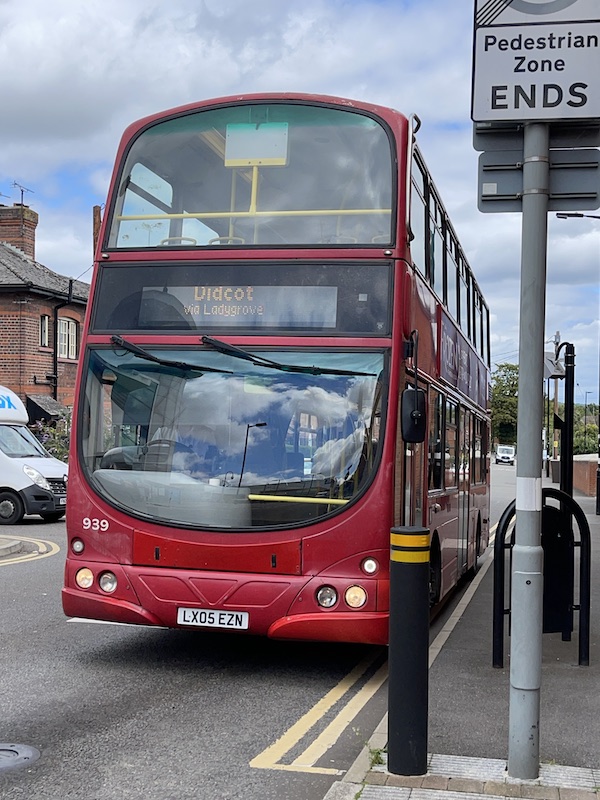
…. as well as the ‘Connector’ brand it uses for many of its routes.

It’s all a bit confusing.
Harwell Campus enjoys a 15 minute frequency to and from Didcot via the nearby village of Harwell as well as serving the recent (since 2009) extensive residential development known as Great Western Park (GWP) on the western flank of Didcot.

The 15 minute headway comprises the new hourly X34 between Didcot and Newbury as well as an hourly short between Didcot and Harwell Campus and a half hourly X35 from Didcot which continues west to Wantage and alternate (hourly) journeys on from there to Faringdon (one R – not the London one). It’s a neat timetable which as you can see below sees interworking between both routes in Didcot.

The X34 and X45 have replaced route 98 which used to run every 15 minutes to Great Western Park and half hourly on to Harwell Campus …

… and the half hourly X32 on its longer journey from Oxford (JR Hospital and city centre) via Milton Park and Didcot to Harwell Campus and Wantage.

The X32 has now been split, with the Oxford to Didcot section continuing as an X32 with the Didcot to Wantage section being taken over by the new X35.
The new X34 between Harwell Campus and Newbury restores a service which last ran in 2016 when Newbury Buses’ routes 6/6A were cut back. The 6 had used the A34, as the new X34 does, while the 6A served villages but the timetable comprised only about four journeys on each route so nothing like the hourly service now operating.
It’s 13 miles from Harwell Campus to Newbury and after a four minute detour around the village of Chilton just south of the Campus the X34 then runs non-stop down the A34 on a 15 minute romp…

… until it reaches the Vodafone complex on the northern edge of the town.

Only two young teens travelled on the new section of route to Newbury on my southbound journey – they boarded in Harwell Village – but I was impressed that eight were waiting in Newbury bus station to board the return.

The timetable includes a 13 minute layover in Newbury but we arrived 15 minutes late having left Didcot similarly late as were other journeys I observed, not helped by the dreaded 4-way temporary traffic lights at the busy roundabout just west of Didcot Parkway station.

The X35 only has five/six minute turnaround times in Wantage and Faringdon with minimal time in Didcot between the X34 and X35 journeys so I reckon late running could become a thing especially as the roads around Didcot seem to always be busy and on my trip last Tuesday an incident near Harwell blocked the A34 with surrounding roads soon feeling the effect.

That concern aside this really is a great initiative and it’s particularly good to see a new cross county route being introduced and with support from Oxfordshire County Council who are paying a subsidy of £158,670 with a review in September 2024.

Another bonus from the X34 is the opportunities it provides for a quick link by bus between Newbury and Oxford by changing at Harwell Campus from the X34 to route ST1 which provides a fast direct link between the Campus and Oxford. Journey time is only 80 minutes and a timetable showing the convenient connections is included in the Harwell Campus timetable book illustrated earlier.

Here’s hoping the X34 (and X35) is a success and it attracts enough passengers to make it a permanent feature of the network.

Roger French
My grateful thanks to Hugh Jaeger of Bus Users Oxford for the historic references.
Blogging timetable: TThS and Su DRT extras


I must have known!! I rode on the X34 yesterday . . . the 1034 from Newbury. The bus arrived on time, seemingly empty. Departure was 9 minutes late, for no reason, other than we were only 5 minutes late at Chilton and would have been on time at Didcot apart from the 4-way traffic lights referred to in the blog. 3 passengers boarded in Newbury; 4 more in Chilton, and then 4 more in GWP, so 11 overall . . . pretty quiet, but it’s early days.
Those traffic lights seem to be delaying occasional buses; the X34 to Newbury at 1128 was 15 minutes late, but my following X35 to Wantage was nearly on time, but delayed again at the TTLs (it was the same bus as from Newbury). Arrival into Wantage was delayed again by more TTLs . . . the curse of bus operations!
I’d say that the running time to Newbury via the A34 was a tad excessive, although I daresay peak traffic around Vodaphone might sort that out! I note a review is due in September 2024 . . . might a diversion via East Illsley on alternate journeys be worth while? It’s pretty thin territory, though.
I concur with the confusing liveries . . . vehicle branding on routes with only a small PVR never seems to work well. Nottingham cracks it by grouping routes together into areas, and having just enough buses for the basic PVR, with generic spares (as do Reading, and to some extent Oxford).
I do wonder about long-term viability, though . . . Harwell was deserted on my first journey, and even at lunchtime there were very few people walking about. Every bus I saw, (and with 10 BPH serving the terminus [including the ST1], there are plenty to see!), had only a handful of passengers on board . . . I hope the peaks are much busier! 2 BPH to Wantage seems OTT, though . . . the Saturday daytime service has only 1 BPH to Wantage and Newbury, which sounds better.
LikeLiked by 1 person
If I have the correct road works they are due to last until the 18th August
It would have been sensible to adjust the timetable temporarily to allow for those works. Probably going to add at least 5 minutes to the journey time
LikeLike
Many thanks for this news. I’ve often thought that numbering a bus route to relate to a main road that it uses might attract more car drivers, who tend to know road numbers pretty well. I wonder if any surveys will be carried out to find if this is the case?
LikeLike
Hi Roger
Thanks for the positive write up. Just a couple of things from me:
– the Harwell to Newbury section of route is funded by BSIP money from both Oxfordshire and West Berkshire Councils, although the contract is with us. It is important that the contribution made by colleagues from West Berkshire is appreciated in getting this service up and running.
– the last time there was a regular service between Newbury and Didcot was 2011. The former 6/6A services then only reached Harwell three, and then latterly, two times a day until their eventual demise in 2016 – they were not well used, primarily because the morning peak journey arrived very early and the evening peak journey departed very late. The 6/6A now terminates in West Ilsley, a few miles south of Chilton.
Beyond the BSIP funding period we have S106 funds remaining from Great Western Park and therefore we do expect to be able to fund the service for a reasonable period beyond the end of the initial contract (which is until September 2024 because that’s when the main GWP contract ends).
There are still some things to iron out but overall we are very pleased to have been able to restore this connection and we hope it is successful.
Kind regards
Dave Harrison
Principal Public Transport Planner
Oxfordshire County Council
LikeLike
Many thanks for all that info Dave.
LikeLike
A great illustration of why branding buses outside urban areas that do NOT stay on the same group of routes (Nottingham style) should not be branded. It just looks an unholy mess in the same vein as Stagecoach, with “distance”, “local” and “special”, none of which bear much relation to each other or mean anything to the public, yet appear haphazardly on most services. By the time Thames Travel get round (if ever) to sorting out liveries, there will have been another review or swapping routes/vehicles with parent Oxford once more and………….further confusing mess.
Far better to standardise liveries, as in the past, and introduce bold destination equipment back and front which can actually be read Transdev Coastliner style, in bold white day-glo or whatever the technical term is.
LikeLike
Branding routes in my view just adds to costs and the buses rarely keep to the branded route
There is no real benefit in branding other than a corporate brand
Most people just want a bus. As long as the route number and destination is clearly displayed which is not always the case passengers do not care
LED display are petty flexible so if they want to clutter it with some kind of branding on that they can
If you go around the country you can see endless old attempts at branding running on random routes
The money could be better spent on running better services in my view, Branding buses does not come cheap
I suspect if you run a survey most people would not have a clue as to the branding of the bus they use
LikeLike
Following the introduction of its new Grey livery across its Fleet National Express West Midlands is abandoning route branding on its services on repaint. After routes such as Nifty Fiftry & the oo2 & 226 Diamond Bus has already abandoned eoute branding. Here NXWM branded WB87s often end up the WB12/A/13/A whilst most days a WB41/2 is on the WB3 while WNX8 branded buses usually end up on any WN route including WN15/6.!
LikeLike
Only a few operators have ever done route branding properly. The ones that spring to my mind are Nottingham, Reading, and Brighton & Hove, although the latter is changing to an aquamarine livery so not sure if route bbrandingis continuing. Really bad examples IMO are Go North East (way too many garish liveries, in an operating territory shared with two other large operators, the overall effect is to chaotic reminding me of Latin America), and TrentBarton with its silly names.
LikeLiked by 1 person
Incorrect route branding might be the least of the X34 problems. For those of us who have spent decades travelling up and down the A34 will know, this stretch of road is notorious for accidents and delays. Back in the early days of privatisation, when traffic was a lot lighter, Hampshire Bus introduced the short lived X34 between Southampton and Oxford, it soon became plagued with timekeeping issues and abandoned. No doubt Thames Travel drivers will soon become accustomed using the parallel roads through West/East Ilsley and Chieveley.
LikeLike
Whilst I commend the ambition, I’m a little skeptical as to the long-term prospects for a Newbury to Didcot link. It’s been tried several times and it’s just very thin territory.
As for the wider question of branding, it does work well but it has to be managed. Routes like the Lands End or Exmoor Coaster would not be as successful without the marketing and branding of the product. However, as Cornwall also testifies, there has to be careful management of vehicles and a critical mass of a PVR to enable the image to be consistently managed.
LikeLike
It depends how it’s promoted, to be honest. The end to end Newbury to Oxford journey is not too bad on rail, but if they were to divert into East Ilsley, they could take quite a few walkers off the nearby Ridgeway, who often pop the mile down into the village centre for a drink in the pub. A short divert to outside Newbury Showground during events might also gain enough passengers to help sustain the service.
LikeLike
What’s in effect you mean is, extend existing routes 6/6A (Newbury to West Ilsley) to Didcot, just as their predecessor routes used to for very many years. Given those routes are relatively infrequent, the improvements to the villages served by providing an hourly service would be certain to generate more passengers.
LikeLike
In part, yes, the issue with that is that the X34 wouldn’t serve the areas of Chieveley and northern Newbury, so I would keep the X34 for now.
LikeLike
How about a blog on the worlds most remote bus service? Just getting there will be a challenge in itself. The only real transport to it is the once a month ship from South Africa a mere 2800Km away which takes about 8 days
LikeLike
One issue you appear to have overlooked is that the residents of Harwell village no longer have a bus which takes them to the Doctor’s Surgeries, Didcot Hospital and pupils at the senior schools are now required to walk I mile in winter evenings to connect with busses at GWP. We are very upset and powerless, some residents require weekly GP appointments, which even if taxis were affordable by they feel their independence has been removed and they are being punished.
LikeLike
Good to see this report. I hope a demand develops.
Can I question the statement “The 6 had used the A34, as the new X34 does, while the 6A served villages but the timetable comprised only about four journeys on each route”. In fact, when the 6 and 6A were introduced in 2009, they were clockwise and anticlockwise circulars via the villages east and west of the A34 between Newbury and The Ilsleys and so served the very same roads and villages, neither was direct via A34 although each used a part of it. Two journeys only (of 8 in total) between them diverted to serve Harwell. At a later points in time the eastern village route was reduced as 6A and the western route became the 6, no longer circulars, still neither direct via the A34.
LikeLike