Saturday 17th June 2023

The Isle of Man must certainly be the top destination to easily visit from the UK and enjoy a huge variety of public transport. In fact within five hours of landing at Ronaldsway Airport on my long weekend visit last month I’d taken a ride on a bus, a steam train, a horse tram, an electric tram and a mountain railway electric tram. I can’t think of any other locations you could achieve such a varied quintet. There’s so much to tell you about on the Isle of Man I’m posting daily blogs over the next seven days describing what’s on offer, even including a DRT operation that actually seems to work. Keep reading for a variety packed week of blogging, and as you can see from the title, it also conveniently deliverers up an M in this year’s fortnightly alphabetical exploration of bus and train companies.
First up today is the Isle of Man’s bus operations, called Bus Vannin.
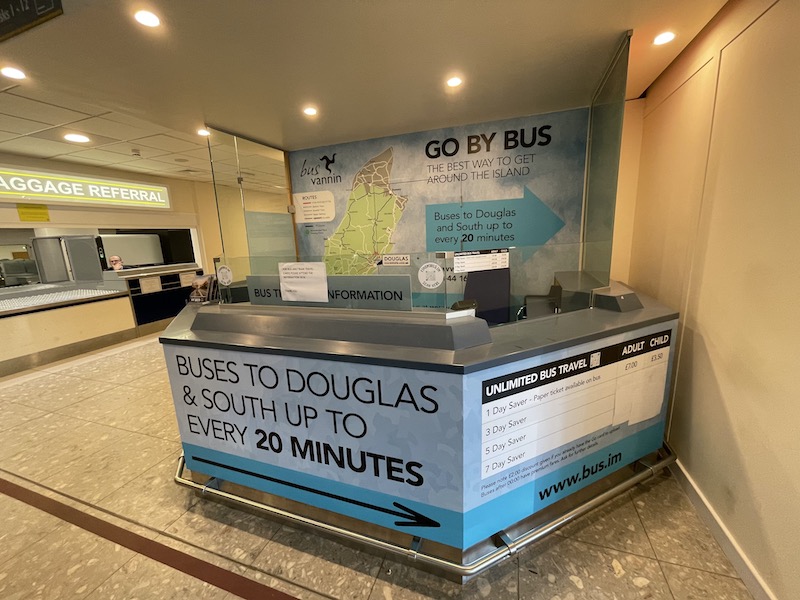
Ronaldsway Airport is located on the Island’s south east coast six miles south of Douglas and my visit began with a ride on the bus route that goes from there to Castletown and Port Erin on the south coast. However, before that I picked up a timetable book from the information point in the airport, rather than the Isle of Man Transport desk (shown above) which was unmanned.
The Information desk (shown below) was doing a roaring trade selling Bus Vannin’s smartcards called ‘Go’ with preloaded explorer tickets as well as handing out timetable books which contain details of all transport on the island including the trams and steam train.
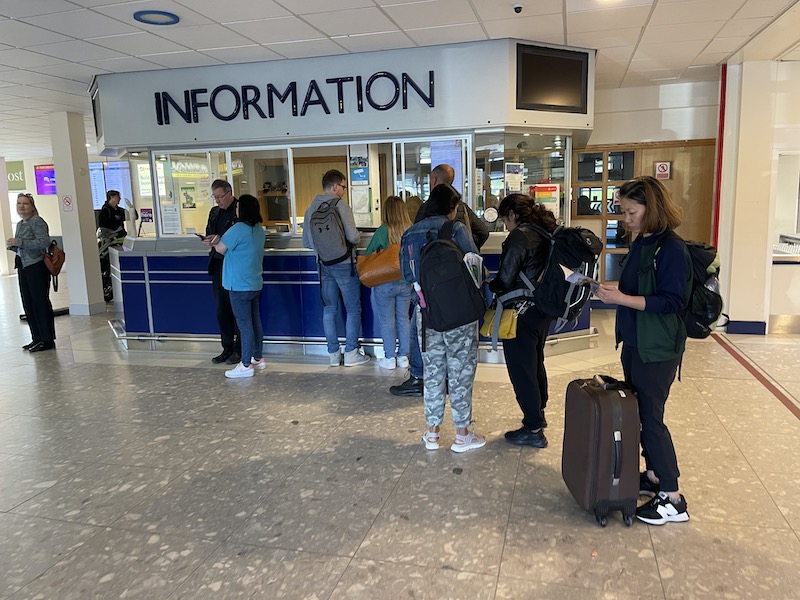
I’d kept my ‘Go’ branded smartcard from a previous visit seven years ago and had bought a 3-day Explorer (for £39) online in the week before my trip, except when I paid I got a message confirming the transaction and saying I had to upload the ticket by placing the smartcard on a bus ticket machine within 24-48 hours. As I wasn’t arriving on the Island for a few more days I emailed customer services who advised they would adjust that timescale for me, which was helpful, but it might be better for the restriction to be flagged up before a purchase rather than after.
The ticket uploaded when I boarded the bus and all was well. The Explorer is excellent value covering all modes of transport including the trams, steam train and horse tram. Indeed for that lot it’s quite a bargain.
There are three trunk bus routes on the Island. Firstly between residential areas and the main hospital north of Douglas via the airport and the south of the Island – every 20 minutes; secondly between Douglas and Ramsey, in the north of the Island – every 30 minutes; and thirdly between Ramsey, Peel (on the west of the Island) and Douglas – every hour Ramsey to Peel and every 30 minutes Peel to I Douglas. It all sounds very simple, but the complication is the myriad of route numbers used for those three routes.
It’s unfortunate this makes it all appear much more complex than it really is. For example on the Douglas to the south of the Island route passing the airport there are ten route numbers to denote variations at either end of the route or different directions – routes 1, 1A, 1H, 2, 2A, 11, 11A, 12, 12A and an N1. The Douglas/Ramsey route is mostly the 3 with the odd 3A/3B/X3 and the Ramsey/Peel Douglas route is mostly 5 or 6 with some A B and C suffixes.
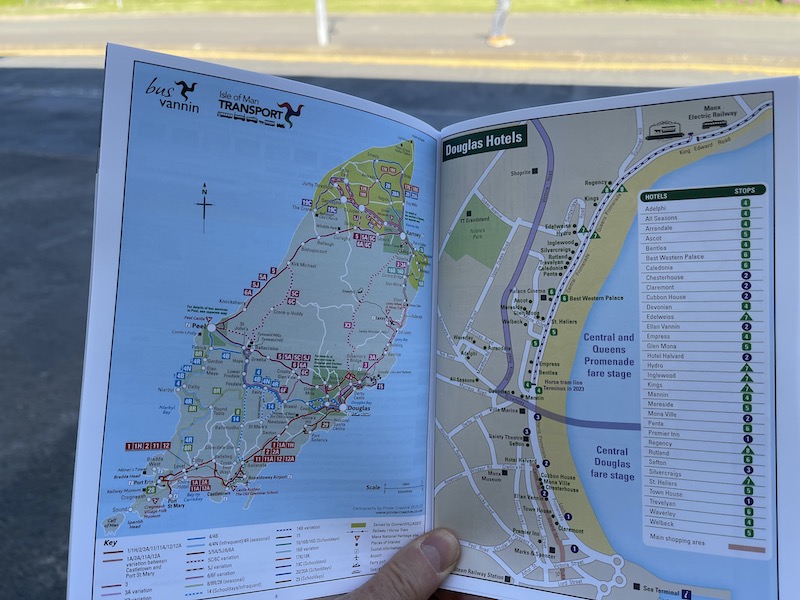
There’s a route map in the timetable book but it’s hard to discern the variations denoted by the different route numbers although the main towns also have detailed maps which are a great help.
At bus stops there’s a diagram which aims to explain the difference between the route numbers but I found this hard to follow as well – maybe different colours might help?
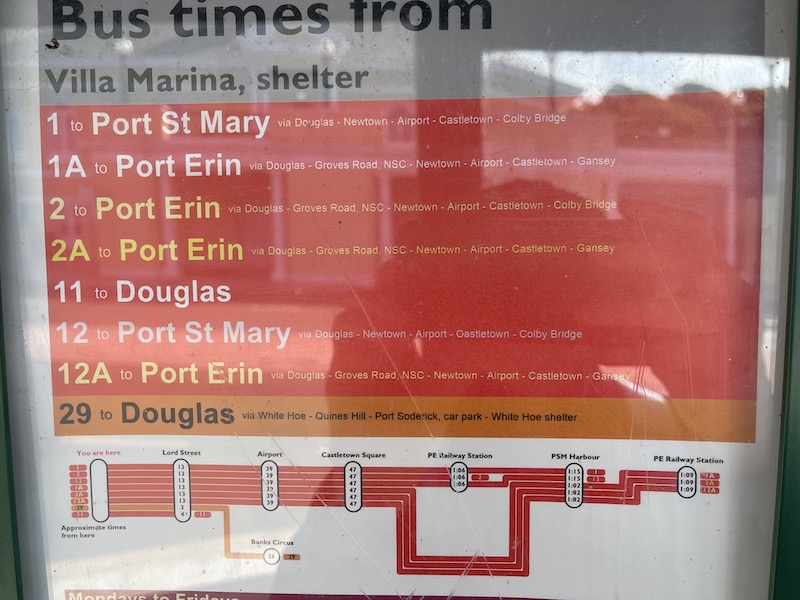
As I was only travelling to the main destinations it didn’t worry me, and I guess locals are used to the differentiations so it may all work, but I did wonder if there was a simpler way of presenting the arrangements TrentBarton style perhaps.
I caught a route 1 from the airport – most passengers from the plane headed north towards Douglas …
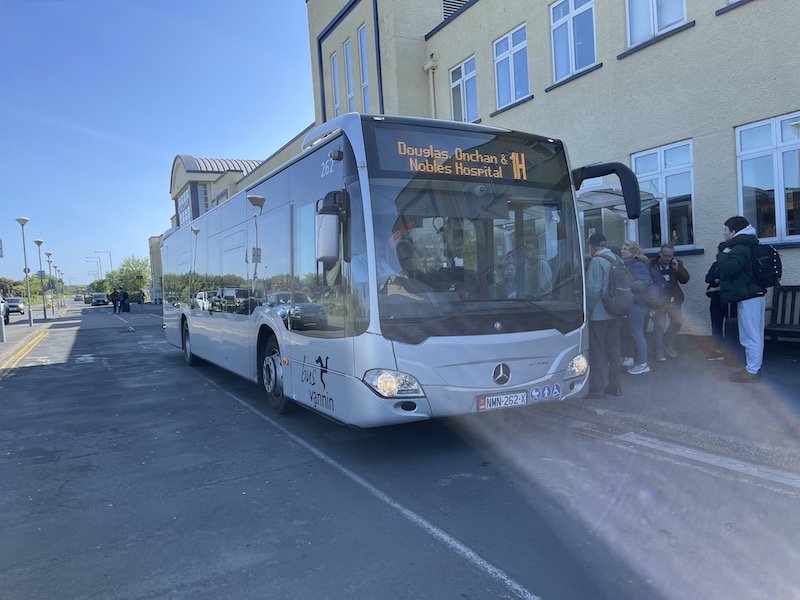
… and it was just a couple of us who headed south.
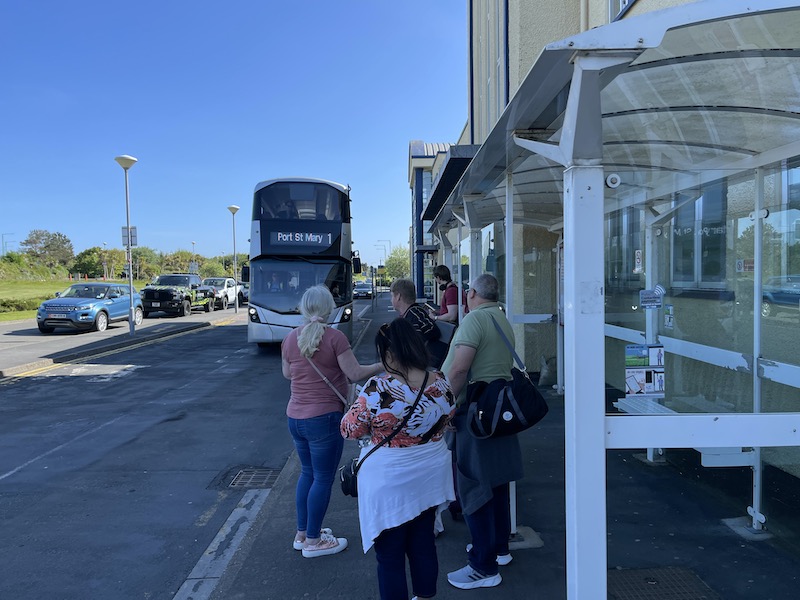
The 1/1A/1H etc route is operated by a mixture of single and double decks – the former Mercedes Citaros and the latter Wright bodied Volvos and I was pleased to be catching the latter to afford the great views as we headed south through Castletown and over to Port Erin and Port St Mary.

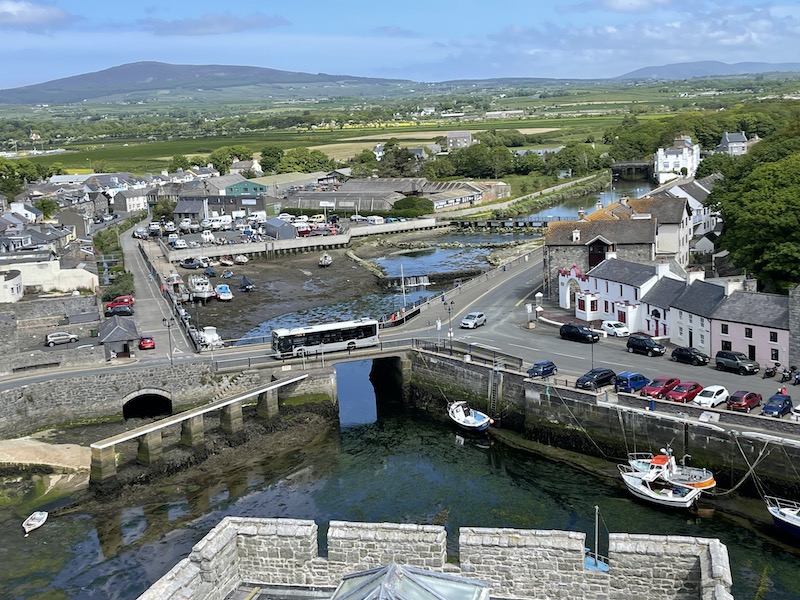
It only takes eight minutes to reach Castletown (shown above) and another 18 minutes to Port Erin where Bus Vannin has an outstation by the steam railway station …

… where the bus waits for seven minutes before continuing on to Port St Mary returning back as a route 1H (H for Hospital) via Port Erin to Douglas and Nobles’s Hospital
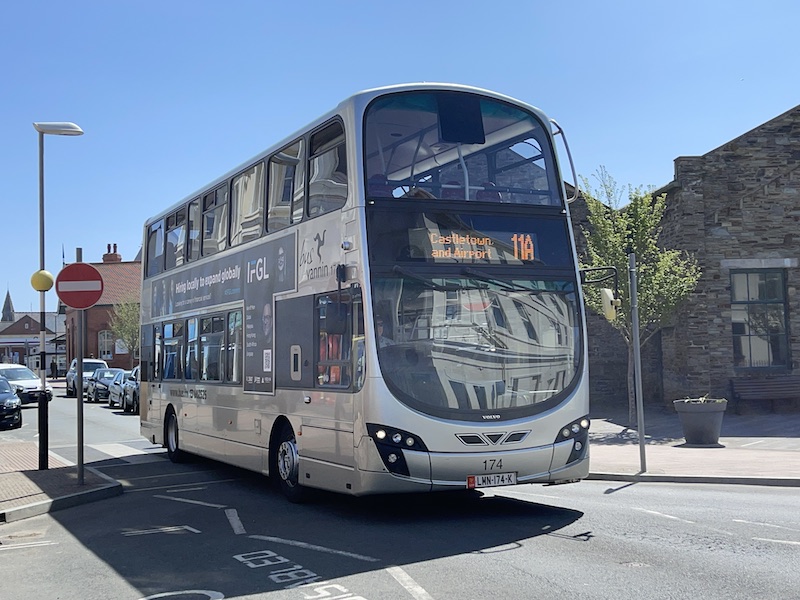
Port Erin is a great little place to visit not only for the beach…

… but also for the steam train which I’ll tell you more about tomorrow.

Back in Douglas buses to most destinations on the Island depart from one of the four bus stops in Lord Street.
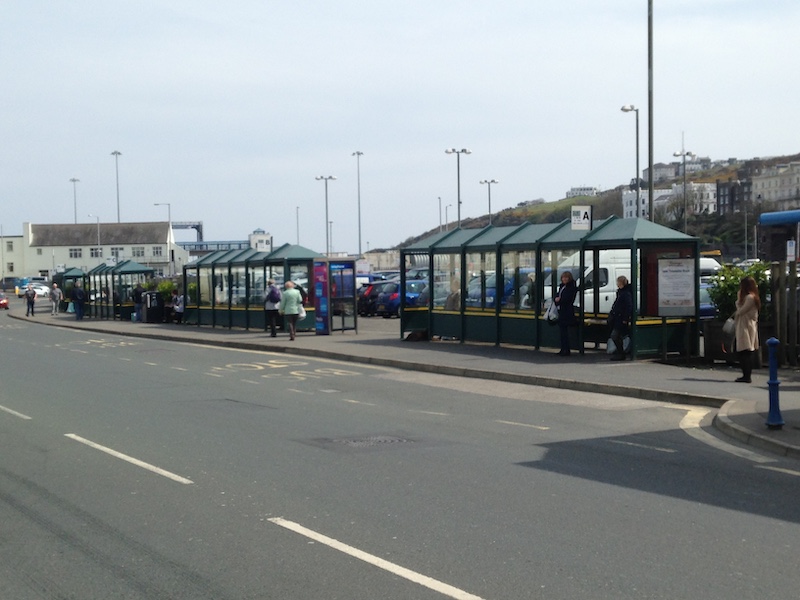
There’s an information point here, although it wasn’t open during my visit.

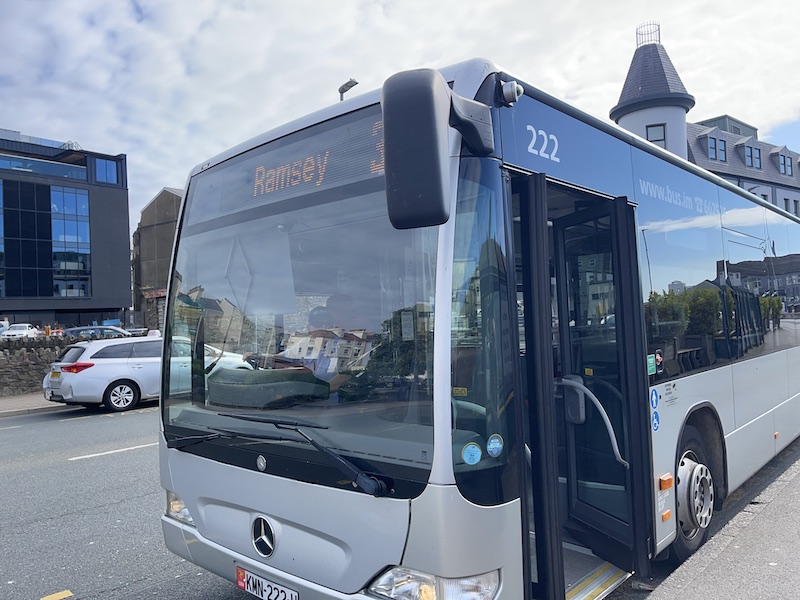
I caught Bus Vannin’s second trunk route from here to Ramsey: half-hourly route 3 which also runs with a mix of single and double deck buses.
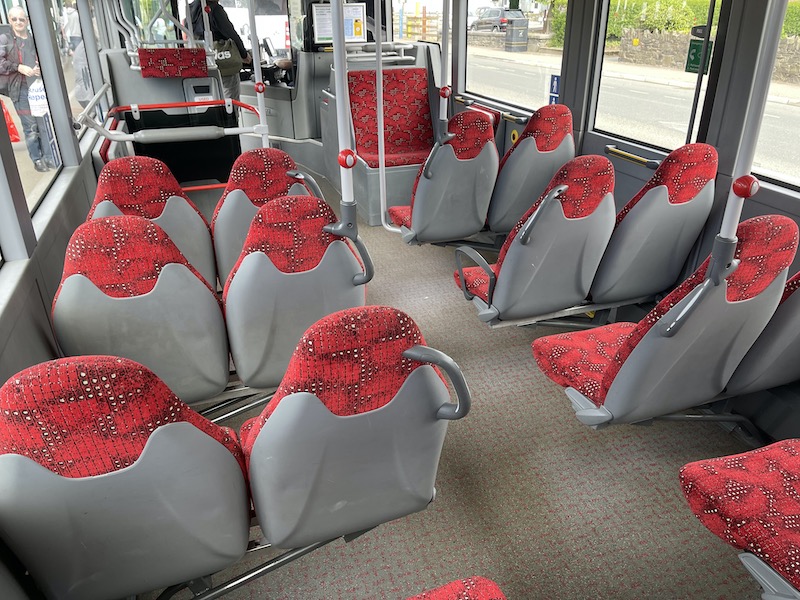
The bus interiors have a smart red moquette and comfortable seats.
It’s a fairly busy route leaving Douglas via its northern residential neighbour called Onchan and then via Laxey taking 51 minutes to Ramsey where it terminates alongside the combined bus garage and bus station where buses are parked round the back.
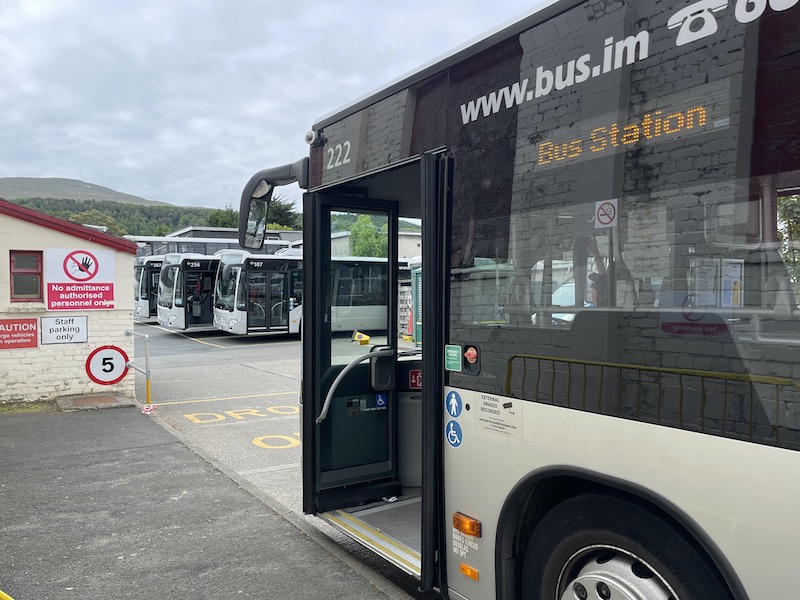
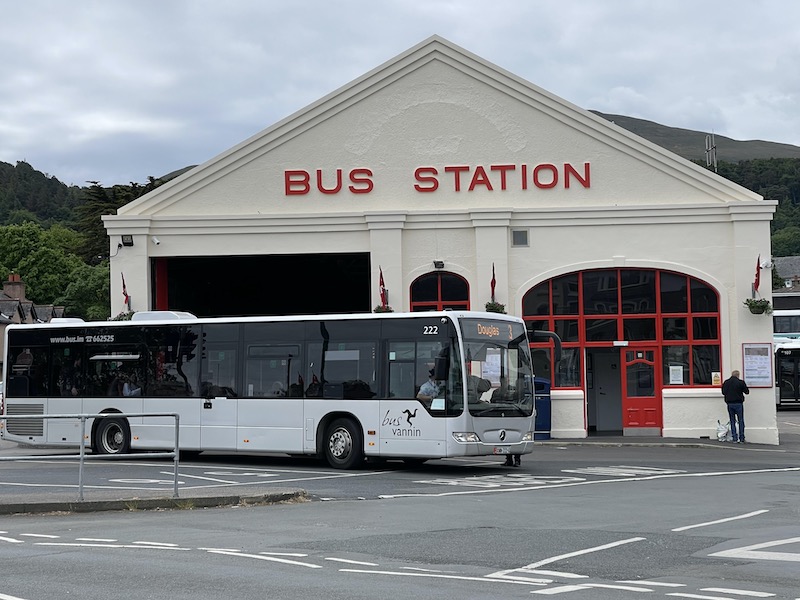
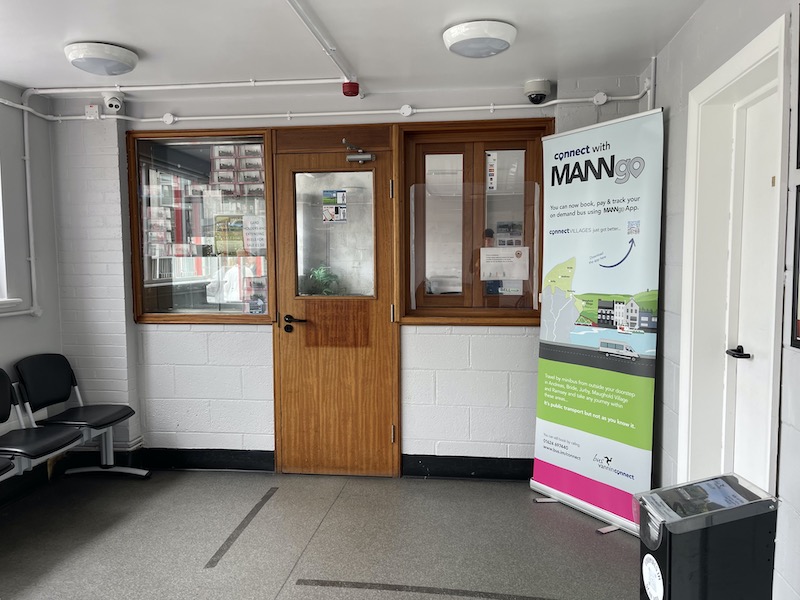
I love the old style building with a lovely waiting room and toilets and an enquiry office.

It’s just the kind of facility one used to find all over Britain in rural or small town locations but sadly they’ve all disappeared now in the name of progress.
From Ramsey you can head back to Douglas on the third trunk route – the hourly 5 which operates along the west coast of the Island as far as Peel and then heads almost due east across to Douglas …

… where it’s joined by the hourly route 6 to make for a half hour frequency. Again these were quite busy routes with passengers getting on and off at many bus stops along the way, especially between Peel and Douglas.
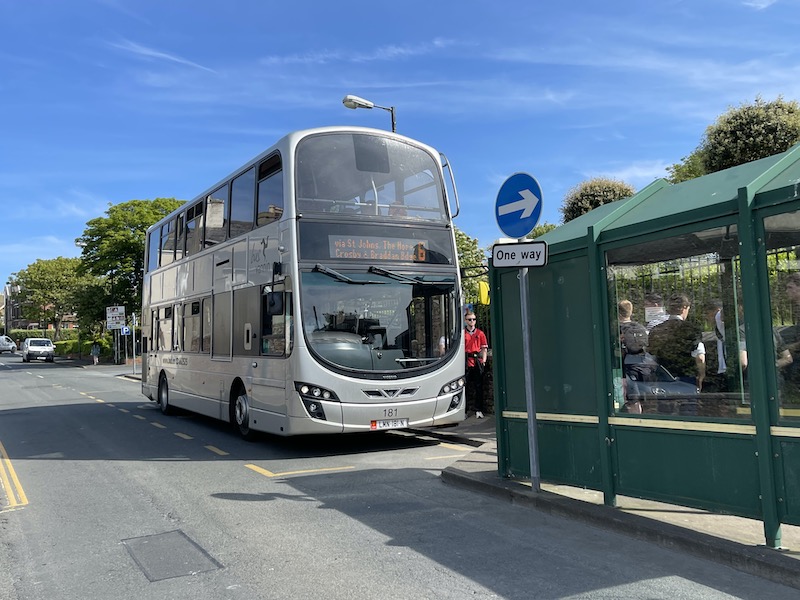

Other routes in Bus Vannin’s network include the 4 and 4B which take a less direct route between Douglas and Peel and the 14 and 14B which link Douglas with Castletown.
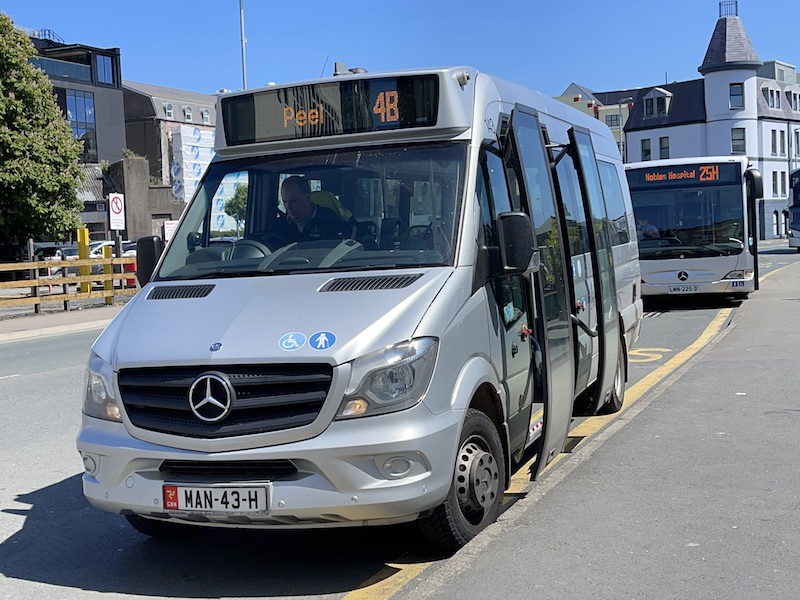
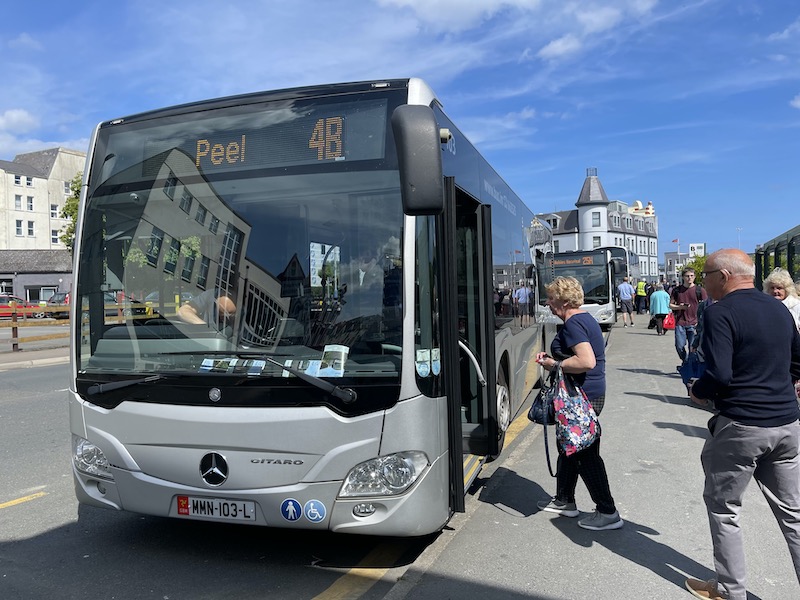
The 4/4B runs every two hours and the mid afternoon journey I took carried eight passengers but it really was a splendid journey with some great views as well as the route out of Douglas being through a residential area with the best kept front gardens I’ve ever seen.
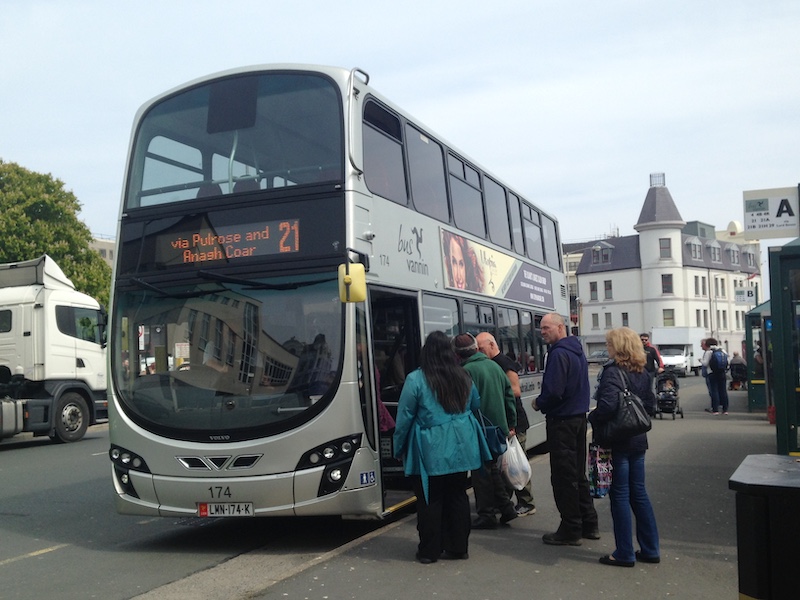
Other routes include half hourly local Douglas routes numbered 21/21B/21H…
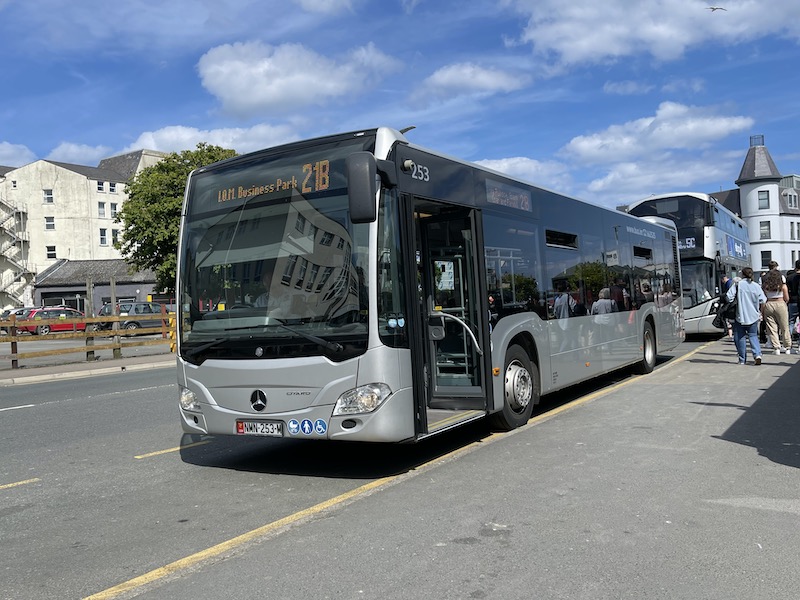
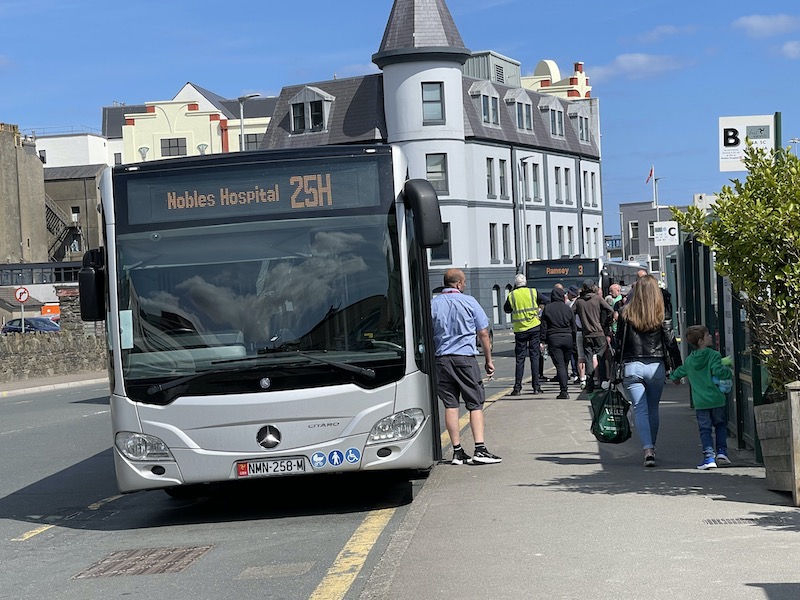
… and a half hourly 22H/25H – the H denotes journeys on all routes which serve Nobles Hospital.
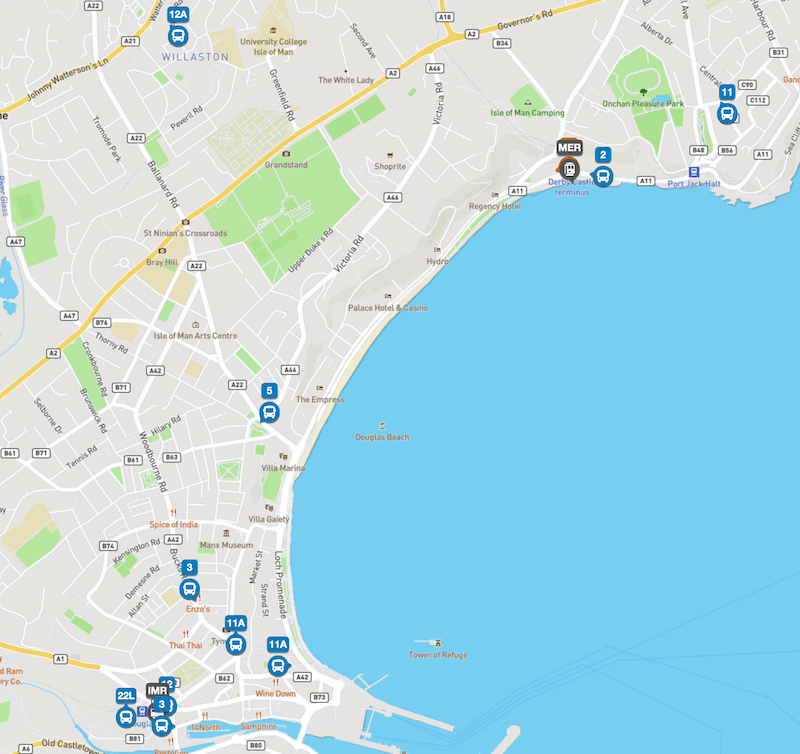
One thing I soon noticed while travelling around is the lack of open data meaning you can’t use Google to plan journeys or see departures from bus stops – there are no bus stops marked on Google maps. However there is a fantastic website findmybus.im …
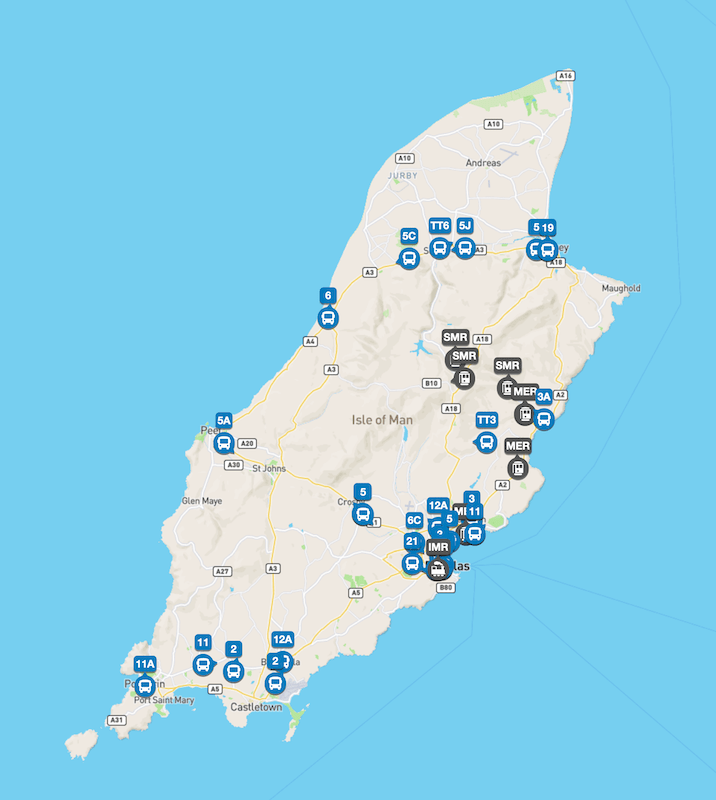
… which shows tracking for not only buses but trams as well.
There is a third party app which I downloaded but it seems to be having problems with data too.
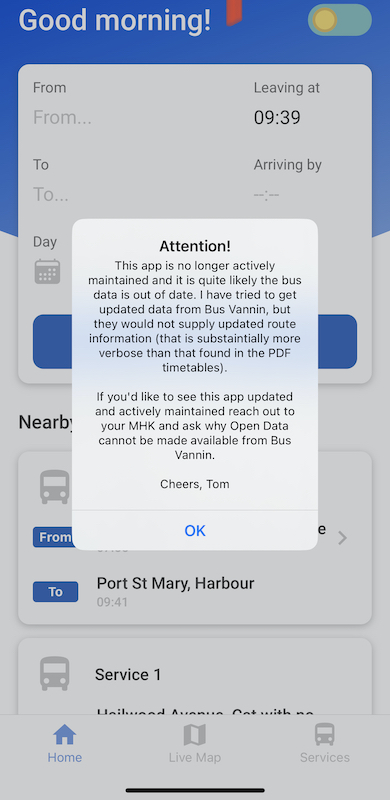
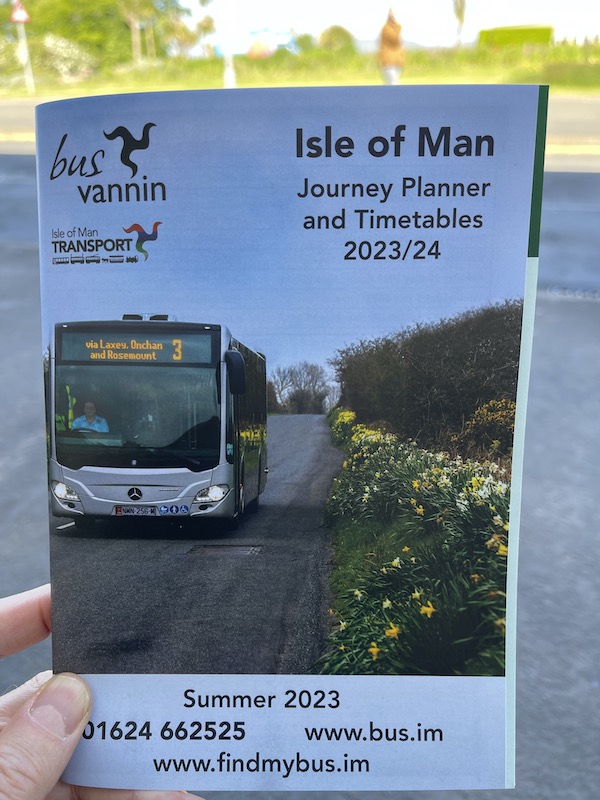
On the positive side the timetable book is an excellent publication and is valid right through until 2024 – with details of school dates, for example, shown up to August 2024. It also has a section detailing all the special timetables which operate during the TT fortnight where there are many road closures for this annual event.
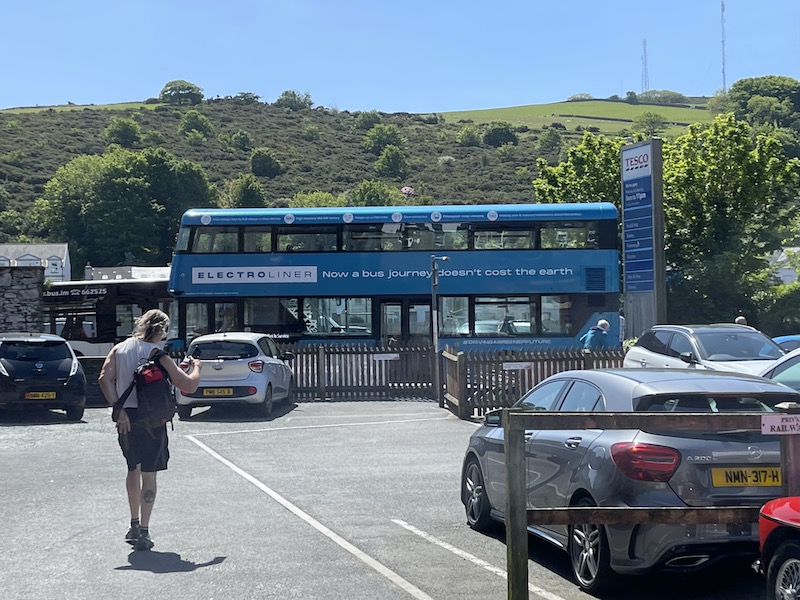
While I was on the Island Bus Vannin was also preparing to run a couple of demonstrator battery electric buses during TT fortnight including a Wright Electroliner spotted in Douglas (below) and a Mercedes Benz eCitaro which arrived on the Island in February.
I really enjoyed travelling around this wonderful Island by bus and Isle of Man Transport does a great job providing a network of services that seems to meet the needs of both resident and tourists. Tomorrow’s blog will feature a ride on the Isle of Man steam train.

Roger French
Previous AtoZ blogs: Avanti West Coast, Blackpool Transport, Chiltern Railways, Delaine Buses, Ensignbus, Faresaver, Grand Central, Hull Trains, Ipswich Buses, JMB Travel, Kirkby Lonsdale Coach Hire, Lynx.
Blogging timetable: 06:00 TThS including an extra on SuMWF this week.
 BusAndTrainUser
Those nice Bus Vannin interiors can also be found in Cardiff as Cardiff Bus fairly recently bought a dozen ex-Vannin Citaros. They now run with mainland registrations of course.
LikeLike
When i visited the Isle of Man in 2014 I rode on Mercedes Citaro K demonstrator BV14 TZY which was on hire to Bus Vannin – it is very rare for a service bus on the Isle of Man to operate with a UK registration. Just for good measure, the registration plates also carried a GB identifier.
LikeLike
Interesting â thanks.
Sent from Mail for Windows
LikeLike
A glorious microsome of an era now lost forever on the mainland. And as a bonus, never sullied by EU membership!
LikeLiked by 1 person
Sorry Terence but that reads like full on rose-tinted myopia.
LikeLiked by 1 person
Rubbish it is a way of life gone for ever never to return on the Mainland
LikeLike
This is not the place for politics unrelated to transport. But, when you are ready for a relevant debate I will be delughted to participate.
LikeLiked by 1 person
Thanks for this lovely blog – I remember my own visit to the IoM, where I found the buses well used, and pretty easy to use.
Your comment about all the ‘sub-routes’ with letters added to the generic number made me think: just supposing we get a government really committed to increasing the use of buses and trains, and everywhere needs a comprehensive and comprehendable network, what would be useful ideas? I checked out the Trent Barton site, but found no helpful map, and am not sure their system is any better than Bus Vannin’s. But perhaps you can clarify that in a blog about TB.
An idea of mine is to number buses with letters for the start and end of the route (e.g. D – Douglas, R – Ramsey), with a number for the variant: but BV’s use of H for hospital is attractive. I’m very glad that London will have its SuperLoop express-buses, but am not sure about the wisdom of just putting an X in front of the regular bus number – makes it look like a bus add-on designed by the bus management, rather than an integrated addition to the Overground/Tube/Bus network, which it should b: is TfL also infected with the old trope ‘train-users don’t use buses (and vice versa)’?
Maybe trunk bus routes could be linked with the number of the road they mainly follow? Perhaps if journey-planners become the default (as satnav is for many car-drivers) the numbering system becomes less important. At present, knowing what bus to catch can seem very arcane to non bus users, which is why, as you consistently remark, clear and up-to-date information at bus stops etc. is so important.
LikeLike
The dedicated Cardiff hospital park-and-ride bus is the H59.
LikeLike
I really like the IOM buses. They are modern clean and do a good service.
What surprised and impressed me most was the number of youngsters doing long unaccompanied trips to/from school or into Douglas in the evening. I saw an early primary school kid doing most of Douglas to Ramsey returning from school and a couple of 10yr olds doing most of Peel to Douglas.
That reflects the safe low crime culture enables bus travel for the young.
LikeLike
Same for Ramsey – lots of pupils from the north of the island travelling into Ramsey Grammar School.
My wife saw this article and the pictures of Ramsey garage and it reminded her of bus pass in hand waiting for the bus home from school towards Laxey and would it make it up the hill out of Ramsey.
And Lacey is Laxey.
LikeLike
If you want a complicated timetable, look no further than this one from Madeira – basically a “spine” route serving a selection of villages. I speak Portuguese and understand buses, but couldn’t work out “what” happened “when”. We took a tourist coach instead!
http://www.horariosdofunchal.pt/mobile/apresenta_horario.php?lang=pt
LikeLike
It’s not the easiest site, but you can change the pt to en and see it in English!
LikeLike
Laxey not Lacey!
LikeLike
I visited the IoM with my father in 1993 for “The Year of Railways” celebration of the centenary of the steam railway, and again in 1995 for the celebration marking the centenary of the Groudle Glen Railway. It was somewhere I’d always wanted to visit bring inspired as a child by books on the steam and electric railways. We never used the buses on either trip , and back then it was called Isle of Man Transport with an attractive maroon and cream livery. The fleet name was in a nice typeface and included the three legs of Mann graphic. I would thoroughly recommend a visit to the island.
LikeLike
No deregulation or privatisation in the IoM. I certainly plan to make a visit. On the other hand the 3 day ticket is expensive. In the South Tyrol their travelcard covers nearly 3000 square miles of railways, urban, inter urban and rural buses, a narrow gauge railway, a funicular and a number of cable cars for £38. For 7 days.
LikeLike
Austria is unfortunately very variable for pricing so may not be the best of examples!
The west of the country is indeed cheap, at least for period tickets, with the €46,80 Wochenticket Tyrol you mention, Salzburg’s “myRegio” ticket at €39 and Vorarleberg’s VMobil “maximo” wochenkarte at €45,70 in the far west, but elsewhere prices are unfortunately very different.
In Styria, the equivalent region-wide 7-day ticket is going up to €101 at the end of this month; head to Oeberösterreich (OÖVV) around Linz, or to Niederösterreich or Burgenland, the areas around Wien which are grouped in the VOR traffic area, and there’s no regional weekly ticket at all, only point-to-point tickets, and while there is a regional day ticket for VOR it’s only available at weekends and costs €25 for one day (including Wien kernzone, urban Vienna, €19,90 without).
I gave up trying to calculate accurate weekly prices for Carinthia (Kärnten) because it’s a combination of regional prices plus urban “kernzone” supplements. There’s a regionwide off-peak group day ticket at €24,90, though.
Fortunately for me I get a week’s free pass for ÖBB (well, mostly free, there’s supplements to pay!) but once I’m off the trains I find that single fares mount up just like anywhere else…
LikeLike
Very interesting I shall do my research whenever I go back to Austria. The South Tyrol though is actually Italian. A post WW1 prize. All legal residents have to register with either the German, Italian or Ladin language community. Currently it stands at about 68/30/2%. Excellent public transport.
LikeLike
Ah, my apologies. I forgot about that bit of Italy!
Italy is another country with random and sometimes strange pricing. Lombardy has the great value state-wide “Io Viaggio in Lombardia” (“I travel in Lombardy) multi-modal ticketing but other areas are still stuck in the buy-single-tickets-from-random-tobacco-shops-somewhere-in-town mode of ticket purchase.
LikeLiked by 1 person
Thanks for visiting our little corner of the world. To answer/elaborate on some of the points:
I haven’t seen the ‘bus desk’ at the airport used for many years – may even have stopped being used pre-Covid, though they may use during TT when I try and avoid the airport – the tourist info desk is the one that’s always open.
Re the 48 hour window to top up, it’s a while since I’ve used an explore card, but I’m not sure why the email says you have to tap in on a bus first rather than a train/tram – this is definitely wrong as I’ve had visitors in the past use the train as their first journey and the cards have worked. I presume it also means to say it would take 24-48 hours to load onto the card for online top-up (it does for my Go Places card) rather than this is the max time allowed to ‘collect’, as I have regularly left a longer gap between ordering and first use in the past.
The 1 group of routes was made slightly simpler with the last timetable update in April (before that for example, the 11 used to run the circular route in both directions). It does have some sense, but is even confusing for locals. It’s due to having loops and various options at both ends of the routes, so you end up with the below:
1 – Port Erin to Onchan via Colby and Douglas
1A – as the 1 but runs via Port St Mary rather than Colby (hence the A)
1H – Route 1 journeys that continue to the hospital (Mon to Sat daytimes only), in this direction only as they return from the hospital as a 1 (as no need to differentiate the routeng)
2 – Port Erin to Ballachrink via Colby and Douglas
2A – as the 2 but runs via Port St Mary rather than Colby (hence the A)
11 – Port Erin to Douglas via Colby and Douglas and then a loop via Onchan and Willaston (this direction only)
11A – as the 11 but runs via Port St Mary rather than Colby (hence the A)
12 – reverse of the 11 (i.e. from Douglas to Port Erin)
12A – reverse of the 11A (i.e. from Douglas to Port Erin)
N1 – night bus (night owl)
So in short the number reflects the routeing at the Douglas/Onchan end and any routes with an A run via Port St Mary instead of Colby. The stop diagrams used to be even more confusing (each route was a separate image when most buses go the same way for the majority of the route).
The 3 and 5/6 group variations are much easier to understand due to the Douglas map you mention showing the differences clearly.
The information point/cabin at Lord Street is a temporary addition for the TT fortnight only – the rest of the time the Welcome Centre iin the sea terminal a 5 minute walk way is the place to top up cards etc.
The info the Manx buses used to be on bustimes.org last year, but no longer appears (it didn’t really work with the myriad of route options anyway as all variations were listed as separate timetables!), however the tracking app works surprisingly well.
LikeLiked by 1 person
Thanks very much Jonathan.
LikeLike
Tiem was when the 4 bus stops in Lord Street Douglas were much more.
The car park opposite was a bus parking ground.
The car park, on the same side of the road as the bus stops, was another 2 lane layby with another full sets of bus stops and proper shelters.
And at certain times of the day, buses arriving from the south and east which terminated at the bus station would continue to the Sea Terminal building to connect with the boats.
LikeLike
That place is called Laxey rather than Lacey.Lacey was a female NYPD detective in the TV show Cagney and Lacey!I’d suggest that the Isle of Man buses could do without Trent Barton’s help otherwise they might start running their buses to the 12 hour clock although as they were serving liquor in gills and flogging people until fairly recently nobody might notice!
LikeLike
If Bus Vannin was run by TrentBarton’s market-o-droids then the 1 would have a snazzy brand name but all the varying letters would still exist (see “The Threes”) or, worse still, as with “Indigo” people would be expected to know that an Indigo bus heading from Nottingham to Long Eaton has a slightly different route to an Indigo bus heading from Nottingham to Derby, because having the Long Eaton short working showing 5a and the Derby working showing 5 using the traditional route numbers as well as the brand is (according to them) old-fashioned and therefore stupid.
Oh, and all the double-deckers would be withdrawn for no better reason than that they prefer single-deckers…
I don’t think Manx passengers deserve to be TrentBartoned.
LikeLike
Referring to “the mainland” doesn’t go down at all well with Manx people! “The adjacent island” is the preferred terminology.
LikeLiked by 2 people
I’ve had the bus book a few times when I was younger it’s a great bus timetable book with all routes, maps and additional information.
LikeLike
OK, so I realise colour schemes are objective but I don’t like that “silver” livery, especially as the part-predecessor, Douglas Corporation Transport, had one of the most striking liveries of all the UK municipals.
LikeLike
Great report. Most buses – if not all – have free Wi-Fi onboard. The services are pretty reliable as well.
LikeLike