Tuesday 13th June 2023

When London Transport’s network of Green Line coach routes was in its prime you could glide across London on a limited stop bus, often on the top deck of a souped up Routemaster linking such delightful Home Counties’ locations as Woking and Chertsey with Stevenage and Hitchin or Tunbridge Wells with Windsor.
One such route was the 715, formerly route M in the newly formed London Transport Board’s 1933 lettering of such routes but rechristened 715 after the war in 1946 when the network gained route numbers instead of route letters. It ran half hourly from Hertford and Ware to Guildford via Enfield, Marble Arch and Esher and for a time in the 1960s was supplemented by an hourly 715A between Hertford (but not Ware) and Oxford Circus via Edmonton on Saturdays and some journeys on Monday to Friday peak hours.
It had always intrigued me as a child to see smart green liveried RMC coaches pass through my north London home area of Winchmore Hill sporting far away destinations in Hertfordshire and Surrey.
With higher fares than standard red bus Central Area routes we never used the 715 for journeys to nearby Enfield, Palmers Green or Wood Green for shopping trips – the fewer and less conveniently sited bus stops were also a disincentive, but I do recall a trip, probably in the early 1960s soon after RMCs were introduced, when my Dad took my older brother and I all the way to Hammersmith to see Bertram Mills Circus and for me, the ride there and back was much more enjoyable and memorable than the circus performance which I have no recollection of at all; but 60 years on that Green Line treat is still with me.
To rekindle old memories, a group of us recently took a ride all the way from Hertford to Guildford exactly as we would have done in the 715’s heyday but using today’s bus route offerings, none of which are limited stop of course.
We decided to undertake the journey across two sessions. A seven or eight hour continual ride across ten separate bus routes and a walk across Hammersmith Bridge (which is what it takes these days) rather than just three hours RMCs managed back in the 1960s sounded like too arduous a trek instead of the enjoyable relaxing outing we desired.
Day one therefore saw us gather at Hertford’s bus station soon after 10:00 for the journey south as far as Oxford Circus and the very first segment was on Arriva’s route 310 which took us as far as Waltham Cross.
There’s extensive building work constructing flats taking place alongside Hertford’s bus station making it a rather desolate place to wait. After our trip in late March, from the beginning of last month, it was deemed unsafe to continue using the site as a bus station while the building work continued and bus departures have been dispersed to temporary bus stops including in nearby Fore Street, ironically the road where the original London Transport bus station was located adjacent to a car park.

Back in those days route 310 existed much the same as today but obviously operated by LT’s Country Bus department running alongside the 715 and extended beyond Waltham Cross as far south as Enfield.
In those days there was a half hourly service between Hertford and Enfield with another half hourly (310A) from Rye House to Enfield making for a 15 minute frequency between Hoddesdon and Enfield and the half hourly 715 sat on top of that.
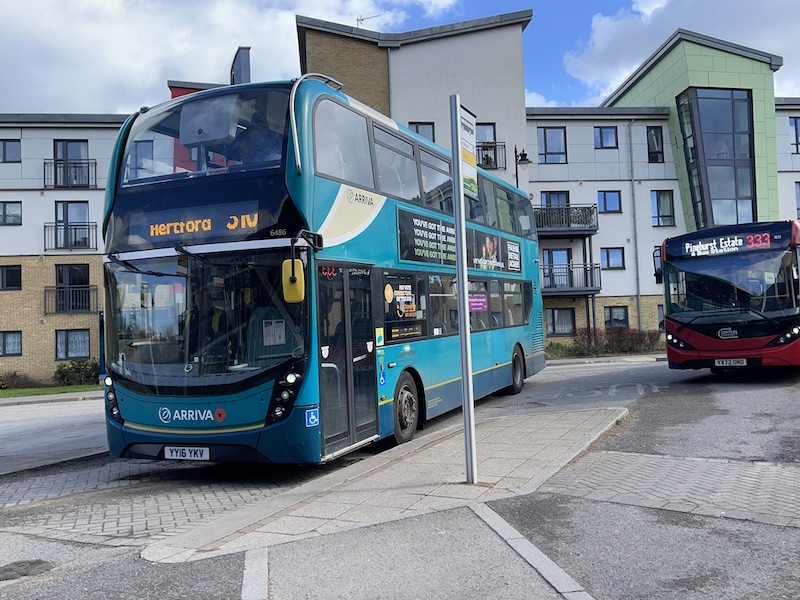
Today’s 310 runs every 20 minutes and takes an hour to reach Waltham Cross whereas in the 1960s it took 42 minutes on the 310 and 33 minutes on the 715. However we did go off the old line of route after Ware to serve the St Margarets area rather than diligently following the old A10 (now the A1170) as the 310 and 715 used to do.
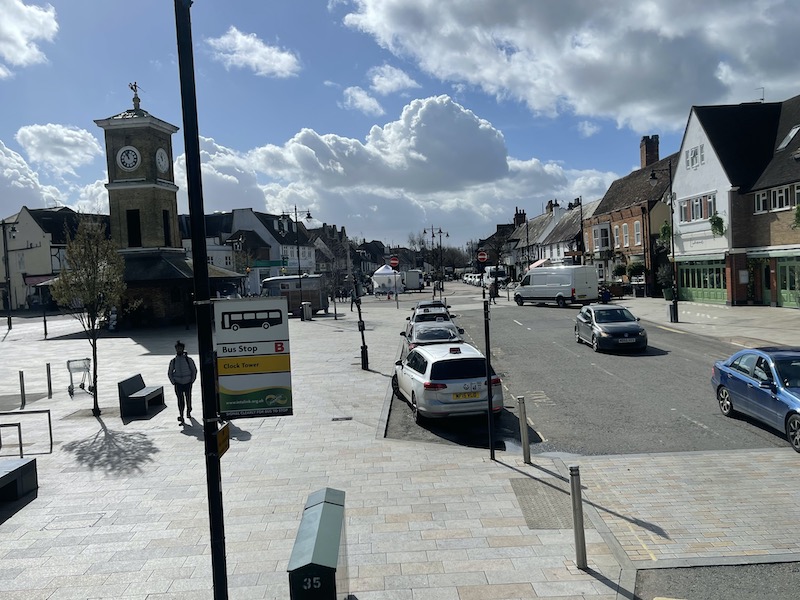
Hoddesdon has had a public realm makeover in recent years with through traffic banished to a by-pass making for a very pleasant place to shop compared to the old days when it was very much on the A10 trunk road.
Although Waltham Cross is just in Hertfordshire its bus station is a TfL run affair with layover spaces restricted to the four TfL routes which reach the town from Greater London.

Our bus on the 310 along with other routes operated by Arriva, Vectare and Epping Forest Community Bus have to hang around outside until their departure time.
Our next bus, route 317, taking us on to Enfield was standing in the layover area and soon drew up to the departure stop and we headed off to the A10 but before reaching that we crossed over the M25, which at that point is buried in a tunnel such you wouldn’t know it was there.
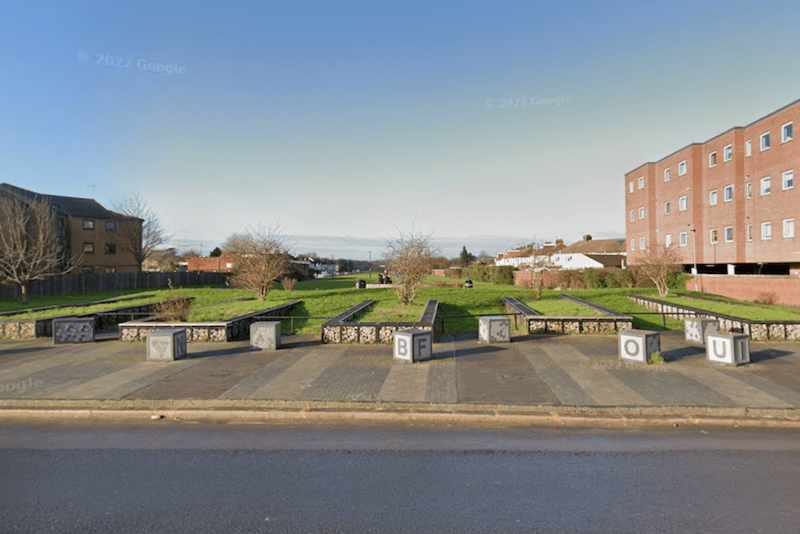
There then followed a spirited run down the A10 to the retail sheds near the junction with Southbury Road where having done a dog leg to serve the retailers spending an interminable time waiting at traffic lights to join Southbury Road and cross the A10, we headed west towards Enfield.

Metroline operate the 317 with five electric MetroDeckers from Potters Bar garage but our bus was a Volvo bodied MCV Evoseti diesel bus. The route runs every 20 minutes with a journey time of 37 minutes. The 310 did it in 18 minutes (half that time) and the 715 took just 12 minutes (a third of today’s journey time). We’re beginning to see a pattern already emerge here, 60 years on, of comparative journey times. No wonder it’s going to take us seven to eight hours instead of three – and we’ve got transfer times between buses to factor in, as well that walk across the closed Hammersmith Bridge.
We had a short lunch break in Enfield before continuing south to Turnpike Lane on route 329. We’re now in Bill Hiron (managing director of Stephensons and an Enfield lad) and my own home territory. Bill joined us on the trip so we both had a strong dose of nostalgia remembering former routes on this part of the retracing, including the 29 and 123 and for me, the 269 that used to join the 715 in the 1960s between Enfield and Turnpike Lane (along with the 275 in peak times) – I can also remember trolleybus route 629 which along with its successor 269 continued all the way south to Tottenham Court Road.
Arriva operate route 329 from Palmers Green bus garage with 15 Wrightbus bodied Volvos taking 44 minutes to reach Turnpike Lane every 7-8 minutes. Journey time to Wood Green is 38 minutes whereas the 715 did it in just 17 minutes and the 629 Trolleybus took 23 minutes running every 3-5 minutes.

In Wood Green High Road just north of Turnpike Lane station we changed from a 329 to a 29 for the next stage of our journey as far as Camden Town. Route 29 is a very long standing route and we could have caught an RT between the same points back in the 1960s (buses went from Cockfosters, Southgate and Wood Green to Victoria) running every 8-10 minutes and taking 23 minutes to reach Camden Town. The 715 did it in 14 minutes whereas the 29 is now scheduled to take 37 minutes but does run every 6 minutes although other routes which used to parallel sections of the route (eg the 221 and 127 have long been cut back or withdrawn).

Arriva run 31 Volvo/Wrightbus Gemini bodied buses from its bus garage in Wood Green on the route. From Camden Town it was time for our fifth and final route for part 1 of this retracing project, and that was route 88 to take us to Oxford Circus as the 715 would have done.
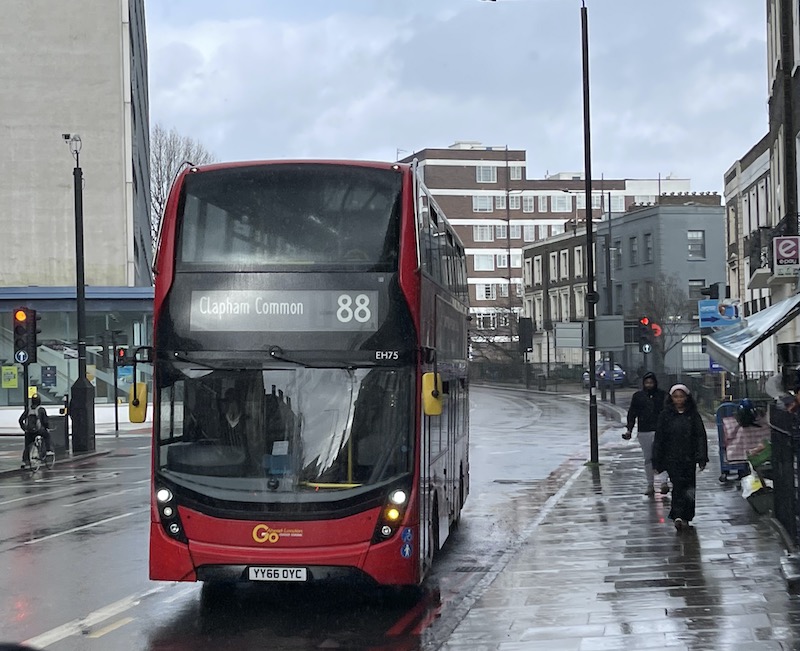
The only problem was southbound buses were on diversion due to long term water and electrical works along the route in Parkway towards Regents Park so instead we continued down Hampstead Road getting caught up in more roadworks south of Mornington Crescent and through the HS2 works for Euston station, including two-way temporary traffic lights, (which I sincerely hope are not going to be around until 2040) so it was slow progress until we reached Euston Road where we turned right to reach the normal line of route at Great Portland Street station.
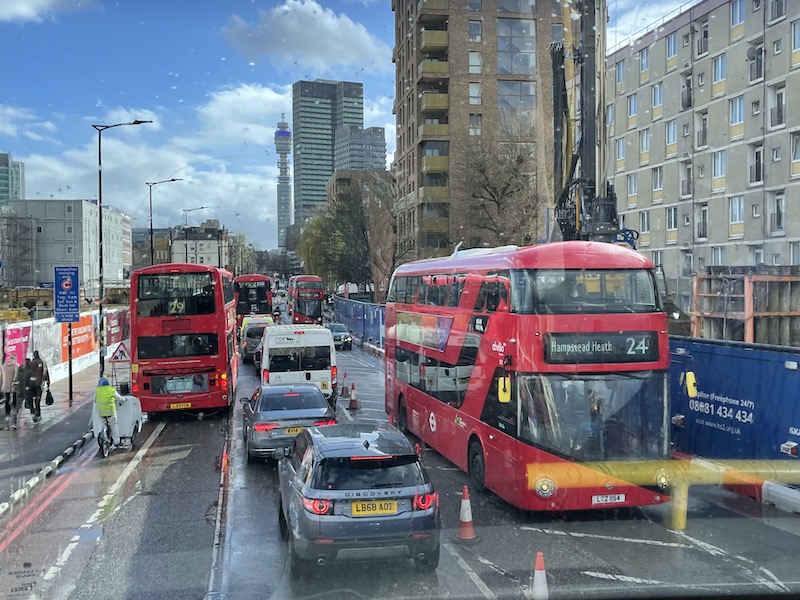
That diversion and delays cost us an additional five minutes over the scheduled time of 21 minutes. Route 715 would have done it in just 9 minutes while back in the 1960s we could also have taken parallel red bus routes 3, 39 or 53.
Today Go-Ahead London operates route 88 from its Stockwell bus garage with 22 ADL Enviro400s providing a ten minute frequency.
And that was it for part 1. It was getting on for 15:00 so we had a coffee to celebrate and headed home.
Now we’re at the halfway stage, it’s time for one of Ray Stenning’s brilliant maps depicting where we’ve been and where we’re heading in part 2. (Ray was also part of the retracing party)

We meet up at Oxford Circus again a few weeks later for part 2 kicking off at the slightly later time of 11:00.
The 715 was one of around half a dozen cross London Green Line routes that didn’t serve Victoria and the Green Line hub on Eccleston Bridge (others were the 709, 711, 714 and 716). One of our group recalled London Transport also had a Green Line office on the second floor of offices above Oxford Circus Underground station where you could visit and ask for a map and buy a Green Line timetable book for a shilling.
Sadly that’s long gone so we decided to head off on our first bus of the day.

This was on route 94. Buses begin their westbound journey to Acton Green at the bottom of Regent Street at Piccadilly Circus. Nine buses per hour are operated with 17 electric ADL Enviro 400 buses by RATP Group from its bus garage in Shepherds Bush which is where we were heading as the 715 would have done.
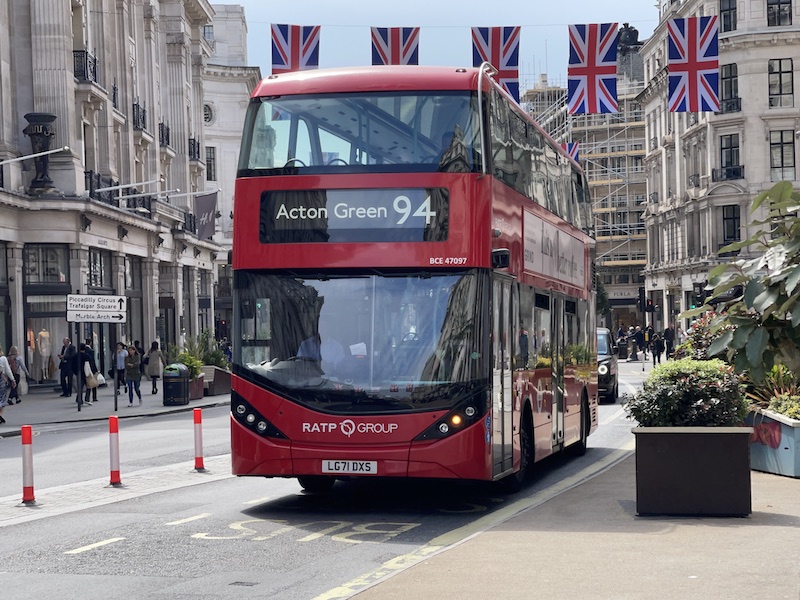
The 715 took just 19 minutes from Oxford Circus to reach Hammersmith (Shepherds Bush isn’t listed as a timing point in my old timetable) so, let’s say 14 minutes to Shepherds Bush, whereas the 94 today is scheduled to take 30 minutes, but we took longer than that, being held up by a Just Stop Oil demonstration along Bayswater Road.
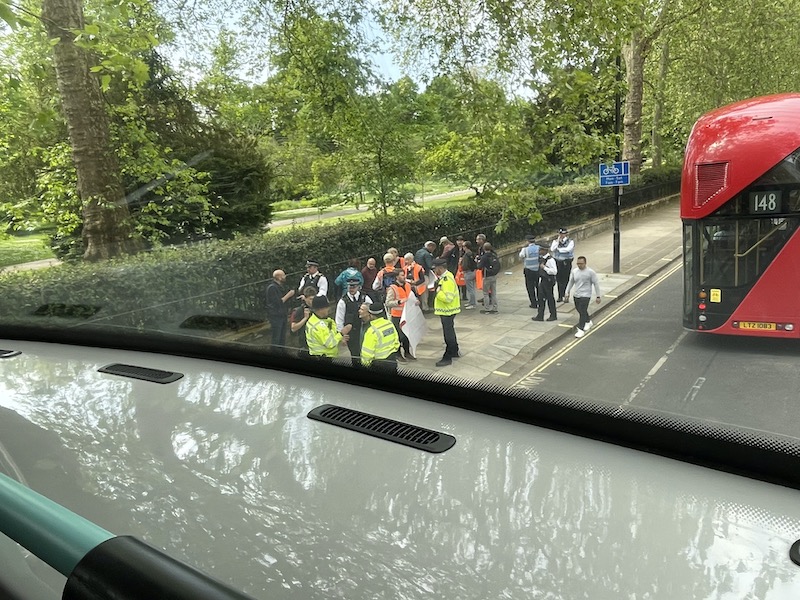
The police were soon on the scene so the delay was only about six or seven minutes and after passing through Notting Hill we soon arrived into Shepherds Bush where we did a slick change of buses on the south side of the Green to a 72 to take us to the north side of Hammersmith Bridge.

This itself took 17 minutes whereas as noted above the 715 got from Oxford Circus to the bus station at Hammersmith in 19!
If route 715 ran today, buses would face a lengthy diversion over either Putney Bridge or more likely Chiswick Bridge but for us it was a case of sticking to the original route by walking over the currently closed Hammersmith Bridge which took us barely 10 minutes.

From the south side we caught route 419 which took us through Barnes to Roehampton. This took us 24 minutes on the 12 minute frequency route operated with ADL Enviro200 single deck buses by RATP from its Hounslow bus garage.

Continuing south from Roehampton we faced something of a dilemma as oddly, for most of its existence, the 715 avoided Kingston and instead was routed via Malden and Tolworth before continuing along the Kingston by-pass and Hinchley Wood to reach the old A3 to Esher at what’s know as The Scilly Isles roundabout.
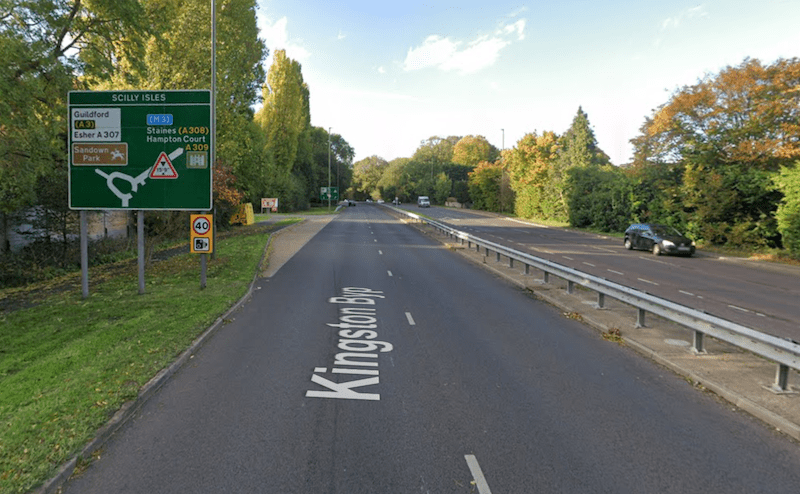
We could have retraced most of that route using route 265 as far as Hook but then we’d have faced a walk along the rest of the Kingston by-pass which didn’t particularly appeal so instead we headed into Kingston on a route 85 consoling ourselves that in its final years before withdrawal south of Oxford Circus in the 1970s London Country did change the route of the 715 to operate via Kingston.

We didn’t have long to wait for an RATP operated 85 – it runs every eight minutes with 15 Wrightbus Gemini bodied Volvos from Fulwell garage – and after a 29 minute journey we took a short break for some sustenance in Kingston before catching our fifth and final bus for part two, which was of course the Stagecoach operated route 715 from Kingston to Guildford – another reason to head into Kingston.
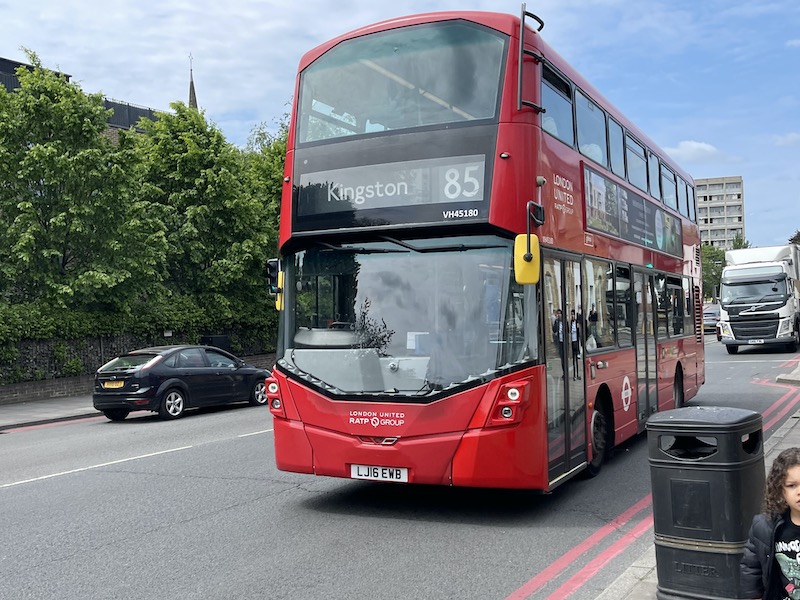
Today’s 715 operates hourly and is unique in seeing a Stagecoach liveried bus enter Greater London from the company’s Guildford base. It takes three buses to operate the service with an end to end journey time of 74 minutes – from Esher it takes 51 minutes. Green Line 715 did that journey in 37 minutes.
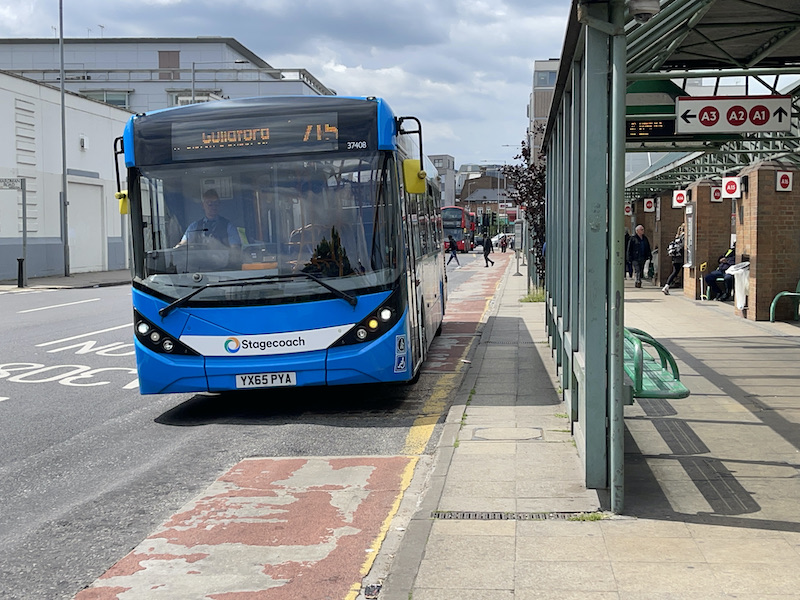
Today’s 715 does a small detour to serve the centre of Cobham before rejoining the A3 and crossing the M25 once again, and this time not only is it not in a tunnel but there are extensive roadworks taking place to widen the slip roads at Junction 10.

After that we took the old A3 (now the B2215) through Ripley from where, back in the day, London Transport Country Bus route 415 also ran along the same route into Guildford. It wasn’t long before we were entering Guildford through Burpham just as Green Line 715 would have done arriving at the town’s Friary bus station just before 15:00, four hours after we’d set off from Oxford Circus (albeit with a short lunch break in Kingston) and eight hours after we’d left Hertford (with a short break in Enfield) counting in part one as well.
In the 1960s London Transport’s routes terminated at the long demolished bus station in Onslow Street.
As already explained the Green Line 715 was timetabled to achieve an end to end run in just three hours which sounds quite remarkable but in its later years it seldom did as, along with all Green Line routes, it was plagued with traffic delays.

Limited stop routes are seemingly coming back into fashion in London with recently announced plans for an orbital Superloop, so could there be a place for reintroducing routes like the 715? The answer is almost certainly a resounding no. The train offers a very competitive journey time and there’d need to be extensive bus priority measures which in some cases would just not be possible – for example the London Borough of Enfield has installed cycle lanes from Enfield through to Palmers Green reducing the carriageway to a single width either way. Our biggest hold up on the route was queuing on the A111 Green Lanes to reach the traffic lights at the junction with the A406 North Circular Road on route 329. It took us over ten minutes to travel a few hundred yards. You can’t be doing that if you’re on the way from Hertford to Guildford.
And, of course, since the 1960s, we now have the M25 which if travelling between the two towns is the way motorists would now go taking not much more than an hour, assuming a clear run. Which is a big assumption, of course.

It cost 5s 6d to travel from Hertford to Oxford Circus in the summer of 1967 and 11s 11d all the way through to Guildford. That’s 27.5p and 60p in decimalised terminology. Not bad for a premium fare. Mind you, if fares had gone up just by inflation in the intervening 56 years that’s £6.38 and £13.93 in today’s money. Good job the Government’s current £2 cap would kick in then.
Roger French
Blogging timetable: 06:00 TThS


I love these comparison blogs Roger, very interesting as always 👍
LikeLiked by 1 person
Interesting looking at the increased journey times. How much of that do you think is down to 1️⃣ not being a limited stop service? 2️⃣ sandbagging and excessive padding in the timetable? 3️⃣ going off route to serve additional developments, or 4️⃣ traffic being that much worse now?
In my neck of the woods, the X46 between York and Hull has slowed down over the last 20 years, from a journey time of about 1h40 to over 2h now, despite following the same route unchanged.
LikeLiked by 1 person
I think the most significant impact will be (4), hugely increased road traffic levels, made worse by (2), padding added to comply with the traffic commissioners’ insistence that all buses must run on time regardless of traffic conditions (which as we all know can vary drastically from one day to the next outside of the peaks). Rerouting to serve intermediate traffic objectives (3) will add some but I doubt nowhere near as much as (4), and Limited Stop is meaningless when you’re just sat in continuous traffic jams.
In urban areas it’s only where there are bypasses or fast roads that Limited Stop services still meaningfully exist (such as, for example, the X6 between Leeds and Bradford which takes a different route to the all stops 72) but Limited Stop has made an unintentional comeback outside urban areas as stops between villages are mostly non-existent nowadays, meaning that interurban services which traditionally would have picked up or set down at any crossroads or remote house no longer do and have become de facto Limited Stop services.
Around deregulation United Counties called their Coachlinks services “selected stop” rather than “limited stop”. I’m not sure what the difference was meant to be, other than perhaps someone thought “selected stop” was easier to understand or sounded more marketable.
LikeLike
Another great blog thanks – and you’re a time traveller in many ways-having said you took over 10 minutes to travel a few hundred years! 👍😂
LikeLiked by 1 person
Thanks for spotting that Nick; now corrected!
LikeLike
No problem- it was not a criticism and I really enjoy your blogs thanks for sharing themAll the best
<
div>
Nick FarthingSent from my iPhone
<
div dir=”ltr”>
<
blockquote type=”cite”>
LikeLiked by 1 person
Cobham is served by the current 715 not Chobham which is near Chertsey. A good article as 715 was my local Green Line along the Kingston By Pass at New Malden.
Keep the trip reports coming. Very interesting.
Richard Thomas
LikeLiked by 1 person
Thanks for that; Cobham corrected.
LikeLike
I used to live near the Kingston By Pass as well at New Malden, and remember the majestic Routemasters passing by. Always an RMC, never an RCL. In later days, AEC REliances (RP class) ran the service.
It wasn’t only the 715 which went round the By Pass, missing the big traffic objective of Kingston. The 152 (and 72?) went down the By Pass, also missing a traffic objective of the town centre of New Malden – it was only dieverted to save the town many years later.
Roger – sorry to nitpick but there was another typo. Falwell instead of Fulwell.
LikeLike
Thanks for spotting that – will correct and update.
LikeLike
Think you meant Cobham, not Chobham. Don’t worry I made the same mistake on a bike tour, riding all the way to Cobham before realising my mistake on leaving Woking- I wanted Chobham!
LikeLike
Very interesting: I lived in Ware in the 1970s so I well remember the 715 and the big shed that was HG garage.
A bit off-topic I know, but I was interested at the mention of TfL route 221 having been cut back. However it’s been extended at its outer end and indeed is now an outer London route rather than an inner route as it used to be. There must be other such routes in London, but I can’t think of any!
LikeLike
The Green Line office at Oxford Circus was in “Western House” in Argyle Street, although there was another LT property above Oxford Circus Station itself, which was later to house the Tendered Bus Unit in its earliest incarnation.
Western House was the home of Green Line Control, from where diversions and duplications were organised, and from where the Green Line control Inspectors at Aldgate, Oxford Circus and Victoria were based . . . all routes through London (except Routes 714 and 716/716A: Baker Street) passed through one of the control points; previously Hammersmith was also a control point, although that had ceased in the early 1970s.
I was lucky enough to work at Western House for three months in the long hot summer of 1976, so I saw the beginning of the end of cross-London services . . . as Roger says, despite the best efforts of drivers, traffic congestion defeated reliable operation; although the number of passengers that went through from Hertford to Guildford was usually a nice round number . . . 0 !!
There is one benefit to shortening routes . . . knock-on delays can be minimised. And that is what will defeat SuperLoop routes, unless “just in case” hesitation time is scheduled along each route, which will extend running times, which will make journey times unattractive, which will deter passengers . . . ah, haven’t we been here before?
Oh, and BTW . . . half the Saturday service on Route 715 was diverted (by LCBS) in the early 1970s as Route 715A via Kingston . . . more shops in Kingston, and therefore more bums on seats!!
LikeLiked by 1 person
Many thanks for clarifying Western House and its purpose.
LikeLike
I get the impression that Superloop is designed as much for its interchange possibilities as reducing journey times, hence the emphasis on shorter frequent routes rather than long, infrequent ones like the former Green Line ones.
The X140 is very much the blueprint for the the new Superloop routes. It has increased patronage and passenger satisfaction along the corridor, and 40% of its passengers use a second bus as part of their journey.
LikeLike
If my recollection is correct Route 714 (Luton-Dorking) did not serve Victoria.
LikeLiked by 1 person
You’re quite right George; now I look again at the map there were others too – 716/718 etc. will reword that but, thanks for pointing this out.
LikeLike
This certainly brought back some happy memories.
We used to live near Hinchley Wood, and I can remember well the RFs trundling past.
And I can confess to persuading my long suffering Nain (my mum’s side of the family were Welsh) to take me all the way up to Hertford and back on it one day, to experience the newly introduced RMLCs (or is it RMCL?).
Much the same as I dragged her up to the likes of Hitchin, Welwyn Garden City and Luton!
Happy days!
I even managed to coerce her into going all the way up to Birmingham so that we could go on the newly introduced high speed Midland Red Motorway Express service.
Maybe it’s her to blame for my fondness of buses and trains!
It’s also interesting to note from the timetable the time honoured british tradition of identifying locations by pub names, though sadly I expect a lot of them have long since gone – Barnes Red Rover, Hook Ace of Spades, Hinchley Wood Hotel and Cobham White Lion for certain………………..
LikeLike
There is a low bridge on the direct road from Kingston to Esher which precludes double deck operation. The 715A (starting in the 70s) went through Kingston and also through Hampton Court, avoiding the bridge.
The 715 serves Cobham. Chobham is somewhere different.
LikeLiked by 1 person
Thanks Steven; Cobham now corrected.
LikeLike
This brings back memories. In the late 70s I lived in Enfield and was at university in Kingston. It was much easier to get the 715 direct than the train, which was about three times the price and involved two changes. From memory the trip was timetabled for about 90 minutes, although northbound in the Friday evening peak could add another hour to that-anything up to 20 minutes just to get over Hammersmith Bridge. I quickly learned to avoid the coaches from Kingston between about 3.30pm and 5.30pm.
LikeLiked by 1 person
Great report, makes me want to do that ride. I think the bus sent into Cobham, not Chobham (where I grew up) – an easy typo that often confuses tbe Royal Mail back in the day when you got a good service for a small price,
LikeLike
Nice read as usual.
As far as I remember, 718 did serve Eccleston Bridge.
LikeLike
You’re right; thanks Bernie. Will update.
LikeLike
Fascinating Roger to read about how journey times have deteriorated over the years – and all in my lifetime too! Excellent blog
LikeLiked by 1 person
We had Midland Express here where all Manor of routes from Bull Ring Bus Station allowed you to access all parts of the Midland by Buzzing Off From Brum. It seems unbelievable now but you stand in the Bull Ring Bus Station with your mates & decide at 11 years of age to go to Nottingham or Leicester or Northampton or Shrewsbury or Banbury or Malvern or Cheltenham & still be home for Wonder Women & your Saturday Tea!
LikeLike
£1.80 for a child Wanderbus or £1 for a child Explorer.
Wonderful days, weren’t they?
I remember one Saturday’s day out being the X92 to Hereford, National Welsh 38 to Gloucester, X72/372 back to Worcester and the motorway express X43/X44 back to Brum.
I feel sad for today’s kids who may have smarthones, game apps and Xboxes but don’t have the freedom to explore we had.
LikeLike
Brilliant era mate sadly long gone.
LikeLike
How about some express routes around the M25, Travelling East West by rail is difficult and by bus very slow and almost , A problem is the Junctions are normally a fair way from the towns
LikeLike
Roger,
Many thanks, especially for the Green Line map. As many have already stated, brought back great memories. In my case for route 705 which I used in the early ‘60s for trips to Biggin Hill airfield (as was). A 2 hour ride from home near the A4 in Hounslow in, usually, a comfy RF. Also used red/green rovers at weekends for trips to other airfields round London. Luton on London Country route 321 from Uxbridge was the furthest.
Looking forward to Thursday Anthony Humm
>
LikeLike
Towards the end of the 715 there was another Greenline route introduced. It ran for a few years from Hertford to Brent Cross
There was also a Cambus service from Victoria to Cambridge that ran though Enfield. I think in it’s later years it was jointly operated with London Country
LikeLike
That was the 734, introduced when the 715 was split at Oxford Circus, with the northern section becoming 735. The two routes gave a half hourly service as far as Turnpike Lane, before the 734 cut off via Hampstead Heath, Brent Cross, Ealing and Heathrow to Addlestone. Again, I used it as I stayed with relatives in Brentford during my second year at University. It was later cut back to run in shopping hours only between Hertford and Brent Cross. I think it was killed off by the horrendous traffic on the North Circular.
The Cambridge service was the 798, jointly between Eastern Counties (later Cambus) and London Country, straight up the A10. There was also a 797 via the A1 and Baldock, and later a 799 via the M11-this was often worked by Olympian coaches.
LikeLiked by 1 person
‘Our biggest hold up on the route was queuing on the A111 Green Lanes …… It took us over ten minutes to travel a few hundred years.’ Sounds like a deep philosophical point, but I think you may have meant ‘yards’! Thanks for yet another enjoyable and informative blog.
LikeLike
Just to add to the notes above, taken from LOTS publications.
RMC replaced RF in August 1962.
The first 715A operated August 1956 – February 1969, although it had started as a daily service, it finished as a Mon-Fri peak hour operation.
The second 715A was a Saturday only variation serving Kingston and Hampton Court, it operated May 1971 – April 1977.
OMO conversion (as it was then) of the 715/A took place in April 1972 using RP, although this is the London Country era, so last days of crew operation are a bit flexible.
In 1977 the 715 replaced the 715A when it was rerouted via Kingston and Hampton Court at all times, a new 710 operating Mon-Fri peak hours covered the former direct route.
Cross London operation ceased in October 1979, the new 735 covered the northern end of the 715 and changes to the 409 the outer southern end of the cross London 719, the section between Victoria and West Croydon wasn’t covered.
It’s partner the 734 linked Hertford and Addlestone via North and West London, providing links such as Turnpike Lane – Golders Green via Muswell Hill and Hampstead Heath.
LikeLiked by 1 person
Thanks very much for all that info.
LikeLike
Wow, the best article I have read on the 715. I was a driver out of Hertford on the 715 from January 1976 to October 1978 so I can remember the 715 using the Kingston by-pass and then all journeys through Kingston. Great memories, great days. I also remember going to Western House to be trained as an Inspector and after that doing the occasional rest day work from Western House whilst being based at Hertford. 7 years as an uniformed inspector and then 4 years on the plain clothes. 13 years of my life which I have fond memories of.
Not sure I would have taken on the monumental task of following the route these days but truly all credit to you and well done.
LikeLiked by 1 person
Love the irony of a Just Stop Oil demonstration delaying an electric bus!
I remember reading an article once about how the 715 was rerouted via Kingston & Cobham to replace th outer end of LT’s 215, which was then cutbcak to Esher, becoming today’s K3.
LikeLike
Roger, An interesting piece, your picture of E200MMC on 419 is rare, it is mostly operated by older E200s.
LikeLike
How things have changed
The first 716 left Hertford t about 5:30am the last bus got back at about 1:30am
Between Waltham Cross and Hoddesdon there were at one time 8 buses an hour
310 2 an Hour
311 2 an hour
715 2 an hour
310A Tfl 1 an hour
310A London Country 1 an hour
LikeLike
Another DRT is going, This time it is the NovusFlex. Funding was originally for 3 years. The route ws covered in the August 22 blog
LikeLike
Its quite ironic Roger how you mention that the journey times of todays equivalent bus trips are so much longer than the 715 from the late 60’s. I’ve always had a fascination with the Green Line routes from Victoria to Cambridge, predominantly the 797 via Stevenage and the 798 via Hoddesdon as i lived for quite a few years in Royston where the 2 routes combined for the run into Cambridge.
Over the past few years I’ve started to gain a small collection of timetables via good old eBay dating from the late 70’s up until its demise in the 00’s. I suggested to my wife that id like to replicate a journey to and from Victoria in my car using the timetables from 1986. she said lets do it !!
So we found ourselves parked up as close to Drummer Street Bus station in Cambridge awaiting for our scheduled 09:00 departure on the 797 via Royston, Baldock,, Stevenage, Hatfield, Apex Corner, Baker Street and Hyde Park Corner. As soon as we made the 1st timing point, at Trumpington, Maris Lane, it was going to be apparent that we would loose a few minutes at each point !. So much so that by the time we had arrived at Victoria, Buckingham Palace Road we were nearly 50 minutes late. (Thank goodness I had accommodated a 3 hour layover at the car park above Victoria Rail station before we returned via the 798 route).
At 15:00, we departed Buckingham Palace Road and I couldn’t resist a quick drive through the Green Line coach station, which was completed and then we were on our way via Marble Arch, Round the back of Oxford Street, Tottenham Court Rd, Camden Town, Finsbury Park, Wood Green, Enfield, Hoddesdon, Ware, Puckeridge, Standon, Buntingford, Royston & finally back into Cambridge. By this point i had totally abandoned trying to keep to the timetable as it was hopeless. We arrived back approx 90mins late…
I was driving my car, only stopping at or as close to the timing points and not picking up/ setting down passengers, issuing fares & dealing with cash. I could drive a tad faster than the maximum speed of a bus/coach and yet with all the road alterations over the years plus all the traffic that has increased over the years, it doesn’t surprise me that the 797, 798 and all the other associated Green Line routes have nearly all but disappeared, 702, 703 & 757 excepted . Its only through luck that the 702/703 has Legoland Windsor on its route and the 757 has Luton Airport on its route that they continue to survive !!
LikeLiked by 2 people
Fascinating. Many thanks for sharing.
LikeLike
My mum was a great user of Green Line buses from Guildford. I think she hardly ever used trains, although we had a local station at Gomshall. Kingston was the main objective for its department stores. I suspect we carried on into London occasionally. One memory I have is of trolleybuses in Southwest London, as seen from the Greenline.
LikeLike
Unless I have missed it somewhere, I am surprised nobody has picked up on the fact that from 1946 until RF to RMC conversion at the end of August 1962, the 715 was every 20 minutes, a frequency not rivalled by any other cross-London service. Dropping to 30 minutes on conversion to RMC was not universally welcomed. It was the first “real” Green Line service in 1930, and the last double-deck service to be converted to One man operation (other than the odd peak hour and Sunday operation from Godstone of the 709), which inevitably heralded the beginning of the end.
LikeLike
I am surprised the Luton Airport Greenline is still going. The traffic at the airport is very season and Luton now has excellent rail links. It also competes with other coach services
LikeLike
It’s a bizarre one Bob, that 757, it seems to fluctuate like you say, with the seasons. Over the winter last year it ran hourly every day with a 2 hourly frequency throughout the night.
Come March or April this year its become an odd service of 2 hourly throughout the night and hourly throughout the day but with extra coaches slotted in between 09:00 til 11:00 towards Victoria and then from 14:00 until 18:00 heading back to Luton Interchange so operating a 30min frequency in those times.
LikeLike
Roger, your Bertram Mills story echoes my somewhat earlier experience after the 1953 coronation. My grandfather hired a taxi to “see the coronation lights” in the late evening. There were massive traffic jams, and I had a splendid bus-spotting time. I was very excited to see a newly-introduced RF on Green Line 709 in Regent Street heading for Godstone at 11pm – goodness knows when it got there. I was far less thrilled with the actual lights!
LikeLiked by 1 person
(I was given these when I was younger) I have four green line coach routes maps by
London transport which are rectangular size and they open up with a map and an index. Dated from 1956,1960 and the other two don’t have a date they all the same style.
LikeLike
Dan you Green Line maps will have a code on the back near the bottom. This LT Order Number/Printer code will have a four or three digit segment in it which can be identified as the date.
LikeLike
The Stagecoach 715 often has electric buses on it , spare from the Guildford P&R routes.
LikeLike
As Winchmore Hill was once your patch you may be interested to know that the enterprising proprietor of the Little Green Dragon micropub which is a quarter of a mile from the former Green Dragon(now at Waitrose) at 928 Green Lanes has a Coundown installed. Nor only that, but it is programmed for the 125 and 329 in both directions so you know whether there is time for another quick half. You can also sit on ex bus seats and there is also bus memorabilia
LikeLike
Another LT Service using part of the A3 Kingston ByPass in the 1970s was the 189 from Clapham Common To Esher.
Did the 215 Go from Kingston all the way to Guildford ?
The map show Kingston’s main Green Line service connected it to Woking. Or course from Surbiton the Southern Electric trains were fast and frequent to Guildford , but presumably more expensive.
Were there also a couple of Southdown Services that called at Kingston – one from Portsmouth and one from Worthing one of which presumably went via Guildford (I dont have all the timetable books i did have.
LikeLike