
Thursday 1st June 2023
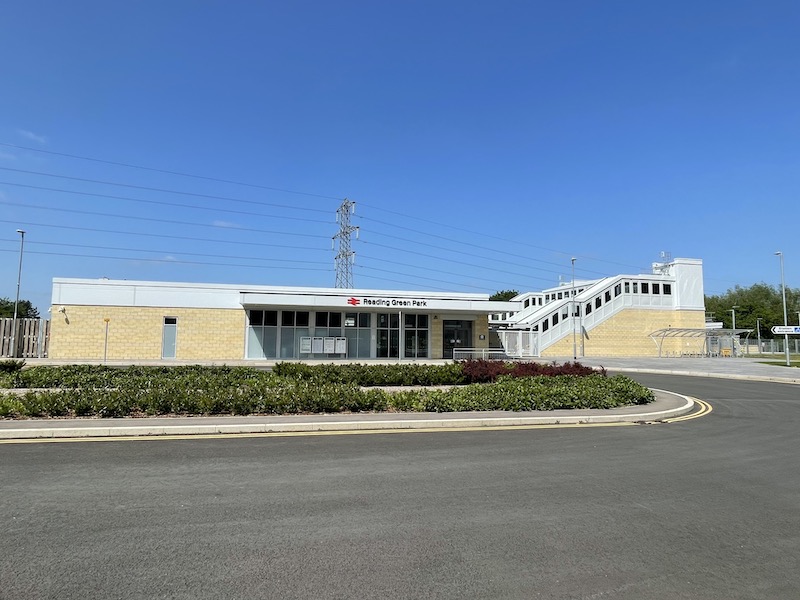
It’s been a long time coming – plans were first announced in 2007 – but Reading Green Park station finally opened for business on Saturday.

Located on the southern edge of the town close to the town’s Green Park business area and sewage works, the station is served by half hourly departures on Mondays to Saturdays (hourly on Sundays) on GWR’s Reading to Basingstoke service.

As readers will know from previous blogs featuring new station openings, they don’t come cheap these days, not least when you factor in footbridges and lifts, and as you can see, this footbridge is fully enclosed, as well as quite an extensive building housing a ticket office, waiting area and toilets along with an access road and car park. In fact the £21.5 million cost sounds quite reasonable for that little lot.

Funding has come from Thames Valley Berkshire’s Local Enterprise Partnership (£9.15m plus £0.55m from its Local Growth Fund), developer Section 106 payments (£5.6m) and the DfT (£2.3m plus £2.5m from the New Stations Fund) with GWR also chipping in £1.25m.
One of the original plans envisaged the station would open in 2018 along with electrification of the Reading to Basingstoke line and new or refurbished trains. Sadly the latter two ideas have not progressed but at least construction of the station did get underway in 2019, and following three years of delays put down to Covid, is now open.
As you can imagine there’s much excitement at Reading Borough Council with the towns latest infrastructure arrival. Councillor Tony Page, lead councillor for climate strategy and transport, said “The new multi-modal interchange will dramatically improve accessibility and connectivity to this important area of south Reading. The future expansion of the business park and residential areas on Green Park, as well as the proposed Royal Elm mixed use development, will all benefit from the new station”.

Some of this exuberance is very much looking forward rather than the here and now; the Royal Elm development by the Football Club has been mired in delays for example, and although provision has certainly been made for the station to be “multi modal” with the access road past the car park to the front door restricted to buses, taxis and authorised vehicles …

… together with two marked bus stop bays and signs, sadly no buses serve the station and I’m not aware of any plans by Reading Buses to do so.

And I don’t blame them. The closest bus stop is in Longwater Avenue – a six minute walk from the station – served by the long established Greenwave branded route 50 which serves the business park, new houses and Reading Football Club’s stadium.
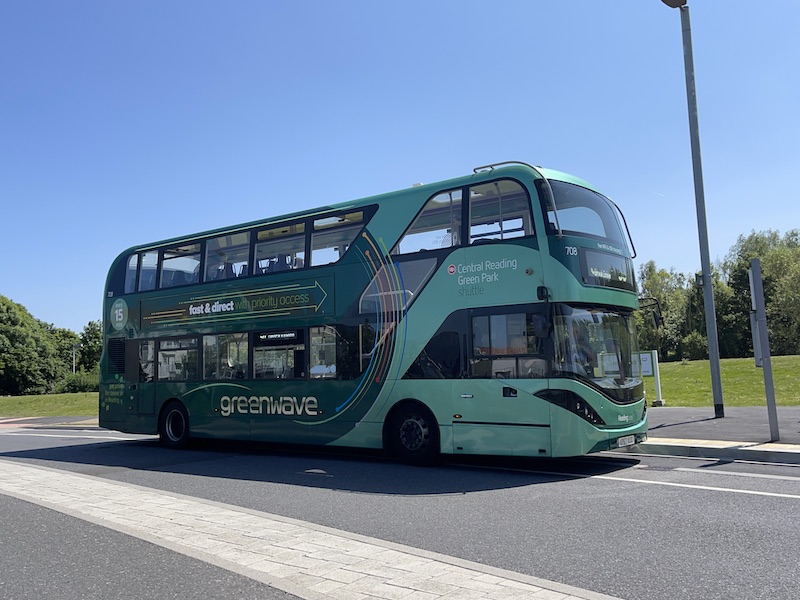
Route 50 runs every 15 minutes providing a direct and quick link from central Reading (including the station) to Green Park (taking 17 minutes) which it circumnavigates on a one way loop.
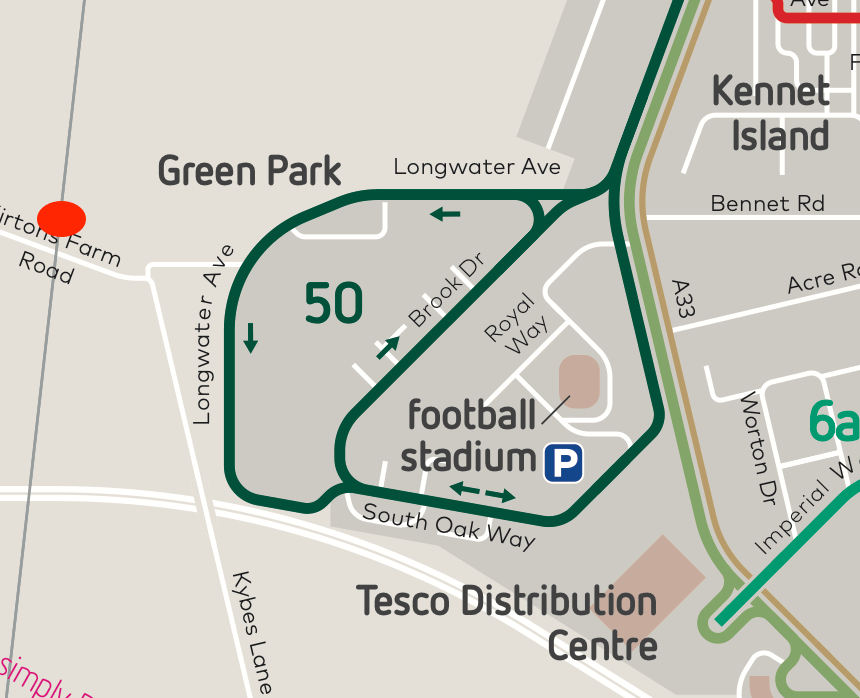
It takes about 15-20 minutes to walk from the station to the big name businesses located in the business park whereas buses on route 50 stop right outside so I reckon there’ll be no contest between bus and train – the bus wins every time – more frequent, quicker and more direct – and zero emission gas powered buses rather than polluting diesel trains too.

Sadly route 50 doesn’t run on Sundays though, which was fine when it was focused on the business park, and receives financial support from it, but now residents have moved in with more to follow, it’s probably time for that to be reviewed.
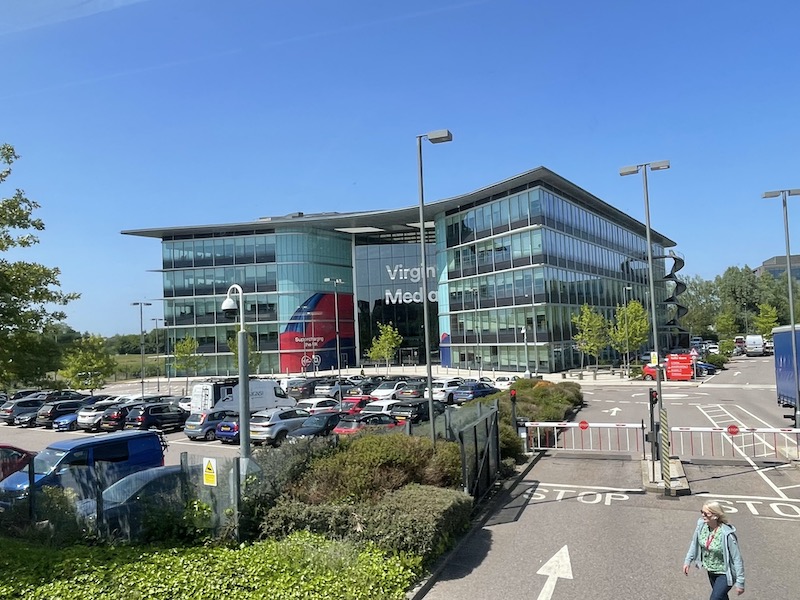
Riding around Green Park on the top deck of a bus on route 50, the one thing you notice is the amount of free car parking available at each business unit, and the fact the roads are completely free of parked cars and there’s no need for yellow lines – it’s all enforced by private contractors on behalf of the business park with a £100 fine if you park on the road.

So who will use the new Reading Green Park station? Well, there’s no doubt there’s extensive residential development underway in what’s called Green Park Village & Bankside Gardens with many flats already occupied.


These residents are closer to the station than to route 50 so they’ll certainly be pleased for the new facility to get them into central Reading.
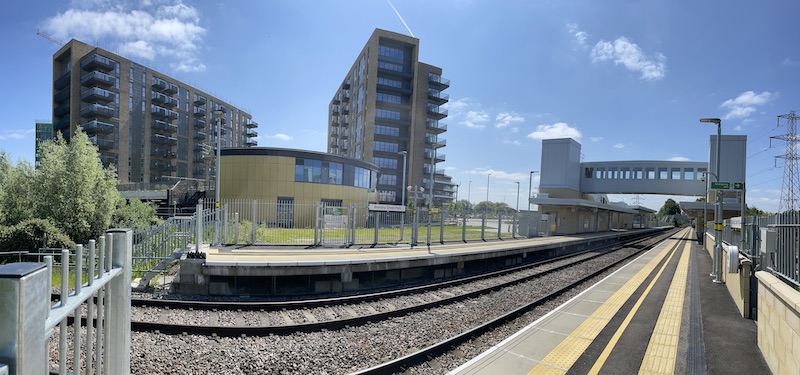
The station itself befits the new breed of the genre and won’t be winning any prizes for stunning architecture, it being very much in the modular format we’ve become accustomed to as new stations open around the network these days.
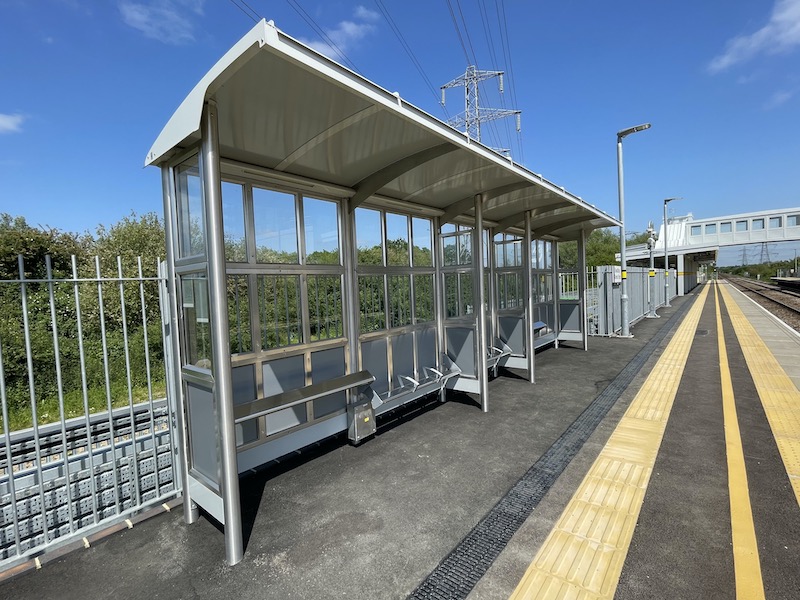
The two 150 metre platforms are capable of taking six-coach trains and each has a double shelter with two uncomfortable metal perches and six sit down seats. There are dot matrix signs referencing where the three coach trains currently being used will stop across the six zones …. except that no zones are marked out on the platforms.

That’s about it for platform facilities. The station building on the east side, Basingstoke bound platform 1…
…. has toilets including an accessible one and a separate baby change room …

… and a new style open plan desk arrangement by the ticket gates for passengers wanting to buy tickets from a member of staff.
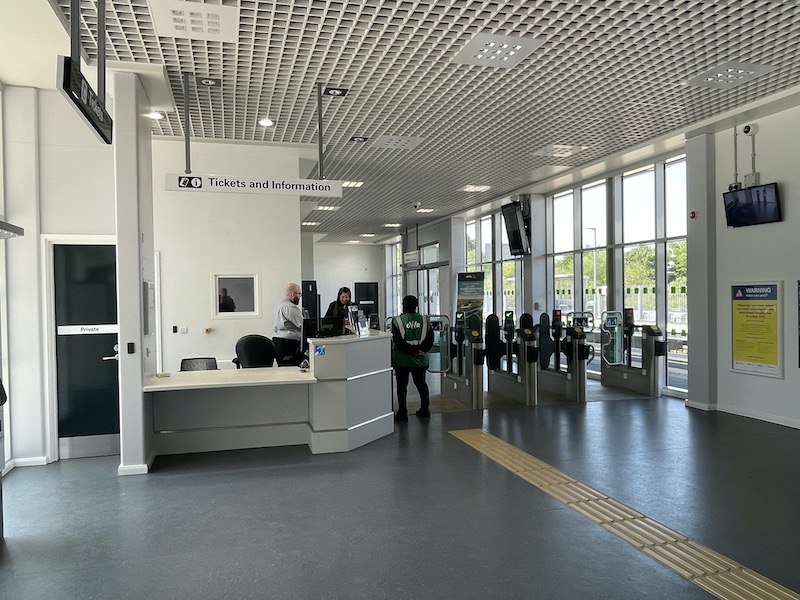
There are two ticket machines inside and one outside for when the ticket office is closed*…
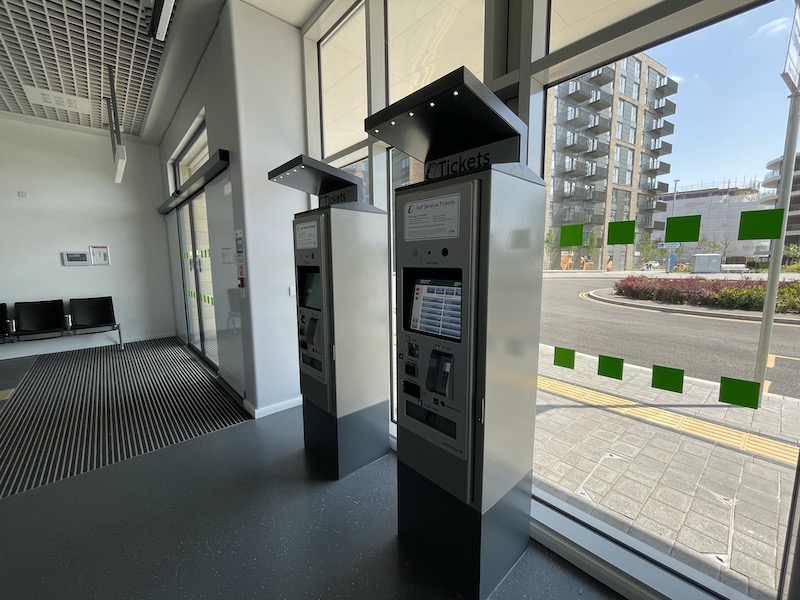
.. with a lockable sliding gate for exit/entrance to the platforms for such times.
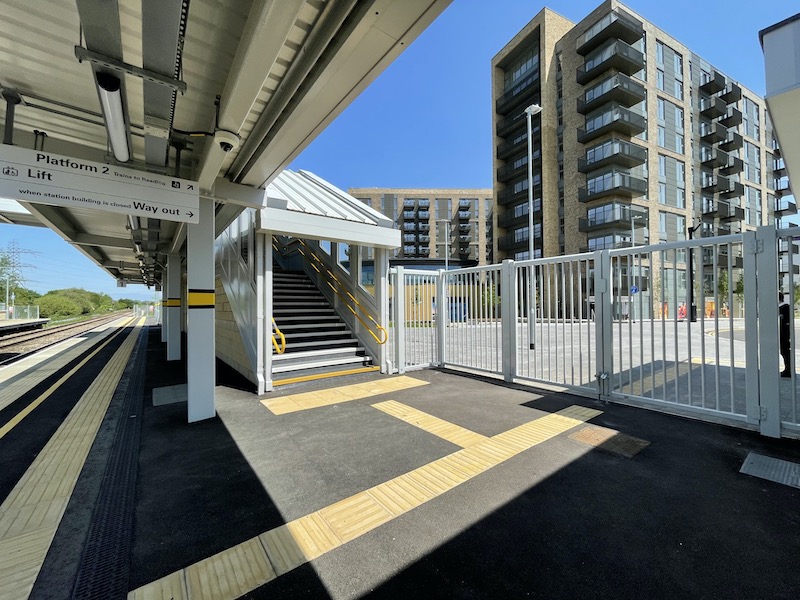
There are three sets of four seats in the station building (one before the ticket gates and two on the other side of the gates) and a next train listing board which for a rather restricted range of departures shows the next 16 departures to either Reading or Basingstoke over the upcoming four hours.
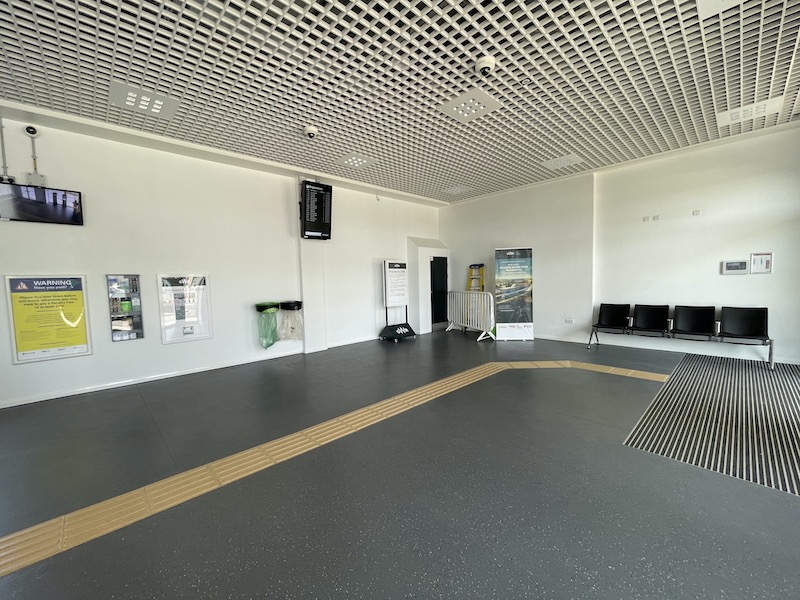
Outside, the bus less bus stops have no seats or shelters but there is a set of three seats under the station totem sign.

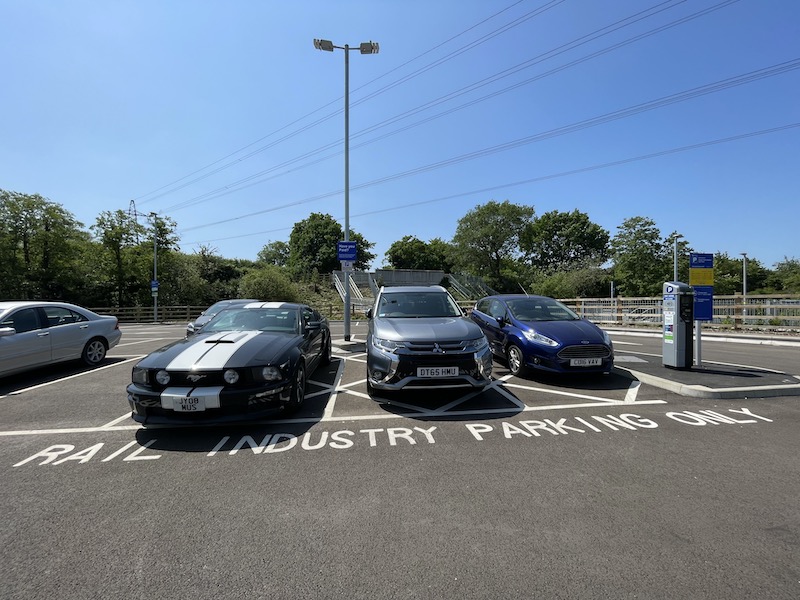
The car park …

…. has reserved spaces for the “rail industry”…
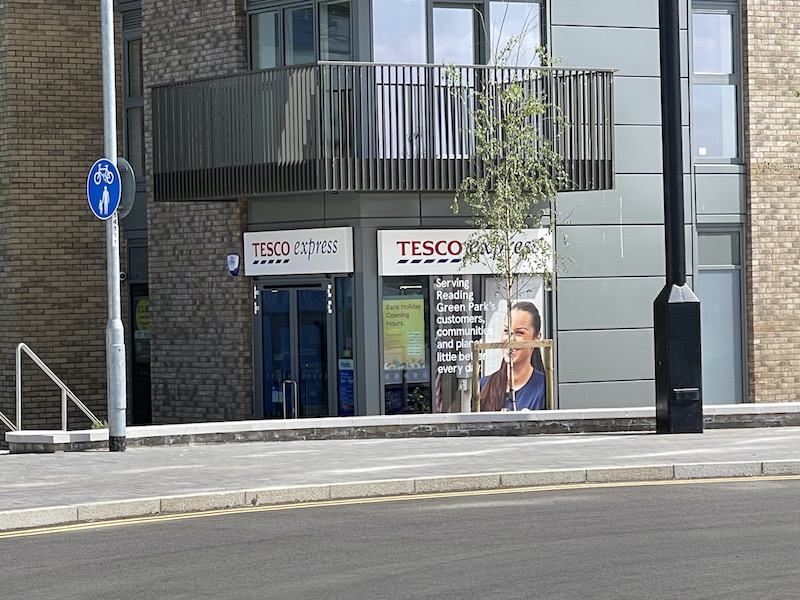
…. and there’s a Tesco Express opposite the station entrance on the ground floor of one of the new residential blocks …
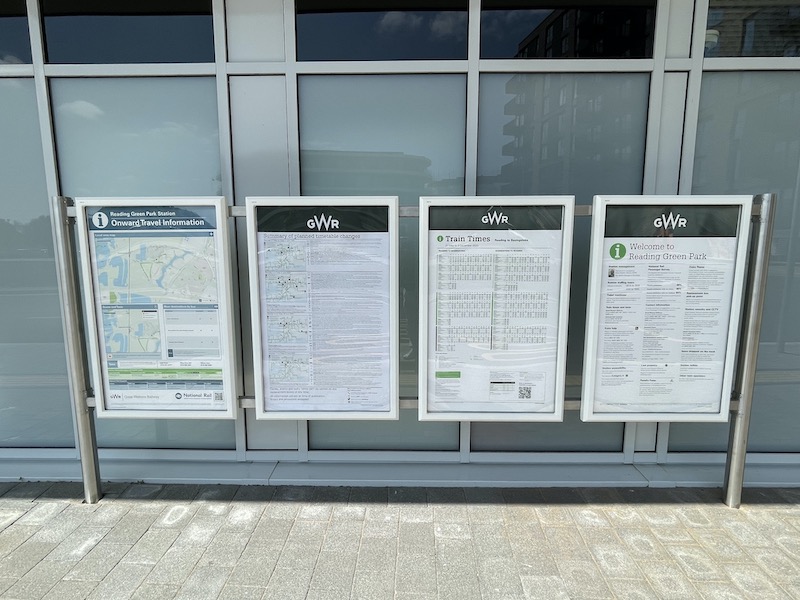
… although an old Open Street Map for the area erroneously showed it as a Tesco Extra which Network Rail picked up for its useless Onward Travel Information poster.


More useful are full timetable displays on both platforms as well as outside the station but sadly no printed timetable leaflets for the service.
But, there are printed leaflets for route 50 on board the buses.

There were a lot of GWR staff on duty at the station on Tuesday – perhaps some are on familiarisation with the new facilities, but I noticed five not doing very much as it was quite quiet…

… although pleasing to see some passengers from the flats arriving to travel into Reading, encouraged no doubt by the lovely weather and school half term.

As recently blogged, seven new stations are in the pipeline for opening this year. Next up in a couple of weeks will be Marsh Barton near Exeter.

*updated 08:00 1st June as I didn’t spot that on my visit (thanks Geoff).
Roger French
Blogging timetable: 06:00 TThS
 BusAndTrainUser
It is very frustrating that it takes so long to open new rail stations in the UK. An example is the Portway Park and Ride station on the Severn Beach line in Bristol. This is a basic one platform station, with no requirement for a footbridge, on land adjacent to an existing park and ride site owned by the City Council. Funding for the station was obtained in 2016, but although the station was completed when I visited it in March this year, it is still not open. I understand that Network Rail have to complete a number of checks before it can open and although I fully appreciate the need to carry out this exercise, why is it taking so long? Come on Network Rail get this completed piece of transport infrastructure open, so that the public can start using it.
LikeLiked by 1 person
I understand Marsh Barton is in a similar position. The station is complete but no opening date confirmed yet.
LikeLike
This station could have been a much wider multi-modal transport interchange, its right next to the M4 so would have been an idea site for a large park and ride. Maybe with its own m4 interchange for london, not that its more than a mile from j11 m4 now distance bus s from London to Wales / west county. The current south reading park and ride is at Mereoak about 2 mile south of the new station so your going to need a bus from the park and ride to get to the rail station. No parking at the station may fulfill the reading council’s green agenda, but the local new housing estates are being built with car parking and all the new offices on Green park have amble parking in multistorey car parks. Even the costco in green park has been allowed to build a new petrol station, previous park owners refused as they where promoting green park an out of town business estate where 99% of workers commute by car as the new greeen way of working. The station could have been the terminus for Elizabeth line, then allowing london commuters and heathrow traveller to get off the the M4 and into a train. The station would have needed to be 4 tracks wide to allow good trains to pass through while trains stopped at the station, maybe north south crosscountry trains could have also stop here and special football trains for Reading football stadium localed about a 1 mile away. The west Reading station area is a bottle neck for more rail services as two main lines become one.
LikeLike
Reading Borough Council are currently out to tender for route 9 with a (if we can afford it) option to extend to Green Park Station via South Oaks Way rather than the business park
https://www.contractsfinder.service.gov.uk/Notice/d8a8a3e1-5fde-4f8e-9fa2-9516fb9888fe
LikeLiked by 1 person
George Palmer’s ambitious dreams for Reading Green Park are rather stymied by the number of trains that already have to squeeze through Reading West. There’s also a more convenient Park and Ride at the football stadium which is closer to the M4. Let’s limit our ambitions to getting the Basingstoke line electrified! Good things might follow from that
LikeLiked by 1 person
I know that banning private cars from stopping right outside the station entrance is meant to encourage greener ways of travelling to/from the station, but I do feel it often ends up being counterproductive; having to scuttle to/from a drop-off point on a wet and windy night will tempt many who have the choice to make the whole journey by car instead.
…and with the trend for unstaffed stations I’m surprised they have gone for such an extensive range of passenger facilities in the main building, which will probably end up locked and tantalisingly inaccessible for much of the day within a few years.
Good to see the footbridge is enclosed though. TfL’s recent step-free station upgrades have mostly resulted in a long unsheltered link to the lift when a basic roof shouldn’t have added significantly to the cost.
LikeLike
That’s a very dangerous looking car in the rail industry spot with the white stripe down it.Strange you can own something like that but not a dangerous dog or a firearm.
LikeLike
The reg number starts with a J so it’s a personalised one.
LikeLike
That open plan desk arrangement by the gates also exists at Oxford Parkway, I think from when it opened in 2015.
And the gas bus is not zero emission: it has reduced levels of CO2 emissions (Nottingham City Transport’s website says up to 84% reduction compared to a Euro VI diesel) and of NOx emissions, but is not emission free.
LikeLike
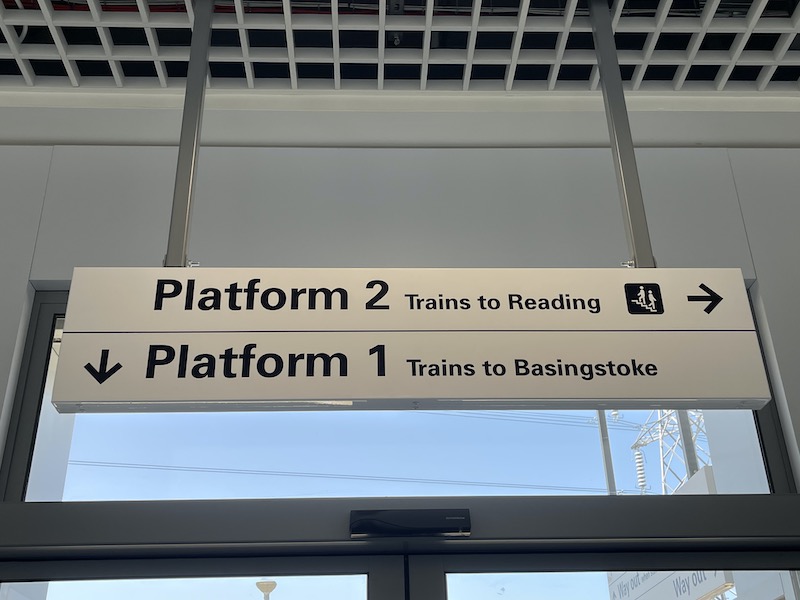
Rail Alphabet 2 hasn’t made it to the signs here. Is this a case of them having been procured so early in the construction process, like Shepherd’s Bush initially having Silverlink signage despite being London Overground by the time it opened?
LikeLiked by 1 person
Correct – the station had already had its signage signed off prior to Rail Alphabet 2 coming on the scene and it’s quicker to leave it as is – also the full toolkit RA2 was not complete
LikeLike
It is rather a nonsense that new transport links are not required if not in advance of new developments but coincident with them. All those office workers will have become mindset into using their cars as a default now given such lavish off-street parking availability. An opportunity missed along with the M4 feeder suggestion (above) which, I hope, doesn’t lead to Green Park becoming a ‘white elephant’!
It can only be hoped that current and future residents will be encouraged to use the polluting diesel turbo trains which, of course, were to have been replaced with electrification having been extended to Basingstoke and also serving a new station along the same line at Chineham. Why both initiatives were scrapped (or, in the case of the station, never left the drawing board) is beyond me as both seem to be relatively easy wins.
LikeLike
An M4 feeder (George Palmer, Ray F Pelham) would have shown just how cheap a railway station is. £21.5M for the station, access roads, car park, etc. as Roger has described here. Of course it could be better, but it’s usable. Compare with £50M for a simple new junction on M49 near Bristol that nobody can use as it has no access roads at all. More detail on that shambles here: https://www.roads.org.uk/blog/ghost-junction
LikeLike
If it were to become an M4 feeder,would it have to be Reading Green Park Parkway,or Reading Green Parkway ? By the way,the station is already part of the Reading-Basingstoke CRP. Hopefully they have our leaflets at the station?
LikeLike