
Saturday 16th May 2026
Cumberland has seen some interesting developments of expanded timetables and new bus routes over the last few months so I recently spent a couple of days taking a look around this scenic part of the country and trying out some of the new routes.
Together with neighbouring Westmorland and Furness, Cumberland Council replaced the larger Cumbria County Council and six District Councils in April 2023. Whilst Cumbria had famously ceased providing any financial support to bus services both Cumberland and Westmorland and Furness have been awarded Government money through BSIP and more recently the Local Authority Bus Grant.
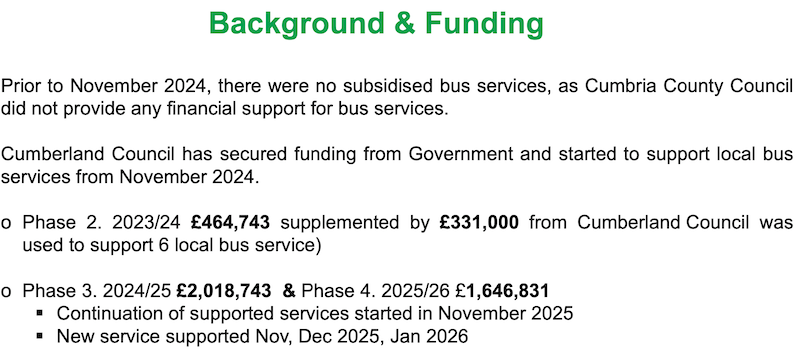
Cumberland received £5,056,175 (Capital: £3,315,344; Revenue: £1,646,831 and ‘Capacity/Capability Funding’: £94,000) in 2025/26 with £7,482,738 awarded for the three years 2026/27 to 2028/29 giving roughly £2.5 million for each of those years leading it to launch an initiative branded as Cumberland Go comprising 18 new and improved bus routes in a three phase introduction between November 2025 and January 2026.

Unsurprisingly the Council got very excited about this positive development with Councillor Denise Rollo, Executive Member for Sustainable, Resilient and Connected Places (I love the job titles they come up with these days, gone are the days of just being the councillor who looks after transport) telling everyone in February “this programme is a genuine game changer for public transport in Cumberland. The investment we’ve made is already delivering results, with some routes showing passenger growth of up to 50%, which is incredibly encouraging. These services reconnect our towns, villages and communities, offering reliable, affordable ways for people to travel for work, education, healthcare or leisure.”
As always with these things quoting “growth of up to 50%” very much depends on your starting point. Carrying three passengers on a sparsely used service instead of two is not necessarily something to shout about even though it’s a 50% increase.
The 18 enhancements and new routes introduced over the three phases at the end of last year and beginning of 2026 are listed on the Cumberland Council website…
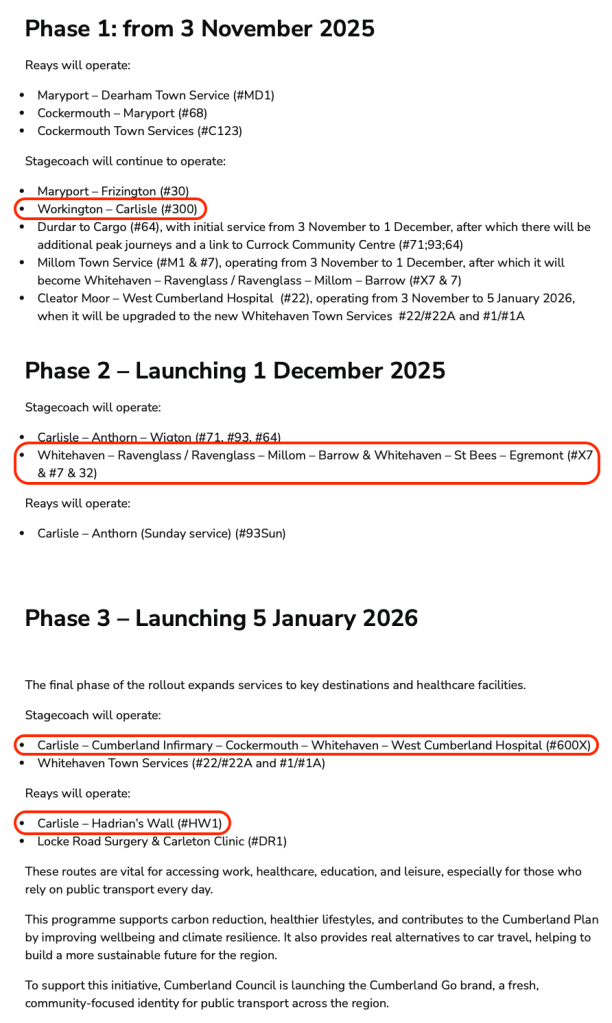
A 24 hour visit obviously didn’t give enough time to sample all 18 enhancements so I just selected four, as highlighted in red on the above list, beginning with new route HW1 linking Carlisle with Hadrian’s Wall (introduced from 5th January) which I assume is mainly aimed at the tourist market, so January does seem a strange time to launch such a route but is probably to do with the way public funding has to be spent within financial years with no carry forward allowed.
In some ways this new route nicely compliments longer standing route AD122 which has linked Newcastle and Hexham with Hadrians Wall for many years and indeed you can now travel along the route of the famous Wall using both routes which meet at the common terminus at the Walltown Quarry Country Park.
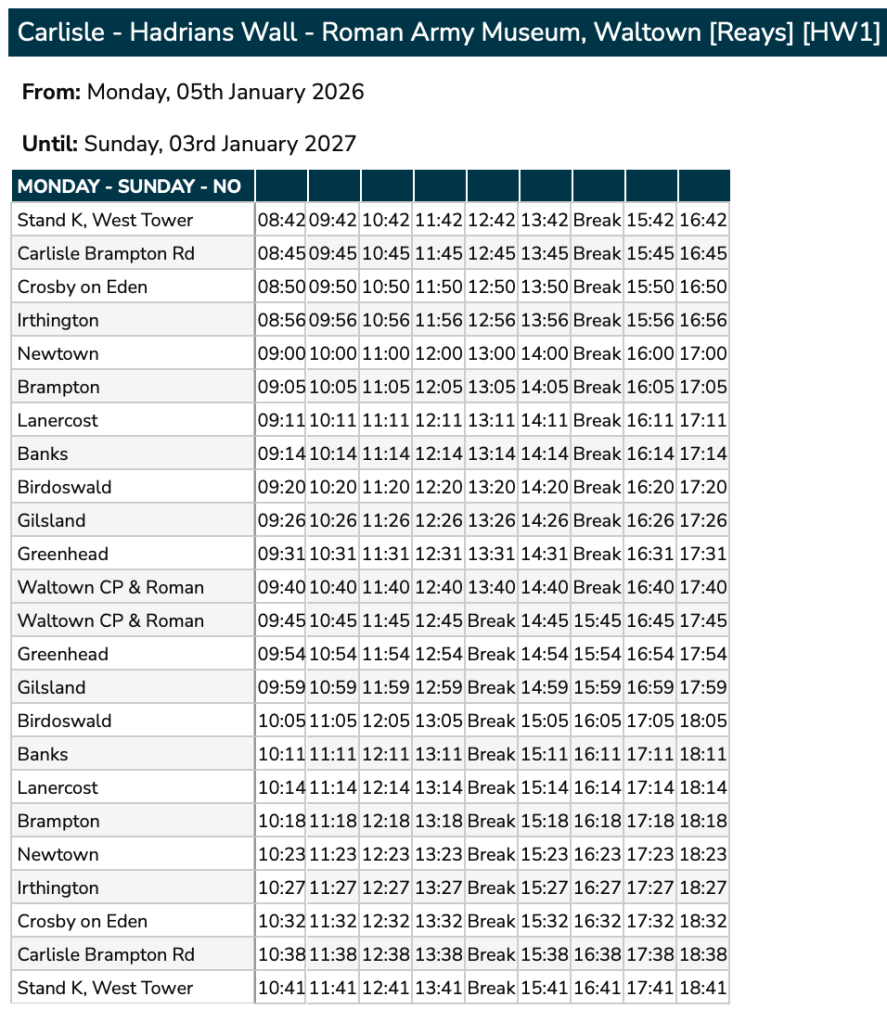
Cumberland based Reays has won the contract to operate the daily route which runs hourly from Carlisle between 08:42 and 16:42 (09:45 and 17:45 return times from Walltown Quarry Country Park) with an hour’s gap in service around lunch time, giving a break for each of the two drivers and the two minibuses allocated to the route.
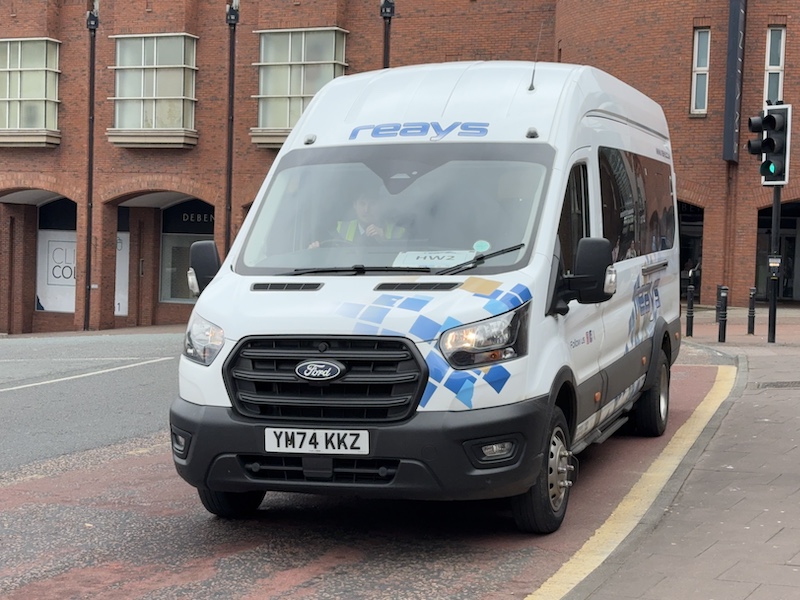
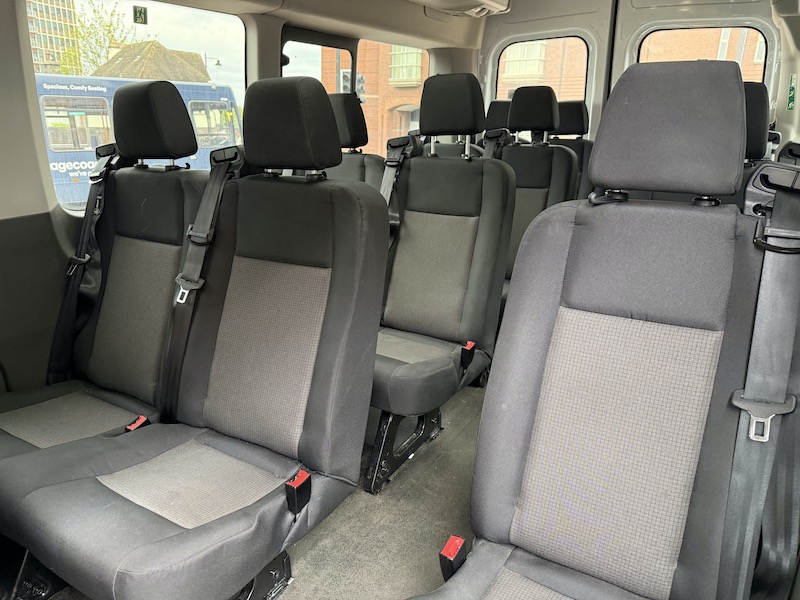
I caught the 13:42 departure from West Tower Street and was a bit surprised to see the minibus that arrived was a non-accessible Ford Transit with a passenger manually operated side door, and quite heavy it was too.
It also arrived slightly late at 13:45 with two passengers who looked as though they were tourists alighting and one passenger who was more ‘local looking’ boarding, along with myself.
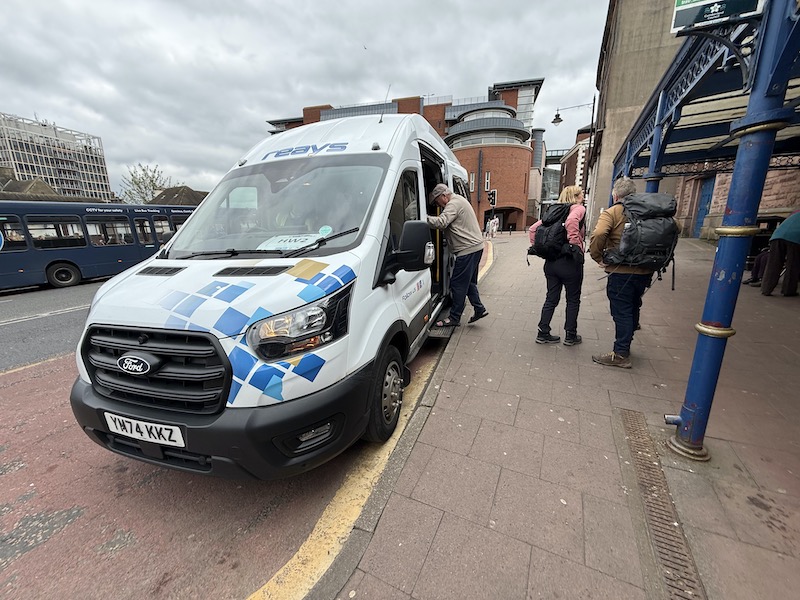
That passenger travelled to Irthington, a village to the north of the A689 which previously didn’t have a bus service prior to the HW1 and the driver told me he’s become a regular passenger to and from Carlisle with that journey home being his third time on the bus that day.
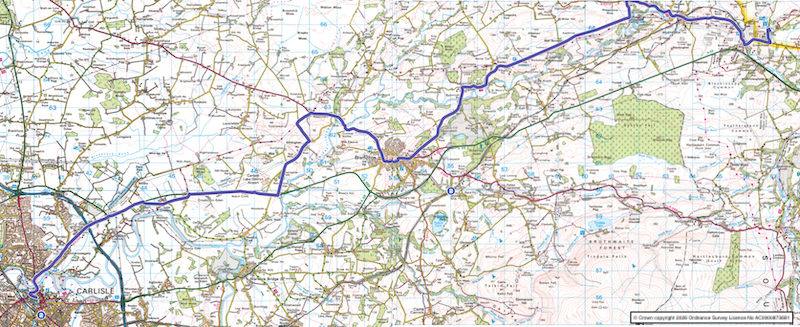
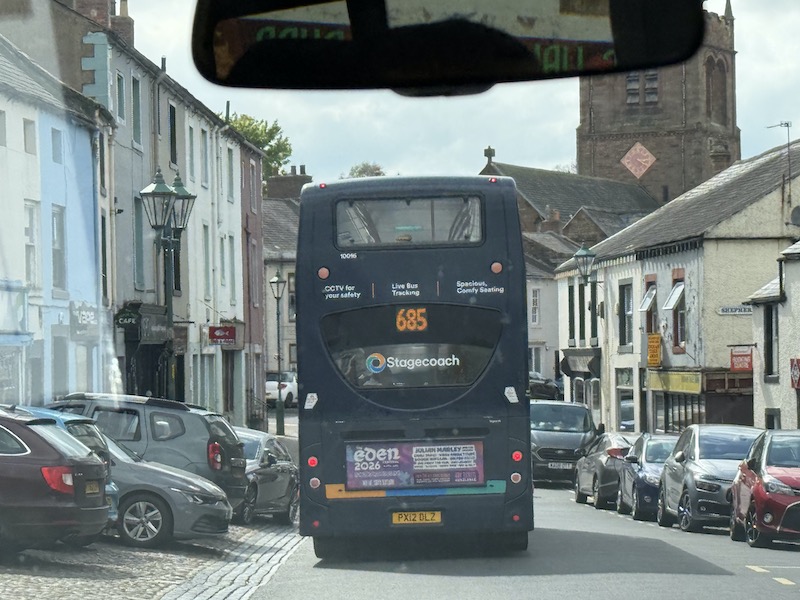
After deviating off the main A689 to serve Irthington and Newtown the route heads down to the town of Brampton where we met a bus on Stagecoach’s hourly route 685 which takes the main road between Carlisle and Newcastle including an hourly short journey between Carlisle and Brampton.
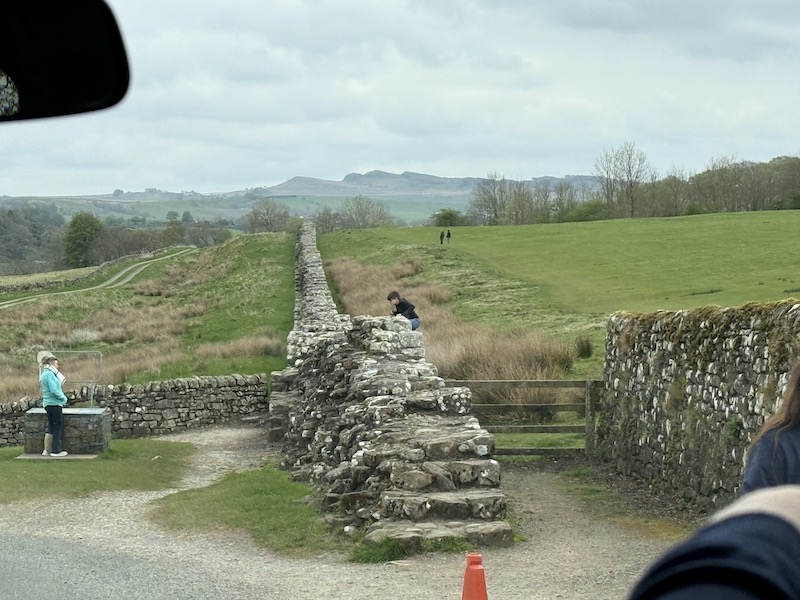
After Brampton there are lots of opportunities to see Hadrian’s construction skills as the route passes along the path of the Wall for a considerable distance…
… along a very straight stretch of road.
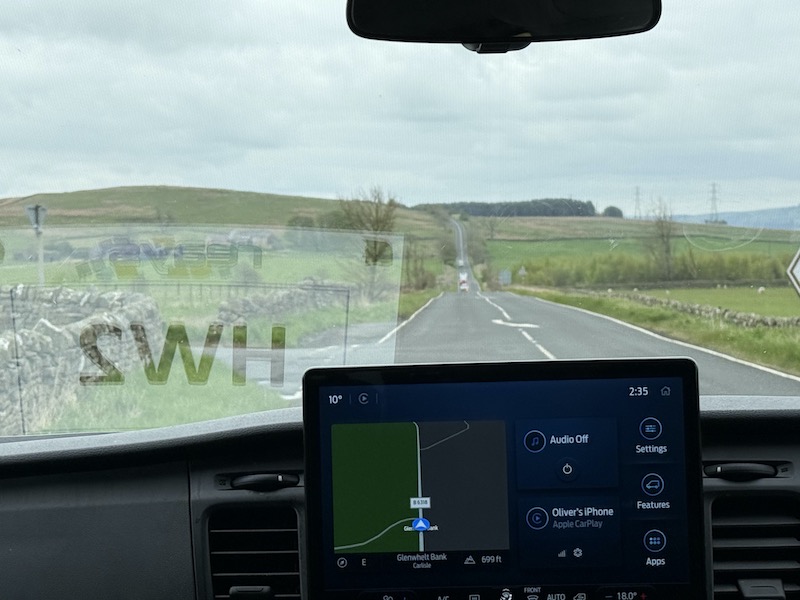
You might notice the route number in the front of the minibus was showing HW2…
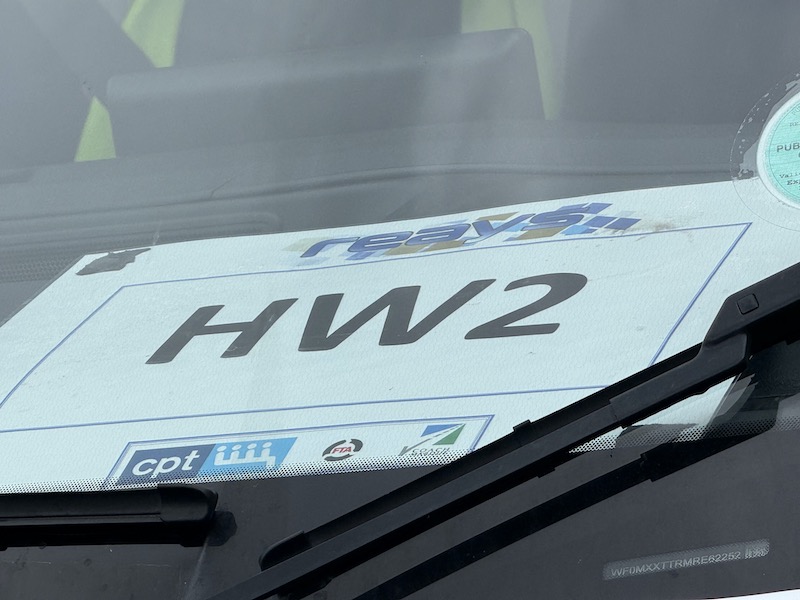
… which I queried with the driver as the route is promoted as being the HW1, but the driver explained he was the second bus on the route and the other one was numbered HW1. Which seemed potentially confusing to passengers and added to the anomalous situation of a non accessible bus coupled with no next stop displays and announcements which for the age of the vehicle is now a requirement on a local bus route.
As we headed towards the terminus at Waltown Quarry and Country Park I noticed we were still around five minutes behind schedule but it then became evident it was another timetable with an inconsistent allocation of journey times between timing points. As we crossed the border into Northumberland at the village of Gilsland we were five minutes away from Greenhead, the penultimate timing point and just one mile before the terminus but an allowance of nine minutes is given to complete that last one mile of the journey. Consequently we arrived four minutes early at the Country Park, 52 minutes after having left Carlisle.
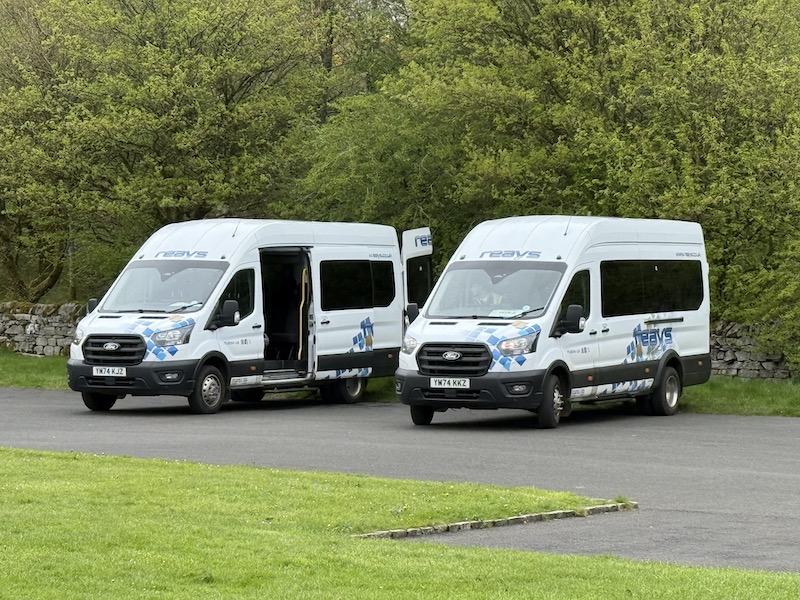
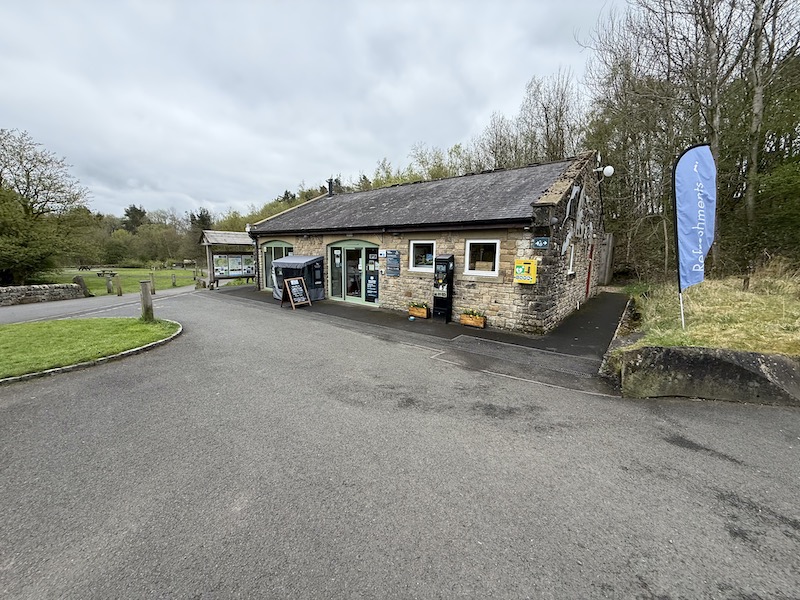
The driver then parked up for his one hour break and had time for a chat with the other driver with HW1 who was going to operate the 14:45 departure back to Carlisle which I decided to catch rather than mooch around the Country Park although it looked like a lovely spot to spend a few hours enjoying the scenery and facilities.
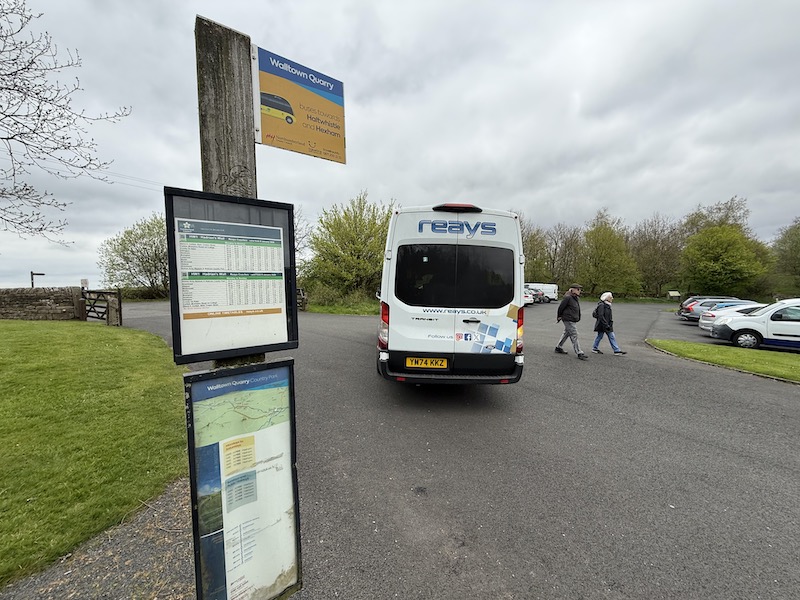
It was good to see both HW1 and AD122 timetables posted at the bus stop
… and a further copy of route AD122 was on display in the cafe.
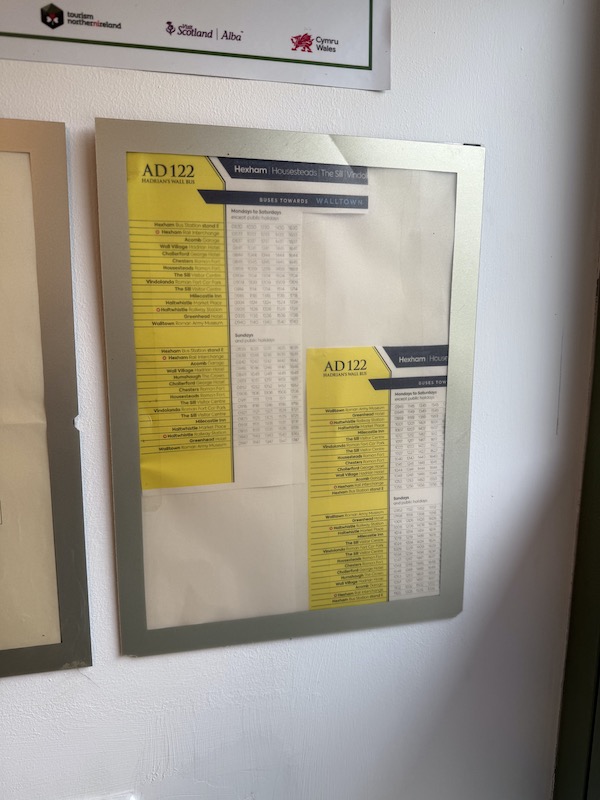
Knowing the generous time allowance of nine minutes back to Greenhead when it only takes three minutes, the driver of the journey back to Carlisle sensibly didn’t leave until six minutes late at 14:51.
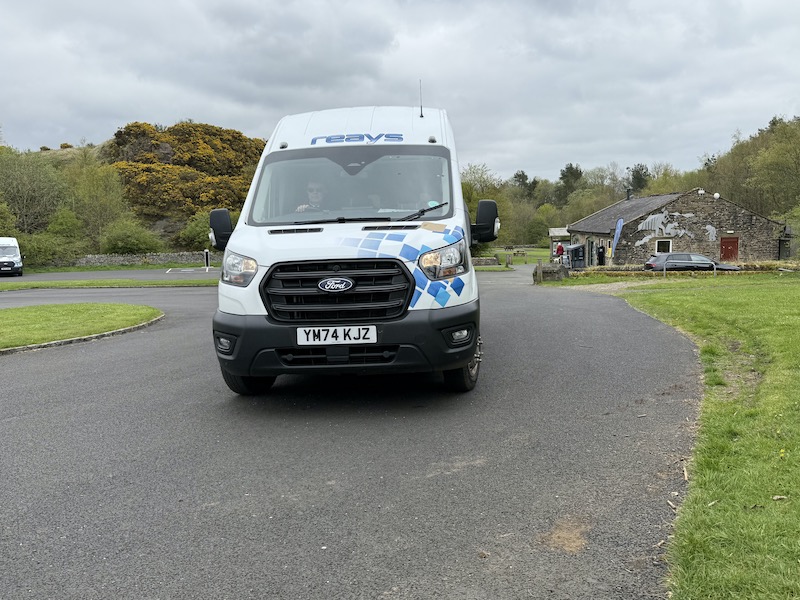
This time we picked up three tourists at the Roman Fort in Birdoswald one of whom alighted at the Priory at Lanercost – both locations on the path of the Wall – and the other two travelled back to Carlisle but sadly no other passengers appeared. I asked both drivers how numbers travelling were going three months into the new service, and they both responded explaining very few so far, but those that have used the service have been very pleased with it. Let’s hope word spreads and awareness increases for the summer season and Reays also soon receives the low floor accessible minibuses I understand it has on order for the service.
Back in Carlisle, thanks to the tightness of the western end of the HW1 timetable I missed my planned connection with Stagecoach’s route 600 to Whitehaven so after a short refreshment break caught the 300 instead.
Both the 300 and 600 have seen Cumberland Go style enhancements as part of this uplift in service provision. Together with the two-hourly 400 they provide a frequent service between Carlisle and Wigton from where the routes continue to either Maryport and Workington (via Aspatria on the 300) or to Silloth (400) or to Cockermouth and Whitehaven (on the 600).
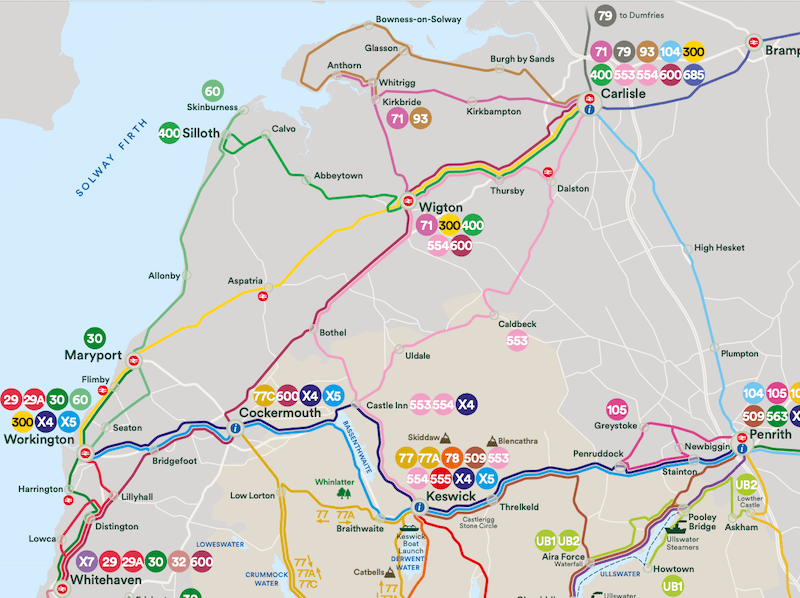
As well as improved frequencies on all routes, the 600 has been diverted to serve Cumberland Infirmary on its way out of Carlisle and at the other end of the route is extended to West Cumberland Hospital, south of Whitehaven. Cumberland Council explains the enhancement has been introduced “in direct response to feedback from the NHS and wider partners about the need for better connectivity between Cumberland Infirmary and West Cumberland Hospital with the timetable developed around clinic schedules, visiting hours and NHS staff shift patterns.”
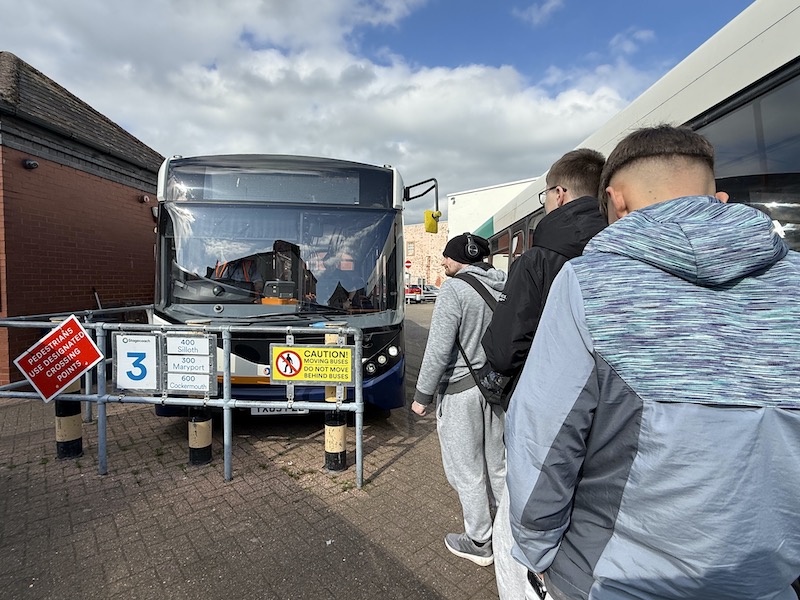
The 300 now runs half hourly and the journey I caught out of Carlisle at 16:35 was a busy one with over 20 on board from Carlisle’s bustling bus station with more boarding as we left the city but by the time we reached Wigton nuimbers had reduced to around half a dozen and I bailed out to switch to a route 600 for Whitehaven.
This wasn’t so busy and perhaps the enhancement to an hourly service has yet to catch on as there were only around half a dozen on board and numbers dwindled even further beyond Cockermouth to Whitehaven.
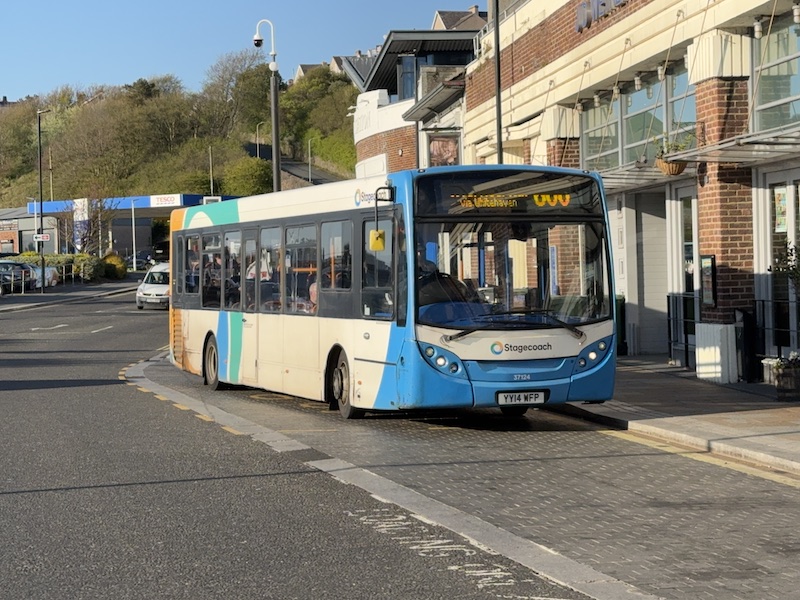
Journey times between Carlisle and Workington/Whitehaven are fairly lengthy on these bus routes – the 300 takes around 90 minutes and the 600 around two hours so I’m sure most end to end traffic is taken by Northern’s rail service.
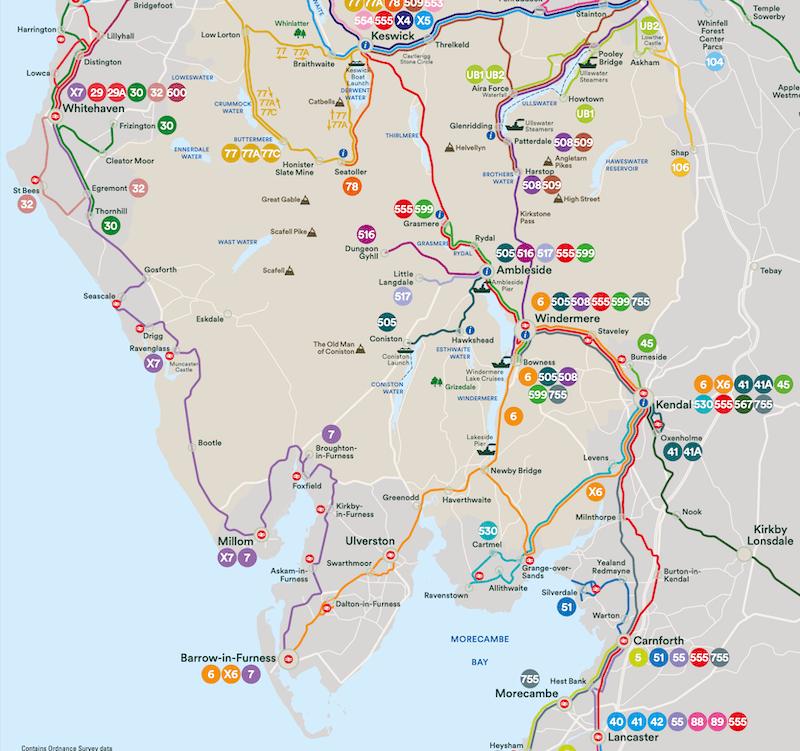
After a night in Whitehaven my next Cumberland Go initiative to try out was the lengthy new route X7 which provides a restored link south from Whitehaven along the coast to Seascale, Drigg, Ravenglass and Millom where the bus turns into a 7 for the continued journey via Broughton-in-Furness, Foxfield, Kirby-in-Furness to Barrow–in-Furness, shown in purple on Stagecoach’s network map extract below.
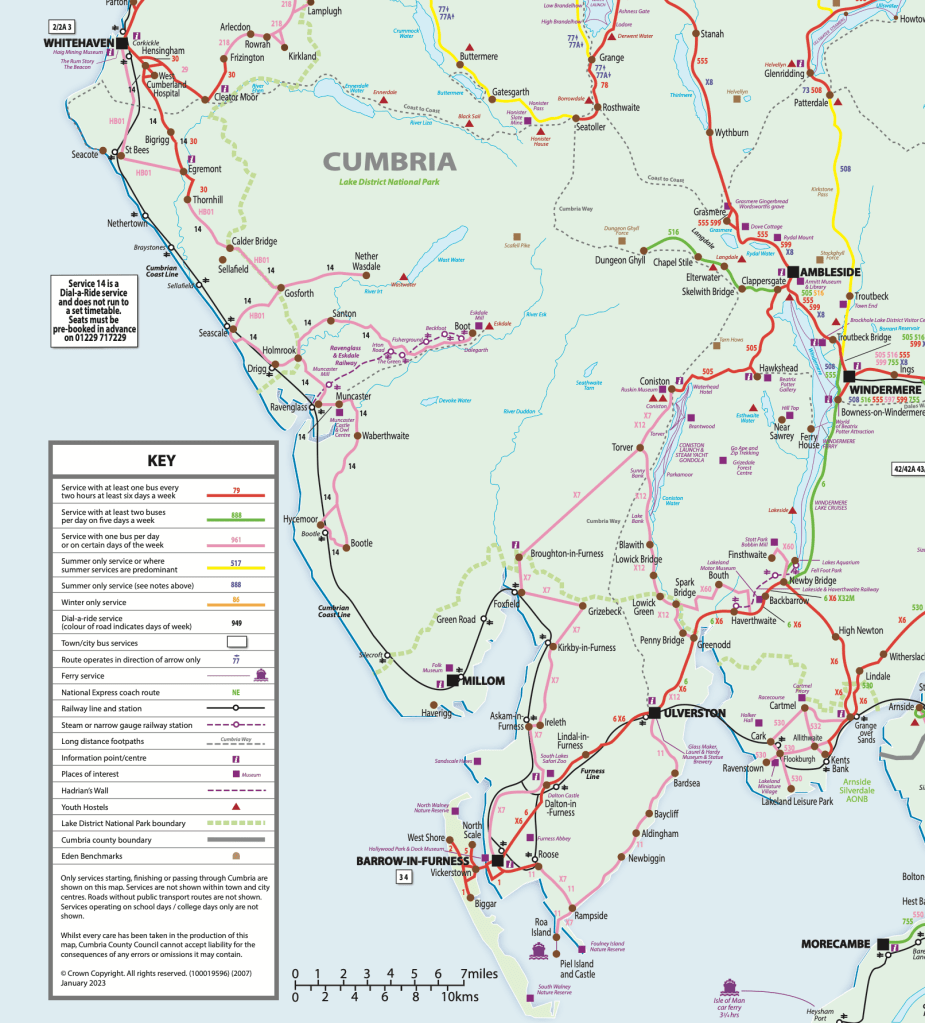
You’d be forgiven for thinking how could that long stretch of coastline have been unserved by bus? A look at the former Cumbria County Council map from 2023 confirms the only provision for part of the area concerned was a limited Dial-A-Ride bus route numbered 14 and another route, coincidentally numbered X7, serving the link beween Boughton-in-Furness and Barrow in Furness which came across from Coniston.
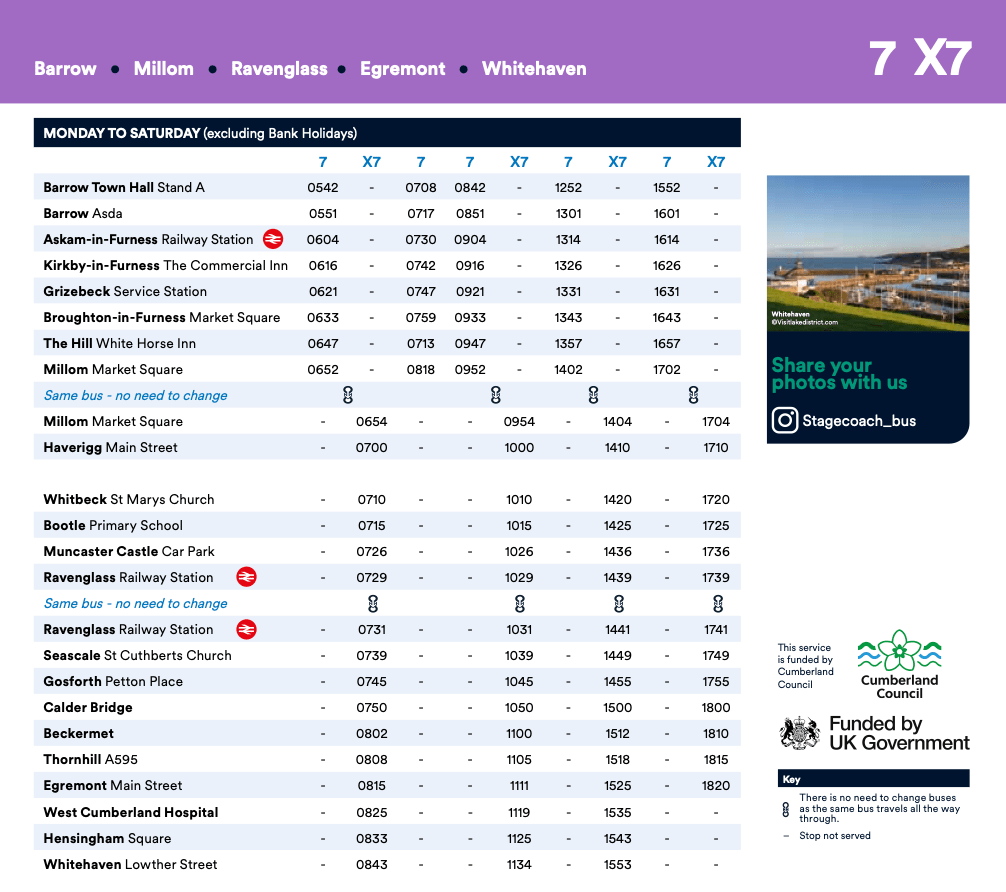
As you can see it’s a fairly limited timetable with just three journeys a day from Whitehaven (four from Egremont) to Barrow-in-Furness with “same bus – no need to change” at both Ravenglass and Millom making for a journey time of two hours and 54 minutes.
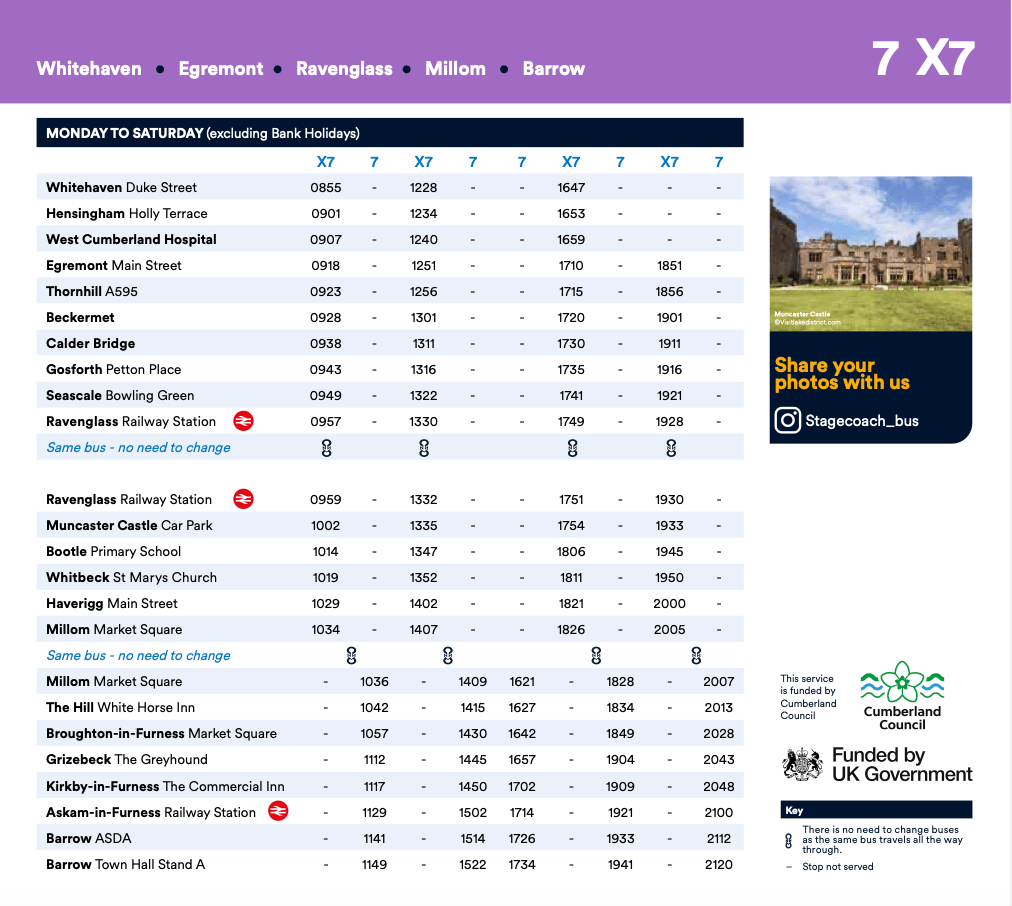
An extra afternoon journey runs between Millom and Barrow-in-Furness with a similar pattern in the northbound direction including an early start from Barrow at 05:42.
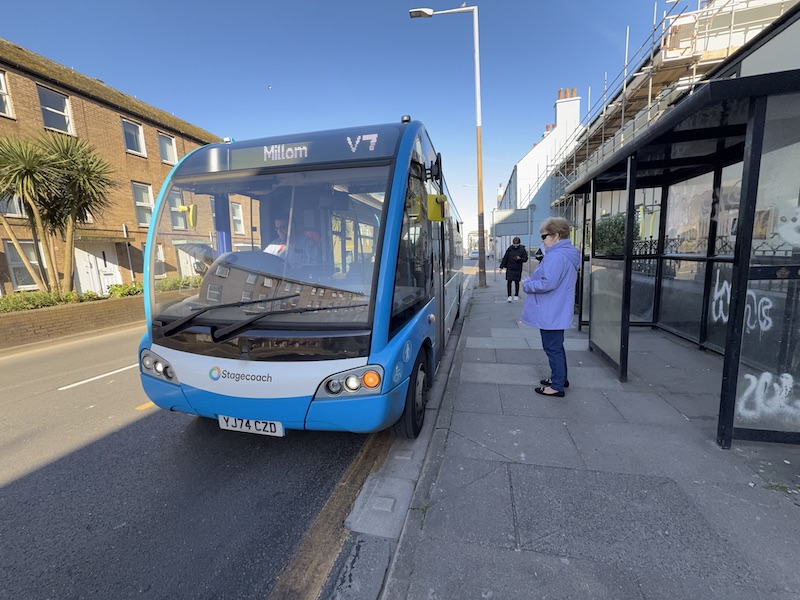
I wandered along to Whitehaven’s Duke Street in good time to catch the first southbound journey at 08:55 which part of me thought would logically be worked by that 05:42 first journey ex Barrow, but that would make for a long spell of driving with only a 12 minute break in Whitehaven, so I’m not sure how it was worked but suffice to say the bus arrived on time and another passenger who’d arrived at the bus stop boarded and we set off with four others who turned up at the last minute.
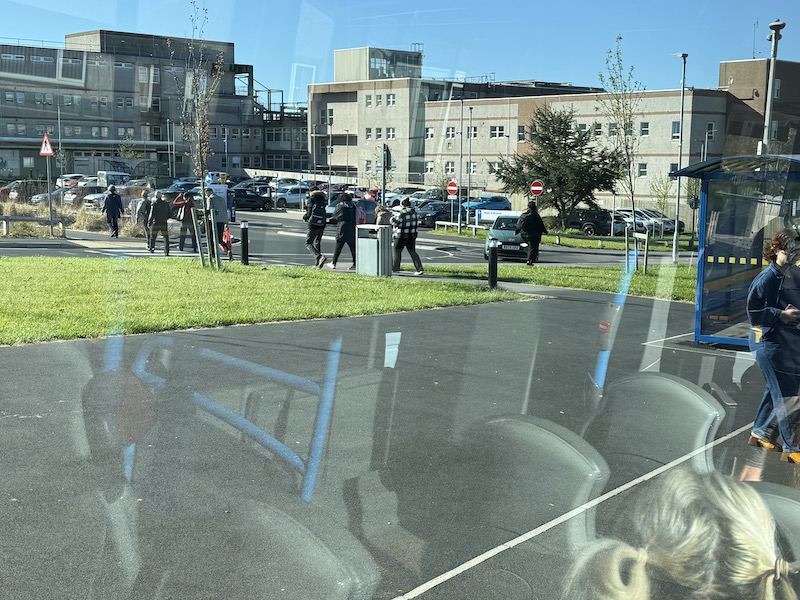
As we headed south out of Whitehaven we made a short detour to serve the West Cumberland Hospital and pulled up behind a bus on route 600 from which an impressive number of passengers alighted, which as explained above, is a new venture for that route.
As we continued towards Egremont we picked four more passengers up with two alighting at the West Lakes Science Park and six alighting in Egremont leaving just the woman who had arrived at the Duke Street bus stop with me. She alighted at Gosforth which we reached at 09:45 so had enjoyed a 50 minute journey on this new route, as I suspect the other passengers alighting at Egremont would have caught other buses prior to the X7 being introduced.
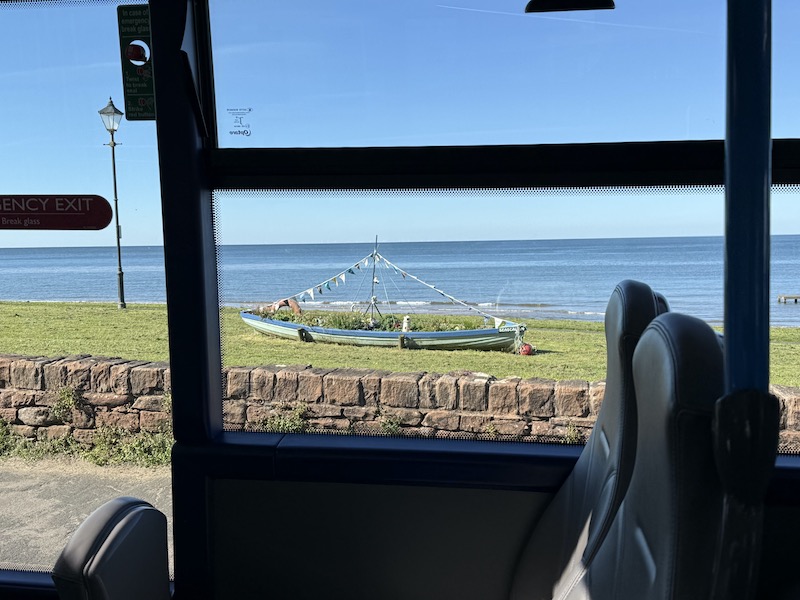
After Gosforth it was just myself on the bus as we continued our journey south getting close up to the coast itself at Seascale except we ran into a delay on the outskirts of the town having to wait while a lorry blocked the residential road unloading materials for some building work leading us to be around 12 minutes behind schedule.
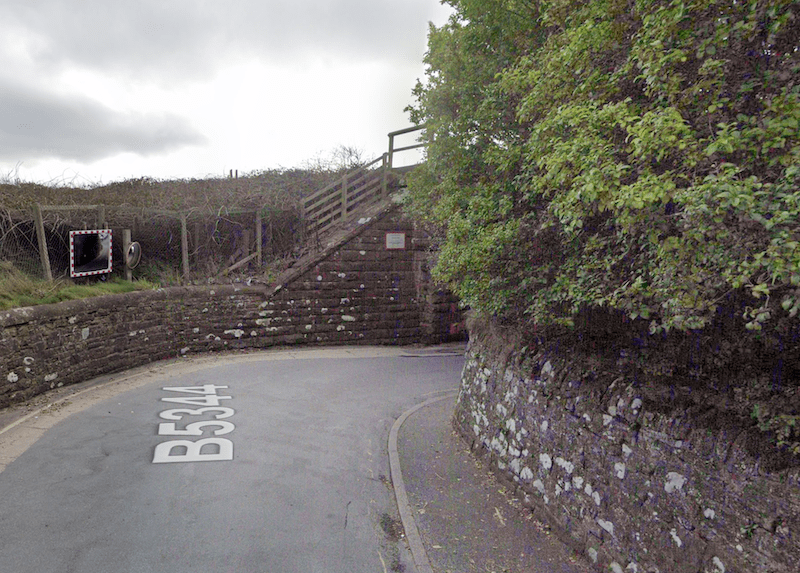
Approaching the coast it’s interesting to see the route criss-cross the Cumbrian Coast railway line a number of times including a very narrow low height bridge in Seascale…
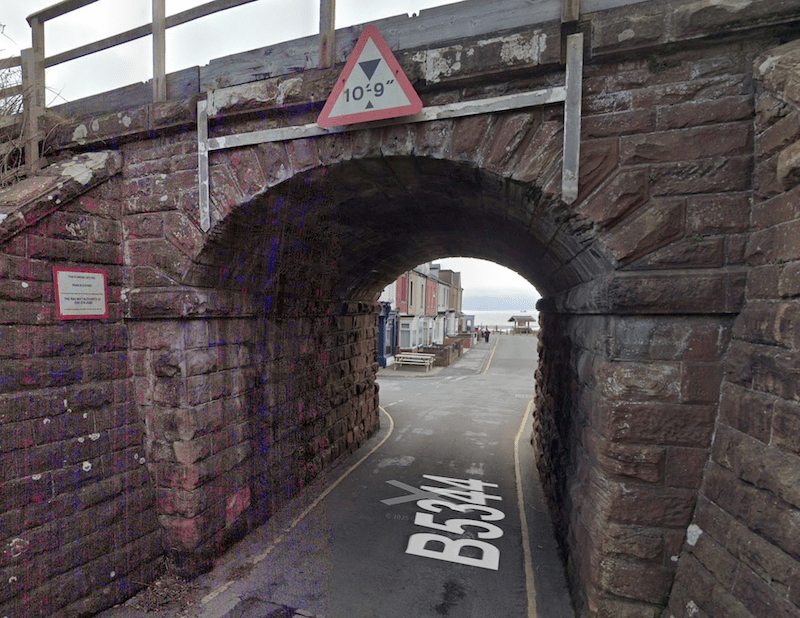
… which would certainly qualify as being in the Top 10 of tight bus manoeuvres.
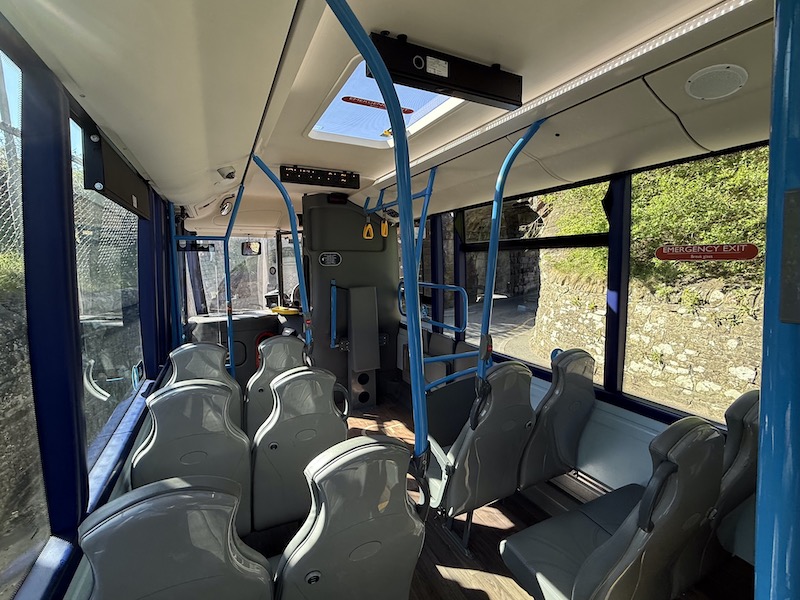
I reckon it even beats Bolton Abbey in the Yorkshire Dales as well as the tight access to Castle Howard testing drivers’ skills.
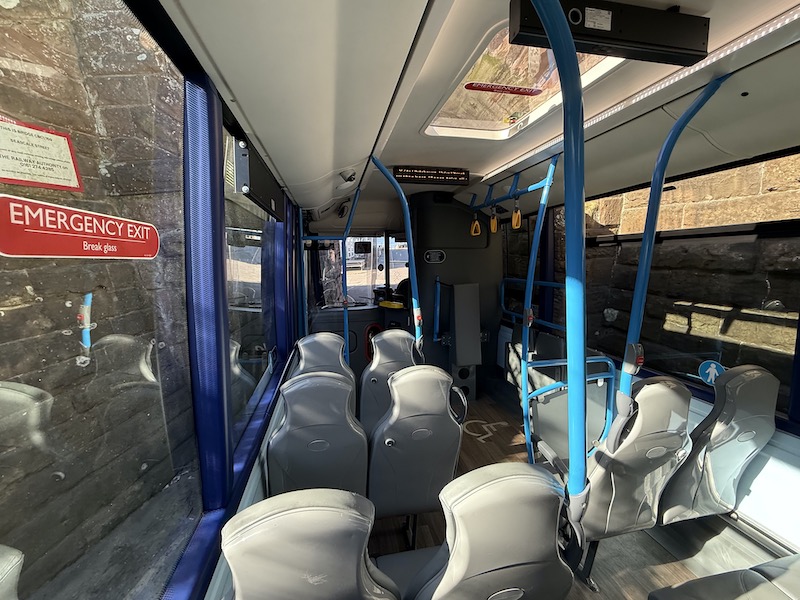
Just to clarify, it is a two-way road too.
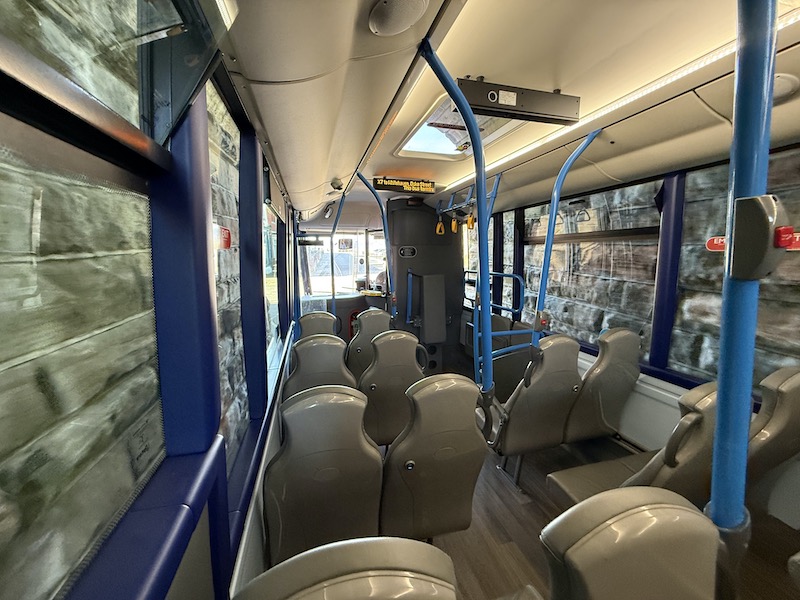
Sometimes it’s a narrow bridge over the railway…
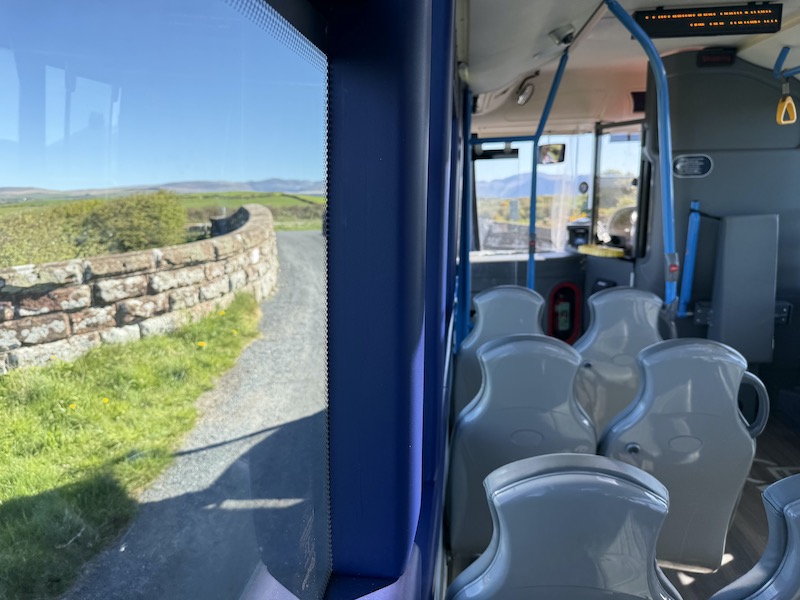
… and each one was negotiated with care.
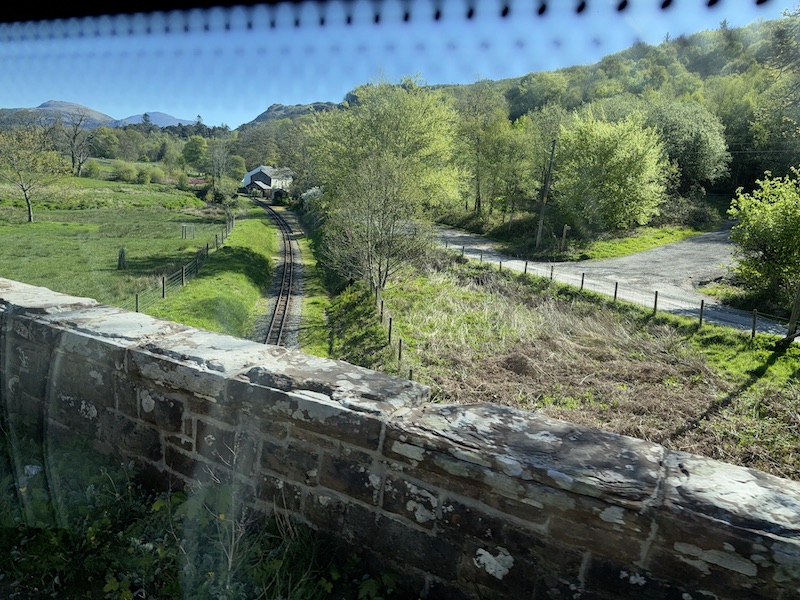
As the journey continues the scenery is well worth the ride…
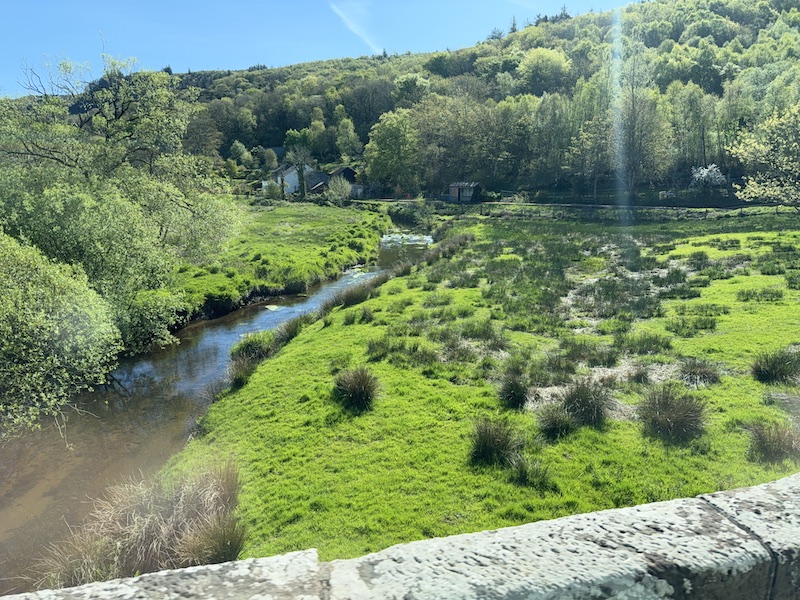
… with streams, rivers and mountains to enjoy.
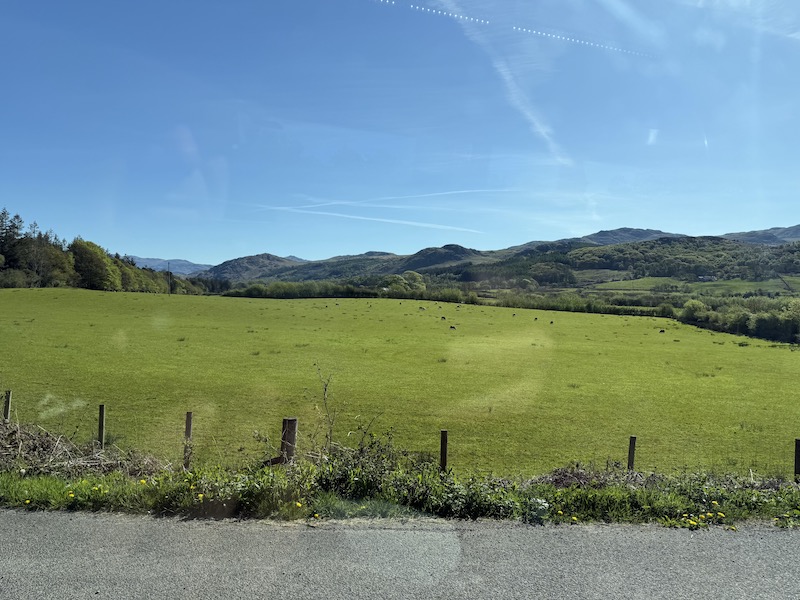
We passed through Ravenglass still 12 minutes down so didn’t bother with the scheduled two minute pause and then, after another 20 minutes or so, a passenger was waiting at a bus stop in Whitbeck, an isolated hamlet on the A595 so it was nice to have someone else on board after being the only passenger for the last 50 minutes.
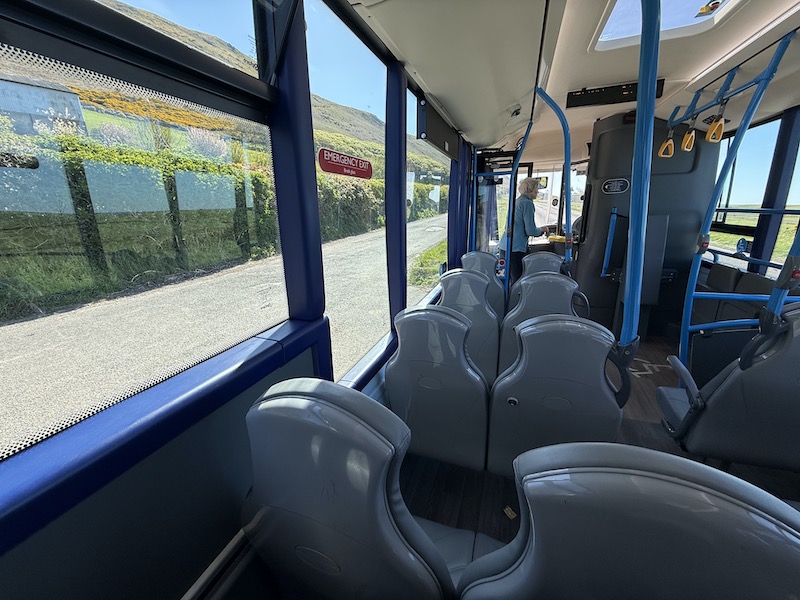
As we got closer to Millom the road crosses the railway at level crossings which are all still manually operated…
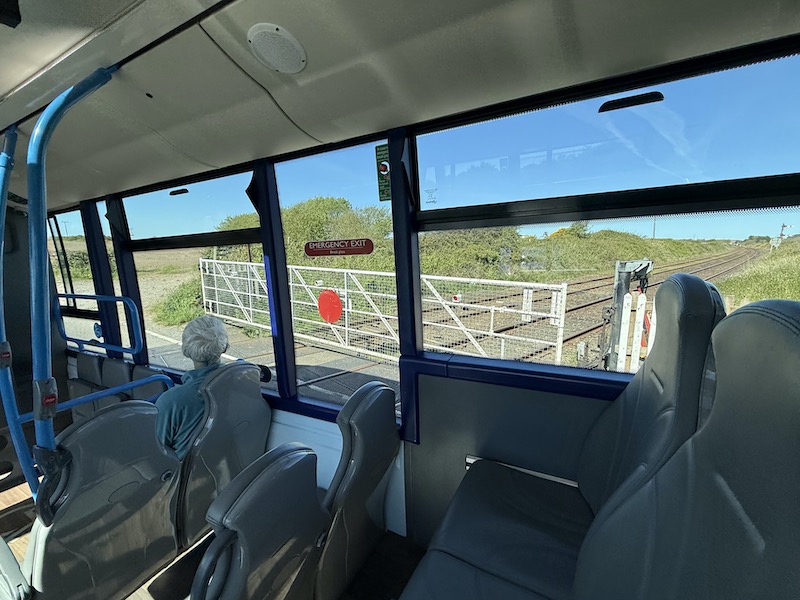
… making for some interesting arrangements.
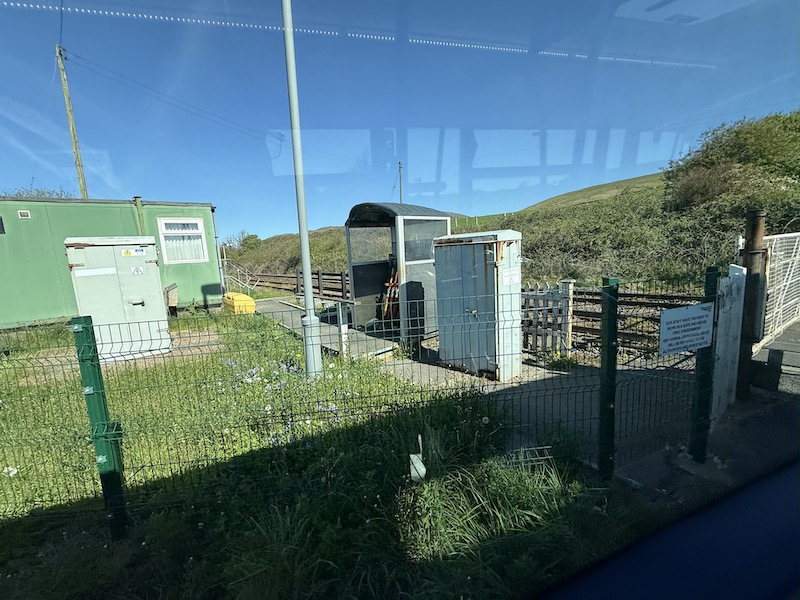
There are three in quick succession – it must cost a fortune to staff them.
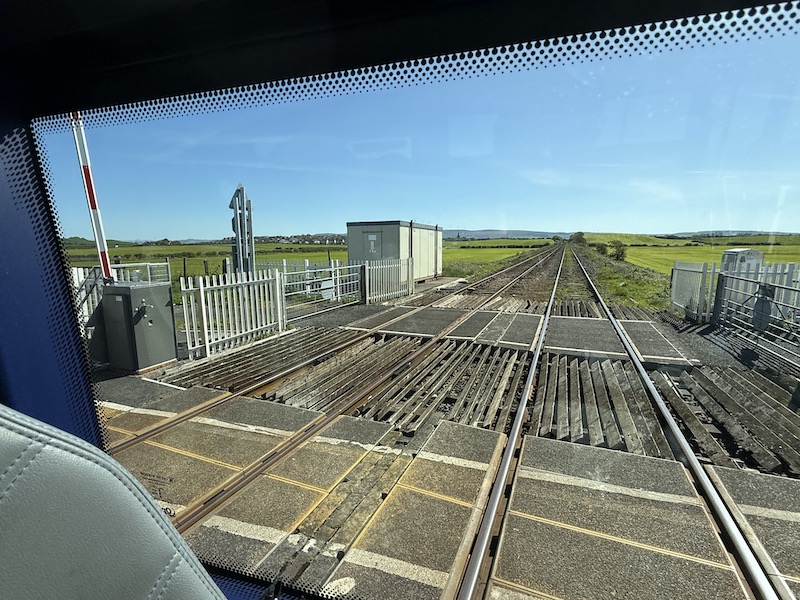
Before reaching Millom we diverted off the main road to serve the coastal village of Haverigg where the Whitbeck passenger alighted and another boarded – both benefitting from this new service and I’m sure appreciating it.
After that it was into Millom where we arrived at the Market Square at 10:47, 13 minutes late and 11 minutes after we were due to leave as a route 7. I hadn’t been sure why the route number changes at this point on the journey from an X7 to a 7 but on arrival there was already a bus loaded up with passengers at the bus stop and the driver explained I had to change buses – despite what it says in the timetable “same bus – no need to change”.
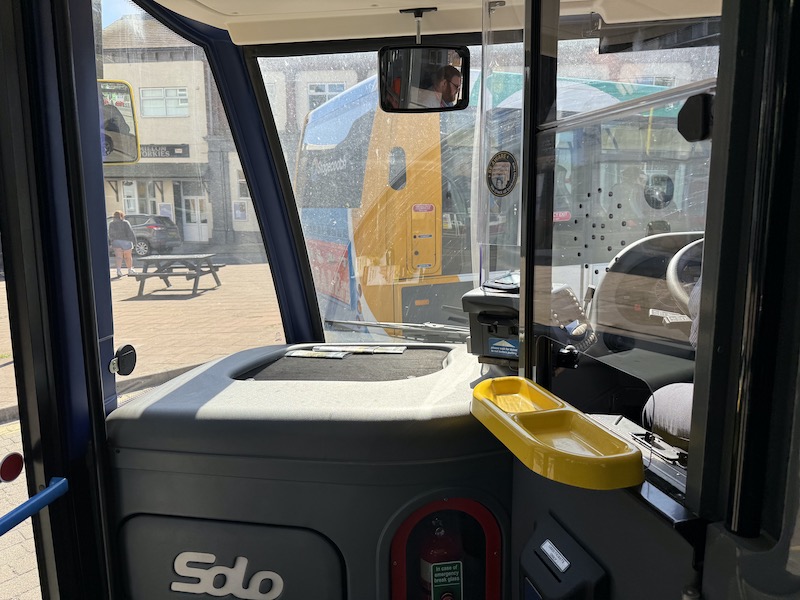
I got the impression it was a regular thing as I hurried from one bus to the other…
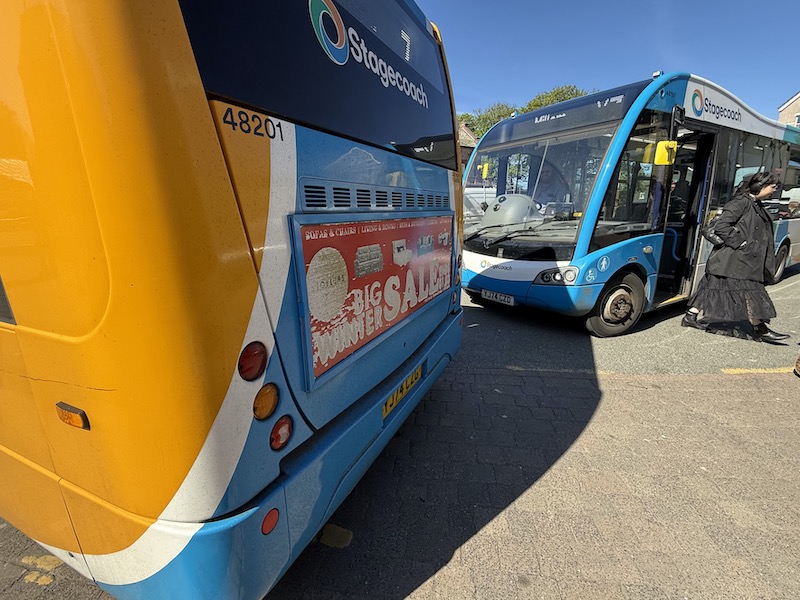
… grateful that the driver had waited for our late arrival. The other two passengers from Haverigg didn’t make the change and I joined the 12 passengers already on board and presumably somewhat frustrated they’d had to wait for my late arrival.
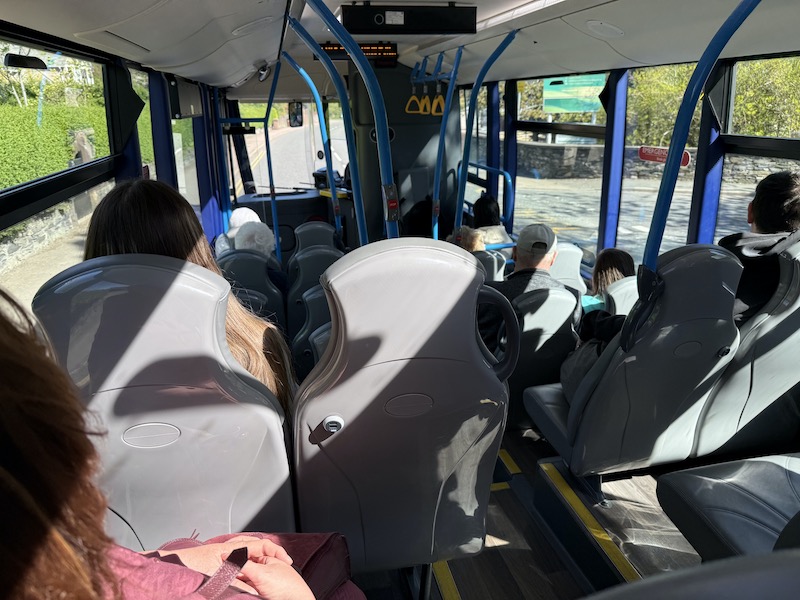
We headed off now in a northerly direction to skirt around the coastline of Duddon Sands picking up two more passengers leaving the town, only to come across another delay…
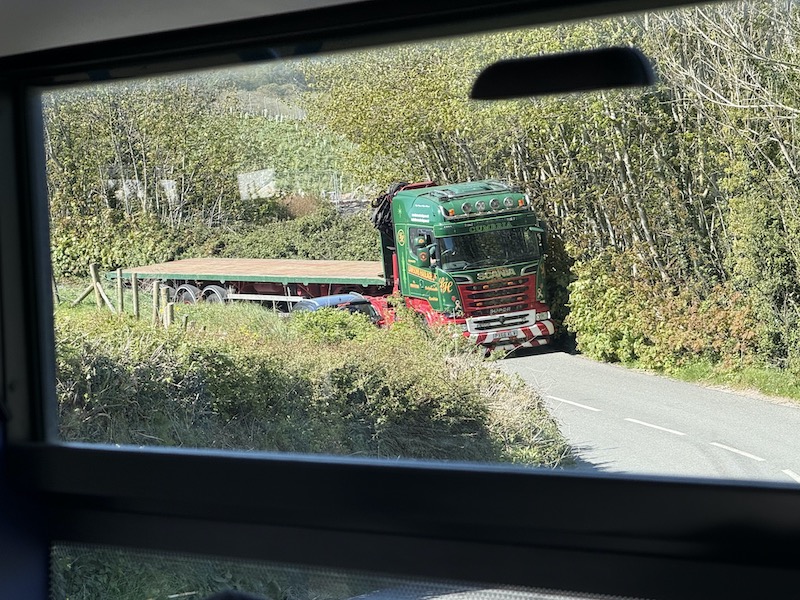
… with a motorist struggling to reverse out of the way of an HGV…
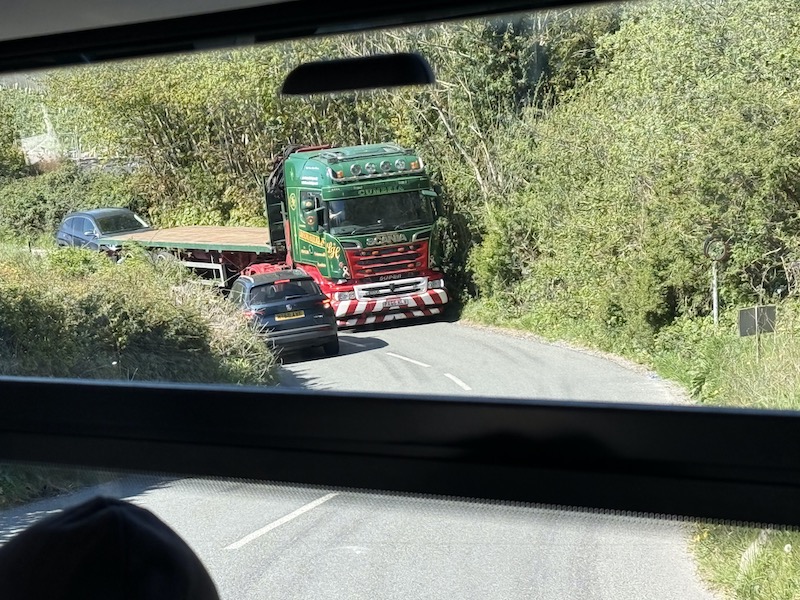
… trying to manoeuvre passed on a narrow bend in the road.
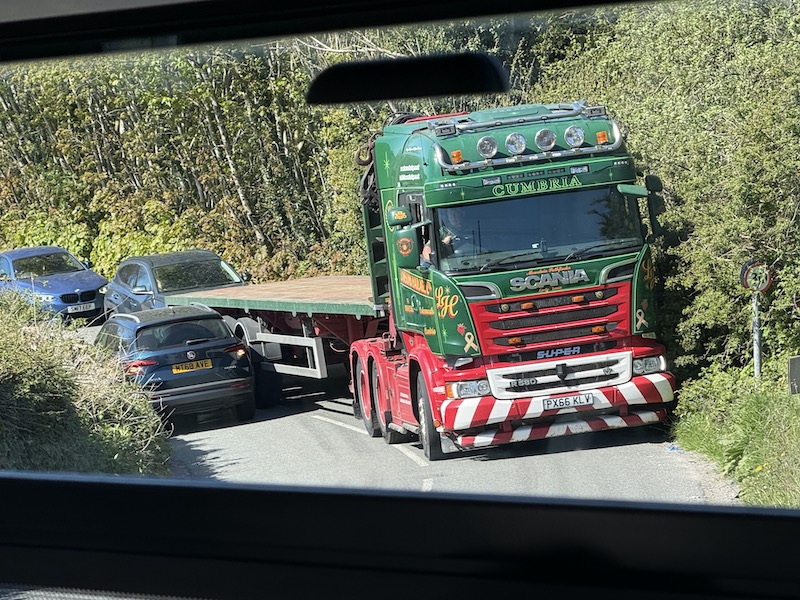
Our driver sensibly kept well away and thanks to the skill of the HGV driver, and no thanks to the motorist, it soon cleared. Two passengers alighted in Broughton-in-Furness and two more boarded at other stops but otherwise, as well as the splendid scenery which continued to enthrall…
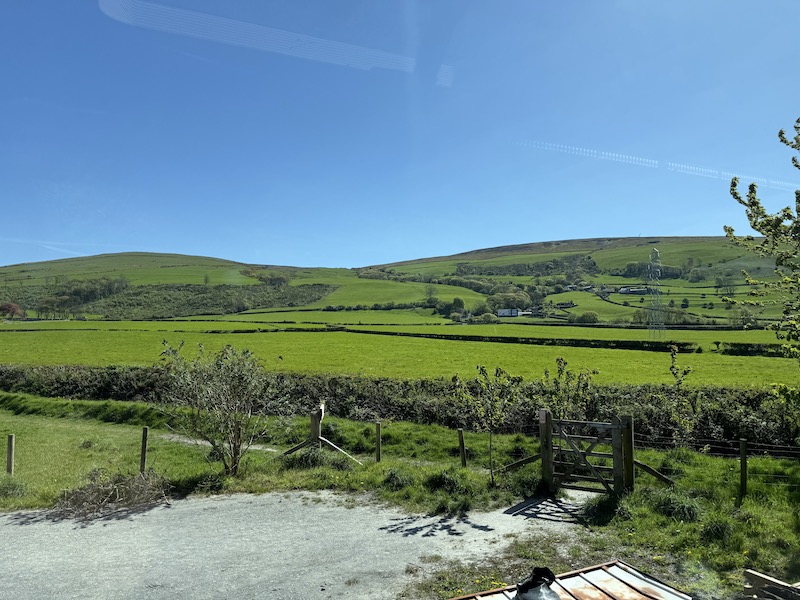
… I was impressed so many travelled right round to Barrow-in-Furness where we arrived only five minutes down, the driver having been able to catch up from the earlier delays.
It had been a fantastic three hours since leaving Whitehaven. I hope the route succeeds but I noted the 26th January report to the Council’s Highways and Transport Strategic Board noted its subsidy per passenger was “very high” albeit that was only a few weeks after introduction, but numbers travelling on the X7 (as opposed to the 7) were obviously somewhat disappointing three months on, as I experienced. I was impressed to see timetables up along the route and it’s good to see it appears on Stagecoach’s network map and in the timetable book for West Cumbria.
The route nicely complements the equally delightful Cumbrian Coastal railway, which is now into its ninth month of disruption due to problems from former mines in Bransty Tunnel, closing the line between Whitehaven and Corkickle. Hopefully that will get fixed in the coming months as it would be great to see some tie up between Northern and Cumberland Council/Stagecoach promoting both bus and train along this scenic route.
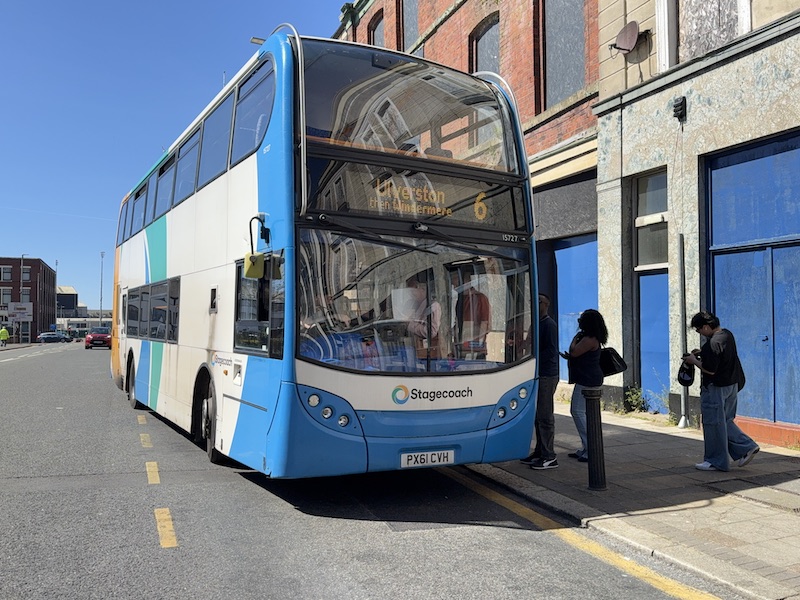
Obviously I’d now left Cumberland Council’s territory with Barrow-in-Furness located in Westmorland and Furness so I headed home via Ulverston to Windermere (and then the train) by catching Stagecoach’s route 6 which threw up an oddity in that the 6 to Windermere and the 6X to Kendal share pretty much the same route as far as Newby Bridge (see earlier map), just under an hour’s journey time away, but both have a departure at exactly the same time of 12:10 with one bus following the other.
As always it had been a fascinating and enjoyable 24 hours in what we used to call Cumbria.
Roger French
Blogging timetable: 06:00 TThS


The X7 section Whitehaven to Ravenglass looks a little light on potential timings with perhaps scope for some more infill times or extend the 32 to Ravenglass betwixt times, rather depends on the connectivity needs of communities to hospitals and the like such as work patterns.
I suspect the north-wests wintery weather will play some havoc on these routes and taking a break at Hadrians Wall might be scenic but it is a bit remote , perhaps the HW1 should be retimed with the return journeys having the 3min getaway in the timetable but longer running time (adjusting connections ?) in Carlise
JBC Prestatyn
PS more london route cutbacks next weekend , route 200 loses a little bit of daytime frequency – but does gain some early morning frequency enhancment
LikeLike
It’s a shame that the HW1/2 aren’t featured on Google Maps and Bustimes, they might pick up a few more passengers if they were advertised more widely on the main platforms that people use when planning journeys from afar 🤔
While it may look surprising that the Cumbrian coast had a big gap in the bus network for so long, your experience kind of shows why! There’s an hourly all-stations train that calls at every town, village, hamlet and garden shed along the route, with very little other habitation of note along the main (and indeed only!) road that isn’t already well served by the train – and although by most standards the train is pretty slow, the bus takes twice as long again.
LikeLike
Like you, I’m fairy certain that these google maps in particular, is critical to people discovering that the services exist, particularly those from out of the area.
LikeLike
There is apparently an ongoing issue with Cumberland and Westmoreland councils contractor in uploading details to Traveline (which in turn is how Google Maps and Bustimes gets it’s data).
LikeLike
Lovely report and great to see some solid enhancements in ex-Cumbria. I think that until this re-introduction, Millom was the largest settlement in Britain without any kind of scheduled, publicly-accessible bus service. I’m not sure what the title holder is now! Good to see that, towards Barrow at least, there is clearly some demand, even if it is more marginal north-bound (as well as the 7/X7, Millom has also gained a ‘suburban’ service to Haverigg as part of these enhancements).
LikeLiked by 1 person
I believe that Jo’s comment above about Millom’s status was technically true for most of its recent busless years, but a local coach operator did for some time provide several unregistered journeys M-F between the town and Haverigg, advertised only on its website. Don’t tell the TC.
Robin Bence
LikeLiked by 1 person
Good and positive developments, but when oh when are we going to get rid of the EU inspired nonsense of having to technically split routes? It still causes unnecessary confusion to non-regular Travellers and should have been abolished the moment we left the EU.
Terence Uden
LikeLiked by 2 people
Agreed, Arriva in North Wales is particularly bad for this, like the 11 Chester-Rhyl changes number at Holywell from 11 to 11C/11M, the 5/5D Llandudno-Caernarfon becomes 5C in Bangor, the 4 Bangor-Holyhead changes to 4A at Llangefni, & they show as separate routes on separate timetables, rather than a through route that changes numbers, confusing passengers
SM
LikeLiked by 1 person
But it can be done – Transdev’s Coastliner operation in Yorkshire runs Leeds to Whitby (840) and Scarborough (843) as single routes with a single through timetable – these are around 70-75 miles end-to-end with a running time of 3½ hours or more, but are registered in multiple sections (Leeds / York / Malton / Thornton le Dale / Whitby, Leeds / York / Malton / Scarborough). What does Transdev know that others don’t?
LikeLike
An evocative report. Cumbria is a stunning area to travel through, especially on a bus with its elevated sitting positions. When the sun is shining, as it was for Roger, there’s no better place to be.
Just one typo spotted. There’s an “ao” which should be a “so”.
Stuart S
LikeLike
But, interestingly, “ao” was one of the local registration marks for this area.
LikeLike
Thanks; typo now corrected.
LikeLike
Have the Americans taken over Cumberland Council, or was it an American consultancy which resulted in the use of # for number?
LikeLike
Great review – I agree with a lot of the comments about the X7 though. It’s a lovely scenic route but any time I’ve travelled on it, there’s rarely been more than one or two passengers north of Millom so I’m not surprised it’s very heavily subsidised per passenger. It’s also a very long way to travel on an Optare Solo and those new ones Stagecoach CNL use on the route I find give a very bumpy ride! I think changing bus in Millom is the regular practice, despite what the timetable says.
Another thought – could the council do more to make the The Wasdale Explorer and the X7 timetables coordinate so that they are actually usable together? The Wasdale Explorer departures from Ravenglass are 0755 (a very early start from Barrow/Lancaster/beyond) and 1020. The northbound X7 gets into Ravenglass at 1036 – so you’ve just missed the last possible bus to Wasdale that morning. Given Wasdale and Eskdale are probably the places tourists most want to get to on the west Cumbrian coast, could the route have a bit more potential if the connections between these services were actually workable?
I agree, some of the timetabling on the 6/X6 is just odd. I’ve never understood why you sometimes get a 6 and a 6A departing within 5 minutes of each other, so that they’re constantly catching each other up all the way up Abbey Rd. I think diagrams that the buses interwork is quite complex, which might explain some of those timetabling oddities.
LikeLike
As always a very interesting read and good to keep up to date with developments.
Let’s hope the vehicles and issues with Reays – no announcements and not on BusTimes.org – are resolved soon.
The suggestion about about connections between the X7 and Wasdale Explorer would seem to be a no brainer! As Reays run the Explorer perhaps some extra X7 positioning journeys could be added?
Will there be a part 2 to look at the Westmoreland side of the former Cumbria? Big gaps in the network there, especially since the end of Cumbria Classic and route 563 from Kirkby Stephen to Kendal.
Richard Warwick
LikeLike
Lanercost rather than Lanacost. Sorry to be pedantic!
LikeLike
Thanks; corrected.
LikeLike
Bustling is one description of Carlisle Bus Station. Too small and too tight would be another.
When I went into catch my bus this morning four buses were loading all at the wrong stand. As we waited to leave the mirror of another bus hit us as it came in although apparently without any damage.
I’ve also been on one of the new routes the 71 between Kirkbride and Carlisle. Unfortunately just one other passenger from Kirkbride and no one else not even within the City.
LikeLike
A close friend moved to St Bees nearly 30 years ago and I have made annual visits ever since. We watched the bus services gradually disappearing, along with the subsidies on many routes. St Bees lost I[s Sunday bus service for several years, then it’s weekday buses too, but thankfully weekday buses have been reinsted.As there were no trains south of Whitehaven on a Sunday, St Bees was isolated completely from public transport on Sundays and our trips to Ravenglass (on a stagecoach mini Mercedes, then other operators) and it’s superb railway were forcefully ended!
In the main passengers including ourselves, use the train to link main stations such as Rsvenglass, Million and Barrow then buses for onward travel.On the plus side, Northern trains now run almost every hour whereas there were three hour gaps in the service before 2000. Also a regular Sunday service has been introduced. Now it just needs Bransty tunnel rebuilding to get the full service back next year without the need for rail replacement buses between Whitehaven and Corkicle.
Paul from Leicester
LikeLike
I forgot to mention that for many years, my senior friend in St Bees could claim either an ENCTS bus pass or a Senior Railcard from Cumbria council. As he and his wife had no buses in the village the council provided him with the Railcard. This facility is no longer available but was that unique to Cumbria, I wonder?
Paul from Leicester
LikeLike
A number of councils give the option of travel vouchers which can be used for rail of taxis. The value though is normally very limited and can be as little as a £100 per annum
LikeLike
Ah, dear Cumbria. Memories from my All Line Rover tours including “free” travel on the BR boats on Windermere. First time I “did” Windermere on one of the BR boats I was stunned by the scenery. I also went through the “Eastern Lakes”, including Kirkstone Pass, once on my motorcycle in L-Plate days. Thinking about all those long distance L-Plate motorcycle journeys I did, having bought current road atlases,, some would be difficult to recreate now such as between Hersham and Birmingham – the M40 having taken the alignment of the Warwick Bypass which was an “A” road and from Lockerbie to Lanark – the M74 having been built one would need to use very minor roads as non-motorway traffic.
LikeLike
Re the M74, which is the A74(M) south of Abington and M74 north of Abington.
You can drive from Gretna to Glasgow on the old road which runs all the way as a mixture of the original single carriageway, or on side of the A74 dual carriageway (before it became upgraded and rebuild to motorway and one carriageway was dug up or greened) or being moved slightly out of the way to one side.
LikeLike
The change of buses at Millom occurs as the drivers find it easier and quicker to keep the same vehicle all day rather than play musical buses. It’s not an official action which is why the timetables don’t show this.
LikeLike
The three journeys a day on the x7 must put people off. Surely every two hours including Sunday is the only way to make these routes sustainable and unlock the latent demand which must be there in the villages and from vistors.
LikeLike
What would make you think that two hourly instead of three hourly, and a Sunday service, is going to suddenly make these sustainable? In the halcyon days of the NBC, it was two to three hourly and a basket case, and it didn’t have a Sunday service even then, that being chopped in the late 70s.
And where is this latent demand from villages coming from? The reality is that the main villages en route are Thornhill (which is served as part of the main Egremont to Whitehaven service), Ravenglass, Bootle, Seascale and Drigg and three of those have a well located railway station that provides many of the required links.
And that is the size of it – there’s a parallel train service that provides the majority of links so the X7 will always struggle to be sustainable.
BW2
LikeLike