Tuesday 18th November 2025
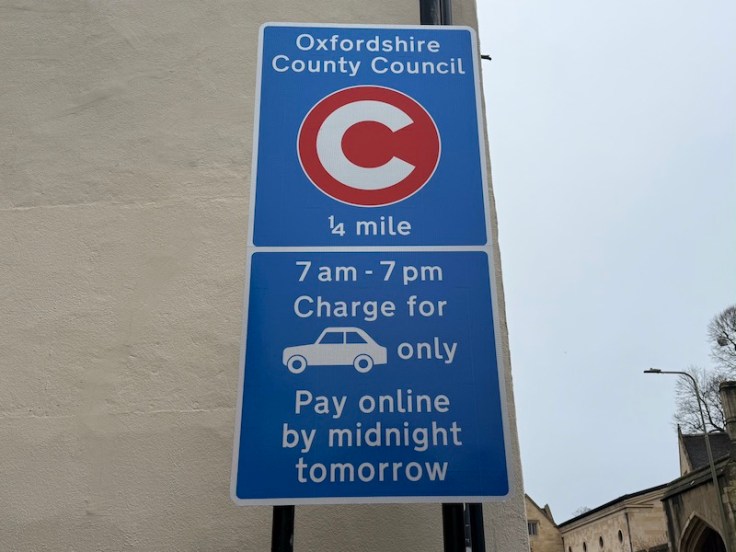
Oxfordshire County Council took the bold step of introducing a three month “Temporary Congestion Charge” for motorists who drive through six camera points in central Oxford at the end of October. I paid a visit to the city on Saturday to take a look.
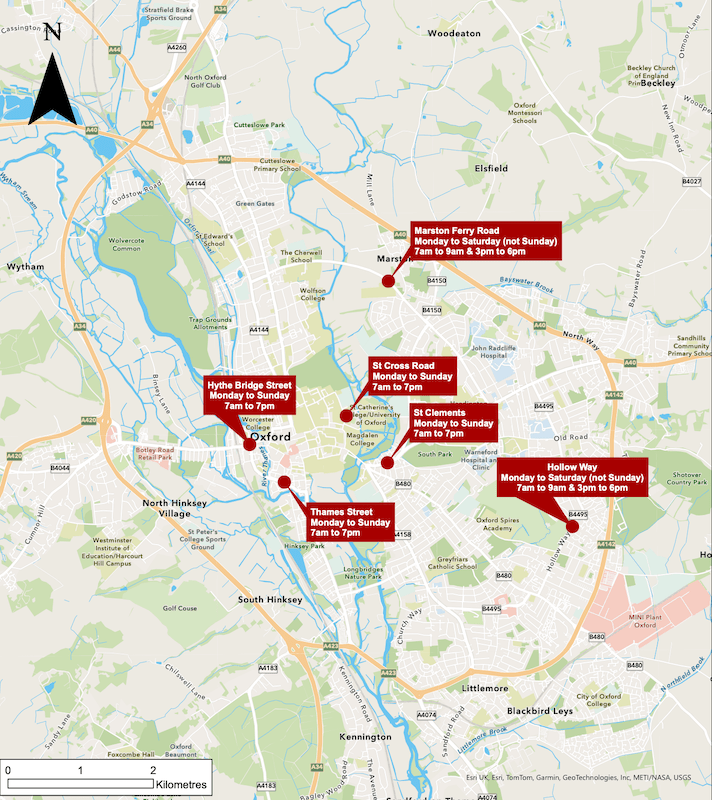
The six sites are shown on the map below, four of which are located centrally and apply every day between 07:00 and 19:00 with the two outliers, Marston Ferry Road and Hollow Way applicable during peak hours 07:00-09:00 and 15:00-18:00 Mondays to Saturdays.
Vehicles crossing these points face a daily charge of £5 which must be paid by midnight the following day or can be paid in advance, if preferred. However, there’s a long list of exemptions not least any vehicle that’s not a car (ie vans, motorbikes, mopeds, lorries, buses and coaches). Free permits are also available for Blue Badge holders, community health or care workers, unpaid carers, frequent hospital patients and many others as detailed in the following list…
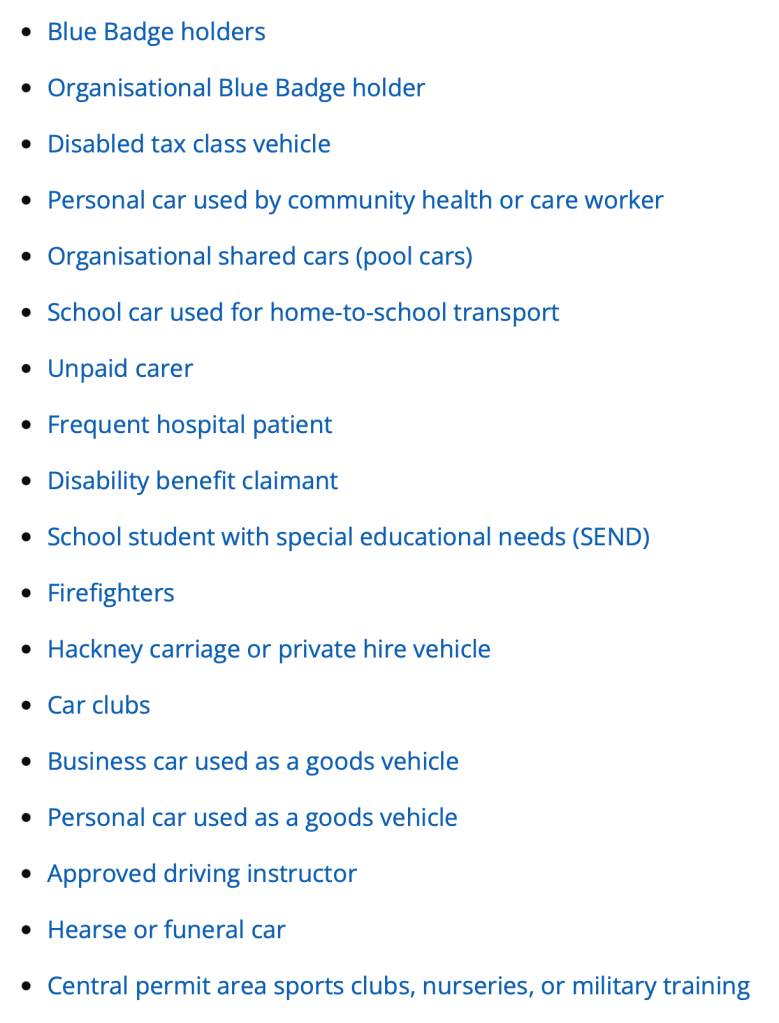
Interestingly firefighters are exempt but not other emergency workers.
Depending where they live, residents can apply to receive a specified number of free daily passes. Those living centrally, within the area affected, receive an unlimited number plus 50 visitor passes; those living within the city of Oxford boundary receive 100 free day passes and those living in a wider area of Oxfordshire outside the city receive 25 free day passes. The maps below show the significant geographic areas involved, particularly Oxford (blue) and Oxfordshire (yellow) – the latter stretching from just north of Reading to north of Babury.

You might be wondering who’s left to pay the £5 after all those exemptions and free passes, especially as many visitors from outside the county have long been accustomed to using Oxford’s well established Park and Ride sites.
According to the County Council, the rationale behind the scheme is “to reduce congestion in Oxford while Botley Road is closed, and we cannot start the traffic filters trial. We expect it to improve bus services and make it easier for permit holders to travel by car into and around the city.” The aim is to reduce traffic and make bus journeys faster and more reliable as well as allowing for new and improved bus routes. Walking and cycling, air pollution, health and well being are also listed as areas for improvement as a consequence.
There’s no doubt the grossly inconvenient continued closure of Botley Road alongside Oxford railway station has been causing severe congestion problems in the city for the last few years. Losing this vital access from the west has inevitably put added strain on all other roads approaching the city centre as well as distributor roads and the ring road. Botley Road closed in April 2023 (originally for six months with another planned six months closure in 2024) but has now been closed continuously for two and a half years but has at last been given a firm date for reopening in August 2026.
Network Rail reckons it’s now on top of the project with its website explaining “on Friday 24 January 2025 a new programme for the expansion of Oxford station was launched that prioritises the reopening of Botley Road. Engineering challenges around the discovery of the true extent of an inverted brick arch and in finding a suitable location for water main connections held up progress by 18 months but we are now making good progress in the most complex utilities diversions.”

While in Oxford I took a look at what is now a much improved environment for pedestrians to walk under the railway while work continues on the project.
This is how it was in 2023…
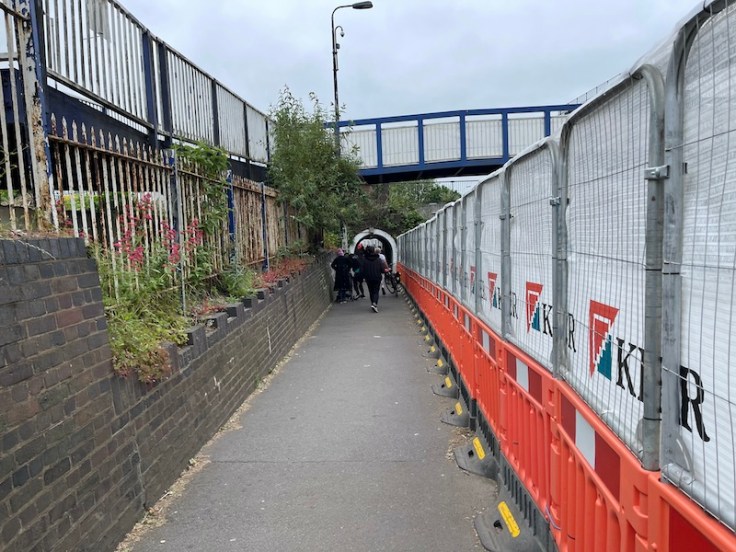
… but now it’s wider and brighter and a PR company has obviously been involved to assist with ‘messaging’.
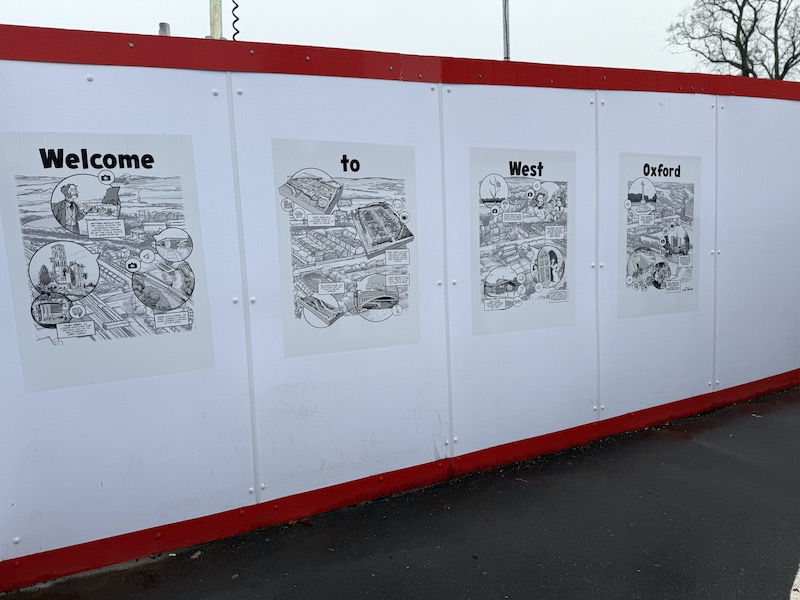
It was impressive to see the constant flow of pedestrians walking in a disciplined manner using the wider temporary foot tunnel where lane markings are strictly observed…
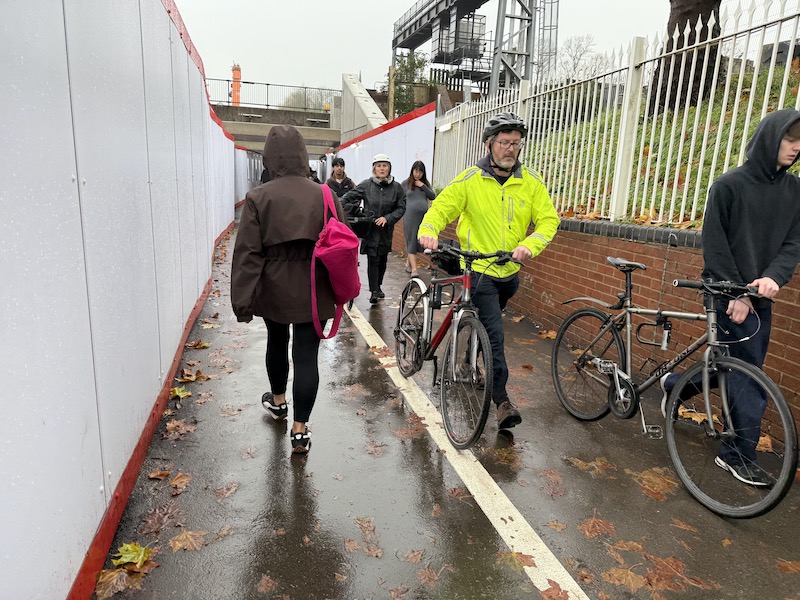
… as is the instruction for cyclists and e-scooter riders to dismount…
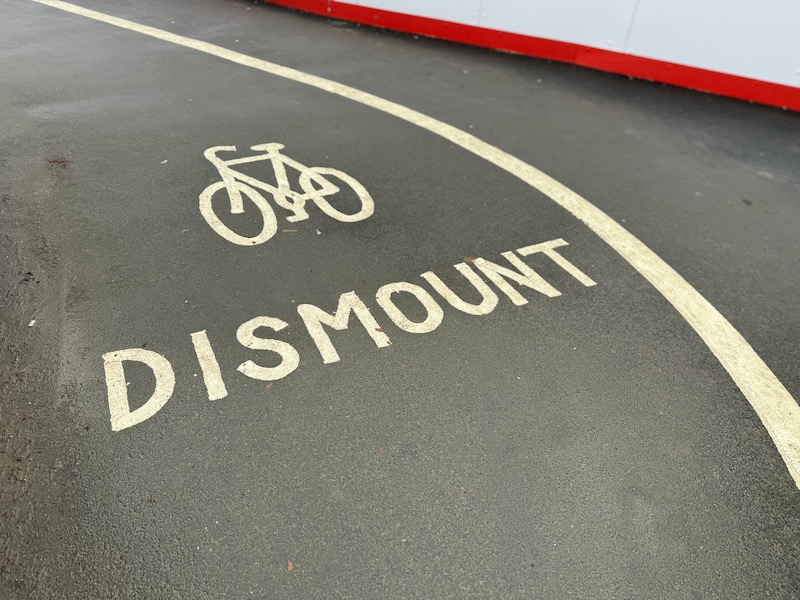
… helped by a security presence ensuring arrangements are enforced.

Messaging also explains the benefits of the new bridge for pedestrians and cyclists.
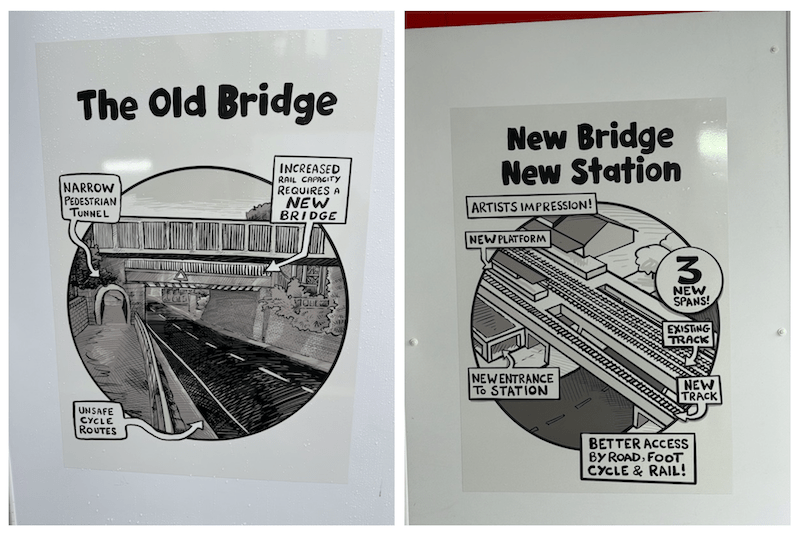
Passengers using bus routes from the west have been experiencing significant inconvenience since Botley Road was closed entailing a long walk from the last bus stop to teach the station and on to the city centre.
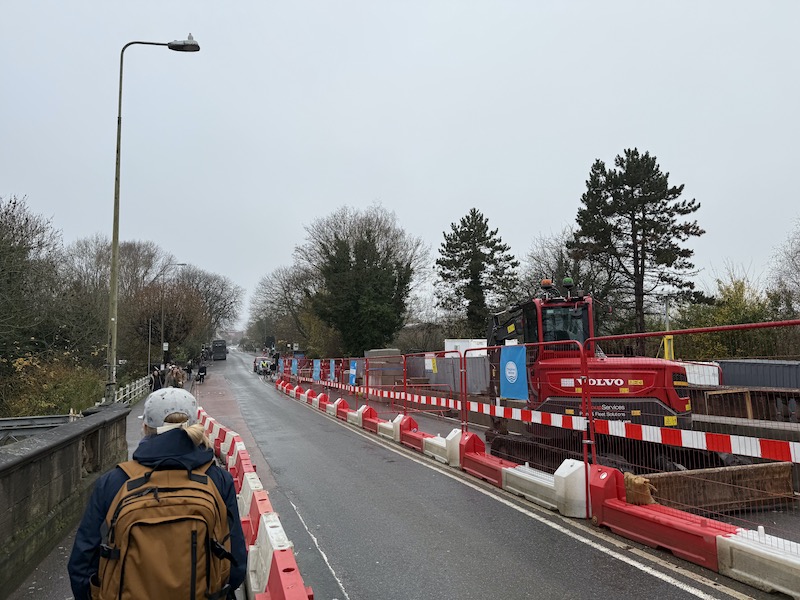
The temporary bus terminal point that had been established to the west of the station in April 2023…
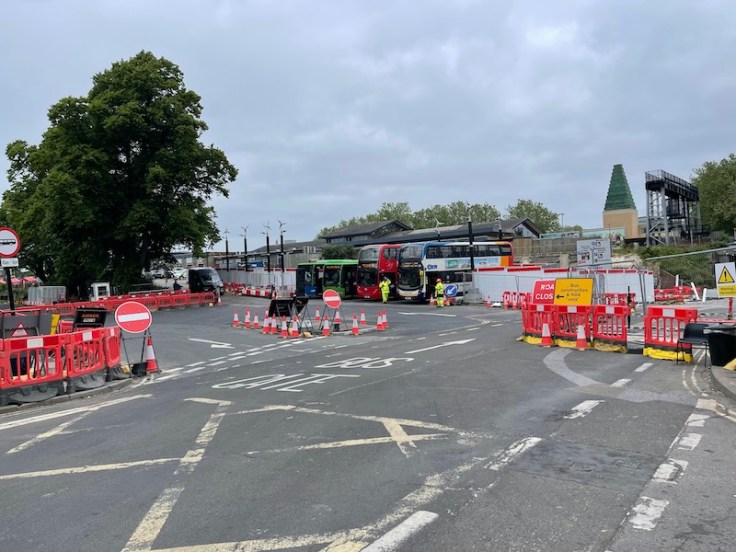
… is now part of the construction site…
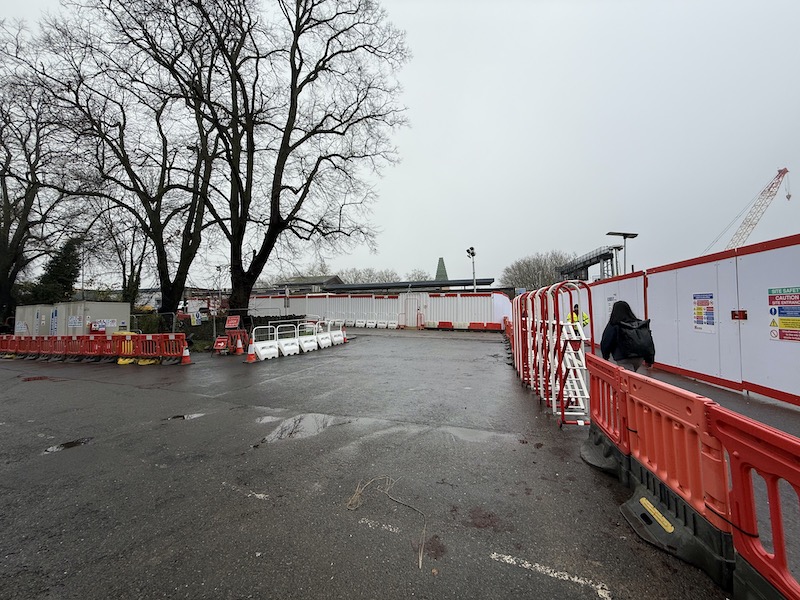
… for the station’s new western entrance/exit…

… so buses on seven routes (4A/B, 44, 63, E1, S6, S9) are having to use unsuitable residential side streets to turn round and layover in between journeys.
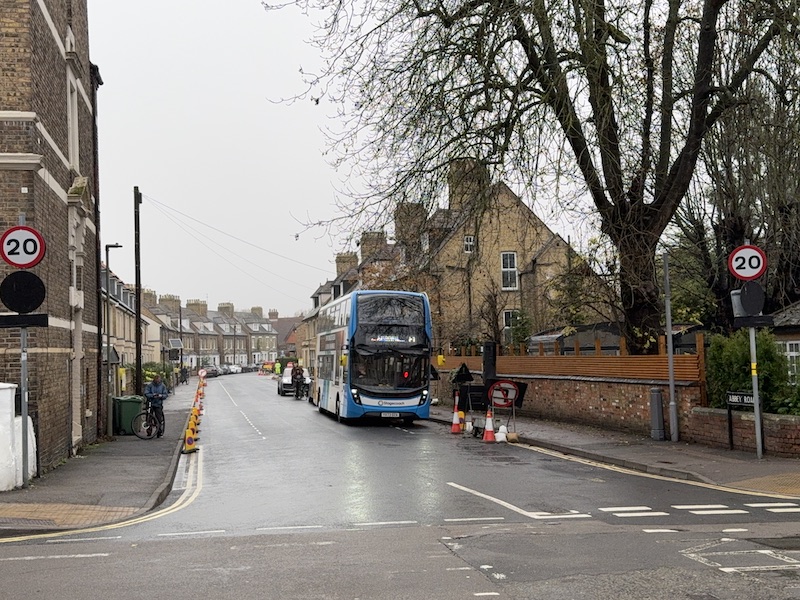
The sooner August comes round and everything can return to normal the better.
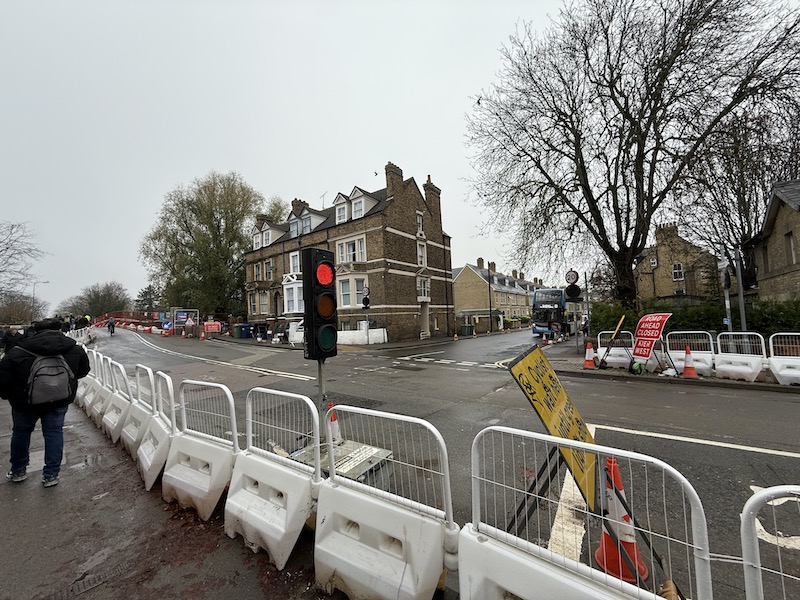
The County Council implies its “traffic filter trial” will begin as soon as Botley Road reopens next August but with the “Temoorary Cingestion Charge” said to be for a trial of three months I’m wondering what will happen between that finishing at the end of January and August. I assume the Congestion Charge will be “temporarily extended”.
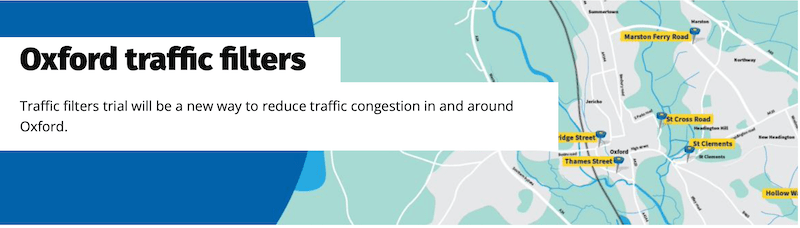
August’s Traffic Filter Trial will involve “camera-operated traffic filters” at the same six points for the same periods of time during the day and week being used for the Temporary Congestion Charge “to help lower the number of private car journeys”. The filters will limit through traffic “along a small section of a road”. The County Council explains “if you drive a car you may need to take a different route or change how you travel if you don’t have a permit to drive though the filter”.
Which sounds to me that come next August, the only change will be the £5 daily charge disappears and motorists without a permit won’t be able to pass those six points, which leaves me puzzled why wait until Botley Road is reopened? And won’t the County Council miss out on the revenue it’s now gaining from all the £5 it will have collected by then?
It’s certainly a brave, bold and welcome move by the County Council to introduce a congestion charge not least when in a public consultation two thirds of the 7,100 respondents were against it and 74% commented it would impact them negatively.
One of the upsides of the current Temporary Congestion Charge for motorists has been making Oxford’s Park & Ride bus routes free for users of the car parks for three months, so Saturday saw me driving over to Oxford and trying that arrangement out.
My first impression driving into the huge Thornhill Park & Ride car park on the outskirts of the city on the A40 was how busy it was even at 09:30 on a Saturday.
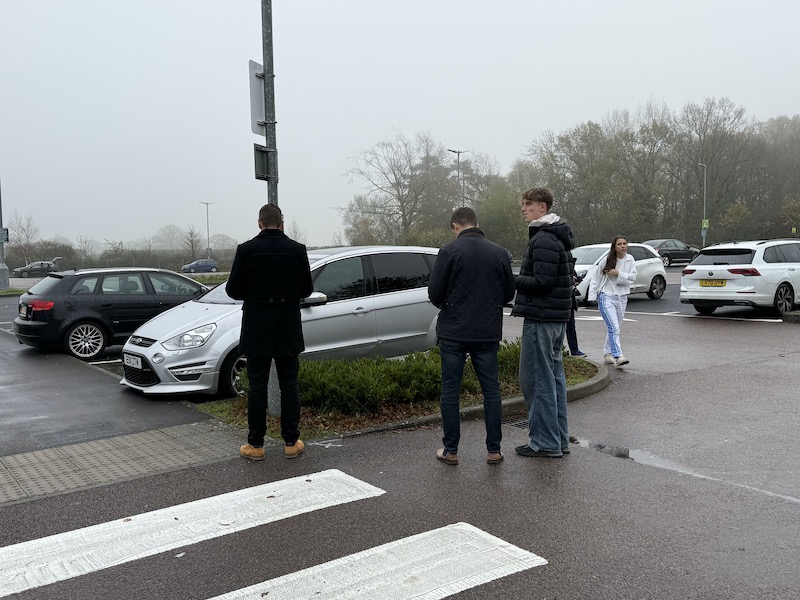
As I parked up I noticed motorists standing by lampposts tapping away on their smartphones and realised they were following instructions how to pay for the parking. Because although the bus ride into the city centre is free, there’s still a charge of £2.50 to park which can be paid using the RingGo app.
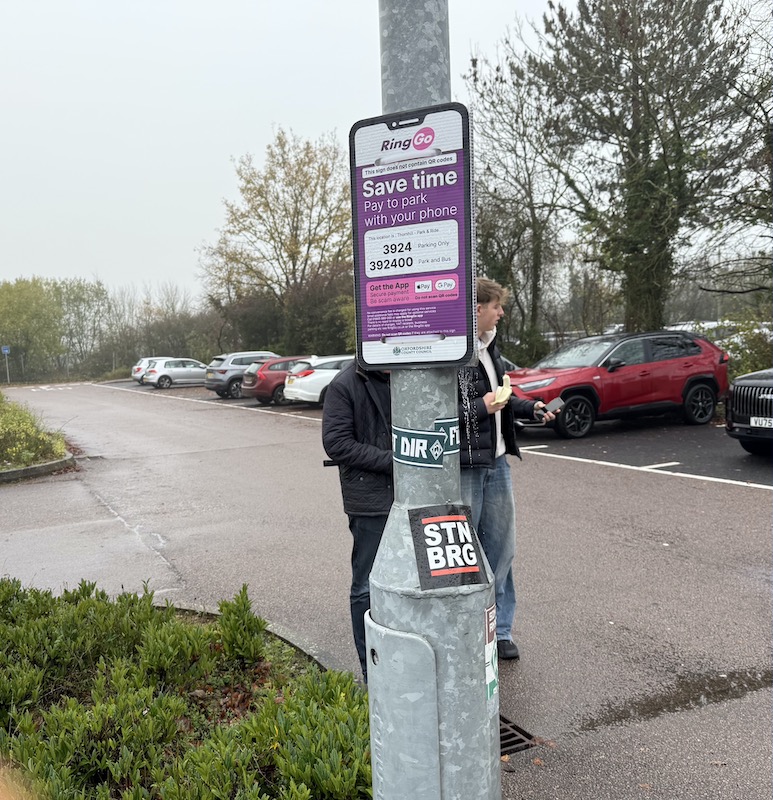
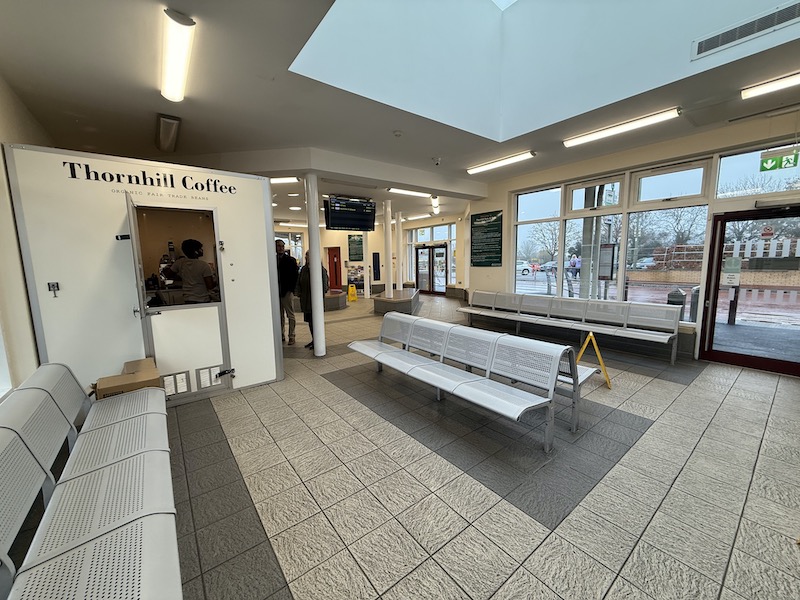
Wandering over to the centrally located bus terminal point which has toilets, a seated area, a coffee stall…
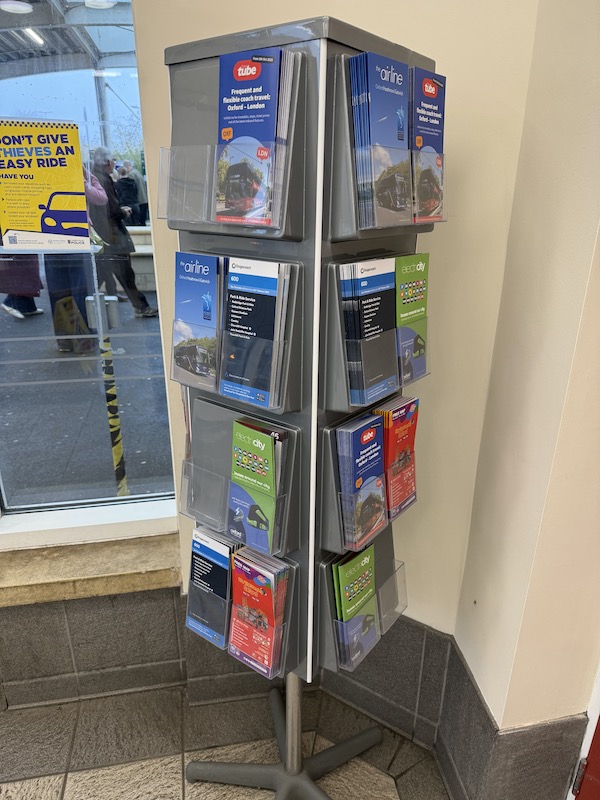
… printed timetable leaffets…
…and electronic departure signs…
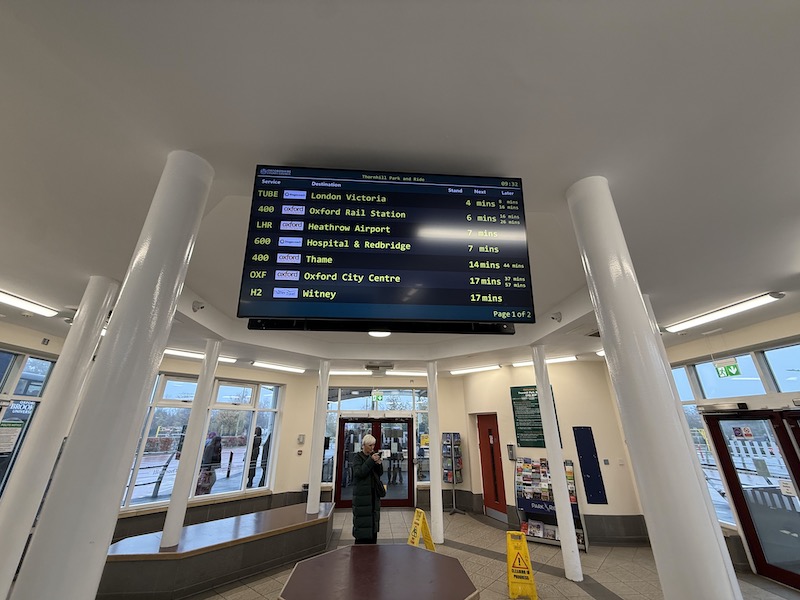
…I noticed many more motorists also paying for their parking at ticket machines…
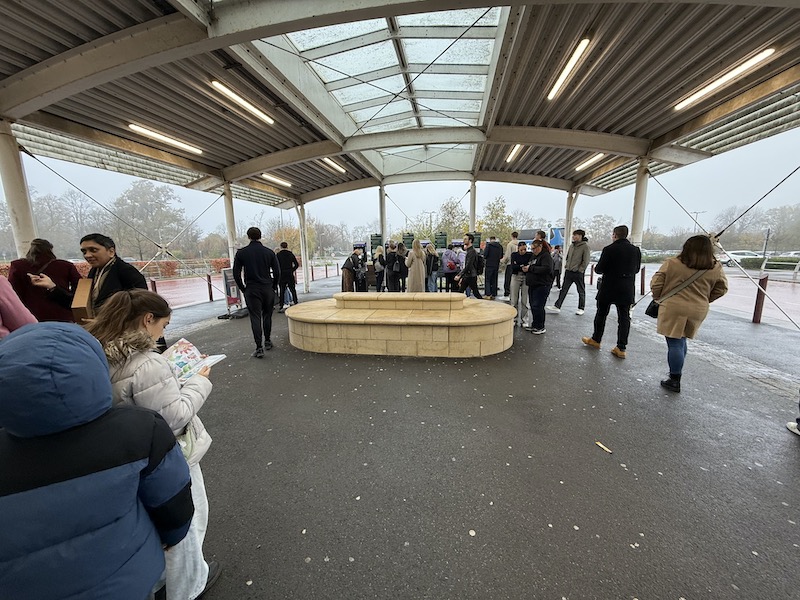
… as well as a long queue of passengers for the Oxford Tube to London…
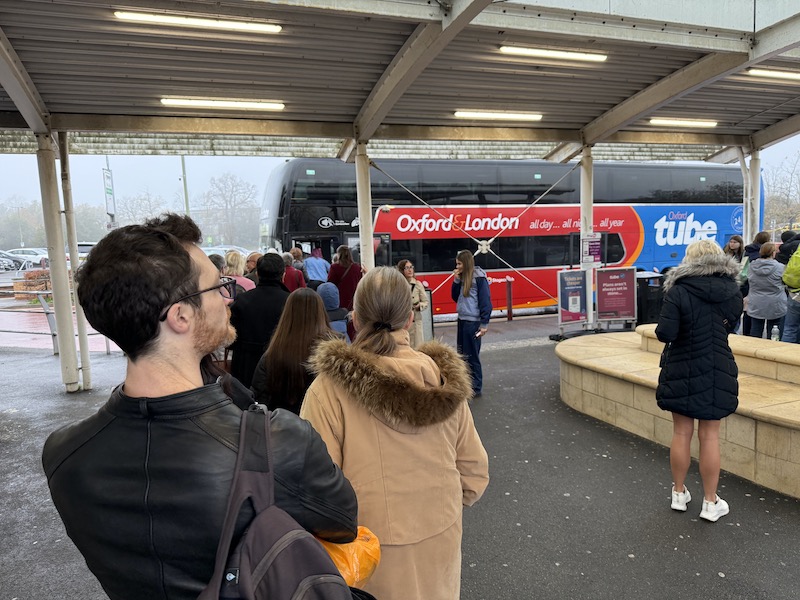
… and more boarding the next departure on Oxford Bus route 400 into the city.
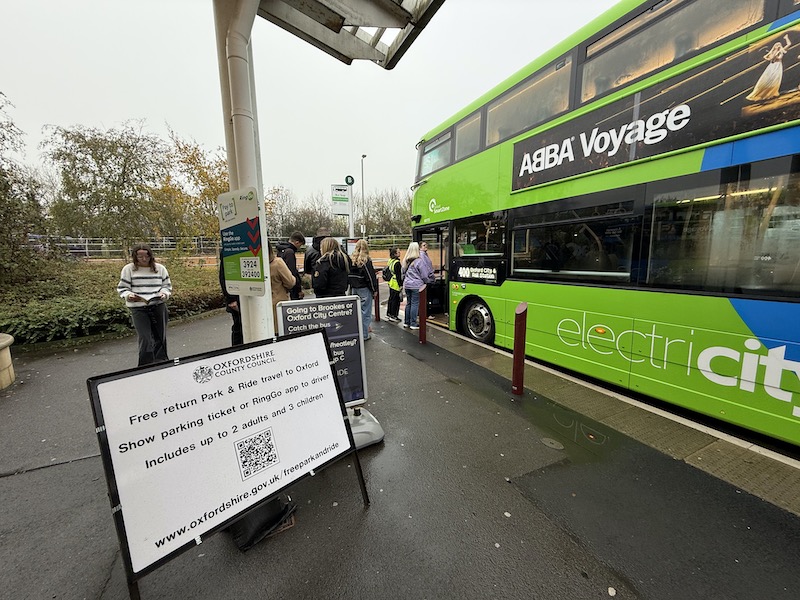
Route 400 runs every 10 minutes (15 minutes on Sundays) via Headington and Brookes University to the centre of Oxford terminating at the rail station. It was particularly busy on Saturday morning when I travelled due to an Open Day at the University.
It’s quite a slow journey into the city with buses acting as a standard city bus route observing all stops and we stopped at most of them. It took just under half an hour for the bus to reach Westgate where frustratingly the driver waited for three minutes before leaving on time for the next and final stop at the station.
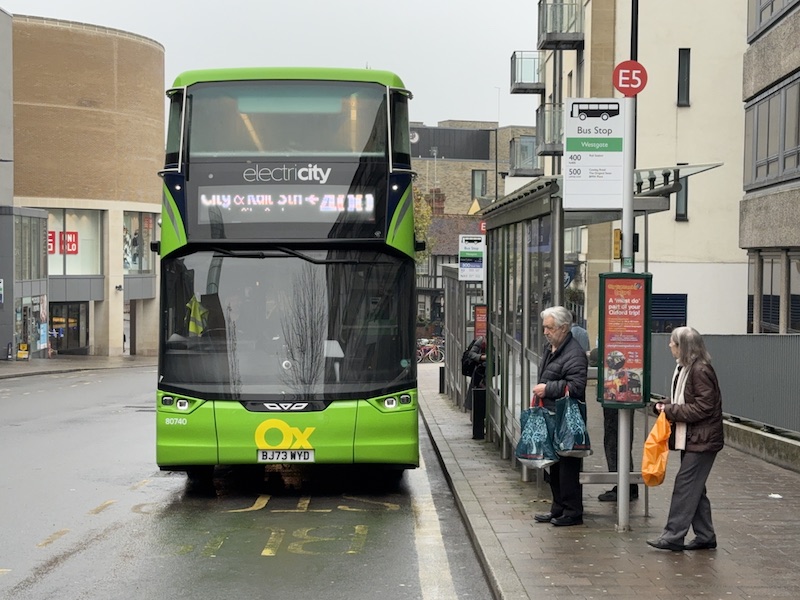
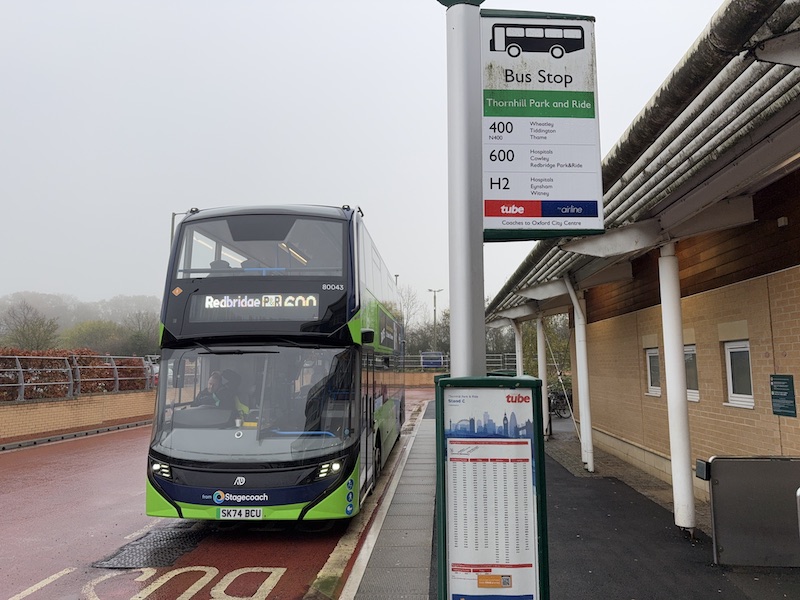
In addition to Oxford Tube, Oxford’s Airlink and route 400, other routes from Thornhill include Stagecoach’s 600 which links the site to John Radcliffe Hospital, Cowley, Kassam Stadium, Science Park and the Redbridge Park and Ride site…
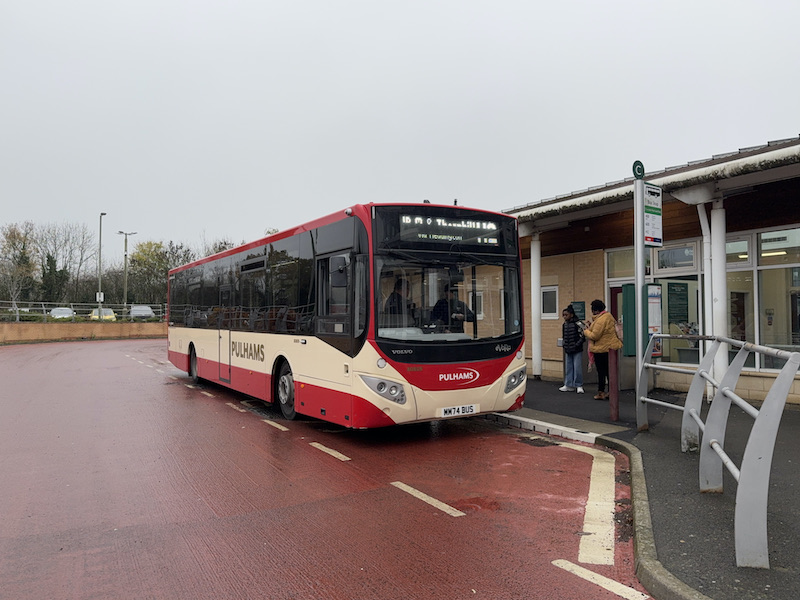
… and Thames Travel’s H2 to Eynsham and Witney which was being operated with a Pulhams bus on Saturday.
Aside from three months worth of free bus travel on Park and Ride routes another benefit flowing from the Temporary Congestion Charge is a raft of improvements to the city’s bus routes and in particular shorter journey times with timetables being sped up to take advantage of better flowing traffic conditions.
Oddly Oxford Bus and Stagecoach are introducing these improvements on different dates. Whereas Oxford Bus brought in its changes on 9th November, Stagecoach’s alterations don’t commence until 30th November.
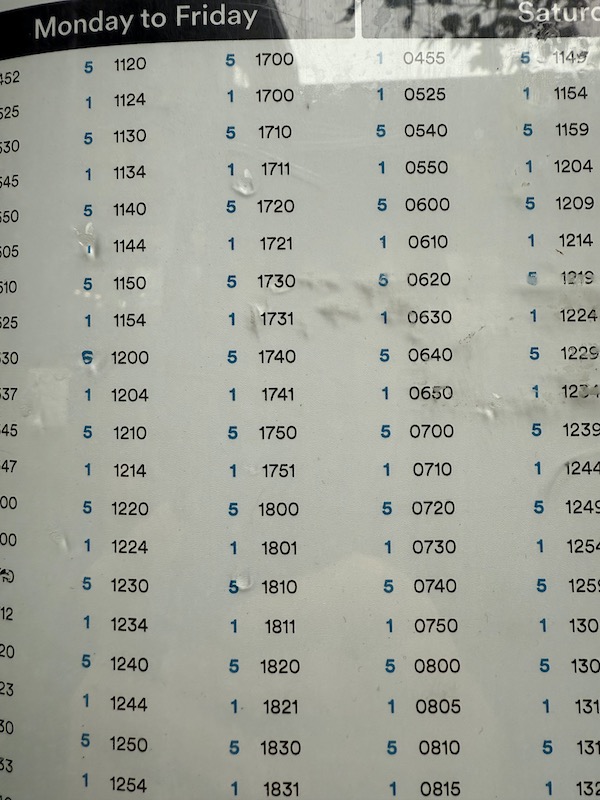
This has the effect of an uncoordinated timetable between Stagecoach’s route 1 and the parallel Oxford Bus route 5 between the city centre and Blackbird Leys during this interregnum period. Checking the departure listing at Oxford’s railway station…
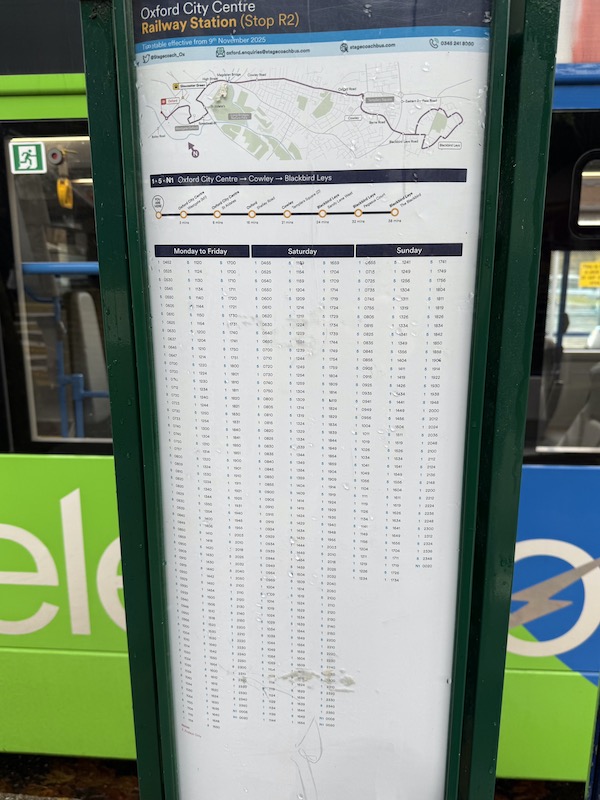
… showed the duplication now inherent in the timetable with the evening peak after 17:00 particularly bad with buses from each company running at the same times or within a minute of each other.
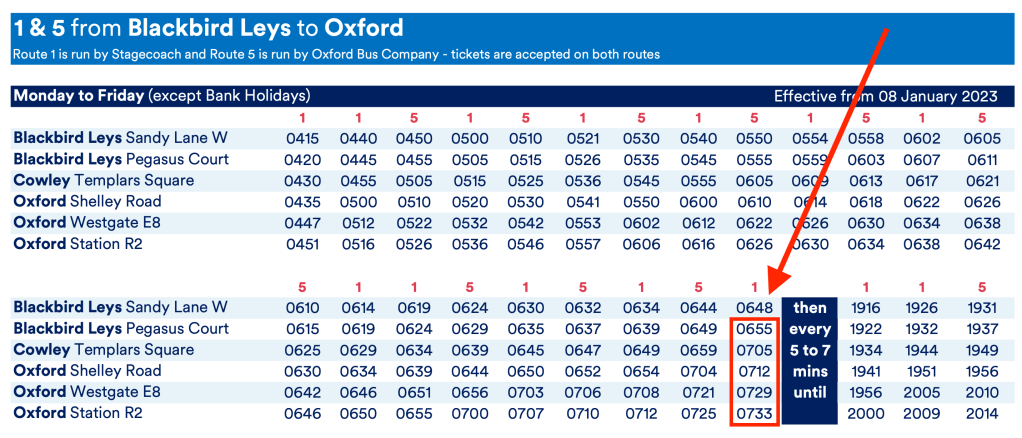
I am also puzzled looking at some of the journey times applying from 30th November where, for example, the 06:55 from Blackbird Leys Pegasus Court currently takes 38 minutes to the station, arriving 07:33…
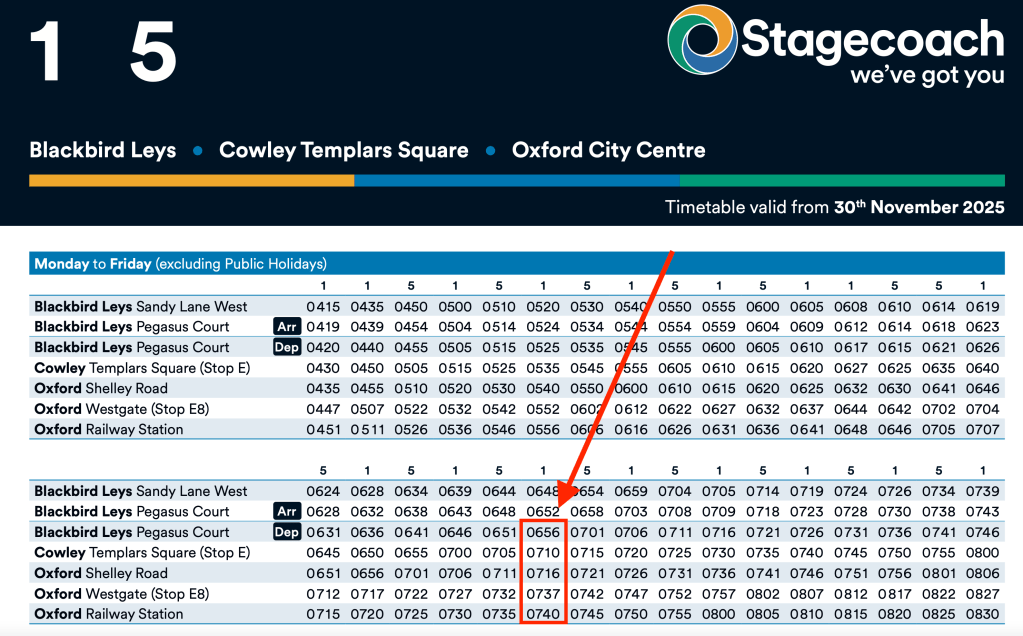
… but the new, supposedly quicker, timetable from the end of the month has the 06:56 departure taking 44 minutes arriving at 07:40. The same also applies to Oxford’s parallel route 5 with the 06:49 taking 36 minutes and the new 06:51 taking 44 minutes.
Looking at Stagecoach’s route 8 timetable I can see a significant improvement with, for example the 07:00 departure from Barton currently taking 49 minutes…
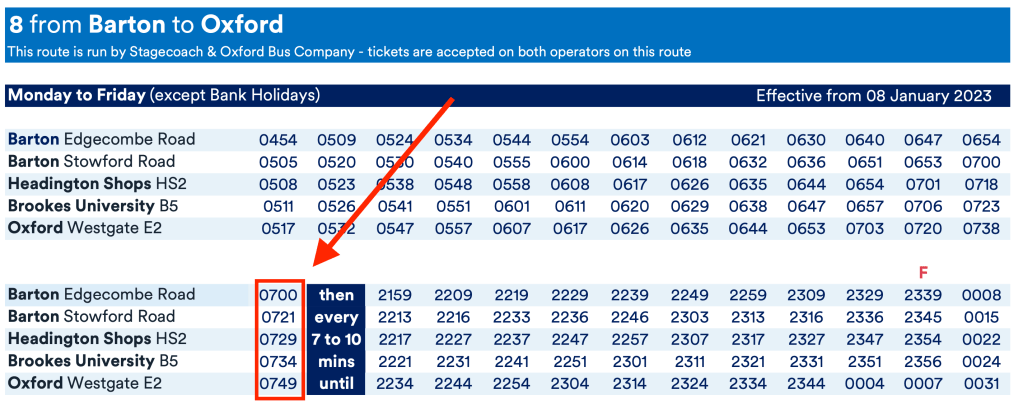
…but from the end of November the 07:05 is given 39 minutes to reach Westgate making for a whopping 10 minute speeding up.
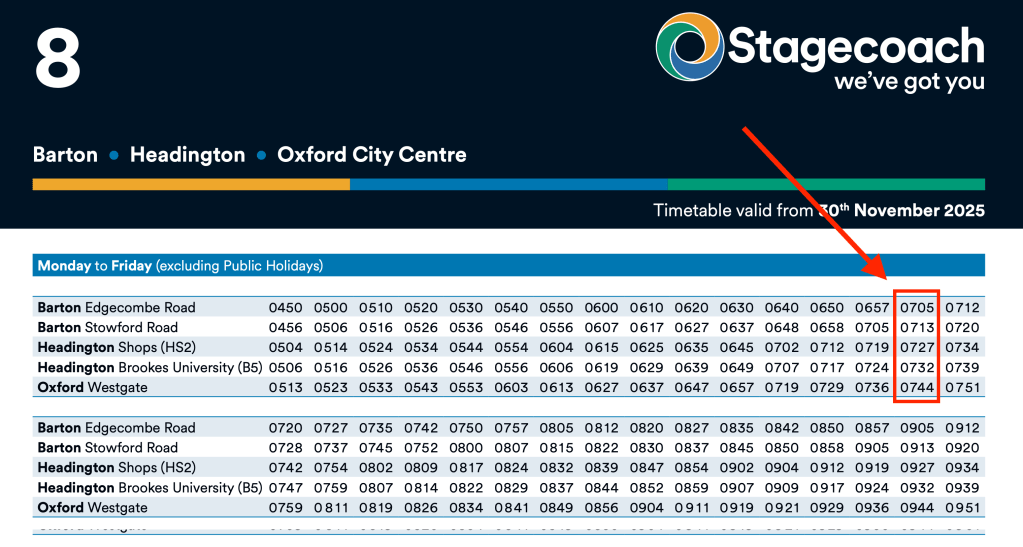
Similar improvements apply to other Oxford Bus and Stagecoach routes in the city so perhaps it shows the previous timetable on the 1 and 5 was unrealistically inadequate.
Other changes from the end of the month include Stagecoach extending its route 600 from Redbridge Park & Ride to Oxford Parkway Park & Ride making for another route connecting three Park & Ride sites, but unlike Cambridge’s infamous route T2 the 600 serves many useful destinations along the way as described earlier. Also extended to Oxford Parkway is the 800 with some journeys continuing to Begbroke, London Oxford AIrport (!!) and Yarnton Village.
Oxford Bus improvements already introduced include extending routes 3/3A to the railway station, frequency improvements on the 5A and 700 and new route 20 between Rose Hill, Iffley Road, Brookes University, JR Hospital and Marston Road.
So there are some very welcome upsides to the Temporary Congestion Charge but the proof of the pudding will be whether congestion eases. Saturday wasn’t the best day to test that out although it was busy with retailers enticing shoppers into the city centre with ridiculously early Christmas marketing but I took a look on Google maps yesterday morning and afternoon to see how some of the bottlenecks were doing.
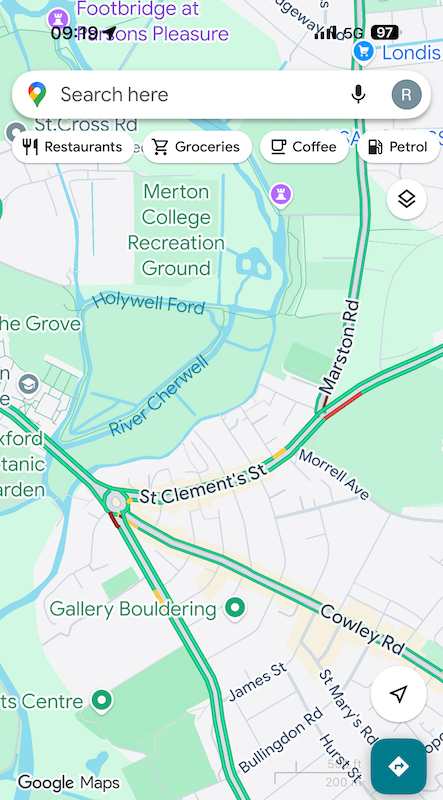
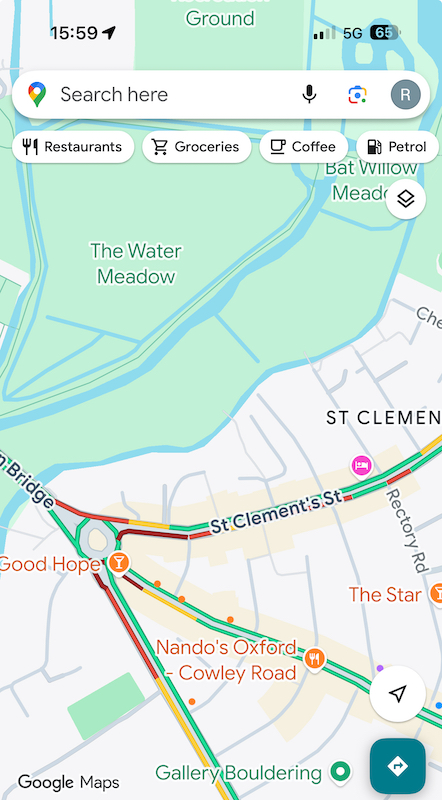
Here’s the junction of Marston Road and Headington Road at St Clements Street leading to the roundabout at the south end of Magdalen Bridge where Cowley Road and Iffley Road also join. It’s a notorious congestion hotspot in the city. This is what it was like at 08:18 yesterday morning…

… as you can see, it wasn’t particularly traffic free with delays approaching the roundabout on all roads, but an hour later at 09:19 it had cleared.
… although was bad again in the afternoon at 16:00….
Back in the morning, another hotspot is at the western end of Botley Road where its closure has put extra traffic on to the A34 Southern By-Pass as can be seen at 08:38.

In fact all the roads surrounding the city were slow going.
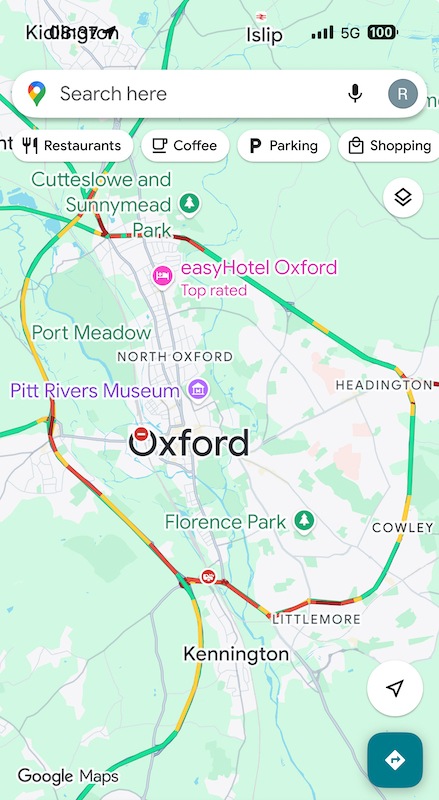
And even more so at around 17:00.
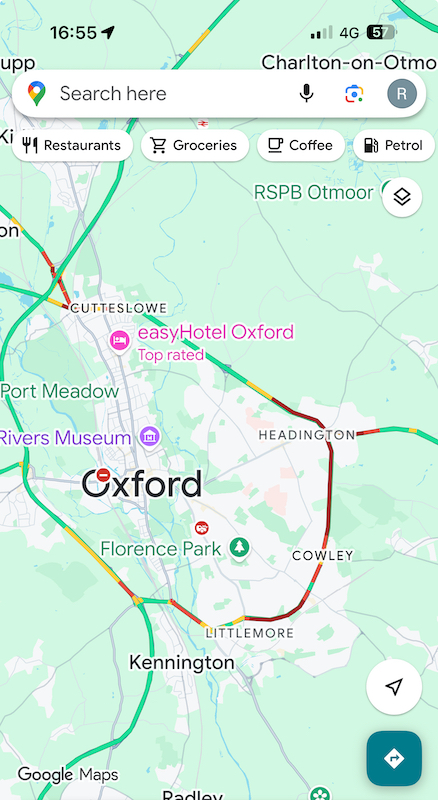
Better that than having buses held up within the city itself. But it does demonstrate that old habits die hard and motorists are clearly still wedded to their cars.
It’s a bold move by Oxfordshire, and good to see the bus companies responding with improvements. If it was down to me, I’d have made the Congestion Charge at least £10 a day (London’s is £15) but I guess it comes down to what is politically acceptable to introduce in today’s febrile atmosphere. Here’s hoping it’s a success and buses become more reliable and much quicker and other cities, particularly Mayoral Combined Authorities keen to “take back control” will take note and follow this example.
Roger French
Blogging timetable: 06:00 TThS
 BusAndTrainUser
Living in North Oxfordshire we use the Peartree Park & Ride or the S5 to and from Bicester Park & Ride to central Oxford both very good with good frequent timetables 7 days a week. My only comment is the 19:00 closure of the congestion zone charge a little late if you are going to any entertainment venues a little late. 18:30 would be a more sensible time in my opinion.
The Wandering Busman
LikeLike
If anything the closure is too early. Westgate shops are open til 2000 at least, and Oxford has too many cars in it well into the evening. Why should we incentivise people to go to entertainment by car? We should be doing the opposite.
LikeLike
Lack of some public transport out of Oxford. I was one of a dozen taking the 10pm to Swindon every weeknight , but that was it going east.
JBC prestatyn
LikeLike
A while ago, as the service is much better these days
LikeLike
It certainly is – last buses from Oxford to Swindon now 2345 M-Th, 0315 (next day) FS and 2315 Su !
LikeLike
It is amazing that the road has to be closed for three years to fix a brick arch and a water main. In that time, the Victorians built Summit Tunnel under the Pennines – the longest tunnel then in existence.
LikeLike
Forty-one workers died in the construction of Summit Tunnel.
Perhaps Oxford suffers from‘Health and Safety Gone Mad’?
LikeLiked by 2 people
Well done to Oxford City Council for actually trying to do something to improve the reliability of bus services, this experiment will be closely watched. Unlike in ‘take back control’ Manchester where virtually nothing has been done to increase bus priority and bus punctuality is now worse than 12 months ago, with Central Government having ignored the Transport Committee’s report on roadworks to make no changes to the current chaotic system
LikeLike
No thanks at all to Oxford City Council.
They oppose the scheme but want all the benefits arising from it (which apparently can just be had by “improving public transport”)!
LikeLike
This kind of scheme only works IF there are park and ride facilities or large car parks on the outskirts of the city or town. It would never work in Brighton for example when all the major car parks are located in the city centre. At least in Oxford motorists have a choice to take park and ride in or drive.
LikeLike
Thank you for this article Roger. In general traffic has been much lighter on radial bus routes since the charge. The increase in traffic on the Ring Road was always expected, as the placing of the filter gates is designed to send motorists round the Ring Road to complete their journeys if they are unable/unwilling to switch to the bus. Not many bus routes use the Ring Road, and the idea is to keep traffic away from bus routes and to speed up buses.
LikeLike
I have been a commuting cyclist for many years. I’ve often seen‘Cyclists Dismount’ signs but I’ve yet to see a corresponding ’Get back on’ sign. I guess it’s left to one’s judgment; but then who is the enforcer to whom you refer to assess my cycling skills?
LikeLike
Does the bus really take 40 to 45 minutes from Barton to the City Centre. At 3.5 miles that is a speed of approx 5 mph. Even with the congestion charge it is still unattractive. I would rather get the bike out the garage, walk or go locally to Headington and not bother with Oxford.
LikeLike
Still some painful running times before and after this scheme, which cannot do much to attract prospective passengers out of their cars. Even thinking of taking a car as close to the City Centre as possible has at least kept Park and Ride services healthy.
It is certainly brave of the County Council to implement this scheme after the predictable noise from the “J. Bonnington Jagworth” lobby. Certainly a turnaround from the not so distant past when it was proposed to terminate all bus services at the City fringes, and transport them by “Cattle-Trucks” into and out of the City itself. Sure that would have worked….NOT!
The bus companies really had their work cut out having to point that potential disaster out, but that was way before the Botley bridge fiasco. The absurd “delay” I gather was the discovery of our ancient past, which for academic Oxford, took priority over common sense.
Terence Uden
LikeLike
The temporary congestion charge is authorised for up to two years, not three months.
The particulars of the Botley Road lowering & bridge replacement (their rationale, what caused the delays, what’s currently funded etc) are explained in Network Rail’s April 2025 FAQs pdf. The bridge replacement (previously planned for July 2024 before its very short notice cancellation) is scheduled for early February 2026.
LikeLike
That’s a very comprehensive and informative FAQ document. Brave of Network Rail to publish it and especially to include the question about what happens if Thames Water goes bust!
LikeLike
London’s congestion charge will increase to £18 from the 2nd January 2026.
LikeLike
As others have pointed out, the temporary congestion charge scheme is until the reopening of Botley Road.
It is the free Park and Ride which is only a three month trial, apparently because of the risk of a court case from “concerned businesses”.
Service 400 is limited stop from Thornhill, not all stops.
LikeLike
The 400 serves all stops.
LikeLike
No, it doesn’t.
There are four or five stops it doesn’t serve.
LikeLike
Oxford is a basket case traffic-wise. Huge efforts have been made to make public transport work, and it’s well-used, but still those folk have to turn up in their exclusive little tin boxes to fill the few roads with stationary metal mostly carrying air.
LikeLiked by 1 person
A brave attempt in this car obsessed world to try to save a city centre!
It reminds me of the zone and collar scheme tried in Nottingham in the 1970s – remember the Lilac Leopards? That failed because it was easy to drive around and looking at the map that might be the case in Oxford. From the Blackbird Leys and Cowley area there is no restriction nor from the north on the A4144. I don’t know Oxford that well but that seems to be a gap.
I had experience of the walk off an S6 at Botley Road to Gloucester Green in the summer. The cyclists didn’t seem to be so disciplined then!
Richard Warwick
LikeLike
I don’t see the rationale (apart from money-grabbing) of making users pay at the P & R and (normally) pay again on the bus. If anyone parks there for some local purpose and doesn’t bus on, it must be a very small proportion of all users.
LikeLike
Parking revenue goes to the council. On bus revenue goes to the bus company.
LikeLike
And I believe the Park & Ride services in Oxford have been commercial for decades, I’m sure I remember Thames Transit competing on them for a short period, so both parties need income to fund their share of the provision. Oxford does allow you to pay for both together, when the bus isn’t free, at the parking payment machines but also allows you to pay for parking separately if you have a season ticket for the buses or want a ticket valid on other buses than just the Park & Ride.
Dwarfer
LikeLike
The prize for the most Park and Ride sites served by one route must go to Winchester, where four sites are served. Two are to the south of the city and two to the east. The route is three quarters of a circle via the city centre. It is well used and often double deckers are required instead of the dedicated E200 MMCs.
LikeLike
You’re absolutely right. My wife & I always use the St.Catherine’s P&R when visiting Winchester. The site is only minutes away from the M3 & the frequent bus service into the city is operated efficiently by Stagecoach. Good value too. On a separate note, I personally miss the dedicated & classy King’s City branding that Stagecoach used for a while around the area. New HQ management obviously didn’t agree.
LikeLike
Thank you Roger for the visit. And if anyone fancies testing the enhanced Oxford bus network, including countywide, then we do have an amazing ticket. It is called “MyBusOxfordshire”, and is £6.50. Almost every bus in the county, and some extensions outside Oxfordshire – e.g. the X40 to Reading Station. It’s a sort of “TravelCard for Oxfordshire”.
Why not come and visit us, see the city and surrounding areas, and sample the lower traffic levels in the middle of town. There’s some good coffee shops on the High Street (CH, Oxford).
LikeLike
The MyBusOxfordshire bus ticket seems ideal for crossing the county coming from outside, quite willing to pay 50p more than price of two singles for the flexibility it gives and only have to mess about paying on the first journey.
On a relatively frequent long route like River Rapids it gives the opportunity to get off en route and step back a bus easily getting value for money.
MybusOxfordshire website clearly states the inevitable restrictions on sightseeing, express services etc. It has excellent downable maps for the county and urban areas on it as well.
Thanks very much for the tip.
John Nicholas
LikeLike
Thanks. Us X40 users are encouraging all drivers to ask passengers: “Would you like to supersize your ticket for 50 pence more, and get all the buses thrown in on arrival in Oxford?”. The response is usually “yes please”.
Although the ticket gets a small subsidy, I bet it puts a staggering amount of money back in to the Oxfordshire economy, with folk catching the bus to extra places you wouldn’t otherwise visit. (CH, Oxford)
LikeLike
I wonder what Lyra Belacqua, the most noble of all child students at Jordan College, might make of these things. Timetables and departure boards for buses are not needed by Lyra as she possesses a rare instrument, and alethiometer which provides her with greater truth than publications of bus companies. As to Lyra’s friend Will Parry, an expert on part of Oxford’s vital Sunderland Avenue (service roads off the A40 “North Way”), has he been able to get the local authorities to erect correct signage to help those travelling to Cittagazze? From what I have read, Cittagazze seems to be an idyllic holiday destination. Those planning visits to Cittagazze must leave their cellphones at home as only lodestone resonators work there. As to Oxpens Road, my recent A-Z Street Atlas must surely be in error as according to what I have read there is surely a zeppelin mast there and not an ice rink. Much as I am sure that the Oxford Tube provides an adequate service such luminaries as Mrs Coulter and Lord Azriel would surely travel the Oxford – London corridor in style and at leisure by zeppelin!
LikeLike
Bizarrely, the Network Rail FAQ is marked “Official-Sensitive” which is a government protective security category where
The mind gently boggles.
LikeLike
Well, there are some out there who think that Oxford is the centre of the known universe. So closing a key bridge could well have strategic consequences.
LikeLike
As a former Oxford resident, it always struck me as a perfect place for a tram. One line east-west (with two branches for Headington and Cowley), the other north-south. It’s already got the passenger flow, it would be popular, and could run at high frequencies throughout the day. Then you could ban cars completely in the city centre, other than perhaps on university drop-off day in October.
Of course it’ll never happen.
LikeLike
why go with all the expense and hassle of installing a tram. Battery trolley buses surely the way forward…..
steve
LikeLike
Interestingly, Oxford did have a tram system. Mainly horsedrawn. One branch towards Summertown and one branch towards Headington. The King’s Arms pub in the middle of town has some pictures of it on the walls. (CH, Oxford)
LikeLike
The firefighter exemption is likely to be those who are “on-call” for a firehouse which is not always manned, and need to mobilise to their nearest firehouse within a matter of minutes to take a unit out.
LikeLike
It may also be down to the difference in deployment. The Fire Service will normally wait at base with the vehicle until called, unless doing a specific task like site checks, so need bases near where fires are likely to be and so are fairly central and may be caught up by a charge zone. In comparison Ambulance crews deploy with their vehicles and wait for call ‘in the field’ (& are also more active with calls for assistance) so their bases are often in industrial estates or on the edges of towns so likely outside any such zones.
Dwarfer
LikeLike
I imagine Oxfordshire has a number of “retained firefighters” who are effectively volunteers.
Wasnt there a problem with electric trams etc with science instruments at the university colleges
I am told Go-Ahead in Oxford is experiencing a reduction in passenger revenue (free buses ex park and ride ?) has it also lost passenger numbers too – are less folk traveling or more bicycles or a reduction in student numbers (and families of students) as govt restrictions on migrant categories come into force for visa ?
JBC Prestatyn
LikeLike
As well as Reading, the MyBusOxfordshire ticket covers services to Aylesbury, Buckingham, Cheltenham, Daventry, High Wycombe, Newbury and Swindon. All according to the website, but I don’t know how frequent they are.
LikeLike
Which is pretty incredible really. So, while checking timetables carefully of course, someone could get a train to Reading. Then for just £6.50, have a day trip to, for instance, Cheltenham and then back to Reading. Much of it through some lovely countryside (even in winter), and enjoying all the delights of Oxford midway while changing buses. And I bet you’d probably put a fair bit back in the local economy, making the small subsidy of this ticket really good value. Try it folks (Roger, fancy a review of using the ticket?). Oh, and if on the X40 to/from Reading, stopping off in Wallingford for a bit might also be a nice option!
Most Oxford Bus / Thames Travel drivers know the ticket really well. But just in case, on the ticket machine screen, the menu is “Network -> More 1/2 -> Right hand blue square” (CH, Oxford).
LikeLike
@steve – look at continental Europe and you will see that over recent decades, trams have been enjoying a renaissance. This is particularly the case in France, where the number of tram systems has shot up, from three to nearly 30, but new tram systems can be found in other countries too. Nevertheless there are some places, including in France, where bus rapid transit systems have been installed instead.
When considering tram v battery trolleybus (or other bus-based systems), I would look at each case on its merits. In some cases the additional expense of a tram system may be justified by the additional benefits of a bus-based system. In others, a bus-based system may be more appropriate.
Malc M
LikeLike
Oxford cyclists obey the rules…?! How unlike ‘the Other Place’ (the one which will one day be at the other end of East West Rail, though possibly not in my lifetime!)
LikeLike