Sunday 26th October 2025
Today’s the day.
Imagine the excitement exactly 39 years ago today, Sunday 26th October 1986, as the new deregulated regime for Britain’s buses outside of London brought to an end 53 years of tight supply side regulation through the requirement for bus operators to hold a Road Service Licence for each and every bus route and its timetable. These were controlled and issued by the Traffic Commissioner for each area who determined when and where buses could run and what prices could be charged with other bus operators, British Rail and local authorities all having powers to object and stymie any innovation.
No wonder, as car ownership grew exponentially in the 1960s and 1970s and social habits changed, not least with the advent of television replacing cinema and theatre visits and out-of-town shopping destinations with large car orientated supermarkets becoming established, the number of passengers travelling by bus plummeted during that period. By the 1980s funding required by local authorities to maintain networks which relied on cross-subsidy to keep services going had become unsustainable with annual reductions the norm. This situation increasingly saw bus routes that had potential to grow the market through improvements to frequencies to instead be cut back so vehicles and staff could be redeployed to keep unremunerative rural routes going with the result both hemorrhaged passengers.
Something had to be done.
The Conservative Government had brought in legislation to ease regulations six years earlier in 1980 which included complete deregulation of express routes, excursions and coach holiday tours, the removal of fares control on bus services and a presumption in favour of a new bus service, rather than against, in Traffic Court hearings overseen by the Traffic Commissioners, but it was the removal in 1986 of the need to seek permission to run more frequent local bus services, change timetables and introduce new routes that opened up the market to commercial opportunities not seen since prior to 1933, when regulation had been introduced.
The backstop of local authorities gaining new powers in 1986 to contract bus routes through a tendering process to plug the inevitable gaps where commercial bus routes weren’t feasible was crucial in not leaving areas isolated from the bus network.
I well remember in Brighton and Hove there was much anticipation during the summer of 1986 as new commercial networks for the competitive era had been registered a few months prior to the 26th October start date and we wondered whether neighbouring Brighton Borough Council owned Brighton Buses would duplicate any of our routes and I’m sure they wondered the same about us, as well as colleagues at the by then separate Southdown bus company encroaching into the city network, to say nothing of any new entrants as envisaged in the legislation.
In reality it was pretty much business as usual, no doubt helped by the aforementioned bus companies having a history of working together under joint agreements and Brighton and Hove being a densely populated area meaning there were few gaps in the network needing local authority funded tendered routes.
The idea behind deregulation was to create a contestable market for bus service provision so if one bus operator failed to provide a quality service on a commercial corridor, then another would step in and run something better to gain market share. The fact there may not have been competition in some areas, such as Brighton and Hove, didn’t mean the principle had failed, because the market was still contestable. Indeed there were instances of Brighton Buses extending a route or two over the top of our routes for a short time and new small operators did start up and compete on certain corridors. This kept us on our toes determined to provide the best possible service for our passengers.
In Brighton and Hove 95% of mileage was operated commercially with the County Council saving money on what it had previously paid to support the overall network through competitively tendering the other 5%. Nationally there was an approximate 80/20 split, commercial/tendered.
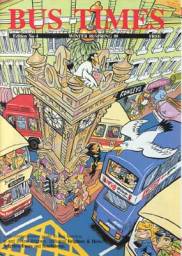
One of the things I was determined we’d do from the start was publish a comprehensive timetable book for passengers with all the bus network’s routes included, even those by our new competitors. This would be issued on two fixed dates in the year so we’d overcome the perception following deregulation that everything was always changing. It wasn’t. And thanks to the good sense and cooperation of colleagues at Brighton Buses, Southdown and the local authorities, who all paid towards the inclusion of their services in the book, we maintained this principle for more than 25 years until I retired. We also took a relaxed attitude towards accepting each others return tickets (even if prices were different) as well as maintaining mutli-operator Travelcard type tickets (including use on local trains until that ended at the behest of the rail company) with PlusBus continuing and becoming one of the best selling such tickets in the country. It’s what customers wanted and we were in the business of providing what customers wanted so we did it. That’s how a commercial market should work.
Sadly, such helpful approaches of using the freedoms brought about by deregulation to encourage passengers weren’t widespread and there were notorious examples around the country of wasteful head to head competition leading to destabilised networks, confusion for passengers and a bad name for the deregulated regime. And that’s continued on and off for the last 39 years. Those original skirmishes in high profile cities in the conurbations, not least Glasgow, are now much in the past, but as yesterday’s blog showed, there are still small scale competitive moves starting up demonstrating the market is still very much contestable in both theory and practice.
I’m sure no-one would want a return to the heavy handed form of control which stifled innovation and saw consistent and endemic reductions in passenger numbers prior to 1986. 39 years on we now have the Bus Services (No 2) Bill about to become an Act in Parliament which will build further on the new form of contracted bus operation being rolled out in the Metropolitan conurbations (it’s not really ‘franchising’ in the true sense of that word, as is common in retail) along with a much welcome heightened spirit of cooperation and partnership between many local authorities with bus operators in ‘shire’ and ‘unitary’ areas, helped by unprecedented public funding made available through various schemes (BSIPs, ZEBRA etc) to facilitate improved bus services to attract passengers and introduce new vehicles particularly those with zero emission.
As I’ve often commented, while so ever this level of significant public funding continues it’s good news, but experience over the last fifty years indicates it won’t, and can’t last and one day a Government of some political complexion is going to reign back the financial support and inevitably once again look to the private sector to use its commercial expertise to try and develop the market for bus travel without so much reliance on public funding.
As evidence of this, just look at the railways where a fortnight ago Secretary of State for Transport Heidi Alexander oversaw the transfer of Greater Anglia back to public ownership and control stating “we’ve got to run a financially sustainable railway” crucially without explaining what that means, but according to the BBC News website adding there was a “gap of about £2 billion” between what the government “ploughs” into the railways and fare income from passengers.
The use of the word “ploughs” sums up the problem when public funding goes into public transport. It’s not seen as positive investment expenditure but something that’s almost grudgingly paid over.
Although there were well known successes, bus deregulation also brought profiteers intent on making a ‘fast buck’ through draconian cost cutting rather than revenue generation. It was, and still is, an easier option than investing and trying to generate revenue but is not a long term sustainable way of working. Passengers deserve an attractive bus service, the kinds I often feature in these blogs such as provided by Delaine in LIncolnshire, Lynx in Norfolk, Stephensons in Essex, Central Connect in Essex, uno and Centrebus in Hertfordshire, Safeguard, White Bus, Falcon and Carlone in Surrey, Compass Bus in Surrey and Sussex, Go-Ahead in Oxford, Bournemouth, Isle of Wight, Southampton, Swindon, Brighton and Hove and Crawley to highlight just a few in East Anglia, south and south east of England I’m particularly familiar with and evidence that the deregulated market can work for the benefit of passengers.
There’s no doubt deregulation didn’t serve the Metropolitan conurbations well. There was no sense of an integrated network with different brands understandably causing confusion in the minds of many passengers. At the moment, with public funding flowing through various streams (Sustainable Cities, Bus Service Improvement Plans etc) it’s proving straight forward for elected Mayors and Council leaders to create new unified regional brands and enhance services. This is to be welcomed and I very much hope will be consistently supported by central Government.
Those examples of private sector competitive skirmishes as featured yesterday provide short term benefits for passengers (cheaper fares and enhanced frequencies) with the private companies’ profits taking the hit. Managers are accountable to company shareholders and owners for the consequential reductions in profits.
What is of concern is a lack of similar accountability for public funding provided by taxpayers where I have also highlighted examples of completely wasteful spending on bus routes which have no justification at all (cf Cambridgeshire’s route T2 featured yesterday) and others which continue with no sense of value for money (cf DRT schemes as featured here ad nauseam).
If route T2 had been tried out by a private bus company it would have been pulled as a failure by now but there’s no similar sense of guardianship over public money and I’m sure the route will continue for months more with no prospect of attracting passengers, as with most of the DRT schemes I’ve featured over the years.
Industry veteran and commentator, Chris Cheek, observed in his book published last year, Britain’s Buses in a New Era, there’s a cycle of around three to four decades with control oscillating between the public and private sectors as the amount of public funding rises to an unsustainable level followed by a need to reduce it. Chris wryly observes “on this basis, maybe we can expect the next era of deregulation to begin somewhere around 2050”.
Interestingly, since that book’s publication we’re seeing a much more volatile political landscape and unless there are significant changes in the meantime, I forsee the possibility of significant regime change soon after the 2029 General Election, so make the most of the next three and a half years.
There’s also plenty of turbulence ahead from the upcoming England wide reorganisation of local government creating unitary authorities across the country (outside the Metropolitan conurbations) together with a plethora of new Mayoral controlled Combined Authorities. It wouldn’t surprise me if many Public Transport Officers at the soon to be abolished county councils take the opportunity for early retirement leading to a loss of valuable experience.
Ultimately, what the last 39 years have proved is that it’s not ownership (public or private) that’s important or which sector is in control, it’s whether you have dedicated, passionate people at the helm who totally believe in public transport and do their very best to give the most attractive service possible to encourage passengers. As one astute commentator observed to me after yesterday’s blog – a benevolent monopoly has always been the best bet for buses.
Roger French
Blogging timetable: TThS
 BusAndTrainUser
In general in my view Deregulation has failed. Bus services need to be seen as a network and not a lot of committing routes. It is very difficult to identify any positives from deregulations but quite easy to identify many negatives
LikeLike
Regulation was a failure too – bus patronage fell for 30 years straight, whilst the cost increased both with overt and hidden subsidy.
I do love the comment below that all the innovations from the last 30 years would’ve come anyway. Given the risk averse approach of the NBC and SBG, I strongly suggest otherwise.
LikeLike
To say that patronage fell for 30 years straight and that was a failure of regulation is to mistake correlation for causation. Throughout that period, private cars were becoming more affordable and more popular, not because of anything the bus industry was doing wrong but because they gave people freedom and opportunities that they hadn’t had before. In the face of that change to the landscape, it’s hard to see how a regulated or deregulated bus industry could have maintained ridership at previous levels.
LikeLike
I agree a benevolent monopolist is the best form of bus provider, but unfortunately these have been a bit thin on the ground. Go Ahead were, but actions in the Thames Valley, East Yorkshire and Cornwall mark a change, Stagecoach was for the most part although I’m sure that many will disagree with that,but going forward Go Ahead, Stagecoach and Arriva are all owned by vulture funds who’s only interest is maximising short term profits and selling on to the next vulture on a 5/7 year timeline.
Stagecoach paid its owners £70m in interest last year, more than its profit and Go Ahead is paying over £2m a week in interest. This is coming at the expense of investment and whilst government funding is allegedly safe until March 2029 after than cuts could be coming.
The industry and its Local Authority partners have three years to generate more passengers, but until the vast majority realise that bus priority has to be prioritised to improve reliability that won’t happen. Only three things really affect passenger numbers, reliability,frequency and fares, in that order of importance
LikeLiked by 1 person
Bus Times personified the best in benevolent monopolistic bus operation. Produced twice a year to coincide with service changes complete with information on fares, reassuringly valid for a defined period of time.
They were available for free as you walked out of Brighton station and also on board every bus prior to the change date. I lost count of the number I gave away to intending passengers at bus stops who were unfamiliar Brightons bus network knowing I could easily pick another one up.
The excellent map in Bus Times was updated over the years to ultimately feature the name of every bus stop.
Pocket Bus Times featured the map and service clock face departure times.
I asked face to face at the highest level why Bus Times is no longer produced and was told they haven’t got anyone to produce it.
Pitiful
John Nicholas
LikeLiked by 1 person
Simply not true, they even made the next version but the MD Ed Wills didn’t want to make it anymore quoting a loss of costs from Covid. The marketing team is the biggest it’s ever been but most have never driven a bus or know anything about buses.
LikeLike
I can assure you that conversation took place and resent your assertion to the contrary, indeed recovering from Covid was the ideal time to publish BusTimes to instill passenger confidence similar to post deregulation.
The capabilities and composition of the Marketing Team is an internal matter, however their ability to communicate with bus users both citizens and visitors like myself is a reflection on the leadership of B&H as the blog eloquently explained happened in previous times.
All City Centre bus stops were renumbered into logical clusters last week at the same time as the implementation of the latest phase of the Valley Gardens public realm works. This positive development would have been another ideal justification for producing BusTimes as key departure points changed on virtually every timetable.
In light of these changes and the recent introduction of route 3X I enquired at “One Stop Travel” whether an updated map is being issued, only to be told “It’ll be a couple of months, mate”.
The need for Brighton and Hove buses to be kept on its toes has never been more relevant, however not by other Operators but by watching them like a hawk for the future benefit of passengers.
John Nicholas
LikeLike
Roger
It would be good to have your views and experience of Edinburgh and Glasgow.
For many years we’ve had a stable and expanding monopoly in Edinburgh with constant investment in new buses. We’ve currently got some poaching on the most profitable routes – the tourist focused ones.
LikeLike
Edinburgh is a classic example of a ‘benevolent monopoly’ whereas Glasgow is not!
LikeLiked by 1 person
A question I wonder would be to ask if deregulation of bus services was a good idea, why other countries around the world didn’t look at the UK as a leading light and copy their path of deregulation.
In addition maybe a good benchmark would be to compare the UK’s public transport in cities and towns with other countries since 1986 to see impact on cost to run, economic benefits, social benefits etc. I wonder how the UK would compare
LikeLike
I recall (can’t find the link) a UN report from 2018/9 which stated that bus services in UK and impact of deregulation had breached people’s human rights!
LikeLike
Even in the home of (allegedly) rampant campitalism, the USA, public transit is seen as a local government function. That says something.
The only other country I have personal experience of which has removed regulation of local bus services is Kenya, and the matatu mayhem makes our deregulated system look like nirvana. Think Glasgow’s post-deregulation bus wars turned up to 11 and you get the sense of what Nairobi’s local bus operations are like. The matatus are definitely a distress purchase for their passengers.
The UK’s electorate has repeatedly made it clear at election after election that they care only about cost to run public services, not about benefits tangible or intangible, except where it affects them personally.
Given a choice between cutting the cost of public services (sold by politicians as being to fund tax cuts) or improving the quality of those services, as a society we have for many decades consistently chosen to cut costs.
We’re now at the point where repairing the damage so caused is going to cost far more than we ever saved by that cost-cutting.
LikeLike
Interesting comment on taxpayer’s money. And how Roger’s articles sometimes selectively use numbers. Since 2020 the industry has chewed through £6bn of government money. £2bn alone on COVID related support. I wonder how much of this money left the system into the pockets of shareholders. Also to note in the world of free market capitalism, most bus companies world have died in 2020 without using our money to bail them out. Deregulation would have probably died too at that time.
LikeLike
This to me is the key test. The answer is that no developed country looked at the UK and said “wow, that’s a good idea”! I’m sure the citizens of say Zurich, or Utrecht are relieved not to have deregulated buses. Zurich is a directly operated municipal and Utrecht tenders its network. If you look at the bus station at Utrecht Centraal Station you will see something beyond the experience of any UK city. It’s not the bus station design It’s that it is next to the railway station and has direct access to it. Thousands of people transfer from trains to buses each day, who knew in the UK that that was even a thing!
https://www.alamy.com/bus-station-in-utrecht-image352866795.html
LikeLiked by 1 person
The benevolent monopolist in Edinburgh decided to extend their monopoly by extending westwards into Midlands territory, and so First quite rightly decided to retaliate against Lothian’s most profitable operations. So benevolent monopolists can also be commercially stupid. And my guess is it’s abused that monopoly by being inefficient with high cost levels.
LikeLike
Not sure I would put Compass Bus up on a par with Delaine and Lynx. They are OK up to a point, but their fleet presentation is poor with a constant procession of what seem to be hired in vehicles, and breakdowns are not infrequent. Their running times are unrealistic in the peaks and so buses are frequently late or very late, although I accept this is likely more up to the Local Authority, but they must have some input, surely. I’m not terribly impressed with them.
LikeLike
Better than Big Lemon!
LikeLike
Sanders (North Norfolk, a semi-competitor to Lynx in rural areas and First in Norwich) have also used BSIP money to improve in recent years, mainly strengthening the trunk Holt-Sheringham-Cromer-aylsham-norwich with extra frequency including early evening; and a slew of tendered social village services.
Sanders growth largely due to deregulation enabling them provide what EC and later first was not (helped by a lot of contract work from the public school in their home town and a solid holiday touring offer)
Sanders /transport Norfolk still have blind spots: no bus stop signage on the main road out of Cromer with the council offices, retail and crem, poor train connectivity at sheringham for last train of the night (just run the last bus 10 mins later along the whole route please). And no single seat travel or Inter ticket to connect through to N&N Hospital/University.
MilesT
LikeLike
Deregulation failed as soon as local authorities could no longer fund socially-necessary services due to austerity. The back-stop provision of these services was always a fundamental part of the argument put forward by the pro-deregulators. Take away this part of the equation and it all falls apart.
Enhanced partnerships only work as long as the partners get along (ref Cornwall).
It’s little wonder that consensus has turned back to regulation, ie how nearly all the rest of the planet runs its bus services.
LikeLike
Deregulation failed spectacularly when there were 3 different operators on the same route on different days of the week. A ‘cowboy’ outfit on Mon to Fri providing a commercial service so no county council involvement. Another company on a Sat which was on a contract as the original ‘cowboy’ registered Mon to Sat but changed their mind & a 3rd operator (ironically the original operator before D~day) on a Sunday through a County contract.
That was an extreme example but similar split operator routes existed where the tendered part wasn’t the commercial operator. Hence, unlike in Brighton passengers were just left to find out on their own!
You might get the odd operator pointing a nod towards ‘cowboy coaches’ now run the evening service but that was it. Passengers suffered & tender money wasted. (Counties usually obliged to take the lowest one of course!) Quality suffered & people said ‘sod that ~ in the car’. Passenger numbers dropped on the contracted routes & councils decided to axe as need to save money. One route near me had a passenger survey of the numbers carried out during the school Xmas holidays, so of course numbers were really low. Service cut & silly taxi~share brought in, that of course no one would use bar say one old lady once a week going to get her pension.
LikeLike
Problem of inter availability of tickets.
I suppose Reading should be added to the List of +ve Places over the years.
Years ago I had a OECD Report c1984 on Public Transport but I cannot remember the gist nor can find it now – wonder if it is on line.
For for and against Deregulation see John Hibbs’s books , worth a view on the economics of the revenue of bus operation.
Perhaps too much was done in one go ( anyone remember though the Trial areas of Hereford and Worcestershire ? )
JBC Prestatyn
LikeLike
One outcome of deregulation was the introduction of minibuses accessing otherwise impossible to penetrate parts of towns. That, along with a high frequency, attracted new passengers, such that the minibuses had to grow in size, and many of these routes continue to thrive.
MotCO
LikeLike
Minibuses weren’t a product of deregulation.
London introduced them in 1972, serving hitherto unserved roads, albeit at fairly low frequencies.
I believe it was Devon General, under the leadership of Harry Blundred, which pioneered high-frequency minibuses replacing low frequency “big buses”, in Exeter. That was in 1984, two years before bus services were deregulated. Other NBC subsidiaries began to follow suit.
High-frequency minibus/midibus services also became common in London. In some cases they replaced established routes at higher frequency, in other cases they provided better penetration of residential areas, reaching the parts larger buses couldn’t easily reach. It didn’t need deregulation for that to happen in London.
Malc M
LikeLiked by 1 person
“Minibuses weren’t a product of deregulation.”
Strictly speaking, yes, it’s quite correct that there were minibus operations in earlier years. However, I think it is also true to say that minibuses were used as a tool in a competitive market, in a manner that had not previously taken place in the UK.
NBC purchased 2500+ minibus chassis from the ends of the production runs of two models that were to be replaced with new versions (Ford Transit and a similarly sized Mercedes), and several were bodied at the NBC’s in-house body builder Carlyle, the former Midland Red works, which I suspect would have been working at below its full capacity. (Whether they would have been able to find sufficient staff to work at full capacity is a separate question!) These vehicles were then used by NBC subsidiaries to provide enhanced frequencies on some routes, generally urban or suburban routes. The fact that this was intended to discourage potential competitors on those routes is, I think, widely understood and accepted.
Taking an example of a (theoretical) urban service running every 30 minutes with conventional buses, with a round trip time of 50-55 minutes, two buses would be required. A potential low-cost competitor would need 3 buses (1 as a spare), and could replicate the existing operator’s route and basic frequency, and capture a significant proportion of the existing operator’s traffic by running 3 or 4 minutes in front. However, if the existing operator replaces the large buses with mini- or midibuses running every 10 minutes, then a competitor running large buses every 30 minutes is unlikely to pick up any more than a few passengers who have missed the previous minibus, or are early and waiting for the next one.
In practice, some of the routes chosen for conversion to mini/midibus operation were odd choices. Hampshire Bus converted an hourly local service in Hythe and Dibden Purlieu to minibus operation, running every 10 minutes (initially), but I rather doubt that service would ever have attracted the interest of a potential competitor. I guess it was just a “proof of concept” exercise. Three times as many vehicles as before would have needed three times as many drivers, so, even if minibus drivers were on slightly lower pay rates, the economics didn’t look good in the long term. However, fighting off a competitor by running extra full size buses (as Southampton City Transport did with Routemasters) would also not have been cheap, and still needed a lot of extra staff.
The fact that these conversions to minibus operation took place a couple of years before deregulation actually happened does not, I think, prove that deregulation was not the motivation for introducing minis. The broad thinking of the government was known for a couple of years, and the relevant Transport Act was passed in 1985. Express coach deregulation had happened in 1980, and was considered to have been a success.
RC169
LikeLike
@RC169 – as I stated above, high-frequency minibuses were also used extensively in a non-competitive environment, in London. That makes any claim that minibuses were an outcome of deregulation somewhat questionable, don’t you think?
Malc M
LikeLike
Malc – “That makes any claim that minibuses were an outcome of deregulation somewhat questionable, don’t you think?”
No, not at all. You have to put those developments into context. Elsewhere in this discussion ( October 26, 2025 at 9:02 pm ), you mention AMOS in 1982; Harry Blundred’s minibuses in Docklands in 1989; and minibuses in other parts of London from 1986.
As I mentioned above, express coaches were deregulated in 1980, and the government had demonstrated an intention to deregulate bus services, so that the idea was in circulation. In such circumstances the businesses that are likely to be involved or affected by the proposals will naturally start to make preparations, as will other new entrants who perhaps wish to take advantage of any changes that may be made. Specific business proposals will be made, to take advantage of the anticipated legislative changes. Why was AMOS proposed in 1982, and not in 1972, or even 1967?
When an anticipated legislative change generates interest in new or revived ideas, it is naturally possible that businesses may also adapt (or attempt to adapt) those ideas to other situations, even where the specific legislation does not apply – but the concepts may be applicable with some adjustment. In other words, cases like AMOS or Docklands Minibus.
RC169
LikeLike
@RC169 – high frequency minibuses were initially introduced by London Regional Transport, the planning/tendering authority, rather than by the operating company (London Buses Ltd) protecting themselves against any future on-the-road competition had deregulation been extended to London. LRT’s aim was to grow ridership (against competition from the car, taxi/private hire car). Minibuses provided a cost-effective way to increase frequencies and thus reduce waiting times – in a regulated environment.
As it happens, London Buses were quite successful at winning the minibus tenders using low-cost units – Roundabout (Orpington, 1986), Westlink (Kingston, 1987), Harrow Buses (also 1987), Bexleybus (1988). But other operators got in there too – London Country North West (including the C2, a radial in inner/Central London), Eastern National, R&I Coaches…
London Buses also introduced minibuses on services which were not tendered. Whether that was in anticipation of future deregulation, who knows? But there was no guarantee that when LBL’s minibus routes were later put out to tender, LBL would retain them (some they did, some they didn’t).
The AMOS proposal of 1982 pre-dated moves to deregulate the local bus industry. They applied to operate in a regulated environment. London Transport turned them down, only after appointing an independent inspector to consider and report on the application; AMOS then appealed to the Secretary of State of Transport, who dismissed the appeal. The Secretary of State was one Nicolas Ridley.
Malc M
LikeLike
It’s interesting to see small scale co-operation in Nuneaton. Roger has recently covered the 148 and 158 which serve Coventry/Nuneaton to Hinckley & Leicester. Stagecoach and Arriva have a local agreement that extends to the housing estates adjacent to this route within Nuneaton and adjoining the A5.
Weddington to the north west is the preserve of Stagecoach and St Nicolas Park to the north east (and almost joins Hinckley) is served by Arriva, with the trunk routes diverting into those respective estates on Sundays when town services don’t operate into those parts.
In a recent response to a photo feature I do on another enthusiast site, Toby France, Arriva Midlands Head of Commercial said the operators agreed it was better for passengers to have a single operator within each area.
There is always the danger of course that some might see that as a small scale monopoly, but it definately works well locally and we’re seeing a housing estate which has been occupied for around 10 years seeing it’s first buses with clearly marked stops displaying timetables. Furthermore, I’ve even seen people waiting for buses!
How radical!!!!
LikeLike
Did deregulation make much difference in the West Midlands? Not really. A monopoly of blue and cream buses has been replaced by a monopoly of dull battleship grey buses, ran by the same company. All of the innovations we had like minibuses penetrating estates, or accessibility being improved by low floor, wheelchair and pushchair accessible buses, would have happened without deregulation.
Indeed, there is an argument that deregulation slowed the low floor revolution down and severely damaged British bus manufacturing. West Midlands Travel were expending a lot of time and energy on operations elsewhere in 1995 rather than focusing on the day job running buses in Birmingham. The result? Protests by disability campaigners blocking Corporation Street in Birmingham City Centre and highlighting the issue on regional TV news while executives were wasting time planning competitive skirmishes in Darlington or Surrey.
It says a lot that when National Express took over, the competitive adventures were sold for buttons and the rebranded Travel West Midlands were refocused on the knitting in Birmingham, the Black Country, Solihull and Coventry.
Kevin
LikeLiked by 1 person
Utter rubbish! In the West Midlands the biggest winner of deregulation is Diamond Bus.
Thirty years ago today the 27th October 1986 Birmingham Coach Company began on Service 16 from Hampstead to City Centre shortly followed by 217 Merry Hill to West Bromwich.
Forty years later Diamond Bus is the Number two operator in the West Midlands & has evolved over the years to be the biggest employer based in Sandwell.
Whoever wrote the above post obviously hasn’t a single clue about Buses in Brum.
Deregulation changed buses in the West Midlands County for ever.
Its legacy is the premium quality Diamond Bus operation we have had now for 40 years which I have proudly used from Day 1 & we still have the tribute to Birmingham Coach Company from National Express West Midlands still in service on Service /3/15 from Pensnett.!
LikeLike
Oh, I don’t know, Richard. At least that person doesn’t try to turn everything into an excuse to dribble over their favourite bus company de jour.
It’ll be interesting to see what levels of vitriol you aim at Diamond when you inevitably fall out of love with them.
What is your link with them, by the way? You’re far too partisan to just be a passenger. Or is it perhaps an ASD thing? (I’m on the spectrum myself.)
LikeLike
The link I have with Diamond Bus West Midlands is I use them7 days a week 364 days a year to get around the West Midlands County & occasionally into Worcestershire for both work & leisure so can judge their performance and quality on my own personal daily experience compare with armchair enthusiasts.
If I find any experience below the expected standard’s passengers should I expect I report it direct to Rotala & Transport for West Midlands.
However compared to other operators in the West Midlands this happens rarely given the modern fleet and professional service of Diamond Bus in the West Midlands County compered to Midland Red (South) Limited on its TfWM contracts & National Express West Midlands whose punctuality, vehicle age especially in The Black Country and reliability leave a lot to be desired.
As for ASD the Qehb haven’t come up with that diagnosis et sticking maninnly to my cancer treatment which is excellent.
LikeLike
Well said. Good luck with the cancer treatment. When you’re out & about next time buy some cheese & a large mouse trap….
LikeLike
Good idea, will do, it may come in useful with Richard Parker the current Mayor of The West Midlands Combined Authority.
LikeLike
In my part of the Black Country, Diamond Bus is no better for punctuality, vehicle age and reliability than National Express West Midlands. Perhaps Roger needs to do a visit to confirm!
LikeLike
Having just boarded Diamond Bus 4H which has arrived on time with a late running NXWM 4M behind it.
I would welcome Roger at any time to enjoy the Diamond Bus network across Birmingham & The Black Country.
I look forward to that happening in the future.
LikeLike
Forgot to add the Diamond Bus Streetlite is a 20 plate while the NXWM Scania is an 09 plate – 11 years older on the same 4/H/M corridor.
LikeLike
Just to follow up my comment yesterday.
I am currently on the 09:15 Diamond Bus 24H from Blackheath on a 74plate Mercedes which departed exactly on time to Merry Hill
Behind is a 57plate Scania on National Express West Midlands 4M running 12 minutes late also to Merry Hill.
Two days to totally different destinations same result.
Whatever the armchair enthusiasts whine about Rotala the actual service delivery quite simply proves my point again & again & again……
LikeLike
As always with the benefit of hindsight de-regulation didn’t turn out the panacea that was originally envisaged. However, it should be remembered that LT, NBC & SBG like British Rail, was regulated largely by faceless bureaucrats who seemed to have no understanding of how to provide a decent transport system. Although LT seemed to run reasonable bus services I understand that its management prior to de-regulation was autocratic & the unions tended to oppose change. Not a combination to inspire innovation & enterprise. Clearly, however, there were good managers within LT as well as NBC & SBG who, when given the opportunity through de-regulation, rose to the challenge. Okay, as in most walks of life, they didn’t always get things right initially, but eventually we did end up with some decent bus operations around the U.K. Unlike other industries, best practice doesn’t always seem to be factored in when trying to address today’s needs & demands for bus services. Hopefully, the newer generation of bus managers (having enjoyed the freedoms that de-regulation provided) will be able to adjust & deliver the services & networks required by the various evolving strategies now being introduced. As with all things though, time will tell.
LikeLiked by 1 person
Before Malc M responds concerning my remarks concerning LT & de-regulation, I appreciate that London Buses weren’t de-regulated but eventually split up into separate companies prior to being eventually sold off. I was simply referring to certain members of their management at that time who eventually rose to meet the challenges of a more liberal approach to service provision.
LikeLike
I’m flattered to be named 🙂
Can I to disagree with you that LT ran reasonable bus services? My recollection is that under LT, bus services in London had become notoriously unreliable. During the late 1970s/early 1980s, LT was managing to cover little more than 80% of the scheduled service (although for 1979, the severe winter didn’t help matters) – and this wasn’t uniform across the fleet, some higher-performing routes were counterbalancing other where mileage not operated was well in excess of 20%. By the mid-1980s, service performance had improved, but lost mileage was still hovering at around 6% overall. Even that doesn’t show that for the mileage that was run, long gaps, bunching and curtailments were all-too-common. On too many routes, the advertised timetable was more of an aspiration than a commitment upon which passengers could rely.
The standards of fleet maintenance were also not good, I understand LT’s O-licence was restricted due to the Traffic Commissioner having concerns about the state of the fleet. London Transport didn’t like “off-the-peg” buses, such as the DMS, which it deemed to be unsuited to London’s “unique” operating conditions. Interestingly, operators such as Ensignbus and Metrobus found themselves capable of running reliable services using DMSs, as did the sightseeing operators using DMSs in Central London traffic conditions. And strangely, for its dislike of “off-the-peg” buses, LT seemed to get on OK with its Leyland Nationals, arguably the most “off-the-peg” buses it ran.
I do think you have hit the nail on the head – there were managers within LT who were very good. Decentralising bus operations, initially to local districts and then in 1989 to subsidiary companies, doubtlessly gave those talented individuals a much greater opportunity to shine. Meanwhile tendering brought in other operators, many (although not all) able to teach LT a thing or two about how to deliver services which were more reliable, and at lower cost. I would highlight Grey-Green’s tenure of route 24 as a flagship example.
Malc M
LikeLike
I have to confess that when stating that LT seemed to run reasonable bus services I’m recalling the 1960s when travelling around London at weekends with friends, courtesy of Red Rovers! Decline in standards in general seemed to occur from the 1970s onwards as the country suffered from innumerable industrial disputes. That links nicely into your analysis concerning LT’s subsequent decline & illogical dislike of ‘off the peg’ buses.
LikeLike
In London it was the threat of competition from the likes of AMOS and Harry Blundred that forced LT to think differently and introduce minibus services to counter this.
Owen Woodliffe
LikeLike
AMOS had applied to introduce minibuses in around 1982, on radial routes crossing Central London. Their application was unsuccessful.
Harry Blundred arrived in London in 1989, with a small network of routes in and around Docklands. That venture failed (partly as Mr Blundred hoped to claim reimbursement from Travelcard revenue, which LRT declined as Blundred’s services were mostly duplicating LRT’s established network).
I would be surprised if either of those were factors in the local high-frequency minibus networks introduced in the suburbs (starting with Orpington in 1986), or in conversions such as routes 28 and 31 in inner west/north-west London in 1989.
Malc M
LikeLike
The problem with reviewing the post 1986 period is so many things were happening at once: deregulation outside London, privatisation including London, the continued growth of car ownership and long periods of underfunding of public transport.
For my money deregulation was clearly a failure. Privatisation was a mixed bag, GoAhead and until recently Stagecoach generally ran quality operations, Arriva the opposite and First has lurched from good to bad depending on who was in charge that week.
To make matters worse, huge amounts of central Government funding has been wasted. As well almost all the DRT money, great chunks of the £2 / £3 cap monies went on subsiding leisure trips and not helping low income families or driving modal shift. Finally the Zebra funding has taken no account of UK industrial policy objectives, and much has ended up in China.
LikeLike
Finally the Zebra funding has taken no account of UK industrial policy objectives, and much has ended up in China.
What I personally don’t understand is why our government doesn’t insist that ZEBRA money allocated to the procurement of Electric buses isn’t conditional to it being spent with U.K. manufacturers only. After all, they keep banging on about promoting British industry & protecting British jobs. Furthermore, they conveniently forget this is our money they’re paying out.
LikeLiked by 1 person
Which UK manufacturers are producing electric buses, and what proportion of their buses are actually made using British parts?
If the answer to the first question is none then the money can’t be spent here, and if the answer to the second question is anything other than 100% then UK taxpayers will still be subsidising foreign businesses.
That’s globalisation for you, I’m afraid.
LikeLike
Both AlexanderDennis & Wrightbus produce electric buses. Of course the batteries & other ancillaries are imported but the point is that the vehicles themselves are assembled in the U.K. I understand AD’s Enviro 100 is partly manufactured in China but the complete vehicle is assembled here. As for globalisation, I’m well aware of both the strengths & weaknesses of the concept but trust as a nation, we continue to keep, as well as develop our manufacturing capability.
LikeLike
The pro and anti Regulation arguments will go on forever, depending on your political stance. Looking at the current climate I don’t think we will be waiting until 2050 for the next big change.
As pointed out very succinctly in the Blog, Regulation is fine until whoever happens to be the Chancellor of the Exchequer at a precise moment, decides to slash funding. That is why I do not delight in the current situation, knowing so many “amazing” improvements and new services appearing at the moment, may be disappearing overnight at some point down the line.
Terence Uden
LikeLike
You say that, but this idea that the regulatory structure of the bus market is conditional on fiscal circumstances, and that a regulated system can only be afforded in times of plenty, doesn’t generally seem to be shared elsewhere.
Many parts of Europe endured far deeper austerity in the 2010s than anything seen here, but I didn’t see any other countries deciding that they must therefore deregulate their local bus market (or even considering doing so).
The wave of re-regulation now taking place in this country is bringing us back into line with the almost unanimous international consensus and I very much doubt we will be going back again.
LikeLike
Fine, but we are not talking about Europe, we are talking about here. Try travelling around the French countryside by bus, bastion of a Socialist state, and see how lucky we are here in most places by comparison.
Terence Uden
LikeLike
@Terence Uden – I’m not sure that is a like-for-like comparison.
Across France as a whole, the population density is less than half that of Great Britain.
France’s population is quite heavily concentrated in major conurbations, with large distances between them. The countryside in between is very sparsely-populated, far more so than much of Britain. Those miles upon miles of deeply rural France are not promising territory for bus services (whether commercial or subsidised).
Malc M
LikeLike
How about comparing to a country with similar population density as the UK, such as the Netherlands?
They don’t seem to feel the need for deregulation.
LikeLike
This is why we need a regional/ federal level of government. With buses, we probably won’t have all of England doing the same thing again, maybe that is a good thing. Some will opt for no change or enhanced partnerships. Others will go to franchising or even municipal. What this shows is that all regions/ counties need to be given the power to raise their own taxes and decide their priorities. At national level, the treasury can ignore the awkward towns and cities up north or out west and treat Scotland and Wales as provinces, with devolution or a mayor and combined authority, they can’t anymore. Westminster should let each region decide what they want and give them the means to do so.
Aaron
LikeLike
Quite an interesting and balanced blog, I think it highlights well that not everywhere could have consistently good bus networks while deregulation is in place.
Personally, I lean towards municipal bus companies and some franchising. Where it went wrong was letting profit seeking private companies let loose on an area leading to a lot of short term thinking. With something like buses, the ‘competition’ can’t be on the street, it has to be them all bidding for the right to run the routes, that’s as far as it should’ve gone. Counties/ the soon to exist Strategic Authorities should be designing the networks and be responsive to where new developments are built. I think public control will do a lot of good in the long run, the issue with Britain is it’s too centralised at national level, with no regional structures, that’s what needs to change. And passengers need more accountability and a say in where buses are needed.
2029, I think a hung parliament is likely, no party has an inevitable path to power, despite the noise on social media.
Aaron
LikeLike
An interesting overview of the last 39 years.
I’ve said before that in Britain we want a Rolls Royce but we only want to pay for a Reliant Robin! Whilst that continues so the pendulum between support or cut will continue.
For a deregulated market the bus industry has actually been quite regulated over the last 39 years. The Monopolies and Mergers people and the Competition and Markets Authority have both had a lot to say over the years and affected the industry. The reluctance of operators to work together to provide a network is largely due to the potential actions of these bodies. The market was only deregulated to a point.
Let’s not forget the real issue here is 60 years of pampering to the car users and their selfish use of road space. Unless that is tackled nothing will really change.
Richard Warwick
LikeLiked by 1 person
As with a number of other UK industries there is an obsession with who owns and runs things rather than concentrating on the basics such as making them work for users rather than other stakeholders whether they be shareholders (increasingly offshore and greedy), unionised labour forces with inflexible officials or the egos/idealism of politicians or autocracy and/or aloofness of managers.
The pre-deregulation structure was designed for a 1930s industry and was clearly ripe for change but there is no doubt that deregulation was designed by people who saw buses as irrelevant to them and their core voters and that saving vast amounts of money was more important than improving services even if some individuals really believed their spin regarding owner drivers stepping in to provide services beneficial to the travelling public and that innovation would solve everything.
If most or at least some of the potloads of money saved (which in some parts of the country were large sums of money) had been allocated to ensure both monitoring quality and reliability of services operated, questionable competitive practices, ensuring coordinated publicity and information that was obligatory and providing workable bus priorities (including at times of work on the highway) as well as measures to combat the growth in car use through the planning process we would be in a much better place today whether there had been full scale deregulation or something less ‘free for all’.
A more sensible political environment where competing parties basically agree on the sensible stuff including realistic and stable public funding and public sector staffing would also go a long way but I fear that is a pipe dream unless things get so bad over the next few years that genuine common sense (rather than the form of common sense touted by those on the political right) will prevail.
I could add much more but will leave it at that and hope that some of these improvements that should have been made over many years will finally happen before it is too late although sadly in some rural and car-reliant areas it may already be too late
LikeLike
Deregulation has generally not led to bus service improvements in the UK, as exemplified by the poor patronage levels and poor perception of so many services. It will be interesting to see how the new mayoral authorities perform. Will they integrate their bus services with trams and rail, or will it just be more or less business as usual, but under a different umbrella?
There’s a hell of a lot we could and should learn from various continental municipalities, what we need is people who have the balls and the determination to bang heads together to achieve services which prioritise the public rather than just the shareholders. Andy Burnham is one such example. He has achieved impressive results with the Manchester Bee network, and is continuing to make further improvements and expansions as we speak. We need more people like Andy!
LikeLike
unfortunately most companies don’t want to promote or encourage young, local knowledged, enthusiastic and relevant experienced people to become managers. It’s always nearly grad schemes with people who’ve never driven a bus or worked in the transport sector as well as business only minded people looking at profits for shareholders instead investing in the company and community.
LikeLike
while I’m certainly far from being a fan of the Tories, it is good that at least they tried something to improve the bus industry. However, it has clearly failed and despite reading lots about deregulation I don’t think I can be persuaded otherwise. Sure, there has been pockets of positivity, where some superb innovations have been made. I’m sure in a regulated industry, we wouldn’t see the glorious buses that Harrogate Bus Company have given us, for example.
However, travelling to Europe to see the city networks, and the regional networks, it’s clear that the UK approach doesn’t really work. Not everywhere on the continent is a good example of course, but I’ve found some networks on the continent, where a foreign language can be a barrier, easier to negotiate than some of the UK networks.
AB
Canterbury.
LikeLike
Such a shame B&H stopped Bus Times. It was by far easier to plan routes than pick up several separate timetable booklets. The App doesn’t cover Stagecoach 700 or 17 for example where as the original A4 Bus Times did. Another reason the company is going backwards instead of progessing.
LikeLike
Bus deregulation has largely been a success, namely in an increase in the number of bus users over the past 40 or so years now, and pretty much no other country has followed suit*
Hong Kong and Singapore already had a largely unregulated bus network, albeit with a strong monopoly, which had both been broken up by the 1990s
*Australia and New Zealand both had a nationalised network of public transport between 1930s-1980s/1990s similar to the UK; in Australia, buses were privatised in a similar manner to that of London – i.e. operations, companies were privatised, but routes remained in government control
While in New Zealand, there was a complete privatisation of nearly every major industry, including the buses, trolleybuses (sadly closed in 2017 by politicians), railways and the dairy industry, although since ~2010, network control of buses & trains has been passed to local government, away from private operators (e.g. AT Metro in Auckland), and the railways were renationalised due to a decline in railfreight transport and investment (NZ Government’s casus belli at the time)
Argentina (and similarly several East-African nations, e.g. Kenya) also saw deregulation and privatisation of public transport in the 1990s, but largely due to government interference + hyperinflation (or high inflation / high cost of imports in the case of East Africa), there has been limited investment in public transport networks, and in Argentina, several rural rail lines have closed, largely due to a decline in passengers, plus an effective end to maintenance (same reason as to why all train lines closed in Albania ~2019).
The lesson here with deregulation of bus services, I think, is that we should get the government out of the way, in all areas except forming agreements between operators as a middle ground towards the creation of integrated networks, like what London General (UERL) and Thomas Tilling had until the formation of the LPTB in 1933.
LikeLike
Where is this increase in passenger numbers that you describe?
Bus usage in Great Britain (excluding London, where deregulation didn’t happen):
1985/86: 4,483 million journeys
2018/19: 2,589 million journeys
2023/24: 2,187 million journeys
I have included 2018/19, to show the effects pre-Covid.
Malc M
LikeLike
According to Google although Albania’s dilapidated railway system was severely damaged due to an earthquake in 2019 it continued to operate in certain areas. The railway system has since been steadily re-built & continues to be modernised by the Albanian government thanks to EU funding.
LikeLike
Only one line closed as a result of the 2019 earthquake, as every other railway line in Albania had become inoperable by that point, with the infrastructure seeing a lack of maintenance, and the rolling stock becoming inoperable due to vandalism.
(Source: YouTube, Wikipedia)
I just double-checked, and it seems that surprisingly enough, they were running trains on the old network in 2022, probably all gone now due to reconstruction efforts, as you state is thanks to new EU funding. Source: https://www.youtube.com/watch?v=klnnw6BNWKM (1:38 for map of rail services in 2022).
LikeLike
You make it sound like a network (in the traditional sense) continues to operate alongside modernisation in Albania. There is one train a day each way four days a week operating on one line 9 months of the year, and a different line for the remainder during pilgrimage season. They are no where near utilising any of the new stuff yet. Dilapidated is an accurate description of the current train and track though.
LikeLike
Singapore has a centrally planned network in 14 blocks contracted by the LTA on a gross cost basis and has been that way since 2016 when the previous duopoly was broken up. Roughly half the blocks have been tendered so far, with the remainder operating under negotiated contracts. Each block is in the region of two dozen routes and 400 or so buses operating from a single depot. Currently contracts are held by SBS Transit (8, of which 2 are tenders), SMRT Buses (3 of which 1 is tendered), Tower Transit (2, both tendered) and Go-Ahead (1 tendered with a second recent tender win due to move over from SBS next year).
LikeLike
Yes, I probably should have mentioned that.
The Hong Kong bus system is still largely ‘unregulated’ though, at least compared to other nations, albeit utilising lots of subsidies from the highly-profitable MTR system.
LikeLike
Bus passenger numbers over the last 40 years have declined significantly and that decline increased afer deregulation
LikeLike
Deregulation is enshrined for ever for those who keenly scrutinise episodes of “Morse”. Some location shooting took place in Oxford’s Council estates where some of the working class characters lived. It is Blundred’s minibuses that appear as bus company rolling stock not the traditional buses of local operator CoMS! Thank you for mentioning Falcon and White bus as flagship operators in Surrey yet I remember when I got my ENCTS pass in November 2017 there was cutthroat competition on my local Route 461: Abellio (Surrey) and Hallmark. Two separate “461” timetables were in the SCC book in those days as it would have been difficult to combine them and the operators might have objected to this. In comparison I thought that the AD buses of Abellio were inferior to the Volvos run by Hallmark, yet I hated Hallmark’s single deck Scanias – awful suspension. That was a nightmare time – often needing to literally run about the Cromwell Road Bus Station so as to board a bus of either operator usually at the road signals allowing exit from the bus station precincts.
LikeLike
Not just in Morse but in other ITV dramas of the same era. We should remember at that time a lot of ITV production was done in the big companies based outside London.
I think “Last Bus to Woodstock”, one of the first Morse adaptations used a City of Oxford Motor Services bus, but as you say, later episodes featured lots of minibuses in the Oxford estates. The first episode of ITV’s Ruth Rendell Mysteries shows what deregulation meant in middle England towns like Kingsmarkham (in real life the Hampshire town of Romsey in the TVS region). In the first scenes our victim gets off a Bristol VR from Stowerton Hospital to Kingsmarkham on a dark miserable night and gets herself murdered walking down a bridleway home. Later on DCI Wexford and DI Burden, desperate for leads, are following a bus being used for a reconstruction for the evening regional news. As its the middle of the day though it is not a Bristol VR but a nice shiny new minibus!!!
GM buses must have thought giving one of their Little Gem minibuses to the production crew of “Cracker” would be a good idea. The streets of Manchester, full of orange GM buses, were regular backgrounds for Fitz. Perhaps the GM buses managers should have asked Granada if they could see the script for that episode, which featured a bus being hijacked with passengers on and being driven around the meaner side of Manchester. Perhaps that is where the producers of “Speed” starring Sandra Bullock got the idea from?
Less controversially. Little Gems made appearances in Coronation Street whenever the likes of Percy Sugden or Mavis Wilton made a trip to Weatherfield Town Centre.
Yorkshire Rider appeared in “Last of the Summer Wine” over on the Beeb, often involving Compo being thrown off Huddersfield garages finest for breaching the Conditions of Carriage and Public Service Vehicle Regulations 1981. Part of the episode involving the return of Brian Wilde (Foggy Dewhirst) back to the series was filmed at Holmfirth Bus Station and Yorkshire Rider provided a new bus in its distinctive jonquil and cream livery.
Central filmed a Children’s ITV comedy called “Woof” in the late 1980’s, starring Lisa (Bergerac) Goddard, about a boy who would turn into a dog, usually at the most inopportune times. The series was filmed in South Birmingham and I’m sure it featured a boy to dog change on a blue and cream West Midlands Travel Metrobus.
It must have given a boost to local bus company managers and staff to see their buses appear on the small screen. Sadly another deregulation, that which led all the ITV companies being merged into one blob headquartered in London has probably resulted in conversations amongst location managers like “We need a bus for this drugs drama set in Glasgow? Where can we get a red bus?”
LikeLike
A Bee Line Buzz Company Sherpa minibus featured in the first episode of the comedy drama “Making Out” as one of the characters travelled to her new job at New Lyne Electronics in Manchester.
Peter Brown
LikeLike
We can also celebrate 40 years of Roger French in our deregulated industry.
Roger thank you for everything you have done & continue to do to promote our industry.
It is much appreciated by us all.
LikeLike
I cannot comment on anything that has happened in Glasgow since 2012. But during those 8 years in which I had responsibility for First Glasgow Ltd, I saw at first hand the incredible benefits associated with there being a truly contestable market in that great metropolis. We were always nimble, never complacent and embraced the cut and thrust of the free market by advancing new innovations and promoting the best in customer service. Commercial mileage (just as in Brighton) was at the 95% level, start-time adherence at a similar 93-95% level and market share was vigorously, albeit lawfully defended. We had excellent partnerships in place with both the Council and SPT (eg – ‘The Stability and Growth Pact’) and we had harmonious industrial relations (with the Union only too aware that that by working as one team with management, they had the best chance of preserving their continuous employment and good quality pension arrangements).
LikeLiked by 1 person
Following up the comments in Part 1, details of Thames Valley’s new route 20 have appeared this morning. It will leave Maidenhead five minutes ahead of Carousel’s 37 and return from High Wycombe eight minutes before the 37. In other words exactly the pointless type of competition that was supposed to have gone out of fashion (although the route is slightly different at the High Wycombe end).
https://www.thamesvalleybuses.com/new-service-20-connect-thames-valley-high-wycombe
LikeLike
In the pre deregulation days North West Durham has a good number of quality independents like Gypsy Queen, Hunters and Armstrong’s. Go Ahead brought them all up closed them down, and now runs an appalling service.
LikeLike
Hunters went busy and both Armstrong’s and Gypsy Queen asked GNE to by them as the owners were wishing to retire.The Armstrong garage was not included and Langley Park Gypsy Queen only held 6 buses(I helped there for 4 months in1995) so should know.Anon get your facts right. GNE do there best but care and congestion are a hindrance.
LikeLike
Maybe I was spoilt by previous management at GNE particularly Martjn Gilbert who ran the best service in the North East, I keep my 2021 timetable to remind me of the good days, since then in the upper Derwent Valley we have gone from 9 buses an hour to 3, they arrive in a random mix of liveries, sizes and ages, Their problems with maintenance and employee relations are very well documented. I leave you with one observation from the Wallsend area, If they are so well run, why do they sometimes run open top tourist buses on local services in the autumn/winter ? (I have photographs)
LikeLike
Can’t say I find Stephensons a particularly attractive operator – far too much mileage is lost with them through “operational constraints” (AKA lack of drivers).
LikeLike
interesting that we don’t seem to be able to reply to one commentators comments now. 1 particular bus route (and there may be more) doesn’t make 1 operator far better than another such as people who read this blog and don’t live locally may expect from the comments made here
LikeLike
Thank you so much. This background information is so useful as we try to work out how to save our rural bus.
LikeLike
The problem is that buses (especially local buses) became political footballs for both Labour and Tory governments. Labour, forgetting the old adage that “if something ain’t broke don’t fix it”, destroyed the fine municipal undertakings which served our biggest conurbations on the grounds of improved integration – when a high degree of service integration already existed. The Tories, by contrast, said that privatising the surviving municipals would lead to competition which in turn would reduce fares and improve services – and on the whole it didn’t.
Given there is no perfect solution surely the best option is a compromise which still exists in a few parts of the country, i.e. municipal ownership but operation on private lines. Lothian (Edinburgh), Reading and Nottingham have shown it can be done.
LikeLike
While Lothian, Reading and Nottingham can be held up as successful operations in municipal ownership, there are also examples where municipal operations fared less well. Merthyr Tydfil, Lancaster, Darlington, Halton, Barrow-in-Furness all come to mind. So does Maidstone, although its difficulties may have arisen partly from its rapid expansion into the London tendered market. Many other municipals have disappeared, having been sold off and mostly now absorbed by the bigger groups.
Malc M
LikeLike