
Thursday 23rd October 2025

West of England Combined Authority’s WESTlink branded DRT was in the news again earlier this week after the local BBC news featured a locally based transport campaigner, David Redgewell of the South West Transport Network, who’d worked out it must be costing the Authority around £40-£50 per passenger to fund. It also follows last week’s blog about the return of route 768 with commentators adding details of further routes in the Greater Bristol area being brought back with fixed timetables.

I was asked to comment on BBC Radio Bristol and the BBC’s regional television news programme, Points West on Monday, using experiences gained when travelling on WESTlink and other DRT schemes around the country.
All this reminded me, I never uploaded a blog I wrote a few months ago about my journey from Bristol Parkway to Pilning stations in the summer with WESTlink.
As it’s a while since I wrote about a DRT experience, here it is now….
It was the usual mishmash experience. Booking the journey was straightforward as by now I’m used to the different app providers, zonal structures and the tricks of the trade if you want to make connections between a train arrival and onward travel by DRT (which I did).
I feel sorry for any first time users not au-fait with WESTlink’s quite complex zonal pattern of operation.

The website explains “there are nine “core” zones and 13 shared zones” with a zoomable map to show the boundaries…

…albeit the dark colours make reading what’s on the map quite challenging as you zoom in…
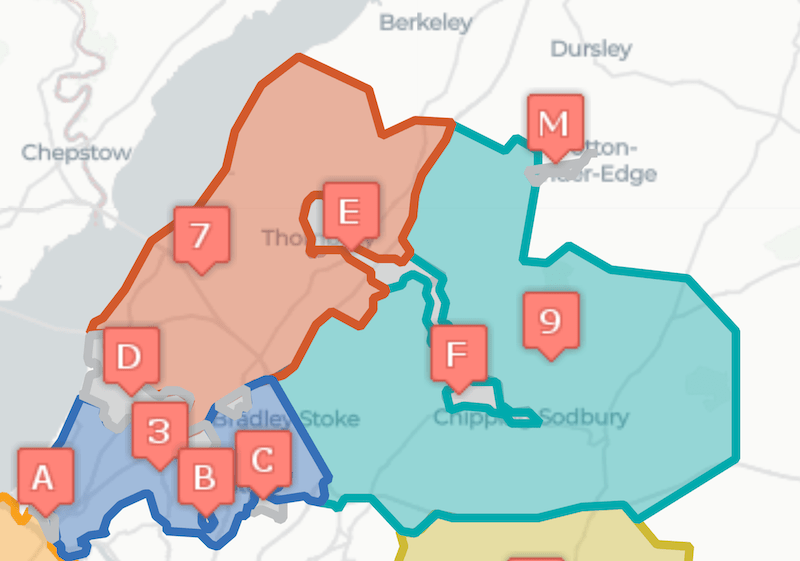
… with a paucity of detail.

From previous experience when I’d travelled from Bristol Parkway to Avonmouth I knew both Parkway station and Pilning were in the same ‘Thornbury Rural’ zone as that lists Bristol Parkway as an ‘outside the zone’ destination/origin passengers can use.
It was easy on the Friday morning before I travelled to use the app and type in Bristol Parkway as my origin and Pilning Station Road as my destination and specify an arrival time of 15:15 on Saturday afternoon, giving plenty of time for the 15:32 GWR departure.

The booking was confirmed…

… and I received a text advising a 20 minute window for the pick up between such precise times of 14:39 and 14:59 albeit using a rather peculiar version of the 12 hour clock – which I have no idea why Via persists with.
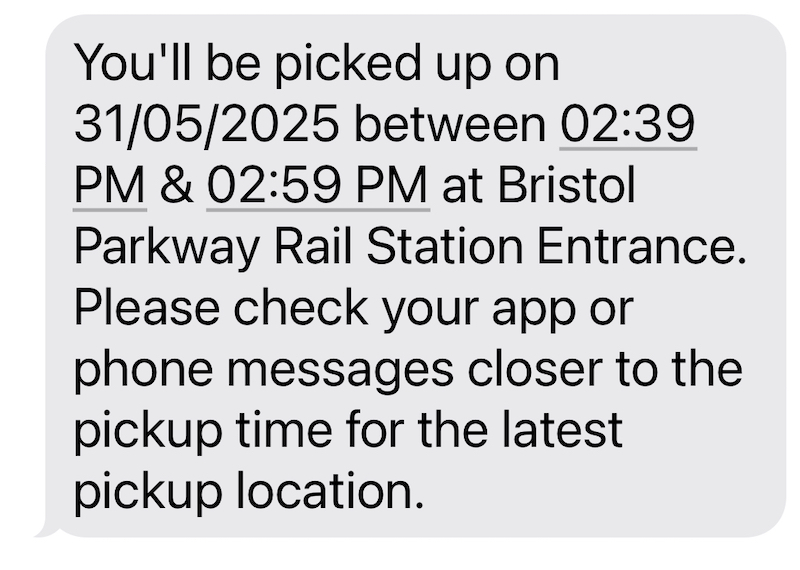
I guess the precision timing was because the software assessed the journey time at 16 minutes (Google maps gives 15 minutes).
GWR runs an hourly service from Paddington to Bristol Parkway on Saturdays so an arrival at 14:04 suited me fine giving plenty of time for any delays to make the connection and I relaxed as we headed on schedule westwards through Reading, Didcot Parkway and Swindon.
And then after we’d left Swindon a text came through at 13:49 from WESTlink advising “you’ll be picked up in 30 minutes” which was a surprise as that would make it 14:19, 20 minutes before the earlier time I was originally given. I was pleased to be on the train with a 14:04 arrival.

But then, as you can see above, a further text came through eight minutes later at 13:57 advising “you’ll be picked up in 5 minutes”. Yikes that’s 14:02 – two minutes before my train arrival, all the more so as we were approaching Bristol Parkway by then and an inevitable unexpected early deceleration and I guessed we’d be arriving slightly late.
The app was showing me the minibus close to the station…

… so I gave WESTlink’s Contact Us number a ring which thankfully was staffed on a Saturday afternoon (very few are) and explained I was still on the train and please ask the driver to wait for me, as well as enquiring why the pick up time had advanced so much and at such short notice.
The person answering explained the pick up time would still be 14:39 but the message was just telling me the minibus was in the area and would be arriving within the time given.
I did point out that’s not what the text says – it would be better to say “hello, your minibus is arriving in good time at Bristol Parkway any time soon so we’ll be ready and waiting for you at 14:39.”

In the event there was no sign of the minibus until 14:16 when I saw a white Ford eight seater with a small green sticker on the offside and rear and guessed that’s my pick up even though it’s very different from the images displayed on the website.

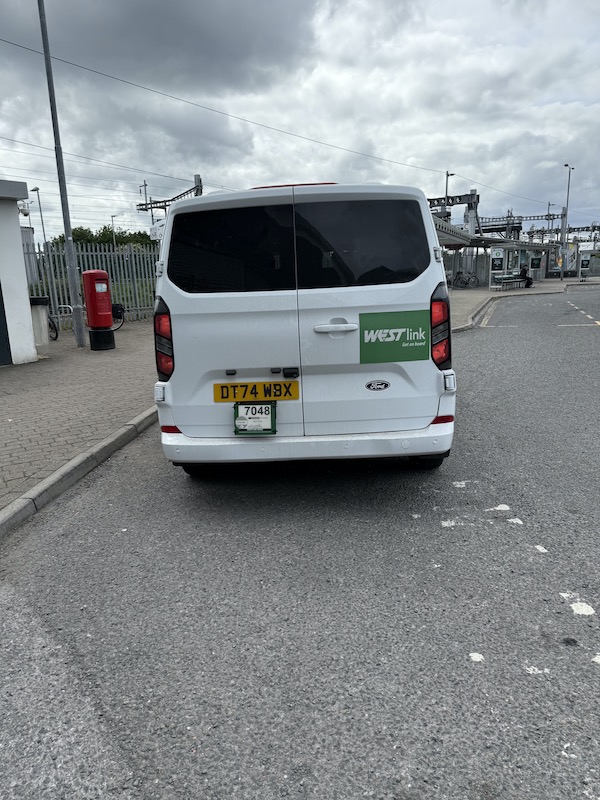
I made myself know to the driver and said it was fine by me for us to depart straight away, so we did and aside from the driver missing the right hand turn at Station Road as we approached Pilning, necessitating a diversion through the village and back out again, it was an uneventful journey taking 22 minutes.

In the event it meant a more convenient drop off by the ramp that leads towards Pilning station after which the driver headed off for a break as he’d dropped me more than half an hour earlier than orignally planned, which suited me fine, giving more time to explore Pilning station and the ‘Waste Removal and Landscaping’ business.
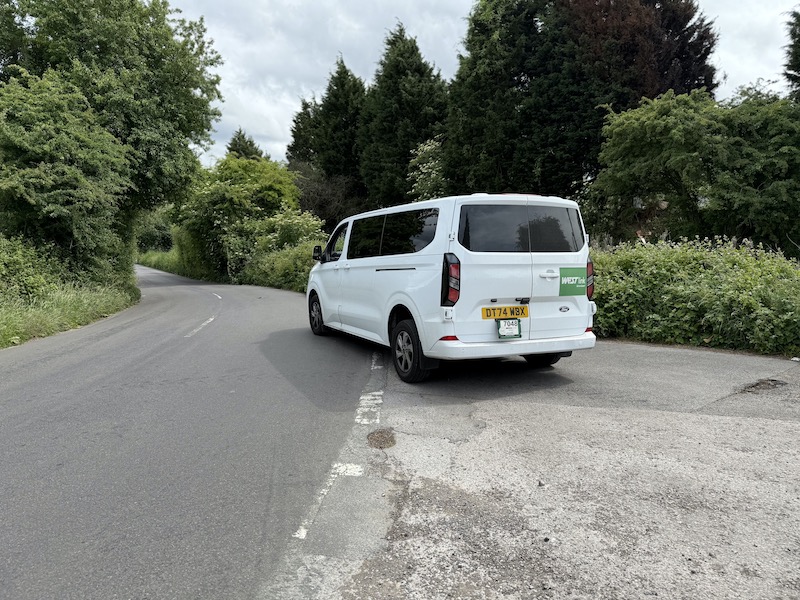
It proved to be yet another sole occupancy DRT travel experience for me, and another example of a bus and driver spending time and covering mileage with no-one on board at the beginning and end of my booking.
Many of the schemes established under the DfT’s Rural Mobility Fund (RMF) have either ceased or continue with BSIP funding. The DfT has never published a follow up report to its Rural Mobility Fund Evaluation Report published in September 2023. Readers may recall this highlighted such gems as the ‘average passengers per revenue hour’ in one case (Central Essex and South Braintree) as low as 0.14 – the best being Swaffham, Norfolk with 1.77 (thanks to peak journeys for scholars) as well as statistics showing some buses spent more time carrying no passengers than passengers. It would be fascinating to see a follow up report now the £20 million allocated to the RMF has all been spent.

Finally, I see another DRT scheme bites the dust at the end of next month when the Stagecoach Connect branded scheme between Aylesham and Whitfield in Kent (north of Dover), introduced in February 2023 with Developer funding for three years is being replaced by the return of a fixed timetable route 92. No surprises there, just another to add to the long list of DRT failures.
Roger French
Blogging timetable: 06:00 TThS
 BusAndTrainUser
As an operator of DRT’s 12 passengers a day is the maximum feasible when the service is basically a new invention, with some as low as 4/5 passengers a day. The best where a previous regular service has been replaced is about 24 passengers a day, although to achieve that the vehicle requirement doubled from 2 to 4.
As neither the Dft or any authority has ever defined what success is, and the Dft seems to be able to get away with spending a mere £20m without any scrutiny, I suppose these DRT’s will drift on until the inevitable financial crisis brought on by Rachel from accounts’ policies causes significant cuts in bus support.
The current steer to LA’s from the Dft is that they will get similar funding to their 2025/6 settlement for the next three years. This stability and certainty is welcome but I fear it means that most LA’s will sit back and let the network bumble on without any clear idea of what they are trying to achieve.
LikeLiked by 1 person
“Politicians in charge of transport planning”. Further comment superfluous.
Terence Uden
LikeLike
More like politicians being taken in by a bunch of profiteering consultants and techie types.
LikeLike
Agreed, but if Politicians had the slightest clue about planning efficient bus services, they wouldn’t get taken in by GenZ “whizz kids”
LikeLiked by 1 person
It’s not really the politicians that do the actual planning, although they may specify the requirements. Professional transport planners work within the constraints and the funding they have been given. I’m glad I’ve not (yet) had to implement one of these hopeless DRT schemes (although I’d love to have a go at the more effective model along the lines of Lincolnshire Connect or Compass Bus 99 where there are fixed points and times). Surely the emperor’s new clothes have been well and truly rumbled by now? But like another commenter says, if you don’t define success you can’t measure it. Surely passengers per vehicle hour measures success in social terms and cost per passenger measures success financially, and both are clearly abject failures when compared with scheduled local bus, even once-weekly market day routes.
Stephen H
LikeLike
it’s all so sad, because what in theory could have been the saviour of car-free rural / suburban mobility has in practice just not worked
LikeLike
Providing car free transport where there is low population density is best provided by a well regulated taxi service with digital hailing and regulations to focus on timekeeping for advanced booking. Including encouraging operators to base themselves to provide good coverage away from main population centres. Focus on reliability and availability and then publicise that taxi (plus bike/walking) can be similar in cost overall to owning/insuring/fueling a vehicle.
Provide a number of discounted journeys per month on a means tested basis to address social needs that would otherwise be covered by a bus.
The development of autonomous taxis will make the model even more viable
MilesT
LikeLike
if the cost was about the same, why would anyone who can drive use such a service instead of owning their own car?
Chris B
LikeLike
The service has to be provided when required and cost has to be much less to encourage those who only need / use a car for short local trips e.g. shopping, doctors, hospital to give it up. The fixed costs of insurance, VED, MOT, basic service for 2000 miles/year are significant then there is the capital cost. The running cost at say 20p/mile is a minor proportion.
If the charge was say 75p/mile not standard taxi rates would that reduce car ownership?
LikeLike
I’m not sure how the moving of the agreed time conforms to the registration rules for a flexible bus service.
My understanding is once a time has been agreed then that is locked in. Compliance of the operator is judged on that time.
LikeLike
People want public transport to be easy to use and to be reliable. In practice these DRT schemes seem to fail miserably on both fronts. How many people are going to even try and persevere with a booking system like that?! But full marks to you for undertaking a visit to Pilning to sample one of its two trains a week (both in the same direction since the footbridge to the westbound platform was controversially demolished in 2016). Ironically it gets a better service during engineering works, when replacement minibuses replace trains, because the minibuses are timetabled to carry passengers in both directions. So you were lucky being able to go direct from Parkway to Pilning at all – normally you’d have had to go first to Temple Meads, get a train to Severn Tunnel Junction (whizzing straight past Pilning en route), change there again and get another train back through the tunnel to Pilning – where you’d be stuck until the following Saturday! There’s a local campaign for services to be improved there – for details, historical info etc, see http://www.pilningstation.uk . Graham L.
LikeLike
Your report just reflects how much governments waste tax payers money. As others have already suggested, politicians shouldn’t be involved in planning transport systems. We only have to look at the losses incurred by London’s buses under the aegis of the mayor & it’ll be interesting to learn whether Manchester’s Bee Line & other franchised systems cover their costs, yet alone turn a profit. As for DRT, you’ve proved the concept isn’t financially viable. Hopefully, your comments are not only noted but acted upon by those that can or are willing to provide better solutions.
LikeLike
There is no particular reason that public transport should be profitable except that society has decided it doesn’t value it and so we want to run it as cheap as possible (so a nimble commercial based operation is best) rather than subsidising it to provide non-commercial factors (frequency, price or breadth of network where government involvement at some level is justified to direct the higher funding to where they want it). London isn’t really intended to turn a profit but some of the historic gold plating to the offer can be criticised, Manchester has so far been more restrained in what it is paying for initially. At the moment there is a chance Manchester can end up with something that may be close to break even (once you include the streams that commercial operators get now like BSOG and once you have paid the set up costs) but it looks like they are more interested in improving the network and that brings cost that may make that harder to achieve.
DRT will never be, and should never be expected to be, profitable or commercial (profitable needs a taxi) but it can be effective if properly designed and targeted as long as you accept it will be subsidised. Call Connect in Lincolnshire has been running for decades and can be considered a success and the Fox Connect in Leicestershire seems one of the stronger ones (just need to see if there is long term funding and how patchy the success is, there are some busy ones and some pretty quiet ones some of which are run by taxis) of the new generation.
Dwarfer
LikeLike
The need for public money will inevitably involve politicians. What other alternatives for oversight are there?
KCC
LikeLike
As we know, DRT normally aims to fill in the gaps in public transport provision where the operation of scheduled services isn’t a sensible option.
I’m reminded of the media comments about vehicles running around empty, the reporters seemingly failing to note that vehicles run empty to pick up their next passengers, who, in rural areas, are very unlikely to be where previous passenger have been dropped off.
In general, I applaud such initiatives because at least someone is giving it a go. The people who rely on DRT also generally welcome the service – and of course they would. But whether a taxi alternative would offer better value for money, or is a suitable alternative to a low-floor minibus, is clearly then part of the ongoing discussion about future operation.
LikeLike
I am still confused with London. At one time the bus profits subsidised the tube’s losses. It looks like a more dense bus network with increases in costs driven by 20mph roads , NHI increases on staff costs to name but two. I think for London bus services need , like Great British Railways , should come under full public enterprise control with more efficiency of running longer routes from multiple garages for example, plus taking the 6percent or so operator profit back to London surplus finds
JBC Prestatyn
LikeLike
Take more water with it JBC – that will help your confusion.
London’s bus patronage is falling and has been since 2013/4. It’s being propped up by £1bn a year. The 6% profit is peanuts in the scheme of things and then you’d have more political control.
Running longer routes from multiple garages…. Longer routes can’t be managed because of the level of congestion, 20 mph zones, and/or the removal of road space for cycles instead.
Oh, and costs for bus operation have climbed far more than the general rate of inflation whilst bus fares are still discounted.
LikeLiked by 1 person
“Waste Removal and Lanscapping” appears to have shifted a d and upended it to being a p elsewhere
LikeLike
I’m surprised that a former Chief Executive of a privatised bus company has an issue with public subsidy.
When I worked at the DfT in the early 2000s, private sector bus operators outside of London were receiving £500 million a year in subsidy.
It certainly puts the costs of DRT into perspective.
LikeLike
Now divide that by the number of passengers travelling and the figure will be tiny compared to some of the DRT per passenger subsidies (it will probably be something like 12p per trip). Not many on here will have an issue with government supporting bus services but there isn’t enough money in total that we can be relaxed about how much is being spent on what. £50 per passenger, it would be cheaper to just book an ordinary taxi for those passengers than spend all that on a more expensive minibus to spend much of the day parked up doing nothing. Roger is often quite complementary about government funded improvements where they are a decent option or proposal.
Dwarfer
LikeLiked by 1 person
I suspect that a large portion of the £500m figure includes reimbursement of concessionary fares. That’s not a subsidy to bus operators, it is a subsidy to bus passengers. Bus operators are supposed to be no better, no worse off, though the general consensus is that it has reduced operators’ income, and it certainly has had an impact on cash flows.
KCC
LikeLike
I dont think so , would have to check the Stats. But Subsidy is that , whole excess funds to pay for unremunerative journeys inc any DRT at the time.
Concessionary Fares reimbursements would be separate to the subsidy amount
JBC Prestatyn
LikeLike
Thanks for the good news about the Aylesham service. Cheered up a pretty grim day.
Jeff/
LikeLike
Don’t understand the uncertainty about the pickup vehicle at BP, as the operator had given the registration number throughout. Are you able to meet the eyesight requirements for a driving licence, Roger?
LikeLike
I was under the impression that all the Rural Mobility Fund demand responsive schemes were still operating. Which ones have ceased?
LikeLike