
Sunday 24th August 2025
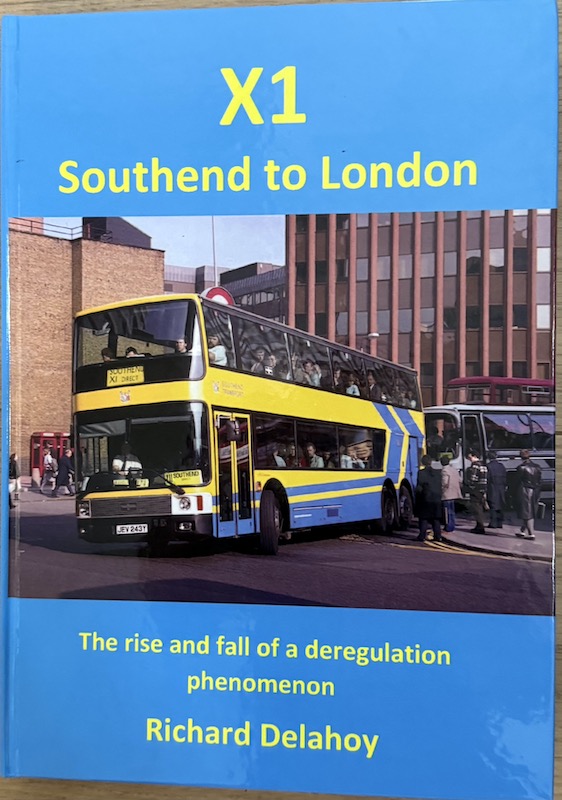
Richard Delahoy has kindly sent me a copy of his recently published book about the famous route X1 which plied between Southend and London in the 1980s. It’s sub-title ‘The rise and fall of a deregulated phenomenon’ neatly encapsulates the book’s substantial content.
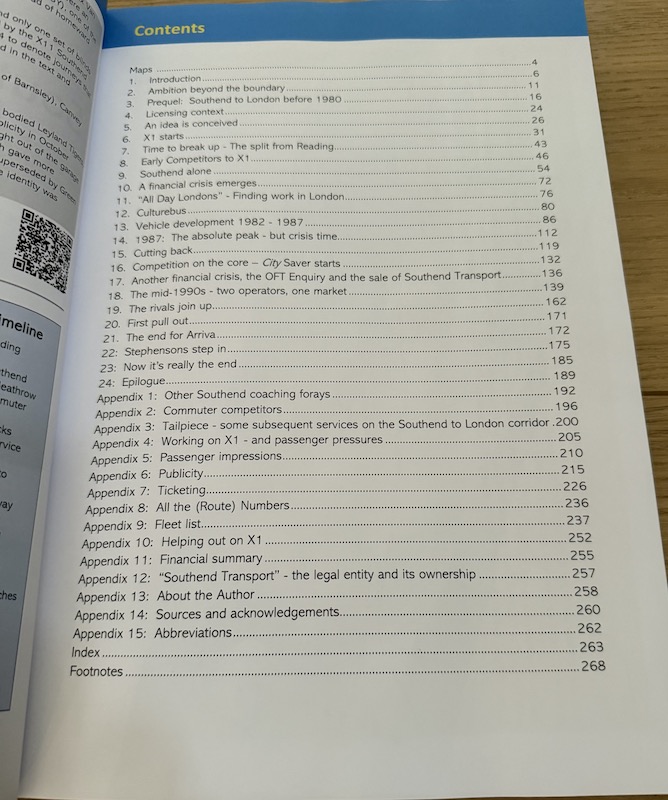
Richard has not only put together a truly fascinating account of this remarkable service, which began on express coach deregulation day on 6th October 1980, but across what is an incredible 284 page volume, covers every conceivable detail about the route including 15 appendices and 200 footnotes with explanatory supplementary text.

The book is also packed full of photographs (254 in all) and countless images of faretables, timetables, publicity, maps, and tickets from Richard’s extensive collection of everything connected with the service.
If ever Richard fancies a go on Mastermind there’s no doubt he’d smash it by choosing The History of Route X1 as his specialist subject. It is absolutely incredible how he has been able to capture every facet of this intriguing story.
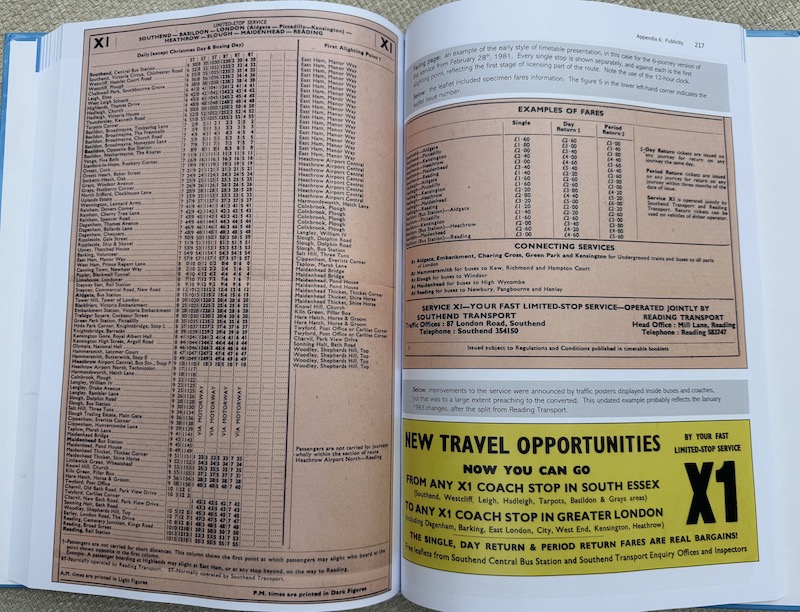
And I hasten to add it’s definitely not the case this book is only for ‘X1 aficionados’. Richard’s very readable and engaging account shows how the story is full of intrigue and surprise at how things developed. Early experience in the first couple of years had the new route written off as a complete failure yet within three years it’s expansion in response to growing demand was so rapid it was almost out of control and threatened to bring the whole company down. Richard observes the words of ‘Mr X1 himself’, the late Derek Giles, “I’ve created this monster that I can’t control”.
Indeed, the book is appropriately dedicated to Derek Giles, Southend Transport’s revered Traffic Superintendent, and rightly so. As Richard observes “without him there would have been no X1 story to tell”.
It’s taken Richard seven years to put this book together. I’m not surprised when you see the contents.
As well as interviews with many of the key people involved, Richard gives an explanatory background to the pre 1980 aspirations of Southend Transport as well as what happened between 2002, after the company pulled out of the service, and 2016 when others who had tried having a go and finally threw in the towel.

The X1 story begins with Derek Giles’s long held view there was a market to be had for carrying passengers between Southend and London, particularly to Heathrow Airport. The 1980 deregulation of journeys over 30 miles was the impetus for him to persuade the company to start such a service.
A similar interest from Derek’s friend and colleague, Mike Russell, over at Reading Transport led to the service initially being jointly operated with through journeys running between Southend and Reading and a journey time getting on for four hours.

But thanks to traffic delays along the route as well as differences over fares policies and a lack of passengers, it wasn’t a success. Within two years both companies agreed to develop their own separate services with Reading’s Goldline branded route running as far east as Aldgate and Southend’s X1 reaching the coveted Heathrow Airport.
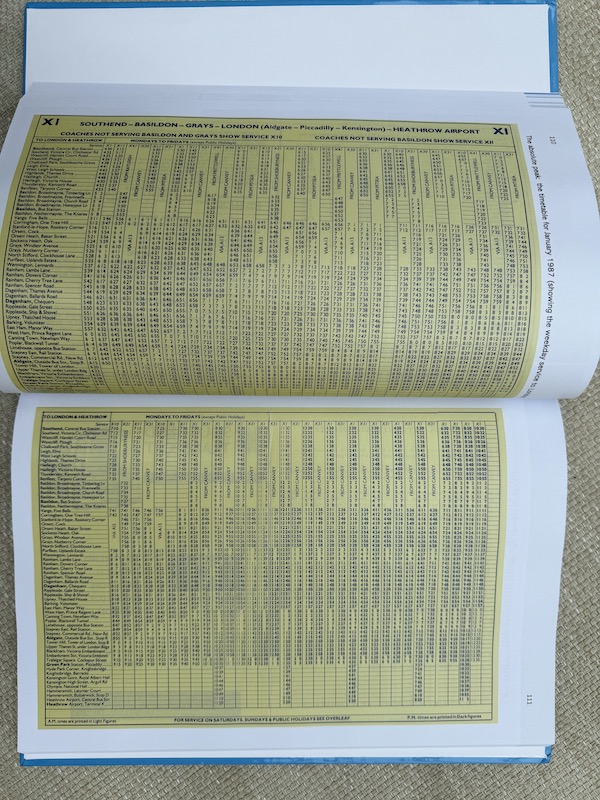
It was the rail strikes of 1982/83 which transformed route X1 into Britain’s most frequent express route as the company strove to meet the burgeoning demand from dissatisfied rail commuters fed up with the alternative provided by what had become dubbed ‘The Misery Line’ into Fenchurch Street. More and more buses were added to the peak vehicle requirement to meet the unceasing growing demand such that whereas the route began with Southend providing four vehicles (and Reading had four) on eight daily journeys in 1980, by January 1987 Southend was turning out 56 coaches on 67 journeys. It was overwhelming the company’s resources.
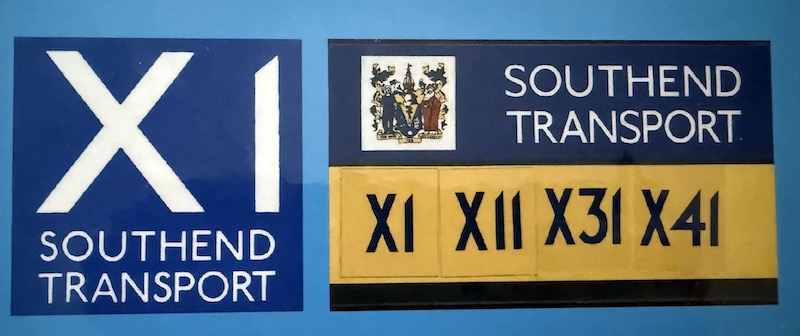
The finances of all those vehicles simply didn’t stack up with so much of the market being peak based and little for the coaches to do during the day. Richard describes the scene at Aldgate bus station on a typical afternoon in February 1987 between 16:30 and 18:15 when 29 blue and yellow coaches could be seen picking up commuters every five minutes on a variety of designated route variations using numbers X10, X11, X21, X39, X31 and X41 in addition to the original X1.

It couldn’t last, and the service began a slow but inevitable decline from that 1987 peak not least when serious competition from Thamesway’s City Saver service began in 1992. Eventually the two rivals came together to run a joint service which was branded under the Green Line banner using route numbers in the familiar 7xx series.

But improvements to the rail service and worsening traffic congestion saw passenger numbers decline further with First (Thamesway’s owners) pulling out in 2001 followed by Arriva (by then, owners of Southend Transport) in 2002. Stephensons had a go with a limited replacement until 2008 followed by Swallow Coaches, Snowdrop Travel and finally Drive With Neo all of which is chronicled in Richard’s narrative and appendices.
It’s a story offering huge lessons which are still applicable today particularly with Bus Service Improvement Funded new bus routes taking to the road in many parts of the country. There are also parallels with the London Oxford situation where Oxford Bus withdrew from the heavily ‘bussed’ corridor in January 2020, albeit the significant market for travel from London to Oxford as well as large numbers of students helps sustain an attractive off-peak service in a way that just just wasn’t the case for Southend.
The book explains the how and why after a difficult start, an exciting new bus service rose to dizzying heights before falling and completely failing. Richard has sought to offer an honest, objective and at times critical assessment of the decisions that saw the service expand to those unsustainable heights and almost bankrupt the undertaking.
It’s well worth a read.
The book costs just £30 offering excellent value for the enormous and comprehensive coverage of the subject matter. Richard has self published it and copies can be obtained directly from him from this website for £35, including postage and packing. You won’t be disappointed.
Roger French
Summer blogging timetable: 06:00 TThSSu


It is curious that the Government pick certain mileages “off the wall” for various purposes. In the case of the X1 and other coach routes, 30 miles became the rule. Under the Transport Act of 1947: 40 miles was the rule for goods traffic carried by road, so British Road Services was formed to nationalise long distance road haulage. Corgi sold sheets of stickers one could decorate one’s models with and for lorries one could decorate the windscreen with both tax discs and discs for “A” “B” or “C” haulage licences. Use of trucks was heavily controlled. The Transport Act 1953 restricted London Transport to a 40 mile radius for private hires (except for staff outings) rather than 100 miles hitherto. I believe in any case LT were so short of their own vehicles that subcontracting private hires was commonplace. [Best example, RLST ran using open top buses from the EKRCC!] AND did not the EU restrict bus services to some maximum mileage with companies getting round this by changing route numbers once or twice during a long journey! “Stay on the bus, connections guaranteed” being printed in timetables.
As to railway strikes: I worked for Thomas Cook & Son Ltd and when there were rail strikes TC&S ran a network of private coaches to get staff into London. Head office at Berkeley Street (where I was based) had an enormous establishment. There were 15 routes in all. I lived in Hersham so if the TC&S coach was running (Route E), I needed to be in Esher at the cinema for a 0715 start for Grosvenor Square, 1730 to go home.
LikeLike
A story that certainly needed writing as memories fade as to the exact sequence of events. Some years after his retirement, I once mentioned to Derek (by the way we all spell his name incorrectly, as typically it was not the normal version and the “S” stood for “Selby”) that he must miss having a direct coach from his Westcliff doorstep to London.
“Good heavens no, I always used the train”
Terence Uden
LikeLiked by 1 person
The Reading to London end of the route also ended being very successful as well, with both Reading Transport and Alder Valley running hourly services into London for many years, albeit with much less peaking (which with hindsight was a good thing financially). I spent three years of my life commuting on the Alder Valley X2/X3/X23 and it was generally a pretty reliable service. I did have the advantage of working 50 yards from Stop Q in Grosvenor Gardens which made it very convienient.
LikeLiked by 1 person
When I worked in Salisbury one of my managers (now sadly deceased) who used to live in this area used the Alder Valley service to commute to her then work in London Monday to Friday. She ended up marrying one of her regular drivers! He later got a job with Wilts & Dorset.
LikeLike
Rail Strikes, and Postal Strikes also saw the rise of a mulitude of parcels carriers in the UK at around the same time – particulary for Newspaper traffic ( when Today / News International were being blacked by Unionised carriers ). Eventually that didnt last or end well either.
Southend London really failed – like much of the Green Line services as Rail became more reliable with faster electric services. Yet the underlying demand probably exists – The Elizabeth Line should have been built as a four track service , with the Reading Chord to / from Heathrow – with full through Southend services fast and semi-fast all the way through.
Meanwhile the Eastern National London services had been reduced with London Traffic Congestion as Kings Cross gave way to Walthamstow as the terminal point to bolt into the Victoria Line.
JBC Prestatyn
LikeLike
Many thanks Roger for such a fabulous review! And in reply to Terence U, I chose to use the common spelling of Derek (Giles) name in the book but as explained in footnote 4, it was correctly Derrick. I first found that out through the Companies House filing of him as a director of the arms-length company in 1986.
Richard Delahoy
LikeLike
An obvious. but never done , service would have been Alder Valley / Eastern National running via Oxford Street in London and Holborn to Aldgate and beyond, this would be just north of NBC HQ at New Street Square (and not really that far away from the BET HQ and One Time Tillings HQ too )
LikeLike
I am in the middle of reading this excellent book. Super nostalgic given I grew up in Southend and used the X1 several times in the 80s. I recall duplication on the 8.30am ex Central Bus Station and the conductor who worked on several vehicles, finally alighting somewhere near Purfleet.
Back in 1986 I bought Richard Delahoy’s history of Southend Corporation Transport, and still have it!
LikeLike
If there had been a couple of early morning Barking – Corringham services that might have been handy for me in the late 1980s
JBC Prestatyn
LikeLike
How great that this has been captured and, by Roger’s account, done so well. When I think of coach deregulation and the innovation I imagine it was designed to stimulate, it has to be best exemplified by the X1, plus perhaps British Coachways. I was only 15 in 1980 but remember both well, including, once the service had grown to its full extent, spending an evening peak standing on the A13 near Barking watching the coaches full of returning commuters and those amazing Astromegas (plus quite a lot of very bog standard coaches as well, it has to be said!).
LikeLike
Richard’s book is a masterly account of the entrepreneurial spirit that bus deregulation in 1986 unleashed, and well worth a read at a very reasonable price. Despite its eventual financial failure it shows that you need alternatives in place when the state owned monopoly rail provider failed to provide an adequate service. The line was dubbed the misery line for many years and no doubt there was the demand for an improved coach service 20 years before 1986 but the dead hand of Road Service Licensing prevented a competitor taking action.
Sadly we are heading the same way with the spread of franchising which is likely to come at considerable cost and the railway system which is declining in reliability, and drowning in its own inefficiency and requiring more and more subsidy from the taxpayer. 18 months into their Government nothing concrete has happened to improve the railways, and I worry that the final complete Nationalisation of the two currently excellent railways in the area, C2C and Greater Anglia will lead to the loss of talented managers and a decline to reliability levels seen elsewhere on Great British Railways.
The omens are not good.
LikeLike
Fortunately, coach services were deregulated in 1980, six years before local buses.
LikeLike
I have a feeling that at one stage, the peak vehicle requirement for the X1 and it’s variants was higher than the number of buses required for Southend Transport’s local bus network.
I am looking forward to reading the book, I have it on order.
Malc M
LikeLike
I have fond memories of the X1, I used to use it a lot. I remember one particular trip that I made in 1982. I travelled to Ongar on the Central Line and then travelled to Southend on Eastern National buses, changing at Chelmsford. I then rode the X1 to Heathrow on a Reading Transport Metrobus followed by a trip home to Harrow on the 140 which was still operated with Routemasters at that time. Another much missed route from that era was the joint Green Line/United Counties service 760 from Heathrow to Northampton via everywhere!
LikeLiked by 1 person
The most intensive service was probably the Eastern National Southend to Wood Green Service
LikeLike
Depends if you mean peak or off peak.
Off peak I think you are correct the 151/251 was the most intensive non-Green Line service into London (IIRC it was every ten minutes between the two routes at one point).
I think Watford to London would have been the most intensive Green Line run, with the 706/707, 708 and 719 all operating half hourly although the 719 took a different route for much of the way.
Peak Hours, its defintely the X1 group, and I don’t think that would change even if you included Green Line routes since non of them peaked to anything like the same extent.
LikeLike
Its a very interesting era of bus history how quite a number of these London destination services popped up.
Even here in Brum West Midlands Travel Limited launched one jointly with London Coaches then part of London Regional Transport between the two cities.
Ironically it was in direct competition with National Express before WMT reversed into NatEx.
It departed from the old WMT Travelshop on Colmore Row & marketed itself quite sucessfully as the “quality ” rival to British Rail & National Express Rapide
Bizarrely it eventually ended up with Diamond Bus then The Birmingham Coach Company until they became a National Express contractor.
Looking back it’s now surprising how many X1 type services popped up after coach deregulation.
LikeLike
his review makes the book sound like a treasure for anyone interested in transport history.
LikeLike