
Tuesday 19th August 2025
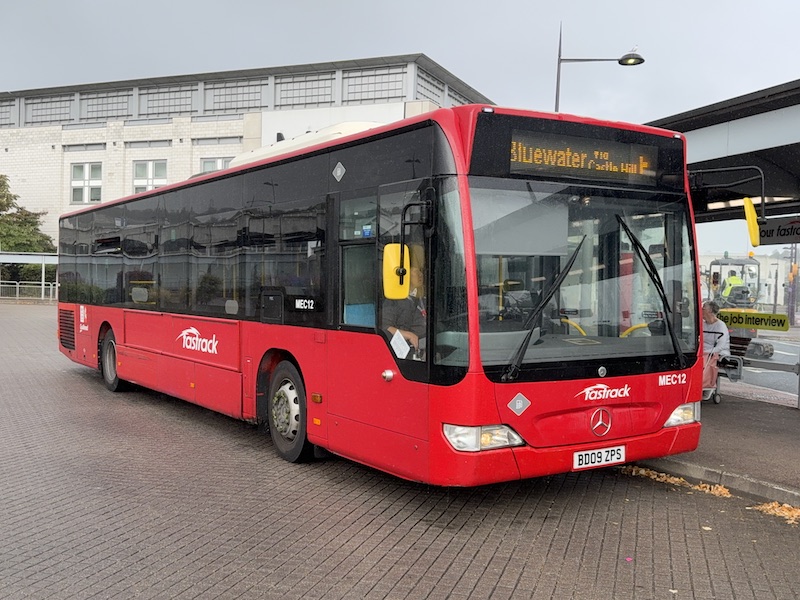
Kent’s Thameside Fastrack quietly expanded at the weekend with the opening of a new section of bus only road extending westwards from the new Whitecliife development by Castle Hill to the Bluewater Retail Park.
It’s definitely a case of getting buses installed before residents move in.
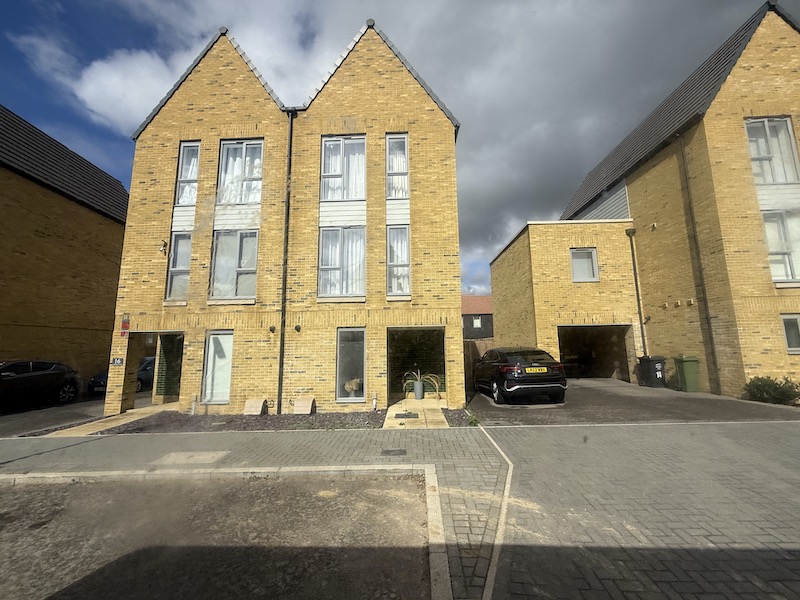
Other than a few houses already occupied in Longhoughton Road at the western end of the newly extended route…
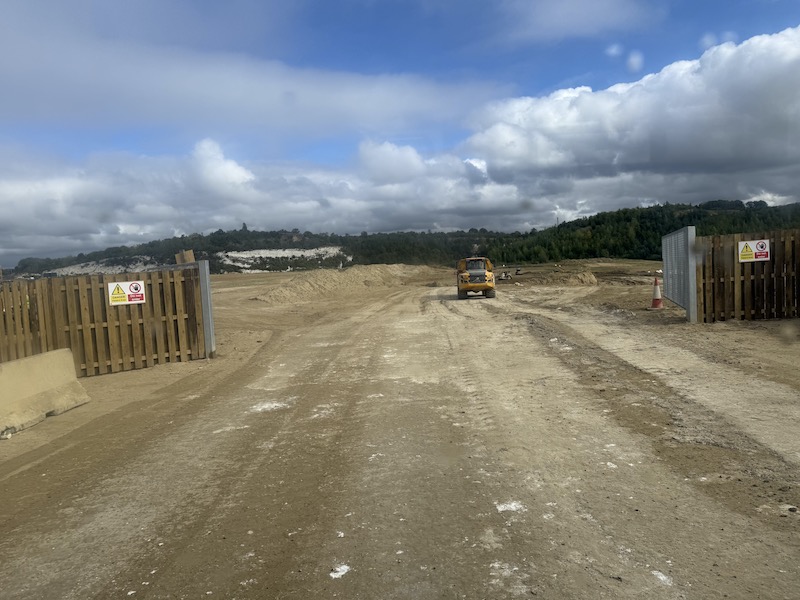
… the area through which the new bus lane passes is currently dominated by ‘heavy plant crossing’…
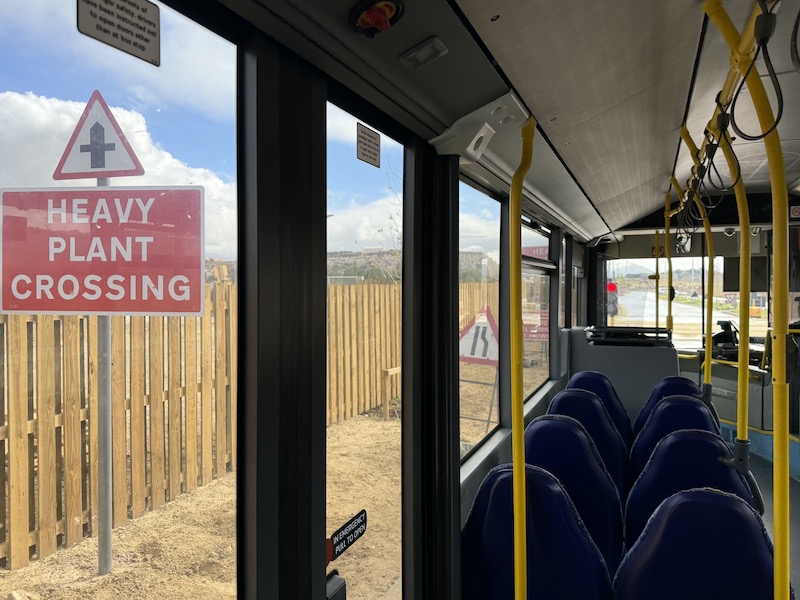
… protected by temporary traffic lights and not a lot else.
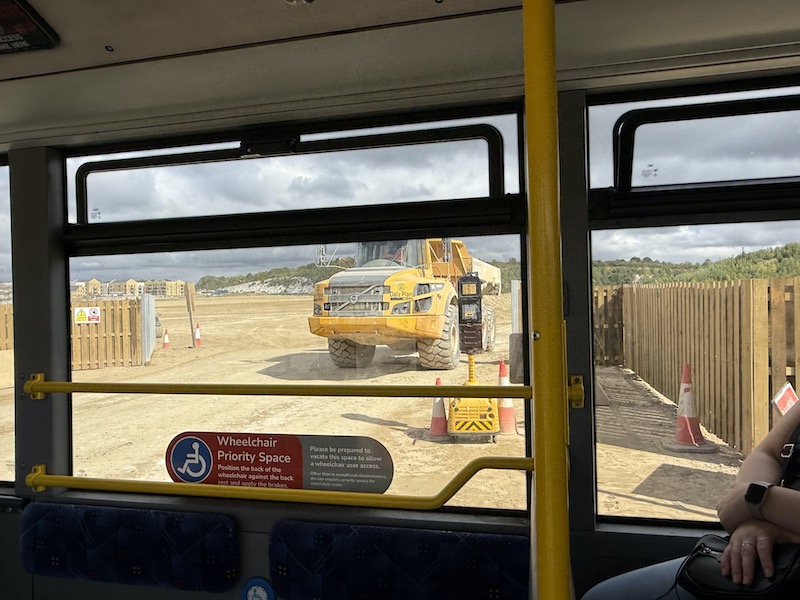
Just huge machines crossing the bus lane in a couple of places.

The area is so new to buses Ordnance Survey would have you believe the bus currently passes through a lake in the former quarry.
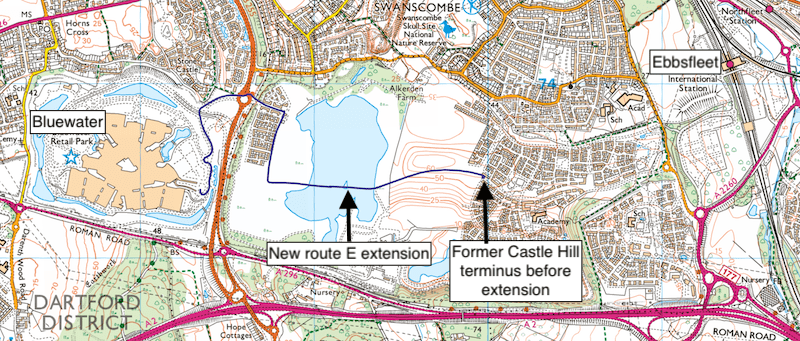
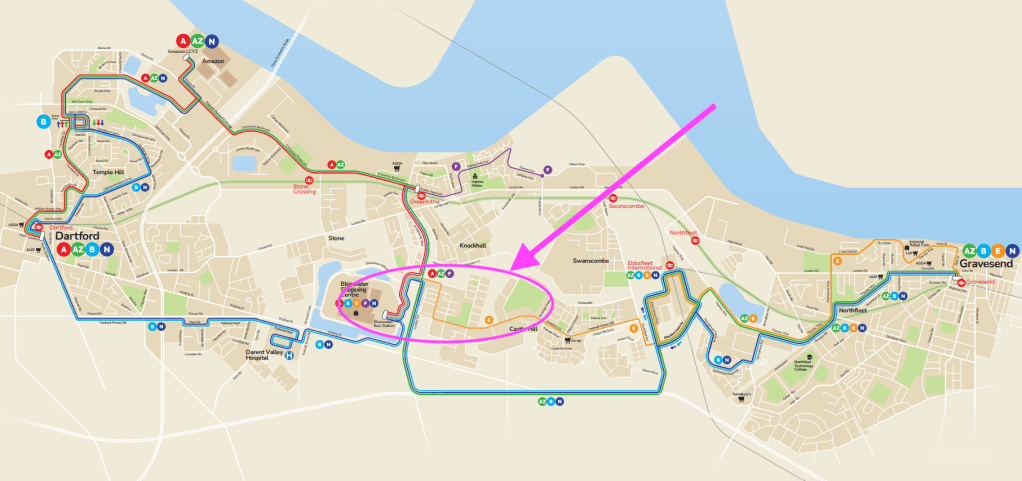
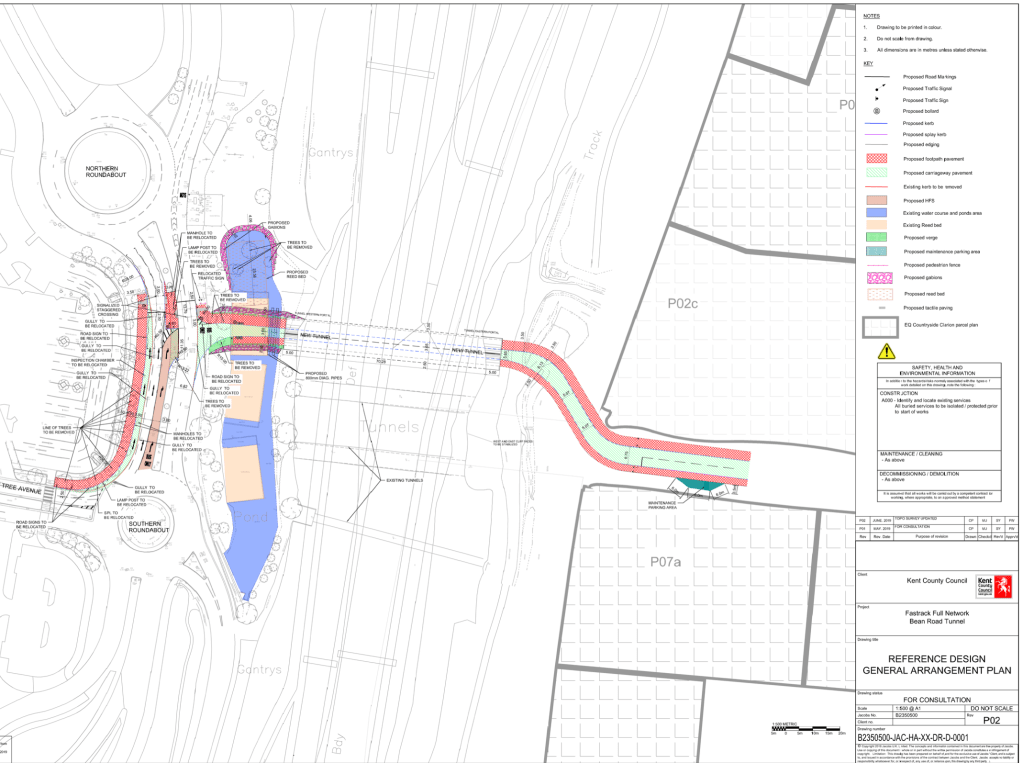
But part of this newly extended route is only a temporary arrangement. Updated plans were approved by Kent County Council in March for the busway to use an old tunnel under the B255 (the orange north/south road on the above map) which will make for a more direct route and avoid buses having to head north to the roundabout and then come back south again, as can be seen in the above map.
I wrote about this ambitious 80 metre tunnel originally costing £13 million (and backed by the Ebbsfleet Garden City Development Corporation) in November 2020. It was granted planning permission in June 2020 but this expired in June 2023 without any work taking place.
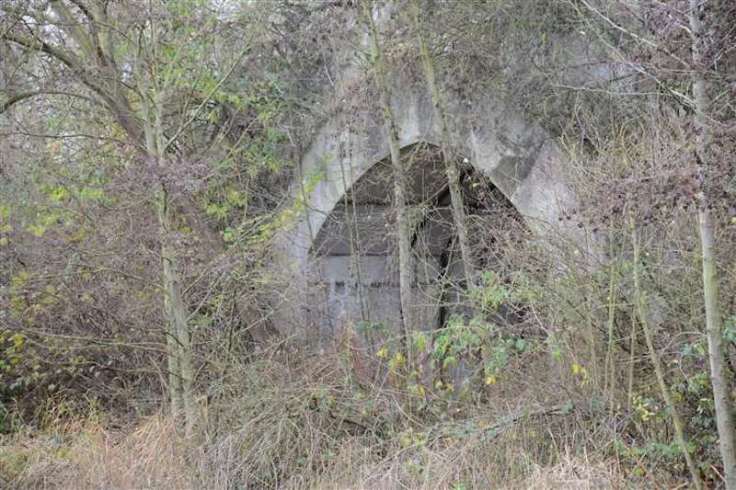
The disused tunnel originally linked two quarries and obviously needs a considerable amount of work to make it suitable for buses, cycles and pedestrians, now estimated to have doubled in cost to £25.5 million. It comprises a 3.5 metre wide single Fastrack busway (controlled by lights) and a shared use footway and cycleway. I understand construction work is due to begin early next year with completion by 2027 with additional funding coming from Kent’s Bus Service Improvement Plan.
Go-Coach began route C2 from Gravesend to the new Whitecliffe, Castle Hill residential area initially on a four month contract in July 2024, with Go-Ahead taking it over in November, when it was also re-lettered to E. Here’s the Go-Coach bus at the temporary terminus in the route’s first week at what was then the western end of the bus only road through Castle Hill…
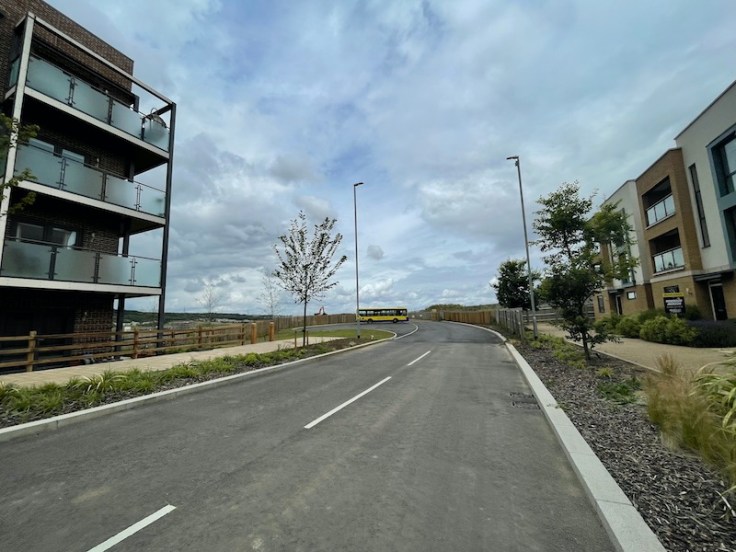
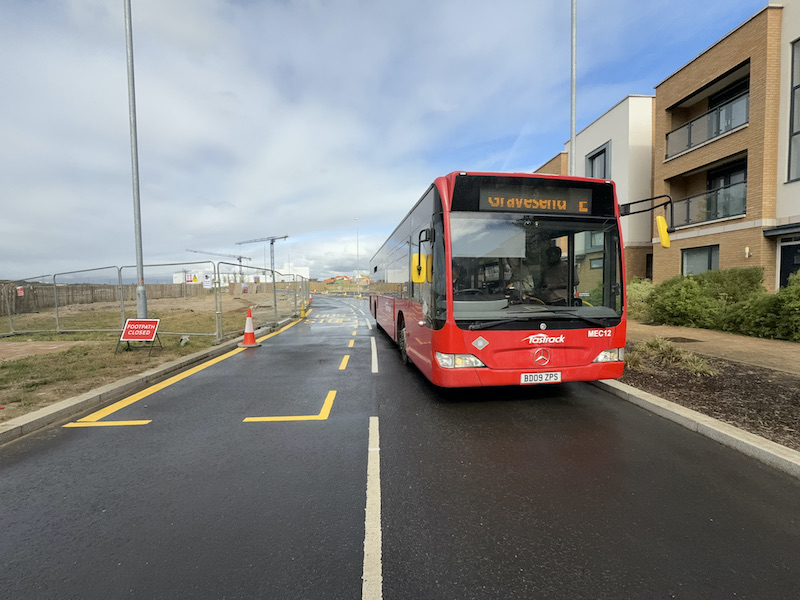
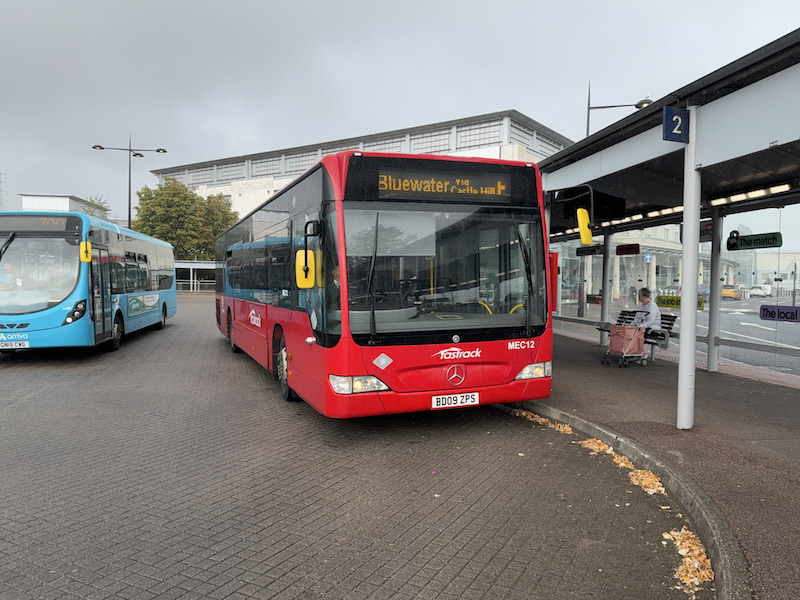
… and fast forward to this week and the photograph below captures the point where route E now continues westwards at the same point on the extended bus only road you can see behind the bus heading to Gravesend.
Route E’s timetable continues to run half hourly to Bluewater, as it did before, with the first bus leaving there at 05:12 and the timetable continuing until 00:38 at Gravesend, the eastern end of the route.
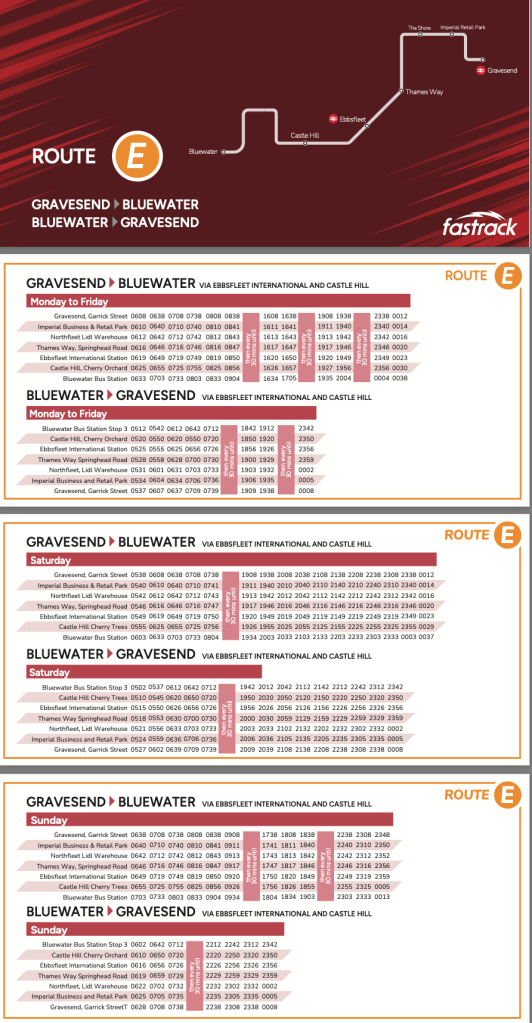
Go-Ahead are now using three buses on the service, which provides for generous layover times, especially at Gravesend. End to end journey time is 26/27 minutes so each bus has 37 minutes stand time in the 90 minute cycle.
It’s a shame the new ie-Tram buses aren’t yet available for route E (nor routes B and F – they continue to only be deployed on route A) as this would have seen the newly extended route with new buses to suit.
It’s great to see there’s a new timetable booklet available from a number of outlets and I understand is also being distributed among the communities in the area. I didn’t see one to pick up on the bus when I had a ride yesterday morning, but I’m sure they’re out there. A copy is also available online here.
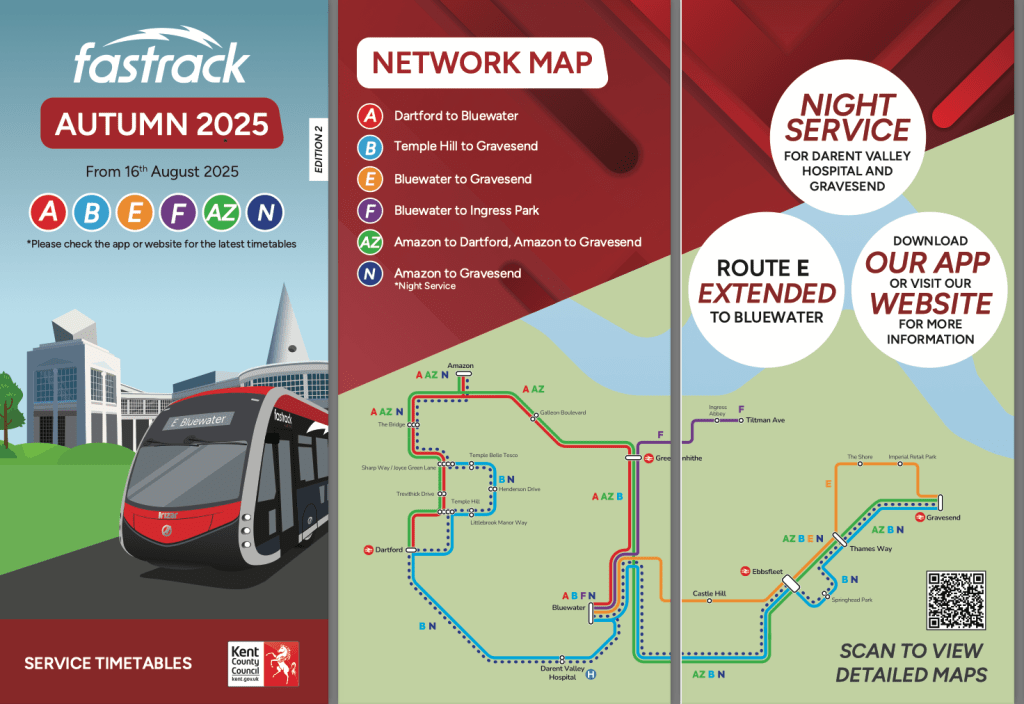
Another change introduced at the weekend was new night route N which has replaced the overnight journeys previously on route A. Route N runs hourly through the night from Amazon to Dartford via Temple Hill then via route B to Bluewater and Gravesend which also gives Darent Valley Hospital an overnight bus service for the first time.
These two newly extended routes began on Saturday so it’s very early days for the residents of Castle Hill to get used to their expanded route E offering a much welcome travel opportunity to Bluewater as an alternative to Gravesend.
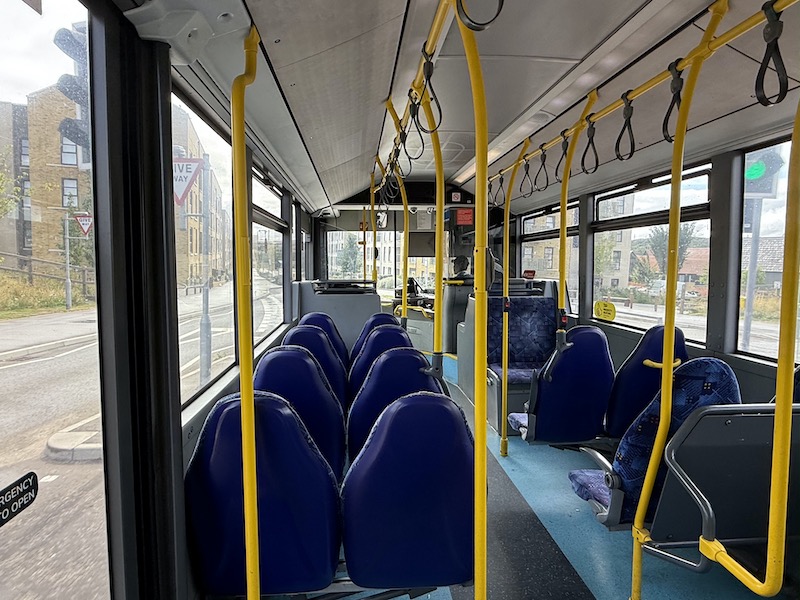
When I travelled up and down yesterday morning, one trip had just me on board and another took a couple of passengers over to Bluewater, but I’m sure it will soon catch on and become a successful addition to this expanding bus network serving this expanding residential area.
Indeed, I suspect in another 60 years someone will write a book about Buses for New Garden Cities charting the development of routes A, B, E, F, N and AZ, and by then, no doubt many other letters of the alphabet.

Roger French
Blogging timetable: 06:00 TThSSu
 BusAndTrainUser
Printed timetables are definitely out there – I picked up a copy from a Citaro visiting Imber at the weekend!
Darryl in Dorset
LikeLike
sadly not to be found on any of the Fastrack buses in service on Sunday, neither at some of the points there are advertised to be some – Gravesend Station, Bluewater Bus Station and the Bluewater shopping centre info desk.
AB
LikeLike
Nor Ebbsfleet station, another nominated distribution point.
LikeLike
I understand that the charging infrastructure to support the ie trams is mired in Network Rail bureaucracy (Gravesend end) and a refusal by the council to allow the charger to be sited sensibly/a land ownership dispute for the alternative (Dartford end). It’ll be some time before the temporary fleet is retired
LikeLike
What does the charging infrastructure have to do with Network Rail?
LikeLike
National Express West Midlands had a similar issue when their Perry Barr garage was being electrified – 100+ chargers installed as well as a dedicated sub-station. But the garage sat next to the railway line, so they had to get clearance from Network Rail before they could all be turned on, which took weeks, if not months, delaying the rollout of new electric buses. The reason was something to do with Network Rail needing to make sure that electromagnetic interference wouldn’t affect signalling equipment at the trackside.
Stu – West Midlands Bus Users
LikeLike
Given the amount of layover time in the schedule, extending Route E to the hospital (taking 4-5 minutes in each direction) would seem an obvious move. What am I missing, is there no suitable turning point there?
LikeLike
No standing area, rather than no turning point.
The E interworks somewhat with the B, and the AZ, and can also act as ferry vehicles in the layover time.
LikeLike
Given the reference to the new towns and other recent books could someone explain to me the Dartford / Northfleet / Gravesend split over the years of London General/ LCBS and M&D. Always confused and maybe if some of the garage locations had not shut then means of charging might have been less fraught with issues now, while noting that LC and Maidstone companies ended up with Arriva rather than GoAhead in its present format.
JBC Prestatyn
LikeLike
Nothing confusing, really! Gravesend was a border town between LPTB and M&D as per the London Traffic Area in 1930 …. there has to be a border somewhere!!
Route 480 was cross-town to Denton, but otherwise the border was absolute.
Dartford was colonised by East Surrey (green) in the 1920s, LPTB (red) only reached Dartford by trolleybus 696 and 699 from Bexleyheath.
Because Dartford was a nominal border town between Central and Country, the border wasn’t absolute …. indeed Country ran several routes westwards as far as Belvedere and Bexleyheath.
LikeLiked by 1 person
With your mention of the 480, it reminded me that at the other end of the route it crossed the rather more porous border into “red bus” territory at Dartford, reaching Erith.
Dartford itself was quite interesting, being served by five operators. As well as London Country, plus London Transport on route 96, Eastern National reached Dartford through the tunnel on route 402 from Southend; Maidstone & District’s route 40 to/from the Isle of Sheppey also reached Dartford at weekends during the summer. This was later extended into south east London, initially as route 40 but later renumbered 300, then 700. There was also an independent operator, Thames Weald, running from and to destinations on both sides of the Thames.
Malc M
LikeLiked by 1 person
The border was at Denton, and Maidstone and District did not carry local passengers on inward journeys after the stop before.
LikeLike
If you wanted an example of appalling cartographical inaccuracies, you should have watched an evening episode of BBC South East Today about six years ago. Brighton & Hove City Council’s Education Department blundered and blundered badly. When their computer was run to allocate school places it calculated each child’s normal walking route to school from each home address. In many cases the “route” was impossible. Such cases involved the computer routeing the child’s walk to school through solid brick walls and across private yards and additionally was unable to do the calculation at all if the home address had its front door above first floor level which would have affected hundreds if not thousands of Brighton & Hove children living in high rise accommodation.
LikeLike
Stuff like this makes a strong case for NOT using AI for everything. There’s a real push to use it everywhere at the moment, including in government and the NHS. And yet AI is rubbish! I can only imagine the blunders that will appear in the news in the coming years and decades, as we trust seemingly everything to automation and machines. A quick Google search annoyingly forces AI and it regularly shows mistakes, misinformation is common, better to not go there! A bit of common sense would’ve avoided Brighton and Hove’s blunder.
Aaron
LikeLike
It seems incredible that those planning electric vehicle networks don’t get all their agreements in place years before given the lead times required. Yes NR can be a challenge to deal with but getting the right contacts and buy in would help. Also incredible that planning permission for the tunnel lapsed. You would have thought that its construction would have been a prerequisite in any planning agreement. No doubt those who made these blunders have now left and been handsomely remunerated. If ‘the new boss’ at Arriva had been around then perhaps they could have won the bus contracts and operated electric vehicles from Northfleet thus safeguarding its long term future
Martin W
LikeLike
You do realise there are these sorts of issues with charging infrastructure delays up and down the country? If you think you’ve got the answers you could make a mint out of offering consultancy services to local authorities and operators!
LikeLike
The ieTrams do appear across the network (I had one on my E journey a fortnight or so ago), but they appear most often on the A as it passes the depot.
As another commenter has said, the charging infrastructure remains a sticking point, so it’s been a very soft launch… But anything is better than having the expensive kit gathering dust!
LikeLike
Go-Ahead also operate ie Trams on route 358 from Orpington to Crystal Palace. Their introduction was also delayed due to electrical installation work, but even now, coming up for a year since that was fixed, there is very rarely a full run out, with Darts and Streetlites substituting. Are the ie Trams so unreliable?
MotCO
LikeLike
They certainly seem incapable of performing a full day’s work and proper buses appear even on a Sunday when the pvr is down to 10. “Teething problems” should have been sorted out by now, so perhaps their delayed entry at Dartford might be a blessing.
Terence Uden
LikeLike
@Terence – on route 358 there may be a problem with the buses, or there may be an issue with the charging infrastructure (or both). Or there may be a different reason to explain why other buses are appearing. Would you happen to know which it is?
Malc M
LikeLike
I only wish I knew Malc, and I thought comment on the issue may pop up elsewhere to explain. It appears they need charging, certainly at the Orpington end, after every journey and I can only assume this causes late running and thus substitution.
TU
LikeLike
Good to see a bus route in place before the houses are built!
Around me there is lots of new housing, but bus services only seem to penetrate the new estates when all the building is finished, often years after the first houses are occupied. This is too late as travel modes are largely established by then.
Clifford Martin
LikeLike
To add a little more … M&D did have a garage in Gravesend, but this closed in (around) the 1970s.
Northfleet Garage opened in 1935, and was one of the LPTB garages designed to their “in-house” style, and still survives today … although with the recent loss of Fastrack, for how much longer?
Dartford (LT) was actually a East Surrey garage, but was always rather small …. this was closed in the 1980s (possibly 1990s) and replaced by the current Arriva Garage …. which is now part of Arriva London and operates only London contracts.
LikeLike
Dartford (DT) was built in 1927 by Maidstone & District and transferred to London Transport in 1933 along with the original Northfleet (NF) garage in Dover Road East which was replaced by the present garage in 1935.
Maidstone & District’s Gravesend Garage closed in 1978 following the reorganisation of the local services by the NBCS out of Northfleet.
LikeLike
AI – or Computer allocation of resources to places can work – sort of – used to take ages but did Statistical and Commercial Analysis of licenced ACORN database ( a residential neighbourhoods social classification database ) handy for working out likely footfall for franchised fast food restaurants and similar – based generally on Post Office Postcode data. It didnt really include non residential places though so some kind of guess by hand on offices factories schools etc that might flex locations was needed (this was in the 1980s). Really for locationing the GPS ( three words thing ) is nowadays a good starting point , adjusting for mean heights above sea level – which can again be adjusted by the known ground spot height thus working out the approx residential height stack (or sub basement for bits of London and other places). I wonder if every property should come with an apple airtag or similar to which census etc information could be encloded anonomised or otherwise.
And yet , again in the 1980s the idea of running bus routes to new neighbourhoods before they were completed was supposed to be good practice (who was paying for it as a bit of cost not quite met by a trickle of revenue meant the bills were difficult to pay).
Was Dartford (DT) mainly retained by LPTB for Green Line services ? Northfleet I think was one of the area engineering support garages – covering the likes of TW Tunbridge Wells Green Line base for example (though DG nearer) and presumably some of Swanley for vehicles not on the Aldenham rotation or repair need.
JBC Prestatyn.
LikeLike
To be accurate, the tunnel will now be a completely new structure, as the old ones could not be re-used on environmental grounds (occupied by rare bats, from memory). The plans do show this, it is north of the disused ones, which is unfortunate as the route was planned to come out on the roundabout giving direct access to Bluewater bus station, but now needs a dedicated right turn lane and another set of traffic lights (to impede all the other bus routes).
The Dartford recharging site has been agreed – on land previously used as a car park – but the original planning application failed on highway safety grounds.
Gravesend’s chargers are in place, but I do not know if they are powered up.
And finally to confirm at least some Bs & Es interwork, so the layovers certainly aren’t over long.
KCC
LikeLike
Many thanks for these clarifications.
LikeLike
If your from KCC then how about you stop wasting BSIP funding on useless summer bus routes.
LikeLike
Who is picking up the substantial costs?
Generally the new buses have to be paid for once they are delivered
As they did not have the charging in structure in place these bus had to go into storage so another cost, They then need to lease buses so yet another cost
LikeLike
https://www.route-one.net/suppliers/snapper-services-helps-drive-fastrack-performance-for-go-ahead/
Interesting article.
Peter Brown
LikeLike