
A Friday bonus blog for 15th August 2025
Government controlled LNER is further restricting passenger choice and in some cases increasing fares again from 7th September as part of its Great Railway Ticket Rip Off on the East Coast Main Line.
In the next phase of its “Simpler Fares pilot” LNER is withdrawing the availability of flexible Off-Peak and Super Off-Peak tickets from 27 stations in the London area in conjunction with GTR and TfL, including all stations between King’s Cross and Stevenage.
What this means is if you travel, for example, from Knebworth (the station immediately south of Stevenage) to Newcastle you can currently buy a Super Off-Peak single for £91.90. This enables you to travel on any northbound train (eg change at Stevenage and Doncaster) except not trains leaving King’s Cross before 09:06 on Mondays to Fridays, which in practice means the first train you can catch from Knebworth is LNER’s 09:28 departure from Stevenage (09:06 from King’s Cross). From that departure onwards you can catch any train and change as you wish as you head up the East Coast Main Line. It’s fully flexible with no time restrictions at weekends.
In the name of “simplification” that ticket is withdrawn from 7th September and if you want to avoid paying the exorbitantly priced Anytime Single at £176.90, your only option will be to restrict yourself to a timed journey with a ‘Fixed’ ticket or what LNER laughingly call ‘Semi Flexible’ which enables you to go through a procedure of changing the time of the ticket to a ‘valid train’ up to 70 minutes before or after your booked journey.
As I was writing this blog yesterday (Thursday) I took a look at the LNER website for a journey from Knebworth to Newcastle at 09:00 for travel today (Friday). As the first option this suggested taking the 09:04 Great Northern train to Stevenage, change to the 09:28 LNER to Peterborough and change again to the 10:18 LNER to Newcastle, arriving 12:35.

Except as you can see in the screenshot above, LNER are claiming tickets are ‘Not available’ – neither the ‘Fully Flexible’ £176.90 nor the Super Off-Peak Single at £91.90. Both are available on the next train half an hour later (involving changes at Stevenage and Doncaster). The website doesn’t give any options of ‘Fixed’ or ‘Semi Flexible’ tickets, so if the new arrangements applied from today, you’d be ‘stuffed’ with the only option of paying out £176.90 and then technically being restricted to the 09:34.
The quota of ‘Fixed’ and ‘Semi Flexible’ tickets have obviously all been sold for the journey arriving Newcastle at 12:35 (which is the 09:30 from King’s Cross), so LNER has ceased to sell any tickets. Yet I can go to the ticket office at Knebworth this morning as I begin my journey and buy a £91.90 Super Off-Peak ticket and travel on the ‘barred train’ and I’m sure there’ll be seats supposedly reserved but available. My informant tells me the train is ‘fully booked’ between Doncaster and Newcastle and on from there to Edinburgh.
Now, fast forward to 7th September, when the Super Off-Peak ticket is no longer available for purchase (even from a ticket office) as it will have been withdrawn, and I’d not be able to travel on that train. In fact, it could be the case I can’t travel at all as all the quota of ‘Fixed’ and ‘Semi-Flexible’ tickets have been sold.
I took a look at the situation three and a half weeks away on Monday 8th September for the same journey. As you can see below, the ‘Super Off-Peak Single’ option has disappeared and as at yesterday I could buy a ‘Fixed’ ticket for that 09:04 journey for £78.30 but if I want just 70 minutes flexibility I have to stump up £20 more at £98.30 which is £6.40 more than the withdrawn Super Off-Peak single which gave me total flexibility for the rest of the day.
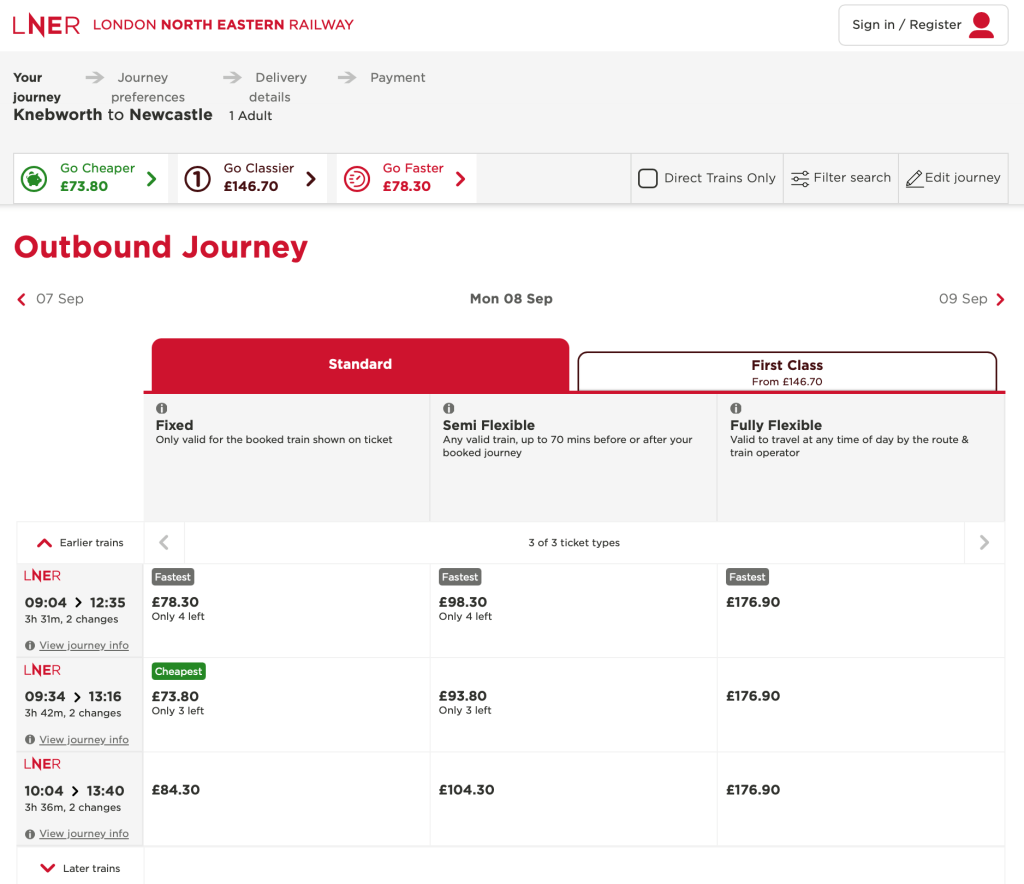
But, hang on a minute, or rather 70 minutes, how will it work if I buy that £98.30 ‘Semi Flexible’ ticket and want to take advantage of moving my departure by 70 minutes? Or even more graphically suppose I opt to travel on the 10:04 and stump up £12.40 more than the old Super Off-Peak ticket and pay £104.30?
Bearing in mind my journey starts on a Great Northern train at 10:04 does the 70 minutes flexibility apply to that departure, or to the LNER departure from Stevenage at 10:28?
I’m told by an Industry Insider the terms and conditions state “if you choose to exercise the Flex option not only do you have to depart within 70 minutes of the original train, you must also arrive within 180 minutes of the original arrival time.” As my informant dryly observed: “so now, passengers have to look up departure and arrival times to make sure their ticket is valid – I’m not sure this is simplifying ticketing!”
Another factor in all this is the availability of sufficient advanced tickets at cheaper prices on Thameslink and Great Northern trains as well as other operators now drawn into this so called ‘Simpler Fares pilot’ where they provide connecting trains. These aren’t necessarily made available in the same time frame or the same quantities as LNER makes them available on its trains so passengers could well will be faced with more “Not available” results from their searches.
But the real clincher is the Super Off-Peak ticket is the Regulated Fare on almost all LNER routes. Regulated Fares were baked into legislation at privatisation, only being allowed to rise by a specified amount set by the DfT each year (usually RPI + or – 1% etc). Pertinent to LNER’s ‘Simpler Fares pilot’ is that Regulated Fare has acted as a cap on Advance (or ‘Fixed’, as LNER calls them) fares at Off Peak times.
My Industry Insider reminds me “DfT/RDG/TOCs have wanted to abolish regulated fares for years, often referring to them as outdated, stuck in the 1990s etc.. Given that Super Off Peak fares are going to be abolished then what is the Regulated Fare? I suspect the concept will go completely as the industry transitions to GBR but this is going to result in massive fares increases.”
Recent Government announcements on fares suggest the way forward is Fixed Advance fares and given the lack of transparency with these fares this cannot be a good thing for passengers.
Meanwhile LNER are churning out their usual PR hype about the “next planned phase of a pilot … to make buying train tickets simpler for customers travelling long distance by rail”.
LNER tells us “research shows more than a third of people are put off from travelling by rail because of confusion around fares” yet it thinks they’ll be happy by telling them tickets are “Not available” or they cost more for less flexibility? What planet are these people on?
Its media statement concludes with this gem…“this important next step is designed to more closely resemble a vision for long distance fares simplification and enables LNER to capture much richer learnings to consider for the future.”
I love the use of the word “richer”! A bit of a Freudian influence perhaps?
Finally it states “during the two-year trial, LNER is continuing to gather and review feedback from customers and industry partners to understand more about how the changes are working for customers, while ensuring a wide range of affordable tickets are available across the pilot routes.”
To those at the DfT and LNER behind this scheme – please accept this as my submission from an unhappy customer at the loss of flexible Off-Peak and Super Off-Peak tickets which have never caused confusion. I urge readers to do the same.
Roger French
Summer blogging timetable: 06:00 TThSSu
 BusAndTrainUser
LNER is seriously on the wrong track with this scheme. For all the industry fawning over David Horne, of this is going to be his legacy then he will have been a catastrophic appointment. No ifs, no buts, this is a categorically unacceptable way to run a railway. It’s enough to make me actively avoid their services and stick to Hull Trains, Grand Central, Lump, TransPennine and even XCountry for my journeys from Yorkshire to London and Edinburgh.
LikeLiked by 1 person
It is not just rail in the UK thats in trouble
The German government sacked the embattled head of Deutsche Bahn on Thursday as it seeks to overhaul the ailing public rail network after years of criticism about deteriorating services.
Once widely admired for its punctuality and efficiency, Germany’s rail service has worsened dramatically in recent years owing to what critics say is chronic underinvestment.
Passengers now often complain of long delays and cancelled trains in Europe’s biggest economy — last year, almost 40 percent of long-distance services were late.
LikeLike
DB has been falling apart for decades, so it’s surprised me just how long the myth that they’re wonderful has perpetuated outside Germany for so long.
Steve
LikeLike
Maybe I’m lucky but I’ve not had many problems with Deutsche Bahn on my frequent trips to Germany.
Hard to complain when a ticket for the whole country of bus, tram and non ICE rail travel costs only 58 Euros for a month.
Used it recently in Munich, Leipzig & Berlin.
LikeLike
This is presumably a way of raising fares by stealth without having to announce a fare increase, and if it does that successfully will be extended to other long distance routes once they are nationalised.
On the East Coast this will benefit Lumo,Grand Central,Hull Trains and the coach operators.
A recent report showed how inefficient National Railways were in staff utilisation compared to Open Access, and the profit made by Lumo compared to East Coast with Lumo now paying full track access charges.
LikeLiked by 1 person
What we need is simplified fares and not the current over complex mess
LikeLike
The problem is that this does not just apply to long distance journeys – far from it! It applies to journeys like Retford-Grantham (55 km approx). The walk-on fare is an astonishing £48 return, with no guarantee whatsoever that the cheaper Advance fares will be available when you need to travel. This is only going to reduce passenger numbers.
LikeLiked by 1 person
Lumo are not yet paying ‘full’ track access charges. Maybe from November this year, possibly April 2026. And the London-Newcastle services won’t be paying those charges either, only London-Edinburgh.
LikeLike
Makes a mockery of their trial on LNER only controlled fares if LNER are asking others to align their directly controlled fares which goes against the Rail Settlement Plan.
At this rate be quicker for LNER just to go full reservation only service a la SNCF TGV
LikeLike
Anytime fares are so astronomically high that what LNER have effectively done is abolish walk-on travel, like SNCF.
LikeLike
Completely ridiculous. We used to have an excellent fares system in he days of InterCity and Network SouthEast with complete flexibility.
LikeLike
A recent letter I sent to “RAIL” magazine.
In years gone by when railway fares and ticketing was more flexible and easy to understand I took a party of eight Scouts from Greater London to the Isle Of Skye via Kyle Of Lochalsh and the then chain ferry. Two adults and eight boys used two Family Railcards. With one third off for the adults and £1 (later £2) flat fare each for the boys, Saver fares were very good value and I am sure was a good introduction to long distance train travel.
We were able to travel out via the West Coast Main Line and legitimately break our journey overnight in Glasgow and resume before 1200 the next day. For the return we used the ECML spending a night in Inverness and another in Edinburgh, staying in youth hostels and then having a few hours in York before travelling home. Tickets were interchangeable on “InterCity” routes.
Here is another scenario. Husband and wife booked a fortnight’s holiday in Inverness and were persuaded to buy cheaper Advance tickets. During their stay the forecast for the second week was rain, rain and more rain. The hotel was willing to make a refund. Now the couple have a dilemma. Do they stay the course or do they buy single tickets for the journey home. Had they bought the flexible Saver tickets to begin with (the return valid for a month) they would probably have paid about £1 more than they would pay for new singles to take them home – a good form of insurance.
Compare this with the LNER fares structure today, which is more expensive, less flexible and definitely less easy to understand. Railway travel should be as flexible as possible.
John Parkin. Carshalton
LikeLiked by 3 people
at any of those prices I’m going nowhere
LikeLiked by 1 person
The train which was fully booked probably had a group reserve seats between Durham & Newcastle because LNER forces you to reserve a seat on local journeys blocking that seat for long distance travellers.
LNER would love a return to the Covid era ‘no reservation, no travel’. Just look at how small the fully unreserved coach is getting, no doubt at some point they will do away with that coach or move to a “this seat might be reserved during your journey” era of uncertainty when someone from Stevenage evicts a long distance traveller as they managed to get a seat reservation.
LikeLike
Just why GBR is a huge waste of time.
LikeLike
Unfortunately, Horne is merely the government’s implementation puppet. They want more control over passengers. I read West Coast gets it next. Of course, the new complicated 70 minute ticket comes with no refunds or break of journey. Lose, lose for passengers but control is everything.
LikeLike
If LNER wants to compete with the FirstGroup’s Lumo service, they’ve better start acting like they’re providing a 1st class service.
I have never used either railway companies, but I almost never hear anything bad about Lumo, especially compared to LNER, which gets near constant public attacks, which they deserve for raising ticket prices by stealth.
I suspect that this stealth ticket price rises will continue under ‘Great British Railways’, and it will probably worsen in the current years if the official CPI inflation rate rises to >7%.
LikeLike
I recall reading once that there were more possible fare variations existing on the entire rail network than the actual population figure. Doesn’t appear to have changed much since then.
I think the problem facing this government is the realisation that railways, whilst a necessity, cost an awful lot of money. Which, thanks to the Chinese virus, we no longer have to spare. Figures since the pandemic show a huge amount of purely leisure travel rather than business (I notice far fewer people on early inter-City trains heading north and west from London than a decade ago), and thus spending £billions does not have quite the importance as previously.
I would imagine the thinking to be “why should we be supporting leisure travellers?” who now out-number by far work and education journeys in many regions, and fares will gradually rise “by stealth” as the blog implies.
Terence Uden
LikeLike
This “simplification” is Orwellian doublespeak!
The simplest form of ticketing is buy on the day of travel at the station, mileage based with distance taper. Why do we need to advance book for a train? It’s a all a load of faff and the real reason I’d to sweat assets rather than provide adequate capacity to meet demand. Swiss trains include a percentage of over capacity to absorb unforseen demand spikes.
I used to love railways and regularly bought Modern Railways and other publications. I haven’t bought any for years now as the faff of advance booking and expensive fares has stopped me travelling long distances by rail, and thus I’ve lost interest in UK railways. I’m more focused on every day transport like buses, trams, metros etc. So far none of these require advance booking!
Peter Brown
LikeLiked by 2 people
Agreed, although where possible just use Lumo instead, unless you’re going to York (their trains are not allowed to stop there).
However Super Off-Peak tickets are not always a good idea. SWR bought them in on the route from London to Portsmouth/Isle of Wight, but all it was was a way of increasing ticket prices. The Super ticket was priced similarly to the standard Off-Peak, but with a new array of restrictions on when you could travel, so invariably you still had to buy a standard Off-Peak ticket to avoid these restrictions. The cost of this ticket though was increased substantially; it was just a cheeky way of increasing prices by claiming it was a restructuring of tickets available, without any benefit to passengers at all.
Time all TOCs signed up to simpler fare structures.
LikeLike
Why does Lumo get away with not paying full access charges on London to Newcastle?
Whilst I’m in favour of efficient Open Access there should be a level playing field
LikeLike
LNER doubling down on this nonsense is so frustrating. I guess it depends on what you see as the purpose of the railway. If it HAS to cover its running costs by itself (nowhere with decent public transport ever does), crack on but to me the railway should be apart of the great shift to making the country sustainable and ultimately fairer. Trains could ultimately achieve some truly great social, economic, cultural and environmental goals if we let it. Flexibility and passenger choice at the heart of it. To me, this ‘trial’ really screams the failure to adequately upgrade our railway and futureproof it for growing demand. Now the government (treasury) are punishing us, that’s how it comes across.
A truly simple ticketing system would be good value for money, flexible, consistent and in my opinion, distance based. A lot of ticket types really don’t need to exist, especially most TOC only tickets and any with time restrictions. LNER doesn’t do this, every time they extend this farce, people find ways around it and let they tell us it’s a success and people are happy! LNER forced unknowing passengers into this, so it’s not even a fair or accurate trial. By contrast, Scotrail is ACTUALLY simplifying tickets by abolishing anytime tickets in the coming weeks, off peak will be the default. Whenever the next phase of Project Oval happens in the south east, tickets will be peak or off peak with no other restrictions, so again really straightforward.
And if subsidy is really a concern, the government needs to make the trains much more reliable. I’ve done 4 Intercity journeys with GWR in the past week, 3 were late enough for delay repay! 2 of which got me half my fare refunded, Delay Repay is good but it must cost a fortune when a train with 100s of people is over 30 minutes late, day in day out! The delays need to be sorted out.
Aaron Smith
LikeLiked by 2 people
I agree Aaron. The UK is useless at strategic planning. The LNER “simplified” fares is a smoke and mirrors distraction from the real issues over what the nation should want from its railways in the context of the global climate crisis snd stated climate mitigation targets. If only we were Swiss. This link illustrates how to plan starting from what you want the rail timetable to be x years in the future and plan backwards from there to decide how to deliver it.
https://www.freewheeling.info/blog/swiss-hs2?utm_source=substack&utm_medium=email
Peter Brown
LikeLike
Very interesting article and website. It’s that exact lack of bigger picture and long term thinking that really gets to me about Britain, it’s totally self-imposed. LNER at least makes it clear that we must do the exact opposite of their reforms.
‘In trying to save money, the Treasury is, unintentionally, the biggest driver of waste and inefficiency in UK infrastructure.’ – Also loved this bit near the end of the article!
Aaron Smith
LikeLiked by 1 person
Ha, if we were Swiss we ‘d paying rather more in taxes for a Swiss-style service. What I’d dearly like to know is just how many empty seats exist on on a daily average: twenty five years ago it was around 55%!
LikeLike
People want to be able to travel from A to B according to their needs. If I want to travel to see a friend in Cardiff then I want to go to Cardiff, irrespective of operator. I won’t decide to go somewhere else by my local operator goes there. So, a straightforward mileage-based payment scale makes absolute sense to me. Yes, perhaps load peak fares (although peaks are different post-Covid), and offer discounts for advance booking, but basically fares for equivalent travel distances should be broadly similar.
John
LikeLike
This is what nationalisation brings you. In BR days it was too expensive to travel from e.g. Newcastle to York. It was a rare treat. Privatisation gave many cheaper options with at least 3 companies. Now it’s back to a luxury, especially if last minute.
Next Beeching II or revival of Serpell.
LikeLike
Serpell wasn’t possible even in the 80s, it’s even more impossible now. We are steadily reopening old railways (albeit with no strategic long term plan). As two examples, he wanted to close all railways to Cambridge and the line between Edinburgh and Newcastle, 2 really busy railways today that show how huge a mistake closing any more lines would’ve been. Even when the government tried to close the Settle Line, it faced huge resistance. The car is increasingly seen as a nuisance today and it’s novelty has long worn off since the 80s and 90s. Public transport is here to stay and very much a key part of the future.
Aaron
LikeLike
Thank God that I did all my serious long distance railway journeys long ago when All Line Rovers were about £27 for a week (1970s). Then there was my motorcycle era (1977-2001). Hersham to Dundee [1978] in three days on a Honda CD175, with hotels at Chester and Lockerbie on the way. I was still on a provisional licence. I spent some of my late evening in Chester before bed chatting to a rolling stock superintendent at the bus garage next to my hotel as he was monitoring the night’s “run in”!
LikeLike
just use lumo it is cheaper and LNER wonder why lumo are abstract more fares!!!
LikeLike
Good points. What did David Horne say when you mentioned all this to him?
LikeLike
I’ve sent him a link to the blog.
LikeLike
For long-distance commuters/contractors/freelancers who travel across the country regularly (but not daily) for a mixture of work and family reasons, super off-peak fares are a lifeline. The time restrictions may be substantial, but they are stable and one can plan around something constant, safe in the knowledge that one can leave it to the last minute (because it is not always possible to confirm 100% exact timings of all work comitments over a month in advance) to decide on exact travel times (because it is a walk-up fare), rather than be at the mercy of advance fares (expensive if booked at the last minute, and often non-existent during engineering works, industrial action, or a major sporting fixture). At first, it does take some work to memorise the rules and exigencies of the timetable, but the super off-peak fare is more affordable and the walk-up nature makes it very “simple” in another, very important respect (which is also beneficial to the TOCs, because many of the super off-peak trains are more than half-empty, so the fare structure enables them to capture price-sensitive travellers needing some stable guarantees on flexibility and put them at times of lower demand).
What would be good is if the regulators made greater effort to mandate and enforce a requirement for all station ticket offices (including so-called “travel centres”), ticket vending machines, and TOC websites to make all these ticketing options discoverable (without recourse to BR Fares or similar websites). My regular super off-peak fare, being tied to a particular TOC, often fails to appear on TVMs maintained by some other TOCs (even at the origin and destination stations for the ticket!), and I remember one ticket office where it took a few minutes for the clerk to find my fare on the system (because the fare is tied to a specific London station rather than the generic “London Terminals”). Even the online journey planner for the TOC involved does not always show the fare option (because the itinerary is usually overtaken by a train from a different TOC with fewer interchanges).
If other TOCs follow LNER’s lead, I suppose I will just have to get in my car and drive hundreds of miles more per week, increasing congestion and wear on the road network (which, apart from a few private toll roads, is maintained at taxpayer expense)… or reduce my working hours and keep only the work closest to home (less interesting, but more profitable after accounting for travel — a big motivator for the work I accept from clients/employers a long way from home is that it involves my specialist skills to a greater extent), paying less income tax and NI as a result.
LikeLiked by 1 person
Thank you, Roger. I have shared your post with my MP and asked her to try to stop such anti-passenger treatment in its tracks.
LikeLiked by 1 person
Next time public money is used to update a junction or something on the route, the public have the right to ask if a useable train service then runs through it. CH, Oxford
LikeLike
Simple it is not.
Fortunately I do not live along the route LNER serve but fear for the future. I have had a few days away using a super-off peak return ticket at ~£70 which works out at ~23p/mile. Hospitality & leisure businesses plus of course the treasury all benefitted. Fixed train advance tickets were only marginally cheaper. Bring in these flex-advance tickets then hike the price and I would not have gone.
As it is destination options are limited. One I considered instead that is slightly fewer train miles has no super-off peak ticket and the off-peak return is ~£120. At the times I would travel booking only a day or two ahead again if any advance tickets were available they would only marginally cheaper. For a long day trip the cost could be cut by ~40% using a combination of day returns but I have not checked recently as £70+ is too expensive.
Somewhere I do want to go is Beamish. For now I can avoid the LNER fares structure by using TPE and/or XC – the latter of course is woefully short on capacity despite their ticket prices.
If the LNER fares structure spreads my travel will end. The looser will be the treasury who need to look at the big picture.
LikeLike
Simon Calder’s take on rail fares. I don’t agree with him as his suggestions continue the pretend to be an airline modus operandi with yield management, so not simple at all.
https://www.independent.co.uk/travel/news-and-advice/uk-train-ticket-rail-fare-system-how-to-fix-b2810665.html
Peter Brown
LikeLike
Here’s a simple rail ticketing system. No advance tickets, just a choice of anytime and off-peak. Heidi Alexander make it so!
https://www.ns.nl/en/tickets
Peter Brown
LikeLike
In the hope that this “Simpler Fares Pilot” does not spread any further Rail Magazine suggests we write & complain to both our local MPs and Transport Focus.
LikeLike
The Telegraph has noticed!
https://www.telegraph.co.uk/news/2025/09/03/cost-of-train-tickets-to-double-on-state-run-rail-line/
Peter Brown
LikeLike
Yesterday evening I bought a Super Off-Peak Single ticket from the ticket machine at Dundee in order to travel to West Hampstead, which required a change at Edinburgh. I ended up changing onto a Lumo train where it was not possible to get ticketed (because the connection time was 8 minutes, less than the 10 minutes required by the booking system), where the first legal connection was the LNER train departing 8 minutes afterwards but with many more stops to London.This is a clear benefit of the off-peak ticket which LNER has abolished between Edinburgh and West Hampstead, to stop people switching between operators at a whim if they can physically make an invalid connection.
LikeLiked by 1 person