Sunday 10th August 2025
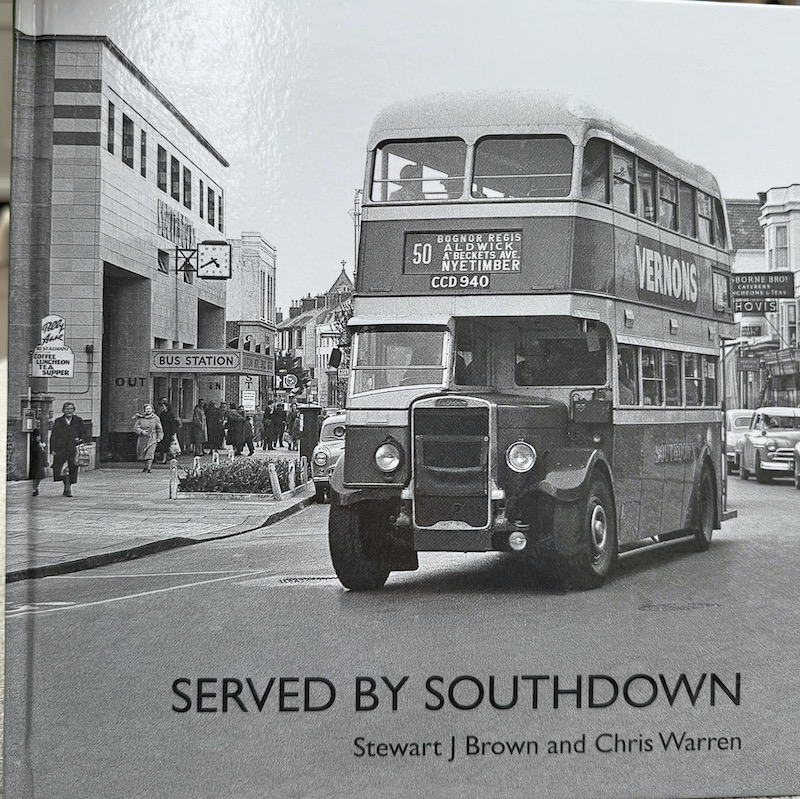
The second of the three books I bought recently is this wonderful Southdown photo album featuring prints from the Peter Mitchell collection of over 500 negatives of photographs he took in the heyday of that much loved bus company in the 1950s and 1960s and which Capital Transport arranged to have scanned in 2020.
The album also includes images taken by Eric Surfleet from the collection held by the Southdown Enthusiasts Club.
Both photographers captured stunning black and white images of Southdown buses at work across a huge stretch of southern England from Fareham in the west…
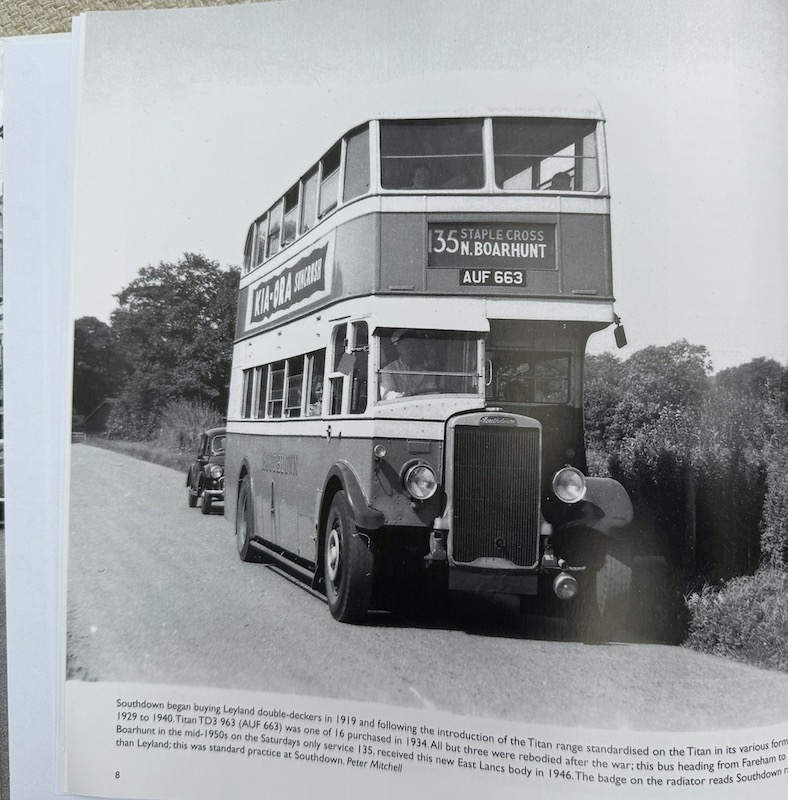
… to Hastings in the east…

… and from the coast north to Petersfield, Horsham, Crawley and even as far as Gravesend.
A detailed caption accompanies each of the 177 excellent photographs laid out mostly either one or two to a page in the 144 page book. The introduction and captions have been written by Stewart J Brown and Chris Warren both of whom are renowned experts in the history of Southdown so you can be sure they’re all extremely informative and interesting.
The photographs take the reader on a journey right across Southdown’s operating area from west to east capturing street scenes in both towns and rural settings.

As I turned page after page of this glorious book I realised the reason many of the photographs are so captivating is because the buses have been captured as they’re in motion yet they’re all to a crystal clear definition and this before digital cameras and editing functions have made it so easy these days.
You cannot but be impressed at both Peter’s and Eric’s skill with a lens and shutter, as well as the distance travelled to capture the buses in action, often working on infrequent rural routes with scenes shot in the middle of nowhere.
The period covered by the book was one of significant stability in the regulatory environment, mostly before passenger numbers began reducing with the rise of car ownership as the 1960s wore on.

Indeed the book captures many areas of east Hampshire and Sussex where towns were expanding with post-war house building creating new estates along the coastal strip in towns like Bognor Regis, Chichester, Havant, Haywards Heath, Horsham, Lewes, Littlehampton, Waterlooville and Worthing and inland, particularly in Crawley (following its designation as a New Town), and Brighton.
It was also a period characterised by joint operating agreements with Portsmouth and Brighton Corporations as well as joint operation with neighbouring bus companies not least what was known as the Heathfield Pool with Maidstone & District where six routes met in the town providing hourly connections to a large part of East Sussex as well as over the county boundary to Kent.
So many of the routes featured in the photographs no longer use the same number or run as they once did but route 12 is one obvious exception between Eastbourne along the coast to Brighton, although in the 1950s and 1960s buses did continue to Withdean in the north of the city.

More nostalgia is enjoyed seeing photographs of bus stations sadly no longer with us including Bognor Regis, Pool Valley (Brighton), Lewes and Uckfield as well as railway stations in West Grinstead and the original level crossing and footbridge at Goring- by-Sea and a rather lovely glimpse of the entrance to Falmer station on a pre dual-carriageway A27 which split the village into two (see earlier photo).
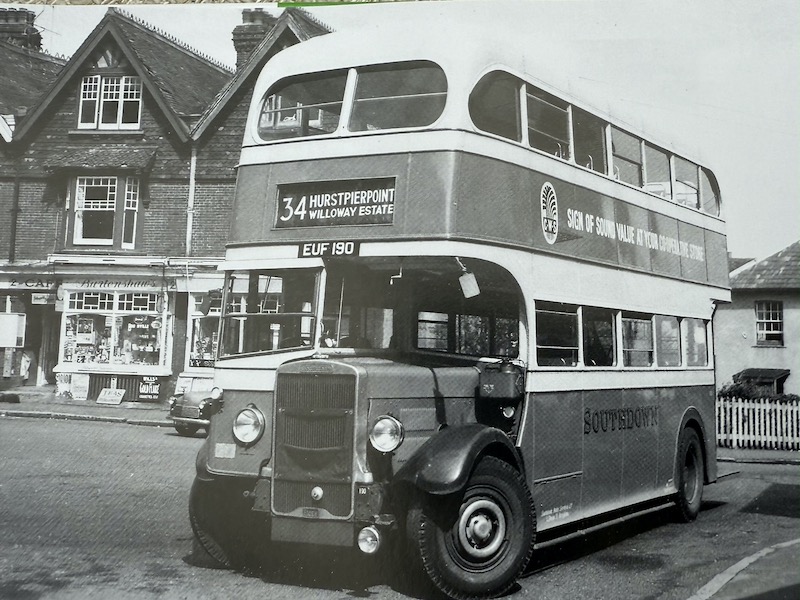
I particularly enjoyed seeing this photograph (below) taken outside my local station in Hassocks (on the west side)…
… and couldn’t resist taking a comparable shot today.
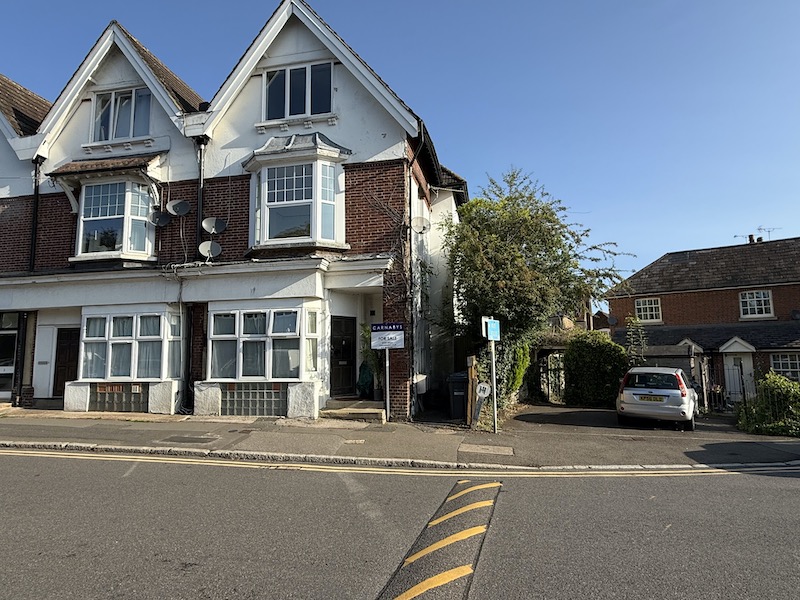
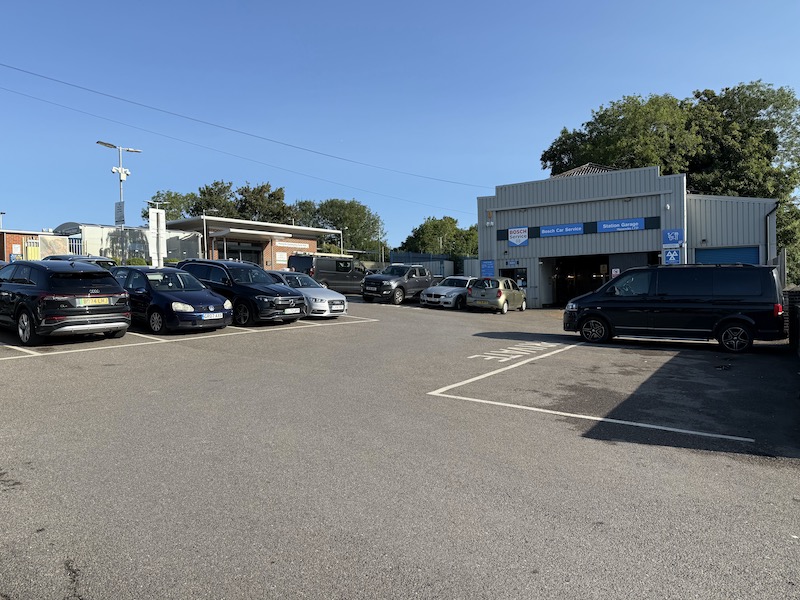
As well as the shops long gone, sadly no Southdown buses were available to pose. Back in the 1950/60s Southdown had a small bus garage on the east side of the station now used for car servicing and repairs.
The photographs include the whole gamut of bus types operated by Southdown during the 1950s and 1960s including the famous Queen Mary’s but also many types of single decks used on routes that were converted to driver only operation.
If you like to see photos of a whole variety of vehicle types from the 1950s and 1960s this book will not disappoint.
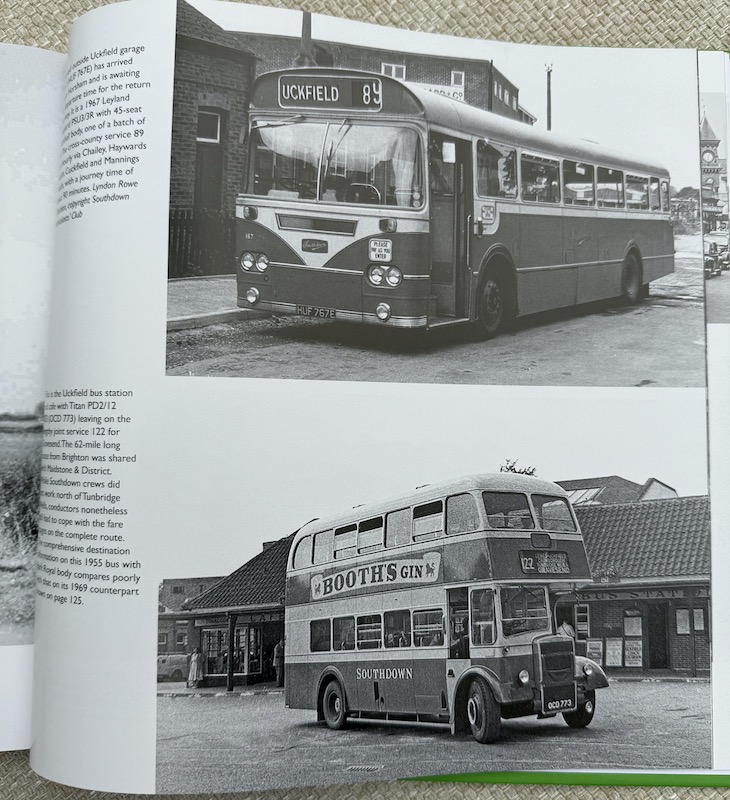
Many books have been written about Southdown over the years. This one contains a very informative introduction giving a background to the Company and the development of its network of routes and changes to the fleet over the two decades covered, but primarily it’s all about the photographs – and what top quality photographs they are too, as I hope the small selection I’ve included here demonstrates.
The book was produced by Capital Transport for Heathfield Publishing and costs £35. It was published in 2024 but is widely available from the usual outlets.
Roger French
Blogging timetable: 06:00 TThSSu
 BusAndTrainUser
The only car father bought “brand new” was a Ford “Anglia” (the model with the inward sloping rear window). He and mother had no end of trouble because of a faulty starter motor. Mother had this problem during a childhood holiday at Bracklesham Bay staying in a caravan owned by either a close or a distant family member. The “Anglia” failed and must have been towed into a workshop at Chichester, unaccompanied! So, along with Mother, possibly my sister and Nan – we needed to collect the car from the workshop after it had been fixed. Thus, I encountered OMO on a Southdown Tiger Cub. This was OMO several years before Hersham’s LT red buses lost their conductors in 1968. This Bracklesham Bay holiday therefore may have been in 1964.
LikeLike
Many thanks for this review – I’ll put in an order for this book. My first contact with Southdown was catching the 122 northbound from Tonbridge,;only to the next village, but travelling in the attractive light green and cream bus was very exciting at the time. Later on, just into the 1970s, I caught an M&D bus from Tunbridge Wells to Hastings (maybe the 51? – my memory not exact) and witnessed the ‘Heathfield Pool’ in operation. I believe a similar co-ordination existed between the 122 and the M&D 9 at Borough Green, where M&D had a bus garage.
LikeLike
My memories of Southdown is as a child in the 60s going down in the family car to Littlehampton and Worthing and seeing those resplendent cream and green buses. In the 70s a schoolfriend moved to just outside Chichester and remember catching the coach from Kingston to get there. I remember catching the Coastliner to Portsmouth when it was operated by ECW bodies Atlanteans. Those cream window rubbers were the give away. LCBS had three operating from East Grinstead. I now frequently visit Crowborough and wondered if the former Jarvis Brook depot was actually demolished or just remodelled. There is now a builders merchant I think on the site. Jarvis Brook is poorly served by buses with only a peak service now to Tunbridge Wells. BSIP money could usefully be used to provide an hourly and late evening service. No doubt the links were much better in Southdown days ?
Martin W
LikeLike
In the less distant past, I recall driving Volvo Olympians and B7TLs to Hassocks station when doing Brighton line rail replacements, turning at the same point where the Leyland TD was photographed.
Have the arrangements changed since, or is it still possible to photograph buses there when they are substituting for trains?
Malc M
LikeLike
Still the same arrangement for rail replacement buses.
LikeLike
An excellent review Roger of a book which I bought when it was first published. For me it has a particular nostalgic connection to family holidays taken in the late 50s/early 60s in Pagham. The front cover of the book depicts a rather nice re-bodied Leyland TD4 operating on route 50. This service passed our caravan park & rather than take the car down to Pagham beach, we often used the bus. This from memory, was usually a Leyland Titan PD2. The other service that passed close by was route 60 & I clearly remember that being operated by Guy Arab IVs. When we went into Bognor Regis I took every opportunity to hang about the fabulous art deco bus station to watch the various buses in their wonderful apple green & cream liveries coming & going. The diesel smells were intoxicating! I was so impressed with the book that I wrote personally to Stewart J Brown to congratulate him & Chris Warren for producing such a great book & providing me personally with some great memories in the bargain.
LikeLiked by 2 people
What a glorious feast of memories! Many years standing on the downs by the Windmill in Rottingdean watching never ending streams of 12s (some even single-deck such was the need to press anything into service in those days), heading along by Roedean school, disappearing into the hollow by Ovingdean, passing the Windmill (a favourite picnic spot), plunging down into Rottingdean, then later seen climbing up towards Saltdean. Sunshine, sea views, salty sea breezes and pure bliss. The arrival of the most handsome vehicles (c1957) ever built, the PD2/12s with platform doors was an added bonus.
Centre-entrance, crew operated Leyland Royal Tigers, usually full to capacity, leaving the “Crown” at East Grinstead and immediately disappearing at what seemed like a hole in the wall to the left on the descent to Dunnings and en route to Haywards Heath and Brighton. Braving flood waters one Sunday near Pulborough on a 22, again a PD2 long after virtually all country services, or what remained of them, had gone OMO.
A childhood holiday in Lancing, with family on beach and me spending every possible moment on Marine Parade in nearby Worthing. Open-top reliefs on the 31 operating all evening at capacity such were the crowds drawn to the thrills and spills of Brighton. Pool Valley a sheer paradise with buses departing to what seemed then all corners of the globe. The seafront by Volk’s railway station literally lined with Southdown coaches offering excursions to every place imaginable!
Watching crew changes outside Bolney out-station for the 14/24 (and Dial Post on the 2), a shed which was only demolished a few years ago long after it closed. The magnificent Haywards Heath bus station which seemed more to resemble a Greyhound coaches departure lounge in the heady days of the 1940s. Although all major Southdown locations were much the same. Crawley Coach station (and small bus garage) which looked as busy as Victoria on busy days with London-Brighton coaches all stopping for the ten minute refreshment break. All treasured memories!
A particular favourite was to take the 119/122 from Tunbridge Wells to Uckfield, enjoy a tea and Kit Kat in the Southdown refreshment rooms before return….but perhaps the sight of a Southdown PD2 working the 122, wending it’s way along the narrow Kentish lanes in Dunks Green on the four hour long run from Gravesend gave the sharpest contrast with their normal operating territory.
Alas, much of this amazing empire died (for me) in the spring of 1971 when the NBC more or less withdrew much of the rural and interworked network at a stroke. Yet over fifty years later, whilst no longer home to Southdown’s beloved green and cream, many locations are now enjoying similar and even better services than existed in the heyday. What more could we ask for?
Terence Uden
LikeLiked by 2 people
A trip to Littlehampton for a two week holiday was by the back seat with mum of the side car attached to dads Norton Motorcycle. Nan was in the front with suitcases strapped to the rear seat squab of the motorbike. I never noticed the buses in the town , with its small pier, mid sized shipping going up the Arun,Arundel Castle, the shopping arcade (particulary the toy shop – Gamages ?) the beach , small funfair, putting and crazy golf all being more interesting . There may have been the official coach park but sometimes coaches lined up along the top promenade road. My Uncle , Cousin and Aunt came down by rail to join us. Odd day trips continued through the 60s but lots of other places drew my attention yet still Southdown other than HCVC trips to Brighton didnt really get my full interest, I dont know why. Did they ever get to Guildford by Service Bus ? – the independents , London Country and Alder Valley were more of interest to me there.
The 1970s saw mums over 60s club coach outings so I would join them to Eastborne with its coach station and local authority buses with me taking a trip to Beachy Head / Birling Gap. Other places would be Bexhill where I didnt get beyond the town centre and of course Maidstone and District dominated as also Hastings for Sunday School Trips. Worthing was another popular destination with Silver Jubillee painted buses in 1977 and the area where the bus station/garage seemed to merge with the small cinema. An early 80s deliberate week Holiday to Selsey Bill saw infrequent Southdown buses linking mainly to Chichester where the bus station reflected the Cathedral in architectural harmony.
Indeed Southdown’s buildings more than its buses held more of a fascination for me, Art Deco in Eastborne and Bognor Regis, 1960s Brutal with Freshfield House (?) Dormy Sheds at Storrington and elsewhere. 1930s Brick complementing southern railway at other inland bus stations, (Haywards Heath ?) the large garage at Hilsea . Were the architects local to the company or BET Head Office supplied ?
Southdown’s script fleetname gave way to the Block Standard of NBC lettering – I wondered if that was part of the downfall of services even before deregulation took away the security of joint pools and working.
JBC Prestatyn
LikeLiked by 1 person
As a kid growing up in Gosport I loved going to Fareham station where I could see some Southdown buses , a change from the local Provincial or Hants and Dorset buses .
LikeLike
I don’t think Southdown ever had any ECW bodied Atlanteans. What they did have were ECW bodied Fleetlines (but I don’t think they were used on the Coastliner), Park Royal bodied Atlanteans and ECW bodied Bristol VRs, a number of the later deliveries of those had Leyland 0.680 engines. Both of the latter two types were used on the Coastliner. My earlier memories of Southdown are from the early/mid-70s when the open-top routes did not run on Saturdays and the buses were used instead on relief journeys from Eastbourne and Brighton in the afternoon on normally single-deck OPO routes so a ride to Hailsham on a BH&D FS or to Hassocks on a ‘Queen Mary’ was possible. Other good normal scheduled runs could be had on PR bodied Atlanteans between Portsmouth and Petersfield
LikeLike
The confusion about the “ECW bodied Atlanteans” may have arisen because the XUF-K registered Fleetline/ECWs had Leyland engines.
I suspect that the open top routes did not run on Saturdays because the drivers were needed for express services; and Saturday being the traditional “changeover day” in holiday areas meant that there were fewer potential passengers.
RC169
LikeLike
Never having visited this part of the country I never experienced Southdown buses. But its nice to read the childhood holiday memories above. My childhood holiday memories were of Western National Lodekkas in Plymouth, Southern National Lodekkas in Weymouth, and Bournemouth Transport Atlanteans & Fleetlines.
Peter Brown
LikeLike