Sunday 3rd August 2025
While passing through Covent Garden recently I naturally called by London Transport Museum’s slimmed down, sad-shadow-of-it’s-former-glory bookshop, but still managed to splash the cash (or more accurately, tap the card) and buy three books, each with a personal connection.
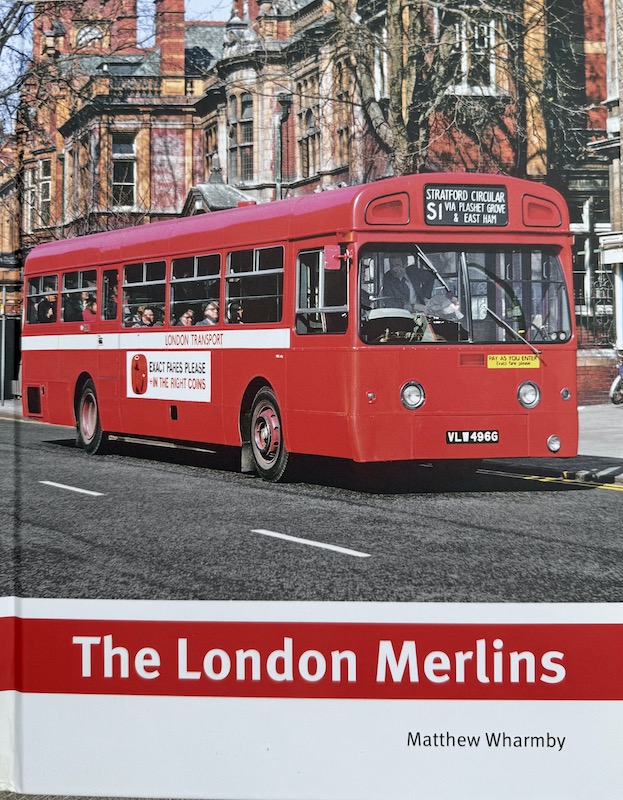
Here’s the first: it’s the sad tale of the London Merlins told by Matthew Warmby.
And if you’re thinking that’s not a book for me, far too niche, you’ll be surprised just how many times history repeats itself within the bus industry (or rail industry for that matter) with decision makers thinking they’re making the right decision, often taken well away from the ‘operational front line’, and ending up wasting a fortune on a fleet of unsuitable vehicles deploying operating practices that are a complete turn off for passengers.
That’s what happened when London Transport bought 665 AEC Swift single deck buses in the late 1960s as a way of solving two intractable and continuing problems having a devastating effect on service quality – traffic congestion impacting reliability of long trunk routes and severe shortages of drivers and conductors leading to many journey cancellations.
This was at a time before driver only double deck operation was legal, so to be fair to London Transport’s senior managers for a paragraph – they didn’t have a lot of options open to them of what to do.
The ‘Merlins’, as the vehicles were initially dubbed, would see the suburban ends of long trunk routes into central London cut back with shorter ‘satellite style’ feeder routes into ‘transport nodes’ such as Underground stations (they’d be called ‘mobility hubs’ in today’s parlance) and thus improve timekeeping and, being one-person-operated, they’d also help resolve the staff shortage.

Matthew provides a comprehensive and fascinating background explaining how the flawed decision making process lead to what became a debacle of monumental proportions. Having successfully introduced the first Red Arrow route, numbered 500, in April 1966, London Transport set about introducing many more schemes to revolutionise the Capital’s struggling bus network, beginning with the largest ever set of route changes in its history on 7th September 1968. Matthew explains how and why it all went disastrously wrong.
The changes coincided with the opening of the Victoria line (initially between Walthamstow Central and Highbury & Islington) and saw 1,100 buses – a fifth of the total bus fleet – move location and 150 new Merlins enter service overnight facilitating a substantially revised bus network across north London and an expanded Red Arrow network in central London.
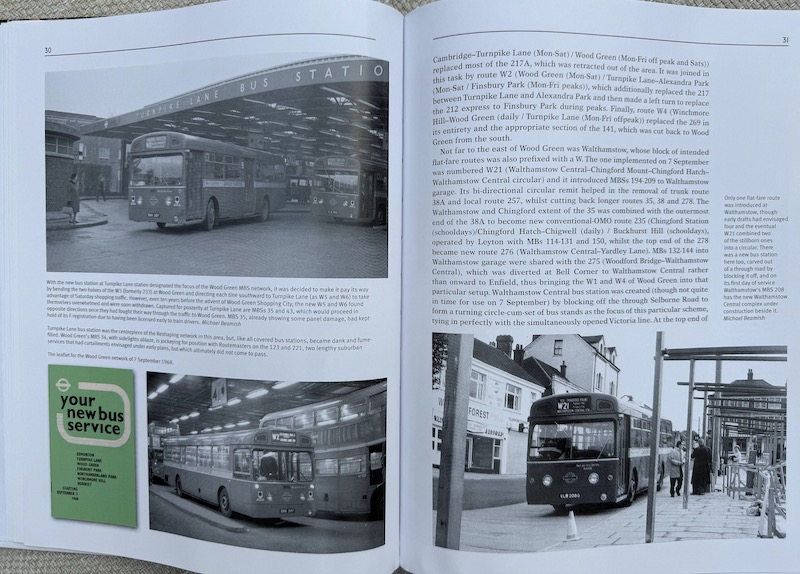
But, literally within hours of the first ‘Merlins’ leaving their garages that first Saturday morning to run the network of new services in the Wood Green and Walthamstow areas deploying a new system of route numbers using a prefix letter – W1, W2, W3, W4, W5, W6, W21 – together with an alien system of fare collection, it became a shambolic disaster.
I lived in the area at the time – on the W4 route in Winchmore Hill – and as a keen 14 year old interested in this revolutionary development of London’s buses can still vividly recall riding up and down the fledgling route and thinking ‘this is never going to work’.
And while it’s accepted any major change leads to inevitable teething problems, which usually soon settle down, it was very clear in this case, as matters worsened day by day, that far from things improving there was going to need to be a full set of teeth extraction.
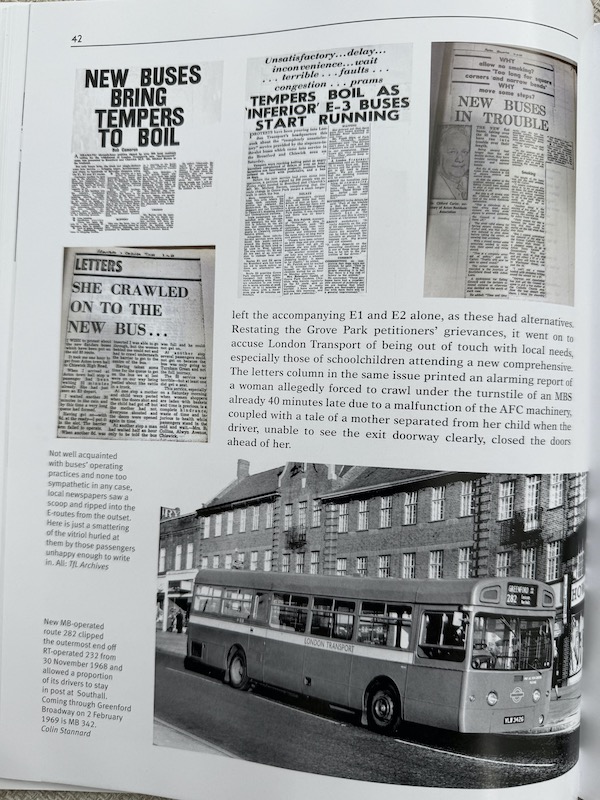
A myriad of problems were faced by both passengers and staff. For passengers the new fare collection system proved impractical. Two turnstiles greeted you on boarding each with a machine accepting pre decimalisation 3d and 6d coins for the new 6d flat fare. Children had to use the offside machine and press a button which made a sound to alert the driver they’d be paying 3d. Parents with multiple children had to pay for each one individually in turn and imagine how it was for a parent with a push chair – which had to be folded – and multiple children and shopping. Many passengers with shopping, having managed to find a free hand to insert their 6d (no change was given), would push the turnstile ahead of them with their shopping bags resulting in the shopping going through but the passenger facing the next bar of the turnstile still on the wrong side. After eventually passing through passengers arrived in a standing area with no seats between the turnstiles and the centre door, with just 25 seats in the raised rear section. The buses were soon dubbed ‘cattle trucks’ and loathed.

LT bosses had made the fatal mistake of thinking because similar vehicles introduced in 1966 on new Red Arrow route 500 between Victoria and Marble Arch had been a huge success, the same principles could be successfully applied in the suburbs on new shortened flat fare routes. They forgot that what might be acceptable travelling conditions for hardened peak hour commuters are not appropriate for suburban passengers used to having a seat and personal service from a conductor.
Drivers faced challenges getting used to the 36 foot long vehicles which weren’t ideal for many of the routes with tight corners and narrow widths to pass through while the mechanical and structural state of the vehicles themselves caused the biggest headache not helped by them being in storage for months and even years while LT managers had been trying to negotiate an agreement with the TGWU for their operation. They were alien vehicles for engineers at garages, more used to the simplicity of Routemasters, RTs and RFs.
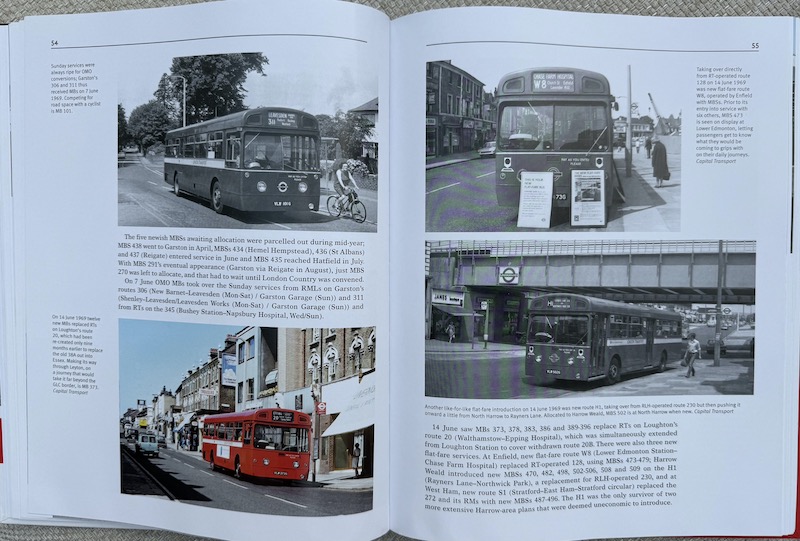
But by September 1968 it was too late to change course in the light of that disastrous north London launch. By then the die had been cast. LT bosses had already ordered hundreds more similar buses, committing themselves to further flat fare schemes in Ealing, Surrey Docks, Hackbridge, Muswell Hill, Enfield and more.
Local media had a field day as more schemes were introduced.
Modifications were made to the buses over the ensuing months including fitting seven individual seats in the standing area and trialling a changed fare collection system with a machine on the nearside able to issue three fares and passengers able to pay the driver on the offside ‘channel’ with officials realising a flat fare system was not going to work universally across the network. In due course further buses were ordered to a shorter length and referred to as Swifts but that’s a development for a follow up book in due course.
It wasn’t all bad news. Merlins were successfully deployed on an expanded network of Red Arrow routes, albeit a network that seemed to be constantly changing, and others were operated on a pay-the-driver conventional basis on some suburban routes and had a relatively happier time. But by 1973, just five years after introduction on the Wood Green scheme, the decision was taken to withdraw much of the fleet and replace it with the shorter Swifts, new Fleetline double deck buses (which had their own troubled career with London Transport), or by the late 1970s, a smaller Red Arrow network gained Leyland Nationals.
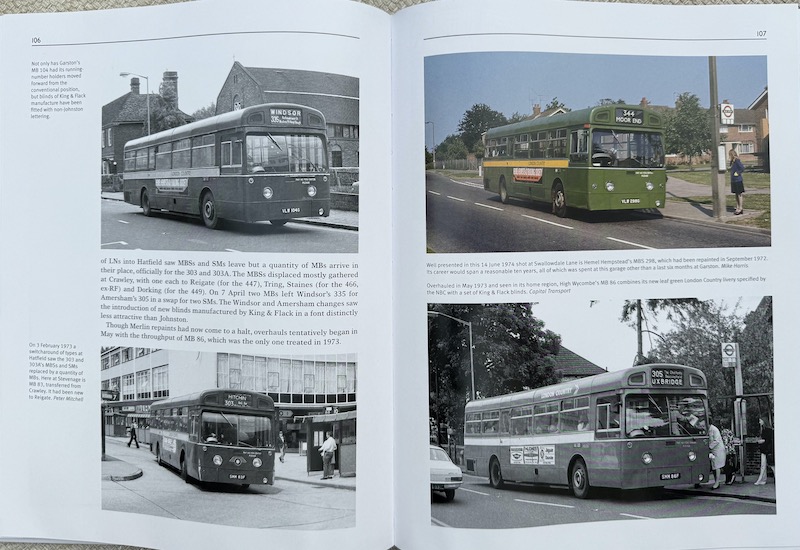
A number of Merlins passed over to London Country on its formation in 1970 with some of these initially adopting yet another fare collection system – Autofare – which was also soon abandoned. If only Oyster, Smartcards and contactless had existed 50 years ago, some of these issues would not have arisen.
Indeed, similar issues with impractical fare collection impacted the ftr (Streetcar) roll out initiated by First Bus in 2006 when company bosses expected passengers to board and start faffing around with a self operated ticket machine at the front of the bus. At least there were no turnstiles. Translink’s Glider in Belfast got around the problem by installing ticket machines at the ‘tram like’ bus stops and in any event by their introduction in 2018, smartcards had become a thing.
I see Mayor Rotheram is hyping up the planned introduction of similar buses for the Liverpool City Region and quoting “the 18 metre, articulated vehicle can carry around 30% more passengers than an average double decker bus”. What he doesn’t say is those 30% extra passengers will be standing, not sitting. Maybe that won’t matter when passengers are travelling to John Lennon Airport, Anfield or Bramley Moore but it won’t go down well when making longer journeys around the Region – something I found when using the Glider route – it’s not pleasant to stand for so long.
The Mayor’s assurances have a familiar ring to London Transport’s enthusiasm for the introduction of the Merlins in 1968 as Matthew chronicles.
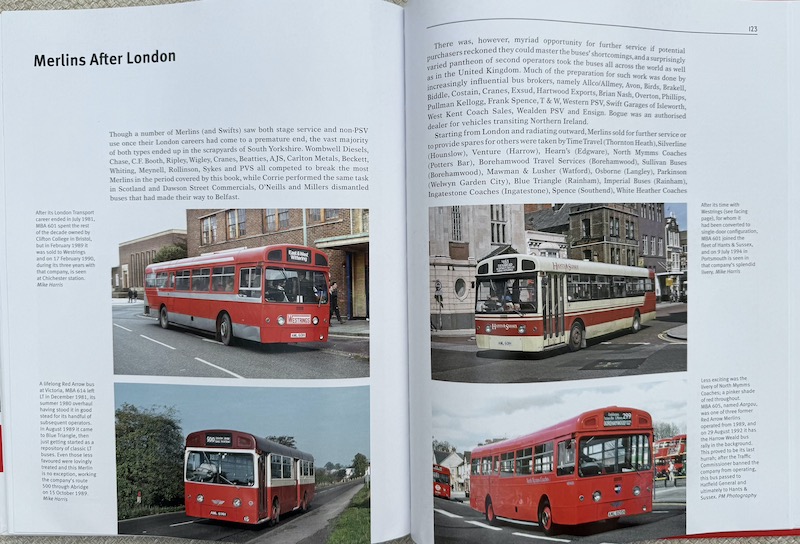
Matthew’s book will not only appeal to those with a thirst for the detailed history of which London bus routes succumbed to Merlin operation as well as lists of vehicle types, garages which operated them, disposal lists and life after LT but also to those with a more general interest in how decisions are made in a large organisation such as London Transport and why things go wrong.
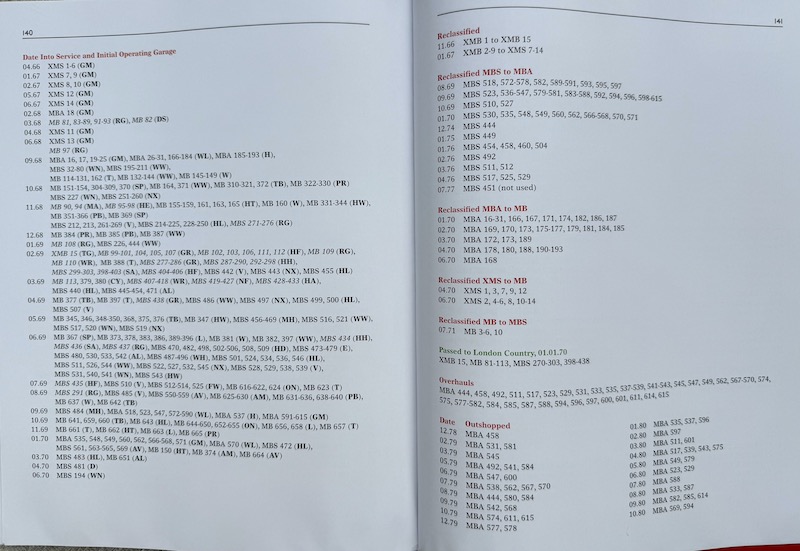
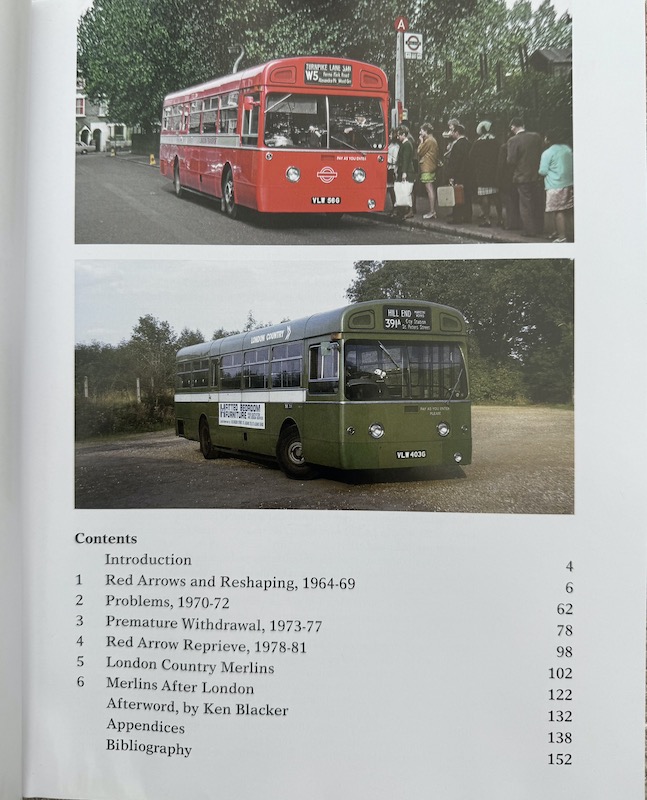
As you can see, the 152 page book is fully illustrated with excellent photographs depicting every type of Merlin at work on the routes operated.
It’s also a very readable chronological account of the decade or so spanning this sad and sorry tale. Aside from the detailed Appendices the book ends with a fascinating six page “Afterword” written by Ken Blacker (a former London Transport manager) looking back on how and why this “unhappy era in London’s transport history” arose.
The book has been produced to the high standards one expects from Capital Transport and is well worth the £30 cover price, especially if you were a 14 year old schoolboy living in Winchmore Hill at the time.
Roger French
Summer blogging timetable: 06:00 TThSSu


I have a copy of “The London Merlin” by Ken Russell dated June 1980. £2.25 also Capital Transport. It runs to 188 pages. I feel sure that Wharmby’s book overlaps with the two versions of “Reshaping London’s Buses” by Arnold & Harris dated 1982 and 2018. Rather naughtily the 2018 book does not mention the 1982 edition. Gladly I knew about and had a copy of the 1982 version when I bought the 2018 version. I also have a copy of the LT booklet produced when sales of the wretched Merlins was about to take place. The 1982 book cost me £8.95 with the 2018 version costing £30. Russell also wrote a book about London’s Swifts of which I have a copy.
As to Wharmby, he lives or lived in a flat above shops on the east side of Bridge Street in Walton on Thames. I tried to look for his front door once to no avail so it may be via some yard at the back of those shops. However, I met him outside Walton on Thames Station. It was blazing sunshine and a man standing by a bus stop had a carrier bag in one hand. The bright sunshine enabled me to see that the carrier bag contained a book about buses. So, I said, “You must be Matthew Wharmby!” to which this man replied “Yes!”. However, this “exchange” did not initiate a conversation.
LikeLike
As a child I lived in Morden and remember when these were introduced on the M1. A bus was on display outside Morden station to explain how it worked to passengers before the route was introduced. I don’t really remember travelling on them but I everyone mourning the loss of the 151 which the M1 replaced. I did enjoy travelling on these on the Red Arrow network and remember them having RT moquette. In latter years I travelled across London and the country area taking pictures of them. It was quite exciting to see a red one on a country bus route helping out with the then vehicle shortage. Digging out some old photos recently I found a picture of one in Townsend Thoresen livery at Dover Western Docks which I took as a teenager. Happy memories.
Martin W
LikeLiked by 2 people
Oh yes! I remember Route M1. I used it in my “Crystal Palace era” going from home in Hersham to the game. Changing from an eastbound 213A to an eastbound 154 in Sutton was an awful bind so using Route M1 going to a game was the better option.
LikeLike
Reminds me of the VIDEMAT fare system tried by municipal operator Portsmouth City in the 70s.
I also recall Hants & Sussex (Basil Williams) buying a few 2nd or 3rd hand Merlins/Swifts that lasted until the mid/late 80s in his fleet.
LikeLiked by 1 person
While I am not sure if Matthews book covers any new ground, insight, or photographs I must admit he has been passionate about the London buses we love to hate in bringing all that information together. I dont think many other UK cities fared (sic) any better with their similar vehicles and service changes , though BET style single deckers and Bristol REs were in place moving out things that were in London at best RF shaped for far too long. Portsmouth’s single deck services I think replaced a few double deck routes and a few municipals – Ipswich notably went 100 percent single deck but without the mass change of routings serve as examples where things seemed to work without incident.
For Red Arrow Routes did arrivals of passengers at Victoria and London Bridge have season tickets that covered LT Bus Services ?
Is the 36foot (or 11.3m in new (leyland national) money) Suitable for use anywhere in Great Britain? Park and Ride Shuttles seem the natural home for something able to carry a standard double decks worth of passengers (56) and really much the same – and guided busways – for the ftr style and similar artics.
The Victoria Line had been some 30 years in the planning yet really was devised as a means of allowing changes to suburban rail services and relief of other tube services (northern, pic, Southern from Brixton, LNER routes into Kings Cross ) but the network of buses seemed to be an afterthought rather than a meaningful assessment of just where people’s changing travel might be and LT thought that they could get away with some lower frequencies which may be true but I would always allow the tube service to settle down first before seeing , for service reductions , how passengers adapt. Similar happened with the Elizabeth Line introduction
1966 was only a few years after the last of the trolleybuses had gone, with North London loosing its comprehensive, high passenger numbers carrying fleet and this one feels had been retrograde , a less complex trolleybus network feeding into the likes of the Victoria Line could have been interesting , swift and with hindsight , less CO2 and at tailpipe pollution. North Londons NW postcodes had also been hit with the loss of the Northern Heights trains LNER and the Northern Line Plans – even if that did lead to a better use of the Northern City Line tunnels with services from far out Hertfordshire – Could adding the Northern Height Edgware purposes to a Victoria Line segment have worked ? – Of Course the Green Belt removed development opportunities and Londons resident population of 9 and a bit Million remained static as residences in the New Towns were encouraged.
Forward to today . The Green Belt (And Allotments) are under threat, the Tower Blocks are back (With effectively still inherent problems of Ronan Point and Grenfell in that if something goes wrong it effects a lot of people in one go) with no thought of how public transport should connect and TfL still make inexplicable decisions on bus services using the same words to justify changes, cutbacks , re routings and new services.
London too has increased in size to a declared 10million resident population with the numbers growth coming from more people on the same plot size and the growth of docklands and beyond eastwards. A changed demographic too with the living over the shop to commuter urbs to now bed and (Delivery) bike being the travel (or not) to work, Yet to provide better bus services (and health, and education) needs even more population to provide enough capable, skilled, staff. Maybe a key is to look at those pesky cross-border services , back to using and connecting out of London locations eg Grays for services to Romford and Barking – enhancing rather than the retrenchment of more recent years.
So where should the Merlins have gone – to me Thamesmead – Bexley has far more open and had more of “straight and wide” road network. And I would have planned routes to have comprehensive rail like limited stop bus services overlaying the traditional bus network – which could have had some frequencies reduced – Would it have worked , not sure , but I think these The Bakerloop bus service could be happily extended to both Thamesmead and Hayes from Lewisham using single decks at a highish 5min/7.5min/10min frequency, and certainly running the Superloop Greenwich- Thamesmead with single deckers retaining the other route too for comprehensive service coverage.
JBC Prestatyn
LikeLike
It wasn’t Ipswich that went 100% single deck. It purchased its last AEC Regents in 1966 and its first Atlanteans in 1968, with the last such models arriving in 1981.
If there was a municipal of size that ditched all its double deckers, I can’t think of it.
Was it perhaps Hartlepool (last new deckers 1965) or Darlington, where the last Daimler CCG rear loaders held on for years (31 December 1981, says the internet).
KCC
LikeLike
Sunderland
LikeLike
Possibly. It bought its last double-deckers (Daimler Fleetlines) in 1966 at the same time as it started buying large numbers of rear-engined single-deckers (Leyland Panthers, Daimler Roadliners, Bristol REs & AEC Swifts) as it introduced large scale conversions to one-man-operation. None of the double-deckers were ever converted for OMO.
Sunderland also kicked off its roll-out of the new fleet by introducing a flat fare scheme that had self-service ticket machines using a tokens system. Unfortunately, the flat fare led to massive revenue losses and was changed to a zonal fares structure.
William.
LikeLike
What the current division of councils, services and planning fails to recognise is the growth of London is also leading to the new towns in the Home Counties to grow at broadly the same fast pace, putting huge pressure on places where the public services are very inadequate after 15 years of austerity measures. The exact places many people left London for in the 1st place. London in the 80s barely had 6.5 million people and around 7 million by 1995, when I was born. It’s somehow fast approaching 10 million today with no major increase in size outwards and not much upwards in outer London. At some point, if the city and surrounding regions keep growing like this, government structure will have to adapt and change with this population growth.
I really agree they need to sort out the cross-boundary routes, bane of my life being able to get within 2 miles of my house 24/7 but because my address is in a different county (Cheshunt, Herts), nothing to cover the last bit after 10:30pm by bus! Only TFL and proper regional government structures can meaningfully sort these sorts of problems out.
Aaron Smith
LikeLike
Probably need to reunite the Red London buses and as significant part of the old London Country are but not as far out as some of the far flung area that were really just for the Greenline services. Perhaps extending out from London by about 5 miles
LikeLike
Hi Roger
I drove SM’s at Chelsham between 1971 and 1974 on the OPO routes 403a (483) and 453 and 403 on Sundays, though with the not best operational reviews, I enjoyed my time driving them.
The Wandering Busman
LikeLike
I forgot, also single door versions on 132’s at BX in 1978/79. They seemed suited to the outer London area.
The Wandering Busman
LikeLike
Also the 132’s at BX 1n1978/79. They were well suited to the outer London area.
The Wandering Busman
LikeLike
Interesting that there were size issues, given that today’s Borismasters, operating in far worse traffic conditions, are longer (11.2m v 11m) and wider (2.55m v 2.5m) than the Merlins. Many electric buses on the streets of London today, including quite tight suburban routes, are close to 11m in length as well.
Steve
LikeLike
Whatever you think about the visual style (and for my money upstairs was a a overheated gloomy disaster), it’s ironic that the Bendybuses were replaced by objectively the least efficient double decker design of the modern era. Who would gave guessed that using up huge amounts of space with doors and staircases was a terrible idea? Prehaps the only way the Borismaster is the descendant of the RM is in its complete failure to win non-London customers on the open market.
LikeLike
Perhaps the only way the Borismaster is the descendant of the RM is in its complete failure to win non-London customers on the open market.
Not quite true. Northern General bought 50 forward entrance versions plus LT’s only FE version RMF1254. Not forgetting the shorter 65 forward entrance versions bought by BEA, albeit influenced by LT.
As for the New Routemaster, TfL are likely to have a hard job selling them on once their London lives come to an end.
LikeLike
I misread your comments Phil, so stand corrected. The New Routemaster for all the hype didn’t attract any orders from the open market, as you state.
LikeLike
And you’re quite right about the NG and BEA Routemasters. I decided a little historic inaccuracy was justified in pursuit of the Borismaster dig.
LikeLike
It’s not just the length that matters, it’s the distance between the front and rear wheels that matters to bus drivers.
LikeLike
They were ill suited to the narrow hilly North London residential routes which is one of the reasons they failed
LikeLike
Not sure exactly where I read it, but just this week saw the original intention of London Transport was to operate way over 5000 of them!!…….Still having nightmares….
Terence Uden
LikeLike
Pretty sure there’s a table from the Reshaping Plan included in the Reshaping London’s Buses book which shows the projected future fleet. IIRC the single deck heavy fleet mix was out of date almost immediately once double deck OMO was legalised. But LT had ordered so many Swifts and Merlins at that point the damage was done.
LikeLike
Well, I never thought I might want to read a book about the Merlins, but your review has piqued my curiosity. I remember the first Red Arrows, which appeared to be popular at the time, and gave passengers arriving at Victoria station some good options to get to where they wanted to go. The coin-machines meant having to be carefull you had the right money, but that was something a teenager had to be mindful of in general at that time.
When the first green ones started replacing the old dependable RTs, my first reaction was ‘excellent – doors – they will be warmer in winter’. But the novelty soon palled, as they got delayed by faretaking, and the very awkward steps, and of course the more passengers they carried, the more delayed they got. I couldn’t understand at the time (and still cannot) how a whole industry knowlngly made its product worse (slower and less reliable) at a time when the competition (the private car) was becoming faster and more reliable. And no one in public transport management seemed to have any idea that integration of bus and rail might compete better with cars. If they couldn’t bear the thought of increasing pay-rates, and had set their minds on OPO, it would surely have been better to introduce zonal tickets for a week/month/year (like filling up the tank of a car, or paying road-tax).
LikeLike
In London they first started to convert to one man operation by replacing the Red RF;s with surplus green ones as the green ones were fitted with doors. Quite why they never got around to fitting doors to the Red RF’s I dont know
LikeLike
When the red RFs were first introduced into the Central area they were not allowed doors because the Metropolitan Police argued that they were not safe! They even tried to ban 8ft wide buses (RTWs) running in the city until LT demonstrated there were no issues. If you go back far enough the MP even stopped roofs from being fitted on double deckers in London until the 1920s. Just as well they don’t have a say in such matters now.
LikeLike
My dad worked on the River Thames and was involved in the annual Thames Pageant.
As a small boy, I recall London Transport somehow secured a Merlin on a barge which was towed by a tug.
This was to help introduce the new bus to Londoners.
A very strange sight it’s too!
LikeLike
Page 23 of “Reshaping London’s Buses” first edition 1982.
LikeLike
I think the earlier comment related to Capital Transport not making any reference in 2018 that this title had already been released in 1982. Having personally bought the 1982 edition I wasn’t tempted to buy it again in 2018 irrespective of the different dust cover photos depicted.
LikeLike
As a Brummie schoolboy (and Birmingham City Transport bus enthusiast) back in the late 1960s & early 1970s, I remember a small fleet of AEC Swift “standee” buses operating one route. They weren’t popular!
LikeLike
https://archive.commercialmotor.com/article/6th-october-1967/44/aec-standee-bus-fleet-for-birmingham
LikeLike
Notoriously, weren’t the BCT engineers so conservative that they basically ordered their standard Fleetline double decker with the upper deck chopped off? Seem to remember reading that as a result they were wildly over engineered and had a dire fuel consumption.
LikeLike
yes there were also some single deck buses around that were Fleetline:
https://www.wythall.org.uk/1st/birmingham-city-transport-daimler-fleetine-bon-472c
LikeLike
Why was the AEC Swift dubbed “Merlin’ by LT? Yes, it was a longer variant, but why not something like ‘Martin’ or ‘Swallow’ to keep the bird connection?
I also recall using the AFC (automatic fare collection) machines on SMSs. Apart from the machines jamming, or requiring the barrier arm to be rotated to make it work, I also recall waiting for the Fare Stage to be updated. If the stage was ascending, that was an easy increment of 1; if it was descending, then the machine had to chunter all the way to the highest fare stage, before restarting at 1 and stopping at the fare stage one before the previous fare stage.
MotCO
LikeLike
A Merlin is a bird!
LikeLike
As an avid 14 year old bus enthusiast (living in Ealing) I was able to acquire information on forthcoming changes from the staff at both Hanwell (HL) & Turnham Green (V) garages on my frequent visits during 1967. The mechanics told me they were dreading the ‘new’ single deckers planned to take over certain routes due to the difficulty of getting them over the pits as well as being rear engined. Later that year I moved to the south coast with my parents but managed to revisit Ealing to see my old friends from time to time. My regular bus route had been the 55 operating between Hayes & Chiswick & operated by RMs but during a visit in early 1969 I was horrified to find Merlins (MBSs) running on the replacement E3. I decided to take a ride to Greenford (as the Hayes section had been withdrawn) & although I managed to get through the turnstiles o.k. there were no seats available. During the journey there & back to Ealing I overheard many people complaining about the lack of a conductor & seating. Like you Roger, I remember thinking ‘this isn’t going to work out well’. And of course, it didn’t. But the E3 continued & remains to this day.
LikeLike
Weren’t there structural problems with the Merlins rear ends flexing? I think other first generation rear engine single deckers had similar issues. LT should’ve ordered Bristol REs, the most successful model of that first generation. Then Londoners could have delighted in the wonderful sound effects of the Leyland engines and transmission whine.
Regarding one person operation, the mistake was to persist with on board fare collection. On the continent the conductor’s job was given to the passengers via ticket vending machines at stops, ticket sales from newsagents, simplified zonal or time based fares. In the UK they just gave the job to the drivers, and kept the multi fare stages and change giving and associated mental arithmetic, time pressure, nightmare job! Some municipals did adopt auto fare exact change systems, and initially city buses had exit doors to improve passenger flow. Critics of exact fares always drew parallels with shops not giving change, but to me this is silly as buses have places to be and can’t linger for long, they are not shops.
Peter Brown
LikeLike
I’m a “Red” that used to stand
on the Kop in the early 1980s
watching Liverpool FC in their
pomp.
After matches a line of
untimetabled relief journeys on
14s ferried supporters back to
the City Centre. Fans hopped
on board either showing their
Zone Tickets or giving money
to the driver.
I vividly remember journeys
with fans standing in the bus
waving flags and singing “You’ll
never walk alone” was all parties of the experience.
On one occasion their singing was interrupted by an almighty bang when the Leyland National we were aboard was struck by a car that pulled out into the side of the bus.
A traffic policeman close by
took charge of the accident,
Thirty of us “Reds” then piled out and stood in the middle of a busy road junction and flagged down a huge “Jumbo” driven by a “Red” after other buses driven by “Blues” gestured they weren’t
going to stop.
Asked to be a witness I wrote my name and address with my the pen on the Drivers payslip as it was the only bit of paper he had.
Thanks to its sturdy construction the policeman was grateful that the bus could to be swiftly driven away to depot for repairs, the Driver obliged after all he had nothing to pay in!
John Nicholas
Merseyside P.T.E. travels
Happy Days!
LikeLike
The Confederation of Passenger Transport might want to buy a batch of these books and send them to the Combined Authorities/Mayors. History does have a habit of repeating itself, especially as the organisational memory goes.
At least in the West Midlands we’ve been spared for the moment from the SPRINT articulated buses with passengers from Walsall or Birmingham Airport to Birmingham City Centre being forced to stand for half an hour or more. Millions will be wasted, Rotheram will end up out on his backside and the Liverpool blunderbuses will end up in a South Yorkshire scrapyard with the Borismasters.
LikeLike
The borismasters seem to have settled down now, with the lower number of passengers travelling in london they offer about the correct seat miles and crush loads . It was getting rid of the London Artics that argueably was Boris’s biggest waste
JBC Prestatyn
LikeLike
Not if you were unfortunate enough to live on one of the routes.
LikeLike
This is what I like about history, we can see the past mistakes and mishaps and successes to join the dots to how we got here. Turnstiles obviously are seen as a bad idea on a bus now (I bet the routes this was tried on were always very late!) but the flat fares on these suburban routes were eventually adopted across the London network decades later and to an extent, all of England if the last few years are anything to go by. The Merlin’s may have been seen as a success with today’s card technology but I’d like to think today’s buses are better given how events panned out. Also, is great to see old pictures of any W routes in London, I grew up on the W8 in Edmonton and Enfield, which itself was introduced in 1969 (long before me).
Aaron Smith
LikeLike
To me a Merlin can be nothing other than a legendary aero engine.
LikeLike
Have just remembered one small point regarding the building of Merlins and the later Swifts. During a week long London Transport staff visit to Leicester in 1969, I shared a room with an Engineer, based at Chiswick. I was astonished to learn that for most of each week he had to patrol the factories where they were being built, Birmingham at least for some I recall, to check the manufacturers were not skimping on the various level of floor ply required between the different classes. Standee types really required very strong floors, and LT had discovered that not all had been built to specification.
Terence Uden
LikeLike
Looking at the pictures it is interesting the front end treatments of the LT roundel, none, outline, or full infill with black (red ?) and gold. The use of the small fleetnumbers challenged my eyes (the Swifts got the larger ones generally back on them) , almost as if LT were embarassed by them. Another reason for the storage rather than bring into use was new bus grant being announced but only applicable for registrations from a certain date.
Pay as you board had been trialled before with an RT with conductor seated at the rear and a country STL with front doors again seated conductor , the experiments were not a success from memory.
LT had trialled new single deck chassis , Bristol and AEC (no Leyland Panther?) so some idea of what might be needed was being worked out. Routemasters ended their main LT batches as F suffix registration numbers and thus the new era of the Single deck came in mainly with the G reg ones which was a nice form of continuity.
Wood Green of course also had its forward entrance buses – The Eastern National Bristol Lodekkas but even On The Buses didnt try to copy LT with the route changes to single deck ( although run in to the garage front and rear were shown in the TV series most internal shots were studio mock ups or a few varieites of ENOC vehicles at ITV (London Weekend) Wembley Studios and streets around there as far down as Ealing. Later series would bring in references to NBC and use LCBS XF vehicle and using a lot of AH in the Banfield era when studios moved to using LWT Tower at the South Bank.
There are some film and other views of DP ENOC Bristol REs presumably on one of the Routes to Wood Green and these appear to be long versions – did they work through to Kings Cross and how regular were they compared to Double Deck use. I suppose we were spared MBs on Green Line duty – though maybe it would have suited them. I cannot remember what Maidstone and District would use in its small amount of cross into Country area services but Southdown at Horsham seemed to be AEC Reliances missing the Swift era completely ? Eastborne chose Leyland Pathers but again how comparatively reliable were they ?
Stop-Start of urban bus operation despite what many say was not unique to London – but was London’s general slow urban bus speeds common elsewhere ?
Perhaps the device that ended up speeding boarding was the Almex A ticket machine which maybe is underrated in its role in public road passenger transport.
JBC Prestatyn
LikeLike
It’s likely that LT didn’t need to trial the Leyland Panther chassis because it was the same as the AEC Swift/Merlin. Remember, Leyland took over AEC in 1962, even though at the time it was reported as a merger. Once the FRM was cancelled AEC was on borrowed time & the rest is history.
LikeLike
I was a 14 year old schoolboy in North West London in 1968 and was none too impressed with the Merlins, particularly when they replaced the RLHs on my local route 230 and it became the H1 in June 1969. The RLH is still my favourite type of bus. One factor that is not mentioned above is that the drivers of suburban Merlins with semi-automatic gearboxes had been driving RTs and RLHs with Wilson pre-selective gearboxes and they tended to drive the Merlins as if they had the pre-selective gearbox.
PS Maidstone & District used AEC Reliances for their 36 foot single deckers until briefly switching to Leyland Panthers and then bought 75 shorter length PSU4 Leopards. Southdown had bought Leopards from the early 1960s (the AUF batch which was sold to Eat Kent in 1971) and stayed with PSU3 Leopards until switching in about 1968 to Bristol RESL with Marshall bodywork.
LikeLike
And today the same people, or at least those they’ve trained, must be working at the DfT and specifying train interiors: see everything from the thankfully-withdrawn Merseyrail Pacers to EMT’s DfT mandated 158 reseating project to Thameslink 700s and the entire IET project (800-802)!
BCT needed single-deckers primarily for the 27 route which passed under the Birmingham West Suburban line and Worcester & Birmingham canal bridge on Bournville Lane which is even today has clearance of below 10 feet (the link should come up with Google Streetview).
They were more interested in consistency with their existing fleet than worrying about fuel consumption. BCT was still basically profitable at the time and in any case was seen as a public service rather than a profit-led business given that Birmingham City Council was busy moving people out of the inner-city slums to huge council estates on the edge of the city.
LikeLiked by 1 person
I was brought up in Bexleyheath. I remember the Merlins well on routes like 122A , 99 and 132. Also the 126 and 160. You also saw them London Country routes 486 , 401 , 401A etc.
LikeLike
Sunderland was another place to try standee single deckers with a flat fare.
Peter Brown
LikeLike
Great review, Roger!
I think I’ll wait for the forthcoming Short Merlin (SM) Swift book, as this variant is more relevant to me having been transported in an ex-Great Yarmouth example (PEX 174K, if anyone’s interested. It was preserved for a while) which was a regular performer on my school run with Warwickshire operator Catterall’s of Southam. The combination of AH505 engine and Self Changing Gears was quite melodic.
Whilst the Merlins and later Swifts were poor, one does wonder whether the ‘not invented here’ attitude which prevailed at LT was partly to blame? Maybe it was the over-specification of such things as door relays and fares equipment at a time when delivery of replacement components was at the mercy of strike-bound British factories? After all, many of the Swifts and the later DMS class that survived scrapping went on to perform ok in those relaxing spheres of operation as Malta and China respectively!
It was unfortunate for LT to encourage use of these standee buses by exhorting users to treat the new buses like phone boxes – ‘This is a bus. But think of it as a phone box’ read the poster. One can only assume the marketing folk at LT had not experienced the advertising contents of a Soho phone box..!
Dan Tancock
LikeLiked by 1 person
I’m impressed that a blog effectively discussing London events that happened over fifty years ago generates fifty “thoughts”, longer than the blog itself!
And as a 13 year-old schoolboy I remember my bus to school, the 122A operating from Plumstead garage, being converted from RT to MB and trying to explain to my friends why this modernisation was supposed to be a “good thing”. At least the seating reduction was only from 56 to 50.
Steven Saunders
LikeLiked by 1 person
The Shorter Swifts apparently had a smaller engine, which ended up being underpowered.
There is a vlog on the DMS Fleetline and comment noted on that being the CMB purchases were simplifed by taking out the auto gearbox control and the door interlocks. ( re seating and bigger window openings for Hong Kong area too were needed
A Buses Yearbook Article noted that driving Non Stop Radlett to Tilbury did no harm to the Merlins and that basically they were better on a fast coach service rather than local buses , along with LT not reading / following AEC filter and similar service intervals for changing lubricants , checking brakes and greasing all the grease points more than the Regent and Routemaster “automatic” lube systems
JBC Prestatyn
LikeLike
The book sounds an interesting read, but, at the time, they were my least favourite Bus, it was really daft putting multi-standee Buses on the busy 142 from Edgware to Watford, just before Christmas 1975, I had to stand all the way, I also used to get the 299 from Southgate to Cockfosters (when I attended Ashmole School), sometimes got a seat, sometimes not, I remember literature at the time saying ‘you can stand even if seats are available’, no thanks !
LikeLike