Sunday 27th July 2025
Having tried out new route 714 and the soon-to-be-amended ‘almost quirky’ route 555 to one of Britain’s best served villages, I can also report on a few other enjoyable journeys I made in the north of Surrey earlier this month.
As previously explained on my first abortive attempt to visit Wisley, I ended up taking a ride on White Bus operated route 458 from Kingston to Staines-upon-Thames as an alternative bus ride to the non appearing 714.
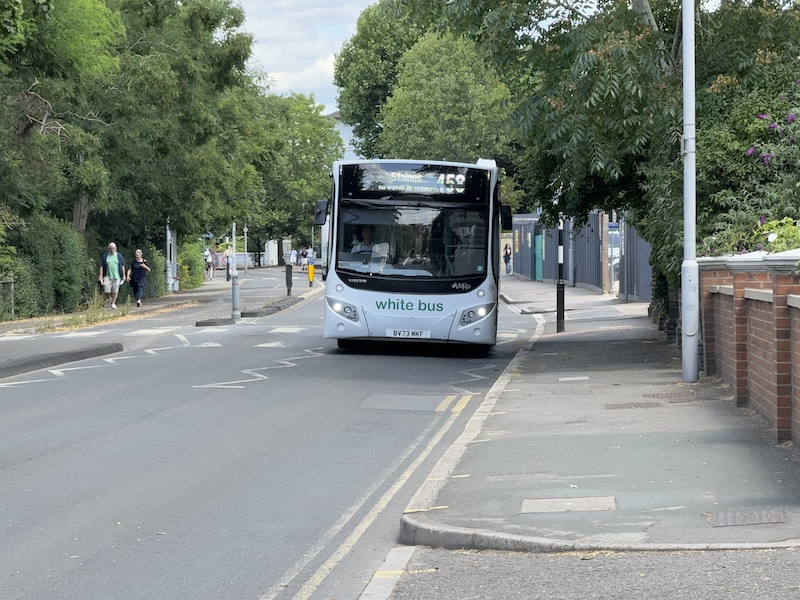
The route takes an east/west trajectory across this part of Surrey on an hourly end to end frequency via Esher, Hersham, Walton-on-Thames, Shepperton and Laleham supplemented by hourly shorts between Walton-on-Thames and Staines-upon-Thames giving a half hourly frequency on that section of route, which, as reported, from next month will become a 459 and commence in Whiteley Village. Ironically that was the quietest section of the route when I travelled on a mid week lunch time journey, but that may have been because the section of route between Kingston and Esher was comparatively busy due to the curtailment of parallel Falcon bus routes that day due to roadworks.

As you can see the route provides very useful links between key locations in north Surrey which are not possible by train as the railway lines from this commuter belt point north-eastwards towards London.
After leaving Kingston late due to the Clarence Street roadworks, the driver was unable to make up time so on arrival in Staines-upon-Thames and a driver changeover used up all the seven minutes layover for recovery and headed back to Kingston five minutes down.

It’s a good strategic route which is clearly appreciated by its passengers.
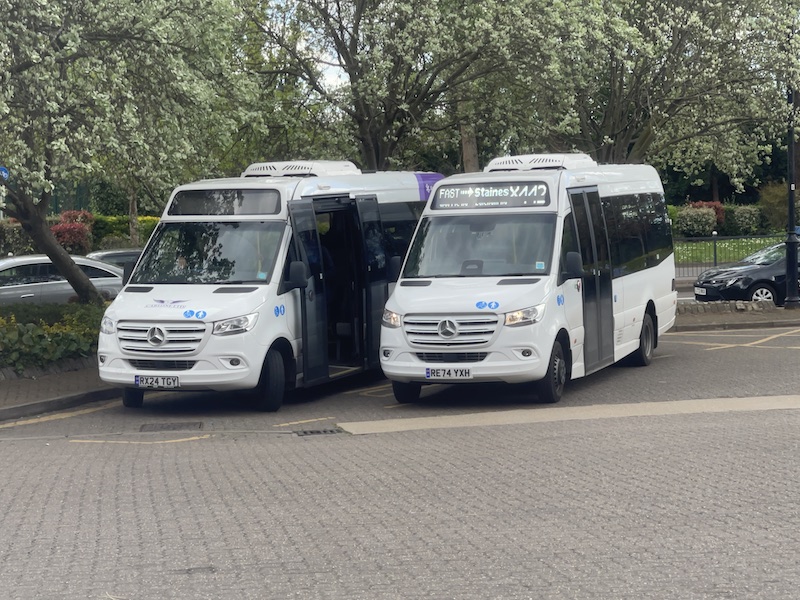
After that I took another ride on the ‘fast’ route X442 operated by Carlone Buses between Staines-upon-Thames and Heathrow’s Terminal 5.
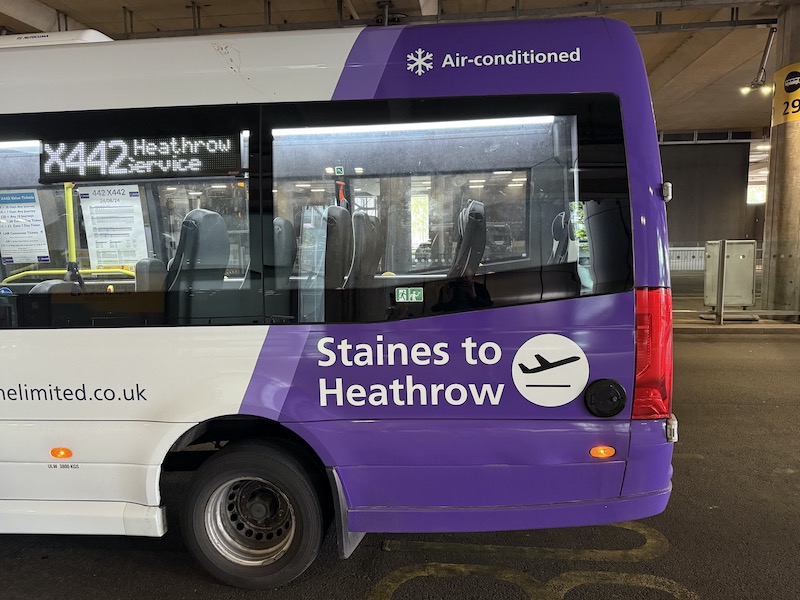
When introduced in November 2019, supplementing sister route 442, the X442 really was ‘fast’ providing an almost non stop link between Staines railway station and the Airport Terminal building which I wrote about at that time.

Since then the route has been extended from the railway station to the bus station which is handy for those wanting connections but it’s via a lengthy detour to the south east corner of the town which I guess is helpful for staff who work at the Airport and live in that part of Staines-upon-Thames.

As you can see from the above map, the ‘slower’ 442 continues to run via Ashford Hospital and Stanwell Moor with early morning journeys to Egham and Englefield Green.
The bus I caught on the X442 from the bus station mid afternoon took a few local passengers home on the south eastern extension and after calling at the railway station we had six passengers on board including a young child in a pram who all went to the Airport.
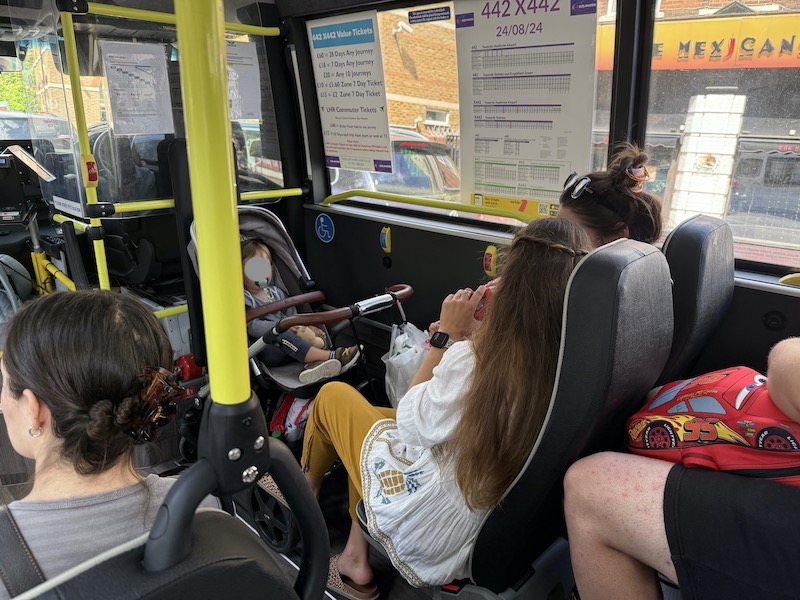
There was also a decent number waiting to board the next journey back to Staines-upon-Thames.
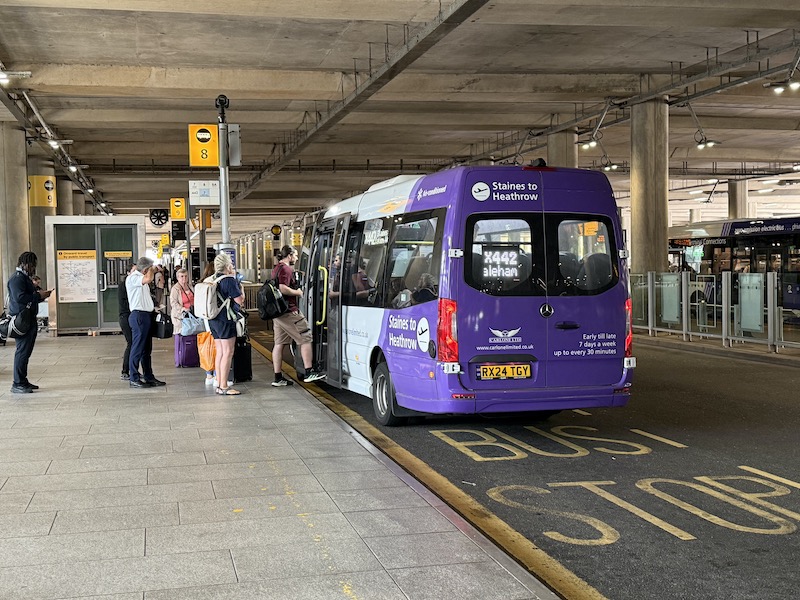
Sadly, six years on, no-one at Heathrow (or is it TfL?) has got round to adding X442 to the flag on departure stop 8 at Terminal 5 but I was very impressed to see a supply of leaflets on board the bus…
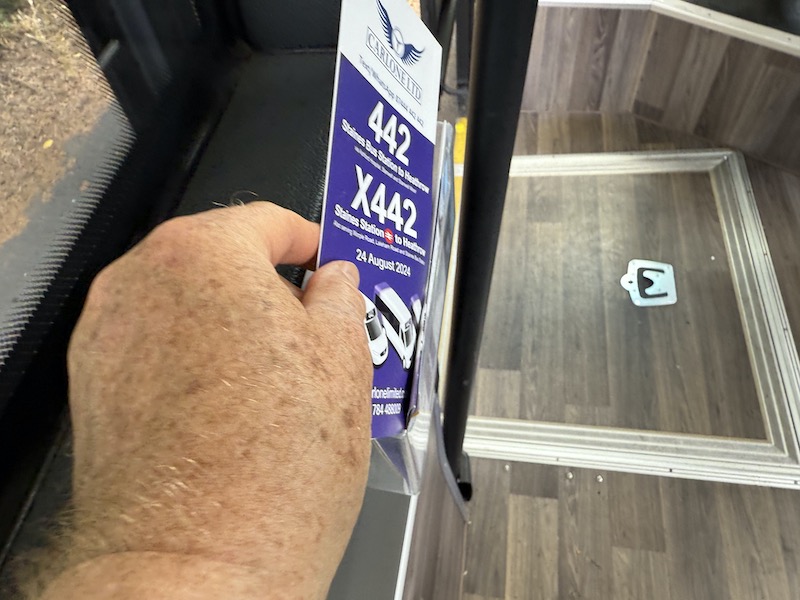
… and poster sized information on the offside window behind the driver, which sadly would block any wheelchair user’s view.

It’s another good strategic route in this part of Surrey which is clearly appreciated by its passengers.
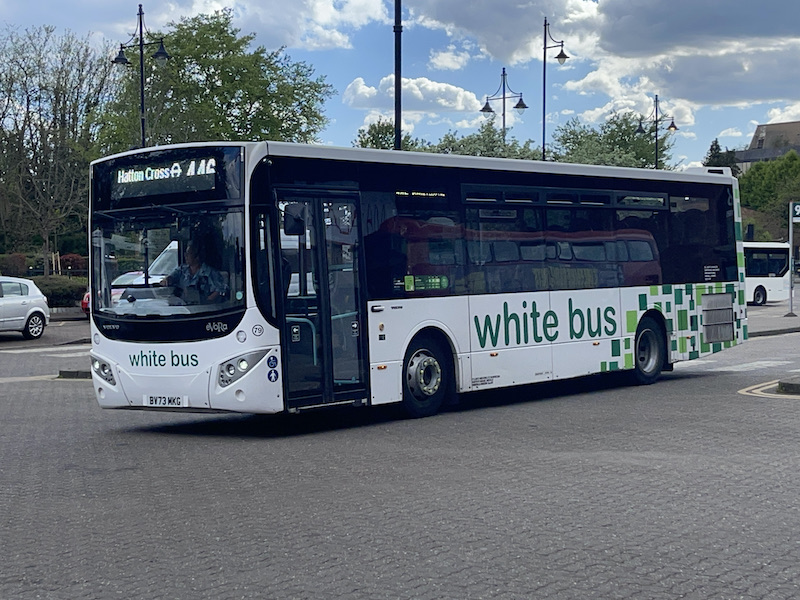
Another recently extended route in Surrey is White Bus operated 446 which links Woking with St Peters Hospital, Chertsey and Staines and from December 2023 had hourly journeys extended via Ashford Hospital and Heathrow Terminal 4 to Hatton Cross…
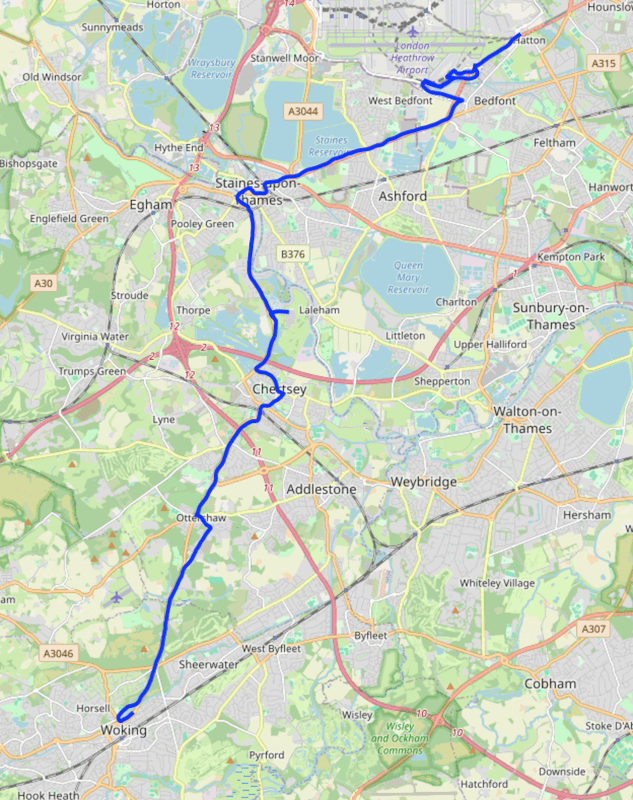
… with a further enhancement in March this year seeing the hourly short journeys between Woking and Staines also extended making for a half hourly service throughout the 20 mile route.

I took a ride to Hatton Cross on the 13:00 departure from Woking with eight on board leaving the terminus. Observing the luggage, I expected a good proportion of these to travel through to Heathrow but they’d all alighted by Chertsey, including three at St Peter’s Hospital where six more boarded. By the time we reached Staines, 45 minutes after leaving Woking, we had 13 on board, 12 of whom alighted in the bus station with the 13th getting off at Ashford Hospital. We carried three passengers to Hatton Cross, one from Staines and two from near Terminal 4.
It was disappointing once again to see TfL hasn’t got round to installing 446 plates on bus stops along the extended route (only 20 months ago)…
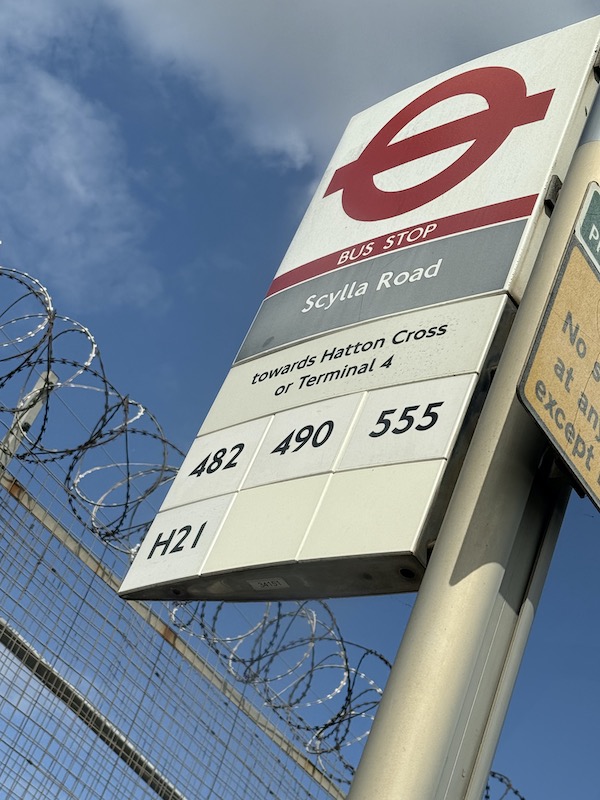
… nor, more importantly at Terminal 4…

… or at the terminus in Hatton Cross.

Hopefully passengers will spot the Heathrow Airport branded sign on the wall in Hatton Cross bus station which does include reference to the 446…

… and there is a timetable in the case on the bus stop pole.
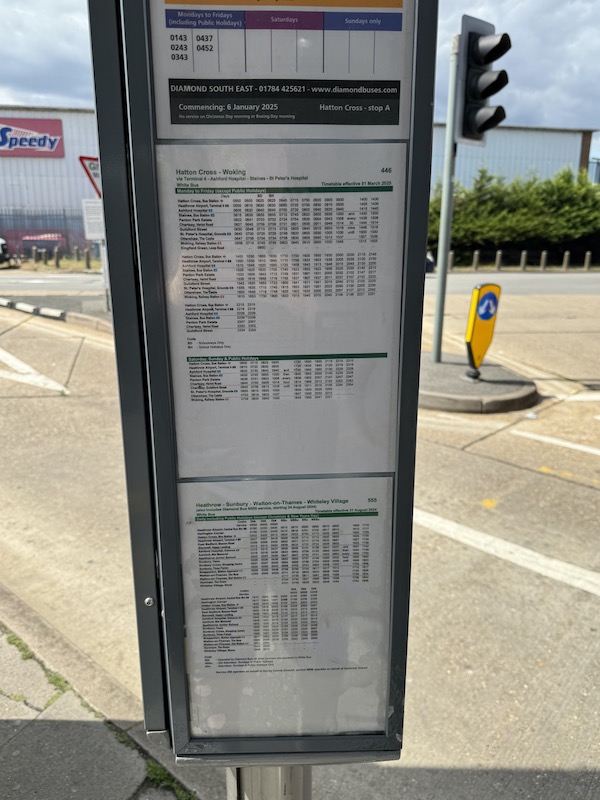
My journey was clearly not at peak travel time for staff at the Airport so perhaps not surprisingly didn’t carry many but I wonder whether Hatton Cross really is the best terminus for staff working at the AIrport – indeed, as recently reported, route 555 is set to join the 446 there when cut back next month.
That aside, the 446 is another good strategic route which is clearly appreciated by its passengers.
My final route in this quartet of Surrey travels was route 437. This is anything but a ‘good strategic route’.
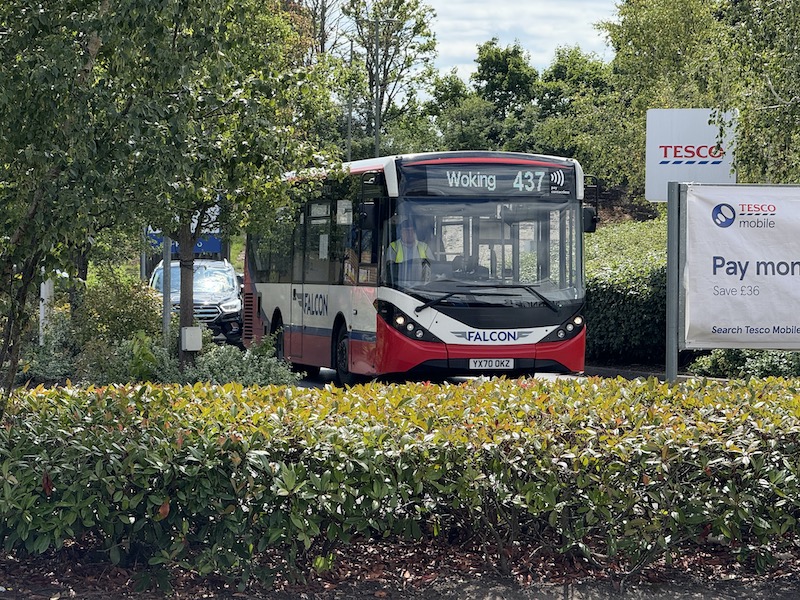
It’s a tendered route operated for Surrey County Council by Falcon Buses providing seven journeys on a 90 minute frequency between the large Tesco and M&S stores at Brooklands, Byfleet with West Byfleet and Woking but rather than operate direct between these main destinations (as the half hourly route 436 does) it serves an area known as Pyrford as shown on the map below…

… which includes some sections of challenging narrow country roads.
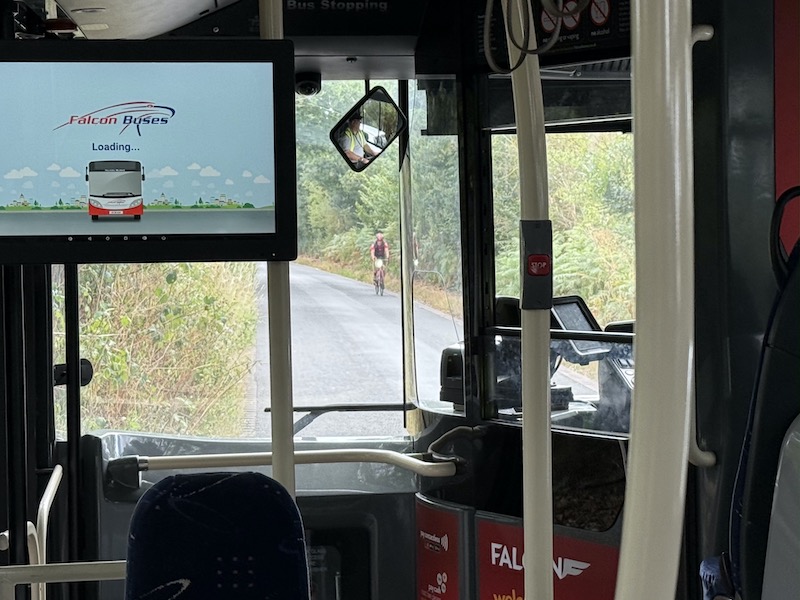
I caught the 14:15 from Brooklands and although we left on time, and picked up another passenger in Byfleet (who was travelling to Woking so it would have been quicker to wait for the 436 just behind us) we arrived into Woking 12 minutes late due to the driver telling us he’d missed the stop at Waitrose as he’d done the circuit by West Byfleet station – which was odd as neither the other passenger nor I noticed he had done so, and we simply went round the block (literally – see map) twice and all the delays that caused in the afternoon traffic.
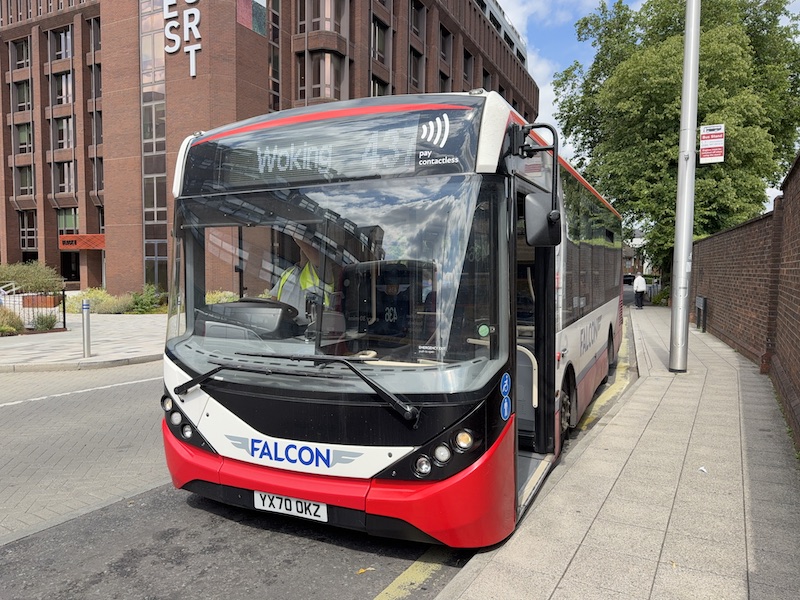
Which made for an interesting experience. Other than that, it was a nice alternative to the 436 to reach Woking.
My wanderings in this part of Surrey have shown how well the County does to provide decent bus services in what is an affluent part of the country where buses are not the first choice for many residents. Not only that but it can easily be overshadowed by TfL’s hugely subsidised service provision just over and crossing the border, by comparison, and as has featured in some of the comments on recent blogs.
The presence of Heathrow Airport and its drive to encourage more of its staff and passengers to use public transport with the benefit of making substantial funding available together with Bus Service Improvement Plan funding have definitely helped the County Council introduce welcome improvements in recent times. The quality of service now provided by White Bus and Falcon compared to some of the operators to be found in the area a decade or so ago represents a noticeable real step change for the better. Recent investment in new buses is hugely welcome to see.
Bus stop plates and timetables are also well presented by Surrey and I can appreciate the County’s frustration with TfL which seems consistently unable to deal with such matters just over the border (where Surrey’s routes operate into Greater London) and shows no interest in providing accurate information for passengers.
TfL could learn a thing or two from Surrey’s impressive online presence too with bus timetables and localised route maps for each town available and up to date as well as excellent printed timetable books.

It’s a shame this otherwise excellent provision is marred by an out of date countywide map which hasn’t been amended since 2022 and now comes with a warning to passengers that it’s out of date.
It would be great if BSIP funding could be used to bring this excellent resource up to date.
This part of Surrey also benefits from having an active Bus Users Group. Both Mark and Graham from the North West Surrey Bus Users Group know their stuff and work well with officers at the County Council for the benefit of passengers and should be congratulated for taking such a keen active interest.
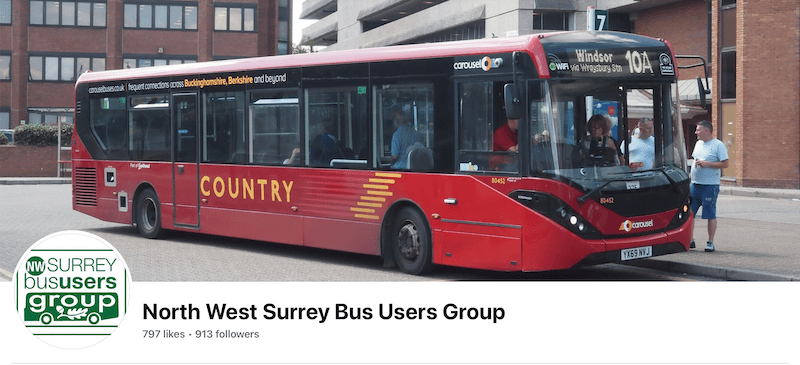
It’s looking good for this part of Surrey.
Roger French
Summer blogging timetable: 06:00 TThSSu
 BusAndTrainUser
Sadly even with all these improvements, Surrey is still struggling to get usage back to pre pandemic levels. Latest numbers (Year to March 2024) are 24.8m journeys year, compared to around 27m pre pandemic. Although that is better than than the national average (about 92% of 2019-20 vs 84%).
LikeLike
You may be interested to know that the 437 is going hourly from 4th August, with more Woking-bound journeys serving the Community Hospital.
LikeLiked by 1 person
Maybe AI can be taught to update maps (and E Plates) I like the Caroline map in the LT Map of years past style.
Perhaps in due course Surrey could look at a form of franchising – even if it is marketing for commercial services for some kind of common livery of “Network Surrey” I think would encourage more confidence in travelling though even the little minibus service to Heathrow seems to be doing well for passengers
JBC Prestatyn
LikeLike
Worth re-visiting Streatham High Road in due course, new road “improvements” are due to start with many bus routes getting temporary timetables of every 12 13 mins which will affect frequencies of other parts of their routes (45 Streatham Vale to Morden) , 57 Kingston to Tooting as just a couple of examples.
Then will the road flow better later in the year when works complete ?
JBC Prestatyn
LikeLike
Will Surrey still have its timetable books and map after the county is abolished by Labour?
Hopefully its excellent passenger transport unit will survive somehow.
malcolm chase, Fleet
LikeLike
It’s only the county council that is being abolished, not the county itself. The present county council doesn’t administer all of the county now anyway.
LikeLike
I’m not sure what relevance this comment has! The Post Office’s decision in 1965 to allow bits of Surrey that have been in London for 60 years now to keep ‘Surrey’ as a postal address leads to much confusion, I recall a resident of Wallington complaining about TfL services to me and although I tried to explain that he should contact TfL, he thought we at SCC had a moral duty to take up his complaint! The worry is that current government policy will split the administrative county of Surrey into either 2 councils (SCC’s favoured option) of 3 councils (most of the boroughs’ favoured option) – how the passenger transport team will be able to perform when split up (unless common sense prevails and a joint unit is formed) is very concerning.
LikeLiked by 1 person
unfortunately common sense rarely prevails in situations like this. Tony
LikeLike
The official postal address have now dropped the use of the county
LikeLike
Not sure what your point is? If you abolish the county council, then you’re effectively abolishing Surrey, as happened with Middlesex in 1965.
And it’s the county council who produce the bus information, so who’s going to produce it if Surrey is abolished?
Which parts of Surrey doesn’t the county council administer?
LikeLike
To those of us who live in Spelthorne (the only part of the county north of the Thames and an area that would sit far more logically in an enlarged Greater London) it sometimes seems that we are out of sight and out of mind to the county council!
LikeLike
Not going to lie, I feel the same in Hertfordshire, Cheshunt and Broxbourne really do feel out of sight from the county and the area clearly sticks out of London much like Spelthorne does.
Also hopefully with counties like Surrey, the strategic authority will be bigger than the current county and that would be the authority that organises and promotes buses, including provision of maps.
Aaron Smith
LikeLike
Current proposal is for Surrey to have two unitary authorities, East and West Surrey
LikeLike
Surrey County Council is pushing for two authorities but a number of borough / district councils are proposing three. Both form part of the consultation currently underway and both will see a mayoral strategic authority established.
LikeLike
A Mayoral Strategic Authority would be established to handle strategic functions and devolved powers such as transport, infrastructure, housing etc. This will cover the area of the current county.
LikeLike
These are the area getting an elected Mayor at present (Does not include existing mayoral authorities)
LikeLike
Great to see Tfl demonstrating the continued excellence that all public bodies are alleged by some to exhibit versus the incompetence of the private sector.
LikeLike
Heathrow is responsible for the stops at T5.
The X442 is an excellent service, very reliable and friendly drivers. It’s just as well it was rerouted to serve Staines railway station – I wouldn’t use it otherwise!
Steve
LikeLike
Of course, the 458 is a long-standing route which used to be numbered 218 and operated by London Transport.
LikeLike
The 218, although operated by London Transport (red buses), operated almost totally outside Greater London. In the 1970s and 1980s Surrey was keen to reduce the amount of subsidy it paid to London Transport and a number of services were either revised, or transferred to London Country and its successors who were able to operate the services more cheaply. The 218 transferred to London Country South West in October 1986 and at a later stage was renumbered 458.
Julian Walker
LikeLike
The “transfer” of route 218 to London Country South West is an interesting story.
London Buses registered route 218 commercially, ready for deregulation. London Country registered a competing route 427. London Country’s registration was for a daily service, London Buses was only for Mon-Sat. London Buses then cancelled their registration, thus surrendering the route to LCSW rather than competing with them. LCSW introduced their service using the 218 route number, rather than 427 as originally proposed.
This info is taken from contemporary London Omnibus Traction Society newsletters.
Malc M
LikeLike
In general the LT routes that ran outside of London had to go out to tender with deregulation and LT ended up losing most of them
These was a strange situation at Waltham Cross where at the time the 279 ran in 3 sections, One section ran outside of London so that section had to go it to tender. It as well turned into a sorry saga. The tender was run by Eastern National but initially they were unable to operate it so LT carried on with it for a while. LT eventually gave it up and London Country took it on for a while. They then decided to register the Waltham Cross to Hamond St section as a commercial service on Mondays to Saturdays. When Eastern National eventually took the 279 up they ended up just operating some journeys between Waltham cross and Manor House and only ran to Hammed St on Sundays
LikeLike
@Anon 28/7 06:40 – I think it was routes which required subsidy from the county councils which were put out to tender. London Buses did lose quite a number of them – but did hold on to some, in some cases through establishing low-cost units (e.g. Westlink, Roundabout) and also won a couple of cross-border routes in the Orpington area which had previously been operated by London Country.
The “out county” leg of the 279 north of Waltham Cross had been transferred to route 259 upon OPO conversion in 1985. As you say, this leg was tendered, with Eastern National winning the tender. I don’t think London Buses “gave up”, however. It needed the buses elsewhere (for route 113’s conversion to OPO). As Eastern National still weren’t ready to take up the contract, London Country North East stepped in for three months. The service was renumbered 359 at the same time. LCNE clearly spotted the opportunity to register the Waltham Cross to Hammond Street section commercially on Mon-Sat thus when Eastern National took up the 359, it led to the unusual situation that Hammond Street was served commercially on Mon-Sat, by a London tendered service on Sundays – and by a London Buses service at night. On Mondays to Saturdays the 359 was effectively a short-working of route 279.
Malc M
LikeLiked by 1 person
There was also a 219 Kingston to Weybridge it appeared to have been replaced by the 437 but that appears to be no more
LikeLike
@Anon, 28/7 15:52 – yes, there was indeed a 219 which parallelled the 218 between Kingston and Hersham. The 219 ceased in 1983, replaced as you say by London Country route 437.
LikeLike
The unique section of the 219 between Esher and Weybridge seems to have been covered by various routes since 1983. I don’t know when the 437 ceased to serve that section, but by 1995 it was part of London & Country 427 (Kingston – Weybridge – Addlestone), while by 2000 it was covered by Tellings Golden Miller 471 (Kingston – Weybridge – Woking). These days it is part of Falcon Bus 515 (Kingston – Weybridge – Brooklands) but that runs via Thames Ditton between Kingston and Esher, rather than the traditional 218/219 routing via the Portsmouth Road which is now left to the 458 and 714/715.
LikeLike
Suggest you fire off a complaint on TfL’s webform about the missing 446 plates at bus stops (giving locations). They’re pretty good at rectifying things once they’re brought to their attention. Graham L.
LikeLike
Yes as someone who grew up in that area in the 70s the emphasis was indeed then on reducing subsidy by getting rid of expensive LT routes and seeking replacements through LCBS. One casualty was route 264 which meant the loss of the Sunbury to Walton link. That took I think 20 years to restore ironically through a TfL (or was it Surrey) tendered service ?
Another novelty was the sight of green buses in Sunbury on the 459 (SMs from Addlestone) which emerged out of Surrey County Council’s Public Transport Plan which I had contributed to. The loss of the 237 to Chertsey and it’s replacement with a Routemaster operation to Shepherd’s Bush was an unexpected bonus which lasted a good few years. We also had two Green Line routes then (718 and 725) which were later split as 725/6. A direct service linking Hampton Court and Windsor which has long since gone. Oh happy days
Martin W
LikeLike
Off topic, and out of the area but you may want to do a piece about Keighley Bus Museum whilst it’s still a museum as yesterday it’s building was on fire caused by another fire to a derelict mill next door. This mill always has fires by the way.
LikeLike
There’s a statement from KBMT (and photos) at their WordPress site https://kbmt620595698.wordpress.com/, which suggests that the situation isn’t quite as bad as you imply.
They certainly need help funding the repairs to the roof, so I’m sure any donations from readers of this blog will be most welcome. The GoFund me link on their web page doesn’t seem to work but their GoFund me page is at https://www.justgiving.com/charity/kbmt
LikeLike
The 446 loads very well at certain times of day between Staines & Hatton Cross so I’m not surprised it’s being increased to half hourly. The parallel Tfl run 203 (every 20 minutes) is also very busy but is painfully slow for the full journey due to the meandering route serving neighbouring residential areas.
LikeLike
Not directly related, but some suggestions for future new routes around London for Roger to visit. From 31st August 2025, there’s a bunch of improvements from Carousel including High Wycombe and Beaconsfield going to six per hour. Two weeks later its Uno’s turn, with some very interesting changes to the Hatfield to Potters Bar corridor.
LikeLike
The Uno changes are certainly something. I can already envision using the new direct link from Cheshunt to Hatfield as a way of exploring all across Herts a bit more, makes St Albans and the west of the county easier to get to. It really is odd though that small villages like Brookmans Park will have a more frequent bus service than Cuffley or Rosedale/ West Cheshunt. And more frequent than Potters Bar to Barnet. Hourly branches, but coordinated 30 minutes where the 242 and 243 share a section of route, as they do from Hatfield to Potters Bar. Also with some luck, we may end up with a proper late evening service eventually, each change seems to be introducing later services each time.
Aaron Smith
LikeLike
Roger, your customary typo was unwontedly early. I can’t believe that you alone tired out the route.
LikeLiked by 1 person
I’m so tired of that typo! Thanks for spotting. Now corrected.
LikeLike
Roger, thanks a lot for the plug for the North West Surrey Bus Users Group and thanks to our members and social media followers who give us a bit more ‘clout’. The problems with TfL inadequate / non-existent timetable posting and bus stop publicity seem endless despite ours and Surrey County Council’s prompting over many years. Very frustrating!
Mark Worley
North West Surrey Bus Users Group
LikeLiked by 1 person
As a Woking resident I was pleased to get the extension to the 446 bus route to Hatton Cross. This has meant I can get into London using my bus pass quite easily. It also connects to the SuperLoop buses at Hatton Cross. One benefit of the 446 is that it is generally quicker than the train as most train journeys require a change at Weybridge with a minus one minute connection that means a 29 minute wait at Weybridge then an 8 minute (I think) wait at Virginia Water to allow a Reading line train through. The White Bus 446 goes pretty direct to Staines.
I’ve enjoyed Roger’s recent tales of bus travel around Woking, there is a pretty decent service connecting main towns running late into the evening on most. Keep up the good work!
LikeLike
“TfL’s hugely subsidised service provision”
Where does this huge subsidy come from? Not from government (the funding awarded to TfL in the recent Spending Review is for capital expenditure, not for subsidising day-to-day operations).
In fact, as far as I am aware, London doesn’t even get BSOG, unlike bus services outside London.
To put this into perspective, how much of Surrey’s bus network is subsidised (whether through BSOG, BSIP or routine day-to-day subsidy)? Is any public funding used for providing and maintaining bus stops, or is that paid for in full by the operators?
And, to add further perspective relating to how services are funded, how do fares in Surrey compare with London (particularly for children, or adults travelling with children)?
Malc M
LikeLike
According to this 2023 report published by the Urban Transport Group https://www.urbantransportgroup.org/system/files/general-docs/Urban%20Public%20Transport%20Funding%20-%20Options%20for%20Reform_0.pdf
“BSOG for London services is wrapped up in the general TfL financial settlement”
The subsidy for buses comes from users of other TfL services (principally rail) who pay higher fares than they would if the bus network was not so heavily loss-making. The most recent figures for London Bus Services Ltd show a grant of £807m to bridge the gap between revenue of £1.566bn and operating costs of £2.353bn.
It should be noted that concessionary fares payments are included in the general revenue. London Councils pay TfL £201m annually for bus travel, while TfL also receives reimbursement from other authorities where services run over the GLA border.
KCC
LikeLike
@KCC:
“BSOG for London services is wrapped up in the general TfL financial settlement”
It was indeed. What the Steer report omits to mention is that the general TfL financial settlement was abolished in 2018.
The current financial settlement is to support capital investment, not day-to-day operations. Therefore I stand by my comment that, unlike bus services elsewhere in the country, TfL bus services do not receive BSOG.
…users of other TfL services (principally rail) who pay higher fares than they would…
I wouldn’t bank on it. Single fares on TfL rail services are generally lower than on National Rail suburban services within Greater London. Daily cap/Travelcard prices reflect usage of NR suburban services and are to some extent governed by revenue to National Rail TOCs.
concessionary fares payments are included in the general revenue
Are concessionary fares payments a subsidy? If so, would you agree that they are also a subsidy when paid to operators outside London? If not, why would you consider them to be a subsidy in one part of the country but not in another?
TfL also receives reimbursement from other authorities where services run over the GLA border
…for sections of route outside the London boundary, where the local authority considers it is worthwhile to support those services within their respective areas. It is not a subsidy to TfL services within London.
The subsidy for buses comes from users of other TfL services (principally rail)
Yes, there is cross-subsidy, within the overall public transport system. However, unlike the rest of the country, there is no general subsidy (for local authority tendered services), BSOG or BSIP.
Malc M
LikeLike
The only cross-border services for which TfL receives any payment from neighbouring authorities are routes 166, 216 and 465.
LikeLike
I think the comment to which this (and other) comment(s) are replying is referring to concessionary travel reimbursement – presumably all concessionary pass boardings onto TfL-operated routes within adjacent authorities need to be reimbursed to TfL the same as they would be to any other operator.
Slough Borough Council does this for route 81, for example.
Stephen H
LikeLike
The only comment I must make about riding Route 458, in a recent era, is the way Shepperton Studios has massively expanded from its original compact site just to the south of the Queen Mary Reservoir all the way south to now have a frontage on the north side of the B376 with presumably a bridge or bridges across the River Ash. One can see a multi-storey car park from a passing Route 458 bus. My first sight of Shepperton Studios from a bus was on a Route 400 worked by London United using a Scania Omni-City as it had its “rest” from doing the school runs for Esher High School.
LikeLike
Many services in Surrey, particularly around the Woking area have improved vastly over the last few years. Other than the then Arriva 34/35, it was rare to see a bus after 1830, and on Sunday at all for many years. But as pointed out, some of this is connected with linking Heathrow, and I have witnessed some extremely healthy loadings at times. Service levels on a number of routes have doubled such as the 456 and the Bookham-Guildford section of the 479, not to mention the aforesaid Cobham-Kingston section 714 “assisting” the 715.
Unfortunately, apart from TfL not putting up service numbers on their stops when in their territory, I noticed a very out-of-date timetable panel for the Surrey 479 when in Leatherhead yesterday, so even Surrey slip up. And a broken down 714 at Wisley Gardens! But on the plus side, many people appear to be using the 462/3 link to Wisley from Woking, albeit a rather circuitous route as mentioned in a recent blog, so hopefully the next set of figures for bus use may go up further.
Terence Uden
LikeLike
I believe the 479 stops you refer to in Leatherhead are TfL ones in which they themselves maintain (not!) the timetables.
LikeLike
That explains it then!!
LikeLike
In general what happened was TfL were no longer responsible for bus stops outside of London even if served by TfL Service. There were a few minor exceptions such as at Waltham cross where TfL maintain them s far as the bus station which is just the odd stop plus the bus station itself
LikeLike
Unfortunately that’s not the case for quite a few routes. TfL seem very protective of their stops that remain on TfL routes beyond the GLA boundary, including route 81 all the way to Slough High Street and route 465 all the way to the outskirts of Dorking. The problem is the posting of timetables in those stops for routes which don’t enter London, meaning that TfL has to keep aware / be informed of bus service registrations well beyond London, and then be willing to receive panels and post them, and update e-tiles if needed, via its contractors, which are different for timetables and e-tiles.
Stephen H
LikeLike
Roger, which were your favourite vehicles of the day?
Volvo or Alexander Dennis?
LikeLike
White Bus Service absolutely super. I used to live in Cheapside, nr Ascot and school in Windsor. Never a problem and only 2 schoolkids on board. They were then based out of Winkfield (60 years ago).
LikeLiked by 1 person