
Saturday 19th July 2025

Longer term readers may recall the D is for Delaine blog I wrote a couple of years ago for 2023’s A-to-Z of bus and train companies series. It coincided with Anthony Delaine-Smith’s tenure as Omnibus Society President that year including his fascinating talk to members at his Presidential address in London. It led me to take a ride on the Company’s small network of routes based on Bourne and Market Deeping in Lincolnshire and reporting very favourably on what I experienced.
Ever since then Anthony has kindly extended an open invitation for me to return and take a look inside the Delaine Bus Museum which sits alongside the company’s bus garage in Bourne. Following another meet up at the ALBUM conference a couple of months ago I was pleased to finally get round to making that visit on Friday, last week.

And what an impressive visit it was. Not only is Delaine unique in being a bus company in the same family ownership since its formation in 1890, even more impressive is the care and trouble the family has taken over the last 135 years to safely retain so many original artifacts, memorabilia and records across that time which Anthony has painstakingly curated into the wonderful Delaine Bus Museum along with a collection of heritage vehicles.
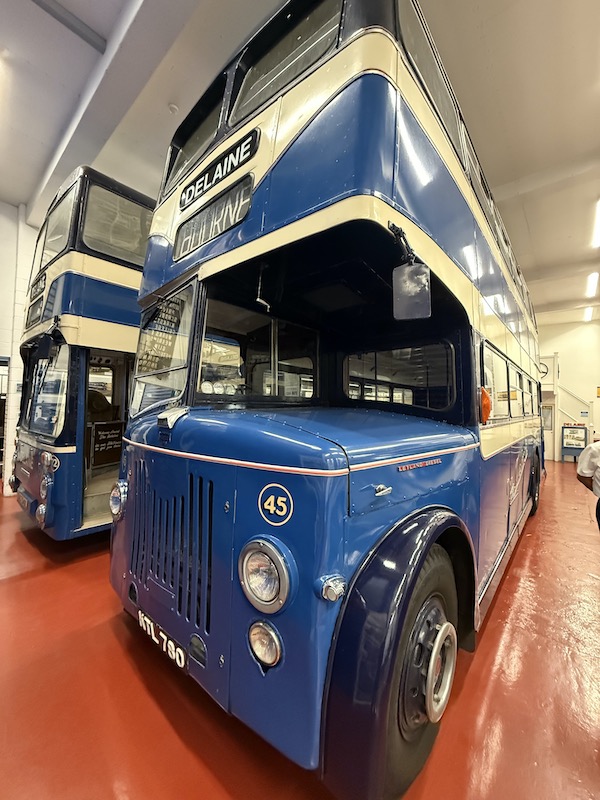
The Museum is overseen by the Delaine Heritage Trust, a separate charity from the bus company, which owns seven heritage vehicles including KTL780, a Willowbrook bodied Leyland Titan PD2/20 which was the first new Leyland double decker to enter the fleet in 1956 as well as being the last vehicle to be purchased by Thomas Arthur Smith founder of the business who passed away in 1958
Another wonderful vehicle in the collection is this superb 1958 Leyland Tiger Cub (MTL750) which has yet another unique claim to fame as being the only such chassis to be bodied by Yeates of Loughborough.
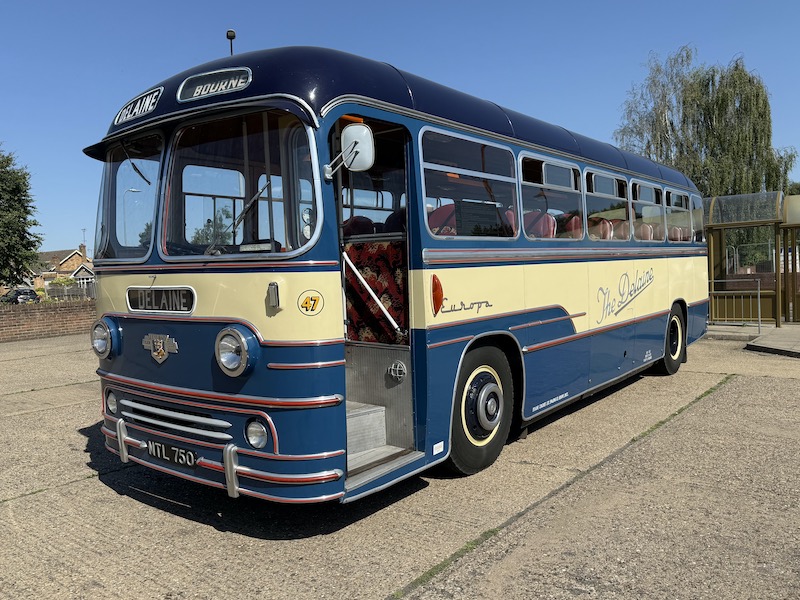
It was withdrawn from service in 1969 but saw further service with Vagg’s in Shropshire until 1975 and was about to be broken up in 1982 when it was rescued by the Delaine team who have restored to its former glory. Having had the benefit of a ride from Bourne’s bus station over to the Museum in it, I can vouch for the superb job that’s been done on returning the bus to its original condition.

They don’t make them like that any more.
The Museum also has one of only two double decks built by Yeates in its collection – RCT3 – a Leyland Titan PD3/1 pictured below and also at the top of this blog with three of the brothers standing proudly in front of it. It was new in 1960 and withdrawn in 1979.
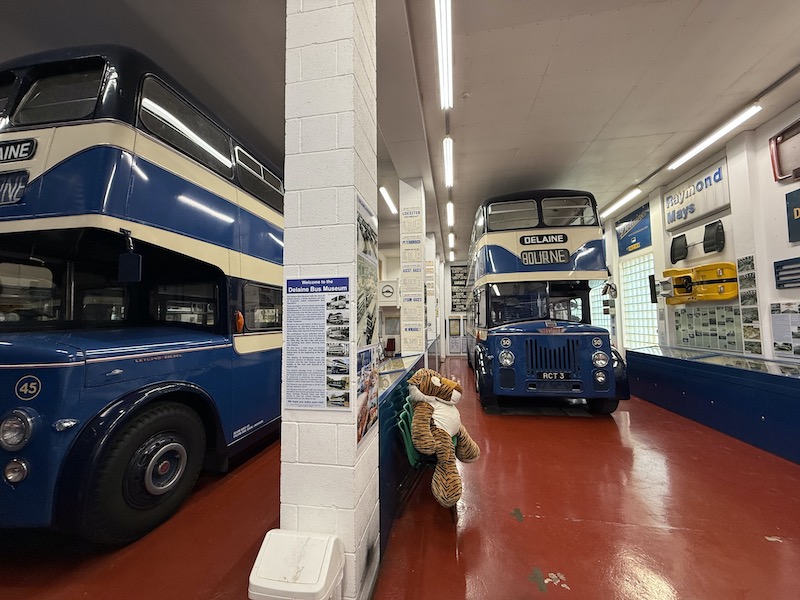
A fourth vehicle in the collection, from 1973, is the last new Leyland double decker to enter the Delaine fleet and the first example of the then new Leyland Atlantean AN68 on an extended 10.3m chassis with bodywork by Northern Counties.
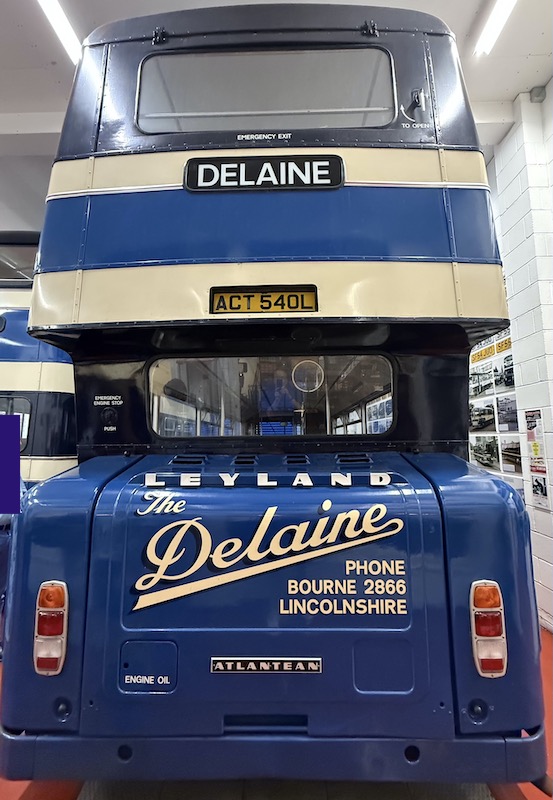
It was part of a five vehicle consortium purchased with fellow independents Whippet and OK Motor Services.

The fifth and final Leyland bus in the Museum is E100AFW. It’s a Leyland Tiger with Duple Dominant bus body and as per usual with Delaine’s heritage collection has another claim to fame, this one being the last Dominant bus body produced by Duple (between 1974 and 1987).
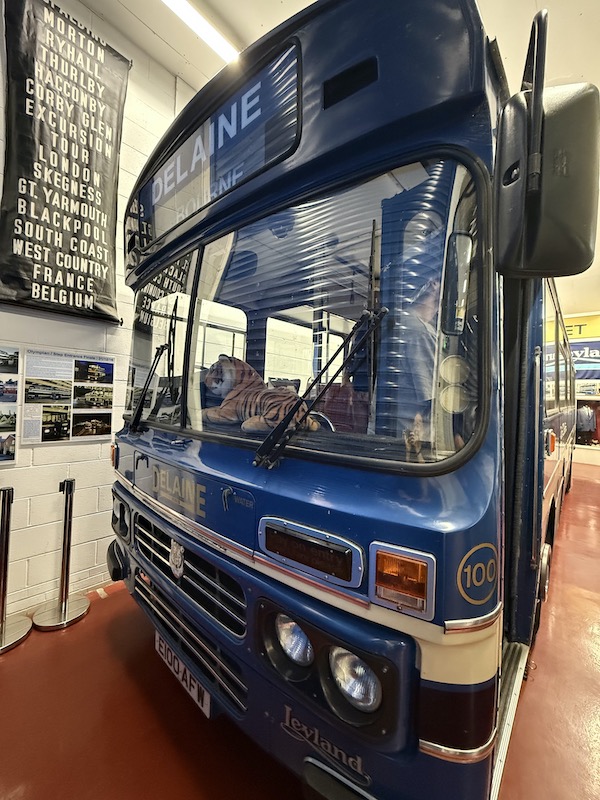
Also intriguing is the 2+3 seating towards the rear making for an overall capacity of 59 and ideal for school runs.
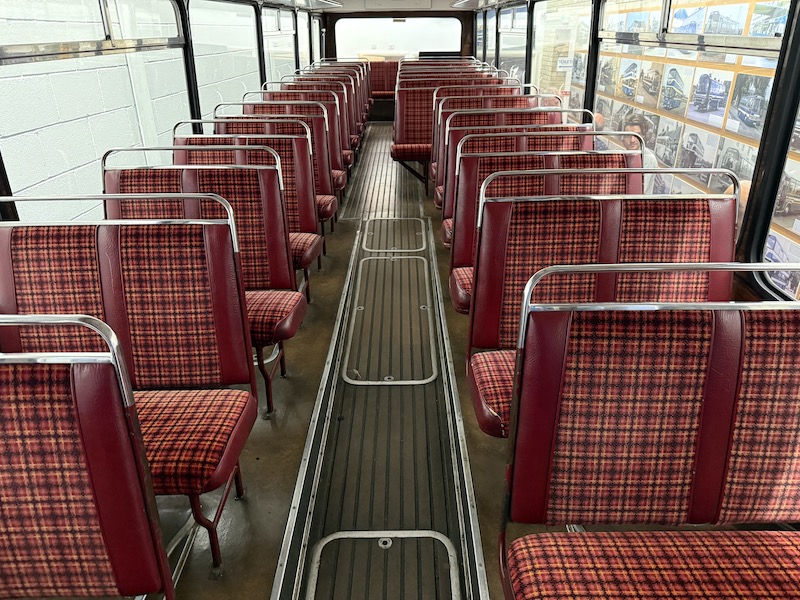
Two other more contemporary vehicles in the Museum collection are a 1995 Volvo Olympian and a 2000 Volvo B7TL both with East Lancs bodies. The former’s claim to fame is being the first Volvo to enter the Delaine fleet and worked the last step entrance journey between Bourne and Peterborough in 2016 while the later was the first PSVAR compliant vehicle to enter the fleet. It was withdrawn from service in 2023.
Aside from the vehicles the Museum is a treasure trove of equipment, records, photographs and a whole host of memorabilia to entertain, delight and fascinate the visitor. There’s so much to see I can’t possibly do justice to the collection in just a few paragraphs, but here are a few tasters of what’s on offer.

There’s a display of uniform including Inspector Jimmy Culshaw’s hat which has a lovely back story. James ‘Jimmy’ Culshaw joined the company in 1932 managing the company’s depot in Peterborough before transferring to Bourne in 1939 when that depot closed. He assisted owner Thomas Arthur Smith who had recently become widowed and dedicated the remainder of this life to the company, working up until two weeks before his death in 1971, aged an incredible 89. On his death his Inspector’s hat became the proud possession of his grandson, Peter Boizot, who became famous for starting the Pizza Express chain of restaurants, but Peter always promised he would pass the hat on to the Delaine-Smith family in due course. 47 years later, on Peter’s death in 2018, also at the age of 89, he kept his promise and one of his most cherished possessions, his grandfather’s Delaine Inspector’s hat was returned and is now proudly displayed in the Museum.
In another display there’s a nostalgic look at hundreds of original items that would have graced the shelves of the company’s stores…

… and along one of the walls a comprehensive timeline of significant developments in the company’s history…

… as well as countless photographs on display throughout the Museum…

… including this nostalgic atmospheric view of Stamford Bus Station on Castle Hill in 1965 on a typical weekday afternoon with a United Counties Bristol bound for Corby, a Delaine AEC for Bourne via Essendine and a Lincolnshire Road Car Bristol for Grantham all awaiting their departures as well as an unidentified bus from Barton laying over. You can sense the businesses as shoppers board these buses to return home while the United Counties driver and conductor exchange gossip before heading off on their next journey.

There’s a collection of registration plates which have graced the company’s fleet…

… and perhaps two of the most interesting photographs on display are one of this 14 seat Ford Model T from 1919 which began Delaine’s motorbus operations and can be seen displaying the Delaine scroll fleetname which has been applied to the rear of every vehicle in the fleet right up to today.

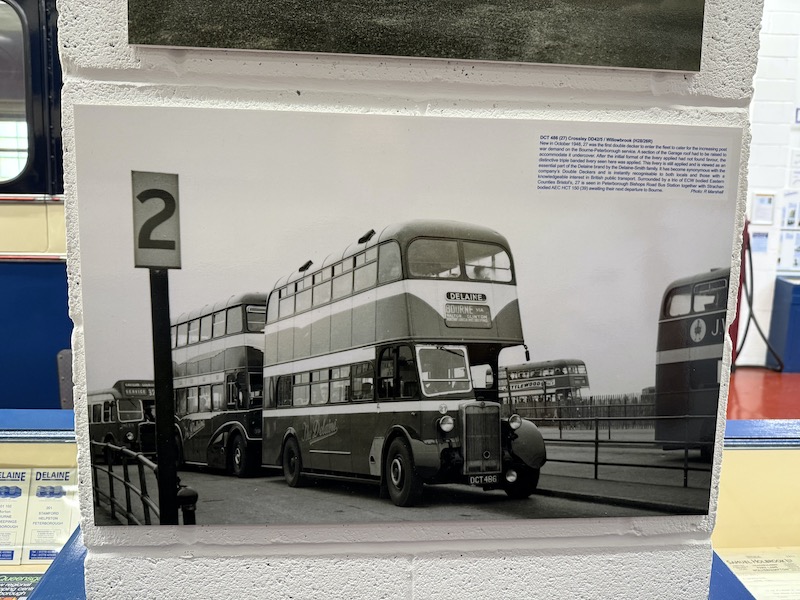
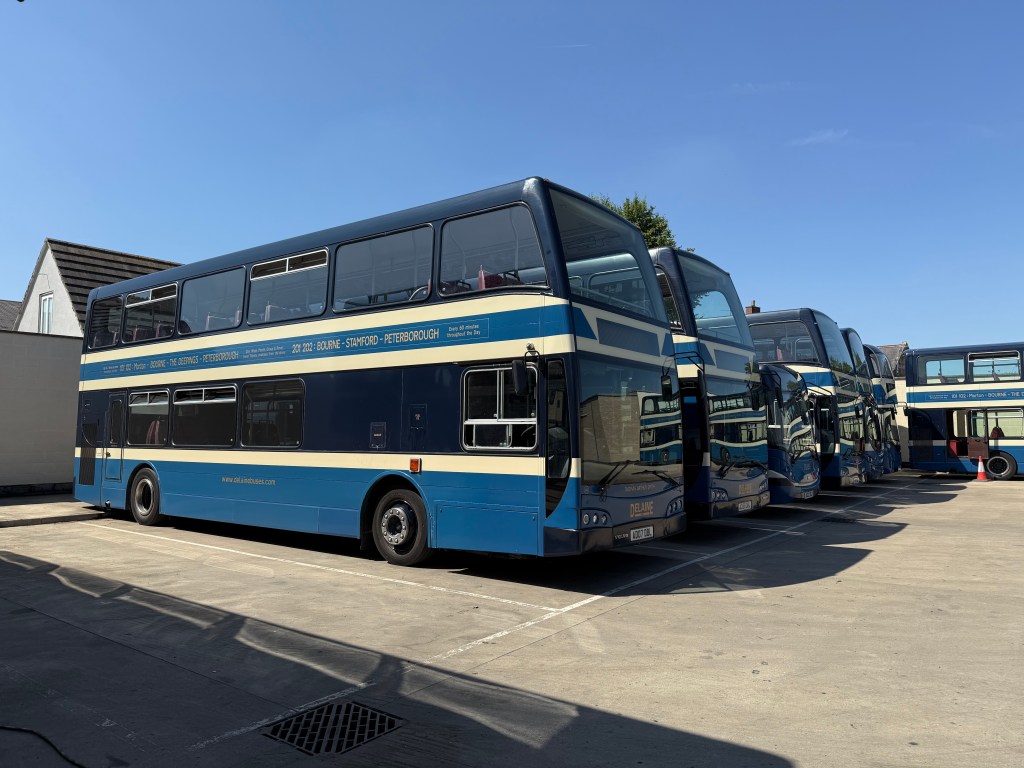
The other is of this Willowbrook bodied Crossley DD42/5 which was the first double deck to enter the fleet in 1948 to cater for the increasing post war demand on the Bourne to Peterborough service. A section of the garage roof had to be raised to accommodate it undercover. Interestingly the initial format of the livery applied didn’t find favour and was quickly replaced by the distinctive triple banded livery seen here and which is still applied to all double deck buses in the fleet today and is viewed as an essential part of the Delaine brand by the Delaine-Smith family.
The other facet of the company that’s become synonymous with the brand is the consistency of the family ownership right from Thomas Arthur Smith (who founded the original Motor Bus operations) and his son Hugh to the latter’s four sons and the next generation. It was lovely to meet brothers Ian and Kevin together with Anthony (photographed at the beginning of this blog) as well as Mark who was beavering away in the office during my visit.
Ian is the eldest son of Hugh Delaine-Smith and his second wife Evelyn. Now aged 78, he joined the business full time in 1965 and has always taken a keen interest in the development of the commercial and operational side of the business. He succeeded his father as Company Chairman on his death in 1995.
Kevin is Ian’s younger brother and the second son of Hugh and Evelyn. Now 71 he joined the business full time in 1971 having served as an engineering apprentice with Whippet. He has always been passionate about the company’s heritage and was responsible for retaining the majority of the artifacts over the decades which are now in the Museum.
Anthony, who is 60 later this year, is the eldest son of Hugh and his third wife Julia. He began working in the company during school holidays as a cleaner aged eight, was working in the office at 13 and was shunting buses in the yard aged 14. He’s been the catalyst for many of the developments in the business since the 1980s and succeeded his father as Managing Director on his death in 1995. His younger brother Mark, aged 55, joined the business full time in 1987. He’s the statistician of the family becoming a Director of the business in 1995 on Hugh’s death, and is one of two Transport Managers for the Company.
Kevin, Ian, Anthony and Mark have kept alive the family traditions established by founder Thomas and his son Hugh over the last 30 years since Hugh passed away and the good news is the Delaine Dynasty continues with Anthony’s eldest daughter Jennifer joining the business full time in 2010, being appointed Company Secretary on her Great Aunt Beryl Tilley’s death in 2012, and Victoria, Anthony’s younger daughter, joining full time in 2016 and becoming the youngest PCV driver in the country when she passed her PCV test that December aged 18 years and 107 days. Last year Victoria succeeded Anthony as one of the company’s two Transport Managers.
Chatting to the family reinforces the observation I wrote back in 2023 that you can’t fail to be impressed by the family’s dedication to providing an outstanding bus service for residents of Bourne and the surrounding area. They and their predecessors have accumulated many decades of vast experience running the business from before the 1930s licensing era through over 50 years of regulation to 1986’s deregulation and the almost 40 years since then, seeing many local government reorganisations and changed funding regimes, experiencing the pandemic and now two new Mayoral authorities in Cambridgeshire and Peterborough Combined Authority and Greater Lincolnshire Combined County Authority,

Fortunately the potential existential threat to Delaine as a business from franchising is increasingly looking a remote possibility with the new Mayor for Cambridgeshire and Peterborough asking ever more pertinent questions about the sources of funding for such an expensive project while the Mayor of the new Greater Lincolnshire Authority seems unlikely to make buses a high priority in her plans.
Which will hopefully mean residents of Bourne and surrounds can enjoy the quality of service Delaine prides itself in offering for many decades and generations of the family to come.

The Delaine Bus Museum is open for public viewing on the second Saturday of the month between March and October together with heritage bus trips in the afternoon and comes very much recommended.
My huge thanks to the Delaine family for their very kind hospitality last Friday.
Roger French
Blogging timetable: 06:00 TThSSu
 BusAndTrainUser
What is meant by “the last step entrance journey”? What does PSVAR mean?
LikeLike
The last journey that was operated by a bus with a step entrance rather than a low floor accessible bus. PSVAR = Public Service Vehicle Accessibility Regulations.
LikeLike
Would a London Transport RF bus count as “step entrance”?
LikeLike
Yes indeed! Those are definitely steps you clamber up to get on…
LikeLike
An excellent blog about an excellent operator.
A minor typo, the caption to the photo of the brothers should read Kevin, Ian, Anthony.
LikeLike
How can a 75 plate be issued before 1st September this year?
LikeLike
Is not on the road yet. Just waiting in the yard for 1st September.
LikeLike
Having a vehicle with the new age identifier ready to run on the first day has become a Delaine tradition – it seems that a vehicle replacement policy of two new vehicles a year fits well for a company this size. They are delivered on trade plates with the pre-agreed registrations affixed, so it just needs the DVLA to officially register it at midnight and it is ready to go.
Julian Walker
LikeLike
Second minor typo, the caption to the 75 reg bus reads Enviro 200, I think that should be Enviro 400.
LikeLike
Many thanks for spotting both of those; now corrected.
LikeLike
Probably not much more that can be said that wasnt on the last blog on the company.
The museum shows that for vehicles to have the best care, modern well constructed buildings are necessary
The stage carriage operations of the company , although not participating in the fare cap scheme had the golden geographical nicety from the half a day walk / horse ride to market theory. With a big city at one end and a decent town at the other both generating destination revenue and having enough draw for the other end to be a place for work or a day out from the other. Protected by road service licencing yet come deregulation it is still in the area where reasonable competitors noted that literally there would not be room for the both of us with full competition. Operated in a way that shows the best of local private enterprise , and an element of living over the shop and with the ability to choose drivers and engineers rather than be desperate for them must help too, additionally the locations dont seem to suffer from severe road congestion that excessively delays bus services into other parts of England.
The next challenge will come when only fully electric vehicles can be purchased and at some time either subsidy or some kind of cost increase will be needed – the strategic overview of a mayoral authority might be needed for this , but if the services are cross border authority ones we can see normally there is some kind of political football of who is responsible (the old days of municipal joint services elsewhere will these be re-imagined betwixt authorities somewhere) , that, as long as passengers continue to travel on buses that turn up on time as an operator they indeed are likely to be left alone.
JBC Prestatyn
LikeLike
You’re right that they don’t, but with a maximum single fare (and that a through ticket allowing connections) of less than £4 and a network day ticket at £5.80, Delaine don’t really need the added bureaucracy of the fare cap scheme.
LikeLike
You can’t beat good, local, independent bus operator who knows the area, the people and the demands unique to an area without flashy liveries and gimmicks. Sadly we have lost so many but long may Delaine continue.
Excellent article, thanks – a visit definitely on the list now.
LikeLike
A point on the services back from Peterborough , while noting for profit the company probably does know best , I would like to see evening services running beyond 6pm all days even if only 2 hrly (giving hr via each main route) . Would they carry more passengers to be worth it , has it been operated like that previously ?
JBC Prestatyn
LikeLike
To answer JBC’s question, there have been evening journeys in the past, e.g. Saturdays and Sundays had an 11pm departure from Peterborough in the 1983. timetable. Anthony Delaine-Smith’s response to a similar question a couple of years ago was that Peterborough doesn’t really have a nightlife so it wouldn’t be worthwhile.
Nigel Turner
LikeLike
Companies such as Delaine were once to be seen in every nook and cranny of the UK. Once the car became a “must have” with increased mobility and thus destroying village life as we had known in the 1940s and ’50s, such companies dropped like ninepins. As stressed by others, the secret for Delaine was dedicated family involvement, attention to detail and possibly a unique set of circumstances regarding their location.
A huge school/college involvement not just in Bourne, but in surrounding towns, has kept around thirty vehicles occupied for the last couple of decades. I don’t recall Delaine ever having to fight off competition in the early days of deregulation, as any such “wannabes” would have realised it would have been a waste of time. Even with the threat of franchising in the region, it was declared that Delaine services into Peterborough would be exempt, probably knowing there may be a public outcry and with the happy excuse the services started just over the Lincolnshire border. Who knows?
Long may they continue, but I fear may be the sole survivor very soon.
Terence Uden
LikeLike
Indeed, Terence.
The franchising scheme for Cambridgeshire and Peterborough Combined Authority signed into being by former mayor Dr Nik Johnson, had a number of Excepted Services.
ANNEX 2: EXCEPTED SERVICES – ARTICLE 6
To – From
X4 Peterborough – Northampton
XL Peterborough – Norwich
37 Peterborough – Spalding
101 Peterborough – Bourne
102 Peterborough – Market Deeping
201/202 Peterborough – Stamford – Bourne
Call Connect – Stamford & Peterborough area DRT
R4 Uppingham – Peterborough
180 Yarwell – Casterton College
46 Kings Lynn – Wisbech
60 Three Holes – Wisbech
U1/U2 Eddington – Cambridge City Centre – Addenbrooke’s Hospital
16 Newmarket – Bury St Edmunds
189/190 Biggleswade – Sandy
444 Barley – Saffron Walden
319 Audley End – Haverhill
On a point of interest, the main reason that no Franchising Scheme was signed into existence by the first mayor of Cambridgeshire and Peterborough Combined Authority, James Palmer, was the intervention of Covid which wrecked his Business Case, which had to be restarted when the pandemic receded.
LikeLike
A great tribute to what was now be a unique operator. For those who haven’t seen it, Venture Publications published an excellent history of Delaine in 2010. It’s available with other titles as a free pdf download from the MDS website.
https://www.mdsbooks.co.uk/downloads
LikeLike
Very good article on a much respected company – definitely have to visit the museum.
Interesting to compare Delaine with their former neighbouring independent Barton who used to run in and around Stamford – I believe the current Delaine 202 was once partly a Barton route. Deregulation brought all sorts of competition to Stamford with Leicester City Bus minibuses (Trippet) as well as Blands and Kimes.
Barton had a go in Nottingham against Nottingham City which lead to their sale to Welglade (Trent), who rather quickly disposed of a lot of Barton’s routes presumably to recoup the purchase price.
Richard Warwick
PS – in the Stamford area is a new community bus route (27), which was featured in Route One recently. Roger might want to investigate?
LikeLike
Barton’s major issue post-deregulation was not so much competition – although it was competed against far more than it competed against others – as the fact they’d replaced their fleet almost en-bloc when the Bus Grant became available in the early 1970s, so by the late 80s a huge proportion of the fleet was due for replacement and the company simply couldn’t afford that wholesale replacement.
Delaine’s long-standing policy of two new vehicles a year is a much better way of handling fleet replacement.
The Wellglade ownership of Barton hasn’t seen the wider historic network survive very well. It’s a shadow of its former self today, as indeed is the former Trent network.
LikeLike
As Roger has mentioned and photographed Leyland Titan KTL 780 I think it is worth giving some extracts of a letter to the editor of the Peterborough Advertiser and published on November 16th 1956.
“The double-decker bus slowed down as the driver spotted my raised hand. Decreasing speed, it slid effortlessly in to the kerb with the grace of a thoroughbred car and halted without the faintest hint of a judder.
The doors were closed but opened automatically as the driver touched a control in his cab. I climbed aboard and seated myself in a wide upholstered seat as the doors slid shut and the bus glided off in to the stream of evening traffic.”
“No, I was not in fabulous America, nor was I dreaming of future transport in distant days yet to come, I was right here in Peterborough, and the date was Wednesday, November 7th 1956. No, it was not a private luxury coach. It was a normal service bus on it’s routine service run, and its number if you would like to try it for yourself is KTL 780.”
The writer goes on to make complimentary remarks about the Delaine and compares them with Eastern Counties. He describes the latter as having “out-dated, out-moded and outclassed vehicles.”
Sadly the writer used a non de plume so we shall never know who he was.
Nigel Turner
LikeLike
Delaine buses always look so smart in their traditional livery, which still suits contemporary bus designs.
Peter Brown
LikeLike
How did Delaine escape nationalization under the Transport Act 1947?
LikeLike
The same way Barton and all the others (including the BET Group) did. The Transport Act 1947 didn’t nationalise the bus industry.
LikeLike
Roger.
What fascinating article. I have an RM 1.50 model in Delaine livery. Was just a wish. Or did they actually have one (RM 2059) Ill send you a photo.
The Wandering Busman
LikeLike
Delaine is a shining example of a good livery which has neither dated nor been breathed on by one of the supposed gurus of such things. Just why do so many changes seem necessary?
Something in the museum not commented on was the destination blind on the wall, which all such museums should have a collection of as part of their social history. I can’t remember for sure if the Queens Road museum in Manchester does (I think so), but if so it would preserve for ever, for example, the names of local industries long gone. I remember MCTD works buses for three in particular: Carborundum and Metrovicks in Trafford Park, Linotype in Broadheath.
LikeLike
People like making their mark, which they do by changing things. In the bus industry it shows in changes of branding, fleetnames, livery, route numbers and so on which rarely provide any benefit for the end user despite often being trumpeted as doing so.
In my home county of Lincolnshire I was mildly saddened when the Lincoln – Skegness route was renumbered from 6 to 56 a few years ago. Why? Because it had been the 6 since 1928, and the only reason given for the renumbering was that a manager had decided all longer-distance ‘InterConnect’ routes should be numbered in the 50-series. I don’t suppose most passengers care, but it seemed such a pointless reason to throw away the history. It was just change for the sake of changing things.
Most bus museums do have destination blinds in their collections; in many cases they have so many that in the past they sold them off cheaply not so much as a fundraiser but to clear space in their storerooms.
You raise a good point about social history, though. Transport preservation groups have a tendency to be blinkered and only interested in their little corner, usually the vehicle(s) they love, whereas there’s a wider social context which links those vehicles into the cities and towns they served and the history of those places. The history of a bus company (or indeed an individual bus) is the history of the people and places served, which ties the transport into the wider community and, if well presented, should make the transport museum of interest to more than just enthusiasts.
I wonder how often, if at all, a single bus route has been used as a social history project showing how the area it serves has changed over the decades or even century or longer that it has existed? I’m sure we all know of routes which, other than a number change or switch from trams to buses, haven’t really altered all that much since their first creation in the early-/mid-20th century.
LikeLike
Interesting replies , thanks. If the all day ticket at £5.80 is clearly less than a couple of fares cap singles one wonders why the through single of £4 is even sold at all (maybe nobody ever buys a single even though its on the fare chart). I dont think the fares cap applies to through booking fares? Seeing how in the past Roger has said he used relationships with local press to get information over maybe that is how The Delaine does the same rather than heavy publicity on fares to people like me who are unlikely to get time to visit with need to travel. But Peterborough is an expanding area with new people constantly moving in or around to new housing and maybe when Chancellors say £3 fare cap it is time to wave a flag and say , hey, we are cheaper than that anyway !
JBC Prestatyn
LikeLike
The big man gave a very interesting talk and slide show at last year’s Buses Festival.
LikeLike
I’d love to see a GREEN version of the company livery if they order an electric double decker soon.
Just an idea until it’s first repaint. Go on Anthony!
LikeLike
Roger
Trust you are ok as I have not received any of your blogs for quite a while now, any reason please?
David Rice York
LikeLike