Thursday 17th July 2025

Regular blog readers will appreciate I couldn’t resist giving last week’s media reports about the bus route costing a £180 subsidy per passenger journey in the Cambridgeshire and Peterborough Combined Authority area the BusAndTrainUser Verify treatment.

Not that I disbelieved for one moment the veracity of the claim as it came straight from Appendix A of an internal report considered at last week’s meeting of the Authority’s Transport Committee to which a number of blog readers had kindly sent me a link (many thanks Paul, Kathleen and Bill).

They knew I’d be interested to read the report updating councillors on how the tendered bus network was doing, not least because it reviewed all the bus routes supported by the Authority including Tiger On Demand DRT operations to which there was a classic quote justifying the reported 1.53 passengers per hour being carried as comparing “well with national and international benchmarks for Demand Responsive Transport” – ie it’s as bad here as everywhere.
Before continuing I must give credit to the Mayor and his team for regularly publishing all this information and making it available to the public – a level of transparency many other Authorities could usefully follow.
But publishing a long spreadsheet detailing numbers of passenger journeys and subsidy paid for every bus route inevitably leads to a ranking of least to most (or worst to best, depending on how you look at it) and the media just love highlighting anything that makes for a good headline. (I’ve only screenshot a few lines in the above spreadsheet image – the full details are here)
Exactly the same thing happened in December 2023 when a similar review highlighted route 7A in the Duxford area was costing £250 per passenger to keep going – you’re welcome to reread my blog report of a journey I took on that route via this link.
That route doesn’t appear on the spreadsheet this time possibly because it’s interworked with another bus route so the figures have been combined.
This time’s top of the league for subsidy is Wednesday only shopper route 15 offering one off peak return journey between Haslingfield and Royston which has captured the headlines with its £180.32 per passenger journey price tag, and as I explain shortly it’s double that cost for each person travelling – an eye watering £360 per passenger using the route each week.

Among the media coverage was the BBC’s report confirming “the Authority was working with the bus operator to understand why passenger numbers on the once-weekly number 15 bus had dropped from 400 to 281 in a year”.
That reduction coupled with the amount paid to operator A2B Travel Group increasing by £28,000 to £50,668.61 has led to the huge subsidy per passenger journey which previously was a more modest (comparatively speaking) £56.93.
Let’s look in more detail at these quoted figures.
Taking the 281 passenger journeys per year and dividing by 51 (as being the assumed number of days the route runs in a year – no service Christmas/New Year week) makes for 5.5 passenger journeys per week so bearing in mind it’s a safe assumption each passenger will make two journeys each time (travelling into Royston and back home again) that makes on average for two passengers travelling on 10 of the 51 weeks (ie 40 journeys – 20 into Royston and 20 back) and three passengers travelling on the other 41 of the 51 weeks (ie 246 journeys). Which more or less comes to the 281 journeys quoted.
The previous year apparently saw 400 passenger journeys which would indicate possibly three passengers travelling on 10 of the 51 weeks (ie 60 journeys) and four passengers travelling on the other 41 of the 51 weeks (ie 328 journeys). That comes almost to the 400 journeys quoted.
So although the report makes out there’s going to be much analysis of the data and discussions with the operator to establish what’s behind the reduction in passengers (and increase in subsidy per passenger) I suspect the explanation is something very simple like one of the three or four regular passengers who use this bus route has moved away or possibly died.
Having established that, I set out very early yesterday morning to take a ride on route 15’s weekly Wednesday outing to see whether I’d be joining maybe two or three others and diplomatically ask how everyone is and if someone is missing and why.
As you can see from the timetable above, the bus leaves the Cambridgeshire village of Haslingfield at 09:15 which is a bit tricky to get to from Sussex but I worked out a way to reach the next village served on the route, Barrington, by the bus departure time of 09:19 with only a modest taxi ride involved.
Sadly the best laid plans didn’t quite work out with an unannounced road closure on the way preventing the taxi from reaching Barrington without a lengthy diversion, so instead the taxi driver made for a village further along the route – to Bassingbourn (adjacent to the oddly named Kneesworth) – which we reached in plenty of time for the bus and is reassuringly also served by another bus route (albeit only a five journey a day one – route 17) which is always handy to have as a backstop when relying on once a week bus routes from isolated villages.

I’ve shown the route taken by route 15 on the above map. It was due to reach Kneesworth at 09:50 from where it does a double run to serve Bassingbourn.
I positioned myself in Bassingbourn High Street in good time at 09:40 and waited.
And waited.
And waited.
No bus tracking was showing on the bustimes.org website so by 10:10 as a bus on route 17 was due (and that was tracking) which would also take me to Royston (albeit via a longer route) I decided the thought of waiting in vain for a bus that may not be coming was too much to bear for the sake of a blog and hopped on the anonymous 17 (there really was no destination blind showing, nor any A2B Travel company logos) and gave up on the 15.

I rang AtoB Travel but “all our team are busy” so sent a message via the company’s website which so far hasn’t received a reply. I’ll update readers when I do hear back.

Maybe unreliability of service – either excessive late running or non operation is a factor explaining the one passenger drop off?
Or maybe it’s the complete dearth of information about the route.
I did find the timetable on Hertfordshire’s Intalink website (even though just a smidgen of the route near Royston is in that County) and couldn’t find anything on the Combined Authority or Cambridgeshire County Council’s website nor is the route’s listed on A2B Travel Group’s website…
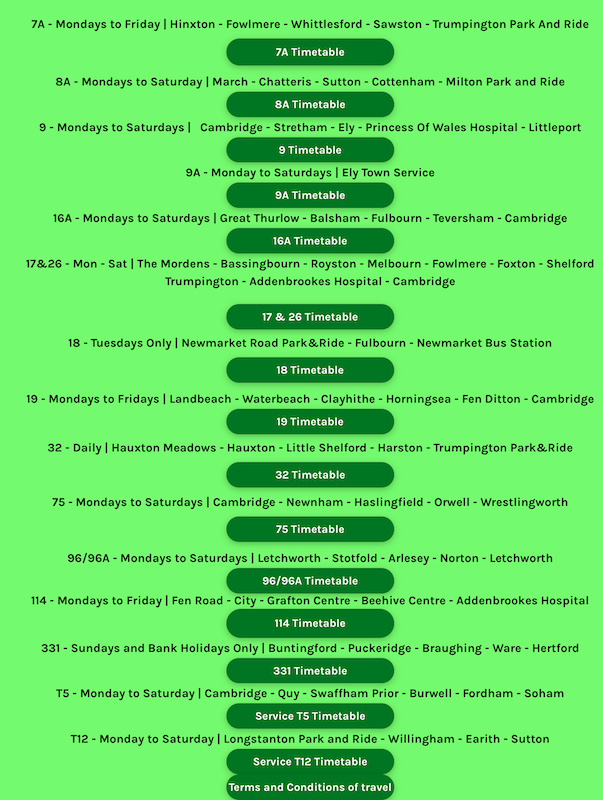
… and certainly in Kneesworth and Bassingbourn none of the 12 bus stops I walked past had any information at all.

You’d be hard pressed to know they were even bus stops in some cases.

It’s attention to things like this which are crucial. It doesn’t matter who’s in control – franchised, enhanced partnership or deregulation, if you don’t tell passengers when and where buses go, you won’t carry anyone and subsidy levels will continue to reach unsustainable levels.
And that was how this blog was going to end, but just as I was finishing writing it up last night ready for uploading on Thursday morning came another BBC News Report in which Mayor Paul Bristow is suggesting three bus routes (including the 15) be abandoned with the money saved paying for the continued operation of routes 9 (Littleport via Ely to Cambridge) and 31 (Ramsey to Whittlesey) which Stagecoach has announced it’s withdrawing from the end of next month as neither are viable any longer.

The Mayor is proposing to a meeting of the Combined Authority Board next Tuesday that routes 8A (March to Cottenham) and the 15 be sacrificed along with the south Cambridgeshire Tiger on Demand service to save around £531,000 a year which would be redeployed to save routes 9 and 31.
The assessed financial implications are set out in the report as follows.
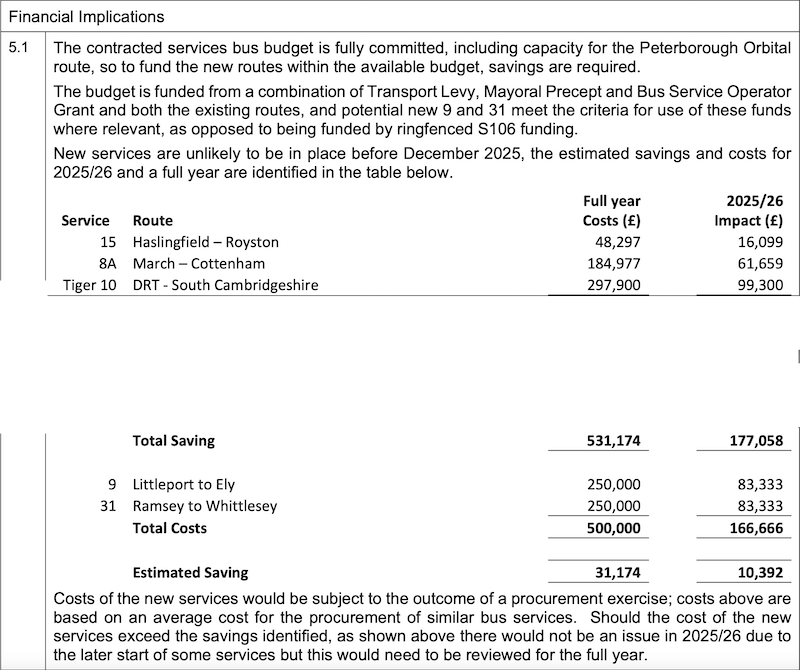
It’s perhaps not surprising the Authority ranks routes 9/X9 and 31 as a higher priority than routes 8A and 15 (see further extract from the report below) to say nothing of the South Cambridgeshire Tiger on Demand which was only introduced six months ago and seems to already be regarded as a hopeless basket case. Perhaps it’s finally dawning on those having to make decisions that when funding is limited it needs to be channeled where it will be most effective and not frittered away on flippant luxuries such as DRT.
Regarding discontinuing route 15, the report states it “has been in place for a significant amount of time and has been re-tendered on numerous occasions. The service links up communities between Royston and Haslingfield via Bassingbourn. The route 17 does cover a number of locations on the 15 but the removal of the 15 would remove direct links to Royston from Haslingfield, Orwell and Wimpole”.
If the Mayor’s proposal goes ahead route 15 won’t be much missed. Indeed, based on my experience yesterday, it looks as though it’s already expendable.
Roger French
Summer blogging timetable: 06:00 TThSSu
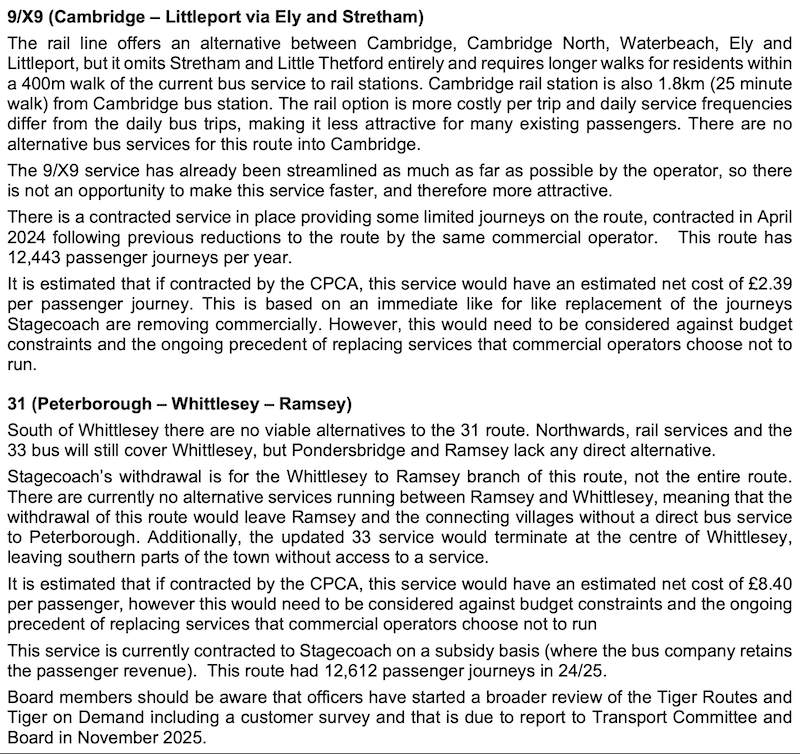
PS For those interested here’s the report’s observations about routes 9/X9 and 31.


Did you wait in Royston to see if the 1230 return operated ? I dont know if 2 hours in Royston is enough time to do shopping , etc. In these odd daily cases where there is a “core” route alternative – the 17 , then maybe the additional luxury of overlapping dial a ride is a better means of covering the double run to get to localities.
However as you say (and indeed has the Mayor looked/aware of the state of the roadside infrastructure and media publicity for the routes ?) without clear information – again any in Royston – who is going to consider to use these local bus services.
Is £360 a day for a bus route reasonable income for an operator ? – if that is the minimum gross cost (what does the mileage rate work out as ?) it seems a bit of a money for old rope contract – and if it didnt run something more than that.
Perhaps this blog page should be submitted in the report to the council comittee.
JBC Prestatyn
LikeLiked by 1 person
How an earth can £48K be justified for one am and one lunch time journey on a Wednesday only
LikeLike
Maybe try thinking like a mayor – of London – or Manchester .
Paint the bus yellow – indeed all the buses – and remove any printed timetables – but at least run with full blinds and easy to see roadside stops and timetables.
Or paint it red and white with rainbow route stripe for on it call it Super Loop SL15 and have the vehicle sat in the garage all week except for the day it is needed out running on the road
JBC Prestatyn
LikeLike
Oops, maths. £1000 a day paid to A2B for one route ? I think that amount has to be checked
How does that compare per mile with the 18 being the tuesday only Newmarket Park and Ride one – which itself looks interesting and a top 20 quirkable consideration to look at
JBC Prestatyn
LikeLike
I doubt the Tiger On Demand will achieve those savings at least 2025/26 as there must be some committments in the contract for upfront funding still to be paid ? Also if there is a review of the Tiger network in nov 2025 is not pre-judging that a little bit odd for decisions to be made in August (but which appear not to be implemented until 01 Dec 2025 ?)
JBC Prestatyn
LikeLike
This service was thin even in Eastern Counties days, Wednesday and Saturday apart from a more frequent service between Bassingbourn Married Quarters and Royston.
As is noted this level of transparency is commendable, as is what is probably an overdue culling of the worst performers. I wonder what horrors lie with many other authorities who don’t publish this data. Perhaps bi annual publication should be a condition of the BSIP grant, but sadly both HMG and LA’s are addicted to secrecy to cover up their failings.
By chance I need to go to Wisbech shortly and thought public transport might be an option. But effectively it’s Norwich or Peterborough and then First Excel coming from the south. Studying the ever useful Busaltas which has just been updated with the Tiger routes and many other changes, the obvious railhead from the south is Ely, well connected by rail but there is no Ely – Wisbech service. Tiger T7 which has been widely reported as carrying fresh air competes with Lynx 60 to Upwell and meanders to Chatteris, and Wisbech is the last place that Chatteris people would travel to. It is no shopping destination and also has no southward bus connections. If the mayor really wants to improve public transport he really needs to look at the complete lack of inter-town routes in the middle of Cambridgeshire
LikeLike
A quick check of routes to/from Wisbech on BusTimes shows a variety of destinations served, however many are infrequent and do not connect with rail services.
The only realistic options for the long-distance traveller from the south are using FirstBus Excel from Peterborough (short walk from the rail station to the bus station) or from King’s Lynn (directly outside the rail station). Or Lynx 46 from King’s Lynn bus station (short walk from the rail station to the bus station).
LikeLike
The Excel from Peterborough picks up outside the railway station, so there’s no need to walk from there to the bus station.
Ian McNeil
LikeLike
… and the main route from Kings Lynn is Excel not the 46, but both of these do pick up at the railway station so there’s no need to walk to the bus station there either.
I would not recommend using the Wisbech link to Bus Times as quoted in the comment from CBGbusUsers, as it includes routes which don’t go there (4, 54 and 33).
Ian McNeil
LikeLike
I was surprised to read that bustimes.org had returned incorrect results when searching for Wisbech, as I’ve always found it extremely reliable (apart of course from incorrect/missing data issues).
However, it did take me a while to appreciate how the search facility works, particularly that it is a two-stage process requiring you to narrow down the search by selecting the precise location or operator of interest from the initial list presented. If you haven’t realised this, the results can be extremely confusing.
So, if you enter a place name (or any other piece of text) into the search box, the system initially displays three sets of information
Using ‘Wisbech’ as an example, it lists six locations, of which the first is Wisbech, the second Wisbech St Mary while the other four are less significant locations with two-part identifiers including ‘Wisbech’, such as ‘Bunkers Hill, Wisbech St Mary’.
There are no operators containing the word ‘Wisbech’, but a total of 15 services are then listed. Of these, the first 12 actually serve Wisbech, while the other three serve bus stops including the name Wisbech. These are 4 (serving Thorney, Wisbech Road), 33 (Westry Wisbech Road) and 54 (Walpole St Andrew, Wisbech Road).
So if you’re looking for the list of services for a given location (rather than a specific bus stop name), it is ESSENTIAL to select it from the list of locations presented after the initial search – even if only one location is returned ! In this case, selecting ‘Wisbech’ then lists the 12 services you need.
It becomes a lot more obvious what you need to do if you enter text such as ‘Newport’. This returns 53 locations, one operator (Newport Bus) and 286 services around the UK – mainly South Wales and the Isle of Wight, but also Newport Pagnell, Newport-on-Tay etc, etc. Narrowing down the search by choosing the required ‘Newport’ then becomes the only practical way forward !
LikeLike
“Tiger T7 which has been widely reported as carrying fresh air“
And according to an FOI response, has an “Expected Gross Annual Cost (25/26)” of £1,017,184.00 (yes, over a million)
Source: https://www.whatdotheyknow.com/request/subsidy_and_cost_breakdown_for_c#incoming-3034331
LikeLike
This is so similar to our recent experience with A2B! On Saturday 7th June, my wife and I waited at Great Bradley for the 16a bus due at 10.20. By 10.45 it hadn’t turned up so we had to abandon our plans for the day. It didn’t show up on tracking and a phone call advised us that the office was shut on Saturday! As in your case, subsequent emails to the company produced no response. We later tried tracking the service at other times and found that, if it runs at all, it sometimes stops short of its full journey. It appears to us that it only runs when the driver knows that they have someone to pick up (I.e. a regular passenger) which might explain why it didn’t turn up for us, as they didn’t know we were waiting! I have written to DVLS about our experience (‘bus not turning up’) but, needless to say, have not received a reply from them either. Thought you might be interested! David and Lyn Ball
LikeLiked by 1 person
£190 per passenger journey is a huge sum. But do we know anything about the users (other than Roger)?
It may be a real lifeline / lifesaver for somebody – aiding mental health and wellbeing and keeping that person well without recourse to the health service.
One of my tablets that – apparently – keeps me going costs the nation over £450 per year. Maybe the bus journey is value for money for someone if it serves the same purpose as my medication.
LikeLike
Following my experiences with rural services that carry “the regulars” and are operated by regular drivers, it wouldn’t surprise me if the double-run to Bassingbourn wasn’t made “because no one ever gets on there now that Mrs Jones has moved away”
Jim Davies
LikeLike
I often wonder how much this happens. I suspect it does on some routes across the UK, and clearly doesn’t help at all with gaining new passengers.
If the operator suspects an ‘awkward’ section of route (e.g. a double-run or a an evening trip run against the main flow) will usually have no passengers then register it as ‘on request to driver’ / ‘phone to book’.
I suspected I was the victim of the latter example when returning from Marnhull to Gillingham early evening recently on South West Coaches route CR3* – the bus simply didn’t turn up. However I was impressed with the operator’s response – their website provided an out-of-hours number which I texted, an explanation (issue with vehicle) was texted back within an hour or so, and a refund was paid within a few days for my taxi fare – well done South West Coaches.
*I learned just the other day that ‘CR’ stands for a Dorset Council ‘Core Route’ – surely best to leave this as an internal reference and simply list it as route 3?
Stephen H
LikeLike
My experience was in Herefordshire and I would usually find out when going to do an on bus survey where the driver would say something like “Well I suppose I’d better follow the full route today then!”
Most of our market day services operated on the basis of set down on request on the way home, but we’re supposed to follow the full route in the way in.
By coincidence I was in Dorset recently add wondered what CR could possibly mean when used as part of a service number!
LikeLike
I had similar experiences with late evening routes in West Sussex in the late 90s, when the last journey back from the outer terminus (eg Selsey) into Chichester could run early as the driver was keen to sign off and get home. As inspector for the Council (these were contracted journeys) I used to check on these, my thinking being (quite apart from not meeting Traffic Commissioner guidance) they might leave behind passengers returning to town from country pubs!
Stephen H
LikeLiked by 1 person
A2B Travel Group are just another one of those typical ‘government-funded private enterprises’ who can only exist on state-subsidies and contracts with the government or tightly regulated businesses (e.g. Railways); Companies who set up their business model in this manor, as opposed to try and be dependent on commercial bus services and their passengers, will generally always fail, and it just takes time for them to do so.
A2B have clearly done as little as possible in the running of route 15, which should not be too unexpected in a Keynesian-run economy like the UK. This is in contrast to, say Brighton & Hove Bus & Coach Company, who actually advertise their public bus services, and appear to not purposely squander tax payer money (not saying that’s what A2B do).
LikeLike
Isn’t this the type of bus service which could be operated by a taxi, chargeable to the Council? It would only operate if requested, and would save thoussnd of £s.
MotCO
LikeLike
Exactly. Car sized problems should have car based solutions.
LikeLike
Typical council contract prices for a short school run are about £50 a day so using a local taxi company to provided that service would save over £900 a week
LikeLike
I know very little about A2B Travel Group but according to its latest accounts, the fixed assets of the company are valued at £535.
Nigel Turner
LikeLike
There web site is quoting an old company name but the right compant number not very profesuional and may not be legal
LikeLike
…but were there perhaps some hefty sums for rental of premises and leasing of vehicles and equipment?
RC169
LikeLike
For many years, and only relying on a comment I heard once, that C.G.Myall & Sons had worked this service from deregulation day right through to August 2021. It then passed to A2B, but I am led to believe continued to be worked by Myalls for some time after under an arrangement with A2B. Somehow this arrangement also changed around June 2023 and Vectare (now Central Connect who seem to be everywhere these days) took over, but in April 2024, A2B got it back. Are you keeping up? At least that is what I understood to have happened.
Thus it’s parentage and certainly operation has been rather shrouded in mystery for some time.
However, if the continuing spate of non-stop road closures continue as for the last few years, there will be no rural services left. In just the last two days, I have come across THREE occasions where buses have been arbitrarily withdrawn from their normal route, leaving villages unserved. Anyone but the hardiest bus traveller would have long deserted, and it was probably the local road work that saw non-operation of the 15.
Terence Uden
LikeLike
Nowadays so many bus stops which are shown on journey planners and on maps sites such as google maps have nothing on the ground to tell you they’re there. Sometimes it’s because the locations shown on the maps and planners are simply wrong and the stop is actually a hundred yards further along the road, but often there really is nothing to identify the stop.
When I was a young mouse in the midlands, it wasn’t at all unusual to see a Midland Red or generic bus stop flag (some very old indeed) poking out of a hedge. That’s the reassurance you need that you’re in the right place, and the reassurance the driver needs that they’re stopping somewhere their boss won’t claim they shouldn’t have stopped if you fall getting onto (or off) the bus!
LikeLike
In many rural area the bus stops imply don’t exist you have to pretty much guess where the bus is supposed to stop. It hardly encourages people to use buses when they cannot even be bothered to install bus stops
LikeLike
We’ve had problems in trying to formalise some unmarked bus stops, as they don’t meet modern day safety standards, or cannot be rebuilt to include DDA compliance.
But if we do nothing to them and they retain their present form, then current standards don’t apply.
At least these days the existence of such stops is mostly recorded in the NaPTAN database, rather than just being a local secret – and one not always known by all bus drivers!
KCC
LikeLike
BET era Midland Red timetables included in the introduction “Omnibuses will stop anywhere to pick up or set down passengers, except….where a system of bus stop signs has been instituted..”. Even busy routes like the 110 still had “custom and practice” stops on the rural section, whilst holidays in Worcestershire found very few marked stops.
When I moved to North Notts in 1969, I found that East Midland simply stencilled “Bus Stop” on a convenient wall or gate post. Proper flags weren’t common in either area until county councils got involved with NBC.
LikeLike
That’s still the case in Wales. On the T2/T28 there are even fare stages which don’t have marked stops.
LikeLike
Phil it was carried over to Midland Red West as their timetable books also used to say buses will stop anywhere except where a system of bus stops is instigated by the Traffic Commissioner.
LikeLike
I wonder if the 4th Passenger is someone at Royston Rail station that gets on to go to Tesco as the 15 is the first arrival for them to travel on. Anyone checked Royston rail connecting times and other route time variations over the past couple of years ?
JBC Prestatyn
LikeLike
With a contracted bus service paying such a large subsidy it is almost worth inventing passengers and paying the “fare” into the pot to keep the larger money coming in. Not that I am aware of any company doing that and I assume the subsidy people do on board checks as well as relying on ticket sales etc.
Seeing Geoff Marshall on you tube with a whole load of real time wi-fi’d out to 1000 interested persons on one of the network rail asset management trains I am sure ticket machines and smart tachometers could be fitted to all buses recording in real time and update summary at end of day of passengers borded and mileage run for both BSIP and similar measures
JBC Prestatyn
LikeLike
Express Motors?
LikeLike
Will Bassingborne become the Berney Arms of Bus Stops ?
LikeLike
Clearly someone is ripping the council off. No way does a return journey once a week cost 50 grand a year to run. Outsourcing, the gift that keeps giving! Also strongly agree the details and presentation matters. Unfortunately, who is using a route like the 15 when the old folks pass away? Would anyone new to the area even know of its existence if it doesn’t even run the advertised route in full so people like yourself can’t turn up one week and just ride it?
Aaron
LikeLike
For that amount for an off peak bus. Why isn’t the 15 running every weekday?
Assume A2B have other commitments or the local authority didn’t bundle all the “odd day” workings which could be done by one bus in one tender?
LikeLike
Presumably the logical approach would be to use a bus that takes children to a school near to Haslingfield. Then the weekly service to Royston would just incur the marginal costs of fuel for the service and the additional hours worked by the driver, plus an allowance for depreciation caused by the additional miles.
This model was used by Jennings of Ashen and described in Keith Turns’ book “The Independent Bus” – admittedly several years ago, but I see no reason why that model should not also work today.
RC169
LikeLike
How awful, to have had a wild-goose-chase at such a remote location which included a taxi fare to reach your destination. The football world protects referees from having wasted trips to match venues only to discover the match will not take place. In landline days the usual reasons for a wasted journey were several: waterlogged or frozen pitches; visiting team does not show up at all; neither or both teams fail to fulfil the quorate standard for the competition (minimum of 8 players) so that I can start the match. The Saturday competition I refereed on (The Arthurian League) required that I be paid the full fee but on Sunday afternoons (The South Thameside Sunday Football League) required that I was merely paid a half-fee. Getting money from some clubs was on occasions difficult. On 21/03/2009 I refereed a game at Chiswick. Old Westminsters FC lost 0-3 at home to Old Foresters FC. I managed to get £20 of the £28 fee, very reluctantly, from a player of OWFC. There were claims that the dressing room has been ransacked by thieves, so I chased the club for the balance by email which I did from a local library. I got the £8 cheque from the OWFC on 11/04/2009. This was an “aggravated” matter, but it was generally awkward securing my fee, from the home club after their visitors had won. I love buses & trains to bits but being a member of the football community takes my emotions to a profoundly wonderful “other place”.
LikeLike
May I point out a typo in the paragraph above the photo of the anonymous 17 – “business.org website” should be “bustimes.org website”.
Steven Saunders
LikeLike
Many thanks Steven; now corrected.
LikeLike
Whilst those who don’t run buses bash A2B they have taken on quite a lot of work recently and are probably struggling, but I accept non operation of a weekly service is unacceptable as is failure to respond to passenger complaints. This service was no doubt won by a competitive tender( as evidenced by changes of operator listed previously) so their bid must have been the lowest. Let’s not also forget that A2B stepped in along with other operators when Stagecoach had to cut back drastically three years ago through driver shortages.
If only we could go back to the Jennings of Ashen days (60 years ago) but for example just think of the work to create next stop announcements for a route like this.
As to costs a bus needs to earn, for a 12 hour day 6 days a week, £150,000 ,and probably more in an affluent area like Cambridgeshire where driver pay rates will be higher.
Running buses is an expensive business these days.
LikeLike
Free bus-pass travel has fallen by a third – and no-one knows why
Older and disabled bus users are staying away from buses after the pandemic and experts aren’t sure why. While fare paying passengers are slowly returning to public transport, those entitled to concessionary or free bus travel are still keeping their distance with many not even bothering to apply for their free bus passes.
A report by the public spending watchdog, the National Audit Office last month said England’s bus network is used more than any other form of public transport but concluded it is ‘still not working for the people who need it most.’
LikeLike
Free bus pass travel – probably differing reasons for the fall. In my case, in Northumberland, last year for a considerable period there were significant numbers of cancellations to services. It was hardly surprising that the reopened Northumberland line rail service, with low fares and a more reliable service, was very successful.
Also, whilst free bus pass travel looks good on paper, some non-direct routes are very slow and tedious, going through large speed bump-ridden estates, so where there’s a rail alternative, it’s quicker and more comfortable to pay a modest amount to go by train (or maybe tram in some areas).
LikeLike
Free Bus Pass travel – maybe in part it is the increase in Pension age upwards towards 67. Much of the use previously was old ladies 60-65 who were active, often volunteers in the local charity shop etc, now at much older ages they are getting inactive generally, plus a change of demographics as older populations start to skew toward – in urban areas – older Indian populations and they just dont go out as much (or retire to Worthing) The provision say of dedicated hospital transport and some dial a ride services takes a few other journeys away and while cycling by older persons has always been a feature maybe some feel more active with that , with the remainder getting lifts in cars or happy to use taxis . Surrey seems to be complaining too that less persons are using its day centres and community facilities too – but if bus routes and times have been cut then how can that encourage access. So, Vicious circle or structural change. Perhaps say the older persons “paid for” cards in London and Manchester (elsewhere ?) may show a different pattern of usage . If you have a service that only runs once a week and for whatever reason you miss it then you wont travel. Covid too has not gone away and catching it knocks you out for 10 to 25 days . It has been similar in other social groups I go to – about 10 deaths in 5 years and the newly retired just are not joining at similar numbers for much the same reasons as not travelling by bus. Maybe too the changes on the high street and internet shopping ( though the catelogue shopping has always been targetted to slipper wearing grannies ) have impacted too with the department store nearly a thing of the past, eating out in anything but a wetherspoon has increased in prices more than even the triple lock pension. But our urban areas have seen other changes too – trams in Nottingham and Manchester’s newer routes, better rail that is becoming (Slowly) more accessible and if one builds “15 min cities” then even just what you need in walking distance has effect – but I think home delivery from ones supermarket of choice has been the big change in need for weekly bus use.
JBC Prestatyn
LikeLike
One point that doesn’t seem to be recognised is that a change to someone else’s circumstances can change your travelling habits. Pre-Covid, I used to meet a couple of friends from a few miles away somewhere convenient most weeks, giving a total of 8 – 12 (ENCS) bus journeys each time. As they both have breathing problems, they were vulnerable during Covid and got out of the habit of coming out. We now only meet a few times a year. So not only are they not travelling, but nor am I.
Frankfrog
LikeLike
“With a contracted bus service paying such a large subsidy it is almost worth inventing passengers and paying the “fare” into the pot to keep the larger money coming in. Not that I am aware of any company doing that and I assume the subsidy people do on board checks as well as relying on ticket sales etc.” That’s what did for Express Motors in north Wales: huge numbers of fraudulent concessionary journeys. Eventually they were caught and prison followed.
LikeLike
I am aware of potential abuse of concessionary fare sytems – thats why I prefered pre smart cards National Travel Tokens a pain to add up but at least the double entry accounting was foolproof. There was also reports of the £2/£3 fare cap being sold to destinations at the last fare stage on the route for greater clawback claims
JBC Prestatyn
LikeLike
Except the fare cap reimbursement was not paid per trip made under the scheme (let alone in reference to the to/from of the trip recorded) but on a calculation based on the travel made before the scheme came in to create a notional expected revenue lost that was then compared to that for each participating operator to calculate a percentage of total national revenue lost which then gave each operator a fixed sum based on that percentage of the total cash allocated to the scheme. Operators did not gain extra reimbursement if the scheme was successful and more passengers traveled let alone if they traveled further. Drivers selected the end of the route (or other significant point) as it was quicker and easier than searching through the list for a specific point where it wouldn’t affect the fare paid by the passenger and wasn’t an issue for the operator as it didn’t affect the revenue received from the government so no fraud occurred.
Similarly for concessionary fares schemes most don’t calculate their reimbursement based on the journeys being made by the concessionary traveler but on a figure created by a calculation of average adult fares (single, return, day & week). Whilst drivers recording the incorrect destination was widely noted in few cases (I don’t believe any of the authorities my employer deals with based their reimbursement on the trip made by the concessionary passenger) did that have any effect on the money received by the operator. Any fraud that had been found related to over recording either by drivers or operators submitting claims (such as the Express Motors case where reports submitted included more weeks than the period contained).
Dwarfer
LikeLike
If I read the 9 correctly part of that is already contract by CPCA to A2B
delegate authority to the Executive Director for Place and Connectivity, in consultation with the Chief
Finance Officer and Monitoring Officer to commence procurement of replacement services for:
which were notified by Stagecoach to cease by 31 August 2025. The estimated costs for these services are £0.5m. The board should note that these services would likely commence late in 2025 with acsuccessful tender process.
I assume then for 4 months people will have no public transport in these areas (rail aside) )
Maybe some checking of usage of the 9 is worth investigating
JBC Prestatyn
LikeLike
National Travel tokens foolproof? They were issued annually and towards the end of the year the drivers and local taxi firms bought them off anyone who had any left at a substantial discount.
LikeLike
£250K for the 31 seems very high, It operated 5 journeys a day Mon to Sat
Passenger numbers given is 1200 which if my maths has not gone wrong about 7 passengers’ a trip on average (I have assumed all return journeys)
Given those passenger numbers a mini bus would do the job
Typical high rate for day with driver about £300
LikeLike
Timetable Archive – A2B
The plot thickens??? Seen this above link says A2B withdrew from this route in November 2024 with no known replacement?? So does this bus actually not exist anymore??
Leonard
LikeLike
Whoever awarded/signed this contract at that price should not be in his/her position. Considering it’s public money, I’d suggest it’s negligent. There has been no sense of value considered. It suggests that a process has been slavishly followed with little consideration of alternatives and no creative thinking. The worst of the public sector.
The bid was highly opportunist. There is no world in which this is in any way reflective of costs. Perhaps A2B expected/knew they would be the only bidder and took advantage of the incompetence of the tendering authority. The worst of the private sector.
LikeLike