Saturday 12th July 2025
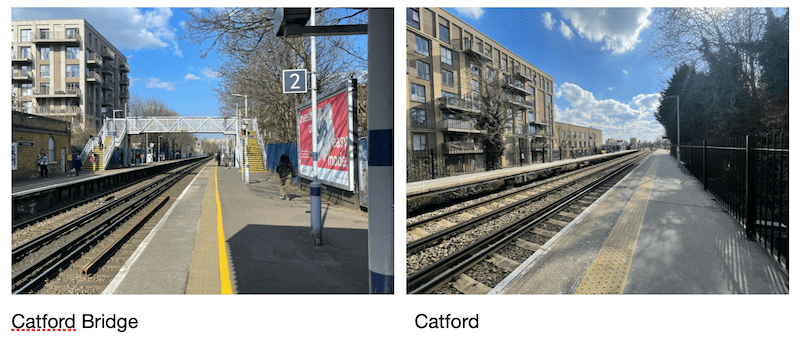
Today’s blog features the two separate stations located closest together in this fortnightly series. They’re in the south London suburb of Catford in the London Borough of Lewisham. Frankly, if it wasn’t for the fact they’re named differently and the railway lines don’t connect, they could be marketed as one station, having platforms closer together than you’ll find at some large stations.
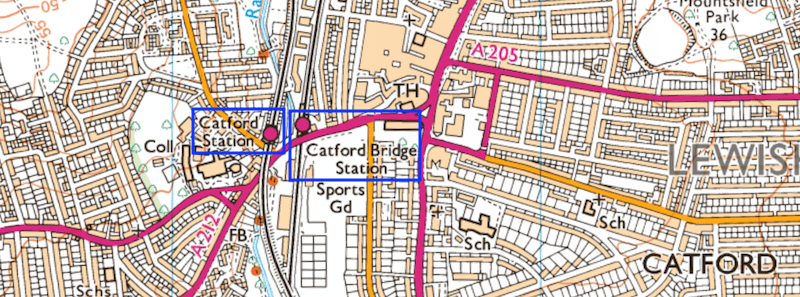
As always history has led to the two Catfords being treated as separate entities and for many years the former Catford Stadium was located between the tracks. Google maps reckons it’s a two minute walk using the South Circular Road (A205) on which both stations sit…


… but I used Adenmore Road which is at a lower level and did it in just one minute without hurrying. In fact you can clearly see the west side entrance to Catford Bridge as you leave Catford station…
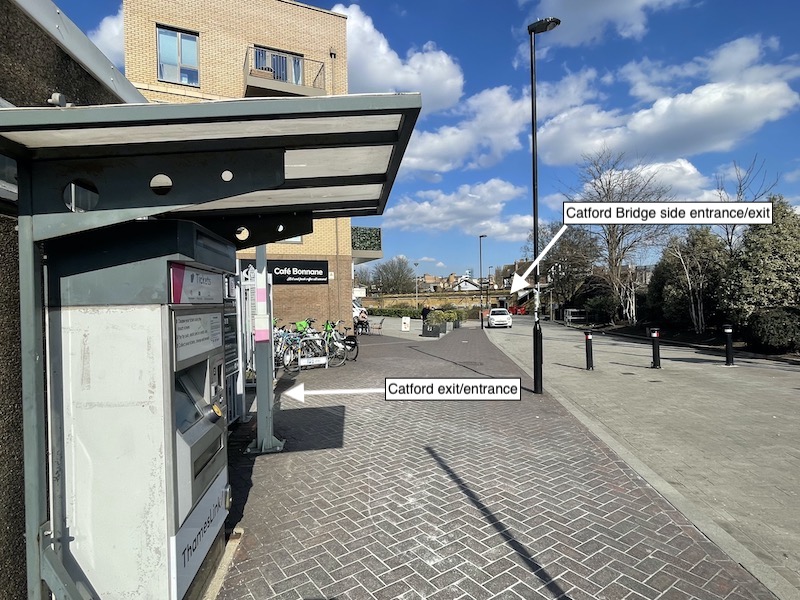
… ahead of you.

Catford Bridge opened 35 years earlier than its adjacent neighbour and is by far the more substantial of the two stations…

… being over three times busier too. In 2023/24 2,357,000 passengers used Catford Bridge compared to 745,000 using Catford.
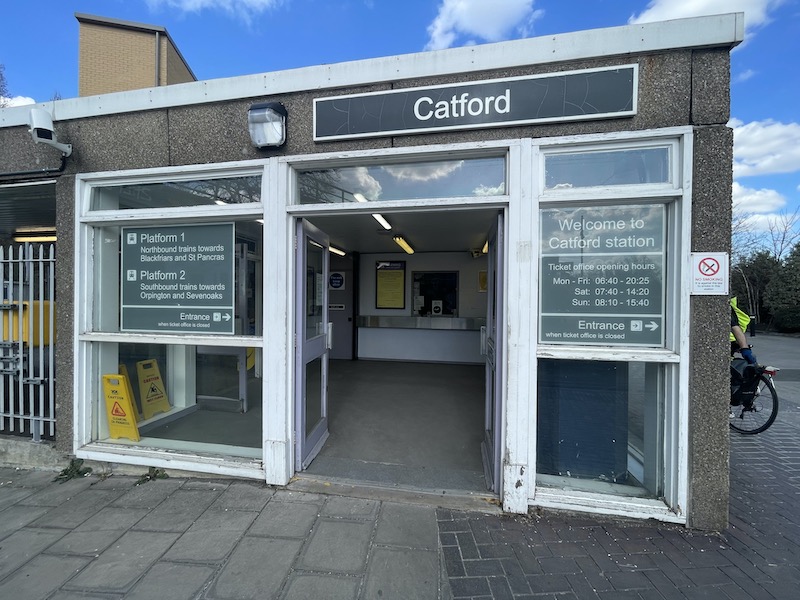
Catford Bridge sits on the Mid-Kent line serving Hayes and began life when the South Eastern Railway opened that line in January 1857 (initially only as far as Beckenham) whereas Catford opened in July 1892 on what is now a Thameslink operated line between Blackfriars and Sevenoaks.

Southeastern trains run four times an hour from Catford Bridge northbound to London Bridge, Waterloo East and Charing Cross and southbound to Elmers End and Hayes.

Catford enjoys a half-hourly off-peak Thameslink service northbound to Elephant & Castle and Blackfriars and southbound to Sevenoaks via Bromley South and Swanley. In the peaks these continue north to and from Welwyn Garden City and are also supplemented by another two trains an hour between Orpington and Luton, although in the afternoon peak most journeys to Orpington commence in Kentish Town with one starting from West Hampstead Thameslink, rather than Luton.

Both stations have a ticket office with Southeastern’s at Catford Bridge being more old-style…

… with Thameslink’s at Catford’s more basic and in fact was closed for lunch when I called by.
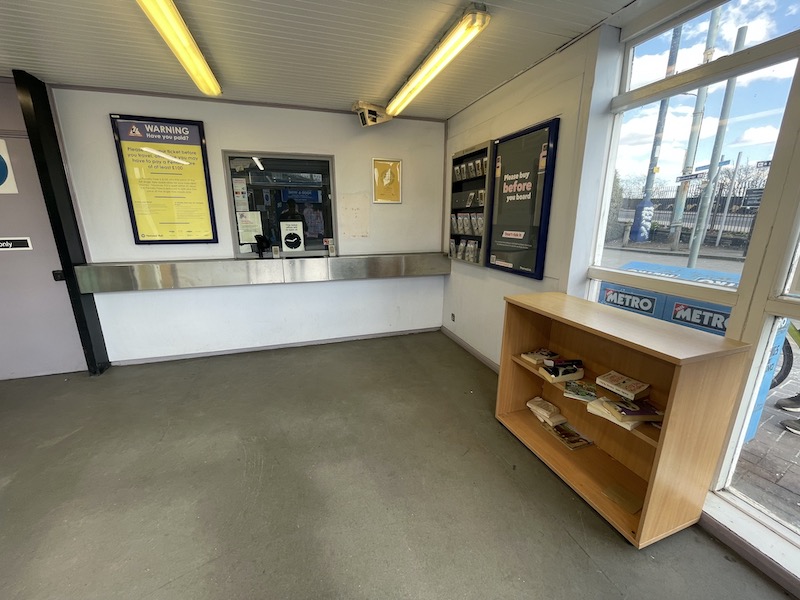
As you can see there’s a book club at Catford (above) and not to be outdone, there’s also one in Catford Bridge (below), although both could do with some new supplies.

Catford Bridge also offers a Community Board…

… and some interesting artwork on the wall alongside a closed former retail unit.

Neither station has ticket gates. Catford Bridge has a number of exits – either through the ticket office on southbound platform 2 or when that’s closed through a side gate next to it…

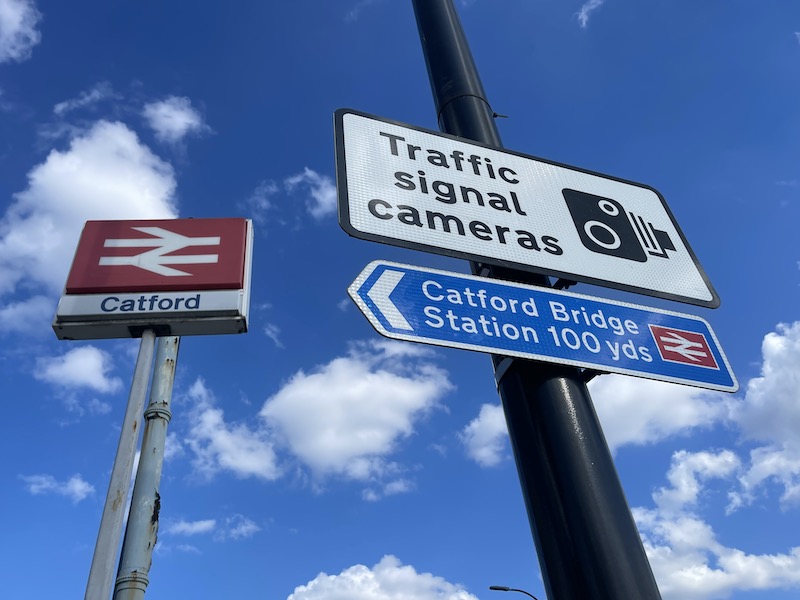
… or via covered steps taking you up to the South Circular Road, and which I see still advertises the walking route to Catford Stadium (it closed in 2003) along with Catford Station almost implying you cross the tracks to reach them with a right pointing arrow.
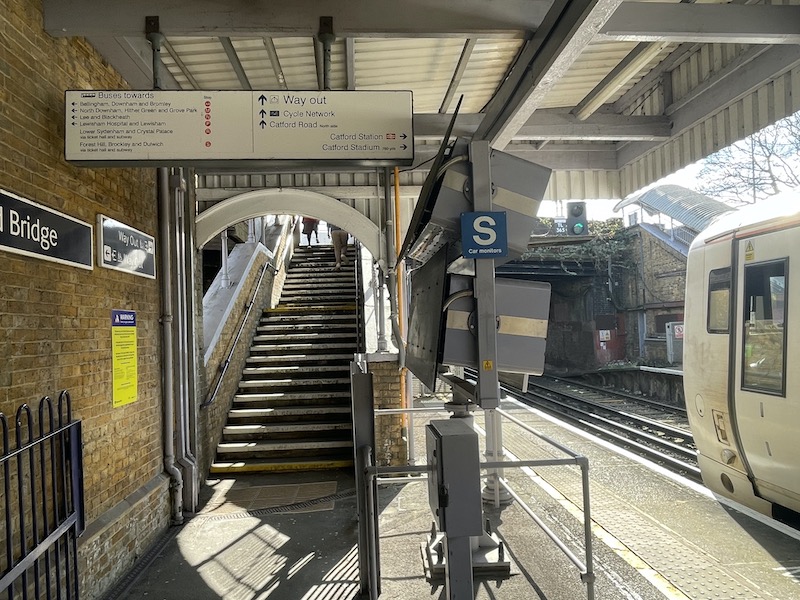
There’s another set of covered steps leading down to Platform 1.
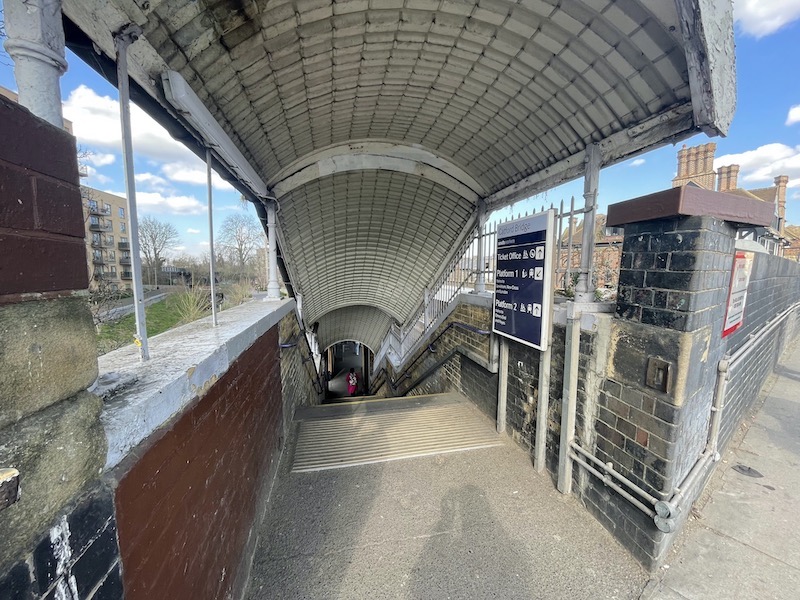
Standing on the South Circular Road overlooking the platforms you can appreciate the large covered shelter protecting the southern end of both platforms and also see the footbridge further north along the platforms which also connects them.
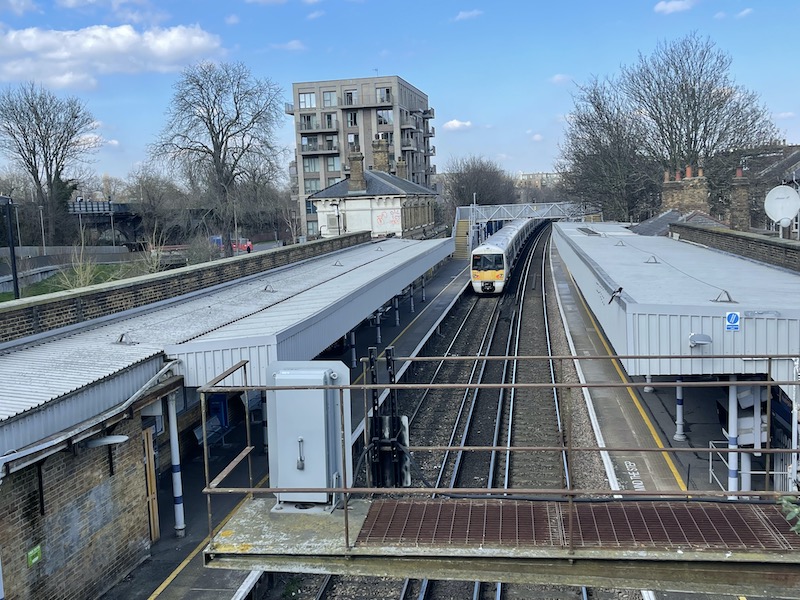
With side entrances/exits to both platforms the station has step-free access.
Over at Catford step free access is provided through fairly modern lifts to both platforms…


… located either side of a passageway under the tracks.

As you can see there’s a significant flight of stairs to reach the platforms…
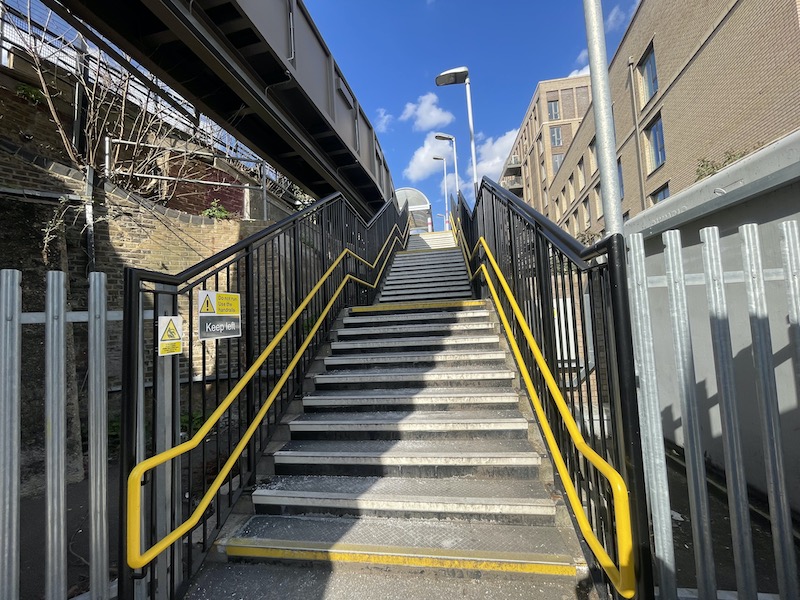
… and once you reach them the facilities are fairly basic. There’s a substantial covering/shelter at the southern end of each platform; soutbound platform 2…
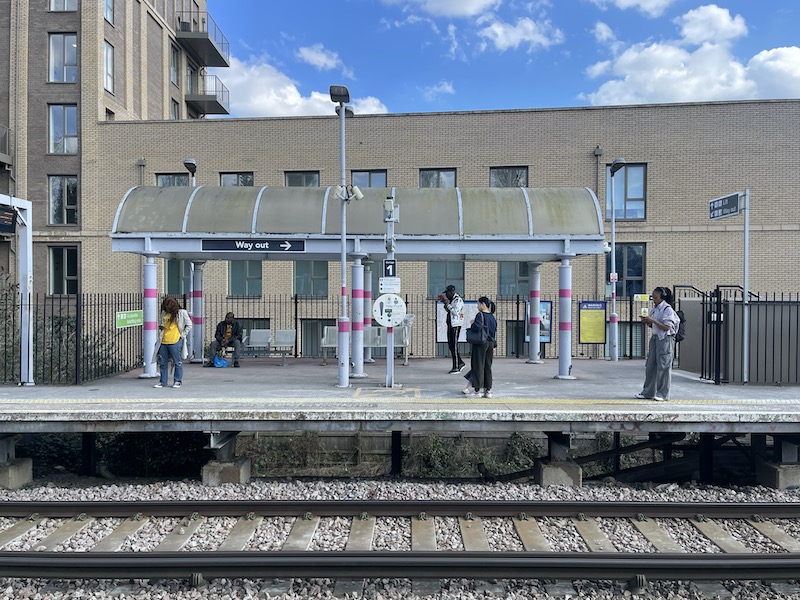
…and northbound platform 1.
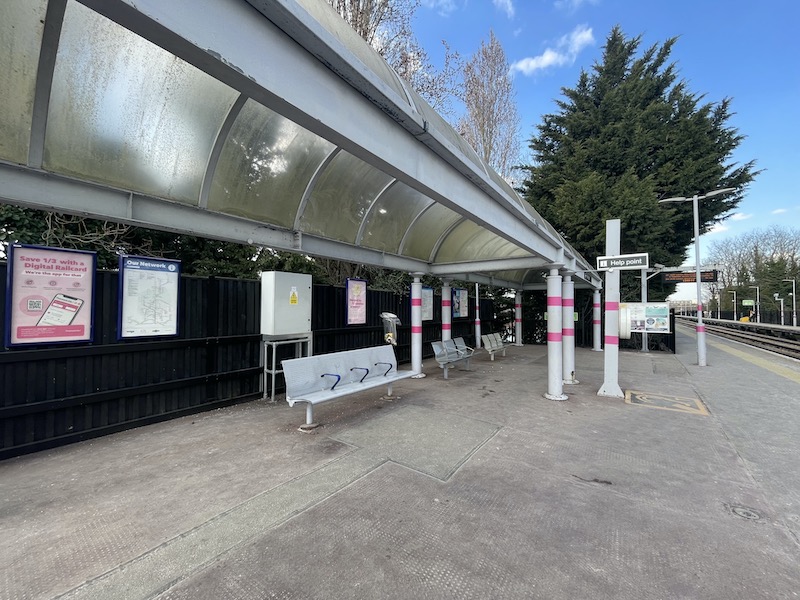
Each has a few seats which is just as well as the only other facilities are a few benches…

… located down the rest of the lengthy platforms.
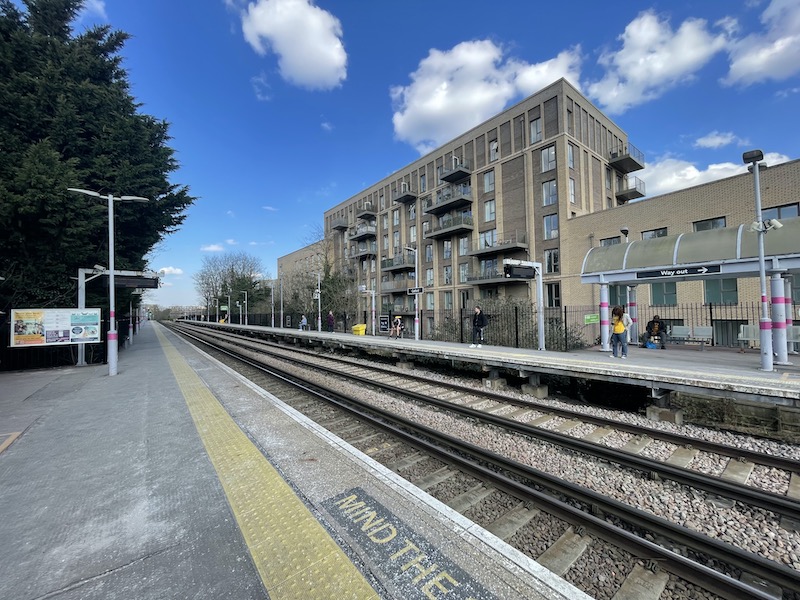
And that’s about it for Britain’s closest pair of stations.
Roger French
Did you catch the 13 previous blogs in this series? 1: Hertford; 2: Canterbury. 3: Wigan, 4 Dorchester, 5 Windsor, 6 Wakefield, 7 Reddish, 8 Yeovil, 9 Newark-on-Trent, 10 New Mills, 11 Tyndrum, 12 St Albans, 13 Falkirk.
Summer Blogging timetable: 06:00 TThSSu


This area of Southeast London is drenched in sports’ culture. Next to the two Catford stations is a sports ground originally owned by “The Private Banks” but then sold to nearby St Dunstan’s College. Two stops south on the Mid-Kent Line at New Beckenham were the CUACO Sports Club which was sold to Crystal Palace FC; two, adjacent, sports grounds owned by Lloyds Bank which were sold to Kent County Cricket Club; and a NatWest Sports Club ground sold to “Fitness First” – all these to the east of the railway. To the west of the railway remains the HSBC Ground although I initially remember visits when it was known as the Midland Bank. My railway thrills of long ago were when railway diversions took one over the junction from New Beckenham to Beckenham Junction on various Sundays. This link used to be double track, but it is now singled with the down line now serving as a stabling siding. All this was so long ago, those rides would have been in 4-EPB stock. Didn’t either Hazzard or Marshall do a video, going by train from one Catford station to the other to test what fare the contactless system would charge?
LikeLike
Geoff Marshall did https://youtu.be/6UZwqWw7REA?si=hX8JjpA-KkyVxzLY
LikeLike
Hi Roger, been to both stations arrived at Catford Bridge, never saw in the ticket offices when I went with my friend to look at the other Catford station that ticket office was closed, actually went there for my late Nan’s birthday, she was from Catford
LikeLike
Catford being on Thameslink features on new July 2025 tube map I picked up yesterday at Highbury & Islington.
Rather than adopt the Rail and Tube services map showing all stations used in your Blog, TfL plods on with an “evolution” Harry Beck’s map showing the services it operates. This means the Moorgate to Finsbury Park line former Northern City Line is no longer shown.
Catford is shown before the line heads north east towards Shortlands, squashed between Woolwich and Elmers End.
When I ask people staring at Tube maps on stations if they are lost, they say no! no! but if I say can I help at all they seem to be embarrassed they can’t understand the diagram.
Welcome to TfL land!
John Nicholas
P.S. “I can’t find Liverpool … that’s because it’s not in London” have a nice day!
LikeLike
We used to drive past these two stations when we visited family friends in Orpington in the 60s and 70s – back then Catford had wooden platform buildings which hadn’t seen a lick of paint in decades and were a real eyesore. Graham L.
LikeLike
Deeply suspicious regarding the disparity in passenger numbers using both Catford stations. I think I am right in saying that apart from Bromley South, there are no stations with barriers the entire way from the “Bat and Ball” (just north of Sevenoaks) up to and including the “Elephant and Castle”, a mere walk from Central London. With possibly Denmark Hill an exception? Ticketless travel must be rife. Thameslink ticket Inspectors are very active north of Finsbury Park to Peterborough and Cambridge, and it is rare not to have your ticket checked. However, I have never encountered a single one on the Sevenoaks/Orpington section.
Going north on the Mid-Kent (fascinatingly planned to become part of an extension of the Bakerloo line at some point!), other than the next station at Ladywell, all main stations have barriers. Not that such things impede the local youth, who simply push their way through, tailgating another passenger or using the wide entry barrier which has a longer opening time. Thus, for the majority heading towards London, the need to buy a ticket becomes a necessity.
Terence Uden
LikeLike
Both Denmark Hill and Peckham Rye have barriers.
LikeLike
”this ain’t Calais, this is blinking Catford” as the PG Tips advert went..
LikeLike
I was in London yesterday and picked up a Tube map expecting it to be the latest version, but it’s dated December 2024. It shows Catford (and the Thameslink stations on the Sevenoaks line as far as Swanley) with a double-arrow symbol signifying National Rail interchange, but Catford Bridge and the stations it connects to away from the centre are excluded (except for Elmers End which is shown as just a tram stop).
Ian McNeil
LikeLike
I dont think Mr Uden needs to fear much about fares loss from Catford, its just an area you dont really travel to or from other bits of SE London by Rail , Orpington maybe excepted.
Would maybe prefer more calling trains , expecialy since Lewisham offers onward travel via St Johns or More Direct to Somewhere like London Bridge, or Beyond
London really could do with a Station closer London Bridge than New Cross
JBC Prestatyn
LikeLike
May I suggest a ‘Bermondsey Junction’ station, with platforms on the N.Kent/Bexleyheath/Sidcup/Orpington lines between the bridges over the two branches of the Windrush line (and new platforms on both of those – there are already plans for a station ‘Surrey Canal Road’ on the Clapham branch). This would fill an important gap in the ‘Overground Circle’ interchanges; at present this connects with the SE main line only at New Cross; the present New Cross OG trains could be diverted to double the service to Peckham and Clapham. ‘Bermondsey Junction’ would speed up many journeys between South-east and South/South-west London, and encourage modal transfer from car to train and bus.
LikeLike
Please clarify where you mean, using road names. Thanks
LikeLike
I am imagining just east of Millwall’s stadium, north of Surrey Canal Road.
LikeLike
The point I made was that many people travel FROM Catford towards London, but alight in places such as Peckham Rye and the Elephant and Castle, returning later. I use the line frequently, particularly early morning, as although it is even more slow than the “Slow Motion Railway” itself (known otherwise as South-East Trains), it avoids my having to use the Underground to cross London. And I can assure you most trains after 0630 are standing room only, with some of the highest numbers joining at Catford. Hence my original comment.
Terence Uden
LikeLike
It’s curious to me why the stations have never been renamed Catford East and Catford West.
Steven Saunders
LikeLike
Catford station is raised on a bridge above the South Circular (and despite the many steps, the road has a height restriction); Catford Bridge station is at ground level, with the South Circular passing above the tracks on a bridge immediately to the south of the station. Clear?
LikeLike
As a local, I am not sure I’ve ever seen the stations looking so tidy – amazing the difference a bit of sunshine makes!
LikeLike
Rick , Clapham Junction might get a bit full perhaps extra services into Battersea Park (for growing Battersea Power Station Area) even if 20mins would work ?
Terrance – I am surprised so many people in Catford want to go to Elephant – are they changing to elsewhere or a lot of workers on the construction sites ?
JBC Prestatyn
LikeLike
Further to Steven S’s comment I do think that official disambiguation is needed in cases like this, to avoid what I am sure are regular conversations like ‘Do you mean Catford Catford or Catford Bridge?’, ‘Are you arriving at TON*bridge or Tunbridge Wells?’. This was fixed years ago for some places like Southampton but persists here and elsewhere.
*confusingly, pronounced TUN
Stephen H
LikeLiked by 1 person
Are the stations really closer to each other than the two at St Budeaux?
LikeLike
The 2014 TfL consultation on Bakerloo to Hayes suggested that 6tph would reverse at Catford, with no details, but subsequent consultations have not provided such detail.
LikeLike
I used Catford station twice today, and was jolly glad of the new-ish lifts for my heavy shopping trolley containing my gardening tools for work. I interchanged with bus route 181, with the bus stops slightly inconveniently located somewhat east, beyond Catford Bridge station.
Stephen H
LikeLike