
Sunday 6th July 2025

Back in April readers may recall I blogged about a raft of changes to bus routes in the Royal Borough of Windsor and Maidenhead involving tendered services passing between Thames Valley and Carousel while in March, after many years absence, the latter introduced a new commercial route (127) between Maidenhead and Reading.
Having looked at those developments I also sampled two new tendered routes operated by Thames Valley which were also part of the changes which began on 7th April.
New route 227 replaced withdrawn routes 234/235 between Maidenhead and the village of Waltham St Lawence now continuing to Twyford while new route 228 incorporated links offered by now withdrawn route 239 and runs between Maidenhead and Henley.
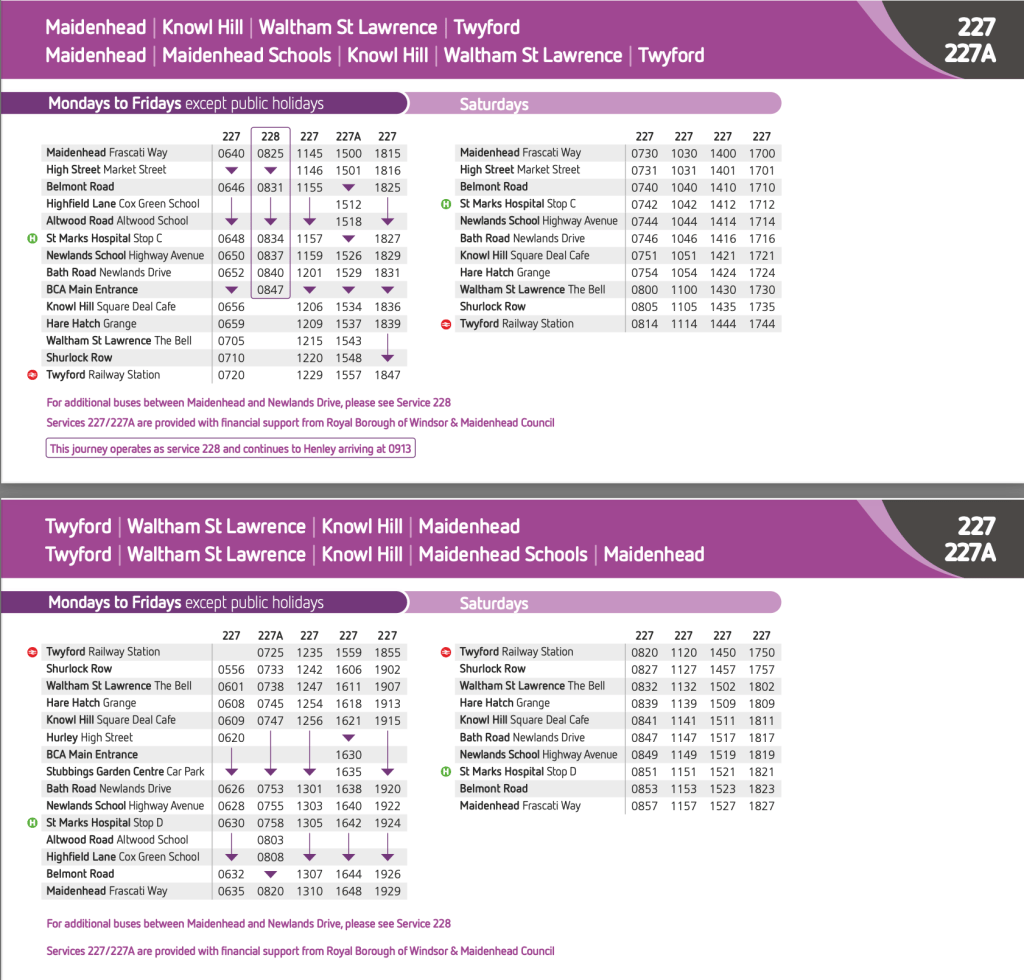
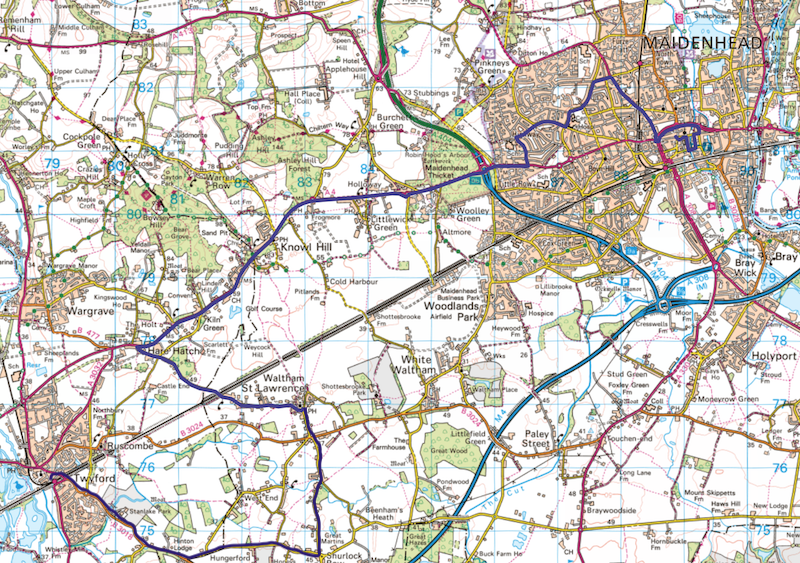
Both routes 227 and 228 serve the residential area to the north west of Maidenhead before continuing either via Knowl Hill on the A4 (also now served by Carousel’s 127) to Waltham St Lawrence, Shurlock Row and Twyford (227) or to Hurley and Henley (228).

One bus shuttles up and down between the two routes all day with an additional bus at peak times to facilitate journeys to serve Cox Green School and Altwood School (leading to a different route being followed within Maidenhead) as well as BCA (Berkshire College of Agriculture).
I caught the 11:45 departure from Maidenhead on route 227 to Twyford. The bus arrived on time from Henley on its previous journey on route 228 at 11:34 with just one person alighting.

It didn’t surprise me there was no one else boarding with me as there hadn’t been an inward journey on the 227 timetable during the morning since 08:20 which would be a bit early for shoppers and pre-concessionary travel validity.
One passenger did make a local five minute journey within Maidenhead from St Lukes Road to St Marks Hospital but otherwise it was just me for the whole 44 minute run through to Twyford. As mentioned earlier, the section of route along the A4 is now well served by Carousel’s recent commercial initiative to run route 127 on Mondays to Fridays through to Reading, and the other main purpose of the 227 in the off-peak, to provide a bus route to the village of Waltham St Lawrence and the hamlet of Shurlock Row didn’t have any takers.
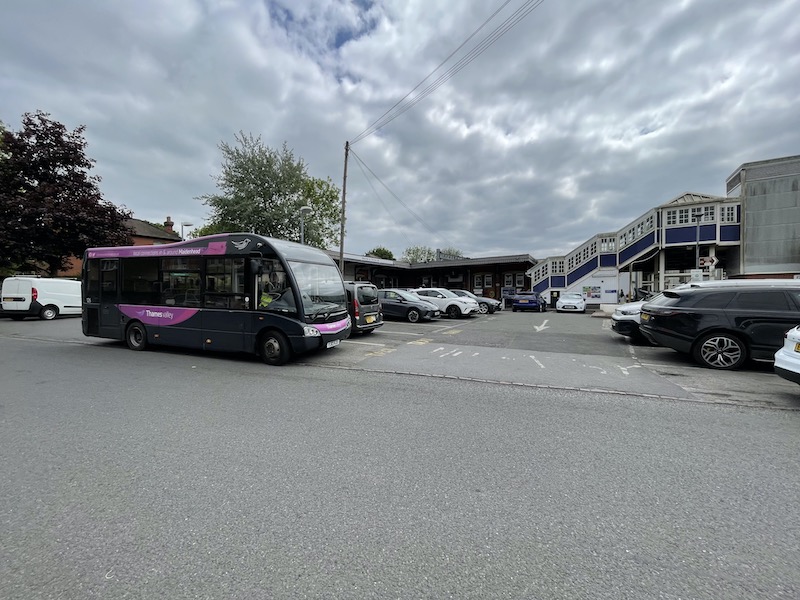
More positively one passenger did board for the return journey once the bus arrived at Twyford, station but I left the bus there to take the train up to Henley for part two.

Incidentally the train was quite busy for an off-peak journey with around 20 students heading to college and a similar number of other passengers, and it was noteworthy that there was no ticket check during the 12 minute journey and there are no ticket barriers at either Twyford or Henley or the intermediate stations at Wargrave and Shiplake.

While I took that trip and had a pleasant lunch break in Henley the driver and bus I’d travelled to Twyford with had returned to Maidenhead and then headed to Henley on route 228 arriving at 14:04 with no one on board.
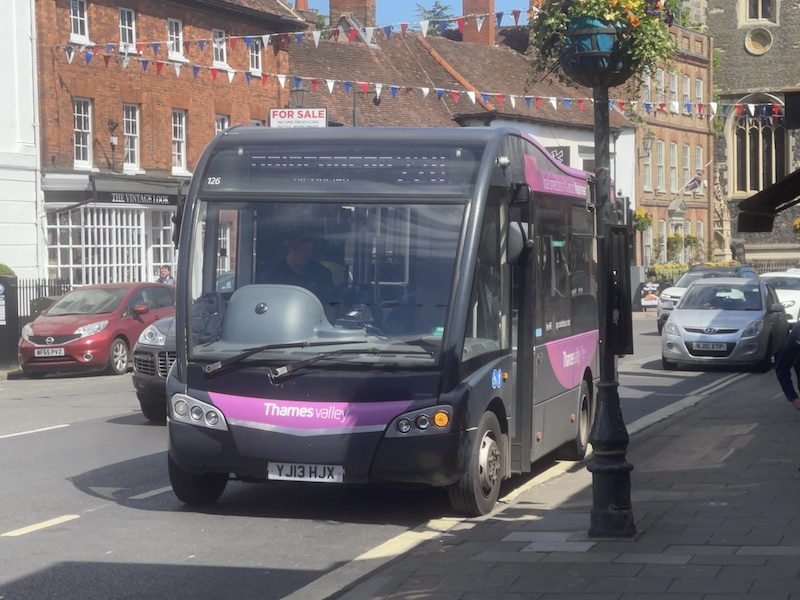
However, on the departure back to Maidenhead, this time another passenger with a dog did board with me and travelled to the residential caravan park at Hurley, eleven minutes away.

This is an unusual section of route – almost quirky like – with the bus taking a narrow road within the park…
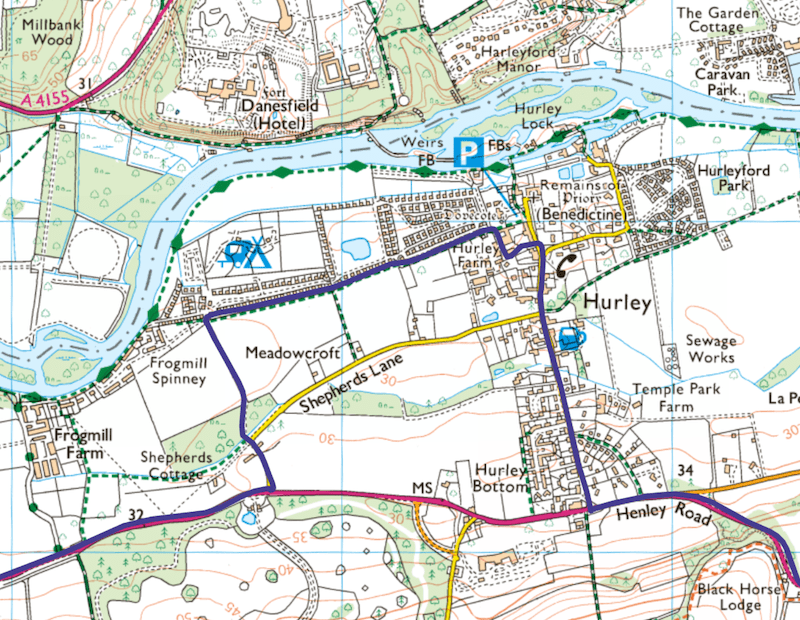
… through to the hamlet of Hurley and then to Hurley Bottom.
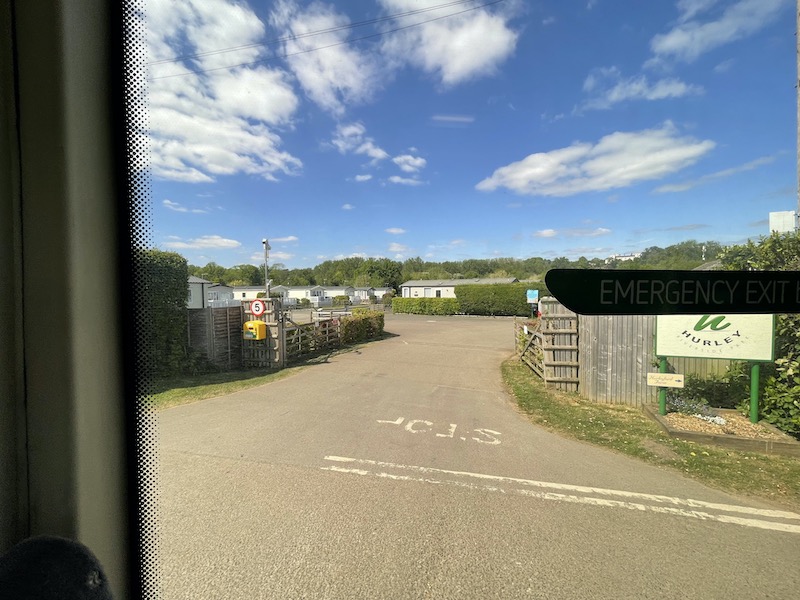

No passengers boarded there nor as we deviated dog leg style to serve Stubbings Garden Centre – a new initiative for this route – but once we got back within the confines of Maidenhead another passenger made a short local journey from Marlborough Road to St Marks Hospital.

It was good to see Thames Valley’s timetable booklet for Maidenhead available on board the bus, but a pity there weren’t more passengers on board to take copies.

You often read reports in the media about the demise of rural bus routes and buses leaving people ‘stranded in their homes’. Here are two examples of rural routes where instead of buses deserting passengers, sadly it looks like passengers have deserted the buses.
Roger French
Summer nblogging timetable: 06:00 TThSSu
 BusAndTrainUser
The Camping & Caravanning Club has a site at Fieldcommon Lane, Walton on Thames. There are two bus stops nearby: Weylands Close and Ansell Hall. These are served by my local Route 461 which runs between Chertsey Hospital (St Peter’s) and Kingston upon Thames. I can easily tell if passengers boarding at these stops are locals or site users. I try to catch sight of the rear of concessionary passes tendered. The rear of a Surrey pass is very sparse on text, but other issuing authorities smother the rear rectangular space with an enormous amount of text. Occasionally I get the joy of seeing the authority’s name on the front of a pass. Another site, Penton Park, for residential caravanning near the Thorpe Park entertainment venue is well served by buses as they shuttle between Chertsey and Staines. Michael Portillo visited the Fieldcommon Site during one episode of a Great British Railway Journey but was filmed using Walton on Thames Station rather than the nearer Hersham Station.
LikeLike
It’s a real dilemma, providing services in rural areas that “ought” to be there, but end up being barely used.
With the 227/228 I wonder if a solution is to operate just school journeys and a limited shoppers service, and instead run an inter-urban express between Maidenhead and Henley which may attract more custom (as Carousel has done with the weekday 127).
Or perhaps the hinterland west of Maidenhead is one of those few areas where a semi-flexible demand-responsive service could actually be the answer.
Julian Walker
LikeLike
Part of the problem is that (collectively) we have no agreement over what buses are supposed to be there for. If you believe that the best use of money and resources is to run buses which shift the maximum number of journeys from car to bus, then you prioritse town and inter urban routes and abandon these rural routes. If you think that the best use of money is providing public transport of last resort to a handful of villagers with no other transport options then you continue to thrown money at routes like this. I tend to the first view, since I’m pretty sure we could provide a better mobility solution in deeply rural areas with susbidised taxi vouchures and/or some sort of community bus on market days.
LikeLike
Hardly that rural, Maidenhead population about 65K., Henley about 13K
Wetherby manages to support hourly service with a population of just 11K
LikeLike
I would of thought it would be better presentation-wise to have a combined 227/228 timetable given the common section between Maidenhead and Bath Rd Newlands Drive. The combined services would show a more attractive frequency on the common section in one place, easier for passengers.
Peter Brown
LikeLike
Must admit I’m surprised to learn that such a level of service operates on these rural routes. Villages in that part of Berkshire are exceptionally affluent and car-focussed, home to some of the country’s most senior business executives and suchlike, and must be absolutely brutal bus territory.
LikeLike
The problem for this area, apart from higher than average car ownership, is that some of these new links, or at least now providing a much more regular service along sections, is that many residents have just lost the habit of using a bus. To think that Maidenhead to Reading was once part of the trunk Thames Valley network is almost unbelievable now, and for three decades only a Saturday link has been maintained until recently.
Many rural services throughout the UK would also do marginally better if linked with population centres at both ends of the route, and thus extending to Twyford and the delights of an “awayday” to Abbey Wood now possible (haha!) is much more useful than the previous route.
Who can forget the cull London Transport were forced to make in Hertfordshire on some deeply rural routes in the 1960s, yet when some returned, now sensibly serving places such as Stevenage rather than Nup End, duplication was required at times so pleased were some Residents to get their buses back. Whilst that will never happen again fifty years on, it will take some time for passenger numbers to rise if they ever do.
Terence Uden
LikeLiked by 1 person
Hello Roger, as a proud owner of the name, I just have to point out that you have misspelt the name of the village of Shurlock Row
Stuart Shurlock
LikeLike
Thanks for spotting that, Stuart. Now corrected.
LikeLike
Perhaps the bus companies are not being innovative or enterprising enough. These services appear to be based on selling ‘one-seat’ journeys alone – shoppers, schoolchildren etc.. While I can see that this is the principal market, was there any consideration of connections – rail and bus – with through ticketing etc. to give the said village people the sort of travel opportunities available with a car? Maidenhead station is not served: I’m sure that the lack of rail connections is as much to do with rail managers as bus managers – are they all waiting to be given a nasty prod (or money) by government before they will pick up the telephone and talk to one another?
My bitter tone is from seventy years of experienc of trying to travel more by public transport, and often failing, largely because of the lack of good connections. But I am sill convinced there is a good market for bus and train – much better than the current 8-10% – if only the managers will sort out the issue.
LikeLike
Definitely agree regarding rail connections. Just relying on serving trips to (in many cases) declining high streets is missing other potentially growing markets. If this was Switzerland Maidenhead Station would be served with timed connections 12 hours per day. Then the village bus stops offer much wider travel opportunities.
Peter Brown
LikeLike
Yes, Rail & Bus needs to talk to each other, unfortunately a full-on merger is now de-facto illegal thanks to competition law.
Has anyone ever thought about trying to sell train tickets onboard rural bus services which connect to nearby railway stations?
LikeLike
I’m aware of at least two routes in the south of England where this used to happen, with small teams of specially trained drivers being equipped with the same sort of railway ticket machine that a train guard would have.
However the complexities of railway ticketing do not make for quick transactions, and with pressure to maintain the train connections there were some “interesting” operating practices at times such as tickets being issued while the bus was on the move.
With an ever-increasing proportion of rail tickets now being sold online or via mobile apps, integrating bus tickets into these sales channels is surely the more practical and relevant approach rather than trying to sell physical rail tickets on board buses.
LikeLike
There is no desire for transport integration in the UK unfortunately. I work for a train company, even connecting with our own trains was questioned by other managers at the time I tried to implement a connectional policy.
Rail and bus connecting shouldn’t be that difficult, but it seems to be. Places like Switzerland never complete between bus and rail, they connect. Integration means no public transport should complete with one another. We are alien to that in the UK.
Positively a few train companies have Transport Integration Managers and I’ve seen some good work carried out at GWR.
Richard
LikeLike
There is no desire for transport integration in the UK unfortunately. I work for a train company, even connecting with our own trains was questioned by other managers at the time I tried (and failed) to implement a connectional policy.
Rail and bus connecting shouldn’t be that difficult, but it seems to be. Places like Switzerland never compete between bus and rail, they connect. Integration means no public transport should complete with one another. We are alien to that in the UK.
Positively a few train companies now have Transport Integration Managers and I’ve seen some good work carried out at GWR for example.
Richard
LikeLike
228 is about the 10th iteration of Maidenhead to Henley services, originally Thames Valley 16/17. With the regular rail service from Twyford to Henley all of the interurban passengers will use the train from Maidenhead to Henley.
227 is a very strange service, White Waltham and Sherlock Row having traditionally been linked to Maidenhead on the more frequent services via Woodlands Park. The link into Twyford was an early Thames Valley casualty, early 1960’s I think. There is little demand to Twyford as a shopping centre and perhaps this link would be best served as an extension of the frequent services to Woodley so that a through service to Reading is available , Twyford itself having a very good service both by bus and train to Reading.
LikeLike
There wouldn’t be. It’s a BR-era Driver-Only Operated service, so the guards were made redundant/redeployed back then and there are few if any revenue protection inspectors in that part of the world nowadays. It’s basically an honesty system so I suspect fare evasion is quite high and a proportion of passengers treat it as a free service.
LikeLike
This changes entirely when Henley Regatta is on. About 20 ticket inspectors are waiting on the platform exits checking all tickets.
LikeLike
It’s interesting to compare the timetables for 227 and 228 with the services they replaced – 234/235 Waltham St Lawrence Circular and 238/239 Maidenhead to Henley/Bisham.
234 was a uni-directional circular via White Waltham, Waltham St Lawrence, Knowl Hill and St Mark’s Hospital, with 5 journeys on M-F departing Maidenhead 0715,1010,1250,1525 and 1730, calling at Waltham St Lawrence 35 minutes later ,and 2 journeys on Saturdays departing 1010 and 1250. Round trip time was 58 minutes. The 235 was a single M-F journey at 1910 from Maidenhead to Knowl Hill and Hare Hatch, balancing an inward trip at 0617, but neither of these reached Waltham St Lawrence and Shurlock Row.
238/239 provided 5 return trips on M-F from Maidenhead to Hurley, of which 3 continued MWF to Henley as 238 or TTh to Bisham and Cookham Dean as 239. On Saturdays there were 2 return journeys to Henley. All journeys were interworked with a single vehicle.
Replacement services 227 and 228 are similarly designed to serve the affluent rural area west of Maidenhead using a single bus. There are some definite plus points to the new arrangements, but also some negatives, mainly due to the round trip to Twyford on 227 taking 85 minutes, rather than the 58 minutes on the 234 circular.
As I see it the plus points are :
On the other hand, there are certainly negatives :
Windsor and Maidenhead Council have obviously put some thought into creating this new pattern, and must be hoping that the extra passengers generated by the new and improved links outweigh those lost by the reductions made to enable them.
LikeLike
Given that service 127 now provides regular connections between Maidenhead and Twyford it might be better if the 227 continued from Shurlock Row to Wokingham via Binfield (where there are regular services into Bracknell).
Wokingham probably offers more opportunities for the village residents than Twyford and the rail station not only has connections to Reading but also other stations in the borough (Ascot/Sunningdale) and Gatwick Airport.
I believe it is at least 50 years since there was a direct Maidenhead – Wokingham service. No doubt the combined population of the 2 towns then was somewhat less than the current total of just under 120,000
LikeLike
Sadly the problem with Roger’s reporting style is that he (albeit understandably!) extrapolates conclusions from a sample of one return journey, that may or may not be representative. I’ve taken several journeys on the new Henley service, mainly on Saturdays, and have been surprised how many passengers it has carried – mostly those actually paying for tickets too. The caravan park in particular sees a fair few dog owners getting the bus one way and walking the other – I was amazed to see people actually boarding there. Never seen anyone using the new Stubbings stop though. Only downside (again particularly on Saturdays) is the traffic on Henley bridge which can delay the service by 15-20 mins – most pax end up getting off early and walking the rest of the way.
The 127 is sadly unpopular but I hope usage increases over time as it’s a very useful link. I wish the Carousel version were 6/7 days, not 5.
Haven’t managed to take the new 227 yet, but in principle agree with those who said Wokingham would be a better option than Twyford. The train serves end-to-end passengers much better, particularly since it accepts contactless taps with proper single-leg pricing.
LikeLike