Saturday 28th June 2025
The 36,000 residents of Falkirk are lucky to have enjoyed the choice of travelling by train to and from the town’s two railway stations for the past 175 years.

It was back in 1850 the Stirlingshire Midland Junction Railway opened its new Grahamston (Falkirk) station joining the town’s original station named simply Falkirk which had opened in 1842 by the North British Railway.
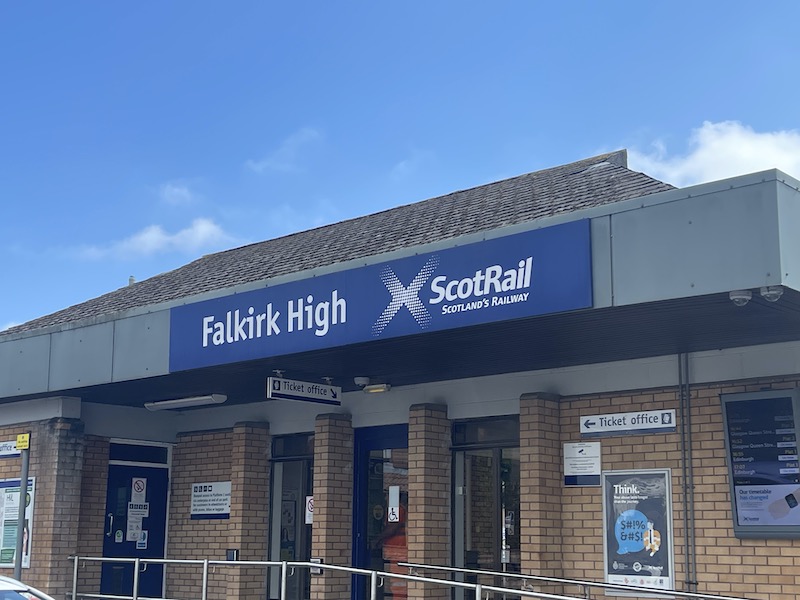
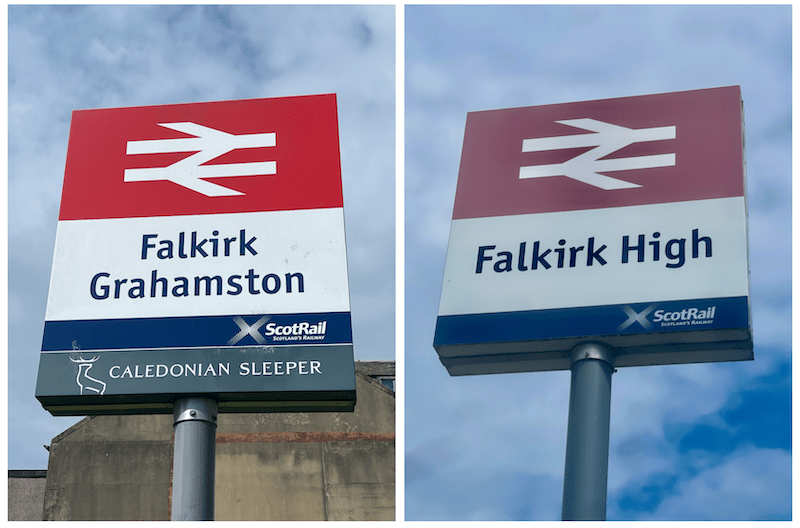
They gained their current names following a renaming in 1903.
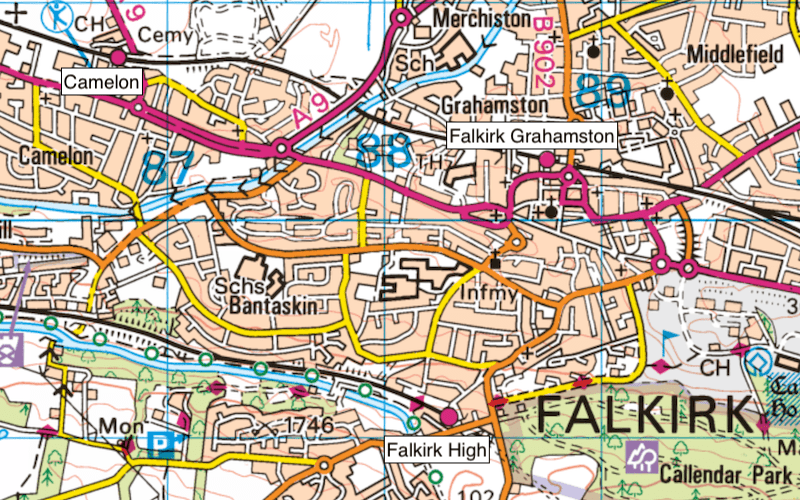
Strictly speaking the town has a third station within its environs called Camelon, situated on the line west of Falkirk Grahamston and west of the Forth & Clyde Canal which divides the town into two, but I’m ignoring that for the purposes of this blog and will concentrate on the two stations named after the town itself.

Falkirk High is the busiest of the two, seeing 733,000 passengers in 2023/24 being served by two trains an hour on the high profile Glasgow Queen Street to Edinburgh Waverley route branded ‘express’,

Falkirk Grahamston saw 580,000 passengers in 2023/24 and is served by two trains an hour on the route between Dunblane, Stirling and Edinburgh Waverley as well as an hourly train to and from Glasgow Queen Street via Cumbernauld which terminates at the station although has to continue six miles east to Linlithgow to make use of a turn-back siding.
Unlike the station pair review of New Mills where a correspondent pointed out the anomaly that tickets to and from Manchester Piccadilly from and to either station are not interchangeable and fares are different, ScotRail tickets are conveniently interchangeable to and from both Glasgow (including from either Central or Queen Street) and Edinburgh Waverley.

Residents therefore have a choice between either using Grahamston, conveniently located in the town centre and taking 35 minutes to Edinburgh (two an hour) and 41 minutes to Glasgow Queen Street (hourly) or use High which is a 15 or so minute walk south of the town centre and takes almost the same journey time to Edinburgh at 32 minutes (also two an hour) but to Glasgow is much quicker at just 19 minutes and double the frequency at two an hour.
You pay (the same) money and make your choice.

On the infrastructure front, neither station will win any awards for architectural merit, particularly Grahamston even though it had a makeover in 1986, although I suppose that is nearly 40 years ago now…

… including a new ticket office, toilet and waiting room on the eastbound platform 1.

The waiting room is very spacious…

… with two ticket office windows along one side…

… and a closed retail unit and toilets on the other.

With the toilets strictly for ScotRail passengers only as per the notice on the door.

Outside there’s a side entrance to the eastbound platform 1 for when the ticket office/waiting room is closed, along with a ticket machine…

… and beyond that is a rather nice outdoor waiting area…

… in front of the cycle rack with a contraption to pump up a whole variety of tyres.

There’s a footbridge for passengers to make their way over to the Stirling/Glasgow westbound platform 2…

… although there’s also access directly on to this platform from the street.
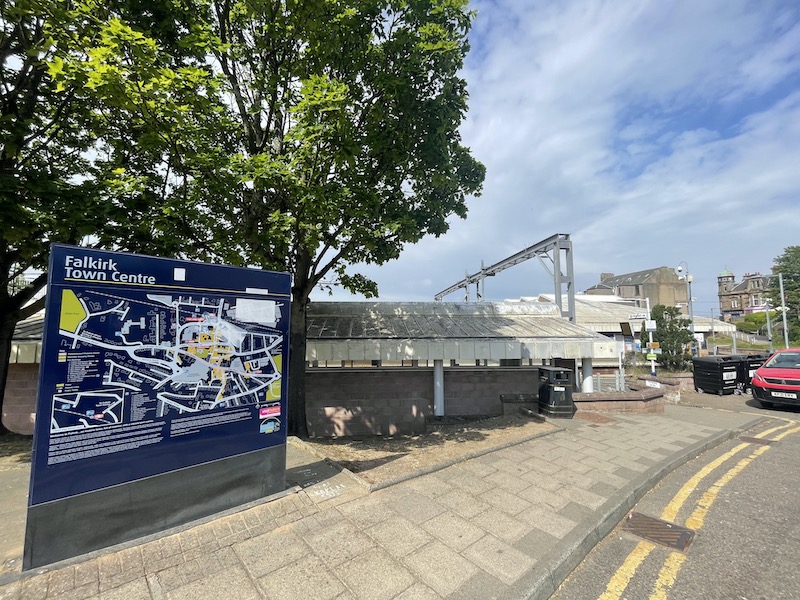
And, there’s a long staircase to take you up to the main road which crosses the tracks at the eastern end of the station…
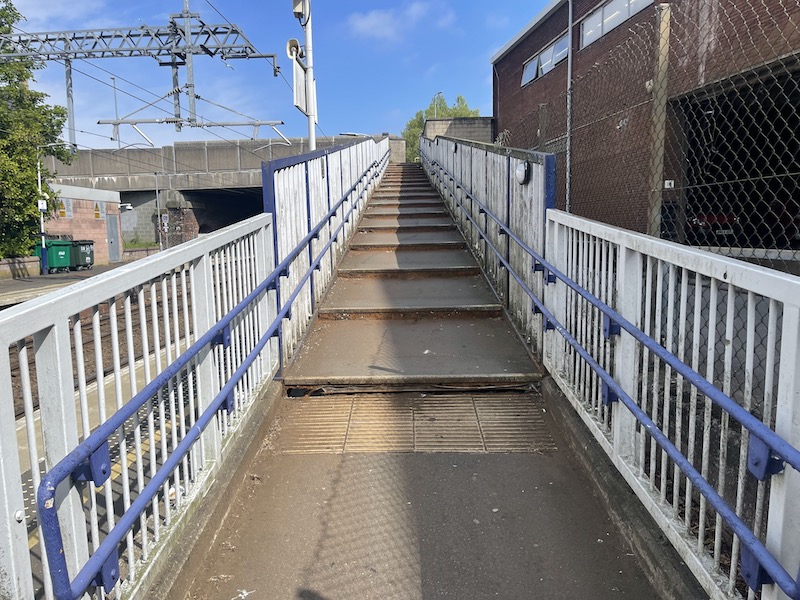
… where there’s a conveniently sited bus stop.

This westbound platform 2 also has a waiting room…

… which is spacious but not over endowed with seating.

… and from where you can see the station’s main building on the opposite platform in all its glory.

As well as ScotRail, the Caledonian Sleeper to Inverness and LNER’s Highland Chieftain between Kings Cross and Inverness both stop at Falkirk Grahamston with the latter marking where its coaches stop on the platforms – especially as there’s not room for all the coaches…

… with just coaches G, H, J and K getting a look in ‘southbound’ and A, B, C, D ‘northbound’.

And that’s Falkirk Grahamston.
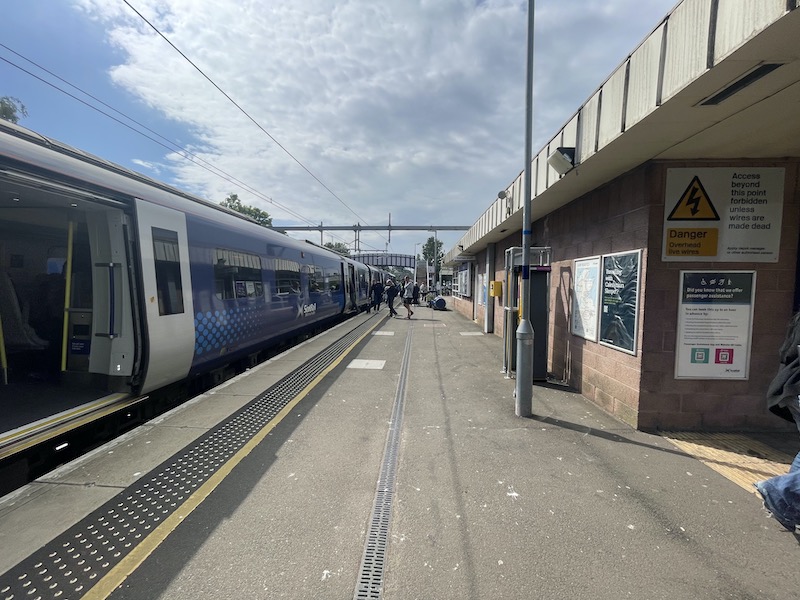
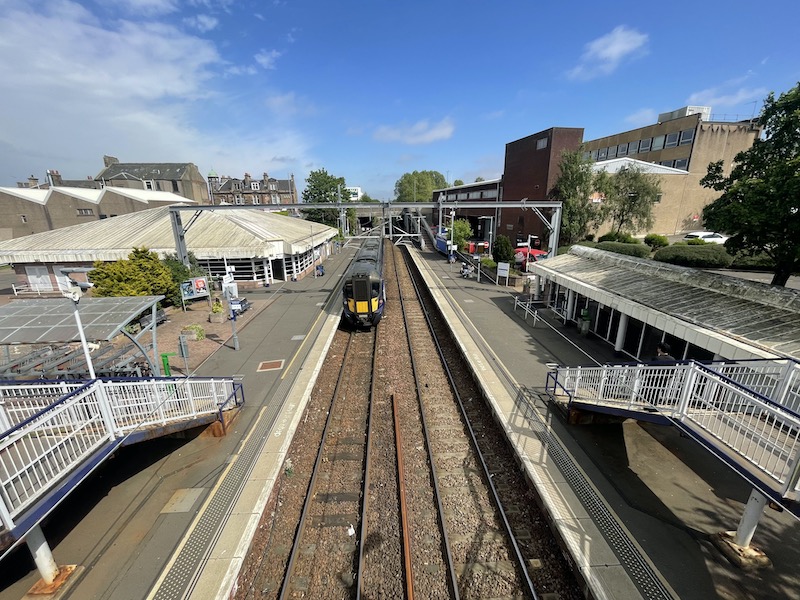
Let’s take the 20 or so minute walk up to Falkirk High and compare and contrast.
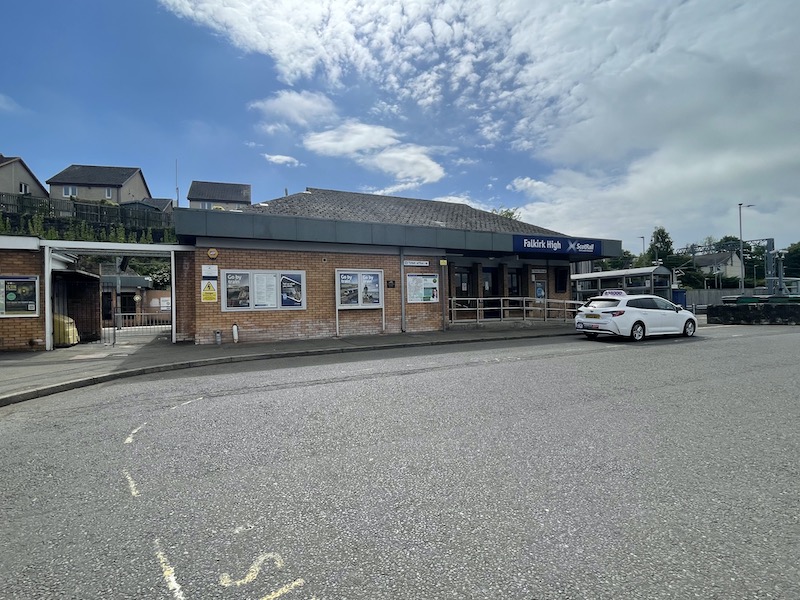

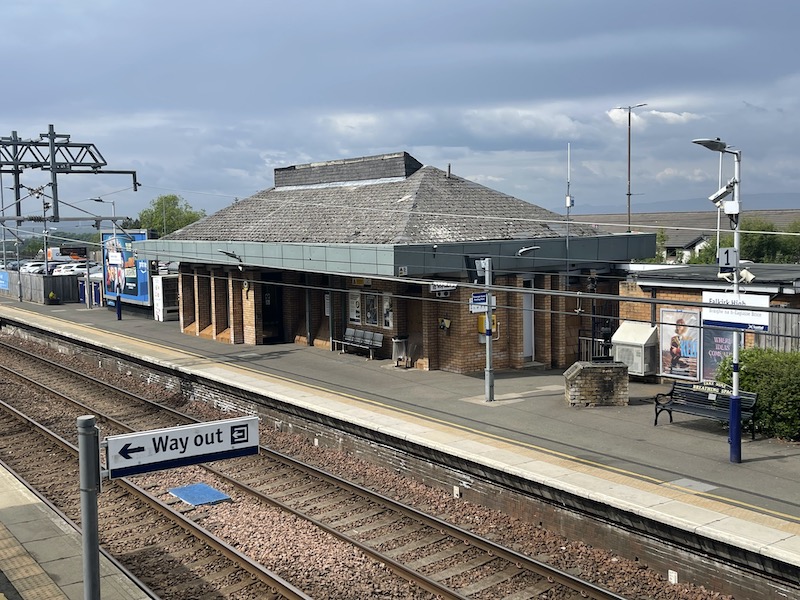
The ticket office and waiting room on the eastbound platform 1 is much more modern than over at Grahamston and has a two window ticket office…

…and a smaller waiting area but almost the same number of seats.

There are also toilets within the building accessible from outside (when the ticket office is open)…

… and over on westbound platform 2 there’s another waiting room and again much more modern and attractive looking than Grahamston.
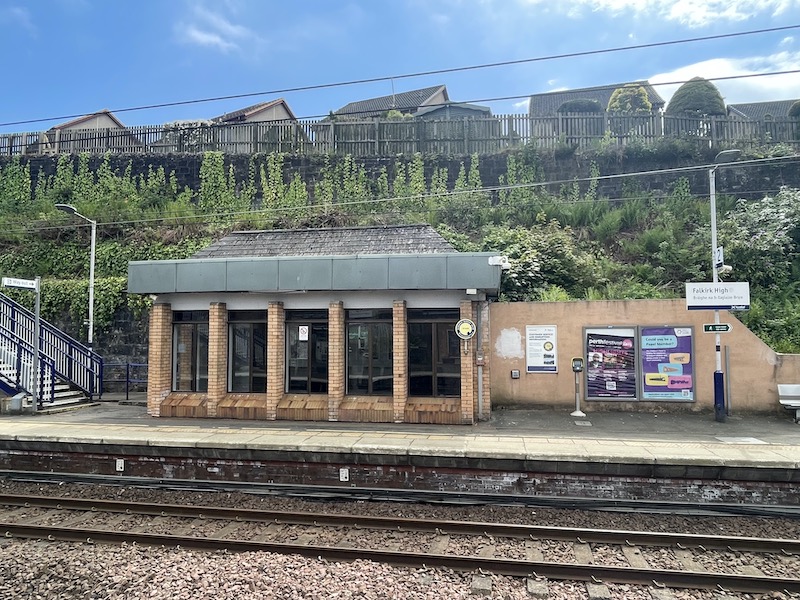
As you can see the topography on that side of the station means there’s no equivalent street access and passengers must use the footbridge (with no lifts) to get to and from the entrance/exit to the station on platform 1….update note…please see explanation re access in Comments below.
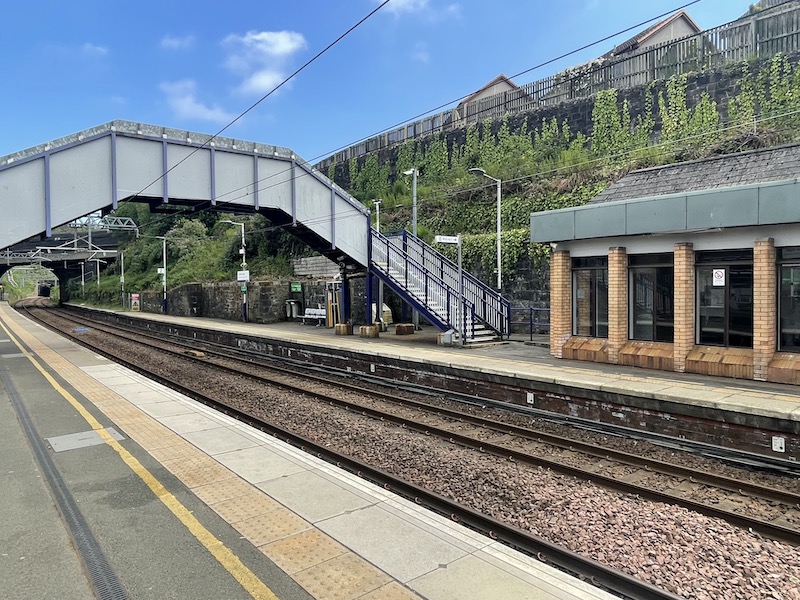
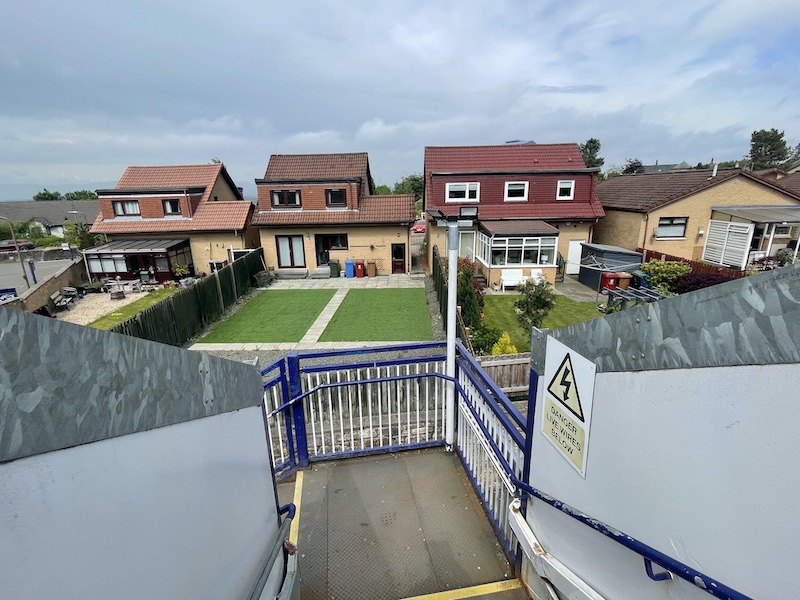
The houses high up above platform 2 offer a birds eye view of the station from their back gardens, while passengers get a birds eye view as they cross the footbridge of the back gardens of houses recently built alongside platform 1 .
Platform 1 has an interesting sculpture…

… to celebrate the 150th Anniversary of the Edinburgh & Glasgow Railway in 1992…

… as well as a rather nice seat to enjoy some ‘breathing space’.

The ticket machine is situated in a shelter at the entrance by platform 1…

… and there’s another in the open on platform 2.
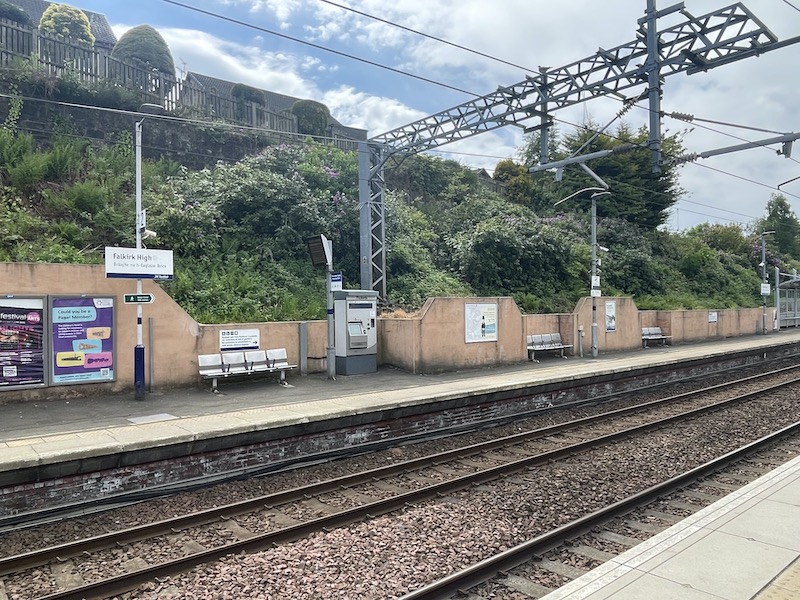
All in all a very pleasant station for its 733,000 passengers each year and yes, a bit more modern than its namesake but it’s a shame westbound trains remain inaccessible for those unable to climb stairs.
Roger French
Did you catch the 12 previous blogs in this series? 1: Hertford; 2: Canterbury. 3: Wigan, 4 Dorchester, 5 Windsor, 6 Wakefield, 7 Reddish, 8 Yeovil, 9 Newark-on-Trent, 10 New Mills, 11 Tyndrum, 12 St Albans.
Summer blogging timetable: 06:00 TThSSu
 BusAndTrainUser
There seem to be vague plans to reopen the branch to Grangemouth. The line is already open for freight
LikeLike
Dear Roger,As part of your two stations project here I expect you will be
LikeLike
With the Alexander-Dennis bus and coach factory nearby, I am surprised you did not weave in a visit to the production lines there or is there a “reserve blog” somewhere on your system?
LikeLike
That would have been a good idea, sadly a missed opportunity.
LikeLike
There was a report recently suggesting that AD is considering closing their Falkirk factory & moving all production to Scarborough. If this is true then you might want to take up the earlier suggestion to visit it sooner rather than later.
LikeLike
You used to be able to access the Glasgow bound platform from a footpath at the Glasgow end, which if I recall gave level access from Slamannan Road Car Park. However not sure if it still open as it’s been a while since I have been there. That gave ‘level access’ to both platforms but not between them without a lengthy detour.
Steve
LikeLike
This is the National Rail (“soon” to be GBR?) statement. I have no local knowledge:
Station Accessibility/Step-free access
Some step-free access to all platforms – please check details.
This is a Category B2 station. Level to platform 1, ramp to platform 2 and connecting footbridge with stairs. Alternative route is a long route using the subway under the rail tracks.
Please take care when boarding/alighting the train at platform 2 as the stepping distance between the train and the platform may be more prominent than at other platforms.
LikeLike
Yes there is level access to the Glasgow bound platform, it’s on the western end and it’s a ramp down with options to turn left up to the Union Canal or right under the railway past a car park and up a ramp or stairs to the other station car park and then back to platform 1 and the main station office.
It’s rare you need to change train to go the opposite direction, so a lift isn’t a priority, much more important at other stations to install a lift.
LikeLike
The Caledonian sleeper only stops southbound, not northbound. You need to go to Stirling and get the local train or bus back. Or go to Edinburgh or Glasgow and local bus or train.
https://sleeper.scot/travel-updates/all-timetables/timetable-detail/?from=EUS&to=INV
LikeLike
Would think most sleeper passengers will likely change at Edinburgh rather than Glasgow, as passengers would have to make there own way between Queen Street & Central [ok i know its a short walk in Glasgow City Centre but would passengers fancy the walk at that time of day?], were as they can stay on the station changing at Edinburgh.
SM
LikeLike
I think there are more things to consider such as price, cabin availability, and connection timings. The last few times I’ve travelled on the lowland sleeper the Glasgow one had more availability and a better connection (bus) for the time I was needing it. I quite enjoy a short stretch of the legs in the middle of the journey out even a meal on the way. Granted not for everyone.
LikeLike
the Glasgow terminators reverse at Grangemouth Junction which is only about a mile or so east, and not Linlithgow
LikeLike
Thanks for clarifying that; I thought it was odd when I saw a train all the way at Linlithgow reversing – I must have read the headcode wrongly.
LikeLike
Not quite true. Some (most?) reverse on the Grangemouth branch, but some do go all the way to Linlithgow. For instance today (Sat 28th) the 1609 ECS goes to Linlithgow, but the 1709 ECS reverses on the Grangemouth branch. Either way, it’s a lot of unproductive hanging around for the train and crew! Rob
LikeLike
In my experience most reverse at the entrance to the Grangemouth branch, with only some going to Linlithgow to turn.
LikeLike
While it would be good to have level access to both platforms at Falkirk High, with Grahamston having full level access and trains to the same destinations plus more, as well as being better located for the town and local buses, I can see why it wouldn’t be a top priority.
LikeLike
Falkirk High does have level access to both platforms via a tunnel and ramp at the Western end of the platform and car park. The path also provides a direct link to the Union Canal with the Falkirk Wheel about an hour walk away. Camelon station is a bit closer. (I’m a local and writing this whilst sat by the Falkirk Wheel and have used all 3 Falkirk stations many times including mapping them in OpenStreetMap).
LikeLike
Many thanks for correcting and clarifying.
LikeLiked by 1 person
I think you highlight an important point that the step free access to the west bound platform isn’t obvious where it is and could probably have improved signage.
LikeLike
You don’t walk ‘down’ from Grahamston to High! There’s a reason why the latter is named the way it is!
LikeLike
Good point; I’ll amend that. Thanks.
LikeLike
Falkirk looks big enough for the Perth service to call at Falkirk Grahamston any reason why it doesnt
LikeLike
I suppose the recommended route between Falkirk and Perth would be to change at Stirling.
Many years ago I had a pseudo-timetable for BR in Scotland. There was a frequent note “Change at Polmont and Larbert” which I now know was a double change rather than one change at a station with two names. I wonder whether this double change is still of use in the area.
Ian McNeil
LikeLike
Generally from Falkirk to Perth is a change in Stirling. From Falkirk High would also need a change in Polmont or a walk down the hill to Grahamston.
On a Sunday there are a couple of trains in the morning south bound and couple in the evening northbound that go from/to Perth and then follow the Dunblane-Edinburgh service pattern.
Won’t get that all week due to the different acceleration profiles of the diesel and electric trains which would cause issues with the timetabling.
LikeLike
One thing I think is worthy of mention is how much service frequencies have been reduced at both stations since covid. For many years Falkirk High had four trains per hour to both Glasgow and Edinburgh Monday to Saturday daytime but it is now just two Monday to Friday off peak. For a shorter period Falkirk Grahamston had had four trains per hour to Edinburgh and two to Glasgow Monday to Saturday daytime. These frequencies have also been halved. Similar cuts were made to services on the Bathgate line and not restored.
This should give anyone who thinks that nationalisation is the silver bullet for improving rail services pause for thought. There were far more positive developments in terms of services and stations during privatisation and instead we now have little happening in the way of new initiatives. Yet a nationalised railway can also be one that expands with better services and more stations, just look at Wales. In short we should focus much more on outcomes than ownership as all that reorganisation can simply divert the energies of the business away from improving things for the customer.
LikeLike
Although correctly stating the population of Falkirk (36k) it is actually the centre of a much larger built-up area, with a population nearer to 100k. In addition to the three stations you mention there is also Polmont, which is part of the conurbation.
LikeLike
Mild pedantry: on a Saturday daytime, Falkirk High has 4-an-hour in either direction – the only day to get the once daily 15-minute frequency reinstated post-Covid.
On a separate matter (full disclosure, as someone who regularly has to travel there from Glasgow by the (very poor) public transport have something of an interest): might be worth keeping an eye on the situation in Dumfries and Galloway.
Wasn’t paying attention – it all kicked off a few weeks ago, but just learned that Stagecoach – who operate most of the subsidised and commercial services in the region – are almost completely withdrawing from the area due to some disagreement in the latest tendering process. They are shutting their depots down there, and are only going to run the Dumfries<->Glasgow and Dumfries<->Carlisle commercial service that they can apparently still service from other depots.
The council are saying they have covered all the subsidised contracts – which I’m a little surprised at; it’s a low income rural area with no other big players, so surprised there’s enough capacity elsewhere to scale up at short notice. Haven’t heard any news on the other commercial services that Stagecoach are abandoning.
LikeLike
Just as well that Councillor Anderson didn’t have all of his forenames in full on the opening panel at Grahamston. And who’s interested in what follows his surname? I always add a mental GCSE, AA, RAC to such self-aggrandising rubbish.
LikeLike
The Scottish Association for Public Transport are convinced there is a strong case to reopen a station at Grangemouth, see https://www.sapt.org.uk/grangemouth-rail-opening/
With much of the infrastructure already in place, and Falkirk terminating trains already heading in the right direction onto the branch line with enough time to spare to travel another 2 miles, this must surely be a no brainer!
Neil Wallace
LikeLike
Just an update on the Dumfries & Galloway bus situation I mentioned in an earlier comment on this blog entry, should you be interested. New timetables have now been published for the Stagecoach withdrawal on 7th August.
In a signficant chunk of the Western part of the region, other than the E-W axial 500 service, it looks like the Council’s in-house operator will be running the majority of the surviving services, due to an absence of any other operators – which is going to involve quite the scaling up of their operation.
That said it does look like it comes with some fairly significant cuts – e.g. the 415 Newton Stewart – Machars service which I rely on when travelling down there goes on a Saturday from 14 departures ex-Newton Stewart to just 6.
There are now very few services from Newton Stewart north to Girvan station – where one could access (relatively) frequent services to Ayr and Glasgow – and indeed none after lunchtime, later services “offering” rail connectivity at Barrhill, which has much fewer services, and whose train station is very isolated around a mile and a half outside of the village itself (where the bus terminates), up a steep winding single-lane road.
Might be worth a blog!
LikeLike
I can’t count apparently. 12 services down to 6 on the 415, not 14.
LikeLike