Sunday 22nd June 2025

Cast your mind back to March 2020. That’s when Arriva was stripped of the Northern Trains franchise and control passed to the Government’s Operator of Last Resort (subsequently becoming DfT Operator). Poor beleaguered Northern never recovered from the May 2018 timetable meltdown nor the strait jacket of a no growth franchise when the reality was a whole lot different leading to a reputation for overcrowding, cancellations and old trains.
It’s just over six months since Alex Hornby made the modal career shift from bus to rail, taking on the role of Northern’s Commercial and Customer Director, having previously been well known for his customer centric approach in high profile roles with Go South Coast’s Bluestar, Trentbarton and Transdev Blazefield.
I caught up with Alex in Leeds recently to find out how he was getting on with the transition to track based public transport and how Northern was doing five years on from its nationalisation.

Northern is the largest train operator outside of London with 376 trains (100 of which are relatively new Class 195 and 331s) and around 7,000 staff including 23 crew bases of which Leeds is said to be the largest such base in Europe.
The corporate statistics tell me for 22 hours a day, Northern’s trains depart from a station every 30-40 seconds serving more than 500 stations as far south as Stoke-on-Trent and Nottingham and as far north as Carlisle and Alnmouth on a comprehensive network of journeys. You get an idea of the scale of Northern’s operations by studying the excellent network map recently redesigned in colour by another bus to train career convert, Matt Harrison, who’s done an excellent job making the network easy to understand.
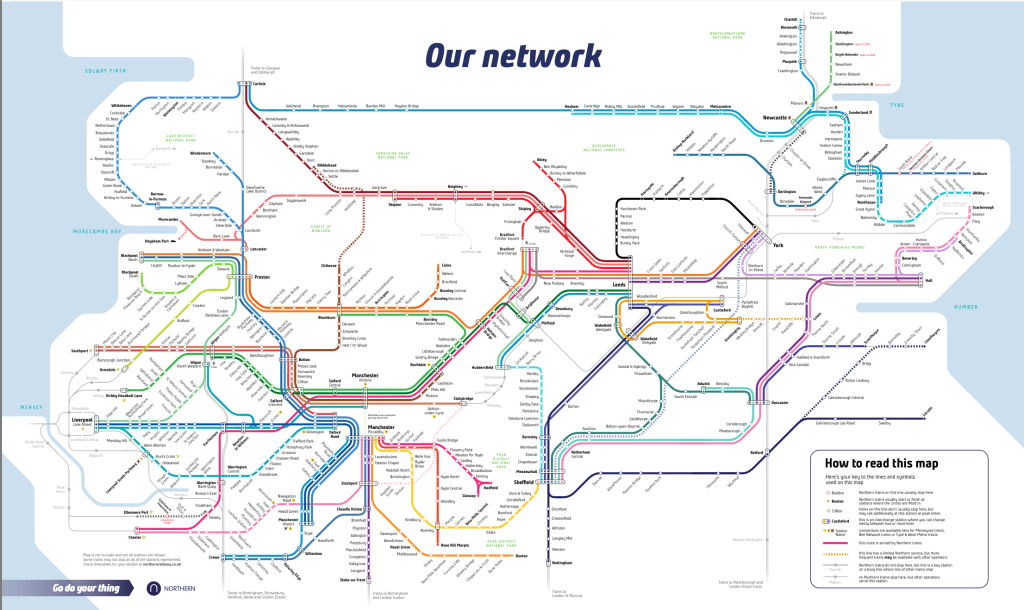
Maybe TfL would like to commission Matt to make the now impenetrable London Underground map as easy to understand and follow?
Alex told me he and his colleagues at Northern are relentlessly pursuing three priorities.

To improve performance; to reduce net subsidy by increasing revenue particularly through growth in passenger numbers; and to keep customers at the heart of the business.
The ambition for performance is to achieve 90% punctuality with only 2% cancellations by 2027. Alex explained part of the challenge is changing a general perception of poor timekeeping on the railway across the north when parts of the network are already preforming very well, including some lines attaining 98% ‘on time’ (defined as up to three minutes late) with consequential rising customer satisfaction.
A case in point is the Leeds, Bradford, Skipton triangle of routes. They’re nicely self contained and provide excellent performance, while at the other extreme some of Northern’s routes share congested corridors with long distance operators, presenting much more of a challenge. And that may not get any easier for Northern when the long awaited East Coast Main Line upgraded timetable begins in December with LNER taking extra paths on an already busy line.
For its part, the Northern team are focusing on fleet and traincrew deployment as well as adding resources to engineering, control and operations where they’ll make a difference, together with implementing a new operating model and a ‘fit for purpose’ structure.
To make his point, while we were chatting, we took a snapshot (literally) of the departure board in the evening peak at Leeds station and it impressively showed a complete full house of ‘on time’ departures on display bar just one exception (a Cross Country to Edinburgh, eight minutes down).

It was the same the next morning when everything was showing ‘on time’ with my onward journey from Leeds along the wonderful Settle Carlisle line also impressively spot on time the whole way, as was every train passing in the other direction.

As with a number of Train Companies, Northern has challenges over long standing agreements with trade unions on Sunday rostering. A temporary timetable is currently in operation in the North West as managers work “to stabalise performance” and Alex describes the situation as “one of our biggest priorities to resolve”.
I’m sure we’re all hoping a resolution is found but I can’t help thinking if I was a trade union officer I’d take my time to change any agreements especially with Great British Railways “coming soon”.
The second priority of increasing revenue so the net subsidy reduces is all about enticing more passengers to travel as well as ensuring everyone pays the correct fare. With regard the latter, train conductors are monitored to ensure they are selling and checking tickets regularly during journeys while Northern also employs a team of 172 revenue officers across the network. These report to Alex and he’s been impressed with their balanced approach when dealing with passengers who have obviously made a genuine mistake and those who are willfully defrauding the company. Transport Focus staff have also been out with the team to be sure that balance is being maintained.
Alex told me how impressed he’s been with the rail industry’s sophisticated insights when it comes to data analysis and seeking out areas for potential revenue growth. It’s much more extensive than anything he’d experienced in the bus industry, mainly because, by nature of its size and high profile, the railway can employ more data specialists and attract experts from outside the industry who can bring valuable insights into yield management and revenue growth.
Although Northern’s network is huge it’s really the summation of a lot of smaller individual markets each with their own characteristics. Increasingly the company is looking at aligning its markets with the Mayoral Combined Authority areas which is obviously the ‘direction of travel’ (as they say) but not forgetting Northern benefits from a range of attractive routes it can position to the burgeoning leisure market. I’ve already mentioned Settle Carlise, but not forgetting the Cumbrian Coast line, the Tyne Valley line, the line to Buxton and the Peak District and many more.
Northern’s busiest line by volume is between Blackpool North and Manchester now run with Class 323s and their additional capacity.
The Leeds/Nottingham via Wakefield, Sheffield and Chesterfield corridor is also a key route in the network. It’s particularly attractive to commuters heading to work at both ends of the line. Another key route experiencing growth is one Alex knows well from a previous role – the Harrogate to Leeds market. Five trains an hour now run in the peaks (including LNER) giving commuters a good modal choice alongside the six buses an hour on bus route 36.
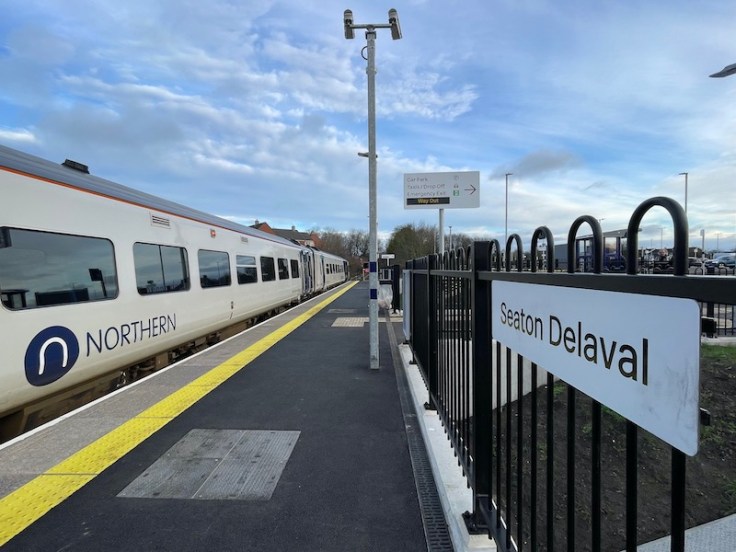
Newest line is of course the recently reopened Northumberland line between Ashington and Newcastle which reached a milestone of 250,000 passenger journeys by the middle of April and has now passed 350,000. Busiest week was the May half term when the 20,000 barrier was breached.
Another interesting observation is the significant number of what can be termed ‘white collar’ workers who use Northern’s network around both Leeds and Manchester for commuting whereas ‘blue collar’ workers are dominant elsewhere.
Alex is well placed to oversee Northern’s third priority – ensure the business is always putting the customer first. His track record in the bus industry is renowned for developing customer service standards ever higher. Alex told me how impressed he’s been with the approach of the whole team at Northern towards making customer service a priority.
Managers are encouraged to travel on trains as often as possible and Alex has set his team a target of completing a minimum of 100 journeys in a year (with a maximum of 50 being a commute to and from work) and submit a full feedback report on each and every journey.

The company is continually keeping its fleet deployment under review to ensure it matches changing customer travel patterns. Back in May some trains were lengthened to cater for increase demand as coaches were redeployed from lesser used trains.
Encouragingly, Northern and TransPennine Express (both owned by DfT Operations of course) have begun introducing simplification of fares and tickets with Northern only tickets now able to be used on a TPE train as a default in the event of any disruption or cancellation. Alex also highlighted Northern’s promotion of LNER’s recent uplift to a two-hourly frequency between Leeds and Bradford alongside its own frequent journeys. LNER also being part of DfT Operations.
It’s good to see such closer working already evident without waiting for the “coming soon” Great British Railways.
Alex also highlighted Passenger Assist arrangements between Northern and TPE have been streamlined.
But perhaps most impressive of all is the ’30 by 30’ target under which Northern is aiming to grow passenger journeys from the current 100 million in a year by 30 million to reach 130 million a year by 2030.
I did point out to Alex that’s quite a tough target with 2030 only five years away but he was undaunted and is clearly relishing the challenge.

With franchising taking a hold in much of the bus industry over the next five years and decision making on matters relating to timetables, fares, tickets and customers removed from many bus company managers, I can now understand why passionate public transport professionals like Alex are jumping ship from bus to train (to mix my modal metaphors). And as GBR gets going you can imagine the potential it will hold for customer centric managers.
In the meantime, five years on from that ‘no growth franchise’, Northern is certainly back on track.
Roger French
Summer blogging timetable: 06:00 TThSSu
 BusAndTrainUser
Off out soon. But what a great comment about, the terrible TFL distruction of the once very useful Beck map. Hay Ho, they will say it’s progress. I smile, raise my eyebrows and shake my head!!!!!!
The Wandering Busman
LikeLike
It’s worth pointing out that some of these “passionate public transport managers” that jumped ship from bus to left thier respective bus ops in an atrocious financial state..
LikeLiked by 1 person
There’s certainly an irony in their jumping from a entirely commercial environment where they can use their “passion” and make genuine decisions to one where they just do what the DfT tells them.
But the latter has better salaries, a nice pension and an almost guaranteed job as long as you don’t upset the applecart. Oh, and the option of blaming umpteen other companies or contractual arrangements (or the unions) for anything that goes wrong.
LikeLike
The modern trains of Northern Trains are a pleasure to travel on these days compared with the Pacers of only a few years ago.
They will still be there when many of Northerns Lines become part of the Bee network with fully integrated ticketing in Manchester which as mentioned before has been in Liverpool for years.
I wish Alex well in his new endeavours in an area where Metro Mayors want to take control of their patch of Northerns Rail network.
They undoubtedly look enviously at high customer satisfaction on Merseyrails route branded network that is proud to say they own their trains.
John Nicholas
Coventry
LikeLike
You are basically describing how things used to be in West Yorkshire, when Metro bought new trains for routes in its area, contributed to electrification costs and promoted the ‘MetroTrain’ network well, with route branding, maps, timetables etc. All gone now, of course.
LikeLike
scenic railways
Settle & Carlisle line why don’t Northern spend money on their stock on this line ? Not every seat has a good view seats cramped up or windows dirty, people travel this line for the scenery, have a look at Swiss railways far better for the tourists, Northern please make a change from ordinary commuter stock to more tourist stock.
LikeLike
Metro Train was a dead brand walking in Serco-Ned days and as a result when Arriva Trains Northern came along it was part of the contract condition that PTE’s removed themselves from creating duplicated publications ie timetables (which in fact the data was given to the PTE from Northern). The Map is, however still produced today
Metro was also required to be no longer involved in supporting the financing of rolling stock owing to the complicated issues it caused with the ROSCOS. Mind when Metro’s sold their rolling stock interests, they did make a small profit.
LikeLike
I do hope that much of this blog comes to fruition as Northern receives a massive subsidy. The rail statistics for 23/24 show a much poorer picture, and it sounds like there has been a massive improvement over the past 12 months. Hopefully that will be reflected in the 24/5 statistics which should be published at the end of July.
But with TPE and Northern now run by the same group(eg the Government/Dft) you would have thought that all ticket restrictions would have been removed on day 2, and trumpeting that there is interavailability during disruptions does not sound like much of a win to me. This shows how far from reality the rail industry is.Unfortunately the dead hand of the Dft will be present however to frustrate the enthusiastic staff on the ground
Still it’s good to hear of progress.
LikeLike
Lovely puff piece for Northern and Alex. Meanwhile on the west, the 769 fleet is in meltdown, Sundays are still a mess (no trains at Bramhall, for example), the 15x fleet is now expected to last until the early 2030s with commensurate worsening availability, and labour relations are at an all time low. Oh and PPM is on the slide as well. Not quite “back on track”
LikeLiked by 1 person
Especially as disruption interavailability during disruption has been available to operators since the start of privatisation. If any manager implies it’s something they’ve set up recently then I’d be asking questions about their understanding of the operation they’re managing.
LikeLike
Hopefully an early benefit of GBR will be the disappearance of misleading single-operator maps, however pretty they look.
LikeLiked by 2 people
A benefit of GBR will be that the national rail map becomes a single-operator map 😎
LikeLike
Northern feels very backward in operating terms; eg when arriving at a station the train manager/guard has to look out down the length of the train before releasing the doors (some of them actually get off the train before climbing back in to push the button). This takes precious seconds and is of course cumulative. No other TOC does this that I know of.
And I don’t think Alex “chose” to leave the bus industry, did he?
LikeLiked by 2 people
SWR are infamous for this too.
To quote one columnist – ” the guards check that the platform is still there”
With the introduction (sometime!) of the new (?) 701 units SWR is looking to have drivers open the doors, someday.
Stuart S
LikeLike
No, they are double checking the driver has aligned the train correctly and no part of the train is over the platform, they are also checking no waiting village idiot has positioned themselves too close to the train and so have butchered themselves, not a great sight for anyone getting off a train and not only that, should 10 or so people walk past said village idiot then they are potentially walking through evidence. Alex has his work cut out if he’s dealing with staff who come up with stupid answers.
LikeLike
We had 80-odd years of automatic sliding doors on BR and LT trains without a “ceremony of the doors”. These were opened immediately the train berthed, if not a few seconds earlier. Now time is wasted at every stop on LUL whilst the train ‘talks’ to the platform…
LikeLike
Not on the Bakerloo!!
LikeLike
Multiple operators run this ceremony of the doors way its ridiculous when others have door release withing a couple of seconds. Its huge waste of time and should be an easy win for GBR to improve performance.
LikeLike
South Western Railway says hi!
LikeLike
What does that mean?
LikeLike
That’s exactly how SWR runs on the inner suburban services and will continue to do for an unspecified time into the future, since as far as we can tell no one bothered to check if the platform CCTV was good enough for the drivers to take over the role.
LikeLike
This is a standard operating procedure across all the railway where doors are directly released by the Guard/Conductor/Senior Conductor/Train Manager – it to ensure that the train is fully accommodated in the platform.
On those where the driver releases and Guard/Conductor/Senior Conductor/Train Manager – the latter have to be at a door ready to key-in and close in case of wrong side release / stopping short
LikeLike
It’s in the national rule book for release of doors by a guard (as opposed to release by a driver). If you know of train guards who aren’t doing it, then they’re breaking those rules and are liable to be disciplined – or sacked (or even prosecuted) if someone gets hurt.
After James Street any guard who takes a lackadaisical attitude to the safety part of their role is asking for trouble.
What really slows Northern’s most recent units down is the insistence of only fitting guards’ door controls at one door in the saloon of each vehicle and none at all in the cabs. If Northern had decent staff relations they might have been able to introduce DRD (Driver Release of Doors), as is the norm on CrossCountry’s 22x Voyager units, but they don’t and at times seem to be proud of their history of poor staff relations and the resulting disruption.
LikeLike
A somewhat unfair comparison with the London Underground map there. Northern’s map doesn’t serve the same purpose; no info about step-free access or interchanges within walking distance for instance, and the network isn’t as complex even though it’s wider. Perhaps the Tube map is trying to do too much, but it does it fairly well.
…and good luck to Alex if he thinks he will have control over “decision making on matters relating to timetables, fares, tickets and customers” in the brave new world of Great BR.
LikeLike
He doesn’t have it in the pre-GBR world of the current concessions (or indeed in the preceding franchises). My cynical guess is that he’s just trying to butter someone up for a cosy, high-paid, safe job at GBR.
LikeLike
Having had some limited experience recently of Northern’s fringe lines (Penistone and Bishop Auckland) I have been reasonably satisfied. However, any DMU (except maybe a 170) feels unnecessarily noisy and sluggish, and not what a modern railway should be. That’s not going to be easy to overcome, although Northern does appear to be flirting with battery trains in its recent enquiries for replacement units.
Stuart S
LikeLike
I do not like the way that you brushed-past the issue that Northern Rail were caught doing overzealous prosecutions where the passenger had bought the wrong ticket because they did not understand the complex ticketing restrictions even though the passenger offered to pay the difference. Presumably that is why there were Passenger Focus staff having to monitor the revenue staff.
You should have questioned Alex on what he had done on that.
Peter
LikeLike
This with Passenger Focus staff monitoring revenue staff is new, however Passenger Focus staff have no legal Jurisdiction across the railway network so therefore they can not get involved or intervene with any Revenue issues and therefore revenue staff still have to carry on their duties including issuing fines/penalty where required
LikeLike
Stuart S – the 701s are currently being introduced at a rate of one diagram per week and there’s no “looking to have the drivers release the doors”. They DO release the doors.
Steve
LikeLike
My understanding is that the roll out of the drivers opening the doors on the 701s has been postponed indefinitely following the discovery of visibility issues with the cab side CCTV at an (unspecified) number of stations.
LikeLike
Another non-Northern comment (sorry Roger):
For some reason which I don’t remember, on one morning last year I went from Peterborough to St Pancras by Thameslink: I think they may run 701 trains.
The Peterborough to Horsham train was waiting at Platform 2 fully 15 minutes before the departure time so I boarded. After 5 minutes or so the driver announced that there could be a delay, as he had a problem with the door mirror indicator mechanism, but he was working hard to rectify it. Shortly after that he announced that he would need to switch off everything and reboot. In due course the lights went out and then things restarted; but the driver said the problem remained and he warned that, although he would continue to work on it, the train might be cancelled. About 20 minutes after it should have left, he said that he had been unsuccessful and advised everyone to cross to Platform 1 where the following train (due to leave 30 minutes behind his) was waiting.
So we all scooted over the bridge and got on that train, which left without incident. But as it was carrying 2 trainloads it got rather busy, and was 5 minutes down at St Pancras where I got off.
I looked at the platform indicator and the next train due in was from Bedford. The second train shown was the one I had left behind at Peterborough, now expected 42 minutes late and to run nonstop between London Bridge and Gatwick Airport. I waited to see it arrive, and it had hardly any passengers on board.
I always wondered whether it was the identical train, or a replacement brought out of the sidings or depot at Peterborough.
Ian McNeil
LikeLike
Good luck to Alex in his endeavours, although it will be a steep gradient of course.
I hope he gets customer contact sorted as, when he was at Transdev Blazefield there was a huge loss of passenger confidence, and no way passengers could contact the company by phone or email.
I hope my trust in the wonders GBR will bring are not misplaced.
LikeLike
Northern services actually go further north than Almouth with a twice daily service to the remote outpost of Chathill. Unlike some stations with very infrequent services, the two trains run at reasonably sensible times, allowing passengers from Chathill a full day in Newcastle (or, in the reverse direction, a long day at Chathill to perhaps visit nearby Bamburgh castle or the Farne Islands).
Carllo
LikeLike
I wish Alex well with his endeavours with the unions, but of course the unions actually have no interest in resolving manning and reliability issues . After all , if the operation is undermanned and needs continuous overtime to function that not only loads money into rail workers pay packets but also means they can take crippling industrial action but still maintain their base pay . Why would the unions give this power up ?
GT
LikeLike
If you take your head out the Daily Mail for one moment and have just a brief glimpse at the real world, you’d see the unions you hate have actually long been critical of the railway for relying on overtime and have suggested maybe a better way to run it would be to employ a full complement of staff. The more frontline staff that are employed, the more union members there would likely be and therefore more money coming in through membership subscriptions, so it’s actually in a union’s interests for the staffing situation to be sorted out…
LikeLike
All I can say in response to GT is “LOL”.
ASLEF and the RMT have both been pushing for the removal of all overtime for decades. As an example, the Central Trains guards’ restructuring of 1997 includes, at the insistence of the RMT, repeated reference to “overtime to be used as a last resort” and “quality time off”.
It’s management who don’t want to recruit additional staff with all the associated expense; it’s management who try to use zero-hours agency staff for customer facing roles such as ticket barriers and “unimportant” roles such as cleaners; it’s management who create the industrial relations situations where ballots happen – I once heard a senior manager openly tell local reps that unless the RMT were balloting they wouldn’t take any action to resolve an issue. That particular issue was a staff messroom and kitchen which was infested by vermin so was instead dealt with by the local reps calling the Environmental Health people in, which ended up being much more expensive for the company than just dealing with it in the first place.
Incidentally, ASLEF in particular has actively campaigned for over two decades for Sunday to be brought into the working week, for exactly the reason Anon at 14:12 says: it means more members, more subs and therefore more money.
LikeLike
I think you are living in a different world. The TOC I work for over recruits for onboard staff but we still struggle with staff availability due to a combination of poor sickness/unavailability management and crippling union agreements which might mean staff aren’t working trains for 3 out of 4 days in a week. I’ve never worked for a TOC who intentionally under recruits
LikeLike
Things certainly have much improved the last couple of years with Northern, but surely, once GBR actually does finally get to be running the show, there will no longer be units such as Northern? Internally, as with British Rail(ways), there will still be sectors for accounting, but for the passenger will it not just be one rail company as before? Presumably, this is not known as yet?
New stock has certainly improved the image, but I have found some over-zealous staff a tad over-bearing, inspecting my Staff card as if a fake.
Terence Uden
LikeLiked by 1 person
No, not yet. The word on the tracks is that the operating units will be based on Network Rail’s Regions and Routes, which means Northern will be split between Eastern and NW&C Regions and there’s going to have to be some discussion as to how the Eastern ‘section’ of Northern is split between East Coast, East Midlands and North & East Routes.
If you have a Staff Travelcard (boxes), I’m finding that more and more staff now have no idea what they are. Ticket training, which in my day was months long, now seems to be little more than “If it doesn’t scan, look it up online”.
East Coast in Stagecoach (Virgin) days employed agency staff as “revenue protection inspectors” who were well known to go out of their way to try to cause issues for any staff of other companies they checked, quite often tripping themselves up in the process. I sometimes wonder if some of those idiots are now employed training revenue staff!
LikeLike
“the railway can employ more data specialists and attract experts from outside the industry who can bring valuable insights into yield management and revenue growth.“
If the railways can do this, why not the bus industry?
As it happens, I know of at least one player in the bus industry which does this (and has done for many years).
“With franchising taking a hold in much of the bus industry over the next five years and decision making on matters relating to timetables, fares, tickets and customers removed from many bus company managers, I can now understand why passionate public transport professionals like Alex are jumping ship from bus to train“
What would stop a public transport professional “jumping ship” from bus operator to bus franchising authority? Nothing, as far as I can see.
Malc M
LikeLike
Much needed longer trains on many routes,to use 2 car trains on routes like Leeds to Sheffield,Nottingham,Lincoln is ridiculous
LikeLiked by 1 person
There we plans to use 170s on these routes however platforming at Leeds prevented it given anything and everything via Woodlesford uses platform 17 which was never intended to be used to the capacity it does today
LikeLike
I commute daily using Northern services. My kids use Northern for leisure travel and to travel to and from university. Northern is most definitely not back on track! It remains an unreliable service. Countless cancellations every Sunday. Countless cancellations of its long distance services e.g. Chester to Leeds. Northern has also just cut the length of most trains on the line I use to commute so that there is unacceptable overcrowding every morning. And yet fares go up every year!
Instead of taking what Northern management says at face value, I suggest you go to Manchester Victoria or Leeds during a busy rush hour or to Victoria on a Sunday and see how many Northern trains are late or fail to run at all. (JS)
LikeLike
Northern’s most recent performance statistics show only 61% of trains ran on time, which is much more consistent with my experience than the impression given in the article
LikeLike
All the trains nicely painted in corporate colours, and the newer ones quite quiet, but the one i was on this week, filthy carpets, a steamed up double glazed window, air con not working, no ticket checks, must have been an escape from Alex and his customer care.
Also why so many ticket checkers just standing around at Victoria and Piccadily chatting, why are they not on trains checking tickets, so many people without tickets traveling between intermediate stations, and talking about victoria, why leave diesel train engines running under the enclosed bit for sometimes 20 minutes,filling the place with fumes.
LikeLike
Ticket checkers at stations are not directly employed by Northern and are employed by Carlisle Facilities.
Under an agreement, they are only permitted to check tickets at stations in the West owing to how the original agreement was set up back in First North Western days. On the East they are at gated stations except the major ones ie Leeds / Bradford INTERCHANGE, but are more mobile to assist given.
LikeLike
Your blog suggests a rosier picture of Northern operations than reality reveals.
Reliability has certainly improved considerably over the past year but the service provided still has significant shortcomings – particularly in Manchester and the North West.
Short notice cancellations are still prevalent particularly at weekends but also during the week. Rolling stock availability isn’t great with up to 150 services short formed on some days in recent weeks causing overcrowding at peaks.
I’m sure that Alex and others in Northern are striving to improve services and the company is certainly on the way to getting back on track – but there’s some way to go!
GV
LikeLike
Mr Hornby sounds like a model train manager.
LikeLike
The author of the article should have spent time talking with people regularly attempting the commute home on the Blackpool North trains from Deansgate. Cancellations, delays, too few carriages; and too few services anyway, even if everything else was fixed.
LikeLike
I’m sure that Mr Hornby couldn’t have put it better himself.
LikeLike
Another comment refers to this blog post being a ‘puff piece’. It’s hard to argue with that description.
LikeLike
Treated myself to a South Pennine Day Ranger last week, mostly using Northern trains.
All on time, clean and all staff friendly, an excellent day!
LikeLike
Roger seems like a decent fellow and tells it as he sees it. I felt he got a bit of grief for this article. No operator is getting things right all the time. It seems to me Northern is trying harder than in the past. Albeit an infrequent user, I’ve had mainly positive experiences with Northe. However my opinion would likely be different if Northen was my local operator. Instead I have to ‘contend’ with Scotrail.
LikeLike
The responses from those of us who have to use Northern on a daily / regular basis give much more accurate picture than the article. For example, a relative who is a student travels regularly from Chester to Halifax at weekends. It should be a direct Northern service. Northern has simply cancelled the Chester to Victoria part of the service for EVERY train on EVERY Sunday for the foreseeable future. So what should be a through journey with no changes for a young woman travelling alone now involves up to two changes and then the connecting services often also get cancelled by Northern or run late. The clear impression as a customer is that Northern has given up, rather than being “back on track”. (Presumably all the planned cancellations get excluded from Northern’s punctuality statistics as well).
LikeLike
As someone who regularly uses Northern in both Yorks and Greater Manchester, I’ll be very happy to see an improvement. We went out and net up with friends from all over the northern map on Saturday. Several trains were late and two cancelled, leaving one friend with a pricey taxi ride home, or a long wait for the next train which may or may not have turned up.
LikeLike
Oh, and we still turn up for a train expecting it to be a few minutes late. It’s rare for both legs of a journey to be punctual; even if it leaves, say, Victoria on the dot, it’s almost always a little late by the time it gets in.
LikeLike
I regularly take the Wednesday Northern operated train route Lincoln to Leeds, as I work in Sheffield that day, whilst the morning train of 2 carriages is okay and there is ample seating but the afternoon Leeds to Lincoln trains of the same 2 carriages are very overcrowded. The conductor is unable to move through the 2 carriages to check tickets, it’s a fare dodgers dream! In my experience and opinion, Northern should either put on an extra carriage for the afternoon trains or run the service every 30 minutes (which will never happen!). This comes from a person who uses a walking stick and has to regularly jostle with the younger ones who think they are entitled to a seat (no respect or manners for their elders) and just look through us people as if we’re not there! Please Northern sort this out! Oh, and when you cancel trains please refund most of the ticket fare and forgo the ‘admin fee’ of £5, it isn’t the passengers fault it’s yours.
LikeLike
Passengers at Ashton-under-Lyne, who have seen their previously twice-hourly weekday service reduced to hourly, and then seen Northern habitually cancel up to a third of the reduced service and then abandon the Sunday service completely, might disagree with the depiction of Northern as “back on track”. It’s one of several locations that Northern have just given up on.
LikeLike
Fair play to Alex and the Northern team – this is the UK’s most challenging railway and I’m sure they are doing great things to meet these challenges. But there are some fundamental issues which successive management regimes have struggled to address. Working practices are the root cause of poor Sunday provision and performance particularly in the North West. Capacity on some flows into cities is woeful and the complex fleet leaves vulnerability to rolling stock shortages. These issues will need more than management hubris to fix.
LikeLike