Saturday 21st June 2025
Quite a bit of negativity was expressed on various online forums earlier this year when news broke First Bus was ceasing its extensive use of open-top buses in Cornwall this summer. These had run over the last few years with particular emphasis on attracting the post Covid growth in the leisure and tourist market to bus travel in the county. Following the loss of tendered routes to Go-Ahead across the county, it also saw First Bus promote its remaining commercial network in a high profile way never seen before.
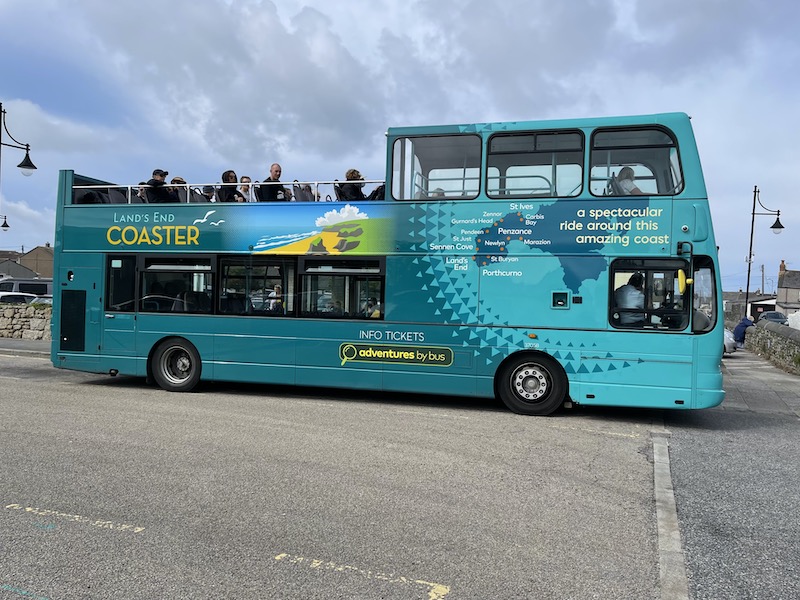
This latest move was seen by many as a retrograde step with First Bus reverting to closed top double deck buses on the famous Penzance to Lands End/Sennen Cove and Penzance to St Ives routes as well as abandoning the section of route around the coast between Lands End and St Ives via Gurnard’s Head and Zennor and the separate route between St Ives, Newquay and Padstow.
Now the summer season is well underway, I thought I’d take a look at the situation on the ground and assess whether this is turning out to be the calamity many online commentators predicted.
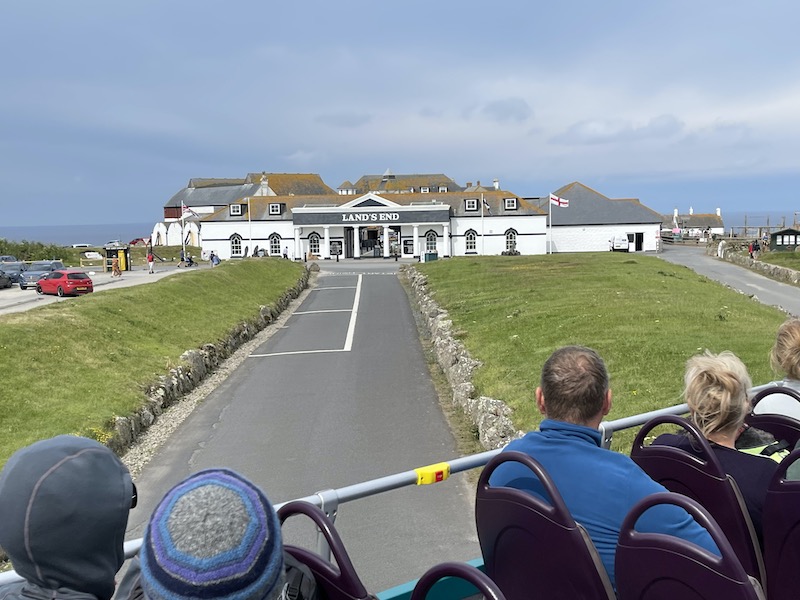
For me, I don’t think the use of open top buses or not is the real clincher here. There’s something much more fundamental and important regarding consistency of image and branding and making the bus routes and vehicles attractive to travel on, especially for tourists.
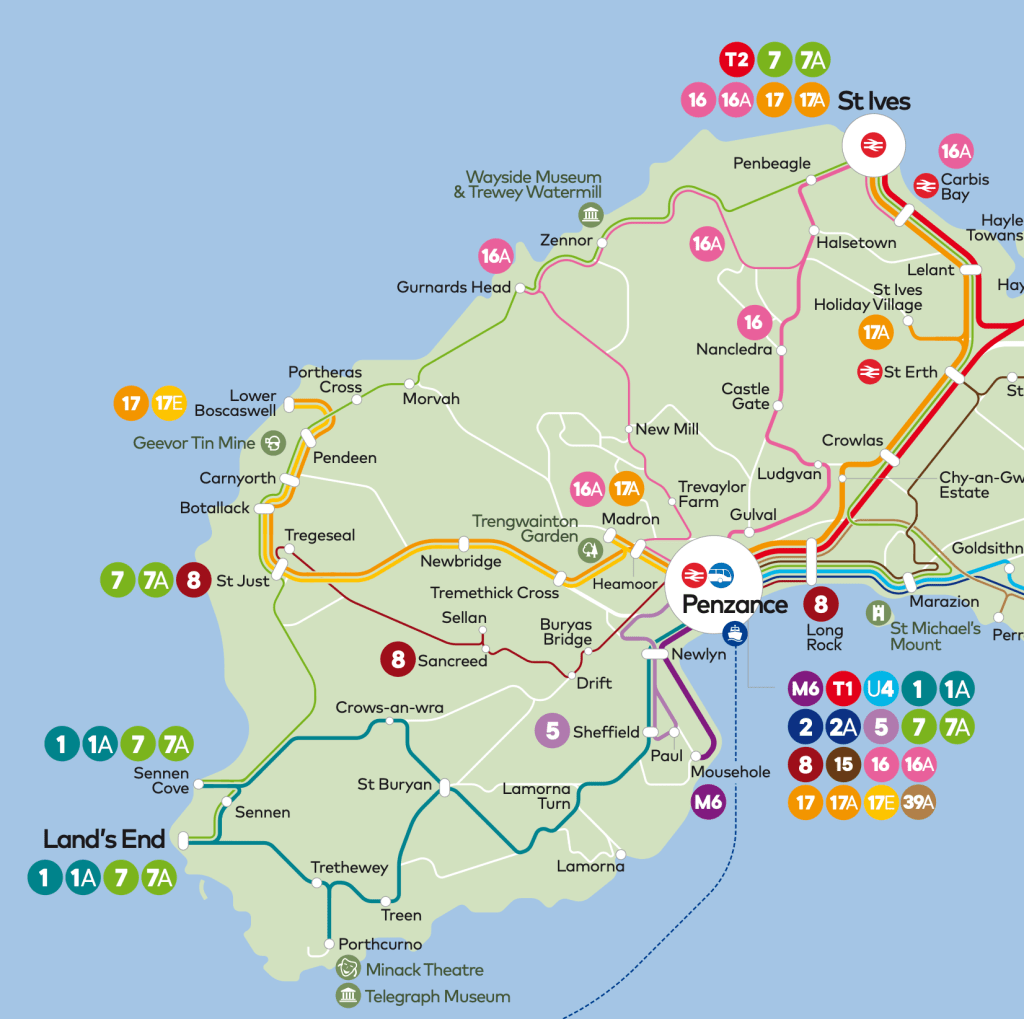
The replacement for the former Lands End Coaster routes is a two hourly route 1 and a two-hourly route 1A making for an hourly frequency between Penzance and St Buryan and at Lands End itself.
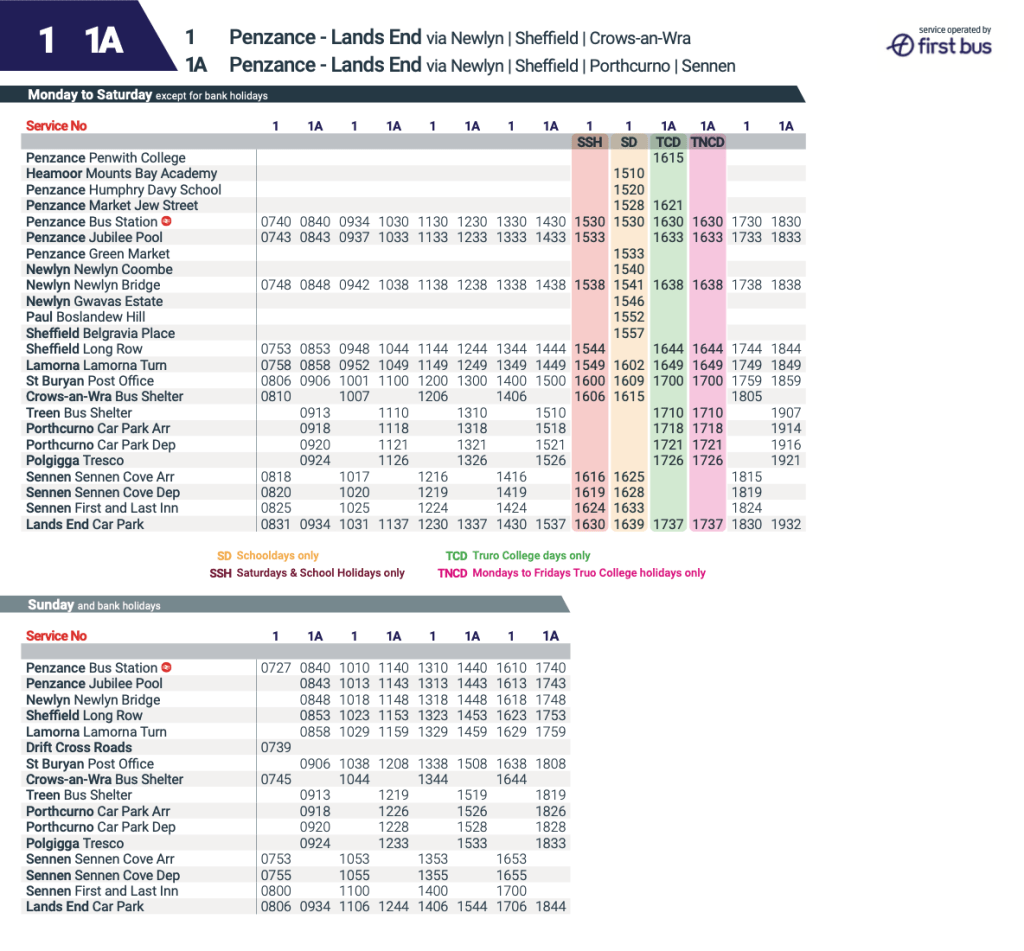
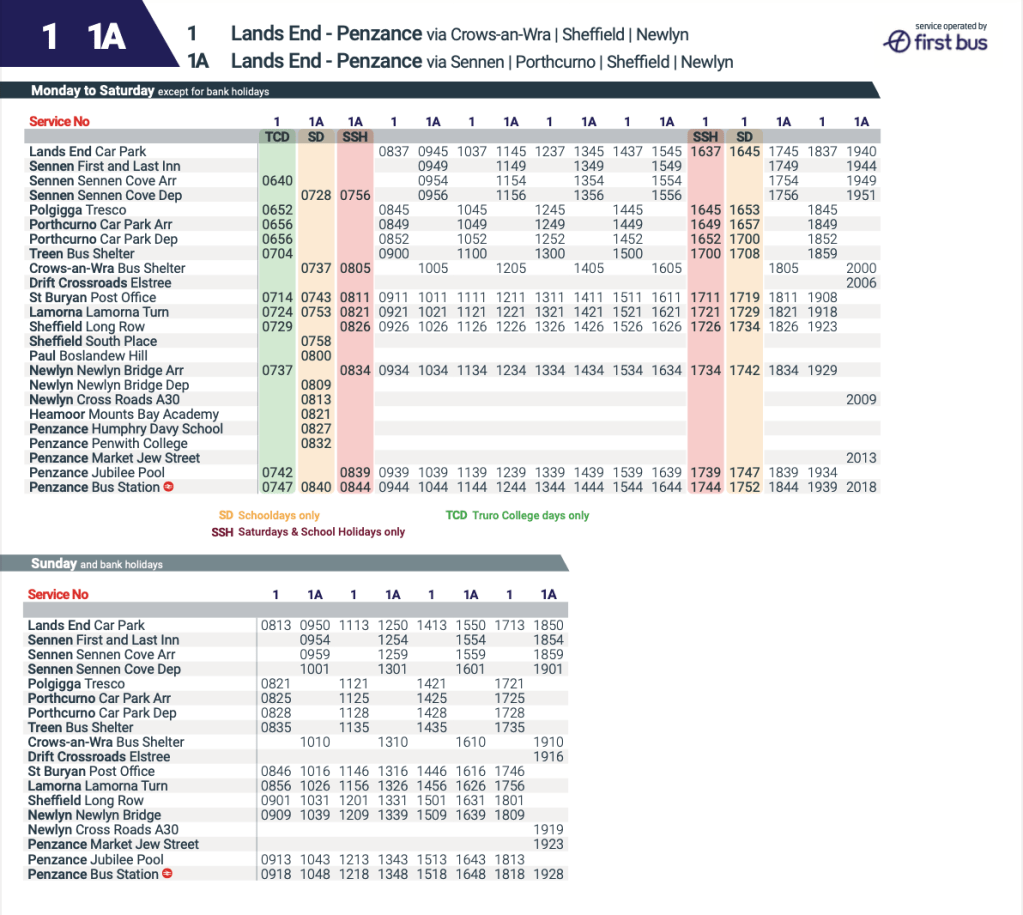
You might not realise it from the timetable or the network map (I didn’t) but each route is a (sort of) circular from Penzance back to Penzance so that on arrival at Lands End, after a seven/eight minute layover. the bus will ‘commence’ its next journey using the same route number it arrived with (ie either a 1 or 1A) but operate the different route back as far as St Buryan and on to Penzance. If they know what they’re doing, passengers can stay on the bus during the layover and continue on to Sennen Cove having crossed Lands End (on a 1A) or return to Penzance having boarded in Sennen Cove via Lands End (on a 1), for example.
I think it would help to make this clear in the timetable presentation and on the map as a couple of passengers at Lands End were confused, as initially I was too.
I took a ride on Tuesday morning on the 08:40 route 1A from Penzance to Lands End returning on the same bus, the 09:45 from Lands End via Sennen Cove back to Penzance. I also separately travelled on the 11:08 route 17 from Penzance to St Ives via St Erth. Around 25-30 passengers travelled on all three journeys. It’s as much as you can do of the former Lands End Coaster circular route as the section of route around the coastline from Lands End to St Ives is limited to a school holiday route 7/7A providing just four return journeys a day – quite a come down from the hourly open-top service of previous years.
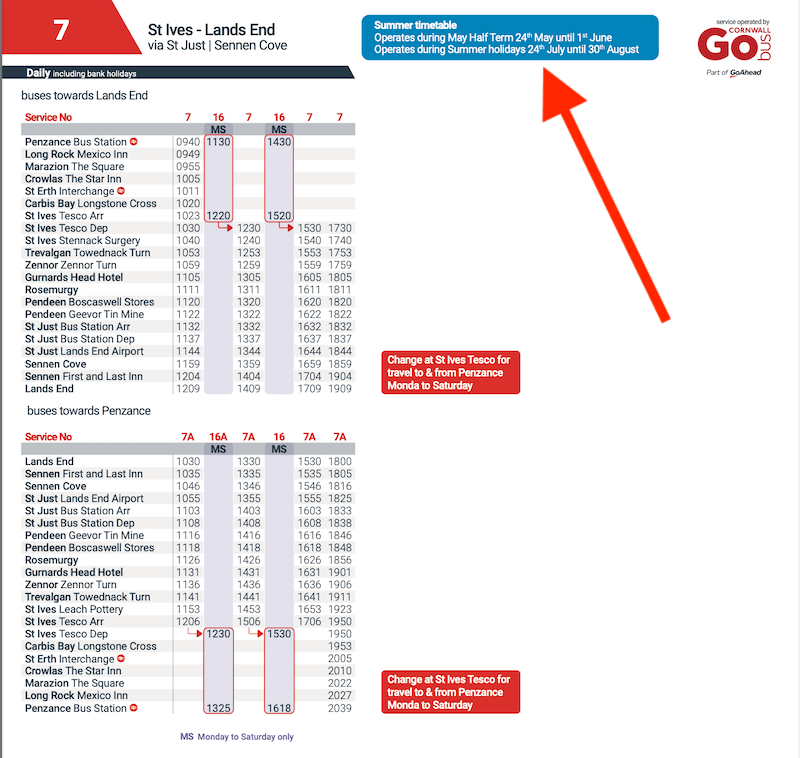
As you can see from the map extract shown earlier, there is a route 16A between St Ives and Gurnard’s Head Hotel which runs two-hourly which I also took a ride on with around ten other passengers on short sections of the route.

In previous years the whole Lands End Coaster circuit from Penzance back to Penzance via Lands End, Sennen Cove, Gurnard’s Head, St Ives, Cabris Bay, St Erth and back to Penzance (in both directions) would have taken almost four hours to complete with buses running hourly in both directions making for a considerable commitment of buses and drivers but also many travel opportunities to attract passengers.
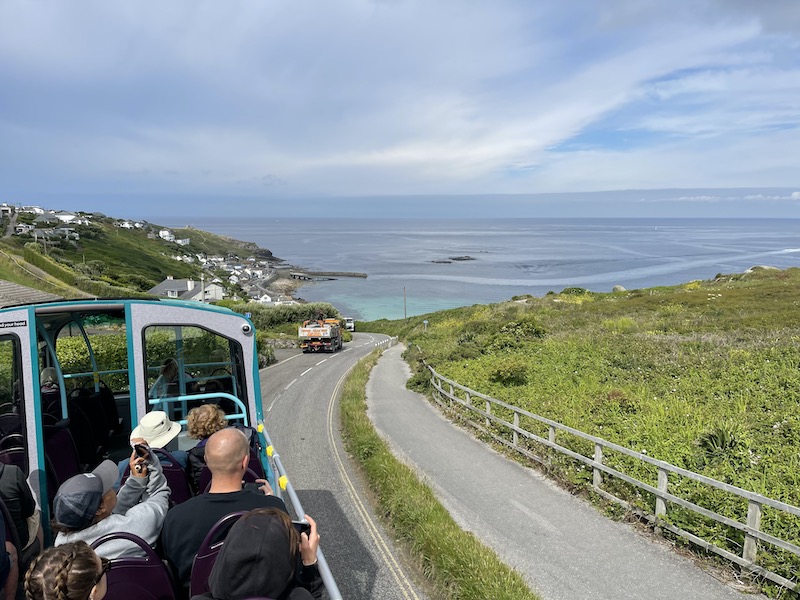
Whenever I travelled on parts of that route in previous years, buses were well used but I doubt many, if any, made the journey all the way around in one go, preferring instead to ‘hop on and off’ or only visit one of the many tourist hot spots on the route.

Undoubtedly some passengers would have been attracted to travel because it was an open-top bus and there’s no doubt such vehicles provided a fantastic way to soak up the spectacular scenery in this part of Cornwall but so too can closed top double deck buses and on days when the weather is not so kind they’re far more suitable on what might be a lengthy journey of an hour or more.

Compare and contrast the approach adopted by Stagecoach in the Lake District, another tourist hotspot, where its mainstay route 555 (Lancaster- Kendal-Keswick) sees regular investment in new closed top double deck buses providing the latest standards of comfort and fittings (eg usb sockets) with similar regular investment in open-top buses on a shorter section of the route between Windermere and Ambleside (route 599).

I don’t think it would work to operate open-top buses all the way through on the 555. It would be too uncomfortable for passengers making a long journey and the vagaries of the British weather add to the uncertainty. So it works for the Lake District and I believe it could work for this part of Cornwall.

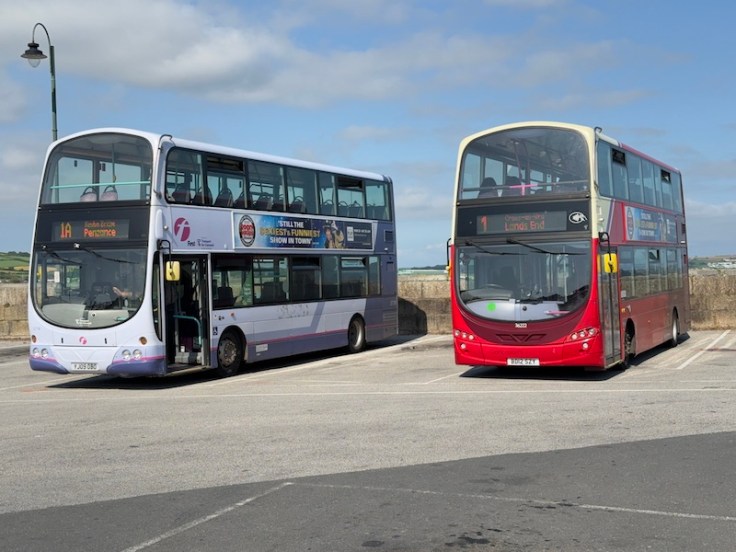
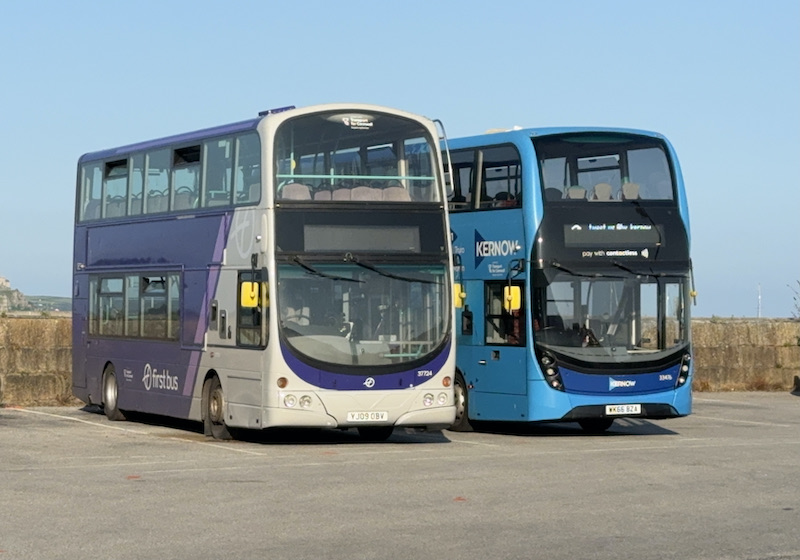
However, where the situation in Cornwall is well below par this summer is the poor image the replacement closed top bus fleet is portraying. Instead of the high profile Lands End Coaster brand there’s a mixed bag of liveries in various colour schemes reflecting the former use of buses transferred in as hand-me-downs from other parts of the First Bus empire.

And it looks awful.
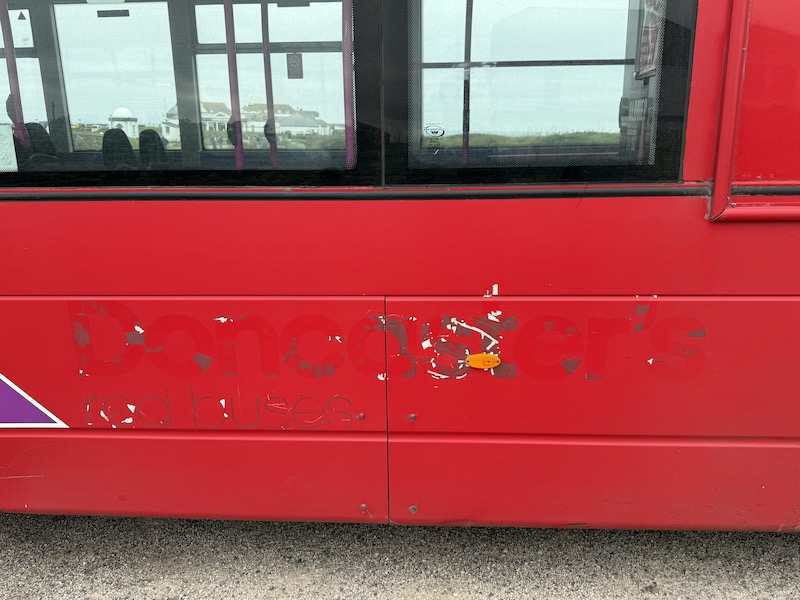
Any sense of the previous branding used in recent years on First’s other commercial routes has also now been destroyed.

I saw Tinner branded buses (Truro to Penzance/St Ives) on other routes; buses branded for the U routes on other routes; and buses in all different colours including Lizard branding on the Tinner routes.
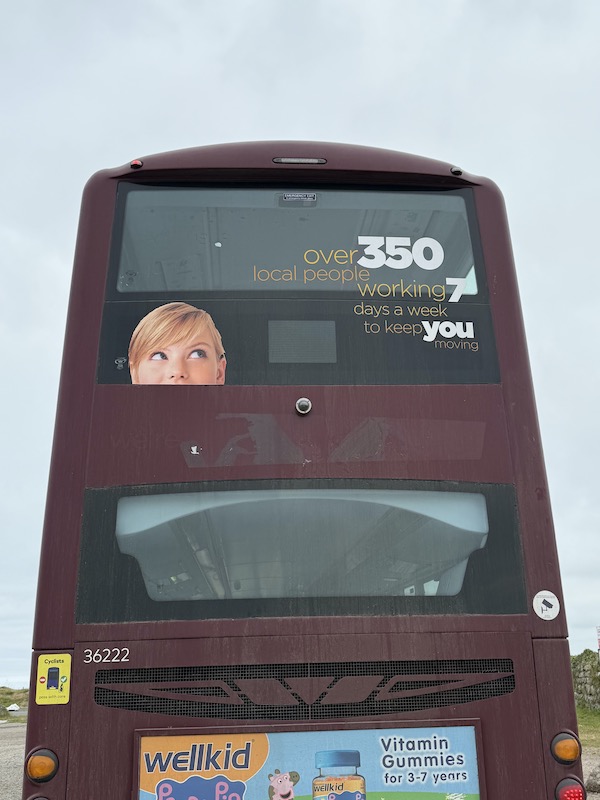
It looked a complete mess and gives the impression no one cares.
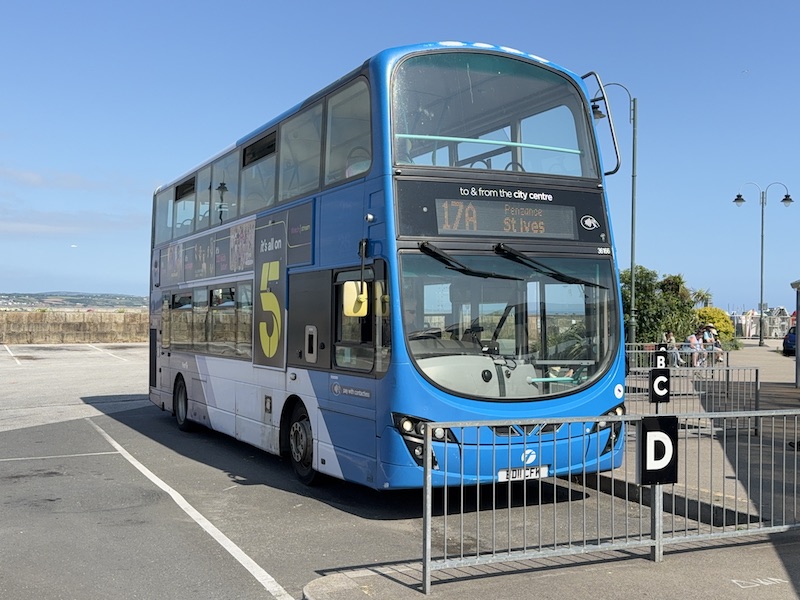
Now I know there’ll be at least one reader who’ll add a comment along the lines of “passengers don’t care what livery the bus is in as long as it gets them from A to B” which misses the point entirely of the need to promote and attract passengers especially in the leisure market where there are many other options for potential customers to spend their money and deploy their time. Buses need to be sold as an attractive and desirable proposition and putting out vehicles that look uncared for will never bring in that all important growth to maintain viability and sustainability.
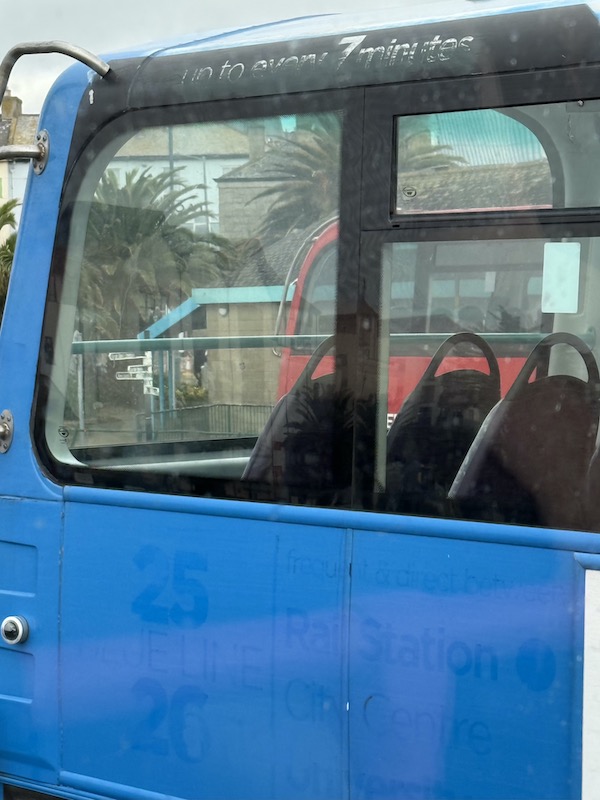
I can also imagine senior executives at First Bus pointing out, ‘this is exactly why we need a nationwide livery so when buses are transferred between companies you don’t get poor presentation when former vinyl branding is removed’. I think it’s somewhat delusional as well as very arrogant to suggest visitors to Cornwall will be more attracted to travel by bus to local tourist hot spots with a national corporate First Bus image in preference to something much more locally orientated. Evidence over many decades (cf Western National, Truronian, Western Greyhound, Lands End Coaster etc etc) shows corporate branding is not the best way to do it.
The tourist market in Cornwall is huge and there’s so much potential for buses to play their part but after unprecedented expenditure of both public funding and First’s commercial investment over the last few years, I detect things are on the slide down again in the county. We seem to have gone past ‘peak bus Cornwall’.
It’s not just First Bus cutting its commercial routes and redeploying older vehicles once again, the publicly funded Transport for Cornwall network also seems to be past its peak with this summer’s timetables including cuts to routes 11 (Bodmin), 12 (Callington) and 21 (St Dennis).
I was also discouraged on picking up the wonderful comprehensive timetable book from Penzance’s Visitor Information Office on Tuesday morning to be asked if I was a local or a visitor “because they don’t print many and visitors use it once or twice then throw it away”. I had to insist despite not being “a local” I would make good use of it and even keep it as a memento.
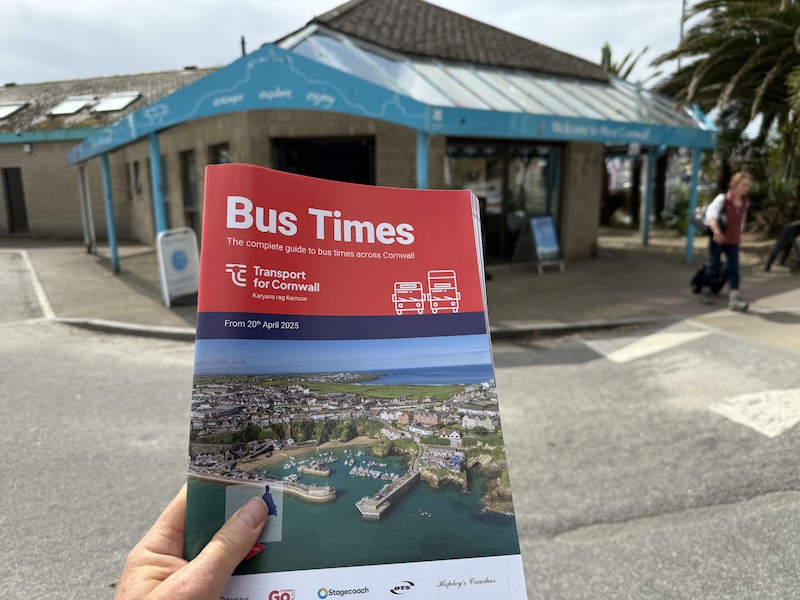
Can you imagine other commercial businesses discouraging their customers from taking sales literature because not enough is printed?
If it’s costing too much then I suggest reduce the paper quality not the quantity printed.
It’s a great publication but still lacks detailed maps of the town networks making it impossible to know where buses go in the suburbs and into and out of each town. Including these would make so much difference.
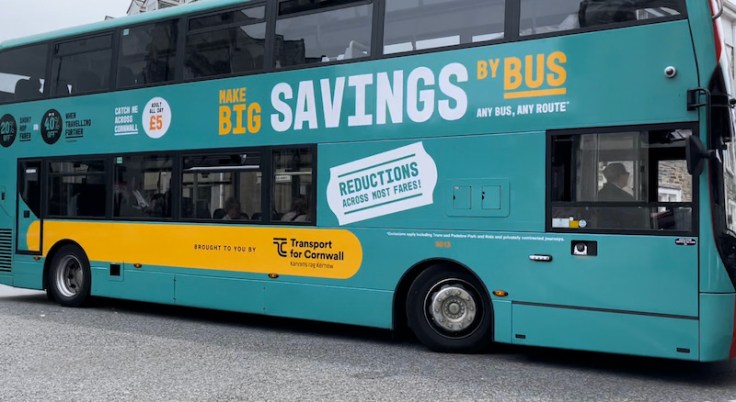
The much hyped “trailblazing low fares pilot” introduced with a great fanfare in April 2022, which among many ticket price reductions saw a day ticket reduced to just £5, thanks to £23.5 million Government funding, seems to have come to an end with the day ticket now £8. Despite all that public money going into the “pilot” no information has been provided in the public domain about whether the “goal of increasing bus usage by 10% across the county” has been achieved. I wonder why not?
Because, with service levels being cut I don’t think there’s much prospect of sustaining that growth.
As I said earlier, compare and contrast with the Lake District. Yes, ticket prices are higher there but the level of public funding into that network is negligible (for many year it was zero) and private investment is consistently high as are numbers of passengers travelling.
It’s the age old problem. When public funds flow then all is well; the moment the money is cut or fails to keep pace with inflation then there’s a problem.
Just a few short years ago, with busloads of public funding pouring in alongside a reinvigorated locally managed First Bus back on the investment trail, Cornwall was held up as an example of best practice for similar areas to follow. I just hope that position can be maintained, but following this week’s brief visit, I have my doubts.
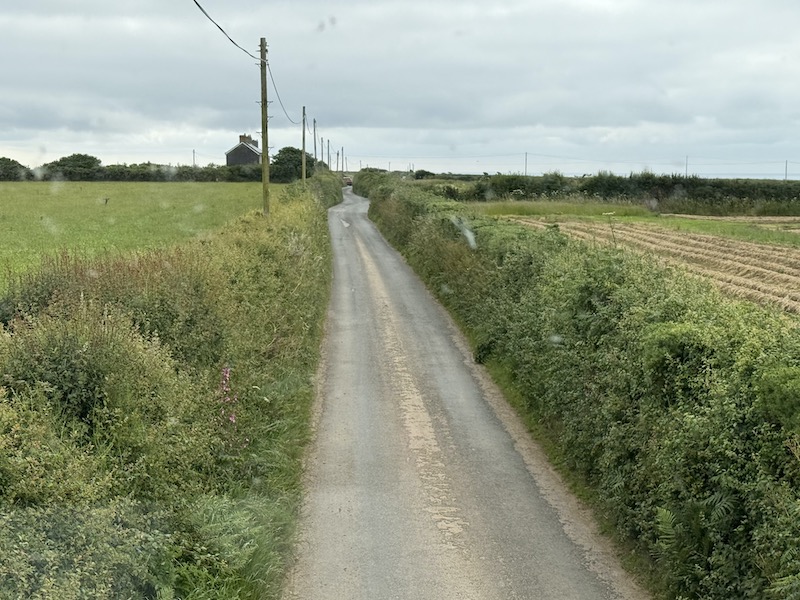
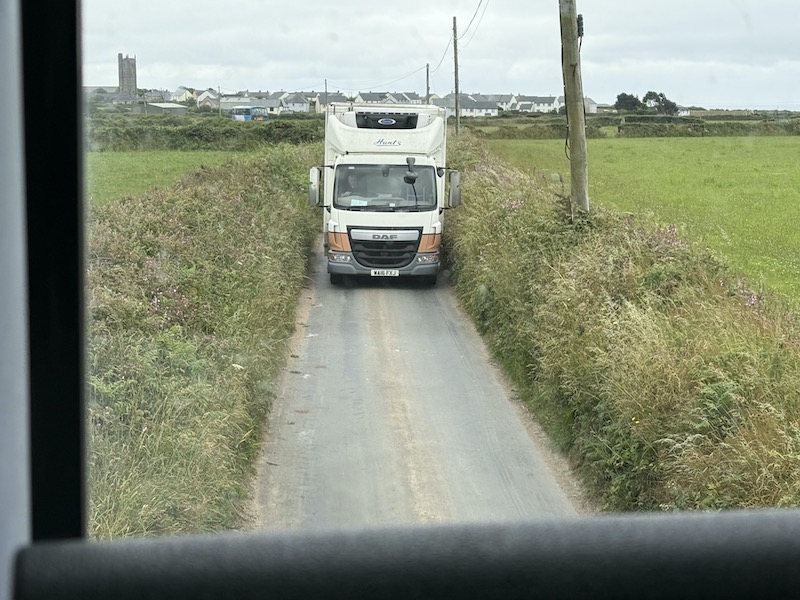
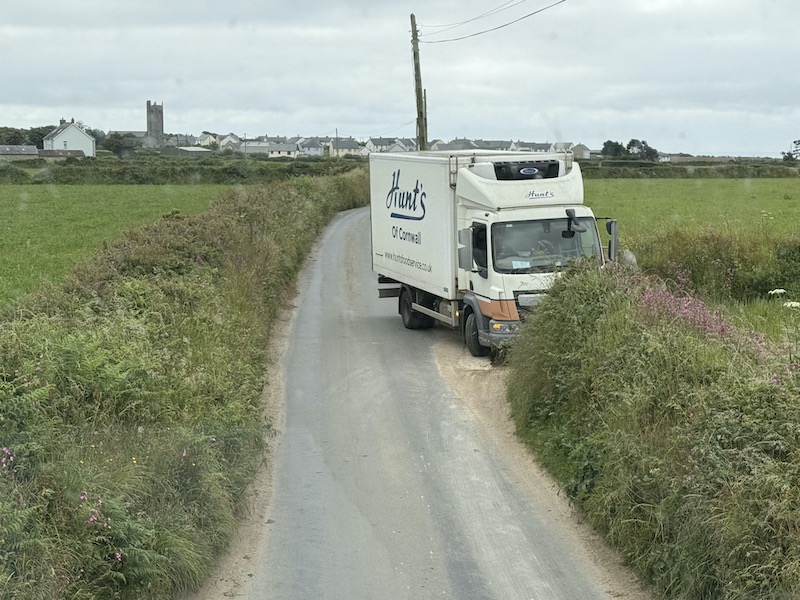
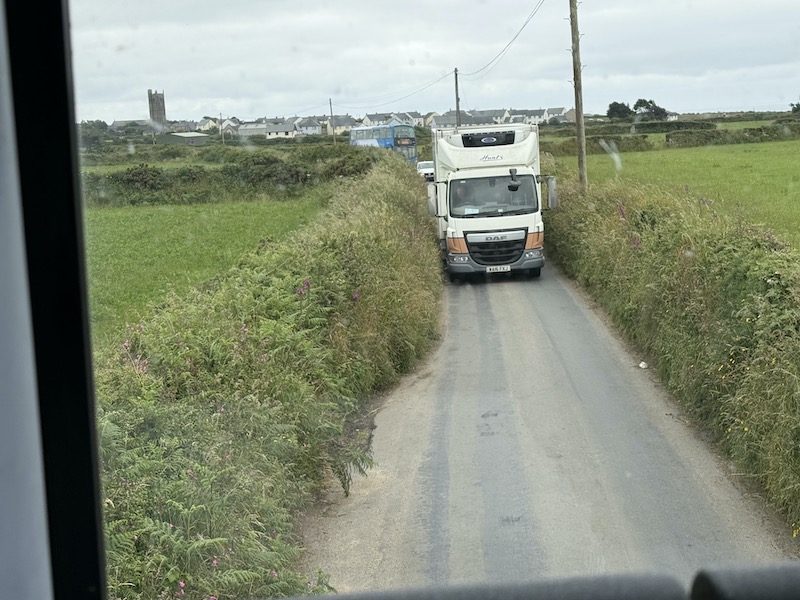
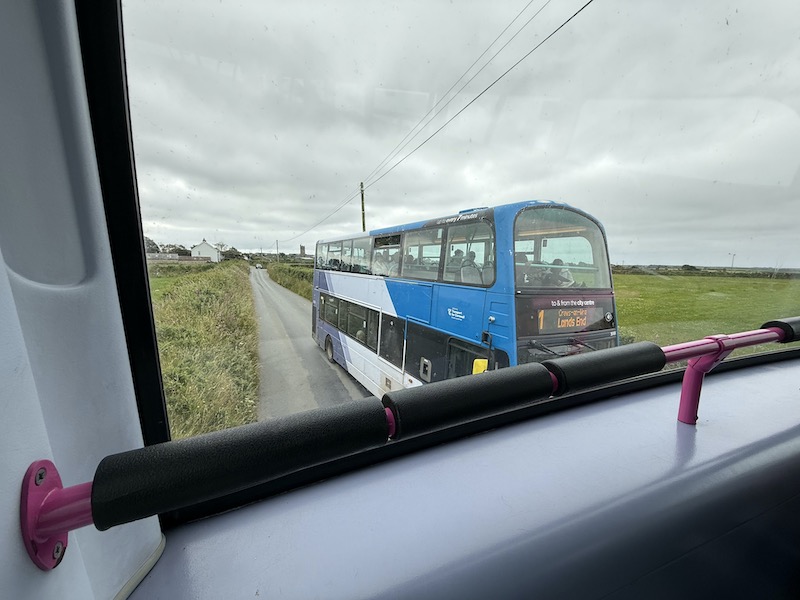
But, to end on a positive, and as with Part 1 of this blog on Thursday, a shout out to the drivers who have to contend with some extremely challenging driving situations on the roads of Cornwall as here near St Buryan on routes 1/1A on Tuesday morning.
Roger French
Blogging Summer timetable: 06:00 TThSSu


I agree with Roger, a smart livery and image is important, not least for the staff. If the company’s buses are scruffy, why do you expect drivers to be smart and have pride in the job? At least NBC and introduced its liveries fairly quickly (albeit aided by significant deliveries of new vehicles). Where I live, we have buses in Stagecoach 2000 and Gold, the old ‘new’ local and distance and now the ‘new new’! A total mess and indicative of a lack of direction.
LikeLike
It’s important to understand regional branding works better than national branding. London, Brighton and other big regional hubs who choose regional over national has maintained or in some case improved ridership. Cuts to services, poor national nondescript liveries, unkept vehicles and poor information of all types brings low morale to staff, and dissatisfaction of the product offered will see passenger demand fall.
The Wandering Busman.
LikeLiked by 1 person
In the past each areas had its own bus company and buses did not go in for route branding so you did not have the mess wee now have
Most companies now are national companies and buses are moved around the country. In most cases router branding does not work as it proves impossible to ensure the branded bus stay on the right route particularly as many routes are interworked. To keep the right branded buses on the right route would bed very expensive as timetables would have to be changed and a lot more spare buses held. Constantly repainting buses is not cheapo neither
A compromise could be to have a common livery But apply some vinyl’s with a local brand name
LikeLike
Sadly, you only have to look at how poorly First, Arriva, Stagecoach and many others are at allocating the vehicles with the right vinyls to the right routes to realise this seemingly can’t be done effectively in most cases either.
LikeLike
The Wandering Busman writes again.
I used to work at high level for an airport associated us and coach company who’s branding was directed at its potential customers. It was made to use national branding by and staff made to wear poor quality uniforms. Publicity of all types were reduced in quality. Where is that regional and also route branded services operator now.
GONE many years ago. The company that introduced national branding for all is now struggling.
just my personal observations and thoughts.
LikeLiked by 1 person
I wonder whether First want to stay in Cornwall.
LikeLike
At the start of this month my Cornwall (+Devon) trip included taking my folding bike on 24 buses over five days. I became aware that there had been service reductions. A good experience overall, and driver skills duly noted. Our Solo had to reverse into a field near Chagford to let a tractor and trailer pass. A frequently overheard complaint, however, was that local school leavers who had jobs a town or two from home had been paying £2 each way. Not only has this risen to £3 for all but very short trips, but some longer routes have been split in the summer timetable, lengthening journeys and costing some such commuters £12 or even £18 return per day, forcing some to give up their jobs and go onto benefits.
LikeLike
No one should be paying £18 for a days travel in Cornwall. There a day and week caps in place at £8 and £32 respectively for journeys within Cornwall and £10 and £40 for trips into Plymouth.
Up to 25 year olds benefit for £5 day and £20 week cap within Cornwall.
LikeLike
The front-end view of the red & white double decker looks cunningly like a SL7 to me!
First Bus has an enormous London fleet now, so shall this help them with their Cornish coastal conundrum?
LikeLike
According to their Annual Report, First are still considering whether to buy or lease buses for their London operation. More generally, I don’t think most enthusiasts (and frankly much of the industry) have got their heads around how the move to BEVs is going to change the second-hand bus market.
My guess is that the TfL bus market will fully move to some sort of closed loop, where buses are financed on the basis of a 12–14-year life in the capital (two 5–7-year contracts with a midlife refurb). The buses will come with a back-to-back guarantee on the battery life and at the end of that period the batteries will be sold for recycling or use for Grid Balancing.
I think very few of the London buses purchased recently will make it out to the provinces via the second-hand market, since they will probably need fitting with a new power pack and drive train which is most unlikely to be viable. I’d assume something similar in Manchester, where if the franchise changes hands the BEV fleet will be transferred to the new owner.
LikeLike
Unless they franchise the rural area EV’s will be a challenge simply because of the charging equipment needed. The cost will be simply to high for small operators and small subsidiaries of the major companies
LikeLike
Exactly, the costs for using BEVs on school and rail replacement serviceds will be prohibitive, even if the depots are close to a substation. As TfW has found it with its half baked plans for the TC network, electrifying most independents’ depots is a pipe dream this decade.
LikeLike
Four years ago, in April, not Easter, I stayed in penzance and travelled the county by bus. I liked the clear information at penzance bus station and I still have the complete timetable booklet roger mentions. I appreciated the local branding too of different routes. It sounds like things have gone downhill with a ramshackle set of buses which give the impression that any old thing is good enough for bus users. At the time I felt that kent could use the approach of Cornwall to promote tourist bus use in the county, but it seems not so now. I even managed an evening meal in mousehole with an easy return!
LikeLike
It tends to prove my point that local and route branding does not work particularly in the more rural area where routes are frequently interworked
It can work with Open top buses which are unlikely to move to another route
LikeLike
Even Go-Ahead South Coast struggles, anyone who visits Poole in the summer will know. You’ll find loads of misbranded buses as double decks are borrowed from Southamption and Bournemouth university contracts to cover for the ramp up in the Breezer network.
LikeLike
Branded vehicles have a habit of wandering all year round in the Bournemouth/Poole area.
Unibus vehicles are routinely used at weekends and during the evenings on normal routes, all year round, possibly to provide greater capacity (double deck in place of single deck). Breezer and New Forest Tour vehicles appear (with their roofs on) on a variety of local routes outside the summer season. Just a few days, the Bournemouth Echo reported on a collision involving a “tour bus” in the northern suburbs of the town. The “tour bus” was a normal service, with a New Forest Tour vehicle being used.
On the Breezer services themselves, the Breezer liveried buses don’t always keep to their intended routes. Nor is it uncommon for closed top buses to appear on at least the “Harbour Breezer” (60 Rockley Park/Poole <> Sandbanks) and “Beach Breezer” (70 linking Poole, Bournemouth, Boscombe and Christchurch), both of which are promoted as open top.
Malc M
LikeLike
If you look at the local First subsidiary accounts it is obvious that the finances have not improved, and Plymouth Citybus and Stagecoach Devon do not look too clever either.
Go Ahead clearly went in cheap to get the Cornwall subsidised network, and that wrecked First’s finances. Not that they had been good before, look at the accumulated losses on the balance sheet.
Somewhere it has been published that passenger numbers have increased 21% over the period of cheap fares and massive increase in the tendered network, which to me seems a very poor result. As Roger says it’s a scandal that £40m+ of money has been poured into this experiment without proper evaluation, so that the results could be used to inform other authorities, all of whom are now in receipt of BSIP funding.
The lack of any meaningful information on how BSIP funding is going is a good example of how Governments waste money, despite Rachel Reeves laser eye on waste.
I’m amazed that it has taken First so long to realise that there is no money in running open tops on a punishing network for 4 months of the year. Engineering costs will be horrendous, and throughout the last couple of years there have clearly been engineering issues.
For Cornwall to return to financial sanity there has to be one major operator running both the commercial and tendered network, so one has to fold. The problem Travel Cornwall has is that by giving the tendered network to one operator, all of the small independents who would have helped to keep prices in check have virtually vanished. So if they only have one large operator they are at the mercy of a monopolist
There may be a check on them from Stagecoach, who have just won college networks from both First and Go Ahead, but that would possibly not cover the whole of Cornwall.
Anyone for a franchise?
Incidentally thinking that the London fleet could provide a cascade of buses as is the past , one has to remember that there are not many pure diesel buses left in London, and so many would be hydbrids with the cost and complications they would bring.
LikeLike
Most LA BSIP’s had a target of annual passenger number increases, Most if not all LA’s have gone strangely quiet on publishing any data on progress if any made
LikeLike
Having several competing operators in what are pretty rural area and area that still have seasonal peaks is not the most efficient or cost effective way to provide services. Maybe a franchised network for Devon and Cornwall ?
LikeLike
The council did not “give” everything to one operator. The routes were tendered in multiple individual lots and Plymouth Citybus submitted a package bid for the whole lot, which proved to be the most economically advantageous tender. Awarding a multitude of operators would have meant higher costs – the opposite of what your suggesting. Plus in any case the three main independent operators ended up working for GoAhead on a sub-contracting basis while benefitting from significant new vehicle investment.
LikeLike
I did once get told off by a very grumpy man behind the counter in an Oxfam shop after picking up a copy of their catalogue of charity gifts and was told I could only take one if I was buying something from the shop at the same time. This could easily have been 20 years ago and I’ve never come across it anywhere else so I think the policy must have been unique to that branch or even that volunteer.
LikeLike
The same charities though will inundate you with junk mail which is a lot more expensive
LikeLike
What I find a real shame is how it doesn’t seem like First are making much effort at all to improve it either. I was keen to read this as I was in Cornwall a year ago and disappointed at the complete mish mash of bus liveries and colours on offer, reminiscent of what I thought was a now gone attitude of “who cares, it’s a bus and it moves”. It seems like a whole year has gone by and they haven’t repainted or tidied up anything!
LikeLike
It could be worse, Generally Arriva come out at the bottom for standard of service
LikeLike
Great review, but I agree it’s really disappointing to see just how much First have gone downhill in Cornwall (and in their other operating areas too, it seems to be the same story pretty much everywhere). Some of their local brands were really well presented and I completely agree that you need to make the bus an attractive prospect to attract passengers and First’s rather drab national corporate livery isn’t going to do that. I do think there’s a balance to be found regarding open-top routes though, and a 4-hour circuit was probably too much (no one other than an enthusiast would genuinely do 4 hours on an open-top bus!) – maybe First could look at operating just Penzance-Lands End as open-top, perhaps with the other of the 1/1A being a normal bus (a bit like how Stagecoach alternate the 508 between open-top and closed-top).
Funny you should mention that making the 555 open-top wouldn’t be a good idea though, because that does actually happen. I remember two years ago, I think, in the winter season, there was one 555 working per day (usually the 2pm departure from Keswick) which was worked by one of the open-top fleet usually based on the 599. I once ended up on it, travelling from Keswick back to Lancaster in February in heavy sleet! A few people (including me) did sit on the open deck at first, just for the novelty of it, but by the time we reached Grasmere it was so freezing we’d unsurprisingly all come downstairs! No idea if Stagecoach still have to do this, but it must be one of the longest open-top journeys in the UK.
LikeLike
i had the same timetable booklet experience in Bude about ten years ago, having made my way there by train to Exeter then bus to Bude. The staff in Bude TIC were very helpful but were obviously quoting from a county-wide policy statement. They only let me have a copy of the timetable booklet when I promised that I would leave it in my holiday accommodation when I went home! I’m amazed to hear the same quotes from another TIC all these years later.
Paul Roberts
LikeLike
I agree somewhat in regards to the open toppers. The lengthier parts of the Lands End Coaster could be a bit of a slog, even on a dry day you’d have cold or warm air lashing you in the face for 1-2 hours as the bus thrashes down national speed limit roads, a far cry from travelling at 10 mph on Scarborough seafront for 15 minutes
The presentation this year is a mess though, if only they could try and remove the old branding a bit better, so you couldn’t see ‘Doncaster’, ‘Halifax’ etc in the residue
The other open toppers route not mentioned, the one to Padstow was clearly not sustainable as you had the hourly Atlantic Coaster competing with the hourly closed top Go Cornwall 56 service. There would never previously have been two buses an hour along this route
As others have said, the Cornwall network doesn’t really work with two operators with most towns now having two depots, so much duplication. It’s noticeable the only time First received big investment was in the window between Western Greyhound closing and TFC/Go Cornwall starting
LikeLike
Why hhas the U1 been withdrawn, with now no services serving Liskey Hill in Perranporth?. Great article BTW!
LikeLike
The route number has changed to 87 with all trips routed via St George’s Hill and St Agnes.
LikeLike
I’ll never understand why bus companies are so reluctant to issue their timetables to their customers. A notice has recently been posted in the window of First Potteries’ travel shop in Hanley stating that due to their cost, they now charge 10p for requests to print a timetable.
It’s like going to a restaurant and having to pay to see the menu.
LikeLiked by 1 person
Nicely put. Food for thought?
LikeLike
In the distant past timetables and routes did not change much now they change at the drop of hat so keeping printed timetable up to date can be problematic
It used to be they largely changed at most annually except for tourist areas where they tended to have summer and winter timetables
LikeLike
Historically bus companies always charged for timetable books, and some (usually smaller companies) even for leaflets.
Looking at some of my older timetables I’d say books were generally sold for the same price as a longer town journey ticket (6d or so in the 1950s, for example); by the 1980s the going rate for a ‘proper’ book such as WMPTE’s Divisional timetables was 50p and for local books such as those issued by West Yorkshire Road Car for Harrogate was about 20p. Those probably equate to about £3 and £1 today.
Trent, the “really good bus company” to be, were noticeable for how expensive their local books were compared to other operators in the Midlands!
LikeLike
I was lucky enough to have a ride on the open-top Lands End Coaster last September. My brother lives in Penzance so while down there one weekend, we took the ‘long way round’ to St Ives via Lands End. I really enjoyed it, was a great experience. I was impressed how well it was used, as well as tourists travelling to/from Lands End, there was also a mix of walkers travelling between different areas, as well as locals going between villages.
Only downside was that the driver wouldn’t sell us £2 single fares, which I suppose was a bit cheeky of us, and understandable. Still, the £7.50 day ticket seemed good value, and came in useful when getting the 17 back to Penzance later in the evening.
It’s maybe not the same experience now, but still a very scenic route to travel on, even inside a closed-top decker.
Stu – West Midlands Bus Users
LikeLike
when I asked for a bus timetable in late March at Penzance TI office I was told that none were or would be available for some weeks which was very unhelpful.
I was surprised, though, at the frequency of buses on rural routes especially during evenings. Hopefully appreciated by locals.
LikeLike
It is not the first time First/Western National have used Cornwall as their “bus graveyard”. Enthusiasts travelled the UK to ride elderly Bristol VRs two decades ago, a vehicle type which had long disappeared from normal service everywhere else. But, who cares how old the bus may be provided it is comfortable and well-maintained? With the safety-culture now along with our weather pattern, I am surprised open-tops were ever considered for such long routes. The tree-lopping must have cost a fortune.
And as that wretched person predicted to say it, yes too, the passengers really neither care or notice. They look for the number at the front, hopefully readable when so-called “bright-tech” can be seen in sunlight. Sadly, often not, and a recognisable company livery helps. It may look pretty in Reading and Nottingham where urban operations can at least keep the vehicle route-bound, but I doubt if it attracts a single extra passenger.
Can you imagine the outcry if TfL decided such a policy of different route colours! They have at least confined to keeping the “Superloop” branding consistent, although for one route this means buses confined to working just peak hours five days a week.
Terence Uden
LikeLike
Open top buses are great in warm good weather, but I experienced one from Lands End a few years back in a howling gale with rain to match. There wasn’t a dry seat anywhere on the bus, outside or inside.
LikeLike
Open Top v Closed Top
Roger seems to be saying that the experience is not dissimilar, because one can still “soak up the spectacular scenery” in a closed top bus.
Possibly the scenery, but not the elements. Compare and contrast the (now) closed top Penzance to Lands End (ghastly!) experience with that of the Bournemouth to Poole open top “Breezer”, where passengers have around to queue the block and fight to board.
I would be interested to know First’s real reason for withdrawing the Penzance open top service.
Mike Ricketts
LikeLike
If I was a tourist wanting to travel upstairs on a bus in the middle of a scorching summer, an open top bus would be very welcome. However, if open top buses are not used, I would expect at the very least it was air-conditioned, otherwise the journey would be far from pleasant.
MotCO
LikeLike
With all this talk of the Cornwall timetable book being hard to get hold of, I worry if it’s on its way out. Next year we will be told ‘it’s all online’
LikeLike
When I asked for a copy of the Cornwall timetable book, I was asked specifically “which services do you actually use”? I replied “all of them” to which the clerk said she had been told to ask!! Yes the First South MD publicly said at a BUG meeting don’t expect that timetable book to be around much longer as it’s not a good use of funds or words to that effect.
LikeLike
Give all those buses to select bus services! They look luxury compared to there current fleet! 😂
LikeLike
An interesting article about running buses in a tourist area. There are lots of challenges but it is obvious that there is a lack of joined up thinking.
For example some commercial sponsorship of the timetable would allow an increased print run. Perhaps some tie ins with local attractions – discounts for bus users – to encourage bus use?
This is also an area where a monopoly would help. The limited profitable summer season is needed to support the poor winter takings. You also need an easily available ALL operator ticket to make it easier for visitors, I thought that was what an enhanced partnership was designed to deliver?
Liveries are very much a personal thing. I find the Trent/Barton network confusing because of all the brands. It only works because they have more spare buses than a National group would allow.
On my recent trip to Devon I was surprised to see a Peak Sightseer open top bus of Stagecoach in use on a local route in Paignton!
Richard Warwick
LikeLike
First were always stingy with buying pots of paint. Every national livery change seems only to be applied to a few vehicles leaving a mish mash. Brands and corporate identities are precious things, to be messed with at your peril!
I think that the bus industry overall has been extraordinarily inept at applying route branding, so perhaps now is time to stop it altogether. Regional identities should be the priority, indeed, I’m sure I read the original BSIP rules stated regional over operator liveries.
Obviously franchising will bring regional identities, although some seem very obscure in their geographical connection (BEE NETWORK, Weaver Network, Tiger Network). What’s wrong with proudly displaying your city or regional name and hiding behind a vague name who’s rationale is lost on everyone?
Peter Brown
LikeLike
With regard to your comments concerning obscure names for certain networks I suspect this is due to the employment of certain consultants not familiar with the areas in question & worse, the industry itself. There are always exceptions of course & the main one for me is Best Impressions run by Ray Stenning. Not only are they totally conversant with the bus industry but importantly, geographically astute.
LikeLike
Geographical names can become confusing, particularly if later expansion takes an operator outside its original home patch – a good example being the pre-1972 “Wilts & Dorset”, which actually had considerably more operations and depots in Hampshire than it ever had in Dorset. Another similar case is “Maidstone and District”.
A slightly different case applies to names like “Greater Manchester Transport”, which probably didn’t go down quite so well in Rochdale or Stockport. “SELNEC” was at least imaginative, and not too closely linked to one of several towns and cities.
Peter B’s suggested name for the Cambridge area operations may be geographically correct, but is long and not very imaginative, and similar names may be used for other local businesses. “Tiger Network” is snappier and does have some local connections (according to the discussion on that topic), and will be more easily remembered.
If the people involved in creating these systems have the degree of local knowledge generally considered to be desirable in bus operation, then they shouldn’t need to pay consultants to devise the names for the networks.
RC169
LikeLike
SELNEC imaginative? Hardly! South East Lancashire North East Cheshire could barely be any more matter of fact – and I always thought, when pronounced as a word, was really ugly. As regards local network names, so long as it has a local connection – which Bee and Tiger seem to – it really doesn’t matter how nonsensical they may seem to the rest of the country. As a former Leeds resident, I’m less convinced by Weaver; I sort of understand the reasoning, and I suppose people will get used to it, but it’s by no means an obvious choice.
LikeLike
As far as I know “South East Lancashire North East Cheshire” was never used as a fleetname. Whether the name or word is ugly or not is, of course, a matter of opinion.
The “SELNEC” name does seem to have found a place in the minds, if not, perhaps, the hearts, of the local people – although I understand that some thought it meant “seldom early, likely never even come”.
LikeLike
The problem so far is that the franchised networks cover large regional areas, serving multiple towns with longstanding rivalries. No-one in Bradford would want their local buses totally branded as Leeds and vice versa, and there seems to be an attempt to avoid using the old PTE identities too.
Kcc
LikeLike
Comparison with Stagecoach operations in the Lake District is interesting.
I do wonder, however, whether the peak season in the Lakes lasts a lot longer than in Cornwall, with plenty of visitors from Spring through to Autumn. The summer service levels in the Lakes would seem to reflect this, mostly operating for seven months of the year (April to October inclusive), with a small number of further enhancements during the summer holiday season. Is Cornwall more heavily “peaked” in a shorter season?
Malc M
LikeLike
The 1/1A confusion is not helped by the fact that the via points have not been swapped around in the timetable headings – the 1 is described as being via Crows-an-Wra in both directions, and the 1A via Porthcurno | Sennen / Sennen | Porthcurno! Very careless.
LikeLike
And, by the way, you’ve succumbed to a very common mistake in your use of “revert” – “to revert” means “to go back” (or return), so “reverting back” is “going back back”. Just “reverting”, please, no “back” required.
LikeLike
I knew what Roger meant.
LikeLike
Many thanks. Now corrected.
LikeLike
Not wholly related, but there was once a restaurant in Salisbury which didn’t offer a printed menu, but instructed diners to scan a QR code instead.
Result: the restaurant no longer exists.
Darryl in Dorset.
LikeLike
We were in Cornwall the week before last and on arrival noticed how tatty the First buses had become compared with 15 months ago. I too asked in the Penzance Tourist Office for the Cornwall timetable book and was actively discouraged. She only gave it to me on the basis I left it in our hotel for others, or returned it. Worse in the Liskeard Tourist Office where I was flatly refused as I admitted I could view it on line. None readily available in Truro bus station. A tip for others planning to visit, telephone Truro Tourist Office where they will post you a copy if you pay the £2.50 postage.
Route 16a via Gurnard Head was a delight using a new Enviro 100 of Go Cornwall. It also dropped us in the centre of St Ives rather than the slightly out of town old bus station.
Late running due to oncoming vehicles in country lanes is a problem and we always allow 20 minutes or more connecting time. Go Cornwall buses generally smart and quite well used, eg the 20 seat minibus 485 to Polruan leaving Looe full compared with only the two of us in April last year
Nice to see that both Fowey and St Ives have town buses to connect with car parks and out of town areas.
Being of a bus pass age we used bus (and train) all week, parkin at Liskeard Station which at £4 a day is cheaper than the likes of Polperro at £10 a day
Brian Willson
Orpington
LikeLike
It’s a real shame to hear the open-top buses have gone and the routes cut back.
I had a few days in Cornwall in September 2020 – during that strange between-lockdowns period – and used the A1 to explore, stopping off at Porthcurno, Land’s End and St Ives. It was wonderful and the buses were well-used too. The skill of the drivers was quite something too.
My first trip was unforgettable – as soon as we got out of Penzance we hit thick fog, and it stayed that way all the way to Land’s End. It was quite an experience on an open-top bus – although it cleared by the time we reached St Ives. Finally bagged better weather the following evening, managed to get up to Land’s End when it was quiet before getting the last A1 back, heading straight to the garage.
I always thought I’d return and do it again, but if the bus network has been cut back then perhaps I shan’t bother – I can’t imagine a second-hand closed-top double-decker is much fun on a warm day.
LikeLike
I wonder if Roger experienced any of the cast off First buses having noisy fans ? This was certainly the case with some of the ex London Volvos still running around Colchester a few years ago. They sounded like they were about to self destruct ! Poor standards of maintenance
Martin W
LikeLike
First in Cornwall. Running small buses in the place of double deckers and leaving passengers behind. Removing clock face timetables. Removing through buses from Falmouth and Penryn to Treliske hospital, Removing local liveries.
Their achievements go on and on. The sooner they pull out of Cornwall the better.
LikeLike
We could also note that the open top Lakesider has a fairly considerable fixed roof element at the front on it ( good grief I thought the whole idea of open top was to be blown away on the upper front deck seats ( a variation on how the Beachy Head services used to be with Southdowns route to Birling Gap being a mere upper windshield and Eastborne Corporation having a couple of side bays as well despite only going to the foot of Beachy Head
J B C Prestatyn
LikeLike
Back in 2013 when Western Greyhound was also operating using mostly the one day Ride Cornwall ticket ( trains included ) and valid just over the border into Devon over 13 full days I only used the car for 3. I was based in Hayle. The missing bus link was a direct service to Perranporth and Newquay as only to run for the peak weeks mid – July to end of August. The other car trip was to the Lizard.
I covered the circuit St Ives – Lands End – Penzance – St Ives, Bude then to Plymouth and train back, Penzance – St Ives by train, Looe and Polperro – train to Liskeard and back from Looe (the only day with a major delay because of a fatality back in Berkshire / Wiltshire reduced by turning a Penzance – Plymouth 150 set around back to Penzance), Mevagissey, Padstow – rail to Bodmin Parkway then Boscarne then walk to main road for the bus to Wadebridge then Padstow, Falmouth – one way by train from Truro, Fowey.
As best I recall both First and Western Greyhound fleets were in their corporate liveries.
How much of this is possible in 2025?
LikeLike
I went to Cornwall on the Easter weekend this year and rode the 1/1A on their first day: it was a complete chaos with the bus leaving Penzance in the morning completely full and standing and leaving around 15 persons behind at the bus station. Then more 2 or 3 passengers left behind at the first stop, more 4 or 5 at Newlyn…
Today’s management at First Bus clearly underestimates the potential of Cornwall: they could have used the savings made by withdrawing open tops and cutting the long Land’s End Coaster by establishing an attractive and reliable service on the 1/1A, with proper branding and extra departures on busier weekends and bank holidays.
But First underestimating Cornwall is not limited to the Land’s End service: The Mousehole (now M6) is such a mess on busy weekends and bank holidays with the new but smaller minibuses getting full and standing along most of the day. Instead of increasing the allocation and offering a 15 min headway to compensate the smaller vehicles, they just crossed their fingers and hoped that people will accept whatever they offer. The new vehicles by the way are so cramped that it is difficult to even accommodate the legs between the seats when sitted. And I am pretty sure Ilesbus would be able to deliver a custom seating layout if requested.
LikeLike