
Thursday 15th May 2025

I had the privilege of speaking at ALBUM’s Annual Conference in Nottingham yesterday. David Astill, ALBUM chair (and managing director of Nottingham City Transport), had invited me to share my thoughts on “what passengers are getting” based on my travels across the length and breadth of Britain over the last decade and more.
ALBUM stands for the Association of Local Bus Managers and exists “to support the vitally important municipally owned and independent SME bus sector in the UK”. Around 40 bus operators including all the municipal bus companies and a large part of the independent bus sector in the UK are members, being responsible for the operation of some 5,000 buses (roughly equivalent to one of the larger bus groups).
Many suppliers join ALBUM as Associate Members helping to foster relationships and exchange ideas and knowledge with operators while ALBUM regularly responds to government consultations affecting the bus industry on behalf of its members as well as sharing information and best practice.
With the expansion of franchising, ALBUM is calling on transport authorities to support policies that protect competition, encourage innovation, and retain the best of local expertise.
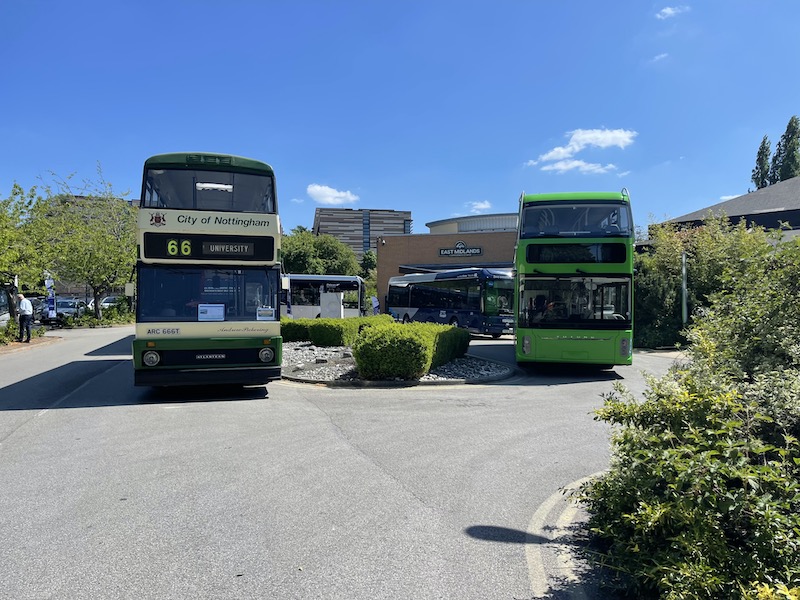
Its Annual Conference is one of the bus industry’s prestigious events, held over two days with an additional ‘golf day’, for those into that kind of thing, which tees things off. An ALBUM member takes it in turns to ‘host’ the Conference every year – last year it was hosted by Warringtons Own Buses in Cheshire and next year’s event is in Blackpool but this time the 500 or so delegates met at the East Midlands Conference Centre located on Nottingham’s University Park Campus, a short bus ride on NCT’s routes 35/36 from the Victoria Centre in the city centre, and I made sure to pick up a timetable from the always well stocked display in the foyer of Nottingham rail station as I arrived.

Around 80% of the delegates attending the conference are from the supply side of the industry as ALBUM provides sponsorship opportunities and exhibition space where many take a stand to show off their wares and create a useful networking environment in the breaks.

An area outside the Conference Centre is also set aside for vehicle manufacturers to display their latest products. It’s almost like a mini Bus Show especially for ALBUM members.
I was interested to see the latest Yutong double deck…

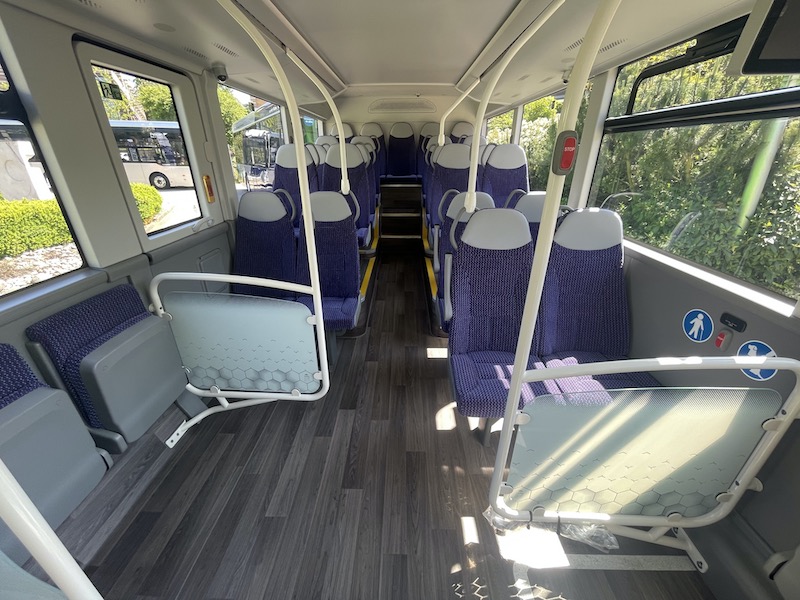
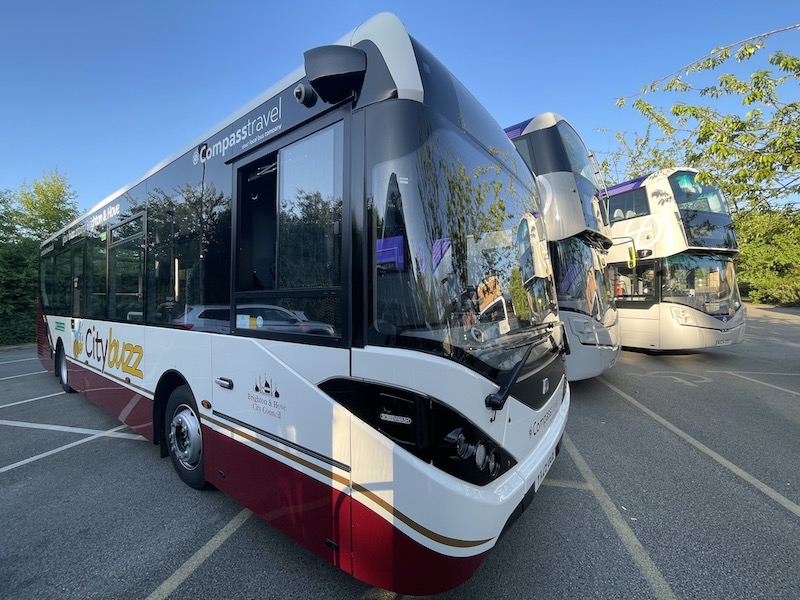
….as well as one of Compass Travel’s 11 Alexander Dennis E200s just delivered for its recently won network of tendered bus routes in Brighton & Hove.
There was also a smart minibus from Strata…

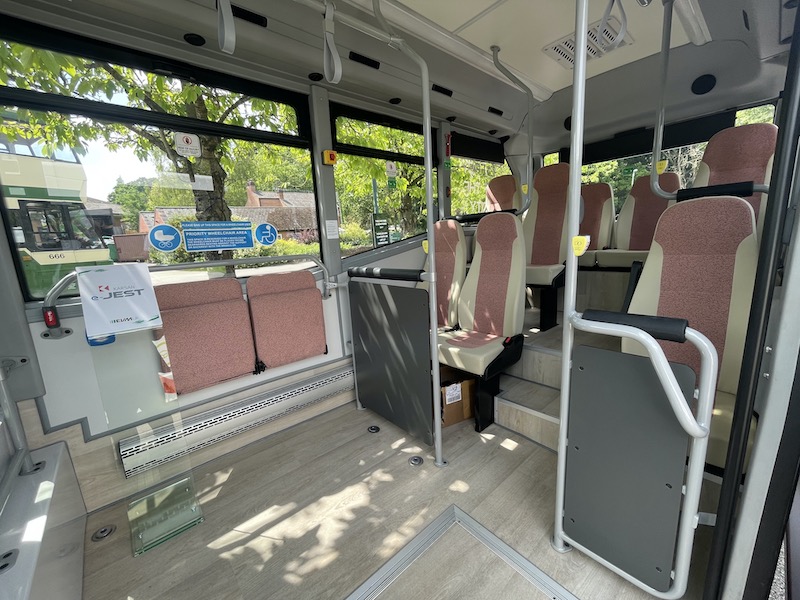
… and an interesting electric powered small minibus from Jest – a new one on me.

I had a wander around the three exhibition areas…
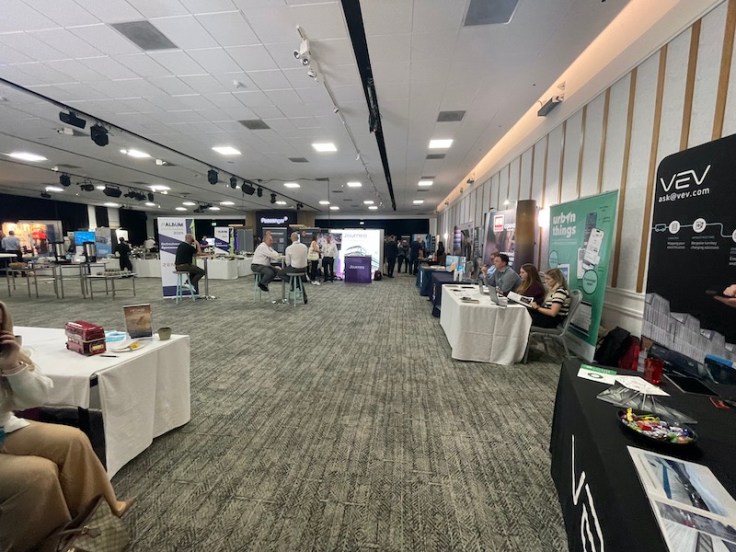
… impressed by the variety of suppliers who were present from web designers and creative agencies….

…. to manufacturers and part suppliers.

Acting as continuity announcer for the Conference was David Lloyd who is the voice of NCT’s on-board bus stop announcements as well as being a local committed bus user so knows a thing or two about the extent of the network as well as a long career in the broadcast industry being a presenter on, and founder of, Boom Radio – which those of us of a certain age are now regularly tuning in to.
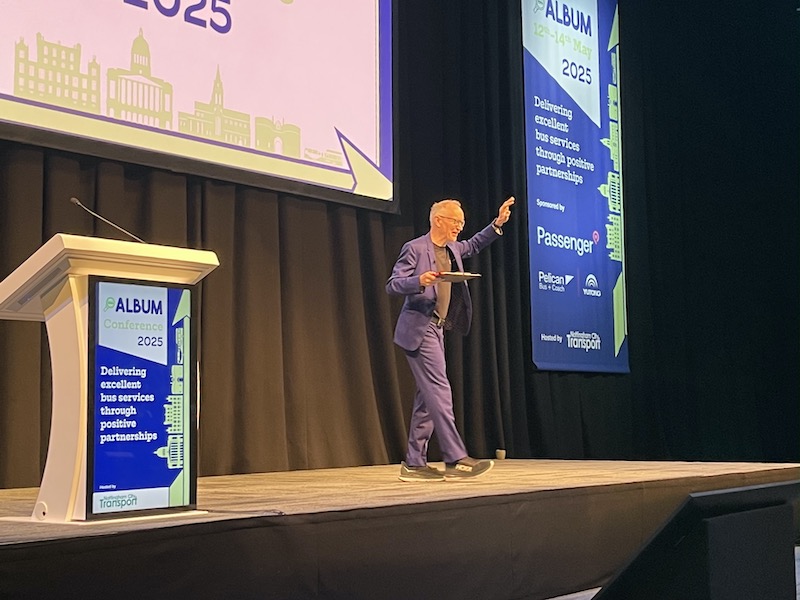
David Astill and NCT Chair, Councillor Graham Chapman, kicked things off by welcoming everyone after lunch on Tuesday to the Conference…

… followed by the ‘Keynote Speech’ by Minister for Local Transport, Simon Lightwood MP. Except as inevitably happens with Ministers, he had to pull out at the last minute due to commitments “in the House” but he sent a video message telling us “improving buses was at the heart of the Government’s ‘plan for change’” and how the Bus Services Bill going through Parliament will not only open up franchising but support those authorities already pursuing Enhanced Partnerships and enable new municipal bus companies to be established.

“Delivering excellent bus services through positive partnerships was the theme of the afternoon” reinforced when we heard from Claire Ward, elected last year as Mayor of the new East Midlands Combined Authority, which is in the process of subsuming transport responsibility from its four constituent local authorities: Derby and Nottingham City Councils and Derbyshire and Nottinghamshire County Councils.

Refreshingly Claire sees partnership working as the way forward explaining how working jointly with expertise in bus companies is the way to deliver her vision for a Regional Network of public transport.

This theme was further developed when we heard from Daniel Pearman Leicester City Council’s City Transport Director on the excellent progress being made in that city to create a unified image, integrated ticketing, coordinated timetables, investment in new electric powered buses and effective marketing all through partnership with the city’s three main operators.
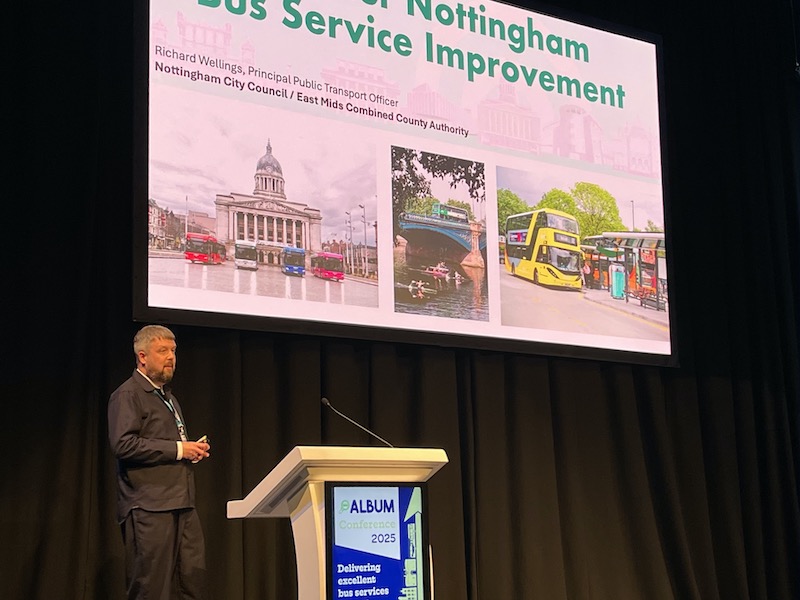
Richard Wellings, Principal Public Transport Officer with Nottingham City Council echoed many of Daniel’s points about the advantages of partnership working as he explained how Nottingham has regularly been lauded for its high quality and award winning bus network. Even Jason Prince from the Urban Transport Group spoke of the benefits partnership working can bring, along with franchising, where appropriate, notably in the large metropolitan conurbations.

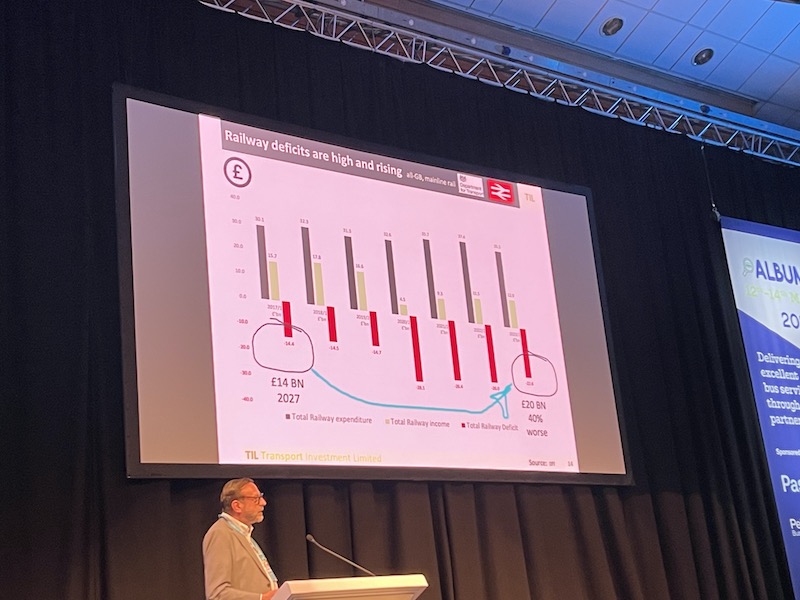
Long standing industry veteran David Leeder gave one of his comprehensive briefings of the Country’s dire financial position and where transport fits into this…

… notably comparing the vast amounts of subsidy going into rail compared to the relatively minuscule amount that supports the bus sector…
…as well as showing the falling passenger numbers on TfL’s buses…

… the amount of public money going to keep London’s buses on the road (including from local taxation)…

…. and the cumulative subsidy for Greater Manchester’s Bee Network likely to exceed £1 billion in the first five years.

He particularly emphasised the importance of prioritising priority for buses on the road with such schemes bringing the all important benefit of quicker journey times and therefore reduced operating costs or reinvestment in improved frequencies and service. He also observed how new models of ownership could be looked at including public-private consortia for newly established bus companies or bus networks giving examples of a number of schemes around the country that were common pre deregulation.

Also speaking during the afternoon was Guillaume Chanussot, CEO of Transdev and shareholder in Nottingham City Transport along with the City Council – itself an unusual ownership model.

Yesterday’s programme kicked off with Louise Collins, Director of Transport Focus, sharing the highlights from the recently published Passenger Satisfaction research which pleasingly had shown an increase in satisfaction from 80% in 2023 to 83% in 2024 thanks to particular improvements in satisfaction with punctuality and value for money, the latter obviously helped by the £2 fare cap.

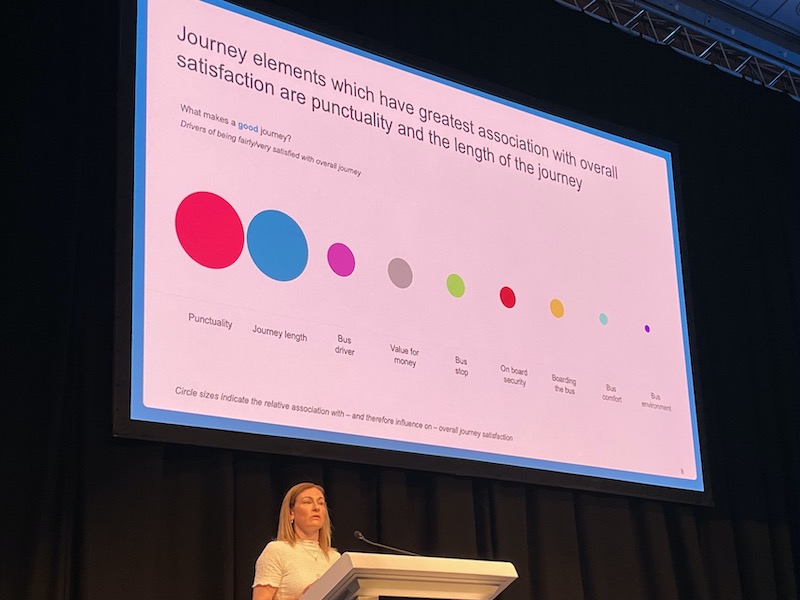
Among the many results Louise highlighted was an interesting assessment of “journey elements which have the greatest association with overall satisfaction” showing punctuality and journey length were followed by the driver.
And then it was my turn to take to the stage. As it was probably the last time I’d be given such an opportunity to share my thoughts in such a forum, now being well into my second decade of retirement, I decided not to hold back but give a ‘no holds barred’ account highlighting both the positives and the negatives passengers face every day as they seek out timetables, consult web sites, wait at bus stops and travel around on buses – all of which regular readers of this blog will, of course, be familiar with as I record such matters every month, so I won’t repeat the images again here.
But, I took the opportunity to thank those in the audience who work for ALBUM member bus companies for the excellent work they do providing a locally based, locally managed, locally determined, locally controlled bus network that thrives because of that wealth of local knowledge and experience.
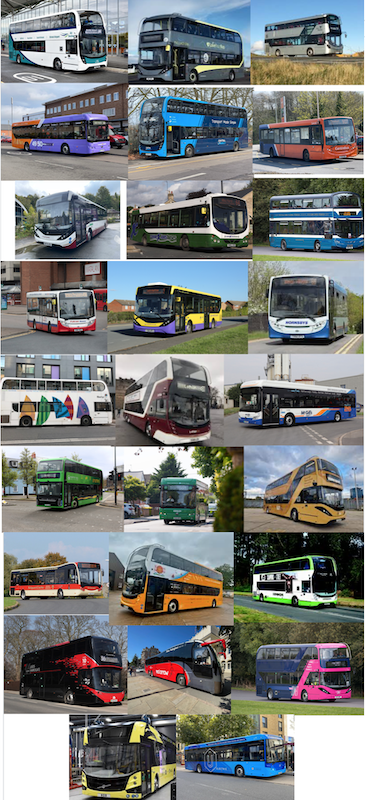
Go-Ahead bus companies and NatEx West Midlands aside, I pointed out the three Groups which make up over half the rest of the industry – Arriva, First Bus and Stagecoach – are following the complete opposite approach to bus provision with ever increasing control from a head office led by senior executives with no career experience in the bus industry, valuing a centralised corporate approach with bland brands that mean nothing to, nor will ever inspire, passengers.
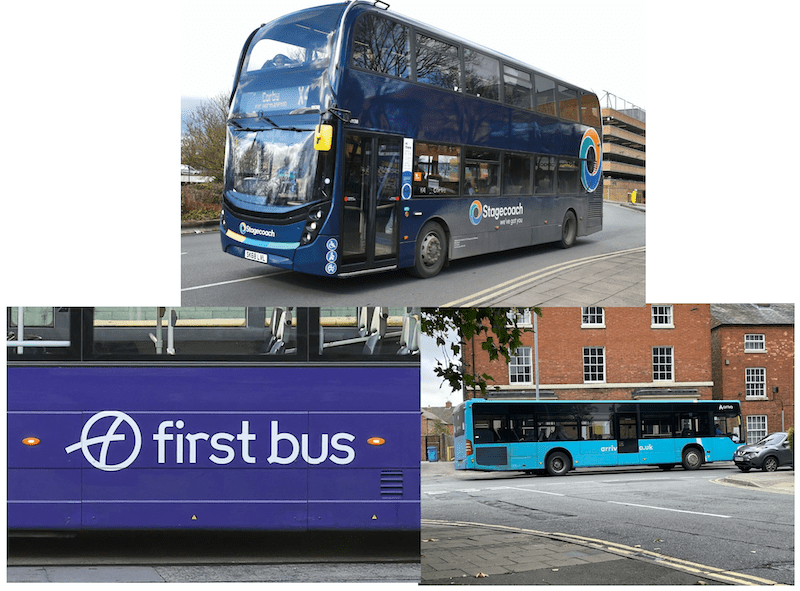
I concluded the 20 minute expose by imaging if ALBUM members got together and decided, as others have done over the last 50 and more years, rather than use those local identities everyone knows and loves, decided to use so called ‘passenger research’ allegedly showing everyone gets confused by such things to instead have just one corporate bland branding for all their buses.
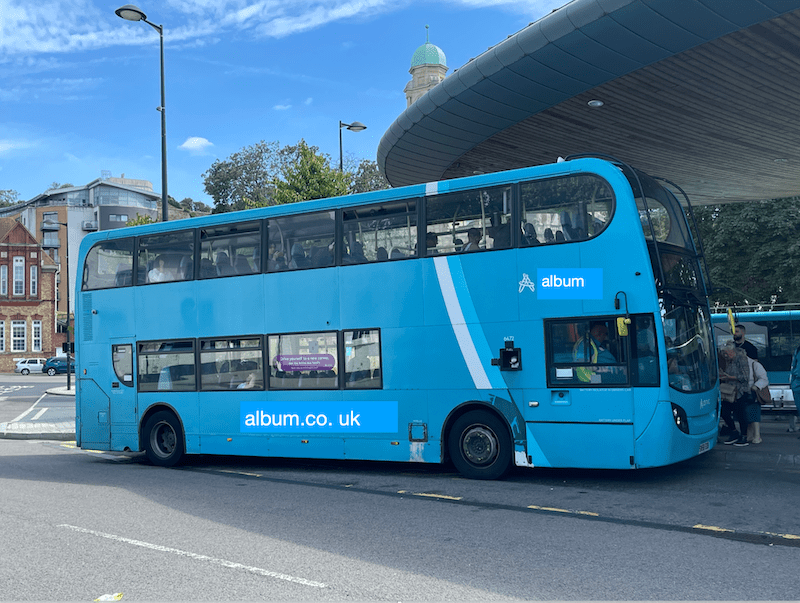
And, then, not bother to look after its presentation in the public eye.
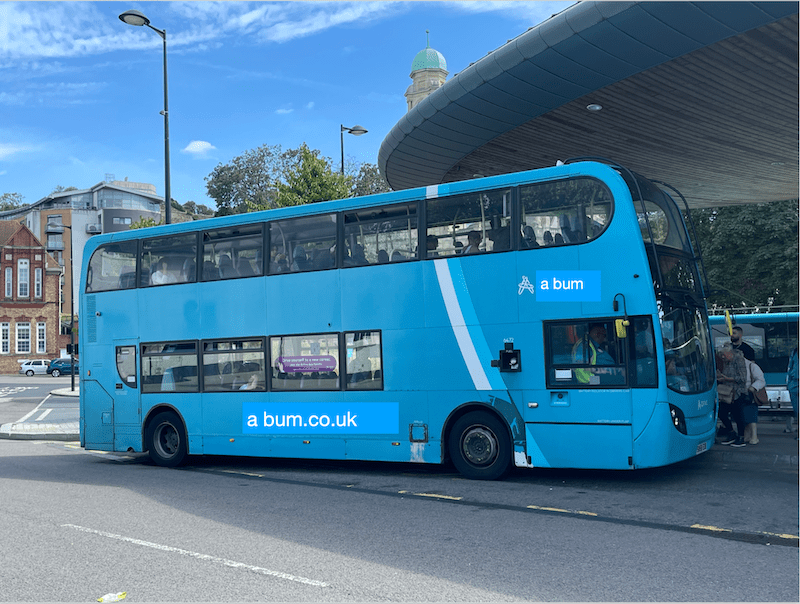
It seemed to go down well with the audience!
Other speakers on Wednesday included Tom Quay, CEO of Passenger the tech company behind the bus industry’s leading websites – the ones I always find the most intuitive to use with timetables, maps, ticket information and news updates all clearly ‘signposted’. Tom explained how one of the company’s latest developments is the ability for users to sign up to relevant ‘Travel alerts’.

I had to leave soon after that but wellbeing of staff, management recruitment, updates on policy and development of electric powered buses were all covered in subsequent presentations yesterday with the day concluding last night with the formal AGM for ALBUM members followed by the Gala Dinner.
I very much enjoyed my 24 hours attendance at the Conference not least sharing thoughts with like minded colleagues with a similar approach to bus operation as I had pursued during my working career. Delegates attending looked as though they all enjoyed it too, and well done to the Nottingham City Transport team for making all the arrangements

Roger French
Blogging timetable: 06:00 TThS


Good blog, especially in highlighting the excellent approach to public transport that Nottingham has followed.
Arriva, First and (to a lesser extent) Stagecoach are, for me as an enthusiast, very bland and unexciting operators, although still hold some interest – if only to see which bits they’ll shed next!
Darryl in Dorset.
LikeLike
Album ( All Lovely British Urban Mobility ?) bus not designed by Ray, come on thats an error , do better. Also for the letter split make sure the name is over a panel join or something where such letter outages do occur or unfortunate spacing for AI … as we know AI timetables as are great
LikeLike
Looking at the last Passenger Focus report , Album members as a group have the most satisfied passengers, followed by Go Ahead who still retain local control. The three other big operators all lag considerably, with Arriva being by far the worst. Greater Manchester and the West Midlands are also poor.
Passengers value local identities and management and I would suggest that this seems to lead to passengers being more satisfied with the driver, a key component of overall satisfaction.
The policies of Stagecoach,First and Arriva to centralise everything are clearly not what the passengers want, and by doubling down on them these companies, led by people who have no understanding of passenger transport, are reducing the appeal of buses.
LikeLike
Public opinion of the major bus operators in the West Midlands has always been low, at least as far back as the 1960s. Positive impressions of past operators only started occurring after they were replaced and the rose tinted glasses effect came into play.
I’m not sure it’s realistically possible to change that.
LikeLike
I feel sad when reading about so many initiatives across the country in these posts. And jealous! Here in west kent the majority of services are run by arriva or stagecoach. There is no coordination, no information in real time at bus stops, no shared ticketing. The only reasonable services are those run by independent companies, Hams Travel, Go coach and Brighton and hove for the bus to Brighton. Maidstone, the county town, has an appalling bus station. Closed for renovation for several months a couple of years ago. Cost to the council I think over a million pounds. Result negligible. Few, uncomfortable seats, no real time information, no staffed information point, no refreshments. Obviously planned by people who never use a bus. Maybe Roger should visit west Kent to expose the failings!
LikeLike
If you picked up a city bus map from the helpful leaflet display at the railway station did you notice that confusingly it doesn’t show the tram routes . . .
LikeLike
The “city bus map” isn’t that, it’s an NCT route map. Not quite the same thing, although NCT’s coverage of the city is fairly comprehensive. If you want an all-operator, multi-modal, map, there are 2 at https://robinhoodnetwork.co.uk/ . Their “Core Services” map is posted in many shelters around the city but I don’t know if either map is currently available as a paper leaflet.
On a different topic, transport policy for the East Midlands Mayoral Authority is currently in limbo as the Conservatives lost both Derbyshire and Nottinghamshire to Reform in the recent elections. At the moment, no one has any idea as to what they would like to see or if they will work constructively with the Mayor and the cities. Transport leads for both authorities won’t be appointed until next week. Bus users await developments nervously.
Jim Froggatt
LikeLike
WE appear to be moving to bus franchising across much of the UK
The following are moving to Franchising
Liverpool City Region
West Yorkshire
South Yorkshire
Cambridge and Peterborough
West Midlands
North East
Bristol and Bath considering it
LikeLike
I forgot Wales, Wales is going down the franchising route and Scotland is also looking at it
LikeLike
our-roadmap-to-bus-reform-march-2025.pdf
LikeLike
Just to add that, on bus franchising, the York & North Yorkshire mayor is also reportedly keen to go in this direction.
LikeLike
What a lot of “trade bodies” there must be lurking in the background away from the eyes of end users: customers and consumers! ALBUM is a new one on me. My first experience of riding a Nottingham City bus was when Maidstone Boroline took over London Route 188 on 19/11/1988. That day I had an extensive Travelcard jaunt: riding through the Rotherhithe Tunnel on a Route P14 single-decker then later on having a Route 188 “binge”: three Ipswich buses (Nos 95,1 & 85) and also Nottingham City Council No 198. On 14/05/1988 I had also ridden Ipswich Buses No 1 in its hometown on a short trip in the Stoke Park vicinity of the Maidenhall Centre.
LikeLike
A bit of news is the Braintree to Stansted serviced is to go 24/7. Stansted has agreed to fund the improved service which will be pretty much the same as the old Arriva service
LikeLike
Of course all the Socialist controlled transport regions (helpfully created by Cameron and Osborne!) are going to jump on the “London-style taking back control bandwagon”, as they have heard the delighted screams of Mancunians finding their bus reliability index has soared from 79.25% to 79.35%. What they haven’t heard yet are the screams from those who have to foot the bill.
I have lived long enough to see the creation of British Railways and the National Bus Company, both of which only managed decline throughout their existence, and to be replaced by changes which saw huge increases in passenger numbers. Much of this depended on who was in charge, and we saw the very best people doing their very best.
Sadly, we never learn from our history.
Terence Uden
LikeLiked by 2 people
Nus services at least in mu view need to be run as a coordinated network and not as in most case at present an uncoordinated mess
LikeLike
Some might wish they were Socialist-controlled rather than having Labour mayors!
LikeLike
Rail travel may have increased post-privatisation (until destroyed by lockdowns), but that was hardly the case with the post-NBC. Just look at the former LCBS empire! Reunited for a few years under Arriva yet they couldn’t manage a system map, printed timetables, or even an all-day ticket?
LikeLike
And in East Kent passenger numbers DOUBLED under Stagecoach ownership…..and as I said, it depended on who was in charge!
Terence Uden
LikeLike
@Terence Uden – I must be living in a parallel universe to you.
Since privatisation and deregulation, bus patronage outside London has continued to fall significantly (while in London, although it has fallen back somewhat more recently, it is still nearly double what it was).
Cherry-picking East Kent to suit your argument merely ignores the overall picture of sustained decline in passenger numbers.
I have posted the stats before, not that long ago, in response to a similar far-fetched claim made by you. I really can’t be bothered to dig them out again just now.
As for British Rail, in my parallel universe, I seem to recall InterCity and Network SouthEast were achieving some success in growing passenger numbers by the early 1990s, but that was sacrificed on a political altar of “private sector good, public sector bad”.
Malc M
LikeLike
To Malc M
You seem to forget that under nationalised/regulated control, the rate of decline was even faster. In the 30 years between 1955 and 1985, passenger numbers halved from 13bn to less than 6. After a fall between 1985 and 1990, numbers stabilised and then began to increase – partly because of London and partly through ENCTS.
People seem to forget that bus patronage was collapsing in the 1960 and 70s, and that subsidy was massively increasing as well.
BW2
LikeLike
@BW2 – no, I didn’t forget the rate of decline under nationalised/regulated control. I was questioning Terence’s assertion that privatisation (and the commercial freedoms that have accompanied it) have been followed by “huge increases in passenger numbers”.
1986 is the point at which things diverge. London remained under regulated control. Since 1986, passenger numbers in London have risen sharply (even when you take into account decline in more recent years). The rest of Britain was released from nationalised/regulated control but, in the rest of Britain, the decline has continued. Pockets which have bucked that trend simply mask deeper decline elsewhere.
Looking through the stats, in the 10 years from 1986 to 1996, passenger numbers in (regulated) London stayed fairly stable. In (deregulated) rest of Britain, they fell by 26%. By 2000, just before the Mayor of London and TfL came into being, ridership in London was up 12% against 1986, the rest of Britain down by 31%.
Looking at 2023/24, ridership in (regulated) London was 60% above what it was in 1985/86. Ridership in the (deregulated) rest of Britain was 51% down. So, if ridership halved in the 30 years pre-deregulation, in the areas where deregulation happened, it has now halved again.
Malc M
LikeLike
You mention 1986 as being the point that London and the provinces diverge and thereby support your view about how regulation must be the reason why London was stable and then grew. This is despite the fact that London had been falling since the 1950s until this point in a regulated world.
The reality is that 1986 was a shock in the provinces and yes, that did result in a step down but ultimately the market stabilised. In London, there wasn’t that impact and there was growth in the capital’s population. However, the fact was that passenger figures were largely static in London until the late 1990s when Ken Livingstone was bold enough to bring in a congestion zone AND massively expand the bus network with a frankly eyewatering amount of subsidy which wasn’t available in the provinces. And this at a time when the population rose from 6.8m in 1991 to 8.2m in 2011. To be blunt, with that population growth and massive investment, it would be incomprehensible if London bus patronage hadn’t grown in that time.
However, we are now seeing a TfL network where bus speeds are so slow that they are becoming both unattractive and grossly inefficient. Moreover, this is something that TfGM is also failing to tackle. Adding in more resource into the network whilst not addressing the issue of congestion is a hopeless equation. Costs go up and revenue continues to fall…but they’re all painted yellow and they’ve “taken back control” so all is good.
BW2
LikeLike
@BW2 – where do I even start with this?
London did not stay largely static until Ken Livingstone and the Congestion Charge. Had you read my previous post, you would have noted that London patronage had already risen by 12% *before* Livingstone was elected to the newly-created position Mayor of London (in 2000, not the late 1990s). The Congestion Charge followed in 2003 (not the late 1990s). In the time pre-Livingstone that regulated London had risen 12%, deregulated rest-of-Britain had dropped 31%.
It is not true that deregulation provided a “shock”, after which passenger numbers stabilised. Again, look at the figures I had already posted (but I will repeat again, in the hope that you might now acknowledge them):
1996: down 26%
2000: down 31%
2023/24: down 51%
Looking at all the years in between, the decline was fairly steady. Yes, there was an initial “shock” at deregulation, a drop of 7%, followed by gentle decline, interrupted by a plateau or two then the decline resumed. By 2018/19, the last full year before Covid, London was +91% compared to 1986, while the rest of the country was at -42%.
Ah yes, you say, but London’s population has increased. Indeed it has. However it has also increased across the rest of the country (again with exceptions, mainly in the North East). You compared 2011 with 1991 for London, and there was indeed a 21% increase in the capital’s population. Over the same time period, there was an increase in 11% across the rest of Britain. Perhaps we should have expected corresponding increases in bus usage there, too, instead of further decline?
Having said all of this, my point remains this. If deregulation was this great success story, isn’t it remarkable that across the deregulated system as a whole, passenger numbers have continued to decline, yet in the one place where deregulation didn’t happen, the decline has been arrested, reversed and some very high growth has been achieved.
Malc M
LikeLike
Well Malc M – I don’t know where you’re getting your figures from or how you are working out your percentages. Mine come from the DfT’s own figures (bus 01) and with regard to the limited nature of figures pre 1982 but here we go.
You seem to have misinterpreted my statement “1986 was a shock in the provinces and yes, that did result in a step down but ultimately the market stabilised.” So here’s the official figures as a percentage change against the previous period:
1985 to 1990 – 20% drop
1990 to 1995 – 9% drop
1995 to 2000 – 6% drop
2000 to 2005 – 11% drop
2005 to 2010 – 7% increase
2010 to 2015 – 5% drop
So as you can see, the figures demonstrate a sharp drop in the period immediately after deregulation, then slower decreases as the market stabilised and even growth (fuelled in part by ENCTS). Those are the official figures so I’m fairly happy in my contention that there was a shock and then a stabilisation. That is true – the official figures demonstrate that.
The second point is regarding London. So I stated that “passenger figures were largely static in London until the late 1990s” so lets again look at the change
1985 to 1990 – 2% increase
1990 to 1995 – 1% increase
1995 to 2000 – 13% increase
2000 to 2005 – 34% increase
2005 to 2010 – 24% increase
2010 to 2015 – 6% increase
So yes, I do take the point that there was a 12% increase (I rounded to the nearest whole). However, it was pretty static before that, AND remember that this is against a backdrop of population growth of over 7% between 1991 and 2001. However, it is also absolutely evident that the period from 2000 to 2010 had much higher increases (relative to the preceding period) and that was undoubtedly due to the measures that Ken Livingstone brought in and the massive amount of investment into the network. I mean, how else do you go from 13% in one period to 34% and not link that to the massive increase in funding during that time?
It is clearly true that the passenger figures were impacted by deregulation, and that obviously didn’t happen in London. The impact of deregulation wasn’t just confined to a few years… It took many years for the ripples to calm as the market consolidated. New vehicle investment that had been confined to minibuses since the mid 1980s only really began to be shown in provincial fleet replacement by the early 1990s. As I alluded to earlier, there was some improvement in the provinces and that is doubtless linked to ENCTS introduction though remember, operators were to be no better and no worse off so limited ability to fund improvements in services and the like. Instead, much has had to be self funding e.g. in Brighton where bus priority improved efficiency and made journey times more attractive so more passengers (and fares) for the same resource… Something London has lost sight of (as has Manchester now)
Oh, and the increase in London’s population is greater and concentrated in a very small geographic, bus friendly area. Easier to capitalise on (pardon the pun). Much more difficult in Rutland where a lower increase is difficult to reflect in bus patronage! Them’s the facts.
BW2
LikeLike
@BW2 – I am using the same DfT figures as you.
As for your final point, in which you contrast London with Rutland, it is worth looking a bit deeper into DfT figures. These show the loss of passengers has been sharpest in the major conurbations, i.e. the former metropolitan counties (passengers down by 63%, comparing 2023/24 with 1985/86), and less sharp in the English shire counties (passengers down by 35% over the same time period).
Malc M
LikeLike
Well Malc M – if we’re talking about the metropolitan areas, we can look at the same figures.
1975 – 13% decline
1980 – 15% decline
1985 – 6% decline
1990 – 33% decline
1995 – 2% decline
2000 – 11% decline
2005 – 13% decline
2010 – 1% increase
Again, as with all figures, they need to have context. The declines pre 1985 are in line with the general decline in bus travel during this time. There was also a period of decline in traditional industries and depopulation in certain areas (notably Merseyside). 1986 was again an earthquake and passenger figures took an even bigger hit though this was perhaps not surprising as fares increased to sustainable levels – even in 1986, you couldn’t run a bus round Sheffield on a mix of 10p and 2p fares without massive subsidy and with a freeze of bus fare increases for EIGHT years. Given that fares increasing markedly at a time of great change resulted in patronage decreasing.
Bus patronage is also influenced by changes in other public transport with some of the Manchester Metrolink developments directly impacting patronage there (abstraction that Mr Burnham always conveniently forgot when quoting bus patronage decline) and the same can be said of improvements in local rail similarly impacting bus usage.
BW2
LikeLike
Thanks for this report, Roger. And well done for capturing the slide presentations so that they are easy to read. Some very interesting messages there.
I hope that the attendees were in a position to sit up and take notice of the fundamental changes that are needed in many of their operating companies.
Peter Murnaghan
LikeLiked by 1 person
It is interesting to note that recently Transport for West Midlands over the last three months undertook a major public consultation about the current moronic brain dead Mayor of West Midlands Combined Authority; Richard Parker from Bristol who doesn’t even live in West Midlands County; plans for bus franchising with West Midlands Bus.
Just 3600 responses were given from 2.9m residents.
As a footnote his predecessor before he lost office in May 2024 aunched a major investigtive report on the options for West Midlands Bus that examined bus franchising amongst other options & was due to report in July 2024.
The report examined ALL options including franchising on the future of West Midlands Bus- No option was ruled out.
LikeLike
Just an aside from the recent discussion we had about the idiot Liberal Party & its ridiculous idea of banning loud music on buses.
The vehicle I am on the way to visit a client is equipped with a radio & Greatest Hits Radio is blasting out around the bus from the inbuilt speakers making a total farce of the wet wooly loving sandals with socks Liberal Party proposals.
There is nothing like the great Depeche Mode blasting out its seminal classic I Just Can’t Get Enough; ironic given my opinion of Diamond Bus in West Midlands County & an excellent round of Popmaster with the legendary Ken Bruce onboard………..
LikeLike
Troll!
LikeLike
To be honest I am more of a synth pop lad myself with Depeche Mode or a/ha blasting out in preference to Jethro Troll and that woolly kind of inept Liberal Party music. Jethro Troll conjures up the perfect image of unkept beards, tofu, green salads & sandals with socks doesn’t it ?
LikeLike
Tell us what you really think of him, Richard, why not?
I’m sure your hatred of him has little to do with his policies (of which I know nothing) and everything to do with the fact that your beloved candidate lost the election.
LikeLike
I make no apologies to standing by my friends whoever they may be.
LikeLike
Very useful piece and only a little tongue in cheek! I did like the Album bus though.
As a Nottinghamshire resident, the biggest concern at the moment is the forced changes to local government and it’s affect on public transport. Replacing the current two tier system with single councils – like Bedfordshire and others. This is being done primarily to hide the debts incurred by Nottingham City Council over the last few years. Sorting the mess out will leave very little for public transport I fear.
What is always missed is that buses need a thriving economy to ensure demand – Nottingham’s buses do well because the city is a positive place to go. Compare with Mansfield or Worksop where the economy is in free fall and so you get less of a bus service. You need to create a demand but make sure it is not met by extra cars on the roads.
Richard Warwick
LikeLike
Following on from Richard’s comments, the presentation given by TfWM to Coventry City Council’s elected members back in February makes interesting reading. I do feel that the chosen option had already been chosen before the results of the public consultation were known however.
(Link to Oxford and Chiltern Bus Page as had previously sent it there for inclusion in last week’s edition. Was the quickest way for me to retrieve it!)
https://www.oxford-chiltern-bus-page.co.uk/Presentation.pdf
LikeLike
It seems all Mayors get some form of ego kick out of taking control of buses . I’m hoping living near Warrington that Warringtons Own buses keeps out of being controlled by Steve Rotherham or Andy Burnham but worryingly all their new buses are black and yellow . A big shout out to whoever oversees their website and especially timetables which are excellent .
LikeLike
Worryingly, the Mayors seem to fail to mention to their electorate the fact that those nasty, greedy and profit driven bus companies they wish to bring under “local control” stand to make even greater profits should they successfully gain a franchise tranche or two. All paid for out of the public purse with no revenue risk to the operator. Why didn’t Andy Burnham just municipalise the bus operation?
LikeLike
One minor note is that Strata is the model name, the supplier is Mellor (on a Merc Sprinter base). Likewise the e-Jest is built by Karsan.
Dwarfer
LikeLike
Out of interest was the conference male dominated ? I only make the point as an observation as there are many women in top management positions in the big groups and within TfL. I wonder if that is because they are more interested in pursuing corporate careers as many have come from other industries and the big groups offer these positions. Indeed I think Roger alluded that. My impression with ALBUM Members is that most are passionate bus people only interested in delivering a high quality product and from what Roger has said that seems to be the case. In no way is this meant as a sexist remark and many may question why I posed it but I think it is nevertheless worth making the point. Others of course may disagree.
Martin W
LikeLike
I was in Bath this week, and noticed the city services are operated in a smart two tone blue livery with “Bath City” fleet names and a “Serving our great city of Bath”. What a shame if this is all swept away by the new First Bus corporate purple.
Peter Brown
LikeLike
I agree. The livery was a vague throwback to the days of Bath’s trams and then they waited until most of the Bath city fleet was nicely reliveried and then scrapped it, likewise the return of Badgerline to Weston-Super-Mare.
LikeLike
Keith, I’ve always thought a wider roll out of Badgerline livery across the West of England company would have been a huge public relations coup as many people (the general public) fondly remember that company.
Peter Brown
LikeLike
Fully agree & I very proudly did my accountancy training at Badgerline Holdings a very long time ago.
LikeLike
Totally agree. My roots are west Wiltshire. I still have a Badger Family children’s book!
LikeLike
I went on one of the Yutong buses in Bristol the other day. One nice touch. Just above the front windscreen, left side and facing inwards, is a small display showing the temperature in the bus and the temperature outside. (CH, Oxford)
LikeLike
Another informative & interesting blog Roger. I can relate to your comments about the Go-Ahead group as I’m lucky enough to live in an area served by Go South Coast. Yesterday my wife & I travelled from Ringwood to Wilton House via Morebus X3 & Salisbury Reds PR3. Each journey was on time & we were greeted pleasantly by knowledgeable & helpful drivers. The buses were clean & comfortable & included Wi-Fi & charging points. A credit to all concerned.
LikeLike
To compare rail subsidies with bus subsidies is not comparing like-for-like. Buses operate on roads which are paid for through taxation (i.e. subsidised), but that does not show up in the figures for bus. Rail costs, on the other hand, include the infrastructure. Were buses to be charged their share of road costs, the figures might look quite different.
The slide showing TfL’s funding is also open to misinterpretation (including wilful). That slide is not a subsidy to TfL’s bus system alone. It is for all TfL activity – capital investment as well as day-to-day revenue support, all modes, not just buses. Note that it even says on the slide, “all modes”. Capital investment includes such things as the upgrades to Underground infrastructure, major items including the signalling system as well as station upgrades (including installing lifts to provide more stations with step-free access). Day to day revenue support includes managing and maintaining London’s strategic road network (the “red routes”) – unless I am mistaken, income from motorists through charges such as Congestion Charge and ULEZ goes nowhere near covering those costs.
Malc M
LikeLike
Stating that locally based, locally managed, locally determined, locally controlled bus networks are thriving may be true in many cases. But not all.
In the last three years, we have seen the sudden demise of locally based, locally managed, locally determined, locally controlled Yellow Buses in Bournemouth and only a few weeks ago locally based, locally managed, locally determined, locally controlled Hulley’s in Derbyshire.
Malc M
LikeLike
Bournemouth was previously wrecked by useless French management, the MBO had no chance as More had the upper hand by then and the tge MBO were left with a poison chalice.
Hulleys, unfortunately purchased by a well meaning but under resourced individual who tried to expand the business. Any large operator would have closed it down 5 years ago
LikeLike
To BW2 without going over all of the writings of the like of Journal of Transport Economics and similar in the UK (well lets stick with England and a lesser extent, Wales) There were quite a few fundamental background reasons why Passenger Revenue ( not always the same as Passenger Journeys ) was not keeping pace with costs ( inbuilt cost pressures from inflation and real terms wages rises ) along with unreliability of bus services – indeed the whole of supply side economics is far less written about BET bus services were private (along with a fair proportion of other bus services – OK in the North East . Barton in the Nottingham (!) area , Delaine on its regulated monopoly being notable larger ones . But even BET saw that profits were megre and the impact of the PTEs would take much of the urban profits the company had hence its sale to the NBC out of the British Transport Commission. NBC would be bound by Capital Expenditure limits and limits to what Local (inc Garage) commercial managers could do. Oddly areas which had fairly robust bus usage (evening Cinema services as TV took over leisure excepted) were co-ordinated = Bournmouth, Portsmouth and Brighton , areas which had a level of economic stability as the mining and industrial parts of England and Wales crashed. But NBC were forward to trying new ideas and the 1984 onward minibus revolution was driven by NBC experiments , which led to much of decoupling of the cost of central works to supply contracts from manufacturers instead.
Our economic thinking became that competition for the market rather than competition in the market was best for road passenger transport and this given some of the spectacular failures of deregulation probably was true. However franchising as London Buses found was not perfect with failures of Harris Bus, Maidstone Boro Line , Mitcham Belle, Limebourne , Atlas Bus and lately Sullivan meaning that contract payments failed to ensure sustainability – in part some of that instability was labour issues – strikes or non availability. Franchising seems better where the contract issuer is providing the vehicles.
I would still argue that the whole system of moving people needs change. A single national driver licence for Taxi, PHV and PCV drivers graduated by size/ carrying capacity of vehicle and a national licence for Taxi , PHV and PCV operators and fitness of vehicles, with for Taxi local route / area competence licence conditions – if it can be done for security staff I cannot see why it should not apply to vehicle drivers and could allow for better flexible transport at the end of the day for people who need, or want , to travel
Our desire to integrate disabled persons into mainstream transport provision I feel has increased costs to operators and passengers with some increases in journey times and lack of space without increased frequencies on bus corridors and as it is such disabled capacity is fairly small anyway (2 max wheelchairs) so is there a better way – and should it be financed by “social services” rather than the bus operators fares revenue ?
Road space management has been talked about for years but our new towns – Milton Keynes and so on were not built around how bus can connect areas efficiently , that must change where new build happens in the future .
Bus vs Train. The South Wales Metro may be all well and good but the express bus network if marketed and run a 10min intervals surely could deliver more for far less money ?
JBC Prestatyn
LikeLike
Looking at Coventry. Are Concessionary Fares contributions an operator subsidy ( so if operators charged commercial fares would they get less total revenue from that passenger segment ? ). Or should they be taken as a fares payment made to an operator
There is some complaint that TWM is the main operator in the area – but was this not a consequence of how WMPTE was privatised as a single lump ?
LikeLike
The principle behind Concessionary Fares reimbursement is that operators should be no better and no worse off … so if the adult single fare is £3, the operator should receive £3.
However, there us an accepted “generation factor” used, which discounts this by 30%; so the operator should receive about £2.25. [This assumes that pass holders will travel more often compared to paying a fare … the calculation of this is arcane, and dates back to at least 1986!].
However … in practice, because of local authority funding strictures, the discount is normally around 50%, and in some cases even more! The amount received is therefore very much lower than “no better and no worse off”.
It is definitely NOT a subsidy … it is a reimbursement for revenue foregone. Imagine going into a shop and saying “I want a loaf, but I’ll only pay half”!! That’s the parallel …..
LikeLiked by 1 person
Well said. The last line sums the situation up succinctly.
LikeLike
Thank you greenline727 for the insight on the reimbursements towards operators. I’m often curious where I live out in the provinces (and there is a large number of elderly bus passengers) how and what bus companies do get paid from concessionary passes, since whole busloads can be just that with a few full fare paying passengers. Surely it should be a case that all riders should pay something, even if it is a half or quarter fare for concessions to make up the shortfall, rather than being entirely free? After all, completely free travel has to be funded from somewhere and rather robbing Peter to pay Paul, the more you hike up fares and cut services for paying passengers, the more likely they’ll want to switch to other methods of transport.
LikeLike
Its was and remembering of course that WMPTE was in existence for a few years before the Coventry municipal fleet was absorbed. It wasn’t a popular move with the public when this happened in 1974.
Stagecoach have made some small inroads into tendered work within Coventry, some standalone services, others evening journeys on NX routes and these are operated from their Nuneaton depot. This has seen the return of double deckers to Nuneaton’s allocation (albeit only 3) for the first time for over 25 years.
Also considering their small number of tendered services around Solihull, they must surely be one of the most significant contenders for TfWM early franchises as this looks like it will include Solihull and Coventry. This will be in addition to their services from Leicester, Nuneaton, Rugby and Leamington/Stratford of course which will be operated under permit within the new regime.
I have read that Stagecoach’s Coventry tendered services will be excluded from the initial franchise for a while once it commences.
LikeLike
Roger, your presentation was one of the highlights of the conference for me. The quality, delivery, and energy were all very refreshing, and I was particularly impressed by your passion.
As someone who is new to the industry, I felt grateful to have found such a fantastic resource. Thank you for elevating the quality of the information presented at Album.
Marcus from INIT
LikeLiked by 1 person
Thanks so much Marcus, that’s very kind of you and much appreciated. Glad you liked it.
LikeLike
Because concessionary fare payments reduced to such a low % of adult fare operators have had to increase adult fares to make up the shortfall , which has deterred adult passengers and led to further deterioration of the network.
The calculation of generation has been a conspiracy between highly paid consultants and the Dft for many years, and as the reduction in Concessionary journeys after COVID has shown, the calculations were complete rubbish. The Dft cling to their calculator because it saves them circa £200/£300 million
LikeLiked by 1 person
Why did the people who run the ALBUM conference invite people who effectively said “We want to nationalise your business, take away everything you have, and outlaw your entire business model just so that you cannot start from anew, all because we hate you, want you dead, and think it’s funny.”??? Seems counter-productive to invite such anti-free enterprise ‘scum’ to a conference of which the majority of members are utilising the ‘free market’ to their advantage!?
LikeLike