Tuesday 29th April 2025
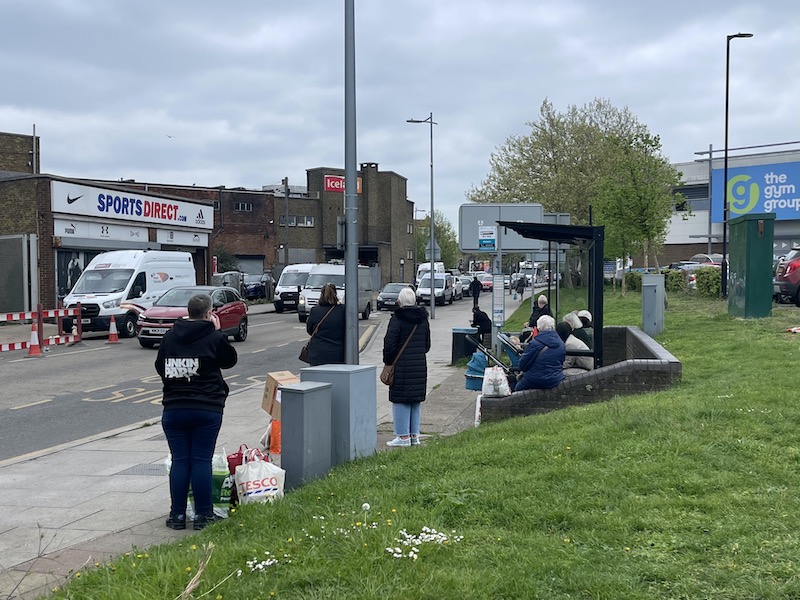
Aside from people blasting out music and conversations on their phones (see Saturday’s blog), another annoyance travelling by bus these days is the impact of roadworks, whether it’s a gruelling slow journey when on board due to consequential traffic queues or waiting in vain for a late running bus caught up in delays.
A blog reader who works for a bus company in the Medway area contacted me last week to highlight the severe impact roadworks in Strood were having on bus routes throughout the region. He explained “at peak since last Thursday, it’s been taken an average of 60 minutes, if not more, to get between the two towns” of Chatham and Strood via Rochester Bridge, ominously adding, “a record breaker was 142 minutes late to Bluewater on route 700”.
This level of disruption sounded almost dystopian in its impact so last Thursday morning I took a look on Google maps to see if I could pinpoint where the blockage was occurring and set off over to Medway to investigate in a BusAndTrainUser Verify special investigation.
As you can see, it wasn’t hard to see the likely point of contention…

… with extended red lines indicating the level of severe congestion either side of the blockage.
Google Streetview shows it as a short stretch of two-lane, one-way section of the A2 Commercial Road alongside a retail park.

I took a train over to Strood railway station, located just north of the A2 and west of Rochester Bridge, and wandered down to the scene and sure enough, at around 11:00 last Wednesday morning, traffic was backed up as far as the eye could see over Rochester Bridge…

… and, there, on Commercial Road was the tell-tale sign of a blockage ahead.
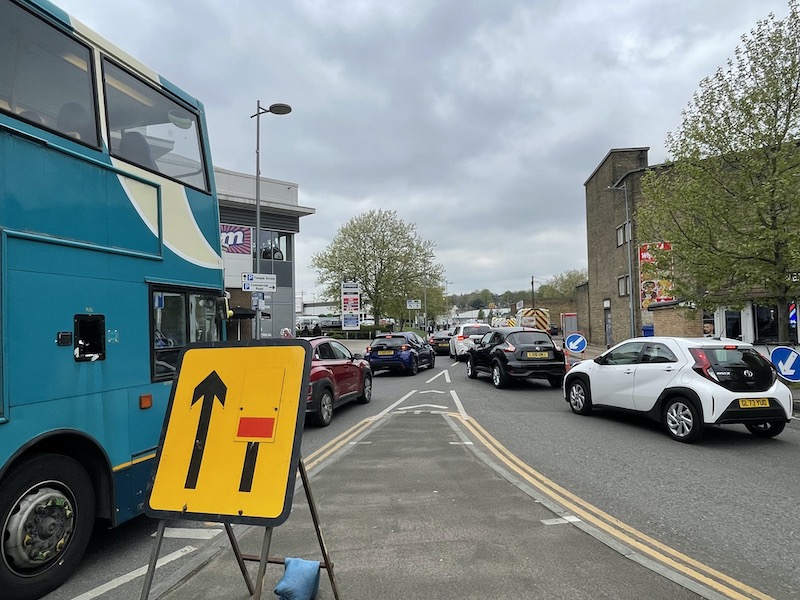
Right opposite the retail park, one of the two lanes was conned off to allow three UK Power Network vans to park…


… and protect a trench that had been dug on the footpath…

… and into the building alongside (an Iceland store)…
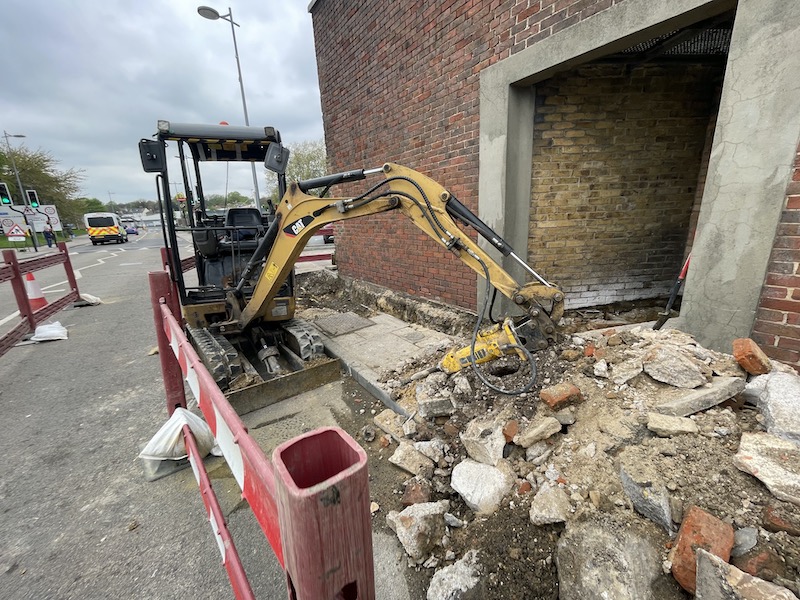
… and allow the footpath to use the conned off lane.
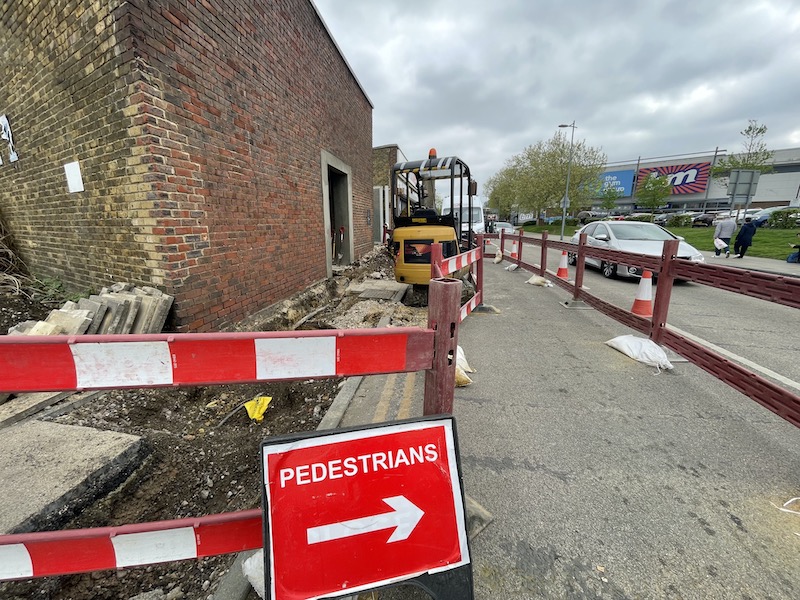
Commercial Road was therefore down to one lane and as you can see from one of the photos above, just beyond the blockage the road is completely clear. You’ll also see there’s a set of pedestrian lights, and they, in my assessment were exacerbating the problem.

Although the road reverts to two flowing lanes just beyond these lights, the problem was not only the road capacity leading up to them being halved, but every few minutes a pedestrian brings the reduced traffic flow to a halt so they can cross the road.
Meanwhile bus passengers waiting patiently at the busy bus stop right opposite the trench stand and wait in frustration.

All the more so as pedestrians wanting to cross the road can do so at the traffic lights (with a pedestrian phase) at the road junction at the eastern end of Commercial Road a few yards beyond the b&m store and tree shown in the above photo.
I’m not a traffic flow expert, but I suspect turning these pedestrian crossing lights off for the duration of the works would make a dramatic difference to the thousands of bus passengers and motorists caught up in this hiatus.
To see just how severe the impact was, I took a walk to the end of the traffic queue, and this was around 11:15 on a Wednesday morning, so hardly peak travel time. It was a lovely walk over Rochester Bridge with fine views of the River Medway…
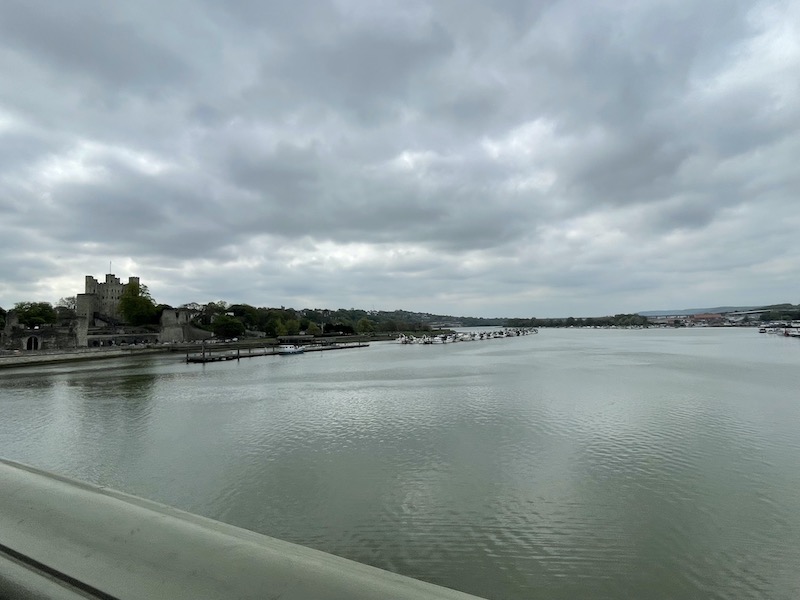
… and I passed many buses heading west along the way…

… including one on Arriva’s route 700 (every 20 minutes Chatham to Bluewater) which was 15 minutes behind schedule and had at least five or six more minutes queuing to go…

… and many more buses behind that.
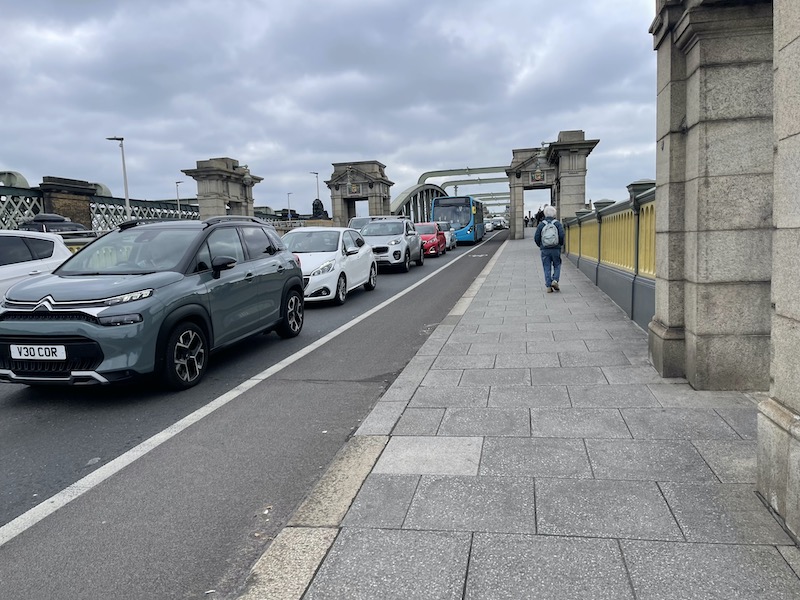
It’s a busy stretch of road for buses with 18/19 an hour.

Arriving on the eastern side of the Bridge I found a short stretch of bus lane and not far beyond that the queue finally petered out.

It had taken eight minutes and 45 seconds to walk the 900 metres (984 yards).

After a short break exploring and enjoying Rochester’s historic High Street I wandered back to the A2 and waited for a bus to see how long it would take to reach the blockage. A bus on Arriva’s route 190 (every 20 minutes Chatham to Gravesend) soon arrived and, impressively, was on time. It was 11:38 and we hit the end of the queue at 11:40.

It was tantalisingly close to the beginning of that bus lane but it took two minutes just to get into it.

But it was a great help…
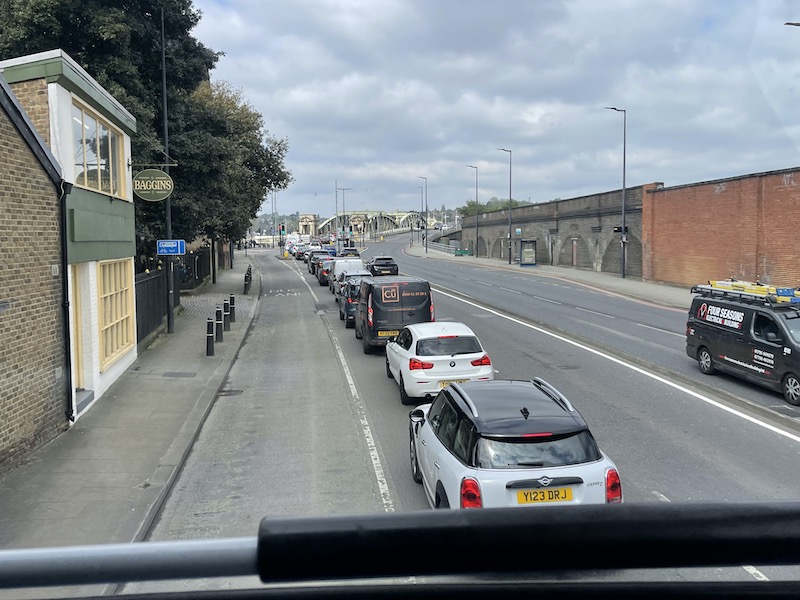
… in reaching the Bridge in only another 30 seconds, so now being just two and a half minutes since joining the queue.

But sadly that was the end of the bus lane bonus.

It was then a painfully slow crawl over the Bridge. I noticed how traffic in the offside lane was moving slightly faster, mainly because it wasn’t impeded by the blockage as traffic in it was turning right at one of the upcoming junctions, although inevitably I noticed motorists using that to gain progress and then cutting back into the nearside lane.
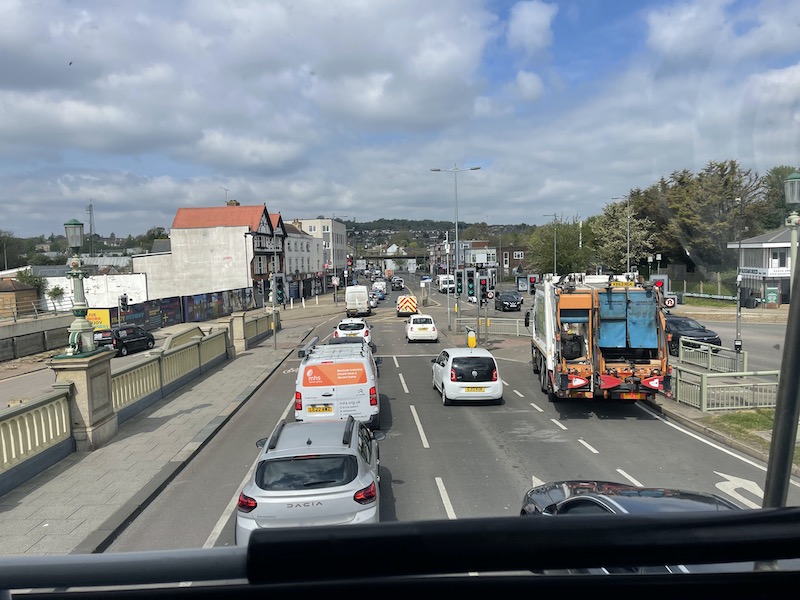
The minutes were ticking by and eventually the end of the queue was in sight, having been joined from the previous junction by a ex London bus operated by Nu-Venture o route 172.
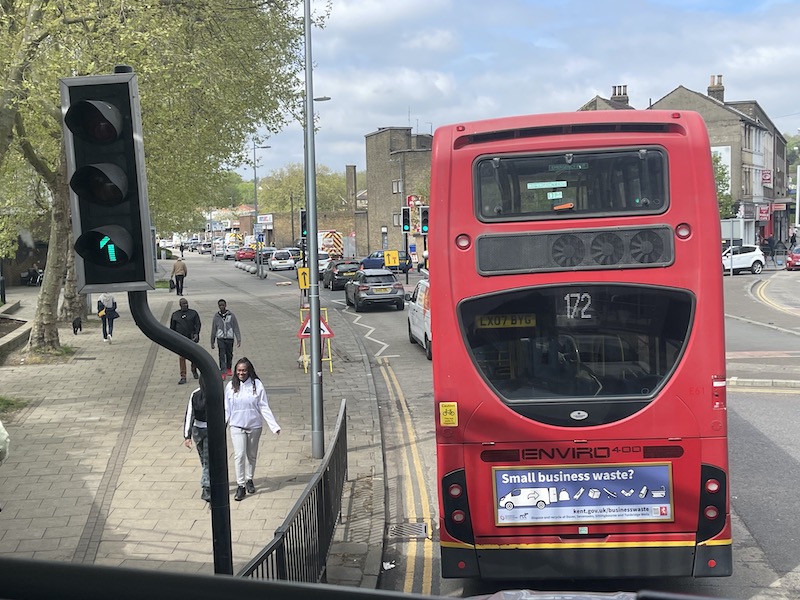
The second set of lights by the tree in the above photo is where I mentioned earlier pedestrians could cross if that other crossing by the trench was discontinued, so you can see it’s not far away from those.

At last we were nearing the end…

… but first those pedestrian crossing lights were on red…

… and as we waited while one person crossed the road, I noticed two of the three UK Power Networks vans had now gone, and the third had the digger seen in earlier photos, now on a trailer, and also ready to leave.
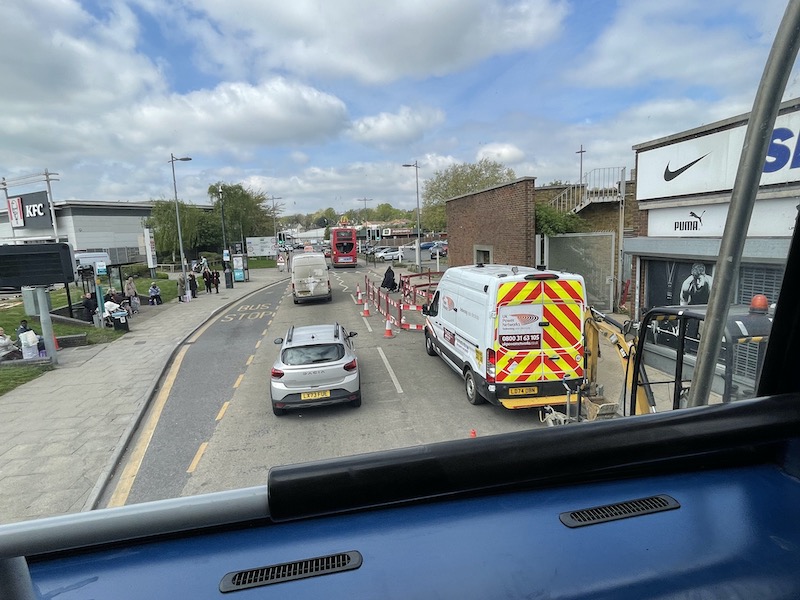
And, from my birds eye view from the top deck, I could see the trench and, yes, there was in fact no impediment to the roadway at all, other than that diversion to the footpath.

And no-one working on site either.
I couldn’t help think a judicious closure of the footpath (so it didn’t need diverting) and those pedestrian crossing lights being taken out of action would make a huge difference to the delays and impact of these works. And that would be appreciated by the thousands of road users affected including bus passengers across all of Medway and the surrounding area.
It had taken the bus I was on 21 minutes to travel that 900 metres. I walked it in less than half the time, giving you a sense of the frustration..

Where are the people responsible for highways in Medway in all this? I’m sure their powers over utility companies are limited but if they were more pro-active and UK Power Networks were more astute at helping to keep traffic flowing, this disruption could be much reduced, if not eliminated completely, particularly while no actual works are taking place when barriers could be moved and signs adjusted.
Where there’s a will, there’s a way.
And the sad thing is, this is typical of what’s happening all over the country.
And don’t get me started on the over-provision of temporary traffic lights these days.

Roger French
Blogging timetable: 06:00 TThS
 BusAndTrainUser
The other scurge of roadworks is the irresponsible closing of bus stops when no work is being carried out. In Hertfordshire this frequently occurs without provision of a temporary stop. Most bus drivers use common sense and serve the closed stop if it is safe to do so, but there is always the “jobsworth” Who won’t do so.
John
LikeLiked by 1 person
If an accident occurs the driver could potentially lose their job. Protecting their job isn’t being a jobsworth. If the stop is closed then passengers aren’t covered to be alighting/boarding. Try being a bus driver and you’ll realise it’s not as simple.
LikeLike
They are deservedly called a jobsworth if they fail to stop at a ‘closed’ bus stop that has no obstructions to it. There has been numerous occasions when a bus stop has remained ‘closed’ long after the roadworks have been cleared, or even before the roadworks have even started.
LikeLike
You said it yourself. It’s CLOSED. You don’t board a train at a closed railway station why should buses be any different. Arrogant and selfish passengers like you are the one of the reasons bus drivers are leaving the role in droves.
LikeLike
I’m going to presume you might be one of those bus drivers that hates passengers.
LikeLike
“If the stop is closed then passengers aren’t covered to be alighting/boarding.”
This is just cack and an urban myth I’m afraid – buses are road vehicles just like any other and can stop where they like in a safe place. Obviously if you’re running a local service you need to be aiming for the stops but stopping to let someone off away from one or at one with a closed hat on is not going to invalidate the company’s insurance.
LikeLike
Not sure that I see much empathy for pedestrians in this one. They may be elderly or have heavy shopping. They may even want to catch a bus! I agree that the temporary footpath in the road seems a bit wrongheaded, and perhaps a temporary zebra crossing could be installed in its place, so that they could get across to safety. But pedestrians need all the help they can get, and it is good when this is remembered.
Martin
LikeLiked by 3 people
Indeed.
How about a “judicious closure” of the road to cars for the duration of the works? That would solve the traffic congestion issue nicely, and it would do so without making it difficult for the bus companies’ customers to get to the bus stops.
The attitude shows that Roger is a car driver who uses public transport at times rather than someone who uses public transport at all times.
LikeLike
We work quite pro-actively with the passenger transport and streetworks teams at our main LA, so temporary bus stops tend to get done right, but there are still too many sets of roadworks which all seem to take an eternity to complete. Informing the public what is occurring is often the biggest issue, as changes happen so frequently and with little notice. AG.
LikeLike
All roadworks are normally published on this web site Causeway one.network
LikeLiked by 1 person
In the old days, when I was very small, policemen and AA men would direct the traffic when necessary.
LikeLike
The volume of roadworks, particularly by our failing utilities trying to repair their crumbling infrastructure, is on the increase.
Local authorities, having had to make continual cuts over the past 15 years often no longer have the expertise or resources to manage the work. And they only have limited powers anyway.
Finally, contractors are becoming more and more risk averse with traffic management, examples being the proliferation of 3-, 4- and even 5-way lights and lane closures when works are entirely on a pavement.
Steve
LikeLiked by 1 person
Agreed here in the north west. In the past the main road between Macclesfield and Congleton has been closed for about 100metres and the 38 bus service (the old North Western 24) diverted miles away via Monks Heath thus leaving 7 miles of road with no bus service for days. Usually no signs on the bus stops either to say service suspended. A total don’t care attitude.
LikeLike
Roger
How appropriate was your 0600 post when just two hours later I was held at 3-way temporary lights in central Gloucester, stuck on red for inbound traffic. No one was manually working the signals at 0800 nor did there seem to be any work going on.
Take a look at the Traffic Management Act 2004 which legislated for every roads authority to appoint a traffic manager to oversee these things. Up until I retired in 2011, the designated officer at Gloucestershire was very supportive to keeping bus routes moving, even though he’d had the task added to other duties. He attended regular meetings with Stagecoach and the Council’s Transport Unit where we were able to discuss forthcoming road works and closures.
Having said that, the onus is also on bus companies to have employees with time in their workload to monitor delays, put pressure on local authorities, and implement temporary timetables or extra vehicles in extreme cases. And to review the long-established linking of routes where a delay on one is knocked-on to another. Plus of course it’s the hard-pressed bus driver who takes the rap from inconvenienced passengers, and front-line depot staff who valiantly attempt to patch up late driver change-overs and missing journeys.
Sholto Thomas
LikeLiked by 2 people
I recall a very similar situation to this in Evesham the other year. The diversion of the foot way leading to temporary lights which caused huge queues – my bus was 40 minutes late.
It does seem that utility companies go over-board with these pavement closures and diversions. As a pedestrian I’m always having to divert off the pavement because of cars parked in such a way that I cannot get past. Nobody does anything about that or worries about me taking risks to walk in the road around the obstruction.
Richard Warwick
LikeLike
“a judicious closure of the footpath” – so we solve the problem of too many vehicles by making life more difficult for people not using them.
How judicious is that!
LikeLiked by 1 person
Welcome to Strood! It was like that 50 years ago when I was catching buses to and from school. Fridays were worst as all the now long gone factories in the area closed early, and buses would regularly be 30 – 40 mins late. Strood has always been a bottleneck, with or without roadworks, and no one has yet to come up with a solution.
LikeLike
One has to wonder why there is so much traffic at 11am on a weekday. Most car journeys are around two miles, an easy cycle ride for able bodied adults, and if there was a network of proper cycle lanes, and traffic calmed residential streets a huge amount of car journeys could be removed. This would free up space for buses and commercial traffic, and collectively everyone would be better off. I’m just hoping Active Travel England can prevail and start the long and slow process to end this madness.
https://www.activetravelengland.gov.uk/
I say this as someone who has just walked into my town centre (25 minutes) along peaceful residential streets, did my errands, and walked home. So that’s my steps done for the day.
Peter Brown
LikeLike
Coned off rather than conned off.
LikeLike
I reply to the anonymous bus driver who replied to my original post.
No sensible person would expect a bus driver to stop in a dangerous location. My point referred to the closed stops before works have started or covers haven’t been removed after the finish and even on occasions when no work is carried out. I assume this driver has access to a car so he can travel to his shifts. Try being a passenger, without a car, who turns up for his bus at a critical time for an important appointment only to see his bus sweep past a safe stop leaving him to miss his appointment or be late for work.
John
LikeLike
Maybe the passenger should go to a stop that’s open, rather than wait at one that’s got a closed sign on it.
LikeLike
Or maybe just maybe…. The contractors should take down the closed bus stop covers! Not really rocket science
LikeLike
Closing the pedestrian crossing on the main desire line would have likely worsened the congestion, as the closest alternative crossing is a set of zebras 100 yards or so to the west.
LikeLike
much the same in the north west. In previous years a hundred metres of road works closed the main road between Macclesfield and Congleton. The diversion was via Monks Heath and the A34, leaving the bus service no. 38 (old North Western 24) leaving out 7 miles worth of stops for days and no notice on the stops. A real don’t care attitude.
LikeLike
Presumably roadworks for ‘bus priority measures’ are the right sort of disruption?
Two miles in, say, Huddersfield, are not the same as two miles in,say, Cambridge!
Terry Ough
LikeLike
In Colchester they have spent several years building a bus lane which is way over budget and still not complete
LikeLike
This is sad tale: sad in its own right because it demonstrates such stupidity and bloody mindedness by the contractors …. but also sad because it’s so very typical of what happens all over the country every day. Thus, I’ve come to the conclusion that there must be a deliberate policy somewhere with says the 1st rule of working anywhere near a road is to ensure maximise disruption to passing traffic. I also expect there’s a secret annual awards ceremony at which the most successful disruptors are rewarded for their efforts. Britain broken by its incompetence!!
LikeLike
Calls for a return of Messrs Salvage and Holloway, the scourge of utility companies.
LikeLike
Maybe if there is no solution to this in the foreseeable future, then we need to think about making bus routes shorter to prevent delays cascading across counties. But it would need decent planning. Proper accessible interchanges, through tickets, and an effort to maintain connections when there are no roadworks. CH, Oxford
LikeLike
Here in Harrogate a particularly interesting recent set of roadworks closed the main A61 heading north from the town for an indicated 6 weeks. Harrogate Bus Co rejigged the timetables for the local services (which interwork), reducing our local service from every 20 mins to every 30. However, the other services on their diversion route near where we live picked up & set down at all stops meaning we actually had 8 per hour! We were most disappointed when the roadworks came to an end, sadly in less time than scheduled.
John
LikeLike
With the trench like that I dont think UKPN could really make the road wider . They are pretty good and it looks like the jointing team have done most of the work hence they have left site. With the digger unit out the way the reinstatement team may even arrive in the afternoon for first fill of appropriate agreggate – probably with a 8 legger to hiab away the arisings and deliver a couple of bags of material to lay in first protective layer , depending on agreed hours of work the first concreting if not done in the evening would start around 8am day following , leave to harden off up to two days then a final tarmac to whatever existing highway finish and decommission site protection, so of course annoying and yes the idea that highway authority should give input into other nearby traffic delay events like change the lights should be a good idea I dont think it is up to UKPN specifically to suggest or arrange that.
JBC Prestatyn
LikeLiked by 1 person
I accept roadworks need to be done, and they will be an inconvenience. But it’s the bad management which really annoys me.
For example, there are occasions when the roadworks have been completed, but the lights have remained in place for sometimes days, waiting to be dismantled. It appears there are different contractors for different things which adds to the bad management.
AMB
Canterbury
LikeLike
Music to listen to* when on the bus stuck in traffic.
1. The Bus Song – The Association
2. Magic Bus – The Who
3. Day In The Life – The Beatles
LikeLike
Hi Roger
I suspect things might have changed since I was an electricity board surveyor, but when the StreetWorks Act 1991 came in, it had a massive impact on utlilities, mainly on the reinstatement which was required to be done the same day (a good thing) as we weren’t allowed to leave ‘holes’ open overnight, but also the huge amount of barriers etc we had to use.
Unless it was emergency works (i.e. power failure/damage after a traffic accident) then all works had to be planned in advance, and the council notified.
In the area I worked in, they could (and did) ban works at certain times of day (e.g. the peak) or force you to do it at weekends.
Certainly, looking at the photos, I agree that the pedestrian crossing should have been put out of use.
However, there is a requirement to barrier off the road to provide for a pedestrian alternative if the footpath is up – that’s non negotiable.
It’s all about working together and co-ordinating. Back in my day (three decades ago now) the local councils – then as now with limited resources – didn’t proactively engage. This was at a time when cable TV networks were being laid.
Of course, now we have a lot more technology to make it easier.
But, like a bad special train plan on the railway, it’s easier sometimes just to let it go ahead, knowing it will go wrong, and that someone on the ground will have to sort the mess out!
Rant over!
Mel
LikeLiked by 1 person
As mentioned above, the provision of temporary traffic lights and other traffic management is frequently handled by a separate contractor to those undertaking the works in the highway.
Last Sunday, the A286 Haslemere Road at Milford in Surrey was under temporary traffic light control yet the closed section of carriageway showed no evidence of current or completed works. The adjoining footway had recently been resurfaced but pedestrians were not being diverted on to the closed sections of carriageway.
The only solution would be to implement a penalty charge (lane rental) that incentivises those undertaking works in the highway to minimises their period of obstruction.
The bus industry needs make much more noise about those factors that disrupt punctual operation, that are outside of the operators control, and encourage the support of their customers who are equally inconvenienced.
LikeLike
Was there any publicity? – (A) for car/lorry drivers who would probably divert if they could, and would benefit from notices well before the date of the roadworks, and at locations up to a few miles before them (especially at junctions where a good diversionary route is available to longer-distance traffic); and (B) for bus passengers to let them know, in advance, of likely delays, and any timetable changes: these should be on all bus-stops of routes affected, and especially down-stream of the road-works.
Roadworks are a major problem for buses and bus-passengers, and this must affect general usage. My local 402 route from Tunbridge Wells to Sevenoaks seems particularly susceptible to roadworks, and there is usually no warning, apart from the local grapevine. If I need to make a particular connection, or get to an appointment, I have to aim for a bus half an hour ahead: this is no way to attract custom! Is it really true that the bus industry has no clout to get this sorted out? It may need legislation, but if this government are serious about getting more people to use public transport, the issue needs taking seriously. My suggestion is a high fee for disrupting traffic, to be spent not, as on the railways, in compensating operating companies, but in ensuring there is the least possible inconvenience to bus users, so – for example – in paying for advance publicity over a wide area, as suggested above, and at least doubling bus service levels.
LikeLike
No set of roadworks is worthy of the name unless they have at least three-way lights, it seems. And cars can divert, but not buses. Bus passengers are the real losers.
Are there any example of good practice for dealing with roadworks?
Peter Hale
LikeLiked by 1 person
We had situation recently where a utility company closed the only road through a large village for an emergency pipe repair, far enough. The company excavated, repaired and filled/resurfaced within the same delay.
Unfortunately poor communication with the traffic management company meant the road closure was left in place for a further four days after the hole had been filled.
After the second day local residents took matters into their own hands and moved all of the signs out the road themselves!
During all of this the village involved was cut off from the bus service as the company had to respect the road closed signs placed in the road regardless of what was actually happening!
LikeLike
Maybe they need to consider how services are to be maintained. In the road currently there can be water pipes, gas pipes. Electric and telephone cables and sewer pipes
It has not helped that multiple operators have been allowed to install fibre . If they had allowed just say two wholesale fibre operators that would have reduced disruption
If they can find an economic way to store excess wind energy it becomes potentially possible to do away with the gas network
LikeLike
And with Kemi banging on about filling in potholes look forward to more of this where you live. You can’t just wander into the road and put a bit of tarmac in then tamp it down. It will need a risk assessment, H$S working plan, traffic lights, signage so for every £1 of budget £0.95 will go on the admin & planning and £0.05 on the hole.
LikeLiked by 1 person
I wonder what the single route record for temporary traffic lights is? I travelled on the 510 from Stansted Airport to Harlow yesterday and had to entertain four sets, with three of those before we even got to Bishop’s Stortford. Quite unlucky, and for our midday working we lost about nine minutes to the timetable. Can’t imagine how much of a nightmare that becomes after-school and during the peaks.
LikeLike
All of these suggestions that inconvenience bus passengers and pedestrians for the sake of “traffic flow” – ie private cars!
Why not, as someone suggested, close this road to all vehicles except the buses?
The works have to take place. The constraint has to be managed. Someone is going to have to accept some inconvenience as a result. But with massive traffic queues everyone is inconvenienced. Wouldn’t it be better to divert vehicles that can be diverted? Those that can use the Medway tunnel or the M2 could be directed that way, and probably save time versus queueing, allowing the buses – which can’t use a diversion without massively disrupting passengers – to keep to schedule?
LikeLike
We’re repeatedly being plagued by temporary lights on the A376 into Exmouth, Devon, at present, so much so that Stagecoach have given in and put an extra bus onto a couple of their routes for the duration. Not sure who’s paying for it.
But I agree with lots of the comments above –
LikeLike