
Thursday 13th March 2025

The long awaited smart new Class 555 trains for the Tyne & Wear Metro are slowly entering service and I was fortunate to have a guided tour of one of the new fleet on a visit kindly hosted by Nexus as part of the Young Bus Professionals conference held recently in Newcastle.
Unsurprisingly the Stadler built trains offer a significant improvement for passengers, drivers and control staff compared to the current Class 599 fleet which is well passed its sell-by date being designed for a 30 year life but now aged 45, having entered service in 1980. With spare parts for the old trains increasingly difficult, or even impossible to obtain, the urgency to get the new fleet into service is obvious. But drivers have to be trained and newly delivered trains need to accumulate extensive pre-service test mileage which all adds to the logistical challenges especially as, once trained, drivers need to keep their hand in to maintain competency to drive the new fleet.

The new fleet comprises 46 trains representing an investment of £362 million. So far 15 trains have been delivered to Nexus and the hope is around half the new fleet will be in service by the end of this year with the transformation complete by the end of 2026. A new depot has been built at Gosforth where the fleet will be maintained by Stadler.
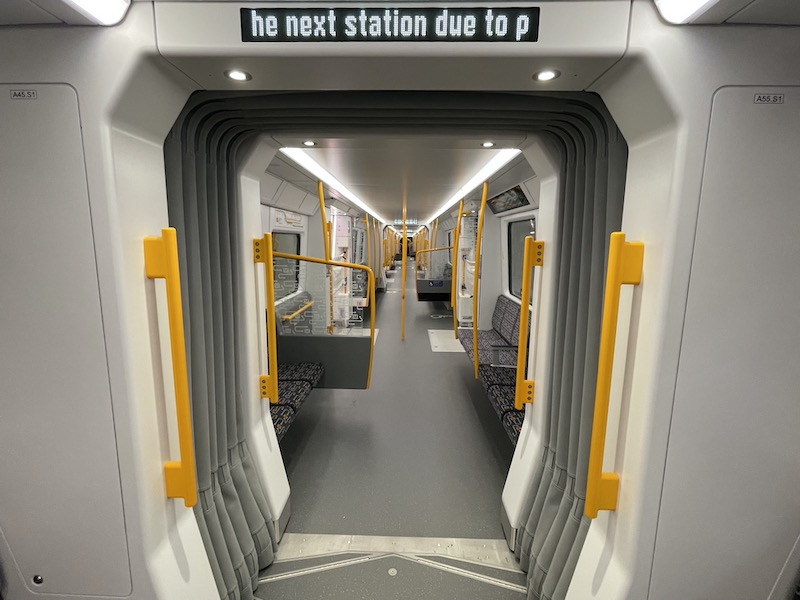
As is now the standard practice on new ‘suburban style’ train fleets, the Class 555’s five coaches are ‘walk through’…

…and, as with trains on London Overground, they have longitudinal seating throughout to maximise standing space and overall capacity.

I’m sure passengers will miss the more traditional layout of seating…
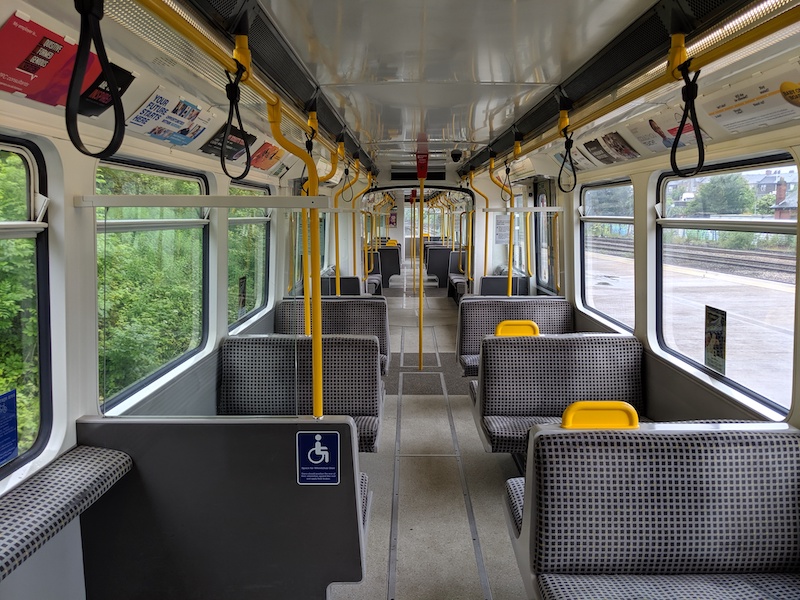
… not least the much sought after double seat at the front…
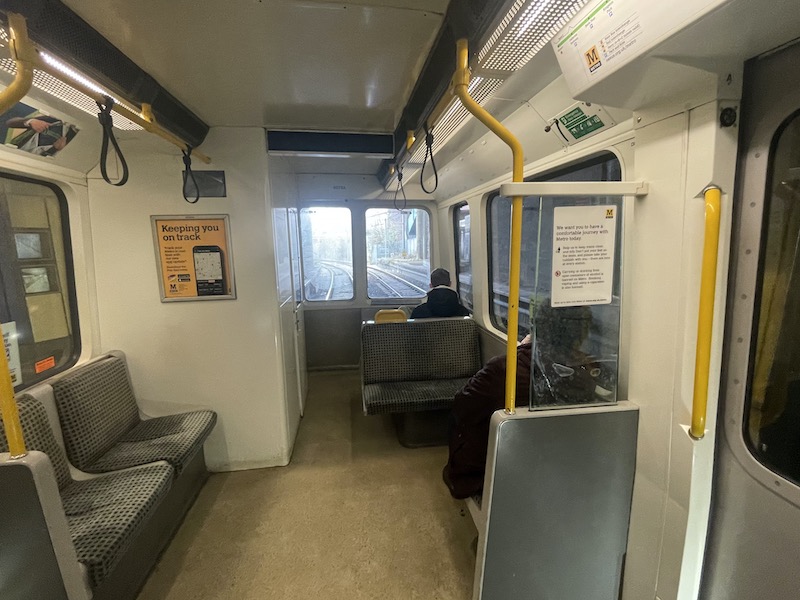
… where passengers could take their turn at pretend driving (à la DLR) right next to the half cab arrangement for the driver.

But things move on and the cramped conditions for the driver in those old cabs…
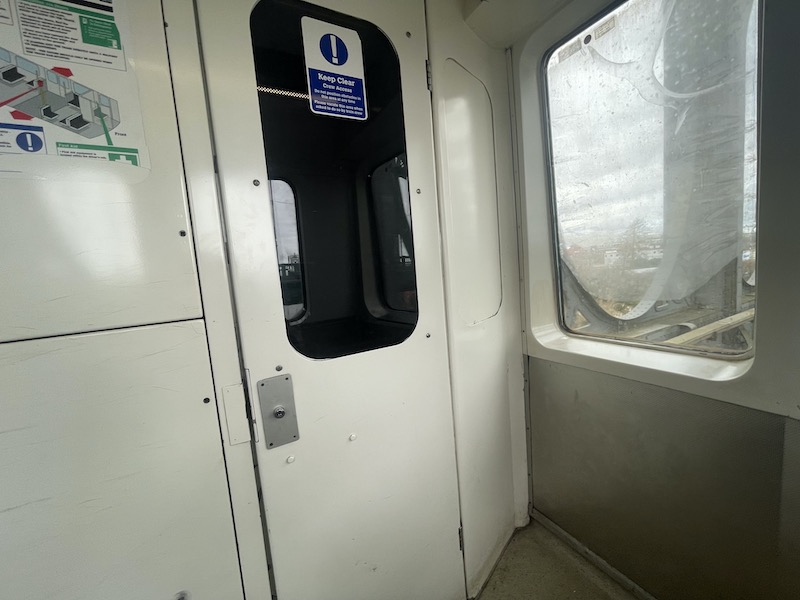
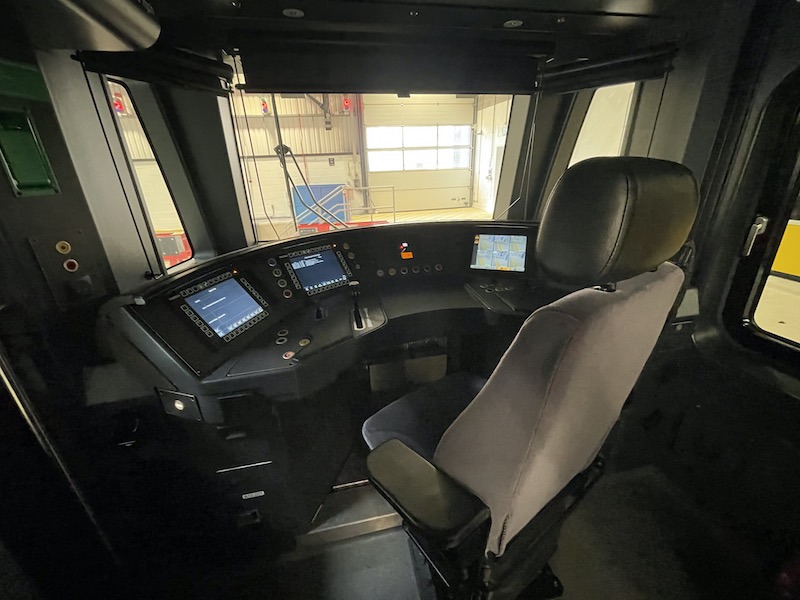
… will now be a thing of the past with a hugely improved full width layout and a multitude of technology, screens and communications equipment befitting for modern times.
For the passenger there’s a smart new moquette with lighter colouring to denote seats close to the doors for those with accessibility needs.

There’s also four designated spaces for wheelchairs (two in each of coaches two and four)….

… as well as four spaces designated for cycles and buggies (two each in coaches one and three).

There isn’t colour coding on the exterior to indicate which coach contains these facilities, as is common on many commuter trains on National Rail, but I’m sure regular passengers will get used to where to wait on the platforms. All told, there are 104 seats and an overall capacity of 600 compared to 64 seats and 188 standing passengers on a two coach Class 599 train making for an overall capacity of 504 on an existing four coach train.

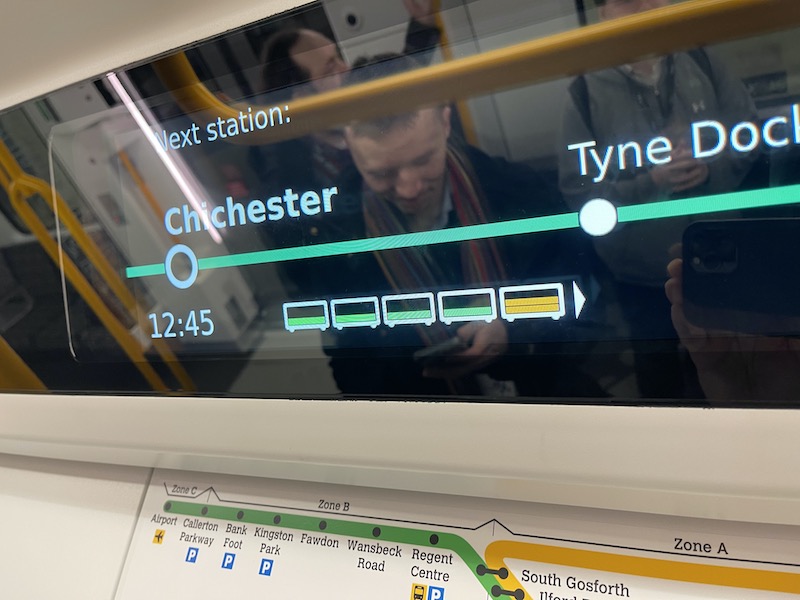
Passenger information screens above side windows show, to what’s becoming a standard layout, the next few stations (which is updated during the journey) and the terminal point…

… as well as updated loading information for each coach.
There are also information screens at the ends of each coach which can display messages from the driving cab such as skipping the next station.
There are also network maps displayed for passengers unfamiliar with the network.

The drivers cab has screens to show the status of the train’s electrical systems and other information…
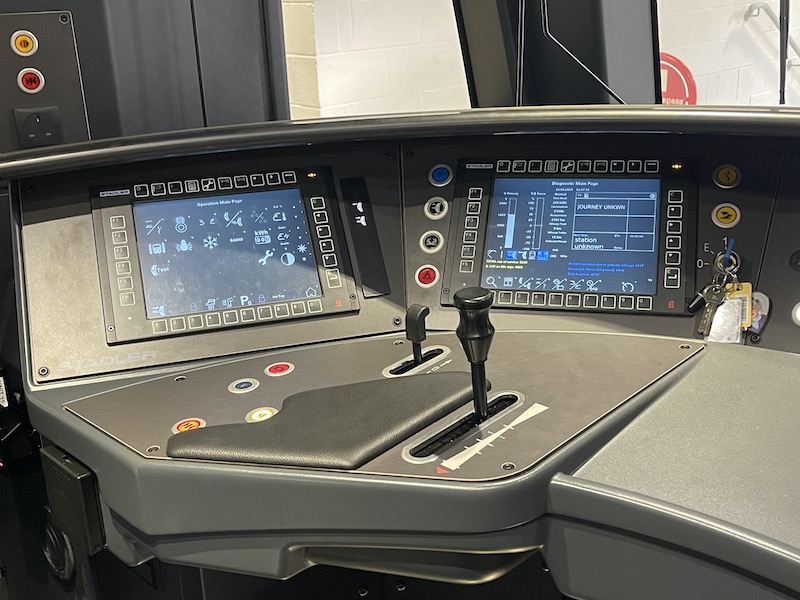
…a list of pre-recorded announcements which can be enacted as well as two radio systems (one being the GSM-R network used on those sections of Network Rail lines.
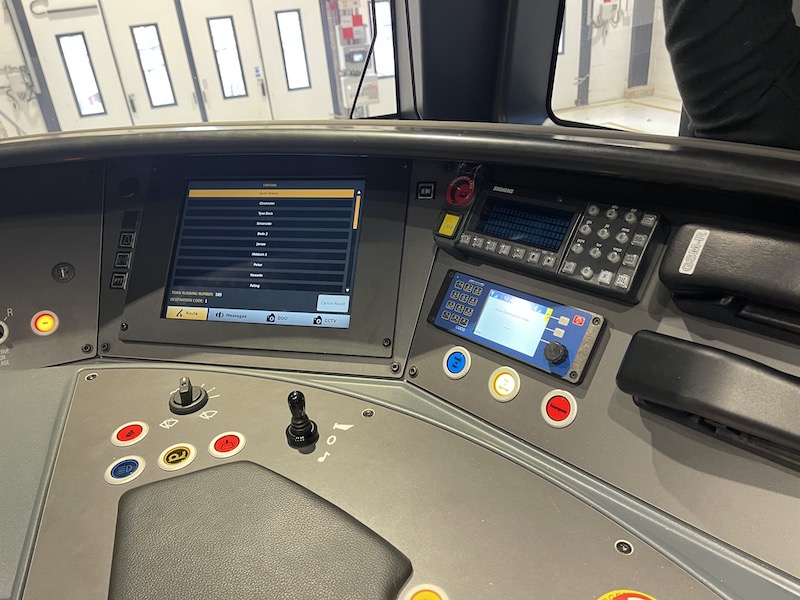
The screen to the left of the radio equipment is also used to display the platform with images from side mounted cameras along the length of the train thus removing the need for mirrors and screens on the platforms.

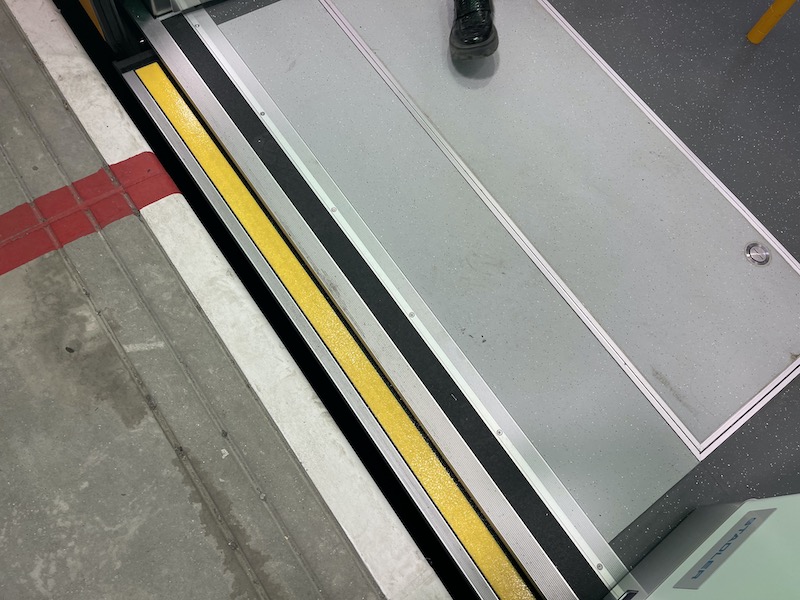
The trains come with the Stadler retractable step at each door making for convenient level boarding where Nexus has been busy enhancing platforms to make this effective.
… with another improvement for passengers being the availability of usb charging sockets where arm rests are in place on the longitudinal seats.

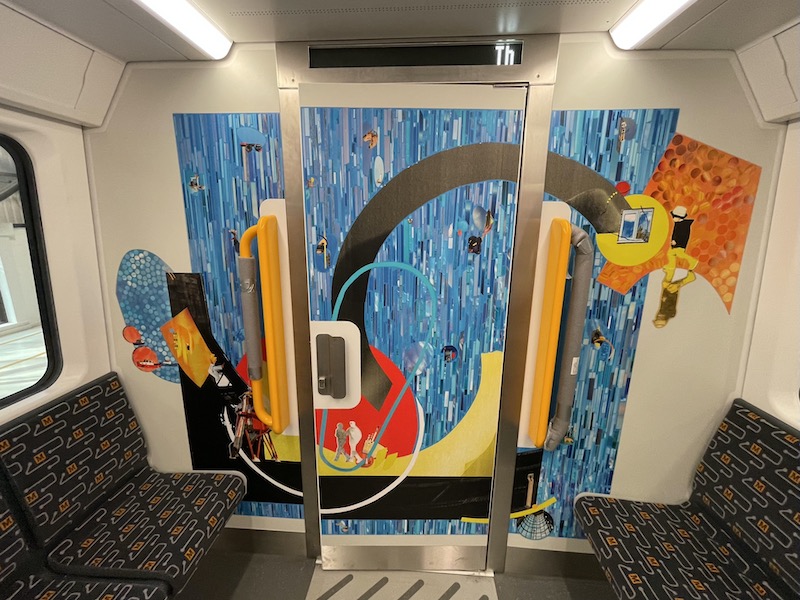
Each train also has one of four designs commissioned from local artists to brighten up the ends of coaches one and five by the internal door to the driver’s cab.
I’m sure passengers will love travelling on these new trains as more are introduced during the coming months. They’re a much welcome improvement on the trains they’re replacing.

This investment is part of a much wider “asset renewal programme” which has seen 65 kilometers of track renewed or refurbished and a similar amount of overhead line fitted, 35 stations refurbished, 27 new escalators and 12 new lifts, and 62 bridges repaired and 3 replaced.

It’s a lot of money, but it is nice to see welcome investment in Tyne & Wear.

Roger French
Blogging timetable: 06:00 TThS
 BusAndTrainUser
lack of traditional seating will upset a few
LikeLike
Very true, but I often find that given there is not quite enough leg space between the seats that it’s almost impossible to get 4 strangers to share that space.
David Potts
LikeLike
There was a public consultation – this layout won. The other option was like the existing trains.
LikeLike
I wonder whether this network would lend itself to driverless trains? If so, what a pity the opportunity was not taken to introduce them, DLR-style.
LikeLike
The DLR is a completely enclosed eco-system whilst the Metro ventures onto National Rail tracks between Pelaw and Sunderland, shared with local DMUs and (at Sunderland Station) Grand Central trains to London and also has a number of open level crossings so I guess driverless trains may be a bit challenging.
David Potts
LikeLike
The UK is being left behind with driverless trains, In the rest of thew world Metro type systems are going driverless
One would have thought on the underground the Waterloo & City line would be ideal for conversion
LikeLike
It’s relatively easy to build a new metro for driverless operation, and much more difficult to reftrofit an existing one. To date only a handful of lines have been converted – notably two in Paris and one in Nurnberg. One problem with the UK’s metros is the limited loading gauge – London’s deep tubes in particular have no easy egress in the event of an emergency. That said, Glasgow is looking at going driverless in the next few years – the new trains and signalling are designed for it.
LikeLike
The choice of the loadings per carriage colors implies that the front carriage is going on the Green Line with the other four taking the Yellow Route
JBC Prestatyn
Otherwise the extra capacity, and I think at 46 trains rather than what I think is 45 present ones must give resilience and introducing from a new depot should help the transition. What will happen to the current depot – will it be used in due course for overhauls or other uses ?
LikeLike
The depot is on the same site as the old metrocar depot. Complete rebuild on existing site.
A temporary stabiling depot is in use south of the Tyne
LikeLike
I never want it to happen but what if there was a fire on-board a walk-thru train?
Or even a nutter being violent?
No door to shut. No door to lock.
LikeLike
What is your plan on, say, a Pendolino, where the doors all slide open? You can’t lock the doors between carriages due to… fire safety!
LikeLike
Well i hope Tyne & Wear Metro have more luck with the Stadler built 555s than Merseryrail have had with the Stadler built 777s, almost every day their’s a fault with a 777 somewhere on the Merseyrail network
SM
LikeLike
Bike & buggy spaces in coaches one and five, according to the train layout. Otherwise no-one would know whether coach one was at the front or the back on the return journey from end of route.
John
LikeLike
Superb looking new trains, excellent system. I do hope the planned extension to Washington goes ahead. Incidentally the original trains were based on the German Stadtbahn B design.
Peter Brown
LikeLike
Speaking as one who has had cab rides in Class 404s, the driving cabs on these new Class 555s are out of this world. Mind you, all that fancy electronics I feel sure is itching to go wrong or be hacked by the Chinese!
LikeLike
The problem the Metro has is it makes huge losses
LikeLike
Most Metros worldwide are subsidised
LikeLike
No decent public transport network or roads ever pay their way and that should be seen as a price worth paying to connect a region up and afford opportunities of education and work to more people and not least leisure and tourism, let alone the clear health and social benefits. Tyne and Wear is mostly sprawl and low density. Try getting around the region on just buses and Northern trains and see how difficult it is, suddenly this region would be very car centric. The Metro adds huge value to this region and I wish more city regions had local trains with the frequency this metro gets. Somewhere like Bristol or Cambridge plus surrounding towns or similar would be much easier to travel around with a metro. Buses are great but their weakness is the slower and unpredictable journey times on them, a peak time journey by bus in most towns and cities takes at least twice as long as an early or late off peak journey, the metro cuts across this with more consistent journey times. In fact, the bus interchanges across this metro system are by far my favourite feature, I wish they were more common in England.
Aaron
LikeLike
The level of subsidy when you look at the accounts is simply crazy
LikeLike
No its a perfectly acceptable subsidy for what it offers
Terrance
LikeLike
How much subsidy do schools get? They’re of zero value for anyone without kids yet we subsidise them anyway for the social benefits.
Think about it.
LikeLike
The problem the Metro has is it makes huge losses
Not helped by competition from buses.
The metro was planned to be the backbone of a modern, integrated transport system. Bus deregulation has worked against that aim, taking passengers away from the metro thus leaving the metro requiring greater subsidy.
Is that a good thing?
Malc M
LikeLike
RAil seems to be unable to control costs.
It is probably unreasonable to expect a Metro system to make a profit but losses on a system should be reasonable and on the Metro they are not
LikeLike
Define “reasonable” in this instance beyond just having a moan about how everything is seemingly rubbish
terrance
LikeLike
It may not be helped by “competition from buses” but I’d suggest that abstraction is fairly minimal. The speed advantage of the Metro is huge. Fact is that prior to deregulation, there were several instances of forced interchange (mainly at Gateshead) and that was ideology gone too far.
The main issue is the reliability of the infrastructure – not just the trains but also the signalling. During the 2010s, patronage grew (whilst buses declined) until 2016 when increasing unreliability impacted the Metro and it’s passenger figures began declining. Hopefully the new train fleet and signalling improvements will improve uptime and grow patronage again.
BW2
LikeLike
@BW2:
Tyne & Wear Metro patronage, 1985/86 – 59.1 million
Tyne & Wear Metro patronage, 1987/88 – 44.9 million
Bus deregulation happened during the intervening year.
There may have been other factors at play too – the opening of the Metrocentre, with its plentiful parking, may have impacted on shopping trips; declining heavy industry on the Tyne may also be a factor. Nevertheless, a drop of almost 25% in two years is quite stark.
Malc M
LikeLike
The new trains do look nice and investment is always welcome but the removal of the front seats is such a shame. Glad I rode the network in the past year on the old trains, got some great pictures out of the front and back of the train as some truly awesome views to be had on this metro. Better than the DLR for sure! Tyne and Wear is a really interesting region, some fantastic architecture in Newcastle and Gateshead. Whitley Bay is a good day out too.
Aaron
LikeLike
Much more space to stand, which is needed for when it’s very congested during rush hours, but nothing for standers to hold on to. No horizontal bars and no hanging straps.
LikeLike
It’s a shame they prioritise driver comfort over giving the passenger a driver’s eye view 🙂
I’ll miss the front seats but last year managed to bag the seats for a whole tour of the network before the old trains disappear.
The fact that I’d booked the trip with the intention of taking in the new Metro trains and the new Ashington line but both were delayed was a bit disappointing but just means I’ll have to return sooner than planned.
MKIan
LikeLike
An excellent and informative overview of the new range, long overdue for the user network community, very well presented.
HRH
LikeLiked by 1 person