Tuesday 25th February 2025
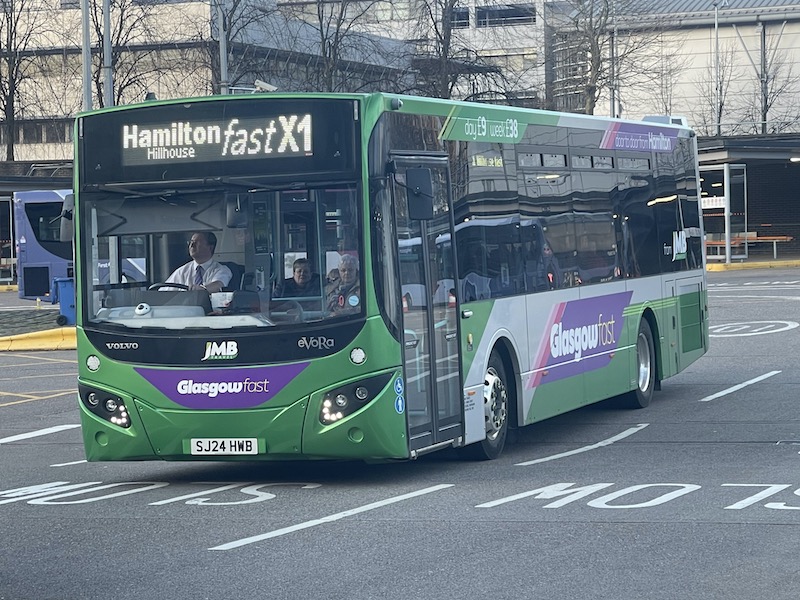
Lanarkshire based JMB Travel reintroduced route X1 last month (13th January), reinstating a fast motorway link between Hillhouse, Hamilton and Glasgow that was abandoned by First Bus in 2020.
Although First Bus cut the route during the early days of Covid it had intended to withdraw the service in October 2019, well before any bat-derived virus took hold, but following a public backlash and the involvement of MPs and MSPs, committed to a few months stay of execution.
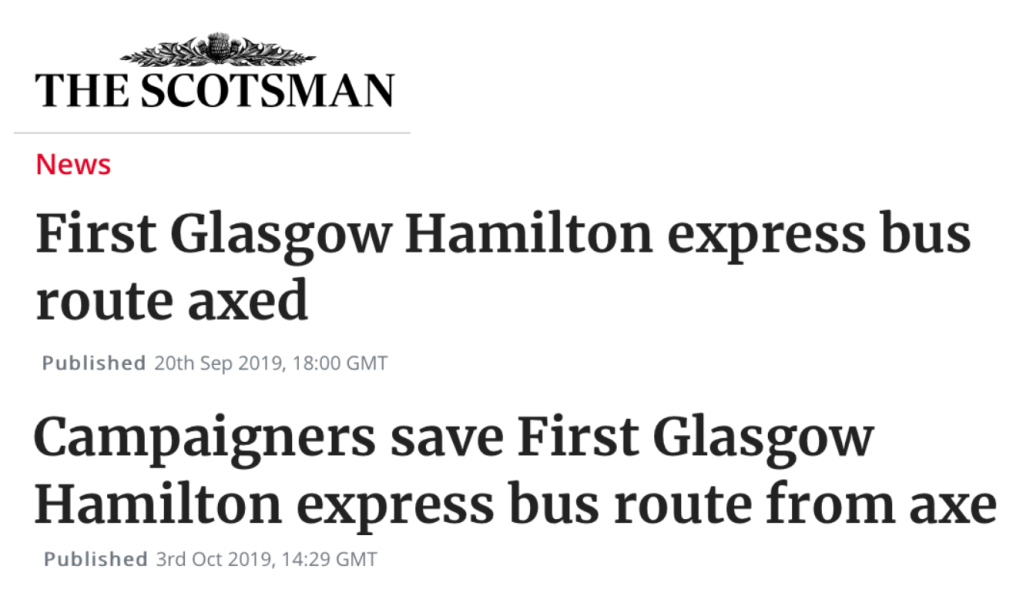
First Bus reckoned passenger numbers using the route had been falling and also cited congestion on the motorway impacting peak journey time reliability, compared to the alternative by train, leading to a decision not to reintroduce the route once the pandemic was over.
JMB Travel, with a keen eye on developing market opportunities, decided to take the plunge and allocated two branded buses to the reincarnated route.
The first bus leaves Hillhouse at 06:38 with hourly departures (albeit a 70 minute gap between 08:38 and 09:48) until lunch time when there’s a 90 minute gap (to facilitate drivers’ meal breaks) and then hourly departures between 13:18 and 17:20. Return times from Glasgow’s Buchanan Bus Station are hourly from 07:40/08:50 to 10:50 then 12:20 to 18:30. The Saturday timetable is similar except the first return journey doesn’t run. There’s no Sunday service.
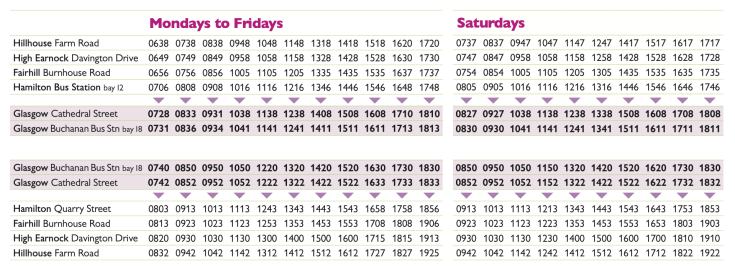
Journey time from Hillhouse to Glasgiow is 53 minutes and from Hamilton bus station to Glasgow’s Cathedral Street is an attractive 22 minutes which competes well with the train from Hamilton Central with its 30 minute journey time to Glasgow Central. However the train is more frequent at four times an hour but the bus provides convenient pick up and set down points in the large residential area between Hamilton and Hillhouse meaning thousands of residents in this densely populated area don’t need to change between bus and train but have a through service from their home into Glasgow.

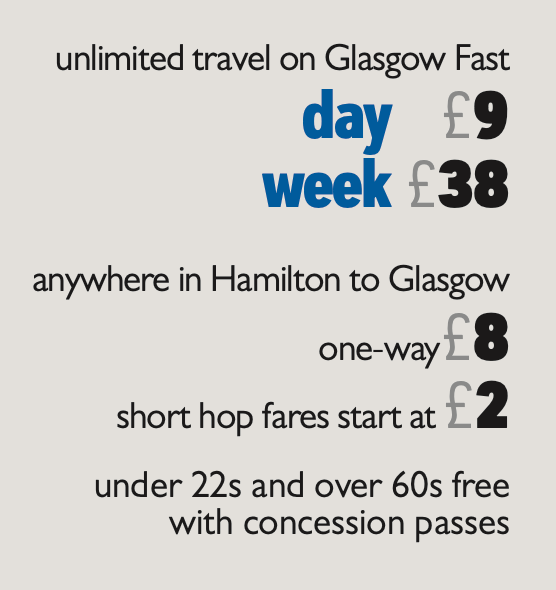
Those under 22 and over 60 travel free with adult fare payers offered a one-way single of £8 and an all day ticket for £9. However, the return rail fare is only £8.90 (Anytime) or just £5.80 (off peak) and £4.80 (after 11:00 but not between 15:00 and 20:00). A seven day ScotRail season costs £25.70 which is currently being subsidised by the Scottish Government making it cheaper than JMB’s £38.
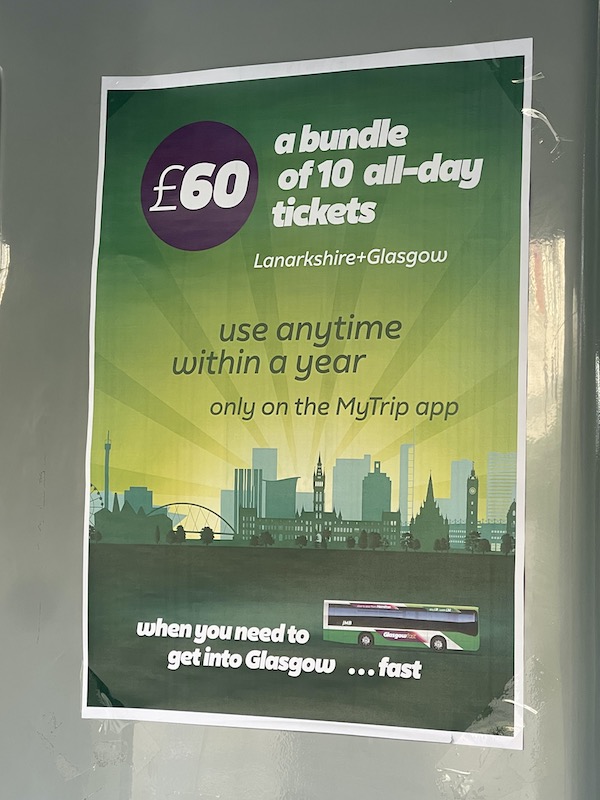
However, as an added attraction for regular passengers who don’t travel every day JMB Travel has recently added a 10 all-day ticket bundle option for just £60 giving it much better comparability with the subsidised rail fares.
I thought I’d take a look and see how the X1 was doing after six weeks on the road and following its five year absence.
I arrived in Glasgow’s Buchanan bus station just in time to catch the 14:20 departure on Saturday afternoon.
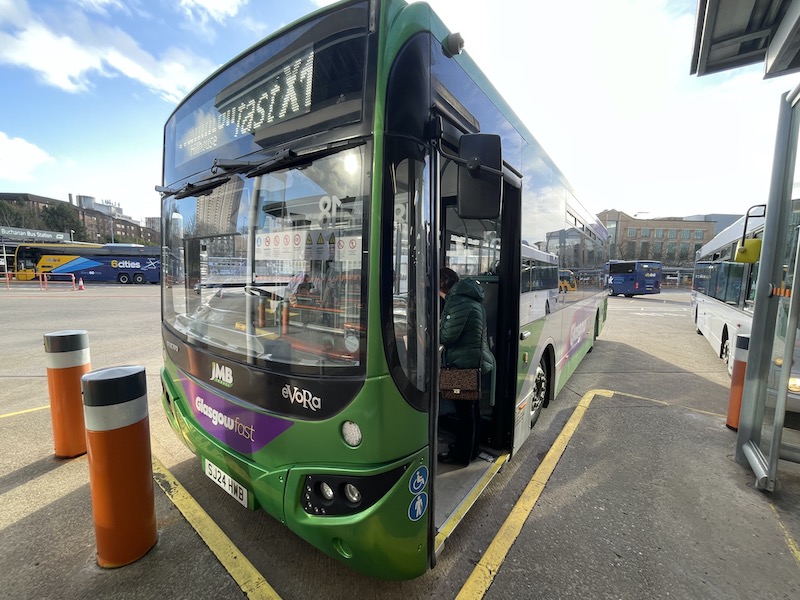
As I boarded the driver remarked how I looked familiar and it wasn’t long before we realised who each other was – I was delighted to be in the company of Ian Bieniowski, who I’d met when he worked with Lothian and had attended Young Bus Managers conferences many years ago.
Ian now works for himself doing consultancy work for a number of bus companies including providing commercial expertise to JMB Travel and it turned out route X1 was a project he’d been working on for some time from inception to introduction so it was a great opportunity to chat and hear about the background.
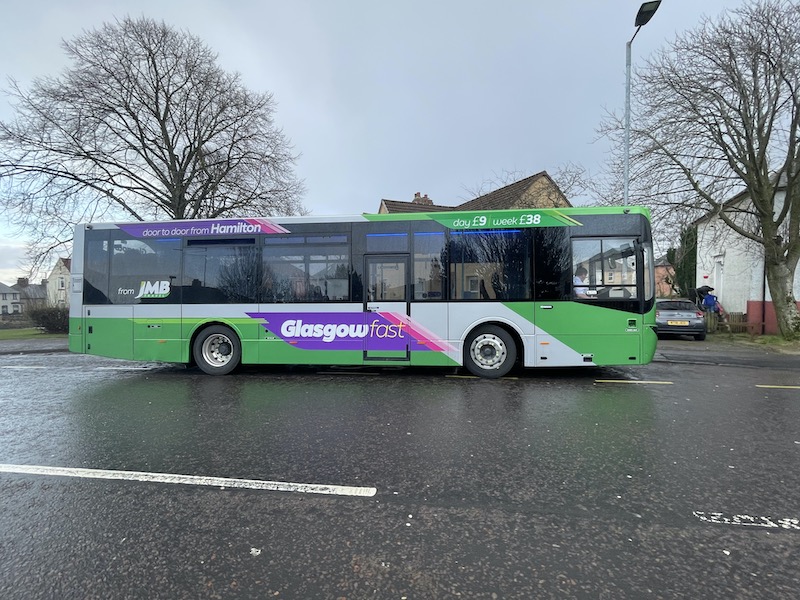
Ian does a driving duty from time to time for JMB Travel and finds it a great way to keep his hand in and learn first hand how the route is doing and hear feedback direct from passengers.
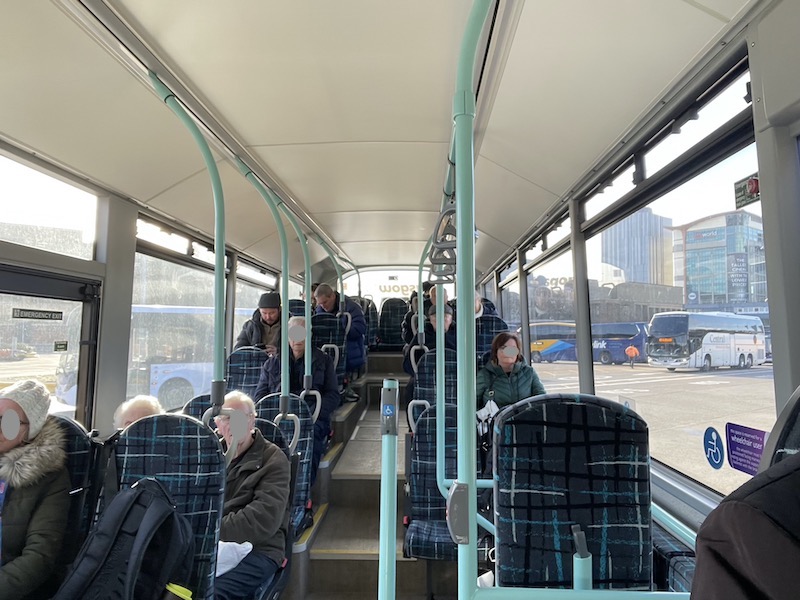
He is very pleased with the great support the route has had from the local community with passenger numbers steadily growing. We carried 13 out from Glasgow on the 14:20 journey with four alighting as soon as we reached Hamilton just 23 minutes after leaving Glasgow having used the M8-M73-M74 on an impressively quick journey.
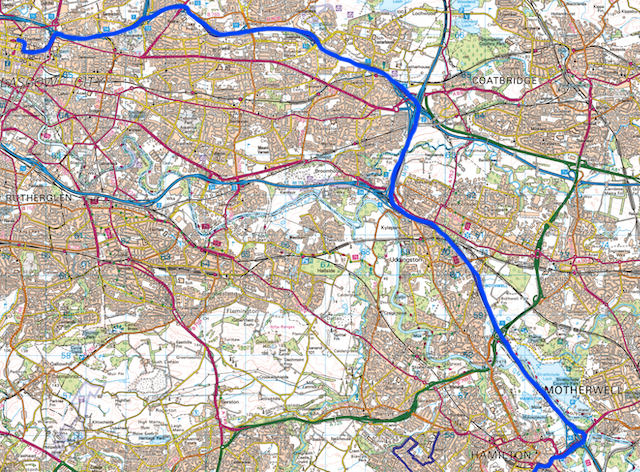
The rest alighted as we did the half hour section of route around the large residential area including eight who boarded in Hamilton and travelled locally.
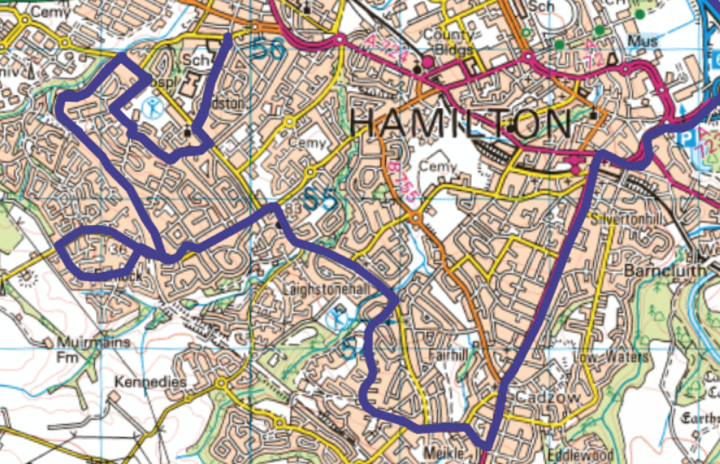
First Bus also operates a circuitous local route 226/229 in Hamilton but the X1 provides more convenient alternative direct links, so there’s potential to grow that market as well as the Glasgow market.
Stagecoach also operates a fast hourly service from Hamilton bus station into Glasgow (its X74 from Dumfries) but the X1 provides more convenient stopping places in the city centre in Cathedral Street by the university and Ian has already noticed many students using the service and of course taking advantage of the concessionary travel arrangements for under 22 year olds which is not available on the train. A market development in the five years since First Bus pulled out.
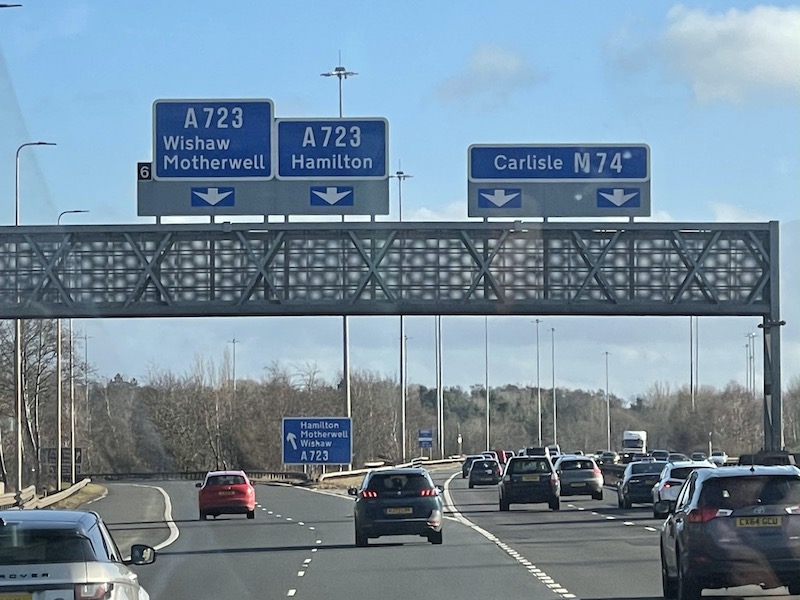
Our return journey from Hillhouse at 15:17 also carried 13 passengers, ten of whom travelled locally to Hamilton and only three into Glasgow but it was very much an ‘against the flow’ journey.
Fifteen passengers were waiting to board at Buchanan bus station when we arrived back there for the 16:20 departure.
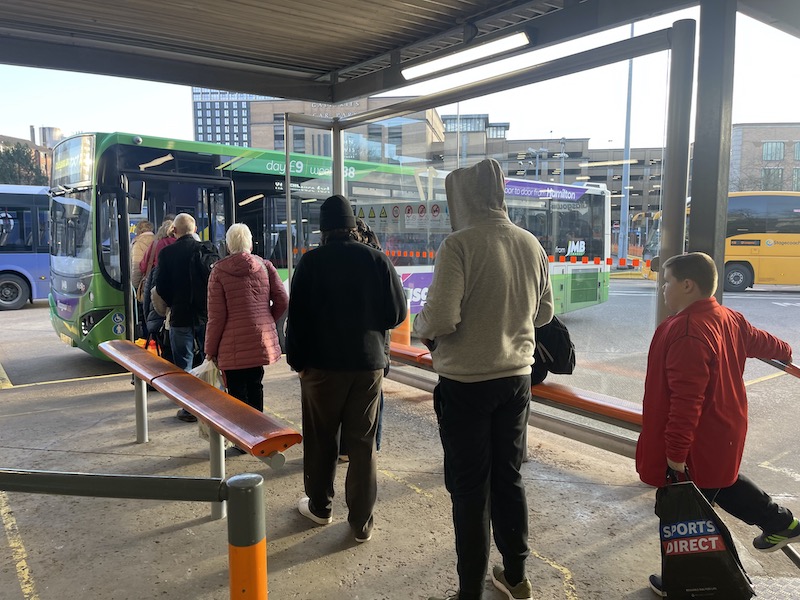
I’d also spotted the second bus on the cycle in Hamilton with a similar number on board.

I was very encouraged to see this level of support so early in the development of the route especially on a cold winter’s Saturday afternoon.
Even more impressive was hearing Ian’s plans for an enhanced timetable from April with a third bus added to the schedule enabling those gaps in the timetable to be eliminated and a standard hourly frequency applying all day.

Ian is also adjusting times to improve arrival times for commuters and workers at a hospital following passenger feedback, demonstrating an excellent approach to service development.
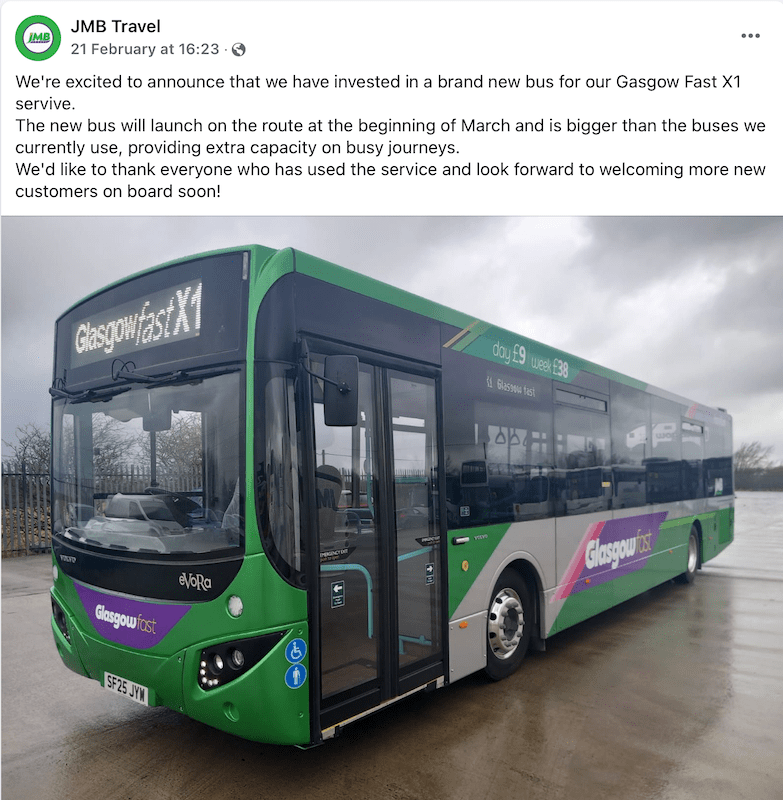
And in more good news a brand new Volvo eVoRa will be allocated to the service later this week.
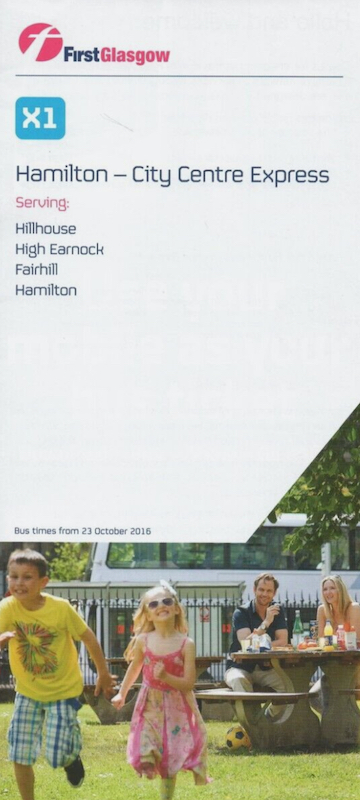
As you’d expect from a quality operator there’s an attractive printed timetable leaflet with easy to follow map and details of fares and tickets with supplies available on board the buses.
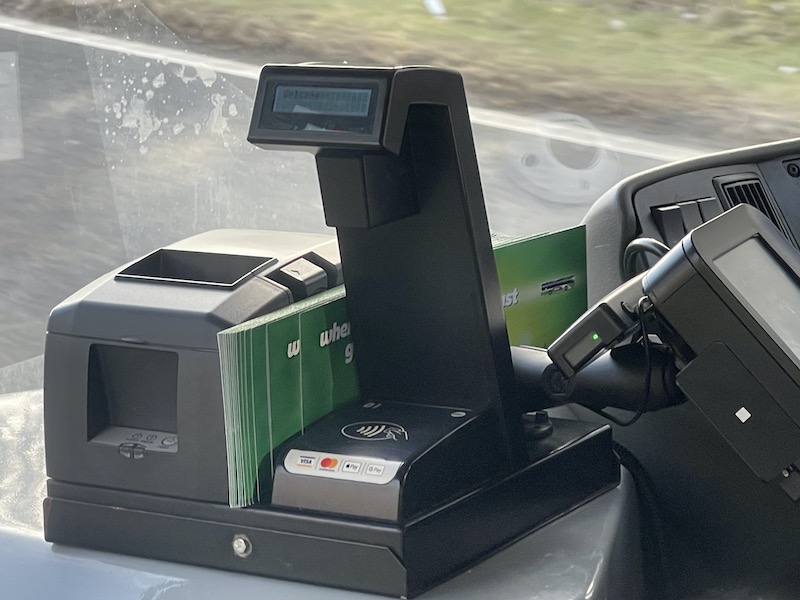
It’s great to see such a positive development and see a small bus company showing how to grow the market for bus travel deploying attractive route branding, readily available enticing printed timetable and fares literature, clean, comfortable, new buses driven by friendly drivers regularly allocated to the route and no ridiculous AI devised timetables which are impossible for passengers to remember.
It offers a complete contrast to the way another bus company is currently approaching bus operation. I’m confident I know which will be the most successful when it comes to developing routes such as the X1 and attracting passengers.
Indeed, it’s already clear to see.
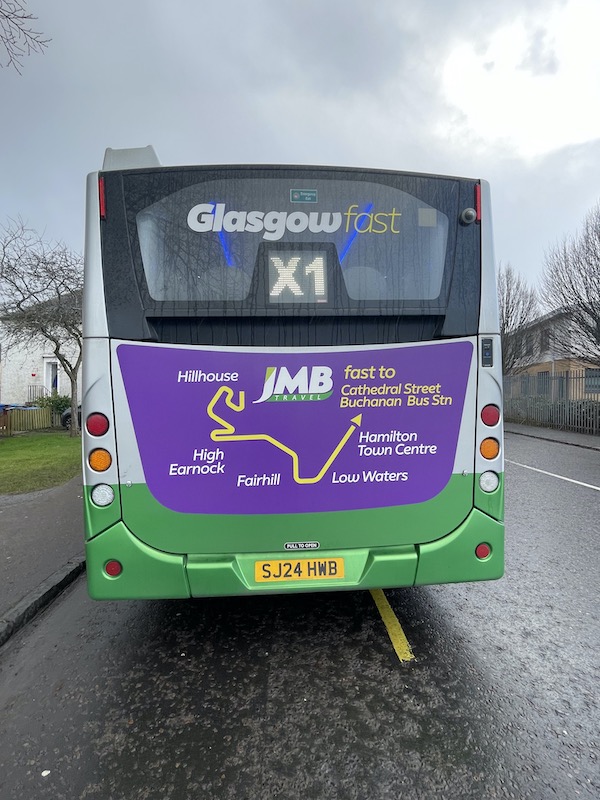
Well done to Ian and JMB owners Jennifer and Martin Bell.

Roger French
Blogging timetable: 06:00 TThS
 BusAndTrainUser
Wow – a consultant who actually goes out and drives buses to see what’s happening on the ground! – good things do happen ….
LikeLike
Great to see a transport provider offering a service run for the benefit of the travelling public rather than its employees (i.e. nationalisedScotRail).
LikeLike
I’m always amused by the way the usual suspects whine about nationalised operators being run for the benefit of their employees. Anyone who works for a nationalised organisation at ground level can tell you that they’re the last people the organisation is run for the benefit of!
LikeLike
Typo alert: the congestion on the motorway was cited (not sited) by FirstBus
LikeLike
Thanks; corrected.
LikeLike
I didn’t think rail fares could get any more complex, but I have been proved wrong…
LikeLike
JMB might want to think about bringing in a Sunday service. Regular cancellations on Sundays on ScotRail because they have to rely on drivers agreeing to work restdays. Unbelievable that in this day and age Sunday is not a regular part of the working week.
LikeLike
@Anon 07:53 – making Sundays part of the rostered working week would require acceptance from the trade unions. Reaching agreement, on terms which are acceptable to both sides, may not be simple – this has been a sticking point in a number of industrial disputes on the railways.
Malc M
LikeLike
Many operators of the size of JMB are not unionised. But they often attract staff on the basis of little or no Sunday working, though a quick perusal of JMB’s timetables shows that they do currently operate on Sundays.
LCC
LikeLike
We were in Glasgow last weekend and struggled to make sense of the bus network. SPT’s website was hopeless – you have to know which route you want in order to get the details. There are too many duplicated route numbers going to different places. First Glasgow has online and printed maps which don’t show clearly what goes where. The 100 service to the Riverside museum doesn’t seem to run. Perhaps JMB should take over the lot!
LikeLike
This is why I’m so glad the wider Strathclyde area has such an extensive rail network and the trains are really frequent, finding information on local buses is impossible and the operators don’t seem to want to work together to provide an idea of a network. It’s pathetic really and why people want at least franchising to happen, SPT needs to go for it, no messing about.
How can people use buses if they can’t find where and when they run? Let alone the cost. Such basic things. It’s sad and frustrating seeing how Glasgow’s really fragmented buses stack up after seeing how much better it could be, when using buses in and around Edinburgh, which are ran by the council municipally instead of uncooperative for profit companies.
Aaron
LikeLike
It isn’t just the operators at fault for the lack of information about bus services, SPT must take some of the blame. For years they’ve promoted the rail network and the Glasgow Subway and pretty much ignored the bus network. In my opinion a “not invented here” attitude, despite public transport information and promotion being within their remit.
Now they’re seeking to introduce a franchised bus network under their control. They could save a fortune simply by effectively publicising what already exists.
LikeLike
I’ve never understood Glasgow’s buses, and I’m from there.
On a visit back home last week, I thought I’d try to avoid the lack of joined-up ticketing by using a Plusbus ticket. “We’ve never accepted those,” said the driver of the first Stagecoach bus I tried to board.
There is such a thing as the Glasgow Tripper ticket, which apparently works on multiple operators, but I expect most drivers would also deny its existence.
Otherwise you need to take into consideration whether you’ll be using the same operator for your return journey, or if you would rather take a short trip on a train that’s only running once or twice per hour.
The one minor win I had in paying for any fares was trying out the Scotrail ‘Tap & Pay’ app. While it was nowhere near as simple as they claim (just let me tap in and out with my bank card!), it did charge me a super off-peak return fare even though I made just a single journey – the return obviously being the cheaper option.
LikeLike
Funny you mention Stagecoach refusing Plusbus. I had that issue in Aberdeen, leading to a proper argument with the driver until I noticed a route run by First Bus was pulling in behind. First Bus accepted my Plusbus ticket just fine and everytime I used them. Not a great experience when you can buy a ticket at a tram stop in Edinburgh and also use it on the bus, no problem. If people want private bus operators, fine! But make them accept a common set of tickets that are well publicised and simple to understand. Hopper fares should be standard.
Aaron
LikeLike
Unfortunately that’s not just a Glasgow issue. I’ve had drivers try to refuse Plusbus tickets almost everywhere I’ve used them, usually because “That’s a train ticket”.
I’ve escalated to “Better call your control and check that” a number of times when a polite explanation hasn’t worked and on one occasion in Yorkshire ended up saying “If you won’t call your control you’d better call the police because this is a valid ticket. I’ll be upstairs when they arrive”. Needless to say that driver didn’t do anything and completely ignored me when I got off.
I really don’t get the attitude some drivers have over multi-operator tickets. It’s not like it’s money coming out of their pockets, after all.
LikeLike
I’ve never understood Glasgow’s buses, and I’m from there.
On a visit back home last week, I thought I’d try to avoid the lack of joined-up ticketing by using a Plusbus ticket. “We’ve never accepted those,” said the driver of the first Stagecoach bus I tried to board.
There is such a thing as the Glasgow Tripper ticket, which apparently works on multiple operators, but I expect most drivers would also deny its existence.
Otherwise you need to take into consideration whether you’ll be using the same operator for your return journey, or if you would rather take a short trip on a train that’s only running once or twice per hour.
The one minor win I had in paying for any fares was trying out the Scotrail ‘Tap & Pay’ app. While it was nowhere near as simple as they claim (just let me tap in and out with my bank card!), it did charge me a super off-peak return fare even though I made just a single journey – the return obviously being the cheaper option.
LikeLike
The temptation to mention that this sort of initiative can no longer happen in Manchester and a few other places soon is just too hard to resist. Excellent news that those who plan the service actually go out and work on it…..a few other companies might like to note that.
Terence Uden
LikeLike
You can use this one to make the case for either side of the Manchester debate. On one hand the fact that First (one the major operators in Manchester) scrapped the service in the first place doesn’t exactly suggest the status quo is working. On the other hand, that another operator eventually picked it up is the kind of thing deregulation was supposed to encourage and whgich Bee might kill off. Given the almost total lack of innovation amongst Manchester’s private sector bus operators for the last decade I’d say the case in favour of the previous system isn’t strong.
LikeLike
A mon-sat bus service with no evening or Sunday operation is hardly a paragon example of public transport provision – no-one is giving up their car for that.
LikeLike
Interesting to re-visit when the hourly service has bedded in. However unless all maintenance is done at night or Sundays do they have spare capacity of fleet to cover the full PVR . Also is ScotRail prices subsidised too much compared to buses that seem to be able to do the job cheaper for passengers ?
JBC Prestatyn
LikeLike
Not sure we are comparing like-for-like here.
The X1 runs Mon-Sat, first arrival into Glasgow 07:30, last bus back at 18:30. No service in the evenings, nor on Sundays. The (subsidised) rail service provides a more comprehensive service seven days a week including evenings – first train in from Hamilton arrives into Glasgow before 06:30 on Mon-Sat (around 09:10 Sun). Last train back is after 23:00, seven nights a week.
Malc M
LikeLike
I wonder if two buses would have been sufficient to provide a 15 minute frequency around Hamilton residential areas terminating at Hamilton Central Station with timed connections to the Glasgow trains with PlusBus tickets? This would save the long trunk haul into the city.
Peter Brown
LikeLike
But wouldn’t be free to the under 22s or over 59s.
LikeLike
Anon @ 11:15 surely forcing the penalty of interchange would undermine the X1. People aren’t daft, forcing interchange when it’s not needed will mean people will vote with their feet and not use it.
LikeLike
@anon, 16:25 – it is worth looking at systems in countries such as Germany, where buses often act as feeders to rail modes (U-Bahn or S-Bahn) rather than duplicating or competing with them. Of course, on those systems, there is no fare penalty for changing between bus and train/metro.
Depending on how you look at it, a feeder to the rail system at Hamilton Central operating four times per hour (and with through fares) may be more attractive than a bus running direct, but only hourly. That, however, would need integration between transport modes (including ticketing).
To give a comparable example, the town of Dachau lies 10 miles from the centre of Munich – more-or-less exactly the same distance as Hamilton is from central Glasgow. There is no direct bus from anywhere in Dachau to Munich city centre, because the S-Bahn (suburban rail) provides the link. Buses from Dachau’s residential districts run to the rail station – some of them do run into the northern outskirts of Munich, but terminate at other S-Bahn or U-Bahn stations (and I guess they are more for intermediate traffic than anything else). Fare from Dachau (zone 1/2) to city (zone M) is EUR6.10 single – unless I am mistaken, that is from anywhere in Dachau to anywhere in central Munich, including changing between modes (e.g. bus to S-Bahn then to U-Bahn or tram or another bus).
Malc M
LikeLike
I really agree with this and seems logical to me. Requires public control of buses to integrate everything though but at least Hamilton has a proper bus station and it’s next door to the rail station, which isn’t the case in so many towns. Integration of buses and trains would make life so much easier where I live too, the trains get to London so fast but local bus travel is such a ball ache.
Aaron
LikeLike
Public control of public transport is a disaster- look at Wales.
LikeLike
No, deregulation and privatisation is a disaster. Until it’s one network, one ticket I’m not satisfied. As for Wales, it needs better investment.
Aaron
LikeLike
Yawn.
Switzerland has public control of public transport, as do Germany, the Netherlands and Singapore. Are you seriously suggesting that public transport in those countries is a disaster?
LikeLike
The way I see it is that a 15 minute frequency Hamilton circle starting and finishing at the railway station ŵould provide connections to ALL the destination/origin points possible by train, thus becoming part of a wider integrated network, and having a larger potential market. The X1 is an isolated hourly bus only serving the travel to Glasgow City centre market.
Far from “forcing” people to change they would have a much greater choice of travel opportunities.
Peter Brown
LikeLike
The timetable may not be AI-compiled, but does feature Saturday times which are just a minute or two different to those on Mondays to Fridays – I’m not sure that’s “easy to remember”.
Paul B
LikeLike
All operators should have heid yins doing some driving to see what’s happening, so well done for that.
To be a bit more positive about First, several times I’ve used their X11 between Glasgow and Motherwell, equally fast and half-hourly. Courteous and considerate drivers, on time and clean buses.
LikeLike
The Munich example sounds great, but people in the UK have a lot of resistance to making changes on a journey. I know this is likely partly as a result of the way we have run public transport in the past, but it takes a lot of overcoming. Several years of answering the phone to people tells me that folk will go to considerable lengths to get a through trip, whether by bus or by train.
A headway of 15 minutes connecting from a train onto a bus sounds fine on paper, but my experience as a public transport user tells me that in many cases sods law would come into operation, and I would arrive at the interchange point on a wet winter evening to find a bus just gone and the next one running well late…
It is really difficult to get up to the level of frequency on inter-modal journeys that will avoid this. I seem to remember a case I think in Newcastle back in the PTE days when the Metro was new and where people had been forced to change onto it and a small bus company came in with a successful through service?
My own feeling is that while there is a good case for the “integrated” model, it doesn’t do to get fundamentalist about it, and that there is room for a high quality alternative sometimes, which is what this seems to be.
Anthony Holden
LikeLike
There is one network in the UK which has been operating for over 100 years and on which passengers go to no particular lengths to avoid changing – it’s the London Underground. The ‘secret’ is frequent, consistent services, well-signed interchanges, and the well-known map. A 15-minute frequency, if enabling reliable connections in both directions, sounds fine. As you say, our experience had been bad; so it is not only the timetable that needs work, but the attitudes of rail and bus people to the idea of co-operating to ‘put the passenger first’ … which seems to be in the mission statements of most public transport operators, and the DfT!
LikeLike
I would say that the network concept involving changing is a fundamental element of all rail based networks. No one expects one seat rides, changing trains, trams, or metros is the trade off for accessing the wider range of destinations. That the UK is so rubbish at this is why passengers don’t like it.
Other countries know differently. This is Amsterdam Centraal Bus Station, it’s literally part of the railway station. Name any UK city that has a facility of this quality.
https://www.benthemcrouwel.com/projects/bus-station-amsterdam-cs
Peter Brown
LikeLike
@Anthony Holden – Tyne & Wear is an interesting one to look at. The Metro was a major investment in the region. When Metro opened, the transport system took on quite a modern European flavour with the Metro forming the backbone, bus services feeding into it. If I recall correctly, there was a zonal fare system where the fare paid depended on how many zones you travelled through, regardless of whether you were using bus, Metro, ferry or a combination, and regardless of whether you needed to change bus or change mode. So, instead of sitting on a bus all the way into Newcastle city centre, the bus took you to a Metro interchange for onward connection by Metro.
Low Fell Coaches did successfully apply for a licence to introduce a cross-Tyne service in around 1985, linking Low Fell with Newcastle city centre. Not that it was that frequent – hourly Mon-Fri, half-hourly on Sat, nothing after 20:00 and nothing on Sundays.
In 1985/86, the last full year before bus deregulation, the Metro carried nearly 60million passengers. In 1987/88, the first full year after deregulation, Metro usage had dropped by nearly a quarter, to just under 45 million. By 2018/19, the last full year before Covid, with the Metro now extending to Newcastle Airport and through Sunderland to South Hylton. And yet, patronage on the Metro had dwindled to 36million. There are a number of reasons for this – the growth of out-of-town shopping, not least the Metrocentre conveniently located just off the A1, which has lured shoppers away from town and city centre shops, and de-industrialisation (with the growth of out-of-town business parks located close to main roads but away from places easily reached by Metro). But bus deregulation, doing away with the integrated transport system introduced in 1980, is clearly a significant factor too.
Less revenue for the Metro leads to higher subsidy (or poorer utilisation of all that investment). Is that a good thing?
Malc M
LikeLike
Have to agree with a lot of the comments above. When visiting Glasgow last year I found the buses confusing (and I am very good at planning journeys by public transport). I couldn’t see an integrated ticket at all which was valid on all 3 modes in Glasgow either which seems bonkers when the network is pretty good.
As much as the X1 sounds useful and seems to be doing well, I do agree with the comments that the bus should feed the rail system in this instance. I’ve done quite a bit of travelling in Western Europe, you don’t need to think when changing modes. This is what an important UK city like Glasgow should be.
LikeLike