
Tuesday 18th February 2025
The DfT got round to publishing a report evaluating “the first 10 months of the £2 bus fare cap” (£2BFC) last week.
It had been handed over to the DfT last November being compiled by consultants SYSTRA and Frontier Economics. But it only evaluates the first 10 months of the scheme to October 2023, meaning the scheme’s next 14 months until December 2024, when the fare increased to £3, isn’t covered thereby significantly limiting the effectiveness of the “evaluation” and the usefulness of the report.
It’s quite a lengthy report, at 140 pages, but here’s a summary of the main take-aways of what happens when Government intervenes to fund a high profile nationwide cap on bus fares; something that’s never before happened.
You may not be surprised to know there’s no ‘magic bullet’ learning points from the evaluation with no real conclusion whether it’s a good thing to subsidise bus fares in this way.
Indeed the very experienced transport journalist who passed on a copy of the report to me on Thursday pulled out what he called a “no sh*t Sherlock” summary of findings from his perusal which included …………… effective pause as per TV results shows ………
- The scheme appears to have had a positive impact on bus patronage.
- The average cost per trip masks the significant variation in bus ticket prices across the country and therefore the savings associated with the £2BFC vary significantly by individual.
- 16–24 year olds, urban populations and frequent bus users tend to benefit the most.
- Reliability and frequency of routes had not significantly improved and still served as a significant barrier to bus usage.
- The scheme has supported the cost of living by reducing travel costs.
- An increase in the number and proportion of single bus journeys since the scheme started.
Another interesting fact in the report is the DfT didn’t spend all the earmarked funds for reimbursing bus operators it had budgeted. It saved 14% in those first 10 months, spending £210 million instead of £245 million.
The report reckons the scheme contributed an approximate 5% increase in passengers from a total 13% increase experienced outside London between January and October 2023 compared to the same period in 2022.
Evidence suggests the scheme had a relatively greater impact on leisure trips compared to those for education and employment, which perhaps isn’t surprising with the former being optional and easier to generate with a cut price offer while the latter journeys have to be made whatever the price.
Things are complicated because at the same time as the £2BFC other initiatives were being introduced including BSIP funded new bus routes, improvements to service levels, much reduced or even free fares for a limited period etc etc while City Region Sustainable Transport Settlements (CRSTS) funding for Mayoral Combined Authorities has led to other improvements in those areas. Furthermore ZEBRA funds have led to many new buses being introduced giving passengers added quality, comfort and more sustainable propulsion. So, understandably, it’s not been easy to isolate the impact of the £2BFC from these other changes.
The report’s authors explain they analysed various data streams including Ticketer data from onboard ticket machines, TfL data (even though the scheme didn’t cover London), Operator data (monthy data on ticket sales and revenues), four waves of a bespoke national panel survey each with a sample of around 4,000 bus users, stakeholder interviews, focus groups and an “online workshop with members of the DfT policy and commercial teams who were involved in the delivery of the £2BFC”.
The report confirms 148 (90%) of eligible bus operators in England (represented by patronage in the market) participated in the scheme from the outset with 144 involved by October 2023.
Prior to the scheme the majority of bus journeys were made using concessionary passes and period tickets (daily, weekly etc) with an average fare below £2. So the report clarifies the £2BFC only applied to a minority of passengers.
On average, for tickets priced above £2, the £2BFC led to a 27% reduction in price for those passengers impacted.
Another conclusion drawn in the report is 67-73% of people who would have travelled by another transport mode (eg train or car) before the cap have saved on their travel costs due to the £2BFC, which makes me wonder why the other 27-33% changing mode did change mode – perhaps those BSIP improvements.
The report concludes that determining whether the £2BFC scheme was ‘value for money’ (VFM) for the use of Government money “is challenging to assess though can reasonably be considered ‘low’ VFM.”
It continues “the preliminary benefit–cost ratio (BCR) is estimated to be 0.71–0.9, although this does not include all the benefits of the scheme. Fieldwork suggests these include the savings to people who switch modes to buses and the wellbeing benefits of reducing the cost of bus travel for all passengers who would have used the bus even without the fare cap. There are also distributional impacts. Preliminary analysis of the potential scale of the wellbeing effects alone suggests it is reasonable to believe the BCR is at least above 1 (categorised as low VfM).
Something I heard a lot from bus operators is confirmed in the report – that is while the intended objectives of the scheme “were clear from the start” ….. “there was less clarity on the reimbursement process, and the data requirements were burdensome to some operators and DfT”.
In the same vain operators had “concerns over managing the policy close-out and operators were generally in favour of a stepped approach” while others expressed concern “the scheme had had an impact on their ability to make commercial decisions, either because they were not in control of setting fare structures across routes or because the change in the type of tickets purchased generated less useful ticket sales data to inform commercial decisions.”
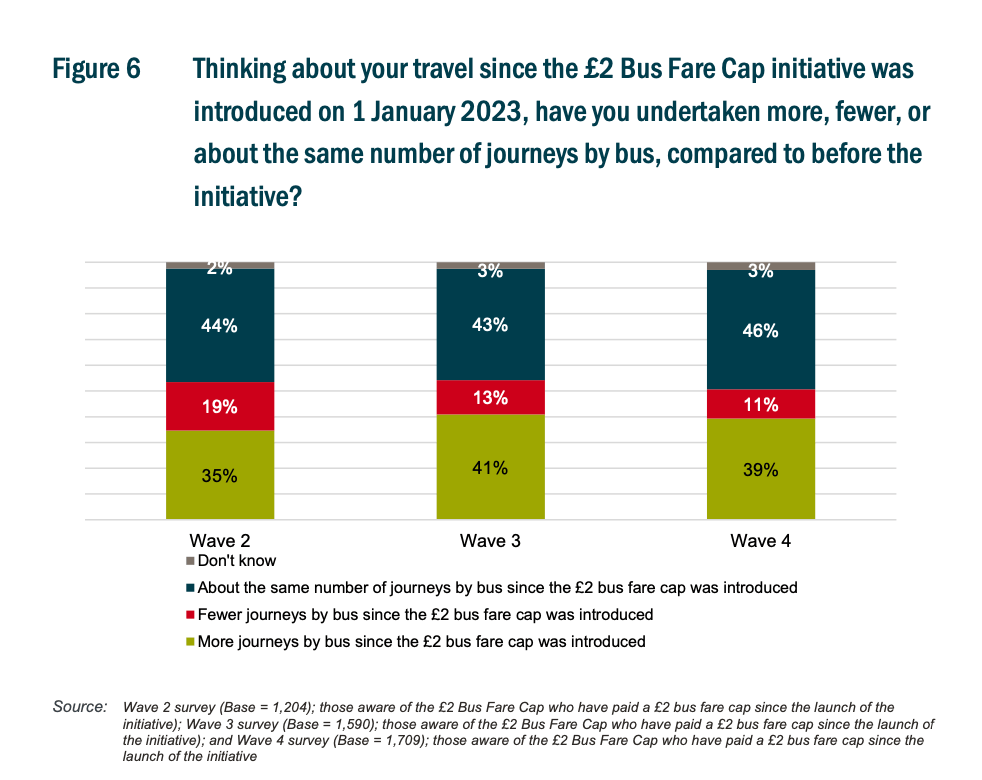
For those who love graphs and pie charts the report delivers in abundance. Here’s a couple that might be of interest….

Readers wanting to immerse themselves in more detail are welcome to take a look at the full report by following this link.
Hopefully there’ll be a follow up report looking at the scheme’s impact between November 2023 and December 2024 as well as what’s happened since the price went up to £3. It would also be useful for a report into the reduced fares pilot in Cornwall to be published (as was promised) and, of course, a follow up to the interim report (in September 2023) into the effectiveness of the public money from the Rural Mobility Fund spent on DRT.
There’s also the not insignificant matter of what happens to the £3 fare at the end of this year ….. £4 anyone?
Roger French
Blogging timetable: 06:00 TThS


One thing that surprises me from that is that it was urban passengers who benefited the most. That may be because they just have more opportunity to travel by bus – but their opportunities for saving money through the cap were more limited. It wasn’t uncommon for cities to have a network ticket for £5/day, so anyone making a simple return journey would only save £1 and plenty of season ticket holders wouldn’t have saved anything – whereas long-distance passengers could be saving substantial amounts, with many return fares cut in half or even better.
The biggest problem with the scheme was always going to be the exit plan. Had it been a genuinely short-term policy running for 3 or 6 months then that wouldn’t have been such an issue, but once it went beyond that, people were going to get used to the low fares and resent them inevitably going back up – it did feel very much like the outgoing government were just extending the scheme to set a bear trap for Labour so that it became their problem to deal with and take the flak for.
LikeLiked by 2 people
It would be interesting to know if this report arrived before or after the decision to scrap the £2 scheme was made? As clearly stated it’s impossible to isolate its effect amongst the COVID recovery and BSIP improvements, or lack of them. My experience was that it was positive in the first year but no discernible passenger generation after that. The £3 has seen a definite negative effect in January, although the weather will not have helped
LikeLike
Mackay:
As an occasional
user of long bus trips the £2 cap was great for me in that it brought certainty… before going pretty much anywhere I knew what the fare was going to be, compared to rocking up at, say Norwich, where the fare to Peterborough could be, well who knows, but I would imagine well north of £10!
Another observation was the inconsistent implementation, which was ok for me but probably confused Joe Public more than was necessary…. All FIRST subsidiaries were happy to sell me a return ticket for £2 each way, so I paid £4 to the driver, but Stagecoach drivers were unable to sell me a return for £4, as their returns appeared to be priced “normally”, so on their services you had to pay twice, £2 on each leg to get the deal.
LikeLike
Taking a year to analyse ten months’ data is disappointing; four months from issue (to DfT) to publication is more normal. They wouldn’t have wanted to publish around the time of the change from the £2 to £3 cap.
More publicity about the scheme would have helped. I first heard about the cap on New Year’s Day 2023 (the day before it started). I was out in the car to view Christmas lights in nearby small towns and noticed the Fares Cap message on bus stop message boards (no bus times to show that day locally). I didn’t hear any radio adverts about it until some time in 2024, and the tone of the ad was that it was [name of big operator]’s new special offer. Similarly, another major national operator has only recently started radio adverts encouraging pensioners to use their bus pass to travel “for free” (bad grammar, I know grrr!).
Generally, it’s difficult to find out bus fares. The operators’ website plug their apps (“for the cheapest fares”, with daily / weekly capping – but may not tell you the cap) and special offers (day tickets, family tickets, etc.), but scarcely a mention of the fares cap, nor of cheaper “short hop” fares.
Chilwell Observer.
LikeLiked by 1 person
In my area Faresaver buses had “Get around for £2” stickers on the front nearside window and rear window.
I think it’s disappointing that the fare cap wasn’t also used as a modal shift opportunity by government ie “Try the bus for only £2”.
Peter Brown
LikeLike
Was there any analysis of £2 fare cap for early/peak pensioner use where concessionary permits were not valid. I think that could be where some of the urban gains came from , but as the pensioner pass gets to beyond age 67 those people are less likely to be in the job market and so on.
Advertising of the scheme indeed could have been better , certainly to non bus users – but where these days is the best place to advertise – local newspapers are less read or produced and social media / online is not always hitting the kind of potential new customers. I think one has to think what was the aim of the scheme and should all operators be compelled to have taken part if the aim was to deliver cost of living savings rather than modal shift. I also wonder if the report could guess the local impact of the leisure travel in tourist locations which must have had a mild benefit to some local economies.
Given computerisation of ticket machines I would have thought destination fare = x , govt claim value – y balance from passenger = £2. all fairly simple.
Was there any abuse of the system in if a longer distance at a fare over £2 being booked for someone actually requesting to go a shorter distance – this would show up in route stats where passenger mileage increases abnormally compared to passenger journeys.
Was refund from govt available when multi ride tickets were purchased that equated to less than the standard single fare reimbursement ?
There is also a problem of route shortening which has occurred in some places such that cross links or longer through journeys were no longer available
JBC from a local operator.
I think an analysis of 2024 data would be interesting as to increase in passenger journeys.
Interesting to note First in Leeds/Bradford has created a 24 hour service daily between the two cities and this has increased trips between 63percent and 138 percent on the route which seems quite good for the increase in vehicle trips.
JBC Prestatyn
LikeLike
JBC asked “Was there any abuse of the system in if a longer distance at a fare over £2 being booked for someone actually requesting to go a shorter distance?”
My experience of buying £2 capped tickets is that is was actually the other way round: I’d ask for a longer journey and get a ticket issued for a shorter journey.
I suspect that many drivers just repeat-issued whatever the first £2 ticket was they had sold on a given trip, meaning that the data provided by the ticket machines would be utterly screwed!
Travelling last year on TrentBarton, where in my experience drivers sometimes push tap-on-tap-off to the extent of refusing to issue tickets against contactless payment when requested to do so, I saw most passengers just tapping on but not tapping off meaning that that data would also be unreliable.
LikeLike
100% my experience as well! Good job there aren’t revenue inspectors on buses these days (Norwich excepted), or most of the buses’ passengers would be fined for travelling beyond their ticket’s validity….
Dan Tancock
LikeLike
As a holder of an ‘Old Man’s Bus Pass’, I took advantage on a few occasions. For instance, I could join the surgery queue shortly after 8am and get treated fairly early (ie within a couple of hours), I was able to get to the nearest bus hub in to catch a bus at 09:30 for ongoing travel which meant I could be back home before school kick-out time. When I did I noticed I wasn’t the only Oldie onboard and the buses were never so full that the employed or school pupils were standing.
Now it has increased, I note that my local provider (Stagecoach) has done away with returns and to get anywhere which isn’t easily walkable is £3. If the minimum gets jacked up to £4 and companies set this as a minimum (so £8 return), it will drive many back to their cars or delivery at home.
Jeff
LikeLike
I wonder how much of the extra passengers were extracted from the rail mode? And to what extent that this impacted rail fare revenues (thereby potentially leading to an increased subsidy requirement by any deficit-financed rail operators)?
LikeLike
I wonder how much of the extra passengers were extracted from the rail mode?
Very few, I should think. Certainly in my bit of the world there was no impact to passenger loads on trains, which have actually been getting busier by the month (mostly with leisure travellers. I thought we were all supposed to have no money?)
I suspect that many of the extra bus journeys were opportunity travel: people making journeys they otherwise wouldn’t have.
LikeLike
Did the report consider whether routes which previously just about covered their costs, became more sustainable with an increase in passenger numbers attracted by the £2 fare? I.e. the cheaper fares saved routes from being cut back.
MotCO
LikeLike
The data is pretty meaningless due to Covid and BSIP etc. The most disposing thing in the report is no deferable improvement in service and reliability
Instead of a flat fare perhaps 3 fare bands. With the £3 fare many operators have already bought in lower fares for short journeys
LikeLike
Given computerisation of ticket machines I would have thought destination fare = x , govt claim value – y balance from passenger = £2. all fairly simple. [JBC Prestatyn}.
You would think so, and in the early days of Covid, reimbursement was pretty much as simple as that. As is always the way, though, DfT were concerned about incorrect claims, or claims not justifiable, and the reimbursement process was complicated by trying to quantify costs versus ridership.
There is something called “trip generation”, which is difficult to quantify, but has for a very long time been set at around 70%. The principle is that, for every 10 journeys actually made, 3 will NOT have been made if there was no discount. In the latter 1980s, this meant that “revenue foregone” was discounted by 30%, so that for every £10 of bus fares not paid by seniors, £3 was assumed to be because it was discounted. With free travel for seniors from 2008 onwards, the same principle applied . . . unfortunately, this was too expensive to be funded, so the average is now around 50% (in some cases even lower), so a full bus of seniors will, quite often, not pay for the basic running costs.
The Covid reimbursement, and the later £2 bus fare cap, applied the same basic principles, but with more comprehensive ticket sales information available, operators had to support each claim with reams of statistics, all of which were fed into a spreadsheet . . . if the answer looked reasonable, then the claim was passed. As each three month period went on, the supporting data became more onerous to collect and submit . . . all well and good if you are Stagecoach, with sufficient back-office staff, but not so good if you are a SME firm . . . hence why some operators declined to participate, and some participated only grudgingly when they saw their market diminishing. Examples are Delaine in the first category, and Grant Palmer in the second.
I don’t think we’ll ever see a clear analysis of “good or bad” for the £2 bus fare cap . . . there are simply too many factors to muddy the waters. As was alluded to in the report . . . bus operators are no longer in charge of their fares and revenue . . . and in the longer term, that WILL inevitably result in more cutbacks in marginal services. Some people may not like that, but there is only so much money to go around, and if the end user (the passenger) doesn’t pay, then someone else will have to.
LikeLiked by 1 person
When first introduced I did wonder just how many people actually travelled on single journey tickets as opposed to day or rover tickets which in a lot of urban areas are often cheaper than two single/one return fares. In the north east we have the anomaly of having Tyne & Wear bus + metro + ferry Day Rover costing less than the Metro (only) Day Rider even when purchased from the same ticket machine.
It all leads back to Greater Manchester mayor Andy Burnham and his publicity stunt journey from Middleton to Media City in Salford a couple of years ago. He put across the idea that public transport (single) fares were too high and the only way to do something about it was to bring buses back “under local control”. If only he, or more to the point his advisors, had looked at purchasing a bus + tram day ticket then we could have possibly been spared the spurious “franchised” bus network we now have.
William.
LikeLiked by 1 person
It doesn’t lead back to Burnham or any of the pro-franchising brigade at all.
The “single fares are too expensive” mantra has been around for a couple of decades at least, and has always ignored the availability of return or day tickets.
Burnham et al have simply picked up on something that has long been in the public consciousness and run with it.
And, let’s face it, when you have people ordering Uber or taxis because for some reason they think bus fares are more expensive than the taxi fare (something I’ve personally seen), you have to acknowledge that there’s something rather strange going on with people’s mindsets.
You can’t blame local politicians for that sort of thinking, but you also can’t be surprised that they take advantage of it.
LikeLike
In some cases taxi fares can be cheaper than bus fares. Generally in the 2 to 3 mile range, if there are two people it is cheaper to use an Uber or similar, especially now the fare is £3 each
My experience, mostly on Stagecoach, was that drivers issued tickets to the end of the route rather than the destination stated.
Gareth Cheeseman
LikeLike
As someone who used to study bus statistics for Buswatch & specialised in bus data for my Mathematical sciences degree the thoughts “no s#it Sherlock” is probably the right response.
However, be interesting to see the next block of results.
There are also ‘wild cards’ to consider…. For example Bluestar (Southampton area) offer a £1 single after 6pm on all routes. There’s the Plusbus ticket for many areas that actually offer a better day fare for rover travel than 2 singles. Yes, you do need to use a train for at least 1 stop but in some places that is so cheap it’s worth it.
LikeLike
Here’s an interesting fact. Oxford and regions often host students or young researchers on placements from around the world. Sometimes these people visit from countries where the UK would like to build better relations. Sadly the stipends are often small, so the visitors can struggle to make ends meet.
At a leaving party, one said “What I really enjoyed about the UK was the two-pound scheme. It was cheap, meant I could travel around on the weekends, and by meeting locals, I realised what a wonderful country the UK is – everyone was so friendly”.
Twenty years down the line, we might be dealing with that person at something like a Davos meeting where billions of dollars of potential trade are at stake. And they will remember the UK fondly, because of their cheap and enjoyable adventures on the weekends.
So if you are government minster reading this, please bring the scheme back to its original two pounds. And please also advertise it well to incoming international visitors. (CH, Oxford)
LikeLiked by 1 person
Subsidising bus fares has returned, and appears to be here to stay.
It is noticeable that many £2 fares, especially in urban areas, didn’t go up to the full £3. My local Stagecoach subsidiary seems to have a single fare structure that could be appropriate going forward, with a £2 single fare in defined urban areas and a £3 fare for inter-urban and rural journeys. Obviously there is still a lot of discussion to be had, and a lot will rest on the policy and availability of funding for subsiding bus fares going forward.
Julian Walker
LikeLike
Whatever your take on the success or otherwise of this scheme, the one thing that made the greatest impression on me during numerous bus journeys in all parts of England was it’s sheer simplicity. I have arranged mortgages in less time that some passengers, too many in fact, take to board a bus and simply pay their fare.
Apart from those who needed to finish their conversation before actually finding their phone banking app (too many of those too!), boarding and payment became so fast and simple. And £2, less than the price of a cup of tea, let alone coffee these days, made people think they were getting a real bargain. Whatever the report findings were (I wonder what that cost?), the scheme was a great success.
For the enormous benefits I witnessed, a sum little over £200million is chicken feed, and the cap rising to £3, psychologically unattractive, will really cancel much of this benefit out. For many Explorer, Discovery, Rover tickets etc if available would be almost as cheap and casual passengers who thought £2 a bargain just to hop on a bus do not consider the same at £3.
But, money is tight and Government Ministers never travel by bus and thus never see the real world. So for them, it is £200million that can be better wasted elsewhere…..a great shame.
Terence Uden
LikeLiked by 1 person
Terence. This contribution is brilliant. And maybe, just maybe, in today’s ever complex world, the simplicity aspect was the most enticing feature. It’s a bus. You pay two quid. Job done.
LikeLiked by 1 person
Yes, agree simplicity was probably the main benefit. Removes one of the age-old arguments for not using the bus in that you wouldn’t queue up at the supermarket without knowing what you would be charged at the till.
With the £3 fare, I think many bus users are quite savvy and realise £2 fares couldn’t last forever as the price of everything else goes up. Anecdotally, I see the same faces on my commuter bus to Stevenage now it’s £3 as I did when it was £2. Not difficult to see why – £6 still provides a handsome saving on the uncapped fare of £7.60 return.
Dan Tancock
LikeLiked by 1 person
Alas Labour find the psychologically unattractive their modus operandi. With Employers NHI Rises , VAT on Private School Fees and Eliminating OAP Winter Fuel Payments all being contributors of trivial income compared to the damage they do. From at least one of these initiatives bus operators will find costs increase so even £3 will contribute little to operators financial well being. This is not meant to be a heavy political blog page/comments but I do find the average chancellors’ economic nous lacking , including where part of the role is managing expectations to create favourable outcomes. At the end of the day rail and bus wont be as cheap at the point of purchase that they could be and our planning systems continue to bring forward developments that make an expensive private car a necessity.
JBC Prestatyn
LikeLike
Ohh for the days of NTT National Travel Tokens to return. Made life easyish even if it meant posting back piles of blue chips to get ones conncessionary fares cheque.
JBC Prestatyn
LikeLike
The increase of fares has not reduced patronage on Falcon Route 461 at all. The main traffic on the route to and from Kingston starts and finishes to the west of my stop on Rydens Road. Between my stop and Kingston, traffic is negligible. This afternoon was hellish! The 1610 to St Peter’s Hospital left on time but the loading was astronomical. It was jam packed from the platform to the steps over the engine. Despite sitting in my favourite seat, the bus was so crowded that I felt utterly uncomfortable. Getting off was so difficult that when I had achieved this feat I needed to use the shelter bench for a few moments before tackling my three furlong walk home in the cold. Road signals are being changed next to Hampton Court Station so despite departing from Kingston on time we were +15 at Hampton Court Bridge and +17 by the time I got to my home stop, owing to a W/B queue on the A308. Hallmark or Diamond Southeast were thoroughly cavalier running the route but one of their double deck buses would have been a joy to have used under this afternoon’s circumstances.
LikeLike
All the indications are that the £2 fare had no significant impact on passenger numbers
It is interesting to compare passenger numbers in England with those in Wales, In Wales the £2 fare did not apply but in many cases they have seen a bigger increase in passenger numbers
LikeLike
Have you read any of this blog?
“The report reckons the scheme contributed an approximate 5% increase in passengers from a total 13% increase experienced outside London between January and October 2023 compared to the same period in 2022”.
Given the years of growth stagnation of the industry, I would say the impact of the £2 fare was pretty significant!
Dan Tancock
LikeLike
In rural areas the £2 fare cap has made bus travel much more attractive. I could travel from Ripon to Leeds via Harrogate on the 36 bus, a distance of about 30 miles for only £2. The bus was noticeably much busier, particularly at weekends.
LikeLike
My 1610 Route 461 out of Kingston today was blighted to a greater degree than yesterday. +29 at Hampton Court Station and still +29 when I got off at my stop at Rydens Road. Full marks however to the driver, one of Falcon’s senior staff. He refused to convey a young man unwilling to offer a fare to his stop at the Fieldcommon Estate. London Buses drivers are all too willing to let the “waifs & strays” travel “ticketless”. These “waifs & strays” carry a mobile ‘phone and have a cigarette in their mouths ready to light after getting off. These “waifs & strays” can afford a mobile ‘phone and a cigarette yet cannot afford their bus fare. Those passengers and the drivers who permit this are a disgrace to society as a whole.
LikeLiked by 1 person
You write of this with such hyperbole as if it is some kind of new phenomenon. It’s been an issue for at least 15 years and no-one with half a brain is going to get in an argument with these fare-dodging types over something as pithy as a bus fare, passenger or driver. Drivers won’t get backed up by their company if they get assaulted on the job. Passengers aren’t running that risk either.
As you don’t mention intervening either, you’re therefore as much as a “disgrace to society” as everyone else??
LikeLike
I think it is unfair to make bus drivers confront fare evaders beyond a firm insistence on payment, they are under enough pressure driving to keep time, traffic congestion, not brilliant pay, long hours. I’m assuming on board CCTV records the driver/passenger interaction to provide evidence to protect drivers accused of giving free rides?
If fare evasion is a significant drain on revenue then big burly inspectors should be employed to do random checks. There’s probably a balance between how many inspectors are needed to make the risk of a random check a sufficient deterrent.
Peter Brown
LikeLike
The £2 fare simple, someone
boarded the bus I was travelling on in Brighton this morning said is it still £2. Didn’t
they see the small coffee
advert on the back of the bus!
My abiding memory of the first
weekday of the Bee Network in
Manchester is an early morning worker finding their
daytime had gone down from
£7.70 to £5 and it was now
valid on all day and night
services even “Out County
services to the boundary.
Because Bee Network fares are
simple.
Journey £2
Day £5
Week £20
Month (28 days) £80
Year £800 with credit facility
People in Oldham and
Rochdale don’t have different
prices for weekly tickets
Passengers aren’t penalised for
travelling in peaks or into the
central area.
After traveling in Manchester it
was quaint travelling from
Hailsham to Eastbourne last
night when intending
passengers were letting my
B&H 28 go to catch
Stagecoach 54 behind.
I wonder if in a years time the
new leader of Sussex will have
the courage to reform bus
services educating every bus
traveller to expect the same
standard from their bus
services, where fares are openly publicised and standardised.
Half term in Brighton, where fares are “secret” causing
daytrippers to delay buses that can be solved by someone with vision and political will, does Sussex have that person whether politician or busman.
John Nicholas
LikeLike
The 28 misses Polegate High Street so some have to get the 54.
LikeLike
I prefer two singles to a return – round here we have Stagecoach competing with Go North East and before the £2/£2.50 single fare, you had to decide which company you wanted to return with and plan your timings accordingly. Now you can just catch the first bus that comes, which is much better.
Pedant of Hexham
PS – It should be in the same vein, rather than same vain.
LikeLike
Purely anecdotally, the £2 cap increased my use of the bus significantly, both for work and for leisure. And as the buses got busier (to an extent than double deckers and increased frequency were then provided) I can only assume – again anecdotally – that at least some other people did too. It also made me swear off White Bus after boarding to find that they had refused to participate, so I have actively avoided their network since.
£3 doesn’t have the same effect for me and is about the limit of what I think it should cost. If I’d been in charge I’d have raised the cap to £2.50 for a year or two, then again to £3. The government have backed themselves into a corner going so far so quickly.
LikeLike
Has there been an equivalent study about the increase in ridership caused by buses generally accepting contactless payments (and other non-cash methods)? I would expect to find a small increase in ridership from that change.
On one of the routes I use regularly, I would expect the £2/£3 bus fare has abstracted a measurable amount of rail revenue from the generally more costly train that parallels much of the route. That would be Greater Anglia Bittern line (Norwich-Sheringham) vs. Sanders “trunk” 44/44A (and associated peak hours limited stop expresses on the same route). Bizarrely this abstraction won’t be from use by longer distance rail travellers (e.g. London-Sheringham is often only £1 more one way than London-Norwich) but from non-concessionary pass holder locals. I’m sure there are similar examples across England.
MilesT
LikeLike