Saturday 15th February 2025

Welcome to a new series of monthly blog posts for 2025 where, over the next 10 months, I’ll be counting down Britain’s Top 10 Quirky Bus Routes each with an increasing quirkiness factor as we head towards No 1 in November.
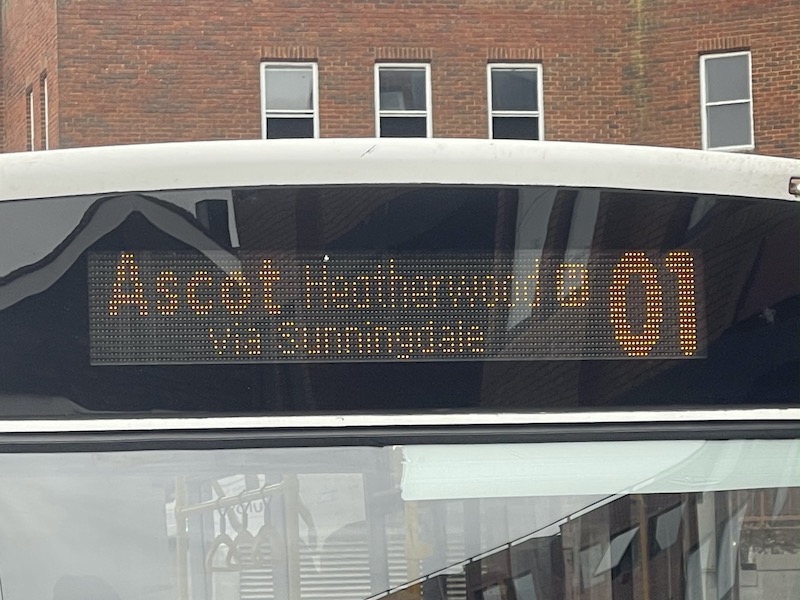
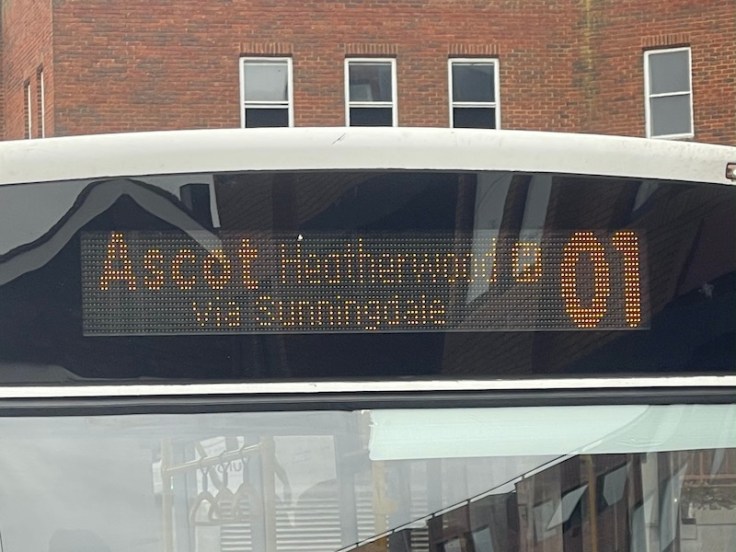
Appropriately enough the countdown kicks off with a bus service that also has a quirky route number: the 01, running between Windsor and Ascot famed for its exclusive access to Windsor Great Park and serving not only the Park’s secluded and exclusive village residences but also, by request on certain journeys, both Cumberland Lodge and Royal Lodge.

The service has been operated for many years by White Bus but I understand this is set to change in the Spring following a tendering exercise by The Royal Borough of Windsor and Maidenhead Council which has awarded the route to Thames Valley, part of the Reading Buses empire.
The current timetable utilises two peak buses with gaps in the mornings (pre 09:00 for one bus, and 08:13-09:40 for the other) and afternoons (14:24-16:10/17:10) for school journeys, thereby providing an efficient and cost effective operation for the small numbers of passengers who use the service.

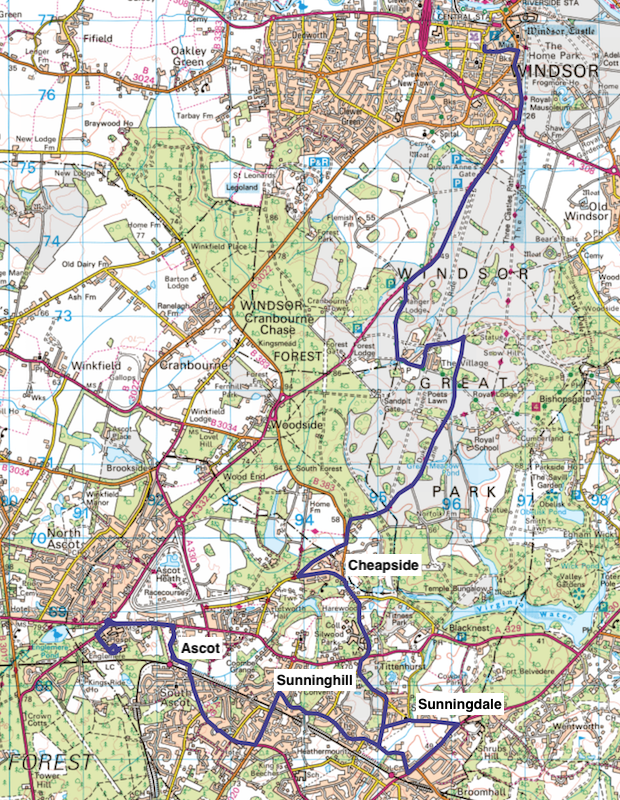
A direct journey from Windsor to Ascot would take not much more than 15 minutes by car but buses on route 01 have an end to end journey time of around 40 minutes due to also serving Sunningdale and Sunninghill including a full circuit of the village, as well as taking a sedate pace through Windsor Great Park itself.
I took a ride one day last week on the 11:55 departure from Windsor which was in the hands of Carl who’s been a regular driver on the route since joining White Bus 15 months ago from National Express.
Carl obviously enjoys driving the 01 and knows all the regular passengers who’ll be sorry to see him go with the changeover in a couple of months time.
Making for a nice royal connection, Ascot bound buses start their Ascot bound journey in Windsor at bus stop B in Charles Street..

… not only that, but the first stop after that is called William Street. And the royal connections don’t end there as we’ll see.
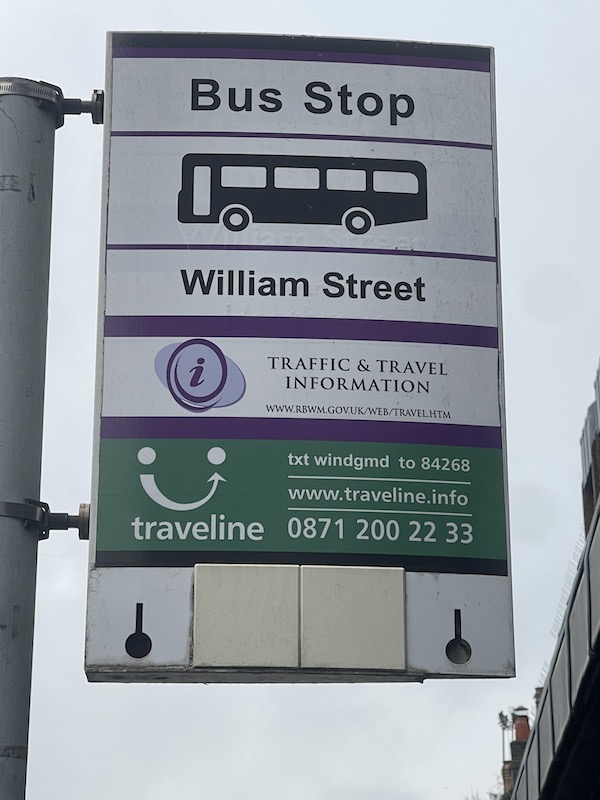
Inbound journeys terminate at the Parish Church close to the Castle…

… but it makes sense to begin Ascot bound services in Charles Street, not too far away at the bottom of pedestrianised Peascod Street, where all the main shops can be found, as roads by the Castle are regularly closed for a period in the mornings for the Changing of the Guard ceremony.

Nine passengers boarded with me at 12:55, most returning home with their shopping and we headed south out of Windsor on the A332 with the Great Park on our left and the first two passengers alighting at the small collection of cottages by Queen Annes Gate, one and a quarter miles from Charles Street.

After another one and a quarter miles we headed into the Great Park at Ranger Lodge with Carl using a remote control to open the gates which are otherwise kept shut to prevent all other traffic (other than residents) from entering the Park.

The next ten minutes is what makes route 01 qualify for its quirkiness mantle.

A unique bus travel experience with an almost traffic free glide along the Great Park’s deserted internal regal roads…

… meeting occasional equestrians (on the road where the late Queen Elizabeth would enjoy a ride) …

… and an even more occasional resident making use of the bus service.
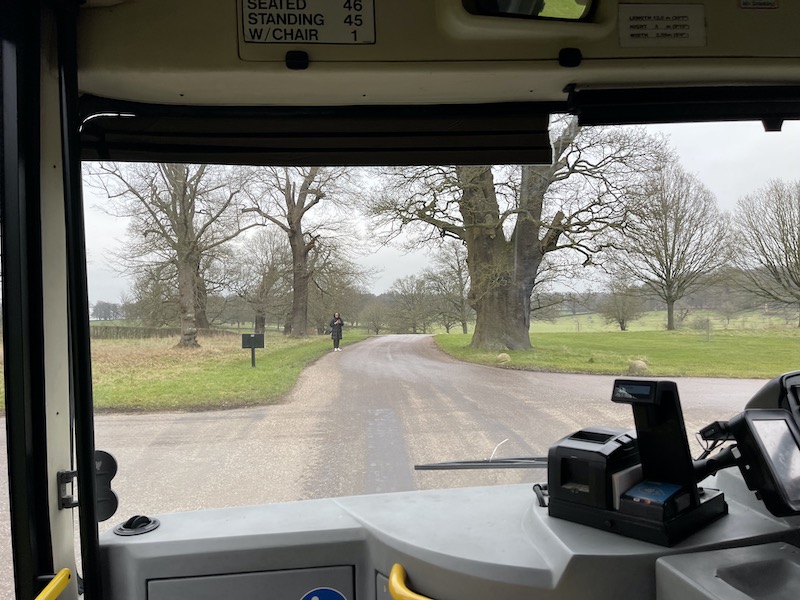
We passed Windsor Great Park Post Office and General Stores…

… before doing a tour of the centrally located village, but there were no takers.

Anyone wanting to board at Royal Lodge and Cumberland Lodge, which are sited off the bus’s normal trajectory through the Park, needs to get in touch with the bus company so a message can be sent to the driver to make a detour but it would seem Prince Andrew, who famously lives in the former residence, didn’t need to take the bus when I travelled as we avoided the diversion with no one on board wanting to alight there either. I thought about calling in, but decided against it.

Carl told me he had seen Prince Andrew on one occasion who boarded his bus and apologised to him and passengers for cutting them up in his Land Rover.

We left the Park through another set of remote controlled gates as a resident was entering in their car…

… and then did a circuit of Cheapside village followed by Sunningdale village (where one passenger alighted) before continuing via Sunninghill (the remaining six alighted with one picked up) and on to Ascot where our Sunninghill boarding passenger alighted at the railway station.

The route terminates at Ascot’s Heatherwood Hospital also served by Reading/Thames Valley’s Flightline 703 (Bracknell to Heathrow Terminal 5), and where there’s been some extensive residential development in recent times.
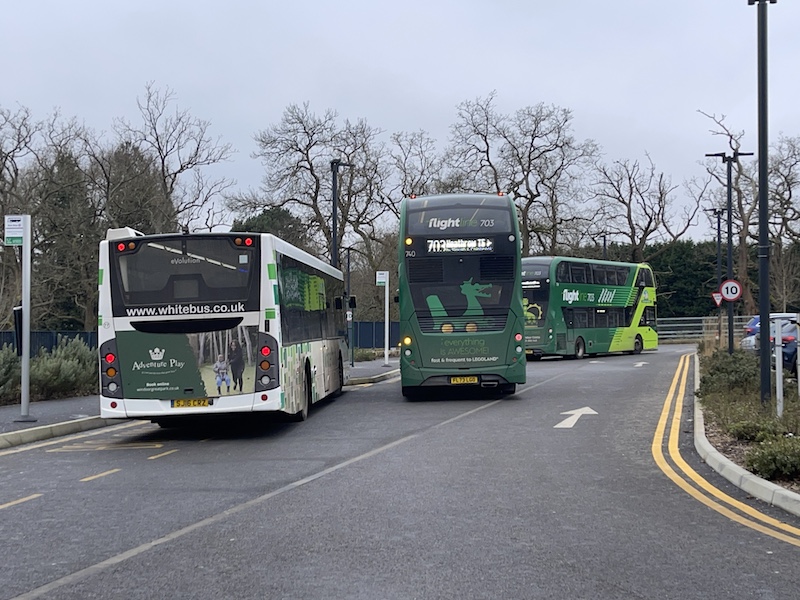
The return journey from Ascot at 12:45 picked up four passengers between Ascot and Sunningdale as well as the first passenger in Great Park (photographed earlier).
For those reading this online (and not in the subscriber’s email), here’s a short video clip giving a taste of the journey through the Park…
… and another showing Carl operating the remote control gates on the return journey as the bus enters the Park at Ascot Gate.
If you fancy a quirky bus ride, route 01 comes highly recommended. Watch out for another bus route, famed for its quirkiness, next month.
Roger French
Blogging timetable: 06:00 TThS


’1255hrs’ departure from Windsor???
LikeLike
11:54 – now corrected.
LikeLike
Interesting just how big White Bus and Falcon have become over the last few years, and that both seem to be able to maintain up-to-date fleets in what we’ve always been told is poor bus operating territory. If you include Thames Valley and Safeguard, a huge area of former NBC operation has been abandoned by the big groups (even more so if you add the various GoAhead operations on either side of this area).
LikeLiked by 2 people
Thank you for this, Roger. I Rode it 50+ years ago when it was the only route that White Bus operated. I don’t remember which route we took but I do remember being issued with a stock “Omnibus” ticket which I still have somewhere. I must take another ride before White Bus lose the route.
John Crowhurst
LikeLike
Quirky bus routes – great idea for a feature. Look forward to the next 9 and seeing which one is at the top of the charts! Maybe commenters could dare to predict them?
LikeLiked by 1 person
I’d put money on the 477 from Berwick to Holy Island being one. RP1 round Richmond Park in London is a favourite of Roger’s, but he’s blogged about it before so that might cost it. The Shetland North Island service 24 would be a worthy inclusion.
LikeLiked by 2 people
The W3 could technically be a quirky route as it runs through Alexander Palace which is a private road
LikeLike
Devastated to hear White Bus are losing the 01 after happily operating it for almost not too far off 100 years. Always a very personal service for me as I lived beside the garage in North Street (Winkfield) for a period in the late ’40s-early ’50s when the Jeatt family were in charge. In those days it actually ran as far as Bagshot on a very even two-hourly headway and included a Sunday pm operation. There was a second service operating just three days a week (Tuesday, Friday and Saturday) from the Crispin Hotel into Windsor via Cumberland Lodge and the famous Copper Horse rather than directly via Queen Anne’s Gate. That really took you into parts of the park that the 01 missed!
As the buses were the only vehicles allowed into 95% of the Great Park, it is small wonder that the Drivers were quite familiar with all members of the Royal Family, and passing waves were always returned between both parties. However, Prince Andrew appears to be still in character, but clearly feeling the need to improve his public image, did at least apologise.
For me, a sweeping wave of glorious nostalgia.
Terence Uden
LikeLiked by 2 people
Definitely a quirky route, with a nice Prince Andrew anecdote 🙂
LikeLike
I suppose that you were wise to “do” the route as a “rounder”. I did it one way southbound. I had a lot of time to kill before my next possible departure from Ascot. A toasted cheese sandwich from the Hospital Café and an “art, architecture & stained glass” inspection at a nearby Anglican church kept me sustained and entertained, before I left on a 703.
LikeLike
I assume that White Bus have been (substantially?) undercut by Thames Valley, but will it prove financially viable / lucrative for them…?
LikeLike
Prince Phillip sometimes used to stop the bus to say hello to some of the staff/retired staff he spotted on board.
LikeLike
I do so love the Quirky routes.
Myself & another local enthusiast penned articles on a few historical ones for a local Portsmouth /Southdown group on Facebook.
Looking forward to your series continuing
LikeLike
It may be worth mentioning that this will be the second time Thames Valley have taken over their route, albeit that Thames Valley were there first. From 1922 White Bus were in competition on service 2 between Ascot and Windsor (now the Heathrow-Bracknell 702), although this eventually petered out a few years down the line, and White Bus were able to switch to the route they have today. Who could have forseen at the time, Thames Valley, albeit now Reading Corporation in disguise, running them off the road again! Perhaps more ironically, they also ran an Ascot-Woking service at the time, also later abandoned. 100 years on a substantially enlarged White Bus now work several services in the Woking area.
What goes around comes around perhaps?
Terence Uden
LikeLiked by 1 person
An interesting idea for a series that has certainly got me thinking about what you will include – what defines a quirky route? The Holy Island bus has already been mentioned but perhaps buses that use ferries – Sandbanks and Torpoint?
For quirkiness I look for routes that include reverse turns either mid route or at terminals. You did a couple last year I recall and I think I’ve suggested route 23 to Langwith Woodlands in Derbyshire before as well.
Enjoy your travels and I look forward to reading the results.
Richard Warwick
LikeLike
The Shetland 24 I mentioned above really is the grandaddy of bus and ferry routes. Not only does it use the ferry between Ulsta and Toft, but it has two feeder services, one of which travels on a second Ferry. It is also fed by the Fetlar Island dial-a-ride service which connects with a third ferry which in turn connects with the 24.
LikeLiked by 2 people
Thanks Roger for your interesting piece, and I look forward to the rest of the series. White Bus runs one of our local routes and the vehicles they use the (the newer Volvos) have a very smooth ride quality. Shame they have not participated in the discounted bus fares cap.
I feel TFL should look to expand their bus routes out into the provinces, this sort of inconsistency amongst bus operators does not make the bus an attractive option to the casual rider.
An all day bus-pass on TFL routes is £5.25 all-day, and it doesn’t matter which bus you get on, as long as it is red, we should be encouraging integration.
It could also speed up boarding, in TFL land riders just tap on, knowing it’ll be a max of £5.25, depending on how many buses they get, or if they can take advantage of the hopper fare it could be cheaper. There’s no having to faff with getting a point to point ticket. This is the part which slows down the boarding.
-Chris
LikeLike
I strongly agree, I want to see TFL become a South East Regional Transport Authority myself. Regardless of London’s boundaries, the transport needs to consistently cover a wider region. Common identity, fares and a proper all day, 7 days a week timetable, feed into the rail network etc. All this is essential if we want to reduce congestion and grow bus ridership. Given contactless is spreading all over the SE, including to the station at neighbouring Virginia Water, spreading the same system to the regional buses seems like a natural next step to me. In fact before bus deregulation, London Transport helped run a very extensive country network including to places like Ascot and Windsor and many more places around London like High Wycombe, Aylesbury, Luton, Stevenage, Stansted, Harlow, Sevenoaks and Guildford and many more towns. The wider bus network used to be tightly integrated with the red buses. Tickets like Green Rovers allowed unlimited travel. This was done 40+ years ago with far less technology than today.
Aaron
LikeLike
The current London Buses network runs at a deficit of not far off £800m a year. How much would it cost to extend it in the way that you propose, to an area of lower density population and longer journeys? £2 billion, £3 billion?
LCC
LikeLike
See this is where I wish the mentality would change, London buses make a sizable loss if you only look at their ridership but it’s essential to fund it at that comprehensive level of service. It has widespread social and economic benefits, so even if the buses lose TFL money, they bring in many more pounds into the areas they serve than the losses are (I’ve heard it maybe as high as £10 in benefits for every £1 spent). If you look at it in purely economic terms, you miss the health and environmental benefits which takes pressure off things like the NHS and care. The fact that the wider region around London used to have the same system and it was manageable for decades despite the smaller population proves it can be done. If anything an integrated network is needed more now than ever, as the SE is far more built up today. Following Roger’s blog for a couple years, I don’t think who owns the buses matters as much as the model. All the places we recognise as having good bus services have one thing in common, they have one really dominant operator. Transport is a natural monopoly that needs a well defined area that makes sense for its region. All deregulation did was fragment everything and create a race to the bottom, so places with stable networks were lost and with it the passenger base. Between it and paying shareholders, deregulation was a costly mistake. Every penny should go back into the service in some way, including to uneconomical services and times of day. So even if a new London Country network lost a few billion, this is the price worth paying for a high quality and integrated network. Not like it’s a sunk cost separate to everything else, all those bus cuts just put the losses on to other things.
Aaron
LikeLike
Agreed, the bus network should be run for the utility of its passengers, as opposed to the supposed free-market competition. Passengers do not particularly care for who owns the bus, but do care that the service is reliable, frequent, affordable and that standards are kept. Unfortunately there was thinking at the time that free-market competition will solve everything, just look at Thames Water and trains for example to see how that’s turned out for its clients and passengers.
Having grown up in the provinces after bus deregulation, in a household that didn’t drive I have never been enthused about the various operators that have run the services, and pretty much everyone learns to drive and buy a car as soon as they can afford to since the quality is so variable and in some cases, dire.
Even though we do have some operators that have invested in their fleet and timetables as a result of BSIP, such as Falcon and White, the system is still very much disjointed with the greater London area, and expensive, especially if you have to switch between provincial and TFL services. That’s two sets of tickets you have to buy!
Sure, in my neck of the woods there’s some effort to try and join operators together (e.g. the Surrey Acorn ticket) but for the casual bus rider it doesn’t go far enough. TFL style tap in once flat fares, with a cap to daily bus pass are the way to go, you just roll up with you have and get on board to where you need to be.
You also have the benefit of speeding up boarding, this is very obvious when you ride a TFL service vs a provincial in which paying passengers have to buy a point to point ticket, and also navigate the Ticketer machine’s fussiness with the presentation of the card. It doesn’t live up with the instantaneousness that people expect with contactless.
-Chris
LikeLike
Spot on! Public transport is an enabler for a host of other government policy objectives which together should improve everyone’s quality of life. Public funding of comprehensive bus networks isn’t a subsidy or a burden, it’s an investment in society and a force multiplier for economic growth.
Peter Brown
LikeLike
It doesn’t matter whether you describe public funding as a subsidy or a burden, it means it is competing against everything else that is funded from the public purse and ultimately comes almost entirely from taxation. The DfT report on the value of the fare cap published last week is lukewarm about its societal benefits, although there are some interesting comparisons with actual behaviour against DfT appraisal guidance.
It is land use planning that needs controlling to enable public transport to run effectively; continuing hollowing out of town centre functions and the phenomenal spread of low density housing – the government’s no.1 objective, it would seem – will never generate more public transport use.
LCC
LikeLike
Green Rovers are coming up to their 70th birthday had they lived that long. And London Transport never actually reached Stansted, but of course had their own garages in the towns mentioned or nearby.
But please, please never let the present TfL take over the previous LT area and beyond. Inflicting their operating practices on the unfortunately population would be a costly disaster.
LikeLike
Stansted got a Greenline route (720) for a little bit in the 70s if my old timetable is anything to go by. Anyway, can you elaborate? Don’t think it could be any worse than Arriva’s commercial services.
Aaron
LikeLike
It wasn’t London Transport after 1970….by then the 720 was a National Bus Company operation
LikeLike
Where’s the money coming from for all these ideas you keep coming up with, Aaron? It has to be paid for somehow and there’s a limited and annually reducing pool of taxpayer funding which has to pay for everything.
Are you taking it from the NHS? Education? Care for the elderly and disabled?
It’s no good saying “I wish the mentality would change” when all you offer is basically fantasy which needs a magic money tree to pay for everything. Sorry to burst your balloon, but you need to be less dismissive of those who point out the holes in your ideas and maybe think before posting what are nothing more than fantasies.
Especially when your fantasies repeatedly involve inflicting London-style bureaucracy on the rest of country without even asking yourself if it’s actually wanted anywhere else or looking at best practice from elsewhere and thinking “Can we take the best of everywhere and create something really good?”.
LikeLike
Anonymouse. I’m fed up with our country being so cynical, seemingly a reaction to decades of Thatcherism, Neo-liberalism and deeply damaging austerity. There are huge sums of wealth that could be used for the greater good out there. We can afford a lot more than you think and frankly we deserve it. But we must demand it. I’m disabled myself, it is wrong to silo off transport from things like healthcare, housing, education and so on. We need all of them. Not oh we can do without this bus route or 1 less council house so we can have a school. One affects the other. We tried the way of austerity, now everything is screwed. Now we must try the opposite, actually investing in things with a proper thought out long term plan and move back to public ownership. It’s more efficient.
By London-style bureaucracy, I assume you mean minimum standards of service, an integrated network and a service that actually encourages people to use the service? I have an English bus pass and the only place I willingly pay for buses is Edinburgh. Why? Because it’s very easy to find out the cost, all the different routes, buses are frequent and clean. I used to happily pay in London for the same reasons and would pay in Manchester since the changes that were brought in for the Bee Network. The opposite of where I live in Hertfordshire, where it’s a disjointed mess. When I found out we were once part of a large London Country network which had these standards, just for it to be sold off, it made me very angry. Even more angry when I found out neighbouring countries still maintain the high standards in their public transport. When I was growing up, ‘rip off Britain’ was heard everywhere on the news, but at least things still worked, now they don’t and I don’t get why we put up with it. For buses, I don’t see why every village can’t get at least one bus an hour, an appropriate level of service, like how a bus every couple minutes in Edmonton is.
I have my own ideas, but your question at the end is all I want. But when all people say is, ‘we can’t afford it’ or ‘it won’t happen’, it winds me up.
Aaron
LikeLike
@A Nony Mouse – to quote Lord Darlington, in Oscar Wilde’s play “Lady Windermere’s Fan”, a cynic is a man who knows the price of everything and the value of nothing.
Bus services can be a great “enabler”, enabling people to get to jobs and opportunities (including to/from employment at anti-social hours), training and education, healthcare, shopping, leisure and entertainment. Bus services which may not wash their face commercially can nevertheless provide wider benefits to the economy. I think the importance to the UK’s economy of good public transport, there when people want or need it, is often underplayed.
You may question whether “London-style franchising” is actually wanted anywhere else. Maybe it is not unreasonable to ask the question – although Greater Manchester has now rolled out a franchised network, with further parts of the country to follow in due course. Perhaps they do want it.
It is worth bearing in mind how, in the years since deregulation outside the capital, bus patronage in London has risen very sharply at the same time in contrast to the spiral of decline which has continued across the rest of the country. A few bright spots only mask deeper decline elsewhere.
As for the cost, yes, London’s bus network is supported to the tune of around £800million a year. But what of the bus services outside London? Next year, in the rest of England, they have been allocated £285million in BSOG (London doesn’t get BSOG). On top of that, another £670million in BSIP, plus another £151million for the £3 fare cap. A total of more than £1billion – source: Bus service operators grant: local transport authority final allocations 2025 to 2026 – GOV.UK What I don’t think this includes (although happy to be corrected if I am mistaken) is the subsidies paid by local transport authorities for tendered services (including school services).
Malc M
LikeLike
Interestingly TfL already extend well beyod London with rail but not with bus
LikeLike
Before my time, but my town of Cheshunt used to have London buses and all the trains were just BR. Now it’s almost like it swapped, we have the Weaver Line on the Overground (TFL) but the buses are deregulated and non-TFL. Would make more sense if both were run by the same authority. Can use oyster on trains but not buses, is very strange and inconsistent.
Aaron
LikeLike
White bus and Falcon are two excellent companies in and around the Woking area where my son lived until very recently.
Few years back I purchased 2 or 3 buses off White bus because they said they were in such a good condition!
Shame when a good operator is elbowed out by a larger rival who has greater financial power but at least Reading buses appear a decent organisation.
How my hometown of Colchester could do with any of these operators!
Tony
LikeLiked by 1 person
Good to know a bus like this exists, love a ramble through Windsor Great Park and neighbouring Virginia Water. Also good you documented someone hailing the bus within the park, shows people use buses in some very unexpected places if the service exists. These things need a higher profile but thank you for showing us this pretty route.
Aaron
LikeLike
I wonder if there are any other operators using service numbers with leading zeroes?
I recall that Cumberland MS used to use them on their town services, but I don’t think anywhere else did.
LikeLike
National Express run services under a 0xx series although far reduced from what it was.
LikeLike
Interesting blog, their was a few quirky routes in the West Midlands that were operated by Ludlows [which is long defunct] they had some routes numbered in the 00 series which included a 007 Merry Hill-Bromsgrove, the current Diamond 002 Merry Hill-Weoley Castle, is the only one of those routes left
SM
LikeLike
I’ve been meaning to tick this route off the list for ages, must get on with it! Unfortunately White Bus seem like they may have bitten off more than they can chew with their recent push to expand. Driver shortages, vehicle failures and not participating in the fares cap on routes where it was previously in place mean they’re not getting a great reputation. Using the 555 has very much become a last resort for me, I was initially pleased they won it from Diamond but unbelievably they’re even worse.
LikeLike
Just for the record, there was, briefly, another operator running through the Park. In the summer of 2007, First Beeline ran service 300 between Windsor and Virginia Water station via Windsor Great Park and Savill Gardens, using some roads in the Park other than those used by White Bus, sponsored by Surrey CC and using the Council’s Ride Pegasus school buses (very long East Lancs-bodied Darts). Unfortunately it had to be withdrawn prematurely because of the Foot and Mouth outbreak.
A few photos here: https://www.flickr.com/search/?user_id=33075566%40N08&sort=date-taken-desc&text=LK56JKE&view_all=1
Michael Wadman
LikeLike
please create a game
LikeLike