
Saturday 25th January 2025
Many thanks for all the positive feedback and comments about the first in this new fortnightly blog series featuring Hertford. I was enthralled to read the fascinating back stories and history about Hertford’s stations many of you kindly provided as well as making suggestions for future places to include as the year progresses. I’ve currently got a fairly blank programme of visits ahead and want to feature places where two (not three or more) contrasting stations in the same locality serve mostly different destinations and ideally are on different tracks without a connection, although this is a lose definition and will, I’m sure, be compromised in some of the places I’ll visit.
For this second blog in the series I’ve taken a look at the two stations in Canterbury.

Canterbury West, which is the busiest, and Canterbury East; albeit, as you can see from the map below, despite their geographic names, they’re actually located one directly above the other on almost the same line of longitude. Each station gained its new designation in an 1889 renaming to avoid confusion caused by both previously being called Canterbury.

Canterbury West came first, built by the South Eastern Railway and opened in 1846, whereas Canterbury East was built by the London, Chatham & Dover Railway and opened in 1860. There was intense rivalry between the two companies and you can still see the companies differing approaches to station architecture in the buildings which survive to this day, 165 years later.
Both stations are now served by Southeastern trains with West located on the line from London to Ashford, Canterbury, Margate and Ramsgate and sees High Speed ‘Javelin’ trains as well as conventional stock while East is on the London, Chatham, Faversham and Dover line. As you can see on the map extract above, these two lines cross just west of the city centre with the former tracks passing under the latter.

Both stations have two platforms with Canterbury West featuring a very imposing Grade II listed building complete with pillars and smart off-white paint work at its entrance…

… while over at Canterbury East the main building has a more traditional station frontage…

… with other extensive former railway buildings in the same style nearby now housing a Snooker Club.

Both stations have a Grade II listed disused* signal box. Canterbury West’s is located over the tracks to the east of the station…

… with Canterbury East’s placed just behind the eastern end of the Dover bound platform 2.

Both look past their prime in their disused* states and will take some upkeep to maintain the Listed status which in my view is somewhat questionable.
*Update – I now understand Canterbury West’s signal box is still in use albeit just controlling the immediate local area including mechanical shunt signals. (Thanks David)
Canterbury West sees an hourly westbound service with High Speed Trains via Ashford to St Pancras and an hourly stopping service via Ashford and Tonbridge to London Bridge, Waterloo East and Charing Cross with Class 375 trains. In the eastbound direction the former terminates at Margate while the latter terminates at Ramsgate.

Over at Canterbury East there’s an hourly westbound service to Victoria via Faversham, Sittingbourne, Chatham and Bromley South with eastbound trains continuing to Dover Priory.

You pays your money and takes your choice from Canterbury for London bound travel on weekdays with St Pancras reached in 57 minutes at £88.30 for an anytime day return from West or reach both Victoria (East) and London Bridge (East) in 94 minutes and Charing Cross (West) in 104 minutes for a saving of £14.50 and pay £73.80.
Arrive into London after 10:00 and you’ll see your day return fare tumble to £47.30 for St Pancras and £39.40 for other London stations and for the latter if you leave Canterbury after 10:00 it’s just £30.60.
Interestingly the full whack anytime, any train seven day season is £202.60 offering a saving over paying daily even if travelling for only three days a week.

You’re able to buy your ticket from a ticket office at both stations. Canterbury West’s has two windows and East has just the one.

There’s just the one ticket machine in the entrance hall at both stations with Canterbury East’s full size version out of action the day I visited…
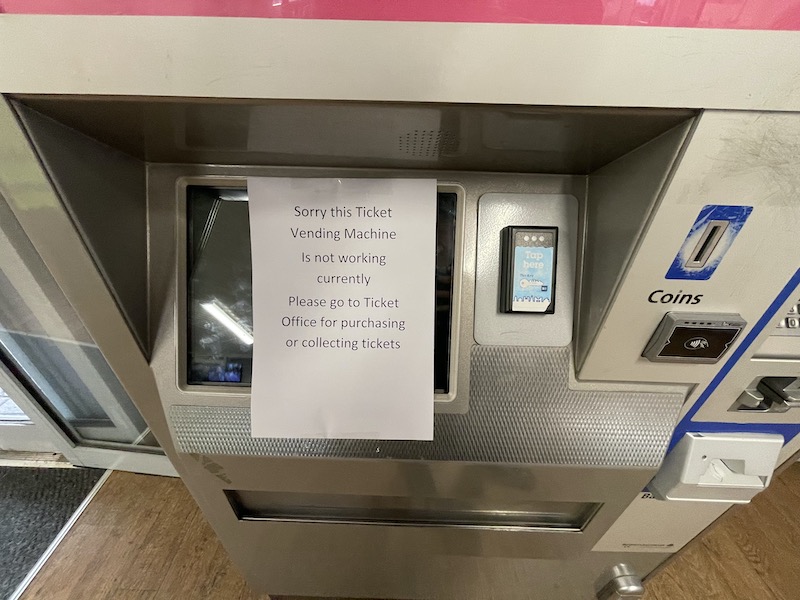
… and West having a mid size one.

Both stations have a four gate gateline with three standard and one wide.

While waiting for your train you’ll find a café at both stations. Canterbury West has a Starbucks on platform 1…

… and an independent mobile coffee dispenser outside…
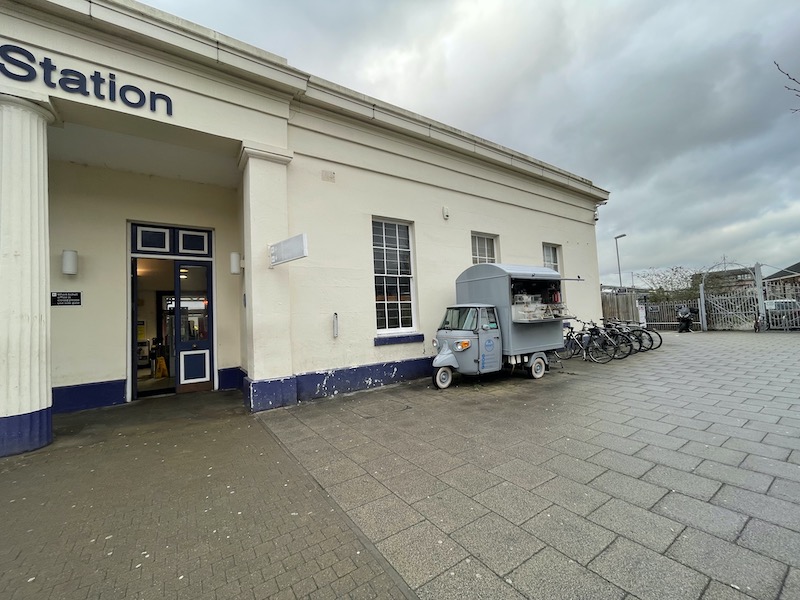
… and Canterbury East has an independent retailer in the ticket hall which also sells bags for some reason.

Both stations have waiting rooms on both platforms with Canterbury West’s on platform 2 being particularly spacious but with just three lots of three seats…
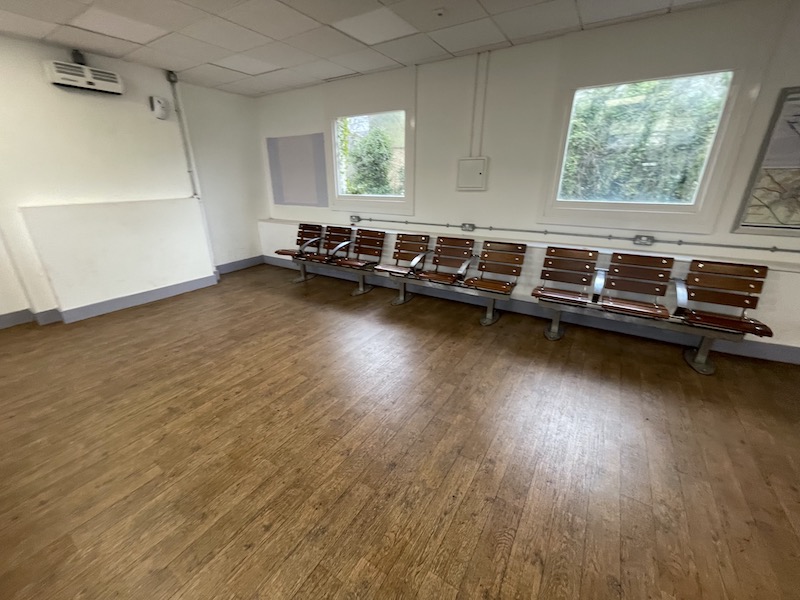
… and an entry/exit door arrangement hangover from Covid…

… and East’s being of a similar size and similarly sparsely furnished.

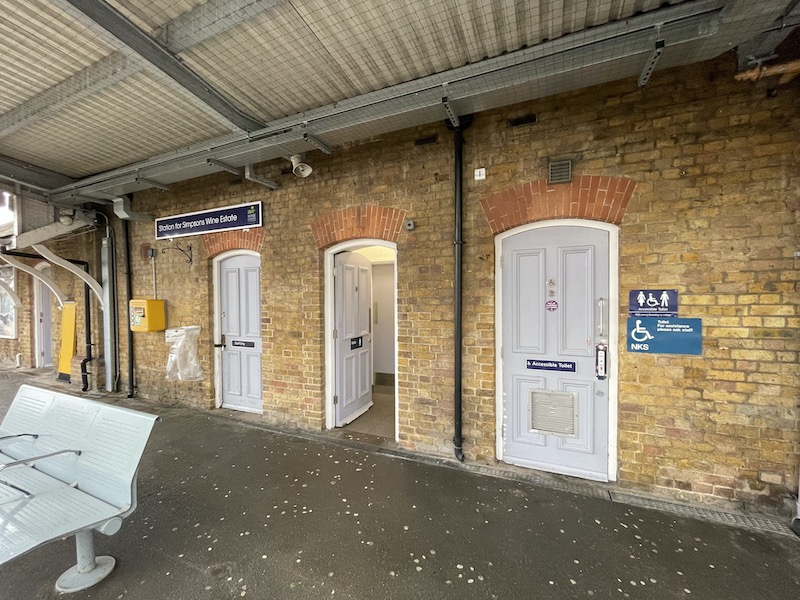
Both stations also have toilets – on the London bound platform 1 at Canterbury West…

… and the Dover bound platform 2 at East.
There’s a bus stop right outside Canterbury West for Stagecoach route Uni2 to the city centre every half hour after the morning peak and other buses depart a short walk away in St Dunstans Street.
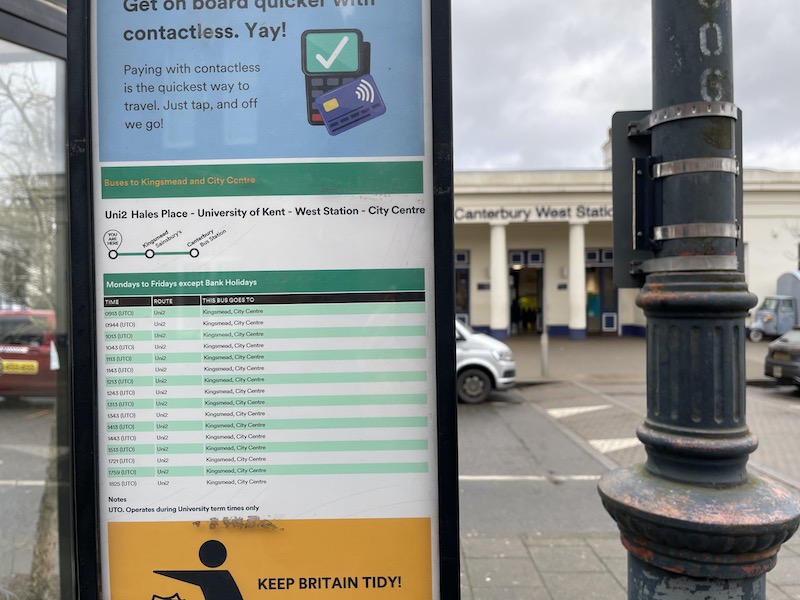
Canterbury East has a multitude of bus routes passing close by in Pin Hill (on the A28 ‘ring road’).

Back on the platforms, both stations have an original subway under the tracks to link the far side platform with the ticket office entrance/exit.

In West’s case the subway is needed to access Ramsgate bound trains…

… and as you can see…
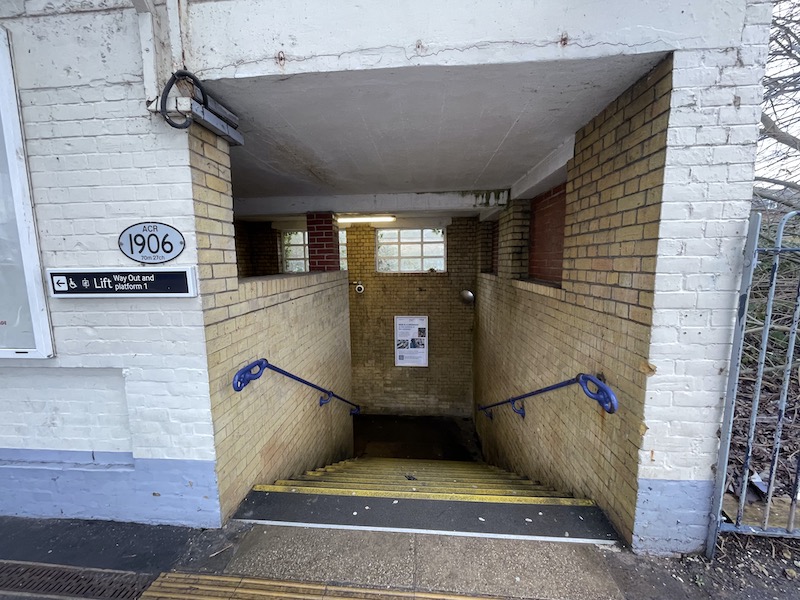
… is a rather a shabby, drab looking affair…

… while over at East…

… the entrance to the subway looks a bit brighter …

… and is more inviting.

However, both stations also now have a footbridge and lifts making both platforms at both stations accessible. Here’s West’s…

and here’s East’s.

One thing that struck me was the extensive provision for 134 cycle parking at West both inside and outside the gateline…
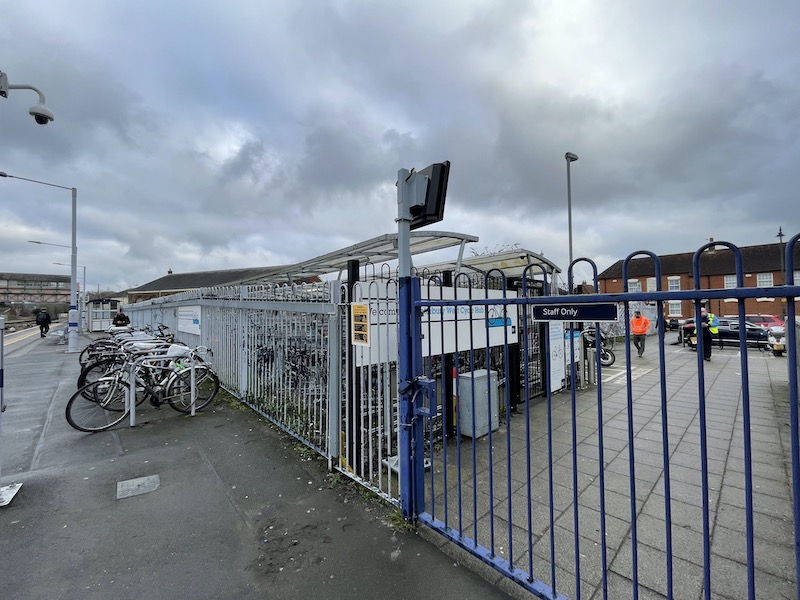
… but a minimalist approach seemed to be apparent at East with only those three stands noted, although when I got home and looked things up, online information confirmed there’s sheltered accommodation for 46 cycles which I missed spotting.

East may not have the imposing pillars at its entrance sported by West, but it does have these rather nice arms holding up the canopy roof over the entrance…

… and it is the station to alight for the Cathedral and University (as well as Simpsons Wine Estate)…
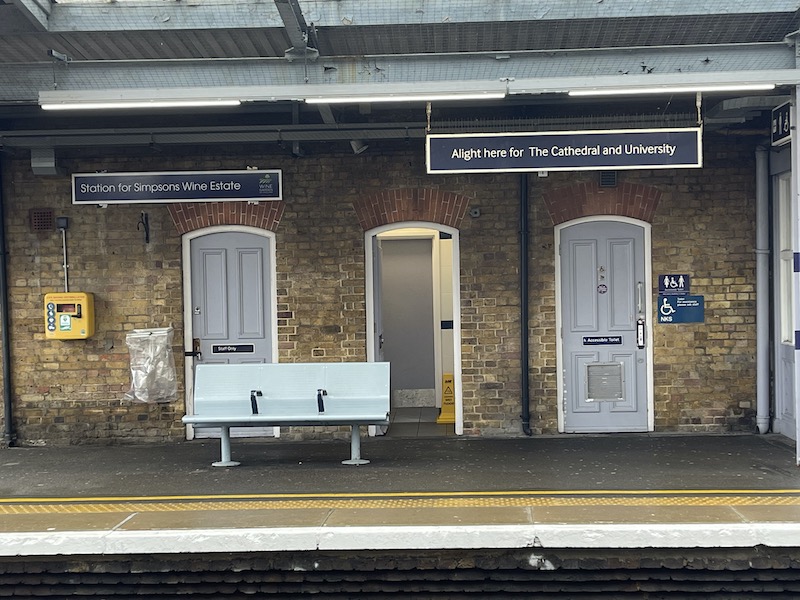
… whereas these attractions got no mention at West, unless I missed them.
Trains between Canterbury East and Sittingbourne seemed particularly popular with students attending college and it was noticeable how some of them they don’t seem to know what the yellow line on the platform edge is for.

And that’s my take on Canterbury East and Canterbury West except to add what a shame Canterbury East’s name has faded from its totem pole.

Roger French
Did you catch the first blog in this series? 1: Hertford
Blogging timetable: 06:00 TThS
 BusAndTrainUser
There was another line from Canterbury West knows as the Eltham Valley line, It ran to Dover. The line closed in about 1948
LikeLiked by 1 person
Elham… not Eltham
LikeLike
The Elham Valley line had a third station, Canterbury South, close to the site of the Kent & Canterbury Hospital, which has subsequently expanded to straddle the old line. Amazingly, the station house survives as a present day dwelling.
Man of Kent
LikeLike
I thought compass technology and cartography were quite well advanced 200 years ago, so some of these station namings are indeed curious.
LikeLike
Another line was the Crab & Winkle line that ran from Canterbury to Whitstable
LikeLiked by 1 person
Which was in fact the first line to arrive in the city (1830) with a station on North Lane. Trains were subsequently diverted into the West station.
Man of Kent
LikeLike
Canterbury West has at least one (possibly two) more ticket machines, in the corner near the ticket office. One can just be seen on the extreme right of the picture taken from within the barrier line – it’s next to the platform side window, to the right of the reinforced door leading into the ticket office.
LikeLiked by 1 person
Indeed. Canterbury West has two full sized ticket machines, plus another slim one nearer the ticket barriers.
Queues for these used to be massive for the High Speed, though the introduction of digital ticketing has since reduced this significantly.
LikeLike
Can I suggest Newark, as we have Newark Castle on the Nottingham-Lincoln line and Newark Northgate on the ECML. The only physical connection is from ECML towards Lincoln.
Niall Spencer
LikeLiked by 1 person
On the list.
LikeLike
Newark – the town with an ‘interesting’ anagram.
LikeLike
…and some equally ‘interesting’ residents.
The local police have in the past suggested that the ‘interesting’ element of Newark’s residents look towards Mansfield for their delight and delectation, so I’m grateful that there is no direct rail link between the two towns.
LikeLike
It’s not surprising that people feel the need to cross the yellow line at East given that it runs down the middle of the available space.
And passengers who rely on the tactile paving to keep them a safe distance from the platform edge will cross it anyway.
LikeLike
Here in the village of Notton, we no longer have a station at all, but back in the day we were spoiled for choice by the fact that we were served by two stations – Notton and Royston (1882-1930), not to be confused with Royston and Notton (1841-1968). Did any similar pairings exist elsewhere? Our nearest two-station communities now are Wakefield and (perhaps more surprisingly) Thorne, near Doncaster.
LikeLike
The critical issue at both stations is the ability to process a peak arriving trainload through the limited gateline although it’s difficult to see how this could be improved within the space available.
LikeLike
I think the East/West distinction is related which side of the river Stour the stations are on, though North/South would really be more appropriate. East/West is better applied in Maidstone – re the Medway river.
Thanks for including some bus details. I have always thought that east Kent would be a good area for a rail+bus integration pilot scheme, with express buses filling the relatively few gaps in the railway map to achive a fast inter-urban travel network. Stagecoach have done a lot to improve bus services and even have a few express routes – duplicating the rail route Dover – Canterbury E – Faversham (which makes up somewhat for the presentent hourly-only rail service. However, there appears to be little evidence of spontaneous co-ordination (try journey-planning a few trips across the area), so perhaps Haidi Alexander should issue a ukase or two to make the rail and bus managements talk to one another in an effort to grow the public transport market and really put the passenger first.
LikeLike
Good feature on two stations I haven’t visited for many a year. Canterbury actually used to have three stations – South Canterbury was on the Elham Valley line to Folkestone, and closed to passengers in 1940 (and to freight in 1945). The military took over the line for the duration of the war, and it was used to house a giant rail-mounted gun (“Boche-Buster”) which was hidden away in Bourne Park Tunnel. Some passenger trains were run by the army, and the public were allowed to use some of these at their own risk. After the war the Southern Railway reluctantly reintroduced a short-lived “proper” service, but only over the southern section of the line. Graham L.
LikeLike
A fascinating series. I look forward to reading about Tyndrum’s stations at some point.
LikeLiked by 1 person
Filling in a blog on the two St Budeaux stations might be even more of a challenge but not sure if they fit the strict criteria.
LikeLike
When I visited many years ago, the ticket office staff member at Canterbury West was happily conversing in French with visiting tourists. I hadn’t thought of the town as a destination for foreign tourists, but I suppose that should have been obvious to me, with England’s premier cathedral there.
LikeLike
Is Edenbridge and Edenbridge Town on your list?
MotCO
LikeLiked by 1 person
On the radar.
LikeLike
Greetings Roger, Thanks as always for the latest blog. How about Hartford (LNW) and Greenbank (formerly Hartford and Greenbank CLC)? My dad occasionally relieved in the Booking Offices at both. Richard Capper
LikeLiked by 1 person
RE East and West, there was once a Canterbury South, which was east of the other two.
LikeLike
For future explorations and extreme contrasts, how about Gainsborough (Central and Lea Road) or Reddish (North and South)? Graham L.
LikeLiked by 1 person
My question is whether the two cafes sell newspapers and magazines? SWR have let two concessions, at Fleet and Basingstoke, with no papers or magazines on sale. This should not have been allowed by SWR. Now at Salisbury I find that the former excellent cafe has been re-purposed to sell mostly sweets and soft drinks, with a cabinet in the centre where there used to be tables,, with only a minimal space for papers – -and no magazines at all. Where can magazines expect to find sales except at railway stations? Can you please look into what “cafes” actually sell on your future visits?
malcolm chase, Fleet
LikeLiked by 1 person
Cafés generally sell food and drink, although the days have long gone when you could get a proper cooked meal in one.
I’d expect to go to a newsagent for a paper or magazine, and I’m sure they’d be grateful for the business given that most printed publications have lost sales drastically over the past couple of decades.
LikeLike
Before HS1, East was the more important station. IIRC there was an hourly all-stations service from Dover via Canterbury East to Bromley South then Vic. And an hourly limited stop service. There was a similar pattern on the Margate to Vic route. The two sets of services connected at Faversham to provide a neat half hourly fast and half hourly slow service on both routes with a cross platform change every other time. At the time Canterbury West just had a stopping service from Margate to Charing Cross via Ashford and the station was pretty quiet.
HS1 reversed the importance and effective service patterns of the two stations by knocking 40 minutes off the previous 100 minute journey time.
LikeLike
Can I suggest you do Action as a bumper edition (Acton Town, Acton Central, Acton Mainline, and North, West, East and South Acton)?
LikeLiked by 1 person
Good afternoon Roger,
Great idea for another series!
We went to Canterbury West from Southend behind Tornado for my 60th birthday treat – a few years ago now!
You’ll be welcome to visit Southend (Central on C2 C to Fenchurch Street and Victoria on GA to Liverpool Street).
Let me know if/when you’re coming and maybe we could meet up.
Kind regards,
John.
LikeLike
Thanks for the invite John, but with East (and Airport) as well as Central and Victoria it fails to get on the list having more than two stations!
LikeLike
Canterbury West ‘box is still in use, and is supplemented by a green Portakabin next to the former goods shed called “CWACC” (Canterbury Wye Area Control Centre). This controls the Stour Valley line and fringes with Ashford International. When I visited, there was a row of plastic ducks on top of the panel. I’m sure you can work out why!
Darryl in Dorset.
LikeLiked by 1 person
Can I suggest Bradford?
LikeLike
I would suggest Dorchester (South and West), and maybe Worcester (Shrub Hill and Foregate Street).
Oliver
LikeLike
Canterbury West is nearer to the traditional University (well, 1960s) at the top of the hill north of the city while Canterbury East is nearer to the newcomers (Christchurch and UCA).
LikeLike
Before High Speed arrived at Canterbury West, it was the East station that was the busiest I believe, as the fastest trains to London were from there.
Before Covid, East had a half-hourly service. It has remained hourly since.
Alex, Canterbury
LikeLike
Once upon a time, both stations had roofs over the tracks. Those at West covered only the platform lines, with the through roads open between them. They disappeared in the Southern Railway era. However, the overall roof at Canterbury East lingered longer, remaining until almost electrification (1959). More remarkable was that the replacement canopies at East were sourced from the never opened Lullingstone Airport station, which was between Eynsford and Swanley.
Man of Kent
LikeLiked by 1 person
Yet more wonderful blogs from you, Roger, and interesting comments from readers. What an excellent idea!
I’m sure we’d all like our own local pairs to be featured. Mine are New Mills Central [Manchester Piccadilly to Sheffield] and New Mills Newtown [Manchester Piccadilly to Buxton]. The passenger services only converge just short of Piccadilly. Both are part-time staffed Monday-Friday mornings. Central is the better looking station, but neither is anything like as impressive as the four you’ve featured so far. Nonetheless, I hope your choice will extend beyond the south of England, though I’m not expecting Tyndrum any time soon!
Brian Musgrave.
LikeLike
Thanks for the suggestion Brian – I’ll add it as a possibility and look out for no 3 in the north (!) but Tyndrum definitely must wait for the summer.
LikeLike
admittedly not glamorous, but Catford?
LikeLike
It must rank as quirkyous though!
LikeLike
Is the very stylish ECRCC HQ building near the West Station still standing?
Ricemans Store opposite the Bus Station must surely have been demolished!
Indeed, is there still a Canterbury Bus Station?
LikeLike
The one time East Kent headquarters in Station Road West is still there, but heavily reclad as the “Westside Apartments” https://maps.app.goo.gl/MiGG2B16xeSoSs689
Ricemans was replaced in the 1990s by the Whitefriars development; the replacement store took up the name of the parent Fenwicks group. Still open; other than Marks & Spencer, now Canterbury’s last department store.
The Bus Station is alive and kicking, and includes the head office of the current Stagecoach South East. Indeed, it is the legal lettering on the side of all the company’s buses.
Man of Kent
LikeLike
I was in Canterbury a few weeks ago and spent a little while in the bus station, which must be one of the busiest south of the Thames – especially if the overflow stands in St George’s Lane are included.
Ian McNeil
LikeLike
What about Bedford (Midland/St John’s) and St Albans (City/Abbey)?
LikeLike
This brings back memories Roger. I was a student at UKC (University of Kent at Canterbury) from 1969 -1972, West station was the nearest. Returning Sunday evenings from Charing Cross sometimes meant diversions from the usual Tonbridge-Ashford route. There was a small crossing keepers hut on the south side of the line on the west side of St. Dunstan’s street level crossing. Invicta, a locomotive used on the Canterbury and Whitstable Railway (C & W), was on a plinth in the Dane John Gardens on the ring road by the East station. At the time, it was painted all red and similar in design to Rocket. According to my 1980 C & W Rly 150th anniversary booklet, in 1977 it was taken to the NRM for full restoration to exhibition standard. Tyler Hill tunnel on the C & W ran under the University site and one Sunday afternoon in 1972 several of us students decided to walk through the tunnel. Being dead straight, we could see the other end, which emerged onto a school playing field. Couldn’t do that now. Some years later, as I understand it, one of the University buildings collapsed into the tunnel!
Looking forward to the next instalment.
Anthony H.
LikeLiked by 1 person
See: http://www.forgottenrelics.org/tunnels/tyler-hill-tunnel/
LikeLike
In the paragraphs regarding fares, Victoria is served by trains from Canterbury East and London Bridge and Charing Cross are served by trains from Canterbury West
LikeLike
Many thanks for spotting that; now corrected.
LikeLike
Quick typo – signal boxes past, not passed, their prime.
Suggestion for rest of series – consideration of quickest/shortest rail route between the pair concerned.
LikeLike
Thanks and thanks.
LikeLike
Farnborough‘s two stations might be a good comparison. A staffed commuter station on the busy four track electrified London Waterloo to Weymouth/Exeter mainline with remnants of past platforms and a branch line to the Royal Aircraft Establishment, versus an unstaffed two platform station on the Reading to Gatwick diesel line served by a different train company and a foot crossing overseen by a crossing keeper due to regular misuse that has resulted in an at least one recent RAIB report and the construction of a footbridge well underway.
LikeLike