Tuesday 21st January 2025

They say the railway’s byzantine fare structure is going to be sorted when Great British Railways (GBR) finally gets up and running. But that promise is like Billy Bunter’s never arriving postal order. Every incoming Minister in the DfT over the last couple of decades has promised to sort the complex system of rail fares and tickets out usually ordering a “full review” but instead another raft of additional price options are added to the mix. It’s happening again even now with the Great British Rail Sale.
Here’s an example of the oddities that abound rail fares in my neck of the woods and I’m sure readers in other parts of the country will have their own examples. I’m not talking Split Tickets or Advance Tickets with their inherent restrictions, I’m talking flexible turn-up-and-travel tickets – singles, returns, anytime, off-peak and super off-peak.
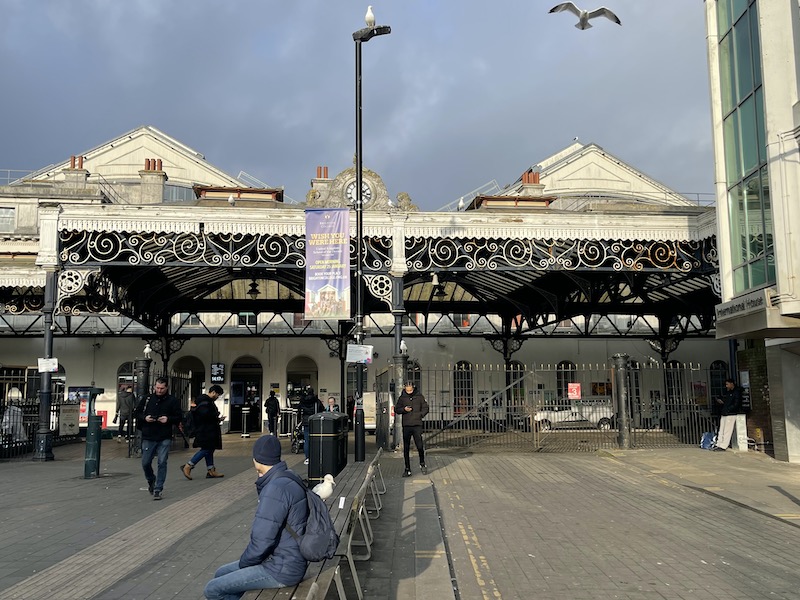
Let’s take a journey from Brighton to Victoria.

No longer served by Southern trains (other than sometimes at weekends when special timetables apply for engineering work which seem to vary from week to week). In normal times, passengers can either catch a half hourly Gatwick Express or a four-times-an hour Thameslink train to Haywards Heath and change there to a Southern train that’s come from Littlehampton or Eastbourne; particularly useful if travelling to Clapham Junction, which for some time has had no direct trains to and from Brighton.
Leave Brighton on Mondays to Fridays to arrive into London before 09:45 and an Anytime Return from Brighton to Victoria will set you back £65.00.
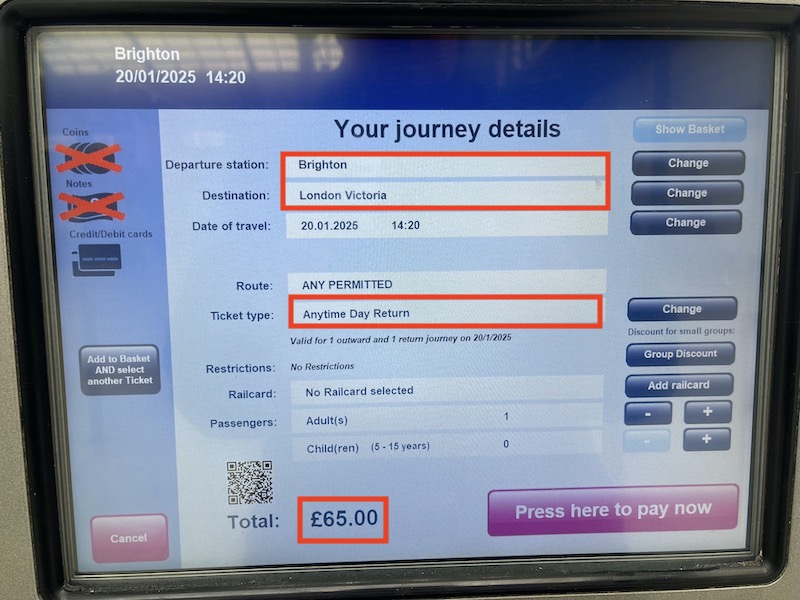
But, here’s the thing. An Anytime Return from Victoria to Brighton costs just £40.80.
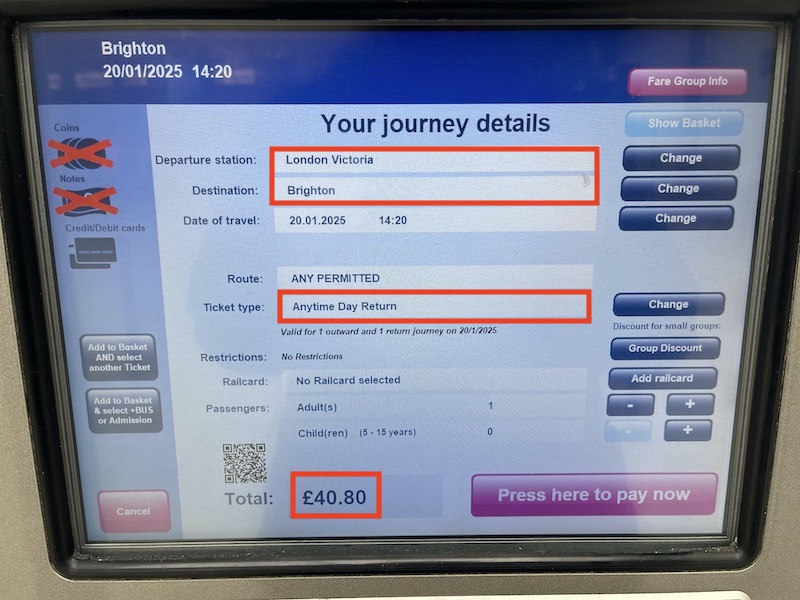
It’s for the same two journeys, albeit taken in a different order.
Bearing in mind there are no time restrictions on these tickets an astute passenger travelling from Brighton to Victoria and back would save £24.20 (37%) by buying a return from Victoria to Brighton and use the return portion for their outward journey up to London and the outward portion for their return.
Britain’s foremost rail fares expert Barry Doe tells me technically this would be in breach of National Rail Conditions of Travel paragraph 11.3 where the small print states “a return Ticket must be used in the correct sequence (you must use the outward portion of your return Ticket before you use the return portion). The outward portion of a return Ticket is no longer valid for travel once the return portion has been used.”
But as Barry points out a gated ticket barrier can’t know whether a return portion is being used before an outward portion and I suspect even the most officious Revenue Protection Officer would find it hard to prove whether you were travelling out or back with each portion.
Whilst there may be an argument that says trains are much busier in the morning peak going into London than coming out so there is justification for charging more for a peak hour Brighton to Victoria return ticket than a Victoria to Brighton return ticket, this logic falls down when you look at the price of tickets for single journeys and even more so with off-peak tickets, as I’ll show.
Because just as anomalous is the fact a differential applies to the price of a single journey ticket, but this time the other way around thereby negating the point just discussed in the paragraph above about busier trains in different directions..
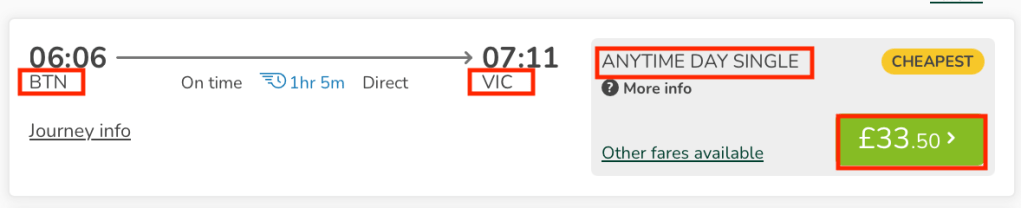
An Anytime Single from Brighton to Victoria costs £33.50 but buy an Anytime Single from Victoria to Brighton and you’ll be charged £2.50 more at £36.10.

Anomalies continue to abound during the day too. An Off-Peak Day Return costs £37.10 from Brighton to Victoria but it’s cheaper by £1.30 for an Off-Peak Day Return from Victoria to Brighton which costs £35.80.

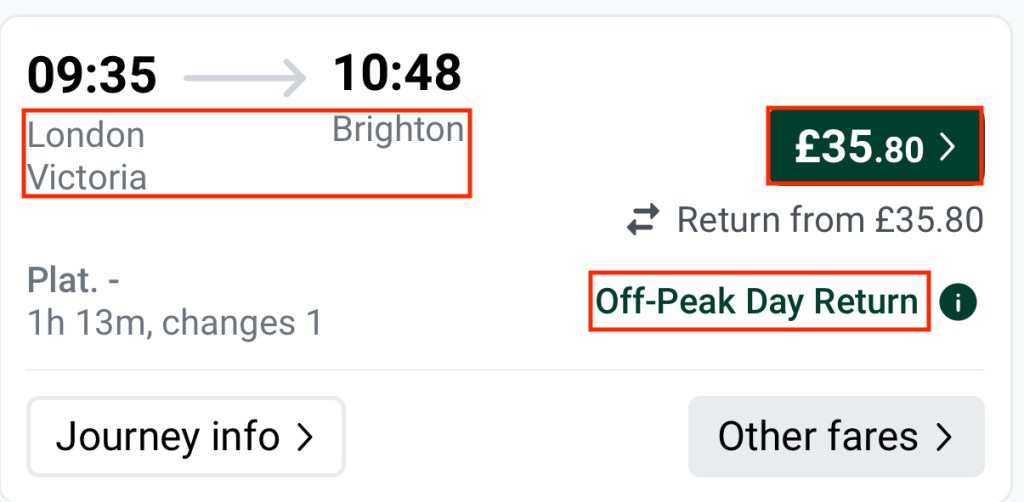
Why the difference when it’s the same trains covering the same distance at the same times with similar numbers of passengers? Both Brighton and London are popular destinations for off-peak travellers. It smacks of discrimination against passengers living in Brighton and other stations in Sussex, where the same anomaly applies – eg an Off-Peak Day Return from Hassocks to Victoria (and back) is £30.50 but from Victoria to Hassocks (and back) is £29.30.
However, when travelling after 10:00 a Super Off-Peak Day Return option kicks in for Sussex stations to Victoria reducing the Brighton to Victoria return price to £24.00 (and the Hassocks to Victoria return price to £20.00).

But the downside is this ticket isn’t available for return travel leaving Victoria between 16:14 and 19:16 on Mondays to Fridays. And there’s no Super Off-Peak Day Return option from Victoria to Brighton so passengers originating in London are stuck with the £35.80 (as shown above), albeit if they’re in the know they could ask for a ticket the other way around and use the outward/return portions vice versa as described above, albeit in breach of paragraph 11.3.
The differential is particularly stark at weekends when the Super Off-Peak Day Return is not only valid all day but reduces in price so passengers travelling from Brighton to Victoria (and back) pay £20.50 but passengers from Victoria to Brighton (and back) pay the same £35.80 that applies in the week which is almost 75% more for the same two journeys!
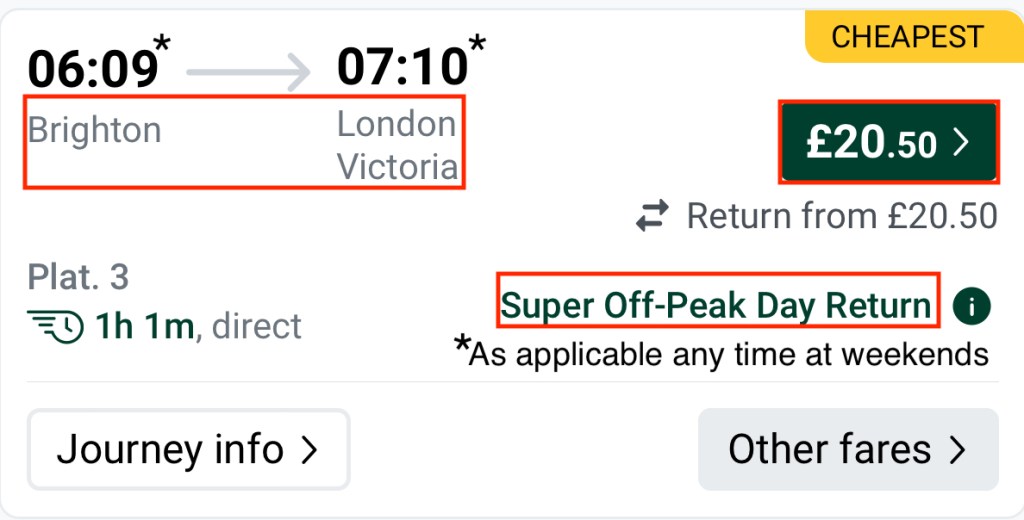
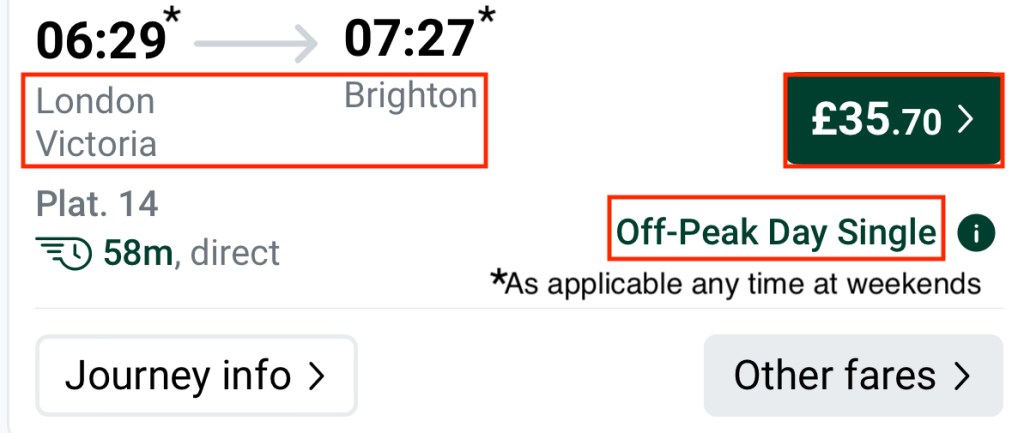
Even more ridiculous, turn up at Victoria station at the weekend and ask for a single to Brighton and the ticket price will be £35.70 – the Off-Peak Day Single for one journey, yet you can buy a Super Off-Peak Return from Brighton to Victoria (and back) for £20.50, so obviously it makes sense to ask for that (if you’re in the know) and wouldn’t be in breach of paragraph 11.3 as you simply throw away the unused Outward portion and just use the Return portion.
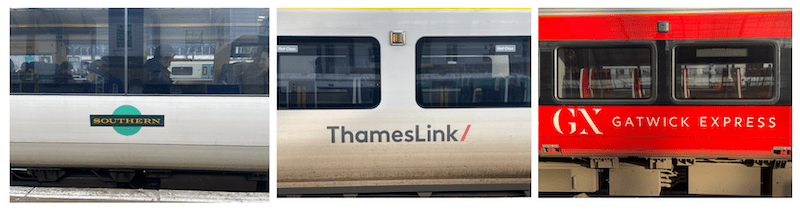
And, of course to add more complexity to all this, there’s the anomaly introduced in the 1990s when Southern and Thameslink were run by rival Train Companies with cheaper fares available if you travel on a Thameslink train rather than a Southern train.

According to what GoVia Thameslink Railway (GTR), which now runs Southern, Thameslink and Gatwick Express, would like you to believe this restriction still applies, but others point to the existence of small print in the Contract Terms and Conditions which says it’s not possible to restrict tickets to part of a contracted Train Operating Company’s operations and therefore a ticket marked ‘Thameslink only’ is perfectly valid on any train operated by GTR, including Southern. I’m not aware this has been established through a successful prosecution in court yet, but when I appealed against a penalty fare for using a ‘Thameslink only’ ticket on a Southern train some years ago the appeal was successful at the first hurdle as the company failed to produce any evidence or paperwork.
There’s a similar huge differential between the Anytime Day Return between Brighton and London Bridge (as well as stations through to St Pancras) depending on which direction you buy (£52.60 -v- £32.80) while a Thameslink only Off-Peak Day Return from Brighton to London Bridge is £22.70 and at the weekend the Super Off-Peak Day Return is just £15.50 which are exactly the same prices as apply for returns from London Bridge to Brighton, unlike Victoria.
Even more bizarre is adding the Travelcard options, especially at the weekend when the Super Off-Peak Day Return is available all day. Ask for a Brighton ‘Thameslink only’ Day Travelcard (for zones 1-6) at the weekend and you’ll pay just £21.00 and enjoy return train travel and the freedom to travel by buses, trams, Underground and surface trains all over London, yet rock up at Victoria and ask for a single to Brighton and you’ll be charged £35.70.

Other anomalies between Brighton and Victoria include splitting tickets at Gatwick Airport and also at Clapham Junction which offer savings for peak hour travel compared to buying a through ticket, but these add a whole new raft of confusing prices to relate which I fear is too much for one blog.
Barry Doe is not optimistic such anomalies will be sorted even under the promised GBR “the ticketing system became a mess as operators sought to ‘play the system’,” he told me, “but GBR will not change this because we are almost certainly not going back to a simpler BR-type fares system but going onwards to something WORSE than we currently have. The keeness of many current senior people for the utterly appalling LNER fares system proves this. Regardless of how a ticket is bought, many people want to have flexibility – a ticket that can be bought on the day and permits travel on a range of trains. In other words walk-on off-peak singles and returns of the type LNER has recently abolished.”
Sadly, as always with Barry, he’s right.
Roger French
Blogging timetable: 06:00 TThS
 BusAndTrainUser
” I suspect even the most officious Revenue Protection Officer would find it hard to prove whether you were travelling out or back with each portion”
If using an eTicket it flags up straight away that the return has been used if someone gives the outward ticket. Also the simplest test if someone suspects misuse is asking for the return ticket. Something which will likely have been eaten by the gates.
LikeLike
The extension of contactless PAYG to further stations outside London from next month was pre-empted by “simplified fares” introduced at the affected stations early last year. These included introducing a new PM peak restriction.
For “simplification” read more expensive.
Steve
LikeLike
sadly simplification usually means more expensive as the bean counters will always take away the cheapest options.
Pity Primark can’t run the railway!
Tony
LikeLike
Pity the railway can’t get it’s costs under control.
If Primark had taken over, they’d have closed the entire network down years ago!
LikeLike
I’ll drive to Brighton instead 😀
LikeLike
Crossing the orange wall
When I stay in Brighton for a few days and I’m not in a hurry I now get a single to Crawley, Top up my Keycard with a week Metrovoyager then bus to Brighton, returning all the way by bus to TfL Land.
On the outbound journey last Sunday the Brighton Mainline was completely closed between East Croydon and Gatwick Airport.
A half hourly Southern service was operating to Gatwick Airport via Mitcham Junction, Epsom and Horsham. The service didn’t even come up on the departure screen at Clapham Junction where the chap on the platform said it was a deliberate ploy to make Gatwick bound passengers go via East Grinstead and use the replacement bus service!
Last Friday I had a thoroughly enjoyable journey back to Brixton using 271, 420, 400, 434, 466, 60 and 250 arriving just under six hours later with comfort stops.
Victoria line to Euston with a view to catching Avanti but I never buy ticket in advance. There were only three people manning Euston ticket office on that Friday night and next Avanti train was cancelled. I went to Watford Junction by Lioness Line and bought Super Off Peak LNWR return saving myself half the fare and only taking just over half hour longer from Watford.
I find buying a ticket on the Brighton line where services are actually operated by the same group is an unnecessary challenge especially as the best value returns are only slightly more than the single and I just want to turn up and get the next train back to London as Barry Doe says.
On the West Coast Main line to the Midlands fares for different operators makes more sense, you pay for speed or pay less and take nowadays not much longer. The lady at Watford Junction even sold me a return from London Euston after understanding my logic that the return journey is usually fast from Leighton Buzzard.
The fact I’m happy to have two sets of fares is sad reflection on the state of the rail fares in the UK.
John Nicholas
The orange wall? Traditionally Tory voting constituencies that now form an unbroken link between Eastbourne and North Devon!
LikeLike
Except Barry isn’t. The regional PAYG schemes are introducing off peak singles fares where previously one way users were forced onto Anytime day singles. Don’t assume the LNER LDHS model is the one being adopted for regional schemes.
Also, as mentioned above RPIs are pretty good at asking to see both halves of paper return tickets, on TPE at least. Obviously digital ticketing means this becomes more difficult to enforce. With Single Leg Pricing, this will become irrelevant.
LikeLike
Agree with first comment re using return portion first, just ask for return portion of ticket when outward is shown, when I was a TTI we caught and successfully prosecuted a serial offender who was using return tickets back to front. TTI fraud squads often work in plain clothes following and observing suspected offenders gathering evidence both on and off railway premises and trains.
LikeLike
When I issued railway tickets for European operators at the TC&S Head Office in the 1970s, fares were charged per kilometre. There were two parts for , say the SNCF Fares Manual, the list of kilometre distances for all the journeys and then one turned to the Bareme which was the list which converted the distance to the fare! Return tickets were the same price regardless as which end one started the outward portion. In Italy this also applied but the “basic ticket” did not cover travel on express services for which an additional “Rapido” supplement needed to be paid. Issuing FSS tickets for passengers was a pain: twice the writing, once for the basic ticket and then again the Rapido supplement tickets!
LikeLike
That was then, this is now.
Now both France and Italy use “global pricing” for everything that isn’t priced by a local authority, with mandatory seat reservations for anything other than the most local trains (in France even some TERs are now mandatory reservation!) and scams like the “Malpensa Express” in Italy which uses standard commuter rolling stock but is classified as entirely first class so the higher fares apply.
Germany has ICE fares which suggest they’re trying to match the rip-off fares introduced by West Coast in Virgin days; a walk-up passenger buying a return from Frankfurt/Main to Düsseldorf (a journey of about 90 minutes) will be charged €203…
LikeLike
Er, I think you mean trains are much busier in the morning peak…..
LikeLike
I think Roger is just keeping abreast of current developments.
LikeLike
It would take something very drastic to sort current rail fare anomalies out, and certainly the Brighton-London line, thanks in no small part to passing Gatwick Airport (Airports are always an excuse to plunder unsuspecting passengers) is perhaps one of the worst.
The root of the problem of course lay in the those heady pre-Covid days when Commuters travelled in huge numbers to London in particular, causing a huge peak bubble and extra costs where stock sat idle for most of the day. To a certain extent, this has now levelled out and the railway should be operating with fewer carriages required, so perhaps the difference in peak fares toward London as opposed to from, could be more equalised.
It is tempting to suggest that fares should revert to a simple cost per mile, tapered to reduce the longer the distance travelled in the manner season and former Inter-City tickets were always priced. But it is also fact that, for example, many fares on Northern trains are considerably lower per mile than in London and the South-East. So there would be an uproar in Leeds and smiles in Lewes should this be equated.
There really is no easy solution to a situation that has been building for years. Perhaps AI could come up with the answer?
Terence Uden
LikeLike
You can get cheap advance london-brighton tickets by specifying via Lewes. Worth knowing about but not well advertised.
LikeLike
But if you specify tickets “Via Lewes” , then don’t you HAVE to travel via Lewes and not direct via Hassocks ??
GN Tel
LikeLike
it’s not just on the railways that fare structures have gone crazy.
I was booking a trip to London and back by coach – NatEx is the only option as no Flixbus. My plan was a single to Victoria and then return from Heathrow as I would nearer to the airport for the return trip and there is an earlier departure. However, I had to change to a straight return to Victoria as the price from Heathrow was nearly double that from Victoria. As the coach doesn’t leave until the evening I’ll have plenty of time to get to Victoria by bus.
LikeLike
I’ve got a copy of a rather charming 1930’s book by SPB Mais “Southern Rambles for Londoners” which was sponsored by the Southern Railway. In the back is an advert for cheap fares heading away from London described as a “single journey for the price of a return” so an early buy one get one free promotion.
This appears to be the origin of differential pricing by direction in the former Southern area which you’ll also find on both South Eastern and SWR. It applies across pretty much all of the former Network South East area to some extent for longer journeys although I’ve no idea if it’s been the case north of the Thames for such a long time.
Surfblue
LikeLike
Incidentally directional pricing is the reason for many split ticket savings. For example if you’re heading to Norwich early morning from London then a split at Colchester allows you to take advantage of the cheaper away from London price for part of the journey. The through fare has no such difference as it was historically priced by Intercity rather than NSE who had a different pricing structure.
This example demonstrates how the commonly held belief that these anomalies didn’t exist under BR is false. While privatisation did lead to more complexity the main difference now is that fares information is much more readily available. In conjunction with on line booking this has lead to the growth of split ticketing, something BR actively tried to discourage through various means.
Surfblue
LikeLike
After all that my brain hurts!
LikeLike
What infuriates me with rail fares is the difference in price between operators, compared to distance/journey time taken. Just as an example, I’ve plotted three possible ‘days out’ this coming Saturday, all starting at Birmingham New Street after 9am, returning back after 5pm.
First one is a trip over to Borth with Transport for Wales. Direct service, 2hr 42min journey time, return ticket cost £40.70.
Second, how about a jaunt up to Liverpool with London Northwestern? Direct service, 1hr 38min journey time, for which a return will cost me £49.70.
Finally, I do fancy a visit to Weston-Super-Mare. There’s a direct service taking 1hr 50min, but as this involves Cross Country Trains, a return cost is £74.80.
I accept that there are cheaper ways to travel, by using split tickets or buying singles further in advance. And I accept that the Cross Country service is more limited stop between Birmingham and Bristol, but how come their service is so much more expensive, considering the train will likely end up rammed full with seat reservations being a waste of time?
What I also don’t get is the miniscule difference in price between a single and a return. As another example, if I decide to go from my local station (Yardley Wood) to Stratford-upon-Avon – a direct service with West Midlands Railway that takes 41mins – a single costs £6.80, with a return costing £6.90.
If £6.90 for a return is good value at £3.45 each way, then £6.80 must be a rip-off! So which one is it, either the return price is too cheap, or the single is overpriced.
This is where I’d like to see rail fares ‘simplified’ and made fairer, so there is more parity between the cost of a single journey and a return. But obviously not at the cost of return fares increasing by too much. There has to be a balance found somewhere.
Stu – West Midlands Bus Users
LikeLike
Well said Stu, I’d argue the single should be £3.45 if a return is £6.90. Anything else over complicates things really quickly and rips people off! Crosscountry fares take the dog’s bone, given the constant overcrowding!
Nearer to me, I looked at a journey from Cheshunt to Harlow recently, only a 10 minute journey and a return with a railcard is £4.90 but a single is £4.55, clearly £2.10 more than it should be. I can’t wait for Project Oval to reach places like Harlow and Stansted at some point this year. The contactless expansion seems to be having a positive effect on the fares down here, another journey but to Southend Central this time on C2C from nearby Enfield Lock – a return is £17.55 but a single is £8.75, the super off peak fare is gone now but I think this new fare structure is better in every way, especially for A to B to C to A journeys (exploring a region). Weirdly taking Greater Anglia to Southend now costs more until Project Oval expands to Southend Victoria later this year. Also hopefully, places like the West Midlands will see similar fare reforms to the places around London, as it has a dense rail network too.
Aaron
LikeLike
Just to answer one point by Stu … back in the 1990s, there was a huge drive to attract off-peak passengers to fill empty seats. The thinking was that the trains were there, the seats were empty, so filling them, even at cheap rates, brought revenue in at almost no extra cost.
This was pioneered in Network South East, and spread across the entire BR network. It was the right idea at the time, and in many ways still is, although the increases in off-peak numbers compared with the peak decreases have muddied the concept.
Interestingly, the spread of contactless in and around London has resulted in the off-peak return becoming the base fare, with singles becoming half the return fare …. so effectively a fare reduction!!
A journey (example) from Watford Junction to Rugby is now considerably cheaper by splitting at Bletchley (the current northern boundary).
This continual tinkering will simply bring more nonsensical examples …. going to a simple mileage basis would remove the complications. Unfortunately the Treasury will never agree …. it would be impossible to come to a revenue-neutral consensus …. so the muddle will continue.
LikeLike
It’s not true that off-peak fares were pioneered by Notwork SoreFeet, I’m afraid. We had them in the West Midlands in the late 1970s in the form of Cheap Day Returns, and Greater Manchester PTE actually called their local variant Off Peak Returns.
BR’s “Awayday returns” were, I suppose, the pioneer of today’s off-peak day returns, and the Saver (White and Blue) their period equivalent, but as with anything created by British Rail they’ve been deemed to be Bad Things unless the rose-tinted glasses are being worn.
Incidentally, back in the late-80s in the West Midlands we had sponsored off-peak fares into the county which meant, for example, that a single from Stourbridge to Worcester (not sponsored) was almost twice the price of the LDR (“Lower-priced Cheap Day Return”, which would probably today be called “Super Off-peak Day Return” if it still existed) from Worcester to Stourbridge.
LikeLike
I’m obliged for the correction …. the publicity (as I recall) was that it was an entirely new initiative by NSE; obviously Chris Green had seen it beforehand!
LikeLike
New Government-backed online train ticket retailer to be created
A new Government-backed online train ticket retailer is to be created, the Department for Transport (DfT) has announced.
The service will be available after Great British Railways (GBR) is established, which is expected to be from late 2026 at the earliest.
On Wednesday, under the Labour Government, the department said: “After Great British Railways is established following legislation, it will retail online by bringing together individual train operators’ ticket websites.
LikeLike
Added on behalf of a well informed reader:
When the TSGN franchise was let the ultimate plan was to harmonise Thameslink and Southern fares – in fact it was written as a requirement into the franchise agreement. As a result the DfT took the revenue risk rather than the operator. Lots of work done by GTR, which essentially involved abolishing the Thameslink only fares and sorting out some other anomalies at the same time. Obviously this would have involved some significant fare increases for those who bought Thameslink only tickets; we did get details of the number of these but I can’t remember the details now. Unfortunately Claire Perry, who was Rail Minister at the time, decided that she didn’t want to put her name to it and we are we are… The option to reduce Southern fares to Thameslink equivalent was considered but that had much wider ranging implications across the whole of the Southern region.
.
.
(Roger French)
LikeLike
It’s nice to hear of Barry Doe. I hope that he’s well and enjoying his retirement. He took pride in answering every query personally if we emailed him with a question around rail fares. That was until poor health required him to take it easy just before he actually retired from writing his Rail column.
Anyway, it comes to mind that that there’s a PAYG system operating on the system in question – KeyGo using GTR’s Key Smartcard. I wonder whether that does what it claims – always charges the best value price!
Already mentioned, but use of bank contactless cards cannot be that far away. The current government is said to be very much in favour of spreading it a lot further. The introductions around London under Project Oval are being preceded by “rationalisation” of every affected fare. However, I understand that even with such a unified system, there are still tricks that offer fare reductions. But you have to be on the right social networks to find them out!
LikeLike
I’ve pointed out to family the absurdity of singles often costing 10p less than returns, which disincentivises single rail journeys as a single should always cost half of a return. That would be a lot fairer. I’m very impatiently waiting for contactless to reach Stansted Airport as the ticket changes do just do that. For some reason, Greater Anglia think it is acceptable to charge a higher amount for a period return than a day return, which again in reality you are making the same journey back but on a different day, it makes no sense for it to be more expensive. Cars don’t cost more to use if returning on a different day!
I also can’t believe singles can cost more than a return in some cases and it is insane that A to B can be a different amount to B to A for the same destinations. This is why I prefer rovers and rangers, but they don’t cover everywhere unfortunately. If travelling after 10am, a Southern Daysave costs just £25 for the whole Southern network. Really for simplification to really mean simplification, we need regional daily and weekly caps, like we see in London today. Split the country into a number of regions (8 to 10) and have monthly tickets similar to the Klima tickets seen in Germany and Austria and cover trains, buses, all public modes of transport including bikes and scooters. 1 up front cost covering a well defined region or regions, no time restrictions, no TOC restrictions or route restrictions. It would be encourage far more leisure travel by train too.
The trains have so much potential to move people quickly across the country, but the tickets let it down. Defaulting to penalising and fining people who are quite rightly confused doesn’t help. It could reform the All Line Rover so it’s more like the Deutschlandticket. That’s how I see the future of rail travel, not A to B tickets (these should be distance based for intercity and zonal for regional) so much but regional and national subscription based tickets that cover everything. Also unfortunately if the political will is not there, GBR or no GBR, little will change as it’s clearly a lot of work to untangle this ball of tangled wires that is our mad rail ticket system.
Aaron
LikeLike
| the absurdity of singles often costing 10p less than returns
This was implemented by BR so that singles didn’t cost more than a return, which was often the case in the days when there was only one single fare.I’m sure you would consider a discounted return being cheaper than the single to be far more absurd.
| a single should always cost half of a return.
Single fares can only be half the return fare if the return fare is 200% of the single fare, which requires the abolition of all discounted return fares.
Be careful what you wish for.
LikeLike
Oh, and these…
| have monthly tickets similar to the Klima tickets seen in Germany and | Austria and cover trains, buses, all public modes of transport including | bikes and scooters. 1 up front cost covering a well defined region or | regions, no time restrictions, no TOC restrictions or route restrictions
Germany’s D-ticket is already under review as it is financially unsustainable without massive funding increases; expect the price to jump significantly in the future and/or it to become a LänderAbo (valid only in one federal state) rather than a BundesweitAbo – or for it to be withdrawn entirely.
Austria’s Klimaticket is under serious political attack; the new government (which is into climate-change denial) has made it quite clear that it sees no real value in the ticket. For the moment they’re just renaming it Österreich-ticket, but make no mistake it’s on the ropes and is unlikely to survive as it’s an easy target.
From a UK perspective, are you willing to have your taxes increased to pay for such tickets? And even if you are, given that you are in a country where most people vote for parties which promise to cut taxes not for the ones which want to increase them, do you think any party with such a policy would get elected?
| It could reform the All Line Rover so it’s more like the Deutschlandticket.
So only valid on local/regional trains and not valid on any InterCity trains like the D-ticket is to keep the cost low?
That would make it basically unusable.
Please try thinking through the possible downsides of your proposals as well as the upsides.
LikeLike
I’m sorry but this feels like a windup, why does reform automatically mean everything gets worse to you? The return fare is not discounted, the single is a rip off, that is obvious. I just want them to decimalise the fare structure. So a return is double a single, a week ticket is 10x single and so on. If a return currently costs £10, a single would cost £5. I am not arguing for a return to cost £19.80. The current return fares should stay as they are and everything else adjusted around that.
As for Germany and Austria, they are a bit stupid if they end these schemes but far better options existed there than in Britain before this anyway like Germany’s Bahncard 50 and regional travelcards actually cover every part of the country over there.
It’s not about taxes going up, it’s about more effectively using what we got and trying to spread the social benefits which then benefits business. We are too obsessed with the cost of things in this country, missing the potential value. Also funny how no one ever talks this way about the military.
That last bit is a big misunderstanding, I know people use intercity services for local journeys. Again all I’m saying is make the all line rover into a more flexible product so it would be more useful. Because of Britain’s rail network limitations, any national ticket would need to cover all routes anyway to be of any use. Maybe nationwide and regional caps based on the cost of rover tickets would be the best solution for Britain. Any changes to tickets would need to emphasise and reinforce the flexibility that makes rail travel so great.
Aaron
LikeLike
i think the point A Nony Mouse touches on and that many people miss is that the base fare for probably the majority of journeys does see a return that’s double the price of the single. Returns which are marginally more than the single are nearly always a historical quirk rooted in some kind of promotion.
For an example of how simplification has led to higher fares you need only to look at London where adoption of a single fare price structure has led to winners and losers. Some return fares have increased massively above inflation, there are some examples which are 4 times the price they were 20 years ago. So be careful what you wish for is a very apt warning.
surfblue
LikeLike
For comparison, there has been a lively discussion for many years about air fare hacking due to similar rule/fare complexity, especially in North America: using tricks with names like “hidden city” and “skiplagging” (optimising the tickets around the way that flight connections work). And with a similar core rule that tickets coupons (legs) on an itinerary must be used in order.
Noting that some of what is permissible on UK trains: splits etc., is not permissible in air ticketing, or at least more heavily constrained. For example, hidden city (where there is a price reduction to buy a connecting ticket to a destination but then stopping short at the connecting airport) is not permissible (not using coupons in order) but you could operate permissibly if you arrange flights to break your journey on the return (using coupons in order).
What hasn’t been explored in this post if what can be optimised if you travel a route regularly, as to whether you can have several return tickets in your possession at the same time, but ticketed in the opposite direction, or some tactical use of singles. E.g. period return Brighton-> London (full price) and then a set of London-Brighton returns (covering different days). This may not be possible in practice with the available tickets and prices, of course. But, from my reading of conditions of carriage, because you are using each set of returns in the right order, the fact you already have a different ticket in your possession that would be valid for the journey (if you chose) is not relevant to enforcement and indeed would not need to be disclosed, and might not even be identifiable by ToC to a specific person through data analysis of ticket sales (depends on how ticket was purchased: channels and accounts)
And of course some tickets marked “London Terminals” will NOT be swallowed by some gatelines (specifically Waterloo as it is valid to proceed onwards to Charing Cross via Waterloo East and vice versa)
Finally, there is the rarer sort of “split” that sometimes works but is not generally offered by the “splits” websites: “Beyond and Back”. An example where this often works is LST-SUY, travelling beyond the connection point (MKT) to COL, then coming back to MKT on the way to SUY. Stopping short at MKT would not be permissible on most tickets (needs break of journey), but the fares/scheduling usually make that a moot point anyway as the cheapest LST-COL leg trains usually doesn’t call at MKT anyway, and would be ticketed as an Advance single to COL so no BoJ either. Other similar options on GEML exist, and often don’t increase travel time that much.
MilesT
LikeLike
My understanding of the origin of single tickets being just marginally cheaper than off-peak returns came from a BR marketing campaign to encourage leisure travel.
It all started from a position where there were Singles and Returns with the latter being double the fare of the former. (Day Returns were localised short-distance exceptions).
BR introduced Savers. These were return tickets for use on off-peak trains, to encourage travel for leisure using underutilised capacity. They were a price REDUCTION as they only cost £1 more than the single fare. It worked. We have forgotten the origin, not helped by their renaming in post BR times as Off-peak Returns.
LikeLiked by 1 person
The core problems are demand management and wanting to increase revenue in response to demand where the travelling demographic (mainly business) is more able to pay and still get value, to better fund the system without excessive state subsidy.
At the moment core fare is the only demand management tool available in UK.
But some operators globally use mandatory reservations on certain trains (and a separate reservation fee) as the method to manage demand.
Using that approach would allow fares to be harmonised to a fixed mileage charge per line or type of service (main lines charged at higher rates than branch lines, maybe express trains charged at higher mileage rates but tickets also valid on slower trains without a refund), and the most popular trains have mandatory reservations with a hefty (fixed?) uplift fee (potentially not eligible for railcard discounts, maybe also not included in rovers). Top up reservations available at TVMs up to 3 minutes before departure, or online anytime. No reservation on a mandatory reservation train? Penalty fare (but not full penalty seen for “No ticket”: maybe 2x or 3x reservation fee). You might also offer a “no guaranteed seat” reservation to allow “walkups”, up to a crush load safety limit.
That’s simple. The downside is the very cheapest fares currently available would disappear; socially the cheapest “mileage” charges should be aligned to mileage charges for driving (e.g. HMRC rates) to ensure trains are cost competitive with driving.
MilesT
LikeLike
What we learn from this discussion is that simplifying rail fares is not a simple job! But then nothing is simple…
A. Henthorn Stott
LikeLike
The whole discussion seems to be predicated on what would work for the operator in terms of revenue maximisation or demand management. But for the good of the country what should or could work for the passenger ought to be the guiding principle. And surely we should aim to increase the people’s opportunity to use the train or any public transport to improve access firstly for those who can’t afford cars – a higher proportion than you may think – and secondly for those who have them but are being persuaded not to use them for the good of the environment or reducing road congestion. Surely GBR’s remit must be to simplify and reduce fares (or provide excellent value) as much as is possible and it cannot be beyond the wit of man to do this. I have to say that the many public transport organisations in, it has to be said, especially German speaking countries in Europe do seem to have this ethos. Why can’t we?
LikeLike