Tuesday 14th January 2024

It’s good to see Merseyside’s Mayor Steve Rotheram provided funding for the reintroduction of the limited stop bus route between Runcorn, Widnes and Liverpool just before Christmas, from 16th December.

The new look route X4 is operated by Arriva running hourly on Mondays to Saturdays over an extended day between 05:00 and 01:30. There’s no Sunday service.
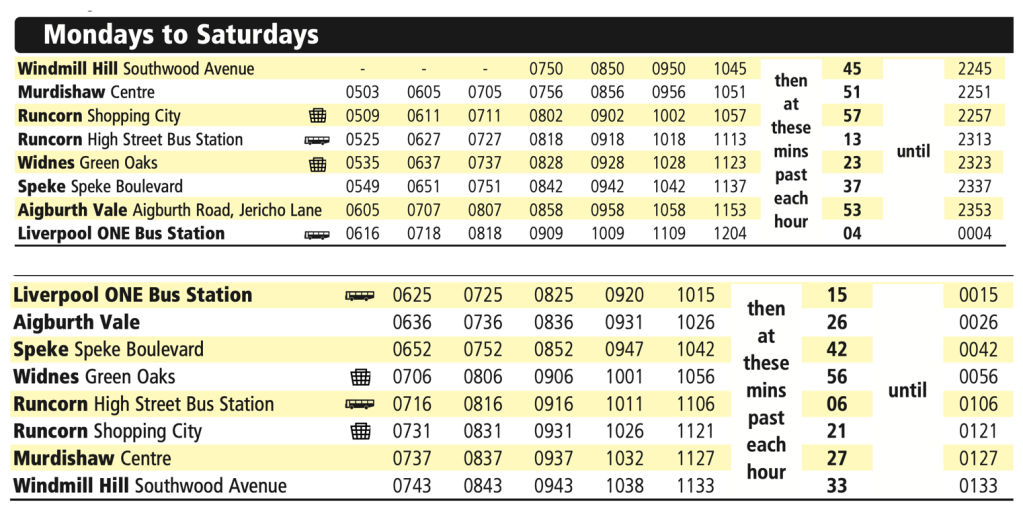
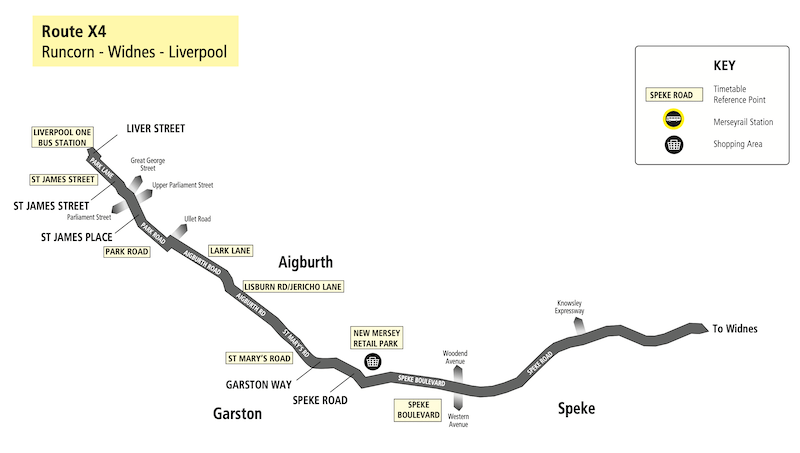
The route terminates along the northern section of the Runcorn Busway at Southwood Avenue, Windmill Hill, picking up at all bus stops along the famous Busway including Shopping City before passing through High Street Bus Station then running non stop to Widnes for a stop by the shopping centre at Green Oaks and then fast into Liverpool via Speke, Garston and Aigburth with just ten stops on that long stetch making for an end to end journey time from Windmill Hill of 79 minutes and 51 minutes from Runcorn’s High Street Bus Station to Liverpool.

The service last ran almost three years ago, in April 2022, as route X1 operated by MP Travel but post Covid was withdrawn due to no longer being commercial.
Pressure for a reinstatement had been building in the Runcorn and Widnes areas and it’s good to see the Mayor has stumped up funds to underwrite what’s being called a “trial” return of the service which almost halves the time for passengers using other bus services between Runcorn and Liverpool.
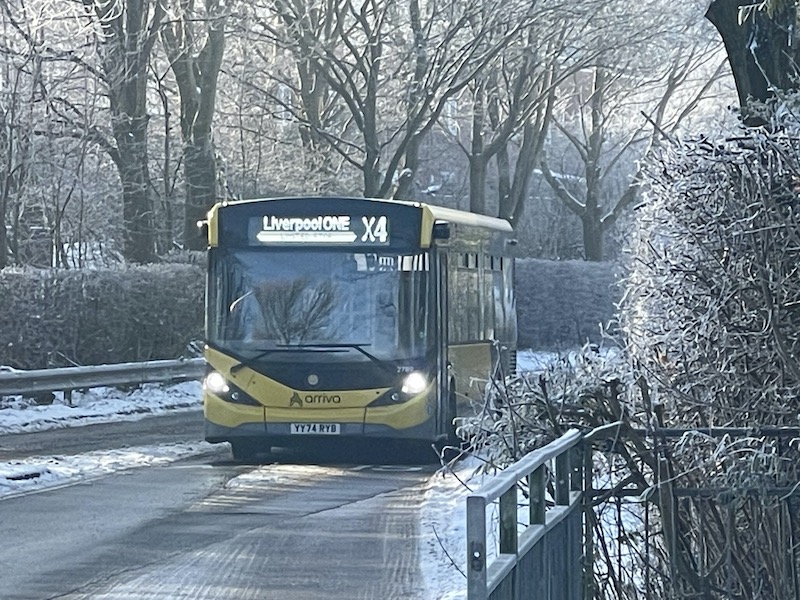
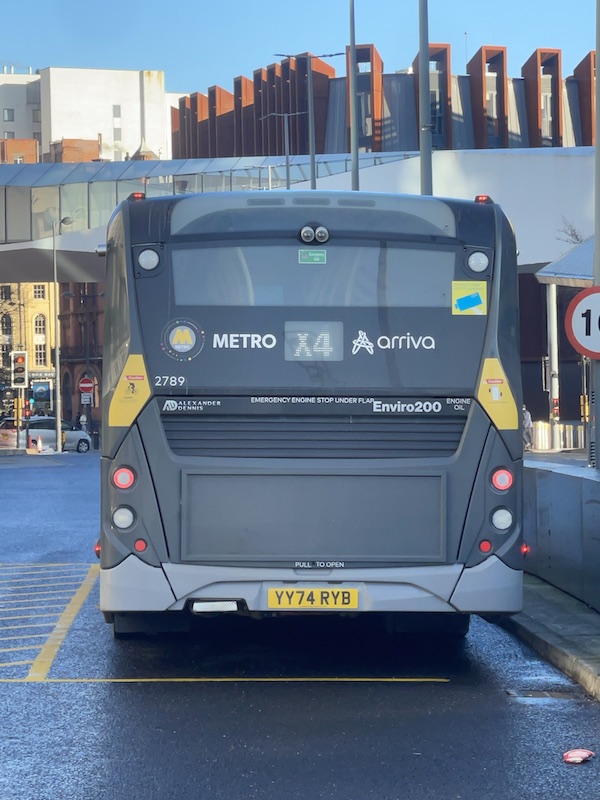
Arriva are using three of its 50 new Enviro 200 buses currently being delivered for operation in the Liverpool City Region which are carrying the new ‘Metro’ yellow and black livery being adopted by the Combined Authority as it moves towards franchising.
I took a ride on the route last Friday to see how it’s shaping up at the end of its fourth week, albeit two of those weeks were Christmas and New Year and last week was particularly cold with significant snow still lying on the ground.
I made my way to the terminus on the Busway to catch the 11:45 departure.
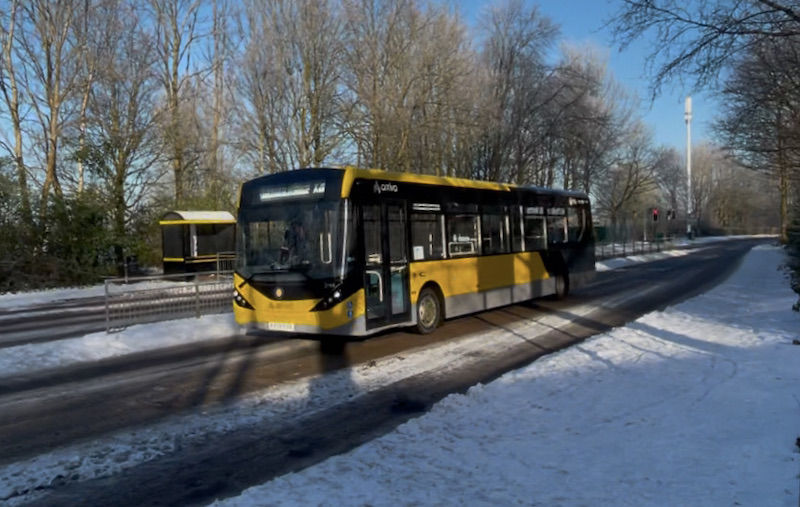
The bus arrived from its previous journey just a couple of minutes after the scheduled 11:33 with no one on board as the driver continued past the end bus stop to turn round in a piece of land just off the Busway.
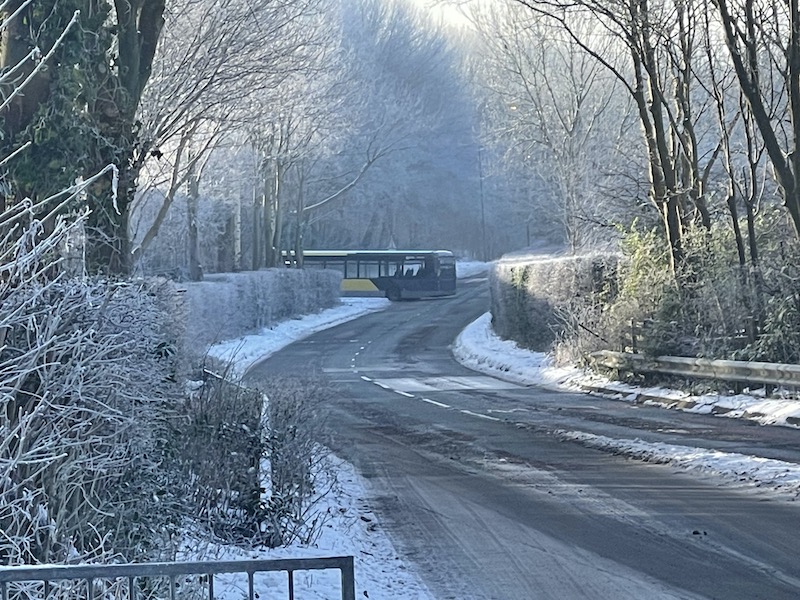
I commented in September 2022 in a blog about Runcorn (R is for Runcorn) that while the Busway remains one of England’s finest pieces of bus priority infrastructure and was way ahead of its time when opened in 1971, it’s now blighted by graffiti and poor upkeep.

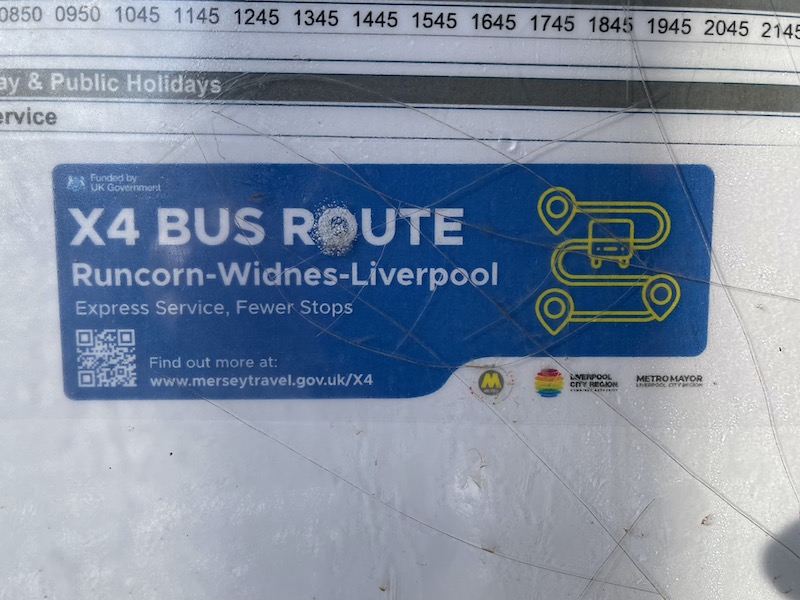
There was no timetable in the terminating bus stop but at least the commencing stop on the other side of the road had one including a small promotional logo for the X4.
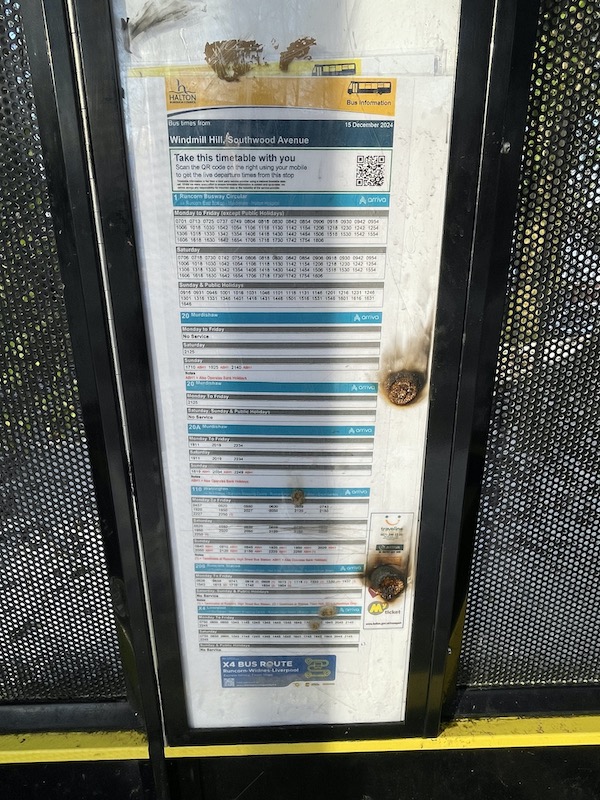
It won’t be winning any prizes for ‘Marketing Campaign of the Year’ that’s for sure.
One of the new buses on route 1, which operates clockwise around the Busway, came by in the yellow and black livery …
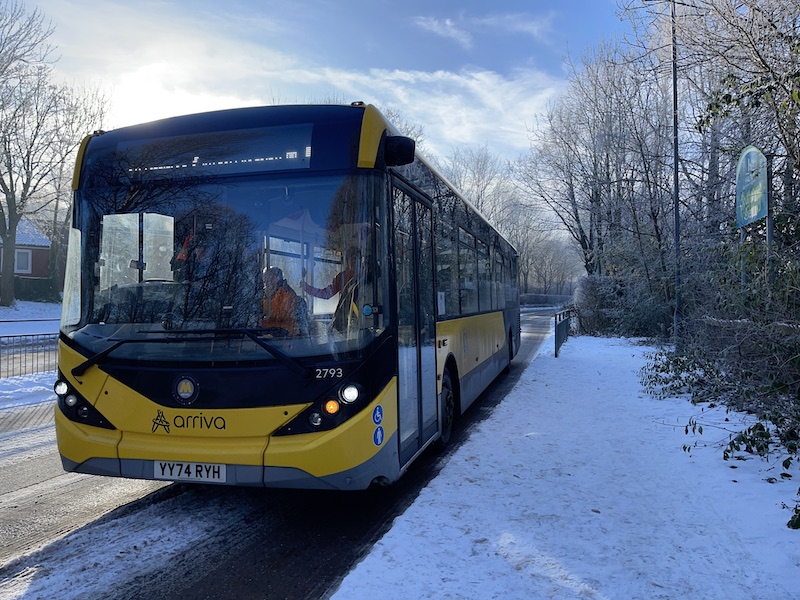
… followed by the X4 with just me waiting for it and boarding.
The interior is a bit of a disappointment for a brand new 74 plate bus. It does have usb sockets and, as required by legislation, next stop displays (including one facing the wheelchair space) and announcements…
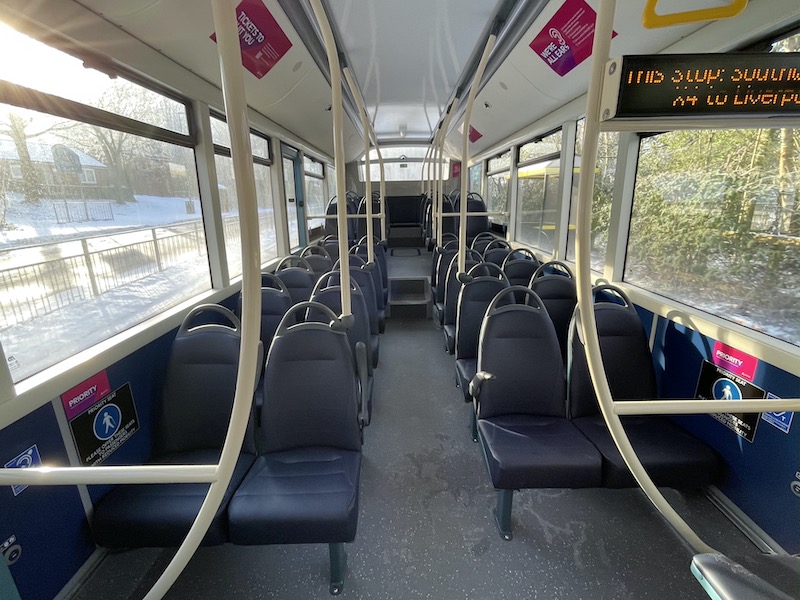
…. but the seat and floor coverings were somewhat old hat compared to current trends.
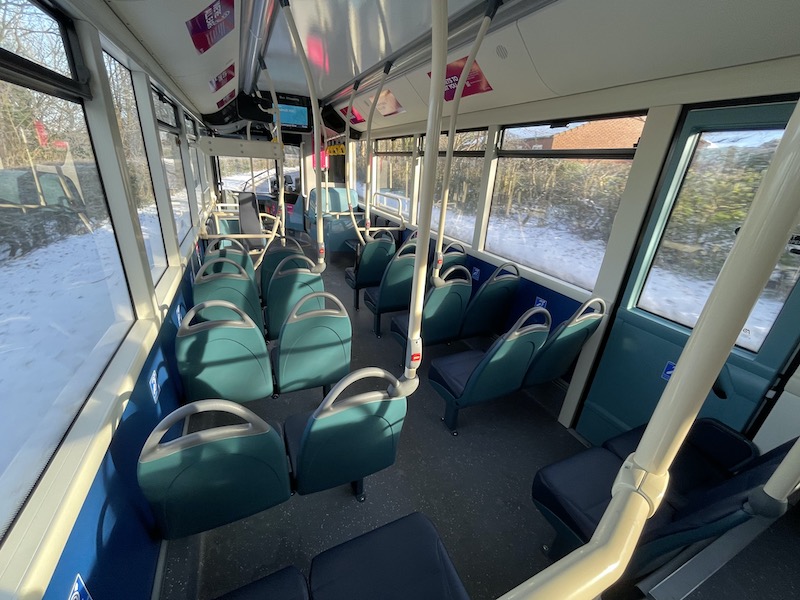
We picked up nine adults and three young children as we travelled around the Busway with six of these and the kids alighting and four boarding at the Shopping Centre (Halton Lea South).
Four more boarded on the next sections of bus only roads as we headed over to Runcorn’s High Street bus station passing one of the other two buses on the route, both of which were the new yellow and black Enviro 200s.
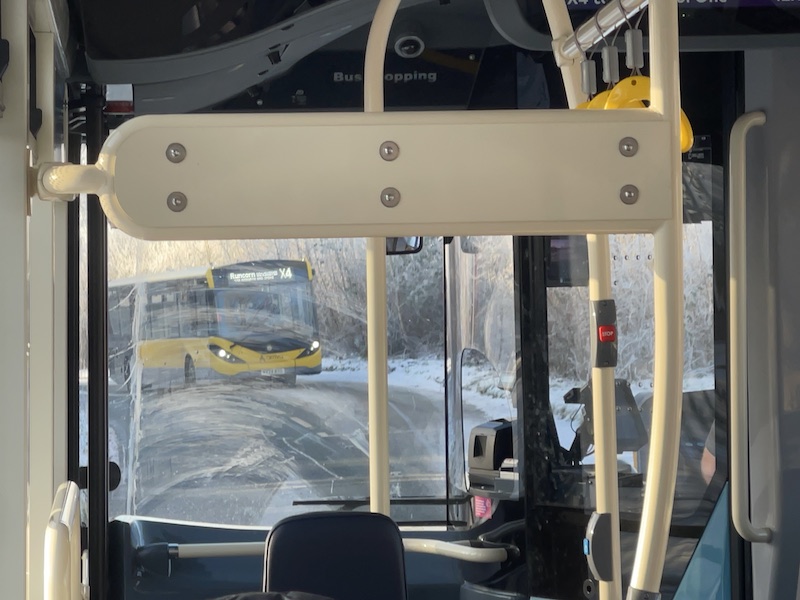
Another four passengers boarded and four alighted at the bus station giving us eleven on board as we began the non-stop section of route over Runcorn Bridge to Widnes.

We lost and gained three passengers here and then headed on to the busy dual carriageway A561 into Liverpool.
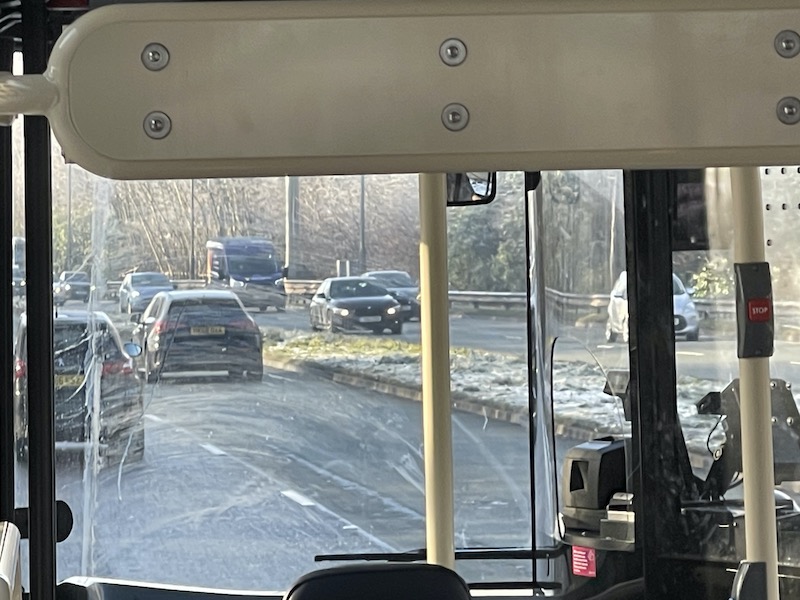
Five alighted at the New Mersey Shopping Centre and as we continued into the city centre we picked four more up but I noticed that the bus stop names being displayed and announced on board didn’t tally with the names shown on the Merseytravel online map shown above.
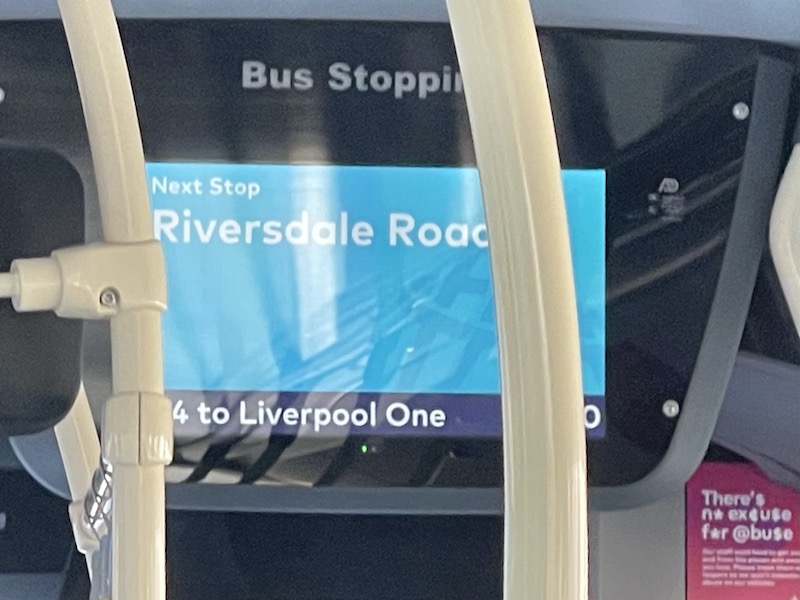
We arrived into Liverpool One bus station at 13:08 which was three minutes behind schedule although there hadn’t been any hold ups other than catching a lot of red traffic lights as we’d travelled along the A561.
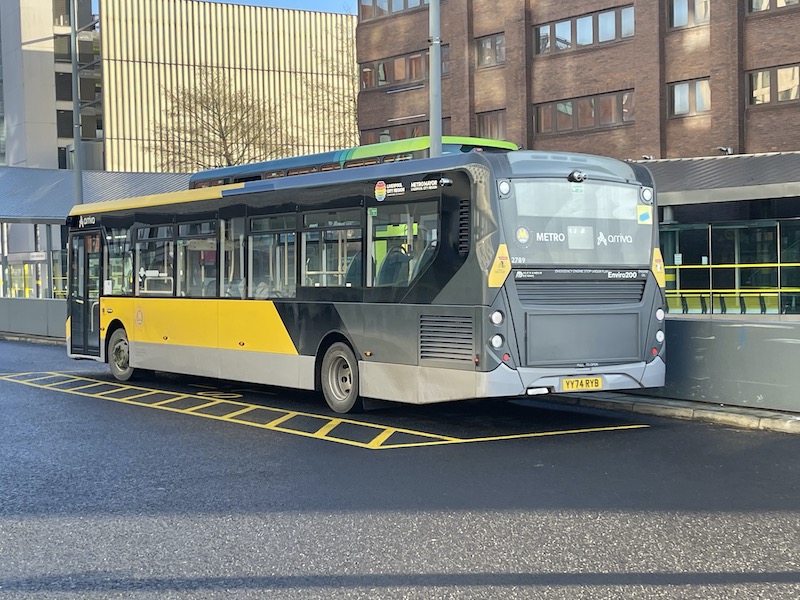
After a brief pause the driver headed back to Runcorn at 13:15 but I decided to wander into the city centre instead of returning the same way – the train only takes 18 minutes to Runcorn.
It’s interesting the route doesn’t encompass a full circuit of the Busway which would save some time in the schedule if it only did one circuit between journeys to and from Liverpool, but I acknowledge not enough to reduce the vehicle commitment.
There’s certainly demand there for a quick journey – other bus routes linking Liverpool, Widnes, Runcorn and Halton are notoriously slow by comparison – so the route stands a good chance of success.
What would certainly help is some high profile marketing and promotion with attractive route branding to raise its profile. But then, that kind of thing doesn’t sit well with an ‘everything must look the same’ approach favoured by most franchise supporters – although TfL are learning (eg Superloop).
Roger French
Blogging timetable: 06:00 TThS
 BusAndTrainUser
The following tale was told at North West Travel Meeting
The Yellow Submarine
Once upon a time a bus air interchange was built at John Lennon Airport. It featured a yellow submarine in the waiting area, but it fell on hard times.
The submarine became neglected and was never cleaned.
The sliding doors soon failed. Moss grew on the kerb and was never treated.
The timetable displayed for the express service was out of date.
The Real Time Information wasn’t and the wrong timetable was loaded anyway.
The express service at the time was worked by Bendybuses and were often cancelled.
Welcome to public transport on Merseyside.
You’re welcome to public transport on Merseyside.
Everyone laughed……
I spent last week on Manchesters franchised buses in the snow and the rain with newly acquired Bee Smartcard which can be topped up on bus with weekly ticket that costs £20.
The sun came out when travelling on one of these excellent new Arriva MMCs. I looked out of window and soon realised why the bus stop had Metro on it, I had entered my beloved Merseyside!
Steven Rotherham now takes up the baton to deliver Franchised buses to Merseyside after Andy Burnham successful delivery of Manchester bus revolution.
John Nicholas
Key card in hand waiting for 0605 23 at Brighton Marina only to told passenger I caught bus with yesterday that the App on his phone says its cancelled today and he will have to catch Gemini on X1!
LikeLike
I recall visiting the Runcorn Busway in the 1990’s ( when Warrington was withdrawing its last REs ), and the Busway looked scruffy and uncared-for even then. My previous visit had been around 1974, when the interior of the Crosville Seddon RU was also in a very care-worn state, despite being only about three years old.
“Segregated” presumably also means “out of sight, out of mind”.
RC169
LikeLike
I’m continually puzzled by both the bus and rail industry treating Sunday as if no one travels. Sure the patterns are different (and it can be very hard to justify early morning/late evening services) but roads packed with cars say that demand for travel is very much there.
surfblue
LikeLike
To have departures until 0015 but no Sunday service is bonkers. Demand at that time on a weeknight will be a small fraction of what it would be during Sunday daytime.
It has all the look of having been devised by politicians working on whims and hunches and outdated notions of Sunday travel patterns from decades ago, rather than anyone in possession of any relevant experience or data.
LikeLike
Sometimes a Sunday service can be difficult to justify financially. As has been noted, the traffic day is shorter, so perhaps 1000-1800 . . . with shops only open for 6 hours, running much earlier and later simply won’t have many pax travelling. With 3 buses required, that’s too long for a driver spell, so an “extra” driver is needed for meal-relief cover, unless a round trip is missed about 1300.
4/5ths of a rota line, potentially paid at a bonus rate for the day, might well cost north of £40K pa, especially including the recent increase in NI. That £40K might make the difference between affordable and financially too expensive.
If the passenger numbers are there 6 days a week, then adding a seventh day becomes a much easier decision to justify. Better 6 days a week than no service at all . . .
LikeLike
It isn’t that they think no one travels but do they think enough will travel as, generally speaking staff are on enhanced rates for Sundays so you actually need more passengers per trip to break even than on other days. Often where a decent sunday service can be provided passenger numbers during the period of operation on Sunday can be similar to that of Saturday (which often can be pretty marginal in themselves) but the higher operating costs mean sundays need support which can be hard to find (councils have often historically prioritised weekdays then Saturdays and left sundays unserved on the basis they have a service on other days so sunday is discretionary). Also Sundays are less popular with operators as it makes finding drivers harder as working sundays is less popular with drivers and, more for smaller operators rather than the big groups, would mean you have to pay your drivers more which may make much of your work unviable to compensate for the requirement for drivers to work Sundays & evenings (smaller operators often pay less which is often seen as compensated by drivers having less work in evenings or weekends to justify).
Bus staff with families want to have weekends off to spend time with them just as much as anyone else but bus driving isn’t seen as the same vocational draw as things like Health or similar important public services whilst the training & age requirements mean you don’t have access to pools of young people in education working their weekends like retail & entertainment businesses do. There are ways of dealing with it but those ways are generally around money, so staff can earn enough to make it worth taking the sacrifice of working more weekends (& Sundays in particular), which generally will mean more money from government at some level as fare rises won’t give that level of extra income to fix that sort of problem.
Dwarfer
LikeLike
Operating costs on a Sunday at most operators are not dramatically different to other days. Drivers may be on a pound or two more per hour and other costs remain the same, so you need perhaps one or two passengers more per hour for break even than you do on a Saturday. Entirely achievable if the right Sunday frequency is chosen. Both weekend days also benefit from operating on marginal costs, with weekdays having paid for the overheads and fleet costs.
Daily operation is essential if buses are to be taken seriously by people beyond the real hardcore of bus users. If you look at the country’s best and most successful operators excellent levels of Sunday provision (and not only during shopping hours) are a feature of almost all of them. Operators who continue to hide behind arguments about having to pay drivers a few pounds more on a Sunday and notions that people only use buses to go to the shops are living in the past and failing to understand their customer base.
While it is certainly true that many daytime tendered services will rightly only have a Monday to Saturday service due to affordability and due to demand even on weekdays being low, returning to the timetable above it includes departures at 2315 and 0015. If affordability is the constraint here then I can be virtually certain that removing these two round trips on Monday to Thursday nights (8 trips a week) and reinvesting as 8 Sunday trips would improve the financial position.
LikeLike
Since you clearly know more about bus operation on Sundays than the two professional bus industry people whose explanations you’re dismissing, can we take it that you’ll be starting up a bus company to show them how it’s done?
No? Thought not.
LikeLiked by 1 person
Actually yes. I am a manager at a large operator which runs extensive commercial Sunday services.
If as an industry we refuse to evolve our service offering to meet today’s travel patterns we will make ourselves irrelevant and obsolete to anyone who has a choice. I stand by my comment that at most operators the Sunday pay premium is a small cost in the grand scheme of things and is at least partly offset by Sunday operations not having to cover fixed costs.
LikeLike
Generally speaking drivers are often on 50% more (with current pay rates that is £6-8 per hour extra) or sometimes still double time so a significant uplift though it does depend on Union negotiating and historic positions (younger companies often have lower uplifts as union positions are weaker or non-existent and the differentiation of sundays used to be stronger than it is now) whilst older, and generally larger, companies often have not been able to lose the old rates though speaking to a colleague who used to work for one of the big groups their local subsidiary had managed to get their uplift down to about £4 per hour a couple of years (may not have been that far off 50% at that time though) so it isn’t as clear cut as I may have portrayed (and possibly not coincidentally that local subsidiary had a pretty good sunday service provision so that may be linked). Also if you are to provide any significant service levels you need supervisors on site and engineers available (at least on call but that has a premium payment attached as well and if you have enough they will need to be on site) who will be looking at their own enhanced rates and remember wages are the largest single cost incurred.
The issue is that if you retained your sunday network through the difficult times (80’s & early 90’s when Sundays weren’t as busy with retail as they are now) you have a thriving and established market but if you are starting from scratch to rebuild the demand it will be a significant period of time of major loss making to get to a point that may never be fully commercial with a business that isn’t making huge margins (regardless of what some campaigners may claim profit margins at most companies have never been good) during a period of ongoing uncertainty over long term ownership & funding (so even if it works you may not get the benefit as the council will have taken your business and given it to someone else). More certainty over the medium term future may see more operators and councils look at restoring sunday service levels. But, as I said previously, it is no good looking at adding more services when you can’t get enough drivers to cover what you have and you don’t want to add sundays if the only reason you have the drivers you have is that they don’t have to work sundays.
Dwarfer
LikeLike
It’s tragic that the Runcorn Busway is so uncared for. It should be a showcase for what a bus based system could do.
I think the weakness lies in the separation between infrastructure (probably the local highway authority who only care about cars), and the bus operators.
Compare and contrast with the look and feel of a rail system, say Manchester Metrolink, Nottingham where the infrastructure is branded the same as the operator.
Or the Cambridgeshire guided busway, where again the infrastructure is branded the same as the operators in a unified Busway livery.
Peter Brown
LikeLike
I caught the X4 first week of operation & the route had decent loadings.
The problem is large part of Runcorn the X4 serves is some distance from Runcorn station, so express route to Liverpool is quite handy, however the X4 needs to be at least every 30 minutes daytime.
I remember catching the old X1 pre Covid & buses were always well loaded even against traffic flow, main issues were reliability, you would often see buses running in 2s from early/mid afternoon & this was on a 30 minute frequency with very little layover at each end, Arriva effectively gave up on the X1 during Covid.
SM
LikeLike
It seems totally typical that the timetable in the case at the X4 start point in Runcorn is just one of the public issue ones, complete with “take this timetable with you”. With a message like that, any right-thinking yob would just smash the plastic and do exactly that.
LikeLike
The ‘take this timetable with you’ bit clearly has a QR code included so people can download the timetable on their phone and… take it with them.
Seems perfectly sensible to me.
LikeLike
Oh dear, when will I learn that subtle humour can be too subtle for some.
LikeLike
I thoroughly admire Roger for doing this “Route Survey” in bitterly cold weather.
I would have waited until a warm summer day.
His recent and other pictures of Runcorn are such that I no longer thirst for the busways I became aware of through my fanatical collection of street atlases which pre-dates my leaving school in 1969!
I did have a friend who lived in Orton Malborne (Peterborough) in my motorcycle era, so visiting him I needed to drive carefully near his home in “Saltmarsh” so as to avoid transgressing busway regulations. New town builds are freaky: just think of several roads in Crawley which have grass verges on both sides of the road, no pavements and the fences of back gardens all to show of human habitation there! My A-Z Atlas of Peterborough shows the Orton Malborne area far better than the Philip’s Atlas does.
LikeLike
The problem is not confined to busways. Milton Keynes has maintenance issues on its cycle routes and many pedestrianised areas suffer from poor maintenance and thoughtless parking. Even on the highway potholes are a severe headache, so the common thread is a local authority.
Gareth Cheeseman
LikeLike
@ Gareth Cheeseman – worth noting that local authorities have borne the brunt of austerity cuts imposed from previous governments back to 2010, forcing them to shrink their budgets.
Malc M
LikeLike
That is very questionable given the abject chaotic management of some councils in England as seen with the council here in Brum.
However street infrastructure ; excuse the unintended pun, improved out of recognition from 2017 onwards following the creation of Transport for West Midlands from the ashes of the useless Centro.
Most bus stops have clean modern shelters ; all usually have up-to-date comprehensive timetable Information with bus stop plates updated regularly. Along with the massive investment in state of the art bus Interchanges at Stourbridge, Cradley Heath, Wolverhampton, West Bromwich & now Dudley.
Given the right leadership especially up to May this year local authority bodies such as Transport for West Midlands have proved some can deliver first class infrastructure in cash strapped financial eras its dependent basically of the leadership qualities of said local authority bodies.
LikeLike
@ Richard Jones – thank you. I’m glad to hear it is as simple as you say 🙂
There is nothing questionable about the cuts imposed upon local authority budgets since 2010. That is factual. Between 2009/10 and 2019/20, local authority spending power fell on average by 17.5% (source: Institute for Government). If you have less money to spend than you did, chances are you are going to find it rather difficult to carry on delivering the same services to the same standards. Hence budgets for, for example, maintenance and upkeep of roads (and pavements, busways, cycle paths) may have to be cut.
You mention Birmingham City Council specifically, blaming its financial woes on poor management and leadership. As I understand it, the financial problems arise largely from a landmark historic equal pay case which was brought in 2012. Meanwhile, some councils turned to risky commercial ventures, to try to generate income to offset the loss of government funding. Not all of those ventures have worked out well for the councils. While you may claim that shows poor leadership or management, I might say that if the funding hadn’t been cut in the first place, the councils may not have had to seek other (riskier) sources of income.
Malc M
LikeLike
Interesting comments however the problems at Birmingham City Council & its Equal Pay Awards were the result of very poor management by the Labour Controlled Authority.
As for other authorities I worked alongside Sir Andy Street CBE for 7 years & the budget set for Transport was always delivered on target without a precip.
Funding may well have be cut for local authorities within this period but as proved sucessfully at West Midlands Combined Authority led by Sir Andy Street CBE its up to local authority management to handle its own budget fiscally sucessfull.
As we have seen at Birmingham City Council to many fail to do this & blame everyone other than thier own financial mismanagement
LikeLike
@Richard Jones, just to correct your comment about Birmingham City Council, it was not controlled by Labour in the eight years leading up to the 2012 ruling (at least, assuming Wikipedia is telling the truth). You may want to check who was leading the council then.
Your adulation of Andy Street misses the point – that as local authorities have had their funding cut, their spending power is reduced and so their budgets are shrunk. The declining public realm (the state of our streets etc) is an inevitable consequence of that. Where local authorities have had to reduce what they spend on the upkeep of bus service infrastructure (e.g. bus stops and shelters, provision of publicity), I think that may also be traced back to the spending cuts which have forced on them by central government.
Malc M
LikeLike
Oh yeah, another thing the interior on the new E200s are the standard Arriva interior.
As for the Runcorn Busway it does need a lot of TLC, the bus stops are quite basic, often with lack of up to date information
SM
LikeLike
I wonder why the bus turns around at Windmill Hill instead of just completing a circuit and heading from Windmill Hill into Runcorn ? I appreciate it would make for a longer journey for passengers from Shopping City , but a quicker trip for those from Runcorn East station and Windmill Hill .
There are , however , lots of strange public transport anomalies in Runcorn, like why don’t more buses call at the Railway Station, and the one that really annoys me is that weekday car parking at Runcorn Station is £12.50 whatever time of day so discourages people popping into Liverpool afternoons and evenings .
Gary T
LikeLiked by 1 person
I participated in a Chartered Institute of Transport visit to Runcorn Busway in the early 80’s before deregulation. There was one part of it that ran through relatively undeveloped land then and the chap who showed us around boasted (jokingly) about this stop having the best rural bus service in the country. I think the service frequency around the busway then was every 5-10 minutes although I can’t recall exactly. I’ve never been back but it seems clear this great piece of infrastructure that could and should have been the core of a high quality network in the area suffered with the neglect and constant change that was part and parcel of deregulation. Of course there are other factors but deregulation is the original sin and ruined other areas that were leading the way to high quality integrated networks as in Tyne and Wear with the Metro and so on. Finally it seems that era is now consigned to the bin but it’s a slow and painful journey to a brave new world littered with obstacles not least will be the difficulties of finding funding despite the long term benefits of high quality coordinated networks. Of course I know not everyone will agree with me but I hope I’ve made my point respectfully.
In the meantime good luck to the X4 and could you actually see out of the windows Mr French!?
MikeC
LikeLiked by 1 person