
Saturday 11th January 2025

Welcome to a new blog series featuring towns and cities around Britain which, by a quirk of history, are blessed with having two railway stations on different lines serving completely different destinations. To kick things off I’ve been to Hertford and had a look at that town’s contrasting pair of stations: Hertford East and Hertford North.

As you can see from the map, Hertford East is located, unsurprisingly, a short distance to the east of the town centre while Hertford North is oddly to the west, rather than the north, but is located on North Road.
The former came first, in 1843, with an extension beyond the terminus at Railway Place in 1858 when tracks looped around north of the town centre then headed westwards towards Welwyn. That station was replaced in 1888 and the line to Welwyn was cut back in 1966 to the current terminus from where trains head south to London Liverpool Street, with useful connections available on to the Underground network at Tottenham Hale (for the Victoria Line).

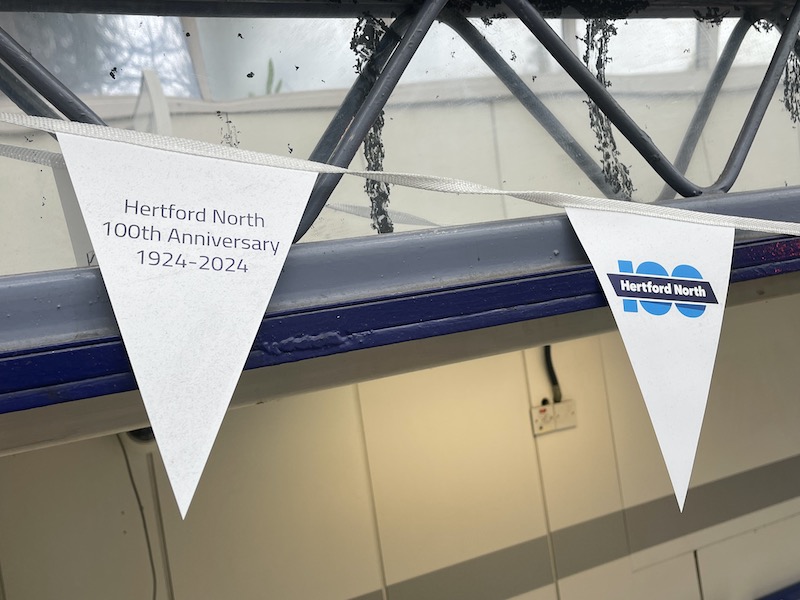
A slightly younger Hertford North celebrated its centenary anniversary last year.

The station was built in 1924 on what became known as the ‘Hertford Loop’, branching off the East Coast Main Line at Alexandra Palace (formerly called Wood Green) and rejoining it at Stevenage.
Trains terminate in London at Moorgate using the former Northern City line from Finsbury Park but in past decades passengers could travel to Kings Cross and at peak times to Moorgate along the ‘widened lines’ (now used by Thameslink as far as Farringdon) or from Finsbury Park some peak trains continued to Broad Street, next door to Liverpool Street using some tracks now used by trains on the Windrush Line.
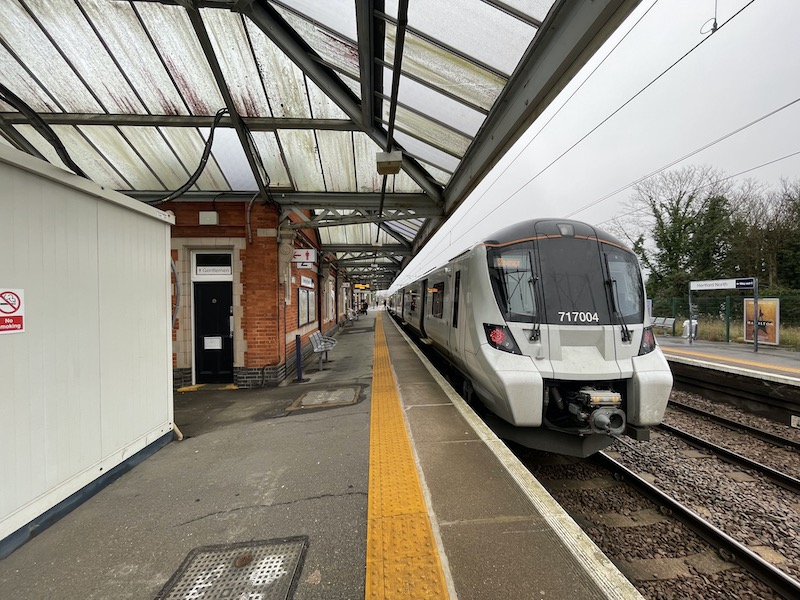
Both Hertford East and Hertford North see half hourly daytime services into London which is the same frequency that applied when I lived in North London as a child 60 and more years ago, indicating not much progress over the ensuing decades albeit both lines were electrified in the 1960s (East) and 1970s (North) and more recently both lines have seen new trains – Great Northern’s Siemens Mobility Class 717 Desiro City trains in 2019 for Hertford North and Greater Anglia’s Bombardier’s Class 720 Aventras for Hertford East from 2021.
Three extra peak hour journeys supplement Hertford East’s timetable to Stratford as well as the full half hourly service terminating there on Sundays. Hertford North’s peak timetable has an enhanced 15 minute frequency.

Hertford East has by far the more substantial looking station building including an arched entrance and another on the southern side…

… whereas Hertford North was for many years much more basic, but last year received a welcome improvement to its facilities and now, in my view, offers a much warmer and welcoming ambiance than over at East, although you do have to like climbing steps at North.

For example, at Hertford North, there’s a very nice shop selling groceries…
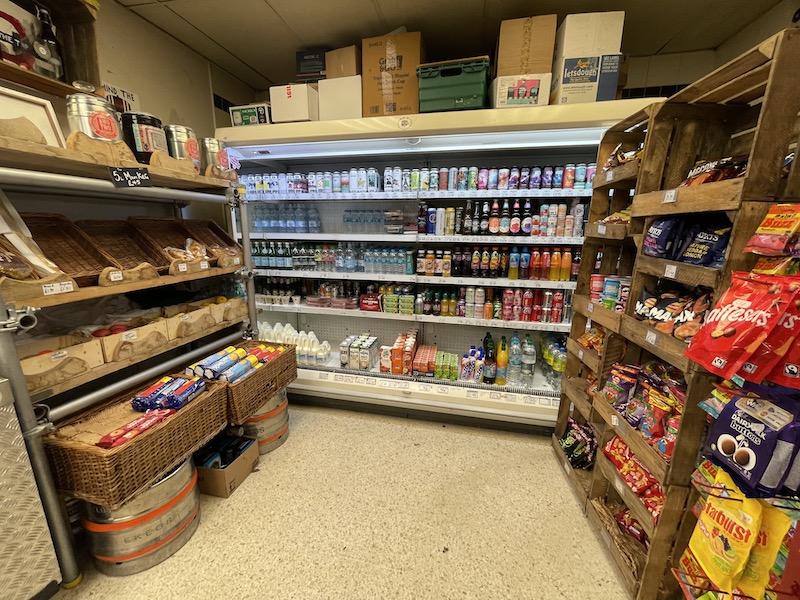
… including fresh produce, magazines and newspapers as well as coffees, teas and pastries….

… for passengers which also includes a nice area to sit and wait for the train with a real time departure board to keep you updated.

There’s a ticket office with the potential of offering three windows…
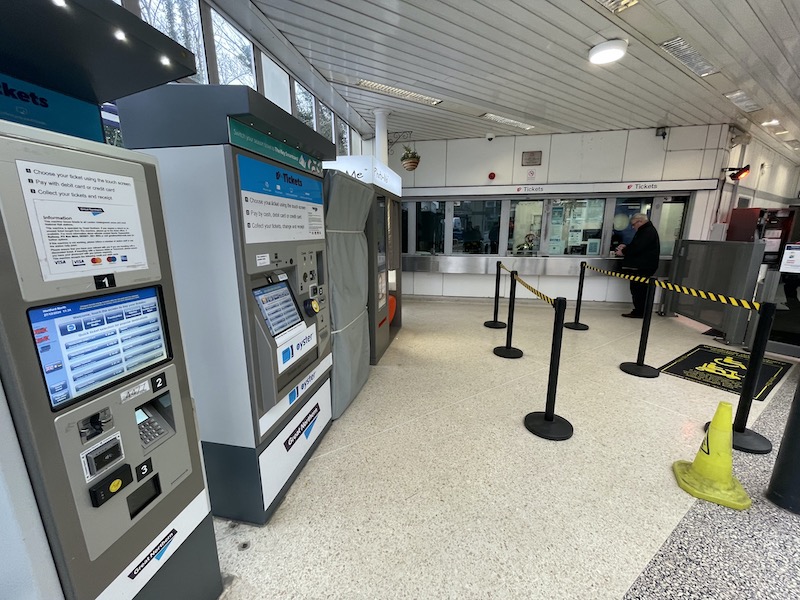
… but it looks like just one is in use these days but there are two ticket machines – a large and slim line one. There’s also a gateline with three gates including a green arrow or red cross above to indicate which way to enter or leave.

There’s now a lift alongside the rather steep stairs giving access to platforms 2 and 3 but not to the London bound platform 1. That’s because the lift (and stairs) take you to a subway under the tracks…

… from which there are only stairs up to platform 1 but there’s a lift (and stairs) to the island platforms 2 and 3.
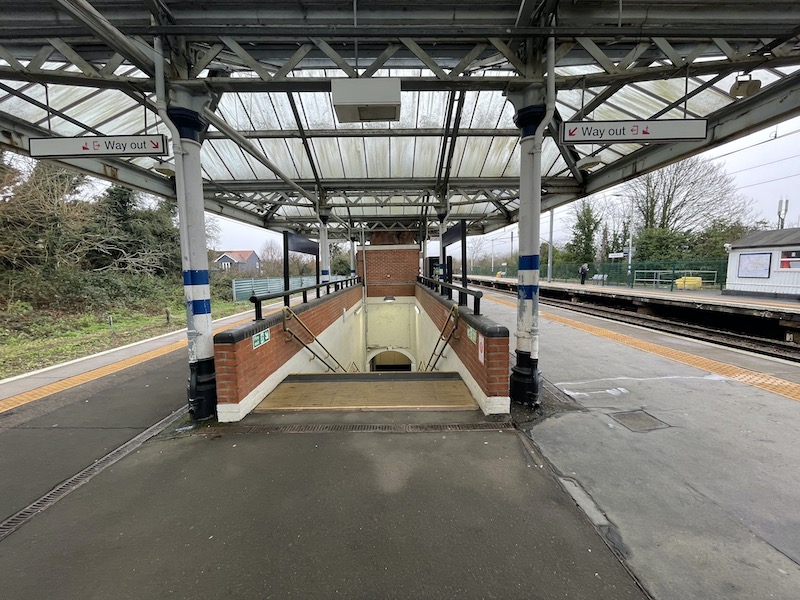
Platform 3 has a buffer stop for terminating trains while platform 2 (and 1) are the through platforms taking trains northbound to Watton-at-Stone and the East Coast Main Line at Stevenage.
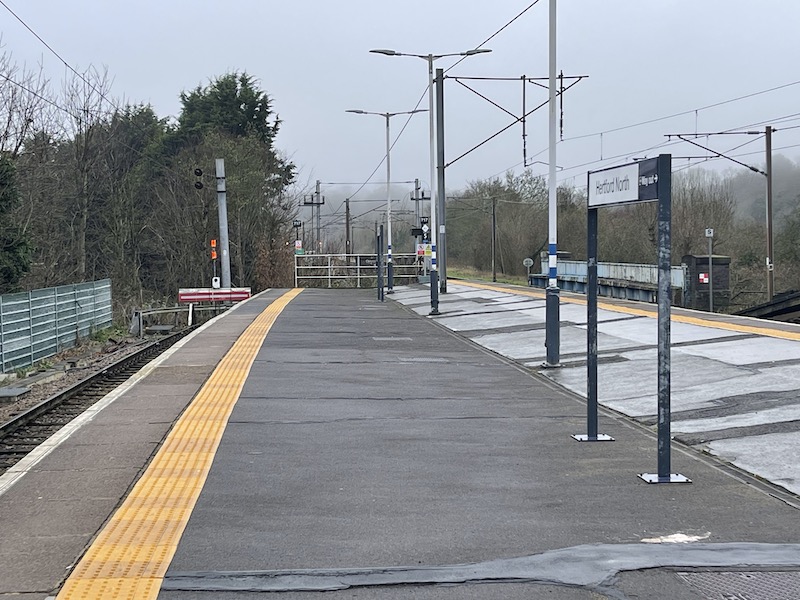
Whereas platforms 2 and 3 have a substantial canopy as well as toilet…
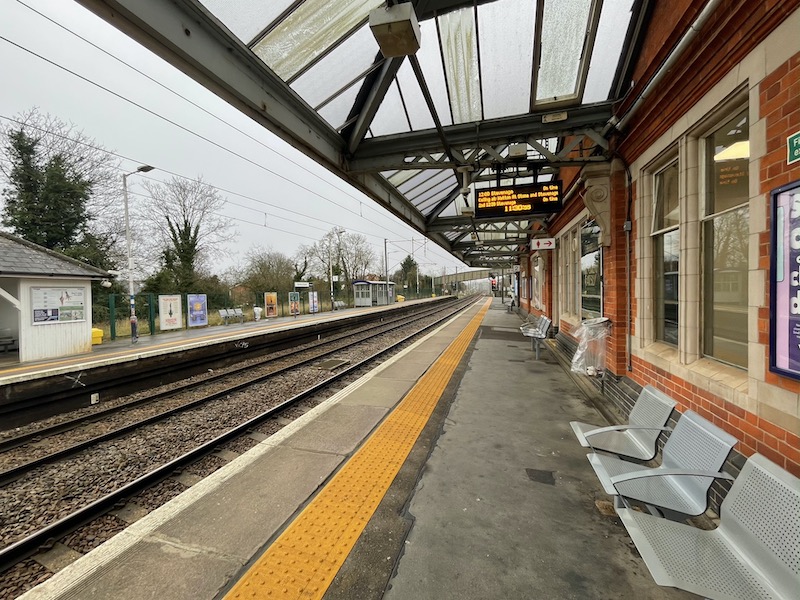
… it’s unfortunate they’re the least used by waiting passengers as the London bound platform 1 is more exposed although does have a couple of shelters including a rather nice wooden one a third of the way along it.

Some sidings south of the station are used to stable trains not needed for service between the peaks, at weekends and overnight.
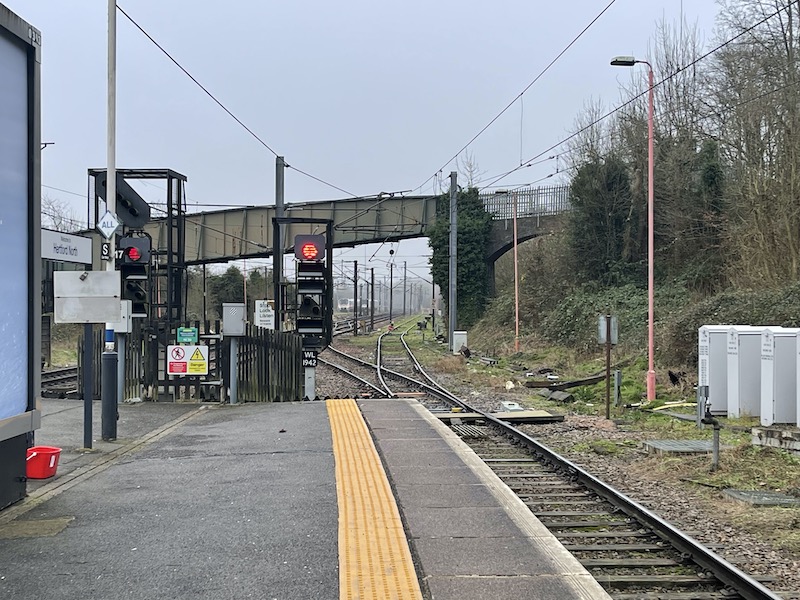
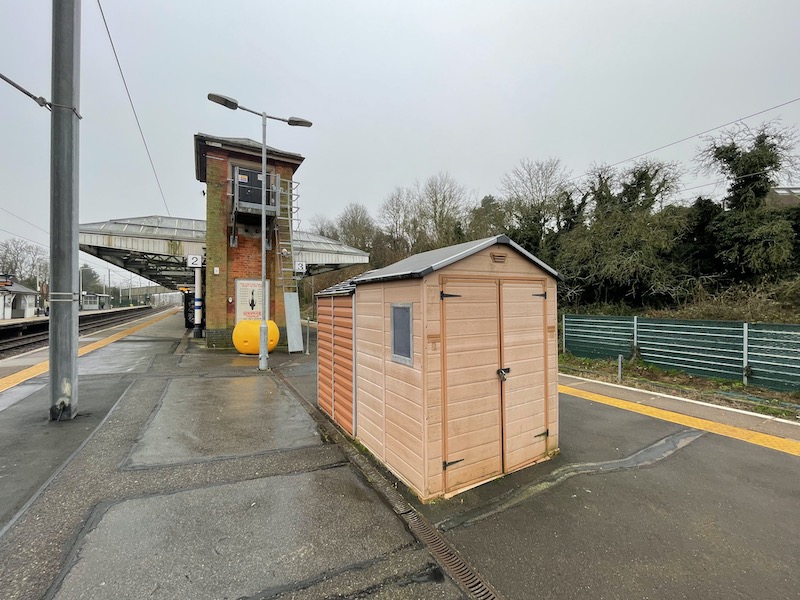
There’s also a couple of rather nice garden sheds back to back on the island platform 2/3 just north of the lift shaft.
Hertford North was included in the Oyster and Contacless Pay As You Go scheme in 2019 with Hertford East’s inclusion beating that by four years, being included in 2015. At the latter there are no ticket gates or barriers but instead two Oyster card readers can be found at the entrance to both platforms.

Although there are two terminating platforms, most trains leave from platform 2 (on the left) with platform 1 (on the right) only seeing action at peak times.

Both platforms are long enough to cater for 10 coach trains and have a canopy cover for only a realtively short distance as you can see in the above photo, giving a long section without any cover or shelters…
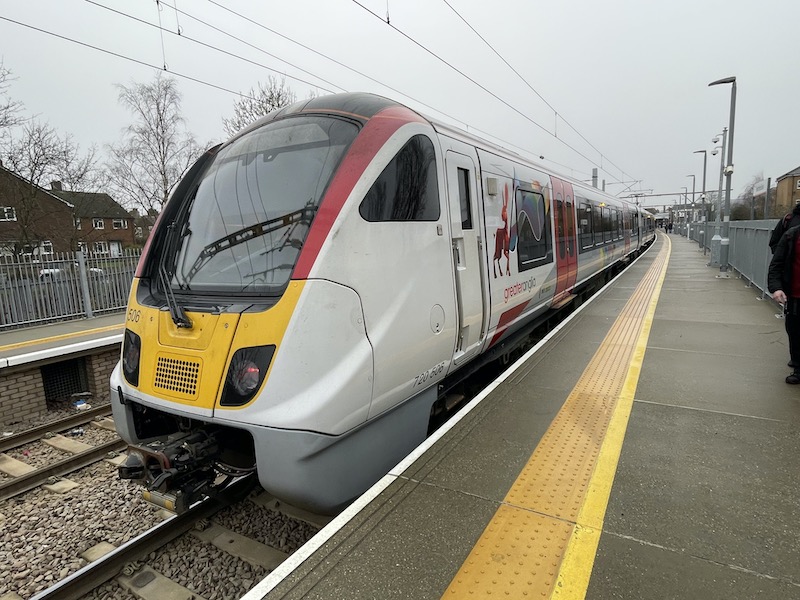
Platform 2 sports a rather nice “community art project” which was “created by pupils from Richard Hale School to celebrate their 400th Anniversary and Hertford’s historical past and present.”

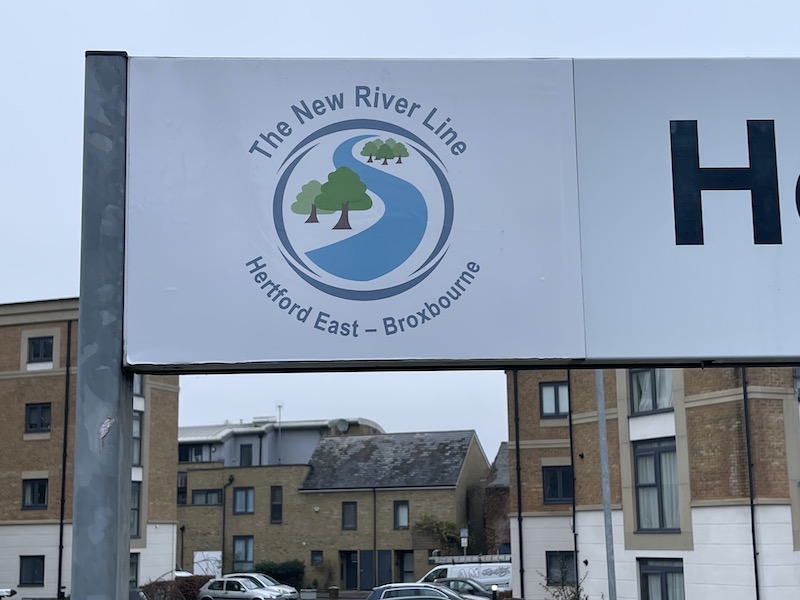
The branch line (with its single track sections) through Ware, St Margarets and Rye House before joining the main line to Liverpool Street at Broxbourne is called the New River Line, after the New River which meanders through this area alongside the more substantial River Lea Navigation.
Hertford East’s concourse area, larger than Hertford North’s, is split into two sections. The outer entrance area has a coffee shop…
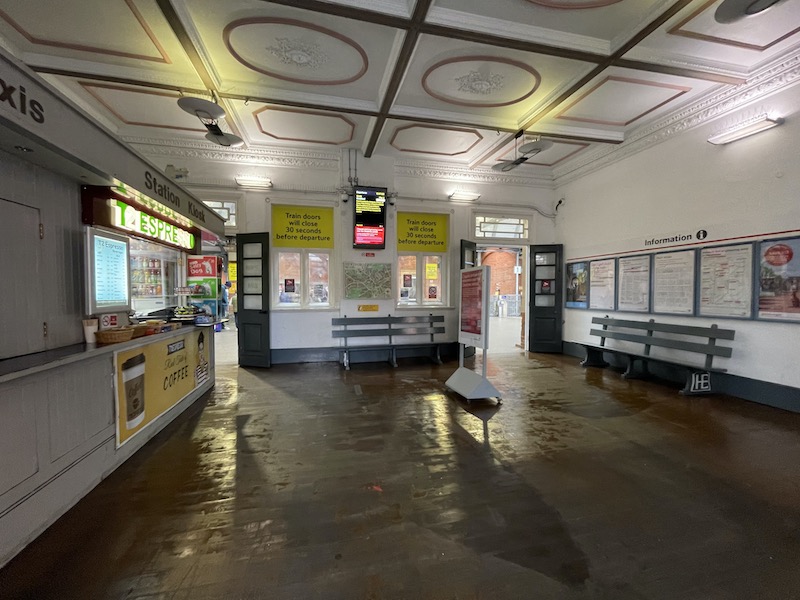
… and leads into another sizeable area from where access to both platforms is available.

… as well as two ticket machines (large and slim line size again).

Dotted around the station are old style Network South East clocks to give a sense of nostalgia for that period…
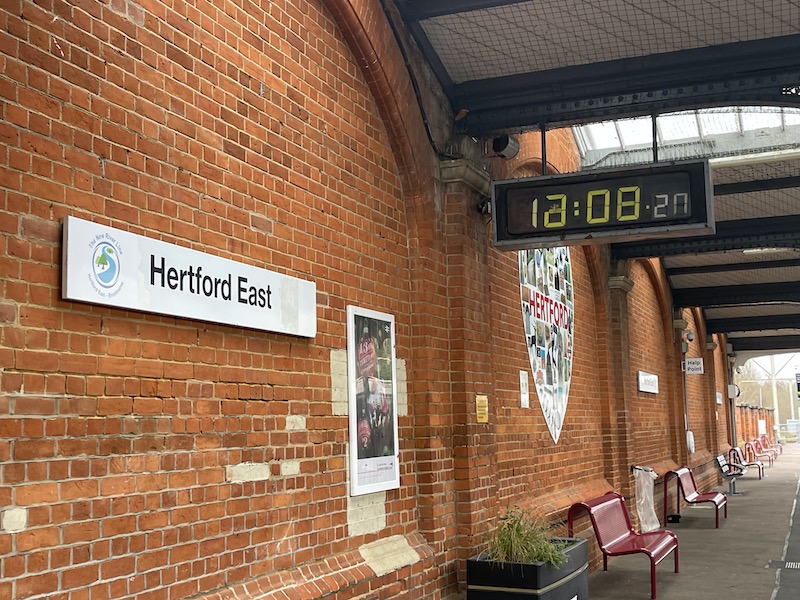
… together with some of NSE original style seats.
Both stations have their own idiosyncrasies and characteristics and both were nice and clean and well presented but with an absence of any staff presence (during my visit) at Hertford East.
Roger French
Blogging timetable: 06:00 TThS.
 BusAndTrainUser
There are another two long closed lines, One was St Margret’s to Buntingford and the other was Hertford to St Albans. Interestingly HCC were looking at as rapid transport system broadly following that old line
A problem with improving service’s is the bottleneck between Cheshunt and Broxbourne . There has been a lot of talk of doubling the line but it has never happened. , Cheshunt Station itself is also a bit of a problem as it is hemmed in by the junction at one end and the level crossing at the other end
LikeLiked by 1 person
There is a nice short video on YouTube, a cab ride from Ferme Park Sidings to Canonbury, over the connection used by trains to Broad Street. It starts rather wonderfully with the driver’s view traversing the Ferme Park viaduct. We must not forget “bus wars” a long time ago! On a meandering jaunt I rode a red bus (310) between Hertford and Ware for £0.15 Return!
LikeLiked by 1 person
I commuted between Ware and Liverpool Street from 1972 to 1980 and the only single-track section I recall at that time was through Ware station.
There were few commuters from Hertford East because the service from North to Kings Cross was quicker.
Before the days of Oyster and PAYG, most passengers bought season tickets. These had a quirky additional validity “to and from Stratford” which I sometimes used from Liverpool Street to Stratford at lunchtimes for shopping. I never used the Tottenham Hale – Stratford route which was provided by an infrequent (2-hourly?) 2-coach DMU.
For a period of 2 years or so during that time Hertford East trains were routed to and from Liverpool Street via Seven Sisters on what is now the Weaver Line. That route was also used on occasions when the main Lea Valley line via Tottenham Hale was closed.
The most frequent cause of service failure was “wires down” and I remember once queuing for a replacement bus for an hour or more at Broxbourne on the way home.
Ian McNeil
LikeLiked by 1 person
At one time the Bishop Stortford service used the Seven Sisters branch, It provided a fast service with the first stop out of Liverpool street being Seven Sisters then the next stop was Edmonton Green
LikeLike
Looking at up-to-date signalling diagrams shows that single track only exists at Ware: https://www.opentraintimes.com/maps/signalling/stansted
LikeLike
If you looked for a toilet at Hertford East you would look in vain – totally unacceptable for a county town terminus. I complained about this to Greater Anglia last year – they promised to look into it but I heard nothing further.
LikeLike
My unerstanding is that the Hertford Loop (through Hertford North) was constructed as a relief line, as the Great Northern Railway were unable to four-track the section through Welwyn North due to the tunnel and Digswell Viaduct.
I worked in Hertford in the late 1990s (doing a ‘reverse commute’ from North London) so remember both these stations well – I would use whichever one was most convenient on the day.
LikeLike
Thanks for this report – I’ll be interested to see more in this series: will you include towns like Maidstone, where there are three stations, but on two lines?
Perhaps you could consider including details of how good bus connections are – particularly where the two stations are a fair walk apart, as in Hertford (22 minutes per Google Maps). Hertford bus station is five minute from East station, and there are a few decent connections if one arrives from Broxbourne or Ware, notably the half-hourly 323 to Welwyn (I haven’t checked up going back). Getting to Hertford North to get to Stevenage and northern destinations is less good: if you arrive at 11:09 – and the train is on time – you might hope to get the 11:30 at North station – but there are no helpful buses – you may as well walk and get the 12 o’clock. If you arrive at 11:39, a brisk walk to the bus station could get you on the H2 at 11:45 – happy days!
Hertford has a lot of bus-routes, and I expect they give a reasonable service to the shopping centre, but getting around Hertford must be frustrating. A quick explore on G-Maps, picking a few random points in N, E, S and W ‘greater Hertford’, showed most cross-town journeys are 30 minutes or more; by car, less than 10 minutes! Seems like a case where linking the routes would be good for passengers, and would considerably simplify the ‘network’ map – but presumably too much trouble for managers … Similarly, journeys to London are mostly not easy, and usually longer than by car (except probably in the rush hour). Bring on the DfT Integration initiative! Sorry if that’s not popular with the operators – but they have a last chance now to get it right by themselves!
LikeLike
If you were in Hertford town centre, I’m not sure it’s particularly logical to want to get a bus to Hertford North Station to then get a train to Stevenage as there are two main bus routes (the 390 and 907) which will take you to Stevenage (stopping outside the rail station) from the town centre combined to run twice every hour, the former actually serving the stop at Hertford North. Other, less frequent routes (378/9, 38A) may be useful if you happen to be there at the right time.
This is often the problem with trains, the often vastly superior travel time is meaningless if it takes an age to get to the station itself. Why not just stay on one bus and avoid the hassle of changing?
Dan Tancock
LikeLike
This is how I see things. I used to use the line to Hertford East a lot but since the 907 came about, it’s just less hassle to take that to Hertford instead. Every train I use has to factor in a 25 to 30 minute walk as buses don’t even try to connect to trains in Cheshunt (except Theobald’s Grove sometimes but not guaranteed). Living less than 10 minutes walk from Brookfield also brings similar advantages on the 25 to Harlow, sounds long at 45 to 50 minutes versus the train taking 10! but the train is some way from Harlow’s town centre as well! So the journey times are probably the same after all that. Also HCC coordinated the 390 and 907 to provide a bus from Hertford to Stevenage every 30 minutes in the daytime, far better than before.
Aaron
LikeLike
This should be an interesting series of blogs, and I look forward to reading the rest!
I know this one won’t make your list, for reasons that will become obvious, but I am reminded of my time living in the Acocks Green suburb of Birmingham. It of course has its railway station of the same name, sitting on the main Snow Hill/Chiltern line, with trains to Dorridge or Stratford upon Avon via Solihull in one direction, and Worcester via Snow Hill and Stourbridge in the other.
But just within the geographical area of Acocks Green is Spring Road station. This sits on the Shakespeare Line, with trains to Stratford upon Avon or Whitlocks End in one direction, and Kidderminster via Snow Hill and Stourbridge in the other.
So different lines, but same destinations ultimately, though calling at different places towards Stratford!
Stu – West Midlands Bus Users
LikeLike
Store trains? Surely the railway term is stable trains.
LikeLike
Ah that term goes back to when they switched from using horses
LikeLike
My son-in-law tells me that the supreme advantage possessed by Hertford North station is a real ale bar.
Cheers
Max
LikeLike
Too late now, but in hindsight, it would perhaps have been better to have called Hertford East “Hertford Town”. And lack of toilets generally in Hertford since the bus station became a building site seem a problem.
Throughout my life I seem to have lived in places with two stations. I started life in Lichfield, living in Deanscroft with trains in view passing between the City and Trent Valley stations. A move south to Caterham-on-the Hill, but actually at the top of Whyteleafe Hill, saw both Whyteleafe and Upper Warlingham a mere stones throw from each other. A further move to Berkshire, but with Windsor the nearest town possessing two stations, where one (the magnificent GWR used regularly by the Royal family) considered itself the “only one in town” and a life ban imposed on Anyone dare mentioning the “other” one down the hill!
For some years I had second homes in both Gillingham (Kent) and Doncaster, both close enough to hear the station announcements from my back garden, but neither possessing second stations.
And now, although living a few miles south of Bromley, but just in postally by a few yards, and actually closer to Orpington and Hayes stations, we have a North and South. So this coming blog has quite a range to get through.
Terence Uden
LikeLike
It always amuses me why they don’t connect up the two stations by rail
LikeLike
Actually, in the case of Hertford East and North they were once joined, albeit by a freight only line. The old brige abutment can still be seen near Hertford North Station and it is possible to determine the old alignment from Google Maps etc. Until a few years ago, the old crossing gate was intact adjacent to Mill Road.
Dan Tancock
LikeLike
They could for example extend the main
Hertford bus service the 310 to server Hertford North. Probably nowhere to terminate it but could run it to the station and turn it around at the roundabout and run it back to the bus station. Another option would be to extend it to Sele Farm where in the distant past it used to go to
LikeLike
At least it seems from your report that both railway stations in the town are better than the state of the bus station, which is a total dump, uninviting with seemingly no facilities whatsoever, and no suggestion that Arriva or anyone else cares enough that it’s likely to be improved anytime soon!
There’s a series for another year-formerly wonderful but now terrible bus stations/terminuses!
…Unfortunately there are likely to be plenty of possible candidates for consideration! ..places like Leysdown spring to mind.
Anyway, keep up the good work in 2025 Roger, this double station series looks like another winner with plenty of scope for comment and “will he/won’t he include xxx town” jeopardy!
Mackay.
LikeLike
The bus station, though rather basic, does at least include toilets unlike Hertford East.
LikeLike
Bus station Toilets always been firmly padlocked shut whenever I’ve been there in the last few years.. not much use like that are they!
Mackay
LikeLike
Another good idea for a series. It would be lovely to know when you will be visiting Runcorn
LikeLike
And Hertford East was used to film an ITV3 indent.
LikeLike
Not specific to this discussion, but I can find no other way of contact.
The unsubscribe link just takes you to a hosting advertisement. Please fix.
LikeLike
Another great series here! I look forward to you getting to Gainsborough, as 1 (Lea Road) gets a proper service whilst the other (Central) gets 1 return journey on Mondays to Fridays only! The 2 in Newark will be interesting too. The other places I can think of like Maidstone, Blackpool and Manchester have 3 stations with the place name in them so hard to say what actually counts. Chessington and Harlow must be on the list? As for Hertford, couldn’t be more of a contrast architecturally between the 2 stations. Hertford East is a pretty great station, but even North is a damn sight better than the bus station. Also lucky that Hertford’s stations support oyster cards as towns nearby don’t and many are still waiting for contactless to reach them! Project Oval seems to have gone dark in recent months.
Aaron
LikeLike
Oyster acceptance at Hertford is a good idea, so good that Oyster should really become nationwide, and TfL should capitalise on that, similar to what the MTR Corporation has done with the Octopus card in Hong Kong, and subsequently replace all other smartcards in use, just by being better.
LikeLike
I believe that Oyster ( new in the Noughties) is “old” technology now, and it also isn’t ITSO-compliant … which is why ENCTS passes are not accepted by the TfL ETMs.
Project OPAL (contactless) was rolled out to a number of rail lines in summer 2024 (Bletchley and Wycombe, for example), but it requires rail fares to be adjusted and readers to be installed, so is a complex programme and thereby slow to implement.
I believe that OYSTER is to be replaced over the next few years, but the TfL systems-hack last autumn may have delayed that.
Computers may be great, but there is a huge amount of “back-office” stuff to be done first, and it always seems to be the interfacing between disparate systems that takes a long time.
LikeLike
On a visit a month ago I discovered that there are two stations in Aberdare, again. Both on the same line, 150 yards apart. One for alighting, the other for boarding, once the train has moved up.
Sholto Thomas
LikeLike
The local museum in Hertford ran a most interesting exhibition last year to commemorate Hertford North’s centenary, consisting of lots of archive photos and transcripts of conversations from those who worked at the station down the years.
As part of the exhibition, there was a reference to the town’s “third” station, Hertford Cowbridge which served the line to Welwyn and was situated in the north of the town; this was briefly renamed Hertford North the year before the current station opened, but closed when the current station opened (and long since lost under a Sainsbury’s store).
I believe the line between the North and East stations remained open for freight until the 1960s and, although much of the trackbed has succumbed to development in the years since, there’s still enough remnants of the original railway infrastructure to trace the route through the town.
Paul S.
LikeLike
Herts Essex Rapid Transport System
It largely follows the old Hertford to St Albans line but with extensions at both ends
I suspect it will never get off the ground as it will be very costly and the passenger numbers will simply not be there
At present a lot of the route is covered by the Greenline 724 which runs hourly
HGB – Introducing the Hertfordshire to Essex Rapid Transit (HERT)
LikeLike
Another place meeting the criterion of two stations opened by different companies is Burscough, with Burscough Junction (Liverpool, Ormskirk and Preston) and Burscough Bridge (Lancashire and Yorkshire). I doubt though that you’d find sufficient meat for much of a post, Roger. Maybe we’ll see.
John Braithwaite
LikeLike
In partnership with local community groups and CAMRA, Greater Anglia have just produced a 23 page booklet ‘ The New River Line – Rail Ale Trail’ . This booklet is packed with information and maps about walks from stations between Broxbourne and Hertford East and distances to the local hostelries. There is a facebook New River Line Community Rail Partnership
Owen Woodliffe
LikeLike
I presume the criteria for inclusion is two (or more) open (or near to open) National Rail stations, excluding Overground, Underground, various metros and trams, and heritage, and also excluding stations only (theoretically) served by Eurostar/Le Shuttle if any (Stratford International?)
MilesT
LikeLike
Excellent idea for a blog series. Good luck if you’re going to include Tyndrum…
Peter
LikeLike
Of course there are no less than seven stations (LUL and National Rail) which include the same “Acton”: North, South, East, West, Central, Town and Main Line.
(And that’s not counting Acton Bridge is somewhere else entirely!)
BTW I’m a bit puzzled by the train that stopped at Aberdare platform 2 as this doesn’t seem to be normal practice … was it held to await the departure of a late-running southbound service?
LikeLike
I’d be interested in the story of Oulton Broad (North and South) less than a mile between the two and one line skirts the other.
LikeLike
To see what progress there might have been over the 60+ years since Roger was a child, I’m looking at a timetable for 1963. Comparing it to today, there have been some changes to the train services.
At Hertford East, on Mondays to Fridays the half-hourly daytime service was a branch line shuttle to and from Broxbourne. Passengers travelling to London would have had to change trains at Broxbourne. On Saturdays and Sundays it appears trains ran through to Liverpool Street, combining with a portion from Bishops Stortford at Broxbourne, every 20 minutes Saturdays and half-hourly on Sundays. Journey time around 52 minutes (56 minutes Sundays). As the 1960s progressed, the Mon-Fri service was extended to run through to Liverpool Street, but the Saturday service was reduced to half-hourly while the Sunday service was reduced to hourly.
Today, as well as a through service to Liverpool Street on Mondays to Fridays, there are connections seven days a week to the Victoria Line at Tottenham Hale. A half-hourly Sunday service has been restored, although it runs to Stratford rather than Liverpool Street. Journey times to Liverpool Street are 3-4 minutes quicker (including on Sundays, with a change at Tottenham Hale) than they were in 1963.
Passenger services on the line westwards to Welwyn Garden City ceased in 1951, although parts of the line may have remained in use for freight until 1966.
At Hertford North, the daytime service on Mon-Sat ran half-hourly, but alternate trains terminated at Finsbury Park with only an hourly service running through to King’s Cross. The Sunday service was hourly to King’s Cross. Today’s service is half-hourly, seven days a week, to Moorgate. So an improvement to the Sunday service, and overall better connections into London’s Zone 1 (albeit to Moorgate rather than King’s Cross). There are also connections at Finsbury Park onto the Victoria Line, and onto the Thameslink route, which weren’t there in 1963.
A more significant improvement is on the line heading northwards to Stevenage. In 1963, this was limited to a couple of trains in each peak on Mon-Fri, and an hourly daytime service on Saturdays only. Today it is half-hourly, all day, every day, opening up connections from Hertford North which weren’t provided in 1963.
So, overall, it would seem that there have been some improvements both to train service at Hertford’s stations and to onward connections.
Malc M
LikeLike
Interesting that train connections have improved a lot to London in this time whilst bus connections have declined a lot. 1963 would’ve been before the Victoria Line existed, so seeing a train terminate at Finsbury Park sounds strange. Greenline 715 went through to Guildford via Wood Green, Oxford Circus and Kingston. 724 went to Romford via Harlow and Epping back then. 310 – Enfield and 350 – Barnet via Potters Bar according to my 1971 London Country map. The Hertford cross-county buses seem similar today in destination today for any other routes.
Aaron
LikeLike
@Aaron – Finsbury Park would have had connections onto the Piccadilly Line and onto the City branch of the Northern Line as well as onto other suburban services into King’s Cross. I do wonder whether pressure on track and platform capacity at King’s Cross might have been a factor in some trains terminating at Finsbury Park (that does assume I have read the timetable correctly!)
Bus services have indeed withered over the years. Maybe as car ownership has risen, trains can still provide faster journey times than the car in a way that buses often can’t. And yet, it is a mix of decline and improvement.
Green Line 724 hadn’t been introduced in 1963 (it came into being in 1967). Looking at a November 1970 timetable, general frequencies on the routes you mention from Hertford were:
310 to Enfield – half-hourly Mon-Sat (including evenings), hourly Sun
350 – roughly every 2 hours to Potters Bar. 1 x M-F and 4 x Sat journeys extended to New Barnet
715 to Oxford Circus – half-hourly all day Mon-Sat, hourly Sun
continuing to Guildford hourly M-F, all journeys Sat and Sun
724 e/b to Romford, w/b to High Wycombe, hourly all day every day
310 daytime service is now every 15 minutes to Waltham Cross Mon-Fri, 20 minutes Saturdays. While that is an improvement, the 715 has been lost over the same corridor. Then again, I have a feeling the Green Line routes charged higher fares than bus routes (no doubt someone can correct me if I am mistaken), and they didn’t serve all stops, nor were the departure times from Hertford co-ordinated between 310 and 715 (M-S departures were 715 at xx13 and xx43, 310 at xx22 and xx52; Sundays they left at xx:44 (310) and xx58 (715).
Malc M
LikeLike
The 310 is not an improvement as back then there was a 310A every half hour Enfield to Rye House
LikeLike
@ Anon, 13/01 06:32 – my comments related to bus services from Hertford (which is the focus of the post) in response to a comment which also focussed on Hertford. 310 from Hertford was half-hourly, now 15/20 minutes.
Yes, there was a 310A as you say, but that did not reach Hertford.
Malc M
LikeLike
I can’t imagine how busy the Piccadilly Line must’ve been without the Victoria Line, especially if BR trains stopped short. A long time before Thameslink too, which must’ve made a difference too.
It really is unfortunate that our rail system makes people go into the city to go back out again for many regional journeys, this is where the bus could make a big difference. It is also unfortunate that the country areas around London once had services planned as part of London’s network and many just fell by the wayside as they became isolated from the main network. Try doing the Epping to Romford section of the 724 today, you can get to Abridge from Epping and Passingford Bridge from Romford but not inbetween by bus, leaving a gap. It probably wouldn’t stop inbetween but this is where serving an area through a limited stop route would make sense, regardless of county boundaries getting in the way.
Limited stop services aside, I think this region doesn’t have enough routes and the existing ones end too early at night. The 310 itself sounds fine at every 15 minutes but it only takes a few of them to be late and waits of over 30 minutes can happen. Roadworks bunch the 310s together. Seen the same on the 251 too! Ideally it needs a new route running alongside it and a coordinated timetable to at least Hoddesdon from WX, the busier end of the route. The drop to hourly in the evenings is harsh and would be much better at every half hour, which is the 317 night frequency.
The loss of Greenline wouldn’t be a problem if buses and trains were consistently integrated in many more places. Until TFL does something to speed up buses again, sadly those routes wouldn’t really work in the city. We see Superloop struggle!
Also thanks for sharing the old timetable information, it’s always interesting to see how things like this change. I think the main difference between then and now is that the late services are a lot poorer now.
Aaron
LikeLike
@ Aaron,
There used to be a choice of bus routes linking Epping with Romford. London Transport’s 250, later replaced by 247, did so via Abridge and Passingford Bridge while Green Line 724 did so via Abridge and Hainault Forest (later replaced by 712).
The 712 was rerouted via Passingford Bridge when London Transport withdrew the 247; subsequently the 339 was extended from Ongar to Romford providing another link from the northern end of Epping. 712 and 339 subsequently became 500 and 501.
When deregulation took effect in 1986, the 500 linked Epping with Romford half-hourly Mon-Sat, with an hourly service in the evenings and all day on Sun. 501 ran three round trips Wed/Fri and four on Saturdays (Wed/Fri/Sat being market days in Romford). The 500 was timetabled to take around 40 minutes, the 501 taking nearer 50 as it took a less direct route. Those links have since disappeared.
The difficulty is that in between Epping and Romford there are plenty of fields and quite a few trees, but not so many buildings or passengers. Bus operators clearly don’t think there is enough passenger traffic to make it worthwhile operating commercially, Essex County Council clearly don’t feel it would be the best use of their public transport budget either.
The two towns are still linked fairly easily by public transport, with a change from Central Line to Elizabeth Line at Stratford. Admittedly that route does take longer than the 500 did, on the other hand it does offer turn-up-and-go frequencies, seven days a week, from early morning to late evening.
Malc M
LikeLike
This could be an interesting and eclectic series of posts, with towns/cities ranging in size. I’m looking forward to seeing further instalments (thank you in advance, Roger!)
Larger cities with two stations on different lines serving different locations – obvious ones are Birmingham, Manchester, Glasgow. Smaller and medium-sized places include Yeovil, Canterbury, Farnborough (Hants), Southend, Watford, St Albans, Pontefract, Wakefield, Warrington, Wigan, New Mills, Reddish and Coatbridge all come to mind. Within London, suburbs including Penge, Beckenham, Harrow, Harringay, Walthamstow, Battersea, Hackney, West Hampstead, Kentish Town, Enfield.
Others have already mentioned Maidstone, Newark, Runcorn and Burscough (as well as Manchester) – and Acton with seven stations spread across multiple lines. Yeovil might not count, as I think there is a train service which connects the two stations, albeit infrequently.
Malc M
LikeLike
Many thanks to you, Malc, and everyone for the suggestions. There are indeed many to choose from so I’ll try and feature a variety during the year, but will stick to places with just two stations (ie not those with three or more – eg Maidstone, Warrington, Southend, Birmingham, Manchester) and where the stations have different characteristics including serving different destinations rather than being on the same tracks. Thanks again.
LikeLike
has anyone got Edenbridge & Edenbridge Town, Farnborough (Main) & Farnborough North – 2 distinct stations on different lines and unconnected. Gainsborough Central & Gainsbough Lea Road. Windsor & Eaton Central/Riverside
I also didn’t see Blackpool South, North & Pleasure Beach or is that 3?? Burnley Central, Barracks and Manchester Road would be in the same boat
On the same line but different stations we also have St Leanoards Warrior Square and West St. Leonards. Folkestone West/Central. Portsmouth Harbour/Portsmouth & Southsea
would Crawley & Three Bridges count?
LikeLiked by 1 person
How about at each place a minibus linking the two stations on different lines and it was contained in the national rail journey planner. Could open up all types of new connections. As you approach the first station, you tap a button on an app and the minibus meets your train. A sort of DRT on steroids. CH, Oxford
LikeLike
Not forgetting Croydon, Coulsdon, Whyteleafe, Bromley, Warrington, Glasgow, Bradford, St Budeaux, Cardiff, Heath, Canterbury…
LikeLike
Interesting article as always, Roger. I’m looking forward to the rest of the series – wherever you take us.
I’ve used both stations at Hertford in the last couple of years, as part of a visit to the town on the way home from London to Nottinghamshire. North station has improved since my visit.
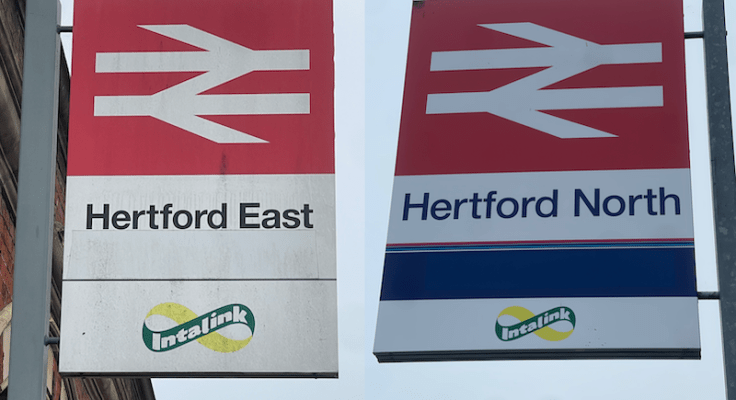
Can you (or your readers) tell us anything about “Intalink”? The logo is on both station signs at the start of your article.
John M.
LikeLike
Thanks John.
Intalink is the branding used by the County Council to highlight coordination and information about public transport throughout Hertfordshire.
See: https://www.intalink.org.uk
LikeLike
That piece brought back some happy memories. I was a young 24 years old driver at Hertford East back in November 72. Back then, there were 28 drivers based there. We would usually do three round trips to Liverpool Street for a days work, but also had turns to Chingford, Enfield Town and Bishop’s Stortford. We also worked to and from Ilford Maintenance Depot, where the stock was maintained, or should have been! Having had experience of working on the Southern Central Division, where rolling stock was maintained to a very high standard. I was appalled on transferring to Hertford East, to experience rolling stock that quite frankly should never have been out on the road. Later in my career as a train crew manager, I managed to address some of these issues, but it was an uphill struggle. As engineers tend to close ranks, and many appeared to be reluctant to challenge them!
At Hertford East, we stabled overnight 2×4 car units in number three siding, 2×3 car units in number two and 2×4 car units in number one. Over in the down siding would be 2×3 car units. In the up platform would be a 1×3 car unit that worked the first up working the 04.33 to Liverpool Street. There were two night running turns along with a night shed turn, winter time the night shed turn was busy, as one would be going round all the units working the brakes to stop them freezing up! The middle road between platforms 1 &2 was generally reserved for “duds” waiting to be towed back to Ilford, but would occasionally be used for general stabling. We also had a washing plant down where the old steam shed was originally. You could only get six coaches through it, so if you had seven or eight car formations, the units would have to be split.
On the night running turns, I would quite often help out and take units down to Southend or Colchester on unit changeovers, as I still signed both routes from my time at Stratford.
When the “juice” was switched off for overhead maintenance work. We would have the Class 125 Rolls Royce 3 car sets. They could leave a three car electric unit on the starting, but their vacuum brakes were not brilliant, so one had to treat them with the utmost respect. A lot of the problem was down to shoddy maintenance at Stratford, and certainly when they went over to the GN they improved. But their brakes were never as good as the other classes of DMU.
I passed through Hertford East on Friday 9th January whilst visiting family, like you experienced not one member of Greater Anglia Staff was encountered. I suspect there is a lot of free travel on the Hertford East branch, as there are no barriers or staff at either Ware, St. Margaret’s or Rye House that I’m aware of! There was talk at one time of continuing the single line from Ware to Hertford to cut down on maintenance, but that seems to have died a natural!
Derek
(Posted on behalf of Derek – RF)
LikeLike
A big problem with rail outside of the large urban areas is the rail stations tend to be poorly located so for relatively short journeys rail is not really viable as it takes more time to get to the station then the actual rail journey takes, You can add into it as well that many rail stations have no public transport to them or very little. How you resolve this I am unsure
LikeLike
Two Dorchesters (West and South).
And a vibrant local bus network including a frequent bus trunk down to Weymouth which passes 3 items of formerly photogenic public art installed circa 2014, one of which is included in a bus stop!
Potentially a bit bleak in winter, best wait for better weather.
MilesT
LikeLiked by 1 person
Miles, my family holiday in this part of Dorset always includes a ride on the 10 from Weymouth to Dorchester or the Jurassic Coaster. Please tell us what these items of art are we have never noticed them?
MikeC
LikeLike
It is incredibly annoying that there are places with two railway stations but, there are places in Lincolnshire where the residents are crying out to have their station reopened.
Graham Lilley
LikeLike
What is interesting about Hertford is to compare the current situation with what it was 101 years ago, at the beginning of 1924.
Then, as now, there were two passenger stations, Hertford East and Hertford North, both of which had been renamed by the LNER the previous July, to distinguish them. While Hertford East – the former GER Hertford station – would be fairly recognisable, as terminus of the branch from Broxbourne, but Hertford North was a completely different station. It was the former GNR Hertford station, sometimes known as Hertford Cowbridge (just north of the town centre), terminus (for passenger trains) of the GNR branch from Hatfield, which had its own single track line alongside the GN mainline from Hatfield to where it turned east, at a site sometimes known as Welwyn Junction. Since 1920 there had been major changes at that end of the branch, as Welwyn Garden City was being developed – Quick says the original WGC station was opened in 1920, with a new (the current?) one a little way too the south, opened in 1926. I don’t sknow when trains from Hertford were cut back from Hatfield to WGC, or what the situation was in 1923-24. While that Hertford North station was the passenger terminus, there was a line which continued east (still GNR), to join the former GER line just east of the Hertford East station (essentially at the station throat), but this was only ever used for goods traffic. But in June 1924 it all changed – at least for passengers – as the ‘Hertford Loop’ was finally opened, through from Enfield Chase to Stevenage, including the new (and current) Hertford North station, in to which the (ex-GN) passenger service from Hatfield was diverted to terminate. But it had no goods facilities: the old Hertford North/Cowbridge station (and the link throught to the GE) remained open for goods traffic until 1966. (See http://www.disused-stations.org.uk/h/hertford_north/index.shtml for some more details.
Will any of the other ‘two station’ places have such an interesting history?
LikeLike
A small rump of the old Hertford to St Albans line remains open as the St Albans Abbey line, It originally had a number of small stations on the line
At Albans London Rd, Salvation Army Halt, Smallford, Nast Hyde Halt
The line closed in 1951
LikeLike