Thursday 2nd January 2025
Welcome to the first blog of the New Year which is my monthly look back at things that caught my eye during the past month’s travels not previously covered in posts. And we begin with a shout out to Alex Nelson at NationalRail.com for his latest….
National Rail Network Map
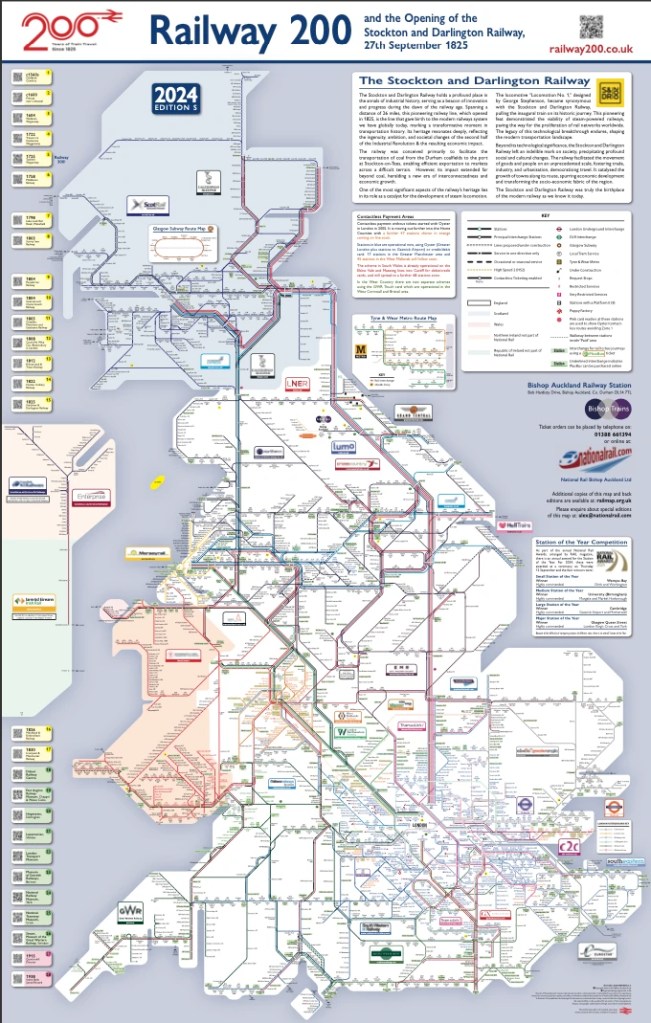

It’s an absolutely fascinating wall map (double royal poster case ‘British Rail’ size) and, together with a pdf electronic version (strictly for personal use), is available for just £12.55 via this link. It’s a brilliant map with exquisite detail depicting every station in all four UK nations with their three letter codes, indications of request stops, restricted access and Platform Zeros as well as PlusBus availability and even contactless zones as they’re being introduced and extended. This latest (fifth) edition just published marks the 200th anniversary of the Stockton and Darlington railway being celebrated this year with a great deal of detail of early railways in the UK, and shows major railway museums around the UK with QR codes down the left side of the map to further information about relevant subjects. Well done to Alex for a truly magnificent job. A highly recommended purchase.
TfW’s backward timings
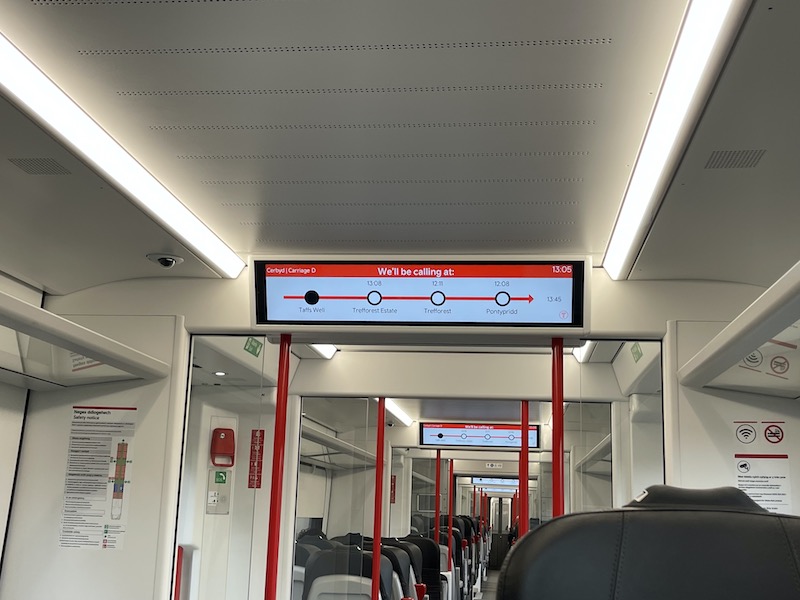
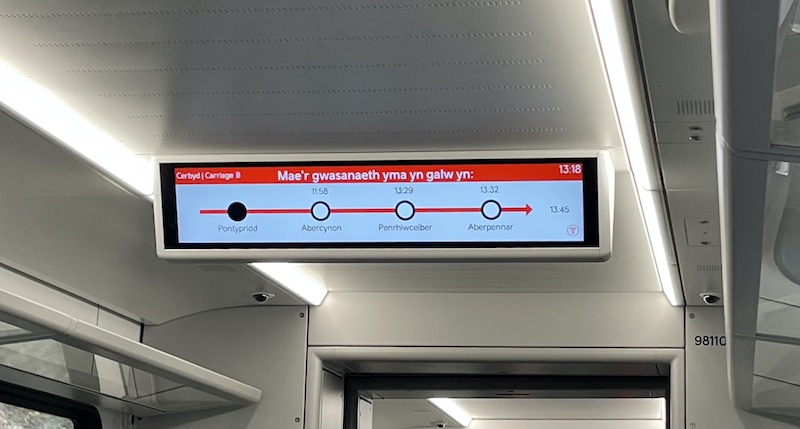
I couldn’t help notice on one of my journeys sampling TfW’s new tri-mode Class 756 trains on the line to Aberdare the very helpful next station displays were showing the correct upcoming stops…

… but we were either going back in time (as above) or taking an inordinately long time to travel between two stations – Abercynon to Penrhiwceiber: one hour 31 minutes for two and a half miles (as below). That’s slow going.
Aberdare’s ticket office

On arriving at Aberdare it was nice to see a ticket office window (literally) built into the station building and even better – it was open.
Avoid the crowded retail units at CLJ
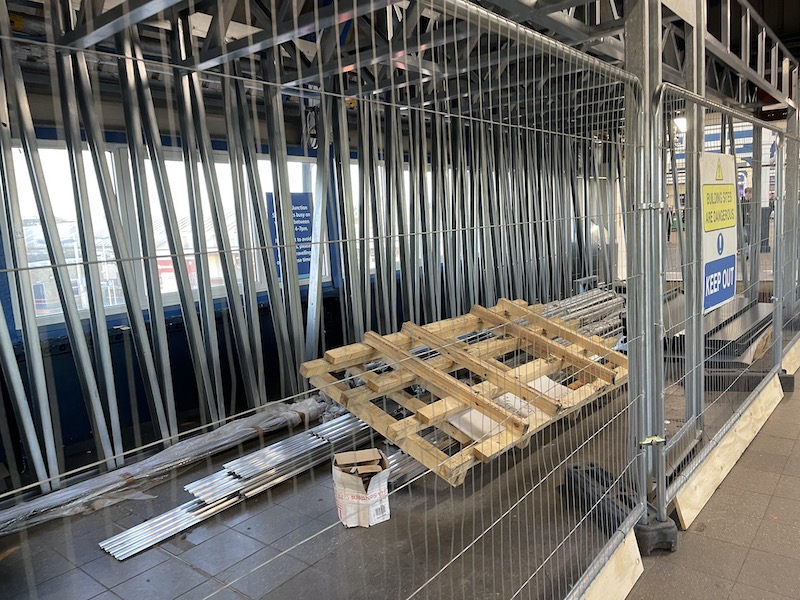
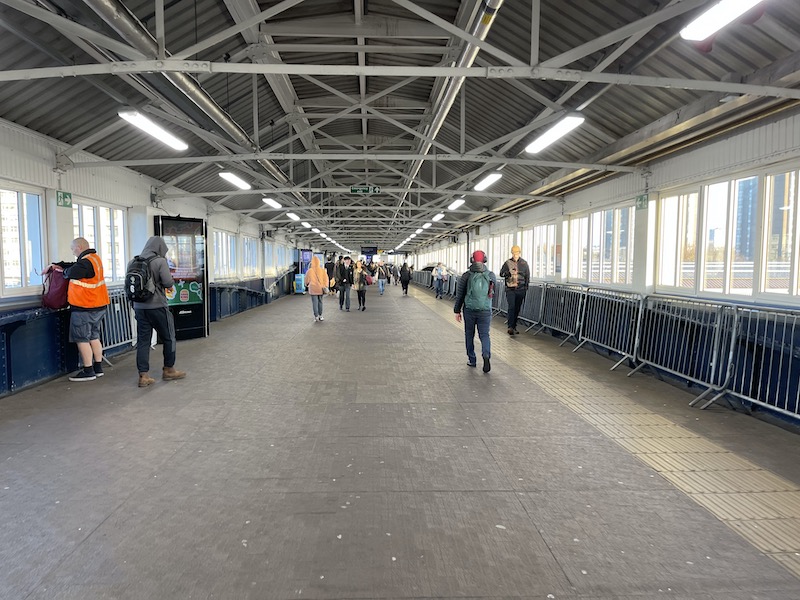
Although retail units have been removed at Euston and Victoria in recent times to create more circulating space for passengers, I see over at Clapham Junction builders are at work reinstating a whole series of shops along the footbridge which connects the Southern platforms with those used by South Western Railway and London Overground trains thus narrowing the amount of space available for passengers.
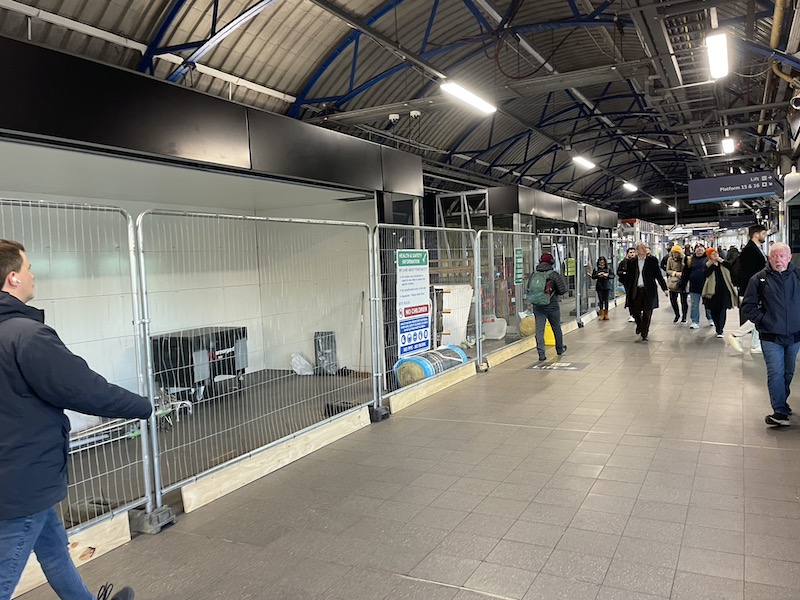
Which doesn’t quite gel with the warning notices advising passengers wanting “to avoid the crowds” not to travel at busy times – which by definition is when passengers do want to travel.

So far the builders have only encroached on the southern end of the footbridge over platforms used by Southern, but there’s plenty of space yet to fill on the northern section towards the lower numbered platforms.
STP’s rarely used entrance
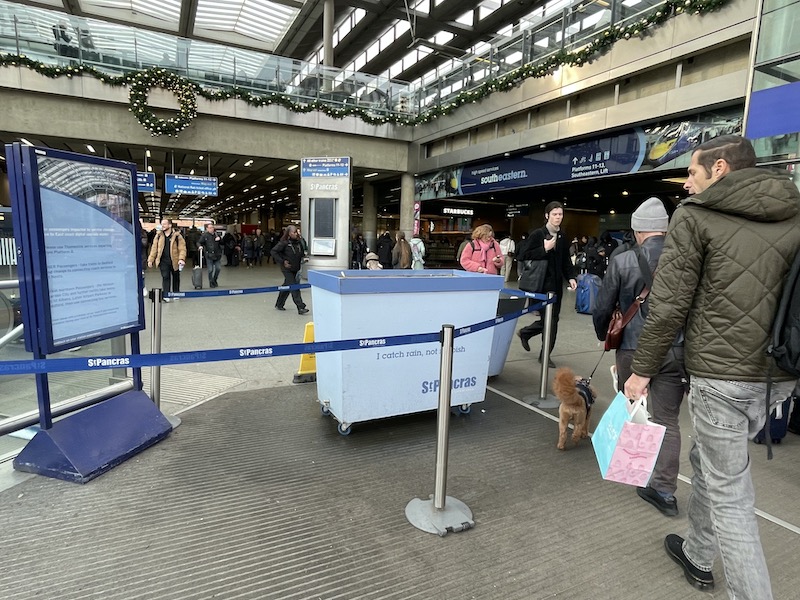
And while on the subject of crowd management, over at St Pancras there was a problem by the concourse exit opposite Kings Cross the other day when I visited which, from the state of the floor covering, looked like some kind of leak. The makeshift barrier (above) was causing quite a lot of congestion with passengers hurrying in and out, yet the rarely used other entrance/exit nearby remained shut behind a barrier. Very odd.

Polar Express adds to the crowds
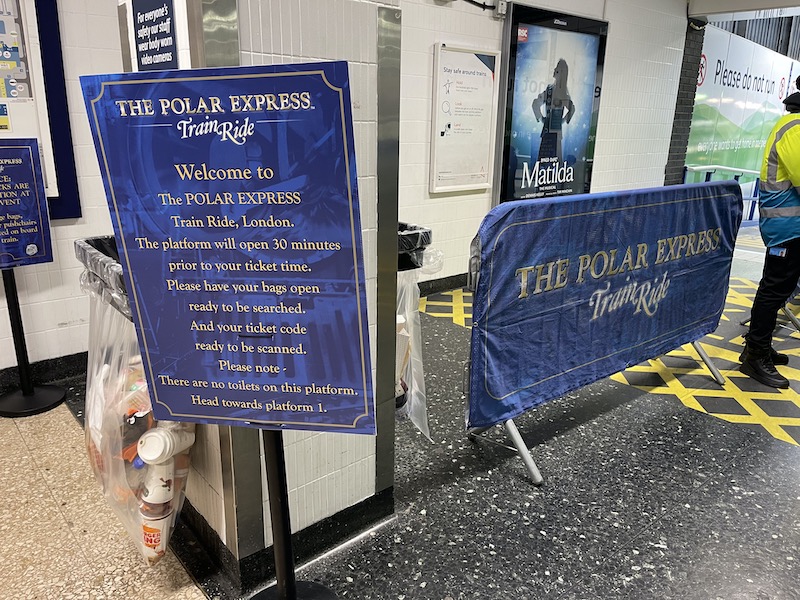
And while talking crowd management, back to Euston which I visited on a day when the grossly over priced POLAR EXPRESS train was running every couple of hours taking pre-booked passengers on a jaunt (with Santa on board) up to Willesden Junction and back.
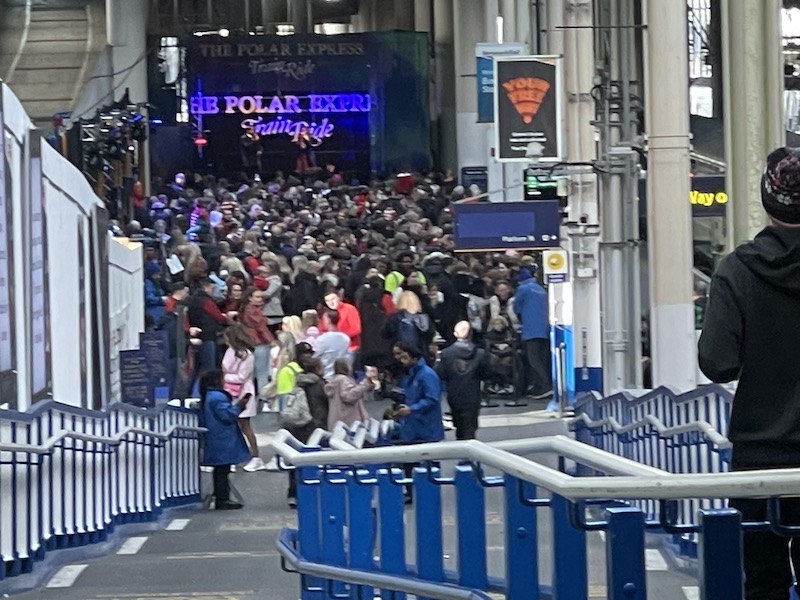
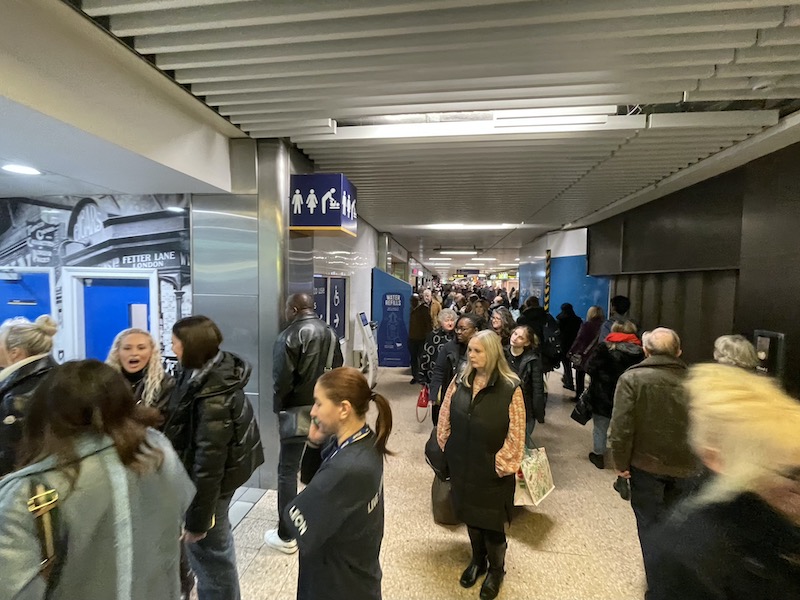
Euston wasn’t in the best of moods that day with huge crowds waiting for delayed trains so is it really a good idea to use the station with known overcrowding problems to run a service of this kind? It wasn’t ideal for the kids nor for their parents/carers either. The queue for the ladies toilets stretched right down past platforms 1, 2 and 3 and towards platforms 4, 5, 6 and 7. A very chaotic and unpleasant experience.
Richmond Park’s RP1 ran in December …. or did it?
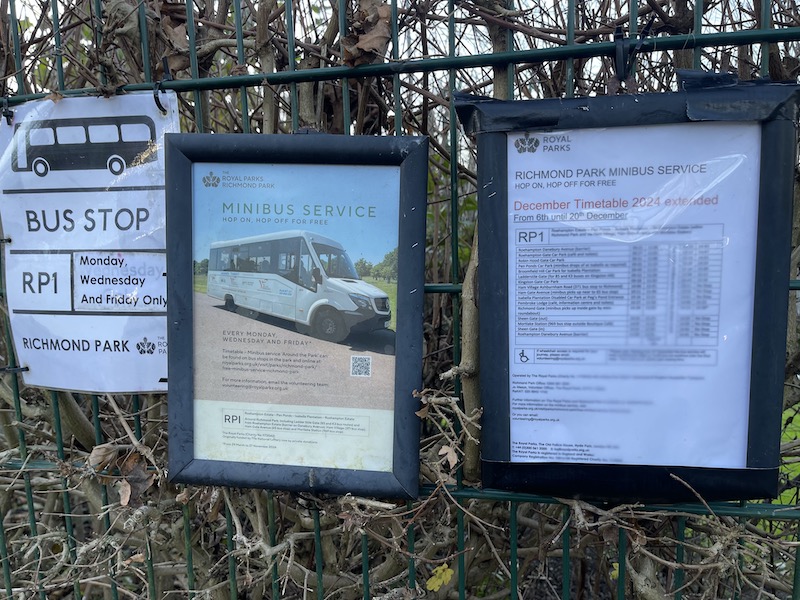
Regular blog readers will know I’ve taken a ride on the quirky Richmond Park free bus numbered RP1 a few times during the summer and over the years the season has gradually extended, until this year came news it was to operate during December having taken a short break for the bus to be serviced and vinyls added promoting the route.
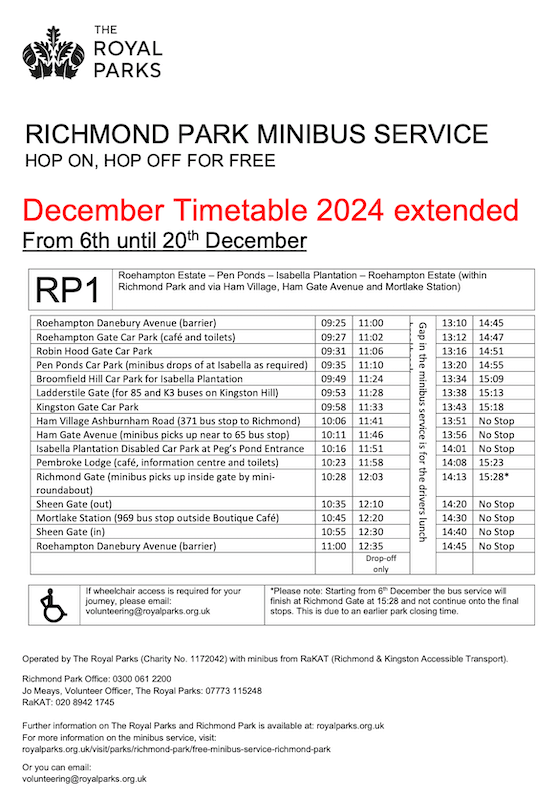
Except I duly turned up in Roehampton at 09:25 to catch the newly liveried bus on what was advertised to be the first day of the extended timetable – Friday 6th December – and waited… and waited…. but sadly no bus. I rang the Royal Park’s telephone number shown on the timetable but there was only an answer-phone. I rang the number for the Volunteer Officer but there was only an answer-phone. I rang the RaKAT number (Richmond and Kingston Area [Community] Transport) which owns the bus and luckily someone did answer and advised the bus had a bald tyre and smashed headlight so wouldn’t be running. I headed off to do some Christmas tree spotting in London’s rail termini as an alternative, but tried again later in the month, taking the precaution to ring the numbers beforehand for up to date information. Despite leaving a message on all the answerphones no-one bothered to contact me so I don’t know whether the bus did run or not.
Bridgend bus station
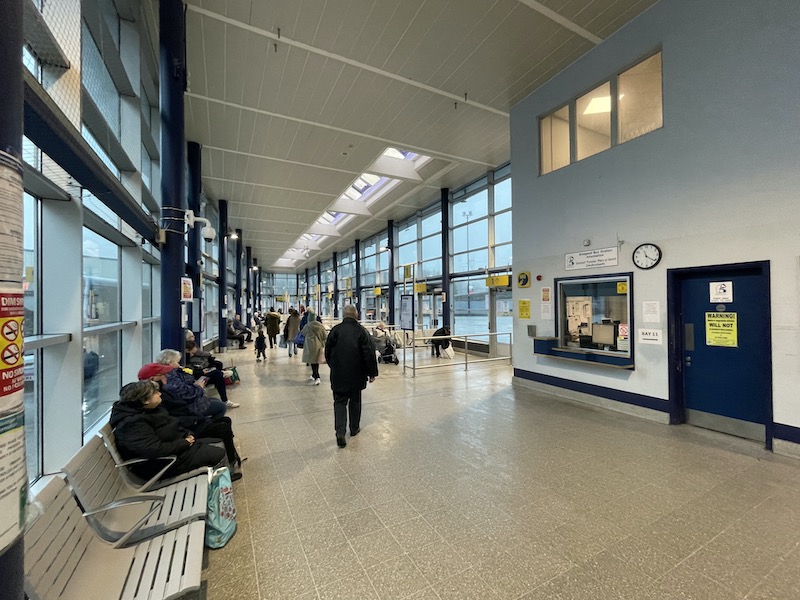
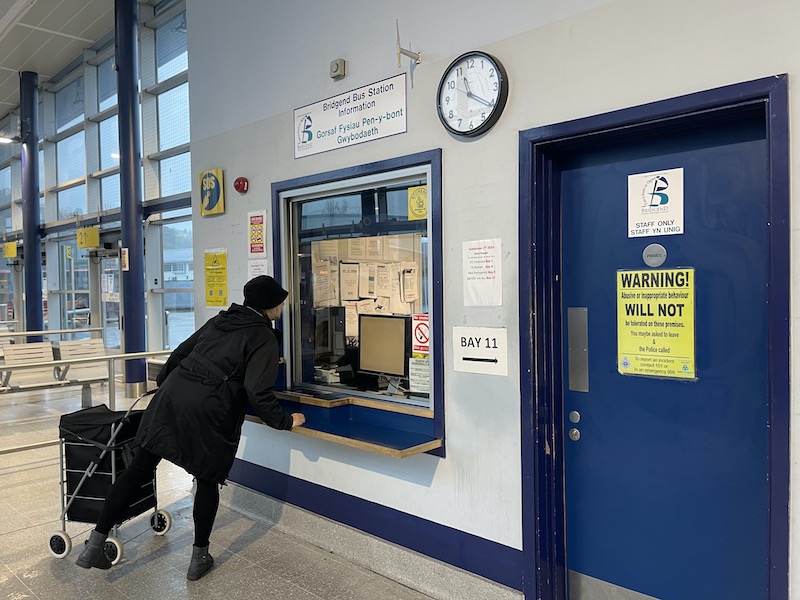
When passing through Bridgend bus station it was good to see a travel office window open and I see the Council are keen to let passengers know by a WARNING! that Abusive or inappropriate behaviour WILL NOT be tolerated in these premises. That’ll tell ’em.
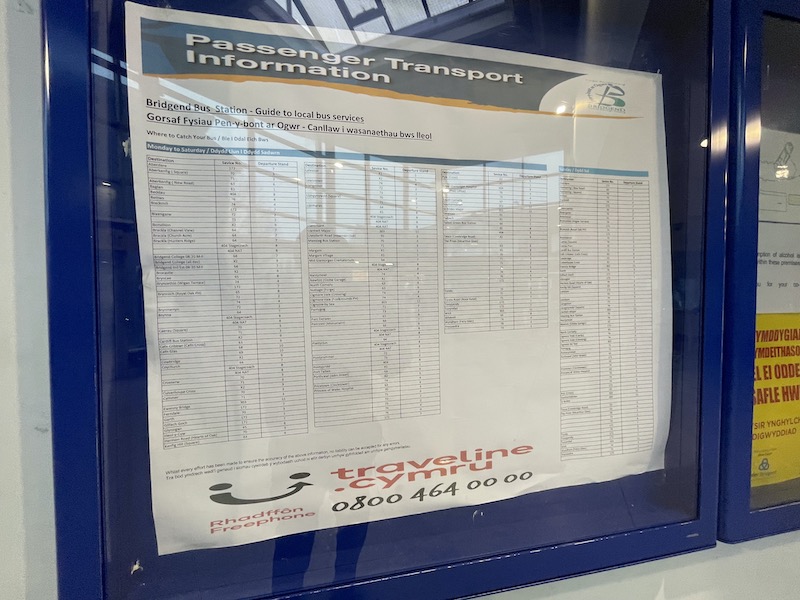
There’s a very spreadsheet style guide to local bus services on display too.
Cardiff’s Interchange displays
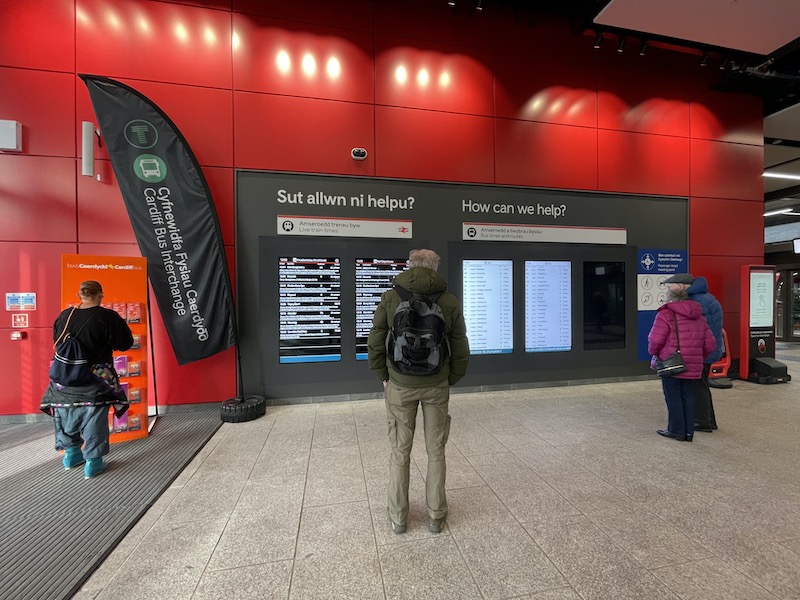
Still in South Wales and I very much like the displays at the entrances/exits to Cardiff’s new Interchange which show both bus departures (on the left) and rail departures (on the right) and printed timetable booklets for Cardiff Buses in a display on the far left. And, as you can see all three proving popular.
New gates for TfW
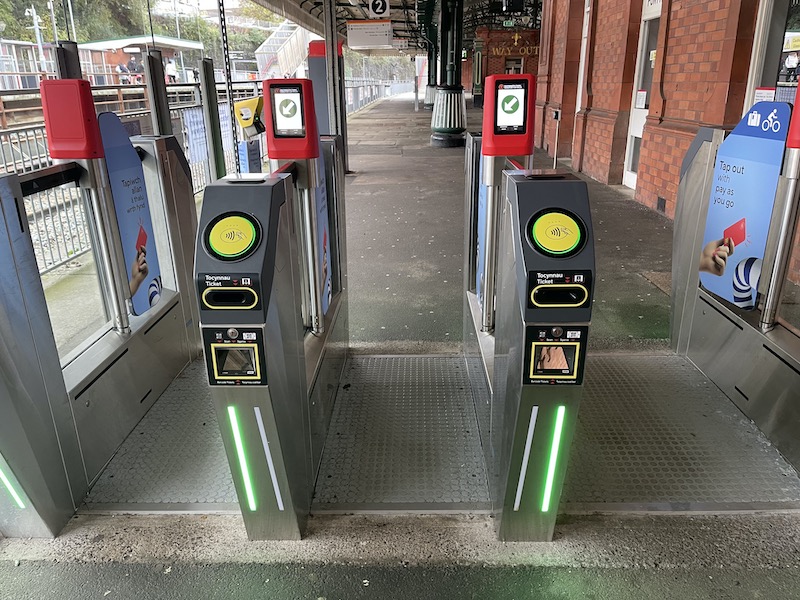
Many of TfW’s stations in south Wales are now equipped with these snazzy new ticket readers/barriers at the gateline. I saw many passengers struggling especially with the QR reader glass panels but I’m sure they’ll get used to it.
Making a bee line for Manchester

I came upon no end of new buses destined for Metroline’s involvement in the third and final tranche of TfGM’s Bee Network this coming weekend. They were all parked up in Comfort DelGro’s other bus company, Adventure Travel’s yard, close to Taffs Well station. I’m guessing they’ll all either be gone or on the move over the next couple of days as mobilisation comes to a climax.

West of England confusion in Porthcawl

Boarding the bus in Bridgend to take me to Porthcawl I was a bit unnerved by the TapOn-TapOff pink sign by the driver’s ticket machine (above) which had a West of England logo, so decided not to TapOn in case it didn’t work – being in a different country. But when I sat down I noticed the cove panel notices had the logo blacked out, so it probably would have been OK.
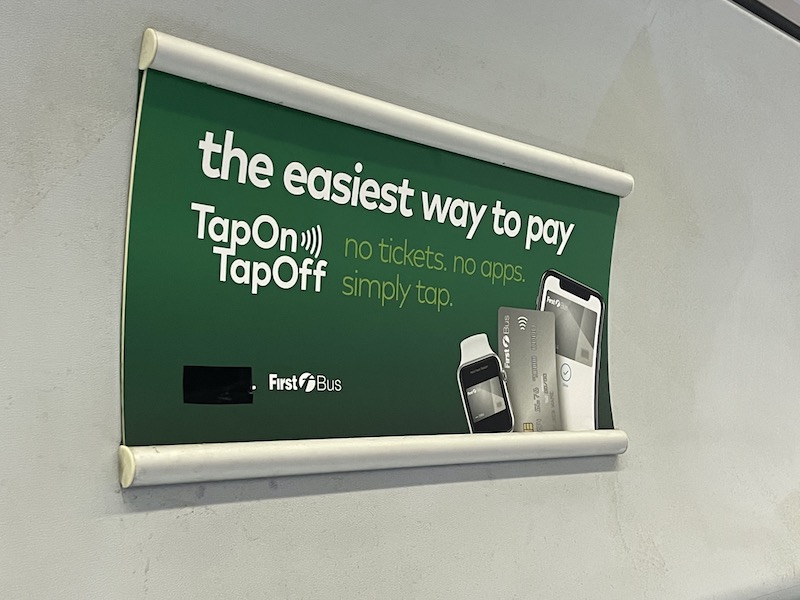
Although getting to Clifton Village from Porthcawl would have been quite a journey.

Nice shelters
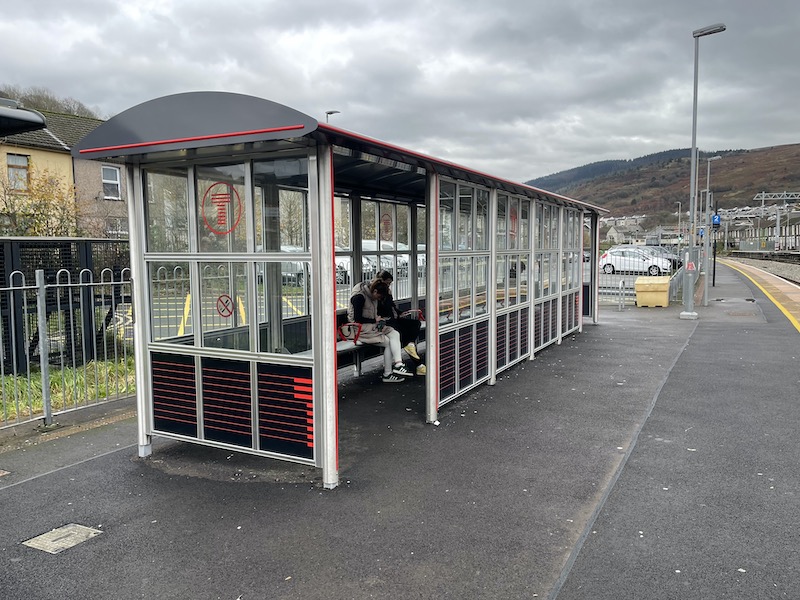
One thing that was noticeable as I travelled on the Cardiff Valley lines was how well TfW has done with its branding. It’s now everywhere – ready for the launch of Metro, and the shelters look particularly smart.
Why the single doors?
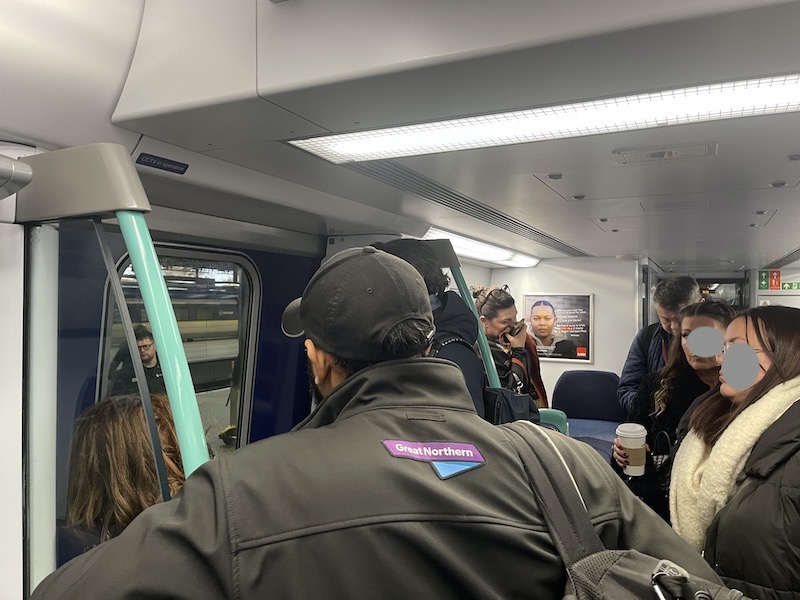
Don’t be fooled by the Great Northern logo on this staff member’s jacket. This was on a Southeastern Javelin Class 395 High Speed train and reminded me how inefficient the single space doors are in these coaches letting only one passenger alight or board at a time. Very unusual these days for a train that sees lots of commuters.
Why the barge?

While in Devizes last month I noticed, for the first time, the illustration for the bus stop used by National Express coaches has a barge sailing along a canal on it, and wondered why? It rather gives the impression of slow travel.
West Ham’s positioning

Catching a c2c train heading eastbound towards Shoeburyness or Southend from West Ham – which a lot of passengers do, especially as it’s quicker to Barking and Upminster than using the District line, I noticed how all four-coach trains (and there are quite a few) stop at the eastern end of the platform…
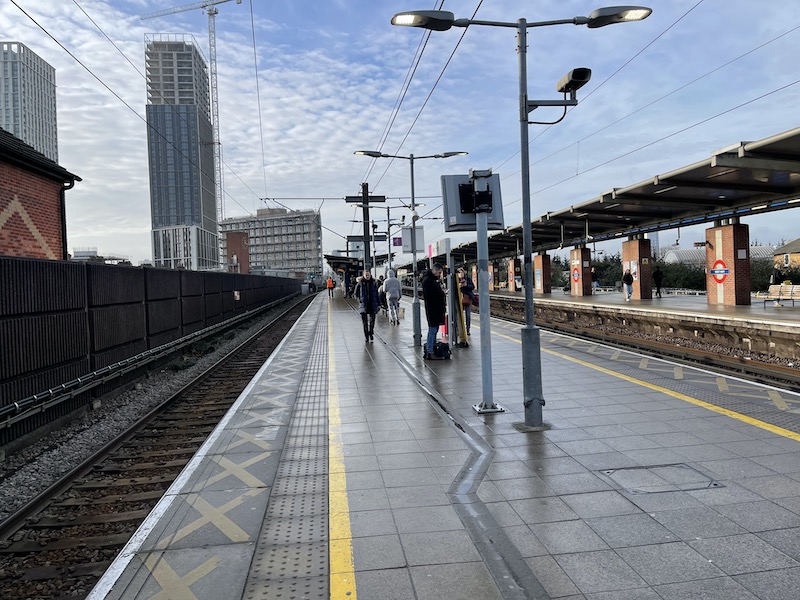
… which is (a) the furthest end from where the entrance to the platform, capable of taking 12 coach trains, is (ie at the western end) and…

… (b) is just outside the protective canopy. While you’re waiting there is a regular auto announcement warning passengers about this practice but many don’t listen and in any event in wet weather it’s hardly convenient.

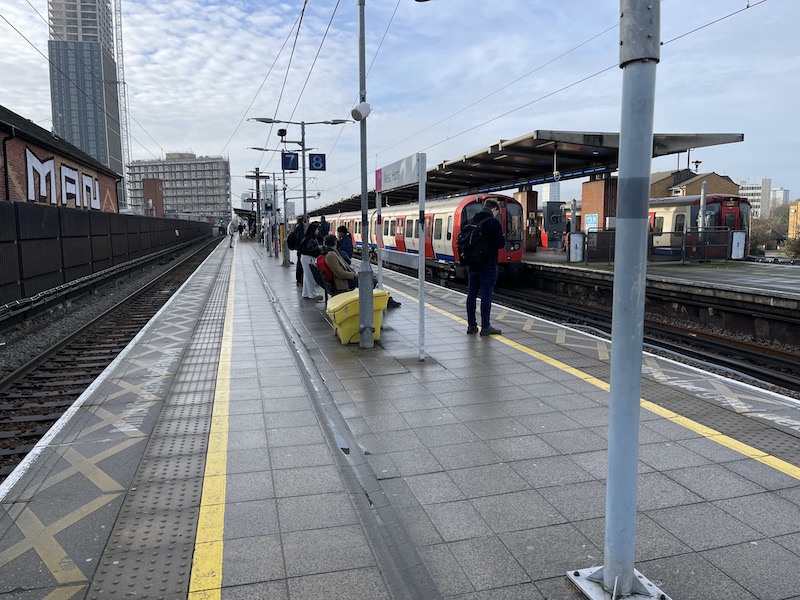
The reason could be something to do with the screen displaying cctv images being out of action at what would be the convenient spot to stop (above) whereas further along the platform they are working (below).
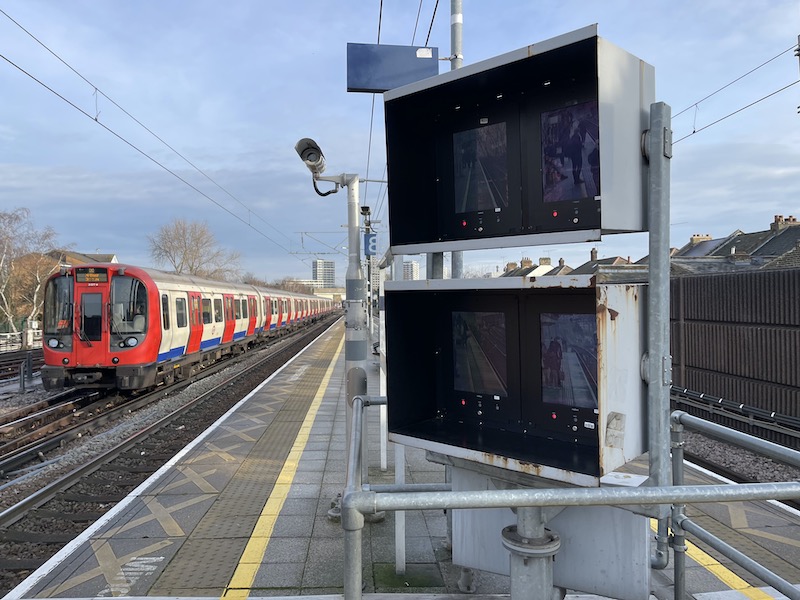
Just to add to the injustice, the canopy over the District/Hammersmith & City line platforms extends a bit further east.
St Neots bus shelter is still the same
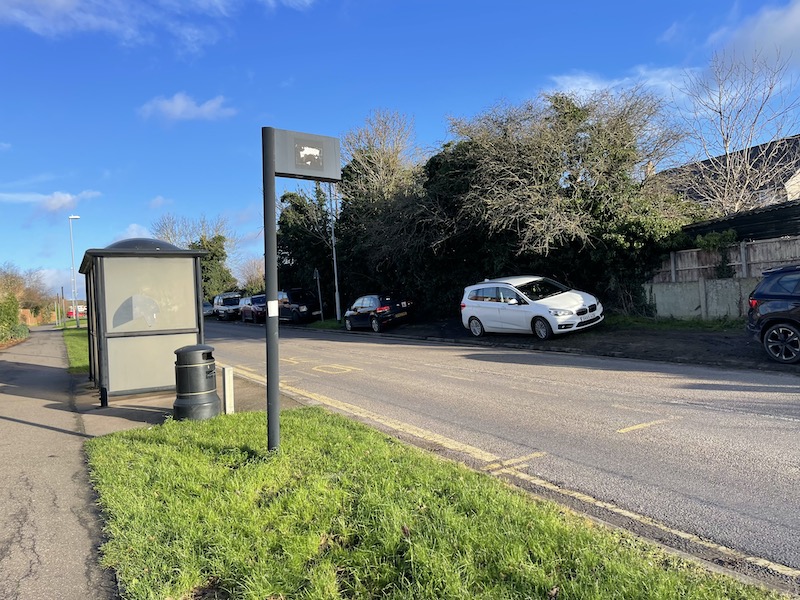
I’ve been out DRT sampling again recently including the newly rebranded Tiger operation in West Huntingdonshire (see this Saturday’s blog) and once again booked a pick up from the bus stop closest to St Neots railway station.
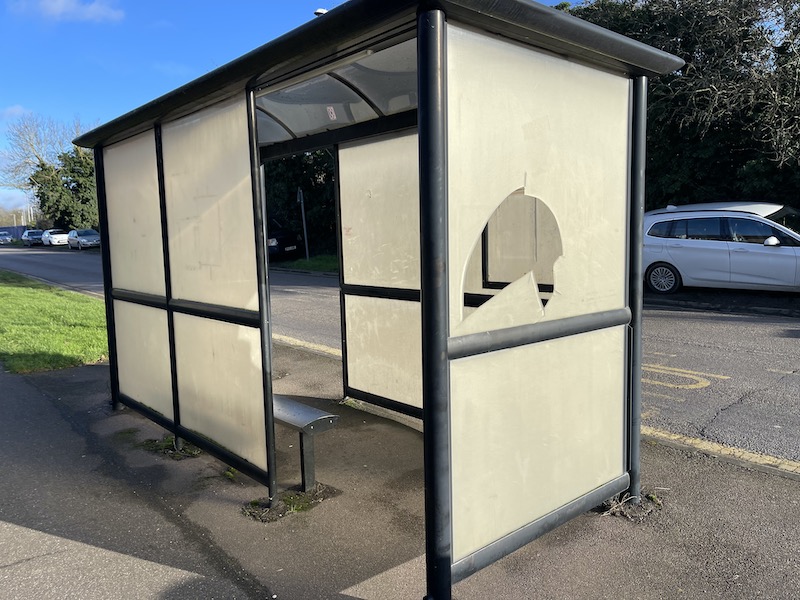
Despite highlighting how awful it was back in October 2021 and in the meantime Cambridgeshire and Peterborough Combined Authority being blessed with more funding for bus improvements, together with rate payers handing over a Mayor derived £36pa precept, I see the bus shelter is still in its woeful state.
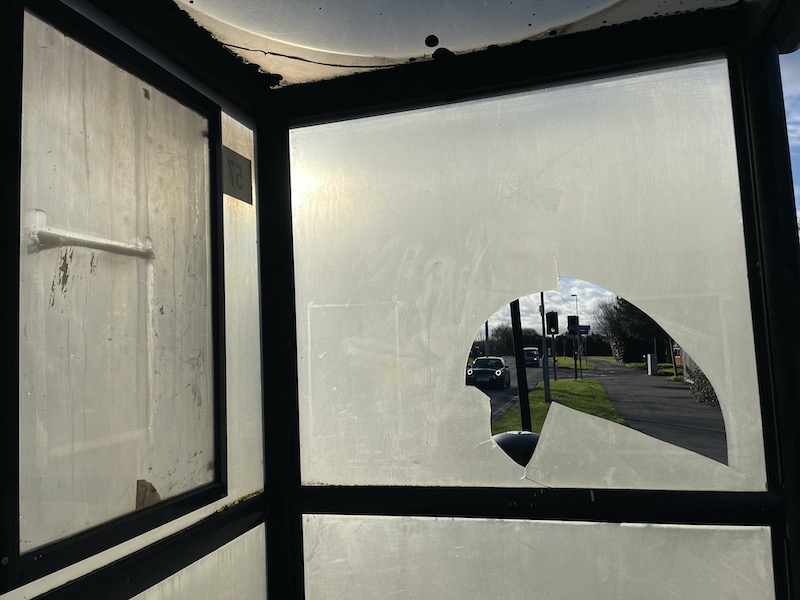
At least the out-of-date timetable information has now been removed and the punched out gap is still there so waiting passengers can actually see if their bus is coming on the real time sign.
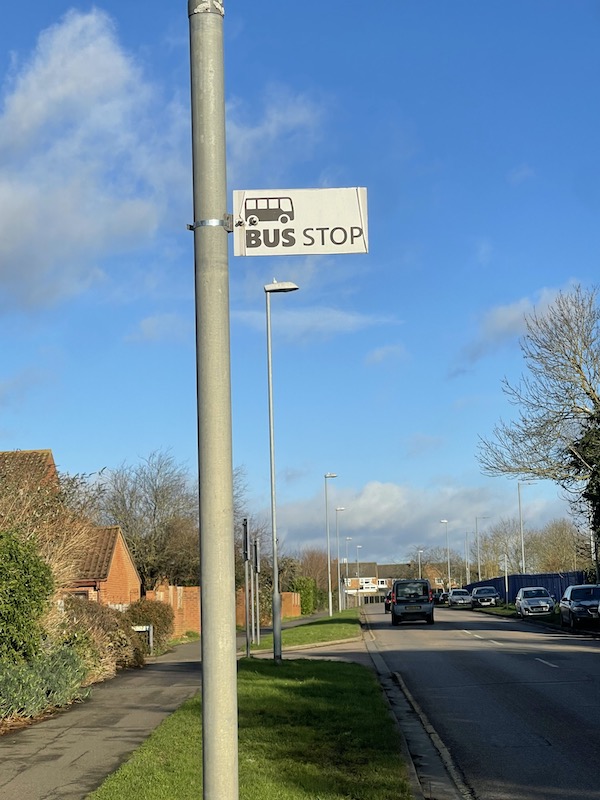
The bus stop flag could do with some improvement too. I hope it’s not another four years before this appalling piece of infrastructure is improved. It’s no way to encourage passengers.
Broken taps in Victoria
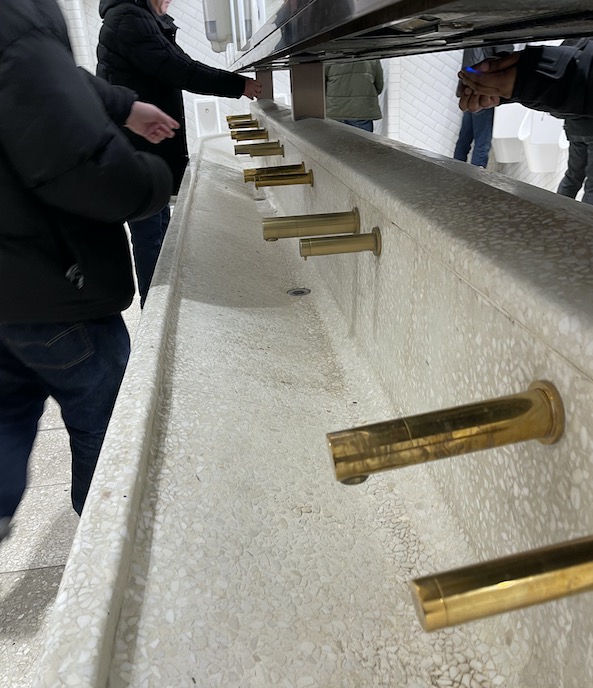
This month’s toilet update is a report from the Gents in Victoria station where on this island of wash basins closest to the urinals only five of the 12 taps (six either side) actually work and none of the 12 soap dispensers have worked for months with just two plastic dispensers either end at mirror height – out of reach of those using the centrally located taps and which many users don’t see. I do hope Network Rail attend to this soon as it’s fast becoming an unhygienic place to visit. So much for all the post Covid raising of standards. I’ve seen many users try a few taps and then give up in frustration and leave without washing their hands.
Paddington’s war on suitcases on escalators
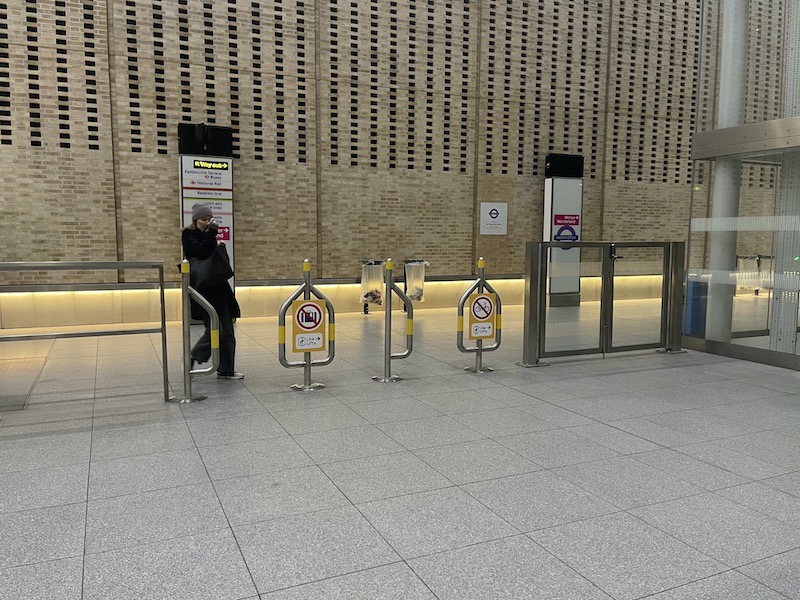
When passing through Paddington’s Elizabeth Line concourse the other day I noticed anti-large suitcase barriers have been installed to encourage passengers to use the lift rather than the escalators. The gap still looks quite large to me though, and sadly I think passengers will still try it on as the lift is already well used and takes ages.
Gail blowing in

Meanwhile over at St Pancras the former East Midlands Railway ticket office has now been fully converted into yet another Gail’s. I suspect the average spend per customer will be similar to when it was a ticket office. I see another branch has opened at London Bridge too.
Thameslink’s spruce up
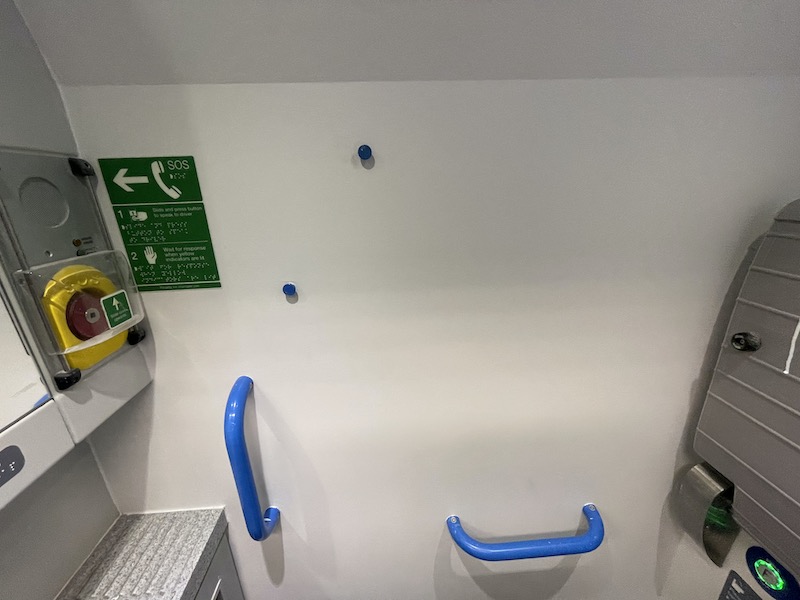
A shout out to the cleaning teams at Thameslink. For years all the toilets in the Class 700s trains have been blighted with overbearing graffiti painted on the walls and I’ve noticed during the last few months of 2024 these have all been cleaned up and the graffiti removed – which must have taken some doing. If the lowlife who carry out such graffiti acts are reading this – take your spray cans elsewhere – like, inside your own homes where you can spray paint all over the walls as much as you want.
Swindon’s new bus interchange for 2025
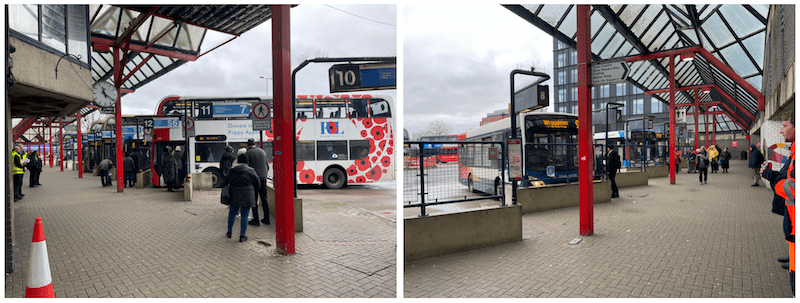
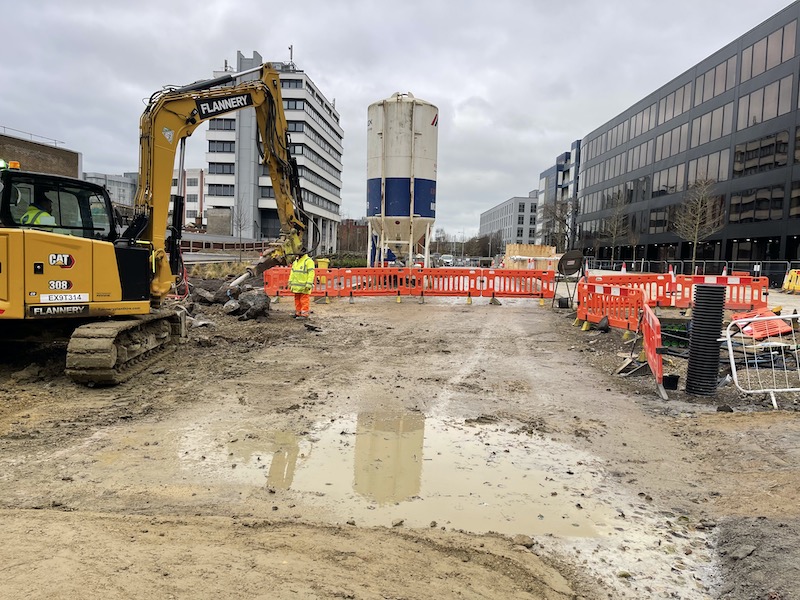
Swindon’s long awaited new bus interchange is set to open this year with the tired old 1980s bus station well past its sell-by date. Town buses have been diverted away from their stands in nearby Fleming Way since work started on the project in September 2022.
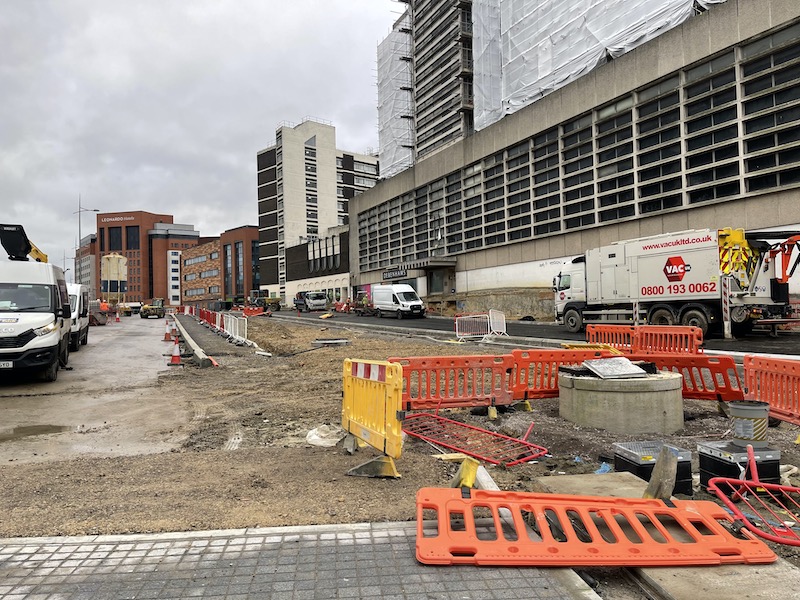
On a recent visit to Swindon I could see the reformed Fleming Way is now taking shape including what will be an impressive central reservation between the two lanes for buses where there’ll be over 100 mixed hedgerow bee-friendly plants. All told the £33 million cost includes 173 trees and 23,000 plants.
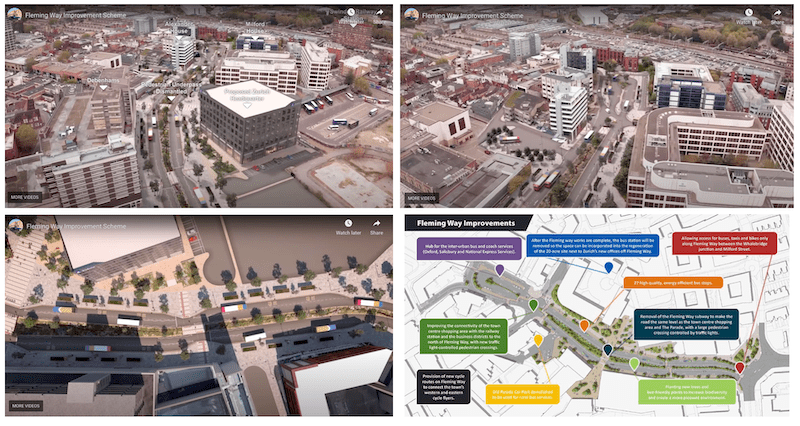
Online images of how the new arrangements for the 27 bus stops on either side of Flemming Way are impressive.
The Wanderings of a Busman
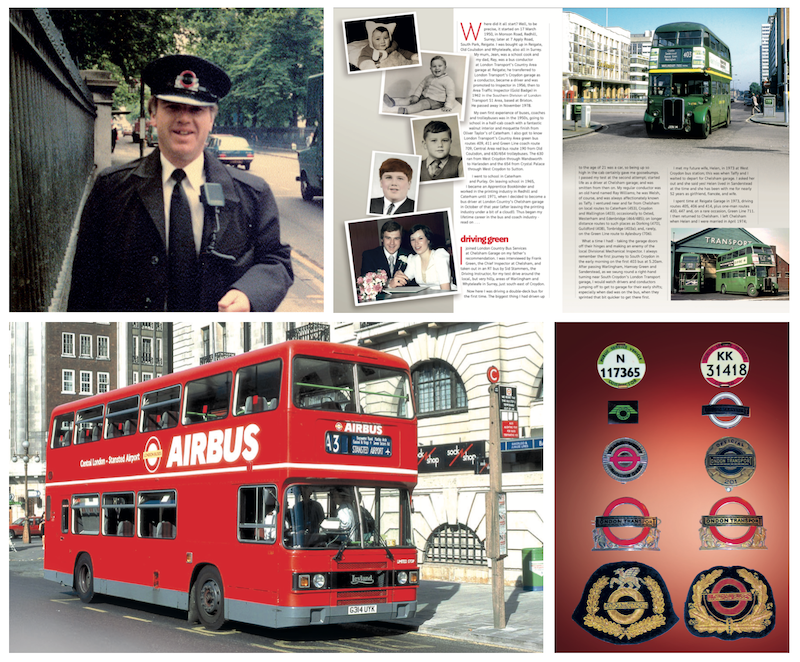
John Kateley is well known to many of a certain age with an interest in the bus industry, not least those who worked in London and the South East through the 1970s and subsequent decades and came across John as his career progressed. Following in his father’s footsteps, John began his career in 1971 at London Country followed by many years working for London Buses as well as during the privatised era with Airbus and then Speedlink but he also spent time with First Bus, Arriva and National Express. John is renowned for his wealth of stories and anecdotes from his varied and colourful career and last year, after persuasion from family and close friends, he committed many of these to print so they could be shared among those he knows best. With help from Barry LeJeune and Ray Stenning, the story of John’s amazing and intriguing career has now been produced in a beautifully designed and colourful auto-biography which John presented to his family and close friends as a surprise Christmas present. Well done John. It really is a great read.
Farewell route 347
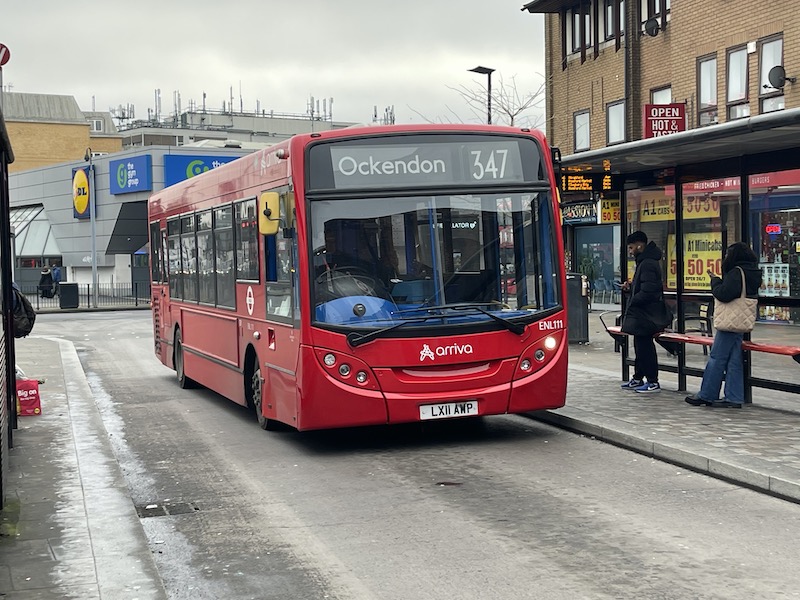
This month sees a number of new bus routes and DRT schemes being introduced around the country, such is the way with a new year commencing, but there are also some bus routes disappearing including in London where TfL are finally pulling the plug on its least frequent route – the 347 from Romford to Ockendon, running just outside the M25 over the border in Essex.

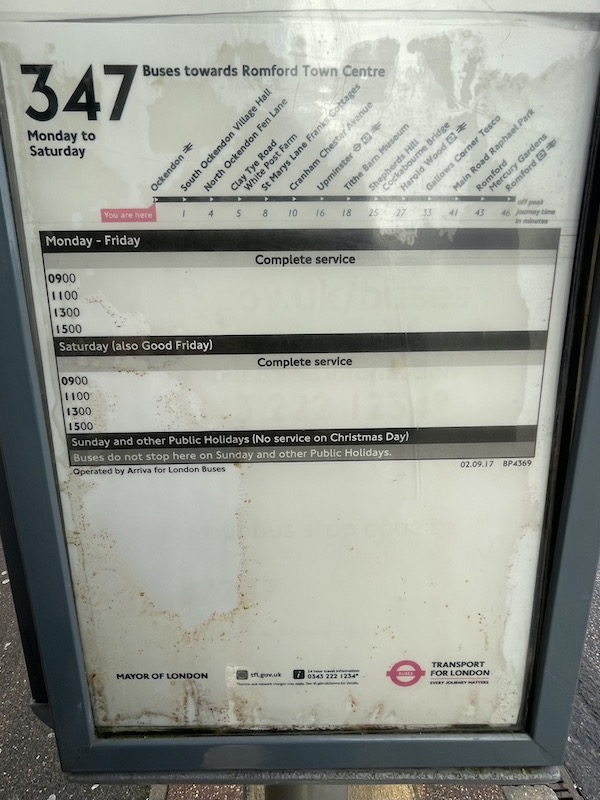
Introduced 20 years ago the timetable comprises a paltry four off-peak return journeys on Mondays to Saturdays…
… and there’s just a short section of route along St Mary’s Lane east of Cranham which will be left unserved including three bus stops within the Greater London boundary – which is very uncharacteristic of TfL, but (financial) needs must, I guess.
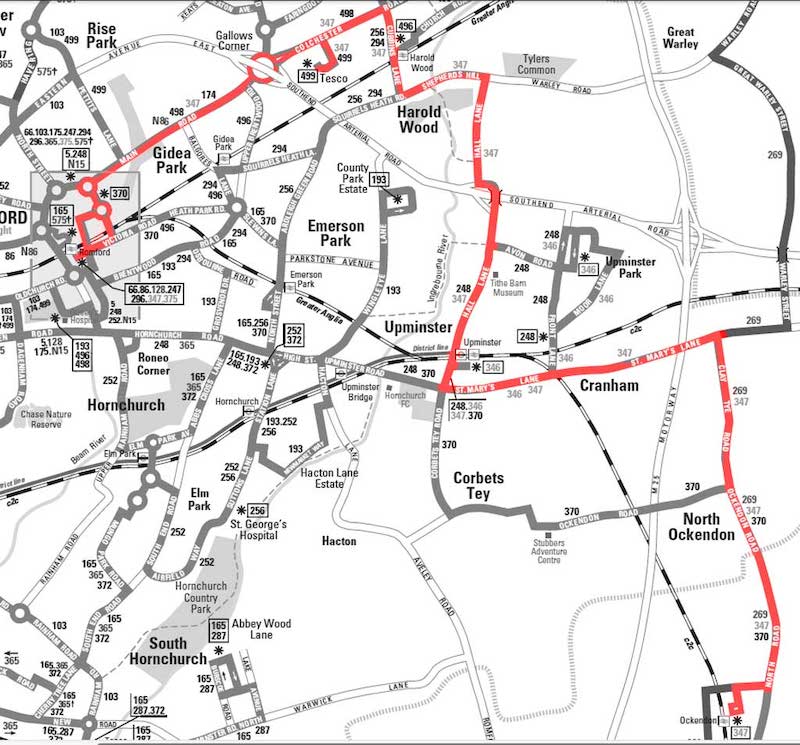
I took a ride on the route earlier last year with Geoff but as it runs for the last time on Friday 17th January I had another ride the other day, for old times sake, on the 13:00 from Ockendon, when just one passenger boarded at the first stop after leaving Ockendon station (who in future will have to take NIBS route 269 to either Grays or Brentwood) while another passenger joined us on one of the to-be-abandoned stops on St Mary’s Lane (Cranham) who’ll have a longer walk to catch a 346 instead. Other than those two it was a quiet journey with a handful of passengers joining us between Gidea Park and Romford who have many alternative options.
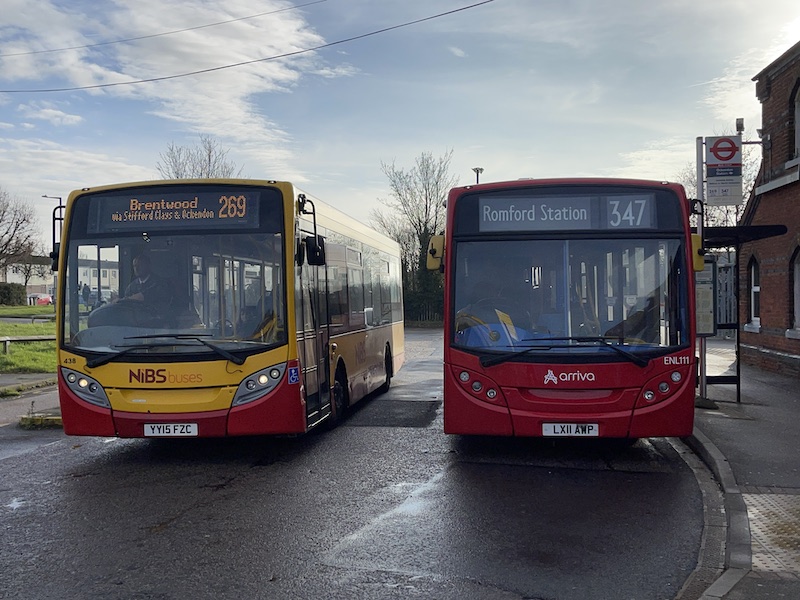
Sadly route 347 won’t be much missed.
More miscellany at the end of this month.
Roger French
Blogging timetable: TThS
 BusAndTrainUser
Glad to see barriers on the Cardiff Area rail network. When the railways were privatised a lot of info was available on each franchises revenue and Valley Lines, despite being a commuter railway, had very little season ticket revenue. Asking a member of management about this anomaly he said ‘ why buy a season ticket when you only have to pay three times a week anyway’ Most people bought tickets from the conductor/guards who had no chance of getting to everyone on the busy trains. I understand adding to second ticket issuer to many trains reduced the problem
LikeLike
The barriers are only any good though when they are in use and at many stations.
These barriers at Pontypridd only cover the Cardiff bound platform and are left open a lot of the time (unless staffing hours have now changed). You’d need a LOT more checks and barriers before people on the valley lines start buying tickets.
LikeLike
I very much look forward to receiving the blog Roger. A great read.
LikeLike
I’m not Really sure it the industry will see any benefits of the £2 fare cap in 2024
but it must find a way to improve the dynamics promotion and service levels to improve the public perception to be able to thrive
i hold out hope in Wiltshire with the new “green” Swindon bus interchange we don’t call it a station round “ere”
we have to wait another 12 months for the 26 new battery reds with hopefully a large drive and publicity to encourage a higher useage in 2026.
I’m going to sample service today and will look for positives.
thanks Roger for your posts. Happy New year to you and family. Yours STU
LikeLike
It isn’t just c2c who stop in stupid places. At Selby, southbound LNER trains pull right up to the far end of the platform, taking the rear end of the train well beyond the canopy and onto the open platform where there are no shelters, no electronic displays, and consequently no waiting passengers. This isn’t even a “train type” issue, as Hull Trains run exactly the same unit types, and do stop at the near end of the platform – and I’ve never seen LNER run a 9-car train on that service so it isn’t even as though they’re worried that drivers might ignore the audible reminder about how many carriages they’ve got and stop short when they’ve got a full length train.
LikeLike
It’s not just at Selby, it’s at all stations LNER serve. LNER management have come up with a policy where they have only one stopping point on a platform for each train type, so one stopping point for “Azumas” regardless of train length and one for the 91+Mk.4 rakes.
It’s not customer friendly but, let’s face it, what is today called LNER hasn’t been genuinely customer friendly since they were GNER and pretending to be superior to everyone else.
LikeLiked by 1 person
Risk mitigation in play… same as on c2c (and now on Great Northern too), lest the driver forgets how many coaches are on their train (and, for example stops at a 5 car mark with a 9 car train) and opens any doors that might not be on a platform…
LikeLike
I believe LNER drivers get an audible reminder how long the train is as they approach the station. Also pretty sure they are not DOO so the conductor would not be opening the doors if the train was not fully on the platform.
LikeLike
Far be it from me to challenge the transport terminology in your blogs Roger, but I really can’t let “barge” and “sailing” slip through, knowing how many thousands of boaty types will be grinding their teeth as they read. It’s a narrowboat of course, and they certainly don’t sail anywhere (well, sideways maybe when the wind is in the wrong direction) – the official boaty term is ‘cruising’ – though I’ll admit the term was probably never used when barges were barges and carried goods rather than people! The coach stop in Devizes invites passengers to visit the famous Caen Hill Flight of locks – one of the seven wonders of the waterways and now a scheduled monument. Happy new year Roger!
LikeLike
Many thanks for al the clarifications John. I’m now much better informed!
LikeLike
The RP1 ran on 11, 13, 16, 18 & 20 December.
I did get briefed, partly by RP1 drivers and by telephone from the Holly Lodge Office.
The new livery was applied by 11 December at a workshop at Yiewsley.
LikeLiked by 1 person
Happy New Year Roger …
A typo in the TfW’s backward timings section … Class 756 not 356 …
Best regards,
Andrew Sutherland
LikeLike
Thanks Andrew. Corrected.
LikeLike
Roger,
Richmond Park RP1 service: part of the problem is that the service has to rely on volunteer drivers, who, as we know cannot always be found…
Congestion at Clapham Junction: when I worked at the ORR, a senior rail official explained to me that Network Rail’s principal interest was in “retail”, rather than running trains. Gails at St Pancras may be evidence of this approach…
LikeLike
Though St Pancras is not a Network Rail station – it is managed by HS1 Ltd.
KCC
LikeLike
This should be made available to download not just to buy, out right, a lot of people, will try to save money and download it instead
LikeLike
Whoever did the graphics on that Bridgend poster needs some tuition on aspects …
LikeLike
The new TfW ticket gates are supplied by the same company that does the Stagecoach bus ticket machines (Vix Technology). Makes a change from the Cubic equivalent seen all across GB, if only because of TfW’s choice of PAYG system.
As a side, the barcode readers are for Aztec (not QR) codes. To be fair QR codes are far common in everyday use* and even those who design the stickers seen on gatelines don’t know the difference!
[* Aztec codes appear to be used for transport ticketing and not much else]
LikeLike
Aztec codes are used on UK (and some overseas) rail tickets; QR codes on UK bus tickets, e.g., Ticketer.
LikeLike
Indeed. Plusbus e-tickets for West Yorkshire or Cambridge have Aztec codes too, I believe; their site speaks of a wider rollout in autumn 2024 so I’m curious as to when that’ll happen.
LikeLike
TfW backward timings, sums them up perfectly. Hidden in the new budget for 25/26 in Wales is the circa £180m in year cash bailout last year becomes the norm.
So the vast majority of transport budget is going to maintain that – plus projected wages increases. Oh, and this is the first of the 30 year PFI payments for the A465 dualing- circa £30m/year.
Welsh transport is in a mess – more of the same to come for buses. Let’s hope the likes of Bray and chums stick around long enough to see the collapse in the bus network which their ‘control’ calls will deliver.
LikeLike
I’ve always assumed that minimising the number of different stopping points along the platform dependent on the train length would make it a lot easier for the drivers to remember where to start slowing (as well as saving having multiple sets of CCTV equipment).
LikeLike
The issue that Roger raises has nothing to do with making life easy for train drivers and everything to do with the company not being willing to spend money on repairing the monitor screens.
Mind you, the quality of the images on those screens is generally so poor that it’s a wonder they haven’t been banned as unsafe.
LikeLike
The cost of doing that is passenger comfort and convenience. When stopping at the far end of the platform regardless of train length means that passengers have to have an unnecessarily long walk to get to the train, often unprotected from the elements, and would leave them waiting in the wind and rain often out of sight of platform displays, the benefits to train operators start to look pretty thin.
LikeLike
It’s Fleming Way in Swindon (one m). The existing bus station dates from sometime in the 80s but has been woefully neglected almost since it opened.
17A
LikeLike
Many thanks. Both corrected.
LikeLike
Network Rail really do seem to have a problem maintaining their often very expensively installed toilets. The ones in the old international terminal at Waterloo are similar with things broken for weeks at a time. The stench also suggests that cleaning isn’t exactly fastidious! A big contrast with the immaculate ones at Heathrow Airport that I’ve used on occasion when getting the Elizabeth line, they surely can’t be any less busy so why do NR find it so hard?
I’m pretty sure Phil Stubbington is right about the stopping marks. It reduces the chance of staff errors from stopping in the wrong place. A case of operational convenience over passenger comfort? It should be noted that while it might reduce errors it increases the risk of slips & trips as passengers run for their trains & may effect on time performance waiting for those people to reach the train. Many years ago SWT strategically added waiting shelters along platforms for just this reason.
Surfblue
LikeLiked by 1 person
| I’m pretty sure Phil Stubbington is right about the stopping marks. | It reduces the chance of staff errors from stopping in the wrong place.
As a railwaymouse I’m pretty sure he’s wrong in the instance that Roger reports.
There’s only one train operator which is fixated on drivers being unable to remember how long their train is, and that’s LNER.
Historically car stop boards would be fitted at multiples of the standard unit length, so 3, 6, 9 or 4, 8, 12 dahn sarf and [2,] 3, 4, 6 oop north (and S for ‘stop here if the other boards are too short’). Drivers were generally expected to be able to stop suitably in between boards on their own if the trains weren’t of standard formation.
It’s worked pretty well for 60 years or so until someone on LNER got a bee in their bonnet, although Stagecoach EMT did like fractional stop boards such as 5/7ths for some reason.
LikeLike
The best stop bards are for Caledonian Sleepers. They are ‘ZZ’.
Steve
LikeLiked by 1 person
I suspect the narrowboat on the National Express sign in Devizes is simply a representation of the nearby Kennet & Avon canal and the Caen Hill flight of locks – the UK’s largest continuous number, but agree, it doesn’t make sense!
Thanks for the great and informative reading over the last year and a Happy New Year to you Roger.
LikeLike
Speaking for my family of three we shall miss the £2 fare. A 50% uplift seems a bit much especially compared to the fuel duty freeze. Hopefully with more investment in buses and greater municipal control and integration local fares will remember families and provide value for money daily and weekly passes valid on all operators and perhaps even local trains. That would be something! Although it is actually only common sense.
On the West Ham c2c stopping arrangements – surely the obvious answer is to provide a member of staff to replace, temporarily, the defective OPO kit. Or, given the savings must be minute in any case, always run 8 car trains.
MikeC
LikeLike
Same now at Barking that London-bound four coach trains stop at the western end of the platform. They used to stop so that the last coach was by the bottom of the stairs down to the platform. Now if I find there is a train at the platform I have to hurry as fast as my 75 year old legs will allow me and almost invariably the doors close before I reach the first set of doors.
LikeLike
My recollection is that retail outlets on the footbridge at Clapham Junction were removed some years ago expressly to free up space for passenger movement. Has anything changed to justify the reversal?
LikeLike
Hi Roger
It’s St.Neots by the way no hyphen👍👍👍🚌
Happy New Year
Ray Ramsey
PS
Would you like to join my Transport WhatsApp Group?
Sent from my iPhone13-256gb
LikeLike
Many thanks Ray – now corrected. Thanks for the invite too but I’m a bit overloaded with social media these days!
LikeLike
I wonder if there are any published statistics concerning accidents with luggage on escalators? I have witnessed two incidents where people lost control of their luggage. Luckily with no injuries resulting. In a third case I foresaw a problem on an escalator at Reading station, with an elderly gent and his case. I just just managed to stop him, his case and me all bouncing back down to the platform.
LikeLike
The little barriers at Paddington are new, but there were previously very officious members of staff posted to deny passengers with cases access to the escalators. The utter futility of this – when so many people are travelling with small wheels cases – is matched only by the insanity of having so many people wait in line for the very slow elevators, delaying things for those using wheelchairs, or pushing children in prams. All over the TfL network, people are using escalators with cases, I am intrigued as to why this one is considered a particular risk, especially compared with some of the very long/steep escalators elsewhere like Holborn.
LikeLike
Thank you Roger…I hope you have had a very good New Year too, and with the advent of ‘Rail 200’, there will be a lot to celebrate!!!!
Kind regards,
Ben Walsh.
LikeLike
Many thanks for this – I always really enjoy your ‘seen arounds’.
Re luggage on escalators, I agree that the slowness of the lifts must be a major factor. Why are modern lifts slow? – is it the computer element? – or the physical equipment? – or some bureaucrat building in unnecessary ‘safety time’, so s/he can’t be blamed if there’s an accident? It’s the same with trains splitting and joining: I remember Alan Williams (in Modern Railways) stating that joins/splits used to be done in two minutes at Haywards Heath – nowadays the split/joins at Horsham take double that, plus an extra five minutes before the last section or combined train departs!
LikeLike
Roger,
I am sure you will join me in wishing Andrew Wickham of Go South Coast Limited Many Congratulations on receiving an MBE in the New Year’s Honours List whilst the former lead of Transport West Midlands Andy Street CBE received a knighthood.
Both so richly deserved for thier dillingent work within the bus industry.
Rich
LikeLike
Absolutely – congratulations to both recipients – much deserved recognition.
LikeLike
and massive congratulations to the Mayor of London on his knighthood too, well deserved for navigating the capital city through lockdowns
Paul
LikeLike
Happy New Year Roger, and thanks for all your very informative blogs last year.
Re: your last ‘Seen Around’ comments on Cambridgshire bus shelters. In 40 years of LTA bus work I’ve lost count of the number of times Cambridgeshire has been given significant funding bus allocations. They never seem to spend any of their vast funds on the simple basics of bussing, seemingly preferring to regularly waste it on continuous consultants studies and plans for underground Metro systems and flying saucers….
LikeLike
The issue with the St Neots Railway Station stop – NaPTAN 0500HSTNS109 – is typical of what was inherited by Cambridgeshire and Peterborough Combined Authority when it took over from Cambridgeshire County Council as transport authority (with the latter function re-delegated to the County Council for most of the first mayoral term).
Some background on the responsibilities for bus stops…
In other words, the Combined Authority inherited a mucking fuddle from the County Council.
In recent times – see Cambridgeshire and Peterborough Combined Authority Transport & Infrastructure Committee, Wednesday 15 November 2023 (public Questions 3.1 and Bus Strategy Update 7.2 (e) – have designated an officer to oversee how to reverse the former lackadaisical ‘oversight’ inherited from the County Council.
Slow progress, yes. But progress nevertheless.
LikeLike
Very proud to announce a new fleet of 74 plate Enviro400mmc’s have hit the streets of Brum from Diamond Bus West Midlands.
This underlays Rotala position as the UK’s Premium Quality bus operator & setting the standards of West Midlands Bus.
LikeLike
Have to say it was an absolute pleasure to use Diamond Bus West Midlands to one of our offices this morning as Rotala continue to set the standards in the West Midlands County which other areas can only dream of.
I had a brand new 74 plate Mercedes on the 24H & a brand new 74 plate Enviro 200 on the 226.
Simon Dunn & Bob Baker continue to set the standards in our industry for others to follow with Diamond Bus West Midlands a shinning example of a sucessfull business based in Sandwell one of the most deprived areas of England.
LikeLike