Tuesday 26th November 2024
This antepenultimate entry in my fortnightly travels on all Britain’s 26 bus routes numbered 100 series is one of the city of Oxford’s bus routes primarily aimed at students travelling to and from Brookes University, but open for anyone to use.
Oxford Bus Company has the contract with the University and provides five buses on the route which links the large residential area of Blackbird Leys and Cowley in the south east of the city with Brookes University and John Radcliffe Hospital in the east.
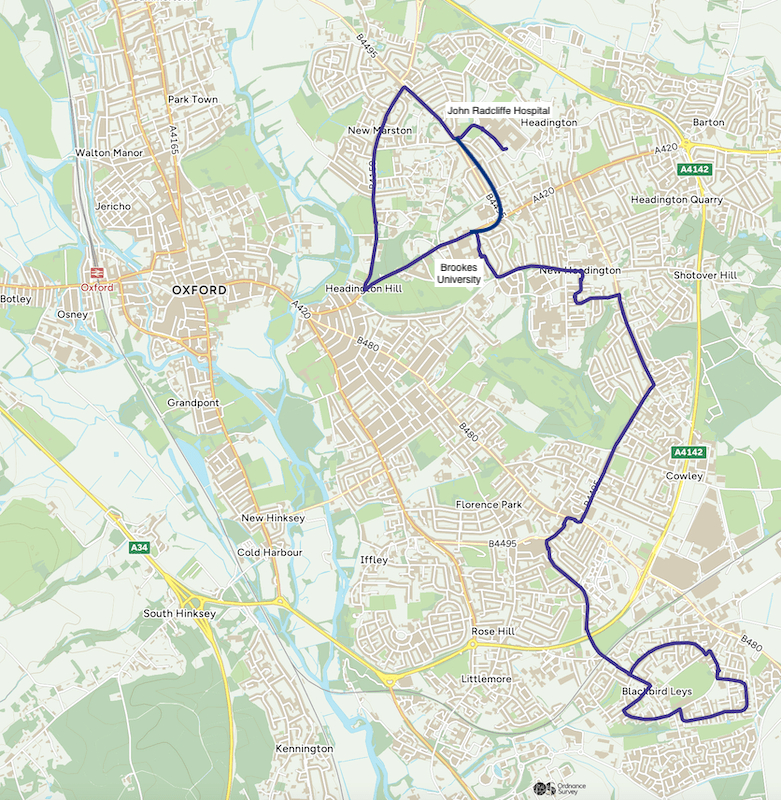
As you can see, the route doesn’t serve the city centre but skirts its eastern side. It only runs on Mondays to Fridays with a 20 minute frequency in term time and half hourly in vacations.
Another characteristic sees both ends of the route operating as loops – the clockwise Blackbird Leys one takes about 15 minutes to complete from where the bus heads back and the anti-clockwise one at the hospital includes seven minutes layover.
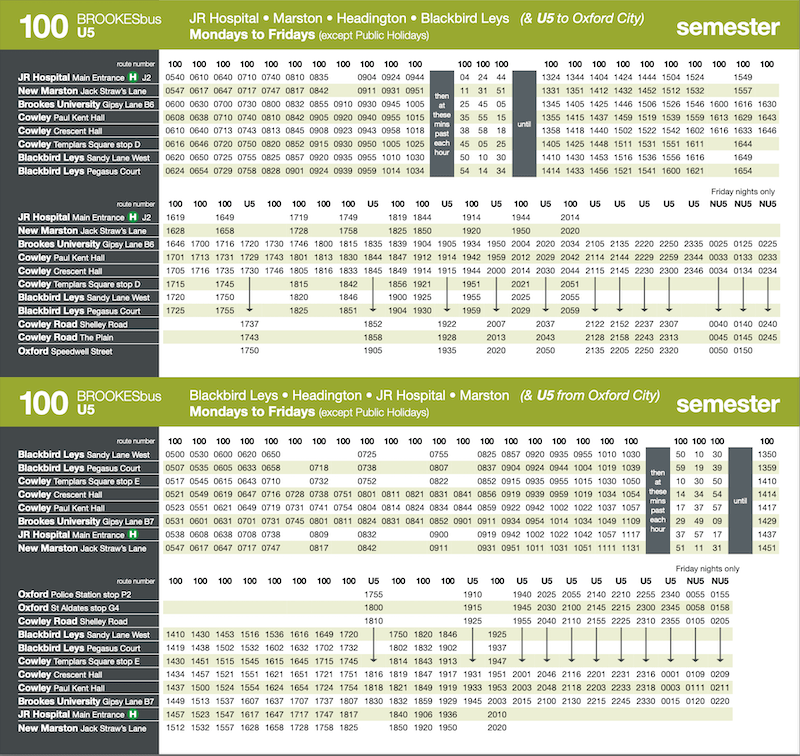
Unusually for a university sponsored bus route, the timetable kicks off as early as 05:00, presumably to cater for staff going to and from the hospital. The last journey back from the hospital in the evening is at 20:14.
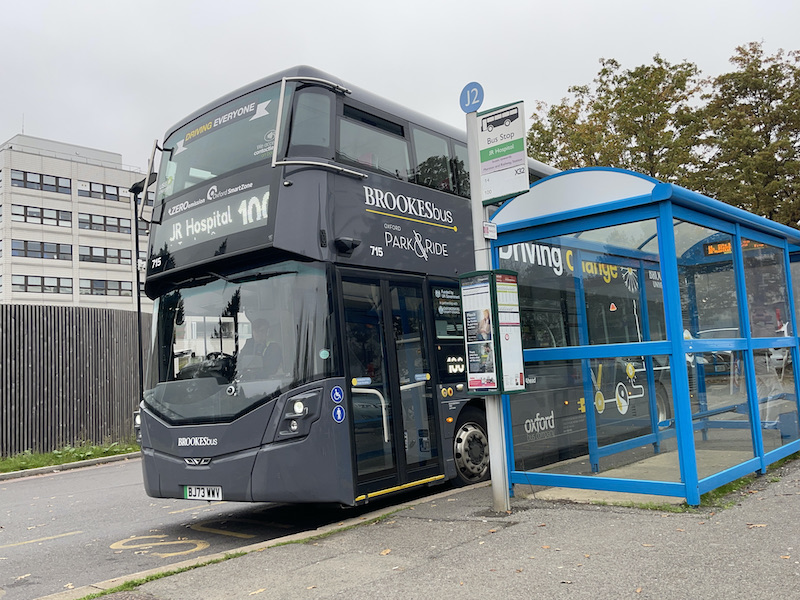
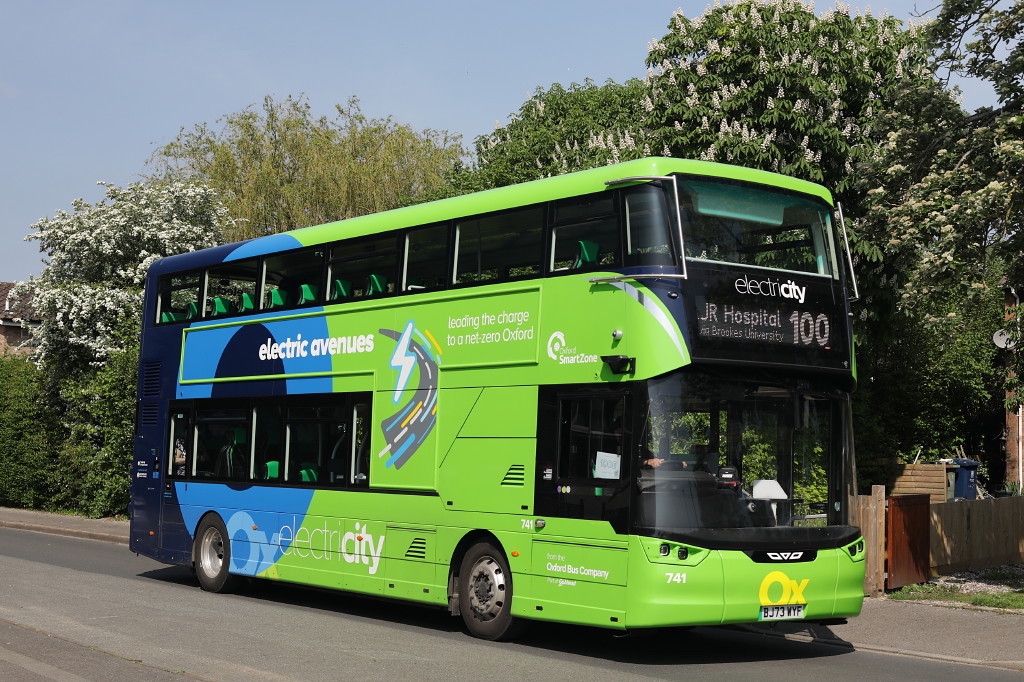
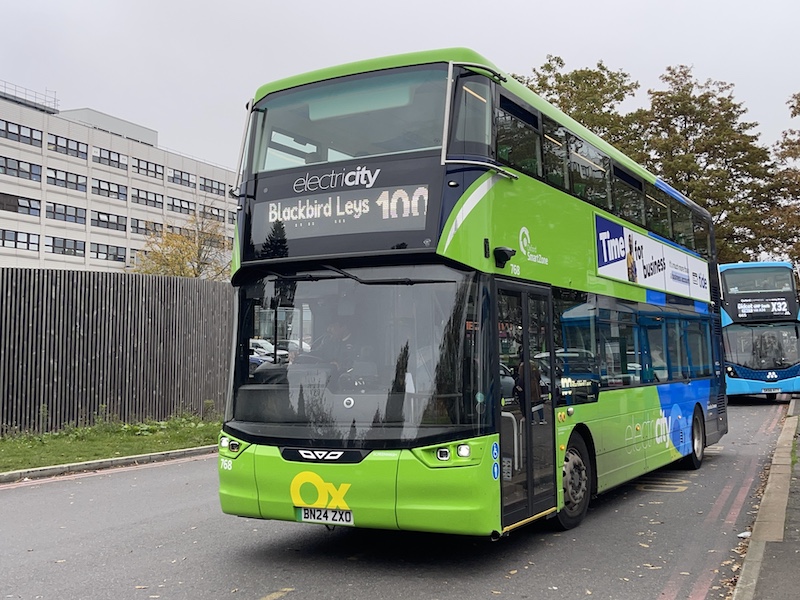
I took a ride from John Radcliffe Hospital over to Blackbird Leys on the 12:24 departure. I arrived at the bus stops by the hospital’s main entrance in time to see the previous 12:04 departure which was being operated by one of Oxford Bus Company’s recently delivered electric powered buses. These vehicles along with similar being delivered to Stagecoach are part of the ZEBRA funded deal which is seeing all the city’s bus routes upgraded to electric propulsion.
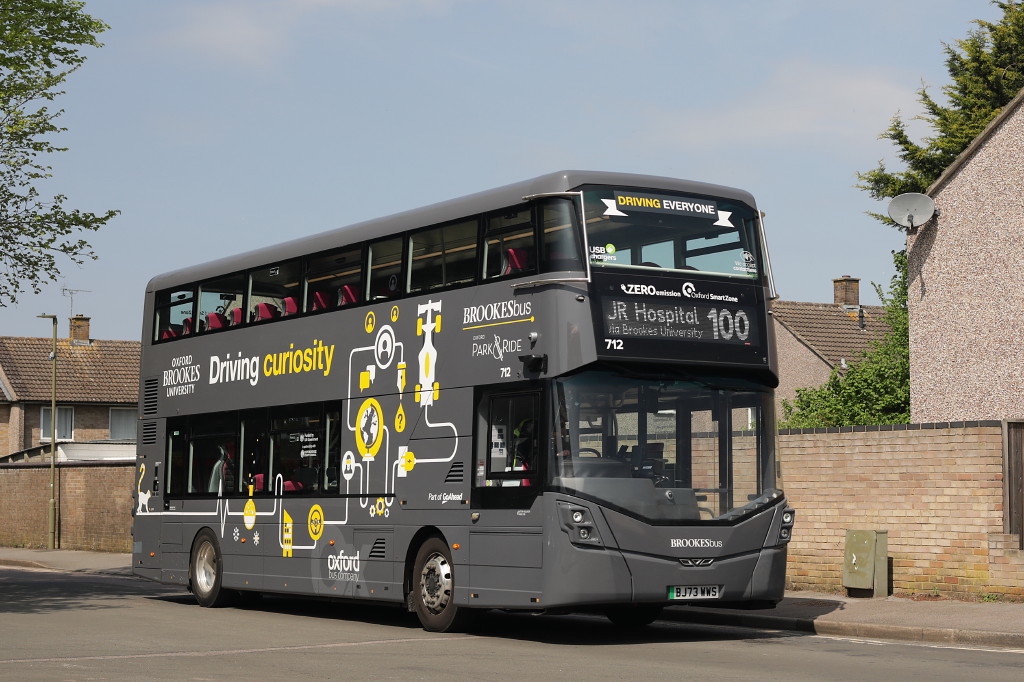
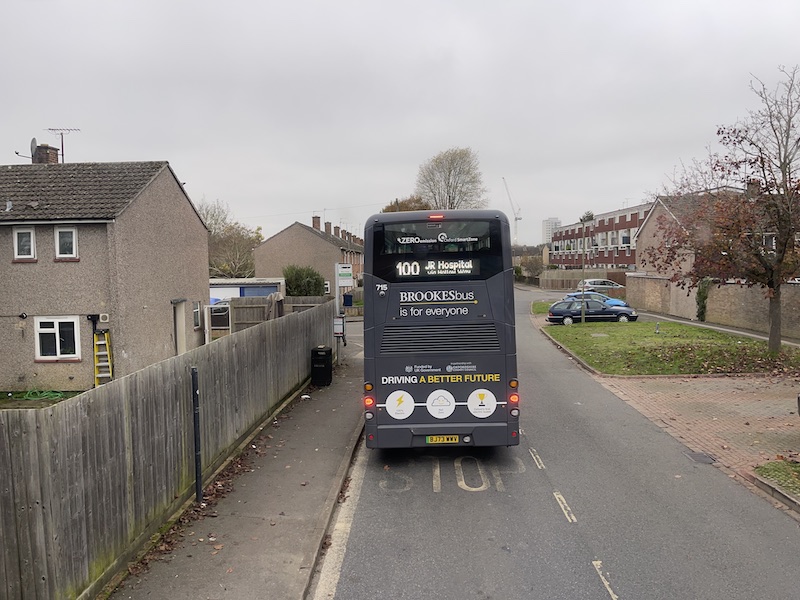
The bus I caught was another electric powered bus – a Wright StreetDeck Electroliner – delivered last year in the rather strange BrookesBus grey livery specifically for the University routes.
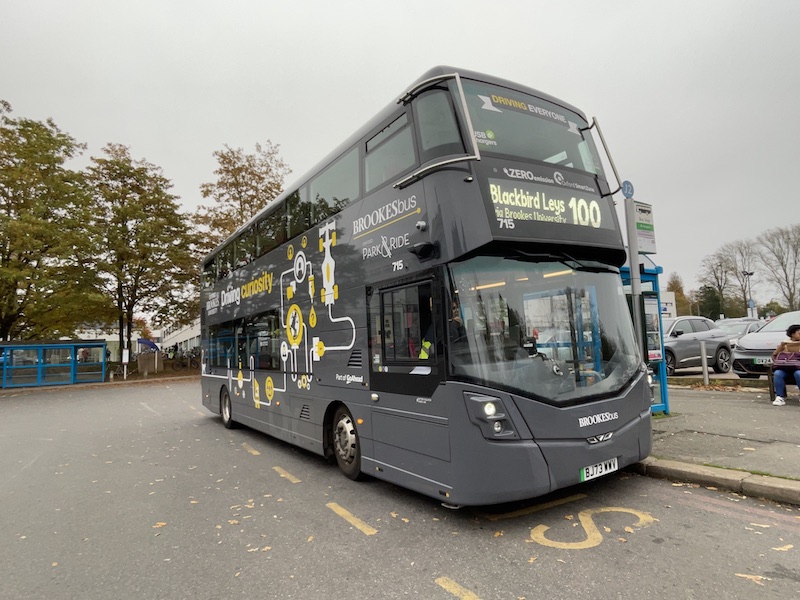
In fact the other three buses allocated to the route, when I travelled, were also from this batch with the 12:04 departure being the exception.

It was the first time I’d travelled inside a BrookesBus vehicle and immediately noticed the splashes of pink which made a welcome relief from the grey.
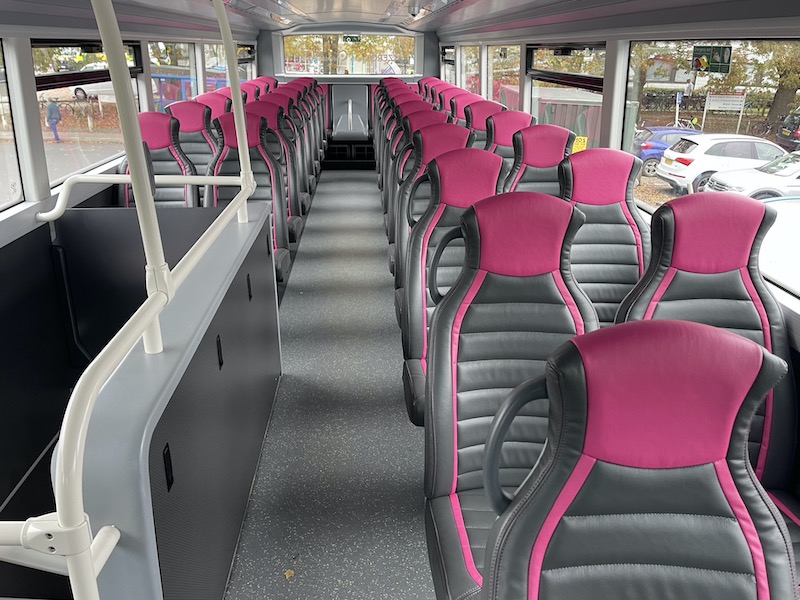
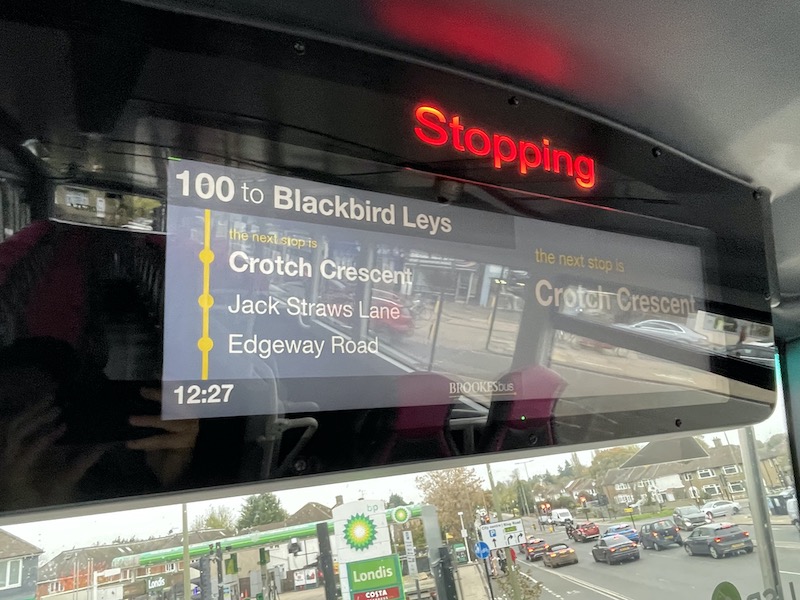
There’s also a large information screen at the front of the upper deck.
A couple of students travelling to the University stayed on the bus during its layover with two passengers boarding with me, and we left on time with five of us on board.
We gained seven more passengers (with five alighting) over the short distance to reach Brookes University where we arrived at 12:37 and had eight minutes stand time before leaving at 12:45 but during this time an impressive 23 students boarded.
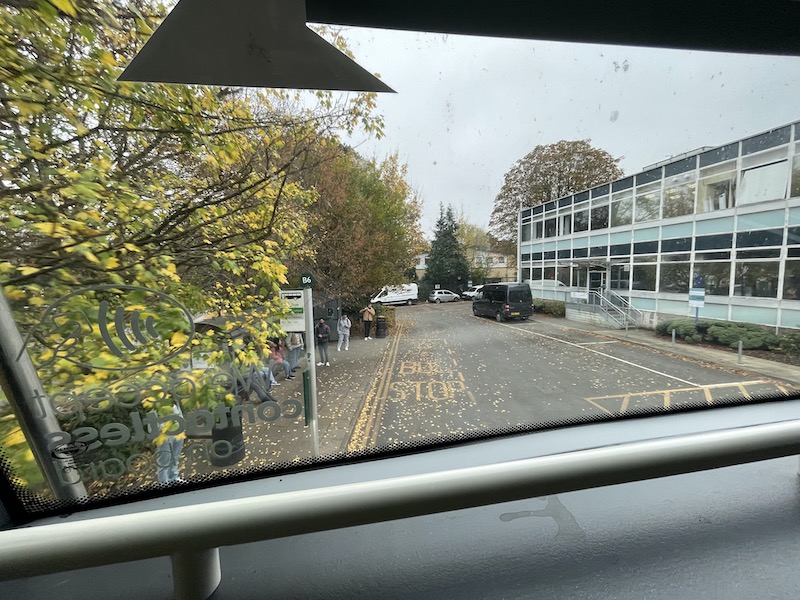
It was quite a busy journey for a Tuesday lunchtime stopping at ten bus stops with eight boarding and 17 alighting until we reached Cowley’s Templars Square.
Not long after that we arrived at the beginning of the Blackbird Leys loop with this part of the route also served by the frequent routes 1 and 5 (Oxford Bus and Stagecoach respectively to the city centre) and Stagecoach route 10 which also links the area to John Radcliffe Hospital but by a slightly different route and has recently gained the first of Stagecoach’s electric buses.

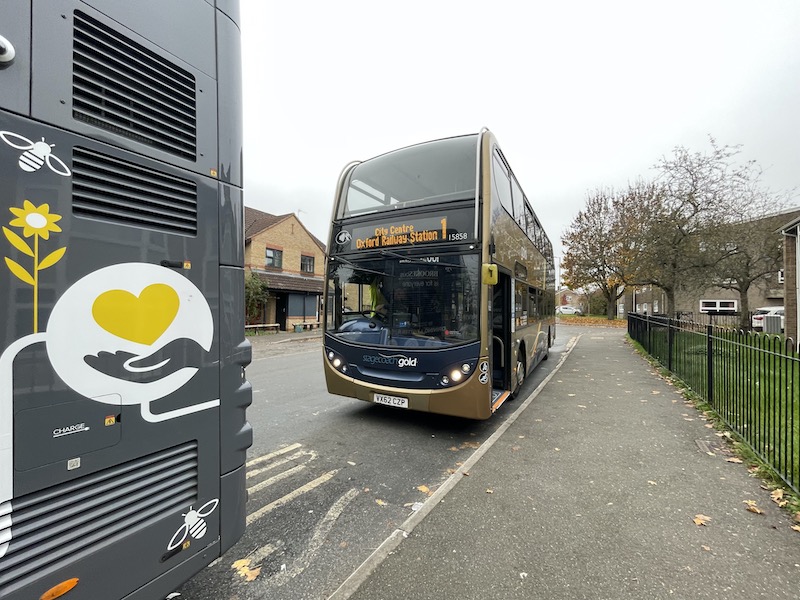
We’d pretty much emptied out with none alighting as we began our circuit although at the Pegasus Court bus stop we had a changeover of drivers with six minutes layover so I decided to switch to a Stagecoach Gold liveried bus on route 1 which pulled up behind – and also changed drivers – but set off first for the city centre, and took a ride on for old times sake.
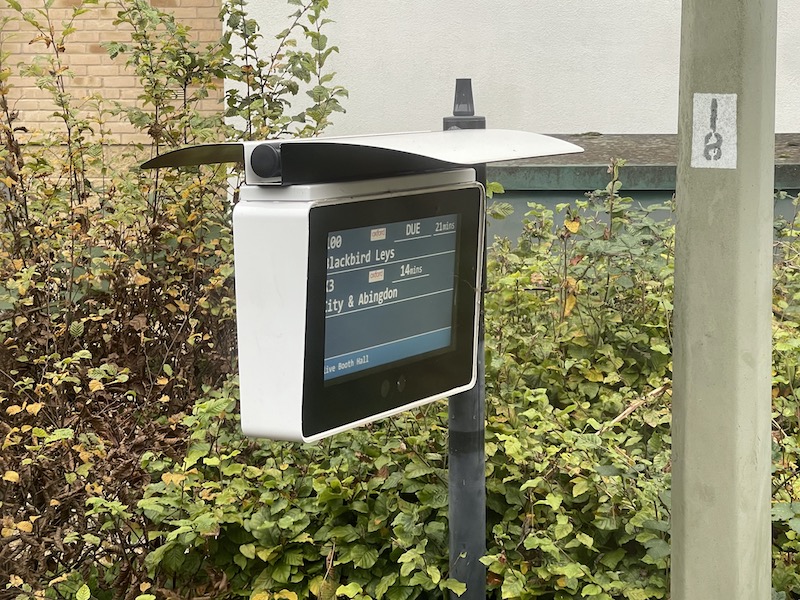
Travelling along the route I was impressed to see some very clear real time signs at many of the bus stops.
This route 100 is obviously serving its market well with students making up the majority of passengers but others, notably accessing the hospital and locally within Blackbird Leys, also in good numbers. It’s nice to see a successful urban route that doesn’t need the city centre to sustain it.
Roger French
Did you catch the other twenty-three ‘Every route 100’ blogs so far? Here’s 1 of 26 (Stevenage-Hitchin) 2 of 26 (Crawley-Redhill), 3 of 26 (Lincoln-Scunthorpe), 4 of 26 (Glasgow-Riverside Museum), 5 of 26 (Campbeltown local), 6 of 26 (Guildford’s Onslow Park & Ride), 7 of 26 (Warrington-Manchester), 8 of 26 Chatham-St Mary’s Island, 9 of 26 St Paul’s-Wapping, 10 of 26 Syston-Melton Mowbray, 11 of 26 Wellington-Telford Sutton Hill, 12 of 26 Hanley-Stone, 13 of 26 Burgess Hill-Horsham, 14 of 26 Aylesbury-Milton Keynes, 15 Pontypridd-Royal Glamorgan Hospital, 16 Barry circular, 17 Farringdon Park-Larches (Preston), 18 Hastings Conquest Hospital-New Romney, 19 Morecambe-Lancaster University, 20 Wakefield-Eastmoor, 21 Clydebank Parkhall-Linnvale, 22 Airlink Edinburgh Airport-Edinburgh Waverley, 23 Basildon-Lakeside.
Blogging timetable: 06:00 TThS
Comments on today’s blog are welcome but please keep them relevant to the blog topic, avoid personal insults and add your name (or an identifier). Thank you.
 BusAndTrainUser
a slight error here – both buses are Wright Streetdeck Electroliners, the green one just has a revised front end
LikeLike
Thanks for this encouraging report. May I fasten upon one of your phrases ‘ … a route which doesn’t need the city centre to sustain it …’: this highlights what I believe is a critical weakness in ‘bus-manager think’ – that every route must be profitable ON ITS OWN – i.e taking no account of the needs of all passengers (including those in ‘not good bus territory’) – and the revenue they might contribute if the network as a whole functioned properly’. This thinking has led to so-called networks of disparate services which (in its worst forms) the bus companies appear to have no interest in connecting with decent interchanges, decent frequencies or timed connections, decent inter-ticketing, decent wayfinding signage etc..
I presume that to drop this thinking would be to kick away what must have been a helpful crutch to the big bus companies in their mission to establish minimum profitabliltity levels throughout their empires, but it is bad news for passengers, and actually costs the companies revenue and profits which they might be making if they could bear to look at their systems as a whole, and develop performance indicators which made bus services into efficient networks for passengers to get around on.
In hope …
LikeLiked by 1 person
Very interesting, the route being sustained by the Uni and the hospital, does it serve any retail park or out of town TESCO enroute?
LikeLike
Not really. It passes the Templar Square shopping centre in Cowley (formerly Cowley Centre), which has seen better days, and there is a small retail park opposite that. There are some shops on Headington High Street but it’s very much a secondary suburban shopping street. But other more frequent bus routes provide the main services to these from most of the destinations served by this route.
LikeLike
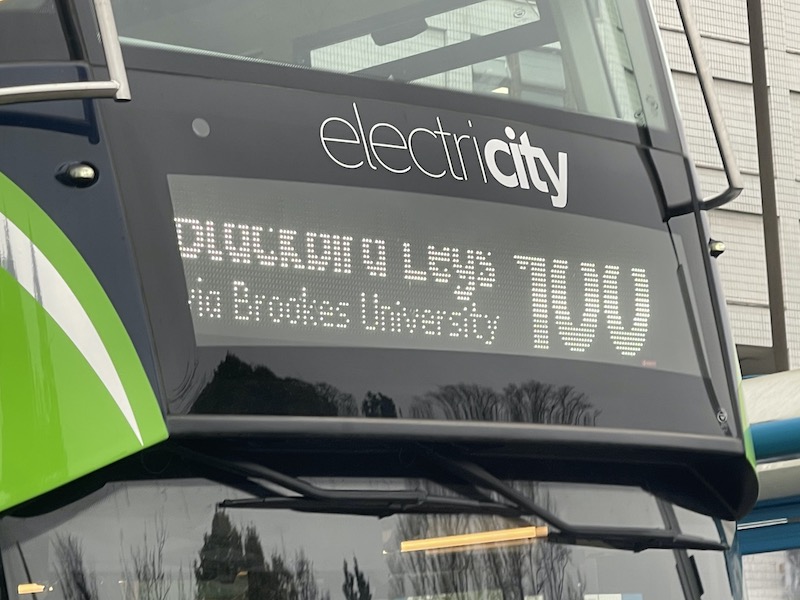
That first stop shown on the on-board screen must cause some amusement to new students in the City. I noticed the road when driving my step-daughter to Oxford Brookes 20-odd years ago.
Wicked step-father 😉
LikeLike
The other “interesting” point about that display is that it demonstrates the importance of good contrast in the colours used. White text on a pale grey background doesn’t show up very well, although reflections might perhaps be making the issue worse in this case.
RC169
LikeLike
Ah yes, Crotch Crescent – tee hee! Actually named after William Crotch, an 18th-19th century musician. Several of the streets locally are named after musicians, some quite obscure, with a connection to Oxford – Weldon Road was my boyhood home.
Really not sure about grey as a bus livery. Where I now live, Plymouth Citybus has a mainly red fleet, but one route has grey fronts, and they’re noticeably less easy to spot as they approach.
V Saltash
LikeLike
National Express West Midlands nowadays uses a primarily grey livery, which they initially called platinum, and on a typically British cloudy day they just look dull. I’m not certain how they can be felt to be attractive to non-bus users.
Visiting Birmingham a few years ago I saw an NXWM bus which had been painted in a version of the old BCT dark blue and cream livery. It seemed noticeably more welcoming than the grey buses around it, if a bus livery can be any such thing.
LikeLiked by 2 people
To try to answer Rick T’s comment . . . (and this applies to most operators, but not all) the basic level of route viability is by individual route; so each route will be evaluated regularly to ascertain its financial status.
Any route that doesn’t meet its target (which could simply be a balance of zero between profit and loss) will be examined further to see if there are individual trips that carry very low passenger numbers that could be withdrawn, but ONLY if there is a significant saving to be made.
So a trip at 20:00 that runs almost empty, and costs disproportionately high in staff pay, might be at risk. A similar trip at 09:30 might remain, as there would be almost no saving involved. This is simply the action of a responsible company ensuring that its operations are economically sound, and similar actions will take place in any business.
However, operators will also apply the network test (which, it could be argued, was what Beeching did NOT take into account) and consider whether a loss-maker actually adds overall value. It’s the same as “sell beans cheap to entice shoppers in” that supermarkets do. It’s more difficult to evaluate if Route H adds value to Routes A-G, and this is where looking at loadings with the Mark One Eyeball can help . . . you actually see where passengers change buses and this isn’t always visible from a spreadsheet.
Cross-subsidisation between routes (which was effectively made illegal when deregulation started in 1986) is alive and well . . . although only if some routes in the network are properly profitable!! If the overall network is barely covering costs, then losing a route that is a proper loss-maker may be the only solution.
I’ll just make the point that this is where LTAs should step in (to subsidise routes / trips that lose money, but add value to society), and that was the basic structure of dereg . . . all the comments about 000s of routes being withdrawn during the 2010s conveniently ignore that a vast number of those routes were LTA financed routes that could no longer be afforded.
Most LTAs will have their own “value-test”, normally on a “subsidy per passenger” basis. Back in the day (2010s) Dorset CC set a value of “at least 10 passengers per service hour” . . . if a route didn’t achieve that level, then it was withdrawn; which is why a bus map of rural Dorset is almost empty!!
Sorry to have rambled on, but this understanding is important, especially regarding network viability . . .
LikeLiked by 3 people
Thank you to Greenline 727 for stepping in and making some valid points in respect of Rick T’s earlier statement.
The fact is that commercial managers DO understand the impact and strength of maintaining the network, both the financial benefits and keeping the competition out! However, no manager is going to be thanked for running unremunerative services. As GL727 states, not every journey is going to make money but you can afford to have some that don’t for the greater good so running that 1830 departure, for example, might not pay its way but the loss is not great and the overall benefit outweighs the loss on that single journey. However, then elect to run through the evening and another four hours of operation just becomes a drain.
There is often a clamour for orbital routes but unless you can link several major traffic objectives (e.g. hospital, superstore, university, halls of residence) then they find it difficult to generate sufficient passengers to cover their costs, no matter how laudable the aim is.
ps I know the idea of large amounts of cross subsidy is attractive but you can’t fundamentally drain the good routes of investment. Cash cows need feeding!
LikeLiked by 1 person
And good orbital routes serving above mentioned traffic objectives will intersect several radial routes, offering new journey opportunities (assuming thought goes into stop locations, and way finding between them), that would otherwise involve going into the city centre and back out, which takes too long so peeps drive.
Peter Brown
LikeLike
@greenline727 – LTAs should step in… but over the years of austerity cuts which began in 2010, local authorities have seen their budgets cut, cut and cut again. One of the casualties for those cuts has been the subsidy for bus services which are socially valuable but don’t wash their face commercially.
Malc M
LikeLike
The likes of Oxford & Reading seem to have cracked it with buses operating very late into the evenings and start ups at similarly early times. They even have some 24 hour routes 🙂 This surely makes it appealing to the user and in turn possibly commercially viable to the operator too.
I know of many times when I have attempted to plan some particular itinery at the start of the day, looking at a 4am or 5am start and found the 1st bus isn’t until 07:30 !!.
I’ve also arrived at certain points around 22:00 or 23:00 whilst planning a journey only to find the last bus departed at 20:00 or 21:00. Not very helpful at all and certainly puts me off trying to use buses when, except with some major conurbations and cities, this tends to be the norm with services 😦
LikeLike
The incredible thing about the Oxford networks is that these lengthy hours extend in some cases to country towns well outside the city (e.g. Witney, Wantage). And in almost all cases the services in these areas are better (more frequent, longer hours) than they have been for (many) decades, or perhaps ever.
LikeLike
I believe that’s down to the lack of house building in Oxford; residents and students have been forced to move to the adjoining towns which creates these intra-town flows. The four buses an hour between Hatfield and Luton is another example, where UH students have been priced out of Hatfield and now commute in from Luton. Its good for bus operators, but if your view of buses is that we’re trying to encourage modal change to reduce emissions its actually less than ideal compared to housing people local to their jobs.
LikeLike
It’s all about who travels.
Oxford and Reading have large student populations, so evening and late night routes have a chance of good patronage.
As alternatives, consider Swindon, or maybe Peterborough …. both decent-sized towns, and with good railway links as well. Whilst some routes run into the evening, not all do, and at reduced frequencies to boot. Both have smaller out-of-town / rural operations, which finish early evening.
As anon@0946 comments, any service, even hourly into the evening, needs decent patronage . . . and that needs decent attractions, be it cinema, bowling, bars, concerts or whatever. Most towns are empty after 7pm …. why would passengers travel to such a place?
“Feeding cash cows” …. I wish I’d thought of that !!!!
LikeLiked by 1 person
Most towns are not empty after 7pm. many are pretty busy particularly at weekends but few ue buses because there are not any buses to use at that time of night and if there are a few they are unreliable
LikeLike
A successful urban route which doesn’t need the city centre to sustain it – yes, but is the 100 a commercial operation or does it depend on external funding?
I am going to hazard a guess it is funded by the university – partly because students studying full-time and/or living in student halls are eligible to travel free on the BrookesBus services, and partly because COMS’ accounts show significant revenue from contract operations – but happy to be corrected if I am mistaken.
Looking at Stagecoach’s 10, the timetable shows only a few early morning journeys running from Blackbird Leys to the hospital, with a handful of evening journeys returning to Blackbird Leys. Otherwise a change of buses is required at Cowley.
Down south, urban routes which avoid the town/city centre include Bournemouth’s U3 and Southampton’s U8 and U9. Again, these are university-branded, presumably under contract to their respective universities.
Malc M
LikeLike
You’ve moved John Radcliffe Hospital!!! (See your own Map) After you’ve exhausted the 100’s how about the ‘7”s – too many to cover all of them but you could ask your committed readers which one they’d like included. S’coach Sth Aldershot – Fleet – Hartley Wintney could be a contender as it’s pretty, but most passengers don’t ride that part of the route over ‘Twiseldown’ with no stops placed to serve a small Retail park containing a very popular Aldi and nowhere en route to stop safely to give access to the Military are containing Caesar’s Camp due to narrowness ad many bends. It’s only been routed that way for 2-3 years, missing out the Aldershot Centre for Health with 2 Doctor’s Surgeries and many ‘outsourced’ functions to decrease the load on Frimley PARK HOSPITAL Ian Johnston
LikeLike
Two of the ‘100’ to go in this series…just a guess on the next one Stagecoach Metrocentre Shuttle’ Service 100‘ in Newacstle?
LikeLike
When did that restart? It was withdrawn in June 2023 soon after it restarted after its Covid pause due to a shortage of drivers.
LikeLike
You can rest assured Roger – it hasn’t restarted. It was suspended and now no longer appears on their Newcastle map (untitled) so you can assume it won’t be returning.
BW2
LikeLike
Does this route serve those whose use of cars is restricted by the City’s “Traffic Filters”?
LikeLike
Yes, it does.
And no, use of cars is not restricted – only the routes they can take.
LikeLike
I think there is an overall aim to make more of all the bus routes in Oxford that do not serve the centre – presented as a form of complete “orbital” network. Yes, we are lucky in Oxford, it is a good system. Even if so well used, tonight I had to wait for the next bus, as the first arrived displaying “Sorry bus full, set down only”. Another was just a few minutes behind, so all fine. CH, Oxford.
LikeLike
A comparison down here in Bournemouth would be the U3, which has a route almost diagonal across the town been Southbourne and the University campus, avoiding the town centre.
Unusually it also runs on Saturday, and I know from experience aside from local shopping trips to Boscome and Winton it’s used for connections to and from Christchurch, Wimborne and Salisbury.
Marco….morebus land
LikeLike
It is interesting to compare Oxford and Cambridge. Similar in many respects but one has very good bus services for a non London location and the other doesn’t really despite busways and the like.
MikeC
LikeLike