
Saturday 5th October 2024
Hello blog readers. I need your help. In the coming weeks and months I’ve been invited to make a couple of online presentations about the state of bus and rail integration in Britain and what can be done to improve things.
I’m enormously grateful to Britain’s renowned rail fares expert Barry Doe for his assistance in providing comments on a draft of this blog as well as adding further information.
I’m aware of many through ticketing schemes and in some places, some deliberate timetable co-ordination between buses and trains, but there must be many more out there so do let me know in the comments of other “joined up” and “integrated” arrangements that work well as well as ideas where new ones could be introduced.
Tickets

Obviously the most well known scheme – albeit perhaps not as well known as it could be – is PlusBus. This began in October 2002, initially at 35 railway stations, administered by a not for profit partnership called Journey Solutions set up by the privatised Transport Groups, Confederation of Passenger Transport and Rail Delivery Group.
Prior to 2002 there were individual schemes in certain parts of the country, one familiar to me because I was involved in setting it up was called RailBus in the Brighton & Hove area, which essentially did the same thing as PlusBus – ie was an add on ticket that rail passengers could show to bus drivers giving unlimited bus travel in a defined geographical area from the arriving station. Brighton, and other towns in Sussex were also pioneers of area wide Travelcards dating back to National Bus Company/British Rail days giving unlimited bus and train travel in defined geographic areas for periods of a week and longer.
PlusBus is now available in almost 300 towns and cities outside of London and offers bargain prices such as £4.90 for bus travel across a huge area centred on Manchester Piccadilly/Victoria stations. Railcard holders pay a discounted price of just £3.25 and children £2.45.
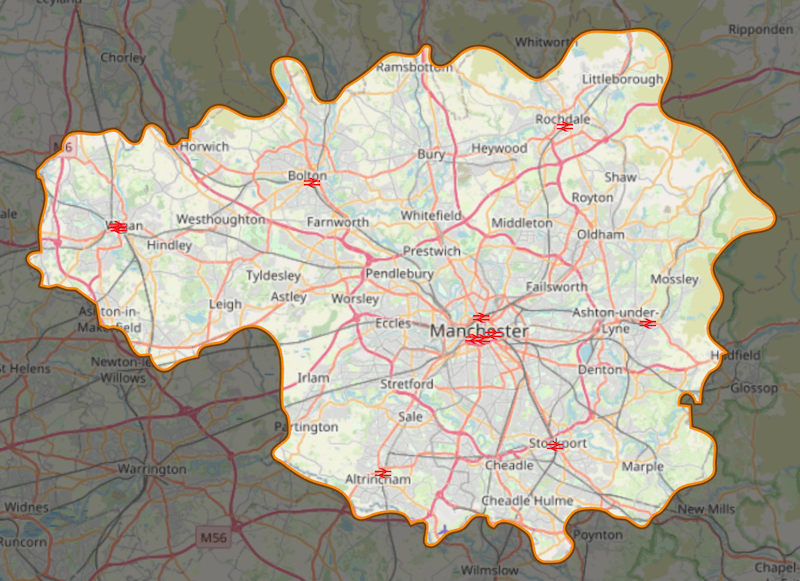
These prices compare with stand-alone day ticket prices for unlimited bus travel on the Bee network of £5 (adults) and £2.50 (child). I wonder how many people arrive in Manchester by train and buy a day ticket on the bus, not realising it would have been cheaper to buy a PlusBus with their rail ticket? The same applies in those areas offering 7-day tickets for commuters.
PlusBus tickets are now available from most Ticket Vending Machines as well as from Train Operating Companies’ online booking pages. If a passenger is able to book and pick up their tickets in advance then a PlusBus ticket can be added for both the origin and destination stations (if in the scheme) but it’s likely they won’t need unlimited travel to get to the origin station, probably just one single journey which will be cheaper to buy from the bus driver.
Which brings me to a radical suggestion that’s been talked about in the past by proponents such as Leon Daniels, as well as myself from time to time, and that is whether the default arrangement should be any rail fare includes an assumed PlusBus element to it. This could be achieved at the time of a rail ticket price increase by adding a small amount on to the price of each rail ticket to a PlusBus destination (subject to a minimum ticket price) which could then be divi’d up among participating bus operators. PlusBus’s market share in many towns and cities at the moment is minimal and although such a move would increase the take up of passengers travelling by bus when reaching their destination station, I doubt there would be hoards doing so and that’s why you’d only need to add a very small amount – probably no more than 5p – to the price of every rail ticket to adequately reimburse bus operators.
But, in any event, since the public sector is relishing taking the revenue risk for running bus services in large conurbations and other Combined Areas I’m sure Metro Mayors will be only to pleased to support what would be the ultimate integrated ticket – bus travel thrown in with your rail ticket.
Leon Daniels spearheaded a three month trial in Bristol in April 2010 called “SuperBus” whereby “all rail tickets costing more than £25 where the destination is Bristol (Temple Meads or Parkway) will be valid for a direct journey on one of our buses commencing at either of those stations (and returning to it if it is a return ticket). The trial will seek to establish what modal shift can be achieved (from taxi or car pick-up) if the bus travel is “free” and included in the ticket.”
Leon went on to explain “in a full scheme, our aim is to see whether every rail ticket to every non-London destination over a certain price cannot include this bus travel. It would be funded by a token increase in the rail ticket price and the pot would be divided between the operators using the same mechanism as is currently used for PlusBus. A token increase is almost unnoticeable on the rail ticket prices but generates sufficient cash to compensate bus opertors for what is generally off-peak marginal extra business. We see passengers arriving at unfamiliar rail destinations hesitant to use local bus services. We are sure that if it is “free” many more will take the opportunity to use them.”
Barry has made very pertinent observations on this idea that firstly, no matter how small the additional price added on, passengers not wanting to use a bus, or unable to because there isn’t one, would object to the idea of paying anything extra no matter how small, and secondly, the apportionment of rail ticket revenue is a fiendishly complicated process through what’s known as ORCATS and he questions whether bus companies would want to be involved in that as well as incurring the cost of doing so.
Barry gave an example to illustrate his point that “there have always been fares from Bournemouth to Exeter and beyond via Dorchester and Yeovil Pen Mill/Junction. It’s the cheapest route – BUT, you have to make your way between Pen Mill and Junction by bus or pay for a taxi. ATOC (RDG) considered making the rail ticket valid on the bus by adding an amount to the existing fare and giving that to the bus operator. It immediately came up against problems such as what if the passenger didn’t want to use the bus (perhaps a taxi instead?). He/she wouldn’t be happy to find out they’d paid for the bus anyway. It was ruled out before it even got started – and that would have been as simple a system as you could possibly get!”
A more recent PlusBus trial is with eTicketing in Cambridge and seven stations in West Yorkshire. This began in June with passengers able to buy a barcode enabled PlusBus “via leading ticketing apps”. During the trial the PlusBus remains as a flash pass to bus drivers but “we are working with bus operators to scan tickets” which will obviously be a sensible next move. Once scanning becomes the norm and there are more downloaded QR enabled tickets on smartphones or printed off at home, the vexed question of revenue share between bus operators can be reviewed in line with actual use which is recorded hy ticket machines rather than assumptions and occasional surveys.
Next up on the integrated ticket front are those towns off the rail network where you can purchase a combined rail and bus ticket to reach such destinations. Keswick is a contemporary example where Avanti West Coast has recently been giving prominence to a scheme Virgin Trains first implemented way back with Stagecoach whereby you can book a rail ticket from any station in Britain to that Lake District tourist hotspot, which at the moment is priced at £2 more than the fare to Penrith from where Stagecoach’s X4/X5 half hourly service runs to Keswick.

Like many schemes of this kind it had been kept quiet for a number of years receiving no publicity.
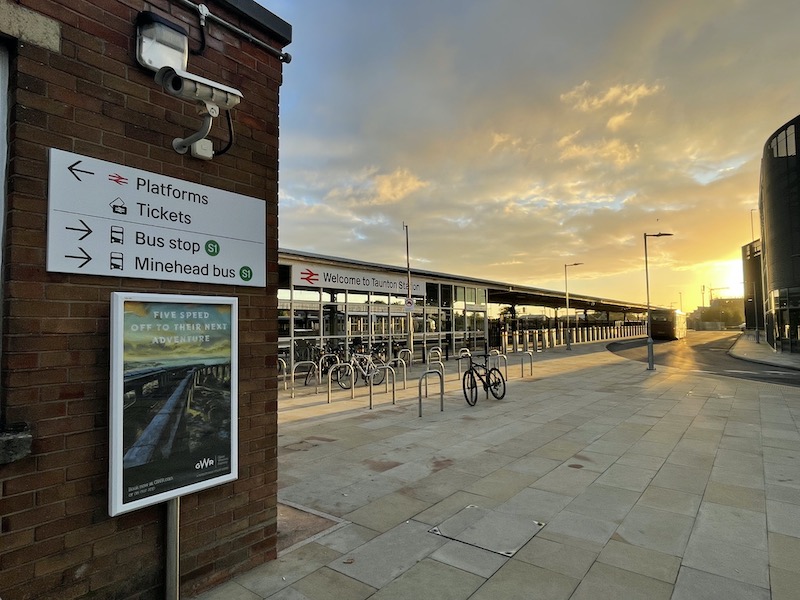
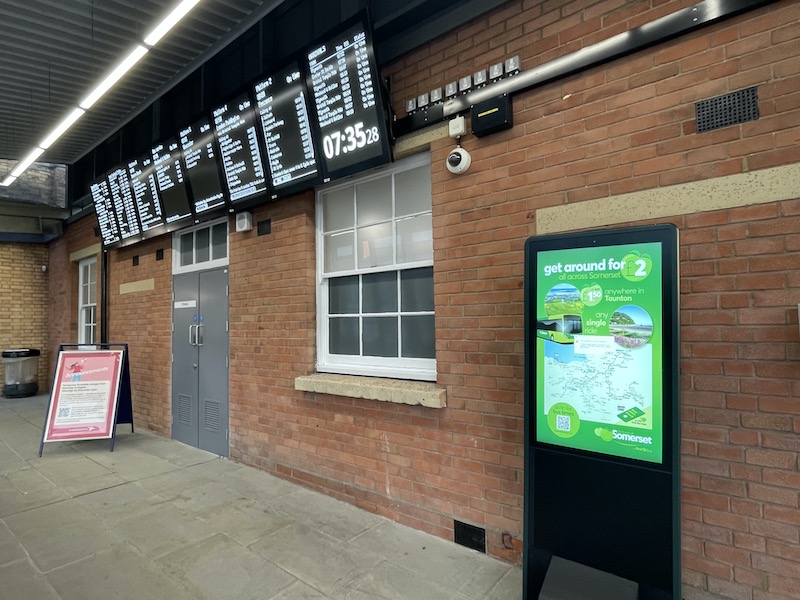
Another long standing example is through tickets from any station to MInehead which includes bus travel on First Bus route 28 from Taunton which even appears on departure boards at Taunton station. This also happens at Peterborough with the bus link on the excel route to Dereham but where else do bus departures appear on rail departure boards like this?
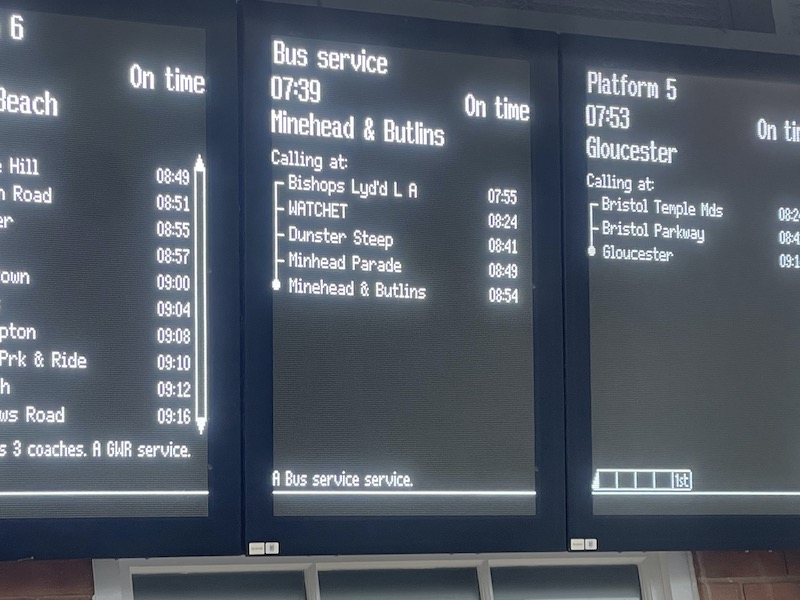
One of the problems with these long standing arrangements is they don’t acknowldege the £2 fare cap so it’s currently cheaper to just buy a ticket to Taunton and pay on the bus rather than the £4.50 extra it would cost for a rail and bus combined ticket to Minehead.
Historically there are many examples of this genre and Barry told me deep inside the National Rail internal website are details of what are called ‘bus link’ tickets available for passengers travelling from a nearby rail station. In many cases this add on fare is also available for the public to see using the brfares website. For example take Alfriston in East Sussex. An add-on fare is available (pre the current £2 capped bus fare) from either Polegate (£7.20) or Seaford (£6.00) stations on routes 125/126 operated by Compass Bus and Cuckmere Buses. But I bet passengers aren’t aware. Nor bus drivers. Nor rail staff. Nor, even, bus company managers.
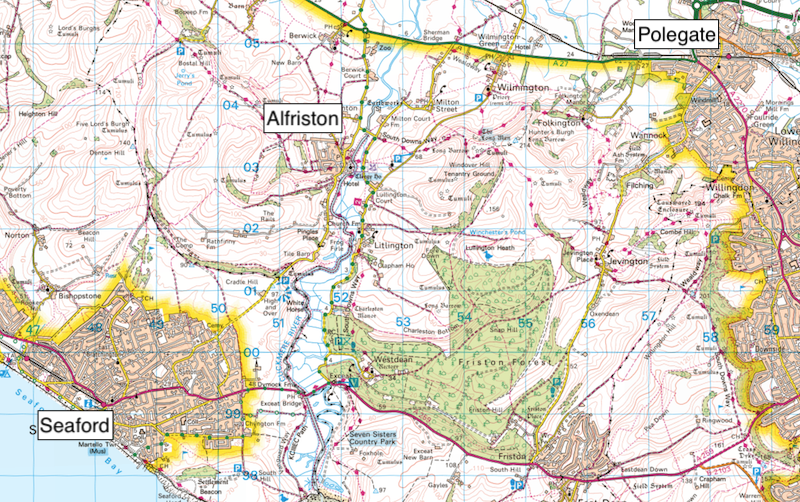
And I bet most readers will be surprised to hear there are 239 such destinations listed in alphabetical order in the National Rail database from Abaraeron to Ystradgynlais. From Dartmouth to Dunster. From Fakenham to Fraserburgh. From Lands End to Lyme Regis. From Padstow to Portree. There’s town after town, yet, aside from Barry and a few fares experts at the Rail Delivery Group and National Rail, few know about them.
Aside from the current £2 bus fare cap, it would make sense to find a way of promoting these ‘buslink’ fares and also establish whether the prices are still pertinent. I wonder when they were last reviewed? Bus company managers are responsible for this but with the number of company reorganisations over the last few years I doubt many, if any, realise this.
The interesting thing with rail ticketing is once something is in the “system” it stays there – which is why there are so many rail fares and everything appears so complicated.
For example, many years ago (probably in the mid 1990s) Brighton & Hove Bus Company introduced one-day SouthernSAVER and ThameslinkSAVER tickets in conjunction with Southern and Thameslink train companies. These still exists today and costs £23 and £24 respectively. Passengers can buy the ticket on the bus which includes unlimited bus travel within the city of Brighton and Hove and a day return rail journey (leaving Brighton after 10:00) to stations on the Brighton Main Line, East Coastway and West Coastway lines as well as stations through to Bedford (but not Cambridge as that was added to the Thameslink network much later, in 2018). There’s an evening peak restriction from Victoria and Clapham Junction but it’s an amazing ticket in that it costs less than the Super Off-peak rail ticket purchased at a rail station or online. And a huge bargain if travelling to Luton or Bedford, for example, where rail only prices are £41.40 or £45.90 respectively in the week or £24.40 or £27.10 at weekends. It would be cheaper for a passengers to hop on a bus outside Brighton railway station, buy the ticket from the driver and hop back off again.
The tickets are advertised on Brighton & Hove’s website but I doubt anyone buys it nor staff know about it. And I can just imagine the look on faces of gateline staff at Bedford, Southampton, Ashford, Victoria and any other station when presented with a bus ticket, or on board rail Revenue Protection Officers in their combat uniforms. I must buy one and try it one day!

Brighton & Hove and Metrobus also have a keyGo facility with Southern and Thameslink whereby the “key” branded smartcard used for Pay A You Go on GTR rail companies can be used on buses in defined zones in Eastbourne and Lewes for a single fare subject to a price equating to the PlusBus price for those towns if you’ve used the train.
A good example of integrated tickets with confusing availability is in Wales where Transport for Wales has recently changed the bus routes on which passengers can use the Explore Wales Pass. No longer available on First Bus or Stagecoach routes it’s now limited to TrawsCymru routes, but apparently not all of them and there’s no definitive list of those included or excluded. No one seems to know.
Similar confusion surrounds the availability of the Spirit of Scotland ticket but thankfully clear details of those bus routes included is posted online.
Finally when it comes to fares and tickets I’ve referred to Travelcards already, and obviously the London example is the most famous, but many of the other large Metropolitan conurbations also have modal integrated Travelcards available, and of course before contactless bank cards became a thing, Oyster in London had historically been the much sought after integrated bus and train arrangement for paying for travel, with extensions into the South East rail network now underway. One can see in the future the possibility of using smartcards/mobile phone apps to extend the availability of Travelcard type tickets to include bus and rail use in given areas and using QR codes to ensure fair revenue apportionment.
“Integrated” Timetables
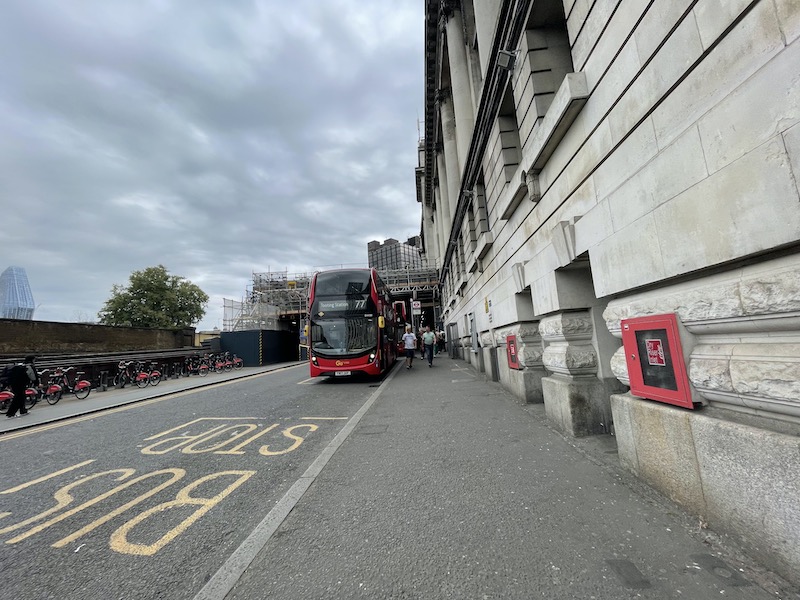
When it comes to “integration” of timetables, passengers most often complain at a perceived lack of coordination between trains and buses with buses timetabled to depart a few minutes before the train is scheduled to arrive or the train leaving before the bus arrives.
In many large conurbations and urban areas buses are frequent enough that it doesn’t matter if timings don’t marry up precisely, and in any event, delays on both the roads and tracks can make tight connections impractical. In a number of towns and cities the railway station is not sited conveniently to route buses from different areas to serve it in any event.
Brighton is a classic case where the station is at the north end of Queens Road, 600 metres away from the Clock Tower where many city bus routes cross on an east-west axis linking Hove with east and north Brighton. It would inconvenience far too many passengers, not wanting the station, to divert buses up Queens Road and back again as well as adding to costs. However, there are plenty of other bus routes which do run along Queens Road including the frequent cross-city route 7, and route 6 terminates at the station from the west as do coast road bus routes from the east.
In lower density and smaller towns or in rural areas the challenge to coordinating timings between modes is often that trains are fixed by complex pathing issues elsewhere on the rail network and buses are tied to school start and finishing times to create an even frequency headway throughout the day (assuming no AI interference).
A good example local to me is in Hassocks where Thameslink trains leave for London during the day at 08 and 38 past each hour (arriving from Brighton) and arrive from London at 02 and 32 past each hour (when they continue to Brighton). The hourly bus route 33 linking the station with the nearby communities of Keymer (east of Hassocks) and Hurstpierpoint (west of Hassocks) passes by at 02 from Hurstpierpoint towards Keymer (and on to Burgess Hill and Haywards Heath) and 31 from Keymer to Hurstpierpoint. So you can appreciate, arriving from London at 02 and 32 makes for an inconvenient half hour wait from the former if travelling to Hurstpierpoint and the latter to Keymer. Going to London there’s a tight six minute connection coming from both Hurstpierpoint and Keymer.

The problem is it takes the bus 11/12 minutes to travel to Hurstpierpoint (and take a layover of eight minutes) and back again so if you move it in one direction for a better connection, you worsen it in the other. And, as already said, the principal determinant is school times.
This is typical of the conundrum of achieving timetable integration in many places.
However, there are examples of bus times being arranged specifically to connect with trains, not least in Okehampton where Devon County Council’s financially supported route 118, operated by Dartline, provides two-hourly connections from Tavistock with nine minutes between bus and train in the Exeter bound direction and 15 minutes from trains arriving in Okehampton from Exeter before the bus leaves. Barry makes the point “this only happens because Devon County Council is keen on integration and specifies timetables like this. Sadly hardly any bus operators would do this without being told to”.

I’m wondering if there are other examples around the country like the 118?
Timetable information

When it comes to the availability of timetable information, rail stations are the obvious places for printed bus timetables to be available yet so many are bereft of such provision. There are some notable stand-out examples such as Nottingham and in the Lake District where Stagecoach ensure timetables are available at stations on the West Coast Main Line and Windermere branch, but other examples from recent years such as Reading and York sadly no longer offer this useful facility.
But as Barry observes “if a bus operator lacks interest to even print timetables for its own customers do you imagine it’s going to worry about not having them in stations? “

A shout out to Northern for its excellent timetable book for Coast, Lakes, Dales & Fells which as well as details of rail, as reported in previous blogs, also contains bus timetables for Stagecoach’s principal routes in the Lake District. But, again as Barry points out, this happens “only because one man maintains them and he no longer works for Northern”. Take a bow Lee.

There’s no reason why this example couldn’t be followed in many other areas, not least those where there are strong tourist markets.
Just think, bus and train timetables readily available at rail stations and joined up integrated tickets. From the foregoing examples, these do exist. What’s the problem of making these the rule rather than the exception?
Answers on a postcard in the comments, please.
To kick off, Barry’s observations on that last question are: “That is the nub of the whole problem with the bus industry. Where areas have good bus services it is invariably down to one or two people at the top who are very keen. That’s why Devon County Council works so well, and Morebus and Southern Vectis and Compass and Cuckmere … and in the past, Brighton &Hove! In my Bus Directory website I show details for 275 British bus operators and in the Best Bus Timetables section I only rate SIX as providing good publicity. Similarly I detail 61 local authorities who publish timetables and rate 11 as being good quality. How can we expect universal joined up quality and adventurous thinking from a low quality industry like this?”
Roger French
Blogging timetable: 06:00 TThS.
Comments on today’s blog are welcome but please keep them relevant to the blog topic, avoid personal insults and add your name (or an identifier). Thank you.
 BusAndTrainUser
I am reasonably certain that the 28 Minehead and the Excel date back to Beeching bus replacements. The latter is an amazing all year round service and, possibly, the best example of its type. The 28 peaks with Butlins and could benefit from some better vehicles and promotion. It is a lovely route and maybe electric vehicles (which will be new) will help (or new vehicles which maybe electric!).
LikeLike
The Minehead example does date back to Beeching days and the same applied to the Exeter- Bude bus service, which was still appearing on the departure screens at Exeter St Davids in the mid 2000s in the First X9 days. I haven’t been to Okehampton since the Dartmoor Sunday rider days, but I wonder if these times are displayed at Okehampton. As you rightly say Roger, Devon County Council is a shing example of what can and should be done.
LikeLiked by 2 people
I don’t know how they are displayed at Okehampton but the Bude buses are also timed to link up with the trains there. Presumably this will become much easier when Okehampton Interchange opens.
LikeLike
There are other bus services timed to connect with trains at Okehampton station in addition to the Dartline 118 to Tavistock.
Stagecoach services 6 to Bude and 6A to Exeter and Go Cornwall service 306 to Launceston.
Both very much inspired by the County Councils and GWR.
Bus timetable information is on the bus stop immediately outside Okehampton station. To get to the stop is a simple and very short walk through the station’s Heritage Booking Hall during the daytime. Not much further out of hours either via the easy access entrance/exits at both ends of the station building.
These services of course now available even before the building of Okehampton Interchange.
LikeLike
One additional bus route shown on station departure (and arrival) screens – York displays Yorkshire Coastliner journeys to and from Whitby.
LikeLiked by 2 people
The simple fact is that currently there is no real integration between bus and train. There is probably more integration with cycling and rail than with bus and rail
BSIP started with good intentions of integrated fares and transport hubs but failed to deliver
WE should have transport hub for Rail, Bus, cycling and taxis
LikeLike
I’m always intrigued when I hear politicians talking about lack of “integration”. They get off the train at Euston or Kings Cross on Monday morning, see a plethora of red buses on the roads and automatically think why can’t my small station in the middle of rural nowhere have the same level of service.
The truth is, many big towns cities have similar bus/light rail service (although evenings are patchy) within walking distance of main stations.
It genuinely annoys me how Plusbus is underutilised by local stakeholders. Part of this is down to the bus industry itself, worried about revenue loss. You have ready made fare zones and competitive prices. If have though this would be the base for any future localised integration, without the need to studies etc..
All of this is worthless though without good information at stations. Be that an easy to understand stop list, or even better, printed publicity. If operators can’t be bothered to tell potential users when buses run, why should train operators or local authorities?
LikeLiked by 1 person
No one is suggesting small towns have the same level of services as London but it might be useful if buses actually served the stations as it is the only option to get to and from the station is the car or taxi
Information on bus services outside of the large towns is all but non existent, No timetables at the stops no route information at the stops , No bus shelters,
LikeLike
A gross generalisation, that simply isn’t true in many places. Even in this post-Covid era, more urban bus stops have timetables than do not.
And as Roger points out, it isn’t always as simple for buses to serve stations as people believe. Now take a look at that 118 timetable, and answer what does the bus do in its 57 minute layover in Tavistock? Does “integration” really justify the costs of running it to be 50% higher than it would be if it wasn’t*
Oh, and what happens with the inevitable engineering works? Apart from the change of timetable, in my local area, the replacement buses block up all the station bus stops, to the detriment of the scheduled local buses.
KCC
*Yes, I’m aware it is a tender, and that the tender may have included other work in Tavistock, but the facts stand – an hourly Tavistock-Okehampton service only requires two buses.
LikeLike
It’s disappointing that B&H Bus Times in no longer in print. It was ahead of it’s time and is far more accessible and easier for customers to plan their journeys with times for all routes AND other operators within one book. Now they’re all split up you have carry or pick up several pocket size books which surely costs more than one large book. Not only that but B&H don’t offer timetables for other companies in one stop and while some might be on the website and app, nothing was easier than flicking through Bus Times.
LikeLiked by 1 person
It’s perhaps easier to cite examples of different modes of transport being close together than timetabling eg Wolverhampton (train, tram and bus); buses calling at railway stations eg Dorridge or just outside the station eg Hall Green / Yardley Wood. But, do these modes connect? In many instances they probably could, but don’t! In my experience it’s worse in the evenings, when there are fewer services and it’s got / getting worse, not better. There seems to be a silo mentality that refuses to accept that we might need to use more than one mode of transport to complete our journeys. Bus franchising could make a difference to improve this.
LikeLike
Bus franchising will make no difference in the West Midlands County to rain connectibility as Swift cards are already valid on Bus Train & Metro & are extended to PAYG next year.
TfWM/Landflight, NXWM , Diamond Bus services to Dorridge, Yardley Wood & Hall Green already run regularly & timetables & frequencies are unlikely to change much in franchising to these stations.
Franchising in the West Midlands County will mainly address targeting the funding already undertaken by TfWM supporting services until the end of year with more direct control over fiscal investment in the routes.
I very much doubt frequencies & services will change after franchising occurs ; which was on the table whichever Mayor had won; given the powers TfWM have already under the Devo Deals since March 2023.
LikeLike
In addition most evening bus services to both Dorridge & Yardley Wood Railway Stations are already controlled directly by Transport for West Midlands & the operator contracted to operate the service for TfWM.
The lack of connections is most likely to be logistical & as such is unlikely to change with bus franchising in the West Midlands.
LikeLike
I think the Aberaeron example is a TfW intiative and applies to all the principal destinations on the T1 (e.g. Lampeter). But of course since this is Britain it hasn’t actually been done properly, so the through ticketing only applies at the Carmarthen end of the route.
This leads to the utter insanity that if you try to book a trip from Shrewsbury to Aberaeron you get four completely different answers depending which journey planner you happen to land on.
The default on the TfW home page is Plan your train journey which will tell you there are no options or fares available at all. If you change to Plan your whole journey it will route you via Aberystwyth taking a very reasonable 2 hours 50 minutes, with a quarter of an hour change from the train to the bus. Use the NR journey planner and it sends you on a 5h 35m adventure via Newport, Carmarthen and the other end of the same bus route.
Of course you can’t buy a ticket on the TfW Plan your whole journey page despite it involving a TfW train and a TfW bus, unlike the Carmarthen option which involves a TfW train, a GWR or TfW train and the same TfW bus. Trainline sends you via Aberystwyth on an Advanced Single Ticket for the train, but you have to pay for the bus when you board. Trainline is probably the winner here, it gives you the best route and at least allows you to buy for the train ticket.
Everyone still keeping up at the back!
LikeLiked by 1 person
PlusBus is a decent idea but the implementation means it is rarely useful. At least now you can get it at the start of your journey and not just the destination, which wasn’t always the case before, but in many cases – especially travelling out and back on different days – passengers are only going to want to make a single bus journey on each day, and yet PlusBus costs them a few pence shy of a full day network ticket each day. Even for passengers making a day return journey (and before the introduction of the £2 fares cap) if they were just making a simple return on the bus it could be cheaper to buy the ticket on the bus.
LikeLike
For the automatic inclusion of Plus Bus in rail fares to work, participation in the scheme would have to be compulsory for bus operators and be a requirement for any new operators in the area.
The current Hereford Plus Bus Ticket, for example, is valid on 5 bus operators’ services, 4 of which provide only interurban or rural services that don’t really function as city services, but excludes Sargeants, which in recent years has become the major provider of bus services in the Plus Bus area.
Regarding availability of bus information at rail stations, Lancaster is a classic example where the bus and rail stations are not anywhere near each other, but as both Stagecoach and the county council provide paper timetables the Bus Users’ Group has reached agreement with them and Avanti West Coast to provide and stock timetable leaflet dispensers at the railway station (although it hasn’t happened yet and is taking an awful long time to come to fruition).
Jim Davies
Lancaster Bus Users’ Group
LikeLiked by 1 person
Interesting blog. Quick typo – it’s Dales not Dells in the Northern Rail printed Lakes are booklet. In Manchester we have to Countycard spanning out into surrounding counties and covering bus, rail, tram… but it’s hard to buy it – you can’t get it online or in ticket apps for example. kp
LikeLiked by 1 person
Many thanks. Updated.
LikeLike
At Darlington the Arriva buses to Catterick appear on the departure screens – and even in Real Time Trains (as LNER services!)
https://www.realtimetrains.co.uk/search/simple/gb-nr:DAR
LikeLiked by 1 person
I’m afraid I never use PlusBus or any of the other rail tickets supposedly valid on buses for the reasons you set out so well, mainly that drivers probably won’t know about them, also that the area of validity is often not clear. It’s one hassle I can do without. If universal scanning of QR coded tickets, whether on phone or printed ticket, is available, that would make things much easier.
LikeLiked by 1 person
Why is the 28 bus to Minehead advertised on the Taunton departure boards as a ‘Bus service service ? Great idea, but poor marks for implementation.
Petras409
LikeLike
Thank you for addressing this very important topic. I’ve thought for a long time that better integration of bus and rail should be a quick and easy win for bus and train operators, plus local and central governments. Thanks also for your amazing list of where integration has happened but is not publicised enough. My comments below are not from experience in running public transport – only as a regular passenger who wants to use buses and trains a lot more – if I could!
Following the format of your excellent presentation on running a bus company, I identify five areas for improvement: Place – make it quick, easy and worry-free to get between one train/bus and another; Time – timetables should take into account possible connections; Publicity (everything from timetables through social media to way-finding signs) – make it easy to understand, standardised (like road-signs are) and LARGE PRINT; Tickets – make them easy to understand and buy and easy for through-journeys; and Staff, knowing about both buses and trains – centrally at help-points, locally to assist at interchanges (including the authority to hold a connection), and also for keeping timetables updated etc.. All of this should be self-financing from even a modest increase in the share that public transport has of total travel. Particularly if one includes the social values of health, and action against congestion, climate change etc..
This will require bus and train managers to talk to each other a lot more, be willing to think outside the box in terms of sharing fairly the extra income generated if the costs are unequally borne, and to drop the instinctive grabbing of all the money they can get (ancient Chinese proverb: “only two kinds of money – Money, and My Money”). Probably the best hope for good integration will be in franchised networks, unless the bus and rail operators can agree to co-operate ‘for the common good’. It does happen sometimes – for example between some train operators and their regional Network Rail divisions.
I take your point about the difficulty of arranging rural connections – as things are. But, to offer the kind of service people want, and to actually transport the potential increase in passengers that proper integration could bring, there are some things which hardly exist now, but which should make possible many more journeys – at present a lot are impossible or impracticable by public transport:
1 – Express bus routes filling the gaps in the rail network (e.g. Lewes – E.Grinstead, or Lewes- Heathfield, Hawkhurst, Tenterden, Ashford); these would probably not wash their faces financially as stand-alone operations, but – if well integrated – might very well generate sufficient income for the network as a whole.
2 – Buses specifically linked to stations/express-bus points and timed to meet trains/express-buses, linking the ‘fast network’ with the local town or area. This would be their main object.. Again, probably not self-financing individully, but bringing in valuable customers for the long-distance journeys.
If (as seems the case) the bus companies are not interested in providing these on their own (or maybe have been rebuffed by short-sighted rail managers, who would actually be the main financial gainers), perhaps the rail operator(s) should be mandated to provide these services themselves.
To succeed, peple must be able to presume that integration exists and that travel will be easy. At present, apart from London and other conurbations, it often feels as it the bus and train companies are displaying a large sign “Don’t try and make a journey involving a change – we are not going to help you”.
LikeLiked by 2 people
Buses at Bodmin Parkway generally split the difference between the broadly 30/30 rail frequency in one direction and 25/35 in the other direction. Add into the mix that some trains are off that general pattern there is no standard connection margin across the day.
In the greater scheme of things why can all train services between Penzance and Plymouth not have a standard pattern with any flex to fit into the wider GWR network put in at Plymouth?
LikeLike
I don’t support the idea of adding ‘a few pence’ to every rail ticket. Why should I subsidise those using a bus.
Over time the ‘few pence’ would just keep increasing making the already expensive train fare even more unattractive.
I’m happy to pay my way, if I need a bus I either do plus bus or pay the fare.
Bus companies have a time table to stick to so I don’t believe there will ever be a true integration. Many times I’ve arrived later than expected at my destination, thanks to GWR delays, to find the hourly bus already gone, cancelled or driving off.
How are the various bus and train companies going to divvy out delay repay refunds, I’ve been refunded over £70 just in the last few months alone.
Some bus companies don’t support plus bus so again I would be paying for a service I’m not receiving.
When the £2 bus fare is withdrawn there will be, without a doubt, fewer bus services causing even less likelihood of integration but the extra cost won’t ever be removed.
LikeLike
Fair play to East Sussex Council that they have finally altered the 231 Etchingham bus to arrive and depart with Trains to London in the last month. When I contacted Southeastern to ask if they could promote it, this was the reply “this isn’t something we advertise on the website otherwise we’d have to do it for thousands of different bus connections. The only bus connections we advertise is for rail replacement buses”. Well, yes that is the point! Suffice to say the last bus connecting with a peak train from London has an average load of nil passengers.
LikeLiked by 1 person
At Darlington Station, Arriva bus services X26/7 to Catterick Garrison are shown on the rail departure screens.
LikeLike
https://www.somerset.gov.uk/news/somerset-to-get-25-new-electric-buses-for-the-countys-network-in-major-14-7m-investment/
The 28 to Minehead is going electric, Hamilton Road depot is currently being upgraged. Hopefully National Grid has a large enough cable!
LikeLike
A good start would be if First Kernow were to remind their drivers that PlusBus tickets are not train tickets and are valid on their buses in the relevant town zones.
Steve
LikeLike
I met a friend from Brighton and Hove in Bedford last year. He has been travelling on the Brighton and Hove bus and Thameslink tickets for many years, at one time issued on a train ticket from the bus enquiry office.
This time he travelled on a ticket issued on a bus from Portslade to Brighton station. On attempting to leave Bedford, in the evening, neither the barrier staff nor the ticket office would accept that the ticket was genuine. Eventually a supervisor grudgingly let him travel but only after about 20 minutes arguing by which he had missed his desired train, making for a very late arrival back home, and being made to feel like a criminal by the very unsympathetic station staff at Bedford.
LikeLiked by 1 person
PlusBus
Perhaps a good idea but badly implemented. The first problem is you need to get to the rail station to buy it. They do claim you can buy a ticket on line though
The tickets are priced at a day ticket rate when most people will simply want a return so it tends to price itself out and often as well the bus drivers are not aware of the ticket and often try to refuse them
LikeLiked by 1 person
I wonder if looking at Switzerland might help? Now firstly, I get they spend a lot money then we do and are much more advanced in their thinking. So I am not deploying any rose tinted spectacles.
But imagine if instead of buying a return rail ticket to (say) Cheltenham, I bought a ticket instead to “Zone SE9” (much akin to the Swiss fare zones, and London). Then all bus and rail in the zone is included. If these zones were created on a national grid system, shown in bus and rail timetables, then it helps with consciousness that these kind of add ons are available.
LikeLike
A national journey planner and ticket retailer such as they have in Switzerland would be great. I just looked up a random journey from Basel to somewhere off the rail network and got a detailed journey plan involving a train and two buses, all of which connected.
Peter Brown
https://www.sbb.ch/en/buying/pages/fahrplan/fahrplan.xhtml
LikeLiked by 1 person
We have a national journey planner. It’s called Traveline.
LikeLike
Try using that in Scotland and Wales- sadly in. most of these areas it doesn’t work!
LikeLike
or there’s google
LikeLike
I’ve never used Traveline, and have never heard much good feedback about it. The beauty of the Swiss solution is that it’s run by the state railway, not a third party, and it’s in the railway’s interest that it works because the railway is fed by the connecting buses nationwide. An actual integrated transport system. If the UK doesn’t have the necessary expertise to do this I suggest getting some Swiss advice.
Peter Brown
LikeLike
Switzerlands 🇨🇭 bus rail & tram network is not Holy Grail many think it is.In fact a lot of time it’s just as bad as our rail network & equally as expensive.
Regularly when I go to my holiday home at Villars-sur-Ollon the IE service to either Aigle or Brig is late or cancelled & often misses the Tram at Bex or the 144 bus at Aigle.
Very rarely are services held for late running connections.
In addition when you pop to Gstad from Villars very regularly the 144, R71 & 180 fail to connect or wait for each other leading to long waits of over an hour.
From my personal regular usage the perception of public transport in Switzerland 🇨🇭 is totally detached from reality.
The Swiss Bus Operators & local authorities could really learn a lot from Diamond Bus West Midlands & TfWM on how to run a sucessfull bus operation.
LikeLike
Dear Roger,
I think ‘integration’ should be a ‘buzz-word’, in the Rail & Bus industries, quite honestly, because it should be simple. Most Rail & Bus Operators have electronic ticket machines, so all it would take really, is a piece of software to make the initial ‘strike!!’ I know that there might be some ‘teething’ issues, but I think this should be viewed, really, as a ‘no brainer’, and something that can simply be done!
Thank you.
Kind regards,
Ben Walsh, Cambridge.
LikeLiked by 1 person
very well written and certainly a fascinating subject. I wonder – does Louise Haigh read these ??
LikeLiked by 2 people
At Maidenhead (Elizabeth line) station, the ticket office staff have no idea about the available local bus services, a friend had to organise to provide them with the local Thames Valley timetable. However this does not include services such as the Carousel 37 to High Wycombe (which in effect replicates the rail service eliminated post Beeching) or the First 6 to Slough which serves the Trading Estate. And they are probably not the only ones who do no know about the twice a week service to Eton!
LikeLike
The best example of integration I’ve come across is St Austell where there’s a tourist information with a full bus timetable booklet available in the station building and a bus station alongside. Unfortunately, however, in our experience the poor timekeeping of the buses made it difficult to rely on them. Bath Spa and Penzance are other good examples of bus and train station being close together whereas Plymouth is undoubtedly the worst big train station I know of for catching a bus from.
Through tickets to Bristol Airport are available on train booking sites and, I think, but can’t 100% remember, that the buses are advertised on the train departure boards.
Chris
LikeLiked by 1 person
Part of the problem is that in many smaller towns the railway station is not easy to serve. In my parents home town of Leominster it is about half a mile away from the town centre and there are no major traffic objectives beyond it so it would have to be served on an out and back run. That would require a chunk of near dead mileage since there is no turning point suitable for buses at the station.
Post Covid the town services are a one bus operation which does an hourly loop to the main estates via the big out of town supermarket interspersed with a few shopping trips to smaller housing areas.
Because of the way the trains are timed there is no way an hourly service can connect with them both north and southbound without a significant layover at the railway station.
So as far as I can see you would need to go from a one bus hourly operation to a three bus half hourly operation and I can’t see any way that would survive without massive subsidy, even if almost everyone caught the bus to the station.
LikeLiked by 1 person
I do not know Leominster but bus times.org show several routes. It does not look as if it would be difficult to route a bus via the station
LikeLike
The problem is that the only regular headway route which is divertable without needing extra resource is the 492 southwards. That could easily be diverted and within the current running time without reducing the frequency. But doing so would take it away from the local primary school, the town hospital and the leisure centre. I mention this to show that a lot of what we think looks an easy fix is actually pretty hard.
LikeLike
The previous poster is quite correct when I was at Midland Red West it was virtually impossible to route anything via Leominster Railway Station due to its location & the amount of dead mileage involved for such relatively few passengers.
Most services passed Ludlow Railway Station however but very very few passengers connected onto MRW 192 or the Shropshire Bus services.
LikeLike
The sad thing is that better integration could greatly increase revenue for bus and train operators.
We need integration without too many bells and whistles which may put off operators.
Good info and marketing is needed. The Penrith Keswick link is a good example but I do not think the rail operators do enough to make drivers aware of the better alternative.
I have failed to get Border Buses intersted in gaining revenue from Carlisle rail passengers bound for the Borders. It would be good for rail and bus revenue, I suspect rail is too bureaucratic for bus operators to work with, I see why they give up.
Similalry, we get some cooperation from Northern but if they tried harder they could gain revenue by filling up Dalesbus at Ilkley and Skipton
Rail companies seem incapable of thinking commercially and it will get worse under state control as it is som muck less trouble to cut services than go for growth
Ray Wilkes
LikeLiked by 2 people
I think PlusBus is a great ticket, but can echo others comments about the lack of knowledge of frontline staff. My experiences include being met by a ticket clerk whose machine would only sell PlusBus with a peak rate ticket, a driver who only let me travel after a five minute debate (including showing the web page) and one occasion having to pay on the bus only to sit under a cove advert promoting the PlusBus that had been refused.
There will be the what about me people who will moan that they don’t get the benefit. I have just gone another year without using the train as there is no convenient station and parking rates equate to the fuel costs of driving the whole way. I live outside of a PlusBus zone and my first thought is why should I pay for a ticket I cannot use. But then I have not used the NHS this year but do not begrudge paying for it as it is a good thing.
Gareth Cheeseman
LikeLiked by 1 person
The West Midlands Plusbus area includes the tram as well as buses throughout the County- at £4 (£2.65 with a railcard) it is effectively a day rover at no more than the price of two bus journeys- but it’s shamefully underpublicised.
I have in front of me a Rail Links information National Fares Manual from 2006- 360 pages of it. Some relates to ships, theme parks etc, but the great bulk covers Plusbus and more specific through bookings. At that time- don’t know about now- it was possible to book through from any NR station to Braemar, Portree, Avebury, Bromyard and Bridport to pick out a random selection from two pages. But again publicity then, as now, was almost nonexistent and one wonders how much use has ever been made of these otheriwse admirable facilities- at least some of which are on brfares.com now.
Phil Drake
LikeLiked by 2 people
@Roger
You may remember we had a brief back and forth by email about the existence of the seemingly standardised “headcode” 0B00 in the timetable data–which can be interrogated via Opentraintimes (but annoyingly I can’t seem to find a way to query Opentraintimes in a way that easily simplifies the results into a list of routes with headcode 0B00 rather than route-days, and haven’t had the time to attempt a software solution to process a data set extracted from OTT into a more useful “bus on rail timetable” ticky-list). Some of these 0B00 headcodes are “Parliamentary” hangovers (such as the routes through Dereham that you mention which used to be shown on rail maps I think, certainly Peterborough Kings Lynn-Hunstanton bus connection was on maps if I recall correctly)
And I’ve also pointed out (in comments here and by email) examples of annoying lack of integration (timing and no PlusBus) at Sheringham in North Norfolk (Sanders–generally fine bus operator, imperfectly targeted country-level BISP subsidy not focussing on strengthening and integration)
Similarly ferry integration (such as Isle of Wight) is visible in the timetable data with headcode 0S00 in the timetable data (and previous posts here highlighting the operational challenges experienced by the Island line to achieve full integration with the ferries at the moment).
I have seen (a few years ago) in Leeds station an onwards bus connection on their displays (Halifax? Harrogate? I can’t remember), but this was before the last refurbishment to the station, so the current displays may not show that anymore.
My one recent attempt to use Plusbus at destination in Norwich worked fine (Bus driver on First Operated bus recognised the ticket with no issues), although the online sales process for Greater Anglia at the time (a few years ago) had a bug and wouldn’t offer PlusBus if you had applied a Club 50 discount (ticket office at Norwich sold me a standalone plusbus at “full price” rather than railcard discounted price, which still made financial sense at the time for the travel mission I was undertaking). Glad to know that the sales process will now offer Plusbus for both start and end (and maybe London Travel card & PlusBus).
Finally the last bit of fares integration I would want to see in London is better multi-modal fares for PAYG travel. i.e. Extension of Bus Hopper fare to tube, train (and tram/cable car?). What I think would be reasonable and not too costly for TfL is to allow a hopper where you can do any combination of bus and other mode within one hour and you pay the normal PAYG fare for the “other mode” and the wraparound/intermediate use of bus in effect becomes free. This would make especially good sense for connecting on and off the Superloop to tube and train, increasing the benefit of Superloop to a broader swath of the suburbs (maybe having s special hopper for superloop that allows other mode travel within the zone of the interchange station for the price of a bus fare–in outer London, not Zone 1)
MilesT
LikeLiked by 1 person
Regarding PlusBus. I can’t work out how to buy this online or on a TVM. The GWR website tells me the station code for say Bristol Temple Meads PlusBus, but National Rail Enquires doesn’t recognise it. In the past I always bought it at the ticket office.
I agree that PlusBus should be a default inclusion on rail tickets, and the price be hidden in the general increase. If people don’t want it well tough, the simplicity outweighs the objections. Of course wayfinding at stations, and bus/train operator information provision must be up to professional standard, as people not used to buses can be caught out by operator eccentricities.
Peter Brown
LikeLike
@peter brown Some train company websites will offer plusbus as an “upsell” later in the checkout journey if it’s relevant for the stations selected for destination/origin. Not sure how TVMs will offer it, never bought PlusBus at a TVM.
If the GWR website isn’t obviously offering plusbus as a “station” choice or opt in item in somewhere in the sales process, try another ToC website (usually any ToC website will sell you the same ticket at the same price with now fees even though the ticket is not on their train, although sometimes operator-only special deals are only available n the operator’s website).
MilesT
LikeLike
If you are buying a ticket from the GWR web site, it offers Bus Plus on the Seats and Extras page before check-out. If you select it, it then opens a pop-up window asking you which end of the journey you want Bus Plus for and showing the prices.
LikeLike
I don’t get to use PlusBus that often, but it is excellent when it works. I discovered last year that as well as the Greater Manchester PlusBus, there is a separate one for the Altrincham area, which was cheaper for the smaller zone. But I couldn’t buy it online, and even when rebooking at Chester I discovered that the ticket machines didn’t offer it. However, I was able to get one from the booking office – although I can’t recall whether I got arailcard discount as applied to the rail leg.
LikeLike
with reference to bus/rail integration I agree that Devon’s attitude is to be commended. As well as the connection with the 118 Tavistock bus Okehampton offers timed connections with Stagecoach 6/6a service to Bude. This used to run through from Bude to Exeter but since the reopening of the line the route has been diverted to Okehampton station and split in two, although the same bus usually works through.
Also I. Devon and new this year, Filers 310 from Barnstaple to Lynton has been extended both ends to run from Barnstaple station and down to Lynmouth. It has also been upgraded to hourly and advertises itself as a Rail Link. Connections are timed to work well at Barnstaple station, and there are also good connections at Lynmouth with the open top Exmoor Coaster.
Such advertised timed connections do of course need to be maintained. A connection published in a timetable gives an impression that some effort will be made to see that this happens, but it is not always the case. Bus drivers at Okehampton have told me they will wait up to 10 minutes for a delayed train, but even this is not always enough, and train conductors have told me that they will not wait at all.
On arrival at the station buses pass the platform entrance and then do a U turn before dropping off, adding perhaps 30 seconds to the arrival time. I have on occasion witnessed the train setting off in full view of the bus as it makes the turn, which I think is a disgrace. In the other direction a customer arriving off a delayed train and missing the bus to Bude will usually be faced with a three hour wait till the next bus.
I would love to see more such advertised connections, but some effort is needed to maintain them.
Peter Cowlyn, Somerset
LikeLike
The Arriva X20 service from Alnmouth station always seems to be well used by rail passengers, with hourly links from just outside the station to Alnwick, Amble and other places down the Northumberland coast. When this service was introduced in 2015 the schedule was co-ordinated with the hourly trains in each direction, which were conveniently timed close together. However, the connections have been eroded over time by changes to both the bus and train services. There’s also an Alnmouth Plusbus scheme with a price that was oddly cheaper than a single from Alnmouth to Alnwick before the £2 fare cap was introduced.
Elsewhere in Northumberland, the County Council seems to have been using some of its BSIP money to improve integration. Last year, a ‘Northumberland Line Connection’ service was introduced even though trains have not yet started. There’s also now a morning and afternoon link between Chathill and villages on the north Northumberland coast, provided by Borders Buses.
LikeLike
‘However, the connections have been eroded over time by changes to both the bus and train services.’
Isn’t that one of the biggest impediments to co-ordination of timings? A bus operator may arrange timetables to dovetail perfectly with the rail timetable — and then find that rail timings are reorganised without consultation, so that the bus operator must then retime (and inconvenience the probable majority of passengers who don’t use the train). Bus operators can play constant catch-up, for it’s unlikely that the rail operator will care in the slightest about bus connections, and in any case, Network Rail may force its hand. In order to work it requires either a partnership, or a rail operator which is operating under Government guidance or a statutory duty to co-operate.
The SWR booking website appears to offer PlusBus as a standard add-on to all tickets booked to or from an eligible station (including Altrincham). That for Exeter is £1.85 with a railcard discount (including a Network card) — less even than the current cap. I would expect other booking websites using the same software to do the same.
LikeLiked by 1 person
Like everything to do with UK public transport this is incredibly complicated. The new government simply needs to find out how the Openbaar Vervoer Chipkaart (and OV-Pay using contactless payment cards) works in The Netherlands and introduce it here. Valid across all operators – bus, rail, ferry – a passenger just taps in and taps out safe in the knowledge they will not be ripped-off, with changes of vehicle or mode permitted within an hour at no extra cost.
Andrew Braddock
LikeLike
Is the Netherlands transit still based on countrywide zonal structure and set fares, which makes fare calculation easier for multiu-modeal,/operator schemes like OV-Pay and OV-ChipKaart?
When I was working/living there some decades ago there was a zonal system in place (this was pre ChipKaart–paper “Strippenkaart” fold over one segment per zone and stamp in the machine regardless of transport mode or modes–fixed time to complete the journey)
MilesT
LikeLike
There’s a boarding charge then a cents per km charge, both of which vary per operator – you can see a breakdown on the 9292.nl journey planner.
LikeLike
To provide bus rail connections, you need to start off with standard timings. In Cornwall, the popular bus services run on regular schedules, repeating every hour, or more frequently.
However, for some reason, the concept of a standard hour is something to be avoided on the railway side of the deal. GWR seem to run at random times each hour and station to station times can vary widely, for no apparent reason. If they can’t (or won’t) adopt a sensible, repeating pattern of departure times each hour, you can’t wonder that connections with regular buses are hit and miss.
And that’s before you start to think about common tickets for bus and rail.
Peter Murnaghan
LikeLike
Different running times for different rolling stock is a contributing factor together with some trains not stopping at Hayle, Lostwithiel, St Germans and Saltash doesn’t help nor does the need to path freight movements through the county. Evening services west are a nightmare to schedule buses around with XX03 departures from Paddington arriving at Bodmin Parkway 2005, 2109, 2152, 2317.
LikeLike
I believe you can still. By. A through ticket to Ventnor on Island Line and complete the journey from Shanklin on a Route 3 SVOC bus.
LikeLike
The main reasons that integration does not happen like in say Switzerland is mainly down to finance, if it is not subsidised it will not happen. Local authorities tender out bus services without specifications for integration – I managed to change this when working at a certain County Hall when I found community buses operated schools contracts in the morning and afternoon and were used as community services out of school hours and seasonal contracts during the summer months. I asked the bus officers who let out the contracts to ensure that where the service passed near to rail stations they would stop at appropriate times- if passengers held a rail ticket they travelled free- the bus officers agreed, providing they would not pick up the bill for any publicity! So the publicity was done and paid for by local community rail partnerships(CRP’s). The scheme lasted just two years when the bus officers stated that the times needed to change to keep onward connections with other bus services and not the trains.
Another trick I pulled was to used S106 funds to pay for bus services to new housing developments and ensure that the tendered contracts or extend service buses served the developments at peak times and called at major commuting stations. The idea was sound until the S106 funds were exhausted and if the route had not become a viable option for the operators it was pulled but each new resident got and still get a limited amount of free travel usually credit added to an app for local bus and rail services.
The Community Rail Network had funds to promote and partially finance integrated schemes and was not limited to buses, it included walking and cycling schemes as well.The CRPs promote and in some cases actually tender for such services to ensure they meet the trains- a good sample of this is the summer 100 Wherry Lines bus at Great Yarmouth.
If integration is to be developed rationally it must be funded as it is very rarely a commercial operation. The chance to do this could have been included in the rail franchises when let, but that is now a missed opportunity.
Another bee in my bonnet is that locally all bus stops have been fitted with posh QR codes linked to RTI- it’s just a pity nobody at the LA thought to see if the stops in rural areas actual had a mobile phone signal!
LikeLike
In South Yorkshire there is a ticket called a South Yorkshire Connect + which can be bought on Bus, Tram & Train for £10.70 daily, there is a weekly but it is an online purchase. It is valid on all buses, trams & trains within South Yorkshire & works as an anytime including peak journeys on trains.
When I was last in Blackpool at the North Train Station there was a kiosk run by Blackpool Transport (no staff were in it) but there was timetables available to pick up on the kiosk for all routes operated by Blackpool Transport
LikeLike
At many stations they will spend a small fortune to provide car parking but will not spend a penny to provide a bus service to the stations
LikeLike
In Orkney there are a number of examples of integration between bus services and ferries and aeroplanes. (There aren’t any railway lines). In all cases (except for the X1 and X10 bus services that are Stagecoach commercial services), integration is planned by the county council.
Bus service X1 connects at Stromness with Northlink ferry services to and from Scrabster. At the other end of the X1 route there are 3 return journeys to and from Gills Bay run by Pentland Ferries but, sadly, not all connect with the bus.
Bus service 2 connects at Houton with ferries to and from the islands of Hoy and Flotta.
Bus service 4 provides a half-hourly NSu frequency between the county town of Kirkwall and the airport and a less-frequent Su service. The last departure from the airport is advertised to wait for the last flight from the Scottish mainland if it’s up to 20 minutes late.
Bus service 6 connects at Tingwall with ferries to and from the islands of Rousay, Egilsay, and Wyre.
Bus Service X10 connects at Hatston with the late evening Northlink ferry services to and from Lerwick (Shetland) and Aberdeen.
Similar arrangements exist in Shetland: all planned by the county council.
Bus services 24, 28, 29, and 30 connect with ferries that provide journeys between the Shetland mainland and the islands of Yell, Unst, and Fetlar.
Bus services 41 and 42 run on the island of Bressay and connect with ferries to and from the county town of Lerwick.
Bus service 90 runs between the county town Lerwick and Tingwall Airport and connects with flights to and from the islands of Fair Isle and Foula.
LikeLike
Certainly the 6 (to Rousay) and 90 worked fine when I visited two years ago.
LikeLike
Yes, buses seemed to work well for me in summer 2022 on Orkney. This included a well integrated bus/ferry/bus from Inverness to Kirkwall with all of about 10 metres of walking outside of the terminals at Scrabster and Stromness. Leaving Edinburgh at about 9 am on Citylink, as I recall, and arriving in Kirkwall on Stagecoach at about 8 or 9pm.
LikeLike
For those less well known tickets, i wonder even if it is easily can bought from driver since they may also not known how to issue it. Once i was onboard the First Excel bus in Peterborough, i almost cannot get the Norfolk Fusion ticket which valid on most buses in Norfolk, since driver never heard of it. Luckily he is so friendly and searched with me for several minutes in the Ticketer to get it sorted.
I wonder if other passengers would be just turned off and buy another ticket (eg. First Explorer which could not work on other operators) who had been told in the first instance that the ticket is not available
LikeLike
When I was on holiday in Norfolk this year I had a comment from every driver I bought a Norfolk Fusion ticket on about how they hadn’t sold one for ages (probably down to the £2 fare cap meaning you need to make more than 4 trips to be saving money) so it took a bit of an exchange to get the ticket but all were helpful about it once they worked out what I was after.
There are a number of tickets that are going to suddenly become more familiar again when the fare cap ends so some of these confusions will fade away.
Dwarfer
LikeLike
Sadly, none of this will change until the Great British Public, and that certainly includes many Rail Managers, actually change their mindset and acknowledge the bus even exists.
Some eighteen years ago in my role as SRA/DfT “bus consultant”, a meeting to discuss forthcoming Rail replacement bus service arrangements during the WCML upgrade, we had a meeting at Weston, a couple of miles and just ten minutes on the bus from our normal location in Crewe. The local bus, Arriva 6 by memory, fitted very well around our timings although I had no clue as to how other Attendees were arriving.
Sure enough, after meeting conclusion, a huge debate began about “how to get back to Crewe?”. I pointed out there was a bus in ten minutes, and they looked at me as if I had suggested walking barefoot across broken glass. Naturally, nobody followed me to the bus stop outside and it was some considerable time before several taxis finally arrived back at the station and much interchange about who was paying for what.
So, if Managers who were actually planning bus services thought themselves too grand to use a bus, what hope is there?
Terence Uden
LikeLiked by 1 person
While there are undoubtedly cases where integration could and should be better, there are also many cases where sub-optimal rail/bus timing coordination is just a rational result of weighing up competing priorities rather than poor management or a lack of will to make it work.
Trains timings are heavily constrained by the need to path services efficiently through key bottlenecks, and to fit fast services, stopping services and freight services onto the same congested tracks without getting in each other’s way, as well as a need for train services to connect reasonably with each other at major interchanges. Given all of these constraints, external factors such as local bus timetables cannot realistically be factored into this process in most cases.
That puts the onus on bus operators to ensure that they connect with the trains. However buses (especially on lower frequency routes) are commonly tied to school or college times, and sometimes also to shift times of major employers such as hospitals. There are also often connections with other bus services to consider, as well as the need to provide a coordinated headway with other bus services on common corridors (and those other services in turn also having their own set of constraints upon their own timings, and likewise for other services which coordinate with those other services, and so it goes on). Often, the rail connection which might be used by just a handful of passengers is the thing which has to give.
There is also the problem that even where connections are able to successfully be established, it can all be undone at a stroke by a sudden change to the rail timetable, and of course many areas of the rail network have repeatedly seen timetable changes during the last few years. Should the bus operator then change the established bus timetable, and that of any other services which connect or coordinate with that service, and of any other services which connect or coordinate with those other services, etcetera? Again, in many cases this would cause a vastly disproportionate amount of disruption for the great majority of bus passengers who are not making a rail connection, and therefore with great reluctance allowing the rail connection to be broken is sometimes the only rational option.
Of course most people, and certainly most politicians, do not consider these details. Rail passengers are always a much protected and highly subsided species in any discourse about transport policy, and with growing political involvement in bus network planning I do fear that we may start seeing an excessive focus on ensuring every bus connects with every conceivable train at every minor station, with the potential for some large unintended consequences for the vast majority of users.
LikeLike
I agree with everything you say above.
On closer examination of Devon’s 118 bus service between Tavistock and Okehampton station, the bus usually arrives in Tavistock 3 minutes after the bus to Okehampton leaves. Which means an extra bus is required to operate what appears to be a hugely inefficient hourly service. Who is paying for that?
The fact is the vast majority of bus users are not intending (or ever will intend to) catch trains and inconveniencing them or incurring masses of extra cost so that someone can go “ooh, it’s just like Switzerland” is just not sustainable.
LikeLike
All true. But this doesn’t excuse not going for low hanging fruit such as making BusPlus easily available and clearly signposting bus services from railway stations. There are many larger urban areas where bus services are sufficiently frequent that they can provide decent connections regardless of the quirks of the rail timetable.
LikeLiked by 1 person
Here’s another take on this. How about we expand the reach of TFL’s jurisdiction to cover a slightly larger proportion of the area around the M25? Be zonal and part of the London “zones” and have TFL enforce/set the standards.
I live in the fringes of outer London in Surrey and we are not fortunate enough to have the TFL bus services to stretch out to here, our nearest is the 411 in Molesey. and stops a few miles short of where I live. Consequently you have a number of private bus operators slugging it out and inconsistency, one happily is part of the £2 far cap scheme, the other doesn’t participate for commercial reasons, and yet these buses go to the same place, Kingston.
The lack of integration with the TFL zones also means more expense for travellers overall, regardless of what method you choose.
Case in point, I needed to get to Epsom hospital to have an eye test, the procedure they use means I can’t drive for several hours afterwards. I wasn’t in a rush, I rode the bus there and back.
Total cost, £9.25 (£4 for the journeys either way to the “sticks”, and £5.25 for a TFL all day bus pass, the times did not mesh for the hopper fare, it would have been even cheaper otherwise). Consider if we were part of the zones, the cost would be only £5.25 max for all of the journeys. Over a 40% saving!
The other thing I notice is boarding times, even with the £2 fare cap the drivers insist on asking where you’re going, and the ticket machines take an age due to the poor design. In TFL land you just tap your card onto the reader and that’s it. If you needed the journey history it could be (until recently) accessed online.
Consistency, integration, a regular service and a low cost will encourage ridership and people out of their cars. I’m not saying TFL do not have their faults, but in terms of making buses usable they have it on point.
Chris
LikeLike
Expanding on your example of Compass Bus number 33, this meandering route also serves three other consecutive stations further north of Hassocks on the Brighton main line: Burgess Hill, Wivelsfield and Haywards Heath. It would need some miraculous timetabling to connect with trains at all those stations, albeit not such an issue at HHE, which has 10 trains an hour in each direction in the off-peak.
Steven Saunders
LikeLike
There are other bus services timed to connect with trains at Okehampton station in addition to the Dartline 118 to Tavistock.
Stagecoach services 6 to Bude and 6A to Exeter and Go Cornwall service 306 to Launceston.
Both very much inspired by the County Councils and GWR.
Bus timetable information is on the bus stop immediately outside Okehampton station. To get to the stop is a simple and very short walk through the station’s Heritage Booking Hall during the daytime. Not much further out of hours either via the easy access entrance/exits at both ends of the station building.
These services of course now available even before the building of Okehampton Interchange.
LikeLiked by 1 person
It’s all very well complaining about the deficiencies of PlusBus but, in many towns, it’s the only ticket available across different bus operators! Though even where there are multiple operator bus tickets, they are seldom publicised and, I suspect, little-known. Do town tickets for the likes of Burgess Hill and Lewes still exist? And does anybody ever ask for one?
Paul B
LikeLiked by 1 person
Non rail related but I took a bus last year on South Uist to connect with a ferry – a connection shown in the council bus timetable. This being the Outer Hebrides, neither bus or ferry is frequent. The bus arrived just a few minutes late to the ferry terminal, only to see the ferry pulling out of the harbour – a few minutes early. It was a snowy January morning so an uncomfortable wait ensued.
As the bus service was a local council contract, I contacted the council public transport department to raise the point that this integration failed. The contact responded and was really apologetic, but (metaphorically) suggested he was on to a looser, reminding both bus and ferry operators about watching out for each other many times, but they failed to do so.
Now whilst this is one example, this suggests there is a cultural change needed at the heart of the British transport establishment. That providing a bus/train/plane/ferry from A to B is just not an isolated means to an end. Rather it is part of a system, a system that enables a really useful service to the travelling public and could also provide new revenue opportunities. As mentioned above, the Swiss get this. The Brits (sweeping generalisation I know) take a blinkered approach. It needs a massive input from someone to show strong leadership to shift this attitude.
Finally, my South Uist ferry was to connect to a plane, but that got cancelled due to snow, which no amount of integration would have prevented. But the airline did put us in a taxi to hotel and a ferry at silly-o’clock the next morning back to the mainland, and then an arranged minibus to Glasgow. This was arguably both good customer care and demonstrated a neat bit of integration.
LikeLiked by 1 person
I have tried to find data on Plus Bus ticket sales but have failed to find anything. I suspect usage of Plus bus is very low but no data seems to exist so we just do not know
LikeLike
There’s a comment on the Plus Bus web site which I see no reason to disbelieve:
After almost 15 years at the helm of Journey Solutions, Jonathan Radley is stepping down as the Commercial Director of the partnership. He commented: “I’ve really enjoyed the role and am proud of the way we’ve developed PlusBus ticketing over the years. We now have 280 PlusBus locations nation-wide, have developed the product with national marketing campaigns, online retailing and have seen transactions rise to around one million a year.”
Speaking for the bus industry, Martin Dean Chairman of the Confederation of Passenger Transport and a Journey Solutions Board member said: “We can all be very grateful for the job Jonathan has done: not only has he led to revenue of around £5.5million per annum for participaing operators but PlusBus has given customers a convenient and great value integrated bus and rail ticketing product. The important role PlusBus plays in integrating public transport across Britain has been recognised in the Governments recently published National Bus Strategy.”
LikeLiked by 1 person
So that appear to confirm the usage is very low. A figure I found was annual bus usage is about 1.6B
LikeLike
Yes 1.6bn journeys is England outside London. Add another 0.4bn for Scotland and Wales and you’re at the total UK outside London.
If we assumed an average of 4 journeys per bus ticket (less than three and its not worthwhile buying it these days) then that’s 4m journeys per annum. So that’s roughly 0.2% of all bus journeys, this might be out a little but is probably in the ballpark.
LikeLike
The other major factor for bus/rail integration is physical proximity. A particularly dismal example of negative change driven by developer and council greed was the move of Newbury bus station from its long-standing location near the station to a new site, far more prone to traffic congestion and delays, around a third of a mile away to clear the way for yet more housing and retail. Now the bus service around Newbury is pretty dire anyway (unless you work for Vodafone with a large, dedicated fleet of buses which still shuttle betwen the station and the Vodafone offices!) but moving the Newbury bus station seems just a terrible example of deliberate transport enshitification!
LikeLike
and see Rogers piece on Lewes, where the concrapulation advances likewise.
LikeLike
In 1972 when LT started selling Go As You Please tickets to British subjects there was lack of bus driver education. Living in Hersham and using the bus and Underground to get to work in central London rather than the train, it was the devil’s own job for Kingston Garage drivers on the 218 & 219 routes to readily and cheerfully accept my ticket. This was coal face stuff: a prepaid ticket for a bus journey starting in Hersham on a weekday well before 0930! As to BusPlus: a poster advertising the scheme was on my Stagecoach bus 46 from Guildford to Charterhouse School on Saturday last.
LikeLike
seems unlikely they were limited to just British subjects!
LikeLike
Clockface and pulse scheduling explainer video (no need for AI real time nonsense).
Peter Brown
LikeLike
Regarding integration of fares, this could all be resolved in an instant if “tap on, tap off” was for all modes of transport and all journeys. With an assumption that at midnight, the cheapest fare is calculated for all your travels. If differentiation is needed between, say, fast and cheaper slow trains running A and B, then it wouldn’t be the end of the world if you also had “tap on” devices near train doors so it is clear which you used. If something like cheap weekend returns were available, then the system could deal with this too. Charge Saturday night, and then a small amount Monday night (or even automatic refund). Railcard holders would have a link to a preferred bank card and charged accordingly. CH, Oxford.
LikeLike
Exactly this. Living in London I don’t need to care about who’s operating my bus or whether I switch mode halfway through my journey or my plans change and I go somewhere else on my way home – I just tap and get charged accordingly. It’s harder to reach the fare cap than it used to (due to many years of TfL single fares being frozen but Travelcard prices going up), but I know I don’t need to worry about getting the best fare.
If I’m visiting family in Glasgow, no such luck – things have improved slightly with tap on/tap off on First Bus (which caps bus travel at the cost of a day ticket – even if the tap off part rarely works), or I can use stored value tickets for the Subway, or buy paper tickets for trains – in no way is any of this joined up. (I’m discounting the new one-day Zonecard option on account of it being terrible value.) I can see why so many people don’t bother and just drive.
We really ought to be looking to the Netherlands, which has nationwide distance-based pay-as-you-go using the stored value OV Chipkaart or with contactless bank cards. It works on everything. Discounts, subscriptions, regional travelcards and advance train tickets are all available on top. It’s not perfect, but the lack of friction involved makes it incredibly user-friendly – it just works without you having to think about it.
Martin
LikeLike
Another explainer video, this one on the Zurich S-Bahn. Interesting points include multiple operators all coordinated through the ZVV common ticketing system. Very frequent services on single track sections. Some branches have 30 minute or hourly service but this is offset by clockface schedules and timed connections minimising waiting times.
Peter Brown
LikeLike
I live in Ovingdean outside Brighton. When I was still dependent on plusbus, I had to remember a few days ago to buy the plusbus ticket for tomorrow because there was no visible mechanism to get my plusbus-and-discounted-rail-ticket without attending One Stop or the station – which meant (when I forgot to buy it yesterday) paying the whatever-it-was-back-then bus fare to get to the station to buy the plusbus.
/
It’s less pertinent now, because of my silver bus pass, but it always irked.
LikeLike
The Stagecoach South 64 (Winchester to Alton) offers fairly good rail connections at the Alton terminus of both train and bus services. Buses arrive at Alton Station 05/35 with trains departing 14/43, and in the other direction trains arrive 10/38 with buses departing 15/45. (Sundays are slightly different times but still work out well). Sadly the weekday train service hasn’t gone back to half-hourly since Covid (although weekends are), which does mean half hour waits train to bus and vice versa after around 2000 on weekdays.
LikeLiked by 1 person
I recently enquired about a rail journey from Edinburgh to South Shields. Was informed when buying my ticket online (or at Waverley) I could add on a Metro ticket from Newcastle Central to SS. No discount but at least it saves time and hassle.
LikeLike
Timely and compelling post: thank you. Immediately, I think Plusbus needs better publicity, and more obvious ways of buying it. Later, maybe, regional rollout of contactless tap-in and -out on both trains and buses could be more user-friendly.
The company that generates the station Onward Travel posters does a gargantuan job, and likes to receive suggestions from wise locals. The one for Hassocks
https://downloads.nationalrail.co.uk/e8xgegruud3g/hskOnwardTravelMap/0c3a40a19c450c7b4a6c38e714920180/Hassocks__HSK_.pdf
seems seriously weird to me: nothing about how to get to, for instance, Grand Avenue Keymer, but does tells you how you might get to Nymans. (Surely you wouldn’t start from Hassocks?)
There are fares in the system for, for example, Paddington to Abingdon via bus from Didcot. (Search BR Fares for ABINGDON DID BUS.) But they are not, in practice, sold (as far as I know).
Traveline often has a reasonable shot at suggesting sensible train / bus journeys. But it is prone to weird glitches. For example, it tells me how to do Hassocks to Steyning by train to Shoreham and then bus. Good, but why does its map tell me to leave Shoreham station from the north (up) side, and then double back over the level crossing to get to the Surry Street bus stop?
Nicholas Lawrence, Radley
LikeLiked by 1 person
Hello Roger First of all a very big “thank you” for all the hard work you put in for the benefit of bus and train users and the interesting blogs you provide. Here are a few thoughts on the issues you raise about bus/train integration. 1 Other countries do this so much better than the UK. Switzerland is often quoted as a shining example, but way back in the 1980’s I was a regular visitor to Holland and was always impressed by the way their transport networks were integrated. You invariably find bus stops outside railway stations there with comprehensive timetable information about local bus services. 2 I am not convinced through combined tickets really are the answer, even though I have used them in the past before I became eligible for a bus pass. I only knew about through tickets from Barry Doe’s Faredealer column in Rail magazine. 3 Plusbus in principle is a good scheme, but it doesn’t seem to get much publicity these days. Also, you always have to look at the details of which bus operators accept them and which journeys are possible. Additionally Plusbus options never seem to be available from ticket machines. 4 One of the biggest issues is the difficulty of finding out details of local bus services. I have helped Barry Doe in the past by providing feedback on his website and South Western Railways ‘ website, as I know he helps to keep the bus information on their website up to date. If you type “bus links” into the search engine on SWR’s website, nothing appears. You have to click on “Travelling with us”, then “Our stations”, then “bus links” to find information about journeys with through tickets to destinations like Sidmouth, Lyme Regis etc. On the right hand side of that page there is then a “useful links” section, which includes a full list of bus links from SWR stations. Only somebody with a keen interest in the subject is ever likely to discover this “treasure trove” of helpful information. 5 You ask for examples of good links between train and bus services. I think the QuayConnect service from Southampton Central Station to the ferry terminal for the Red jet services to East Cowes fits into this category. You can buy a through ticket to “Cowes East” on Redjet , which includes the bus ride. Of course, you do have to know that the railway industry calls it “Cowes East” rather than East Cowes to buy a ticket! Another through journey to the Isle of Wight is more problematic. Although you can buy a through train ticket from say London Wateroo to Yarmouth, Isle of Wight, the connecting train from Brockenhurst to Lymingon Pier quite often leaves before trains from London arrive if they are running only a few minutes late. 6 In my opinion the availability of information and robust timetables which reflect the practicalities of taking connecting bus routes are the keys to encouraging more train passengers to travel to /from railway stations by bus. The fact that train operators no longer provide printed timetable booklets sadly tells you everything you need to know about how interested they are in promoting integrated public transport. Kind regards Ian
Yahoo Mail: Search, organise, conquer
LikeLiked by 1 person
integration is a concept many planners don’t have in their dictionary. Take the example of HS2 and the news that it is to go to Euston 👍. Shame that in the same news, Euston is branded as being “overcrowded “ on the concourse. Why doesn’t HS2 go to St Pancras to link up with HS1 and Eurostar?
LikeLike
Because there isn’t room at St Prancras unless you fancy demolishing the British Library.
LikeLike
Admitidly this not about bus intergration but Transport for Wales operate rail services to intergrate with the ferries to Ireland. I would like to be able to buy a through ticket from anywhere in Great Britain to anywhere in Ireland for example Cardiff to Belfast via Holyhead-Dublin ferry. Currently the Sailrail tickets only intergrate with the ports in Ireland. Tfw does operate a very good service from Cardiff to Aberystwth via Carmarthen utilsing bus between Carmarthen and Aberystwth.
LikeLike
Proper integration won’t happen until we have local authorities with whole network planning power as in, dare I say it, Switzerland. We had started going the way of European best practice as in Tyne and Wear for example but that was wantonly vandalised by the Conservative government of the 1980’s. Two months ago myself, partner and daughter travelled from Basel to Mals in northern Italy by SBB InterCity train, Rhatische Bahn local train and PostBus. All modes on an hourly cycle. On one ticket. Which was actually valid for the whole day on any mode of Swiss public transport.
I’m not naive enough to think we could replicate this model here on a national level. But on a regional basis of course we can. And it isn’t just about funding although that is essential. Main line U.K. rail has been extremely generously funded since privatisation but the fragmentation means much money has been wasted. Expertise needs to be grown and imported into regional public transport executives which have service to the population as their core function. We need democratic oversight to keep these executives on their toes and stop wasteful schemes like badly thought through DRT which companies flog as a concept to poorly staffed local authorities. We need to think in terms of a total mobility service.
LikeLike
Forgive me for a rather delayed comment on the most interesting blog about integration, but I thought I should give a shout for the Tyne and Wear Transfare scheme (link below) which is perhaps worthy of inclusion in any analysis of integration.
Originally introduced as part of the bus/metro integration era in the early 1980’s, Transfares were based very much on the model in many German conurbations which allow for the purchase of a single ticket between any two points in the conurbation using any combination of modes. Transfares were reduced in scope at the time of bus deregulation for both commercial and revenue protection reasons, but so far as I can tell have remained largely unaltered since then.
https://www.nexus.org.uk/adult-transfare
Robert Monroe
LikeLike